Catalog of Type Specimens of Recent Fishes in the National Museum of
Natural History, Smithsonian Institution, 8: Suborder Zoarcoidei (Anarhichadidae, Bathymasteridae, Pholidae, Ptilichthyidae, Scytalinidae,
Stichaeidae, Zoarcidae)
VICTOR G. SPRINGER and
M. ERIC ANDERSON
I
W
9\
SMITHSONIAN CONTRIBUTIONS TO ZOOLOGY • NUMBER 589
Emphasis upon publication as a means of "diffusing knowledge" was expressed by the first Secretary of the Smithsonian. In his formal plan for the institution, Joseph Henry outlined a program that included the following statement: "It is proposed to publish a series of reports, giving an account of the new discoveries in science, and of the changes made from year to year in all branches of knowledge." This theme of basic research has been adhered to through the years by thousands of titles issued in series publications under the Smithsonian imprint, commencing with Smithsonian Contributions to Knowledge in 1848 and continuing with the following active series:
Smithsonian Contributions to Anthropology Smithsonian Contributions to Botany Smithsonian Contributions to the Earth Sciences Smithsonian Contributions to the Marine Sciences
Smithsonian Contributions to Paleobiobgy Smithsonian Contributions to Zoology
Smithsonian Folklife Studies Smithsonian Studies in Air and Space Smithsonian Studies in History and Technology
In these series, the Institution publishes small papers and full-scale monographs that report the research and collections of its various museums and bureaux or of professional colleagues in the world of science and scholarship. The publications are distributed by mailing lists to libraries, universities, and similar institutions throughout the world.
Papers or monographs submitted for series publication are received by the Smithsonian Institution Press, subject to its own review for format and style, only through departments of the various Smithsonian museums or bureaux, where the manuscripts are given substantive review.
Press requirements for manuscript and art preparation are outlined on the inside back cover.
I. Michael Heyman Secretary
Smithsonian Institution
Catalog of Type Specimens
of Recent Fishes in the National Museum of Natural History, Smithsonian Institution,
8: Suborder Zoarcoidei (Anarhichadidae, Bathymasteridae, Pholidae, Ptilichthyidae,
Scytalinidae, Stichaeidae, Zoarcidae)
Victor G. Springer and M. Eric Anderson
SMITHSONIAN INSTITUTION PRESS Washington, D.C.
1997
Springer, Victor G., and M. Eric Anderson. Catalog of Type Specimens of Recent Fishes in the National Museum of Natural History, Smithsonian Institution, 8: Suborder Zoarcoidei (Anarhichadidae, Bathymasteridae, Pholidae, Ptilichthyidae, Scytalinidae, Stichaeidae, Zoar- cidae). Smithsonian Contributions to Zoology, number 589, 27 pages, 2 figures, 1997.—This study treats the putative type specimens included in all the families of zoarcoid fishes known or believed to have been deposited in the Smithsonian Institution collections and whose descriptions were published prior to January 1997. The types pertain to 113 species and include at least 530 specimens in 189 lots, of which 71 are holotypes, 20 lectotypes (15 designated herein), seven syntypes, 59 paratypes, and 32 paralectotypes. Of the specimens, four holotypes and at least one syntype and two paralectotypes are lost. In addition, we report paratypes, syntypes, and paralectotypes originally deposited in the Smithsonian collections that were exchanged to other museums, in so far as we have been able to locate them. We list each nominal taxon together with its original literature citation and, for primary types, include published collecting data and length measurements. Discrepancies between original descriptions and putative types are discussed, as are numerous other relevant problems encountered during the course of preparing this catalog.
OFFICIAL PUBLICATION DATE is handstamped in a limited number of initial copies and is recorded in the Institution's annual report, Smithsonian Year. SERIES COVER DESIGN: The coral Montastrea cavernosa (Linnaeus).
Library of Congress Cataloging-in-Publication Data (Revised for vol. 7)
National Museum of Natural History (U.S.)
Catalog of type specimens of recent fishes in the National Museum of Natural History, Smithsonian Institution.
(Smithsonian contributions to zoology ; no. 576) includes bibliographical references.
Contents: v. 1. Characiformes (Teleostei: Ostariophysi) / Richard P. Van and Jeffrey C. Howe—v. 2. Blenniidae Victor G. Springer, Jeffrey T. Williams, and Thomas M. Orrell—[etc.]—v. 7. Chaenopsidae, Clinidae, Dactyloscopidae, Labrisomidae, and Tripterygiidae / Victor G. Springer and Thomas M. Orrell.
1. Fishes—Type specimens—Catalogs and collections—Washington (D.C.). 2. National Museum of Natural History (U.S.)—Catalogs. I. Title. II. Series: Smithsonian contributions to zoology ; no. 517, etc.
QLl.S54no. 517, etc. 591s 90-28564 [QL618.15] [598'.074'753]
>S The paper used in this publication meets the minimum requirements of the American National Standard for Permanence of Paper for Printed Library Materials Z39.48—1984.
Contents
Page
Introduction 1 Methods 1 Acknowledgments 2 Combined Alphabetical Listing of All Included Species and Subspecies with
Family Allocations 2 Annotated List of Type Specimens 3 Anarhichadidae 3 Bathymasteridae 5 Pholidae 5 Ptilichthyidae 7 Scytalinidae 8 Stichaeidae 8 Zoarcidae 13 Literature Cited 25
in
Catalog of Type Specimens
of Recent Fishes in the National Museum of Natural History, Smithsonian Institution,
8: Suborder Zoarcoidei (Anarhichadidae, Bathymasteridae, Pholidae, Ptilichthyidae,
Scytalinidae, Stichaeidae, Zoarcidae)
Victor G. Springer and M. Eric Anderson
Introduction
This report continues a sequentially numbered series of catalogs of type specimens in the collections of the Division of Fishes, National Museum of Natural History (NMNH), Smithsonian Institution (collections of the former United States National Museum (USNM)), the most recent previously being that of Springer and Orrell (1995). Herein, we treat the putative type specimens included in all the families of zoarcoid fishes (Anderson, 1994:3) represented in the Smithsonian collections prior to January, 1997. Of the eight families contained in the suborder Zoarcoidei, only the monotypic family Zaproridae is not represented by type specimens in the Smithsonian collection (holotype, which is the only type, is deposited in the Canadian Museum of Nature, Ottawa). The types pertain to 113 species and include at least 530 specimens in 189 lots, of which 71 are holotypes, 20 lectotypes (15 designated herein), seven syntypes, 59 paratypes, and 32 paralectotypes. Of the speci- mens, four holotypes and at least one syntype and two paralectotypes are lost. In addition, we report paratypes, syntypes, and paralectotypes originally deposited in the
Victor G. Springer, Division of Fishes, Department of Vertebrate Zoology, National Museum of Natural History, Smithsonian Institu- tion, Washington, D.C. 20560. M. Eric Anderson, J.L.B. Smith Institute of Ichthyology, Private Bag 1015, Grahamstown 6140, South Africa.
Review Chairperson: Stanley H. Weitzman, Department of Vertebrate Zoology, Smithsonian Institution, Washington, D.C. 20560.
Smithsonian collections that were exchanged to other muse- ums, in so far as we have been able to locate them. We list each nominal taxon together with its original literature citation and, for primary types, include published collecting data and length measurements. Discrepancies between original descriptions and putative types are discussed, as are numerous other relevant problems encountered during the course of preparing this catalog.
METHODS.—A list of all included species and subspecies, alphabetized by species (as originally spelled), with family assignment for each, is presented first, followed by the family accounts in alphabetical order. The species within each family are presented in alphabetical order, and each is given exactly as it appeared in its original description, followed, in brackets, by the corrected spelling of the genus or species-group name, if mandated by the rules in the 1985 edition of the International Code of Zoological Nomenclature (ICZN). All subsequent information that we provide for each taxon is essentially identical with that given in the original description or available elsewhere in the publication containing the original descrip- tion. Any corrected or additional information we provide that augments that given in the original description is placed in brackets: [ ]. Where known, we provide the USNM accession number for each type lot. The accession numbers refer to files in the Office of the Registrar, Smithsonain Institution. These files often include important information (letters, invoices, etc.) that have bearing on the acquisition of the types and that is not included in the USNM catalog registers. Museum acronyms
follow those given by Leviton et al. (1985) with modifications of Leviton and Gibbs (1988). The following standard abbrevia- tions are used: SL = standard length; TL = total length. We measured the lengths of many of the earliest described primary types for comparison with lengths given in original descrip- tions as an aid to verifying their type status. We present our measurements in brackets.
ACKNOWLEDGMENTS.—D.G. Smith (NMNH) offered par- ticularly valuable discussion and advice during the course of our study. E.B. Bohlke (ANSP), D. Catania and W.N.
Eschmeyer (CAS), K. Hartel (MCZ), J. Nielsen (ZMUC), and J.T. Williams (NMNH) responded to queries concerning types or provided useful discussion. K. Murphy (NMNH) provided much collection maintenance and cataloging help. B.R. Kirby, Smithsonian Archives, assisted in the location of relevant old correspondence. Prepublication drafts of the manuscript were critically reviewed by W.N. Eschmeyer and D.G. Smith. D.M.
Tyler (Smithsonian Institution Press) edited the manuscript.
We express our appreciation to all these individuals.
Combined Alphabetical Listing of All Included Species and Subspecies with Family Allocations
(names given as originally published) Opaeophacus acrogeneius, Zoarcidae
Derepodichthys alepidotus, Zoarcidae Lyconectes aleutensis, Stichaeidae
Anoplarchus archolepis, see Anoplarchus purpurescens ar- cholepis
Lycodapus attenuatus, Zoarcidae Alectridium aurantiacum, Stichaeidae Abryois azumae, Stichaeidae Lyconema barbatum, Zoarcidae Alectrias benjamini, Stichaeidae Gymnelopsis brevifenestratus, Zoarcidae Lycodes brevipes, Zoarcidae
Maynea brunnea, Zoarcidae Lycodes brunneus, Zoarcidae Lycenchelys bullisi, Zoarcidae
Bathymaster caeruleofasciatus, Bathymasteridae Maynea californica, Zoarcidae
Lycodes camchaticus, Zoarcidae Esselenia carli, Stichaeidae Scytalina cerdale, Scytalinidae Xiphister chirus, Stichaeidae Lycodes coccineus, Zoarcidae Lycodes concolor, Zoarcidae Aprodon corteziana, Zoarcidae Lycodopsis crassilabris, Zoarcidae Gymnoclinus cristulatus, Stichaeidae Lycodopsis crotalinus, Zoarcidae Exechodontes daidaleus, Zoarcidae Rhigophila dearborni, Zoarcidae
Lycodapus dermatinus, Zoarcidae Lycodes diapterus, Zoarcidae Lycodes digitatus, Zoarcidae Nalbantichthys elongatus, Zoarcidae Azuma emmnion, Stichaeidae Lycodapus endemoscotus, Zoarcidae Lycodapus extensus, Zoarcidae Plectobranchus evides, Stichaeidae Anarrhichthys felis, Anarhichadidae Lycodapus fierasfer, Zoarcidae Apodichthys flavidus, Pholidae Lycichthys fortidens, Anarhichadidae Lycodes frigidus, Zoarcidae
Apodichthys fucorum, Pholidae Pholis gilli, Pholidae
Zoarces gillii, Zoarcidae Ptilichthys goodei, Ptilichthyidae Pholidapus grebnitskii, Stichaeidae Lycodapus grossidens, Zoarcidae Pachycara gymninium, Zoarcidae Plagiogrammus hopkinsii, Stichaeidae Bathymaster hypoplectus, Bathymasteridae Apodichthys inornatus, Pholidae
Anoplarchus insignis, Stichaeidae Bathymaster jordani, Bathymasteridae Lycodes jordani, Zoarcidae
Esselenia laurae, Stichaeidae Pachycara lepinium, Zoarcidae Anarrhichas lepturus, Anarhichadidae Lycodapus leptus, Zoarcidae
Bathymaster leurolepis, Bathymasteridae Lumpenus longirostris, Stichaeidae Lycodapus lycodon, Zoarcidae Bryolophus lysimus, Stichaeidae Lumpenus mackayi, Stichaeidae Lycodapus mandibularis, Zoarcidae Muraenoides maxillaris, Pholidae Zoarchias microstomus, Stichaeidae Bothrocara mollis, Zoarcidae Lycenchelys monstrosa, Zoarcidae Xiphidion mucosum, Stichaeidae Alectrias mutsuensis, Stichaeidae Krusenstemiella notabilis, Zoarcidae Gunnellus ornatus, Pholidae Bryostemma otohime, Stichaeidae Lycodapus pachysoma, Zoarcidae Lycodes palearis, Zoarcidae Melanostigma pammelas, Zoarcidae Embryx parallelus, Zoarcidae Lycodapus parviceps, Zoarcidae Leurynnis paucidens, Zoarcidae Lycichthys paucidens, Anarhichadidae Gymnelus pauciporus, Zoarcidae Lycodes paxillus, Zoarcidae
Lycenchelys poecilimon, Zoarcidae Lycodapus poecilus, Zoarcidae Lycodes porifer, Zoarcidae
Lycodapus psarostomatus, Zoarcidae Anoplarchus purpurescens, Stichaeidae
Anoplarchus purpurescens archolepis, Stichaeidae Maynea pus ilia, Zoarcidae
Bothrocara remigera, Zoarcidae Poroclinus rothrocki, Stichaeidae Stichaeus ? rothrocki, Stichaeidae Xiphister rupestris, Stichaeidae Lycodes Sagittarius, Zoarcidae
Ulvicola sanctae-rosae, Pholidae Apodichthys sanguineus, Pholidae Pholis schultzi, Pholidae
Lycenchelys spilotus, Zoarcidae
Neozoarces steindachneri, Stichaeidae Centronotus subfrenatus, Pholidae Pachycara sulaki, Zoarcidae Eulophias tanneri, Stichaeidae Bryostemma tarsodes, Stichaeidae Opisthocentrus tenuis, Stichaeidae Lycodes turneri, Zoarcidae Zoarchias veneficus, Stichaeidae Lycodes verrillii, Zoarcidae Xiphistes versicolor, Stichaeidae Apodichthys violaceus, Stichaenidae Apodichthys virescens, Pholidae Delolepis virgatus, Stichaeidae Bothrocara zesta, Zoarcidae Lycodes zoarchus, Zoarcidae Opisthocentrus zonope, Stichaeidae
Annotated List of Type Specimens
ANARHICHADIDAE
Anarrhichthys felis Girard, 1858:125
Remarks: The species name, as Anarrhichas felis, origi- nally appeared as a nomen nudum in Girard (1854:150).
Girard (1858:125), who accepted Ayres's (1855a:31) new genus Anarrhichthys, was, according to current nomenclatural rules, in error in treating Anarrhichthys ocellatus Ayres (1855a:31) as a junior synonym of Anarrhichas felis Girard (1854), which must date from 1858. As Girard (1858) did not designate a holotype, all five of Girard's specimens, as well as both of Ayres's syntypes of A. ocellatus (from Bay of San Francisco), are syntypes of A. felis. The earthquake and subsequent fire of 1906 destroyed the CAS collections, and apparently none of Ayres's types of fishes survived (but see remarks below under USNM 511). Only two, of a possible maximum seven, syntypes of A. felis are known with certainty. Both are in pieces in the same jar, bearing the catalog number USNM 511. Under the circumstances, we refrain from designating a lectotype.
Syntypes
[USNM] 511 (3) [2], adults, San Francisco, California, 1856, provided and collected by W.O. Ayres, original [field ?] number 12, largest specimen 22 inches [= 559 mm] TL [both specimens are about same TL].
Remarks: The USNM catalog ledger entry indicated that three specimens were present initially. We are unaware of the disposition of the missing third specimen. Because Ayres was depositing speci-
mens (including quite probably types1) at the Smithsonian and because he stated that one of his two syntypes was, coincidentally, 22 inches long, the other 52 inches, it is possible that one of the two specimens in USNM 511 is also the smaller of Ayres's two syntypes of Anarrhichas ocellatus (the 1856 collecting date, if accurate, would eliminate this possibility).
[USNM] 692 (1) [0], adult, bones, California, [collected 1853], provided and collected by Lt. W.P. Trowbr- idge, corresponding number 3380, [entered in USNM catalog 29 May 1858].
Remarks: Based on other entries, particularly for cyprinids, in Girard (1858), the corresponding number appears to refer to a number assigned to dry bony parts (pharyngeal teeth in the case of the cyprinids) kept separately from the alcoholically preserved specimen. We have found no other listing of the corresponding number 3380.
[USNM] 693 (1) [0], adult, bones, Monterey, California, [collected 1853], provided and collected by Lt. W.P.
Trowbridge, corresponding number 3381, [entered in USNM catalog 29 May 1858].
Remarks: See under USNM 692. We have found no other listing for corresponding number 3381.
'In a letter to Spencer F. Baird dated 16 July 1855, San Francisco, Ayres wrote, "I intend to forward presently to the Smithsonian Institution, a suite of specimens, containing among others those which I have described." The letter is filed in the Smithsonian Institution Archives.
Lycichthys fortidens Gill, 1911:166 Type [Holotype] [LOST]
USNM 21845, Banquereau, 300 fathoms [=~549 m], Gloucester fishing vessel Marion, [18 September
1878].
Remarks: Gill (1911:166) indicated that Goode and Bean's (1895:301) "Anarrhichas latifrons, Steen- strup and Hallgrimsson" was the same as his new species, but Gill was primarily referring to Goode and Bean's description of USNM 21845 and the accompanying illustration (Goode and Bean, 1895, pi. 77: fig. 269, which they (p. 17) indicated was based on USNM 21373; see remarks under paratype below). Goode and Bean gave a detailed description of USNM 21845, which they indi- cated had an "extreme length" of 1108 mm and a length to middle caudal rays of 1048 mm. An old entry in the catalog register indicates that USNM 21845 was a skin. A survey of USNM types made during 1980 did not uncover the presence of the holotype, and our search was equally unsuccess- ful.
[Paratype] [LOST]
USNM 21373 [21873] (1) [0].
Remarks: Gill (1911:166), who clearly did not check the catalog register for the correct number, noted that this specimen was made into a cast and appeared not to have been preserved. It is probable that the cast is the one of a wolffish that was transferred to the Florida State Museum in 1990. Goode and Bean (1895:302) stated that they had received many specimens from the halibut schooners and that the Albatross had obtained the species at station 2429. Gill (1911:166) noted that none of these specimens, which might be considered paratypes, appeared to have been preserved.
Anarrhichas lepturus T.H. Bean, 1879a:212 [Syntypes (2)]
[Lectotype]
USNM 21509, 600 mm extreme length [-582 mm TL], 555 mm to origin of middle caudal rays [~545 mm SL], St. Michael's, Alaska, Lucien M. Turner, 1876 [1877], [original number 220].
Remarks: The two syntypes were in the same jar bearing a neck label with two catalog numbers, 21509 and 21510. We placed the specimens in separate jars and herein designate the larger, USNM 21509, in better condition, lectotype. The date of collection, 1877, given in the catalog register differs from that given by Bean.
[Paralectotype(l)]
USNM 21510, 495 mm extreme length [-476 mm TL],
455 mm to origin of middle caudal rays [~432 mm SL], St. Michael's, Alaska, Lucien M. Turner, [24 June] 1876, [original no. 1147].
Remarks: The abdomen is open and the digestive tract is ruptured, with contents of crushed mollusks falling out.
Lycichthys paucidens Gill, 1905:251 [Holotype]
USNM [23915], Banquereau near Nova Scotia, [200 fathoms = ~366 m, or 250 fathoms = ~457 m], [September 1879], [Capt. Geo. Oleson, schooner Willie M. Stevens], [originally in alcohol; skele- tonized], [original number 476].
Remarks: Gill (1905:251) based his description on a single specimen in poor condition for which he provided inadequate information to allow for its recognition. Gill (1911:167-168) provided a catalog number for his holotype, illustrations of its upper and lower jaws, an apparently erroneous number (467) for its skull, and erroneous names (Philip Merchant, Marion) for the captain and fishing vessel that obtained the specimen. The erroneous names are those that appear for USNM 23916, the catalog entry just below that of USNM 23915. Number 467 was probably a slip for 476, which is the number assigned to collections made by Capt. Geo. Oleson and the schooner Willie M.
Stevens (Anonymous, 1882:829; see also remarks section under Simenchelys parasiticus in D.G.
Smith, 1994:38). The original handwriting in the catalog ledger for USNM 23915 indicates the name "Anarrhichas" with an original number of 476 and nature of object entered as "ale." A revised identification, Lycichthys paucidens, and remark, "skeletonized," were added later to the register for 23915, but there is no indication of the specimen's type status, nor that it had ever been recataloged. Number 476 is also indicated as the original number for USNM 23912,23913,24376, 24390, which relate to different species, but all refer to the same ship captain, Geo. Oleson.
During our search of the collection for the holotype, we found metal tags stamped, "476"
and "23915" in the skeleton box bearing the USNM catalog number 111084. The box con- tained a dried skull (lacking lower jaw) and left pectoral girdle and fin. The catalog register for 111084 indicated that 23915 had been recatalo- ged on 18 January 1941, but gave no reason why.
We also found a large jar bearing the catalog number 231755 indicated as the type of Lycich- thys paucidens. The jar contained a dried verte- bral column, lower jaw, and hyoid arches. USNM
231755 originally had the old bone catalog number 26505. The original entry for 26505 in the bone catalog indicated only the name Lycich- thys and that the object was "vert." A later entry in the bone catalog for 26505 was made during 1933 by George S. Myers. He added the species name, paucidens, and other data taken from the type description, and the remark, "This is the figured jaw found without any data." We agree with Myers's remarks (the peculiar arrangement of the lower-jaw teeth is clearly recognizable in Gill's, 1911, fig. 10). Considering the agreement of the coloring and preservation of the skeletal parts in USNM 111084 and 231755, the fact that the parts conform and are of the correct size relative to each other, and that, with one exception, the parts missing in one lot are found in the other (the right pectoral fin and girdle are missing altogether), we have combined all the parts and reassigned them to the original catalog number, USNM 23915, as reported by Gill (1911:168). The USNM catalog register gives the depth of capture as 200 fms, whereas Anonymous (1882:829) gives the depth as 250 fms.
BATHYMASTERIDAE
Bathymaster caeruleofasciatus Gilbert and Burke, 1912:84 Type [Holotype]
[USNM 74391], 235 mm, [233 mm TL, 206 mm SL], Agattu Island, Aleutian chain, secured with hand line, summer, 1906, steamer Albatross, [ace. no.
54484].
Remarks: Tags tied to the specimen read, "Type"
and "Drawn." The label in the jar reads, in part,
"June 8... 1906."
[Paratypes]
Remarks: The description indicates variation in charac- ters and a remark, after mention of the type, that
"others were obtained at Agattu, Medni, and Bering Islands, and at the following [Albatross] stations on Petrel Bank: 4777 ...4778." The number of these specimens is not given. Data associated with the following lots agrees with their recognition here as paratypes. Other paratypes probably exist, e.g., CAS SU 22242 (6) (McPhail, 1965:1293).
[USNM 70796 (3), ace. no. 53267].
[USNM 70865 (1), ace. no. 53267].
[USNM 70915 (2). ace. no. 53267].
[USNM 70968 (14), ace. no. 53267].
Bathymaster hypoplectus Gilbert, 1890:97 [Holotype]
[USNM 44380], about 8 inches [= 203 mm] [142 mm
SL; 152 ± 1 0 mm TL], Albatross station 2944, [34°00'00"N, 119°28'30"W, off coast of California and outlying islands south of Point Conception, 6 Feb], 1889, in 30 fathoms [= 54.9 m].
Remarks: The description is based on a single specimen. Gilbert's length appears to be in error or this is not the holotype. Gilbert (in litt. 20 September 1912, to B.A. Bean) again indicated that the holotype was "about 8 inches long." Bean (in litt. 26 September 1912, to C.H. Gilbert) wrote that the holotype was 55/s inches [= ~ 143 mm]
SL and mentioned that "the specimen had been partially dried at one time or else shrunken by too strong alcohol." Our impression is that the specimen never approximated 203 mm SL or TL.
[Letters filed in Smithsonian Archives, group 213, box 7, folder 9.]
Bathymaster jordani Gilbert, 1889:554 [Syntypes] (3)
[Lectotype]
USNM 26641 [153 mm SL, Seattle, Washington Terri- tory, taken from stomach of chimaera no. USNM 26631, received from Col. WE. Prosser].
Remarks: We herein designate this specimen lecto- type, as first suggested by Kieman (1990: 111).
[Paralectotypes]
USNM 27265 [(1), -160 mm SL, Puget's Sound, D.S.
Jordan].
Remarks: Flesh is removed from the left side of the body.
USNM 32404 [(1), Wrangel, Alaska, coll. M.H. Jones, July 1882, ace. no. 12163].
Remarks: The specimen is badly decomposed.
Bathymaster leurolepis McPhail, 1965:1294 Paratypes
[USNM 202533 (3), ace. no. 274614, formerly part of]
UW 17201.
PHOLIDAE
Apodkhthys flavidus Girard, 1854:150 [Holotype]
USNM [494], between 11 and 12 inches long [= 279- 305 mm], Presidio, Bay of San Francisco, California, W.P. Trowbridge.
Remarks: The specimen is somewhat distorted, and the caudal-fin rays are broken off and contained in a vial. A rough measure of the SL is about 270 mm; the caudal-fin rays measure about 16 mm (or about 286 mm TL).
Apodkhthys fucorum Jordan and Gilbert, 1880a: 139
"Numerous typical examples" [Syntypes]
Remarks: According to the catalog register, USNM
26994 originally contained over 60 specimens, of which some were sent to ZMUC. The 60 may not have included two specimens that were in Jordan's collection at Butler University. These two specimens were sent to USNM in 1993 [ace. no. 402185] and were added to USNM 26994. E.B. Bohlke (1984:140) reported the presence of a paratype [sic]
of Apodichthys fucorum as ANSP 10501, formerly part of USFC [sic] 26994. E.B. Bohlke informed us (pers. comm., 24 March 1995) that she obtained her information from a note written by H.W. Fowler.
[Lectotype]
[USNM 26994, 96.4 mm SL], Monterey, California.
Remarks: The description appears to have been based on a single specimen 4.35 inches [ = 1 1 0 mm] in "extreme length" and 4.10 inches [= 104 mm] to base of caudal fin, although no single specimen was designated type. Most of the 38 specimens we found in USNM 26994 were segregated in groups, each group tightly tied with string and each with a USNM metal catalog number tag. We removed all of the strings and tags, but impressions of the strings marred most of the specimens. We selected a specimen in relatively good condition, which we designate herein as lectotype. The lectotype retains the original catalog number.
[Paralectotypes]
[USNM 335151 (37)]. Formerly part of USNM 26994.
See remarks under lectotype above.
Pholis gilli Evermann and Goldsborough, 1907:337 Type [Holotype]
USNM 57826, 6.75 inches long [=171 mm; -167 mm SL, -178 mm TL], Bering Sea, 1902, sent in by Mrs.
E.W. Clark, [ace. no. 47988].
Remarks: A paper tag bearing the printed number 246 is tied to the holotype.
Apodichthys inornatus Gill, 1862:279 [footnote]
[Holotype] [LOST]
USNM, 13 inches [=~33O mm] long, obtained by naturalist of the Northwestern Boundary Commis- sion.
Remarks: There is no indication that anyone has seen the holotype since its original description. We were unable to locate it in a search of the collection and believe it to be lost.
Muraenoides maxillaris T.H. Bean, 1881:147 Type [Holotype]
USNM 23999, Saint Paul Island, Bering Sea, H.W.
Elliott, 1872.
Remarks: The holotype was not found during inven- tory in 1980; an old entry in the catalog register book indicated that the specimen was destroyed.
Gunnellus ornatus Girard, 1854:149 [Holotype]
USNM [490], [111 mm SL], Presidio on the Bay of San Francisco, California, W.P. Trowbridge.
Remarks: Although the description appears to be based on a single specimen, the number of specimens, or sizes, were not provided. Girard (1858:117) listed only one specimen, USNM 490, that bears associated data agreeing with that given in the original description. The specimen in USNM 490 agrees well with the description.
Ulvicola sanctae-rosae [sanctaerosae] Gilbert and Starks in Gilbert, 1897:455
Type [Holotype]
USNM 47579, 4V2 inches [= 114 mm; 110 mm TL, 103 mm SL], rock pool at Santa Rosa Island, California, 6 January 1889, Albatross, [ ace. no. 30301].
Apodichthys sanguineus Gill, 1862:279 [Syntype] [LOST]
USNM [4480?], adult, California, [between 1860-1862], S. Hubbard.
Remarks: The USNM catalog register has an entry for USNM 4480 listed as Apodichthys sanguineus and collected by Hubbard among a series of specimens also collected by Hubbard, including other species and types listed by Gill (1862). We were unable to find this lot in a search of the collection, and there is no indication that anyone has seen the holotype since its original descrip- tion. We therefore believe it to be lost. Gill (1862:280) mentioned that there was a second, smaller specimen [syntype] "in the collection formed by the Northwestern Boundary Commis- sion." We are unaware of the present disposition of this specimen, which is not present in the USNM collection.
Pholis schultzi Schultz, 1931:45 [Type material] [Syntypes]
Remarks: The complex nomenclatural history of this species was treated by Schultz and Hubbs (1961), which is essentially correct except for attributing the species name to Hubbs, and indicating, erroneously, that Hubbs was not indicated as responsible for the name in Schultz (1931). Schultz (1931:48) gave the name as Pholis schultzi Hubbs. Even so, it appears, unfortunately, according to the wording of ICZN Article 50(a) that Schultz must be considered author of the name, a fact first noted by Robins et al.
(1980:53, 88). No type material was mentioned in Schultz (1931). The first mention of types, including designation of a lectotype, was given in Schultz and Hubbs (1961). We accept their statement that Schultz's (1931) description was based on only three
lots of specimens, USNM 104366, 104367, 117582, comprising 3, 6, and 30 specimens. Some of the specimens from these lots were apparently deposited at MCZ subsequently.
[Lectotype]
[USNM 195955, 81 mm SL, Cape Johnson, N of Mora, Washington, L.P. Schultz, 1 June 1931, originally cataloged as part of UW 3033 and then as USNM
104366, ace. no. 142501.]
[Paralectotypes]
[USNM 104366 (28)], same data as lectotype.
Remarks: The lot originally contained 30 specimens.
One specimen is now cataloged as MCZ 35974, thus accounting for all the specimens in this lot.
[USNM 104367 (4), ace. no. 142501].
Remarks: The lot originally contained six speci- mens. An undated entry in the computer catalog register indicates that only five specimens were present. Two specimens from this lot are cata- loged as MCZ 35939, but according to K. Hartel (in litt. 22 March 1995), this lot is no longer present in the MCZ collection.
' [USNM 117582 (3), ace. no. 156279], all specimens accounted for.
Centronotus subfrenatus Gill, 1859:146 [Syntypes] (several specimens) [4]
Remarks: The types of Gill's species have not been reported since the original description, and we cannot demonstrate unequivocally that the speci- mens listed below are his types. We believe, however, that circumstantial evidence strongly fa- vors their acceptance as his types. Based on other USNM catalog entries on the same page, these specimens were cataloged into the collections during 1869 with the name Centronotus bifrenatus. This name has never been published [and is not to be considered as such here] but is close enough to Gill's name to arouse suspicion. Gill mentioned that he had several specimens but that only one was in good condition. Of the four specimens in this putative syntypic lot, only one, the largest (~150 mm SL), is in good condition, and it agrees extremely well with Gill's description, including details of the color pattern, and particularly that of the bands and spots on the head. We herein designate this specimen lectotype. Gill reported that the dorsal fin comprised 76-79 spines, and we count 79 in the lectotype and 78, 79, and 81 in the three paralectotypes. Yatsu (1981:176) considered Gill's species to be a junior synonym of Enedrias nebulosa (Temminck and Schlegel) and gave the range of dorsal-fin spines as 76-83.
[Lectotype]
[USNM 5693], collected by J. Morrow, during Commo- dore Perry's expedition to Japan [1852-1854].
[Paralectotypes]
[USNM 336601] [3].
Apodkhthys virescens Ayres, 1855b:55 [Syntypes?]
[Lectotype?]
[USNM 496, 260 mm SL], Bay of San Francisco, California, collected by WO. Ayres.
Remarks: An old handwritten indication that these specimens are "types" is entered in the USNM catalog register. There is no date of collection nor date received entered in the catalog register. In most instances we know of, specimens of various Ayres species sent to USNM are reported to have been collected in 1856 (see also Girard, 1858, who lists many Ayres specimens with 1856 collection dates). If such is the case for USNM 496, the specimens cannot be types. On the other hand, there is an indication that Ayres deposited type specimens at USNM (see footnote refer- enced above in Anarrhichthys felis (Anarhichadi- dae)). Ayres's description appears to be based on a single specimen; however, his (1855b:56) mention that the largest specimens he had seen were 972 inches [= 241 mm; SL or TL not specified] indicates that he may have had more than one specimen before him. The two speci- mens that we consider to be syntypes are about 257 mm SL, somewhat longer than the size reported by Ayres. Both specimens agree reason- ably well with the description, except for body color pattern. Ayres reported markings on the head but otherwise indicated that the species is uniformly green. The syntypes exhibit numerous dark bands dorsally on the body, with some band continuing into the dorsal fin and others continu- ing into the anal fin. In spite of the discrepancies, it is possible that these specimens are Ayres's syntypes. We herein designate the specimen in better condition as lectotype. The lectotype retains the original catalog number.
[Paralectotype]
[USNM 336443 (1)], removed from USNM 496.
PTILICHTHYIDAE
Ptilichthys goodei T.H. Bean, 1881:157 Type [Holotype]
USNM 26619, length 160 mm, entrance to Port Le- vasheff, Unalashka [=Unalaska], 10 fathoms [= -110 m], S. Bailey, 28 July 1880, collector's number (1590).
Remarks: The specimen is in pieces and in poor condition. The catalog register also indicates an
original number, 3511, in the same column and space with (1590).
[Paratype]
Remarks: Bean (1881:157) indicated that he had a second specimen, 302 mm long, from Unalaska, that was on loan from the Alaska Commercial Company of San Francisco. The disposition of the paratype is unknown.
SCYTALINIDAE
Scytalina cerdale Jordan and Gilbert, 1880b:267 [Syntypes (2)]
[Lectotype]
[USNM 27400], extreme length 5.8 inches [= ~ 147 mm]
[~140 mm TL], length to base of middle caudal rays 5.5 inches [=~140 mm; -133 mm SL], Waadda Island, in Neeah [sic] Bay, near Cape Flattery, at the entrance to the Straits of Juan de Fuca, [D.S. Jordan, 1880].
Remarks: The description was based on two speci- mens, and the catalog ledger indicates that two specimens were originally present in USNM 27400. Both specimens were stated to be "about 5V2 inches," although a table of measurements indicates that the lengths for specimen number 226 are those given above after the catalog number. Only one specimen was found in the jar labeled 27400. It had two metal tags tied to its body, one imprinted with the catalog number, the other with 226. We designate this specimen lectotype. The locality data for the syntypes can be found on page 265 of Jordan and Gilbert (1880b).
[Paralectotype]
[USNM 27400] (1) [0], disposition unknown; probably lost.
STICHAEIDAE
Lyconectes aleutensisGilben (1895:452) [Holotype]
[USNM 48620], 180 mm long, [161 mm SL, 178 mm TL], north of Unalaska [= Unalaska] Island, [53°59'N, 166°25'09"W], Albatross station 3312, 45 fathoms [=82.3 m], [15 August 1890], [ace. no.
30477].
Remarks: The caudal-fin rays, broken off as a group, are in a vial in the jar with the holotype. An original Albatross station label with the word
"Type" inscribed on it is also in the jar.
Anoplarchus archolepis Hubbs, see under Anoplarchus pur- purescens archolepis
Alectridium aurantiacum Gilbert and Burke, 1912:87 Type [Holotype]
[USNM 74393], 83 mm long, [81.1 mm TL, 75.2 mm SL], Nikolski [Bay], Bering Island, [15 June] 1906, Steamer Albatross, [ace. no. 54484].
Remarks: The tag with the specimen reads, "DRAWN."
Abryois azumae Jordan and Snyder, 1902a:486 Cotype [Paratypes]
USNM 50294 [7].
Remarks: Jordan and Snyder (1902a:487) mentioned a "type," at Stanford University [CAS-]SU 7078, and a "cotype," USNM 50294. In neither case did they specify a locality or the number of speci- mens. Following these two catalog numbers, they gave a table listing fin-ray counts for six specimens, without associated catalog numbers or localities. Following the table, they stated, "We have many specimens from Mororan [= Muroran]
and Otaru...." J.E. Bohlke (1953:99) indicated the presence of the type, SU 7078, and six paratypes, SU 7097, all with the exact same data, the locality being Muroran, Japan. The six specimens in CAS-SU 7097 cannot be considered as paratypes because they were not among the specimens specifically designated as type mate- rial. A different problem exists with USNM 50294, which contains seven specimens, also labeled as having been obtained at Muroran. We assume that Jordan and Snyder were referring to a cotype lot of specimens rather than to a single specimen. We do not know where the specimens obtained at Otaru were deposited, but as they are assigned neither of the two catalog numbers mentioned as type material by Jordan and Snyder, they have no type status.
Alectrias benjamini Jordan and Snyder, 1902a:475 Cotype [Paratypes]
USNM 50295 [33].
Remarks: Jordan and Snyder (1902a:477) mentioned that they had many specimens, but they only designated a type [holotype], SU 7074, and one
"co-type" [paratypic] lot, USNM 50295. All other specimens available to Jordan and Snyder at the time of description must, therefore, be considered
"other material" according to the ICZN. J.E.
Bohlke (1953:100) erroneously indicated the presence of paratypes at SU. Some of the latter were apparently divided and distributed to other museums. At least one such lot went to MCZ, from where part or all was transferred to USNM.
Similarly, E.B. Bohlke (1984:140) erroneously indicated the presence of paratypes, which origi- nated from SU and BPBM, at ANSP.
Esselenia carli Follett and Anderson, 1990:149 Paratypes
USNM 296208 (2), [ace. no. 380452].
Xiphister chirus Jordan and Gilbert, 1880a: 135 [Syntypes] (about 12)
Remarks: We have located only four putative syntypes of the "about 12" indicated by Jordan and Gilbert (1880a: 136). All four were originally assigned the catalog number USNM 27175. During May 1966, one of the four specimens, clearly not conspecific with the other three, was identified as Xiphister rupestris and was recataloged as USNM 200384. The three conspecific specimens conform with the current concept of Xiphister chirus, now placed in the genus Phytichthys, as considered by Hart (1973:338) and Eschmeyer and Herald (1983:251, pi. 40). This placement is in agreement with the original description, particularly in that the speci- mens lack pelvic fins and have multiple lateral lines, two anal-fin spines (not mentioned in original description), dorsal-fin origin just posterior to level of tip of appressed pectoral fin, pectoral fins as large or larger than orbital diameter, and, in the largest specimen, which we designate herein as lectotype, indications of numerous dark spots on the head, body, and dorsal fin. The two conspecific paralecto- types were recataloged as USNM 336453. The fourth syntype, USNM 200384, is clearly identifi- able as Xiphister atropurpureus (Kittlitz).
[Lectotype]
[USNM 27175, 101 mm SL, 106 mm TL], Point of Los Pinos [= Pt. Pinos, Pacific Grove], near Monterey, California, [1880, D.S. Jordan].
Remarks: The lectotype, which is much larger than the three paralectotypes, is almost broken in two at the posterior end of the abdomen. The lectotype had a metal tag bearing the number 95 tied tightly to its body. Jordan and Gilbert (1880a: 138) presented a table with characters for the three species they recognized in the genus Xiphister. In the table they provided information on two specimens each for X. mucosus and X. rupestris, but for only one specimen of X. chirus, for which they gave 4.08 inches ( = 104 mm) TL and 3.90 inches ( = 99.1 mm) SL, which measurements are close to those we obtained for the lectotype.
[Paralectotypes]
[USNM 200384 (1)], formerly part of USNM 27175, metal tag reading 202 was tied to body.
[USNM 336453 (2)], formerly part of USNM 27175, metal tag reading 95, tied to body of one specimen, free metal tag reading 96 loose in jar labeled USNM 27175 transferred with specimens to this lot.
Gymnoclinus cristulatus Gilbert and Burke, 1912:86 Type [Holotype]
USNM 74392, 37 mm long, [36.4 mm TL, 32.1 mm SL], Nikolski, Bering Island, Summer, 1906, Steamer Albatross, [ace. no. 54484].
Remarks: J.E. Bohlke (1953:100) indicated, errone- ously, the existence of a paratype (CAS-SU 22358). The original description indicated no variation in characters and the existence only of a
"type." Although the description also indicated that the species was common in tidepools, it cannot be assumed the description was based on more than one specimen. Printed paper tags with USNM 74392 read, "TYPE" and "DRAWN"; a typewritten tag reads, "RADIOGRAPH IN FISH DIVISION FILES."
Azuma emmnion Jordan and Snyder, 1902a:463 Cotype [Paratype]
USNM 50280 (1).
Remarks: Jordan and Snyder (1902a:464) described the species from the holotype, CAS SU 7137, from Hakodate, and stated, "The cotype in the National Museum is numbered 50280. Other specimens measure 400 mm." Locality data were given only as "collected at Same, Hakodate and Miyako...." Following the latter statement, they provided a table of fin-ray counts for five specimens from Same (1), Hakodate (3), and Miyako (1). A printed label in the jar containing the catalog number USNM 50280, reads, "Moro- ran, Hakodate, Japan. Jordan and Snyder, Col- lectors." The USNM catalog indicates the speci- men was cataloged 25 March 1902 with the name Azuma japonica ( = Chirolophis japonicus Herzenstein), which is an older name for Jordan and Snyder's species. (The publication date for Jordan and Snyder, 1902a, is given as 26 September 1902 in the table of contents to volume 25 of the Proceedings of United States National Museum.) We are unable to explain the locality contradiction for the USNM paratype.
J.E. Bohlke (1953:100) indicated, erroneously, that SU 7107 (1), with identical data as the holotype, and SU 7118 (1), from Miyako, were paratypes. As the latter two specimens were not specifically included among the type series, they cannot be paratypes.
Plectobranchus evides Gilbert, 1890:102 [Holotype]
[USNM 43093], 4 inches long [= 102 mm], Albatross station 3064, [46°03'15"N, 124°09'00"W], 46 fath- oms [=84 m], [13 June], 1889, [original no. FC 5564], [ace. no. 23787].
Remarks: The specimen is in pieces and in very poor condition. There are two metal tags in the jar; one reads, "DRN," and the other, "198."
Pholidapus grebnitskii T.H. Bean and B.A. Bean, 1896:390 [Syntypes] (2), USNM 47564.
[Lectotype]
USNM 47564, 141 mm [TL], 126 mm to base of caudal [fin], [120 mm SL], [Vulcano Bay, Port Moro- ran = Volcano Bay off Muroran], Yesso, Japan, N.
Grebnitski, [July], 1894, [ace. no. 30232].
Remarks: The species was described from two specimens, which were recorded as having identi- cal lengths. We herein designate the specimen in better condition as lectotype. The lectotype retains the original catalog number.
[Paralectotype]
USNM [335143], same collection data as holotype, [119 mm SL].
Plagiogrammus hopkinsii T.H. Bean, 1894:700 Type [Holotype]
USNM 44721, 6 inches long [= 152 mm; 149 mm TL, 132 mm SL], Monterey, California, 22 June 1893, U.S. Fish Commission.
Anoplarchus insignis Gilbert and Burke, 1912:88 Type [Holotype]
[USNM 74394], 102 mm long, Attu Island, Aleutian Chain, summer [10-11 June], 1906, USF Steamer Albatross, [ace. no. 54484].
Remarks: The specimen is in a test tube with tied cloth covering the opening, possibly as prepared by Gilbert and Burke. Paper tags tied to the specimen read, "TYPE" and "DRAWN." A separate paper label with the scientific name and the word
"Type" is in the jar, as is an original printed Albatross label with handwritten locality data.
The specimen was not removed from the test tube for remeasuring but appears to be about 100 mm TL.
[Paratypes]
[USNM 70971 (11)], [ace. no. 53267].
Remarks: Gilbert and Burke (1912:88) did not designate cotypes but mentioned that they had 17 specimens besides the type. J.E. Bohlke (1953:100) indicated that SU 22362 contained six paratypes, thus accounting for all the paratypes.
Esselenia laurae Follett and Anderson, 1990:153 Paratype
USNM 296209 (1), [ace. no. 380452].
Lumpenus longirostris Evermann and Goldsborough, 1907:340
Type [Holotype]
USNM 57827, 9.3 inches, [227 mm TL, 212 mm SL],
Albatross station 4255, Alaska, [Taiya Inlet], Lynn Canal, [Indian Rock], 16 July 1903, [ace. no. 47988].
Remarks: A paper tag reading, "131" is tied to the specimen.
Cotypes [Paratypes]
Remarks: E.B. Bohlke (1984:158) reported that a paratype from Albatross station 4252 is deposited at ANSP.
USNM 61159 [1], Albatross station 4251, [ace. no.
47988].
USNM 61160 [30], Albatross station 4254, [ace. no.
47988].
Remarks: An old label in the jar reads, "32 cotypes,"
and the number of specimens originally was recorded as 32 in the catalog ledger. Nineteen specimens have been sequentially numbered, and printed tags tied through the lower jaws are numbered 51-57, 59-70. Evermann and Golds- borough (1907:341) presented a table of measure- ments of 19 specimens from station 4254, numbered sequentially 52-70.
USNM 61161 [10], Albatross station 4255, [ace. no.
47988].
USNM 61163 [3], Albatross station 4256, [ace. no.
47988].
USNM 126871 [11], Albatross station 4255, [ace. no.
163614].
Remarks: The Albatross label in the jar states "9 co-types," and the number of specimens was originally recorded as nine in the USNM catalog ledger. We are unable to explain the discrepancy in the number (2 extra) of specimens.
Bryolophus lysimus Jordan and Snyder, 1902b:617 Type [Holotype]
USNM 50571,100 mm long, [-99 mm TL, 87.6 mm SL], near Unalaska, Albatross station 3213 [54°10'00"N, 162°57'30"W, 75 m, 21 May 1890].
Remarks: The specimen is deteriorating. A metal tag in the jar states, "DRAWN." A paper tag states,
"Radiograph in Fish Division Files."
Lumpenus mackayi Gilbert, 1895:450 [Syntype, Lectotype]
[USNM 48633, -237 mm SL, -262 mm TL, in poor condition], summer [3 June], 1890, Albatross, [ace.
no. 30477].
Remarks: The original Albatross label with the specimen reads, "Leptoblennius makayi [sic] type (figured) Nushagak R. Alaska." The description appears to be based mostly on a single specimen, and only a single length, 290 mm [TL?], is provided, which might be interpreted as indicat- ing only the length of the longest specimen. The illustration (plate 32, top figure) accompanying
the description depicts a specimen approximately 275 mm TL (based on scale with figure), which we believe is reasonably close to that of the specimen in USNM 48633. At the close of the description, the remark is made, "Several speci- mens were seined near the mouth of the Nushagak River," indicating more than one specimen was available, and all can be considered as syntypes.
J.E. Bohlke (1953:100) indicated the presence of five syntypes in the Stanford collection. We herein designate USNM 48633 lectotype of Lumpenus mackayi in accordance with our inter- pretation of Gilbert's apparent intention as indi- cated by the labels with the specimen.
Zoarchias microstomus Kimura and Jiang, 1995:115 Paratype
USNM 331200 (1), [ace. no. 411066].
Xiphidion mucosum Girard, 1858:119 [Syntypes] (17) [13]
Remarks: Girard mentioned that he had 17 specimens, ranging in size from 2 to 7 inches [50.8-178 mm]
TL, and that "none were in a perfect state of preservation." The USNM catalog register indicates that 17 specimens were present originally in the syntypic series, USNM 493, but we found only 13, all in very poor condition. All lack caudal-fin rays and some are in pieces or otherwise deteriorating.
Two other specimens out of USNM 493 were apparently transferred to MCZ.
[Lectotype]
USNM 493, [-160 mm SL], S. Faralones [= Farallon Island], California, 1856, W.P. Trowbridge.
Remarks: We herein designate one of the 13 speci- mens in USNM 493 lectotype of the species. The lectotype retains the original catalog number.
[Paralectotypes]
USNM [336448 (12)].
Remarks: These specimens were formerly part of USNM 493. MCZ 35943 (1) and 35992 (1) are both also indicated (K. Hartel, in lift., March 1995) as formerly part of USNM 493, thus accounting for 15 of the 17 original syntypes.
Alectrias mutsuensis Shiogaki, 1985:307 Paratypes
ACAP 5453 and 5457 [USNM 278052 (2)], [ace. no.
369299].
Bryostemma otohime Jordan and Snyder, 1902a:466 Cotypes [Paratypes]
USNM 50302 [5], [ace. no. 39095].
Remarks: The catalog register entry indicates that six specimens should be present.
Anoplarchus purpurescens Gill, 1861:262 [Syntypes]
[USNM 9409] (!)[?] [2], 100 [mm?] TL, waters of
Washington Territory, Dr. Kennerly.
Remarks: Gill did not indicate the number of specimens on which he based his description. The description appears to be based on a single specimen, as no variation is reported for any character. USNM 9409, containing the badly deteriorated remains (in pieces) of two specimens of possibly closely similar size, is indicated in the USNM catalog register as "Types" of this species;
however, who took this action and when is unknown. Considering the condition of the specimens, we refrain from designating a lecto- type for the species.
Anoplarchus purpurescens archolepis Hubbs, 1927:375 Paratypes
Remarks: Hubbs (1927:375) indicated only that there were "numerous paratypes, deposited in several institutions," without specifying catalog numbers or numbers of specimens.
[USNM 75457 (4)], [ace. no. 56467].
[USNM 117501 (2)], [ace. no. 156279]; jar contains note written by C.L. Hubbs stating, "2 paratypes."
Poroclinus rothrocki T.H. Bean, 1890:40 [Holotype]
[USNM 45366], 7 inches long [= 178 mm; 175 mm TL, 155 mm SL], Albatross station 2852, 55°15'N, 159°37'W, between Nagai and Big Koniushi Islands, 58 fathoms [= 106 m], 4 August 1888.
Remarks: A metal tag tied to the specimen reads,
"DRN."
Stichaeus ? rothrocki T.H. Bean, 1881:146
Remarks: Following the description, Bean remarked (p.
146), "If, as I suspect, the developed form of the species shows but one lateral line ... this character... will entitle the species to rank as the representative of a distinct genus for which the name Notogrammus is here proposed." Because Notogrammus dates from the same publication as the species rothrocki, some authors have ignored the original name combination, Stichaeus rothrocki, and reported the original description as Notogrammus rothrocki. Although Bean questioned the generic allocation of the species at the beginning of the description, we consider the original name of Bean's new species to be Stichaeus rothrocki.
Types [Syntypes] (17) [Lectotype]
USNM 27573, [30.0 mm SL], Cape Lisbume, Alaska, Arctic Ocean, summer [18 August], 1880, [T.H.
Bean, collector's number (1679)].
Remarks: The catalog indicates that USNM 27573 originally contained eight specimens, but a note in the jar written by L.P. Schultz, dated IX-18- 1951, indicates there were only five specimens in
the jar at that time. Schultz recataloged four of the specimens as USNM 112750 because he intended to designate the remaining specimen in USNM 27573 as lectotype. We have found no published indication that a lectotype for Stichaeus rothrocki has ever been designated, although Walters (1955:307) indicated that he had examined the specimens in USNM 112750, which he indicated were "paratypes" of Notogrammus rothrocki. In order to establish a lectotype, and because we may have overlooked a designation of the specimen in USNM 27573 as lectotype, we herein designate it lectotype. Two of the three syntypes that Schultz implied were missing from the original eight specimens contained in USNM 27573 were transferred to MCZ at some early date. They are cataloged as MCZ 35919. The disposition of the third specimen is unknown to us.
[Paralectotypes]
USNM 27580 [8].
USNM 27565 [1]. Not found. A note in the USNM catalog ledger indicates "Destroyed."
[USNM 112750] [4], originally part of USNM 27573. See remarks section under lectotype above.
Xiphister rupestris Jordan and Gilbert, 1880a: 137 [Syntypes] (upwards of a hundred)
Remarks: Jordan and Gilbert (1880a) did not provide information adequate for unequivocal recognition of the number of specimens in their type series, and they did not indicate whether they included only specimens collected by one or both of them, or by others. The original description indicates that the authors had procured "upwards of a hundred specimens," and that it was extremely abundant on the Point of Pines [=Pt. Pinos, Pacific Grove], Monterey. The USNM catalog register gives the number of specimens at the time of cataloging of syntypic lot USNM 27001 as 53. Subsequent remarks indicate that there is one specimen out of this lot at UMMZ and that some specimens were sent to UZM Copenhagen, 1881-1887. K. Hartel informs us (in litt., 17 March 1995) that there is a specimen out of USNM 27001 cataloged as MCZ 26922.
Furthermore, E.B. Bohlke (1984:158) reported the presence of two specimens from USFC [sic] 27001 as ANSP 9737-9738. Her indication, however, that ANSP 9739, one specimen out of USFC [sic, actually, USNM] 27327, from Cape Flattery, Wash- ington, is a syntype is in error. The title of Jordan and Gilbert's (1880a) paper indicates that the new species were being described from Monterey, Cali-
fornia, and the original description mentions only this locality. We conclude therefrom that specimens from Cape Flattery, Washington, have no type status.
[Lectotype]
[USNM 27001], [-147 mm SL, -152 mm TL], Monterey, California, [D.S. Jordan, 1880].
Remarks: Jordan and Gilbert presented (p. 138) detailed data on only two specimens, the smaller of which was 6.25 inches [= 159 mm] TL, and 6.10 inches [= 155 mm] SL, slightly larger than the specimen we herein designate lectotype, which agrees closely otherwise with the original description.
[?Paralectotypes]
[USNM 20343 (3)]. These specimens are indicated as having been collected by H. Hemphill at Monterey, California, in 1875. Given the collection date, they would have been available to Jordan and Gilbert, but it is unclear that these authors referenced Hemphill's specimens.
Neozoarces steindachneri Jordan and Snyder, 1902a:479 Cotype [Paratype]
USNM 50277 [1].
Remarks: Jordan and Snyder (1902a:480) designated a type, SU 7075, and one cotype, USNM 50277, which contains only one specimen, but mentioned that they had a total of six specimens, five from Hakodate and one from Otaru. [CAS-]SU 7075 and USNM 50277 are both from Hakodate.
USNM 50301, which contains the specimen from Otaru (and an Albatross label on which is written
"Co-type"), and SU 7025, which contains three specimens from Hakodate, and which J.E. Bohlke (1953:99) indicated as paratypes along with the erroneous statement that this lot was referred to as 4025 in the original description, cannot, there- fore, be paratypes.
Eulophias tanneri H.M. Smith, 1902:94 Type [Holotype]
USNM 49798,45 mm long, [41 mm TL], Head of Suruga Bay, Suruga Gulf, Japan, about 67 fathoms [= ~ 122.5 m], Albatross station 3715, 11 May 1900.
Remarks: The specimen is in pieces and in poor condition.
Bryostemma tarsodes Jordan and Snyder, 1902b:614 Type [Holotype]
USNM 50570, 115 mm long, [>109 mm TL, 101 mm SL], Albatross station 3213, [54°10'00"N, 162°57' 30"W, 75 m, 21 May 1890], near Unalaska, Alaska.
Remarks: The metal tag tied to the specimen reads,
"DRAWN."
Opisthocentrus tenuis T.H. Bean and B.A. Bean, 1897:463 Type [Holotype]
USNM 47565, 5'/g inches [= 130 mm] to caudal, [129 mm SL], Vulcano [= Volcano] Bay, Port Mororan [Muroran], Japan, N.A. Grebnitski, July, 1894, [ace.
no. 30232].
Zoarchias veneficus Jordan and Snyder, 1902a:480 Cotype [Paratypes]
USNM 50278 [27 including 2 cleared and stained, ace.
no. 39095].
Remarks: Jordan and Snyder (1902a:481) designated a type (SU 7076, which consists of a single specimen, hence a holotype) and only 1 cotype [lot], USNM 50278, which was entered in the USNM catalog ledger on 25 March 1902 with the indication that it contained "25+" specimens. The latter entry was crossed out and replaced with
"27" in an entry dated 27 September 1922.
Although Jordan and Snyder indicated they had
"a great many specimens," citing three different localities, no specimens other than the holotype and the 27 specimens in USNM 50278 are part of the type series, according to Article 50(a) of the ICZN. There is no evidence that specimens were removed from USNM 50278 before 1922 and exchanged to other museums. Although there are many specimens bearing the same collecting data as the holotype and paratypes, J.E. Bohlke (1953:99) and E.B. Bohlke (1984:158) were in error in citing SU 7104 and ANSP 91267 as paratypes. Quite possibly other museums have erroneously indicated paratypes of Zoarchias veneficus.
Xiphistes versicolor Gilbert and Burke, 1912:88 Type [Holotype]
[USNM 74395], 175 mm long, [174 mm TL, 167 mm SL], Attu Island, Bering Sea, [shore], summer [10-11 June], 1906, Albatross, [ace. no. 54484].
Remarks: Paper tags tied to the holotype read,
"TYPE" and "DRAWN." An original Albatross label gives the date and locality of collection.
Cotypes [Paratypes]
[USNM 70938 (8)], Attu Island, [ace. no. 53267].
Remarks: Gilbert and Burke (1912:89) stated that they had nine specimens from Agattu but only eight from Attu. The holotype and eight USNM paratypes exceed, therefore, the putative number of specimens from Attu. J.E. Bohlke (1953:99) indicated that eight paratypes from Agattu were present in SU 22368. We are unaware of any other paratypes. It is possible that Gilbert and Burke switched the numbers of paratypes be- tween Agattu and Attu.
Apodichthys violaceus Girard, 1854:150 [Holotype]
USNM [499], 33/4 inches TL [= 95.2 mm; -95.6 mm TL, -91.4 SL], San Luis Obispo, California, W.P.
Trowbridge.
Delolepis virgatus Bean, 1882:466 Type[s] [Syntypes] (2)
[Lectotype]
USNM 29149,470 mm extreme length, [408 mm SL, 454 mm TL], Kingcombe Inlet, British Colombia, 2 Aug 1881, H.E. Nichols.
Remarks: The specimen is herein designated lecto- type.
[Paralectotype]
USNM 29150 (1).
Opisthocentrus zonope Jordan and Snyder, 1902a:485 Co-type [Paratype]
USNM 50292 [11].
Remarks: This lot was [originally?] indicated in the catalog ledger as having only 10 specimens.
Jordan and Snyder (1902a:486) stated that their description was based on the type [= holotype]
(SU 7077), but the description included informa- tion on an additional 25 specimens. The authors indicated they had "many specimens from Moro- ran [= Muroran] and one from Otaru," but they indicated only one paratypic lot, USNM 50292, which, like the holotype, is from Muroran. The specimen from Otaru, and any others from Mororan not contained in USNM 50292, cannot be paratypes. J.E. Bohlke (1953:100) erroneously indicated that SU 7098, containing 27 specimens from Muroran, were paratypes.
ZOARCIDAE
Opaeophacus acrogeneius Bond and Stein, 1984:523 Holotype
USNM 260320, 145 mm SL, female, off Seguam Island, 52°42'N, 172°15'W, 500-800 m, G. Hewitt aboard M/V Mito Maru, 12 April 1979, [ace. no. 355080].
Paratypes
USNM 260321 (2, including 1 cleared and stained and in pieces, in separate jars), [ace. no. 355080].
Derepodichthys alepidotus Gilbert, 1895:456 [Holotype]
[USNM 48615], 110 mm long, off Queen Charlotte Island, Albatross station 3342, 1,588 fathoms [=-2,900 m], [3 September] 1890, [ace. no.
30477].
Remarks: The specimen is in very poor condition.
Lycodapus attenuates Gilbert, 1915:372 Type-specimen [Holotype]
USNM 75821, 163 mm long, Albatross station 4461, Monterey Bay, California, [Point of Pines light house, S 3°, E 15 km], 285-357 fathoms [= - 5 2 1 - 653 m], [12 May 1904], [ace. no. 56923].
Remarks: The specimen is in poor condition. Schultz (1967:4) provided vertebral counts for the holo- type.
Lyconema barbatum Gilbert, 1895:471 [Syntypes(12)]
Remarks: Gilbert described L. barbatum based on 12 specimens from Albatross station 3129.
[Lectotype]
[USNM 48582], Albatross station 3129, 36°39'40"N, 122°01'[00"]W, 204 fathoms [=~373 m], [13 March] 1890, [ace. no. 30477].
Remarks: Jordan and Evermann (1900:3305) indi- cated that their plate 352, fig. 863, was based on the "type," thus, effectively designating the illustrated specimen lectotype. Jordan and Ever- mann failed to specify the catalog number of the specimen, but the original drawing of Jordan and Evermann's figure 863 is in the USNM illustra- tion files and it bears two labels, one on the drawing, and one on the cover sheet, each of which indicates that USNM 48582 is the "type"
and that it is 5.1 inches long [= ~ 130 mm]. Based on the scale bar accompanying the drawing, the length appears to refer to TL. The lectotype, unfortunately, is now in pieces and in poor condition (whereas, at least one of the paralecto- types, USNM 53036, is in good condition) and cannot be remeasured with accuracy. Schultz (1967:5) erroneously referred to the lectotype as the holotype.
Anderson (1994:76) overlooked Jordan and Evermann's (and Schultz, 1967) lectotype desig- nation when he erroneously designated [CAS-]
SU 3627 as lectotype.
Schultz (1967:5) gave vertebral counts for the lectotype and paratype.
[Paralectotypes]
[USNM 53036 (1)], [ace. no. 44660].
Remarks: Of the remaining 10 paralectotypes, we know of the disposition of only seven: CAS-SU 3627 (1), CAS-SU 69673 (4), MCZ 28317 (1), andZMUO 1684(1).
Gymnelopsis brevifenestratus [Gymneiopsis brevifenestrata]
M.E. Anderson, 1982b:52
Remarks: The generic name is feminine.
Holotype
USNM 92587, young adult female, 89 mm SL, Okhotsk
Sea, 57°50'N, 141°47'E, 146 m, 30 June 1912; F.
Derbek, Eastern Ocean Hydrographical Expedition, R/V Okhotsk, station 11, [ace. no. 120879].
Lycodes brevipes T.H. Bean, 1890:38 [Syntypes] [Lectotype]
[USNM 45362], [243 mm TL, 239 mm SL], Albatross station 2848, 55°10'N, 160°18'W, between Unga and Nagai islands, [110 fathoms = - 2 0 1 m], 31 July
1888.
Remarks: There have been two questionably valid designations of a lectotype for L. brevipes, both of which refer to the same specimen that we designate lectotype, that require discussion.
T.H. Bean (1890) did not designate a holotype but indicated only that he had "many specimens,"
for which he provided no catalog number, from Albatross station 2848. The specimen in USNM 45362 and the 16 in USNM 162712, originally part of USNM 45362, are the only ones we know that are identified as Lycodes brevipes and are indicated (original printed Albatross station label in jar) as having been obtained from Albatross station 2848. "12+" was recorded in the USNM catalog ledger as the number of specimens in USNM 45362 when it was originally cataloged on 12 April 1894. The original number of specimens was crossed out later and "17" was pencilled in its place. The 17 was later rewritten in ink, crossed out, and replaced by " 1," with an accompanying note, by person unknown, stating that 16 specimens were recataloged as 162712.
The date-cataloged column in the USNM register for 162712 indicates that it was entered on 10 March 1953, an important date to keep in mind.
Jordan and Evermann (1898:2468) were first to designate a lectotype, which they did by indicat- ing that USNM 45362 was the "type." We do not consider this a valid lectotype designation be- cause no single specimen was clearly indicated;
subdivision of USNM 45362 did not take place until 1953. The single specimen we found in USNM 45362 has a metal tag stamped "DRN" tied to it. It is the only one of the original 17 associated with such a tag. In our experience, we have found that when USA authors (particularly, Bean, Evermann, Gilbert, Jordan, etc.) of the late 19th century illustrated their new species, they almost always illustrated the holotypes, and these specimens often have tags reading "DRAWN" or
"DRN" associated with them. It is probable, therefore, that Bean intended for this specimen to be the holotype. It is also possible that, because of the tag tied to it, the specimen now in 45362 was
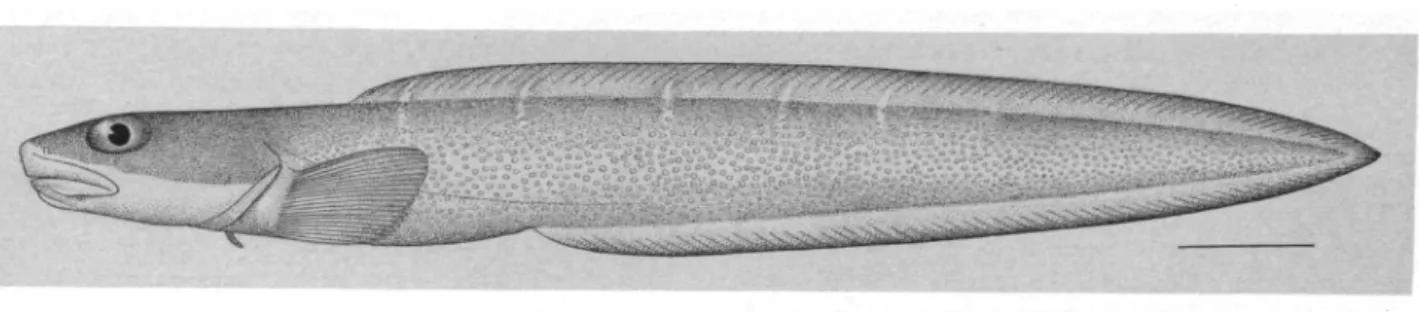
FIGURE 1.—Previously unpublished illustration of the lectotype ofLycodes brevipes Bean, drawn by S.F. Denton, 27 April 1889.
segregated in 1953. In keeping with our interpre- tation of the circumstances, we designate the specimen in USNM 45362 lectotype of Lycodes brevipes. We know of no published illustration depicting this specimen; however, there is an unpublished drawing, which is undoubtedly based on this specimen, in the illustration files of the Division of Fishes, USNM. The drawing bears Bureau of Fisheries illustration number 2898 and an identification only of Lycodes.
Information written on the drawing indicates it was drawn by S.F. Denton, 27 April 1889 [completion date?] based on a specimen from Albatross station 2848. The drawing is stated to be natural size and measures 257 mm TL and 251 mm SL. We ascribe the nominal difference in lengths between the drawing and the specimen in USNM 45362 to mechanical error and/or shrink- age. We reproduce the illustration here as Figure 1. The lectotype is slightly longer than the largest paralectotype. Schultz (1967:5) gave vertebral counts for the lectotype and three of the paralecto- types.
Schultz (1967:5) questionably designated a lectotype for Lycodes brevipes when he errone- ously referred to USNM 45362 as the holotype. In our interpretation of the ICZN articles referring to holotypes and lectotypes, particularly Article 73(a)(iii), which states that a holotype can only be designated in the original publication by the original author of a species-group taxon; Article 74(a), which does not exemplify "holotype" as an equivalent expression for "lectotype" or "type";
and Article 74(b), which relates to a very specific case of "holotype" being acceptable as an inference for lectotype designation, Schultz's holotype designation does not constitute lecto- type designation.
[Paralectotypes]
USNM 162712 [16].
Remarks: See the remarks under lectotype.
Maynea brunnea T.H. Bean, 1890:39 [Holotype]
[USNM 53029], 18 inches [ = - 4 5 7 mm], Albatross station 2839, 33°08'[00"]N, 118°40'[00"]W,off San Clemente Island, southern California, 414 fathoms [=~757m], 8 May 1888.
Remarks: The specimen is now almost totally disin- tegrated. Schultz (1967:5) erroneously reported that the holotype is USNM 119446 and a paratype is 119447. He also gave vertebral counts for the specimens in these two lots. Actually, these two catalog numbers are those of the holotype and paratype of Lycodes brunneus Fowler (see next taxon).
Lycodes brunneus Fowler, 1944:73 Type [Holotype]
USNM: 119446, 235 mm, [-225 mm SL], Albatross station 2660, 28°40'[00"]N, 78°46'[00"]W, north of Bahamas, 504 fathoms [= -922 m], 3 May 1886.
Remarks: The caudal fin and possibly the last vertebra is missing. Schultz (1967:5) gave the vertebral counts for the holotype and paratype but erroneously identified them as the types of Maynea brunnea Bean (see above taxon).
Paratype
USNM 119447 (1), same collection data as holotype.
Lycenchelys bullisi Cohen, 1964:113 Holotype
USNM 188232, female, 180 mm TL, 174 mm SL, Oregon station 4038, 28°51'N, 88°41'W, 732-750 m, Gulf of Mexico, off mouth of Mississippi River, 3 Nov 1962, [ace. no. 247715].
Remarks: Schultz (1967:4) provided vertebral counts for the holotype.
Maynea calif or nica Starks and Mann, 1911:16
Remarks: Although Starks and Mann (1911:16) attributed the species name to "Gilbert. (MS.)" and indicated that the holotype was that described by Gilbert, Starks and Mann are the authors of the species according to Article 50(a) of the ICZN. Gilbert (1915:362) described