Everywhere librarians turn these days, they are encouraged to pay close attention to the needs of the people they serve. The Guidelines are an important contribution of the Cataloging and Classification Section of the Association for Library Collections and Technical Services.
Background
The Committee on the Cataloging of Children's Materials also envisioned that the development of MARC standards and widely used bibliographic tools offered the potential for more widespread dissemination of standardized cataloging if guidelines for standardization could be developed and followed. In response, the committee recommended in 1969 that LC's practices for cataloging children's materials be adopted as a national standard.
Scope
Dewey Abbreviated Decimal Classification and Relative Index (14th edition or newer), or Library of Congress Classification Schedules. These guidelines are based on Library of Congress practices for cataloging children's material and note or expand certain rules and options in AACR2.
Guidelines for Description and Access
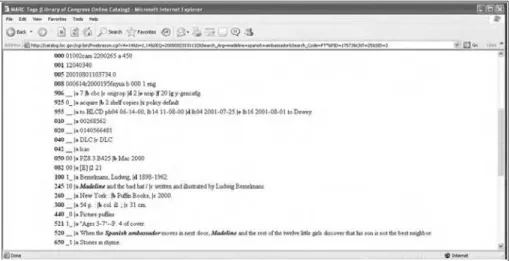
LC maintains an electronic file of the authorized form of each name in its bibliographic records. If the authorized form of the series appears in the item, it is recorded in field 440 of the MARC record, for example,.
Local Implementation
I became a children's librarian to work with children - I'm not a cataloger and I don't want to be. Anyone faced with implementing or overseeing the cataloging of children's materials is in the same boat as you.
Cataloging Strategies
They probably go to the library or other catalogs online and now they want my catalog to work the same way. Creating short entries for my records doesn't seem to work well in the federal catalog - apparently my records don't "match well" with those from other libraries.
Cataloging Rules
It is closely based on another set of cataloging rules called the International Standard Bibliographic Description (ISBD), but it is not exactly the same.3 The second part of AACR2 tells us how to add search terms to descriptions. Remember that if everyone follows the same rules for providing the same bibliographic information when describing the same sources, after one cataloger provides bibliographic information, other catalogers can copy the information instead of having to create it all from scratch.
Copy Cataloging and the Rise of MARC
In a massive undertaking called format integration, which was almost as difficult as coming up with the standards, all the differences between the formats for different materials were eliminated, giving us a unified set of standards for encoding the bibliographic information . for anything we need to catalog. You can purchase the most recent version of the MARC standards in print from LC (MARC 21 Format for Bibliographic Data, or MARC), and you can find a concise version online (MARC 21 Concise Format for Bibliographic Data).
The Cataloging Process
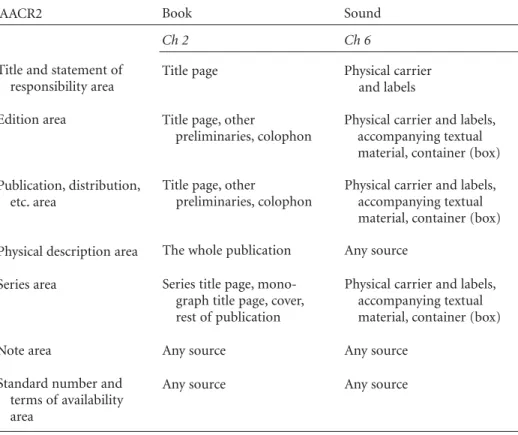
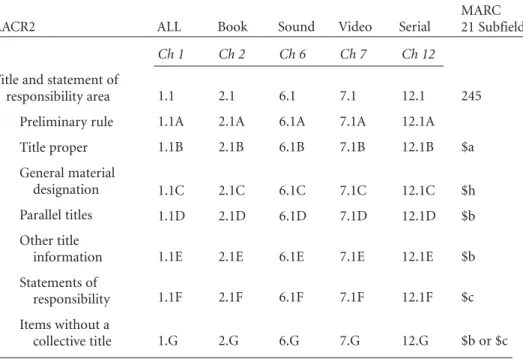
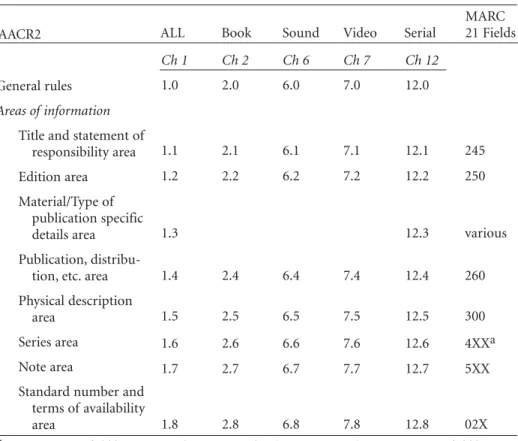
Then MARC says to put the title and statement of responsibility information in a 245 field. Look closely at figure 3-1 and see where MARC says to put each of the eight areas of information.
More about MARC
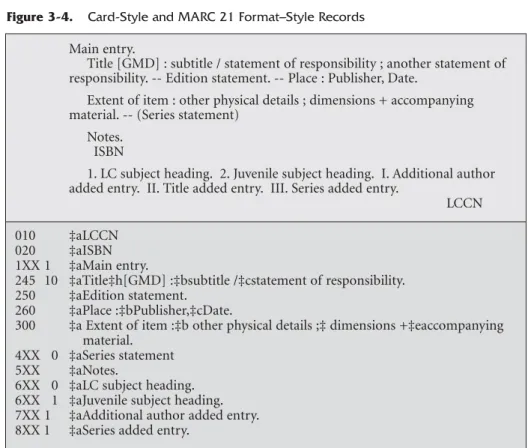
Enter the subtitle in sub-field b, preceded by a colon, and rewrite it exactly as it appears on the title page, just as the AACR said. There you have it - in a nutshell, how to enter a title and statement of responsibility for a book in a MARC 21 bibliographic record.
Sources of MARC Records
This detailed information needs to be entered into MARC records so that your OPAC can show it to your children, that your circulation system can accurately track loans, and that you can share your records and resources with other libraries. You may have to do this and hope for the best if you are doing a retrospective conversion (ie converting a slip catalog to MARC records) or if you are getting fifty thousand records at once for a collection on opening day.
Searching for MARC Records
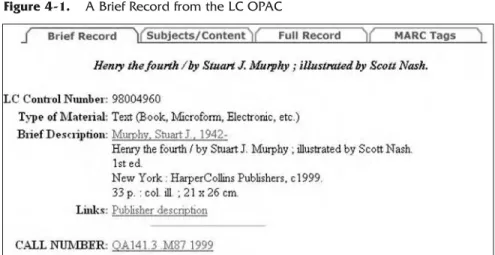
If you search the LC database by LCCN, you only need to display one record. If you search by ISBN, most of the time you will only see one record that matches your book.
Matching MARC Records against Resources
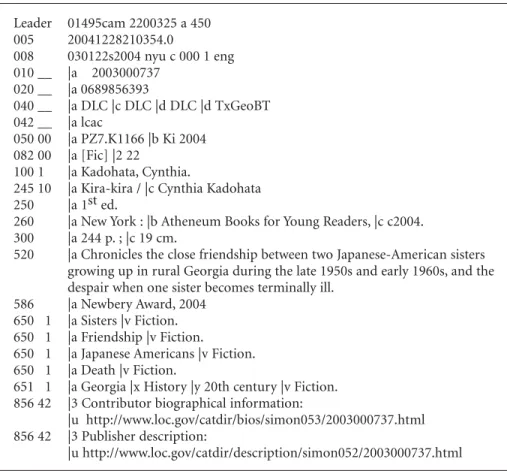
You may or may not remember that you need to remove the wording on the introduction. This means the record is at the full level according to LC's standards: "The most complete MARC level created from information derived from an inspection of the physical item."4.
Editing MARC Records
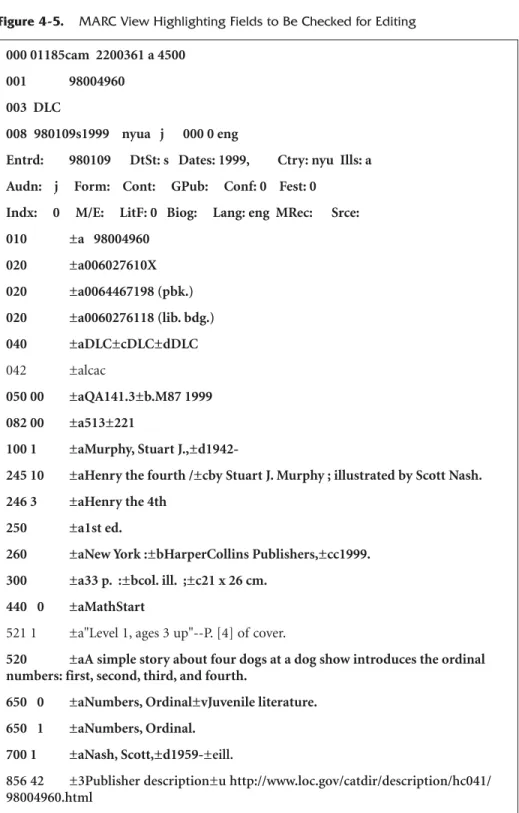
Forgot to check for incorrect indexing or archiving indicators in the title field of the record you copied. Did you forget to check the language code in 008 in the record you copied.
Back to the Beginning
What Is Authority Control?
Catalogers must understand that “we are dealing here with points of access, not with description.”3 In other words, the form of a name that appears on the title page—. Instructions for providing cross-references from one form of a name or title to another are found in Chapter 26.
Why Is Authority Control Important?
Authority control also provides references to the users of the catalogue, so if they e.g. want a book about pigs and enter that keyword into a catalog using the Library of Congress subject headings, the catalog will steer them gently to the word pig. Rules for professional authority work are specific to the thesaurus or subject heading list used.
Authority Control and Children’s Cataloging
Decisions in Authority Control
For many, if not most, libraries, budget constraints dictate the answers to their authority control questions. Most libraries do very little of their cataloging from scratch; rather, they purchase existing cataloging records through bibliographic utilities or other sources and spend their cataloging money on local adjustments to the records.
Creating the Authority File
Clack describes in detail the processes required to create authority records and cross-references from scratch; however, for all but the largest libraries such work is prohibitive. Many libraries load only those authority records that include cross-references or scope notes, or both, that will be displayed and that patrons can use directly.
Maintaining the Authority File and Bibliographic Records
A librarian may ask the authority control vendor to maintain a copy of the library authority and bibliographic records. Then, whenever one of the titles changes, the vendor sends the library a new copy of the record or any relevant authority record or both.
A Word about Filing
Since 1980, there have been two methods of alphabetization, embodied in two different tools: the ALA Documentation Rules and the Library of Congress Manuscript Rules. 9Both tools share some basic principles. The Library of Congress follows its own rules for its subject headings, both for adult materials and for Annotated Card titles.
Conclusion
Each year, several of the superseded terms replaced less commonly used and obsolete terms in the main list of subject headings. Each heading in the Sears list is also assigned one or more numbers from the abbreviated edition of the Dewey Decimal Classification (DDC).
The Dewey Family: History and Background
Undoubtedly, however, many of the Dewey numbers in American libraries were originally assigned to the Library of Congress. The link between DDC and LC provides a convenient editorial environment for the development of successive editions of the classification.
Editing the Classification
The editors also consult with groups outside of ALA, such as the Special Libraries Association. The EPC is emblematic of the international reach of the Dewey family—the UK representative keeps the editors in close contact with CILIP's Dewey Decimal Classification Committee, a group that reviews each draft plan that the editors send to the EPC.
The Products
The approval consists of a recommendation that the revised timetable be published in the next edition. Sometimes the reviews are not positive and the proposed revision has to go back for more work, often being reworked in the process.
Classifying Library Material
Other libraries may use field 092 or field 082 with the second indicator set to 4. Only the second indicator tells whether the Dewey number was checked (value 0) or simply copied without checking (value 4).
Descriptive Cataloging
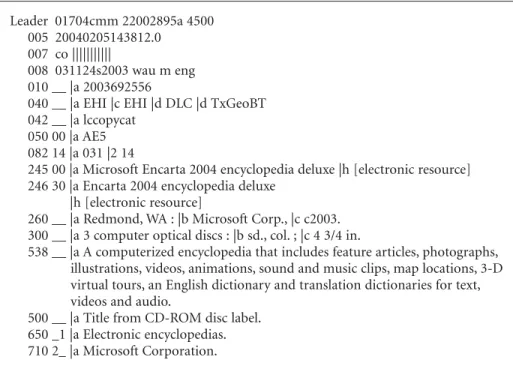
Contains images of Beethoven and his living quarters, pianos, scores and related documents from the Bonn archives. When the bibliographic description is complete, descriptive headings are created for authors, composers, performers, performers, and others responsible for creating a non-book entry; the title and title variations found in or on the item and listed in the catalog record; and all series to which the title belongs.
Subject Analysis
These are assigned using the AACR2 Part 2 rules exactly as it is done for books. Libraries have four options regarding the disposal of book and non-book materials: (1) include everything in one classification sequence; (2) separate the materials by physical format, but follow the same classification sequence for each (this requires a collection prefix before or above the classification numbers or letters); (3) separate books from non-book materials, but combine all non-book formats and follow the order of classification in both areas; and (4) integrate some non-book formats with books and treat other formats separately or in various combinations, following the sorting sequence in each area.3 A key characteristic of shelving is to take advantage of the sorting sequence for shelving, whether or not how the parts of each individual collection are arranged.
MARC Coding
White's Charlotte's Webmight gets a theme about spiders, as well as one that shows it's an animated film and another that's a video recording. The greater complexity of some non-book formats is reflected in additional data encoded in some control fields (MARC tags 006, 007, and 008) as well as in the eye-readable parts of the catalog record.
Other Considerations
Fritz, Deborah A. Cataloging with AACR2 and MARC 21: For Books, Electronic Resources, Sound Recordings, Video Recordings, and Serials. Schultz, Lois, and Sarah Shaw, eds. Cataloging Sheet Music: Guidelines for Use with AACR2 and the MARC Format.
Why Do Publishers Participate?
Publishers send the galleries or frontispieces of their upcoming books to the Library of Congress so that pre-publication catalog data can be printed in the book. In addition to the CIP data that appears in the book, a machine-readable version of the record is created.
Cataloging Benefits
These MARC CIP records are distributed to subscribers of the MARC files through the Cataloging Distribution Service (CDS) of the Library of Congress. When a cataloger creates a MARC record or catalog card set from the CIP data printed in the book, the parenthetical subject headings and Dewey options, such as B, E, or Fic, are normally used in place of the enclosed bracketed headings and classes. - sification.
Service Benefits
The study of children's literature as a serious, scientific discipline has long cast its net over researchers. This chapter examines current practices in cataloging children's materials in academic libraries and provides a report on their use compiled in a recent survey.
General Observations
Although children use academic libraries and their childhood collections, it is the college student and his or her mentor, the academic, who are most likely to use the youth collections in academic settings for research purposes. In the 1970s, teachers and academics began to emphasize the value and interpretation of children's literature, with a particular focus on literary analysis.1 Since then, the study of children's literature has become a legitimate pursuit, and the scholarship associated with it has both fascinated and engaged many academic institutions and their libraries.
Kupitz and Vickie Frierson-Adams
Computerized Catalog Records
Current Practices: A Report
Only two of the sixty libraries reported that their juvenile collection is classified using both the LCC and Dewey Decimal (DDC) classifications. Seventy percent of institutions surveyed said they use the same classification system for juvenile collection as that used for general collection.
Obtaining the MARC Database
Subscribe to an online service and access millions of MARC records over the Internet, or purchase a CD-ROM product that you can search to find records that match the titles in your collection. With Z39.50, you can search different databases from other libraries that don't necessarily use the same software as you do, and download matching MARC records into your database.
Additional Tasks
Ongoing Concerns
Some vendors produce MARC records on CD-ROM (such as Alliance Plus and Its.MARC). Know how your MARC record providers and automation system handle these changes.
Call Numbers
Subject Headings
Reading Programs
Physical Processing
The cataloging record, whether on cards or in a computer file, should be reviewed for completeness, accuracy, and the library's specific collection and call number requests. The vendor must also be periodically evaluated for adherence to bibliographic standards and implementation of changes in standard cataloging practice, call numbers, or subject headings.
Directory of Vendors
S. and Canadian Wholesalers and Prebinders Offering Cataloging Services
Subject headings for children: A list of subject headings used by Library of Congress with Dewey numbers added. Annotated Map Program: AC Subject Headings.” In Library of Congress Subject Headings, 27th ed., xix–xxxvi.
![Figure 1-4. Example of an Annotated Catalog Card for a Nonbook Item 031 Microsoft Encarta 2004 encyclopedia deluxe [electronic resource]](https://thumb-ap.123doks.com/thumbv2/123dok/10210095.0/18.648.69.585.104.375/example-annotated-catalog-nonbook-microsoft-encarta-encyclopedia-electronic.webp)