Finally, I thank all the faculty, fellow students, family and friends who supported me during the completion of this project. ANNA KATHRYN HAILEY: New catalysts for the photocatalytic reduction of carbon dioxide to C1 organic compounds. Photocatalytic reduction of carbon dioxide (CO2) has recently been identified as one of the five notable research areas in catalysis because it simultaneously reduces carbon emissions while storing clean, "green" solar energy in organic compounds.
Carbon doping (C-doping) has been shown to reduce the intensity of energy required, allowing the photocatalyst to take advantage of the visible light spectrum. Reported here is a comparison of the CO2 reduction efficiency by the following photocatalysts: commercial TiO2, commercial TiO2-Cu, C-doped TiO2, C-doped TiO2-Cu, undoped TiO2 and undoped TiO2-Cu.
INTRODUCTION
- Impact of Energy and the Environment on National Security
- Emerging Technological Solutions
- Semiconductor Photocatalysis
- TiO 2 -photocatalyzed Reduction of CO 2 in Aqueous Solution
In addition, using renewable energy avoids the net production of CO2 emissions to the atmosphere, thus reducing a country's impact on the environment and global climate change. A new carbon capture technique that utilizes alternative energy to reduce CO2 emissions is the photocatalytic reduction of CO2. As shown in Figure 1, UV radiation constitutes only 3% of the total solar radiation, so measured in terms of energy input, the efficiency of the photocatalytic reduction of CO2 using solar radiation is low.
In 1992, Hirano et al (15) demonstrated the photocatalytic reduction of CO2 in aqueous solution by UV irradiation, with TiO2 and Cu powder acting as co-catalysts for the reaction. In 1994, Ohta et al (16) demonstrated the photocatalytic conversion of aqueous solutions of CO2 irradiated by sunlight and catalyzed by silicate rocks, producing H2 and CH4.

OVERVIEW OF THE EXPERIMENT
- C-doped TiO 2 vs. undoped TiO 2
- TiOSO 4 -based TiO 2 vs. commercial TiO 2
- Effect of Cu as a co-catalyst
- Experimental Parameters
Although high purity TiO2 is readily available, it is commercially produced via sol-gel synthesis. If an effective TiO2 photocatalyst can be synthesized based on a low energy impact method, the cost and energy savings could be significant. Thus, the results of TiO2 synthesized according to the environmentally friendly method developed by Dong et al (12) will be compared with those of commercial TiO2.
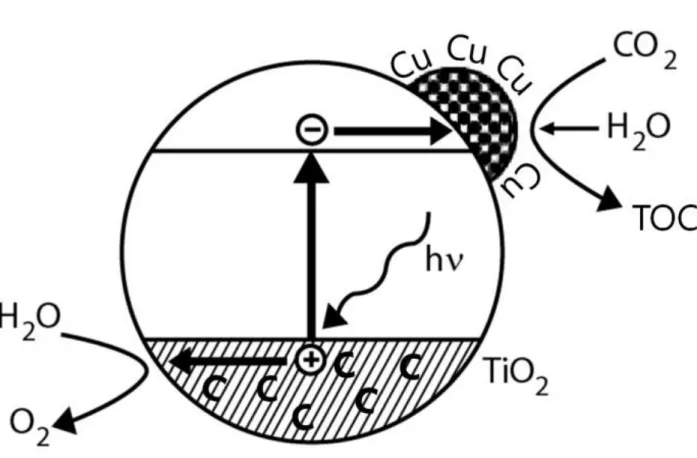
Titanium sulfate in the form of TiOSO4 is here replaced by Ti(SO4)2, because Ti(SO4)2 is not readily available. Previous studies have shown that mixing Cu power into TiO2 suspensions promotes the photocatalytic reaction of CO2 into C1 organic compounds. Hirano et al. (15) suggested that this effect is due to the rapid transfer of an excited electron to the Cu particles, thereby increasing the exciton longevity.
Thus, Cu would promote the reaction by separating the reduction and oxidation sites and increasing the time available for molecular interaction at these electron–electron sites. TiO2 samples with added Cu powder acting as a co-catalyst are expected to have an enhanced level of photocatalytic efficiency similar to that observed by Hirano et al. CO2 reduction efficiency was determined by the amount of total organic carbon (TOC) produced.
Minor variations on the method of Hirano et al (15) include the scale of the photocatalytic cell and the power of the light source.
MATERIALS AND METHODS
Synthesis of Doped and Undoped TiO 2
二氧化碳是一种导致全球变暖的温室气体。而且溶液可以回收利用,吸收更多的二氧化碳。在密西西比大学,我们研究了碳离子掺杂的二氧化钛。
首先讨论一下二氧化碳吸收技术的现状和问题 研究人员希望利用化学吸收剂来减少二氧化碳的排放 在相同浓度条件下,DEA和TEA吸收二氧化碳。
DEA的二氧化碳吸收能力略优于TEA。 DEA和TEA的二氧化碳吸收效果优于MDEA。我的第二个研究课题是二氧化钛,一种二氧化碳的光催化剂。
科学家们正在研究各种方法来提高二氧化钛的光催化性能。在二氧化钛中掺杂金属离子有很多优点。但他们认为,最理想的掺杂二氧化钛的非金属元素是氮。

Photocatalytic Reaction Procedure
Analysis Procedure
The milky aqueous products are centrifuged (Fisher Scientific Micro Centrifuge Model 235C) and then filtered to obtain a clear aqueous solution. To determine the specific identities of the organic compounds produced, the aqueous samples were further analyzed at the University of Mississippi. This analysis included the experimental samples as well as a standard solution of CH2O (which contains both H2O and CH3OH to stabilize the solution).
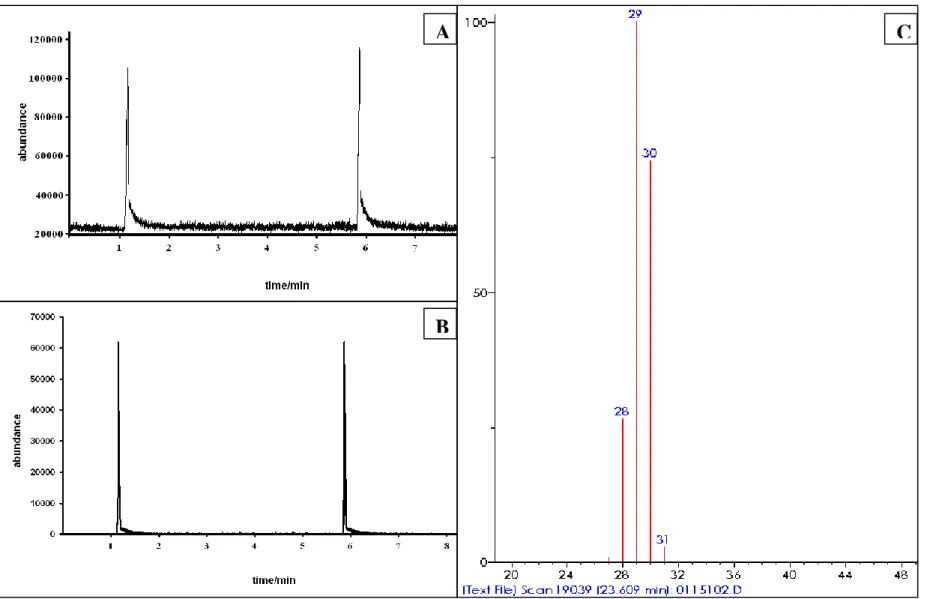
According to the MS results, there was no significant amount of HCOOH and CH3OH in the experimental products (evidenced by the absence of peaks at their characteristic positive ion mass signatures of 45 and 31, due to HCOO+ and CH3O+, respectively). has focused on CH2O, the main product (almost 40% of the TOC produced). However, mass 29 in the spectrum of the CH2O standard is contributed by CH2O, CH3OCH2OCH3 and HOCH2OCH3, the latter. The calibration value of CH2O is therefore underestimated if mass 29 of the standard is used as the characteristic mass.
The maximum possible error (occurs if all CH3OH is completely converted to HOCH2OCH2 and does not contribute to mass 29) would give a 30% underestimated CH2O calibration value or a 30% overestimated CH2O yield in the experimental results. Thus, reported yields of CH2O from experimentation are estimated from the amount present in the standard solution based on an adjusted calibration value. This figure shows the total ion chromatogram (2 consecutive injections) (A), the 29 mass chromatogram (2 consecutive injections) (B), and the MS spectrum (C).
RESULTS
C-doped TiO 2 vs. undoped TiO 2
TiOSO 4 -based TiO 2 vs. commercial TiO 2
The TiOSO4 used in these experiments was of low quality (65% purity); if higher purity TiOSO4 were used, it is likely that TOC and CH2O production from the TiOSO4-based catalysts would be even greater. Whether or not the TiOSO4-based catalysts achieve the effectiveness of the commercial catalysts, the advantage of using TiOSO4-based TiO2 is that the synthesis process is a low temperature method and therefore a low energy impact, both relatively cheap and environmentally friendly.
Another possible factor is that the Cu powder may prevent light from reaching the TiO2, thereby reducing Cu's positive effect on the photocatalytic efficiency. Both in the Hirano et al (15) study and the experiment presented here, the Cu particles are separate from the TiO2. It is possible that the actual doping of the Cu into the TiO2 will produce a stronger positive effect on photocatalysis than simply mixing the Cu and TiO2 particles together.
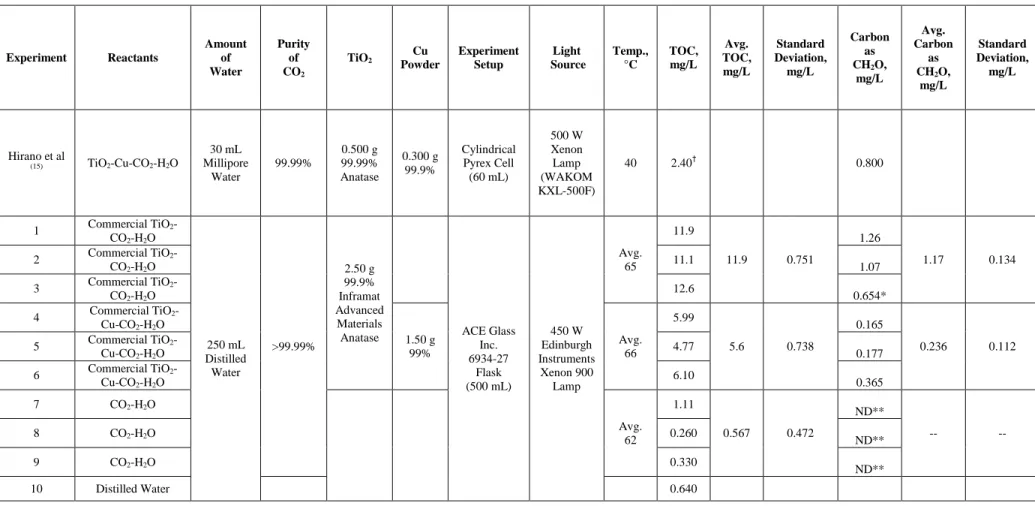
Experimental data obtained at the University of Mississippi, with the results of Hirano et al (15) as reference. 0.0516 Notes: All experiments, including those of Hirano et al (15), were performed with a reaction time of 9 hours. TOC from Hirano et al (15) was calculated from peak product formations of aqueous organic compounds including methanol, formaldehyde, and formic acid.
CONCLUSION
近年来,二氧化碳排放量不断增加。他们研究可以吸收烟气中二氧化碳的解决方案。最常用的二氧化碳吸收剂是乙醇胺(MEA)。除了光之外,二氧化碳也会发生光催化反应,需要催化剂来促进反应。
由于二氧化钛是该反应最常用的催化剂,因此希望通过掺杂来提高二氧化钛的光催化性能。掺杂是指在二氧化钛的晶格结构中添加少量的其他物质。本文的实验是为了测试添加剂的添加最终对MEA溶液中二氧化碳的吸收速率和再生速率。
第一类实验的结果是,PZ添加量越大,溶液吸收二氧化碳的速度越快,吸收电荷也越大,这是因为PZ与二氧化碳的反应不如PZ与二氧化碳之间的反应稳定。 MEA和二氧化碳使用AMP 结果几乎相同:AMP添加量越大,溶液吸收二氧化碳越快,吸收负荷越大。
吸附能力大于MDEA,且吸收剂浓度越大,对二氧化碳的吸附能力差异越大,虽然有科学家成功利用碳来提高二氧化钛的光催化活性,但研究表明一些共掺杂双金属二氧化钛比单一金属掺杂更有效。
科学家发现,双非金属以及非金属和金属的共掺杂可以提高二氧化钛光催化反应的效率,研究人员首先分析了不同阴离子及其掺杂量对二氧化钛薄膜光催化活性的影响。