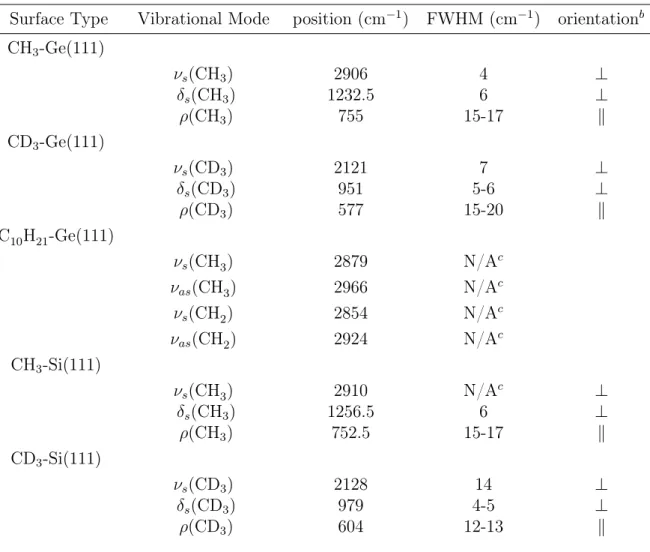
The orientation of the vibrational modes with respect to the plane of the surface can be measured by controlling the angle of IR incidence on the wafer. At Brewster's angle, the path of the reflected ray is parallel to the electric field of the transmitted p-polarized light. The electric field vector of the transmitted light is at an angle to the wafer surface, with components both perpendicular and parallel to the surface.
Vibrational modes perpendicular to the surface can absorb energy from the component of the p-polarized light in the same orientation, and surface-parallel vibrational modes likewise absorb the parallel component, so that all modes are visible in the collected absorption spectrum. If the angle of incidence is changed to be closer to normal incidence, the component of the transmitted p-polarized light that can be absorbed by the vibrational mode perpendicular to the surface is reduced. In contrast to the ATR technique, external reflectance measurements involve the light reflected from the surface of the higher refractive index material.
The overlap of the electric field vector of incident p-polarized light with the transition dipole moment vector of vibrations both parallel and perpendicular to the surface in the XY plane leads to two absorption components, Ax and Az, respectively. The low throughput of the setup required collecting 5,000 scans for a single beam spectrum. Further confirmation of the sensitivity of the absorption bands to the orientation of the electric field of the incident radiation can be seen in the external reflection spectra of Figure 5.5, collected at θ = 67◦ outside the normal angle of incidence.
The signs of the CH3 absorption bands indicate that for both CH3-Si(111) and CH3-Ge(111) the methyl groups are oriented perpendicular to the surface.
Etched Surfaces
This is demonstrated in Figure 5.10, which shows spectra of two 6.0 M HF(aq) etched surfaces, the upper one of which had just previously been treated with the H2O2-based etch and shows no meaningful absorption bands. The lower spectrum shows a clear peak at 2040 cm−1, attributable to the ν(Ge-H) stretch.17–19 When the HF concentration is increased to 12.0 M, the Ge-H stretch becomes observed for both treated and non-treated surfaces. treated with Superoxol etching. In addition to the absorption in the stretching mode, there is another absorption at 560 cm−1, shown in Figure 5.11, which is more noticeable in the sample treated with Superoxol etching, but may also be present in the sample with HF only. .
The peak at 560 cm−1 is less stable than ν(Ge-H), and is completely gone within ten minutes. If the peak at 560 cm−1 is initially present on the surface treated with the anisotropic etchant and then 6.0 M HF(aq) but is simply too air-sensitive to measure, a hydrocarbon film may help protect it from moisture to to extend the lifespan. Both spectra are from the same sample, but the background for the upper spectrum is the sample after it had been allowed to sit undisturbed in the spectrometer for 50 min.
The background of the lower spectrum is a sample after sonication in a detergent to restore a purely hydrophilic surface. Surfaces treated with HCl(aq) or HBr(aq) did not show any absorption bands within the available spectral window, except for random hydrocarbon C-H stretching modes near 3000 cm-1, which varied in intensity between samples. The XP spectra confirmed the presence of halogen on the surface, but the vibrational modes were too low energy for the instruments used.
Ge(111) surfaces that had been treated with HCl(aq) or HBr(aq) showed no infrared absorption bands within the available spectral window, except for accidental hydrocarbon CH stretching modes near 3000 cm−1, which varied in intensity between the samples. XP spectra of surfaces etched with 6.0 M HCl(aq) and exposed to Br2 showed evidence of both Cl and Br, but the Cl peaks were not intense enough to be quantified.
Decyl-Terminated Surfaces
Discussion
Methyl-Terminated Ge(111) Surfaces
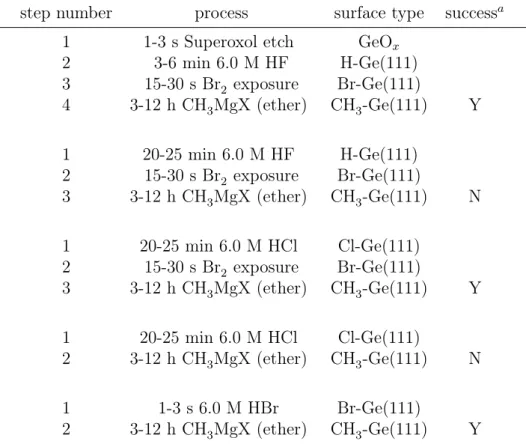
The lack of clear IR absorption peak for CH3-Ge(111) prepared by chloride surface methylation was not expected. While it is possible that the hydrogen-terminated surface is not ideal for alkylation, the chlorine-terminated surface is expected to be a good surface for the reaction because it is believed to be well ordered and has been shown to react with Grignard reagents. .16,25-28 Although the chloride surface produced by etching was not found to be a good precursor surface for methylation itself, it was found to be suitable if subsequently exposed to Br2, as seen in Figures 5.6 and 5.7 . It can also be seen in Figure 5.6 that etched HBr surfaces can be directly methylated to form well-ordered surfaces.
Samples etched with HBr and HCl were both subjected to almost identical handling conditions, so any contamination or moisture artifact independent of the nature of the halogen surface should affect both surfaces. This indicates that it is possible to directly methylate a surface originating from an aqueous environment, and that the Br2 vapor and Schlenk vacuum are not strictly necessary. Surfaces etched only with HF before exposure to Br2 did not produce IR spectra with identifiable methyl modes, so there is no evidence that the short exposure to Br2 etched the Ge to produce a well-ordered surface.
The IR results could be explained if the Cl-Ge(111) surface reacted less preferentially with the methylmagnesium reagent than any impurities than Br-Ge(111), because it cannot be determined from XPS whether the entire C 1s component at 284.3 B. To say whether the Ge-Br bond itself is necessary, it would be necessary to chlorinate the etched surfaces with Cl2 gas.
Etched Surfaces
The presence of the 560 cm−1 band in the spectrum comparing the sample to itself after 50 minutes (the upper spectrum of Figure 5.12) indicates that the decay of the chemical species responsible for that band absorption was slowed. The addition of hydrocarbons to the HF etchant was investigated because the NH4Cl-HF mixed etching covered the sample with an organic contaminant film, while subsequent bromination and methylation steps produced the high-quality methyl-terminated surface, as seen in Figure 5.8, indicating that organic contaminants did not necessarily interfere with the etching process. This is most likely due to roughening of the surface, which would negate the effects of the anisotropic etching.
The total time required for the pretreated sample to become hydrophobic in 12.0 M HF(aq) was approx. 30 s, but the apparent transition from hydrophilic to hydrophobic was less than 5 s, making it difficult to manually optimize the etching time. Apart from these doubts, both the presence of a peak at 560 cm−1 for the etched surface and the presence of distinct absorption bands on the methylated surface are associated with the use of the anisotropic etching. Prolonged exposure to HF etchant can lead to atomic surface roughening, so HF-only methods of etching can produce surfaces too rough to allow well-ordered methyl monolayers.6,18.
Decyl-Terminated Ge(111) Surfaces
Conclusion
The methyl umbrella state and the methyl rock state are similar to what is observed with CH3-Si(111), but at lower frequency. The umbrella mode absorption peaks are dependent on the orientation of the wafer with respect to the incident infrared beam, indicating that the vibrational mode is normal to the surface. In contrast to what was observed with the CH3-Ge(111) case, C10H21-Ge(111) surfaces prepared with or without the anisotropic etch prior to 6.0 M HF etching gave nearly identical IR spectra.
The packing density and degree of order in a hydrocarbon monolayer is not as sensitive to the initial quality of the surface as the more confined methyl monolayer.