Stability Characterization of Carotenoid from Ambon Banana Peel: It’s Potency as vitamin A Supplement
Suparmi1*), Harka Prasetya 1,2), Martanto Martosupono3) and Lasmono Tri Sunaryanto4)
1) Medical Faculty; Sultan Agung Islamic University, Semarang, Indonesia
2) Semarang Eye Center Sultan Agung Islamic Hospital, Semarang, Indonesia
3)Master Program of Biology Satya Wacana Christian University, Salatiga, Indonesia
4)Agricultural Faculty Satya Wacana Christian University, Salatiga, Indonesia
*)Corresponding author: [email protected]
Abstract
Exploration efforts of β-carotene pigment from Ambon banana (Musa paradisiaca) peel as a natural source of vitamin A, became one of the alternative solutions to overcome the problems of vitamin A capsules supplying in Indonesia. However, the use of this pigments in vitamin A supplement products may face some problems due to its stability during storage. The characterization of β-carotene on temperature, pH, light, and oxidator-reductor was investigated to determine its stability.The spectra absorption was analyzed by UV-Vis spectroscopy. The stability of carotenoid crude extract from Ambon banana peel compared with β - carotene marker E – Merck. Crude extract and β - carotene was more stable at low temperature (4 °C ) to room temperature (27 °C). Crude extract relatively more stable at high temperature (50 °C) compared with β - carotene. Crude extract β - carotene was more stable in dark storage conditions . Polychromatic light irradiation for 3 hours per half hour had caused degradation of 2.4 % and 1.9 %; for the crude extract and β - carotene respectively. Crude extract was more stable at pH 6 (neutral). The oxidizing and reducing agents did not significantly influence the stability of the pigment. β-carotene from yellow ambon banana peel was stable on temperature, pH, light, and oxidator-reductor. It is potential as vitamin A supplement.
Keywords : ambon banana peel, β-carotene, light, pH, oxidator, reductor, stability temperature
INTRODUCTION
Beta-carotene (C40H56) is one of the major carotenoids present in the diet (Johnson, 2002). It is found in a variety of orange, yellow, and green fruits and vegetables (Holden et al., 1999). Beta-carotene, along with alpha-carotene and betacryptoxanthin, are sources of provitamin A. Once converted to vitamin A, health benefits derived from these compounds include maintenance of normal eye health, epithelial function, embryonic development, and immune system function (NAS, 2001). Suparmi & Prasetya (2011) reported that the peel ambon banana (Musa paradisiaca) was contain carotenoid total content of of 6.203 ± 0.004 mg/ g and carotenoids of vitamin A conversion was 124.06 ± 0.08 IU. Zeaxantin, xantofil, and β - carotene found in carotenoid crude extract. Antioxidant activity of the carotenoids crude extract was higher than pure β - carotene with IC50 2350.3 ppm. However, the stability of carotenoid from ambon banana peel have not characterized yet.
Exploration efforts of β-carotene pigment from Ambon banana (Musa paradisiaca) peel as a natural source of vitamin A, became one of the alternative solutions to overcome the problems of vitamin A capsules supplying in Indonesia. However, the same properties that make carotenoids useful in healthy tissue function, create challenges in preventing the degradation of carotenoids in drug products. In order to produce stable carotenoid delivery
systems for functional foods, ingredient developers must carefully consider the pathways that may lead to carotenoid degradation. By understanding these pathways, the predominant proxidants in the delivery system and the final product can be identified and, in some cases, the delivery system can be modified to provide greater protection to the carotenoids (Boon et al., 2010).
The main problem in the use of pigments in drug products is to maintain the stability of the color pigments during processing and storage of drugs (Kiattisak. 2004). Scotter et al.
(1994) reported that carotenoids are susceptible to oxidative degradation. Factors that affect the pigment stability are temperature, oxygen, pH, light, solvents, ascorbic acid, metal ions, and the presence of sulfur dioxide (Scotter et al. 1994; Scotter et al. 1998; Montenegro et al., 2004; Bittencourt et al . 2005; Silva et al. 2005; Laleh et al. 2006). The use of β - carotene in drug requires a detailed knowledge of the stability of the pigment to possible degradation processes, in order to optimize industrial production, packing and storage of the vitamin A drop. In the present study, the stability toward heat, light, pH, and oxidator-reductor of crude extract and β - carotene have been studied.
MATERIAL AND METHODS
Isolation and Purification of β - carotene from Banana Peel
Isolation of β-carotene from banana peel conducted in Carotenoids and Antioxidant Research Center (CARC) Master of Biology Satya Wacana Christian University, Salatiga.
Carotenoid crude extract was prepared from ambon banana peel by extraction with acetone as described by Britton et al. (1995). At the extraction, added CaCO3 as a neutralizing agent and ascorbic acid as an antioxidant to prevent oxidation. The extraction was done in a dark room at a temperature of -15 ºC to prevent oxidation or enzymatic degradation. Furthermore, the extract was filtered by filter paper, the residue obtained was extracted again with the same solvent until all the pigment taken up (banana peel becomes colorless). The extract partitioned with hexane, and then filtered with the multilevel filter paper 42 in a cold state.
Subsequently, the extract added into anhydrous Na2SO4 to remove water content in the extract. The filtrate obtained was evaporated to dryness at 65°C, then exposed to a stream of nitrogen gas (N2) until completely dried. Marker pure β - carotene was obstained from E – merck.
Preparation of Carotene Solution
Carotene crude extract and pure β - carotene was dissolved in acetone 100%. For determining premier solution (A0), 3.0 ml of a solution transferred to a quartz cuvette with a 1 cm light path. The absorbance of its solutions measured spectrophotometrically at
wavelength 300-800 nm. When the value of absorbance at the absorption maximum 453 nm was 1, it was used throughout the stability investigation.
Termostability
Carotene solutions (20 ml) were stored in tightly sealed glass tubes at 4, 37, and 50 C in the dark for 3 hours. Storing at 4 °C conducted in a refrigerator, whereas the other
temperatures achieved in a water bath. (Rao et al., 2004).
Light Stability
The carotene solution was irradiated with daylight lamp (Philip 15 Watt) for 3 hours, also compared with dark conditions. Every experiment used 50 ml of a solution in a volumetric flash.. For experiments at dark condition, the volumetric flash contain carotene solution was covered by aluminum foil and kept under stirring at 27±2 °C (Suparmi et al., 2007).
pH effect
Carotene stability on pH analyzed at pH 3, 6 and compared with pH 9. Acetone solutions with crude extract and β-carotene buffered with NaOH 1 M and HCl 1 M until desired pH. The final solutions maintained at 27±2 C for 3 hours (Wijaya et al., 2001;
Jespersen et al., 2005).
Effect of oxidator-reductor
The pigment solutions (10 ml) were placed in tightly sealed glass tubes, added by oxidator 1 ml H2O2 30%, and homogenized by vortex. The pigment stability on reductor tested by adding 5 mg ascorbic acid to 10 ml solution and homogenized by vortex (Wijaya et al., 2001).
Data Analysis
Pigment stability characteristics were analyzed spectrophotometrically by Varian Cary 50 UV-Vis spectrophotometer at the λ300-800 nm, the changes in absorbance monitored every 30 minutes. The absorption values of the λmax crude extract and β-carotene solution after stability treatment (A) were used to calculate the rate constants (k) for degradation. The k value determined by linear regression of the ratio of A/A0 versus time (Jespersen et al., 2004).
RESULTS AND DISCUSSION
Termostability
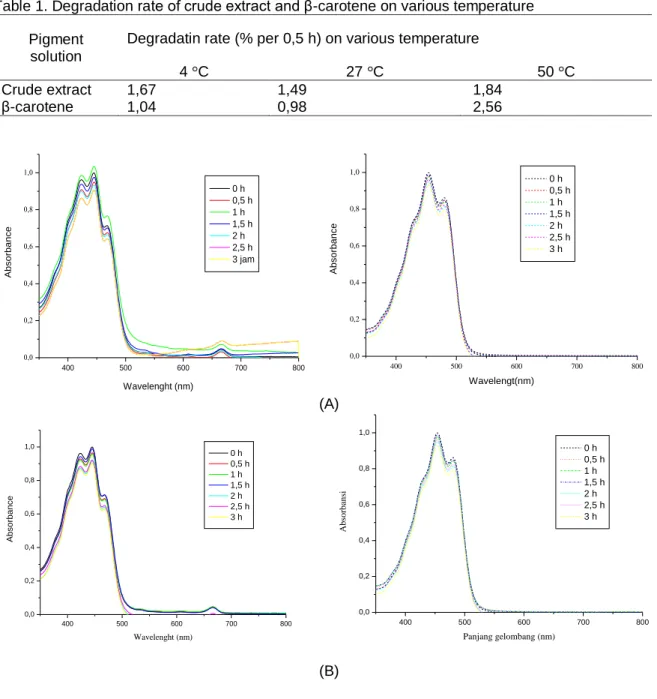
Degradation of crude extract and β-carotene solution absorption in variation of storage temperatures seems almost not significantly different, as shown by Figure 1. The changes of crude extract and β-carotene solution absorption spectra along 3 hours indicating that crude extract and β-carotene solution was relatively stable at temperatures 4, 27 and 50 C (Table 1).
Table 1. Degradation rate of crude extract and β-carotene on various temperature Pigment
solution
Degradatin rate (% per 0,5 h) on various temperature
4 C 27 C 50 C
Crude extract 1,67 1,49 1,84
β-carotene 1,04 0,98 2,56
(A)
(B)
400 500 600 700 800
0,0 0,2 0,4 0,6 0,8 1,0
Absorbance
Wavelenght (nm)
0 h 0,5 h 1 h 1,5 h 2 h 2,5 h 3 jam
400 500 600 700 800
0,0 0,2 0,4 0,6 0,8 1,0
Absorbance
Wavelengt(nm) 0 h 0,5 h 1 h 1,5 h 2 h 2,5 h 3 h
400 500 600 700 800
0,0 0,2 0,4 0,6 0,8 1,0
Absorbance
Wavelenght (nm) 0 h 0,5 h 1 h 1,5 h 2 h 2,5 h 3 h
400 500 600 700 800
0,0 0,2 0,4 0,6 0,8 1,0
Absorbansi
Panjang gelombang (nm) 0 h 0,5 h 1 h 1,5 h 2 h 2,5 h 3 h
(C)
Figure 1. Absorption spectra of ( ) crude extract and β-carotene ( ) in acetone along 3 hours storage at any temperatures: (A) 4 C, (B) 27 C, and (C) 50 C.
Fotostability
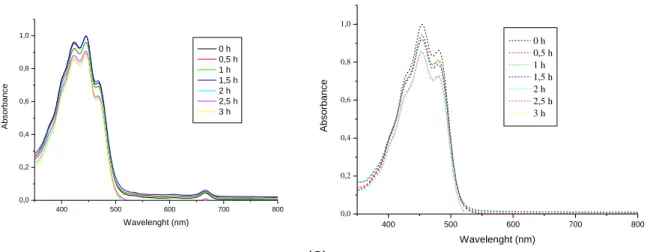
Changes that occur during fotostability process called photodegradation, which is a chemical change of a compound or molecules into smaller molecules due to the absorption of photons, both derived from ultraviolet light, visible light, or infrared light. The results of measurements of the absorption spectra patterns were performed every half hour showed a tendency to decrease (Figure 3).
(a) (b)
Figure 2. Absorption spectra of ( ) crude extract and β-carotene ( ) in acetone along 3 hours storage at polychromatic light 123 lux storage.
This result shows that β-carotene is stable in dark storage. Light is thought to cause oxidation, so that the chemical structure of the pigment was damaged. Changes during photodegradation include changes in composition, color change, break the bond, and rearrangement of the atoms in a molecule (Wiles & Carlsson 1987; Lagowski 1997). The wavelength of light that is received by a molecule is one of the factors that affect the speed of photodegradation (Wiles & Carlsson 1987). Linear regression formula, the percentage of
400 500 600 700 800
0,0 0,2 0,4 0,6 0,8 1,0
Absorbance
Wavelenght (nm) 0 h 0,5 h 1 h 1,5 h 2 h 2,5 h 3 h
400 500 600 700 800
0,0 0,2 0,4 0,6 0,8 1,0
0 h 0,5 h 1 h 1,5 h 2 h 2,5 h 3 h
Absorbance
Wavelenght (nm)
400 500 600 700 800
0,0 0,2 0,4 0,6 0,8 1,0
Absorbance
Wavelenght (nm) 0 h 0,5 h 1 h 1,5 h 2 h 2,5 h 3 h
400 500 600 700 800
0,0 0,2 0,4 0,6 0,8 1,0
Absorbance
Wavelenght (nm) 0 h 0,5 h 1 h 1,5 h 2 h 2,5 h 3 h
the value of determination, and the percentage of degradation rate per a half hour for each pigment can be seen in Table 2.
Table 2. The degradation rates of crude extract and β-carotene along 3 hours storage at polychromatic light 123 lux and dark storage
Pigment
solution Storage Regression equation R2 (%) Degradatin rate (%
per 0,5 h) Crude extract
polychromatic light y = -0,024x + 1,012 86,0 2,4
dark y = -0,016x + 1,024 56,1 1,67
β-carotene polychromatic light y = -0,019x + 1,00 91,5 1,9
dark y = -0,010x +1,00 50 1,04
pH effect
The maximum absorption used to determine the pigment degradation rate caused by pH, and combination between pH and storage technique (Table 3). The condition is
indicating that pH causing the pigment degradation (Limantara, 2006).
Table 3. The degradation rates of crude extract and β-carotene along 3 hours storage at pH 3, 6 and 9 storage.
Pigment solution Degradatin rate (% per 0,5 h) at various pH storage
3 6 9
Crude extract 19.44 5.34 0.02
β-carotene 20.6 2.03 1.66
Oxidator and Reductor Effect
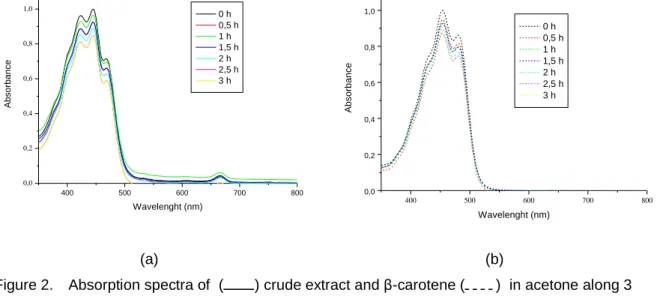
The dgradation rate of crude extract and β-carotene on oxidator addition are 2.9%
and 2.1 % per a half hour, respectively. The oxidator H2O2 30% that added in pigment solution can attack the reactive chain of pigment, causing the break of reactive chain, so cannot display the color (Wijaya, 2001). The effect of oxidator addition to norbixin solution could be seen in Figure 3. The addition just makes lowest degradation rate, because the pigment possess antioxidant potential, so it able to avoid free radical O2- of H2O2 30%.
(a) (b)
Figure 3. Absorption spectra of (a) crude extract and (b) β-carotene in acetone along 3 hours at addition oxidator H2O2 30%
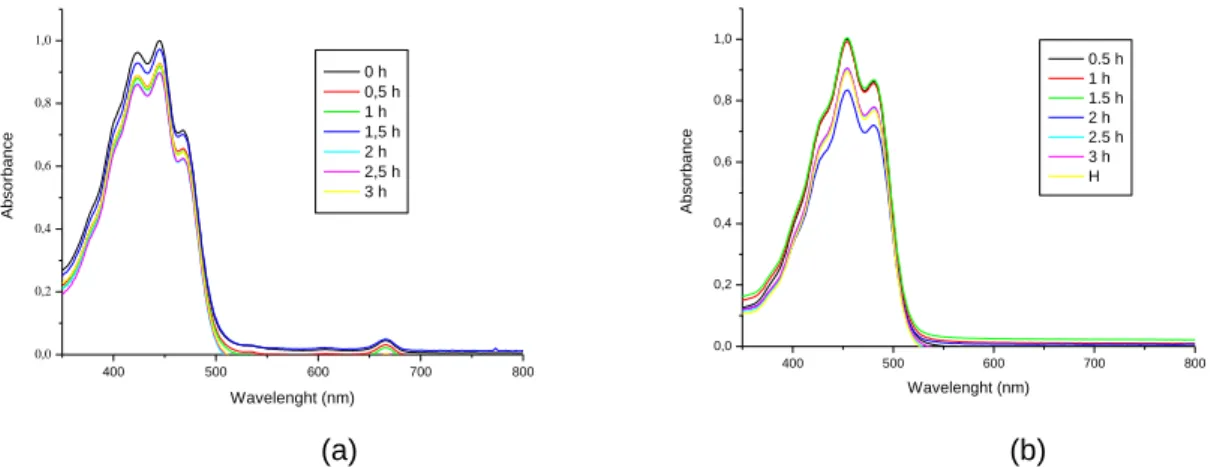
Addition of reductor ascorbic acid to crude extract and β-carotene solution makes its absorption spectra almost constant in time, as shown in Figure 4. The crude extract and β-
400 500 600 700 800
0,0 0,2 0,4 0,6 0,8 1,0
Absorbance
Wavelenght (nm) 0 h 0,5 h 1 h 1,5 h 2 h 2,5 h 3 h
400 500 600 700 800
0,0 0,2 0,4 0,6 0,8 1,0
Absorbance
Wavelenght (nm) 0 h 0,5 h 1 h 1,5 h 2 h 2,5 h 3 h
carotene degradation rate caused reductor (ascorbic acid) addition are 1 and 2.1% per hour.
The addition expected can avoid pigment degradation caused by external oxidative factor such as temperature, pH, and light. Humeau et al. (2000) reported that ascorbic acid added to food functioning as antioxidant for keep the color stability, avoid enzymatic browning, keep the flavor, and protect the oxidation process.
(a) (b)
Figure 5. Absorption spectra of (a) crude extract and (b) β-carotene in acetone along 3 hours at addition ascorbic acid
CONCLUSION
The carotenoid from ambon banana peel was stable at low temperature (4 °C), room temperature (27 °C), dark condition, pH 9, daylight irradiation, and on addition of oxidator (H2O2 30%) and reductor (ascorbic acid). It is potential as vitamin A supplement.
ACKNOWLEDGMENT
The recent study was funded by Hibah Penelitian Kerjasama Antar Perguruan Tinggi (PEKERTI) of The Indonesian Directorate General of Higher Education (DIKTI) with Number of Contract 0300/B.I/SA-LPP/V/2013.
REFERENCES
Baihaki A. & Sudrajat M. 1997. Perancangan dan analisa percobaan. Bandung: Fakultas Pertanian Universitas Padjajaran; hal. 45-7.
Bittencourt, C., M.P. Felicissimo, Jean-Jacques Pireaux, & L. Houssiau. 2005. Study of Annatto from Bixa orellana L. Seeds: an Application of Time-of-flight Secondary Ion Mass Spectrometry. Article Spectroscopy Europe 17 (2): 16-22
www.spectroscopyeurope.com.
Boon, C.S. Boon, D. Julian Mcclements, Jochen Weiss, and Eric A. Decker. 2010. Factors Influencing the Chemical Stability of Carotenoids in Foods. Critical Reviews in Food Science and Nutrition, 50:515–532.
Britton, G., Liaaen-Jensen, S., & Pfander, H. 1995. Carotenoids Volume IA: Isolation and Analysis. Birkhauser Verlag. Basel. Boston. Berlin, 47p.
Gross, J., 1991. Pigment in Vegetables, Chlorophyll and Carotenoids, Van Nostrand Reinhold, New York.
400 500 600 700 800
0,0 0,2 0,4 0,6 0,8 1,0
Absorbance
Wavelenght (nm) 0 h 0,5 h 1 h 1,5 h 2 h 2,5 h 3 h
400 500 600 700 800
0,0 0,2 0,4 0,6 0,8 1,0
Absorbance
Wavelenght (nm) 0.5 h 1 h 1.5 h 2 h 2.5 h 3 h H
Jespersen, L., L.D. SrØmdahl, K. Olsen, & L.H. Skibted. 2005. Heat and Light Stability of Three Natural Blue Colorants for Use In Confectionery and Beverages. Eur Food Res Technol (2005) 220:261–266.
Johnson, E. J. (2002). The role of carotenoids in human health. Nutr Clin Care. 5(2): 56–65.
Kiattisak, D., B. Saiccheua, & S. Sueeprasan. 2004. Roselle Anthocyanins as a Natural Food Colorant and Improvement of Its Colour Stability. AIC 2004 Color and Paints, Interim Meeting of the International Colour Association, Proceedings: 155-158.
Lagowski, J.J. 1997. Macmillan Encyclopedia of Chemistry. New York: Simon & Schuster and Prentice Hall International 3:1198-1201.
Laleh, G.H., H. Frydoonfar, R. Heidary, R. Jemeei, & S. Zare. 2006. The Effeect of Light, Temperature, pH, and Spesies on Stability of Anthocyanin Pigments in Four berberis Species. Pakistan Journal of Nutrition 5(1): 90-92.
Limantara, L., P. Koehler, B. Wilhelm, R.J. Porra, & H. Scheer. 2006. Photostability of Bacteriochlorophyll a and Derivatives: Potential Sensitizer for Photodinamic Tumor Theraphy. Photochemistry and Photobiology 82: 770-780.
Montenegro, M.A, A. De O. Rios, A.Z. Mercadante, M.A. Nazareno, & C.D. Borsarelli. 2004.
Model Studies on the Photosensitized Isomerization of Bixin. Journal of Agricultural and Food Chemistry 2004 (52): 367-373.
Rao, P.G.P., T. Jyothirmayi, K. Balaswamy, A. Satyanarayana, & D.G. Rao. 2004. Effect of Processing Conditions on The Stability of Annatto (Bixa orellana L.) Dye Incoporated Into Some Foods. Lebensm-Wiss. U.-TechnoL I (IIII): 1-6.
Scotter, M.J., S.A. Thorpe, S.L. Reynolds, L.A. Wilson, & Strutt. 1994. Characterizations of The Principal Colouring Components of Annatto Using High Performance Liquid Chromatography with Photodiode-Array Detection. Food Additives and Contaminants 11 (3): 301-315.
Scotter, M.J., L.A. Wilson, G.P. Appleton, & L. Castle. 1998. Analysis of Annatto (Bixa orellana) Food Coloring Formulations. 1. Determination of Colouring Components and Colored Thermal Degradation Products by High Performance Liquid Chromatography with Photodiode-Array Detection. Journal of Agricultural and Food Chemistry 1998 (46):1031-1038.
Silva, M. C. D. J. R. Botelho, M. M. Conceição, B. F. Lira, M.A. Coutinho, A. F. Dias, A. G.
Souza, & P. F. A. Filho. 2005. Thermogravimetric Investigations on the Thermal Degradation of Bixin, Derived from The Seeds of Annatto (Bixa orellana L.). Journal of Thermal Analysis and Calorimetry 79 (2005): 277–281.
Suparmi & Prasetya, H. 2011. Isolation and Identification of Carotenoid Pigments of Yellow Ambon Banana Peel (Musa paradisiaca sapientum L.). Prosiding International Conference on Natural Sciences (ICONS 2011)
Wijaya, L.S., S.B. Widjanarko, & Tri Susanto. 2001. Ekstraksi dan Karakterisasi Pigmen Dari Kulit Buah Rambutan (Nephelium lappaceum) Var. BINJAI. BIOSAIN 1 (2): 42-53.
Wiles, D.M. & Carlsson, D.J. 1987. Mc Graw-Hill Encyclopedia of Science & Technology.
New York: Mc Graw-Hill Book Company 13(6): 337-379.