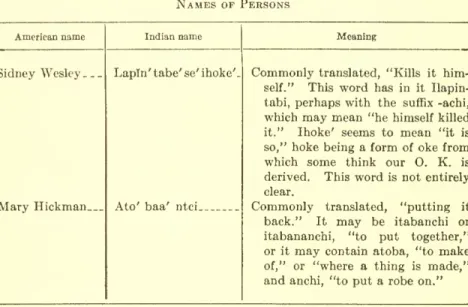
The purpose of the research was to determine whether this feature is present in the songs of other tribes in the south. This purpose was fulfilled by the discovery of this peculiarity in the songs of the Choctaw, who lives near the ChoctawIndianAgency in Philadelphia, Miss. There was no trace of this peculiarity in the songs of Alabama, Texas, and no song remains among the Chitimach of Louisiana. .
NAMES OF SINGERS AND NUMBER OF SONGS TRANSCRIBED, EXCLUSIVE OF DUPLICATES
CHARACTERIZATION OF SINGERS AND PLACES WHERE SONGS WERE RECORDED
He acted as an interpreter throughout the work and recorded a limited number of songs in the agency's office when Lysander Tubby's songs were being recorded.
SPECIAL SIGNS USED IN TRANSCRIPTION OF SONGS
BRIEF LIST OF WORDS USED BY THE CHOCTAW OP MISSISSIPPI These words were noted down as pronounced by the Indians. The corrected
CHOCTAW MUSIC
THE CHOCTAW TRIBE
The exact boimdaries are apart from the present interest, but the article concludes with the statement that "none of His Majesty's subjects shall be permitted to settle on Tombechee River north of the river called Centebonck" (Thomas inRoyce, 1899, p. 559, 560). The first treaty between the United States government and the Choctaw Indians was made at Hopewell, S. Meyer, superintendent of the Choctaw Indian Agency at Philadelphia, Miss., states (correspondence Dec. when the census for that jurisdiction was taken.
MUSICAL INSTRUMENTS
CERTAIN PECULIARITIES OF CHOCTAW SONGS
The melodic structure of Choctaw dance songs is characterized by an unusual number of repeated tones and intervals. Thus the leader of the Choctaw singers had a responsibility beyond the actual direction of the songs. An exception is the copy of the song for success in a ball game (Duplicates of No. 6).
WAR SONGS
Two records of the first song were made, one containing the words ''Hispanimi (Spanish) headmanIamlookingfor," and the other substituting "Folance" (French) for the reference to the Spaniards. The French entered the region in the latter part of the century and the relationship between the Choctaw and the French were friendly until they were broken by English traders.It was said that the first song was sung at the beginning of preparations for war.
BALL GAME
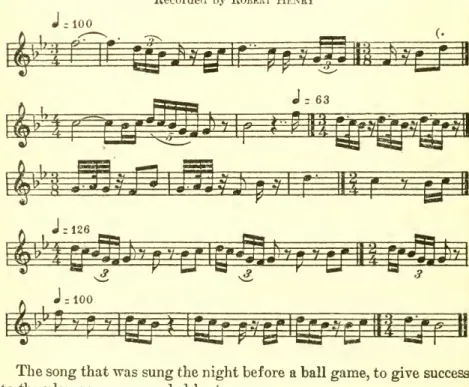
Both recorded a song that is sung the night before the game, and a comparison of the two renditions is presented with an analysis of the song on page 131. 136 Events on the night before the ball game included dancing by both men and women. But shortly after dark a procession of liglit flambeaux was seen coming from every camp. to the floor, where the players gathered individually; and to the beat of the drums and the singing of the women, each group of players began the "ball dance."
BULLET GAME
Each company danced for fifteen minutes around their respective farewell parties, in their play clothes; while they rattled their ball-sticks together in the most violent manner, and all sang as loudly as they could raise their voices; while the women of the tach party, for whom their goods were at stake, formed themselves in two lines on the line between the two parties of players, and also danced, in a uniform step, and sang all their voices together in chants on the Gn^at Spirit. - in which they asked his favor to decide the game in their favor; and also encouraging the players to use whatever power they possessed in the battle that would arise. The manner in which the score is kept is beyond present consideration, but it is possible to make four by a correct guess, the number of chips being handed to the correct gambler by the man who hid the bullet. The words of the next song would mean, “I'll guess so well that I will.
134 BUREAU OF AMEKICAN ETHNOLOGY
If batons are used, the leader is the only man to provide this accompaniment. Wesley said they form in advance with the men and move slowly, the step consists of advancing the left foot, bringing the right foot to a side-by-side position and momentarily standing on both feet before stepping forward again go.
36 BUREAU OF AMERICAN ETHNOLOGY
WIT^
138 BUREAU OF AMERICAN ETTHNOLOGY
140 BUREAU OF AMERICAN ETHNOLOGY
Similar songs, the signature is used for convenience to indicate pitch, not as a key indicator in the musician's use of this term. Gus Willis teamed up with Tubby on this song to show the way. in which the leader is joined by other singers. Analysis.—With the exception of one tone, each of these melodies is in the fifth compass, and its leading tones are those of a major triad.
The next song was explained as follows: "In this song, Gaman says that she danced so much that he lost his wife, but he doesn't mind." Comby is an Indian police officer with the station and was familiar with Choctaw customs in other places.
BUREAU OF AMERICAN ETHNOLOGY
148 BUREAU OF AMERICAN ETHNOLOGY
Analysis. – The most important interval in this song is the major third from G to B, followed by a descent to D in some bars and to E in others. The latter part of this representation differs from Bushnell's description, which describes the custom among the Choctaw in Bayou Lacomb, La. displays. Analysis. These two songs (Nos. 31, 32), recorded by different singers, are practically the same in the first part, but differ in the second part, which was repeated an indefinite number of times during the dancing.
Analysis.-A change of key from major to minor without change of root occurs in this song and is indicated in the transcription. The rhythmic units in the two parts have the same length, but differ in count divisions. The man who recorded the next two songs was a former leader in the Bear dance.
Analysis. — The short rhythmic unit in the first of these poems is extended into the second. The leader of the singing was an old man standing in the middle of the circle. The highest note occurs on the second beat, as with most songs of this form.
This change in pitch level was clearly unintentional and is not shown in the transcript.
BUREAU OF AMEORICAN ETHNOLOGY
166 BUREAU OF AMERICAN ETHNOLOGY
168 BUREAU OF AJVIEKICAN ETHN0LCM3Y
170 BUREAU OF AMEORICAN ETHNOLOGY
In three of its occurrences it is preceded by an unstressed tone and in the first. Analysis.-The descent of an octave in the first and second bars of this song is interesting and unusual. A characteristic of the Quail and Duck Dances (Nos. 29, 30) is a gradual increase in time, possibly related to the movement of the birds.
Analysis.—The main interval in this song is a major third (AC sharp), which is followed in this second bar by a descent to Fsharp, forming an amino triad, and in the fourth bar by a descent to E, which completes a major triad. The step of the Turkey dance consists of a hop with both feet together, iBrst one foot and then the other placed fonvard. This, along with the intricate rhythm of the song, is a testament to the singer's musical ability.
In the Pleasure dance, the men are in one row and the women are in the other, facing them. Analysis.—The opening phrases of this poem contain two descending fourths followed by two ascending fourths. In the fourth and fifth bars, we find three successive ascending fourths with a slight prolongation of the highest note.
The tempo of the drumsticks was not even, sometimes slightly faster than the tempo of the voice.
HUNTING SONG
About half of the intervals are whole tones, and fourths and major thirds are equal. Henry's was a simpler version of the tune, and it must be remembered that his version of the song for success in the ball game was simpler than Willis's (cf. the effect of discarding, to widen and fill the bore of the gun, is a result which could not possibly be secured by the use of feathers, as in the case of common arrows" (Bushnell, 1909, p.18).
Phrases in the latter part of the song were sometimes sung at a slightly faster tempo, but the change was not obvious enough to indicate in the transcription.
SONGS CONNECTED WITH PASTIMES
There was a slight change in tempo, the change was gradual. and the original rhythm resumed after a few measures. Anthbop.Pap.no.28] CHOCTAW MUSIC — DENSMORE. 0^some la-dieschainrab-bit,put-tingluthegar-deUjCatftcomeout. chain, rabbit put-tiuginthegar-den, mundHdal O^somela-dieschaiu. some chain la-dies, rab-bit. tfrt^^j^^Tput-tingInthegar-den,cannotIC^ py-Mcome out. 0 some chain ladies, put-bet-rapi in the garden, can't get out. gar-den,gar-den can't come out I bet youfivedoI-Iars,caiftcomeout. Analysis.—This melody is short, and its repetitions are transcribed because of the interest in the words.
There is a special quality to the rhythm that would allow the song to continue for a long time. the tones are those of the 5-tone fourth scale, the whole melody lying above the principal voice. The dog chases the raccoon, which runs through the spectators, followed by the dog until it escapes. Nonsense syllables interspersed with a few words were sung to the tune, as shown. was spoken after the performance of the song.
A minor third occurs in the fourth measure and a minor third occurs in the measure before the spoken words. Instead, it seems to reflect the state of mind of an observer, as indicated by the words. COMPARISON BETWEEN ANALYSIS OF CHOCTAAW SONGS AND ANALYSIS OF RECORDED SONGS OF OTHER UNCLASSIFIED TRIBES”.
COMPARISON BETWEEN THE ANALYSES OF CHOCTAW SONGS AND THE ANALYSES OF SONGS RECORDED IN CERTAIN OTHER TRIBES "
136 Tahle k. Last note of the song; its relation to the compass of song.– The . the last note is the lowest in 47 percent of Choctaw songs. In the cumulative group 68 percent end, and in the Chippewa songs 88 percent end on the lowest note of the compass. In songs where the final note is immediately preceded by a lower note, the most common approach is via an ascending minor third, 12 percent of the Choctaw and 5 percent in the cumulative group with this approach to the final note.
Measured by this standard, we note that 29 percent of Choctaw songs are in the "major and minor pentatonic scales, and 21 percent lack only one tone to be based on these scales. In Choctaw songs, 57 percent begin with a descending progression. .. the number of intervals in the cumulative series of 1,553 songs shows the trend .. in descending Indian melodies, 60 percent of the progressions are descending, but the percentage of songs that begin with a descending progression, in this cumulative series , is only 41 percent. In the Nootka and Quileute songs only 41 percent begin with a descending progression, while 70 percent of the Chippewa and 71 percent of theirs.
Next are the Pawnee, and Yuman and Yaqui, with 74 percent of the songs in each of these groups containing a tense change. The next percentage is in the Menominee group, with 87 percent having a rhythmic unit. The least rhythmic songs are found among the Nootka and Quileute, only 55 percent of these songs contain a rhythmic unit. The Pawnee group contains 84 percent and certain other groups contain 68, 70, and 76 percent of the songs with rhythmic units. Songs contain only one rhythmic unit, but others have two, three, four or five rhythmic units.
The largest group of intervals consists of 612 whole tones and 430 minor thirds, showing that the overall melodic structure is similar to that of the other stems under analysis.
MELODIC AND RHYTHMIC ANALYSIS OF SONGS BY SERIAL NUMBERS
186 BUREAU OF AMERICAN ETHNOLOGY
BIBLIOGRAPHY
Mary Hickmans House. Where Songs Were hecorded