Cogent Social Sciences <[email protected]>
Fri, Mar 10, 5:36 PM to me
Dear Dr Syahraini Tambak,
Ana Maria Lopez Narbona, Senior Editor for Cogent Social Sciences, would like to invite you to review a manuscript entitled "Religious education reform in developing countries toward global competition through value-based leadership". This involves completing a scorecard and submitting your recommendation, with the entire process conducted via an easy online system.
Please note that all journals in the Cogent Series follow the single blind peer-review process. All agreed reviewers must have expertise in the topic of the manuscript and have no conflict of interest preventing them from providing an unbiased view. For more information about our criteria for publication, expectations of reviewers and our review process please visit the website at https://www.cogentoa.com/reviewers.
If you have reviewed a previous version of this manuscript, please note that you should be primarily assessing the revision based on whether authors have
successfully made the requested amendments, rather than identifying new issues.
Please find the abstract for the manuscript below for your information. The full paper will be available to read on the online system if you accept the invitation.
The leadership position in the structure does not only function to encourage
cooperation between members of the organization. Leaders inspire, exchange, and identify processes and social learning among organizational members through their interactions with subordinates to improve capabilities. The research objective is to analyze the role of authentic leadership (AL) as a source of organizational ability and competitive advantage of Private Madrasah Aliyah (MAS). Uses an explanatory survey approach to MAS teachers as the observation unit. Amount of 478 randomly selected teachers to represent MAS. Data analysis using SEM. The study results show that self-directed leadership encourages interactions between leaders and subordinates to become more natural. The interactions can expand opportunities for partners to learn about things from their leaders as role models. Identification allows teachers to develop their role and increase the school's capability to compete.
Organizational capacity partially mediates the influence of leadership on competitive advantage. Theoretical implication is the need for an explanation from the
perspective of social learning and the identification of theories about the role of authentic leadership in realizing competitive advantage. The practical implication is that it is necessary to optimize the leadership role to encourage organizational capabilities and not work as individuals but become an essential part of the system.
Leadership promotes the development of authentic leadership values, formally and informally, so that teachers' learning process and social identification occur.
Contributions are integrated to explain the position of AL and the process for
providing resources for Madrasah's competitive advantage through organizational capability
If you are able to accept the invitation, please click this link:
Agree to Review *.
If you are unable to review the manuscript on this occasion, please click this link:
Decline to Review *.
*If these links do not work, please go
to https://www.editorialmanager.com/cogentsocsci/ and log-in as a reviewer.
Your username is: syahraini click here to reset your password
The manuscript reference is COGENTSOCSCI-2022-1646.
We are collaborating with Publons to give you the recognition you deserve for your peer review contributions. On Publons you can effortlessly track, verify and
showcase your review work and expertise without compromising anonymity. Sign up now for free so when you complete any reviews they can be instantly added to your profile.
If possible, I would appreciate receiving your review 14 days from the date of accepting this invitation.
Thank you in advance for your support, Cogent Social Sciences Editorial Office
*If clicking the link above does not open an Editorial Manager window, your email program may have inserted some spaces and/or line markers into the link. Please open a browser window manually and copy and paste the entire link from the email into the url address box. The link starts with the letters "http" and ends with the letters "rev=X" (where X represents a number such as 0,1,2, etc.) Note that the end of the link may be shown on a different line in this email, and may be shown in a different color than the beginning of the link. The entire link must be copied and pasted into the browser in order for the correct Editorial Manager window to be displayed. After copying the link into the url address box, you must also remove any spaces and line markers (e.g. > or >>) by using the delete or backspace keys on your keyboard.
Cogent Social Sciences <[email protected]> Thu, Mar 23, 11:34 AM to me
Ref: COGENTSOCSCI-2022-1646
Religious education reform in developing countries toward global competition through value-based leadership
Cogent Social Sciences Dear Syahraini Tambak,
Thank you for agreeing to review a manuscript for Cogent Social Sciences. Your review is due by Mar 24, 2023, and you can submit your review
at https://www.editorialmanager.com/COGENTSOCSCI/.
Username: Your username is: syahraini
Password: https://www.editorialmanager.com/cogentsocsci/l.asp?i=583338&l=IL6NI7 4U
To download the paper, please click this
link: https://www.editorialmanager.com/cogentsocsci/l.asp?i=583342&l=7DGTKW8O *
As a reminder, we encourage you to focus your review on the methodological and/or theoretical rigour of the manuscript and its relevance to the journal's audience. The journal's policy is not to base editorial decisions on a prediction of a manuscript's future level of importance to the field. When submitting your recommendation you can choose from the following options:
* Outstanding
* Sound
* Sound with minor or moderate revisions
* Unsound or fundamentally flawed Kind regards,
Cogent Social Sciences Editorial Office On behalf of Ricky Dalida
*If clicking the link above does not open an Editorial Manager window, your email program may have inserted some spaces and/or line markers into the link. Please open a browser window manually and copy and paste the entire link from the email into the url address box. The link starts with the letters "http" and ends with the letters "rev=X" (where X represents a number such as 0,1,2, etc.) Note that the end of the link may be shown on a different line in this email, and may be shown in a different color than the beginning of the link. Theentirelinkmust be copied and pasted into the browser in order for the correct Editorial Manager window to be displayed.
After copying the link into the url address box, you must also remove any spaces and line markers (e.g. > or >>) by using the delete or backspace keys on your keyboard.
Cogent Social Sciences <[email protected]>
Apr 1, 2023, 1:31 PM to me
Ref.: Ms. No. COGENTSOCSCI-2022-1646
Religious education reform in developing countries toward global competition through value-based leadership
Cogent Social Sciences Dear Tambak,
Thank You for your review of this manuscript.
You can access your review comments and the decision letter (when available) by logging onto the Editorial Manager site at:
https://www.editorialmanager.com/cogentsocsci/
username: syahraini
your password can be set at this link: click here to reset your password
We are collaborating with Publons to give you the recognition you deserve for your peer review contributions. If you haven't already added a record of this review to your Publons profile, simply forward this thank you email to [email protected] to ensure your hard work doesn't go unnoticed. Publons helps you effortlessly track, verify and showcase your review work and expertise without compromising
anonymity.
In appreciation, you are eligible for a 30% discount on Routledge, CRC Press, and Taylor & Francis books. For details on how to claim please go
to www.tandf.co.uk/journals/pdf/books_discount_postcard.pdf
We would be interested to hear your experience of reviewing for us today, please click the following link to complete a short
survey: https://survey.alchemer.eu/s3/90329429/Taylor-Francis-peer-review- survey?ac=OASS
Kind regards,
Ana Maria Lopez Narbona Senior Editor
Cogent Social Sciences
Cogent Social Sciences <[email protected]>
Sat, Apr 1, 11:39 AM to me
CC: "Ana Maria Lopez Narbona" [email protected] Ref: COGENTSOCSCI-2022-1646
Religious education reform in developing countries toward global competition through value-based leadership
Cogent Social Sciences Dear Syahraini Tambak,
You agreed to review Manuscript Number COGENTSOCSCI-2022-1646 on Mar 10, 2023 and your completed review was due by Mar 24, 2023.
Your review is now 8 days late. Are you still willing to provide comments on this paper?
Please let us know if you require more time or are now unable to complete this review.
To download the paper now, please click this
link: https://www.editorialmanager.com/cogentsocsci/l.asp?i=590023&l=1C5AF0HD * Username: Your username is: syahraini
Password: https://www.editorialmanager.com/cogentsocsci/l.asp?i=590026&l=W2BC G4JB
Kind regards,
Cogent Social Sciences Editorial Office On behalf of Ricky Dalida
*If clicking the link above does not open an Editorial Manager window, your email program may have inserted some spaces and/or line markers into the link. Please open a browser window manually and copy and paste the entire link from the email into the url address box. The link starts with the letters "http" and ends with the letters "rev=X" (where X represents a number such as 0,1,2, etc.) Note that the end of the link may be shown on a different line in this email, and may be shown in a different color than the beginning of the link .Theentirelinkmust be copied and pasted into the browser in order for the correct Editorial Manager window to be displayed.
After copying the link into the url address box, you must also remove any spaces and line markers (e.g. > or >>) by using the delete or backspace keys on your keyboard.
Cogent Social Sciences <[email protected]>
Apr 13, 2023, 3:38 PM to me
Ref: COGENTSOCSCI-2022-1646
Religious education reform in developing countries toward global competition through value-based leadership
Cogent Social Sciences Dear Syahraini Tambak,
Thank you for reviewing this manuscript. The Editor has decided not to publish this paper; a copy of the decision letter can be found below.
You can also access your review comments and the decision letter by logging onto Editorial Manager as a Reviewer.
To: ********
From: "Cogent Social Sciences" [email protected]
Subject: 220925538 (Cogent Social Sciences) A decision has been made on your submission
Ref: COGENTSOCSCI-2022-1646 220925538
Religious education reform in developing countries toward global competition through value-based leadership
Cogent Social Sciences Dear ******** ******** ********,
Reviewers' comments on your manuscript have now been received. Having
considered these comments alongside your paper I have decided that, unfortunately, we will not be able to publish your paper in Cogent Social Sciences on this occasion.
If you feel that the manuscript could be significantly revised based on the reviewers' comments, you could consider resubmitting as a new manuscript in the future.
For your guidance, I append the reviewers' comments below.
Thank you for giving us the opportunity to consider your work.
If you are considering reworking your article you might be interested in exploring our Scientific Editing service (https://www.tandfeditingservices.com/services/scientific- editing-
services.html?utm_source=broadcast&utm_medium=email&utm_campaign=JQG221 72). The service offers developmental editing, support, and feedback from three
industry experts to improve the quality of your journal article. Use of the service does not guarantee acceptance on any subsequent submission.
Yours sincerely
Ana Maria Lopez Narbona Senior Editor
Cogent Social Sciences
Comments from the Editors and Reviewers:
Do you want to get recognition for this review on <a href="https://publons.com/publisher/24/taylor-francis"
target="_blank">Publons</a>?</p><p><i> Don’t let your reviewing work go unnoticed! Researchers the world over use Publons to effortlessly track their
valuable peer review contributions for any journal. If you opt in, your Publons profile will automatically be updated to show a verified record of this review in full
compliance with the journal’s review policy. If you don’t have a Publons profile, you will be prompted to create a free account. [<a
href="https://publons.com/publisher/24/taylor-francis" target="_blank">Learn more</a>]</i></p>
Reviewer 1: Yes
Title, Abstract and Introduction – overall evaluation Reviewer 1: Unsound or fundamentally flawed
Methodology / Materials and Methods – overall evaluation Reviewer 1: Sound
Objective / Hypothesis – overall evaluation Reviewer 1: Unsound or fundamentally flawed Figures and Tables – overall evaluation
Reviewer 1: Unsound or fundamentally flawed Results / Data Analysis – overall evaluation Reviewer 1: Unsound or fundamentally flawed Interpretation / Discussion – overall evaluation Reviewer 1: Unsound or fundamentally flawed Conclusions – overall evaluation
Reviewer 1: Sound
References – overall evaluation Reviewer 1: Sound
Compliance with Ethical Standards – overall evaluation Reviewer 1: Not applicable
Writing – overall evaluation
Reviewer 1: Unsound or fundamentally flawed
Supplemental Information and Data – overall evaluation Reviewer 1: Not applicable
Comments to the author
Reviewer 1: There is no novelty and significant contributions on the study. There are bunch of study relate to leaders' personality. There is no strong analysis and
argumentation regarding authentic leadership in the draft.
Do you want to get recognition for this review on <a href="https://publons.com/publisher/24/taylor-francis"
target="_blank">Publons</a>?</p><p><i> Don’t let your reviewing work go unnoticed! Researchers the world over use Publons to effortlessly track their
valuable peer review contributions for any journal. If you opt in, your Publons profile will automatically be updated to show a verified record of this review in full
compliance with the journal’s review policy. If you don’t have a Publons profile, you will be prompted to create a free account. [<a
href="https://publons.com/publisher/24/taylor-francis" target="_blank">Learn more</a>]</i></p>
Reviewer 3: Yes
Title, Abstract and Introduction – overall evaluation Reviewer 3: Outstanding
Methodology / Materials and Methods – overall evaluation Reviewer 3: Sound
Objective / Hypothesis – overall evaluation Reviewer 3: Sound
Figures and Tables – overall evaluation Reviewer 3: Outstanding
Results / Data Analysis – overall evaluation Reviewer 3: Outstanding
Interpretation / Discussion – overall evaluation Reviewer 3: Outstanding
Conclusions – overall evaluation Reviewer 3: Sound
References – overall evaluation Reviewer 3: Outstanding
Compliance with Ethical Standards – overall evaluation Reviewer 3: Sound
Writing – overall evaluation Reviewer 3: Sound
Supplemental Information and Data – overall evaluation Reviewer 3: Sound
Comments to the author
Reviewer 3: In principle, this manuscript is good, but requires some improvements in aspects; research novelty and its implicit; as well as dialogue on research results from various other people's up-to-date research.
Do you want to get recognition for this review on <a href="https://publons.com/publisher/24/taylor-francis"
target="_blank">Publons</a>?</p><p><i> Don’t let your reviewing work go unnoticed! Researchers the world over use Publons to effortlessly track their
valuable peer review contributions for any journal. If you opt in, your Publons profile will automatically be updated to show a verified record of this review in full
compliance with the journal’s review policy. If you don’t have a Publons profile, you will be prompted to create a free account. [<a
href="https://publons.com/publisher/24/taylor-francis" target="_blank">Learn more</a>]</i></p>
Reviewer 4: Yes
Title, Abstract and Introduction – overall evaluation Reviewer 4: Sound
Methodology / Materials and Methods – overall evaluation Reviewer 4: Sound
Objective / Hypothesis – overall evaluation
Reviewer 4: Sound with minor or moderate revisions Figures and Tables – overall evaluation
Reviewer 4: Sound
Results / Data Analysis – overall evaluation Reviewer 4: Sound
Interpretation / Discussion – overall evaluation Reviewer 4: Sound
Conclusions – overall evaluation Reviewer 4: Sound
References – overall evaluation
Reviewer 4: Sound
Compliance with Ethical Standards – overall evaluation Reviewer 4: Sound
Writing – overall evaluation Reviewer 4: Sound
Supplemental Information and Data – overall evaluation Reviewer 4: Sound with minor or moderate revisions Comments to the author
Reviewer 4: Should clarify more details about research instrument, including its quality.
Should put research objective
The hypothesis can represent by the figure of hypothesis model.
Do you want to get recognition for this review on <a href="https://publons.com/publisher/24/taylor-francis"
target="_blank">Publons</a>?</p><p><i> Don’t let your reviewing work go unnoticed! Researchers the world over use Publons to effortlessly track their
valuable peer review contributions for any journal. If you opt in, your Publons profile will automatically be updated to show a verified record of this review in full
compliance with the journal’s review policy. If you don’t have a Publons profile, you will be prompted to create a free account. [<a
href="https://publons.com/publisher/24/taylor-francis" target="_blank">Learn more</a>]</i></p>
Reviewer 5: Yes
Title, Abstract and Introduction – overall evaluation Reviewer 5: Unsound or fundamentally flawed
Methodology / Materials and Methods – overall evaluation Reviewer 5: Unsound or fundamentally flawed
Objective / Hypothesis – overall evaluation Reviewer 5: Unsound or fundamentally flawed Figures and Tables – overall evaluation
Reviewer 5: Unsound or fundamentally flawed Results / Data Analysis – overall evaluation Reviewer 5: Unsound or fundamentally flawed Interpretation / Discussion – overall evaluation Reviewer 5: Unsound or fundamentally flawed Conclusions – overall evaluation
Reviewer 5: Unsound or fundamentally flawed References – overall evaluation
Reviewer 5: Unsound or fundamentally flawed
Compliance with Ethical Standards – overall evaluation Reviewer 5: Unsound or fundamentally flawed
Writing – overall evaluation
Reviewer 5: Unsound or fundamentally flawed
Supplemental Information and Data – overall evaluation Reviewer 5: Not applicable
Comments to the author Reviewer 5: Dear Authors,
Thank you for submitting your work. Social science research on value-based
leadership in religious education reform in developing countries is timely. Despite its strengths, there are several topics you want to consult when reviewing your
manuscript. This review process should encourage you to update your documents for better readability and reproducibility.
It is vital to ensure that the research is properly presented and accurately reflects the field's current state. Furthermore, readers should be able to easily follow the
argument and understand the implications of the research for the educational reform in question. Proper formatting, sentence structure, and citation are crucial for
readability and reproducibility.
1.You should conceptualize your theory and consult authentic leadership theory to understand it. Conceptualizing your theory is imperative because it helps to clarify the underlying assumptions and how they fit within the broader context of authentic leadership theory. By re-contextualizing your theory within the authentic leadership theory framework, you can better understand its implications and applications.
2. An authentic leader demonstrates self-awareness, relational transparency, balanced processing, and an internalized moral perspective. Using these pillars, leaders can develop their authenticity and build relationships of trust with their followers, which allows them to develop their self-awareness, self-regulation, and ethical behavior. Organizational capabilities and competitive advantages are enhanced by improving leadership image and legitimacy
3. In religious instruction and institutions, authenticity of leadership is of paramount importance yet we need to know who are respondents. Since this study respondents are teachers you should bring out educational literature and discuss relevance of authentic leadership concept in education
4. The results of your study are not well articulated and discussed. The paper does not provide sufficient detail on how the results were collected, the methods used, and how the data was analyzed. Furthermore, the discussion section does not provide enough detail on the implications of the results and how they relate to the
original research question.
5. To report results, authors should consult theory and recent academic articles. The authors should analyze the data, explain the methodology used to collect the data, and discuss the implications of the results. They should draw connections between the study's results, the theory, and the research behind it. Finally, the authors should explain how the study's results contribute to understanding the research question.
6. They should also provide relevant recommendations for future research.
Discussions implications, theory, and practice are other relevant sections authors would want to delve deeper into and build this paper's case thoughtfully. Authors should present their ideas in a way that enables readers to understand how the study's results relate to the theory and research behind it and how it furthers understanding of the research question.
7. Additionally, the authors should consider and explain the study's broader implications, both within the relevant theoretical framework and in practice.
8. Furthermore, the language of this paper is unscientific, so the authors should have it proofread by an expert editor. Readers may have difficulty understanding a paper's content if written in unscientific language. This could negatively reflect the credibility of the authors. Having a professional editor review a document can help ensure accuracy, conciseness, and audience appropriateness.
Kind regards,
Ana Maria Lopez Narbona Senior Editor
Cogent Social Sciences
__________________________________________________
In compliance with data protection regulations, you may request that we remove your personal registration details at any time. (Use the following
URL: https://www.editorialmanager.com/cogentsocsci/login.asp?a=r). Please contact the publication office if you have any questions.
Cogent Social Sciences
Religious education reform in developing countries toward global competition through value-based leadership
--Manuscript Draft--
Full Title: Religious education reform in developing countries toward global competition through value-based leadership
Manuscript Number: COGENTSOCSCI-2022-1646
Article Type: Research Article
Keywords: authentic leadership; competitive advantage; organizational capability; private madrasah aliyah; social learning; value-based leadership
Manuscript Classifications: 50.2.2.24.3 Leadership; 50.7.23 School Leadership, Management & Administration;
50.7.27.6 Sustainability Education, Training & Leadership
Abstract: The leadership position in the structure does not only function to encourage cooperation between members of the organization. Leaders inspire, exchange, and identify processes and social learning among organizational members through their interactions with subordinates to improve capabilities. The research objective is to analyze the role of authentic leadership (AL) as a source of organizational ability and competitive advantage of Private Madrasah Aliyah (MAS). Uses an explanatory survey approach to MAS teachers as the observation unit. Amount of 478 randomly selected teachers to represent MAS. Data analysis using SEM. The study results show that self- directed leadership encourages interactions between leaders and subordinates to become more natural. The interactions can expand opportunities for partners to learn about things from their leaders as role models. Identification allows teachers to develop their role and increase the school's capability to compete. Organizational capacity partially mediates the influence of leadership on competitive advantage. Theoretical implication is the need for an explanation from the perspective of social learning and the identification of theories about the role of authentic leadership in realizing competitive advantage. The practical implication is that it is necessary to optimize the leadership role to encourage organizational capabilities and not work as individuals but become an essential part of the system. Leadership promotes the development of authentic leadership values, formally and informally, so that teachers' learning process and social identification occur. Contributions are integrated to explain the position of AL and the process for providing resources for Madrasah's competitive advantage through organizational capability
Powered by Editorial Manager® and ProduXion Manager® from Aries Systems Corporation
Religious education reform in developing countries toward global competition through value-based leadership
Nurdelima Waruwu1, Ahmad Kultur Hia2, Alex Winarno3* and Deni Hermana4
1 Department of Education Management, UIN Syarif Hidayatullah, Jakarta, Indonesia.
2 Department of Management, STIE Pertiwi, Bekasi, Indonesia.
3 Department of Business Administration, Universitas Telkom, Bandung, Indonesia.
4 Department of Business Administration, STIE Bagasasi, Bandung, Indonesia.
* Correspondence author: [email protected]; Department of Business Administration, Telkom University, Jl. Telekomunikasi No. 1 Terusan Buah Batu, Bandung, Indonesia, 40257
Manuscript - with author details Click here to access/download;Manuscript - with author details;submit_cogent_Religious education reform in
Religious education reform in developing countries toward global competition through value-based leadership
Abstract
The leadership position in the structure does not only function to encourage cooperation between members of the organization. Leaders inspire, exchange, and identify processes and social learning among organizational members through their interactions with subordinates to improve capabilities. The research objective is to analyze the role of authentic leadership as a source of organizational ability and competitive advantage of private madrasah aliyah (MAS). The research uses an explanatory survey approach to MAS in West Java with the teacher as the observation unit. Amount of 478 randomly selected teachers to represent MAS. Data analysis using SEM. The study results show that self- directed leadership encourages interactions between leaders and subordinates to become more natural. The interactions can expand opportunities for partners to learn about things from their leaders as role models. Identification allows teachers to develop their role and increase the school's capability to compete. Organizational capacity partially mediates the influence of leadership on competitive advantage. Theoretical implication is the need for an explanation from the perspective of social learning and identification of theories about the role of authentic leadership (AL) in realizing competitive advantage. Practical implication is it is necessary to optimize the role of leadership to encourage organizational capabilities and not work as individuals but become an essential part of the system. Leadership promotes the development of authentic leadership values, formally and informally, so that teachers' learning process and social identification occur. Contribution are integrating to explain the position of AL and the process for providing resources for Madrasah's competitive advantage through organizational capability
Keywords: authentic leadership, competitive advantage, organizational capability, private madrasah aliyah, social learning, value-based leadership.
Introduction
Leadership is a strategic issue and has become an exciting theme to be studied (Cheng & Zhu, 2021). One form or style of leadership is authentic leadership (AL).
The foundation of authentic leadership is authenticity (Aria et al., 2019). AL as a resource for work and personal (Adil & Kamal, 2020). Even AL can encourage sustainability Corriveau (2020) and internalizes moral values through social interaction for organizational effectiveness (Lei et al., 2021). AL is a positive role model for corporate morals and beliefs (Tak et al., 2019; Jaworski et al., 2022). AL source for employee institutional resource control (Daraba et al., 2021). Authentic leadership is a new alternative to leadership that can help organizations overcome many difficulties in facing change (Jang, 2021).
But along with the development and degradation of values, leaders in educational institutions are no longer authentic. Several cases of leaders in
educational institutions in Indonesia tarnish institutions. Leaders lose their self- concept as leaders (Avolio & Gardner, 2005; Walumbwa et al., 2010). Leadership is experiencing a degradation of authenticity. Many things are covered up, which has become a momentum to improve MAS educational institutions. In MAS educational institutions, there are more leaders perceived from the aspect of power possessed because of the foundation's representative. The AL is a resource in work and personal for individuals (Adil & Kamal, 2020; Daraba et al., 2021; Gigol, 2020;
Wang et al., 2021; Wirawan et al., 2020).
AL as a value base in organizational practice still needs to be improved (Gill et al., 2018). the construct still contains some criticisms, including conceptual clarity, leader-centricity, biased toward the person, not the leader. The diversity of leadership concepts has the consequent risk of confusing academics and professionals with little history of approaching the theme (Crawford et al., 2020).
Understanding the concept of leadership and the position of resources to build competitive advantage is still rarely discussed at the organizational level, especially for educational institutions such as madrasas which are considered inclusive.
Leadership is identical to the organizational structure at the top management level.
The differences cause the AL's leadership practices for competitive advantage in MAS educational institutions to be limited, especially for institutions that are seen as exclusive.
In previous studies, there is a gap regarding AL research, which is still rare in MAS education. MAS is rich in these values as MAS resources to build a competitive advantage. The second, explaining the concept and relationship of authentic leadership theory as a resource for competitive advantage (resources- based view), is rarely discussed in madrasah educational institutions. The third explains the process to optimize the role of the AL in promoting excellence, namely through institutional mechanisms by building dynamic organizational capabilities first. MAS places great emphasis on the moral aspect of MAS leadership. Studies on the interaction process between leaders, subordinates, and organizations are still lacking (Laguna et al., 2019). But on the other hand, MAS is faced with competitive challenges that require the functionalization of the role of leaders to build capabilities and competitive advantages.
The research contribution is first, through authentic leadership theory and social learning theory, explains the process of imitating the values attached to AL by teachers and staff and MAS and making AL an institutional value system. The output of the process is an increase in the organization's dynamic capability. The researcher contributed to presenting a conceptual model at the organizational level for MAS educational institutions, testing the organizational capability mediation model. Second, the study explores AL in the entire education sector of MAS so that MAS encourages changes and dares to make decisions to compete based on its
resources. MAS is an educational institution with religious characteristics that must reform itself to be more moderate while still showing universal madrasah values.
The research area on the competitive advantage of educational institutions is still open, (De Haan, 2015). The competitiveness of madrasas cannot be separated from the resources they have. The study results can be used as a framework for building a competitive advantage based on the availability of resources and increasing MAS's organizational capability. The study aimed to analyze authentic leadership's role as a source of organizational capability and competitive advantage of private madrasah aliyah (MAS).
Literature review Authentic leadership
Authentic leadership in schools is leaders who act on deep personal values (Feng, 2016). AL is based on values (Akdemir, 2017). Creativity is based on self- awareness, internalization of moral views, transparency of relationships, and balanced processing (Chaudhary & Panda, 2018). The ability to influence to act towards the achievement of goals, keeping in mind values such as integrity, honesty, balanced treatment, authenticity, and relationships based on transparency (Semedo et al., 2019). AL means knowing oneself" and "acting according to at least one's self themselves (Alvesson & Einola, 2019). Authentic leaders demonstrate values, principles, morals, and ethics (think critically about morality utterances in their leadership behavior) (Avolio & Gardner, 2005).
Organizational capability
Organizational capability refers to routine activities by optimizing the available resources. The organization can use internal resources to achieve goals and maintain a sustainable competitive advantage (Aggarwal & Srinivasan, 2017).
More specifically, it is seen as a collection of individual abilities that will emerge when individuals interact in organizations. (X. Wang & Zeng, 2017) suggested such knowledge, skills, and organizational effect. Set of capabilities needed to implement strategies in achieving organizational goals. According to (Nayeemunnisa & Gomathi, 2020), organizational capabilities are knowledge and integrative learning processes of all organizational components, as supported by (Khan, 2019). OC can integrate, build, and reconfigure internal and external competencies to cope with a rapidly changing environment (Kronblad & Pregmark, 2019). The organization's ability to collect, manage, and integrate internal resources for the benefit of the organization. (Chou & Chen, 2020). In the context of educational institutions, OC is related to the role of an educational institution that is required to produce output to the demands of change and competition.
Competitive advantage
The concept of competitive advantage is developing in the field of strategic management. Competition demands encourage educational institutions to adopt this framework to realize value superiority. (Salunke et al., 2019) stated the ability to achieve a superior market position. The concept of competitive advantage becomes a direction for efforts to improve the education service system, which aims to meet the needs of customers of educational institutions. An essential feature of an educational institution is its image and quality. Regarding competitive advantage in the context of education at the first level, (Panda et al., 2019) stated that competitive advantage can be identified from its image with several choices. (Miotto et al., 2020) put forward legitimacy and reputation in education as a competitive advantage.
Hypothesis development
Leadership and organizational capability
AL is a pattern of leader behavior that utilizes and promotes positive psychological capacities and a positive ethical climate (Iqbal et al., 2020). AL act according to their values and beliefs in the organization (Alazmi & Al-Mahdy, 2022). Values and faith as the basis for developing organizational capabilities. AL comes from an understanding of value-based leadership theory. Values become the foundation and are translated through interaction and organizational structure as a leader. Pitelis and Wagner (2019) asserted leadership as the primary source of dynamic organizational capabilities.
Organizational capability and competitive advantage
According to view source power, an organization that has capabilities will be able to compete. (Aggarwal & Srinivasan, 2017). Fainshmidt et al. (2019) state that organizational capabilities affect the ability to compete. Zhao et al. (2019) and Brink (2019) promote organizational capabilities through open innovation platforms that lead to competitive advantage. Eldor (2020) shows existence's influence capability to competitive advantage. Hifza et al. (2020) added that valuable resources and capabilities enable schools to achieve institutional competitiveness. Organizational capabilities are used to deal with change (Nayeemunnisa & Gomathi, 2020). Hifza et al. (2020) emphasize that institutional resources and capabilities can be a sustainable competitive advantage for private Islamic educational institutions.
Organizational capability mediates the influence of leadership on competitive advantage
Several resource collective mediators determine competitive advantage (see RBV) and processes" (Varma et al., 2020). (Zhao et al., 2019) stated that RBV views organizational resources and capacity as the primary source of competitive advantage. Organizational resources can be tangible or intangible. Lo and Tian (2020) added that there is a relationship between knowledge, absorption capacity, innovation ability, and competitive advantage. Gomes and Romão (2019) describe competitive advantage based on resources. Gligor et al. (2020) suggest the effectiveness of the combination of various resources to build a competitive advantage. Interaction with leaders allows for expanding knowledge, skills development, and awareness of the role of each individual in the organization. This interaction encourages the identification of the role of each teacher in realizing madrasa excellence.
Method
The use method explanatory survey research on MAS in West Java with a teacher observation unit. Researchers collected data on the condition of the MAS, the number of teachers per MAS, and data on the characteristics of MAS teachers from data from the regional office of the Ministry of Religion of West Java. The researcher informed the relevant agencies, namely the West Java Ministry of Religion Office, to conduct research. After obtaining teacher data per MAS and permits, then applying to conduct research. The data collection process is based on a proposal to the relevant agency and then applies to the MAS. Data collection was carried out for one month. The focus of the first stage is collecting data for areas that are difficult to reach via the internet. Data collection is done offline using mail delivery services. Coordination during the data collection continues in each MAS to obtain reliable data.
The unit of observation is the teacher selected based on several considerations.
The observation unit is selected based on a minimum of 1 year of working experience with a permanent employee position and the homeroom teacher status.
Researchers still pay attention to health protocols for COVID-19 during data collection. Online data clumping is carried out on teachers with good internet networks. Data collection involved the MAS coordinator. The number of collected questionnaires was 478 out of 600 questionnaire results of screening data. The processed questionnaire is a questionnaire that is filled out and free from extreme values (outlier free). The questionnaire selection was carried out manually, namely by looking at the completeness of filling out the questionnaire and using a tool to test outliers free in the answers to the questionnaire using the Z score.
Measurement of authentic leadership refers to Walumbwa et al. (2010) and Feng-I (2016), i.e., self-awareness, internalization of moral views, transparency of relationships, and balanced processing. Measurement of organizational capability refers to X. Wang and Zeng (2017), namely knowledge, skills, and organizational effectiveness. The measure of competitive advantage refers to Mioto et al. (2020), suggesting legitimacy and reputation as a dimension of competitive advantage. Data were collected with answers ranging from strongly disagree to strongly agree (1 to 5) with data analysis using covariant SEM.
Results and discussion Results
Based on gender characteristics, it is known that 57% of respondents are men and 43% are women teachers. It shows the openness of MAS to both female and male teachers. Most teachers are of productive age, namely 30 to 35 years at 32.6%
and 36 to 40 years at 30%. It shows the potential for MAS to develop with the availability of teachers of productive age. Majority educated bachelor. Teachers with bachelor education are 52%. Teachers with diploma education are 43%. There are five teachers with high school education and provided with non-formal education in pesantren or 3%. Respondents with postgraduate education were eight respondents or 2%. Description of research variables showns at Table 1 are as follows.
Table 1. Description of research variables
Variable Means Conclusion
Authentic Leadership 3.8 Currently
Organizational Capability 3.3 Not enough Competitive Advantage 3.1 Not enough
Based on Table 1, the average results of the study, it is shown that authentic leadership is in the medium category, which is close to high, namely 3.8, while organizational capability and CA are in the less category with an average of 3.3 and 3.1, respectively. It shows that the existence of AL as a resource to realize OC and CA is sufficient. AL is developed through a structured process and non- formal social interactions within the organization. AL outlines the essential leadership features required for MAS. These features are based on values, experiences, and reflections on morals. AL extends the notion of "who" and "what"
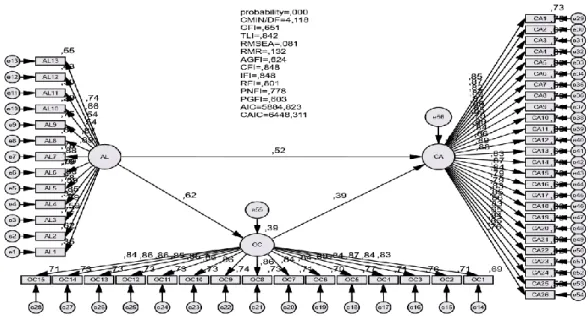
based on moral values, roles, and functions of educational institutions and educational goals. Figure 1 shown the full model research results are as follows.
Figure 1. Full model first-order confirmatory analysis
The test results of Confirmatory Factor Analysis (Convergent Validity), average variance extracted (AVE), and Composite reliability are as follows.
Table 2. AVE and CR. test results
Construct Indicator Loading factor
Authentic leadership AL1 0.593
AL2 0.789
AL3 0.851
AL4 0.586
AL5 0.881
AL6 0.889
AL7 0.883
AL8 0.893
AL9 0.867
AL10 0.537
AL11 0.544
AL12 0.657
AL13 0.744
AVE 0.577
CR 0.942
Organizational capability OC1 0.833
OC2 0.842
OC3 0.871
OC4 0.84
OC5 0.877
OC6 0.839
OC7 0.843
OC8 0.857
OC9 0.862
OC10 0.856
OC11 0.852
OC12 0.854
OC13 0.857
OC14 0.856
OC15 0.842
AVE 0.726
CR 0.947
Competitive advantage CA1 0.853
CA2 0.868
CA3 0.821
CA4 0.859
CA5 0.819
CA6 0.895
CA7 0.847
CA8 0.788
CA9 0.891
CA10 0.842
CA11 0.859
CA12 0.893
CA13 0.88
CA14 0.829
CA15 0.872
CA16 0.836
CA17 0.79
CA18 0.792
CA19 0.83
CA20 0.854
CA21 0.86
CA22 0.832
CA23 0.651
CA24 0.843
CA25 0.846
CA26 0.763
AVE 0.700
CR 0.95
Note: AVE = Average Variance Extracted, CR = Composite reliability Discriminant validity test
The results of the discriminant validity test showed that the AL1-AL13 indicator had the highest correlation to the authentic leadership (AL) variable and was able to explain 57.7% of the changes in the AL latent variables with a CR value of 0.942. OC1-OC15 indicator has the highest correlation to the organizational capability variable. The indicator OC1-OC15 can explain the organizational capability variable of 72.6% with a high CR level of 0.947. The CA indicator has the highest correlation to the competitive advantage variable that is 70% of the changes in CA can be explained by the indicators constructed in this study with a CR value of 0.95 so that it can be concluded that discriminant validity is in the category of each indicator more than 1.96 with a loading factor of more than 0, 5.
It means each observed variable has a more significant relationship with its respective latent variables than with other latent variables. The construction of each variable follows the research context, namely privately-owned Madrasah Aliyah educational institutions. The AL definition was developed based on the philosophical conception of authenticity that is considered organizational resources and is manifested by group members in the form of organizational capabilities.
Significance test
The results of testing the relationship between latent variables show a significant relationship between latent variables. The beta coefficient indicates that the relationship between AL and OC is 0.62, and the alpha coefficient of AL and CA is 0.52. The beta coefficient of the relationship between OC and CA is 0.39.
Model fit test (goodness of fit test) and model reification
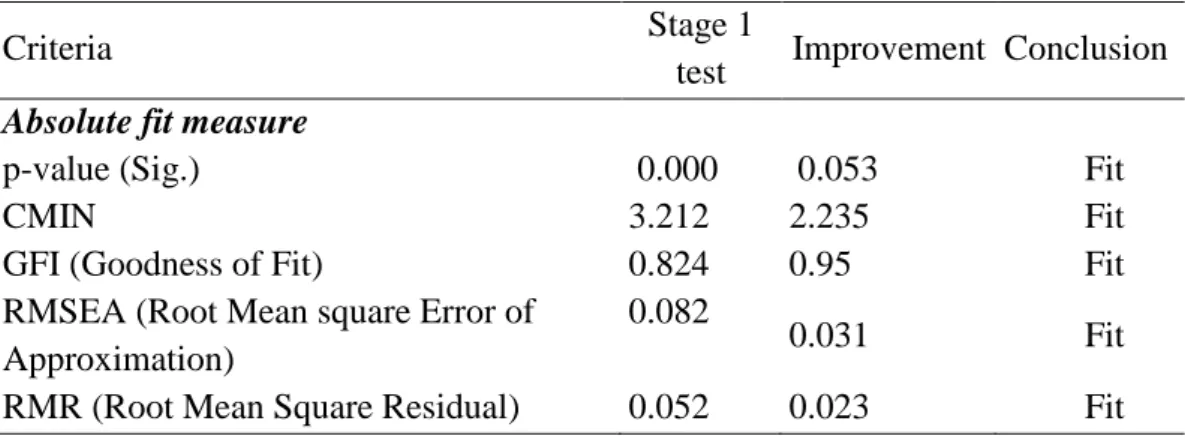
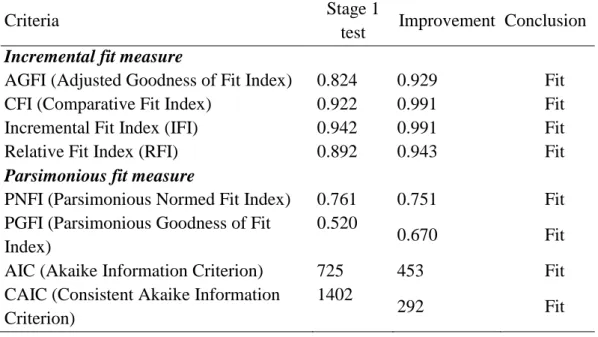
The results of the model fit test shown at Table 3 are as follows.
Table 3. Model test results
Criteria Stage 1
test Improvement Conclusion Absolute fit measure
p-value (Sig.) 0.000 0.053 Fit
CMIN 3.212 2.235 Fit
GFI (Goodness of Fit) 0.824 0.95 Fit
RMSEA (Root Mean square Error of Approximation)
0.082
0.031 Fit
RMR (Root Mean Square Residual) 0.052 0.023 Fit
Criteria Stage 1
test Improvement Conclusion Incremental fit measure
AGFI (Adjusted Goodness of Fit Index) 0.824 0.929 Fit
CFI (Comparative Fit Index) 0.922 0.991 Fit
Incremental Fit Index (IFI) 0.942 0.991 Fit
Relative Fit Index (RFI) 0.892 0.943 Fit
Parsimonious fit measure
PNFI (Parsimonious Normed Fit Index) 0.761 0.751 Fit PGFI (Parsimonious Goodness of Fit
Index)
0.520
0.670 Fit
AIC (Akaike Information Criterion) 725 453 Fit
CAIC (Consistent Akaike Information Criterion)
1402
292 Fit
Based on Tabel 3, the goodness of fit criteria testing results, each requirement, namely absolute fit indices, incremental fit indices, and parsimony indices, has not been represented as shown in Figure 1.
Therefore, improvements are made by increasing the relationship between indicators and variables according to the value of modification indices. After improvement with modification indices, the model is fully represented. The test results show that the model is accepted. There is a match between the data in the field obtained through a survey with the model constructed in the study.
Causality test with regression analysis techniques and mediation effects
The results of the causality test show a significant positive relationship between the variables, including the results of organizational testing capability as a mediating variable, as shown at Table 4 as follow.
Table 4. Hypothesis test results
Hypothesis Direct Indirect
via OC
Total There is a positive influence of authentic
leadership (AL) on organizational capability
0.623 0.623
There is a positive influence of organizational capability (OC) on competitive advantage (CA)
0.388 0.196
Organizational capability (OC) positively mediates the effect of authentic leadership (AL) on competitive advantage (CA)
0.518 0.242 0.760
The test results show that authentic leadership's positive effect on organizational capability has a beta coefficient of 0.623 or is in the high category.
Positive Organizational Capability (OC) against Competitive Advantage (CA) is 0.388. The direct effect of authentic leadership on CA is 0.518, while through organizational capability, it is 0.242, meaning that OC partially mediates the impact of authentic leadership on competitive advantage.
Discussion
Authentic leadership has a strategic position in driving MAS excellence. MAS leadership figures are needed who represent values as guidance. The leadership figure has self-awareness, which manifests in behavior, as stated by Akdemir (2017) and Dudka and Marjorie (2016), who explain leadership is based on moral values. The conception of AL is in line with (Avolio & Gardner, 2005). The concept and role of the AL as an organizational resource following the context of educational institutions such as madrasas.
MAS requires leadership construction that is sourced on values originality to direct madrasa with values and ideologies to meet people's needs for Islamic education. Islamic education in the modern era has been at the crossroads of globalization, rapid economic development, social change, and the rise of religions with different ideologies. Authentic leadership guarantees the implementation of Islamic education that has strength and can adapt to the realities of the modern world. Originality authentic leadership values direct the leader's permanent commitment to education with Islamic ideology amid various discourses of change and even deviation. The results show that the leadership position is very strategic both through organizational capability and directly on competitive advantage. The two paths serve as a mechanism that is built consistently and continuously to realize competitive advantage.
Authentic leadership encourages competitive advantage by increasing knowledge, skills, and organizational effects. The process is carried out through structured formal and non-formal mechanisms, namely social interaction and expanding opportunities for teachers to identify themselves with leaders as role models. Authentic leadership is developed at every level, both structured and through several learning processes and social interactions, as well as the process of individual self-identification of values that encourage the development of the role of teachers in educational institutions.
The interaction between leaders and subordinates to encourage capabilities is based on teachers' social learning process. Leadership values imitated through the modeling effect mean imitating the leader's behaviour as a model through associations, inhibiting effects, and removing barriers (disinhibition). Behavior that is not following the behavior of the leader is inhibited from appearing. Obstacles
that can hinder the imitation process are removed so that more real behavior arises from subordinates according to the model being imitated. The facilitation effect is where the conduct that subordinates have studied is easier to reappear by observing the leader's behavior as a model. Social interactions emphasize learning and cognition to identify themselves based on values that become role model orientations. A leader in an educational institution acts not only as a manager.
Leaders act as a prototype of moral attitudes and actions or become ethical role models for subordinates. At the group level, the formation of morale in the team is influenced by the process of social interaction between leaders and subordinates and the tendency of teachers and academic staff to imitate superiors as something natural. The imitation needed is the imitation of the characteristics of an authentic leader, as described by (Iqbal et al., 2020); (Alazmi & Al-Mahdy, 2022). Values are the foundation of a leader.
The interaction between leaders and subordinates is a process of identifying roles in which teachers continue to develop themselves to be more optimal in carrying out their work for superior MAS education services. Leaders in educational institutions play a role in expanding opportunities for teachers and staff to share in the social identity of educational institutions. Leaders outline important features as an essential part of an educational organization. Leaders encourage subordinates and staff to reflect on themselves as part of the crucial goals of education. Through existing social interactions and structures, leaders define themselves as members of the educational purposes for teachers and staff. Leaders tell us who we are as educators and academic staff. Leaders have a visionary and inspiring outlook when thinking about being a part of educational goals, and leaders increase understanding of the individual's self-concept about being part of educational goals. This understanding comes from values, experiences, and reflections on morals.
These interactions encourage the development and change of identity as a social group with a high responsibility for achieving educational goals. Leaders with their moral values, actions, and visionary views show that being part of the goal of education is the identity of teachers and staff. Leaders lay the foundation for teachers to have a social identity rooted in the order of values. Teachers and academic staff are motivated to get a social identity based on the moral values of leaders. Teachers and staff become part of the educational goals and their role compared with other groups. Leaders demonstrate self-respect and the meaning of being part of educational goals.
Leaders increase the ability to know who we are and what we are. Through these social interactions, leaders encourage the ability to identify ourselves (self') and 'others' based on moral values, roles, and functions of educational institutions and educational goals. Leaders simplify the process of self-identification through
role models. Teachers and staff as individuals better understand the identity of students, parents, and expectations in the world of education. Leaders encourage teachers and staff as professionals in the world of education who care about the ethical values of their profession, several technical competencies and attributes required to become part of an educational institution oriented to providing superior educational services. The teachers derive their social identity based on the process of leadership interaction. They are determined by MAS, which has established authentic leadership values as a shared orientation and has become a practice at every level, even individually. Original identity determines teacher capability (knowledge, skills, organizational effect) on MAS. The teacher's self-concept is formed through a process that comes from his understanding of his authenticity and the inherent emotional value or significance as part of the MAS.
In line with Alazmi and Al-Mahdy (2022) argues that authentic leadership is a process that draws from positive psychological capacities and highly developed organizational contexts that result in greater self-awareness and positive self- regulated behavior on the part of leaders and colleagues, as well as encourage positive self-development. Authentic leadership represents teachers' knowledge capacity, skills, and organizational effects for competitive advantage. The interaction is a competitive advantage framework based on authentic leadership as a valuable, rare, imperfect resource owned by madrasas: Imitability and non - substitution with value superiority orientation.
Conclusion
Authentic leadership positively affects competitive advantage through organizational capabilities—the better the authentic leadership, the higher the organizational ability, and the better the competitive advantage. The process can be explained as a process of social learning and self-identification of teachers to their leaders, which produces knowledge, skills, and organizational effects that are used as resources for competitive advantage.
Limitations
The research was only conducted at a private madrasah without distinguishing accreditation. Primary data sources through surveys are teachers. Therefore, further research is needed with different approaches, such as mixed methods and data collection not only limited to MAS.
Theoretical implications
More research is needed on the role of AL from a social learning perspective to realize competitive advantage. In contrast to several previous studies, the concept in this study was developed based on AL theory and resources to realize competitive
advantage. AL is at a strategic level as a value that underlies leadership practices at every level. AL is not limited to individuals within the organizational structure. AL is a representation of the organization's understanding of the philosophy of authenticity. Social interaction and identification of values by organizational members to support capabilities and advantages as concepts that support the explanation of AL and competitive advantage.
Practical implications
It is necessary to optimize the role of leadership to encourage organizational capabilities and not work as individuals but become an essential part of the system.
Optimization is done by encouraging interaction between leaders and teachers to become the formal agenda of the institution. Leadership promotes the development of authentic leadership values, both formally and informally, so that the learning process and social identification by teachers occur.
References
Adil, A., & Kamal, A. (2020). Authentic leadership and psychological capital in job demands-resources model among Pakistani university teachers. International Journal of Leadership in Education, 23(6), 734–754.
Aggarwal, V., & Srinivasan, P. (2017). An Empirical Study on the Impact of Organizational Learning on Organizational Competency. JIM QUEST, 13(2), 47.
Akdemir, F. (2017). Choreographing Complexity: A Cross-Cultural Study on Authentic Leadership in Contemporary Dance Projects. Europa-Universität Viadrina Frankfurt.
Alazmi, A. A., & Al-Mahdy, Y. F. H. (2022). Principal authentic leadership and teacher engagement in Kuwait’s educational reform context. Educational Management Administration & Leadership, 50(3), 392–412.
Alvesson, M., & Einola, K. (2019). Warning for excessive positivity: Authentic leadership and other traps in leadership studies. The Leadership Quarterly, 30(4), 383–395.
Aria, A., Jafari, P., & Behifar, M. (2019). Authentic Leadership and Teachers’
Intention to Stay: The Mediating Role of Perceived Organizational Support and Psychological Capital. World Journal of Education, 9(3), 67–81.
Avolio, B. J., & Gardner, W. L. (2005). Authentic leadership development: Getting to the root of positive forms of leadership. The Leadership Quarterly, 16(3), 315–338.
Brink, T. (2019). Orchestration of dynamic capabilities for competitive advantage.
International Journal of Energy Sector Management.
Chaudhary, R., & Panda, C. (2018). Authentic leadership and creativity: The intervening role of psychological meaningfulness, safety and work engagement. International Journal of Productivity and Performance Management.
Cheng, Z., & Zhu, C. (2021). Academic members’ perceptions of educational
leadership and perceived need for leadership capacity building in Chinese higher education institutions. Chinese Education & Society, 54(5–6), 171–189.
Chou, T.-Y., & Chen, Y.-T. (2020). Applying fuzzy AHP and TOPSIS method to identify key organizational capabilities. Mathematics, 8(5), 836.
Corriveau, A.-M. (2020). Developing authentic leadership as a starting point to responsible management: A Canadian university case study. The International Journal of Management Education, 18(1), 100364.
Crawford, J. A., Dawkins, S., Martin, A., & Lewis, G. (2020). Putting the leader back into authentic leadership: Reconceptualising and rethinking leaders.
Australian Journal of Management, 45(1), 114–133.
Daraba, D., Wirawan, H., Salam, R., & Faisal, M. (2021). Working from home during the corona pandemic: Investigating the role of authentic leadership, psychological capital, and gender on employee performance. Cogent Business
& Management, 8(1), 1885573.
De Haan, H. H. (2015). Competitive advantage, what does it really mean in the context of public higher education institutions? International Journal of Educational Management.
Dudka, M. G., & Marjorie, E. T. (2016). Introduction to the Adult Learning Special Issue: Embodying Authentic Leadership Through Popular Education at Highlander Research and Education Center. Adult Learning, 27(3), 94–97.
Eldor, L. (2020). How collective engagement creates competitive advantage for organizations: A business‐ level model of shared vision, competitive intensity, and service performance. Journal of Management Studies, 57(2), 177–209.
Fainshmidt, S., Wenger, L., Pezeshkan, A., & Mallon, M. R. (2019). When do dynamic capabilities lead to competitive advantage? The importance of strategic fit. Journal of Management Studies, 56(4), 758–787.
Feng-I, F. (2016). School Principals’ Authentic Leadership and Teachers’
Psychological Capital: Teachers’ Perspectives. International Education Studies, 9, 245. https://doi.org/10.5539/ies.v9n10p245
Feng, F.-I. (2016). School Principals’ Authentic Leadership and Teachers’
Psychological Capital: Teachers’ Perspectives. International Education Studies, 9(10), 245–255.
Gigol, T. (2020). Influence of authentic leadership on unethical pro-organizational behavior: The intermediate role of work engagement. Sustainability, 12(3), 1182.
Gill, C., Gardner, W., Claeys, J., & Vangronsvelt, K. (2018). Using theory on authentic leadership to build a strong human resource management system.
Human Resource Management Review, 28(3), 304–318.
Gligor, D., Feizabadi, J., Russo, I., Maloni, M. J., & Goldsby, T. J. (2020). The triple-a supply chain and strategic resources: developing competitive advantage. International Journal of Physical Distribution & Logistics Management, 50(2), 159–190.
Gomes, J., & Romão, M. J. B. (2019). Sustainable competitive advantage with the balanced scorecard approach. In Advanced methodologies and technologies in business operations and management (pp. 1415–1428). IGI Global.
Hifza, J., J., & Palapa, A. (2020). The Strategic Foundation for Competitive
Excellent Development in Integrated Islamic Primary Schools in Indonesia.
Journal of Advanced Science, Vol. 29, 1747–1753.
Iqbal, S., Farid, T., Khan, M. K., Zhang, Q., Khattak, A., & Ma, J. (2020). Bridging the gap between authentic leadership and employees communal relationships through trust. International Journal of Environmental Research and Public Health, 17(1), 250.
Jang, E. (2021). Sustainable Workplace: Impact of Authentic Leadership on Change-Oriented Organizational Citizenship Behavior and the Moderating Role of Perceived Employees’ Calling. Sustainability, 13(15), 8542.
Jaworski, M., Panczyk, M., Leńczuk-Gruba, A., Nowacka, A., & Gotlib, J. (2022).
The Trend of Authentic Leadership Skills in Nursing Education: The Key Role of Perfectionism and Self-Efficacy. International Journal of Environmental Research and Public Health, 19(4), 1989.
Khan, M. H. (2019). Knowledge, skills and organizational capabilities for structural transformation. Structural Change and Economic Dynamics, 48, 42–52.
Kronblad, C., & Pregmark, J. E. (2019). Beyond digital inventions—Diffusion of technology and organizational capabilities to change. In Legal tech, smart contracts and blockchain (pp. 123–146). Springer.
Laguna, M., Walachowska, K., Gorgievski-Duijvesteijn, M. J., & Moriano, J. A.
(2019). Authentic leadership and employees’ innovative behaviour: a multilevel investigation in three countries. International Journal of Environmental Research and Public Health, 16(21), 4201.
Lei, S., Qin, C., Ali, M., Freeman, S., & Shi-Jie, Z. (2021). The impact of authentic leadership on individual and team creativity: a multilevel perspective.
Leadership & Organization Development Journal, 42(4), 644–662.
Lo, M. F., & Tian, F. (2020). How academic leaders facilitate knowledge sharing:
a case of universities in Hong Kong. Leadership & Organization Development Journal.
Miotto, G., Del-Castillo-Feito, C., & Blanco-González, A. (2020). Reputation and legitimacy: Key factors for Higher Education Institutions’ sustained competitive advantage. Journal of Business Research, 112, 342–353.
Nayeemunnisa, A., & Gomathi, S. (2020). Understanding organizational capabilities: Review literature. Journal of Critical Reviews, 7(9), 413–415.
Panda, S., Pandey, S. C., Bennett, A., & Tian, X. (2019). University brand image as competitive advantage: a two-country study. International Journal of Educational Management.
Pitelis, C. N., & Wagner, J. D. (2019). Strategic shared leadership and organizational dynamic capabilities. The Leadership Quarterly, 30(2), 233–
242.
Salunke, S., Weerawardena, J., & McColl-Kennedy, J. R. (2019). The central role of knowledge integration capability in service innovation-based competitive strategy. Industrial Marketing Management, 76, 144–156.
Semedo, A. S., Coelho, A., & Ribeiro, N. (2019). Authentic leadership, happiness at work and affective commitment: An empirical study in Cape Verde.
European Business Review.
Tak, J., Seo, J., & Roh, T. (2019). The influence of authentic leadership on authentic