
Oxford Companion to Emotion and the Aff ective Sciences David Sander and Klaus Scherer (eds.). Department of Sociology, CUNY Graduate Center, City University of New York, New York, NY, USA Arvid Kappas.
David Knottnerus
These examples are just the most drastic and vivid examples of collective emotions in contemporary social life. For centuries, researchers and theorists in the social and behavioral sciences, as well as in the humanities, had a great interest in collective emotions.
Section 1
This volume seeks to revive and continue the legacy of collective emotion research in the social and behavioral sciences and humanities by addressing relevant and long-standing conceptual and theoretical questions by connecting collective emotions with the large body of research on individual emotions, particularly approaches that concern the social and cultural aspects of individual emotions, and by bringing together perspectives on collective emotions from a wide range of disciplines. We have decided to structure the 28 chapters in this volume following a logic that moves from fundamental conceptual questions to the micro-social and psychological mechanisms underlying collective emotions in face-to-face encounters to the social relational context of collective emotions, their social consequences, issues of group and intergroup emotions, the role of social organization in collective emotions and finally the importance of online social systems, especially social media, for the understanding of collective emotions.
Section 2
Rapson's research, which highlights its role as a precursor to collective emotions, as well as in the social transmission of various mental and physical diseases and problems such as allergies, obesity, reactions to chemical spills and environmental hazards. Hatfield and his colleagues thus present a more general case for conceiving of collective emotions as caused in part by various contagion processes.
Section 3
Section 4
Section 5
Section 6
Section 7
As editors of this book, we could also have gone the opposite way, selecting contributions based on their adherence to a specific understanding of collective emotions or on their disciplinary orientation. While this would certainly have its merits in terms of rigor and consistency, we chose not to do so—in part because widely accepted accounts of collective emotion are only beginning to take shape even within different disciplines—and instead welcome and bring together the existing diversity of concepts and approaches.
Chapter 1
This chapter defends the view that some groups have real emotions with all the collective consciousness involved. The first part argues that if groups have complex intentional states, they must also have consciousness.
Is there nothing it is like to be a group?
Rather, the point is that no matter what unity there is in a group, there is no such thing as something that is what that group is like (cf. Sosa, 2009). Instead, unconscious intentional states appear to be attributed because of his consciousness.
Shared feelings
Shared feelings involve a certain 'phenomenological fusion'. They are 'shared' in the strong, straightforward sense in which there is one symbolic affective state in which many individuals participate. The claim that it is the feeling that unites participants in a shared emotion has been repeatedly criticized in the recent literature.
Corporate emotions
It is true that collective consciousness is not a consciousness that is autonomous from the consciousness of the participating individuals, as are the intentions and judgments of some groups. Yet it is certainly uncomfortable to argue for a position that seems so fundamentally at odds with ordinary intuitions about the nature of corporations.
Acknowledgments
Chapter 2
The easy answer is that "We are very excited," refers to being very excited, and so on. 2 Hereafter, my use of the term "collective feelings" and the like is intended as an abbreviation for "the.
Preliminaries
Suppose one assumes that everyday collective emotion attributions do not implicitly deny individualism about consciousness. Nor can any account be taken of the referents of everyday collective emotional labels beyond the purely trivial.
A joint commitment account of collective emotion
A full explanation of the joint liability account cannot be offered here. But enough has been said to facilitate consideration of the relationship between the collective sentiments of the joint undertaking account and the personal sentiments of the parties.
Collective emotions and the personal emotions of the parties
A joint engagement account of collective emotions is also consistent with previous considerations of the ways in which a particular collective emotion might emerge, allowing for a specific interpretation of the previously envisioned scenarios. If there is a certain collective emotion, we can then conclude that all or some or at least one of the parties has the corresponding personal emotion, or at least had it when creating the collective emotion.
Conclusion
Until now, EM theorizing has been silent with regard to emotions and affective states. Upon closer examination of a variety of typical human emotions and affects in their usual settings, this assumption seems premature.
The gist of emotion
Thanks to all this, emotions are among the fundamental 'sources of the self'; rather, they constitute the dimension in which things can concern us or be a problem for us. This basic affective dimension seems to be precisely what qualifies some states as mine, and thus intuitively seems to be something “inside me” rather than something “out there.” Haugeland thinks (rightly, in my opinion) that to care, what he also calls existential commitment, is the hallmark of the mental, it is what substandard or intrinsic intentionality entails (see Haugeland, 1998, pp. 291–304).
Extending emotion—motivation and basic idea
At least in some such cases, we find ourselves with emotions that we would be totally incapable of experiencing in the absence of the environmental structures or without the actions that help reinforce these emotions. The playing field on which externalists and internalists meet would be leveled, treating as an open question whether or not the enabling machinery of emotional (and other) experiences is all in the head.
Emotions are excellent examples of the kinds of dynamic, embodied, performative "sense-making" processes posited by entactivists. As such active processes, emotions are a matter of the lived body in a Merleau-Pontian sense: the body is understood as a means of engagement in the world and experience of the world.
Extending emotion, steps toward a theory
Chapter 4
In the case of the community of all persons, I will suggest, these rational models of reactive emotions will be central to understanding what it is to be a person and how we are bound by moral norms. Then in "Dignity, honor and reactive emotions" I will argue that these reactive emotions simultaneously constitute the dignity of the members of a.
Emotions and caring
In general, such a pattern of emotions, desires, and judgments is a tendency to respond to their joint focus of attention and action when this focus is favorably or unfavorably affected. In each case, the pattern of emotions, desires, and evaluative judgments in part constrains what about their common focus is worth considering and acting on their behalf, thereby defining an account according to which this focus matters to one.
Reactive emotions and rational patterns
As with other types of emotions, reactive emotions exhibit rational connections among themselves. What an account of the reactive emotions should provide is an explanation of these intrapersonal and interpersonal rational interconnections.
Dignity, reverence, and the reactive emotions
For a commitment to the dignity of community members generally means a commitment to the significance of their status and authority to hold themselves and others accountable to the community's standards. Likewise, in the case of the reactive emotions, the focus will be on the community itself, with the.
Dignity and communities of respect
Chapter 5
To achieve this goal, recent advances in research into the neural and biological underpinnings of empathy and affective sharing will be reviewed. At the end of the chapter, we speculate on how the various aspects and mechanisms of empathic responses as described by social neuroscience may be relevant to understanding the emergence and regulation of collective emotions.
What “is” empathy?
However, it is only during the experience of empathy that we see vicarious responses that are not influenced by the observer (in the sense of the "duplicate state" or "feeling with/as" mentioned earlier), while sympathy, empathic concern, and compassion carry additional processes of "feel for" originating from the observer. For example, interacting with a sad person in the case of empathy will be associated with a state of sadness in the observer that is similar to that of the target.
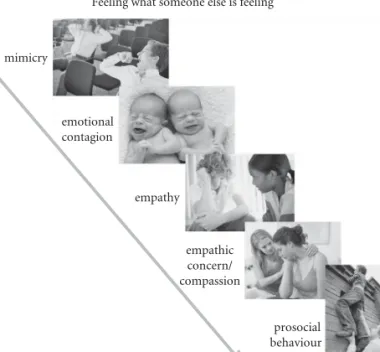
The neural bases of empathy—a core network of shared affect
These areas—especially the bilateral anterior insula (AI), the medial cingulate cortex (MCC), brainstem and the cerebellum—. It has been proposed that these regions represent a crucial part of the human interoceptive cortex (Craig and subserve neural representations of internal bodily states such as information about temperature, lust, hunger, bodily arousal states and information from the gut (Craig Critchley, 2005; Critchley, Wiens, Rotshtein, Ohman, & Dolan, 2004; Damasio, 1994).
Distinct mechanisms enabling the activation of the core network of empathy
Several recent findings provide strong support for top-down influences on empathy, and that there are many different routes to eliciting responses associated with sharing affection in the core empathy network. The most compelling question in the field of empathy research is how empathic responses relate to prosocial behavior, such as helping others in need or foregoing selfish benefits for the sake of someone else's well-being.
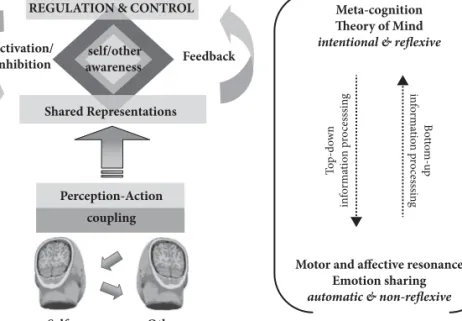
From the social neuroscience of empathy to collective emotions
Lack of self/other awareness and distinction is a putative mechanism of collective affective experiences, such as the high synchrony between individuals that occurs during mass phenomena, such as music concerts or political demonstrations. Attentional selection can be driven by several different factors, such as low-level features of a stimulus (e.g., high intensity, exogenous attention) and factors related to the observer (e.g., goals or current expectations, endogenous attention.
Neurocognitive mechanisms of attentional selection
Endogenous attentional control is mainly exerted by interactions of dorsal regions such as the intraparietal sulcus (IPS) and the frontal eye field (FEF), exogenous reorientation of the focus of attention is mediated by more ventral regions in the right hemisphere such as the right ventral frontal cortex and temporo-parietal junction . Targets defined by a simple bottom-up feature such as color (for example, a red bar between blue bars) are found effortlessly and relatively independently of the number of distractors, indicating efficient parallel search.
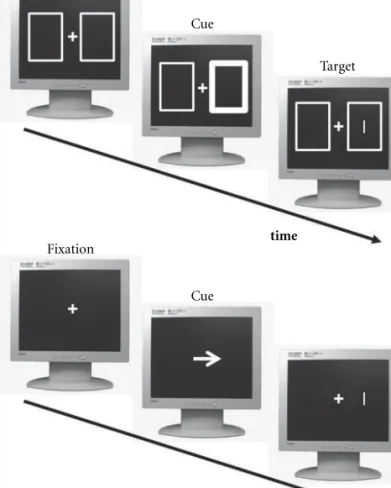
Mechanisms of attention capture by socio-affective information
The relevance hypothesis of attention predicts a high degree of flexibility, since the relevance of a stimulus can change frequently to reflect the changing motivational contingencies of the observer. To evaluate this hypothesis, in a second experiment we manipulated the accessibility of the socio-affective relevance of our stimuli.

Joint attention: mechanisms of eye gaze cueing
The large number of brain areas dedicated to processing the human face reflects the importance of this information to humans. In the second part of the chapter, I focused on the mechanisms of joint attention, which enable individuals to use information from the point of view of others to divert their focus of attention and shift their own attention to the same place.
The defi ning characteristics of emotional mimicry
The first defining feature of emotional mimicry is that two people show the same nonverbal expression of emotion, immediately after each other, so that one facial display is a reaction to the other facial display. However, there are times when two people show the same expressions of emotion, but when this is not the result of mimicry.
Emotional mimicry, emotional contagion, and empathy
More recent research on affective empathy, based on mirror neuron research, also emphasizes facial expressions as part of the empathic process (Decety & Jackson, 2004; Goldman & Sripada, 2005). In summary, affective empathy and emotional mimicry refer to processes that can lead to capturing the emotions of others (emotional contagion).
In general, a negative attitude toward the target can inhibit emotional mimicry and increase the interpretation of the emotional signal as hostile (e.g., Hutchings & Haddock, 2008). We expect that individuals will imitate the emotional reactions of ingroup members more than those of outgroup members (Bourgeois & Hess, 2008; van der Schalk et al., 2011).
Mimicry and contagion as different forms of simulation
These studies indicate that mimicry is not a necessary condition for recognizing an emotional expression. However, we are still able to recognize emotions even when mimicry is inhibited or experimentally impeded (for a related idea see Niedenthal, Mermillod, Maringer, & Hess, 2010).
Mimicry as a communicative act
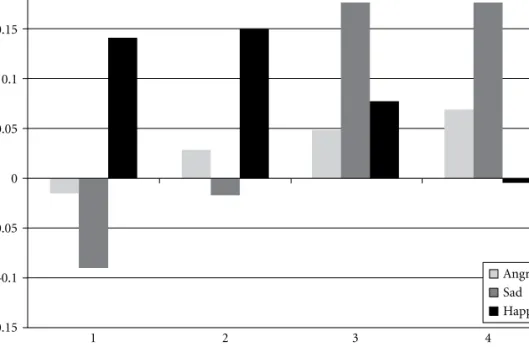
Facial expressions of anger and sadness are characterized by increased activity of the Corrugator Supercilii muscle and relaxation of the Orbicularis Oculi and Zygomaticus Major, while happy expressions are characterized by the reverse pattern. These data therefore best fit the explanation that participants indicated their understanding of the other's emotional state, supporting the idea that mimicry serves to enhance understanding.
Theoretical overview
Hatfield, Rapson, and Le (2009, pp. 19–20) define primitive emotional contagion as: “The tendency to automatically imitate and synchronize facial expressions, vocalizations, postures, and movements with those of another person and, consequently, to converge emotionally.” Researchers have often measured "emotional contagion" through the scale of emotional contagion, or by assessing the degree to which people imitate others' facial, vocal, and postural expressions and/or come to share others' emotions. The fact that people's faces often mirror the facial expressions of those around them is well documented (Hatfield et al., 1994; Hess, Houde, & Fischer, Chapter 7, this volume).
Contagion and emotions in collectives
Chapter 9
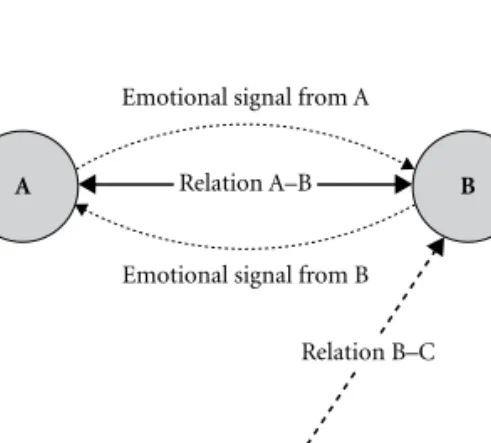
In this chapter we argue that an important social function of emotions is to govern people's relationships with each other. While network science is the study of all networks, social network analysis (SNA) is the application of network science to networks of people: it is the study of dynamic social structures.
Social network analysis
This approach is particularly useful when the boundaries of the relevant population are difficult to define. SNA involves various types of measures regarding individual actors in the network, their relationships, and the overall structure of the network itself (for a comprehensive review, see Wasserman & Faust, 1994).
Individuals as social actors
To fully understand the processes that shape networks and the actors within, the ability to model (multiple) networks over time is required. SAOMs use observed network data as the basis for statistical simulations to quantify the factors that influence how actors create, maintain, and dissolve relationships with one another.
Interpersonal relations
Thus, anger signals that the relationship is threatened, contempt signals that the relationship no longer exists. Later, it was argued that the object could be a third person in the network (Holland & Leinhardt, 1976).
Groups and network clusters
Chapter 10
Group-based emotions are not necessarily collective, because the group-based nature of the emotions refers to the fact that concerns about one's group-based self have evoked the emotional response, such as when one's favorite football team loses an important match. . Such group emotions can be experienced or expressed in isolation, such as when watching a match on television alone.
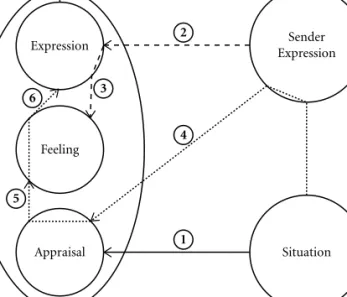
Primitive emotional contagion and social appraisal theory
Social appraisal is the process of incorporating information obtained from the emotional expression of others into one's own assessment of a situation. 2 In addition to this form of social assessment (called situational social assessment), Manstead.
Social appraisal theory
Apparently, monkeys also share the ability to use the expressions of others to evaluate unfamiliar objects (Morimoto & Fujita, 2012). We propose that both the capacity and motivation to process others' emotional expressions play a major role in predicting when people engage in social appraisal.
From interpersonal convergence to collective emotions
Warmth and competence as universal dimensions of social perception: The stereotype content model and the BIAS map. While helpful in characterizing certain aspects of emotions, these individualistic approaches often fail to take into account the extent to which emotions are mediated by the actor's social niche—that is, the extent to which emotions emerge from within and sometimes partially shaped by the dynamics of an agent's ongoing interaction with evolving social contexts.
The notion of the (cognitive) niche
The notion of cognitive niche construction is at the heart of recent distributed approaches to cognition and related discussions of the extended mind thesis (Clark, 2008; Clark & Chalmers, 1998; Hutchins, 1995; Menary, 2010; Rowlands, 2010). Yet this fact has not been adequately addressed by proponents of the niche construction approach to human cognition.
The notion of the (emotional) niche
The manipulative actions, as well as the tools and environmental resources they use, are thus part of the larger (distributed) computational system. First, starting from the discussion of cognitive niche construction, I want to argue that emotions are from the beginning of life essentially conditioned (both synchronically and diachronically) by features of the surrounding social environment.
Synchronic scaffolding and emotional performance in early infancy
This crowding of the child's body space focuses the child's attention by removing competing perceptual distractions. The caregiver's gestures, behaviors, smells, and expressions are material aspects of the child's social niche.
Diachronicity and ideational factors in emotional development
Again, the simple point is that the ideological factors of the social niche materially affect long-term emotional development. Scherer (Eds.), The Emotional Power of Music: Multidisciplinary Perspectives on Musical Expression, Arousal, and Social Control.