COMMUNITY-BASED RESPONSES TO DOMESTIC VIOLENCE: A SOCIAL ECOLOGICAL ANALYSIS
By
Patricia Conway
Thesis
Submitted to the Faculty of the Graduate School of Vanderbilt University
in partial fulfillment of the requirements for the degree of
MASTER OF SCIENCE in
Community Research and Action
December, 2008
Nashville, Tennessee
Approved:
Professor Douglas D. Perkins Professor Linda G. Manning
In memory of Tony Conway. Weʼre almost there Dad and
For Mum, Pat Conway. Your endless and selfless support drives me on.
ACKNOWLEDGMENTS
This project would never have been finished without the warmth and encouragement of Dr. Linda Manning, whose keen insight made the impossible possible. The ladies of the support-action group took me under their wings and helped me come to understand that which I otherwise would never have seen. Thanks go to Dr. David Fryer for the space he provided during fieldwork for careful reflection, and most importantly, for maintaining a relationship with the local community after I moved across the Atlantic. I am grateful to Dr. Doug Perkins for getting involved when he could have declined, for his flexibility and ongoing support. My deep appreciation goes to Dr.
J.R. (Bob) Newbrough for the many hours of guidance and reflection he offered throughout this process, and for his continuing encouragement and support.
Love and thanks are due to my husband Terrell, for his keen insights in the early stages, reminding me what mattered most, for providing me with countless meals and most of all for putting up with our ‘third-wheel’, the ever-present laptop.
I am privileged to have great friends who were there when the going got tough. Thank you to Tonya & Chris, Sarah & Chris and Dylan. Thanks also go to Leslie for being my writing partner.
Keep on keeping on. A special thank you goes to Michelle Sciumbato, for all the technical help, family support, creativity and friendship.
TABLE OF CONTENTS
Page
DEDICATION... ii
ACKNOWLEDGEMENTS ... iii
LIST OF TABLES ... vi
LIST OF FIGURES ... vii
Chapter I. INTRODUCTION ...1
History of a Social Movement...1
A Typology of Domestic Violence ...1
Global Definitions of Domestic Violence...2
Prevalence of Domestic Violence ...3
Impact on Health and Well-being ...3
A preventable Public Health Problem ...4
Understanding the Root Causes of Domestic Violence ...5
Feminist Frameworks: Gender Based Inequality and Oppression ...6
Psychological & Sociological Frameworks ...11
Key Tensions in Understanding Domestic Violence...17
Responses to Domestic Violence in Practice: A Literature Review...22
Reflections on the literature reviewed...23
Study Rationale ...25
Study Aims...27
II. METHODOLOGY & METHODS ...29
III. RESULTS ...41
An Ecological Analysis...41
A Community Case Study in Context ...47
Direct Responses to Domestic Abuse in a Local Community...48
Governmental Sector ...53
Criminal Justice Sector ...68
Non-Governmental Organization Sector ...99
Housing Sector ... 112
Heath Sector... 125
Social Services Sector ... 131
Prevention Analysis ... 138
The 3ʻPʼs Analysis... 141
Reflections on Local Responses: What Works ... 145
IV. DISCUSSION ... 158
Summary of Results and Key Findings ... 158
Study Limitations and Opportunities for Further Research ... 162
Emergent Issues for Reflection ... 163
Appendix ... 173
A. Duluth Power & Control Wheel ... 173
B. Stakeholders, preliminary list ... 174
C. Semi-structured Interview questions ... 175
D. People and organisations interviewed ... 176
E: Journeys ... 177
REFERENCES ... 181
LIST OF TABLES
Table Page
1. Modified ecological levels ...42
2. Levels of the social ecology as presented ...44
3. Primary prevention efforts ... 138
4. Secondary prevention efforts ... 139
5. Tertiary prevention efforts ... 140
6. Responses at the level of Prevention ... 142
7. Responses at the level of Protection ... 143
8. Responses at the level of Provision ... 144
LIST OF FIGURES
Figure Page
1. People in context, levels of the social ecology ...28 2. Sectors of Responses to Domestic Violence across the Levels of the
Social Ecology...46 3. Recording of domestic abuse incidents reported to the Scottish police as an
offence or crime in 2004 ...84 4. Disposal of incidents of domestic abuse reported to the Scottish Police AND
recorded as a crime or offence ...85 5. Number of reports of Domestic Abuse recorded by 3 Scottish Agencies in
2004: the Police, Womenʼs Aid and the Procurator Fiscal Service (PF)...86
CHAPTER I
INTRODUCTION
History of a Social Movement
Domestic violence has been the subject of research and action for over 35 years. This international recognition of domestic violence as a public as well as private problem has emerged from decades of activism and scholarship, around the globe, to raise awareness of the existence of violence in domestic settings, and to organise responses to the problem, these efforts started with the ‘battered-women’s’ social movement in the 1970’s (Dobash & Dobash, 1992). This social movement emerged out of the larger women’s movements in both the UK and the USA (Schechter, 1982). The battered-women’s movement is said to have started in Chiswick, England in 1972, when women suffering domestic violence sought refuge at a newly opened community house for local women (Dobash & Dobash, 1979). This sparked the birth of the National Women’s Aid Federation in 1974 (Sutton, 1978), now a UK wide organisation offering refuge accommodation, legal and financial advice and political and policy advocacy on behalf of women suffering domestic violence1. Activism in support of battered-women quickly spread to the USA and other countries throughout the world, with the opening of refuges seen as key to offering an appropriate response to battered women (Dobash & Dobash, 1992).
A Typology of Domestic Violence
Johnson (2005) suggests that when we speak of ‘domestic violence’ we are most often referring to one of three major types of intimate partner violence known as ‘intimate terrorism’. Intimate terrorism refers to instances when violence is “enacted in the service of taking general control over one's partner”.
Consistent with Johnson’s theory, the term domestic violence is used throughout this study, to be consistent with the terminology of the field, but the term is being used only in reference to the intimate terrorism type of violence, which is the focus of this study. Intimate terrorism is markedly different from the other two
1 The Women’s Aid website offers full information on the organisation’s activities throughout the UK
major types of domestic violence known as ‘situational couple violence’ and ‘violent resistance’. ‘Violent resistance’ refers to violence “utilized in response to intimate terrorism”, when someone suffering from intimate terrorism uses violence to fight back. ‘Situational couple violence’ is violence that is “not embedded in a general pattern of power and control but is a function of the escalation of a specific conflict or series of conflicts”. Johnson clarifies that “although all three types of intimate partner violence can be either frequent or infrequent, and can range from relatively minor acts of violence to homicidal assaults, intimate terrorism is the type most likely to be frequent and brutal” (p. 1127). These differences are key to our understanding of ‘what is’ domestic violence. Johnson’s typology is an aid to our understanding of the complexities presented in the field of domestic violence. Determining the type of violence we encounter or inquire about in our research enables us to study not only acts of domestic violence, but also, crucially, to study the function of such violent acts and the contexts in which they occur. It is this ‘intimate terrorism’
type of domestic violence that is the cause for grave concern globally, and also the focus of this study.
Global Definitions of Domestic Violence
The United Nations (U.N.) consider domestic violence as a sub-category of ‘violence against women’, which they define as “any act of gender-based violence that results in, or is likely to result in, physical, sexual or psychological harm or suffering to women, including threats of such acts, coercion or arbitrary deprivations of liberty, whether occurring in public or private life” (U.N. General Assembly, 1993). For the U.N. ‘domestic violence’2 refers to instances when such acts occur between those who are related to each other “through blood or intimacy” (U.N. General Assembly, 2004).
In 2002 the World Health Organisation (W.H.O) published a global research report on ‘Violence and Health’ (Krug, Dahlberg, Mercy, Zwi & Lozano, 2002), referred to as the “first comprehensive review of violence on a global scale - what it is, whom it affects and what can be done about it”. The report describes domestic violence as including “acts of physical aggression, such as hitting or kicking”, as well as “forced intercourse and other forms of sexual coercion, psychological abuse such as intimidation and
2Domestic Violence and Domestic Abuse are used interchangeably in this report to signify the same phenomena. The United Nations and the World Health Organisation define ‘violence’ as a term encompassing acts of abuse, while other organisations (e.g. Women’s Aid and NHS Scotland) prefer the use of the term ‘abuse’ which is inclusive of, but does
humiliation, and controlling behaviours such as isolating a person from family and friends or restricting access to information and assistance” (p. 24).
Prevalence of Domestic Violence
The W.H.O report found that violence against intimate partners occurs “in all countries, all cultures and at every level of society without exception”(Krug et al, 2002, p. 24). The report affirmed that although women can be violent towards their male partners and violence occurs also between partners of the same sex, the “overwhelming burden is borne by women at the hands of men” (p. 24). The WHO review found that “in 48 population-based surveys from around the world, 10–69% of women reported being physically assaulted by an intimate male partner at some point in their lives” (p. 25). The review found there are two different patterns of domestic violence. The first, known as battering, is described as
“a severe and escalating form characterized by multiple forms of abuse, terrorization and threats, and increasingly possessive and controlling behaviour on the part of the abuser”. The second is said to be “a more moderate form of relationship violence, where continuing frustration and anger occasionally erupt into physical aggression”, also called ‘common couple violence’ (p. 93). General population surveys are recommended as a means to investigate the second pattern of abuse, and seen as less useful for studies of battering.
Impact on Health and Well-being
The latest U.N. resolution on the ‘elimination of domestic violence against women’ (U.N. General Assembly, 2004) recognises the harm caused by domestic violence to the health and well-being of the person experiencing such violence. Similarly, the CDC, drawing on extensive empirical studies, reportthe myriad ways in which domestic violence damages health and well-being, with increasing damage the longer the abuse continues. The CDC outline the harm caused to physical health, emotional well-being and health behaviours (Centres for Disease Control, 2006, p.1),
“Many victims suffer physical injuries. Some are minor like cuts, scratches, bruises, and welts. Others are more serious and can cause lasting disabilities. These include broken bones, internal bleeding, and head trauma…..Victims often have low self-esteem. They may have a hard time trusting others and being in relationships. The anger and stress that victims feel may lead to eating disorders and depression. Some victims even think about
or commit suicide…..Victims are more likely to smoke, abuse alcohol, use drugs, and engage in risky sexual activity”.
A Preventable Public Health Problem
In recognition of the widespread prevalence of domestic violence throughout societies, and its serious impact on health and well-being of those who live with it, a new framing of domestic violence (raised over 20 years ago, but only recently coming to prominence) speaks of domestic violence as not just a personal, inter-personal or gendered problem, but as a public health problem (for a historical review see Goodman, Koss, Fitzgerald, Russo & Puryear Keita,1993 or Tjaden, 2005). Currently promoted by major institutions such as the United Nations, World Health Organisation and the U.S. Centres for Disease Control (CDC), this new framing of domestic violence as a public health issue, extends the responsibility for responding to domestic violence into the public realm, and calls for states to take a role in responding to domestic violence.
Key to the emergent public health framing of domestic violence more recent reframing of domestic violence from a public health perspective is a call not only to respond to domestic violence, but also to actively work to prevent domestic violence from occurring in the general population. The WHO report on ‘Violence and Health’ (Krug et al, 2002) eloquently suggests: “despite the fact that violence has always been present, the world does not have to accept it as an inevitable part of the human condition” (p.
3).
The CDC states that ‘Intimate Partner Violence’ (IPV) is a major public health problem that is costly to society and needs to be prevented (Centres for Disease Control, 2006). Similarly the United Nations states that “domestic violence is of public concern and requires [U.N. member] States to take serious action to protect victims and prevent domestic violence” (U.N. General Assembly, 2004, p.2); while member states of the World Health Organisation have committed to addressing and preventing domestic violence within their own borders.
According to the public health perspective in order to prevent a problem emerging in the general population, the problems ‘root causes’ must be tackled to prevent it developing in the first place. Having an understanding of the risk factors associated with the development of the problem, enables development and implementation of interventions to reduce the likelihood of the problem emerging in those groups most
at risk. Interventions can also be aimed at those already experiencing the problem, in order to minimise its recurrence or harmful impact.
How we attempt to prevent domestic violence will be a reflection of what is understand to be the root causes, or put differently, what we believe must be changed in order to block the occurrence of such violence. The call to recognise domestic violence as a problem, to respond to it and ultimately prevent its occurrence is compelling, but what is understood to be the cause(s) of domestic violence and what responses does that lead to in practice?
Understanding The Root Causes Of Domestic Violence
Alongside the building of the battered-women’s movement, multiple theories have emerged in an attempt to understand domestic violence, and consequently determine what needs to change to eliminate such violence. The battered-women’s movement was always, and continues to be, comprised of multiple interest groups. Writing on the emergence of the movements in the UK and the US, Schecter (1982) and Dobash & Dobash (1992) make distinctions between the feminist sectors of the movement, including women’s rights activists, radical feminists and socialist feminists on one hand, who advocate that domestic violence is a problem of unequal gender relations in society; and the other sectors of the movement which are said to be ‘non-feminist’ in that they do not consider gendered social arrangements as the underlying problem causing domestic violence.
Theoretical Explanations for Domestic Violence
Feminist theories predominate, but are not unanimously upheld. Whether or not domestic violence is a ‘gendered-issue’ is hotly debated. Theories draw from history, cultural practices and
empirical work in order to come to understand why violence exists in domestic settings. In the introduction to their text titled ‘Current controversies on family violence’, editors Gelles & Loseke (1993) write that
‘theoretical disagreements prevail over the causes of family violence and appropriate social interventions’.
According to Gelles & Loseke, at the centre of the disagreement are psychological, sociological, and feminist frameworks offering what they refer to as ‘competing ways to conceptualize the behaviors involved in family violence’ (p. x).
Feminist Frameworks: Gender Based Inequality And Oppression
Patriarchy at Home
Feminist theorists (e.g. Schecter, 1982; Sugarman, 1996; Risman, 2004for overviews) propose that domestic violence is a symptom of the gender inequality and gender-based oppression that exists in societies throughout the world. They argue that such oppression and inequality are a result of ‘patriarchal’
societies, structured on the basis of family units with men at the head of the family (see Dobash & Dobash, 1979 for a comprehensive review). Drawing back to the Roman and Christian roots of contemporary western cultures two of the leading researchers into the problem of domestic violence, Dobash & Dobash (1979) explain the mechanism of patriarchy as it has evolved in law, culture and rites of passage over time.
They explain that within patriarchal societies family units are of fundamental importance. In these family units men, as the fathers, are deemed to have responsibility for and therefore authority over their family, including their wives. Under this system women are first the property of their fathers and then become property of their husband when they (and their wealth) are formally transferred to him through marriage.
Men had a legal right and moral obligation to control their wives in order to maintain the social
arrangements around which society was organised. Controlling wives included the use of physical abuse, as demonstrated by the ‘Rule of Thumb’ established as common-law in 18th Century England. The ‘Rule of Thumb’ deemed it a man’s right to beat his wife, as long as it was with a stick no thicker than the diameter of his thumb.
Schecter (1982) explains that this patriarchal legacy impacts on how women are viewed in contemporary society. She states that women are often viewed as dependents rather than self-sufficient individuals, someone to be taken care of or a burden. Under this arrangement women become property rather than people (property of their fathers, husbands and society) and have been expected to refrain from work that did not service their family or community’s needs. Women under these social arrangements are seen as a commodity, providing essential labour, without pay, to the family and community, in the form of household maintenance, child rearing and caring for the sick and elderly. Under these arrangements women without personal wealth lack economic independence, and are instead dependent on their husbands
for shelter, food and other resources. Working within the home is also socially isolating, women in this situation often find themselves with limited social support.
The battered-women’s movement assert that these factors, women’s limited economic and social independence, play a central role in women throughout the world putting up with violence at home.
Kalmuss & Strauss’s 1982 survey of over 1000 women in the U.S. general population supports this assertion. Their survey explored subjective (psychological) marital dependence, objective (economic) marital dependence and the experience of violence. They found correlations between marital dependency and experience of abuse, with rates of minor and severe marital violence increasing as wives’ marital dependence increased. According to Kalmuss & Strauss, these findings suggest that both objectively and subjectively dependent wives tolerate more abuse than “non-dependent” wives, with subjective dependency having a stronger relationship to minor violence and objective dependency having a stronger relationship to reported severe violence at home.
Patriarchy Everywhere
The feminist framework states that the patriarchal structure of power and control also operates beyond the individual family setting, extending into society as a whole, resulting in society wide oppression of women and the maintenance of social structures that benefit men more than women (Lopez-Claros &
Zahidi, 2005). In patriarchal societies men are said to have responsibility for collective society and consequently hold the positions of authority created to manage society. These positions are highly valued, and afford privilege to those who hold them. As a result, a gender-based power imbalance has been created and maintained in society, in which the male gender is afforded more privileges, and therefore more power, than the female (Dobash, 1979). Even in countries with equal rights for women and men, men
predominantly fill positions of authority and other privileged positions (Lopez-Claros & Zahidi, 2005).
Under such patriarchal social systems, women and their work are said to be less valued than men and their occupations. The subordinate role of women in society has minimised their opportunities for education, self-expression, autonomy and control over their environments (Lopez-Claros & Zahidi, 2005).
As a result, in societies today despite holding equal rights to education and employment under law, many women are still economically and socially dependent on their fathers or husbands. The dependence of
women on the men in their lives, and their limited independence is said to result in the tacit acceptance of violence against women under such societal arrangements (Dobash & Dobash, 1992).
Gender, Power & Control
Patriarchal societies have resulted in social arrangements in which men typically hold more social and economic power compared to their female counterparts, creating a gender imbalance with wide impacts. Under these arrangements men are not only superior to women, women as the property of their men, become subordinate to men. With one group in society (men), having socially sanctioned power over the others (women and children), the dominant group are said to act violently against the subordinate group in order to maintain control over them, as an abuse of this male power (Allen & Strauss, 1980 as cited in Kalmuss & Straus, 1982). Domestic violence is said to be one form of such abuse of power, referred to by feminist theorists as being part of a ‘continuum of violence’ against women and children that also includes rape, sexual assault and sexual harassment (e.g. Leidig, 1992; Buchwald, Fletcher & Roth, 2004). The results of a major population survey of experiences of intimate partner violence, involving 16,000
respondents, by the US Department of justice (Tjaden & Thoennes, 2000) supported this theory. The report states that their data supports the theory that “violence perpetrated against women by male partners is part of a systematic pattern of dominance and control, or what some researchers have called ‘patriarchal terrorism’.”(p.34). More specifically, the survey found that:
“women whose partners were jealous, controlling, or verbally abusive were significantly more likely to report being raped, physically assaulted, and/or stalked by their partners, even when other sociodemographic and relationship characteristics were controlled. Indeed, having a verbally abusive partner was the variable most likely to predict that a woman would be victimized by an intimate partner. These findings support the theory that violence perpetrated against women by intimates is often part of a systematic pattern of dominance and control.”(p. iv).
Patriarchal Legacy in Contemporary Relationships
In 1998, findings from research by Dobash & Dobash suggested four main causes of domestic violence in contemporary relationships (p.144). Each cause stems from what they term ‘male sexual proprietariness’ (p 214):
2. Disagreements and expectations concerning domestic work and resources.
3. Men’s sense of the right to punish ‘their’ women for perceived wrongdoing.
4. The importance to men of maintaining or exercising their power and authority.
In a similar vein, the more recent extensive review of global literature presented in the WHO
‘Violence and Health report’ (Krug et al., 2002) indicated that
“around the world, the events that trigger violence in abusive relationships are remarkably consistent. They include disobeying or arguing with the man, questioning him about money or girlfriends, not having food ready on time, not caring adequately for the children or the home, refusing to have sex, and the man suspecting the woman of infidelity (p. 24).
Such violent acts by men on women are explained as a result of socially sanctioned male use of aggression, whereby boys and men are socialised to use aggressive behaviour as a way to maintain control over their environment, including those they live with (Kimmel, 2004).
How Power and Control Operates at Home
Developed by Ellen Pence and the Duluth Abuse Intervention Project, the ‘power and control wheel’ (Fineman & Mykitiuk, 1994, p.88; See Appendix-A) has become a pivotal tool in understanding the mechanisms through which power and authority are operationalised in abusive domestic relationships (see Pence & Shepard, 1999 for a complete overview). In Duluth, Minnesota an initiative was launched to co- ordinate existing community-based responses to perpetrators of domestic violence. The co-ordinated community response developed through this initiative is known as ‘the Duluth model’ (Pence & Paymar, 1993). The power and control wheel emerged from this initiative, developed from accounts of 200 women who had suffered domestic violence recorded in focus groups in Duluth during 1984 (Mederos, 1999).
The wheel outlines how power and control is operationalised and maintained in abusive relationships. Power and Control sit in the centre of the wheel, with sexual and physical violence at the periphery. Power and Control are said to be maintained or possible through the threat or use of physical and sexual violence within the relationship. The physical and sexual violence may happen infrequently, but the ever present threat enables women to be controlled by their partners, through other mechanisms.
Between the violence at the periphery and the centre of power and control, are eight segments. Each of these segments emphasises a mechanisms used by men to maintain power and control over their partners.
coercion and threats; the use of (4) emotional and (5) economic abuse; the use of (6) male privilege; the use of (7) children to manipulate women’s behaviour and response to the violence; (8) silencing women through minimising or denying the abusive acts; deflecting responsibility for the abuse through attribution of blame for the abuse to the person being abused.
A Human rights Issue
The U.N. resolution on the Elimination of Violence Against Women (U.N. General Assembly, 2004) considers violence against women to be a human rights issue. The resolution recognises that violence against women is “inter alia, a societal problem and a manifestation of unequal power relations between women and men” (p. 2). In an expert paper delivered to the U.N. in 2005, Tjaden states that gender-based violence “constitutes discrimination against women” and impacts upon “women’s well-being and their enjoyment of human rights” (p. 3). As such, the human rights perspective focuses attention on
“state-tolerated and state-sponsored discrimination against women”, and recognises that such
“discriminatory practices make women more vulnerable to violent victimization and emotional abuse” (p.
3). The U.N. resolution, therefore calls for the promotion of gender equality in member states, particularly for the “empowerment of women and their economic independence as critical tools to prevent and
eliminate domestic violence against women” (U.N. General Assembly, 2004, p. 2).
Feminist Solutions
These theories of domestic violence emphasise the social and cultural roots of what was long regarded as socially acceptable practices. With the advent of the 20th Century women’s suffrage and women’s rights movements the practices lost their acceptability, but did not diminish. They instead became private troubles, which women suffered in silence (Mears & Visher, 2005). Feminist
understanding of domestic violence emphasise the gendered roots of these private troubles, making them visible and calling for appropriate and effective responses to women dealing with domestic violence.
Recognition of inequity in gender relationships is called for, and redress sought through social changes.
Chancer (2004) suggests that in order to prevent domestic violence we must focus beyond
“battering, per se” and implement social interventions that both critique and transform how we understand
gender relations. She calls for a more concerted effort to “bring gender respect and gender awareness into early childhood (not just college) curriculums with the same vigor as recent progress has been made toward inserting study of ethnic and racial diversely into American education.” (p. 261). Chancer promotes changes to family counselling services, recommending they “promote gender equality as an ordinary rather than extraordinary goal” (p. 261). She also suggests there is “much room for improvement” in the popular cultural representations of gendered power-relations (Chancer, 2004, p. 261). These suggestions are part of a call for social changes which redefine male-female social relationships, secure equality for women under the law and the physical representation of women in valued social institutions. Changes called for are aimed at empowering women, reducing the power men have over women, and therefore protecting women from violence in domestic relationships.
Psychological & Sociological Frameworks
The ‘non-gendered’ theories of domestic violence, are essentially psychological and sociological theories which offer explanations for domestic violence based in problems of individual psychology, relational psychology and social structure such as ‘the family’ rather than a problem of gendered power relations (e.g. Gelles & Loseke, 1993). Prominent within these frameworks are theories of
‘intergenerational learned behaviour’ and ‘individual pathology’ as explanations for violent behaviour of not only men, but also women, in domestic settings.
Individual Pathology Of Women: Masochistic Wives
The founder of the first refuge in Chiswick, Erin Pizzey, drew on the intergenerational transmission of violence theory to explain the behaviour of the women staying in her refuge. Pizzey’s (1982) theory proposes that women actively sought out violent relationships as a result of their experiences of domestic abuse in childhood. Pizzey was not alone, this theory known as the masochistic wife theory, was supported by psychologists and psychiatrists of the day. Pizzey’s views were shared by the
psychiatrist J.J. Gayford, with whom she collaborated on early research into the aetiology of domestic violence. In her 1982 text ‘Prone to Violence’, based on 10 years of work at the Chiswick Refuge, Pizzey suggests that children growing up in violent families ‘bond to pain’ leading to an addiction to pain, with the
result that “throughout life, the person then recreates situations of violence and pain, for those situations stir the only feelings of love and satisfaction the person has ever known” (p. 7). Pizzey calls for the ‘caring community’ to help such “emotionally disabled” and “violence-prone” women learn how to “overcome their addiction to pain”, so that “these people can then learn to trust and be happy in love instead of pain”
(p. 7).
Pizzey’s theory that women experiencing domestic abuse actively seek out violent relationships, has always been rejected by the feminist sectors of the battered women’s movement. Her lack of influence on the growing battered-women’s movement did not, however, diminish her ability to persuade others of the merit of her perspective, with far ranging consequences. As a well-connected upper middle-class woman, Pizzey had opportunities to promote this theory widely in the UK and US. She was regarded as a key figure in domestic violence activism which allowed her to occupy a position of influence, independent of the movement. Pizzey and Gayford were considered experts on domestic violence by those outwith the movement, and as such were asked to provide testimony to the UK parliament during deliberation upon the newly proposed ‘Battered Wives (Rights to Possession of Matrimonial Home) Bill (Ashley, 1975). The Pizzey-Gayford view of domestic violence, referred to as the ‘theory of deprivation’ was used as a framework for the governmental response to domestic violence and is suggested to have directly contributed to the development of pervasive cultural myths about domestic violence, namely that it is a problem affecting ‘damaged’, violent and ‘vulnerable’ women, predominantly in the working classes. This framing led to the psychopathology of victims, suggested they be protected from themselves as much as their abuser, and that as damaged, vulnerable and themselves violent people it would be in the best
necessary for society (via social services) to take over their role of parent, for the sake of their children (see e.g. McCabe, 1977).
This theory of women seeking out violence, or ‘masochistic wives’ has also, according to O’Leary (1993) fallen into disrepute in the field of psychology, due to recognition of the concept as victim-blaming, with no evidence to support it. Morley & Mullender (1994) report findings from three studies, which contradict this notion of the masochistic wife. The first, a 1988 study by Andrews and Brown, ‘the Islington community study’, found that of the 32 abused women who had lived with more than one man, only 3 had been involved in more than one violent relationship. The second study reported, research
conducted by Kelly in 1988 of self-reported survivors of domestic violence was said to have found that “in every case where the woman had experienced more than one violent relationship, the new partner knew of the previous violence and used it as a justification for his own violence” (Morley & Mullender, 1994, p. 5).
Morley and Mullender state that this “casts doubt on the common suggestion that some women seek out violent relation-ships” (p.5). The third study, one of women survivors in the USA, by Pagelow (1981) found 57% of male partners who had been previously married were known to have been violent to another wife, suggesting that the “evidence is stronger” that violent men, rather than masochistic women, “carry their violence from one relationship to another” (Morley & Mullender, 1994, p. 5).
Individual Pathology Of Men
Drawing on the work of previous theorists, Johnson & Ferraro (2000) suggest there are three typologies of ‘male-batterers’. They reference Holtzworth-Munroe and Stuart’s (1994) typologies of
‘family-only’, ‘generally-violent-antisocial’ and ‘dysphoric-borderline’ batterers (Johnson & Ferraro, 2000, p. 950). Johnson & Ferraro suggest that the ‘family-only’ batterers are those engaging in situational couple violence, while the other two engage in intimate terrorism. They propose that these two types of batterers
“come to their terrorism through two quite different developmental histories and psychological profiles”, with one type being “broadly sociopathic and violent” (‘generally-violent-antisocial’ batterers) and the other “deeply emotionally dependent on their relationship with their partner” (‘dysphoric-borderline’
batterers) (p. 950). Johnson & Ferraro discuss findings from a study by Jacobson & Gottman (1998) of the physiological responses of batterers during arguments.
This study found physiological response differences within their group, with one group, labelled as ‘cobras’, showed “a ‘cold’ physiology even in the heat of vicious verbal attacks on their partners, with heart rate and other physiological indicators that suggest a chilling internal calmness” (Johnson & Ferraro, 2000, p.950). The men labelled as ‘cobras’, according to Johnson and Ferraro shared characteristics and personal histories consistent with Holtzworth-Munroe and Stuart’s ‘generally-violent-antisocial’ batterers.
The second group identified by Jacobson & Gottman’s study were labelled ‘pit-bulls’. These men were
“more physiologically in tune with the emotional displays involved in their verbal attacks on their partners”
(p.950), and resembled the “dysphoric-borderline” type of batterer identified by Holtzworth-Munroe and
Stuart. Johnson & Ferraro report that these typologies of male-batterers have received ‘general empirical support in a number of empirical tests’ (p. 950).
Alcohol And Violence
There is a long history in western societies of associating alcohol consumption with family abuse and neglect (see Gelles, 1993 for an overview). This connection has been used to explain violent acts in domestic relationships. Empirical support has been found for such a connection, with violent partners found to be either alcohol abusers or to perpetrate violent acts when drinking (Morley & Mullender, 1994).
These studies have been criticised for over emphasising the connection between alcohol use and violence.
Morley & Mullender (1994) advise that on closer inspection of these studies, the generalisability of the connections found between some men who are violent and alcohol use or abuse are questionable. They report that in most of these studies no more than half of the samples studies report alcohol use or addiction,
“indicating that alcohol cannot explain the behaviour of the other half” (p. 6). They also cite research by Kaufman, Kantor and Straus (1987) who found that while ‘men who were classified as high or binge drinkers had a two-to-three times greater rate of assaulting their wives than did husbands who abstained, … about 80 percent of the men in both the high and binge drinking groups did not hit their wives at all during the year of this survey’ (p. 10).
Morley and Mullender suggest that rather than being the direct cause of violence, “alcohol is better viewed as a means of gaining courage to carry out the act and/or as a convenient rationale to excuse it once it has occurred” (p. 6).
Intergenerational Transmission Of Violence
First proposed by clinicians and academics in the late 1960’s and early 1970’s (Gelles & Loseke, 1993) the ‘intergenerational transmission of violence’ theory sought to explain how domestic violence continued to manifest itself over successive generations of a family, through understanding of the psychological and behavioural consequences of such violence in families. In essence this theory suggests that people engage in abusive relationships as adults as a result of the psychological and social
consequences of experiencing or witnessing abuse in the home during their childhood. The introduction of this theory coincides with the period just prior to the emergence of the battered-women’s social movement.
Empirical Support
In 1975 the prominent and influential British Medical Journal published findings from an early study by Gayford into the aetiology of domestic violence. Gayford surveyed 100 of the women seeking shelter at the Chiswick refuge on both they and their partner’s life experiences of abuse. Interestingly the findings from Gayford’s study did not substantiate the theory he and Pizzey espoused, with only 23% of the women interviewed reporting having been “exposed to models of family violence” in childhood. A larger number of the interviewees (51%) reported that their abusive partners, however, had been exposed to family violence. Gayford offers no explanation for the inconsistency in the theory and data presented, shows surprise at the high level of education held by some of the women, and ultimately recommends a course of action to remedy domestic violence based on the theory that these women are emotionally and psychologically damaged and seek out violence in relationships.
A recent study by Rapoza and Baker (2008) lends support to the intergenerational transmission of violence theory. Rapoza & Baker reported findings of specific “risk factor for victimisation or perpetration of violence in an adult relationship” amongst their cohort stemming from the ”experience of abuse in childhood” (p. 54). They report findings from a survey of 171 heterosexual dating couples, drawn from a U.S. undergraduate student cohort, who were asked about the behaviours they and their partner “use to resolve conflict” as a couple (p. 56). Amongst the women in their cohort childhood experiences of
“physical and psychological abuse from the father were reported significantly more often by the physically violent group”. A similar picture emerged for the men in the study, with “physical abuse from both parents, psychological abuse from the mother and greater anxious attachment, all reported significantly more often by the physically violent group” (p. 60). The authors suggest that their study contributes to “a growing body of research demonstrating that both men and women engage in physical violence in their dating relationships” (p. 60). Rapoza & Baker draw parallels with their study findings and the findings of other major research into ‘intimate partner violence’. The questions asked in the study, however, are specifically about the type of domestic violence referred to by Johnson as ‘situational couple violence’.
Caution should therefore be used with these finding to avoid over-generalizing them to speak to the type of violence we think of as ‘intimate terrorism’.
A study by Ehrensaft, Cohen, Brown, Smailes, Chen & Johnson (2003) found support for the
intergenerational transmission of violence theory amongst a more representative general-population based sample. In 1999, as part of their 20-year longitudinal study of a random population cohort of over 800 children, questionnaires were sent to the cohort asking about their experiences of aggressive behaviour and partner violence in a current relationship. Of the 543 people returning questionnaires (66% of original cohort), 39% reported having “seen or heard physical fights between his or her parents or between a parent and the parent’s partner, as a child” (p. 744). Amongst this sub-cohort, 25% reported one incident of seeing or hearing a parental physical fight, while 14% reported two or more incidents. 22% of the sub- cohort reported perpetrating some act of partner violence over the past year, while 19% reported being victim to some act of partner violence over the same time period (p. 745). Using self-report and officially recorded reports of abuse in childhood, 8% of the sub-cohort were classified as belonging to one or more of three childhood maltreatment groups: experienced neglect; experienced sexual abuse, and experienced physical abuse in childhood. Their analysis of these variables found that for the sub-cohort, being exposed
“to domestic violence between parents as a child” was predictive of becoming victim to domestic violence as an adult. The analysis also found that experiencing abuse as a child increased the risk of being violent towards ones partner in adulthood.
The scale of this study is impressive, and the results certainly merit more investigation. Recalling Johnson’s advice to heed the type of domestic violence under study, however, casts some ambiguity on the conclusions drawn here. The study makes claims about exposure to ‘domestic violence’ in childhood and the perpetration or experience of the same in adulthood. Consideration of the specific questions asked in the study suggests that the type of domestic violence respondents were asked about was actually
‘situational couple violence’, rather than ‘intimate terrorism’. People were asked to speak to their relationship experiences over the past 12 months. Respondents could not therefore share potential experiences of abuse over the length of their relationship or even in past relationships, which could have shed light on whether or not domestic violence was a persistent feature of their lives, or a unique occurrence in their recent relationship history. The questions did not inquire into the function of violent acts either perpetrated or suffered as adults, or the context in which they occurred. As a result we do not know to what extent the violent acts could be said to reflect a more problematic attempt to control or be controlled through violence, which would help us determine the type of violence reported. The omission of
questions aimed at understanding the function of violent acts and the role of control issues, creates
ambiguity around the labelling of respondents as having ‘been exposed to domestic violence in childhood’.
The questions ask whether people saw or heard ‘fights between parents’, specifically physical fights. There were no opportunities to share whether the events reported, mostly lone events, were embedded in a pattern of abuse of the intimate terrorism type, or more as a part of situational couple violence. Different questions may have led to different responses.
Increased Risk Versus Predisposition
An important distinction can be made between Pizzey and Gayford’s framing of domestic violence and the contemporary studies that support the intergenerational transmission of violence theory. Whereas Pizzey and Gayford suggest childhood experiences of abuse predisposes people to seek out violence and act violent themselves, the contemporary theories explain childhood abuse as a potential risk factor for becoming victim to, or perpetrating domestic violence in adulthood.
Key Tensions In Understanding Domestic Violence
Domestic Violence as Pervasive and ‘Normal’
Chancer (2004) states that “domestic violence remains disturbingly common” (p. 255). The ubiquity of domestic violence is upheld to refute individual pathology and reaction to stress theories for such violence. Rather than being a problem of ‘deprivation’ domestic violence has been found to occur to women in all walks of life. Speaking on behalf of a study conducted by the American Psychological Association's ‘Committee on Women in Psychology's Task Force on Male Violence Against Women’
(APA Task Force) Goodman et al (1993) report that male violence against women is found to cross “lines of ethnicity, economic status, sexual orientation, and age” (p. 1054). In their study on dating violence, Rapozza & Baker (2008) sampled predominantly middle-class couples, who reported perpetrating and being victim physical assault in their relationship. Weitzman’s (2000) popular study on upscale violence highlighted how those in the upper-middle classes experience and cope with domestic violence.
The findings of the APA Task Force cautions that: “psychology's disciplinary tradition of focusing on the individual must not obscure the problem's social and cultural dimensions” (Goodman et al, 1993, p.
1056). The Task Force report concludes by emphasizing “that the problem of violence against women cannot be fully understood, let alone solved, by focusing exclusively on individual psychology. Only by changing the social and cultural institutions that have given rise to the problem can a lasting solution be achieved” (p. 1054).
Women Who Are Violent
Despite the overwhelming evidence indicating that women are most often victim to violence from their male partners (Krug et al, 2002), research findings which highlight the existence of violence by women against men and violence in same-sex relationships are interpreted as evidence that domestic violent is not a gendered problem. Das Dasgupta (1999) engages this issue in a paper titled ‘Just like Men?: A Critical View of Violence by Women’. She suggests that “the hasty attempt to equate men and women who have used physical force against intimate partners to batterers, stems from the
misinterpretation of the concept of battering itself” and that “to comprehend battering only in terms of the incidence of violence is to misconstrue its full implications”. Das Dasgupta defines battering as a “pattern of coercion in which abusers establish control over their partners” (p. 199). This brings to mind Johnson’s typology of ‘intimate terrorism’. Like Johnson’s insistence that we think beyond the acts of violence to the functions they serve, Das Dasgupta reminds us that just with all other forms of violence, we must consider the “motivations, intentions, results and consequences” of violent behaviour within intimate relationships.
Methodological Issues
Johnson (2005) suggests that the findings of research into domestic violence have less utility when the type of violence studied is not made clear when the different types of domestic violence are discussed as a unitary phenomenon. The problem, according to Johnson & Ferraro (2000), stems from the tendency of studies to lump together the different types of violence. With intimate terrorism essentially perpetrated by men, violent resistance perpetrated most often by women, and situational couple violence perpetrated only slightly more by men than women, putting together experiences of all three types of violence can give the
impression that women and men are equally abusive. Without attending to the type of violence under study, or attempting to understand the function of the violence reported by participants, data from people reporting ‘situational couple violence’ or ‘violent resistance’ are reported as if the findings were about the experience of ‘intimate terrorism’. Johnson (2005) critiques such work as creating unnecessary conflict over the prevalence, cause and mechanisms of the type of violence labelled intimate terrorism. In his view
“serious errors of fact, theory and intervention inevitably follow from the failure to acknowledge the major differences among the three different types of intimate partner violence” (p. 1126).
What Should Be Done About Domestic Violence?
There is disagreement over how we should respond to domestic abuse based on these apparently competing frameworks of understanding. Those who adopt a feminist framework promote equal rights for women under the laws of the land, or call for an end to the gender-based oppression of women, through the restructuring of hierarchical relationships in society. Those who have adopted a psychological or
sociological framework, the ‘non-feminist’ sectors, call for recognition of domestic violence against children, and violence perpetrated by women against men and their children, and are said to promote the end of all violence in the family setting (for an overview see Gelles & Loseke, 1993). Despite these differences it seem that all those concerned with domestic violence agree that domestic violence in all its forms is a pervasive and damaging problem in society that should be prevented. This is a central concept in the emergent ‘preventable public health problem’ approach to domestic violence. This approach may offer a way past these controversies to find how we can most effectively respond to domestic violence.
A Third Position?
A public health approach to violence is said to offer an inter-disciplinary and scientific approach
“to preventing health problems, and extending better care and safety to entire populations” (Krug et al., 2002, p. 3). The approach emphasizes ‘collective action’, meaning that it promotes co-operative efforts from sectors such as health, education, social services, justice and policy to solve problems.
The field of public health works to prevent problems before they arise in a population. In order to prevent a problem, we must know from where the problem stems. For public health approaches in order to
understand the ‘complex causation of domestic violence’ necessitates investigations of its ‘root causes’.
Public health approaches utilise an ‘ecological model’ in their attempts to understand the ‘roots of violence’. Their ecological model views used situates the roots of violence in four places, namely the individual, relationships, the community and society (Krug et al., 2002; p. 12). Coming to know how domestic violence emerges or can be resisted in each of these ‘spaces’ is said to offer possibilities for prevention of the problem.
This means that their focus recognizes a need for individual, relational, community and societal level strategies to prevent problems such as domestic violence. As stated by the lead U.S. public health agency, the Centers for Disease Control & Prevention (CDC):
“A combination of individual, relational, community, and societal factors contribute to the risk of becoming a victim or perpetrator of IPV. Understanding these multilevel factors can help identify various opportunities for prevention.” (Centers for Disease Control, n.d.).
The solutions to domestic violence advocated by the CDC are a mixture of feminist, psychological and sociological approaches, with a clear emphasis on trans-agency partnerships and prevention efforts:
“Prevention efforts should ultimately reduce risk factors and promote protective factors. In addition, prevention should address all levels that influence IPV:
individual, relationship, community, and society. Effective prevention strategies are necessary to promote awareness about IPV and to foster the commitment to social change.”
The public health approach therefore offers us a win-win approach to tackling domestic violence.
Instead of being forced to choose either a feminist or ‘non-feminist’ framework of understanding, so that we may attend to either the structural, cultural and gendered roots of domestic violence or the social, relational and psychological roots, the public health perspective demands that we attend to them all, in a collaborative effort to end domestic violence.
Prevention In Practice
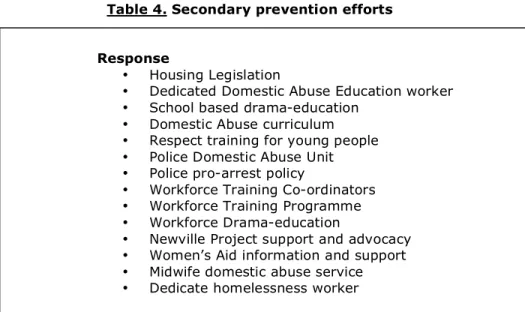
A comprehensive public health approach to preventing domestic violence involves working at all three levels of prevention, primary, secondary and tertiary, each defined by their temporal aspects. Primary prevention takes place before violence occurs, secondary prevention are efforts enacted immediately afterwards to prevent the problem worsening and tertiary prevention occurs over the long-term to continue
member states are currently making effort towards secondary and tertiary prevention, but advises that
“such responses, while important and in need of strengthening, should be accompanied by a greater investment in primary prevention”. The report notes a preponderance of programmes attempting to “deal with the immediate and numerous consequences of intimate partner violence” (secondary and tertiary prevention efforts) (Krug et al., 2002, p. 113). The efforts to develop sufficient programming are said to be understandable, but result in an overshadowing of the importance of developing primary prevention efforts.
The report clarifies that a
“comprehensive response to violence is one that not only protects and supports victims of violence, but also promotes non-violence, reduces the perpetration of violence, and changes the circumstances and conditions that give rise to violence in the first place”
(Krug et al., 2002, p. 15).
Long-term success in the prevention of violence is said to require comprehensive, collaborative approaches across institutional sectors at local (community), national and global (international) levels. The report advises that responses must include “empowering women and girls, reaching out to men, providing for the needs of victims and increasing the penalties for abusers” (Krug et al., 2002, p. 113). The
involvement of children and young people and a focus on ‘changing community and societal norms’ are said to be ‘vital’ in any efforts to successfully reduce violence against intimate partners.
Considering Existing Responses To Domestic Violence
The WHO has set a challenge to member states to work to prevent violence in all its forms within their borders. The public health approach is suggested as a way to work towards prevention, but the details as to how the commitment made by member states could or should be enacted is left up to each state to determine. Whether these commitments are being enacted in practice is yet to be seen. What resources, if any, are committed to responding to this public problem and preventing its occurrence is not known. As suggested by the WHO report, if there are active efforts to intervene in domestic violence within states, it cannot be presumed that prevention is a goal, or that root causes are being tackled.
The study presented below is concerned with how domestic violence is responded to in the public realm, with a particular interest in prevention efforts. The frameworks discussed so far explain how domestic violence is understood in theory, while the following section turns to how it is responded to in
Responses To Domestic Violence In Practice: A Literature Review
General Domestic Violence Literature
Peer reviewed literature on domestic violence over the past two decades covers a multitude of issues related to the phenomenon of domestic violence. Some aspects, however, are presented more frequently, such as (i) those with a focus on elements of risk of being victim to domestic violence, or risk of repeat offending by perpetrators, (ii) the treatment of perpetrators or victims of domestic violence, and (iii) the physical and mental health impacts of living with domestic violence. In general, the published research focuses overwhelmingly on either the perpetrators of domestic violence or those who find themselves victim to it. Few articles relate to the role of communities, society, culture or institutions in this social problem (see Salazar & Cook, 2002 for a comprehensive overview).
Literature On ‘Responses To Domestic Violence’.
A small literature was found on responses to domestic violence, published since 2000 (119 journal articles). Of these research articles, the responses discussed were largely split between (i) exploration of responses to domestic violence at the system level (such as the criminal justice system or the health care system) (28%) (e.g. Seave, 2006; Fleury-Steiner, Bybee, Sullivan, Belknap & Melton, 2006; Allen, 2006;
Hopkins & Koss, 2005; Pennell & Francis, 2005; Burman & Chantler, 2005; Mears & Vusher, 2005;
Welsh, 2005) (ii) responses by particular bodies (such as the police or medics and including policy, resource provision and treatments offered), (28%) (e.g. Stapleton, Taylor & Asmundson, 2007; Baig, Shadigian & Heisler, 2006; Worrall, Ross & McCord, 2006; Hovell, Seid & Liles, 2006; Haggblom, Hallberg & Moller, 2005; Griffin, Resick & Yehuda, 2005; Errez & Bach, 2003) and (iii) responses of victims themselves to the violence (such as help-seeking behaviours and emotional reactions) (28%) (e.g.
Buzawa, Hotaling & Byrne, 2007; Hollenshead, Dai, Ragsdale, Massey & Scott, 2006; Raj & Silverman, 2007; Fisher & Shelton, 2006; Goodkind, Sullivan & Bybee, 2004).
The remaining articles focus on a variety of responses to domestic violence, such as considerations of the perspective of women who have been victim to domestic violence (6%) (e.g. Tower, McMurray,
Rowe & Wallis, 2006; Dienemann, Glass & Hyman, 2005; Belknap & Sayeed, 2003) or understanding perpetrators and/or their responses to treatment (14%) (e.g. Rivett & Rees, 2004; Sartin, 2005; Field, Caetano & Nelson, 2004).
A small number of those papers focus on responses at the societal level (4%) (e.g. Phillips, 2006;
Gracia & Herrero, 2006) and the community level (3%) (e.g. Atkins, 2005; Rose, 2003). A proportion of all studies (13%) discuss responses at more than one ecological level, commonly looking at how
individuals (victims) engage with a particular system3 (e.g. Stalans & Finn, 2006; Kelly, 2004; Baker, Cook & Norris, 2003).
The published research overwhelmingly discusses violence against women by male partners, with a subsection exploring domestic violence within same-sex relationships, mainly within lesbian couples (e.g.
Atkins, 2005; Rosen, 2003; Younglove, Marcee & Vitello, 2002; Tigert, 2001). A very small number of papers focus on the responses geared towards young people and children as victims of domestic violence (e.g. Cohan, 2007; Waugh & Bonner, 2002).
Reflections On The ‘Responding To Domestic Violence’ Literature Reviewed
Recognising Typology
The vast majority of these studies used the term ‘domestic violence or assault’. A large proportion used the more recently adopted term ‘intimate partner violence or abuse’. Some used ambiguous terms such as ‘partner violence’ and ‘violent behaviour’, while others used specific terms for the type of violence under study such as ‘male violence’, ‘violent-men’, ‘batterers’, ‘men who batter’,
‘lesbian batterers’ and ‘battered women’. Some of the specific terms used, such as ‘abusive relationships’,
‘low-level violence’, ‘family violence’, suggest a focus on the ‘situational couple’ or ‘common couple’
type of violence, but as Johnson (2005) asserted the studies rarely acknowledged the typology engaged and typically generalised their findings to other types of domestic violence.
Frameworks Used
Gendered, psychological, sociological and public health frameworks for understanding domestic violence were all represented in the studies reviewed. The gendered and psychological frames were predominant. Gendered frameworks tended to speak of battering, while the psychologically framed studies had a strong emphasis on developing therapeutic responses to those who are victim to abuse. Some of these studies employed the now discredited ‘victim-blaming’ framework, through focussing on the psychology of victims of domestic violence, particularly the aspects of their psychology or past which puts them at risk of becoming victim to violent behaviour. It appears from this review that there is still a disproportionate focus on victims of abuse over a focus on the perpetrators. Responses focussed on perpetrators of domestic violence are reported, but are housed firmly in the criminal justice system, with no reports of wider community-based interventions with other men who abuse.
Prevention Efforts
Primary prevention efforts were not represented in the literature reviewed. As the WHO review suggested, there was an overwhelming focus on responding to the immediate and long-term needs of people who become victim to abuse or changing the behaviour of those who are abusive (secondary and tertiary prevention efforts). Assessment of risk factors for becoming victim to abuse or perpetrating abuse were reported, but not beyond the individual or relational level. Exploration of resilience to abuse, potential preventative factors, was not reported in this literature. An encouraging number of the published responses to domestic violence, did however, focus on the adequacy of provider responses, and even systems of response. This indicates recognition of the role the wider community has in responding to domestic violence. The majority of these studies focussed on the criminal justice system, however, with limited coverage of the other social and community resources that could be enacted to respond to domestic violence.
The frameworks for understanding domestic violence enable us to think through the complexities of this pervasive social problem. They offer us insights into what causes the problem and how best to respond. Reviewing the literature of reported responses to domestic violence enables us to look beyond the
theory, to how domestic violence is engaged with in practice. This provides us some insight about what action is being taken, by whom, and to what end, to address domestic violence in our societies.
Study Rationale
Despite the insights offered by such a review of the literature, the responses published in journals do not necessarily represent the actual responses to domestic violence taking place in society. By focussing on the responses of individuals, individual agencies or individual systems, the vast majority of these reported responses have been de-contextualised. They are explained in isolation to the very context in which they operate. The bulk of the responses reported were operating at the relational or community level, with very little exploration of responses at the state or society levels. Whether this is because few responses actually exist at these levels of the ecology is unknown. These studies are of course useful, but they do not facilitate our understanding of how we respond to domestic violence across an entire social ecology. In other words, these studies do not provide insight as to what the sum total efforts looks like, collectively, across all levels of a particular ecology. Such an understanding would enable reflection on how well we are responding to domestic violence, to determine where efforts are based, where resources are being allocated and why, and where resources may need to be re-allocated in order to comprehensively tackle domestic violence. The literature reviewed suggests that responses to domestic violence are not geared towards primary prevention efforts, again whether this reflects reality is unknown. Seeking an understanding of the total responses across a social ecology would provide insights as to whether or not efforts, in practice, are extending beyond secondary and tertiary prevention to primary prevention.
In order to come to know how domestic violence is responded to in practice, across all levels of a particular social ecology, a community-based case study of responses to domestic violence was
conducted. Based in the field of community psychology, this study took an ecological approach to the case study. Community psychology concerns “the relationships of the individual to communities and society. Through collaborative research and action, community psychologists seek to understand and to enhance quality of life for individuals, communities, and society.” (Dalton, Elias & Wandersman, 2001, p.
5). An ecological approach recognises that people live their lives within a social ecology, comprised of multiple-levels of action and interaction, which impact upon people's lived experience. The levels of the
social ecology interconnect the individual experiencing abuse with their family, their local community, the society and the wider cultural, political and economic structures within which they live. A community- based case study enabled the study to position itself at a level of the social ecology between individuals and the societies they live in.
Understanding the Ecological Approach
A social ecology refers to the entire society within which we as individuals live. This is the context within which we live and as such our lives cannot be fully understood without reference to it.
Taking this approach to domestic abuse views the lives of the people affected in context.
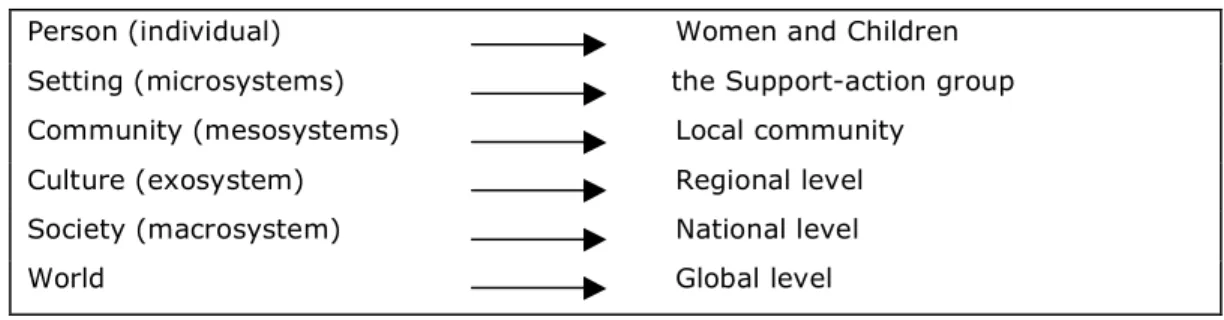
This ecology is comprised of multiple inter-connected levels. Levels include the social, political, economic and relational structures in which we live. Within community psychology the levels of our social ecology are spoken of as ‘ecological levels of analysis’ (Dalton, Elias & Wandersman, 2001). Various theorists have labelled these levels of analysis, but all follow a similar format. The levels are explained as being centred around the individual, increasingly extending out from the individual first to those levels closest to the individual, such as relationships/ family/ work to those levels furthest removed, such as political and economic systems. Analogies have been made likening the levels of the social ecology surrounding us as individuals that of a Russian nesting doll (Bronfenbrenner, 1979). The distance of the level from the individual (or the levels separating the smallest doll from the biggest) does not refer to the extent that this level has influence on the persons life, rather it connotes the distance from their daily interactions. Bronfenbrenner (1979) first assigned labels to the levels of our social ecology. He termed these levels as the individual, microsystems, mesosystems, exosystem and macrosystem (see Figure 1). He explains that
“Microsystems are the immediate pattern of activities, roles, and relationships of the individual. Microsystems are encircled by the mesosystem, the relationships between two or more settings in which the individual participates [for instance home and church]. Mesosystems exist within exosystems, which are settings outside of the individuals' direct contact but whose decisions affect the individual [e.g. your child’s school, local health services]. Lastly, the outermost ring of the model represents macrosytems, the social order and cultural norms underlying the consistencies in the inner circles”.
Maton (2000) later termed the levels of the social ecology as: person (individual), setting (microsystems), community (mesosystems), culture (exosystem), society (macrosystem) and world. The level of ‘world’ is referring to the effects of globalisation and how that also impacts upon us as individuals.
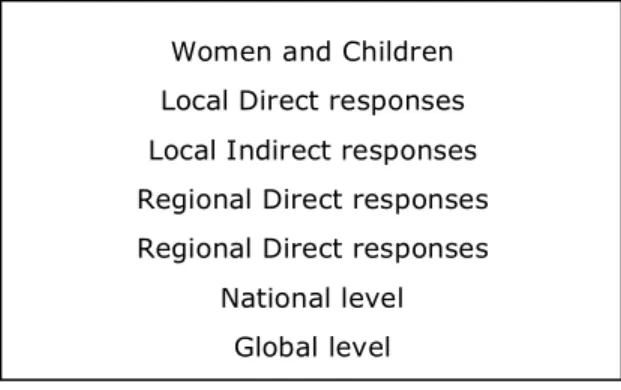
In this study taking an ecological approach entailed seeking out existing responses to domestic violence at all levels in the social ecology of which the community is a part. A community base allows development of an understanding of what responses were immediately available to individuals in the community dealing with domestic violence. The community identified also formed a base from which responses at all levels of the social ecology connected to the community could be explored and reflected upon. The use of an ecological approach enables a fuller understanding of how we respond to domestic violence in context, by identifying the responses throughout our society. Attending to the social ecology as a whole furthermore reflects the approach suggested by the preventable public health framing of domestic violence. Identifying all the places where we respond to domestic violence in this specific community’s social ecology also respects the different frameworks explaining domestic violence.
Study Aims
This study investigated (i) how domestic violence is responded to in practice, across all levels of a particular social ecology. More specifically this study sought to understand who is responding to