The Epidemic Before the Pandemic: Conceptualizing Youth Mental Health through the Social Determinants of Mental Health Framework
By Jessica Creedon
Thesis
Submitted to the Faculty of the Graduate School of Vanderbilt University
in partial fulfillment of the requirements for the degree of
MASTER OF ARTS in
Medicine, Health, and Society
May 13, 2022 Nashville, Tennessee
Approved:
Kenneth MacLeish, Ph.D.
Tara McKay, Ph.D.
JuLeigh Petty, Ph.D
ACKNOWLEDGEMENTS
I would first like to thank my advisor Dr. Kennth MacLeish for his continued support throughout this process. His encouragement and feedback were invaluable in getting me to the finish line.
I also owe a huge thank you to my thesis committee, Dr. McKay, Dr. Petty and Dr. MacLeish for working with me to finalize this project. A specific thank you to Dr. McKay for lending me a computer to finish the stata calculations while I was traveling for athletic competitions. It made my otherwise idle time on buses and planes my most productive moments.
Additionally, I want to extend my gratitude to the Vanderbilt Track and Field Coaches and staff for helping me pursue my goals on and off the track. Particularly my athletic trainers and Coach Justin Byron. Finally, I want to thank my family, friends and teammates for listening to me constantly talk about this project but never hesitating to lend a listening ear. Your support is what has made this process
possible.
TABLE OF CONTENTS
Page
ACKNOWLEDGEMENTS ... ii
LIST OF FIGURES ... iv
LIST OF ABBREVIATIONS ... v
EPIGRAPHS ... vi
Introduction ... 1
Lit Reviews ... 4
Social Determinants of Mental Health ... 4
Child Development and Youth Mental Health ... 9
Syndemic Theory ... 10
Methods... 12
Study Design and Research Objectives ... 12
Variable Selection ... 15
Results... 22
Trends in Anxiety and Depression... 22
Social Determinants of Anxiety and Depression ... 26
Multivariate Analyses Predicting Anxiety and Depression ... 34
Conclusions and Policy Recommendations ... 37
Appendix ... 40
A. Glossary ... 40
B. Variable List ... 41
C. Associations between the SDoMH and Mental Illness by Year... 45
REFERENCES ... 49
LIST OF FIGURES
Figure Page
1 “The Social Determinants of Mental Health Framework ”... 6
2 “National Survey of Children's Health Sample Size and Collection Timeline”... 14
3 “Prevalence of Mental Illness in Youth by Year”... 23
4.1 “Prevalence of Anxiety in Youth by Age and Year”... 23
4.2 “Prevalence of Depression in Youth by Age and Year”... 24
5 “Prevalence of Anxiety in Youth by Race and Year”... 24
6.1 “Predicted vs. Observed Increase in Youth Anxiety ”... 25
6.2 “Predicted vs. Observed Increase inYouth Depression ”... 26
7.1 “Cross Tabulation of Discrimination and Mental Health Outcomes ”... 27
7.2 “Cross Tabulation of AELE and Mental Health Outcomes ”... 28
7.3 “Cross Tabulation of School Safety and Mental Health Outcomes ”... 29
7.4 “Cross Tabulation of Poverty Measurements and Mental Health Outcomes”... 30
7.5 “Cross Tabulation of Food Insecurity and Mental Health Outcomes ”... 31
7.6 “Cross Tabulation of Neighborhood Features and Mental Health Outcomes”... 32
7.6 “Cross Tabulation of Mental Health Care Access and Mental Health Outcomes”... 33
8 “Reported Effort Obtaining Mental Health Care by Year”... 34
9 “Probability of Mental Illness and School Safety ”... 35
10 “Probability of Mental Illness and Racial Discrimination”... 36
LIST OF ABBREVIATIONS
YMH Youth Mental Health
CDC Center for Disease Control and Prevention SDoMH Social Determinants of Mental Health NSCH National Survey of Children’s Health WHO World Health Organization
SDoH Social Determinants of Health GxE Gene-by-Environment Interaction ACE Adverse Childhood Experience AELE Adverse Early Life Experience
FPL Federal Poverty Line
G.C. Gini Coefficient
SNAP Supplemental Nutrition Assistance Program
SES Socioeconomic Status
PCP Primary Care Physician
“Pandemics always follow the fault lines of society—exposing and often magnifying power inequities that shape population health even in normal times”
- Clarence C. Gravlee, (Gravlee, 2020)
“Epidemics have always been a mirror for social thought and plausible action — a way of thinking about the way we live — and they remain so."
- Charles Rosenberg, (Rosenberg, 2008)
INTRODUCTION
On October 19th, 2021, more than 77,000 physicians and representatives from 200 children's hospitals in the United States published a press release declaring the child and adolescent mental health crisis as a national emergency (American Academy of Pediatrics, 2021). After more than a decade of worsening youth mental health, the co-occurrence of the COVID-19 pandemic exacerbated the problem and elevated it to an urgent status. COVID presents a unique opportunity to respond with policies that target the root causes of the youth mental health (YMH) epidemic defined in the literature as the social determinants of mental health (SDoMH) (Compton & Shim, 2015). Although the social determinants fueled youth mental illness before the pandemic, the co-occurrence of both conditions brings to light the underlying social landscape perpetuating disparity and inequality. Therefore, policymakers must
understand how underlying social conditions produce, sustain, and interact with diseases to worsen health outcomes regardless of the intervening mechanism. Until this point, the social factors driving youth mental health outcomes have been insufficiently addressed. This thesis examines youth mental health before and after the pandemic to find out how social determinants influence rates of depression and anxiety in children and adolescents. It aims to inform policymakers about the social factors responsible for exacerbating mental illness so that proposed interventions target the fundamental causes.
Concern over anxiety, depression, and suicide among children and adolescents predate the pandemic. In 2019, the Center for Disease Control and Prevention (CDC) conducted a 10-year trend report examining changes in youth mental health from 2009 to 2019. The data indicates that about 37% of high school students experienced depressive symptoms in 2019, a staggering 40% increase over ten years (Ethier & Mermin, 2020). Furthermore, roughly 1 in 6 high school students in 2019 reported making a suicide plan, and in 2018 suicide was the second leading cause of death among kids ages 10-24 (Ethier &
Mermin, 2020). Taken together, these statistics paint a grim picture– America faced an epidemic in youth mental health before the pandemic (Whitaker, 2005).
The existing literature agrees that social features impact the risk and prevalence of mental illnesses (Compton & Shim, 2015; Link & Phelan, 1995). The epidemic in youth mental health is no
exception; the rise in depression and anxiety among children and adolescents is centrally driven by the social determinants of mental health. Formalized by the World Health Organization, social determinants are broadly defined as the conditions in which people "are born, grow, live, work, and age" that are governed by the multilevel distribution of money, power, and resources (World Health Organization, 2008). In regards to mental health, the literature outlines nine social factors that shape psychiatric outcomes. These variables encompass the upstream risk factors that set the stage for poor mental health and subsequent mental illness (Compton& Shim, 2015).
Recent research by psychiatrists Michael Compton and Ruth Shim (2015)insists that particular emphasis be paid to the social determinants of mental health because they arefundamental causesof mental illness. Fundamental causes, also known as "the causes of the causes," are the social conditions that dictate access to resources, affect disease outcomes, and have a persistent association with the disease despite changing contexts (Link & Phelan, 1995). This theory proposed by Link and Phelan (1995) explains that when a new condition like the SARS-CoV-2 enters the population, it inherits the existing social environment and connects new disease outcomes to enduring fundamental causes. Ultimately, the social determinants of mental health have and will continue to drive mental illness regardless of the COVID-19 pandemic.
Nevertheless, the unprecedented nature of COVID-19 has made things dramatically worse.
Recent findings indicate that youth depression and anxiety doubled during the first year of the COVID-19 pandemic (Slomski, 2021). In addition to coping with the loss of family members, challenging and novel stressors caused by the pandemic include increased social isolation, adjustment to online schooling, more screen time, less exercise and prosocial activities (sports, hobbies, clubs), and reduced medical and mental health care (Meade, 2021). Simultaneously, youth are processing the racially charged sociopolitical events that have unfolded in America since March 2020. The attacks on Asian-Americans, police brutality of Black citizens, protests in major cities, a tumultuous presidential election, and the insurrection on the U.S.
capital exposed youth– and particularly children from communities of color– to unprecedented violence and racism (Meade, 2021). Although the SDoMH fuel mental health problems regardless of COVID-19,
the pandemic and YMH epidemic are interacting in a manner that amplifies harm and disproportionately worsens the disease burden for some members of society (Singer et al., 2017; Shim & Stark, 2021).
When social and environmental factors interact with two or more co-occurring diseases to amplify adverse outcomes, it is characterized as asyndemic(Singer et al., 2017; Shim & Stark, 2021).
Notably, the syndemic approach recognizes that policy must address both the disease and the social ecosystem in which it is spreading to achieve sustainable treatment and illness prevention at the population level (Rudd et al., 2021). Despite this progress in the scientific literature, current policy targeting youth mental health during COVID has not acknowledged how multiple interrelated systems contribute to higher levels of mental illness in youth. The Biden Administration invested $85 million in funding to increase mental health access, promote equity, and foster innovation (U.S. Department of Health & Human Services, 2021). Equal access to mental health services is crucial; however policy has its most profound benefits when all of the social determinants of mental health are recognized, understood, and addressed using a syndemic approach. Therefore, it is imperative that the social and environmental factors underpinning the synergistic relationship between the YMH epidemic and COVID-19 be further investigated.
The current study presents a cross-sectional time series design of the 2017, 2018, 2019, and 2020 National Survey of Children's Health data (NSCH). This survey obtains a broad range of health data about U.S. children ages 0 - 17 years old and includes information on the nine SDoMH and youth mental health. The term “mental health” takes on many meanings and is typically tailored to reflect a specific demographic and focus. In the context of this paper, “mental health” is defined via the presence or absence of a reported depression or anxiety diagnosis at the time of the survey. While research shows that other behavioral disorders, such as ADHD and substance abuse disorder, have increased across the board, pediatric experts are particularly concerned about the incidence of depression and anxiety since the onset of the pandemic (American Academy of Pediatrics, 2021). Some may argue that higher rates of
depression and anxiety diagnoses are not associated with SDoMH or COVID, but instead reflect a broader trend of diagnosis inflation and mental illness medicalization (Horowtiz, 2012). Although these
phenomena are occurring in psychiatry, the “soaring rates” of mental health witnessed by pediatric doctors exceed any general rise in diagnosis rates (American Academy of Pediatrics, 2021).
The yearly collection of the NSCH survey allows for a multi-year analysis to investigate how depression and anxiety vary pre- and post-pandemic in relation to the SDoMH. This thesis aims to answer three primary questions:
1. How has depression and anxiety in youth changed pre- and post-pandemic and for whom?
2. Are changes in depression and anxiety related to the SDoMH?
3. Does COVID interact with the SDoMH in a way that explains the increase in depression and anxiety?
The results of this study show that social inequality drives mental illness in youth regardless of the novel stressors created by the COVID-19 pandemic. Some forces behind youth mental illness have clear policy levers for changing them, for example, an unsafe school environment, food insecurity, child poverty, and lack of healthcare access. Although broadening the coverage of mental health resources is essential, these findings show that policy interventions must also target other social factors associated with higher rates of mental illness.
LITERATURE REVIEW The Social Determinants of Mental Health
The social determinants of mental health are the non-medical psychosocial and socioeconomic influences that enable mental suffering and drive illness in the population (Fink-Samnick, 2021).
Psychiatrists Micheal Compton and Ruth Shim created a theoretical model to diagram the multivariate relationship between the SDoMH and psychiatric illness. Their proposed framework demonstrates how upstream factors fundamentally shape mental health outcomes by illustrating numerous pathways along the causal chain. This section will explore concepts foundational to the SDoMH, define and review the nine SDoMH outlined in the Compton and Shim model, and describe how these determinants organize and structure this thesis' analysis.
The SDoMH framework is grounded in concepts from medical anthropology and public health.
Medical anthropologists Link and Phelan (1995) developed the theory offundamental causesto explain how social conditions upstream on the causal chain drive disease outcomes by shaping access to
resources. These "causes of the causes" are related tosocial inequality, defined as the uneven distribution of money, power, and resources (Compton & Shim, 2015). Individuals with access to a broad range of resources enjoy health advantages and avoid diseases, while those without abundant social and financial resources suffer a more significant burden of illness (Link & Phelan, 1995). Moreover, these advantages and disadvantages are persistent. In other words, health outcomes are influenced by resource distribution no matter what disease or intervening mechanism is present in a population at a given time (Link &
Phelan, 1995). Therefore, one's position within a resource distribution system dramatically influences their health status.
The uneven distribution of resources in society creates health disparities and health inequities (Phelan et al., 2010). Health disparities describe population-level differences in health outcomes within and between societies (Compton & Shim, 2015). These differences are characterized as inequity resulting from systemic, avoidable, and unjust public policies (Compton & Shim, 2015). Thus, addressing the fundamental causes of disease is a matter of social justice, a moral imperative that upholds every individual's right to an opportunity for a healthy, meaningful, and empowered life (Compton & Shim, 2015).
Social justice is the cornerstone of public health ethics, another field foundational to the
conception of the SDoMH framework. The World Health Organization (WHO), a United Nations agency responsible for protecting international public health, expanded on Link and Phelan's fundamental cause theory to define social determinants of health (SDoH). As stated above, this concept describes how the larger-scale social systems impact the environment and impact physical health outcomes on the population level (( World Health Organization, 2008). The distribution of social determinants, such as food, insurance coverage, income, housing, are dictated by economic arrangements, political agendas, and public policies ( World Health Organization, 2008).
A few years later, the WHO published a document extending the social determinants model to include behavioral health. This paper emphasized the essential responsibility of the government to develop policies and social programs that foster mental wellness across the lifespan (World Health Organization and Calouste Gulbenkian Foundation, 2014). Additional research reiterates this point and shows that health outcomes improve over time when governments invest their resources toward decreasing health inequities created by social determinants (Compton & Shim., 2015). Therefore, designing policies to increase health equity is paramount to improving mental wellness and reducing mental illness on the population level.
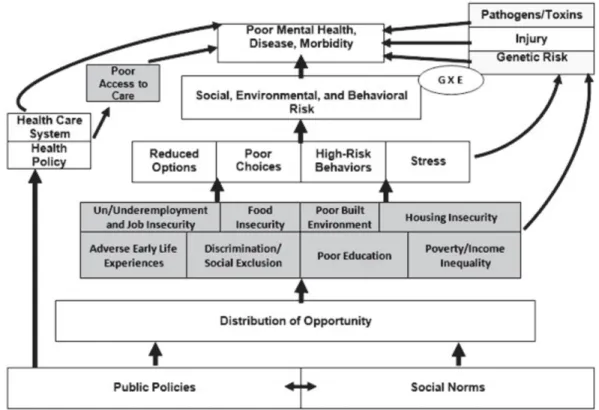
Figure 1 - The Social Determinants of Mental Health Framework
The Compton and Shim model builds off concepts from the aforementioned literature to explain how structural and social factors dictate behavioral health outcomes. Illustrated in Figure 1, many
variables along the causal chain influence the risk for poor mental health, illness, and morbidity. The most proximal individual-level forces are social, environmental, and behavioral risk factors. These risk factors describe features of one's immediate environment associated with increased prevalence of mental illness,
such as family and peer relationships, stressful life events, illicit substance use, urban upbringing, and demographic characteristics (Compton & Shim, 2015).
Additionally, this model depicts a direct impact of biological features. Discoveries in
neuroscience have transformed psychiatry's understanding of mental illness to recognize the profound effect of genetic heritability and gene-by-environment interactions (GxE), otherwise known as epigenetics. Epigenetics studies the stable, functional gene alterations that occur without changing the DNA code (Anway et al., 2005). Furthermore, a growing field of research examines psychological stress's harmful effects on mental health. Altogether, social, biological, and psychical features directly impact an individual's risk for mental illness. These influences are well-understood in psychiatry due to the
emergence of the biopsychosocial model (Compton& Shim, 2015).
However, Compton and Shim's model goes a step further to highlight the fundamental causes of proximal individual risk factors- the social determinants of mental health. Nine socioeconomic factors are identified in this model as underlying drivers of mental illness at the population level. These factors are shaded grey in figure 1 and listed as follows: (1) adverse childhood experiences; (2) racism, social exclusion, and discrimination; (3) poor education; (4) poverty, neighborhood deprivation, and income inequality; (5) unemployment and underemployment; (6) food insecurity; (7) poor housing quality and housing instability; (8) adverse features of the built environment, for example, public-works infrastructure and housing/office/school buildings; (9) poor or unequal access to health care services (Compton& Shim, 2015). Definitions and examples of these variables are further explained in the methods section.
Unlike proximal individual risk factors, these nine variables have a distal but profound influence on mental health outcomes. Figure 1 depicts the positions of the SDoMH on the causal chain, showing that poor access to mental health services directly impacts the severity and progression of mental illness.
Still, it is not a proximal risk factor because access to care is socially constructed and determined by health policy and government-designed health care systems. The other eight SDoMH are grouped together because they interact to create an environment prime for mental suffering. By reducing options,
creating stress for the individual, and increasing the likelihood of high-risk behaviors and poor choices, the SDoMH are the "causes of the causes" that precede proximal risk factors for mental illness.
There are two important notes to make about how these variables are defined. First, it is necessary to highlight that the Compton and Shim framework artificially divides these fundamental drivers into nine categories. While this facilitates visualizing and analyzing the SDoMH's specific impact on mental health, it is not wholly accurate. In reality, the SDoMH are inextricably linked and frequently co-occur in
community settings leading to an even greater risk of illness (Compton & Shim, 2015). Due to the highly interconnected nature of these variables, they cannot be considered independent in this paper's analysis or our conceptualization of SDoMH. Second, these variables are reviewed in the context of behavioral health outcomes, but the SDoMH and the SDoH are created by the same upstream causes (Compton& Shim, 2015). These ubiquitous social factors affect health and illness and must be addressed to reduce inequalities that expose subsets of the population to a higher risk for mental illness.
Underpinning all social determinants of mental health are society's written and unwritten rules:
public policiesandsocial norms. Public policies are ordinances, rules, regulations, funding, court decisions implemented by a governmental entity (Compton& Shim, 2015). These are the written rules of society that organize how resources and opportunities are distributed across the population. Social norms are society's unwritten rules. Attitudes, biases, and opinions create a social stigma that sets the stage for poorer health among disadvantaged groups (Compton & Shim, 2015). Public policies and social norms perpetuate an unwell society, in which social structures drive poor mental health, and an unfair society characterized by prominent health disparities and inequalities. Therefore, reducing mental illness and promoting behavioral health equity requires optimizing public policies to make them more
health-promoting and redefining social norms to prioritize the health of Americans (Compton & Shim, 2015).
Despite the considerable evidence, American psychiatry has been slow to recognize how social conditions impact behavioral health at a societal level. U.S. doctors primarily understand mental illness as a brain-based disease resulting from genetic predispositions and 'chemical imbalances' rather than a
disease outcome underpinned by social determinants (Horwtiz, 2012). The etiology of mental illness has definitive biological causes, but focusing on individual-level risk factors limits large-scale prevention methods and disregards health disparities and inequities (Link & Phelan, 1995). A population-level approach to behavioral health gained traction in 1999 when the sitting surgeon general published a report urging mental health inclusion within the public health field (Compton & Shim, 2015). More progress was made last year when the American Psychological Association launched a task force investigating mental health equity that focuses on the SDoMH (American Psychological Association, 2021).
Now that mental health equity is receiving greater formalized attention, special focus must be given to the SDoMH to inform policy responses. Fundamental cause theory and the SDoMH framework tell us that health inequity is inextricably linked to social inequity, both of which arise due to systemic variations in resource distribution (Phelan et al., 2010). By examining health inequity, researchers can visualize the social landscape to better understand and correct the consequences of unjust social systems (Gravlee, 2020). Although policy must target mental illness at all levels of the causal chain, the greatest preventative effects arise when policy targets the root causes (Compton & Shim, 2015).
Child Development and Youth Mental Health
The evidence reviewed to this point establishes social factors as fundamental causes of mental illness and inequity in the population. This section will highlight the critical significance of this
developmental period and demonstrate why it deserves specific attention and targeted intervention from policymakers.
Childhood and adolescence are distinct developmental periods during which individuals undergo cognitive, neural, moral, and social development. Psychologists were the first to examine the critical differences between childhood, adolescence, and adulthood. Erik Erikson famously proposed the psychosocial theory of human development in the 1950s that identifies eight stages of maturation spanning infancy to late adulthood (McKenna & Marks, 2018). In this theory, five of the eight
psychosocial milestones occur during childhood and adolescence and set the stage for wellness across the
lifespan (McKenna & Marks, 2018). Furthermore, Psychologist Lev Vygotsky created the sociocultural theory of cognitive development to describe how children interact with members of society to gain cultural values, beliefs, and problem-solving strategies (Tavassolie & Winsler, 2018). Both theories explain how the social and cultural environment impacts youth development.
In addition to developmental psychology, neuroscience demonstrates the significance of early life experiences on brain development. Most mental disorders begin in childhood. For example, evidence shows that traumatic stress during childhood increases the likelihood of mental illness in adulthood (Mock & Arai, 2011). Stressors created by the physical environment and the social hierarchy have induced epigenetic change that can predispose future
generations to a higher risk of mental illness (Gapp et al., 2016; Saavedra-Rodríguez & Feig, 2013). However, genetic risk is differentially expressed in response to environmental features. Studies show that one's environment can have protective effects on mental wellness by improving behavioral flexibility and resilience (Gapp et al., 2014). For example, one study in rodents found that enriching environments equipped with social, cognitive, and physical stimuli effectively reversed the deleterious genetic biomarkers caused by early life stress (Gapp et al., 2016). These results underscore the profound long-term impact early-life experiences have on mental health and the critical importance of the built environment. Therefore, policies designed to structure the child and adolescent environment to promote mental wellness have the highest potential for preventive effects.
Syndemic Theory
The emergence of SARS-CoV-2 in America added a layer of complexity to the already intricate relationship between the social determinants and mental health outcomes. Policymakers must understand how the SDoMH, COVID-19, and the youth mental health epidemic cluster and interact to create
interventions that effectively reduce youth mental illness. This section will describe the syndemic theory regarding COVID-19 and claim that its interaction with the YMH warrants a syndemic approach to policy interventions.
Synergy describes when two entities interact to produce a combined effect more significant than the sum of their separate effects. In other words, synergy occurs when one plus one is greater than two.
This concept was first applied to health phenomena in the 1990s by the American medical anthropologist Merrill Singer and has since gained wide recognition in public health and medical disciplines (Singer et al., 2017). Singer et al. (2017) defines synergistic epidemics, or syndemics, as "the aggregation of two or more diseases or other health conditions in a population in which there is some level of deleterious biological or behavior interface that exacerbates the negative health effects of any or all of the diseases involved." Syndemic theory describes disease concentration, interaction, and the underlying social forces that fuel harmful disease patterning.
Public health events must meet three criteria to qualify as a syndemic. First, two or more biological or behavioral factors need to co-occur and cluster together within the population. Clustering occurs when health conditions aggregate among only some population members and are guided by social determinants. The second criteria require that contextual and social factors, otherwise known as the SDoH, stimulate disease clustering in the population (Singer et al., 2017). Finally, syndemics must result in adverse disease interactions that make the health burden on people more significant than that of the individual disease's effects (Singer et al., 2017). Unlike two comorbid problems that occur in parallel, syndemics interact and amplify adverse health outcomes. Ultimately, syndemics can exist anywhere there is social inequality.
Recent scholarly debate has referenced this theory to argue for the characterization of COVID-19 as a syndemic (Horton, 2020; Mendenhall, 2020). The dynamics between COVID and pre-existing physical health conditions like hypertension, diabetes, cardiovascular disease, and cancer follow the established faultlines of society (Gravlee, 2020; Horton, 2020). Additionally, the intersection of mental health, structural racism, COVID-19, and its resulting inequalities are recognized as syndemic in nature (Shim & Starks, 2021). Long-established patterns of inequality in American society dictate which members of society bear the most significant burden of disease; this is a reality that predates COVID-19 but has been laid bare in its wake. The benefit of a syndemic approach is that it centers the discussion on
social conditions as fundamental causes of health inequalities and drivers of adverse health outcomes (Horton, 2020). However, the social and environmental factors underpinning the synergistic relationship between the youth mental health epidemic and COVID-19 have yet to be examined.
METHODS Study Design and Research Objectives
Drawing on fundamental cause theory, the social determinants of mental health framework, and syndemic theory, this thesis analyzes youth anxiety and depression from 2017 - 2020 to learn how the social determinants of mental health have influenced rates of depression and anxiety in children and adolescents before and after COVID-19. Furthermore, it aims to characterize the relationship between mental health outcomes and social mechanisms to inform effective and equitable policy interventions.
To achieve this purpose, the researcher conducted a three-phase study using a cross-sectional time-series design. The first phase created graphs and figures to depict the changes in depression and anxiety diagnoses from 2017 - 2020. Calculations used to make these figures account for demographic characteristics and expected trends. The researcher predicts that anxiety and depression prevalence will be higher for middle to late adolescence and children in marginalized racial groups. Additionally, the
researcher predicts that mental illness prevalence will be greater in 2020 than an expected increase based on previous years due to the COVID-19 pandemic.
The second phase examined the relationship between mental health outcomes and the SDoMH using bivariate analyses. The hypothesis predicts that children who experience harmful SDoMH will have a higher proportion of anxiety compared to the national average and children not exposed to the SDoMH.
Finally, the third phase builds on the initial findings to investigate and compare interactions between SDoMH, mental illness, and year. This is achieved using a logistic regression model for depression and anxiety in which the SDoMH variables and year are predictors. To support a syndemic interaction
between the YMH epidemic, SDoMH, and the COVID-19 pandemic, the researcher anticipates the results
to show a main effect of year and an interaction between year, SDoMH variables, and mental health outcomes.
This quantitative analysis is conducted using 2017, 2018, 2019, and 2020 National Survey of Children's Health data. The NSCH is a national sample survey conducted yearly by the Census Bureau since 2016, with prior iterations collected in 2003, 2007, 2011, and 2012 by the National Center for Health Statistics at the Centers for Disease Control and Prevention (The United States Census Bureau et al., 2021). Data is collected using a two‐phase multimodal design. First, a screener survey identifies if children live in the household and randomly selects one child from each home to be the subject of the questionnaire. Second, the adult completes the topical questionnaire tailored to the child's age group: 0-5 years, 6-11 years, and 12-17 years. The questionnaire is completed online or via mail by request and offered in Spanish and English (The United States Census Bureau et al., 2021).
The NSCH was selected for this analysis because it obtains a broad range of data on U.S.
children's physical, emotional, and mental health ages 0 - 17 years old. This survey comprehensively reviews information on access to behavioral health care, mental illness prevalence, socioeconomic status, food security, adverse early life experiences, and community features across the United States.
Furthermore, the yearly collection of this survey allows for a multi-year analysis to investigate how these variables may vary pre- and post-pandemic. Data in the 2017 NSCH survey was collected from June 2017 - January 2018, the 2018 NSCH from June 2018 - January 2019, 2019 NSCH from June 2019 - January 2020, and the most recent 2020 NSCH collected from June 2020 - January 2021 (The United States Census Bureau et al., 2021). Therefore, the 2019 survey captures data directly preceding the onset of the COVID in America and the March 2020 lockdown. The 2020 survey reports measures from directly after the lockdown through the election cycle and inauguration of President Biden.
All analyses used the statistical software package STATA and were exported to Excel to create graphs and figures. However, multi-year studies demand special considerations because four years of results are compiled into one data set. Although this increases the sample size to produce national estimates with smaller standard errors, multi-year analyses must first check for data consistency across
years (U.S. Census Bureau et al., 2021). The 2017- 2020 surveys vary in the wording of questions, response options, and reported ranges. Sometimes these modifications include adding or removing variables. In such cases, variables may not be combined across years. Therefore, NSCH Survey Item Crosswalk was used to determine which variables remain consistent from 2017 to 2020 and can be included in this analysis. For example, the variable measuring demand for professional mental health treatment is only measured in the 2018 - 2020 surveys.
Next, multi-year analyses must correctly adjust the yearly survey weights to reflect the average annual population. Since each survey year is individually weighted to represent the population of children in households for that year, the adjusted survey weight averages across the yearly weights to derive an accurate multi-year measurement of U.S. children ages 0-17 when comparing across years (U.S. Census Bureau, 2021). In this case, each survey weight is divided by four. Adjusting the survey weight is necessary to ensure correct estimates of variance and standard errors for the population of children.
Finally, prevalence estimates of depression and anxiety from multiple years are adjusted to represent each survey year equally. For example, the sample size for the 2020 NSCH is twice as large as the sample size in 2017. Therefore, aggregate estimates across years balance the data so that all years are equally
represented to avoid bias (U.S. Census Bureau, 2021).
Figure 2 - National Survey of Children's Health Sample Size and Collection Timeline
Year National Sample Size State Sample Size Range Dates Collected
2017 21,599 343 - 470 June 2017 - January 2018
2018 30,530 520 - 769 June 2018 - January 2019
2019 29,433 474 - 651 June 2019 - January 2020
2020 42,777 644 - 3039 June 2020 - January 2021
The results of this study do not speak to causal relationships. Instead, the findings measure associations between variables and detect trends in the general population. Another limitation of this analysis is the indirect collection of data. These findings' accuracy depends on a guardian's evaluation of their child's health status instead of direct clinical measurements. However, this study captures
associations between the SDoMH, the YMH epidemic, and the COVID-19 pandemic, which can
promulgate further investigation into underlying social mechanisms. The researcher hopes the information presented here can facilitate dialogue about the social foundations of mental illness and inform effective and equitable mental health policy.
Variable Selection
Variables included in this analysis represent temporal factors, mental health outcomes, and Compton and Shim's SDoMH. The most fundamental variable associated with this study design is year;
2017, 2018, 2019, and 2020 survey years are used throughout this study to examine how relationships between variables change over time. Additionally, time is an important aspect of syndemic theory because two conditions must simultaneously occur in order to produce interactions that exacerbate health
outcomes. Therefore, 2020 is the only time frame included in this study that represents syndemic interaction between COVID-19 and the YMH epidemic. There are distinct limitations to this
measurement since the pandemic began at the end of 2019 and remains a public health threat to this day.
Furthermore, youth mental health was not declared an emergency by doctors until October 2021 (American Academy of Pediatrics, 2021). However, the year variable can be used to calculate youth mental health trends over time and reveal when changes in youth mental health outcomes may have occurred.
Next, this study defines behavioral health as anxiety and depression. The NSCH has three questions about anxiety and depression in the questionnaire that reflect historical prevalence, current prevalence, and severity of the condition. Although the question's wording does not specify whether a healthcare provider explicitly diagnosed the child with anxiety or depression, it will be considered in this analysis as equivalent to a diagnosis and proxy measurement of mental illness. The variable was recoded to only include youth with a current diagnosis of depression or anxiety during the survey year. The question wording for anxiety and depression are identical except for 'anxiety problems' is replaced with 'depression':
Has a doctor or other health care provider EVER told you that this child has anxiety problems?
1 = Yes 2 = No
If yes, does this child CURRENTLY have the condition?
1 = Yes 2 = No If yes, is it:
1 = Mild 2 = Moderate 3 = Severe
The researcher used the definitions described in the Compton and Shim bookSocial Determinants of Mental Healthto evaluate criteria for the SDoMH in this analysis. Selecting variables that matched Comptonand Shim's definitions required consulting the NSCH Crosswalk, which outlines all survey questions, modifications, additions, and deletions since 2016 (Child and Adolescent Health Measurement Initiative, n.d.). Readers can find the exact wording of each survey question used in this analysis in Appendix A. Descriptions of the nine social determinants of mental health is as follows:
Discrimination, racism, and social exclusion.This SDoMH is defined as prejudice,
discrimination, and social exclusion based on race, age, or sex. Although all discrimination has negative consequences for mental health, Compton and Shim focus specifically on the adverse effects of
race-based discrimination due to the long history and ongoing state of racial inequality in the United States (Comtpon et al., 2015). Furthermore, the relationship between racism, chronic stress, and mental illness is best documented in the literature compared to other types of discrimination (i.e., sexual orientation). The literature finds that chronic stress created by systemic racism contributes to poor physical and mental health outcomes. Specifically, the nervous system's stress response can become overloaded, which is linked to hypertension as well as depression and anxiety (Compton & Shim, 2015).
The stressors associated with the pandemic have exposed historically marginalized races to higher levels of traumatic stress. For example, children are coping with the loss of family members at
disproportionately higher rates. Compared to White and Asian Americans, the COVID-19 death rate is two times higher for Pacific Islander, Latino, Indigenous, and Black Americans (APM Research Lab
Staff, 2021). The factors that place communities of color at increased risk of dying from COVID-19 also elevate their risk of adolescent mental illness.
The 2017 - 2020 NSCH survey asks a question directly measuring racial discrimination.
However, a question regarding discrimination on the basis of sexual orientation and gender identity was only added in 2020 and therefore could not be used in this analysis. Although this study cannot measure it, evidence suggests COVID-19 has had a disproportionate impact on the mental health of LGBTQ youth.
More time spent in the home environment due to the national lockdown in March 2020 increases the risk of suicide and depression for LGBTQ youth who experience parental rejection (Ormiston & Williams, 2022). Additionally, children with multiple intersecting and marginalized identities are at the highest risk of mental illness. However, this is unable to be adequately captured by the NSCH survey or this analysis (Ormiston & Williams, 2022).
Adverse early life experiences.Adverse early life experiences (AELE), also known as adverse childhood experiences (ACE), are defined as threatening and stressful social interactions within the family, neighborhood and school environment before the age of 18 years (Compton & Shim, 2015).
Research links stressful life events during childhood with long-term physical and mental health consequences (Mock & Arai, 2011). Examples of AELEs include violence and abuse, caretaker
incarceration, mental health and substance abuse of one's guardian, and caretaker death. These complex interactions with the social environment fuel mental illness in the population because some groups are at higher risk of experiencing an early life stressor due to their social and economic status. Angeles can be addressed with public health interventions and policies to promote safe, stable, and nurturing
environments for youth, further emphasizing their role as a social determinant of mental health (Compton
& Shim, 2015).
The NSCH survey asks a series of questions about the most common adverse childhood experiences. Unfortunately, recent research regarding AELEs during the pandemic predicts increased prevalence linked to increased parental stress and mental health struggles (Bryant et al., 2020). More time
spent at home with family was a positive experience for some children, but higher levels of parental stress combined with economic hardship increased the risk of maltreatment for others.
Poor education.Extensive research supports the relationship between education and health outcomes; low education is related to diverse illness states, while better education predicts better health (Compton & Shim, 2015). This relationship partly exists because less-educated individuals struggle to find secure jobs with sufficient pay. Education quality is also linked to mental health outcomes because the school setting is a crucial environment for children to learn foundational social and psychological skills that promote mental wellness across the lifespan. Children who inadequately acquire these skills are at elevated risk for depression, anxiety, hostility, and feelings of hopelessness, helplessness, and
worthlessness (Compton & Shim, 2015).
Many reports have been published describing how the pandemic has disrupted student learning and harmed well-being. Reports show that K-12 students are five months behind in mathematics and four months behind in reading skills compared to previous years' trends and indicate that historically
disadvantaged students have been impacted the most (Dorn et al., 2021). Furthermore, the pandemic has impeded children's access to school-based mental health services when demand is at an all-time high (Ormiston & Williams, 2022). Although the NSCH does not capture information about a child's education quality, it can measure another key feature of the learning environment– school safety. The government's responsibility to enforce childhood education must also ensure that school settings are safe,
health-promoting environments for children to learn and develop (Compton & Shim, 2015).
Unemployment, underemployment, and job insecurity.The Bureau of Labor Statistics in America classifies individuals as unemployed if they do not have a job and actively seek employment (Compton & Shim, 2015). Underemployment is a related concept that measures how well the labor force is being utilized in terms of skills, experience, and availability to work (Compton & Shim, 2015). These conditions are adversely associated with physical and behavioral illness. In fact, evidence from a
meta-analysis between unemployment and poor mental health supports a causal relationship (Compton &
Shim, 2015). As previously stated, employment status is highly related to educational attainment and predictive of poverty.
Job insecurity and unemployment were significant stressors during the pandemic. The economic downturn cost tens of millions of people their jobs, and unemployment remained high throughout 2020.
Although the government provided unemployment benefits and expanded the child tax credit, this was particularly stressful for parents and guardians with dependents. Research shows that the heightened demands on parents during the lockdown correspond to a dramatic rise in stress, which can negatively affect children (Stark et al., 2020). This analysis did not include a variable measuring parent or guardian employment status.
Poverty, income inequality, and neighborhood deprivation.Poverty is measured to reflect an individual's ability to afford basic needs. In the United States, the government assesses poverty based on the federal poverty level (FPL). The FPL is used to determine eligibility for benefits and programs provided at the state level, including Medicaid and Supplemental Nutrition Assistance Program (SNAP) (Compton & Shim, 2015). Although the FPL is scaled based on the year and number of dependents per household, this calculation does not capture the local cost of living and income inequality. Income inequality reflects the distribution of income in a population compared to perfect equality. This economic feature is measured using the Gini coefficient (G.C.), of which the United States ranks thirty-first globally with a G.C. of 0.38 (Compton & Shim, 2015). A large body of research demonstrates that poverty is particularly detrimental for children and is associated with higher rates of depressive and anxiety disorders (Compton & Shim, 2015). Also included in this category is neighborhood deprivation, defined as a high proportion of individuals with low SES status living in a designated geographic location (Compton & Shim, 2015).
Link and Phelan developed fundamental causes theory in response to the persistent association between socioeconomic status (SES) and adverse health outcomes (Link & Phelan, 1995). At its most basic level, poverty is a fundamental driver of health inequality. While the government distributed stimulus checks to citizens to offset some of the economic hardships created by COVID, the pandemic
has undeniably hit low SES individuals the hardest. Although the NSCH collects information reflecting a household's position relative to the FPL, this variable was not included in this analysis because it is an imputed variable. This technique is valuable because it does not assume that the missing data are random.
However, imputed variables must be averaged together to obtain the correct standard errors and significance values which is incompatible with the experiment's design (U.S. Census Bureau, 2021).
Therefore, government welfare and Medicaid insurance coverage are proxy measurements of poverty and income inequality in this analysis.
Food insecurity.Food security is a social determinant of health because it contributes to physical, emotional, behavioral, and social well-being. Therefore, struggling to find enough food to eat and lacking sufficient healthy food is related to poor mental health outcomes. This multidimensional social construct is influenced by government programs like SNAP and other social determinants like transportation systems and poverty. These factors decide the quality, quantity, distribution, and access to nutritious food. Food insecurity has been most clearly linked to depressive disorders, though the
psychophysiological stress it induces undoubtedly elevates the risk for many behavioral health conditions (Compton & Shim, 2015).
During the pandemic, economic hardship increased the number of families facing food insecurity.
38.3 million individuals lived in food-insecure households in 2020, an increase of 3 million from 2019 (Coleman-Jensen et al., 2021). This increase will have undeniable fallout on youth mental health. Food security was directly measured by the questionnaire and did not demand recording by the researcher.
Poor housing quality and housing instability.This variable reflects one's living situation, including neighborhood environment and housing stability. Housing instability is defined as two or more moves in one year and is related to homelessness (Compton & Shim, 2015). Research finds a bidirectional relationship between homelessness and behavioral health; stress from homelessness increases the risk of mental illness, and many mentally ill individuals cannot maintain consistent housing (Elbogen et al., 2021). Inadequate housing conditions are closely related to zoning laws, mortgage rates, government programs, and other socioeconomic features. Included in this variable is neighborhood safety, which
burdens residents with high levels of psychological stress. The economic hardships created by COVID undeniably contributed to more housing instability in 2020, but the NSCH did not capture information about housing status.
Adverse features on the built environment.Adverse features of the built environment are, by definition, social determinants because they construct the physical environment in which we live, learn, work, and play. Furthermore, these characteristics are intrinsically political because they are designed by urban planners, politicians, and individuals with wealth and power. In their book, Compton and Shim highlight four environmental features that impact mental health: 1) public works infrastructure, 2) built green space, 3) housing, and 4) schools and workplaces. Public works infrastructure includes energy systems, transportation systems, communications systems, and waste management systems. An
individual's access to green space has protective effects on mental health and is particularly important for urban communities with less natural greenery (Compton & Shim, 2015). Finally, housing, schools, and workplaces are critical environments that impact mental wellness; these features overlap with the previous SDoMH on housing quality.
An unstable and unsafe home and neighborhood environment is especially detrimental for youth mental health and development since the home and school are the two primary environments in which young people live, learn, and play (Compton & Shim, 2015). To capture features of the built environment, the researcher uniquely combined NSCH questions to create new variables that characterize neighborhood quality.
Poor access to health care.Access to health care is defined as the timely use of health services to treat and produce positive health outcomes (Compton & Shim, 2015). The factors that dictate access involve health policy, the health care delivery system, insurance coverage/parity, and social stigma.
Though health care access impacts all health conditions, it is particularly significant for behavioral health in America. Shortages of mental health providers are widespread across America and much higher than shortages for primary care physicians (PCP) and doctors focusing on physical health (Summers-Gabr,
2020). Over one-third live in areas without mental health professionals, and two-thirds of shortage areas are in a rural environment (USA Facts, 2021).
Additionally, mental health insurance and parity significantly impact healthcare access and disadvantage low-income individuals. Recent findings show that only 40 percent of all psychiatrists accept any form of insurance, primarily due to lower reimbursement rates (Coe et al., 2021). When insurance companies deny claims, it is harder for doctors to accept patients with these providers, reinforcing inequity in behavioral health treatment. Finally, social stigma is a pervasive determinant for individuals needing behavioral health care. Especially for individuals from Black and Hispanic
communities, stigmatizing attitudes deter seeking treatment.
Taken together, these barriers dramatically lower the likelihood of accessing mental health services. COVID created novel stressors for parents and children; however, a healthcare system riddled with inequality and inconsistency in care failed to meet the increased demand. The NSCH asks two questions about access to mental health care which measure the demand for care and the difficulty in obtaining care. These variables did not demand recording by the researcher.
TRENDS IN ANXIETY AND DEPRESSION
The first set of analyses inquires into the worsening mental health outcomes observed by American Pediatric Professionals and characteristic of the existing epidemic. Figure 3 shows the
prevalence of depression and anxiety per survey year. An anxiety diagnosis is on average 2.3 times more common in youth than a depression diagnosis. A Pearson's chi-squared test was performed to test the association between mental illness and survey year. The relationship between the two variables is significant at an alpha level of 0.05 for depression,X²(123,722,N= 123,824) = 58.89,p= 0.001, and anxiety diagnosesX²(123,464, N= 123,566,) = 113.68,p= 0.000. This test indicates that the increase in mental illness per year is not due to chance and tells us that this difference is important.
Figure 3 - Prevalence of Mental Illness in Youth by Year
Proportion of Mental Illness 2017 2018 2019 2020 Average Prevalence
Anxiety 5.89% 6.86% 7.65% 7.85% 7.06%
Depression 2.43% 3.11% 3.28% 3.38% 3.05%
In addition to varying by survey year, the proportion of youth with mental illness varies by age.
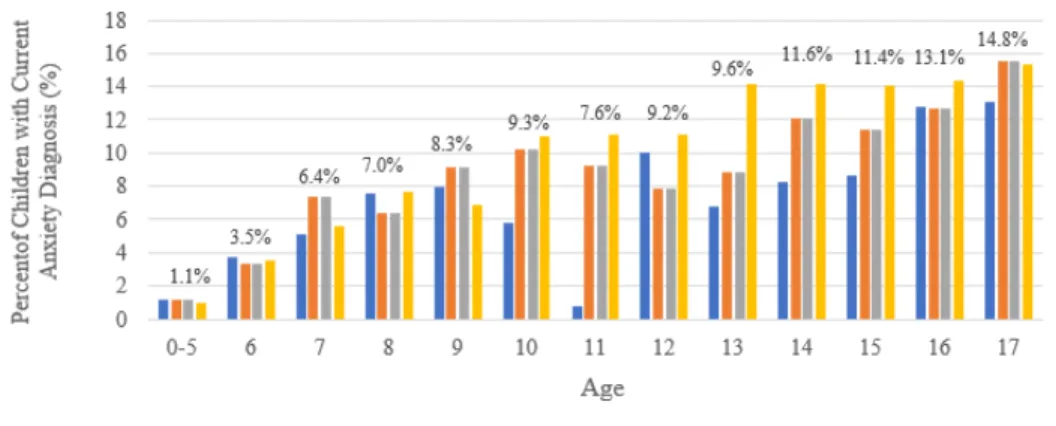
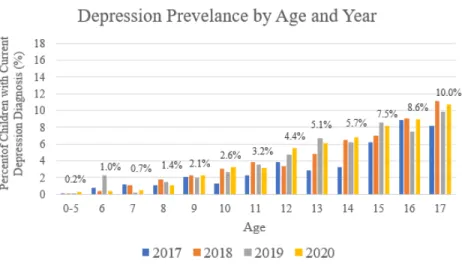
Figure 4.1 and 4.2 depict anxiety and depression reported as a function of survey year and age. The prevalence for each age group is plotted according to the survey year and distinguished by color. The number above each age category corresponds to the average percentage of anxiety and depression. Ages 0-5 are grouped together due to the low overall prevalence of mental illness.The data callouts represent the average prevalence of mental illness diagnosis from 2017 - 2020 by age in figure 4.1 and figure 4.2.
These results are consistent with the previous findings that report an increase in mental illness per year and highlight the ages that are most affected by anxiety and depression. Adolescents aged 17 have the greatest average prevalence of anxiety (x̄=14.8%) and depression (x̄=10.0%) compared to the other ages. However, 13 year old children show a large jump in anxiety during 2020. The proportion of parents reporting that their 13 year old has anxiety increased from 8.8% in 2019 to 14.2% in 2020. Children ages 11 - 12 and 14 - 16 also have increases in anxiety diagnoses in 2020.
Figure 4.1 - Prevalence of Anxiety in Youth by Age and Year
Figure 4.2 - Prevalence of Depression in Youth by Age and Year
Compared to anxiety, depression is less affected by year. The proportion of depression diagnoses in 2020 does not dramatically change from previous years. However, both mental illnesses increase with age. The graph shows depression steadily rises with a slope of 0.7965 and R² = 0.95. Anxiety increases rapidly until age 10 (m=1.60,R²= 0.95), dips slightly at age 11 then rises again until age 17 at a less rapid rate (m=1.12,R²= 0.96). In 2020, 16 year old children had the highest increase in depression from the year prior, with an estimated 1.5% more youths experiencing symptoms of depression.
Figure 5 - Prevalence of Anxiety in Youth by Race and Year
Figure 5 indicates that anxiety prevalence in children varies significantly by race,X²(122,170,N
= 122,068) = 481.8,p= 0.00. The 2017 and 2018 NSCH survey gave respondents the option to select 'some other race alone,' but removed this option in 2019 and 2020, and as such is not included in these calculations. The stacked bar graph illustrates the cumulative percentage of anxiety from 2017 to 2020 and each year's contribution to the total. Children with two or more racial identities have the highest average prevalence of anxiety (x̄= 8.65%). Although these children only make up 8.9% of the sample, they have a disproportionately high rate of anxiety prevalence that is 1.60% higher than the average anxiety prevalence (x̄= 7.06%). Children whose parents report their race as white alone (x̄= 7.06%) and American Indian or Alaska Native alone (x̄= 7.06%) have the next highest proportion of anxiety.
Figure 6.1 - Predicted vs. Observed Increase in Youth Anxiety
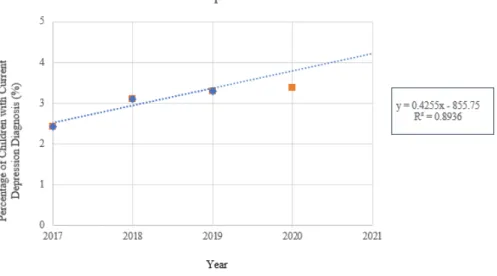
Although there is an observed increase in youth mental illness in 2020, the results indicate that this trend is not more dramatic than expected. A linear forecast based on the average proportion of depression and anxiety in 2017, 2018, and 2019 predicted a higher prevalence of mental illness for both conditions. The R²values indicate how well this linear model fits the data, showing that it almost
perfectly matches the trend in anxiety diagnoses. The linear model predicted that 8.54% of children would have a diagnosis. Instead, 7.85% of children are reported with this condition. Similarly, the trend
anticipated depression to affect 3.76% of children, but the observed prevalence in 2020 is 3.05%. This may be due to changes in other social determinants of anxiety and depression that occurred in response to
the COVID-19 pandemic, public health measures, and social and economic programs. These factors are examined in the next section.
Figure 6.2 - Predicted vs. Observed Increase in Youth Depression
SOCIAL DETERMINANTS OF ANXIETY AND DEPRESSION
Upon verifying that adverse mental health outcomes are more severe post-pandemic, the second set of analyses tests the hypothesized relationship between youth mental illness and the social
determinants of mental health. Figure 7.1 through 7.6 depict the bivariate analyses for each SDoMH concerning anxiety and depression. Figure 8 compares the effort required from parents to obtain mental health services by survey year. For cross-tabulation, the independent variable is the SDoMH, and the dependent measures are the proportion of anxiety and depression in each subpopulation. These analyses aggregate data from 2017, 2018, 2019, and 2020 NSCH surveys and are weighted to represent the population. Additionally, the frequency of the social determinants in the population is included on each table's rightmost column.
Racial discrimination
Figure 7.1 depicts the relationship between racial discrimination and mental health outcomes.
4.4% of children are reported as being treated or judged unfairly because of their race or ethnic group in this sample, totaling an estimated 3,212,000 youths nationwide. However, 17.3% of these children have an anxiety diagnosis within this portion of the population, and 10.2% are diagnosed with depression.
These statistics are staggering compared to the average prevalence of anxiety (x̄= 7.06%) and the average prevalence of depression (x̄= 3.05%). However, the impact of racial discrimination on mental health is even more profound when compared to children who have not experienced racism. Children facing discrimination are more than twice as likely to have an anxiety diagnosis as those who do not face discrimination and nearly four times as likely to have a depression diagnosis. The relationship between racial discrimination and mental health outcomes is statistically significant, indicating that differences in depression and anxiety when a child experiences this SDoMH are not due to chance.
Figure 7.1. - Cross Tabulation of Discrimination and Mental Health Outcomes
Discrimination
Anxiety
Diagnosis No Anxiety Depression
Diagnosis No Depression PROPORTION OF TOTAL
No Discrimination 6.6% 93.4% 2.7% 97.3% 95.6%
Racial Discrimination 17.3% 82.7% 10.2% 89.8% 4.4%
AVERAGE PREVALENCE 7.11% 92.89% 3.03% 96.97%
Adverse Early Life Experiences
Approximately one-third of the youth sampled in the 2017 - 2020 surveys have experienced at least one AELE, though other studies have found this proportion to be closer to two-thirds (Compton&
Shim, 2015). The results show a ubiquitous increase in anxiety and depression for children exposed to an early life stressor compared to children with no AELE history. Notably, anxiety affects only 4.5% of children whose parents report no history of adverse early life experiences, three percent less than the average prevalence (x̄=7.02%) and more than eight percent less than children who have experienced an early life trauma (x̄= 12.19%). The average proportion of anxiety in children that have experienced one of the described AELEs included in this analysis is 12.19%. This suggests a potential protective effect of positive early life experiences on mental health.
In this survey, data is collected on divorce, death of a guardian, a guardian in jail, witness to domestic abuse, witness to violence, a guardian with mental illness, and a guardian with substance abuse.
Of these stressors, living with a guardian that struggles with mental illness or substance abuse has the most significant effect on youth anxiety. Children living with a guardian with mental illness are nearly
five times more likely to have an anxiety diagnosis than children with no AELE history and three times more likely than the average probability. Due to the complex etiology of mental illness, these findings may be explained by a combination of biological and social factors. The proportion of children with depression and anxiety that have a guardian in jail, lost a parent, or have divorced parents does not differ substantially from the average prevalence.
Regarding the relationship between adverse early life experiences and depression, guardian mental illness and substance abuse also significantly affect the likelihood of this outcome. Two other stressors that increase the chance of having a mental illness are witnessing domestic abuse and violence.
In this survey, information about domestic violence is collected by asking parents if their child has ever seen or heard adults in the home slap, hit, kick, or punch one another. Violence is defined as either witnessing or being a victim of violence. Experiencing violence increases the likelihood of depression by about 5% compared to average and about 7% compared to children with no AELE history.
Figure 7.2. - Cross Tabulation of AELE and Mental Health Outcomes
Adverse Early Life Experience
Anxiety
Diagnosis No Anxiety Depression
Diagnosis No Depression PROPORTION OF TOTAL
No AELE History 4.5% 95.5% 1.2% 98.8% 67.11%
Divorce 7.6% 92.6% 2.8% 97.2% 12.29%
Death 7.3% 92.7% 3.9% 96.1% 1.79%
Jail 6.8% 93.2% 3.8% 96.2% 2.63%
Domestic Abuse 11.2% 88.8% 4.9% 95.1% 1.43%
Violence 12.5% 87.5% 8.1% 91.9% 1.60%
Guardian with Mental
Illness 22.1% 77.9% 12.1% 87.9% 4.71%
Guardian with Substance
Abuse 17.8% 82.2% 11.9% 88.1% 8.43%
AVERAGE PREVALENCE 7.18% 92.82% 3.09% 96.91%
The results show that violence has a stronger relationship with depression than anxiety; a diagnosis of anxiety is 1.7 times more likely, and depression is 2.6 times more likely when youth
experience violence. These effects are statistically significant at an alpha level of 0.05. These statistics demonstrate how early life stressors have a substantial relationship with youth anxiety and depression.
Poor education
While the school setting should be a safe and health-promoting environment for youth, these data show that one in five parents' somewhat disagree' or 'definitely disagree' that their child is safe at school.
This response directly affects the likelihood of mental illness; children who are considered 'definitely' unsafe at school are four times more likely to have an anxiety diagnosis and seven times more likely to have a depression diagnosis than children who are 'definitely safe' in the school environment. These results are significant at an alpha level of 0.05 for anxiety with school safety,X²(85,875,N =85,977) = 1170.34, p =0.000, and depression with school safety,X²(86,096,N= 86,198) = 1419.69,p= 0.000.
Furthermore, parents that somewhat disagreed with their child being safe at school are 3 times more likely to be diagnosed with anxiety and 5.2 times more likely to be diagnosed with depression than children who are definitely safe at school. One in five parents consider their child 'somewhat' or 'definitely' unsafe at school.
Figure 7.3. - Cross Tabulation of School Safety and Mental Health Outcomes
Poor Education
Anxiety
Diagnosis No Anxiety Depression
Diagnosis No Depression PROPORTION OF TOTAL
Definitely agree child is
safe at school 8.40% 91.60% 3.20% 92.82% 75.55%
Somewhat agree child is
safe at school 11.89% 88.07% 6.03% 93.97% 24.88%
Somewhat disagree that
child is safe at school 25.95% 74.05% 16.76% 83.24% 18.5%
Definitely disagree child
is safe at school 34.21% 64.47% 22.67% 77.33% 0.75%
AVERAGE PREVALENCE 9.80% 90.20% 4.40% 95.60%
An important note about these calculations is the inflated average proportion of anxiety (x̄= 9.80%) and depression (x̄= 4.40%) in the sample compared to the other bivariate analyses conducted in this section and the sample average. This result is because this question is only asked of kids attending
school in the T2 and T3 form type. Therefore, children ages 0 - 5 are excluded in this table resulting in 20,000 - 35,000 fewer data points than the other calculations. The logistic regression model created in the third section of this study accounts for this difference and can make more accurate comparisons.
Poverty and Income Inequality
In this sample, approximately one-third of children are covered by Medicaid, Medical Assistance, or another government insurance designed to assist those with low incomes or a disability. For these children, their likelihood of having anxiety or depression is one percentage point higher than the average and two percentage points higher than children without this type of insurance. This relationship is
statistically significant at an alpha level of 0.05, indicating that the variation in mental illness is related to Medicaid insurance coverage. This result estimates the impact of poverty on youth mental illness as well as access to mental health care.
Figure 7.4. - Cross Tabulation of Poverty Measurements and Mental Health Outcomes
Medicaid and Welfare
Anxiety
Diagnosis No Anxiety Depression
Diagnosis No Depression PROPORTION OF TOTAL
Received Medicaid or government medical
assistance 8.36% 91.67% 4.51% 95.49% 36.15%
No Medicaid or government medical
assistance 6.51% 93.49% 2.29% 97.73% 63.85%
AVERAGE PREVALENCE 7.18% 92.82% 3..08% 96.92%
Received cash assistance from a government
welfare program 10.72% 89.04% 5.81% 93.95% 4.30%
No cash assistance from a government welfare
program 6.87% 93.14% 2.88% 97.12% 95.70%
AVERAGE PREVALENCE 7.04% 96.99% 3.01% 96.99%
Although only 4.3% of this sample reports receiving cash assistance from a government welfare program in the past year, a chi-square test of statistical significance indicates that receiving government assistance impacts the probability of having a diagnosed mental illness. Children living in households receiving welfare, which is a proxy measurement of poverty, are 1.5 times more likely to be diagnosed with anxiety than those not receiving government assistance and two times more likely to have a depression diagnosis. Therefore, the results of these analyses suggest that poverty is associated with