I never would have considered pursuing a PhD in chemistry in the first place if it weren't for the fantastic chemistry faculty at Macalester College. In addition to the chemistry faculty, Chad Topaz in the math department also deserves special mention. I could not have been paired with a better mentor – you are the complete package: brilliant, patient and friendly.
I look forward to seeing your independent career take shape – you are open, creative and extraordinarily intelligent. Jean Li, thanks for making me feel welcome and answering my silly questions when I first joined the group. Myles Herbert, Crystal Chu, and Alice Chang, you have been my closest friends in the lab as well as easily among the closest friends I have had in my life.
Thanks for putting up with my teasing about your stint at Grubbs Lab.
INTRODUCTION
The Tsuji-Wacker oxidation has made it possible to view alkenes as masked methyl ketones with orthogonal reactivity (alkenes are much more stable than carbonyl compounds to typical basic and acidic conditions). In the decades following its initial development, the Tsuji–Wacker oxidation and related variants have been widely used in organic synthesis.3,8–10. Wacker oxidation processes are united by nucleopalladation and subsequent decomposition of the alkylpalladium intermediate to provide a carbonyl compound.
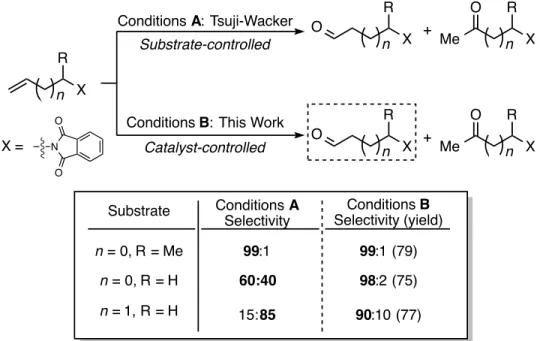
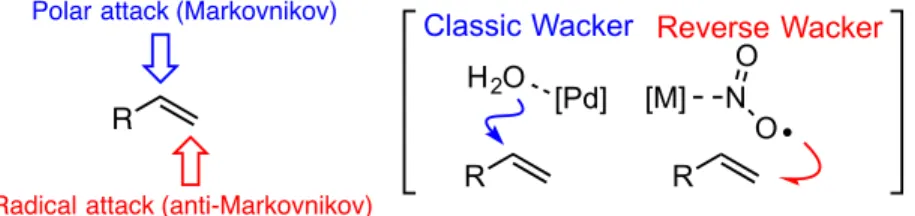
The regioselectivity of the Tsuji–Wacker oxidation is controlled by the substrate, and methyl ketone products are usually favored according to Markovnikov's rule. Unfortunately, despite initial promising results, low yields have hindered the use of tert-butanol in the oxidation of unbiased aliphatic substrates, and a synthetically useful, catalyst-controlled Wacker oxidation has yet to emerge from this strategy.26. In Chapter 2, the development of catalyst-controlled anti-Markovnik Wacker oxidation is discussed in detail.
Overall, despite more than half a century of extensive research and broad acceptance of the Wacker oxidation by the synthetic community, the reaction remains an arena full of opportunities.

CATALYST-CONTROLLED ALDEHYDE-SELECTIVE
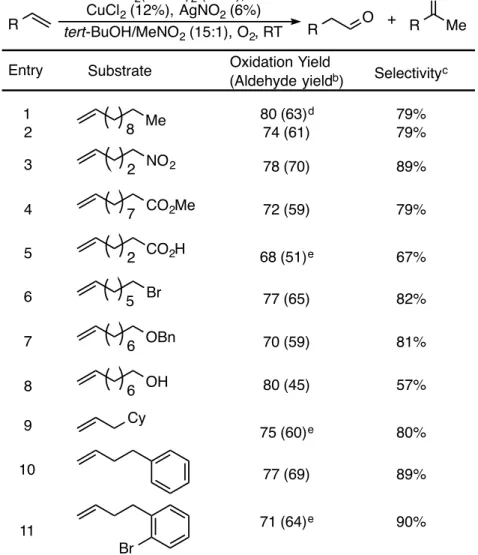
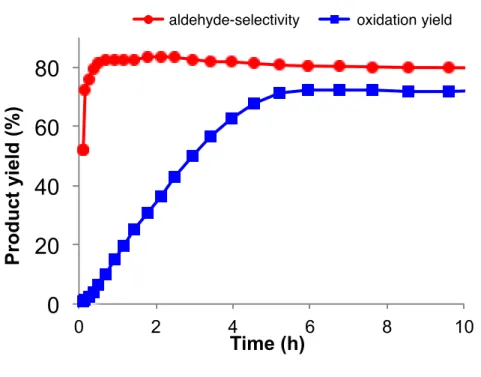
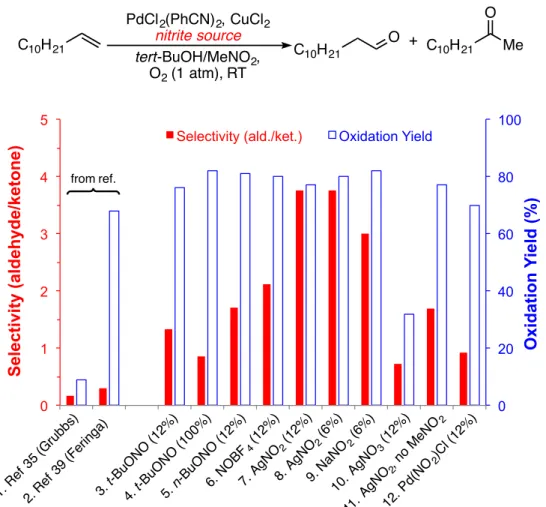
Reversal of the high Markovnikov selectivity of Wacker oxidation was achieved using nitrite additives. Finally, the origin of the influence of proximal functional groups on this anti-Markovnik reaction was investigated. The traditional approach to anti-Markovnik functionalization of terminal alkenes has been based on the ubiquitous hydroboration reaction.7 The widespread adoption of hydroboration in organic synthesis is due to the synthetic versatility of alkylborane products, which can be converted into many important functional groups.
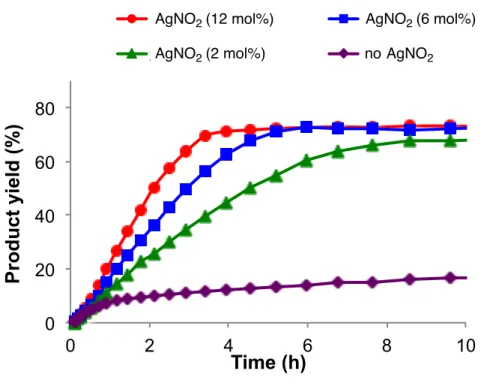
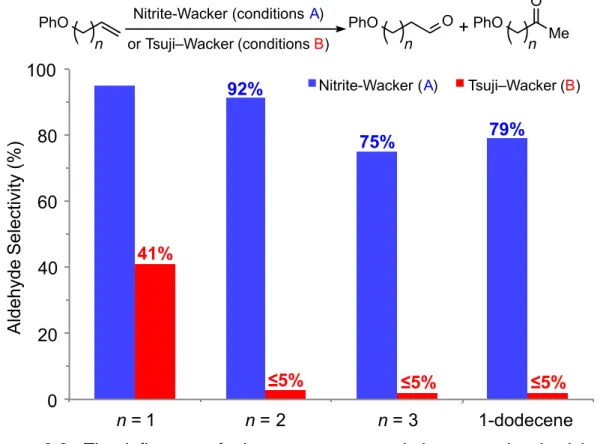
Of the nitrite sources evaluated, each offered similar oxidation efficiency with different selectivity for the aldehyde (entries 3–9). This potentially suggests that the same catalytic species, once formed, remains active throughout the rest of the reaction. Thus, we then decided to evaluate whether Lewis basic oxygen functional groups would interfere or increase the aldehyde selectivity of the reaction.
Exceptional aldehyde selectivity (>90%) was observed with both the allylic (n=1) and homoallylic phenyl ether (n=2), despite the significant difference in the inherent regioselectivity of the two substrates under Tsuji-Wacker conditions. This result suggests that the reaction will be readily amenable to producing significant amounts of the desired aldehyde products. The ratio of the aldehydic proton signal to the clearest signal from the methyl ketone was used.
AEROBIC PALLADIUM-CATALYZED ALKENE
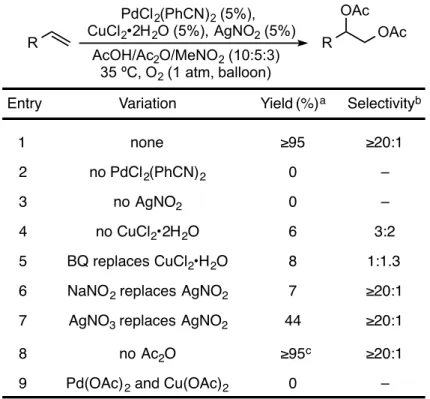
Replacing the alcohol solvent in our previously reported nitrite-modified Wacker oxidation conditions with acetic acid suppressed Wacker-type oxidation (characteristic of Pd(II)) and promoted alkene difunctionalization (characteristic of Pd(IV) or Pd(III)) (Scheme 3.2). Initial optimization revealed that increasing the amount of the nitromethane co-solvent and raising the temperature slightly to 35 ºC improved the reproducibility of the reaction. Intriguingly, each catalytic component of the nitrite-modified Wacker oxidation system (see Chapter 2) was required to facilitate mild alkene difunctionalization (Table 3.1, entries 2–4).
The omission of the copper salt resulted in poor selectivity for the dioxygenated reductive elimination products over β-hydride elimination products. Although copper is commonly used as an oxidizing agent for Pd(0), another classical oxidizing agent that mediates the catalytic cycles of Pd(II/0), benzoquinone, was found to be an unsuitable substitute, yielding poor yield and selectivity (entry 5). the empirical observations regarding copper are currently unclear. Given the potential synthetic utility of this aerobic palladium-catalyzed dioxygenation reaction, the functional group tolerance of the transformation was then examined by subjecting alkenes bearing a variety of functional groups to the reaction conditions (Table 3.1).
Having demonstrated the synthetic utility of the process, we sought to elucidate the role of the main nitrite co-catalyst in the reaction. To investigate this hypothesis, reaction profiles of the stoichiometric oxidation of 1-dodecene using nitrite and nitrogen dioxide were compared (Figure 3.1). To gain more insight into the reductive elimination event that forms C-O bonds, the source of the oxygen atoms in the dioxygenated product was elucidated.
In addition to the synthetic value of this transformation, important mechanistic evidence was provided regarding the role of the nitrite co-catalyst and the reductive elimination step. The multiples of the signals are denoted by s (singlet), d (doublet), t (triplet), q (quartet), p (pentet), and m (multiplet). Detailed discussion of the labeling experiment: The diol (rather than the mono- or diacetate) products were of particular interest because of the clarity of the position of the 18O label.
However, given that the diol oxygen atoms were the labeled positions, the masses observed in the monoacetate provide important evidence that the majority of the carbonyl oxygen atoms are not derived from the HOAc solvent. The likely source of 16O in the carbonyl oxygen is from H2O, upon hydrolysis of the acetoxonium ion.
GENERAL AND PRACTICAL WACKER-TYPE
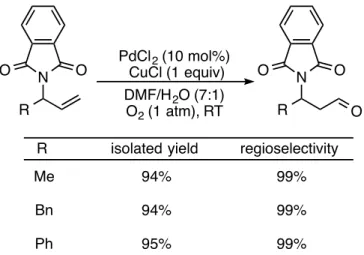
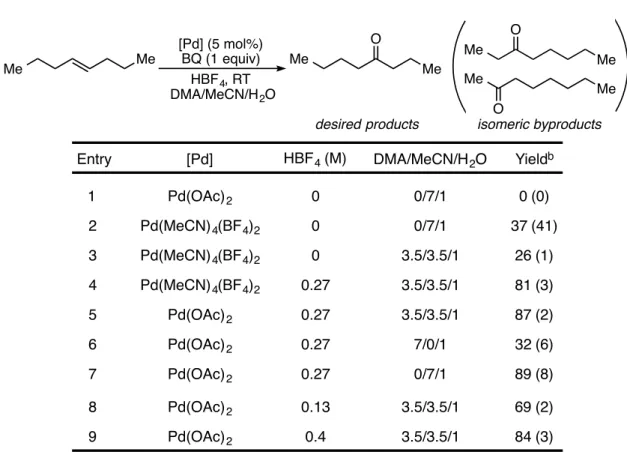
It is likely that a similar biscation complex is formed in situ in the presence of HBF4 by protonation of the acetate ligands. Control reactions showed that the use of a binary solvent mixture of DMA/H2O allowed lower conversion and, surprisingly, increased isomer formation (entry 6). In contrast, cinnamyl acetate allowed complete regioselectivity for the Markov product, indicating a strong directing effect of the acetate group (entry 8).
The internal alkene group was smoothly oxidized in the presence of the other functional groups, yielding a high yield of the desired product. Due to the paucity of reports on oxidation of internal olefins and the corresponding lack of mechanistic information, we became interested in monitoring the progress of the reaction with stoichiometric benzoquinone and both trans-4-octene (A) and cis-4-octene ( B ) (Figure 4.1). It is worth noting that other cis-alkenes studied in this work showed no detectable isomerization by raw NMR spectrum analysis.
The results described in the first part of this chapter suggest that the synthetic power of Tsuji–. No interference with the directing ability of the benzoate moiety was observed, proving the potential of this strategy for complex functionalization of molecules. After addition of the corresponding substrate (1.00 mmol), the homogeneous reaction mixture was stirred for 16 h at room temperature.
After addition of the corresponding substrate (1 mmol), the homogeneous reaction mixture was stirred for 16 h at room temperature under an atmospheric pressure of oxygen (balloon). In some cases, NMR analysis of the crude mixture was performed to determine the regioselectivity of the process. NMR analysis of the crude mixture was performed to determine the regioselectivity of the process.
The bottle was capped and removed from the glove box, placed under an Argon atmosphere (balloon) and stirred for 20 h at 40°C before quenching by addition of ethyl vinyl ether (a few drops). The solvent was then evaporated and the E/Z ratio was determined by NMR analysis of the crude reaction mixture. The mixture was stirred open in the glove box for 10 h at the indicated temperature, and then taken out of the box and quenched by the addition of ethyl vinyl ether (a few drops).
The solvent was evaporated and the E/Z ratio was determined by NMR analysis of the crude reaction mixture.
UNDERSTANDING AND MANIPULATING
Direct deconvolution of factors contributing to regioselectivity in Wacker-type oxidations of allylic functionalized alkenes has been particularly challenging due to the inherent steric and electronic asymmetry of terminal alkenes. The oxidation product of the most electron-rich position (distal to the 4-NO2-BzO group) was oxidized with regioselectivity greater than 20:1. This result complements the results of intermolecular experiments and shows that protecting group selection can enable selective oxidation, even when potentially competing directing groups are close to the alkene.
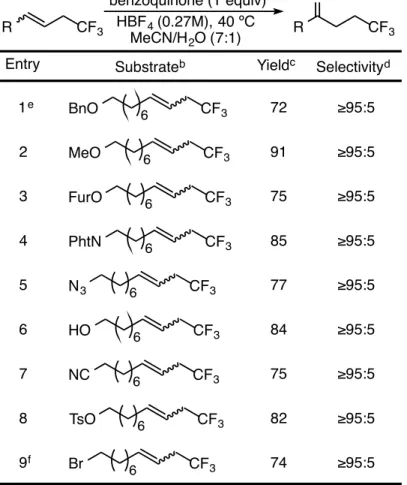
Coordination to the palladium center is often assumed to be the source of the regiochemical influence exhibited by proximal polar functional groups. 20:1 (distal:proximal) were obtained and further established the strong directing effect of the trifluoromethyl group in Wacker-type oxidations of internal alkenes. Next, we sought to investigate the driving power of the trifluoromethyl group relative to classical Wacker driving groups.
Thus, these competition experiments further illustrate the powerful steering ability of the trifluoromethyl group for the synthesis of valuable fluorinated products. To investigate the distance dependence of the observed targeting effects, a series of alkenes with trifluoromethyl groups at increasing distance from the alkene were subjected to the catalytic conditions (Table 5.2). Thus, despite replacement of the potential coordinating oxygen atom with a purely inductive trifluoromethyl group, a similar model is qualitatively accurate.
Overall, the results in this chapter improve our understanding of the regioselectivity of nucleopalladation events and lead to improved predictability in the Wacker oxidation of unsymmetrical olefins. This detailed understanding of the factors contributing to the inherent Wacker selectivity will continue to prove very valuable in the development of methods aimed at manipulating the regioselectivity of nucleopalladation in Wacker oxidations by changing the catalytic system. After the addition of the appropriate substrate (1.00 mmol), the homogeneous reaction mixture was stirred for 2 hours at room temperature.
After the addition of the substrate (0.2 mmol), the homogeneous reaction mixture was stirred for 16 hours. NMR analysis of the crude mixture was performed to determine an isomeric ratio of 31:1 (major, triplet adjacent to 4-NO2BzO: 4.62; minor, triplet adjacent to OBn: 3.77). The crude product was then further purified by column chromatography. on silica gel with pentane/ether as eluent and the oxidized product obtained in 50% yield (34.3 mg, 0.1 mmol).