Consumer and buyer behaviour
Objectives
After reading this chapter you should be able to:
• explain how consumers make purchasing decisions;
• describe the differences between the ways in which professional buyers work and the ways consumers make decisions;
• explain how consumers develop a perceptual map of the product alternatives;
• develop ways of dealing with customer complaints.
3
45 Consumer behaviour
INTRODUCTION
This chapter is about how buyers think and behave when making purchasing decisions. Buyers fall into two categories:consumers,who are buying for their own and for their family’s consumption, and industrial buyers, who are buying for business use. In each case, the marketer is concerned with both the practical needs of the buyer or the buyer’s organisation, and the emotional or personal needs of the individual.
CONSUMER BEHAVIOUR
The consumer decision-making process follows the stages shown in Figure 3.1.
Problem recognition
Problem recognitionarises when the consumer realises that there is a need for some item. This can come about through assortment depletion(where the consumer’s stock of goods has been used up or worn out) or assortment extension(which is where the consumer feels the need to add some new item to the assortment of possessions). At this point the consumer has only decided to seek a solution to a problem, perhaps by buying a category of product. The needs felt can be cate- gorised as either utilitarian (concerned with the functional attributes of the product) or hedonic(concerned with the pleasurable or aesthetic aspects of the
Feedback loops
Problem recognition
Information search
Evaluation of
alternatives Purchase Post-purchase evaluation
Divestment
FIGURE 3.1 Consumer decision-making
product).1The current view is that there is a balance between the two types of need in most decisions.2
An internal stimulus, or drive, comes about because there is a gap between the actualand desiredstates. For example, becoming hungry leads to a drive to find food: the hungrier the individual becomes, the greater the drive becomes, but once the hunger has been satisfied the individual can move on to satisfying other needs. For marketers, the actual state of the individual is usually not susceptible to influence, so much marketing activity is directed at influencing the desired state (e.g. ’Don’t you deserve a better car?’). Thus drives are generated by encour- aging a revision of the desired state. The higher the drive level (i.e. the greater the gap between actual and desired states), the more open the individual is to consid- ering new ways of satisfying the need: in simple terms, a starving man will try almost any kind of food.
It is, of course, stimulating and enjoyable to allow gaps to develop between the desired and actual states: working up a thirst before going for a drink makes the experience more pleasurable, for example. Each individual has an optimal stimu- lation level (OSL), which is the point at which the drive is enjoyable and challenging, without being uncomfortable. OSL is subjective: research shows that those with high OSLs like novelty and risk-taking, whereas those with low OSLs prefer the tried and tested. Those with high OSLs also tend to be younger.3
Drives lead on to motivation, which is the reason why people take action. The level of motivation will depend on the desirability of the end goal, and the ease of achieving the end goal; motivations are subjective, so it is difficult to infer moti- vation from behaviour. Few actions take place as a result of a single motivation, and sometimes a motivation may not even be apparent to the individual experi- encing it: in other words, some motivations operate below the conscious level.
Information search
Having become motivated to seek a solution to the need problem, consumers engage in two forms of information search.
• Theinternal searchinvolves remembering previous experiences of the prod- uct category, and thinking about what he/she has heard about the product category.
• The external searchinvolves shopping around, reading manufacturers’ litera- ture and advertisements, and perhaps talking to friends about the proposed purchase.
For most purchases, the internal search is probably sufficient. For example, a con- sumer who needs to buy biscuits will easily remember what his or her favourite brand tastes like, and will also remember where they are on the supermarket
shelf. When buying a new hi-fi set, on the other hand, a fairly extensive informa- tion search might be carried out, reading manufacturers’ brochures and looking around the hi-fi shops. The purpose of this exercise is to reduce risk; buying the wrong brand of biscuits involves very little risk, since the financial commitment is low, but buying the wrong hi-fi could prove to be an expensive mistake. For this reason many retailers offer a no-quibble return policy, since this helps to reduce the level of risk and make purchase more likely.
Evaluation of alternatives
Having found out about several competing brands, the consumer will evaluatethe alternatives, based on the information collected or remembered. In the first instance, the consumer will select a consideration set, which is the group of products that would most closely meet the need. Typically a consumer will use cut-offsto establish a consideration set: these are the minimum and maximum acceptable values for the product characteristics. For example, a consumer will typically have a clear idea of the acceptable price range for the product. (This price range might have a minimum as well as a maximum; the individual may not want something that is perceived as being cheap and nasty.) Signals are important when making choices; a particular price-tag, a brand name, even the retailer will have some effect on the consumer’s perception of the product. Price is frequently used as an indicator of quality, for example, but this can be reduced in the presence of other signals.
Occasionally the use of cut-offs eliminates all the possibilities from the consid- eration set, in which case the consumer will have to revise the rules. This can result in the creation of a hierarchy of rules.4For marketers, the challenge is often to ensure that the product becomes a ’member’ of the consideration set.
The decision-making process appears lengthy and complex as stated here, yet most of us make several purchasing decisions in a day without going through a lengthy decision-making process. This is because most of us use heuristics, or deci- sion-making rules, for most purchases. These are simple ’if . . . then’ rules that reduce risk by using previous experience as a guide. For example, an international traveller in a strange city might have a heuristic of eating only in restaurants that are full of locals, on the grounds that the inhabitants of the city would know which are the best restaurants. Heuristics divide into three categories:
• search heuristics,which are concerned with rules for finding out information;
• evaluation heuristics,which are about judging product offerings; and
• choice heuristics,which are about evaluation of alternatives.
The decision-making process may contain a number of interrupts– points at which the search is temporarily suspended. Interrupts come in four categories:
47 Consumer behaviour
• environmental stimuli, which include in-store promotions (perhaps eye-catch- ing posters for other products);
• affective states, which include physiological needs (the sudden need to go to the toilet, or to have a coffee);
• unexpected information, for example a change of layout in the shop or some change in the product attributes; and
• conflicts, which occur when the consumer realises that the original decision- making plan cannot be followed, or an alternative plan appears that is not consistent with the original plan.
For example, an approach–approach conflict occurs when a second product is presented that would probably do the job just as well. This means that the con- sumer has to make a comparison, and the search pattern is temporarily suspended. An approach–avoidance conflict might arise when the consumer finds out the product is much more expensive than expected; an avoidance–avoidance conflict might arise when the two alternatives are equally distasteful (an example might be the reluctance to spend money on new shoes while at the same time not wanting to be embarrassed by wearing old ones).
The effect of the interrupt will depend on the consumer’s interpretation of the event. Sometimes the interrupt activates a new end goal (for example, a long shop- ping trip might be transformed into a search for somewhere to sit down and have a coffee), or perhaps a new choice heuristic might be activated (for example, meet- ing a friend who recommends a brand). Sometimes the interrupt is serious enough for the search to be abandoned altogether; here the strength of the interrupt is important. Clearly a sudden desire for a cup of tea will not permanently interrupt a search process, but the news that one has lost one’s job very well might.
In most cases, consumers will resume the interrupted problem-solving process once the stimulus has been absorbed and accepted or rejected.
Purchase
The actual purchasecomes next; the consumer will locate the required brand, and perhaps choose a retailer he or she has faith in, and will also select an appropriate payment method.
Post-purchase evaluation
Post-purchase evaluationrefers to the way the consumer decides whether the product purchase has been a success or not. This process usually involves a com- parison between what the consumer was expecting to get, and what was actually purchased, although sometimes new information obtained after the purchase will
also colour the consumer’s thinking.5 Before the purchase, the consumer will have formed expectations of the product’s capabilities in terms of
• equitable performance(what can be reasonably expected given the cost and effort of obtaining the product);
• ideal performance(what the consumer hopes the product will do); and
• expected performance(which is what the product probably will do).
Sometimes this evaluation leads to post-purchase dissonance, when the product has not lived up to expectations, and sometimes to post-purchase consonance when the product is as expected or better. In either event, the consumer will feed back this information into memory, to inform the internal search for next time.
One of the more interesting aspects of dissonance is that there is evidence to show that a small discrepancy between expectation and outcome may provoke a bigger change in attitude than a large discrepancy. This is because a small dis- crepancy may force the consumer to confront the purchase behaviour without offering a ready explanation for it: for example, a general feeling of being unhappy with a new car might crystallise around its poor acceleration (a major problem), and the consumer might simply shrug and accept this as part of the deal. On the other hand, if the only immediately identifiable problem is that the car’s ashtray is poorly positioned, this may lead the owner to look for other faults with the car (and, of course, find them).
Consumers will usually act to reduce post-purchase dissonance. There are four general approaches to doing this:
1 Ignore the dissonant information and concentrate on the positive aspects of the product.
2 Distort the dissonant information (perhaps by telling oneself that the product was, after all, the cheap version).
3 Play down the importance of the issue.
4 Change one’s behaviour.
From a marketing viewpoint, it is generally better to ensure that the consumer has accurate information about the product beforehand so as to avoid post-pur- chase dissonance, but if it occurs then marketers need to reduce it in some way.
Research has shown that only one-third of consumers will complain or seek redress; the remainder will boycott the goods in future, or simply complain to others, either of which is a non-optimal outcome from the viewpoint of the mar- keter.6Consumers express dissatisfaction in one of three ways:
• voice responses, in which the customer comes back and complains;
• private responses, in which the consumer complains to friends; and
49 Consumer behaviour
• third-party responses, which may include complaints to consumer organisa- tions, trade associations and TV consumer programmes, or even legal action.7 The most effective way of reducing post-purchase dissonance is to provide a product that meets the customer’s expectations. This is partly a function for the manufacturer, but is also a problem for the retailer to address since it should be possible to ensure that the consumer’s needs are fully understood before a recom- mendation about a product is made. As a fall-back position, though, every effort should be made to encourage the consumer to complain if things do not come up to expectations. This is why waiters always ask if the meal is all right, and why shops frequently have no-quibble money-back guarantees. Ferry companies and airlines provide customer comment slips, and some marketers even make follow- up telephone calls to consumers to check that the product is meeting expectations.
Research shows that the perceptions of employees about the shared values of the firm, and especially their view of how fair the firm is in its dealings, are reflected in the way in which they deal with customer complaints. This in turn is reflected in the ways customers perceive the complaint-handling process.8
If the complaint is about a physical product a simple replacement of the faulty product will usually be sufficient, but it is always better to go a step further and provide some further recompense if possible. Services fall into the following cate- gories, for the purpose of correcting complaints:9
• Services where it is appropriate to offer a repeat service, or a voucher.
Examples are dry cleaners, domestic appliance repairers and takeaway food outlets.
• Services where giving the money back will usually be sufficient. Examples are retail shops, cinemas and theatres, and video rental companies.
• Services where consequential losses may have to be compensated for.
Examples are medical services, solicitors and hairdressers.
The above categories are not necessarily comprehensive or exclusive; sometimes it may be necessary to give back the consumer’s money and also make some other redress. It is important that dissatisfied customers are allowed to voice their com- plaint fully, and that the appropriate compensation is negotiated in the light of:
• the strength of the complaint;
• the degree of blame attaching to the supplier, from the consumer’s viewpoint;
• the legal and moral relationship between the supplier and the consumer.
A failure to solve problems raised by post-purchase dissonance will, ulti- mately, lead to irreparable damage to the firm’s reputation. The evidence from
research carried out by the Coca-Cola Corporation is that consumers whose com- plaints are resolved satisfactorily tend to become more loyal than those consumers who did not have a complaint in the first place. In the last analysis, it is always cheaper to keep an existing customer than it is to attract a new one, and therefore it behoves suppliers to give customers every chance to express prob- lems with the service or product provision.
Divestment
Finally, the divestmentstage refers to the way the consumer disposes of the prod- uct after use. This could be as simple as throwing an empty food container into the bin, or it could be as complex as the trade-in of a second-hand car. This stage is of increasing importance to marketers, both in terms of green marketing (the environmental issues raised) and in terms of the possibility of making sales of new products (for example on trade-in deals).
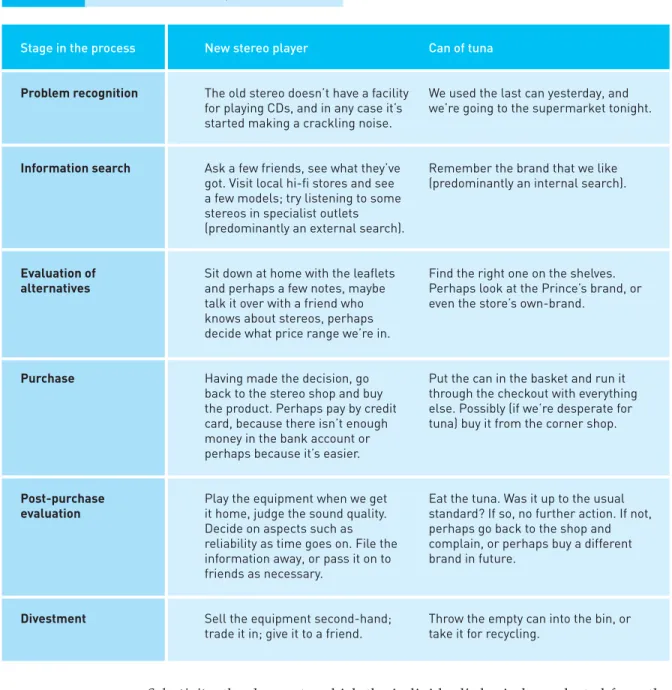
This model of the decision-making process appears somewhat long and involved, but in practice most purchasing decisions are habitual, and the process is carried out quickly and virtually automatically. Table 3.1 shows a comparison of a non-habitual purchase and a habitual purchase, showing how each stage in the decision-making model is carried out.
PERCEPTION
Human senses constantly feed information into the brain; the amount of stimula- tion this involves would seriously overload the individual’s system if the information were not filtered in some way. People therefore quickly learn to abstract information from the environment; the noise from a railway line near a friend’s home might seem obvious to you, but your host is probably unaware of it. In effect, the brain is automatically selecting what is relevant and what is not, and for this reason the information being used by the brain does not provide a complete view of the world.
The gaps in the world-view thus created are filled in by the individual’s imagi- nation and experience. The cognitive map of the world is affected by the following factors:
• Subjectivity: the existing world-view of the individual.
• Categorisation: the pigeonholing of information. This usually happens through a ‘chunking’ process, whereby information is grouped into associated items.
For example, a particular tune might make someone recall a special evening out from some years ago.
51 Perception
• Selectivity: the degree to which the individual’s brain has selected from the environment. This is also a subjective phenomenon; some people are more selective than others.
• Expectation: the process of interpreting later information in a specific way. For example, look at this series of letters and numbers:
Stage in the process New stereo player Can of tuna
Problem recognition The old stereo doesn’t have a facility We used the last can yesterday, and for playing CDs, and in any case it’s we’re going to the supermarket tonight.
started making a crackling noise.
Information search Ask a few friends, see what they’ve Remember the brand that we like got. Visit local hi-fi stores and see (predominantly an internal search).
a few models; try listening to some stereos in specialist outlets (predominantly an external search).
Evaluation of Sit down at home with the leaflets Find the right one on the shelves.
alternatives and perhaps a few notes, maybe Perhaps look at the Prince’s brand, or talk it over with a friend who even the store’s own-brand.
knows about stereos, perhaps decide what price range we’re in.
Purchase Having made the decision, go Put the can in the basket and run it back to the stereo shop and buy through the checkout with everything the product. Perhaps pay by credit else. Possibly (if we’re desperate for card, because there isn’t enough tuna) buy it from the corner shop.
money in the bank account or perhaps because it’s easier.
Post-purchase Play the equipment when we get Eat the tuna. Was it up to the usual evaluation it home, judge the sound quality. standard? If so, no further action. If not,
Decide on aspects such as perhaps go back to the shop and reliability as time goes on. File the complain, or perhaps buy a different information away, or pass it on to brand in future.
friends as necessary.
Divestment Sell the equipment second-hand; Throw the empty can into the bin, or trade it in; give it to a friend. take it for recycling.
TABLE 3.1 Habitual v non-habitual purchase behaviour
• In fact, the number 13 appears in both series, but would be interpreted as a B in the series of letters because that is what the brain is being led to expect.
• Past experience: this leads us to interpret information in the light of existing knowledge. This is also known as the law of primacy. The sound of sea birds might make us think of a day at the beach, but could in fact be part of an advertisement’s soundtrack.
In practice, people develop a model of how the world works and make deci- sions based on the model. Since each individual’s model differs slightly from every other individual’s model, it is sometimes difficult for marketers to know how to approach a given person.
One of the problems for marketers is that the perception the consumers have of marketing communications may not be what was intended. For example, fast- paced advertisements on television attract people’s attention involuntarily, but have little effect on people’s voluntary attention, so the message is often lost.
Furthermore, a fast pace focuses attention on the style of the advertisement at the expense of its message.10
INFLUENCES ON THE BUYING DECISION
The main influences on the buying decision are of three types:
• personal factorsare features of the consumer that affect the decision process;
• psychological factorsare elements of the consumer’s mental processes; and
• social factors are those influences from friends and family that influence decision-making.
Personal factors are shown in Table 3.2.
Involvement can be a major factor in consumer decision-making. Consumers often form emotional attachments to products, and most people would be famil- iar with the feeling of having fallen in love with a product – even when the product itself is hopelessly impractical. Involvement can also operate at a cogni- tive level, though; the outcome of the purchase may have important practical consequences for the consumer. For example, a rock climber may feel highly involved in the purchase of a climbing-rope, since the consequences of an error could be fatal. Whether this is a manifestation of a logical thought process regard- ing the risk to life and limb, or whether it is an emotional process regarding a feeling of confidence about the product, would be hard to determine. People also
53 Influences on the buying decision
Feedback loops
become involved with companies and become champions for them.11 People are often swayed by their relationship with the people who work for the firm:
research shows that the relationship with the dealer is more important than the price when buying a new car.12
Psychological factors in the decision-making process are as shown in Table 3.3.
Consumers’ attitudes to products can be complex. They vary according to:
• valence– whether the attitude is positive, negative or neutral;
• extremity– the strength of the attitude;
• resistance– the degree to which the attitude can be changed by outside influences;
• persistence– the degree to which the attitude erodes over time; and
• confidence– the level at which the consumer believes the attitude is correct.
It should be noted that conation is not necessarily consistent with subsequent behaviour; a consumer’s intentions about future behaviour do not always materi- alise, if only because of the existence of interrupts. For example, an individual with a grievance against a bank may intend to move his/her account to a differ- ent bank, but find that the difficulties of switching the account would create too much paperwork to be worthwhile.
The traditional view of attitude is that affect towards an object is mediated by cognition; Zajonc and Markus13challenged this view and asserted that affect can
Personal factor Explanation
Demographic factors Individual characteristics such as age, gender, ethnic origin, income, family life cycle and occupation. These are often used as the bases for segmentation (see Chapter 4).
Situational factors Changes in the consumer’s circumstances. For example, a pay rise might lead the consumer to think about buying a new car; conversely, being made redundant might cause the consumer to cancel an order for a new kitchen.
Level of involvement Involvement concerns the degree of importance the consumer attaches to the product and purchasing decision. For example, one consumer may feel that buying the right brand of coffee is absolutely essential to the success of a dinner-party, where another consumer might not feel that this matters at all. Involvement is about the emotional attachment the consumer has for the product.
TABLE 3.2 Personal factors in the buying decision
arise without prior cognition. In other words, it is possible to develop a ’gut feel- ing’ about something without conscious evaluation.
Attitude contains elements of belief (knowledge of attributes) and opinion (statements about a product) but is neither. Belief is neutral, in that it does not imply attraction or repulsion, whereas attitude has direction; and unlike opinion, attitudes do not need to be stated.
From the marketer’s viewpoint, attitudes are important since they often pre- cede behaviour. Clearly a positive attitude towards a firm and its products is more likely to lead to purchase of the firm’s products than a negative attitude.
There is, however, some evidence to show that people often behave first, then
55 Influences on the buying decision
Psychological factor Explanation
Perception This is the way people build up a view of the world. Essentially, this process of selection or analysis means that each person has an incomplete picture of the world; the brain therefore fills in the gaps by a process of synthesis using hearsay, previous experience, imagination, etc. Marketers are able to fill some of the gaps through the communication process, but will come up against the problem of breaking through the selection and analysis process.
Motives The internal force that encourages the consumer towards a particular course of action. Motivation is a vector; it has both intensity and direction.
Ability and knowledge A consumer who is, for example, a beginner at playing the violin is unlikely to spend thousands of pounds on a Stradivarius. Ability therefore affects some buying decisions. Likewise, pre-existing knowledge of a product category or brand will also affect the way the consumer approaches the decision. Pre-existing knowledge is difficult for a marketer to break down; it is much better to try to add to the consumer’s knowledge wherever possible.
Attitude Attitude has three components: cognition, which is to do with the conscious thought processes; affect, which is about the consumer’s emotional attachment to the product; and conation, which is about planned courses of behaviour. For example, ’I love my Volkswagen (affect) because it’s never let me down (cognition).
I’ll definitely buy another (conation)’. Conations are only intended actions – they do not always lead to action, since other factors might interrupt the process.
Personality The traits and behaviours that make each person unique. Personalities change very slowly, if at all, and can be regarded as constant for the purposes of marketing. Typically marketers aim for specific personality types, such as the gregarious, the competitive, the outgoing or the sporty.
TABLE 3.3 Psychological factors in the buying decision
form attitudes afterwards,14and therefore some car manufacturers find that it is worthwhile to give special deals to car rental companies and driving schools so that consumers can try the vehicles before forming their attitudes. Trial is consid- erably more powerful than advertising in forming attitudes.15
Social factors
Social factors influence consumers through:
• normative compliance– the pressure exerted on the individual to conform and comply;
• value-expressive influence– the need for psychological association with a particular group; and
• informational influence – the need to seek information from a group about the product category being considered.
Of the three, normative compliance is probably the most powerful, and works because the individual finds that acting in one way leads to the approval of friends or family, whereas acting in a different way leads to the disapproval of friends and family. This process favours a particular type of behaviour as a result.
Good moral behaviour is probably the result of normative compliance.
Peer-group pressureis an example of normative compliance. The individual’s peer group (a group of equals) will expect a particular type of behaviour, includ- ing (probably) some purchase behaviour. For example, most cigarette smokers began to smoke as a result of pressure from their friends when they were young teenagers. The desire to be a fully accepted member of the group is far stronger than any health warnings.
The main source of these pressures is reference groups. These are the groups of friends, colleagues, relatives and others whose opinions the individual values.
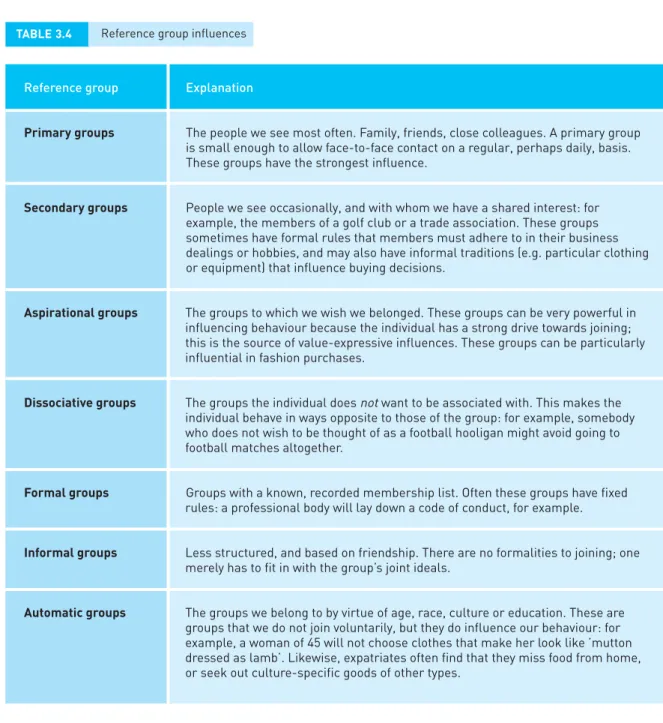
Table 3.4 gives a list of types of reference group. The groups are not mutually exclusive; a formal group can also be a secondary group, and so forth.
Roles
The roleswe play are also important in decision-making. Each of us plays many different roles in the course of our lives (in fact, in the course of a day) and will buy products to aid us accordingly.16Somebody who is to be best man at a wed- ding will choose a suitable suit, either to buy or to hire, to avoid looking ridiculous or otherwise spoiling the day. In terms of longer-lasting roles, the role of Father will dictate purchasing behaviour on behalf of children; the role of
Lover may dictate buying flowers, or wearing perfume; the role of Friend might mean buying a gift or a round of drinks; the role of Daughter might mean buying a Mother’s Day present.
Familyroles influence decision-making far beyond the normative compliance effects. Frequently different members of the family take over the role of buyer for specific product categories; the husband may make the main decisions about the
57 Influences on the buying decision
Reference group Explanation
Primary groups The people we see most often. Family, friends, close colleagues. A primary group is small enough to allow face-to-face contact on a regular, perhaps daily, basis.
These groups have the strongest influence.
Secondary groups People we see occasionally, and with whom we have a shared interest: for example, the members of a golf club or a trade association. These groups sometimes have formal rules that members must adhere to in their business dealings or hobbies, and may also have informal traditions (e.g. particular clothing or equipment) that influence buying decisions.
Aspirational groups The groups to which we wish we belonged. These groups can be very powerful in influencing behaviour because the individual has a strong drive towards joining;
this is the source of value-expressive influences. These groups can be particularly influential in fashion purchases.
Dissociative groups The groups the individual does notwant to be associated with. This makes the individual behave in ways opposite to those of the group: for example, somebody who does not wish to be thought of as a football hooligan might avoid going to football matches altogether.
Formal groups Groups with a known, recorded membership list. Often these groups have fixed rules: a professional body will lay down a code of conduct, for example.
Informal groups Less structured, and based on friendship. There are no formalities to joining; one merely has to fit in with the group’s joint ideals.
Automatic groups The groups we belong to by virtue of age, race, culture or education. These are groups that we do not join voluntarily, but they do influence our behaviour: for example, a woman of 45 will not choose clothes that make her look like ’mutton dressed as lamb’. Likewise, expatriates often find that they miss food from home, or seek out culture-specific goods of other types.
TABLE 3.4 Reference group influences
car and its accessories and servicing, while the wife makes the main decisions about the decor of the home. Older children may decide on food, choosing the healthy or environmentally friendly alternatives.
In terms of its functions as a reference group, the family differs from other groups in the following respects:
• Face-to-face contacton a daily basis.
• Shared consumptionof such items as food, housing, car, TV sets, other house- hold durables.
• Subordination of individual needsto the common welfare. There is never a solu- tion that will suit everybody.
• Purchasing agentswill be designated to carry out the purchasing of some items.
As the number of working parents grows, pre-teens and young teens are taking an ever-increasing role in family shopping.
Conflict resolution within the family decision-making unit is usually more important than it would be for an individual, since there are more people involved. Whereas an individual might have, say, a difficulty in choosing between two equally attractive holiday destinations, discussions about family holidays are inevitably much more difficult since each family member will have his or her own favourite idea on a holiday destination or activity.
Culturecan have a marked effect: African cultures tend to be male-dominated, whereas European and North American cultures show a more egalitarian pattern of decision-making.17This may be because decision-making becomes more egali- tarian when both partners earn money outside the home.18
Decision-making stagealso affects the roles of the family in the decision: problem recognition may come from any family member, whereas information search and product evaluation may be undertaken by different members. For example, the father may notice that the teenage son needs new football boots, the son might ask around for types, and the mother might decide which type falls within the family’s budget.
Four kinds of marital role specialisation have been identified:
• wife dominant,where the wife has most say in the decision;
• husband dominant,where the husband plays the major role;
• syncratic or democratic, where the decision is arrived at jointly; and
• autonomic,where the decision is made entirely independently of the partner.19 Marketers need to know which type of specialisation is most likely to occur in the target market, since this will affect the style and content of promotional messages;
recently some advertising in the United Kingdom has tended to portray men as being incompetent at household tasks, despite evidence that men are taking a more active role in housework.20
In most industrialised countries the family is undergoing considerable changes because of the rising divorce rate and the increasing propensity for couples to live together without marrying. In the above role specialisations, the terms ’husband’
and ’wife’ apply equally to unmarried partners.
Childrenhave an increasing role in purchasing decisions: ’pester power’ often results in increased family purchases of particular brands of chocolate, pizza, burgers and snack foods.21Consequently, marketers often try to reach children aged between 5 and 12 through the use of sponsorship of teaching materials, free samples and sponsorship of prizes in schools.22
Children sometimes have greater influence on the family purchasing decisions than do the parents themselves, for the following reasons:23
• Often they do the shopping, since both parents are out at work.
• They watch more TV than do their parents, so they are more knowledgeable about products.
• They tend to be more attuned to consumer issues, and have the time to shop around for (for example) environmentally friendly products.
Purchasing behaviour is also affected by people’s identity – in other words their view of themselves. The more closely the purchasing behaviour fits with the person’s identity, the more likely it is to occur; this is particularly important in non-profit marketing such as charitable donations or participation in voluntary work, where the exchange involves individuals and is often based on social exchanges.24
IMPULSE BUYING
Impulse purchases are not based on any plan, and usually happen as the result of a sudden confrontation with a stimulus.
Pure impulseis based on the novelty of the product. Seeing something new may prompt the consumer to buy it just to try it. Reminder impulse acts when the consumer suddenly realises that something has been left off the shopping-list.
Suggestion impulsearises when confronted with a product that meets a previ- ously unfelt need, and planned impulseoccurs when the consumer has gone out to meet a specific need, but is prepared to be swayed by what is on special offer.
For example, a consumer may be on a shopping trip to buy a new jacket for a weekend party. In the shop he notices a rack of bow ties, and buys one because he
59 Impulse buying
has never owned one before (pure impulse). Next he remembers that he has not got a suitable summer shirt, so he picks one up from the counter (reminder impulse), and near it he sees a rack of cotton trousers which are on offer (sugges- tion impulse). Finally he sees a safari jacket which, although it is not the style he was thinking of, is actually ideal for the job so he buys it (planned impulse). Most shoppers are familiar with these situations, and indeed they commonly occur when browsing in supermarkets.
The purchase process itself is an important part of the benefits consumers get from consumption; research has shown that satisfaction with the process relates to the desire to participate in future purchases.25
INDUSTRIAL BUYER BEHAVIOUR
Industrial buyers differ from consumers in that they are (at least theoretically) more formalised in their buying behaviour. The major areas where organisational buying differs from consumer buying are as follows:
• Bigger order values in terms of finance and quantity.
• Reciprocity; the firms may buy each other’s products as part of a negotiated deal.
• Fewer buyers, because there are fewer firms than there are individuals.
• More people in the decision process.
• Fewer sales in terms of the number of deals.
• More complex techniques exist for buying and for negotiating.
Organisational buyers are buying in order to meet the organisation’s needs, but it should also be remembered that they have their personal needs. These might be a need for prestige, a need for career security,for friendship and social needs, and other personal factors such as the satisfaction of driving a hard bargain, or the buyer’s personality, attitudes and beliefs.26The astute marketer, and particu- larly the astute salesperson, will not ignore these personal needs of the buyers.
Regarding the organisation’s needs, however, the chief considerations of most buyers appear to revolve around quality, delivery, service and price.27This often means that buyers will be working to a set of specificationsabout the products.
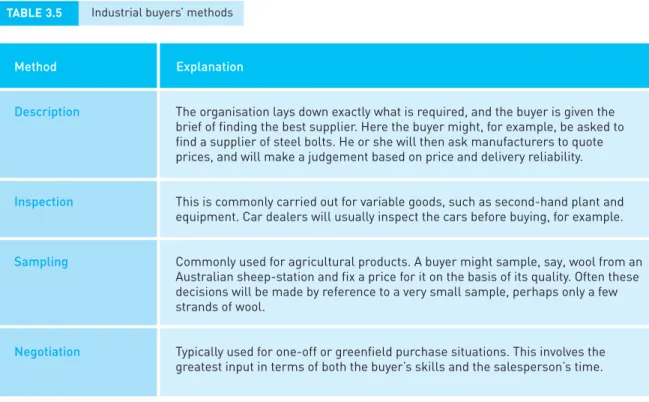
Buyers will usually be operating to the purchase methods given in Table 3.5.
The industrial purchase task might be a new task,in which case the buyer will need to adopt extensive problem-solving behaviour. The vendor has the opportu- nity of establishing a relationship which might last for many years, however.
New-task situations will often involve the greatest amount of negotiation, since there is little (if any) previous experience to draw on.
Straight re-buytasks are routine; the buyer is simply placing an order for the same products in the same quantities as last time. This requires very little thought or negotiation on the part of either buyer or seller. Often these deals are con- ducted over the telephone rather than spending time and money on a face-to-face meeting.
Modified re-buyinvolves some change in the purchase order, for example a larger order value or a different delivery schedule. Sometimes the re-buy can be modified by the salesperson, for example by suggesting that the buyer orders a slightly larger value of goods than usual, or by altering the delivery schedule in some way. In circumstances where the two firms have an ongoing relationship, buyers will often track the performance of their suppliers over a long period of time; buying firms that monitor their suppliers effectively can gain real competi- tive advantage, because they can control their supply of inputs much better.28
Often the demand for industrial products will be dictated by factors outside the buying organisation’s control. For example, derived demandoccurs because the buyers are using the products either for resale, or to use in making other
61 Industrial buyer behaviour
Method Explanation
Description The organisation lays down exactly what is required, and the buyer is given the brief of finding the best supplier. Here the buyer might, for example, be asked to find a supplier of steel bolts. He or she will then ask manufacturers to quote prices, and will make a judgement based on price and delivery reliability.
Inspection This is commonly carried out for variable goods, such as second-hand plant and equipment. Car dealers will usually inspect the cars before buying, for example.
Sampling Commonly used for agricultural products. A buyer might sample, say, wool from an Australian sheep-station and fix a price for it on the basis of its quality. Often these decisions will be made by reference to a very small sample, perhaps only a few strands of wool.
Negotiation Typically used for one-off or greenfield purchase situations. This involves the greatest input in terms of both the buyer’s skills and the salesperson’s time.
TABLE 3.5 Industrial buyers’ methods
products. The demand is therefore dictated by the demand for the end product.
Frequently the demand for a component will be inelastic: for example, the price of wheel nuts will not affect the demand for them much, since they form only a tiny proportion of the price of a car, and also the car cannot be made without them.
Joint demand occurs because the demand for one type of product dictates the demand for another. For instance, if the demand for guitars rises, so will the demand for guitar strings in the following months.
Fluctuating demandis more common in industrial markets because a small reduction in consumer demand for a product will lead to de-stocking, which causes a big reduction in production. A rise in consumer demand is likely to lead to re-stocking, which causes a bigger than expected rise in demand for compo- nents. In this way the fluctuations in demand for industrial products are more extreme than for consumer products.
Decision-making units
Industrial buying decisions are rarely made in isolation. Usually several people are involved in the process at different stages.
Gatekeeperssuch as secretaries and receptionists control the flow of informa- tion to the decision-makers. Often they will act as a barrier to salespeople, and see their role as being primarily to prevent interruptions to the decision-maker’s work pattern.
Influencersare those individuals who ’have the ear’ of the decision-makers.
They could be people within the firm whom the decision-maker trusts, or they could be golf partners, spouses, or even children.
Usersare those who will actually use the product. For example, if the organisation is contemplating the purchase of a new computer system, the finance department and the IT department will clearly want to have some say in the decision.
Decidersare the ones who make the real decision. These are usually the hard- est to influence, since they are usually the more senior people in the decision-making unit and are surrounded by gatekeepers. They are also some- times hard to identify. They are not necessarily buyers, but they do hold the real power in the buying decision.
Buyersare the ones given the task of actually going through the process of buying. The buyers may be given a very specific brief by the decider, and may have very little room to negotiate except on areas such as price and delivery schedules. Sometimes they are merely there to handle the mechanical aspects of getting tenders from possible suppliers.
Each of these people has an independent existence outside the organisation;
each will bring their own personal needs and aspirations to their role. In some cases this will be a job-related need (for example, career progression or the need to appear professional); in other cases the individual may have personal needs, such as a need to exercise power or the hedonic need to drive a hard bargain. The need to impress others within the firm can be extremely powerful.
From the viewpoint of the industrial marketer, it is essential to get to the deciders in some way rather than wait for the buyers to make the first contact by issuing a tender. The reason for this is that a tender will usually be very specific, and the buyers will then be deciding on the basis of price. The only way to get the order in those circumstances is to be the cheapest, and this inevitably results in reduced profits. If the seller has managed to approach the decision-maker before- hand, the seller can persuade the decision-maker to include certain essential aspects of the product in the tender, and thus ensure that the tender contains specifications that are difficult or impossible for the competition to meet.
Webster and Wind29theorised that four main forces determine organisational buyer behaviour: environmental forces (such as the state of the economy), organi- sational forces (for example the size of the organisation and therefore its buying power), group forces (internal politics and the relative power of group members), and individual forces (the personality and preferences of the decision-maker).
These forces combine in complex ways to influence the final decision.
This means that the role of the salesperson is crucial in industrial markets.
Salespeople are able to identify potential customers and approach them with a solution for their specific problem; even in cases where the buyer is going to invite tenders from other firms, the salesperson can often ensure that the tender is drawn up in a way that excludes the competition. Firms also seek to develop long-term relationships with purchasing firms, and salespeople are in the front line in this process. There is more on relationship marketing in Chapter 12.
In the end, organisations do not make purchases. Individuals make purchases on behalf of organisations, and therefore salespeople are always dealing with human beings who have their own needs, failings, attitudes and blind spots.
Purchasing decisions are not made entirely rationally; often the personal relation- ship between the representatives of the buying and selling companies has the biggest role in the purchase. Buyers will naturally prefer to deal with someone they know and trust (see the section on personal selling in Chapter 9).
63 Case study 3: Buying aircraft carriers
CASE STUDY 3: BUYING AIRCRAFT CARRIERS
In January 2003 the UK government announced that the £2.8 billion contract to build two new aircraft carriers for the Royal Navy would be split between British company BAE Systems and Thales, its French arch-rival. When maintenance work and upgrades are considered, the deal is worth approximately £9.2 billion over the lifetime of the vessels.
Celebrations were, however, somewhat muted at BAE. The company will be get- ting two-thirds of the business, but will (under the terms of the deal) have to build the ships to Thales’ designs. In other words, BAE are taking the lion’s share of the risk, since they will be responsible for any cost overruns and design corrections,
▲
but will not have the power to vary the designs. Even though the UK taxpayer will pick up 10% of cost overruns, this still leaves BAE vulnerable in some respects.
The situation is worsened by the fact that the companies who were involved in the bidding process were told that the outcome would be a ’winner takes all’ contract.
On the other hand, BAE may be lucky to have been offered anything at all. In December 2002 the company’s shares dropped dramatically after it announced cost overruns on other Ministry of Defence deals; then on 15 January Geoff Hoon, the Defence Secretary, announced that he thought BAE was ’no longer British’.
Then as late as 21 January the national organiser of the Transport and General Worker’s Union, Jack Dromey, revealed that senior civil servants were recom- mending that the contract should be awarded to Thales in its entirety.
Final details need to be worked out, and it is fairly certain that BAE will be pressing for a better deal on the overruns, since the company is already in dispute with the Ministry of Defence about cost overruns of up to £1 billion on the Nimrod aircraft and Astute submarine deals. Industry reaction to the deal was one of astonishment – one senior defence executive said ’Thales won this on design and price, but BAE got the prime contractor role because of politics.’
The political issues are by no means simple. Under European Union rules, con- tractors throughout the EU must be given the opportunity to bid on government contracts within any of the member states – in other words, national governments are not allowed to play favourites by awarding contracts to their own suppliers. The problem is that this law is honoured more in the breach than in the observance – although Thales have apparently come in with a lower price and a better design, it would be impossible for a UK government to award the contract entirely to the French, knowing that there is no possibility of the French allowing British companies to compete on an equal footing in France.
Defence Secretary Geoff Hoon dismissed such allegations as being ’the kind of anti-European, anti-French rhetoric that’s come to characterise the modern Conservative party ... It’s a disgrace.’ Meanwhile Lord Bach, the procurement min- ister, and Sir Robert Walmsley, chief of defence procurement, were examining the extent to which the taxpayer would carry the risk in terms of cost overruns.
Government policy has been to move these risks away from the taxpayer and towards the contractor, but of course the higher the risk the contractor is expected to take, the higher the overall cost of the contract, so the government will almost certainly need to compromise.
City analysts believe that the contract represents a Pyrrhic victory for BAE.
Although the contract will contribute £30 million to annual profits, this is a rela- tively small amount of money – the total contract represents only 2% of sales for BAE. In exchange for this, the company has given Thales a stronger foothold in the UK, building on its acquisitions of defence companies such as Racal, Pilkington Optronics and Shorts Missile Systems. Some City analysts believe that BAE would have been better off if the company had lost the prime contract to Thales and had instead concentrated on low-risk subcontracting work at its shipyards.
65
In this chapter we have looked at how people behave when faced with buying decisions. We have looked at the decision-making process both for consumers and for organisational buyers, and at the influences and pressures on each group.
Here are the key points from this chapter:
• Consumers buy because they recognise either assortment depletion or assortment extension needs.
• Complaints should be encouraged, because they give the opportunity to cure post-purchase dissonance and create loyal customers.
Summary
SUMMARY
Meanwhile, the Royal Navy eagerly awaits delivery of the ships. Captain Simon Williams, assistant director of strategy at the naval staff, says that the current car- rier fleet is designed primarily for protecting the Navy from attacks while at sea.
The new carriers will have the capability to attack shore installations. ’If you put one of these carriers in international waters off another country it becomes a very flexible tool, and it focuses the mind of the people we are trying to influence,’ he said. The ships will be equipped with the new F-35 fighters, the replacement for the Harrier Jumpjet, now nearing the end of its useful service life.
Whatever the outcome, the unions are pleased. Bill Morris, general secretary of the Transport and General Workers’ Union, said, ’I believe our quality British work- force will deliver a quality British product. The challenge is now for BAE Systems to deliver on time and on budget.’
Questions
1 How has the political environment affected the purchasing process?
2 Who were the influencers, deciders, buyers, gatekeepers and users in the DMU (Decision-Making Unit)?
3 What effect does the UK government’s previous experience of the suppliers have?
4 If the potential profits on the deal are so low, why would BAE be interested in bidding for the contract?
5 What effects might the deal have on the long-term relationship between BAE and Thales?
• Individuals belong to several reference groups, and are also influenced by groups they do not belong to such as aspirational groups and dissociative groups.
• Normative compliance is probably the most powerful factor in attitude formation and decision-making.
• The family is probably the most powerful reference group.
• Industrial buying is complex because of the number of people involved.
• Gatekeepers, users, influencers, deciders and buyers are all involved in organisational decision-making. None of them should be ignored if the deal is to go through.
• The route to success in industrial marketing is to make sure the tender has something in it that the competition cannot match.
1 How do family members influence each other’s buying behaviour?
2 What are the main differences between industrial buyers and consumers?
3 What is the difference between assortment depletion and assortment extension?
4 How can the use of choice heuristics reduce post-purchase dissonance?
5 How can a marketer use interrupts to influence consumer behaviour?
1 What is meant by assortment depletion?
(A) The consumer owns very few possessions.
(B) The consumer has worn out or used up some of his or her possessions.
(C) The consumer has decided to concentrate on owning only a few possessions.
2 Hedonic needs refer to:
(A) The practical aspects of owning something.
CHAPTER QUESTIONS
MULTI-CHOICE QUESTIONS
67
(B) Unnecessary purchases.
(C) The cult of pleasure.
3 Utilitarian needs refer to:
(A) Only buying things that are strictly necessary.
(B) The practical aspects of living.
(C) Products that are plain or boring.
4 Remembering information about products is part of:
(A) The internal search.
(B) The external search.
(C) Interrupts.
5 Affective states are:
(A) Emotional feelings about products.
(B) Emotions that dictate heuristics.
(C) Circumstances that change behaviour patterns.
6 A consideration set is:
(A) A group of products that would meet the consumer’s needs.
(B) All the available products within a given group.
(C) The criteria by which a consumer will judge products.
7 The point at which anticipation becomes uncomfortable is called:
(A) The optimum stimulation level.
(B) The affective state.
(C) The ideal performance.
8 A decision-making rule is called:
(A) An interrupt.
(B) A heuristic.
(C) Dissonance.
9 Deciding whether a product met expectations is called:
(A) Post-purchase dissonance.
(B) Post-purchase evaluation.
(C) Post-purchase verbal response.
10 Complaints that are expressed to friends and acquaintances are called:
(A) Private responses.
(B) Verbal responses.
(C) Third-party responses.
Multi-choice questions
Consumer Behaviorby Roger D. Blackwell, Paul W. Miniard and James F. Engel (Mason, OH, Southwestern, 2001). A very comprehensive American text, now in its ninth edition; this is a readable and clear coverage of all aspects of consumer behaviour.
Consumer Psychology in Behavioural Perspectiveby Gordon Foxall (London, Routledge, 1990). An in-depth analysis of consumer psychology; a rather academic text, with some interesting insights into some more obscure aspects of consumer behaviour.
Business Marketing Management: A Global Perspective by Jim Blythe and Alan Zimmerman (London, Thomson, 2005). This book provides an in-depth view of business-to-business marketing, taking a global perspective. It covers all aspects of marketing to other businesses, including buyer behaviour and strategic issues.
Actual state The current position of the individual in terms of well-being and possessions.
Affect What is felt about a product; liking, dislike, fear, etc.
Affective states Conditions of the emotional or physical well-being of the individual that cause interrupts.
Assortment depletion The consumption of the whole or most of an item in the consumer’s stock of possessions.
Assortment extension The act of adding to an existing stock of possessions.
Buyer The individual who carries out the mechanical processes of purchasing.
Cognition What is thought about a product; beliefs and opinions.
Conation Planned behaviour regarding a product or event.
Confidence The degree to which the individual feels sure that the attitude is the correct one.
Consideration set The group of products which the individual is aware would adequately meet his or her needs.
Culture A set of shared beliefs and behaviours common to a society.
FURTHER READING
GLOSSARY
69
Cut-off The maximum or minimum acceptable values for product attributes.
Decider The individual who has the power to make the final purchasing decision.
Derived demand The state of affairs where the demand for a component derives from the demand for the finished product.
Description The process of industrial buying whereby the buyer describes the required product and asks suppliers to provide tenders for its supply.
Desired state The position the individual would like to be in, in terms of well-being and possessions.
Divestment The act of disposal of a used-up or worn out product or its packaging.
Drive The state of unease that derives from the gap between the desired and actual states.
Environmental stimulus A factor in the search or purchase environment that causes an interrupt.
Equitable performance The level of product performance which the individual would regard as reasonable, given the cost of the search in terms of time and effort and financial cost of the product.
Expected performance The level of product performance the consumer expects, given the pre-purchase information collected.
External search Information obtained from sources other than the individual’s personal experience and memories.
Extremity The strength of attitude towards a product.
Fluctuating demand This is common in industrial markets, whereby a small reduction in consumer demand for a product will lead to de-stocking, thus causing a big reduction in productivity.
Gatekeeper An individual who controls the flow of information to a decision-maker.
Hedonic needs The pleasurable or aesthetic aspects of product ownership or service use.
Heuristic A simple ’if ... then’ decision-making rule.
Ideal performance The level of product performance that the consumer would regard as meeting or exceeding all criteria.
Influencer An individual who has influence, but not power, in a buying decision.
Informational influence The need to seek information from a reference group.
Glossary
Inspection The act of examining a variable product to ensure that it meets particular criteria.
Internal search Information retrieved from the individual’s memories and experience.
Interrupt An event or piece of information that temporarily suspends the information search.
Joint demand The state of affairs where the demand for one product is affected by the demand for another product.
Law of primacy The rule that states that later information is interpreted in the light of earlier experience, thus implying that early experience is more important than later experience.
Motivation The predisposition that arouses and directs behaviour towards certain goals.
Negotiation The act of discussing with a supplier what would be the best way of approaching a new-purchase task.
Normative compliance The pressure exerted by reference groups to behave in the same way as the rest of the group.
Optimal stimulation level The level of gap between desired and actual states at which the individual feels stimulated, but not yet uncomfortable.
Persistence The stability of the attitude over time.
Planned impulse Buying behaviour in which a planned course of action is changed as the result of a new stimulus.
Post-purchase consonance The state of affairs where the product’s characteristics and benefits match up to or exceed the purchaser’s expectations.
Post-purchase dissonance The state of affairs where the product’s characteristics and benefits do not meet the purchaser’s expectations in one or more respects.
Post-purchase evaluation The examination of the purchased product to determine whether it meets, exceeds or fails to meet pre-purchase expectations.
Private responses Complaints made about the product or supplier to friends or others.
Pure impulse Buying behaviour undertaken without prior rational thought.
Reference group A formal or informal group from which the individual seeks cues regarding appropriate behaviour.
Reminder impulse Buying behaviour undertaken when the individual is reminded of something.
71
Resistance The level of difficulty experienced in changing an attitude.
Role The group of behaviours expected of the occupant of a given position.
Sampling The act of testing a small part of a bulk supply to judge whether the whole meets particular criteria.
Signals Attributes of the product or its peripheral aspects that indirectly indicate its quality.
Suggestion impulse Buying behaviour undertaken when the individual receives a new stimulus.
Third-party responses Complaints made to the supplier through a third party, such as a lawyer or consumer protection agency.
User The individual who will actually use the product (usually considered in an industrial buying situation only).
Utilitarian needs Needs that derive from the practical aspects of ownership of a product or use of a service.
Valence The direction of feeling about a product; positive or negative.
Value-expressive influence The pressure to experience psychological association with a group by conforming to its norms, values or behaviours, even if membership is not sought.
Voice responses Complaints made direct to the supplier.
1. Holbrook, Morris P. and Hirschmann, Elizabeth C.: ’The experiential aspects of consumption; consumer fantasies, feelings and fun’,Journal of Consumer Research, 9 (September 1982), pp. 132–40.
2. Engel, James F., Blackwell, Roger D. and Miniard, Paul W.: Consumer Behaviour, 8th edn (Fort Worth, TX, Dryden Press, 1995).
3. Raju, P.S.: ’Optimum stimulation level; its relationship to personality, demographics, and exploratory behaviour’, Journal of Consumer Research, 7(December 1980), pp. 272–82.
4. Bettman, James R.: An Information Processing Theory of Consumer Choice(Reading, MA, Addison Wesley, 1979), Chapter 7.
5. Oliver, Richard L.: ’A cognitive model of the antecedents and consequences of satisfaction decisions’, Journal of Marketing Research, 17(November 1980), pp. 460–9.
References