Jl. Perintis Kemerdekaan I No. 33 Kota Tangerang, Banten 15118 Website : http://jurnal.umt.ac.id/index.php/nyimak
Email : [email protected]
DAFTAR ISI (TABLE OF CONTENT)
A Content Analysis #pecatluhut on The Political Ethics of Government in Indonesia
––Asriadi, Cici Sundari, Zuly Qodir––
1 – 20
Social Media Twitter @BGRM Indonesia as a Medium of Information Communication and Outreach
––Herlan, Hermansyah, Irfandi Pratama, Eko Priyo Purnomo, Aqil Teguh Fathani––
21 – 38
Self-concept on @Nge.review Instagram Account as a Representation of User Character
––Farrasepta Deandra Sanubari, Sigit Surahman, Yudhistira Ardi Poetra––
39 – 53
The Role of Local Mass Media in Anticipating Hoax Information (Case Study at Radar Tasikmalaya)
––Doddy Iskandar Cakranegara, Dadi Ahmadi, Septiawan Santana Kurnia, Firmansyah, Satya Indra Karsa––
55 – 70
The Wisdom of Sundanese Intercultural Communication in Social Interaction with Javanese Ethnic Communities
––Alex Abdu Chalik, Lely Arrianie, Riska Sarofah––
71 – 88
#PrayForKanjuruhan On Twitter: Public Response to the Kanjuruhan Stadium Disaster
––Gusti Naufal Rizky Perdana, Bambang Irawan, Paisal Akbar––
89 – 107
Power Relations and Patriarchy Politics on Dating Violence
––Umaimah Wahid, Rafeah Legino–– 109 – 130
Citation : Asriadi, Sundari, C., & Qodir, Z. (2023). A Content Analysis #pecatluhut on The Political Ethics of Government in Indonesia. Nyimak Journal of Communication, 7(1), 1–20.
A Content Analysis #pecatluhut on The Political Ethics of Government in Indonesia
Asriadi1, Cici Sundari2, Zuly Qodir3
1,2,3 Universitas Muhammadiyah Yogyakarta
Email: 1[email protected], 2[email protected], 3[email protected]
ABSTRACT
This study aims to see the development of Luhut Binsar Panjaitan based on #Pecatluhut through social media Twitter. This research focuses on developing Luhut Binsar Panjaitan on pricing polymerase chain reaction (PCR) tests. This study seeks to answer the question of the substance of the development of the Luhut case studied from November 1, 2021, to November 10, 2021. The research uses the Q-DAS (Qualitative Data Analysis Software) approach with the Nvivo 12 Plus software analysis tool. The research data is Twitter content, namely the hashtag
#Pecatluhut. The results of the study show that there is harmful public sentiment towards the policy stipulation made by Minister Luhut Binsar Panjaitan regarding the changing PCR prices and makes the public, not respect and disappointed with his policy, seen from the percentage class that shows performance; very negative (15.05%), moderately negative (45.69%), moderately positive (38.31%), and very positive (0.94%). The percentage that has the highest number is 45%. The hashtag #pecatluhut is complemented by various stories of residents being disappointed by the policies set by minister hut. By analyzing the most frequent words, the researcher took 20 words from #pecatluhut. The content contains a form of public criticism that often disappoints people and has no respect for the performance and pricing of PCR by Minister Luhut Binsar Panjaitan.
Keywords: Trending topic, Twitter, #Pecatluhut, political ethics
ABSTRAK
Penelitian ini bertujuan untuk melihat perkembangan kasus Luhut Binsar Panjaitan berdasarkan #Pecatluhut melalui media sosial Twitter. Fokus penelitian ini untuk mengetahui perkembangan kebijakan yang ditetapkan oleh luhut binsar panjaitan terhadap penetapan harga tes polymerase chain reaction (PCR). Penelitian ini berupaya menjawab pertanyaan substansi perkembangan kasus luhut yang diteliti mulai dari tanggal 1 november 2021 hingga 10 november 2021. Metode penelitian menggunakan pendekatan QDAS (Qualitative Data Analysis Software) dengan alat analisis software Nvivo 12 Plus. Data penelitian ini adalah konten Twitter yaitu tagar #Pecatluhut. Hasil penelitian menunjukkan bahwa adanya sentimen negatif masyarakat terhadap penetapan kebijakan yang dibuat oleh Menteri Luhut Binsar Panjaitan terhadap harga PCR yang berubah-ubah dan membuat masyarakat tidak respect dan kecewa atas kebijakannya, terlihat dari kelas persentase yang menunjukkan kinerja; sangat negatif (15.05%), cukup negatif (45.69%), cukup positif (38.31%), dan sangat positif (0.94%). Presentase yang memiliki jumlah paling tinggi 45%. Tagar #pecatluhut dilengkapi dengan berbagai cerita warga yang dikecewakan oleh kebijakan yang ditetapkan oleh menteri luhut. Melalui analisis kata yang paling sering muncul peneliti mengambil 20 kata dari #pecatluhut. Konten tersebut berisi bentuk kritikan masyarakat yang sering membuat masyarakat kecewa dan tidak respect terhadap kinerja dan penetapan harga PCR yang dilakukan oleh Menteri Luhut Binsar Panjaitan.
Kata Kunci: Trending topic, Twitter, #Pecatluhut, etika politik
INTRODUCTION
Political ethics in the practice of democratization is now an urgent and exciting study for at least two reasons; firstly, the phenomenon of political course is suspected of having gone off the beaten path of political ethics and public morality. Second is the emergence of a new awareness in our society to strive to build a democratic community and sound and clean governance based on ethics (Menendez et al., 2018). Public policy-making is a crucial function of a government. Therefore, policymakers’ ability and adequate understanding of policy- making are essential for realizing fast, appropriate, and good public policies. The power and knowledge of policy-making procedures must also balance with public policymakers’
understanding of their authority (Liu et al., 2018). The concept of man as a political being shows that political thinking is based on man’s essence and the process and outcome of political activity in a government’s political system. This means that humans must be the criteria or measures and goals. Although in politics, people may underestimate the fact that humans are ambivalent, power wherever and whenever is used well and abused (Prawira &
Irawan, 2021).
Government ethics teaches the proper behaviour by human nature related to virtue (Endah, 2018). Bureaucratic ethics or moral standards or values that guide all government officials in carrying out their responsibilities for the public interest and society is another term for government ethics (Sadhana, 2018). Meanwhile, Bisri & Asmoro (2019) states that the term
“government ethics” refers to a unique professional code of ethics for those who work for and for the government; this code of ethics contains rules and guidelines for behaviour and behaviour for various groups within government agencies, including leaders—elected (such as the president and cabinet ministers). This is supported by the fact that officials in government are expected to have high moral awareness from politicians and the government when they carry out their responsibilities, ensuring that honesty, truth and justice are achieved (Ismail Nurdin, 2017). Thus, government ethics must be owned by every public official to provide policies according to what is expected of the problems faced (Setiawan & Fauzi, 2019).
Therefore, since time immemorial, humans have tried to oppose the abuse of power, especially those carried out by those who hold political power (Rahmat & Eko Priyo Purnomo, 2020). Politics is interpreted as a process of seizing, maintaining, and preserving power through an agreed-upon (and violated) mechanism by the perpetrators, both individual and group actors (Appel et al., 2020). Politics is a phenomenon related to humans who permanently live in society. He is a social being who always lives dynamically and develops by nature. Politics is the face on behalf of the people and religion at the expense of its
values. Therefore, politics is always a symptom that manifests in human beings in the context of their development process (Korstanje & Strang, 2017). Ethical marginalization that takes place seriously, in such a way, experiences a shift in value due to global information transactions and a pragmatic-materialist mindset that has an impact on the erosion and marginalization of ethics. As a result, the political elite is no longer used to reference acting and behaving (Kim & Hastak, 2018).
The primary problems in politics today are with politicians, policyholders, or leaders who have been given power. This is because they are representatives of the community. But the fact that often happens is that hopeful politicians betray their positions. Many crimes were committed, such as KKN (Corruption, Collusion, and Nepotism), violence, drugs, defamation, slander, blasphemy, and various forms of failure of modernity (Westerlund, 2019). In connection with the above, the background of this research problem is based on the existence of academic anxiety, which is quite strong in me. Almost every day, Indonesian people witness various issues that arise in their lives (Pamungkas & Wahyunengseh, 2018). And this problem is almost always related to political ethics in the endless world government, including
#pecatluhut, which occurs because of public anxiety about the policies made (Parmudi, 2017).
The problem that arises from the trending hashtag #pecatluhut on Twitter media is the alleged connection with businesses that play on the price of PCR tests in Indonesia so that people do not respect their ministry positions because presidential aide officials should be able to alleviate people’s suffering, this issue is reinforced by the consistency of magazines and the media online Tempo which highlighted that Luhut was involved in playing up the PCR price amid the co-19 pandemic (Sibaweh, 2021). Of course, under these conditions, it is very natural for the public to react negatively to Luhut, who does not carry out his duties professionally, so people who are active on Twitter media continue to criticize him (Yustika et al., 2020). Plus, Luhut also has a company engaged in PCR production, in line with the position he holds as the minister in charge of maritime affairs and investment (Nugroho &
Syarief, 2022). Thus, it is essential to reveal and analyze more deeply by using analysis of Twitter media content with the hashtag #pecatluhut because this hashtag was trending from 1 November 2021 to 10 November 2021. Therefore, this research aims to analyze the development of the Luhut Binsar Panjaitan case based on # Pecatluhut via social media Twitter.
Political Ethics in Public Formulation
In realizing a country with a democratic society, the participation and aspirations of the people will be very much needed in government administration. The substance of democracy in the context of government itself is implementing a government based on the aspirations and will of the people. Thus, the smooth channeling of people’s aspirations plays an essential role in democratizing a nation (Liu et al., 2018). Public policy is a series of actions determined and implemented by the government with specific objectives for the benefit of the community.
Suppose a state government provides services oriented to the public interest or public needs.
In that case, the government must consider serving the public by acting as a public service that organizes public services (Caplan & Boyd, 2018). The pattern of government has changed from centralized to decentralized. People’s involvement in political and development processes in the regions, including people’s participation in making local legal regulations (Perda), is very dominant (Palvia et al., 2018). To achieve the country’s goals, the government must choose action steps to do or not do something. Not doing anything is a public policy because it is an effort to achieve goals, and this choice has the same impact as the choice of steps to do something to the community. Policy statements in speeches and discourses expressed by political and government officials immediately follow up with government programs and actions(Lauro et al., 2019).
The quality of public services is driven by bureaucratic machines that are difficult to access and the low performance of the bureaucracy in Indonesia which still provides services to the public, even at the level of policy making that does not fully involve local communities, by utilizing local resources. Resource. Potential and wisdom (local culture) (Menendez et al., 2018). The community. In connection with the low utilization of local institutions, a careful introduction and understanding of various dimensions of community life and local culture must be addressed together (Darmawati, 2020). Political ethics reflects the attitude of a good and responsible leader because of his ability to act under the words that he has said.
As Bung Karno said, “unite words with actions.” The political elite should imitate Bung Karno’s expression, but it turns out that these elites are not; in fact, they cannot maintain the spirit of Bung Karno’s teachings themselves (Darmawati, 2020).
Therefore, in encouraging political ethics in public formulation, a sense of well-being and justice is needed to meet the needs of society (Sen, 2017). According to Nurcholish Madjid he emphasizes the principle of justice in the form of equity and efforts to alleviate the suffering of people in need (Janah, 2017). Nurcholish Madjid’s perspective is expected to raise awareness and attitudes, establish moral principles of humanity and justice as an ethical foundation, and help the nation overcome prolonged political problems (Zuliana,
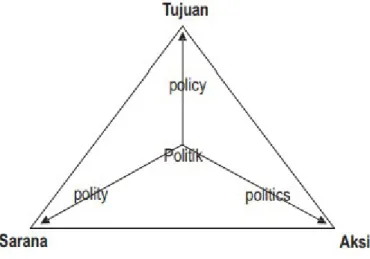
2015). In supporting and encouraging these conditions, it is important to pay attention to the dimensions of political ethics, which explains that at least policyholders must have synergy between the dimensions of goals, means, and actions in maximizing the services provided to the public (Hasibuan et al., 2018). The dimensions of political ethics are more clearly outlined in the conceptual framework, which can be seen in Figure 1 below.
Figure 1. Dimensions of Political Ethics Source: Hasibuan et al., (2018)
The three dimensions of political ethics explain that the objective dimension presupposes the right to freedom and justice, including the welfare and peace felt by the people. Within the framework of national democracy, the objective aspects of political ethics and the government’s responsibility in administering the country by prioritizing social welfare and peaceful life. Means dimension used to achieve goals. This dimension includes the state system and the basic principles governing administrative practices and social institutions.
The role of ethics in evaluating and critiquing legitimacy decisions, institutions, and political practices is the moral component of this dimension of means. Meanwhile, in the dimension of political action or action, political rationalism is influenced by actors. Rational action and the virtues or moral qualities of the doer comprise political rationality. If an actor is situation oriented and understands the difficulties faced by society, then his political actions are said to be rational. Thus, the public will feel prosperous because the government or stakeholders, in determining their policy directions, continue to prioritize the community’s interests (Hahury
& Sos, 2022; Ratminto et al., 2018). These three dimensions will be used as conceptual in discussing the findings in this study, analyzing the objectives, means, and policy actions of the Luhut Binsar Panjaitan case based on #pecatluhut through Twitter social media, especially
in the development of policies set by Luhut Binsar Panjaitan regarding the pricing of polymerase chain tests reaction (Wicke & Bolognesi, 2020).
Political Ethics
Political ethics included in the social ethics group discusses moral norms that should lead to attitudes and actions between humans. Almost all human obligations go hand in hand because they are social beings. Political ethics does not offer a normative system as the basis of the state(Budiman & Widiksono, 2018). Ethics is reflective; it contributes ideas about how life’s problems can be faced but does not offer advice on how to solve them. Thus political ethics questions the responsibilities and obligations of humans as humans and not as citizens to the state, applicable laws, and so on(Maria, 2018). Because human goodness as a human being and human integrity as a citizen are not identical, the function of political ethics is limited to providing theoretical thoughts to question and explain political legitimacy in a responsible, rational, objective, and argumentative manner(Onainor, 2019). It can be seen that the antagonists continue to manipulate public discourse by exploiting weaknesses in social media. This is in addition to the large amount of evidence published and acknowledged by the platforms over the last year about state-driven manipulation of social media. (Fredheim et al., 2020).
Therefore, political ethics is a subsidiary in helping the discussion of ideological issues be carried out objectively. It is based on arguments that can be understood and responded to by all parties who understand the problem. Political ethics can provide benchmarks, orientations, and normative guidelines for assessing political order and life quality by measuring human dignity(Azikin, 2018). In addition, political ethics can function as ideological criticism (not the state and law) in the form of understanding and legitimacy strategies that underlie state administration(Simanjuntak, 2021).
So political ethics can only help people’s efforts to embody the noble state ideology into actual political reality, for example, by reflecting on the essence of social justice and how power should be handled to be compatible with human dignity. Management should be sought for its own sake and as a tool to serve human ends. Political power can and must relativize for the benefit of the people (Eid & Ward, 2016). At all levels of politics, power must be used to help, not to dominate, regardless of personal commitment. Power and domination are by no means synonymous. Based on this thought, ethics is a challenge for politicians. The need for political ethics to control political management and abuse of power by institutions is a fundamental problem of state theories(Wibowo et al., 2020).
RESEARCH METHOD
This study aims to look at the development of the Luhut Binsar Panjaitan case based on
#Pecatluhut via Twitter social media. This research method uses qualitative research methods with the QDAS (Qualitative Data Analysis Software) approach. Data was collected using NCupture from social media Twitter using the search hashtag #pecatluhut. The reason for using Twitter is that the public widely uses it to criticize public opinion (Alkatiri et al., 2020).
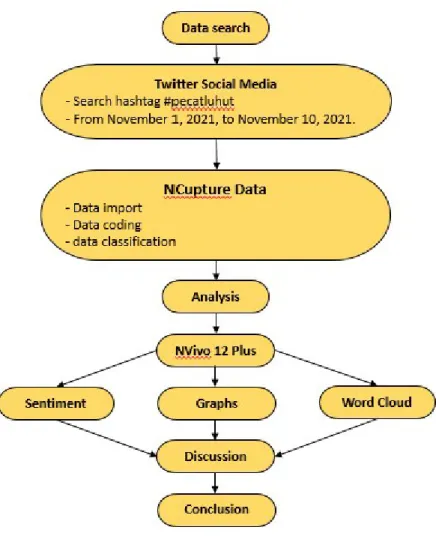
In the data analysis stage, they use NVivo12 Plus software to visualize data through sentiment analysis, tables and word clouds. The reason for choosing to use the NVivo 12 Plus software as a data analysis tool is that it is a new way to be used in qualitative research to make it easier for researchers to see trends and analyze media accurately (Sundari et al., 2022). For more details on the stages of research can be seen in Figure 2 below.
Figure 2. Research Stages Source. Created by the Author
The picture above shows that at this stage of the research using social media Twitter as a source in data collection, searching for data using the hashtag #pecatluhut and limiting data from 1 November 2021 to 10 November 2021. After that, NCupture found data that was considered necessary from the machine search for #pecatluhut by importing, coding, and classifying data. The next step is to analyze the data using the NVivo 12 Plus software to visualize it in sentiments, graphs, and word clouds to make it easier for researchers to read the data. Other processes will be discussed and analyzed more deeply through a literature review to corroborate the findings and draw conclusions. Using the NVivo 12 Plus software is relevant because it can be used to accurately analyze research on media trends, in line with Machmud et al. (2021) , who analyzed government coordination on Twitter in overcoming the Covid-19 pandemic in Indonesia. NVivo 12 Plus is an accurate analytical tool for developing increasingly sophisticated 5.0 technology (Rahmanto et al., 2021).
DISCUSSION
Information on Twitter media in forming a public opinion is developing quickly because it is a medium that users, government institutions, and public officials widely use. (Juditha, 2014; Susanto, 2017). The use of social media to send and receive information is increasingly being used by both individuals and institutions such as educational institutions, government, and businesses (Budiman & Widiksono, 2018). Twitter is a microblogging site that sends and reads someone’s latest status. Some of the functions of hashtags on Twitter are a medium for searching and displaying information more efficiently and as a marker for active or trending topics (Sundari et al., 2022). Lately, social media has had a significant role in various accesses to modern life. In politics, social media is used to carry out political agendas, such as political campaigns leading to specific issues and tools for propaganda (Simanjuntak, 2021). Therefore, with the development of social media among public officials, they must carry out their duties and responsibilities properly to gain public trust (Nawawi, 2012). because polemics that often occur are trending issues that grab users’ attention, such as blasphemy against public officials, interrogating political figures, and other trending criminal issues (Duwi Septi Rini, 2021; Zein, 2019).
Plus, social media can now be used to share sources of information and communicate with new people and build public opinion, as well as a tool for disseminating information and is very user-friendly (Fitriani, 2017). With social media, the public can provide criticism and suggestions to the government regarding the policies being implemented (Cahyono, 2016). Plus, interacting with social media is a fast way to highlight issues that are developing in public audiences (Darmastuti, 2012). Thus, it is very relevant if the #pecatluhut trend on
Twitter social media becomes public opinion which builds up quickly in November, as a form of public criticism of the government, which is considered not a pro with the situation because it is suspected of being involved in increasing the price of PCR tests when the Covid-19 pandemic increased. In addressing this issue, the government should be able to improve the welfare of its people by being sensitive to the conditions needed (Said, 2018). Tweets allow users to share what is being done or felt, conversations, information sharing, and news reporting. Tweets post things about users and share information (Nurhuda et al., 2016). The media can also create conditions that support the development of trust and reciprocity among citizens, public agents, and clients who can unite and engage in collective action to encourage disclosure and enforcement of secrets between state-issued policies (Darwis et al., 2020).
Viewed from the ethical and political dimension, it includes the dimensions of objectives, means, and actions of government policies built into the pricing of polymerase chain reaction (PCR) tests which have resulted in a significant trending hashtag #pacatluhut on Twitter social media, due to weak coordination between central and regional government agencies so that the public feels that the prices set are not uniform in several regions (Devianti, 2021). In addition, during the Covid-19 pandemic, the price of polymerase chain reaction (PCR) test kits continued to fluctuate due to supply and demand factors. The limited availability of PCR test equipment and laboratories at the start of the pandemic also impacted the price of services (Supranto, 2011). Another reason from the health ministry is that the Reagent is the first component. Second, consumables such as PPE, gloves, tubes, and other similar items. Third, several administrative and operational costs (Candrawati, 2021). Under these conditions, it is only natural to invite controversial political action on Twitter social media users because the public should be provided with services that can prosper them and get out of the downturn during the Covid-19 pandemic; the public also believes that the pricing for polymerase chain reaction (PCR) tests is high levels will add to misery in society (Syauqi, 2020). Thus, the dimension of the ‘objective’ of the policy was not felt useful because Luhut Binsar Panjaitan assessed that it was not sensitive to what the public felt during the Covid-19 pandemic with PCR pricing. In addition, the dimensions of government facilities have not been spread evenly in each region, so services are still felt to be slow in handling the pandemic. So, it is very natural to cause political action in public in the form of rejection on social media and Twitter (Indiahono & Tobirin, 2021; Marina, 2021).
Therefore, it will invite controversy among Twitter social media users in responding to the polymerase chain reaction (PCR) test pricing case with the hashtag #pecatluhut highlighted because one of the ministers is suspected of being involved in price fixing (PCR) in society (Suaib et al., 2021). This is also supported by sentiment on social media, Twitter which
shows positive and negative feelings (Pratama & Qodir, 2022). A social media sentiment is a form of implementing positive or negative feelings depicted on posts or engagements on social media (Dolan et al., 2019). That sentiment is also that all conditions of social media exposure do not always positively impact. Nowadays, civil disobedience often occurs on social media (Schradie, 2018). The government’s failure to implement trustworthy and fair law enforcement has momentum for the rise of civil society to voice their rights (Ong et al., 2016). This situation is easy to understand using the government’s repressive actions to respond to people’s demands (Neumayer & Rossi, 2016). The increasingly widespread use of social networks such as Twitter makes the social network very large. One of the uses of this data is to find out the opinions or sentiments of social network users on a topic.
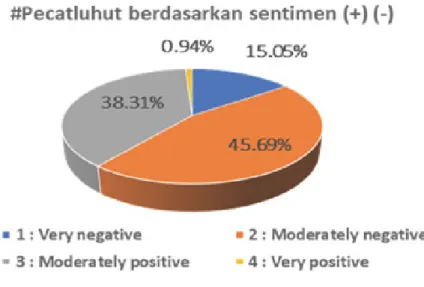
Figure 3. Sentiment #pecatluhut
Source: https://populis.id/read4136/pecatluhut
The topic in the spotlight lately means the viral hashtag #pecatluhut. Through social media and Twitter, thousands of people thronged and expressed their disappointment with the policy on PCR pricing made by Luhut Binsar Panjaitan, the Coordinating Minister for Maritime Affairs of the Republic of Indonesia (Budiman & Widiksono, 2018). According to the data displayed, it can be seen that the negative sentiment of residents towards Luhut is getting stronger. This negative sentiment can be interpreted as disappointing residents cannot dam. Negative sentiment dominates the hashtag #Pecatluhut using a percentage of 15.05%.
The sentiment is quite negative on its own, as much as 45.69%, using the number towards its negative of 60.74%. Only 39.26% came from the hashtag #pecatluhut, which stated that the public had no objection to the hashtag (Appel et al., 2020).
The form of public policy by Minister Luhut Biner Panjaitan has resulted in fraudulent behavior toward law enforcement in Indonesia. The hashtag #pecatluhut is not just a conversation in a coffee shop, a public evaluation from the government to improve the policy structure that has taken root there. What needs to be improved is the enforcement of rules in the field of investigation. There has been a new norm recently when the investigation and investigation process is closed. This leaves room for abuse of authority (Westerlund, 2019). Abuse of power currently has the potential to occur. There is almost no open space for the public; both the complainant and the reported objected. There are at least 12 issues that are not allowed by the police from June 2020 to October 2021. The cases that are not allowed to circulate at the Polsek, Polres, and Polda levels with problem reports are very diverse. Such as violence, gratification, assault, sexual assault, and shooting by officers.
The reason so many cases are not followed up. For example, there are no witnesses, evidence, and leads resolved internally and quietly. There are obstacles to revealing the characteristics of the perpetrators and several other reasons for the case (Caplan & Boyd, 2018).
Twitter Social Media Analysis Content based on Hashtag #pecatluhut
Accurate insights from social media such as Twitter can be obtained if users view Twitter tweets daily. Due to a large number of tweets and fast growth, it is impossible to do this manually without the help of computer-based tools. Researchers used data collection techniques captured through Ncapture to produce various activities using
#percumalaporpolisi (Liu et al., 2018). Researchers use the Capture feature because it allows researchers to obtain tweets uploaded by Twitter users simultaneously, so in this study, tweets were collected by utilizing this facility. The first tweet text analysis analyzes the frequency of word occurrences (Kim & Hastak, 2018).
Table 1. #pecatluhut
Source: Coding Analysis via NVivo 12 plus Software
Based on the Crosstab Query-Rate on the #pecatluhut variable, this explains Minister Luhut binary Panjaitan’s policy which makes the public have no respect for Luhut’s performance. The main tasks, functions, ideas, and work achievements are duties and responsibilities. The results of the Crosstab Query-Rate for the #pecatluhut variable based on consideration explained that the emergence of the #pecatluhut hashtag was initiated by the public’s disappointment with the policies made by Luhut. Based on a much higher percentage, namely 45% of the performance Minister Luhut, which makes the public disrespectful, secondly, it can be seen from the portion of policy setting, 35% of the community considers that the policy decisions made by Minister Luhut are fluctuating, as can be seen from the PCR pricing. Finally, it was seen that Communication had the lowest percentage because the public considered Minister Luhut’s Communication suitable for handling Covid- 19 cases (Palvia et al., 2018).
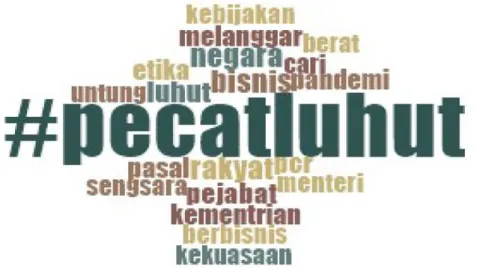
Figure 4. Wordcloud Visualization for Frequently used Words #pecatluhut Source: NVivo 12 plus Software
Based on the results of Word Frequency, it can be seen that the most frequent word content from the hashtag #pecatluhut is the hashtag #pecatluhut itself. The hashtag was often accompanied by stories of people being disappointed by the policies set by Minister Luhut Binsar Panjaitan (Rosanti et al., 2021). By analyzing the most frequently used terms, the researcher considered the 20 most commonly used words in #pecatluhut. The content contains a form of public criticism that often results in angry people over the PCR price- fixing case that likes to change (Ulas, 2019). Minister Luhut Binsar Panjaitan’s criticism must be used as a form of attention and input for introspection or self-improvement. A government must be professional, transparent, and responsible for the positions assigned;
all government agencies must be careful to set policies and their performance. Continue to improve professionalism, be transparent and always make policies that ease the burden on the community for the good of the country and the Indonesian nation in the future (Menendez et al., 2018).
This issue is a novelty in dealing with the problems that are affecting the global spread of Covid-19, so it is essential to address it adequately so that the problems that have become trending public opinion on Twitter social media are not repeated in handling the implementation of high and variable PCR tests (Wafa, 2020). It is hoped that by implementing the PCR test policy, the government can suppress the Covid-19 pandemic from becoming endemic and, ultimately, the implementation of a new normal in society (Oey-Gardiner &
Abdullah, 2021). So good coordination and strategy are needed between all government officials at the central and regional levels to encourage public trust in the government regarding the PCR test policy to avoid causing new problems in handling Covid-19 in Indonesia (Agustino, 2020). With this, the acceleration of the endemic period and the new standard can be well realized in society and can encourage the recovery of the economy and public welfare as a whole (Firdaus et al., 2021).
This study implies that public officials must prioritize the interests of the community in making decisions and political policies (Khoirul Saleh & Achmat Munif, 2015) so as not to cause problems that are controversial to the public and can lead to a motion of no confidence in stakeholders (Hasibuan et al., 2018). A further impact is reduced public trust in the government, thus inviting social action that can be detrimental to many parties, such as anarchist demonstrations, rampant hoax news circulating on social media, and public disobedience to policies made (Sauter, 2014). Under these conditions, a sense of justice and transparency must be presented to the public in deciding a policy so that the country’s condition continues to be better, advanced, and stable (Pozen, 2018). Thus, political ethics in government is important and must be instilled in every stakeholder to encourage prosperity and accelerate national development, especially making policies based on the community’s interests, not on elites or certain groups (Maiwan, 2016; Ramdhani & Ramdhani, 2017).
CONCLUSION
Social media is critical for Communicating about every incident, including community rejection. This study aims to see the development of Luhut Binsar Panjaitan based on
#Pecatluhut through social media Twitter. Explores the messages and reactions evoked by social media platform Twitter. Internet users can now freely disseminate information to create public opinion with various meanings. This opinion is believed to be accurate data
because public opinion is formed from an outpouring of emotions, existing opinions, or viral stories in the general media. Twitter, which is used to update tweets, reply to tweets, and mention someone, has become a part of everyday life for internet users. The hashtag
#pecatluhut Some tweets contain messages and criticisms of setting policies for PCR prices that make the public not respect the guidelines and work of minister Luhut. A hashtag is also a form of community spontaneity in communicating through criticism and social control over the world of government to improve public services and be more transparent in the future.
ACKNOWLEDGEMENT
This research work is supported by the Master of Government Science study program at the University of Muhammadiyah. In addition, the authors would like to thank the Journal of Communication
REFERENCES
Agustino, L. (2020). Analisis Kebijakan Penanganan Wabah Covid-19: Pengalaman Indonesia.
Jurnal Borneo Administrator, 16(2), 253–270.
Alkatiri, A. B. M., Nadiah, Z., & Nasution, A. N. S. (2020). Opini Publik Terhadap Penerapan New Normal Di Media Sosial Twitter. CoverAge: Journal of Strategic Communication, 11(1), 19–26.
Appel, G., Grewal, L., Hadi, R., & Stephen, A. T. (2020). The future of social media in marketing.
Journal of the Academy of Marketing Science, 48(1), 79–95. https://doi.org/10.1007/
s11747-019-00695-1
Azikin, A. (2018). Konsep Dan Implementasi Ideologi Pancasila Dalam Perumusan Kebijakan Pemerintahan. Jurnal Kebijakan Pemerintahan, 77–90. https://doi.org/10.33701/
jkp.v1ino.2.1098
Bisri, M. H., & Asmoro, B. T. (2019). Etika Pelayanan Publik di Indonesia. Journal of Governance Innovation, 1(1), 59–76. https://doi.org/10.36636/jogiv.v1i1.298
Budiman, A. A., & Widiksono, S. (2018). Aplikasi Pengolahan Data Untuk Menganalisa Penggunaan Hashtag Pada Twitter. 8(2).
Cahyono, A. S. (2016). Pengaruh media sosial terhadap perubahan sosial masyarakat di Indonesia. Publiciana, 9(1), 140–157.
Candrawati, T. B. (2021). Peran World Health Organization Dalam Upaya Penanganan Covid- 19 Di Indonesia Tahun 2020. In Repository.Uinjkt.Ac.Id (Issue 11171130000052). Fakultas Ilmu Sosial Dan Ilmu Politik Universitas Islam Negeri Syarif …. https://
r e p o s i t o r y. u i n j k t . a c . i d / d s p a c e / h a n d l e /1 2 3 4 5 6 7 8 9 /6 0 8 3 1 % 0 A h t t p s : / / repository.uinjkt.ac.id/dspace/bitstream/123456789/60831/1/Inggrid Galih Mustikawati.FISIP.pdf
Caplan, R., & Boyd, D. (2018). Isomorphism through algorithms: Institutional dependencies in the case of Facebook. Big Data and Society, 5(1), 1–12. https://doi.org/10.1177/
2053951718757253
Darmastuti, R. (2012). Media relations: konsep, strategi, dan aplikasi. Andi.
Darmawati. (2020). Jurnal Sipatokkong BPSDM Sulawesi Selatan. Jurnal Sipatokkong BPSDM Sulawesi Selatan, 1(2), 137–142.
Darwis, D., Pratiwi, E. S., & Pasaribu, A. F. O. (2020). Penerapan Algoritma Svm Untuk Analisis Sentimen Pada Data Twitter Komisi Pemberantasan Korupsi Republik Indonesia. Edutic - Scientific Journal of Informatics Education, 7(1), 1–11. https://doi.org/10.21107/
edutic.v7i1.8779
Devianti, I. (2021). Respon Pemerintah Kota Makassar dalam Penangan Covid-19 (Studi Kasus Kelurahan Batua). Universitas Islam Negeri Alauddin Makassar.
Di Lauro, S., Tursunbayeva, A., & Antonelli, G. (2019). How Nonprofit Organizations Use Social Media for Fundraising: A Systematic Literature Review. International Journal of Business and Management, 14(7), 1. https://doi.org/10.5539/ijbm.v14n7p1
Dolan, R., Conduit, J., Frethey-Bentham, C., Fahy, J., & Goodman, S. (2019). Social media engagement behavior: A framework for engaging customers through social media content.
European Journal of Marketing, 53(10), 2213–2243.
Duwi Septi Rini, B. (2021). Analisis Stigma Masyarakat Terhadap Akun Buzzer Politik (Studi Kasus: Tagar# JaksaRasaBuzzerRp di Media Sosial Twitter). Fakultas Ilmu Sosial dan Ilmu Politik.
Eid, M., & Ward, S. J. A. (2016). Editorial/ : Ethics , New Media , and Social Networks Editorial/
: Ethics , New Media , and Social Networks. Global Media Journal, 2(1), 1–4.
Endah, K. (2018). Etika Pemerintahan Dalam Pelayanan Publik. Moderat: Jurnal Ilmiah Ilmu Pemerintahan, 4(1), 141–151. https://jurnal.unigal.ac.id/index.php/moderat/article/view/
1088
Firdaus, I. T., Tursina, M. D., & Roziqin, A. (2021). Transformasi Birokrasi Digital Di Masa Pandemi Covid-19 Untuk Mewujudkan Digitalisasi Pemeritahan Indonesia. Kybernan: Jurnal Studi Kepemerintahan, 4(2), 226–239.
Fitriani, Y. (2017). Analisis pemanfaatan berbagai media sosial sebagai sarana penyebaran informasi bagi masyarakat. Paradigma, 19(2), 148–152.
Fredheim, R., Bay, S., Dek, A., Dek, I., & North Atlantic Treaty Organization. Strategic Communications Centre of Excellence. (2020). Social media manipulation 2020/ : how social media companies are failing to combat inauthentic behaviour online.
Hahury, J. F., & Sos, S. (2022). Etika Administrasi Publik Telaah Konsep Mewujudkan Birokrasi yang Responsif dan Profesional. Penerbit Lakeisha.
Hasibuan, P. A. S., Indrawati, M., & Hartati, C. S. (2018). Punahnya Etika Moral Elit Politik di Indonesia. Jurnal Manajemen Dan Administrasi Publik, 01(04), 458–463.
Indiahono, D., & TOBIRIN, T. (2021). Kebijakan dan Pelayanan Publik: Berbasis Keadilan Sosial di Era Disrupsi dan Big Data. SIP Publishing.
ISMAIL NURDIN, M. S. (2017). Etika Pemerintahan: Norma, Konsep, dan Praktek bagi Penyelenggara Pemerintahan. Lintang Rasi Aksara Books.
Janah, N. (2017). Nurcholish Madjid dan Pemikirannya (Diantara Kontribusi dan Kontroversi).
Cakrawala: Jurnal Studi Islam, 12(1), 44–63.
Juditha, C. (2014). Opini Publik Terhadap Kasus “KPK Lawan Polisi” dalam Media Sosial Twitter. Jurnal Pekommas, 17(2), 61–70.
Khoirul Saleh, & Achmat Munif. (2015). Membangun Karakter Budaya Politik dalam Berdomeokrasi. Addin, 9(2), 309–332.
Kim, J., & Hastak, M. (2018). Social network analysis: Characteristics of online social networks after a disaster. International Journal of Information Management, 38(1), 86–96. https:/
/doi.org/10.1016/j.ijinfomgt.2017.08.003
Korstanje, M. E., & Strang, K. D. (2017). Comparing the Socio-Political Ethics of Fighting Terrorism with Extreme Self-Defense in USA. International Journal of Risk and Contingency Management, 7(1), 1–19. https://doi.org/10.4018/ijrcm.2018010101
Kurnaedi, D., Nurmandi, A., & Rahmawati, D. E. (2021). Local Government Use Website and Twitters as Communication and Interaction Tools The development of people ’ s lives in an increasingly modern direction impacts the increase in community needs that must always be fulfilled . The government ’ s role as an . 5(148), 438–455. https://doi.org/
10.26740/jsm.v5n2.p438-455
Liu, W., Lai, C. H., & Xu, W. (Wayne). (2018). Tweeting about emergency: A semantic network analysis of government organizations’ social media messaging during Hurricane Harvey.
Public Relations Review, 44(5), 807–819. https://doi.org/10.1016/j.pubrev.2018.10.009 Machmud, M., Irawan, B., Karinda, K., Susilo, J., & Salahudin, S. (2021). Analysis of the intensity
of communication and coordination of government officials on twitter social media during
the Covid-19 handling in Indonesia. Academic Journal of Interdisciplinary Studies, 10(3), 319–334.
Maiwan, M. (2016). Kelompok Kepentingan (Interest Group), Kekuasaan dan Kedudukannya dalam Sistem Politik. Jurnal Ilmiah Mimbar Demokrasi, 15(2).
Maria. (2018). Local wisdom of indigenous society in managing their customary land: A comparative study on tribes in Indonesia. E3S Web of Conferences, 52. https://doi.org/
10.1051/e3sconf/20185200023
Marina, H. (2021). Inkonsistensi Kebijakan Pemerintah Pusat dalam Penanganan Covid-19 Di Indonesia. KEMUDI: Jurnal Ilmu Pemerintahan, 5(02), 215–238.
Nawawi, J. (2012). Membangun kepercayaan dalam mewujudkan good governance. Jurnal Ilmiah Ilmu Pemerintahan, 1(3), 19–29.
Neumayer, C., & Rossi, L. (2016). 15 Years of Protest and Media Technologies Scholarship: A Sociotechnical Timeline. Social Media and Society, 2(3). https://doi.org/10.1177/
2056305116662180
Nugroho, Y., & Syarief, S. (2022). To be or not to be/ ? Dilemmas of Covid-19 policy implementation and coordination in Indonesia. Paper Presented at the ISEAS-Yusof Ishak Institute Conference, 1–30. https://www.iseas.edu.sg/wp-content/uploads/2022/07/ISEAS- Conference_Covid-19-in-SEA_Indonesia_Dilemmas-of-policy-implementation.pdf Nurhuda, F., Widya Sihwi, S., & Doewes, A. (2016). Analisis Sentimen Masyarakat terhadap
Calon Presiden Indonesia 2014 berdasarkan Opini dari Twitter Menggunakan Metode Naive Bayes Classifier. Jurnal Teknologi & Informasi ITSmart, 2(2), 35. https://doi.org/
10.20961/its.v2i2.630
Oey-Gardiner, M., & Abdullah, M. A. (2021). Ragam Perspektif Dampak Covid-19. Yayasan Pustaka Obor Indonesia.
Onainor, E. R. (2019). Defining Success: A Comparison Study of Jambi’s Community Forests in Response to Rapid Deforestation by Agribusiness. 1, 105–112.
Ong, M. K., Romano, P. S., Edgington, S., Aronow, H. U., Auerbach, A. D., Black, J. T., De Marco, T., Escarce, J. J., Evangelista, L. S., Hanna, B., Ganiats, T. G., Greenberg, B. H., Greenfield, S., Kaplan, S. H., Kimchi, A., Liu, H., Lombardo, D., Mangione, C. M., Sadeghi, B., … Yan, T. (2016). Effectiveness of remote patient monitoring after discharge of hospitalized patients with heart failure the better effectiveness after transition-heart failure (BEAT-HF) randomized clinical trial. JAMA Internal Medicine, 176(3), 310–318.
https://doi.org/10.1001/jamainternmed.2015.7712
Palvia, S., Aeron, P., Gupta, P., Mahapatra, D., Parida, R., Rosner, R., & Sindhi, S. (2018).
Online Education: Worldwide Status, Challenges, Trends, and Implications. Journal of Global Information Technology Management, 21(4), 233–241. https://doi.org/10.1080/
1097198X.2018.1542262
Pamungkas, M. M. A., & Wahyunengseh, R. D. (2018). Efektivitas Media Informasi Sistem Penanggulangan Kegawatdaruratan Terpadu (SPGDT) Kota Surakarta Mahardhika. In Seminar Nasional Addministrasi Publik.
Parmudi, M. (2017). Perilaku Politik Bung Hatta ( Sebuah Telaah Etika Politik ). 93.
Pozen, D. E. (2018). Transparency’s Ideological Drift. The Yale Law Journal, 100–165.
Pratama, I., & Qodir, Z. (2022). Ada Apa di Balik Mosi Tidak Percaya pada Media Sosial Indonesia? 86–99. https://doi.org/10.33019/society.v10i1.334
Prawira, I., & Irawan, R. E. (2021). The objectivity of three indonesian cyber media: study of news content in the israel-palestine conflict. 6(2), 95–107. https://doi.org/10.24198/
jwp.v6i2.35073
Rahmanto, F., Pribadi, U., & Priyanto, A. (2021). Big data: What are the implications for public sector Policy in society 5.0 era? IOP Conference Series: Earth and Environmental Science, 717(1), 12009.
Rahmat, A. F., & Eko Priyo Purnomo. (2020). Twitter Media Platform to Set-Up Political Branding: Analyzing @Kiyai_Marufamin in 2019 Presidential Election Campaign. 4(1).
Ramdhani, A., & Ramdhani, M. A. (2017). Konsep Umum Pelaksanaan Kebijakan Publik. Jurnal Publik. https://doi.org/10.1109/ICMENS.2005.96
Ratminto, Sharbina, F., Yusuf, R. R., Laksana, L. U., Wahyuni, S., & Apriyanti, S. (2018).
Pelayanan Prima/ : pedoman penerapan momen kritis pelayanan. In UGM Press. UGM PRESS.
Reyes-Menendez, A., Saura, J. R., & Alvarez-Alonso, C. (2018). Understanding
#worldenvironmentday user opinions in twitter: A topic-based sentiment analysis approach. International Journal of Environmental Research and Public Health, 15(11).
https://doi.org/10.3390/ijerph15112537
Rosanti, D., Bela, S., Nurmandi, A., Muallidin, I., & Kurniawan, D. (2021). Meta-Analysis the Root of Terrorism from the Perspektif Islamic Movement in Indonesia Dinda Rosanti Salsa Bela Isnaini Muallidin Danang Kurniawan Abstract/ : Keywords/ : Abstract/ : 16(2), 393–
420.
Sadhana, K. (2018). Etika Birokrasi Dalam Pelayanan Publik D. In Journal of Materials Processing Technology (Vol. 1, Issue 1). Rizmedia Pustaka Indonesia. http://dx.doi.org/
10.1016/j.cirp.2016.06.001%0Ahttp://dx.doi.org/10.1016/j.powtec.2016.12.055%0Ahttps:/
/ d o i . o rg /1 0 . 1 0 1 6/ j . i j fa t i g u e . 2 0 1 9 . 0 2 . 0 0 6 % 0 A ht t ps : / / d o i . o rg /1 0 . 1 0 1 6/
j.matlet.2019.04.024%0Ahttps://doi.org/10.1016/j.matlet.2019.127252%0Ahttp://dx.doi.o Said, A. L. (2018). Corporate Social Responsibility dalam Perspektif Governance. Deepublish.
Sauter, M. (2014). The coming swarm: DDOS actions, hacktivism, and civil disobedience on the Internet. Bloomsbury Academic.
Schradie, J. (2018). The digital activism gap: How class and costs shape online collective action. Social Problems, 65(1), 51–74. https://doi.org/10.1093/socpro/spx042
Sen, A. (2017). Elements of a theory of human rights. In Justice and the Capabilities Approach (pp. 221–262). Routledge. https://doi.org/10.4324/9781315251240-6
Setiawan, A., & Fauzi, E. A. (2019). Etika kepemimpinan politik dalam penyelenggaraan pemerintahan Indonesia. Jurnal Pemerintahan Dan Kebijakan (JPK), 1(1), 1–12.
Sibaweh, N. (2021). Respon Media Atas Polemik Tes Pcr ( Tinjauan atas Konten Majalah Tempo dan Media Online Tempo . co ) Media Response to Pcr Test Polemic ( Overview of the Content of Tempo Magazine and Tempo . co Online Media ). November 2021, 53–68.
Simanjuntak, G. P. (2021). Echo Chambers Dan Polarisasi Politik Di Media.
Suaib, E., Harjudin, L. O., Bilu, L., Asriani, & Cahyani Yusuf, P. (2021). Siapa Untung Siapa Buntung (Kajian Ekonomi Politik Covid-19 di Indonesia). Senaspolhi 3 Fisip Unwahas, 4(1), 1–23.
Sundari, C., Nurmandi, A., Muallidin, I., Kurniawan, D., & Salahudin. (2022). Analysis of Secondary Education Services During the COVID-19 Pandemic. In Lecture Notes in Networks and Systems (Vol. 319). Springer International Publishing. https://doi.org/10.1007/978-3- 030-85540-6_123
Sundari, C., & Suswanta. (2022). Artificial Intelligence Innovation in Capsule Bus in Jambi City. Iconpo 2021, 209(5), 104–110.
Supranto, J. (2011). Pengukuran Tingkat Kepuasan Pelanggan untuk. In Menaikkan Pangsa Pasar (Cetakan Keempat). Jakarta: PT. Rineka Cipta. Penerbit Qiara Media.
Susanto, E. H. (2017). Media sosial sebagai pendukung jaringan komunikasi politik. Jurnal Aspikom, 3(3), 379–398.
Syauqi, A. (2020). Jalan Panjang Covid19. Jkubs, 1(1), 1–19.
Ulas, D. (2019). Digital Transformation Process and SMEs. Procedia Computer Science, 158, 662–671. https://doi.org/10.1016/j.procs.2019.09.101
Wafa, M. A. (2020). Analisis Framing Twitter Presiden Joko Widodo Dimasa Covid-19.
Westerlund, M. (2019). The emergence of deepfake technology: A review. Technology Innovation Management Review, 9(11), 39–52. https://doi.org/10.22215/TIMREVIEW/
1282
Wibowo, A. R., Nidya, N., Rahma, A. F., & Agussalim. (2020). Analisis Sentimen Hashtag
“Dirumahaja” Saat Pandemi Covid-19 Di Indonesia Menggunakan Nlp. Jurnal Informatika Dan Sistem Informasi, 1(2), 343–353.
Wicke, P., & Bolognesi, M. M. (2020). Framing COVID-19: How we conceptualize and discuss the pandemic on Twitter. PLoS ONE, 15(9 October), e0240010. https://doi.org/10.1371/
journal.pone.0240010
Yustika, A. E., Faisal, A. H., Sambodo, A., Prasetyoko, A., Aviliani, Damanhuri, D. S., Sentosa, D. A., Hartanti, E. S., Kristiadi, J., Wijaya, K., Basri, M. C., Hasan, M. F., Dahuri, R., Nugroho, Y., Piliang, Y. A., & Latief, Y. (2020). Pandemi Corona/ : Virus Deglobalisasi Masa Depan Perekonomian Global dan Nasional.pdf (Vol. 1). PT Penerbit IPB Press. https://
www.google.co.id/books/edition/PANDEMI_CORONA_VIRUS_DEGLOBALISASI_Masa/
ybbwDwAAQBAJ?hl=en&gbpv=1&dq=corona+virus&printsec=frontcover
Zein, M. F. (2019). Panduan Menggunakan Media Sosial untuk Generasi Emas Milenial.
Mohamad Fadhilah Zein.
Zuliana, E. (2015). Konsep etika politik menurut pemikiran Nurcholish Madjid. Pascasarjana UIN Sumatera Utara.