All rights reserved. The Southern Baptist Theological Seminary has permission to reproduce and disseminate this document in any form by any means for purposes chosen by the Seminary, including, without limitation, preservation, or instruction.
DEVELOPING A MULTISITE PLAN FOR MOUNT ARARAT BAPTIST CHURCH
STAFFORD, VIRGINIA
__________________
A Project Presented to the Faculty of
The Southern Baptist Theological Seminary
__________________
In Partial Fulfillment
of the Requirements for the Degree Doctor of Educational Ministry
__________________
by
Brian Carroll Bennett May 2022
DEVELOPING A MULTISITE PLAN FOR MOUNT ARARAT BAPTIST CHURCH
STAFFORD, VIRGINIA
Brian Carroll Bennett Read and Approved by:
Faculty Supervisor: Jamus H. Edwards II
Second Reader: Matthew D. Haste
Defense Date: March 29, 2022
TABLE OF CONTENTS
Page
LIST OF TABLES . . . vi
LIST OF FIGURES . . . vii
PREFACE . . . viii
Chapter 1. INTRODUCTION . . . 1
Context . . . 1
Rationale . . . 7
Purpose . . . 8
Goals . . . 8
Research Methodology . . . 8
Definitions and Limitations/Delimitations . . . 10
Conclusion . . . 11
2. THE BIBLICAL AND THEOLOGICAL BASIS FOR THE MULTISITE MULTIPLICATION MODEL . . . 13
Introduction . . . 13
Multiplication in Genesis 1-2 . . . 14
Multiplication in Acts 1:8 . . . 19
The Ideal Church . . . 23
Conclusion . . . 39
3. MODERN MULTISITE CONSIDERATIONS . . . 40
Multisite Models . . . 42
Three Big Questions . . . 47
Conclusion . . . 59
4. IMPLEMENTATION OF THE MINISTRY PROJECT . . . 61
Introduction . . . 61
Project Research . . . 62
Building the Organization . . . 74
The Launch Plan . . . 76
Conclusion . . . 76
5. EVALUATING THE MINISTRY PROJECT . . . 78
Introduction . . . 78
Evaluation of the Project Purpose . . . 79
Evaluation of the Project Goals . . . 79
Strengths of the Project . . . 85
Weaknesses of the Project . . . 86
What I Would Do Differently . . . 87
Theological Reflections . . . 88
Personal Reflections . . . 88
Conclusion . . . 92
Appendix 1. MULTISITE EVALUATION TOOL . . . 93
2. TOP-LEVEL STRUCTURE CURRENT . . . 94
3. EXPANDED ORG CHART CURRENT . . . 96
4. EXPANSION PHASE 1 . . . 98
5. EXPANSION PHASE 2 . . . 100
6. RESPONSES TO QUESTION 22 . . . .102
7. MULTISITE ORGANIZATIONAL STRUCTURES SURVEY . . . 104
8. EVALUATION TOOL RESULTS . . . 107
9. LAUNCH PLAN—EASTER . . . 111
BIBLIOGRAPHY . . . 122
LIST OF TABLES
Table Page
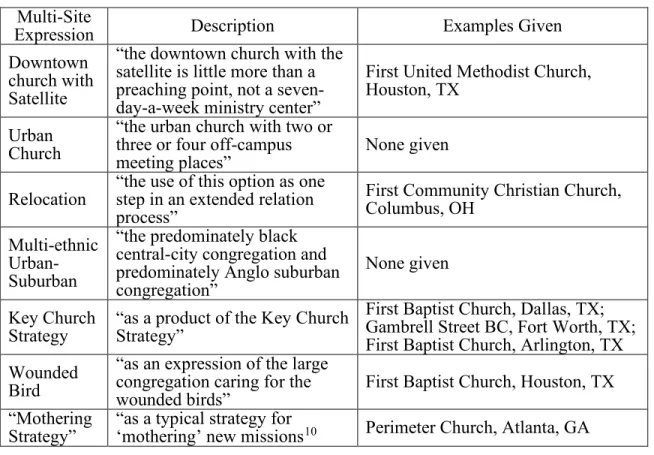
1. Lyle Schaller’s “multisite expressions” . . . 44
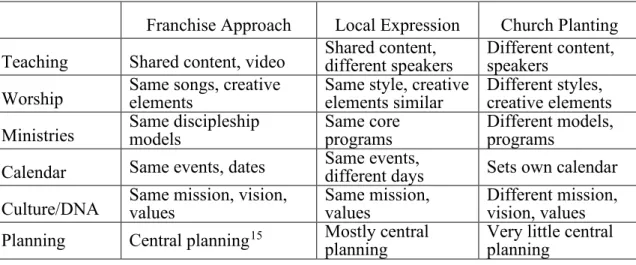
2. Five models for multi-site churches . . . 44
3. Tony Morgan multisite models . . . 46
4. Ministry insights: attendance and number of campuses . . . 64
5. Ministry insights medians . . . 65
6. Sermon delivery . . . 66
7. Vision and direction . . . 67
8. Ministry decisions . . . 67
9. Budgets . . . 68
10. Matrix structures . . . 68
11. One church . . . 69
12. Brand consistency . . . 70
13. Management structure efficacy . . . 70
14. Current organizational chart review . . . 80
15. Future organization chart review . . . 82
16. Launch plan review . . . 84
17. Attendance pre-covid versus current (November 2021) . . . 92
A1. Responses to question 22 . . . 102
LIST OF FIGURES
Figure Page
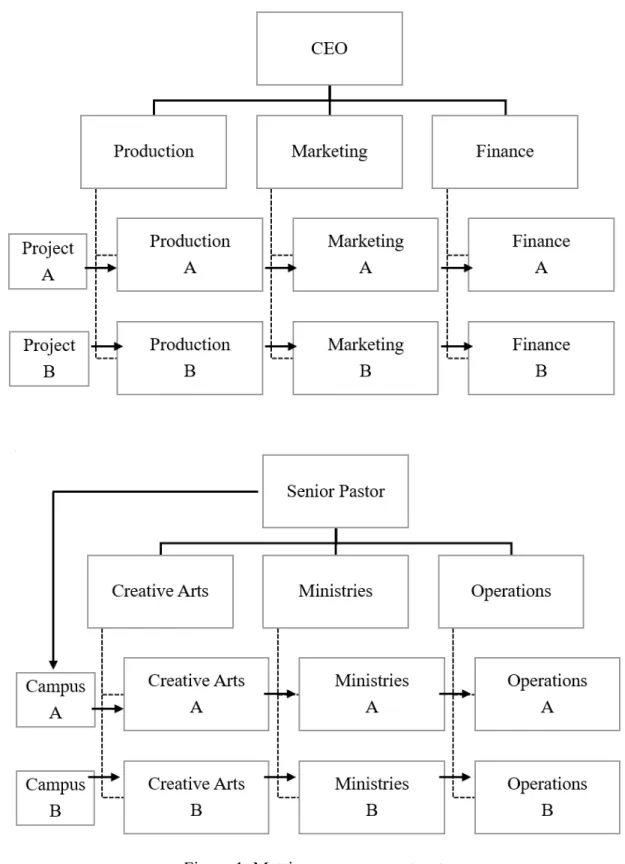
1. Matrix management structures . . . 55
2. Decision-making continuum . . . 58
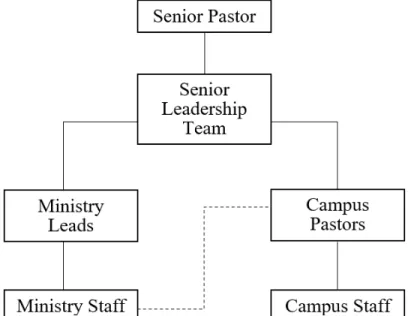
3. Elder led multisites . . . 72
4. Elder protected, staff led multisites . . . 73
5. No elders, staff led . . . 74
A1. Top level structure: current . . . 95
A2. Expanded organizational chart: current . . . 97
A3. Expansion phase 1 . . . 99
A4. Expansion phase 2 . . . 101
PREFACE
Doctoral projects are attributed to one author, but they are the result of many working together to make it come to fruition. Indeed, if I were to list all those who made this project possible along with their contributions, it would quickly run into a dozen pages. Nevertheless, I will attempt to give kudos where kudos are due.
To the founder and perfector of our faith, I give all glory. I never intended to enter the ministry. Indeed, I was in my thirties before I came to Christ. If Lewis was the most reluctant convert in England, I was surely among the top ten in the US. God has His plans, and I am eternally thankful that my salvation was always a part of them.
To my family, the most patient and steadfast companions I could ever hope for, thank you for your love, encouragement, and understanding, especially when Dad had to make the trek to Louisville and missed important moments in your lives.
To my fellow students, what a journey! I will treasure the time we spent during our campus visits. You are all so incredibly gifted and loving servants of the Lord. I have no doubt that your ministries will be blessed for the sacrifices you made to pursue your studies.
A special thank to Pastor Andrew Segre. This project dealt with multisite church operations, and you were the multisite campus pastor for much of the time I spent
producing this document. Your campus was the lab for this project, and you were every bit the mad scientist I was.
Finally, to Dr. Jamus Edwards and the Southern Baptist Theological Seminary faculty for allowing me to study under you. Your instruction, guidance, and encouragement were essential to this endeavor.
Brian Bennett Stafford, Virginia
May 2022
CHAPTER 1 INTRODUCTION
The motto of Mount Ararat Baptist Church is “For One More.” We are on a mission of multiplication. Approximately 170,000 souls in the immediate area do not have a church to call home, and The Mount’s goal is to use the multisite multiplication model to connect unbelievers to The Mount.1 This area is fertile ground for evangelism.
The Mount’s desire as a church is not to fill seats; the Great Commission compels the church to go further: “Go therefore and make disciples of all nations, baptizing them in the name of the Father and of the Son and of the Holy Spirit, teaching them to observe all that I have commanded you” (Matt 28:19-20).2 Given the great honor and responsibility of this task, The Mount leadership team set out to locate a community to expand the reach of the 117-year-old church by using the multisite church model. God graciously provided The Mount with an ideal location
Context
Mount Ararat Baptist Church (The Mount) launched in Stafford County, Virginia, in 1907. It has been at its current location, near the original site, since 1955.
Since then there have been several expansion projects, driven by numerical growth, resulting in the multi-purpose buildings that house the church ministries on the thirty- five-acre campus. Continued growth, however, caused overcrowding, which led to discussions about further expansion. In 2014, a planning team came together to address
1 Association of Statisticians of American Religious Bodies, “U.S. Religion Census 1952 to 2020,” accessed September 19, 2020, http://www.usreligioncensus.org/compare.php. In 2010, the population of Stafford and Spotsylvania counties was 251,358 of which 81,361 were religious adherents.
2 All Scripture quotations are from the English Standard Version, unless otherwise noted.
three issues: an immediate need for space to overcome the problem of overcrowding, a long-term solution for overcrowding, and a strategy for ensuring future growth.
Early on, the planning teams confirmed through data analysis that scores of people were commuting to The Mount from neighboring communities, some as far away as forty miles. A heat map, generated from further analysis, revealed that commuters were concentrated in three nearby locations. The planning team believed that a campus situated in proximity to one of these population centers would be an attractive alternative for commuters. It followed then that a fair number of commuters not attending the main campus would relieve the strain of overcrowding and perhaps free up enough space for additional growth. The church decided to launch a new campus using a multi-site model.
Evangelical churches employ many different multisite models, each model with its own best practices.3 The model chosen by The Mount delivered pre-recorded content each Sunday to the multisite (Courthouse) campus. In addition to the “taped”
teaching, which presented challenges, the campus offered live worship, and a full kids ministry program, infant through elementary.
The Courthouse campus, although smaller than the Stafford campus, offered a similar experience as the main campus. The Courthouse campus met at a high school; the campus utilized the school theatre for the worship service, which made recreating the contemporary black-box achievable. Additional equipment, projectors, screens, lighting, and a professional system were brought in to augment the permanent, onsite capabilities.
The children’s ministry utilized the cafeteria, gymnasium, and library. Every Sunday
3 There exists some agreement as to the various shapes a multisite church can take, but the models are not static. See Vanderbloemen, “The 3 Models of Multisite Ministry,” February 4, 2016, https://www.vanderbloemen.com/blog/the-3-models-of-multisite-ministry. Some practitioners define multisite quite narrowly as is the case with Paul Alexander, who claims, “If it’s not on a screen, it’s not a multisite. It may be multi-congregational or even a family of churches, but it’s not a multisite church.” Paul Alexander, “Multisite Models: Which Is Best,” Tony Morgan Live, August 24, 2017,
https://tonymorganlive.com/2017/08/24/best-multisite-church-models/. Many different organizational approaches must be considered when launching a multisite campus. See Jamus Howell Edwards II,
“Leadership Structures and Dynamics in Multisite Churches: A Quantitative Study” (PhD diss., The Southern Baptist Theological Seminary, 2014).
beginning at 6 a.m., the set-up team transformed the high school into a church campus, complete with branding. This facelift resulted in a campus that felt permanent and resembled the Stafford campus.
Several key staff members were relocated temporarily to Courthouse, along with a core group of Stafford attendees who filled highly visible volunteer positions. By relocating and positioning key staff members and volunteers, leadership hoped to infuse The Mount’s DNA into the new campus. The DNA of The Mount is summed up in four values: gather, volunteer, give, and invite. New attendees/members would be inculcated from day one with these four values, facilitating disciple-making and resulting in numerical and spiritual growth at the Courthouse campus.
Initial numbers at the Courthouse campus were good. The campus ran as many as 300 in the first months after opening. However, within twelve months, the initial attendance had peaked and declined by 50 percent. It was later determined that the proximity of the Courthouse site to the main campus was the driving factor behind the drop in attendance. Around the same time, the staff members who were temporarily assigned to the Courthouse campus returned to their permanent positions back in Stafford, causing a leadership void that accelerated the decline in attendance.
Hoping to stem the tide, The Mount assembled an executive team to address the precipitous decline in the health of the Courthouse campus. The Mount then engaged The Unstuck Group, a consultancy firm ran by Tony Morgan to assist in the diagnosis of said decline. The efforts of the executive team and the Unstuck Group resulted in a multi- dimensional plan that addressed the multisite problem as well as some additional
systemic issues that demanded attention.
In October 2017, a decision was made to suspend operations at the Courthouse campus at the end of 2017. By that time, attendance had dropped to about 120. The closure of the Courthouse campus was not the end of the multi-site effort at The Mount; instead, it was the beginning of a new era in multi-site operations for the church.
The Mount planned to resume multisite operations in 2018, shooting for launch during December of 2019 or Spring 2020. Leadership assembled a core team of
volunteers to seed the new campus. They began to meet, pray, and plan for the future, while another team searched for a venue. The leadership team expected to find a school to serve as an initial location for the new campus. Unsurprisingly, other churches had the same idea. It appeared that multisite operations would have to be put on hold several months in hopes that a school would open up. God had other plans.
A Catholic church located in Fredericksburg long dreamed of having a permanent location for their parish. For seven years they met in a building that had previously been a motorcycle salesroom. Their tenancy ended as their brand-new cathedral opened its doors on July 15, 2018. Leadership’s knowledge of the property’s vacancy before it became available on the market was nothing short of an act of God. The Mount signed a five-year lease beginning on August 1, 2018 and opened the doors to the public on Easter of 2019.
Barriers to Success
Several problems led to the demise of the Courthouse campus, but none more evident than the location. The site chosen to house the campus sat a mere three miles from the main campus.4 At first, leadership did not view this as a potential problem, but instead as a way to reduce overcrowding at the main campus while reaching new people who may not want to drive to the Stafford site. Initially, many took advantage of the smaller crowds at the second venue, but eventually, the majority of those who opted to attend soon returned to the Stafford campus.
4 A common refrain heard from leaders at failed multisite campuses is that the main campus was too close to the new campus. Jim Tomberlin and Tim Cool, Church Locality: New Rules for Church Buildings in a Multisite, Church Planting, and Giga-Church World (Spring Hill, TN: Ranier, 2014), 119, Kindle; Rich Birch, “4 Painful Mistakes Multisite Churches Make Early On,” Unseminary, July 10, 2018, https://unseminary.com/4-painful-mistakes-multisite-churches-make-early-on; Tiffany Deluccia, “This Church Experiences a Failed Campus Launch and Wants to Share How You can Learn From It,” Tony Morgan Live, June 22, 2016, https://tonymorganlive.com/2016/06/22/church-experienced-failed-campus- launch-wants-share-how-can-learn-from-it.
Technical challenges with the sermon delivery method plagued the campus from the start.5 Insufficient bandwidth made streaming unreliable, so the sermon had to be recorded onto a hard drive and then driven to the Courthouse campus. This too, however, proved a less than ideal solution due to the genuine possibility that the recording would fail to make it to the Courthouse campus in time, or that the recording would itself fail, which it did on several occasions. Attendees, tired of the technical difficulties, stopped coming to the Courthouse site. Fixing technical problems was a priority, but not the only priority.
Staffing issues also required immediate attention. The Mount’s management and staffing structure at the time of the launch was unclear at best. The Executive Pastor, along with a long-time associate pastor, departed. Since they were not “on-board” with the decision to move to a multi-site model, they stepped away from their positions—
several other staff members left in their wake, including the Student Pastor. Two campus pastors were hired. They started work on the very day the Courthouse Campus opened.
The Senior Pastor, Family Ministry Director, and Worship Pastor absorbed much of the work the vacancies left behind. The result of this shuffling was an unclear chain of command with a bottleneck at the top—the Senior Pastor found himself with entirely too many direct reports and making too many decisions that should have been made a few rungs lower on the management ladder. The Mount added me as Executive Pastor to help with organizational restructuring and multisite operations.
The newly formed Lead Team—consisting of the Senior Pastor, Executive Pastor, Worship Pastor, and Director of Family Ministries—reconstituted the
organization’s structure. The lead team constructed a new management hierarchy, shifted responsibilities, and clarified roles. Despite these positive developments, the
organizational structure required more clarity and definition.
5 Portable Church Industries, “Multisite Church Challenges: Technology,” August 10, 2015, https://www.portablechurch.com/2015/portable-church-systems/multisite-church-challenges-technology/.
Another matter requiring definition and clarity was determining which programs were essential, “tier 1” ministries. One factor contributing to the number of attendees returning to the Stafford campus from the Courthouse campus was the programming disparity between the two sites—the main campus offered more ministry opportunities. The paucity of programming, together with the proximity of the campuses motivated many to return to Stafford.
The pastors and directors spent several days with The Unstuck Group devising a new strategic plan. One unexpected insight from the strategic planning process was the realization that the ministry and programs structure had become unnecessarily complex.
The church had a shotgun approach to the ministries and the programs offered to the congregation. Whenever a need arose, no matter how small, the church staff started a program to meet the need.6 Dozens of programs resulted. Leadership pared the list down considerably. The church even cut a well-attended program, AWANA, because it was no longer a good fit with The Mount’s ethos.
The church now offers three tiers of programming. Tier 1 and tier 2 are non- negotiable. These include assimilation classes and beginning discipleship curricula.
Comprising tier 3 are campus-specific programs based on the needs of the congregants at that site, like Celebrate Recovery and Financial Peace. All new campuses would launch with tier 1 programs, with tier 2 programs coming online as soon as possible. No new tier 1 or tier 2 programs would be launched at the main campus unless they could be feasibly reproduced at the new campuses
6 Greg L. Hawkins and Cally Parkinson, Move: What 1,000 Churches Reveal about Spiritual Growth (Grand Rapids: Zondervan, 2011), 15-18. Willow Creek Community Church performed an in- depth analysis on the state of spiritual health of their congregations. One of the interesting findings was that simply offering programs to meet felt needs has little effect on spiritual development and leads to a glut of programming. Summaries of their analysis can be found here.
Rationale
The Parable of the Talents (Matt 25:14-30; Luke 19:11-27) compels Christians to do the Lord’s work unceasingly. Each person is given talents, whether material as in treasure or immaterial as in gifts of the Spirit. In this parable, a household master entrusts his servants with a measure of silver: “To one he gave five talents, to another, two, and to another, one, each according to his own ability” (Matt 25:15). The master leaves, and upon his return he enquires how each of the servants has done with their portion. The master showed his pleasure with the effort of the first two servants but dealt harshly with the third who had risked nothing by burying his in the ground.
The parable can be extended to cover a corporate body such as the church. Each church body is blessed with treasure. In other words, every congregation is made up of people who give of their time, talent, and gifts. Some congregations are blessed beyond their needs, while others struggle to make ends meet. Nevertheless, all bodies are called to take what they are given and to evangelize. Evangelism takes on many forms and the one that the Mount chose was the multisite multiplication model.
The Mount elected to use its resources to launch a new campus utilizing the multisite model for three reasons. First, there existed a need to relieve overcrowding at the main campus, and building a new facility was not an option due to fiscal realities and the intransigence of the Stafford Counting Planning Commission. Second, large
concentrations of unchurched people existed in nearby communities. Based on the number of people already traveling to the Stafford campus from surrounding towns, leadership believed that a multisite campus could be successful if launched in these communities.
Third, the New Testament, specifically the book of Acts, models what might be construed as a multisite approach to evangelism. I will speak in detail about this third reason in chapter 2.
With the decision to move forward with multisite operations came the need to overcome the failings of the previous attempt. The initial efforts of The Mount’s multisite operations yielded some positive results and the church retained the physical resources,
AVL equipment, branding, computers, needed for this second iteration. What was lacking was a detailed and intentional plan that mitigated prior failures and built upon previous successes.
Purpose
The purpose of this project was to create a multisite campus master plan for The Mount in an effort to reach the people in the communities in and around Stafford, Virginia.
Goals
To achieve the purpose of this project, I directed my efforts to meet the following goals.
1. The first goal was to create a best practices survey to be sent out to multisite churches in an effort to gain insight into their ongoing operations.
2. The second goal was to create an organizational structure for the current multisite campuses of The Mount.
3. The third goal was to develop a scalable organizational plan for future expansion.
4. The fourth goal was to develop a launch plan for future multisite campuses at The Mount.
Meeting these goals would result in a blueprint for current and future multisite operations at The Mount. The research methodology and instruments used to measure the success of each goal are detailed in the following section.7
Research Methodology
The completion of each goal was dependent on a defined means of measurement and a benchmark of success. The first goal was to create a best practices survey to be sent out to multisite churches in an effort to gain insight into their ongoing operations.
Although the multisite church model is a relatively new method for launching churches,
7 All of the research instruments used in this project were performed in compliance with and approved be The Southern Baptist Theological Seminary Research Ethics Committee prior to use in the ministry project.
several best practices have developed. The survey sought to uncover these practices to ensure that The Mount took advantage of the wisdom of other churches with more experience.
The second goal was to create an organizational structure for the current multisite campuses. Since several multisite organizational models exist, choosing the model that best fits the ministry context of The Mount was vital to the long-term success of the campus. The organizational structure must ensure church DNA transference but allow for some autonomy. This goal was measured by a panel of multi-site practitioners who utilized a rubric to evaluate the feasibility of the plan based on its scalability, ability to communicate and inculcate church DNA, and level of flexibility that allows for some campus autonomy.8 The goal was successfully met when a minimum of 90 percent of all the rubric evaluation indicators met or exceeded the sufficiency level. If the 90 percent benchmark was not initially met, then the material was revised until it was met.
The third goal, like the first, involved creating an organizational structure for the future of multisite operations at The Mount. This goal, if successful, would result in a scalable management plan for further expansion. Once multisite organizations reach a certain size, global operations become more complex, resulting in a need for a new organizational structure that takes advantage of economy of scale while balancing central control and local autonomy. As the organization expands geographically away from the central campus, the local context is likely to change. What “speaks” to the people at the central campus may not resonate with the multisite campus due to demographic
differences.9 The panel of experts reviewed this expanded and reorganized management
8 See appendix 2 for rubric.The panel was comprised of multisite practitioners, one from the state convention (BGAV), another who serves as the mulstisite director for a large church in Virginia, and a lead pastor at a mulstisite church in Virginia who also served as a campus pastor.
9 Paul Alexander describes some of the challenges multisite organization face as they grow:
When campus number four launches everything changes. Staff Teams are restructured and a Central Service Team is typically built to support the campuses and allow things to begin to scale. I’ve previously written about Central Service Teams here. At this stage attendance shifts and more than
plan in tandem with the original multisite organization plan to ensure that it had the potential to meet the demands and challenges posed by future campuses. The goal was successfully met when a minimum of 90 percent of all the rubric evaluation indicators met or exceeded the sufficiency level. If the 90 percent benchmark was not initially met, the material was revised until it was met.
The fourth goal was to develop a multisite campus launch plan (LP).10 The purpose of the LP was to ensure that each of the various facets of the campus launch was considered: site selection, renovations, staffing, marketing, etc. The LP was adjudicated by a panel of church planting practitioners using a rubric to determine the LP’s
thoroughness, functionality, scalability, provisioning, and potential to succeed based on the best multi-site practices. The LP was considered successfully produced when a minimum of 90 percent of the evaluation criterion met or exceeded the sufficiency level.
If the 90 percent benchmark was not initially met, the plan was revised until it met the standard.
Definitions and Limitations/Delimitations
This section defines terms that will be used throughout this project. Additionally, a delimitation will be described.
Multi-site or multisite. There is no one agreed-upon model for multisite churches. An often-cited and satisfactory definition from Geoff Surrat, Greg Ligon, and Warren Bird’s early work on the subject is “one church meeting in multiple locations—
different rooms on the same campus, different locations in the same region, or in some
50% of the overall attendance of the church is no longer at the original campus. Someone is paid to be on Staff to wake up everyday thinking and leading the multisite initiative. (Paul Alexander,
“Three Organization Changes That Multi-Site Churches Experience,” May 31, 2015,
http://www.paulalexanderblog.com/leadership/3-organizational-changes-that-multi-site-churches- experience/#.YVh2VYH3a-o)
10 See appendix 1 for the LP.
instances, different cities, states, or nations. A multi-site church shares a common vision, budget, leadership, and board.”11
This project had one delimitation. The timeframe for this project was twenty- six weeks. The timeframe included enough time to create a launch plan, an organizational structure for current operations, and another for future expansion. It was also enough time to receive feedback and redesign as necessary. It was not, however, enough time to thoroughly test the efficacy of the launch plan since the new campus opened before the completion of the launch plan. The existing second campus provided an opportunity to implement the organizational model, but not the model that contained additional sites.
However, a thorough assessment of the organizational structure would take a longer time than is allotted from this project.
Conclusion
The multisite model is an effective, biblically-based multiplication method for starting churches. There are many ways to implement the model and many challenges to address. First, the organizational relationship between the main and multisite campus(es) must be considered before launching the new campus. Second, the decision rights and organizational hierarchy depend, to a large extent, on the model chosen. Finally, a way to
11 Geoff Surratt, Greg Ligon, and Warren Bird, The Multi-Site Church Revolution: Being One Church in Many Locations, The Leadership Network Innovation Series (Grand Rapids: Zondervan, 2006), 18. While citing the same source and definition Allison and House offer an update and expansion of the definition:
But this is the bare minimum. There is even more shared among the locations of a multisite church, including all the commonalities listed in our definition of church (gospel-centeredness, preaching and teaching the Word of God, celebrating baptism and the Lord’s Supper) and the commonalities listed in our definition of denomination/network (doctrinal statement, mission focus, core values, and ministry philosophy). These common matters of faith, vision, practice, resources, leadership, and ministry unite a multisite church. To be even more specific, a multisite church is any church that does not limit its gathering to one location and time. When a church broadcasts what is transpiring in its main auditorium to an overflow room, or when it adds a second (or third) service, it has taken the first steps into the realm of multisite. But this is only one type of multisite. Other multisite churches may have multiple venues, multiple sites, or different geographic locations” (Gregg Allison and Brad House, MultiChurch: Exploring the Future of Multisite [Grand Rapids: Zondervan, 2017], 15, Kindle).
measure the success and health of the multisite campus must go beyond attendance. The desired result is a new campus of fully engaged disciples, who in turn desire to carry on the mission of multiplication.
CHAPTER 2
THE BIBLICAL AND THEOLOGICAL BASIS FOR THE MULTISITE MULTIPLICATION MODEL
Introduction
Multiplication was always a part of God’s plan. James Hamilton writes,
God is going to fill the earth with the knowledge of his glory as he saves and judges.
The world was created for this purpose, as the previews in the tabernacle and temple show. God himself announced that he would fill the earth with his glory (Num.
14:21). The seraphim proclaimed the earth full of his glory (Isa. 6:3). David looked to the day when his seed would reign, and the earth be filled with the glory of
Yahweh (Ps. 72:18–19). Isaiah said it would come to pass (Isa. 11:9), and Habakkuk echoed him (Hab. 2:14).1
The Bible opens with God creating a world to reflect His glory. The crowning
achievement of His creation was man, whom He made in His image. God created man with the full knowledge that He would have to save him. This salvation scheme would further bring God glory. He created the world knowing it would be corrupted by sin, and despite man’s best effort to derail God’s plan, he would one day restore the world to its Edenic state. The final act of history will be without end, an eternal age replete with God’s glory.
The central character in what Hamilton calls a “cosmic drama” is Christ.2 His Great Commission gives the church its mission. His bride, the church, is where believers gather to worship Him and grow as Christians. Since the first century, the church model has adapted to the worldwide Christian community’s growth. The simple house church was replaced by a more prominent centralized worship place meant to accommodate
1 James M. Hamilton, Jr., What Is Biblical Theology? A Guide to the Bible’s Story, Symbolism, and Patterns (Wheaton, IL: Crossway, 2014), chap. 4, Kindle.
2 Hamilton, What Is Biblical Theology?, chap. 4.
entire communities of believers. While the liturgy, size of the gatherings, and
congregational polity has changed, the basic building block of faith remains the local church, at least for Protestants.
This chapter argues for the premise that the local church, as expressed in the multisite model, stands on solid biblical and theological ground. First, I explore the concept of multiplication found in the Old Testament, specifically in Genesis and the New Testament in Acts. Second, I argue that modern multisite models reflect the biblical expressions of the “ideal church” found in Acts. Third, I make a case for a plurality of elders as the biblically-based model for all churches, multisite or otherwise.
Multiplication in Genesis 1-2
Why is there something rather than nothing? Philosophers have wrestled with this enduring question since the fifth century BC.3 Most philosophers find the concept of nothing nonsensical, especially Neo-Platonists, who believe that abstract objects, like colors, propositions, works of art, etc., exist necessarily. In the world of metaphysics, something must exist, even if it is the proposition, “nothing exists.” Of course, that possible world would be an empty one and is thankfully not the one God created. The world we inhabit teems with life, but it was not always that way. At one time, nothing except God existed.
The Old Testament begins, literally, in the beginning, with God breathing the universe into existence. This act is known as creatio ex nihilo or creation from nothing.4 Yet, while Genesis explains how God created the universe, the question of his motivation
3 Roy Sorenson, “Nothingness,” Stanford Encyclopedia of Philosophy, accessed February 27, 2020, https://plato.stanford.edu/entries/nothingness/.
4 William Lane Craig, “Creation ex Nihilo: Theology and Science,” Reasonable Faith, accessed February 27, 2020, https://www.reasonablefaith.org/writings/popular-writings/existence-nature- of-god/creation-ex-nihilo-theology-and-science/.
remains.5 Why did he make man? If, as orthodoxy claims, God existed prior to the creation of the universe, eternally in perfect harmony as the Father, Son, and Holy Spirit, possessing no defects and perfect in every good thing, then why did He need man?
Indeed, why did he create anything? Joel White offers this explanation: “The world was created with a specific purpose: to direct the minds and hearts of human beings to their creator so that they might worship and glorify him.”6
From the first moments of creation, God had multiplication in mind. Genesis describes God fashioning the world as a place that will sustain His ultimate creation, man. First, God gives every living thing the breath of life, and then He commands each living thing to be fruitful and multiply, first the creatures of the seas (1:20-22) and those on land (1:24-25). God only creates man once He has delivered a suitable environment for him to inhabit (1:25b); God’s plan is for man to thrive. Victor P. Hamilton points out,
“What God creates he preserves. What he brings into being he provides for” (1:29-30).7 Man will want for nothing in the garden; God has placed man there and spread out a feast for him.
There are two accounts of God creating man in Genesis. The shorter but more lyrical narrative in chapter 1 is concerned with pointing out the significance of God’s ultimate creation. K. A. Mathews states,
5 Joel White writes,
The modern understanding of cosmology as a sort of ‘anatomy and physiology’ of the universe reflects the naturalistic paradigm of the post-Enlightenment West. From the perspective of the ancient world, however, questions concerning the structure and workings of the cosmos cannot be separated from questions concerning its origin, and within an early Jewish world view the question of purpose of the cosmos must be considered paramount. (Joel White, “Paul’s Cosmology: The Witness of Romans 1 and 2 Corinthians, and Galatians,” in Cosmology and New Testament Theology, ed Jonathan T. Pennington and Sean M. McDonough, Library of New Testament Studies [New York:
T&T Clark, 2008], 91)
6 White, “Paul’s Cosmology,” 95.
7 Victor P. Hamilton, The Book of Genesis, Chapters 1-17, The New International Commentary on The Old Testament (Grand Rapids: Eerdmans, 1990), 96.
of this creative act in several ways: (1) the creation account shows an ascending order of significance with human life as the final, this pinnacle, create act; (2) of the creative acts, this is the only one preceded by divine deliberation (“Let us make” in v. 26); (3) this expression replaces the impersonal words spoke in the previous creation acts (e.g., “Let there be,” “Let the earth”); (4) human life alone is created in the ‘image’ of God and has the special assignment to rule of the created order.8 That God chose to create man in his image is of paramount importance. It is through a man, albeit a perfect one, that God will be most glorified.
After God blesses the couple, he immediately gives them two commands. The first command sets up a creation hierarchy. Man is given dominion over “every living thing that moves on the earth” (1:28b).9 Russell Reno remarks, “The capacity for
dominion is an aspect of the imago dei (1:26a). Our ‘crown’ of ‘glory and honor’ is found in our ‘dominion over the works’ of God’s own hand.”10 Man was created to rule from the outset—to be God’s representative on earth. God prepared the kingdom for man to utilize, manage, and nurture. Reno goes on to say that dominion is not meant to be viewed as a dictatorship, “Instead, dominion is a natural vocation of headship that guides and governs so that things can flourish according to their proper purposes.”11
One of these proper purposes is the second of the two commands given by God to Adam and Eve: be fruitful and multiply. Reno expounds on the role that sexual
intercourse plays in the world: “The power of ‘begetting’ serves as the engine of history in Genesis and in scripture as a whole. The generations are the streams of forward movement. Procreation gives us a future. It is the human power that realizes the capacity
8 K. A. Mathews, Genesis 1-11:26, The New American Commentary, vol. 1A (Nashville:
Broadman & Holman, 1996), 160.
9 Mathews explains, “The mandate to subjugate the world includes the major zoological groups: fish, bird, and land animals. The lists of the animals are only general classifications and vary in details within the account. (1:26, 28, 30). The appointment by God gave the human family privilege but also responsibility as “caretakers.” Mathews, Genesis 1-11:26, 175.
10 Russell R. Reno, Genesis, Brazos Theological Commentary on the Bible (Grand Rapids:
Brazos Press, 2010), 66.
11 Reno, Genesis, 66.
of creation to have time and history.”12 With the command to multiply, God set in motion the human phase of his plan to bring glory to himself through filling the world with his ultimate creation. Adam and Eve are the progenitures of every living human being who has ever or ever will walk the earth.
Genesis 2 retells the story of man’s creation with greater emphasis placed on the “mechanics” of God’s creative act. In verse 7, God creates man, not ex nihlo as he has the rest of the universe, but instead, God uses dust from the ground, which he forms into a man and animates directly by breathing into his nostrils. Hamilton lays out the vital difference between the creation of every other living thing, plants, creatures, and that of man: “In contrast to 1:26ff., here we are told that mankind was made from something already in existence. The word of God (1:26ff.) is now augmented by the work of God (2:7), a work that includes both formation and animation.”13 God gives all creatures the breath of life, but with man, “The breath comes directly from God, and this signals that the ‘man of dust’ is to live in a special way, according to the image of the ‘man of heaven.’”14
It is important to note that the word for breath used in this account differs from other instances. Hamilton explains, “Instead of using rûa for ‘breath’ (a word appearing nearly 400 times in the OT), Gen. 2:7 uses nᵉšmá (25 times in the OT). Unlike rûa, which is applied to God, man, animals, and even false gods, nᵉšmá is applied only to Yahweh and to man.”15 The relationship between man and God is obviously a special one.
12 Reno, Genesis, 69.
13 Hamilton, The Book of Genesis, 104.
14 Reno, Genesis, 83.
15 Hamilton, The Book of Genesis, 105.
Mathews writes, “The correspondence between man and his Maker is expressed both by the language of ‘image’ (1:26–27) and by the metaphor of a shared ‘breath.’”16
This imagery of intimacy between man and Maker is reinforced by the care God takes in forming an ideal environment for Adam, intentionally placing him in the domain that would afford him every necessity needed to survive and thrive (2:15), and then commanding him to take care of what he has been given. In this account, however, the emphasis is not only on dominion over the creatures (2:19) but also over the physical environment. Hamilton explains, “The point is made clear here that physical labor is not a consequence of sin. Work enters the picture before sin does, and if man had never sinned, he still would be working. Eden certainly is not a paradise in which man passes his time in idyllic and uninterrupted bliss with absolutely no demands on his daily schedule”17 God’s plan is clear: Adam is to rule over and actively care for creation so future generations can depend on it for their sustenance.
Of course, for future generations to exist, God will have to provide Adam with a suitable helper (2:18). So God makes the statement, “It is not good that man should be alone” (2:18). Adam seems to be aware that something is missing in his life as well. He has surveyed and cataloged creation, given names to all the creatures, and concluded that no other living thing is like him. God, it seems, has created a desire in Adam with no suitable partner to satisfy that desire. Only Adam was created out of pre-existing material, namely dust, and the same thing is true of Eve, but instead of forming her from the “dust of the ground,” God fashions her from another pre-existing material, Adam.
Adam recognizes that Eve is the partner he longed for; she is the suitable mate who will join him in multiplication. Reno writes,
The emotional and physical bond between male and female reaches toward new life in children. This drive toward new life reflects the divine intention in creation. Just
16 Mathews, Genesis 1-11:26, 196.
17 Hamilton, The Book of Genesis, 110.
sake of something more, something fuller, something that evokes the “at last” of our spiritual desire.18
Human beings are meant to multiply. Therefore, what happens in this first act found in Genesis is merely the beginning of a much grander dramatic ark that plays out over the course of the Bible. Mathews sums it up nicely:
God’s promissory blessings of land and seed had their inception at creation (1:10, 22, 28) and hence are universal promises bestowed upon all those created in the “image of God” (1:26-27). Genesis 1–11 shows how the universal blessing is realized only through a particular lineage, namely, through the progeny of Seth and his descendant Shem (chaps. 5; 11). Even more so, the genealogies narrow on the one man Abraham (11:26), who is deemed the recipient of divine blessing par excellence (12:1-3).
Creation, therefore, entails the beneficent intentions of God, sets the course for their outworkings in human history, and prepares us for the ensuing account (2:4-11:26) of how God, despite recurring human disobedience, preserves his promises through the appointed seed of Abraham (11:27-50:26).
There is, as explained next, a particular type of multiplication that God intends. It seems He desires to bring glory to Himself by filling the world with humans who will freely choose to follow Him.
Multiplication in Acts 1:8
The plot of the New Testament revolves around multiplication. Jesus is clear as to what he expects of believers. Robert Wells of the International Mission Board writes,
“Perhaps the clearest statements of God’s plan for the nations are found in the Gospels and Acts. In the Great Commission passages, Jesus called his followers to make disciples among all nations (Matt 28:18-20; Luke 24:46-47; John 20:21; Acts 1:8). These aren’t mere suggestions, they are royal edicts from the king of the cosmos.”19 The following sections exegetes Acts 1:8, argue how the Great Commission remains applicable, and demonstrate how the multisite church is a legitimate model for carrying out
multiplication in a modern context.
18 Reno, Genesis, 94.
19 Robert V. Wells, “Teaching God’s Mission in the New Testament,” IMB, December 12, 2017, https://www.imb.org/2017/12/12/teaching-gods-mission-in-the-new-testament/.
Acts 1:8 gives the context for the rest of Luke’s story. It is a starting pistol of sorts for the mission of multiplication that plays out over the rest of the New Testament.
Jesus tells the gathered, “But you will receive power when the Holy Spirit has come upon you, and you will be my witnesses in Jerusalem and in all Judea and Samaria, and to the end of the earth” (Acts 1:8). The similarity this verse shares with the creation accounts in Genesis is remarkable. Recall there that God breathed into man, animating him, and then gave him the mission to multiply. Here too, God shares his animating power, this time through the Holy Spirit, and in the same breath recasts the multiplication vision. Genesis is partly an account of man’s first birth; Acts is an account of how man is born again. In both cases, God is the power that brings man to life.
John B. Polhill points out, “The word used in Acts 1:8 for power is dynamis, the same word used of Jesus’ miracles in the Gospels. It is the Spirit’s power (2:1-21).”20 Jesus announces that each of the twelve would receive power from the Holy Spirit, enabling them to carry out their assigned duties. The apostles did not realize that all believers would be in-dwelt by the Holy Spirit, giving each Christian access to the same power that raised Jesus from the dead (Rom 6:10-11). Most scholars hold that the power given here is specifically for the task of witnessing, although the apostles would go on to do miracles using the dynamis of the Holy Spirit.”21 Craig S. Keener believes, “The promise of empowerment for mission is given directly to the apostles (1:8), but that the same power is promised to all the church at Pentecost (2:38–39) implies that all Spirit- empowered believers will contribute to the same task (albeit in diverse ways).”22 Just as the power was never meant to be limited to the twelve, the power given at Pentecost was never meant to be limited to the people present that day in Jerusalem. Believers today are
20 John B. Polhill, Acts, The New American Commentary, vol. 26 (Nashville: B & H, 1992), 76.
21 Craig S. Keener, Acts: An Exegetical Commentary (Grand Rapids: Baker, 2012), 1:689.
22 Keener, Acts, 1:689.
filled with the Holy Spirit the moment they are born again (Rom 8:11). At that moment, they are drafted into God’s army and tasked with bearing witness.
In the strictest sense, witnessing is giving direct testimony of one’s observation and experiences. Keener explains the importance Jews placed on testimony: “In Judaism, one who was able to testify firsthand yet withheld the testimony could be viewed as liable before God. In the LXX, the term indicates an appeal to objective evidence, and it
frequently appears in law, court or controversy imagery.”23 The apostles would be called to testify to their observations in various settings, but it was not the law that drove them to testify. Instead, they felt compelled to testify because the risen Jesus gave them the command. The Holy Spirit gave their testimony force, empowering them to speak out even under dire circumstances (Acts 7:54–8:2). Darrell Bock writes of the transformative power of the Holy Spirit: “The disciples’ direct and real experiences of Jesus and his resurrection qualifies them as witnesses, but the Spirit will give them the capability to articulate their experiences with boldness. Acts 2 will show the initial enablement in Peter, who is transformed from the person who denied Jesus three times.”24
The power to provide testimony was never meant to remain restricted to the apostles and other eyewitnesses to the resurrected Jesus. Today, the church is called on to witness differently. That is to say that believers today need not make the same sacrifices the original twelve were called to make, but the substance of the witness has not changed, nor has the scope of the charge.
Jesus tells the disciples that they are tasked with carrying the message of his resurrection and their salvation to the people of Jerusalem first and eventually to the “end of the earth.” There is some debate over the geographic boundaries of the phrase. Indeed, the saying was familiar to the apostles. Polhill argues, “The phrase is often found in the
23 Keener, Acts, 1:694.
24 Darrell L. Bock, Acts, Baker Exegetical Commentary on the New Testament (Grand Rapids:
Baker, 2007), 64.
prophets, however, as an expression for distant lands; and such is the meaning in Isa 49:6, which may well lie behind Acts 1:8.”25 Rome, Spain, Thule, and other “distant” lands stood in for the end of the earth. The disciple’s context of the phrase was much different than even that of their contemporary, Paul. Keener writes, “The disciples may have understood this witness ‘to the ends of the earth’ as part of their mission in the Jewish Diaspora since in Isaiah it was scattered Jews who would be witnesses for far-flung places when God saved and vindicated them.”26 That understanding would change with the inclusion of the Gentiles into the mission.
Perhaps the disciples understood the phrase simultaneously as both a metaphor and a concrete boundary, as Bock suggests: “Thus the difference between interpreting
‘end of the earth’ as specifying Rome or as looking at the broader edges of the world is not great. If Isa 49:6 is in the background, as is possible (see Acts 13:47), then the point is that the message is going out to the world (but its reaching Rome is an important part of that task).”27 Whatever position one holds regarding the disciple’s original
understanding, it soon became clear to them and remains so for believers today, that the
“end of the earth” is less about geography and more about demographics. “The kingdom message will move out gradually and encompass all. The church’s call is to be missionary in direction and eschatological in focus. The world is the end goal, pointing to complete deliverance that drives the present mission and gives it focus.”28
Clearly, the call to witness is a call to multiply. Looking at Matthew 28:19, another well known Great Commission verse, one learns exactly what believers are told to multiply: “Go therefore and make disciples of all nations, baptizing them in the name
25 Polhill, Acts, 77.
26 Keener, Acts, 1:694.
27 Bock, Acts, 65.
28 Bock, Acts, 66.
of the Father and of the Son and of the Holy Spirit.” This call is more specific than that given to Adam and Eve. Instead of being simply the progenitors of the species, Christians are directed to be ambassadors for Christ so that the world may be filled with disciples (2 Cor 5:20; Luke 14:23; Eph 6:20). As ambassadors, Christ’s followers are not called on to make merely believers, but disciples. It will take churches to accomplish this feat. In this next section, I argue that the church described in Acts 2 is a great template for modern churches to follow. It is one that multisite churches can and should emulate if they are to be biblically and theologically sound arenas for creating disciples.
The Ideal Church
In the Old Testament, temple polity, rituals, and ceremonies were helpfully defined in detail by Scripture. When God came to earth as a man, he radically changed the way church was done forever because he changed the relationship between God, man, and the priestly caste (1 Pet 2:9-10). Unfortunately, Jesus left his followers with few details concerning “temple” practices moving forward. Scripture gives guidance
concerning elders and deacons, but there is a paucity of detail about governance, liturgy, or, more importantly, what constitutes a church.
It is clear that the early church met in houses and the temple (Acts 5:42).29 What is also apparent is that the size of these meetings varied greatly. Furthermore, the gatherings were less structured than what the Jewish converts were used to in the temple—Christian liturgy had yet to develop. The emphasis was on fellowship and sharing the gospel (Acts 2:42), not on rituals and ceremonies; that would come later.
For centuries, the Christian church has grappled with the question, “Which church model best reflects the New Testament writings?” As various church models developed, church leaders returned to the scriptures to determine if the models were
29 It is unclear if we can draw a straight line comparison from this text to the modern multisite, but it at least shows that the Christian community no longer sees the temple building as the one place were people must gather to worship.
biblically and theological defensible. The same litmus test can be applied to the modern multisite model. In this section, I argue that the model is not only theologically sound but also biblically so, and in many fundamental ways, resembles what Keener calls the “ideal church” portrayed in Acts 2:42-47.30
Acts 2:42-47
While the New Testament says little about how Christians should organize a church, and what is found in Scripture is generally descriptive and not prescriptive, a few best practices are outlined in the text.31 The final six verses of Acts 2, for instance, paint a picture of early church life in Jerusalem. The critical elements of a biblically sound church are portrayed in this short section. These foundational features delineated in Acts 2 are teaching, fellowship, breaking bread, and prayer.32
Luke tells the reader that the believers in Jerusalem “devoted themselves” to the practices listed above. This devotion suggests that a strongly bonded community formed early on after Pentecost. Bock believes, “The expression ‘devoting themselves’
has the idea of persistence or persevering in something.”33 The “something” Bock speaks of was Jesus Christ and the gospel’s message, which the apostles began to spread in earnest following Pentecost.
30 Keener writes,
The goal of the Pentecost experience, with its empowerment for mission. Includes a community modeling the ideal, proleptically eschatological lifestyle of the kingdom (cf, comment on Acts 1:3–8;
2:1–4). The community is now much larger than the earlier united nucleus in Acts 1:12–14: the Holy Spirit’s activity has brought about church growth. The ideal church offers a pivotal climax and goal of Luke’s larger story, though, for Luke, this ideal church cannot be complete until it includes representatives of all nations (1:8). (Keener, Acts, 1:991)
31 First Cor 14 appears to go into the weeds to address a few issues and offer some precepts, but by no means comes close to codifying a liturgy for the church to follow.
32 Keener explains, “Most scholars recognize four elements in the community life (the apostle’s teaching, fellowship, breaking bread, and prayers); some see two elements (with breaking bread and prayer together as part of fellowship); grammatically, one could also divide it into three elements.” Keener, Acts, 1:1000.
33 Bock, Acts, 149.
As with any church, a multisite church must persistently keep Jesus as the focus of its worship. Moreover, just as the apostles remained faithful to their calling of spreading the gospel, the modern church, multisite or otherwise, is expected to pick up the call and carry the good news forward with teaching and preaching. It will take more than just evangelism to bond a group of people together. Keener explains, “As comparisons of evangelistic claims and church growth reports reveal today, it is possible to have many
‘converts’ in meetings yet lack a lack of social reinforcement for, and perseverance in, their new faith afterward.”34 Had the church in Acts failed to cultivate a community that resulted in discipleship and unity of purpose, there is little reason to believe that it could have sustained the growth it saw after Pentecost or matured into the church experienced today. Therefore, the multisite church must be inclined to generate a community life that mirrors that found in Acts; the same is true, of course, for any church model. Nothing in the multisite model, that is to say, the church model, promulgates the concept of one church in many locations that would prevent the multisite church from cultivating community and promoting discipleship. Indeed, multisite churches put great emphasis on the community and unity. Any multisite church that fails to promote unity will soon find itself not one church in many locations but many separate churches.
Teaching and Preaching the Gospel
Teaching and preaching about Jesus was the priority of the apostles, and the community eagerly listened and sought to apply the precepts they learned from the gospel stories. It was, after all, the reason the community came together. Although a theology clearly articulated in confessions of faith was several centuries in the future, kerygma had developed, and the oral teachings of the apostles gave the community members a basic understanding from which to launch personal evangelistic endeavors. Bock says this about the need for teaching and preaching, “Instruction is an important part of the new
34 Keener, Acts, 1:1000.
community. The centrality of Jesus and the preparation of members to share in the new life and witness are key community concerns.”35 Therefore, the multisite church would do well to maintain consistent, fully orbed biblical teaching as the cornerstone and priority of the church. Again, nothing inherent to the multisite model would prevent evangelizing through the preaching of God’s Word. On the contrary, one of the strengths of the multisite model is the desire of its practitioners to spread the gospel using sound preaching at each of its campuses, just as the early church in Acts taught in the temple and in the believers’ homes.
Coming Together in Fellowship
Fellowship is tantamount to biblical preaching in the hierarchy of priorities for churches. Verse 42 speaks of the community’s devotion to one another. Polhill describes this devotion, “Verses 43-46 give an ideal portrait of the young Christian community, witnessing the Spirit’s presence in the miracles of the apostles, sharing their possessions with the needy among them, sharing the witness in the temple, sharing themselves in the intimacy of their table fellowship.”36 The sense of sharing and covenant is palpable in this section. While there is no doubt, as Bock states, that there is a material element to the fellowship, it is much more than merely sharing physical goods.37 The community
sincerely cares for one another. Bock writes, “Luke points to a fellowship to underscore the personal interactive character of relationships in the early church at all levels. There is a real sense of connection to, between, and for each other.”38 Another strength of the multisite model is that it promotes the coming together in fellowship. Indeed, there is a strong emphasis on promoting the idea that although the campuses may be geographically
35 Bock, Acts, 150.
36 Polhill, Acts, 101.
37 Bock, Acts, 150.
38 Bock, Acts, 150.
distant, they are all part of one community. Many multisite churches make an effort to bring all the campuses together periodically to emphasize the importance of fellowship further.
Breaking Bread
Luke next mentions that the ideal church breaks bread. It is easy to see why some scholars conflate sharing a meal with fellowship, as it is hard to imagine sharing a meal without fellowshipping. Other scholars suggest that breaking bread refers to the practice of communion.39 In either case, the breaking of bread further illustrates the close bonds formed in the community. The meals were probably accompanied, at times, by the apostle’s teaching, demonstrating that the temple was not the only place (cf. Acts 2:42;
Acts 5:42) where worship was prevalent.
Corporate Prayer
The final element Luke mentions is prayer. Jewish communities prayed in the temple and in their homes, with the corporate gatherings for larger groups occurring at the temple. The Acts communities continued this tradition, knowing all too well the importance of this practice. Luke and the other New Testament authors make it clear that prayer is the method by which believers seek and learn God’s direction in their lives. Bock agrees, writing, “A community at prayer is something Luke emphasizes about community life. It seeks God’s direction and is dependent upon God because God’s family of people do not work by feelings or intuition but by actively submitting themselves to the Lord’s direction.”40 Scripture is clear that both individuals and communities (churches) must rely upon prayer. Therefore, prayer is an essential element in both settings.
39 Bock, Acts, 150.
40 Bock, Acts, 151.
Luke continues to detail the intimate bond formed in the ideal church. Such was their love for one another that they shared their bread and their financial burdens (2:44).
Polhill interprets this verse accordingly: “It seems to depict the gathered community, with a strong emphasis on their unity. This unity is further expressed by their holding
‘everything in common’ (which is described in v. 45 as selling their goods for the benefit of others whenever a need arose).”41 Benevolence in the twenty-first-century church rarely extends this far. Nevertheless, modern churches should emulate the ideal church’s
generosity within their community’s context.
Unity is the theme of verse 46. The word ἀφελότητι stands out here as it is the only time the term is found in the New Testament or the Septuagint. Keener suggests,
“Given the context, emphasizing both worship and activity together, perhaps it could imply singleness of heart to the Lord as well as being in unity.”42 Jesus was the object of the early church’s adoration and the hub for their unification. No matter where they were, whether, in their homes or the temple, they remained bound together in the Lord.
The temple remained a central place of worship for the community, with many believers making frequent visits each week to praise God. Regarding the continued importance of the temple to the developing community, Marshall writes, “The religious devotion of the early Christians was a daily affair. They met together in a spirit of unanimity in the temple. This could simply mean that they used the courtyard of the temple as a meeting place (cf. 5:12), but it is also implied that they took part in the daily worship of the temple (3:1).”43 The enormous temple space allowed the church to come together in numbers that would swamp the house meetings that were the model for the early church. Luke implies that the temple services served as a reminder of the
41 Polhill, Acts, 100.
42 Keener, Acts, 1:1029.
43 Marshall, Acts, 68.
community’s ethnic and religious roots. Keener asserts, however, that the Christian community moved away from the temple as a symbol of their faith even as it continued to serve as public space for their congregation: “Acts moves from heritage to mission . . . but without despising that heritage in which Luke has so carefully grounded it.”44
The multiple site element of early Christian worship marked it as a departure from the temple-centric worship of the Jews. House meetings served as alternate campuses for the faithful. Keener offers the following observation:
Some scholars suggest that early Christians used public meeting places to evangelize in seeking converts, but houses to disciple the converts (cf. Acts 5:42, 20:20). The meetings from house to house follow Jesus’s instructions for expansion (Luke 10:5- 7) and form the basis for the later house churched, which became the dominant meeting places for early Christians.45
Marshall says something similar when he argues that Christians met in large religious gatherings and smaller groups in homes.46 Polhill adds, “Verse 46 sets forth the dual locale of their life together.”47 No longer was God confined to the temple. More and more, the church was beginning to reflect the spirit found in Jesus’ words: “For where two or three gather in my name, there I am among them” (Matt 18:20).
Luke’s depiction of the ideal church in Acts 2:42-47 aptly ends with a church growth report. In addition to the increase in believers, there is heightened awareness among the outsiders of this new religious group’s positive impact on the broader community.
These final verses echo verse 43, where Luke wrote, “Awe came upon every soul.”
Whereas awe sometimes denotes apprehension, the phrase “glad and generous hearts, praising God” indicates the contrary. Certainly, the apostles’ wonders and signs, coupled
44 Keener, Acts, 1:1032.
45 Keener, Acts, 1:1030.
46 Marshall, Acts, 68.
47 Polhill, Acts, 100.