All rights reserved. The Southern Baptist Theological Seminary has permission to reproduce and disseminate this document in any form by any means for purposes chosen by the Seminary, including, without limitation, preservation or instruction.
SOUTHERN BAPTIST CONVENTION PASTORS’
CONFERENCE AND SBC FORUM, 1961-1991
__________________
A Dissertation Presented to the Faculty of
The Southern Baptist Theological Seminary
__________________
In Partial Fulfillment
of the Requirements for the Degree Doctor of Philosophy
__________________
by
Brian Steven Dubberly, Jr.
May 2017
APPROVAL SHEET
COMPETING VISIONS: A RHETORICAL ANALYSIS OF THE SOUTHERN BAPTIST CONVENTION PASTORS’
CONFERENCE AND SBC FORUM, 1961-1991
Brian Steven Dubberly, Jr.
Read and Approved by:
__________________________________________
Robert A. Vogel (Chair)
__________________________________________
Thomas J. Nettles
__________________________________________
Gregory A. Wills
Date______________________________
To God’s greatest gift to me in this life—my precious wife, Lauren.
Here’s to new adventures and quick getaways.
TABLE OF CONTENTS
Page
LIST OF TABLES ... ix
LIST OF FIGURES ... xii
PREFACE ... xiii
Chapter 1. INTRODUCTION ...1
The Controversy and Baptist Identity ...2
Thesis ...3
The Reflection of a Denomination ...5
The Value of Studying the Pastors’ Conference and SBC Forum ...6
From Progressive to Conservative ...7
A Rhetorical History of the Conservative Resurgence ...9
The Pastors’ Conference and SBC Forum, 1961-1991 ... 10
The Conservative Resurgence as a Social Movement ... 11
The Use of Ultimate Terms ... 11
Fantasy Theme Analysis ... 12
A Summarized Integration of Findings ... 12
2. THE SERMONS OF THE PASTORS’ CONFERENCE AND SBC FORUM, 1961-1991 ...13
Topical Method of Sermon Selection ...13
The Topics of the Controversy ... 14
The Frequency of the Topics ... 15
Insights Gained from the Topical Comparison ... 16
Chapter Page
The Southern Baptist Convention Pastors’ Conference, 1961-1991 ...17
Tension in the Convention (1961-1967) ... 17
A Struggle Over Ideas (1968-1978) ... 21
The Conservative and Moderate Movements (1979-1990) ... 28
A Different Convention (1991-) ... 36
The SBC Forum, 1984-1991 ...37
An Alternative Pastors’ Conference ... 37
The Preaching of the SBC Forum ... 39
Conclusion ...47
3. THE SOCIAL MOVEMENT RHETORIC OF THE PASTORS’ CONFERENCE AND SBC FORUM ...48
Social Movements, Rhetorical Situation, and the Functions of Social Movement Rhetoric ...48
Social Movements and Their Rhetoric ... 48
The Rhetorical Situation of a Social Movement ... 51
The Functions of Social Movement Rhetoric ... 54
Understanding the Preaching of the Conservative Resurgence as the Rhetoric of a Social Movement ...61
The Conservative Resurgence as a Social Movement ... 62
The Rhetorical Situation of the Conservative Resurgence ... 63
The Conservative Resurgence as a Particular Kind of Social Movement ...83
Anti Movement ... 83
Managerial Movement ... 84
Value-Oriented Movement ... 86
The Functions of Social Movement Rhetoric in the Preaching of the Pastors’ Conference and SBC Forum, 1961 – 1991 ...87
Chapter Page The Stages of a Social Movement as Exemplified in the Preaching of
the Pastors’ Conference and SBC Forum, 1961 – 1991 ...93
Dormancy (1961 – 1967) ... 94
Organization (1968 – 1978) ... 103
Response (1979 – 1990) ... 114
Decay (1991 to the Present) ... 123
A Competition of Baptist Visions ... 126
4. ULTIMATE TERMS IN THE PASTORS’ CONFERENCE AND SBC FORUM ...127
Introduction ...127
What Are Ultimate Terms? ...128
Different Types of Ultimate Terms ... 130
Characteristics of Ultimate Terms ... 132
Another Ultimate Term ... 133
Ultimate Terms and the Ethics of Rhetoric ...137
The Ultimate Terms of Conservative Rhetoric ...137
God Term ... 138
It Was All about Inerrancy ... 144
Devil Term ... 148
Charismatic term(s) ... 154
The Ultimate Terms of Moderate Rhetoric ...157
God Term ... 157
Devil term ... 164
Charismatic terms ... 169
Conclusion ...175
5. A FANTASY THEME ANALYSIS OF THE PASTORS’ CONFERENCE AND SBC FORUM ...177
Chapter Page
Introduction ...177
Fantasy Theme Analysis ... 178
A Methodological Caveat ... 181
The Appeal and Function of Fantasy Themes ... 182
This Study ... 187
The Conservative Rhetorical Vision ...187
Conservative Fantasy Themes ... 188
The Functions of Conservative Fantasy Themes ... 207
The World of Conservative Fantasy ... 210
The Moderate Rhetorical Vision ...211
Moderate Fantasy Themes ... 211
The Functions of Moderate Rhetoric ... 229
The World of Moderate Fantasy ... 231
A Fundamentalist Takeover ... 232
Evaluation of Fantasy Themes and Rhetorical Visions ...233
An Evaluation of Conservative Vision ... 234
An Evaluation of Moderate Vision ... 239
Conclusion ...245
6. CONCLUSION ...248
Baptist Identity and the Convergence of Doctrine and Denominationalism ...248
Key Insights ...249
The Issues ... 249
The People ... 250
The Setting ... 255
The Values ... 256
The Visions ... 256
Page
Ideas for Further Study ...257
Other Points of Controversy ... 257
Preaching that Did Not Contain Divisive Topics ... 259
Baptist History in the Preaching of the Resurgence ... 260
A Call to Benevolence and Conviction in Disagreement ...260
Appendix 1. TOPICAL ANALYSIS AND COMPARISON ...262
2. THE SERMONS OF THE PASTORS’ CONFERENCE, 1961-1991 ...270
3. THE SERMONS OF THE SBC FORUM, 1984-1991 ...314
BIBLIOGRAPHY ... 323
LIST OF TABLES
Table Page
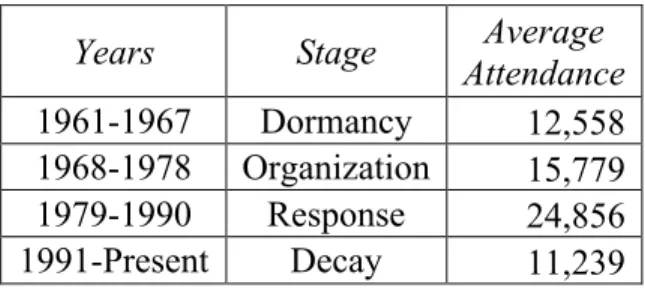
1. Average attendance at SBC annual meeting ...118
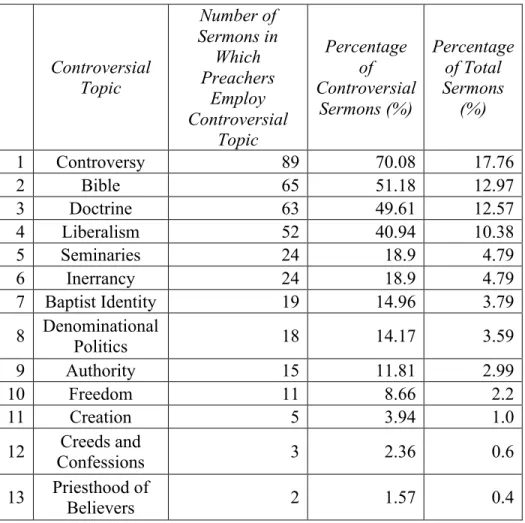
2. Pastors’ Conference sermons that were controversial by topic ...139
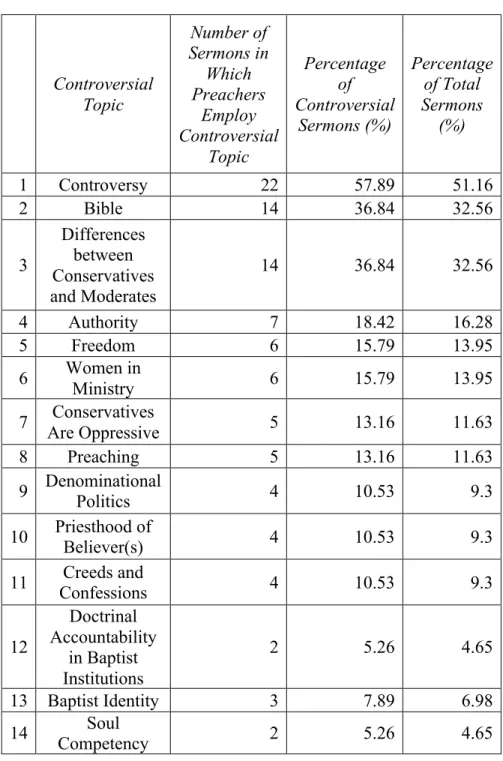
3. SBC Forum sermons that were controversial by topic ...160
A1. Similarities between Pastors’ Conference and SBC Forum topics ...263
A2. Pastors’ Conference unique topics ...263
A3. SBC Forum unique topics ...264
A4. Pastors’ Conference sermons that were divisive by year ...265
A5. Pastors’ Conference sermons that were divisive by topic ...266
A6. Political leaning of Pastors’ Conference sermons ...266
A7. SBC Forum sermons that were divisive by year ...267
A8. SBC Forum sermons that were divisive by topic ...268
A9. Pastors’ Conference and SBC Forum sermons that were divisive ...269
A10. 1961 Pastors’ Conference ...271
A11. 1962 Pastors’ Conference ...272
A12. 1963 Pastors’ Conference ...274
A13. 1964 Pastors’ Conference ...276
A14. 1965 Pastors’ Conference ...278
A15. 1966 Pastors’ Conference ...280
A16. 1967 Pastors’ Conference ...281
A17. 1968 Pastors’ Conference ...283
A18. 1969 Pastors’ Conference ...286
A19. 1970 Pastors’ Conference ...288
Table Page
A20. 1971 Pastors’ Conference ...290
A21. 1972 Pastors’ Conference ...291
A22. 1973 Pastors’ Conference ...292
A23. 1974 Pastors’ Conference ...293
A24. 1975 Pastors’ Conference ...294
A25. 1976 Pastors’ Conference ...295
A26. 1977 Pastors’ Conference ...296
A27. 1978 Pastors’ Conference ...297
A28. 1979 Pastors’ Conference ...298
A29. 1980 Pastors’ Conference ...299
A30. 1981 Pastors’ Conference ...300
A31. 1982 Pastors’ Conference ...302
A32. 1983 Pastors’ Conference ...303
A33. 1984 Pastors’ Conference ...304
A34. 1985 Pastors’ Conference ...305
A35. 1986 Pastors’ Conference ...306
A36. 1987 Pastors’ Conference ...307
A37. 1988 Pastors’ Conference ...308
A38. 1989 Pastors’ Conference ...309
A39. 1990 Pastors’ Conference ...311
A40. 1991 Pastors’ Conference ...312
A41. 1984 SBC Forum ...315
A42. 1985 SBC Forum ...316
A43. 1986 SBC Forum ...317
A44. 1987 SBC Forum ...318
A45. 1988 SBC Forum ...319
Table Page A46. 1989 SBC Forum ...320 A47. 1990 SBC Forum ...321 A48. 1991 SBC Forum ...322
LIST OF FIGURES
Figure Page
1. Convention president appointment flowchart ...82 2. SBC annual meeting attendance, 1961-2015 ...119 3. Ultimate terms and motivational potency ...130
PREFACE
Writing a dissertation has not been easy, and I do not believe it was supposed to be. Doubtless it would not have been possible without the abundant support and influence of the many wonderful people God has placed in my life. Pride of place must first be given to my beautiful and godly wife, Lauren. Her loving support is the reason I was able to complete this daunting task. She is in every way my soul mate and best friend, God’s greatest gift to me in this life. I treasure her beyond words and will forever be thankful for her confidence in me throughout my degree program. I am also greatly indebted to our children—Judson (age 3), Delaney (age 2), and Beau (age 3 weeks)—for the profound ways in which they have inspired and encouraged me. I am unspeakably proud of them. The thought that some day they may look at my dissertation and be proud of me moves me deeply.
I am grateful as well for my parents, Brian and Laura Dubberly. I am not sure they can ever fully know how proud and thankful I am to call them “Dad” and “Mom.” I am an extremely blessed man, and I consider them to be among God’s choicest of
blessings in my life. Whatever of my life is worthy of recognition must be credited to their account in large measure. Truly, they raised me in “the discipline and instruction of the Lord.” A word of appreciation is also in order to my in-laws, Anthony and Judy McKinnon. They have been enormously supportive these past few years. Mrs. Judy especially provided support by way of childcare during the final stages of this dissertation. I am proud to call the McKinnons my family.
I need also to recognize the churches it has been my honor to serve throughout the course of my formal education. To the congregations of Eastside Baptist Church in Douglas, Georgia; Forest Baptist Church in Forest, Virginia; Eastwood Baptist Church in
Bay Minette, Alabama; Milton Baptist Church in Milton, Kentucky; and Southside Baptist Church in Hazlehurst, Georgia: from the bottom of my heart, thank you for letting me serve as a part of your church family while I have pursued my education. May God richly bless you.
Additionally, I am grateful for the guidance of my supervisor, Dr. Robert Vogel. It has been my privilege not only to study under him, but also to serve as his Garrett Fellow from 2012 to 2015. I have learned much from his experience, expertise, and kindness. He has been a mentor to me in many ways, both pastorally and
professorially. Indeed, he epitomizes what it means to be both a gentleman and a scholar.
I am also appreciative to Dr. Gregory Wills and Dr. Thomas Nettles—both of whom graciously and helpfully served as members of my supervisory committee. It was a joy to participate in their seminars and to benefit from their great passion for and breadth of learning. I am a blessed man to be able to have set at the feet of such remarkable doctors of the church as Drs. Vogel, Wills, and Nettles.
A word of gratitude and warmth is also owed to my high school teacher, Scott Grubbs. His influence has meant more to me than I imagine he will ever know. He believed in me and invested in me, and for that I am truly grateful. He will always be a very special person to me—both as a teacher, mentor, and friend. He is living proof that a teacher can make in difference in a student’s life.
“Give thanks to the LORD, for he is good, for his steadfast love endures forever” (Ps 136:1).
Deek Dubberly Hazlehurst, Georgia
May 2017
CHAPTER 1 INTRODUCTION
The Southern Baptist Convention has been in a few fights.1 Perhaps this is because they have been overly quarrelsome. Arguably, it may be better explained by the fact that they are a convictional group of people who have perennially sought to hold fast to both the idea of and a body of unchanging truths in the midst of a rapidly changing world. Whatever the case, Southern Baptists have been no strangers to controversy.
Their largest controversy came in the second half of the twentieth century. Broadly speaking, there were two main parties engaged in the conflict—conservatives and moderates.2 The episode is known alternatively as the Conservative Resurgence or the Fundamentalist Takeover.3
1For an introduction to the major controversies that have shaped Southern Baptist life, see Walter B. Shurden, Not a Silent People: Controversies That Have Shaped Southern Baptists (Macon, GA:
Smyth & Helwys, 2012).
2There have been many different names given to the respective parties. For example, Nancy Ammerman has identified and described five different labels for persons involved in the controversy: 1) self-identified fundamentalists; (2) fundamentalist conservatives; (3) conservatives; (4) moderate
conservatives; and (5) self-identified moderates. For more on these labels, see Nancy Ammerman, Baptist Battles: Social Change and Religious Conflict in the Southern Baptist Convention (New Brunswick, NJ:
Rutgers University Press, 1990), 78-79. The labels of “conservative” and “moderate” are preferred in this work for two reasons. First, they are widely recognized and are therefore helpful for avoiding confusion.
As a result, even if one prefers other labels such as “fundamentalist” or “liberal,” most will understand to whom the names “conservative” and “moderate” refer. Second, neither side seems to have a major problem with these designations so far as they apply to themselves. One will find many moderate works in which moderates refers to themselves as moderates. Similarly, conservatives do not mind being referred to as conservatives.
3Those who sympathize more with the conservative party typically prefer the designation of
“Conservative Resurgence.” They see the convention’s emphasis upon a more conservative doctrine as a positive result. Those who sympathize more with the moderate party mostly refer to the episode as a
“Fundamentalist Takeover” of the convention. These alternate names provide quite a commentary on how the various sides read the controversy. “Conservative Resurgence” is the phrase preferred in this work.
The main reason is that the convention’s leadership and institutions were more conservative, doctrinally speaking, after the controversy than they were before the controversy. Further, there are at least two reasons for objecting to the designation of a “Fundamentalist Takeover.” First, it is disputable whether or not conservatives, historically and theologically, should be dubbed as fundamentalists. Further, the notion of “takeover” connotes negative ideas such as hostility, unfairness, and perhaps even illegality. These connotations are not fair or helpful for moving one’s understanding of the controversy forward.
The Controversy and Baptist Identity
The primary question this dissertation seeks to answer is twofold: (1) what was the Conservative Resurgence really all about; and (2) who were Southern Baptists during these most tumultuous years as revealed by the issues over which they divided? In order to answer this question, this dissertation analyzes the pulpit rhetoric of the Pastors’
Conferences and SBC Forums from 1961 to 1991 in concert with three complementary methods of rhetorical criticism.
The sermons of the Conservative Resurgence offer great promise for
understanding what it means to be a Baptist, as they are a valuable and plentiful supply of primary sources that have remained mostly untouched in terms of critical study. An interpretation of conservative and moderate sermons delivered during the controversy provides an extraordinary case study of modern Baptist history in which Baptists refined and forged their identity not only against the inevitable forces of time and change, but also against one another. This work offers an interpretation of the issues, the setting, the people, the values, and the visions of the Conservative Resurgence by way of the
preaching of the Pastors’ Conference and Forum.
The most contested issues of the conflict as expressed in its sermons are described and discussed. Conservatives and moderates often preached about the same topics, but they spoke about them differently. These differences are demonstrated and clarified. Further, the conservative and moderate movements are presented as unique peoples entangled in a movement-countermovement relationship. In this regard, their respective distinctives will be examined.
This work also depicts the historical setting in which the sermons of the controversy were preached. The Conservative Resurgence did not take place in a vacuum. The Southern Baptist Convention from 1961 to 1991 was an environment rife with potential for disruption and change. Therefore, the historical components of the setting of the controversy are put forward and analyzed in terms of their relation to the
divisive preaching.
The primary values of the two groups are also explored. A discovery of the most treasured values of the conservative and moderate movements reveals something of what was at the heart of each group. These truths are contained in the ideas that the two camps frequently spoke for and/or against in their pulpit rhetoric. They represent the distinguishing values of each group of people.
Finally, the overall vision of conservatives and moderates is summarized and defended. A vision stands for a utopian idea of what life would look like in a best possible scenario. Conservatives and moderates held forth competing visions for
Southern Baptists during the Resurgence. Their visions were encapsulations of what was most important to them. These visions are available for analysis in the preaching of the period. By unearthing and expressing the conservative and moderate visions for Baptist identity, as well as by exploring the ways in which these visions competed with one another for the hearts and minds of a denomination, this dissertation seeks to understand and explain what happened when the Southern Baptist Convention submitted itself to a very public, very divisive, and quite transformative controversy. This dissertation is thus, ultimately, a rhetorical consideration of the Conservative Resurgence.
Thesis
This dissertation contends that the pulpit rhetoric of the Pastors’ Conference and SBC Forum reveals that the Conservative Resurgence was a competition between conservative and moderate visions for Baptist identity as differentiated by the mutually exclusive manner in which each group perceived of doctrine and the constitution of denominational fellowship. The democratic processes inherent within Southern Baptist polity largely reveal the competitive nature of the controversy. There were two main parties—conservatives and moderates. Both parties engaged in something of a political effort to win the support of the convention’s constituency, a support evidenced primarily
by the election of the respective party’s presidential candidate. Both parties had a voice through the sermons of their representative preachers, and a vote through their
sympathizing messengers. At the end of the controversy, there was a clear winner and loser. Conservatives defeated moderates in what was a competition to lead the
convention.
The competition had mainly to do with Baptist identity—that is, with what it means to be a Baptist. The conservative vision for Baptist identity was concerned with protecting Christian orthodoxy from the dangers of theological liberalism. The moderate vision for Baptist identity was concerned with protecting Baptist freedom from the oppression of religious fundamentalism. These competing concerns manifested at one particular point in the struggle for control of the convention—namely, the place where doctrine and denominationalism intersect.
Conservatives and moderates understood doctrine and the basis of
denominational fellowship in what proved to be mutually exclusive ways. Conservatives stressed orthodoxy, calling for more specific doctrinal definition and tighter doctrinal accountability for employees of Southern Baptist institutions—most especially, for professors at the convention’s colleges and seminaries. Moderates emphasized freedom as they rejected such calls for a more rigid system of doctrinal maintenance, arguing instead for a greater tolerance of doctrinal diversity so as to promote wider participation in the convention’s cooperative missionary endeavors. Accordingly, conservatives prioritized the doctrinal unity of the denomination, while moderates focused on the functional unity of the denomination.
Eventually, the differences between conservative and moderate visions for Baptist identity came to a crossroads. Conservatives believed the moderate vision was too open. Moderates believed the conservative vision was too closed. One vision’s gain was the other vision’s loss. It was as if the visions were two different poles with a cable suspended tautly between them. The pull of both visions lifted the cable, thereby creating
and maintaining the tension of Baptist identity in the twentieth century. The two ends, however, continued to grow apart until eventually the cable reached a breaking point.
Southern Baptists could not simultaneously pursue both visions. Thus, the controversy became a story about competing visions.
The Reflection of a Denomination
This dissertation studies the sermons of the Southern Baptist Convention Pastors’ Conference from 1961 to 1991 and the sermons of the SBC Forum from 1984 to 1991. Both the Pastors’ Conference and the SBC Forum were inspirational meetings held in the same city as and just prior to the annual meeting of the convention. They were intended to be a source of encouragement, fellowship, and worship for the many Southern Baptist messengers who had traveled into town to attend the convention’s business meetings. The Pastors’ Conference during this time contained quite a wide array of sermons. Some preachers used their time in the conference’s pulpit to campaign for a conservative vision for Baptist identity, while other preachers used the platform to cast vision for moderate ideas regarding Baptist identity. However, by the mid-1970s conservatives gained control of the Pastors’ Conference and effectively used it as a soapbox upon which they often aired their views and paraded their leaders before the convention.
Moderates believed themselves to be at a great disadvantage for no longer having opportunities to preach at the conservative-led Pastors’ Conference. Therefore in 1984 they started their own pre-convention ministers’ conference. They called it the SBC Forum.4 From 1984 to 1991 moderates hosted the SBC Forum as a place where the moderate voice could be heard and moderate Southern Baptists could find encouragement and fellowship prior to the convention’s annual meeting.
4See John H. Hewett, “The History of the SBC Forum,” in Struggle for the Soul of the SBC:
Moderate Responses to the Fundamentalist Movement, ed. Walter B. Shurden (Macon, GA: Mercer University Press, 1994), 73-92.
The preaching of these two conferences during the given time periods provides an authentic representation of the competing visions operating in the denomination during the Conservative Resurgence. Such was the conclusion of George Steincross at the height of the conflict in 1987. At the time, Steincross was the chairman of the SBC Forum’s steering committee. Writing to Charles Fuller, chairman of the Southern Baptist Convention’s Peace Committee—a committee appointed by the denomination to search out the primary sources of the controversy—Steincross perceptively declared that the relationship between the Pastors’ Conference and the SBC Forum provided “a rather accurate reflection of the dilemma of our denomination.”5 Assuming Steincross’
description of the two conferences is accurate, this dissertation will assess the unique perspective provided by the preaching of these meetings in order to gain deeper insight into the Conservative Resurgence.
The Value of Studying the Pastors’ Conference and SBC Forum
The sermons of the Pastors’ Conferences and SBC Forums have largely been neglected in the literature devoted to the study of the conflict. Yet they are a relatively large body of primary sources from within the period that are simultaneously rich in content and mostly untapped in terms of their potential for providing insight into
Southern Baptist identity. The Forum sermons especially have been all but forgotten for their role in the conflict. Therefore a study of the sermons from these annual meetings holds forth promise for filling in an important gap in studies of the Conservative Resurgence. The preaching of the two meetings also provides a good timeline of the controversy, a glossary of many of its most important terms, and a roster of most of its major players. A side-by-side comparison of the especially conservative sermons and the
5George W. Steincross, “Letter from George W. Steincross,” January 8, 1988, cited in Shurden, Struggle for the Soul of the SBC, 85.
markedly moderate sermons yields a vivid and revealing contrast between the competing groups for how they understood themselves, one another, and the controversy as a whole.
From Progressive to Conservative
The sermons preached at the Pastors’ Conference and SBC Forum from 1961 to 1991 provide a sort of panoramic, before-and-after snapshot regarding the effects of the Conservative Resurgence. In 1961 there was a strong presence of moderate rhetoric in the preaching of the Pastors’ Conference. By 1991 there was not any moderate rhetoric present in the preaching of the Pastors’ Conference. Further, 1991 was the final year in which moderates hosted the SBC Forum. The developments in the convention from 1961 to 1991 represent a basic reversal of trajectory regarding the theological direction of the convention as expressed by the preaching of the Pastors’ Conference.
There are at least two reasons why 1961 is a good starting point for this study.
First, 1961 was the year in which Ralph Elliot published his controversial book, The Message of Genesis.6 Elliot’s book represented a more progressive side of Southern Baptist scholarship as it utilized the historical-critical method of interpretation, so that the so-called religious or theological message of the Bible was separated from the scientific and historical details of the Bible.7 Prompted by K. Owen White’s exposé of its tendency toward liberal-friendly methodology and interpretations, Elliot’s book started its own
6Ralph H. Elliot, The Message of Genesis (Nashville: Broadman, 1961).
7What is meant in this sentence by the term “progressive” has been well summarized by Gregory A. Wills, “Progressive Theology and Southern Baptist Controversies of the 1950s and 1960s,” The Southern Baptist Journal of Theology 7, no. 1 (2003): 13. Wills explained, “The progressives drew on the tradition of Protestant liberalism from the late nineteenth and early twentieth centuries. They shared its sense of crisis—modern science appeared to contradict many of the teachings of traditional orthodoxy and therefore to discredit the Christian faith as a whole. They shared its conviction that the solution to the crisis was to reconcile faith and science by adopting a view of inspiration that restricted the Bible’s meaning to the religious sphere only. They shared its earnest apologetic aim to make Christianity credible to the modern scientific mind. And they shared its reverence for Jesus and the Bible.” In his article, Wills uses the terms “progressive” and “moderate” interchangeably so far as they relate to a concept of Baptist identity that stood in competition against the more conservative view of Baptist identity. This dissertation understands the terms “progressive” and “moderate” similarly.
controversy among Southern Baptists.8 In fact, Elliot would later write, reflecting back on his controversy and its role in the Resurgence, “There is a real continuity between the 1960s ‘Genesis controversy’ era and the present literalisms, power struggles, and
theological debates.”9 In further proof of the influential connection between the Elliot controversy and the Resurgence, Paul Pressler and Paige Patterson—both very
instrumental and public leaders of the conservative movement—have cited Elliot’s book and the liberalism with which it was so comfortable as a primary influence in their decisions to commit themselves to involvement in the conservative cause.10
A second reason why 1961 is defensible as a starting point for this work is because it was one of the foremost years in which progressives were featured in the lineup of speakers at the Pastors’ Conference. Greg Wills described the 1961 conference by writing, “In 1961 the Southern Baptist Convention’s Pastors’ Conference, the premier venue for Southern Baptist preachers, gave great hope to Southern Baptist liberals as the presence of Dale Moody and Carlyle Marney made it the most progressive and
controversial lineup in memory.”11 Speakers such as Marney and Moody, both considered paragons of Southern Baptist learning and sophistication, exemplified a modernistic, cosmopolitan shift in Southern Baptist leadership. It is telling of the changes wrought in the convention by the conservative movement that neither Marney nor Moody—both headliners, so to speak, at the 1961 Pastors’ Conference—would remain Southern Baptists by the end of the Conservative Resurgence.
8K. Owen White, “Death in the Pot,” Baptist Standard, January 10, 1962.
9Ralph H. Elliot, The Genesis Controversy and Continuity in Southern Baptist Chaos (Macon, GA: Mercer University Press, 1992), 13.
10Paul Pressler, A Hill on Which to Die: One Southern Baptist’s Journey (Nashville: Broadman
& Holman, 1999), 51–52; Paige Patterson, Anatomy of a Reformation: The Southern Baptist Convention 1978-2004 (Ft. Worth, TX: Seminary Hill Press, 2011), 1.
11Gregory Wills, Southern Baptist Theological Seminary, 1859-2009 (New York: Oxford University Press, 2009), 407.
The year 1991 is an apropos point at which to end this study for at least three reasons. First, moderates essentially surrendered the contest to conservatives by not fielding a presidential candidate at the 1991 Convention. Second, moderates hosted the SBC Forum for the final time in 1991. There would no longer be any meaningful moderate voice and fellowship prior to the annual meeting of the Southern Baptist Convention. Third, it was in 1991 that moderates launched the Cooperative Baptist Fellowship, an alternative means through which like-minded Baptists could fellowship and associate for the purpose of Christian missions.
Enough time has passed from the period under review that its sermons may be studied with appropriate perspective. New generations of Southern Baptists are
beginning to appear for whom the Conservative Resurgence was not personally experienced. It is hoped that this work will help contribute to the education of such persons so that the convention will not soon forget how influential role the Resurgence played in establishing Baptist identity.
A Rhetorical History of the Conservative Resurgence
This dissertation utilizes several methods of rhetorical criticism in order to interpret the preaching of the Pastors’ Conference and SBC Forum with a view towards understanding the Conservative Resurgence. All sermons preached at the Pastors’
Conference from 1961 to 1991, and all sermons delivered at the SBC Forum from 1984 to 1991 were included for analysis.12 The result will be something of a rhetorical history of one of the more significant forces in the movement—its preaching.
12A methodological caveat is in order. It is acknowledged that there is some repetition of sermon quotations both within and across the rhetorical analysis chapters of this work (chaps. 3, 4, and 5).
For instance, one will find quotes from the preaching of Clark Pinnock repeated in each rhetorical analysis chapter. Such repetition is justifiable on the grounds that sermons like those of Pinnock demonstrate more than one rhetorical strategy—strategies which are revealed in different, yet complementary ways by the variety of rhetorical methods highlighted and employed in the rhetorical analysis chapters of this dissertation.
Richard Weaver’s thoughts on the nature of rhetoric help to establish some of the warrant of this study. Weaver described the relationship between rhetoric and politics by explaining, “Rhetoric must be viewed formally as operating at that point where
literature and politics meet, or where literary values and political urgencies can be
brought together. The rhetorician makes use of the moving power of literary presentation to induce in his hearers an attitude or decision which is political in the very broadest sense.”13 The pulpit rhetoric of the Conservative Resurgence provides an excellent body of primary sources upon which rhetorical criticism may be performed to the end that new insight may be gained regarding Baptist identity and Southern Baptists’ most embroiled controversy. The preaching of the conflict is the most public and accessible place where Southern Baptist values and denominational politics were brought together, thus meeting Weaver’s description of rhetoric.
The Pastors’ Conference and SBC Forum, 1961-1991
There were 501 sermons delivered at the Pastors’ Conference from 1961 to 1991, and 43 sermons delivered at the SBC Forum from 1984 to 1991. Though all of these were examined in this research, space does not permit a comprehensive summary of each of these events and every one of these sermons. However, chapter 2 does present an overview of the meetings and sermons that best demonstrate the rift between
conservatives and moderates, as well as a brief explanation of the topics over which conservatives and moderates most often divided. Many of the sermons introduced in chapter 2 are treated more thoroughly in the rhetorical analysis chapters of this work.
Additionally, chapter 2 relates key sermonic rhetoric to relevant denominational developments in order to situate the important conference preaching within the larger
13Richard M. Weaver et al., Language Is Sermonic: Richard M. Weaver on the Nature of Rhetoric (Baton Rouge: Louisiana State University Press, 1970), 225.
context of the Southern Baptist controversy.
The Conservative Resurgence as a Social Movement
In chapter 3 the sermons of the Pastors’ Conference and SBC Forum are treated as the rhetoric of a social movement. Lloyd Bitzer’s theory regarding the
historical components of a rhetorical situation and Michael McGee’s theory regarding the collectivization of “the people” of a movement prove especially helpful in interpreting the controversy by way of its pulpit rhetoric.14 Bitzer’s method of identifying the
rhetorical exigencies, the rhetorical audience, and the rhetorical constraints present within the setting of a movement is well suited for a study of the Southern Baptist Convention during the Resurgence. Similarly, McGee’s idea about how “the people” of a movement are defined by their rhetoric is quite pertinent to the study of the preaching of the
controversy and the subject of Baptist identity.
The Use of Ultimate Terms
In chapter 4 the selected sermons are analyzed for their use of ultimate terms.
Ultimate terms are the words and/or phrases used within a group’s lexicon which contain the most potent motivational ideas of the group. Ultimate terms include god words and devil words—or words with positive associations or negative associations, respectively.
Noted rhetorician Richard Weaver has done more than any other theorist to develop the idea of ultimate terms.15 He referred to them as “‘rhetorical absolutes’—the terms to which the very highest respect is paid.”16 The ultimate terms of conservative and moderate rhetoric are discovered according to the preaching of the Pastors’ Conference
14Lloyd F. Bitzer, “The Rhetorical Situation,” Philosophy and Rhetoric 1 (1968): 1–14; M. C.
McGee, “In Search of ‘The People’: A Rhetorical Alternative,” Quarterly Journal of Speech 61 (1975):
235-49.
15Richard M. Weaver, The Ethics of Rhetoric (Chicago: Henry Regnery Press, 1952), 211-32.
16Ibid., 212.
and SBC Forum.
Fantasy Theme Analysis
In chapter 5 Ernest Bormann’s theoretical contributions regarding fantasy themes and rhetorical vision are applied to the Pastors’ Conference and SBC Forum sermons.17 Bormann argued that there is significant rhetorical power in the dramatization of ideas. As ideas are dramatized, hearers are not only struck with a message, but they are invited to participate in a world filled with actors engaged in a conflict of good versus evil. Fantasy themes are particular ideas in which hearers are often called upon to
participate during the course of a piece of rhetoric. A rhetorical vision refers to the assimilation of a group’s fantasy themes into a unified whole. Bormann’s method of fantasy theme analysis is applied to conservative and moderate rhetoric in order to discern and explain their respective fantasy themes and overall rhetorical visions.
A Summarized Integration of Findings
In chapter 6 the findings of all previous chapters are summarized and
integrated. The results of studying the sermons preached at the Pastors’ Conference and SBC from 1961 to 1991 are brought together in order to present and interpret the
respective issues, settings, peoples, values, and visions of conservative and moderate rhetoric during the controversy. It is believed that such a presentation and interpretation will provide a meaningful and original contribution to the continued discussion
surrounding the Conservative Resurgence in the Southern Baptist Convention and the subject of Baptist identity.
17Ernest G. Bormann, “Fantasy and Rhetorical Vision: The Rhetorical Criticism of Social Reality,” Quarterly Journal of Speech 58 (1972): 396-407.
CHAPTER 2
THE SERMONS OF THE PASTORS’ CONFERENCE AND SBC FORUM, 1961-1991
This chapter introduces the preaching of the Southern Baptist Convention Pastors’ Conference and the SBC Forum from 1961 to 1991.1 First, a brief methodical qualification is outlined in order to explain which sermons were especially relevant to this study. Second, an overview is given wherein are highlighted several of the
conferences and sermons that best exemplify the divisions that prompted and sustained the Conservative Resurgence. These are analyzed more fully in the rhetorical analysis chapters of this work. Third, relevant denominational developments are presented in order to relate the key sermons of the Pastors’ Conference and SBC Forum to the larger setting of the Southern Baptist controversy.
Topical Method of Sermon Selection
In order to determine the pulpit discourse most useful to a rhetorical analysis of the Conservative Resurgence, the sermons of the Pastors’ Conference and Forum have been analyzed in terms of the presence or absence of certain topics over which
conservatives and moderates regularly divided. Sermons were deemed particularly relevant for treatment in this study to the extent that they contained such topics. The topics were chosen in accordance with what virtually all of the literature regarding the
1Most of these sermons are available online in manuscript form in a collection of Baptist Press news releases hosted on the website of the Southern Baptist Historical Library and Archives. “Baptist Press Archives from 1948 to 1996,” Southern Baptist Historical Library and Archives, accessed May 9, 2017, http://www.sbhla.org/bp_archive/index.asp.
controversy agrees were the main issues that divided Southern Baptists during the controversy.2
The Topics of the Controversy
Eight divisive topics were featured at both the Pastors’ Conference and the SBC Forum. Both sides spoke about the controversy by addressing the following eight issues: (1) the controversy itself; (2) the Bible; (3) Baptist identity; (4) denominational politics; (5) authority; (6) freedom; (7) creeds and confessions; and (8) the priesthood of believers.3 The preachers of the two pre-convention meetings did not always say the same sorts of things about these eight topics. That both groups felt compelled to discuss them, however, does reveal something of the nature of the controversy. Additionally, there were five divisive topics unique to the Pastors’ Conference: (1) doctrine, (2) liberalism; (3) seminaries; (4) inerrancy; and (5) creation.4 Likewise, there were six
2See, for examples: Bruce T. Gourley, The Godmakers: A Legacy of the Southern Baptist Convention? (Franklin, TN: Providence House Publishers, 1996), 57-70; Jerry Vines, Vines: My Life and Ministry (Nashville: B&H Books, 2014), 132-45; David T. Morgan, The New Crusades, the New Holy Land: Conflict in the Southern Baptist Convention, 1969-1991 (Tuscaloosa: University of Alabama Press, 1996), 152; Walter B. Shurden, Struggle for the Soul of the SBC: Moderate Responses to the
Fundamentalist Movement (Macon, GA: Mercer University Press, 1994), xix-xx; James C. Hefley, The Truth in Crisis: The Controversy in the Southern Baptist Convention (Dallas: Criterion, 1986), 35; Grady C. Cothen, What Happened to the Southern Baptist Convention? A Memoir of the Controversy (Macon, GA: Smyth & Helwys, 1993), 11; Jerry Sutton, The Baptist Reformation: The Conservative Resurgence in the Southern Baptist Convention (Nashville: Broadman & Holman Publishers, 2000), 6; Bill J. Leonard, God’s Last and Only Hope: The Fragmentation of the Southern Baptist Convention (Grand Rapids:
Eerdmans, 1990), 131-72; Cecil Sherman, By My Own Reckoning (Macon, GA: Smyth & Helwys Pub, 2008), 131-48; Nathan Finn, “Southern Baptist History: A Great Commission Reading,” in The Great Commission Resurgence: Fulfilling God’s Mandate in Our Time, ed. Adam Greenway and Chuck Lawless (Nashville: B&H Academic, 2010), 65-68; C. Douglas Weaver, “Baptists and Denominational Identity and the Turn toward Creedalism: 2000” in Turning Points in Baptist History: A Festschrift in Honor of Harry Leon McBeth, ed. Michael E. Williams, Sr. and Walter B. Shurden (Macon, GA: Mercer University Press, 2008), 296-7; James Leo Garrett Jr., Baptist Theology: A Four-Century Study (Macon, GA: Mercer University Press, 2009), 491-506; Walter B. Shurden, Not a Silent People (Macon, GA: Smyth & Helwys, 2012), 83–112; Leon McBeth, The Baptist Heritage (Nashville: Broadman Press, 1987), 681-7; Barry Hankins, Uneasy in Babylon: Southern Baptist Conservative and American Culture (Tuscaloosa:
University of Alabama Press, 2002), 1-13; Paul Pressler, A Hill on Which to Die (Nashville: Broadman &
Holman, 1999), 93; Paige Patterson, Anatomy of a Reformation (Ft. Worth, TX: Seminary Hill Press, 2011); R. Albert Mohler, Jr., “A Conflict of Visions: The Theological Roots of the Southern Baptist Controversy,” Southern Baptist Journal of Theology 7, no. 1 (Spring 2003): 4-11.
3See table A1 in appendix 1 for information regarding the similarities between the employment of divisive topics in the preaching of the Pastors’ Conference and SBC Forum.
4See table A2 in appendix 1 for statistics regarding the use of divisive topics unique to the sermons of the Pastors’ Conference.
controversial topics unique to the preaching of the SBC Forum. They were: (1) the differences between conservatives and moderates; (2) women in ministry; (3) the
oppressive, controlling nature of conservatives; (4) preaching; (5) soul competency; and (6) doctrinal accountability in Southern Baptist institutions.5 These topics are
demonstrated from the preaching of the Pastors’ Conference and SBC Forum and discussed more fully throughout the remainder of this dissertation, especially in the chapters containing rhetorical analysis.
The Frequency of the Topics
Preachers at the Pastors’ Conference delivered five hundred and one total sermons from 1961 to 1991. One hundred and twenty-seven of these sermons contained one or more of the divisive, controversy-related topics. Thus, 25.35 percent of all preaching at the Pastors’ Conference from 1961 to 1991 was immediately connected to the Conservative Resurgence by way of the presence of its most contested topics.6 The controversy therefore, though an important and relatively common subject, was not the overwhelming theme of Pastors’ Conference preaching during the Conservative
Resurgence.
Forum preaching was much more divisive. Contested subjects dominated the preaching of the SBC Forum. Forum preachers gave a total of forty-three sermons over the course of the eight-year history of the event. Thirty-eight of forty-three sermons contained one or more of the contested issues closely associated with the Resurgence.
Therefore 88.37 percent of the sermons preached at the Forum were directly related to the controversy as revealed by the presence of divisive preaching.7 The overwhelming
5See table A3 in appendix 1 for numeric date concerning the use of divisive topics unique to the preaching of the SBC Forum.
6See Ttble A4 for more specific information about the percentage of Pastors’ Conference sermons that contained divisive topics. See table A5 in appendix 1 for a listing of the divisive topics and the frequency with which they were addressed in the Pastors’ Conference.
7See table A7 for more details about the percentage of SBC Forum sermons that contained
majority of preaching at the Forum was controversial. For five of the eight years of the Forum’s existence—1984, 1985, 1989, 1990, and 1991—every speaker delivered a message in which at least one of the topics of division was addressed.8 For the other three years—1986, 1987, and 1988—the percentage of sermons with controversial topics was still very high. The preaching at the Forum was controversial from start to finish.
Insights Gained from the Topical Comparison
A comparison of the divisive topics and the frequency with which they were employed in the preaching of the Pastors’ Conference and SBC Forum has revealed at least three important details about the Southern Baptist conflict.9 First, there was indeed a serious controversy. Such a claim is supported by the fact that the most often cited topic of controversy at both the preaching meetings was the controversy itself. Seventy percent of Pastors’ Conference messages containing divisive topics referenced the controversy, while nearly sixty percent of Forum sermons with divisive topics spoke of the controversy.
Second, the Resurgence was mostly a conflict about the Bible. This reality is borne out by the fact that the second-most discussed subject of controversy was the Bible—and this was true in both the Pastors’ Conference and the SBC Forum. Third, the controversy was very much a battle regarding Baptist identity. Accordingly, the subject of Baptist identity was a significant emphasis in the divisive preaching of both the Pastors’ Conference and SBC Forum. That the Conservative Resurgence was a serious
divisive topics. See table A8 in appendix 1 for specifics regarding the divisive topics and the frequency with which they were addressed in the Forum.
8The 1984 Southern Baptist Convention Forum (Kansas City, MO, June 11, 1984); 1985 Southern Baptist Convention Forum (Dallas, TX, June 10, 1985); 1989 Southern Baptist Convention Forum (Las Vegas, NV, June 12, 1989); 1990 Southern Baptist Convention Forum (New Orleans, LA, June 11, 1990); 1991 Southern Baptist Convention Forum (Atlanta, GA, June 3, 1991).
9See table A9 in appendix 1 for a side-by-side comparison of the amount of divisive sermons preached at the Pastors’ Conference and SBC Forum from 1961 to 1991.
controversy about the Bible and Baptist identity is not really disputed. It is mentioned here simply to establish that such was clearly revealed by this dissertation’s analysis of the presence and frequency of divisive topics in the preaching of the Pastors’ Conference and SBC Forum.
The Southern Baptist Convention Pastors’ Conference, 1961-1991
Over five hundred sermons were preached at the thirty-one meetings of the Pastors’ Conference from 1961 to 1991. Space does not permit a thorough description of each of these conferences and sermons. However, what follows are descriptions of key sermons wherein may be observed the major features of the preaching most relevant to this work. In addition to the messages described in this chapter, Appendix Two contains pertinent information for every Pastors’ Conference sermon during the time frame.10 The thirty-one years’ worth of preaching has been divided into four phases. Each phase is described and explained by way of sermons from within the period that best characterize the nature of the denomination’s struggle as it developed over time.
Tension in the Convention (1961-1967)
The preaching of the conference from 1961 to 1967 revealed a significant tension between the incipient moderate and conservative movements. The 1962 and 1966 meetings, for example, contained sermons that sufficiently demonstrate this tension.
In these two instances the tension concerned the respective beliefs of both groups regarding two issues very closely connected to the controversy—namely, the
conservative-liberal divide and the degree to which one’s doctrine of revelation ought to be defined and defended.
10For a year-by-year presentation of the Pastors’ Conferences and their preaching, see appendix 2. The tables in appendix 2 contain the date, location, theme, and president of each Pastors’
Conference. They also contain the speaker, sermon title, sermon Scripture, and main idea(s) of each sermon.
The 1962 Pastors’ Conference took place on June 2-3 in San Francisco, with Carl Bates presiding. There were eleven sermons that spoke directly to the turmoil bubbling in the convention. The most notable were the ones delivered by J. Sidlow Baxter and Roy McClain. Baxter appealed to the more conservative group, warning that,
“We Baptists always have been champions of the duty of private judgment, but liberty to interpret the Bible never meant liberty to discredit the Bible.”11 Jim Newton reported that Baxter “received a standing ovation after a scathing sermon condemning neo-orthodox theology, liberalism, and existentialism.”12 Baxter’s condemnations of liberalism were so strongly worded that one apparently moderate-sympathizing individual was so provoked that he jumped on stage while Baxter was preaching and demanded that Bates, “Hush up that man.”13
Roy McClain sounded quite a different note at the conference, expressing views more in harmony with the later developing moderate movement. Whereas Baxter lambasted liberalism, McClain “chided Baptists who . . . were trying to climb the
denominational ladder to glory by condemning intellectuals in the name of ‘defending the Word (of God).’”14 McClain viewed what would become the conservative movement as power-hungry Fundamentalists who criticized professors at Baptist colleges and
seminaries in ways that were both unfair and uninformed. He added that it was a
“disgrace for grown men to go around with sharp axes hacking on innocent lambs.”15 McClain also directly addressed the divisive labels of “conservative” and “liberal,”
11J. Sidlow Baxter, “Pentecost and Inner Experience” (Southern Baptist Convention Pastors’
Conference, San Francisco, CA, June 5, 1962).
12Jim Newton, “For Wednesday AM’s,” Baptist Press, June 5, 1962.
13Gerald Martin, Sir We Would See Jesus: The Story of the Southern Baptist Convention Pastors’ Conference (Memphis: Wimmer Brothers, 1968), 19.
14Jim Newton, “For Tuesday AM’s,” Baptist Press, June 4, 1962.
15Roy O. McClain, “Making Disciples” (Southern Baptist Convention Pastors’ Conference, San Francisco, CA, June 4, 1962).
describing both terms in positive and negative ways. He was attempting to defuse the conservative-liberal tension by suggesting that, though there may be unhealthy, extremist versions of each position, there were also versions of each position that should be
commended and welcomed within the convention.
Baxter and McClain represented two very different views of the controversy.
Baxter and the conservative movement were convinced that theological liberalism was the problem and that it needed to be removed from the denomination’s institutions. They believed it had sneaked into the convention underneath the cover of so-called Baptist liberty. McClain and the moderate group, however, did not believe that liberalism was the problem, suggesting instead that the problem was more to blame on what Baxter
described as a very unflattering version of conservatism (read: Fundamentalism).16 The presence of stress regarding conservativism and liberalism in the preaching of the Pastors’ Conference was related to the fact that Southern Baptists updated their confessional statement, the Baptist Faith and Message, in 1963.17 The update was occasioned perhaps most of all by the Elliot controversy, and was an attempt to appease conservatives who were upset that the historical-critical method of
interpretation was being relied upon and taught by professors in southern Baptist schools.
Baptist historian Bill Leonard commented that though the updated confession may have appeared to be a victory for conservatives, in practice “the historical-critical method continued to be utilized in many Southern Baptist seminaries and universities.”18
The 1966 Pastors’ Conference provides another set of sermons that help to
16McClain, "Making Disciples." McClain explained, “If as a conservative you mean a man has ALL the answers revealed to him by the Spirit, or that everyone else is wrong if they disagree with him, then being a conservative is no compliment at all.”
17“Comparison of 1925, 1963 and 2000 Baptist Faith and Message” (The Southern Baptist Convention), accessed May 7, 2016, http://www.sbc.net/bfm2000/bfmcomparison.asp.
18Bill J. Leonard, God’s Last and Only Hope: The Fragmentation of the Southern Baptist Convention (Grand Rapids: Eerdmans, 1990), 72.
establish the uneasy nature of the early setting of the controversy. A sermon by Clark Pinnock, representing the conservative viewpoint, and sermons by Herschel Hobbs and Carl Bates, representing the moderate perspective, convey that the conflict had very much to do with the nature of the Bible. Pinnock preached a very conservative sermon about the nature of the Bible in which he articulated and defended the doctrine of inerrancy.19 He referenced the ongoing debate in the convention over the nature of Scripture and charged Southern Baptists to “increase the clarity of our conviction regarding it.”20 Seeking to determine what the Bible said about itself, the conclusion to Pinnock’s message was essentially, “The Bible does not err, because God cannot lie.”21 Conservatives embraced Pinnock and his understanding of the nature of the Bible as God’s inerrant Word.
Rather than spelling out their own doctrine of Scripture like Pinnock, Hobbs and Bates said something very different about the Bible. Both preachers responded to conservative notions of defending the Word of God by saying that the Bible does not need to be defended. Hobbs said, “The Sword of the Spirit does not need defending. It needs to be unsheathed.”22 Bates preached similarly, “I believe it would be an utter waste of time for me to attempt some involved polemic concerning whether or not God speaks and, if so, whether or not we have an accurate record of that word.”23 The preaching of Pinnock, Hobbs, and Bates at the 1966 Pastors’ Conference indicates that indeed there was tension in the convention during this first phase of the controversy, and even more
19Clark Pinnock, “Our Source of Authority: The Bible” (Southern Baptist Convention Pastors’
Conference, Detroit, MI, May 23, 1966).
20Ibid.
21Ibid.
22Herschel H. Hobbs, “Worthy of Our Vocation” (Southern Baptist Convention Pastors’
Conference, Detroit, MI, May 23, 1966).
23Carl Bates, “Is There Any Word from the Lord?” (Southern Baptist Convention Pastors’
Conference, Detroit, MI, May 23, 1966).
specifically that this tension concerned not only the nature of the Bible, but also the extent to which Southern Baptists believed they should define and defend it.
A Struggle Over Ideas (1968-1978)
The sermons from this period demonstrate a growing sense of ideological organization for both conservatives and moderates. Whereas sermons in the previous phase merely expressed a growing tension between the two groups—one that was largely doctrinal in nature—sermons in this phase reveal more of the visionary maturation of the conservative and moderate movements. The result was that each group began to develop their own unique sort of vision for why and how they believed their ideas about the convention should be adopted in order to help Southern Baptists to be the very best Baptists they could be.
Clark Pinnock delivered three addresses at the 1968 Pastors’ Conference.24 They are perhaps the clearest and most organized expression of conservative rationale for the Resurgence anywhere in the over 500 sermons studied in this work. At the time, Pinnock was a professor at New Orleans Baptist Theological Seminary, where he wielded a pivotal influence upon students who would later, mostly in the 1970s and 1980s,
become deeply involved in the conservative movement. Some of his more well known students during his years as an influential Southern Baptist professor were Paige Patterson, Jerry Vines, and Adrian Rogers—men who would later become some of the most recognizable leaders of the conservative movement.
It is difficult to estimate just how instrumental Pinnock was in the whole episode of the Conservative Resurgence. Southern Baptist leader, Russell Moore,
24Clark Pinnock, “The Evangelical Imperative” (Southern Baptist Convention Pastors’
Conference, Houston, TX, June 3, 1968); Clark Pinnock, “Sola Scriptura” (Southern Baptist Convention Pastors’ Conference, Houston, TX, June 4, 1968); Clark Pinnock, “The Fact of Christ” (Southern Baptist Convention Pastors’ Conference, Houston, TX, June 4, 1968).
believes the Resurgence would not have happened had it not been for Clark Pinnock.25 Pinnock took a bold, strong stand on the issue of biblical inerrancy very early on in the Controversy. Though he later changed his mind on the subject of inerrancy, his influence as an early apologist for inerrancy remains.26
Pinnock’s conference sermons are very helpful for understanding the controversy. Accordingly, they feature very prominently in the rhetorical analysis
chapters of this work. In his first message, he addressed modern attacks on Christianity’s doctrine of revelation. He compared the Southern Baptist controversy of his day to Charles Spurgeon’s Downgrade Controversy, saying of Spurgeon’s contemporaries, “The Baptist leaders were preferring denominational peace to their duty of dealing with
error.”27 Pinnock warned with very little ambiguity: “A denomination which preserves its outward tranquility at the high cost of the Biblical gospel is not to be admired.
Cemeteries are also peaceful. There is no controversy in the grave.”28 The main issue for Pinnock was “a loss of conviction about the objective authority of Scripture.”29 Pinnock qualified his argument by adding the Southern Baptist theological decline was at an early stage.
Pinnock’s second address provides the most pointed and concise articulation of the conservative perspective on the controversy in all of the Pastors’ Conferences.
Among other things, he contended that the people of the Convention adhered to a much more conservative doctrine of revelation and Scripture than the professors in the
25Russell Moore, “Why Conservative Evangelicals Should Thank God for Clark Pinnock,”
Russell Moore, accessed May 7, 2016, http://www.russellmoore.com/2010/08/17/why-conservative- evangelicals-should-thank-god-for-clark-pinnock/.
26For a discussion of Pinnock’s changes regarding the Bible, see Ray C. W. Roennfeldt, Clark H. Pinnock on Biblical Authority: An Evolving Position (Berrien Springs, MI: Andrews University Press, 1993).
27Pinnock, “The Evangelical Imperative.”
28Ibid.
29Ibid.
convention’s colleges and seminaries.30 He claimed,
If the percent of our pastors who hold to Biblical infallibility is very large, the percent of our professors who do is very small . . . . Most of the delegates to our Convention believe that the Bible is the very word of God to man. It is not merely a human, fallible witness to someone else’s revelation, it is divine revelation itself . . . . The strong minority in positions of considerable power continue to vocalize their sub-Biblical view of inspiration just as if the opinion of the body were of no importance, as if merely to remind them of the fact were to infringe upon their freedom, as if the Christian faith involves no more matters of truth than the individual may wish to embrace.”31
He explained that the view of many professors was that the church was always to be learning more about God and the Bible and never to arrive at a full and complete knowledge of the truth. Such a view, Pinnock complained, was terribly convenient, allowing them to quote the Bible when they wished and backpedal on whatever made them uncomfortable. He concluded, “The difficulty in the discussion is the smokescreen which the minority opinion uses in order to prevent attention being focused on their basic denial of the integrity of the Bible.”32
Pinnock argued similarly in his third address that there was a great deal of double-speak going on in the Convention.33 Double-speak was what he referred to when someone used familiar Christian language, but filled it with unfamiliar, heterodox
meaning. Much more is said about Pinnock’s pulpit rhetoric at later points in this dissertation. His messages were crucial expressions of both the ideas and the identity of the conservative movement.
The year 1970 marked the beginning of what would become known as the Broadman Commentary controversy, in which conservatives successfully led a campaign to have the first volume of the Broadman Bible Commentary series withdrawn because it
30Pinnock, “Sola Scriptura.”
31Pinnock, “Sola Scriptura.”
32Ibid.
33Pinnock, “The Fact of Christ.”
was too liberal. G. Henton Davies wrote that first volume on Genesis.34 The volume was subsequently rewritten by Clyde Francisco and republished by Broadman Press.35 The Broadman Commentary incident helped to further establish the conservative movement as a formidable presence within the convention. Conservatives believed it a significant part of the mission of their movement to discover and rectify what they deemed to be sub-conservative doctrine, most especially regarding the doctrine of revelation, in the convention.
Another telling episode in the library of Pastors’ Conference sermons transpired in the contrast between the respective sermons of W. A. Criswell and Grady Cothen at the 1971 meeting. Criswell presented a conservative message regarding “the long and bitter controversy about the inerrant and infallible Word of God.”36 Criswell confronted the modern argument that the Bible contains historical and scientific errors and “jabbed at those who would ‘rewrite the Bible on the basis of the latest scientific information.’”37 Criswell compared the ever-changing annals of scientific hypothesizing to the steadfast Word of God and urged his hearers to stand upon the Bible over and against the evolving knowledge of science. Criswell presented a very bold and clear understanding of the conservative concerns regarding the doctrine of Scripture. Bob O’Brien, reporting for Baptist Press, referred to Criswell’s message as “The Amen- punctuated sermon.”38
Grady Cothen, then president of the New Orleans Baptist Theological
34G. Henton Davies, Genesis, in vol. 1 of The Broadman Bible Commentary, ed. J. Clifton Allen (Nashville: Broadman Press, 1969), 99-304.
35Clyde T. Francisco, Genesis, rev. ed., in vol. 1 of The Broadman Bible Commentary, J.
Clifton Allen (Nashville: Broadman Press, 1973), 101-288.
36W. A. Criswell, “God’s Preacher and His Mandate” (Southern Baptist Convention Pastors’
Conference, St. Louis, MO, May 31, 1971).
37Bob O’Brien, “Pastors’ Conference Roundup,” Baptist Press, June 1, 1971, 1.
38Ibid.