All rights reserved. The Southern Baptist Theological Seminary has permission to reproduce and disseminate this document in any form by any means for purposes chosen by the Seminary, including, without limitation, preservation or instruction.
MISSION BOARD’S CHURCH PLANTER INITIAL ASSESSMENT INSTRUMENT AND THE
IMPLICATIONS FOR THE BROADER CHURCH PLANTING COMMUNITY
__________________
A Thesis Presented to the Faculty of
The Southern Baptist Theological Seminary
__________________
In Partial Fulfillment
of the Requirements for the Degree Doctor of Ministry
__________________
by
Jason Alexander Walker May 2023
APPROVAL SHEET
STATISTICAL EVALUATION OF THE NORTH AMERICAN MISSION BOARD’S CHURCH PLANTER INITIAL
ASSESSMENT INSTRUMENT AND THE
IMPLICATIONS FOR THE BROADER CHURCH PLANTING COMMUNITY
Jason Alexander Walker Read and Approved by:
Faculty Supervisor: Joseph C. Harrod
Second Reader: Timothy P. Jones
Defense Date: February 13, 2023
This work is dedicated to my godly wife who has taught me much about selflessness and sacrifice for the glory of God.
TABLE OF CONTENTS
Page LIST OF ABBREVIATIONS ... VII LIST OF TABLES ... VIII LIST OF FIGURES ... IX PREFACE ... X Chapter
1. INTRODUCTION ...1
Familiarity with the Literature ...3
General Overview of Assessments ... 4
Church Planter Assessments ... 6
Church Planting and Leadership Resources ... 7
Scientific Methods ... 8
Void in the Literature ...9
Thesis ...10
Outline of Chapters ...11
2. THEOLOGY OF ASSESSMENTS ...14
Introduction ...14
Objective ... 17
Methodology ... 18
God’s Creation, Character, and Gifting ...18
God’s Creation ... 19
God’s Character ... 24
God’s Gifting ... 28
Chapter Page
Church Planter Qualifications and Evaluation ...32
Church Planter Qualifications ... 32
Church Planter Evaluation ... 33
Conclusion ...37
3. THE DEFINITION OF CHURCH PLANTER SUCCESS ...39
Introduction ...39
Defining the Problem ... 39
What Is at Stake? ... 40
The Challenge of Defining Success ... 42
Guiding Principles ... 43
The Numbers Definition ...45
Alternative Definitions of Success ...48
Sustainability ... 48
Multiplication ... 50
Faithfulness ... 51
Fruitfulness ... 56
Summary ...59
4. RESEARCH METHODOLOGY ...61
Introduction ...61
Data Source, Description, and Limitations ...61
Church Planter Assessment Data ... 62
Church Planter Outcome Data ... 63
Ethical Use of Data ... 68
Data Limitations and Biases ... 69
Chapter Page
Statistical Methods ...70
Description of Variables of Interest ...72
CPIA Variables ... 72
Quarterly Report Variables ... 72
Variables Measuring Success ... 77
Summary ...78
5. STATISTICAL ANALYSIS ...80
Validity of the Overall CPIA Score ...80
Traditional Performance Measures ... 80
Measures Associated with NAMB’s Definition of Success ... 85
Most Predictive Church Planter Characteristics ...89
Summary of Analysis ...94
6. SUMMARY AND IMPLICATIONS ...97
General Summary...97
Recommendations for the North American Mission Board ...98
Broader Implications and Path Forward ...101
BIBLIOGRAPHY ... 104
Appendix 1. CORRELATION MATRIX OF QR VARIABLES ...109
LIST OF ABBREVIATIONS CPIA Church Planter Initial Assessment
IO Industrial and Organizational PII Personally Identifiable Information
QR Quarterly Report
LIST OF TABLES
Table Page
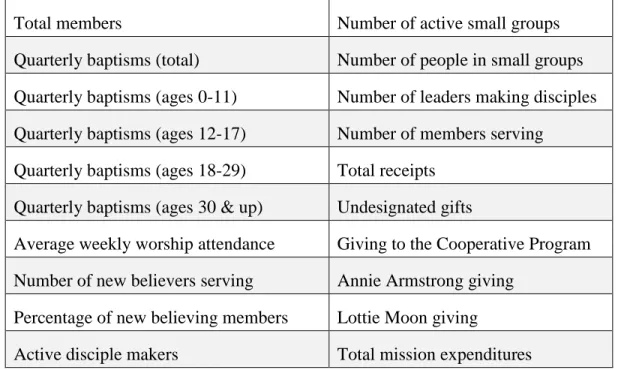
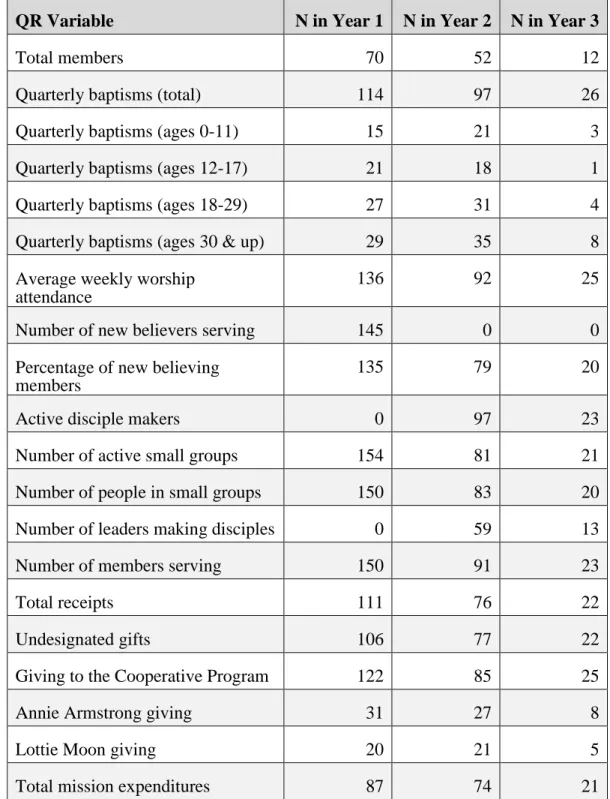
1. Available metrics from the Quarterly Reports for analysis ...66
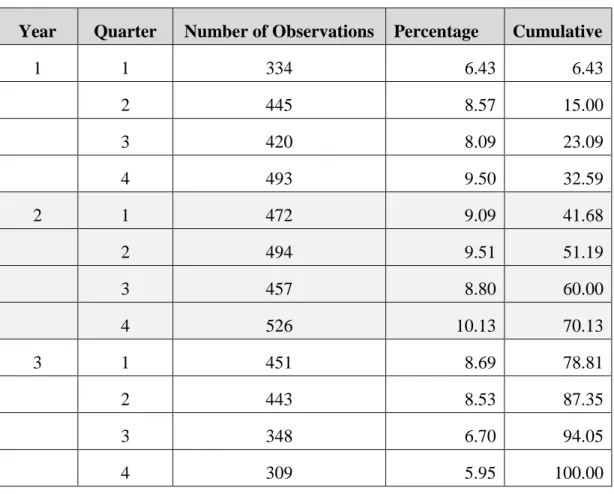
2. Breakdown of QR data by quarter ...67
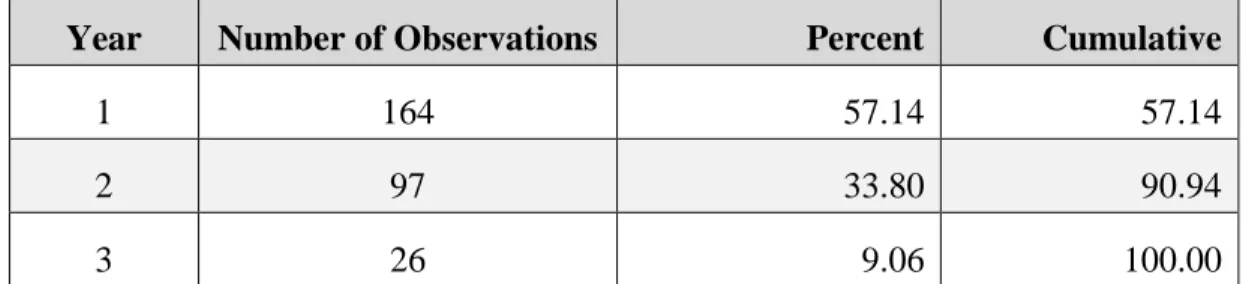
3. Sample by year for observations with both CPIA and QR data ...68
4. Sample size by year for church planters with corresponding CPIA data ...75
5. Summary statistics of dependent variables ...79
6. Statistics associated with the main CPIA categories and key measures ...90
7. Statistics associated with the vision sub-elements and worship attendance ...92
8. Selected sub-elements and multiplication success relationships ...95
LIST OF FIGURES
Figure Page
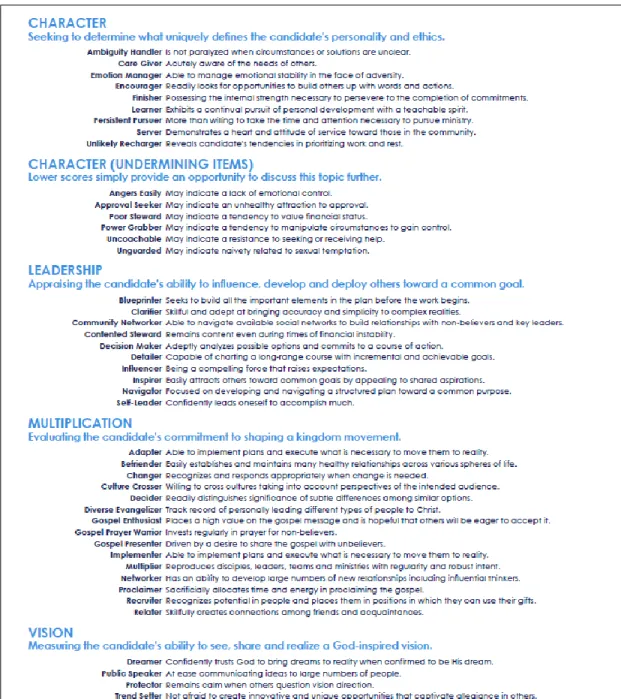
1. Description of CPIA categories ...64
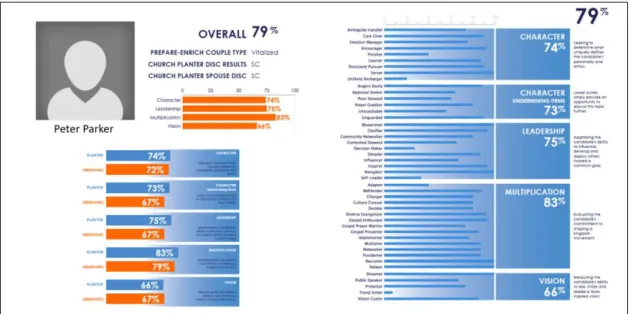
2. Anonymized example of CPIA outcomes ...65
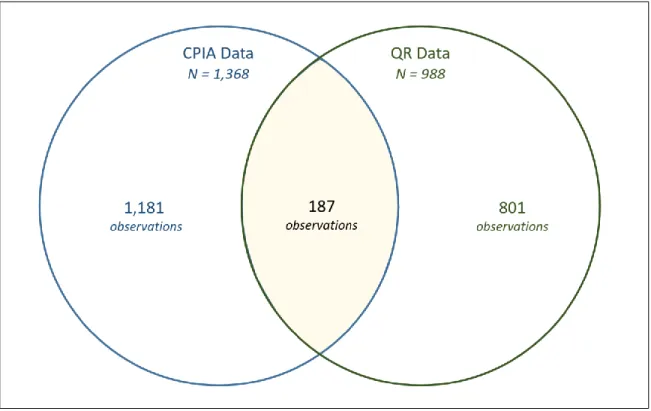
3. Overlap of CPIA data and QR data ...68
4. Distribution of overall CPIA scores ...73
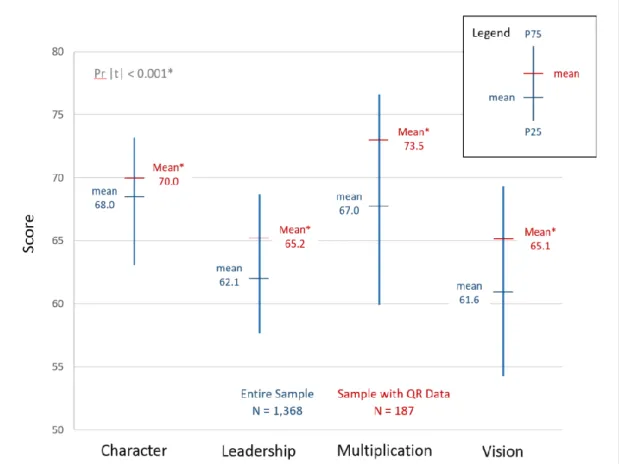
5. Distribution of scores associated with the four main categories ...74
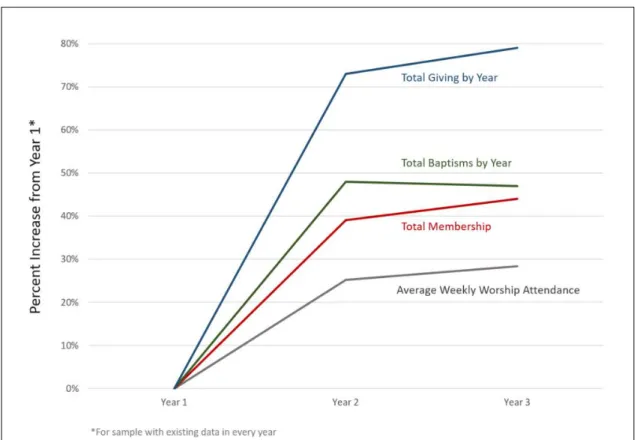
6. Percent change of key QR variables by year ...76
7. Average weekly worship attendance versus overall CPIA score ...82
8. Average quarterly baptisms versus overall CPIA score ...83
9. Cooperative Program giving versus overall CPIA score ...84
10. Number of active disciple makers versus overall CPIA score ...86
11. Probability of multiplication success versus overall CPIA score ...87
12. Probability of sustainability success versus overall CPIA score ...89
13. Average weekly worship attendance versus vision CPIA score ...91
14. Probability of multiplication success versus multiplication and vision scores ...93
PREFACE
On the eve of seminary graduation, a young and passionate church planting candidate enters the room accompanied by his equally energetic bride. They are both filled with a deep longing to see God’s name glorified and his kingdom advanced in their home state. With the goal of planting a church in a burgeoning city a few miles east of their hometown, the enthusiastic couple is seeking support from a prominent sending organization and are going through the standard assessment protocol. Three years prior, the aspiring pastor and his wife left jobs, homes, and families in order to pursue
theological education after surrendering to God’s calling of pastoral ministry. Now, on the verge of graduating from one of the world’s most prestigious seminaries with an excellent academic record and a heart for reaching the lost, the pastor and his wife feel adequately equipped and are returning home as missionaries with the hope of planting a church. The last step in the process is to obtain approval from churches and sending organizations which will provide necessary support for the missionary work.
In the room of the sending organization’s office, the pastor and his wife are given a stack of papers with a set of questions, literally hundreds of questions, and are told that they will be given a few hours to provide the corresponding answers. Their answers will generate a score which will be used as the primary criteria in the decision- making process regarding their support. The questions seem odd, many of them don’t apply, and a number of them are poorly worded. The vast majority of the questions are not about the Bible, theology, pastoral ministry, or missions. Instead, the questions are primarily focused on personality and temperament. There are nagging thoughts in the back of the young pastor’s mind that ring over and over again. “Do any of these questions
matter? What is the basis for these questions? Have any of these questions been linked to success?”
After completing the assessment forms, the pastor and his wife are ushered into another room where they wait to hear from the sending organization’s representative who is compiling the answers and generating the scores. Moments later the representative walks in and reveals the unfortunate news. Regrettably, the pastor and his wife’s
personalities are simply not suitable for church planting. The recommendation is to exit the field of church planting altogether and consider a change in vocation. The
conversation lasts no more than ten minutes as the confused couple is sent on their way to reflect on what just happened.
I share this story because it represents the experience of many church planters who have gone through church planter assessments and have been left with more
questions than answers. I am seriously concerned that sending organizations have been making critical selection decisions based on false assumptions regarding the legitimacy of their assessment instruments. These decisions have significant implications for the advancement of the gospel, and I believe that we can do better. More emphatically, I insist that we must do better. With a background as a professional statistician, pastor, and church planter, I am undertaking this research with the hope that it will provide
encouragement for church planters, improve the church planter assessment process for sending organizations, and deliver timely insights for the broader church planting community. May God be glorified through this research and may the gospel of Jesus Christ be proclaimed to the nations.
Jason A. Walker Culpeper, Virginia
May 2023
CHAPTER 1 INTRODUCTION
One of the most effective means for carrying out the Great Commission is planting new churches. In addition to following the pattern set forth in the New
Testament, church planting is essential for establishing long-term gospel witnesses within local communities. However, put simply, church planting is hard. A comprehensive review of the literature demonstrates that the church planting success rate is far too low,1 which underscores the reality that church planting is not only difficult but also risky for the church planter and the sending agency alike.
Church planting requires significant investments in both human and financial resources. Sending organizations are tasked with the responsibility of stewarding
resources well, which implies funneling limited resources to church planters with the highest probability of success. Consequently, most sending organizations, including the North American Mission Board (NAMB), employ some version of a church planter assessment instrument in order to improve the selection and development of church planters.2 A church planter assessment is a scientific assessment instrument used to evaluate the character, traits, and abilities of church planters in order to assist in the selection of qualified candidates. These assessment instruments generally include hundreds of questions and use algorithms to generate an overall score. Additionally,
1 Actual success rate data is difficult to validate and heavily dependent upon success criteria;
however, most denominations and church planting resources indicate that there is a need to increase the rate of church planting success. Ed Stetzer and Warren Bird, Viral Churches: Helping Church Planters Become Movement Makers (San Francisco: Jossey-Bass, 2010); H. Stanley Wood, Extraordinary Leaders in Extraordinary Times (Grand Rapids: Eerdmans, 2006).
2 In fact, 73 percent of regional denomination agencies report that they have a formalized church planter assessments system in place. Stetzer, Viral Churches, 83.
church planter assessments frequently evaluate the candidate’s spouse, consider marital health, and some even include “360 evaluations” where selected references complete a portion of the assessment on behalf of the candidate from an unbiased perspective.
However, these assessments are rarely statistically validated which significantly hinders the intended utility and efficacy of the instruments themselves.3 Given the weight of the decisions and the importance of improving the probability of church planter success, it is necessary to bring to bear the most robust scientific methods for the advancement of the kingdom of God.
Throughout its existence, the North American Mission Board has evaluated hundreds of potential church planters using a series of quantitative and qualitative church planter assessment tools. One of these assessment tools is the Church Planter Initial Assessment (CPIA), a pre-assessment tool which provides various metrics utilized in the church planter selection process. While the CPIA was largely built upon an established church planter assessment instrument, it has not been through a rigorous statistical evaluation to assess the validity, reliability, and efficacy of the questions therein. As a result, one of the objectives is to utilize robust statistical methods in order to validate and improve the CPIA by analyzing the links between the CPIA questions and church planter success. To this end, the analysis will seek to define success and identify which questions or corresponding metrics are most predictive of church planter success in order to
improve the selection process and identify key areas for church planter growth and development.
While this study will focus on NAMB’s CPIA, it will have extensive implications for the broader church planting community. The publication of the results will help improve church planter assessments in general by identifying church planter
3 Ed Stetzer and Daniel Im, Planting Missional Churches: Your Guide to Starting Churches that Multiply (Nashville: B&H Academic, 2016), 53.
characteristics and personality traits that are most predictive of success from a statistical perspective. Accordingly, the research will provide valuable insights for church planters and sending organizations.
To be clear, applying scientific methods to the selection process of ministerial candidates inevitably raises a number of fundamental questions. For example, is it appropriate to employ science to church related decisions? What is the role of science versus the Holy Spirit in the selection process of church planters? Are church planter assessments a biblical concept? What is the benefit of using statistical methods to help shape church planter assessments? What is the definition of church planter success? Can church planter success even be measured? This thesis will seek to address these
questions, among others, in order to establish a biblical framework for the associated analysis.
Familiarity with the Literature
A review of the pertinent literature can be broken down into four specific categories. The first category includes key resources and reference material regarding the general use of assessments for job placement and selection throughout history. An
examination of the literature in this category will produce details about the history, purpose, validity, and use of assessments in the secular realm in order to create a general overview which will serve as a necessary reference point when evaluating the use of assessments for the selection of church planters in particular.
Following the general overview of assessments, the second category will focus more specifically on the history of church planter assessments. Even though very little has been published on the topic, what has been published will essentially serve as the primary source material. Perhaps the most important publication in this category is
Charles Ridley’s work, How to Select Church Planters,4 which will be explored later in detail.
The third category of resources is comprised of works associated with church planting, church planting leadership, and church planting success. This thesis is based on the assumptions that church planting is a fundamental endeavor for accomplishing the Great Commission, that the success rate for church planting is too low, and that successful church planters share common characteristics and leadership traits which enable them to achieve a higher rate of success. As a result, it is essential to review and interact with the existing literature that highlights the importance of church planting and discusses potential characteristics of successful church planters.
The final category of resources encompasses fundamental textbooks that identify, explain, and defend various scientific methods. This set of literature will provide the mathematical and theological basis for the selected statistical techniques utilized throughout the analysis. Additionally, these resources will help ensure that the proper statistical methods are followed and that the final conclusions are based on robust analytical techniques.
General Overview of Assessments
Assessment instruments have been used successfully for many years in the military, businesses, and education. Industrial and Organizational Psychology (I-O
phycology), a field of study which specializes in human behavior in organizations and the workplace, has advanced the scientific knowledge, methods, and implementation
techniques regarding the use of assessments for selection and placement which must be considered. Human Resource Selection by Barrick, Field, and Gatewood is a frequently
4 Charles Ridley, How to Select Church Planters: A Self-Study Manual for Recruiting, Screening, Interviewing and Evaluating Qualified Church Planters (Pasadena, CA: Fuller Evangelical Association, 1988).
cited textbook in the field of I-O psychology that explores the validity and reliability of various selection methods.5 Similarly, Mumford, Owens, and Stokes’ Biodata Handbook:
Theory, Research, and Use of Biographical Information in Selection and Performance Prediction is a model resource for selection procedures and offers useful methods and proven techniques for the validation of assessment instruments.6
Perhaps the most comprehensive overview of the history of assessment tools for the purpose of selection can be found in Neal Schmitt’s The Oxford Handbook of Personnel Assessment and Selection.7 Schmitt offers a broad overview of the use of assessments and how it relates to the selection of qualified candidates. Additionally, there are a few specific examples of historical assessments that are worth exploring in more detail such as Personnel Selection in the British Forces, a World War II era work by Philip Vernon and John Parry that explain how scientific methods of personnel selection were applied in the British Royal Navy and Royal Air Force.8
Finally, the Society for Industrial Organizational Psychology has provided a contemporary list of approved principles and practices related to the validation and use of assessment instruments in Paul Sackett and Nancy Tippins’ Principles for the Validation and Use of Personnel Selection Procedures. The principles contained in this work have been adopted as policy by the American Psychological Association (APA) and represent
5 Murray Barrick, Hubert S. Field, and Robert D. Gatewood, Human Resource Selection (Mason, OH: South-Western, 2008).
6 Michael D. Mumford, William A. Owens, and Garnett S. Stokes, Biodata Handbook: Theory, Research, and Use of Biographical Information in Selection and Performance Prediction (Palo Alto, CA:
CPP Books, 1994).
7 Neal Schmitt, The Oxford Handbook of Personnel Assessment and Selection (New York:
Oxford University Press, 2012).
8 Philip E. Vernon and John B. Parry, Personnel Selection in the British Forces (London:
University of London Press, 1949), 5.
the accepted scientific practices in the field of personnel selection.9 As a result, Sackett and Tippins’ work is highly relevant to the topic of church planter assessments.
Church Planter Assessments
The introduction of formal assessment instruments to evaluate the
qualifications of candidates for a specific job function began in Germany during World War I and were eventually adopted by church planting organizations in the early 1980s.10 While the literature dealing with church planter assessments is scant, the seminal work entitled How to Select Church Planters was published in 1988 by Charles Ridley. As church planting was gaining momentum across all major denominations in the ’70s and ’80s, Ridley acknowledged that “Selecting candidates who will perform effectively as church planters has emerged as a major concern in the church growth movement.”11 As a result, Ridley developed a manual for evaluating church planters to improve decision making and help identify those planters who are most likely to succeed.12 By performing a job analysis in 1984, Ridley identified forty-eight dimensions of a successful church planter and later narrowed the list down to thirteen essential qualities that are commonly referred to as the Ridley Profile.13 It is hard to overstate the importance of Ridley’s work for church planter assessments since most church planter assessments today are built upon Ridley’s foundation.14
9 Paul Sackett and Nancy Tippins, Principles for the Validation and Use of Personnel Selection Procedures (Bowling Green, OH: Society for Industrial Organizational Psychology, 2018), 1.
10 Lloyd Walter Grant, “Theological Analysis of Church Planter Profiles” (PhD diss., Southern Baptist Theological Seminary, 2012), 4.
11 Ridley, How to Select Church Planters, 1.
12 Ridley, How to Select Church Planters, 4.
13 Ridley, How to Select Church Planters, 7.
14 Stetzer and Bird, Viral Churches, 82.
While Ridley’s church planter profile is the most well-known, Thomas Graham and the Presbyterian Church in America began experimenting with church planter
assessments in 1983 and ultimately published an article in the January 1987 edition of Evangelical Missions Quarterly which identifies twelve characteristics of a successful church planter.15 Apart from Graham and Ridley, precious little has been published regarding church planter assessments that is worthy of consideration other than a few dissertations.16 The only other work that bares mentioning is Stanley Wood’s
Extraordinary Leaders in Extraordinary Times, which is the result of an extensive
research study aimed at evaluating the characteristics of successful church planters across seven mainline denominations.17 Through his research, Wood was able to identify a profile for successful church planters and produced one of the only publications on church planter qualifications that is supported by hard data.
Church Planting and Leadership Resources
There are extensive resources about starting a new church; however, the most prolific and influential author when it comes to church planting is Ed Stetzer. In Viral Churches, Stetzer and Warren Bird present findings from one of the most comprehensive studies ever undertaken to evaluate methods and trends regarding church planting in the United States.18 Additionally, Stetzer’s work Planting Missional Churches serves as a
15 Thomas Graham, “How to Select the Best Church Planters,” Evangelical Missions Quarterly 23, no. 1 (January 1987): 72-73.
16 In A Practical Theology of Assessment, John Bradley and Don Wiggins present discoveries from twenty-five years of assessing candidates. John Bradley and Don Wiggins, A Practical Theology of Assessments (Colorado Springs, CO: Christian & Missionary Alliance, 2015). Noteworthy dissertations include the following: Norman K. Duncan, “A Correlation Study of Church Planter Emotional Intelligence and Church Sustainability” (PhD diss., Dallas Baptist University, 2018); Lloyd Walter Grant, “Theological Analysis of Church Planter Profiles” (PhD diss., Southern Baptist Theological Seminary, 2012); and J.
Allen Thompson, “Church Planter Competencies as Perceived by Church Planters and Assessment Center Leaders: A Protestant North American Study” (PhD diss., Trinity International University, 1995).
17 Wood, Extraordinary Leaders in Extraordinary Times, xix.
18 Stetzer and Bird, Viral Churches, 4.
comprehensive guide to starting reproducing churches and highlights key methods and characteristics when selecting church planters.19 In addition to Stetzer, J. D. Payne provides a useful summary of church planting practices in his work The Barnabas Factors by referencing the biblical example of Barnabas and the first century church.20 Payne’s contribution is a focus on church planting teams and team members rather than lead church planters themselves.21 Finally, works on Christian leadership, such as John Stott’s Basic Christian Leadership, are important to consider since church planting inevitably requires strong leadership skills. Stott relies on the first four chapters of 1 Corinthians and Paul’s biblical example of leadership as his source for admirable leadership qualities.22
Scientific Methods
When it comes to using appropriate statistical methods, Michael Longnecker and R. Lyman Ott’s statistical textbook, An Introduction to Statistical Methods and Data Analysis, is a great place to start.23 For multivariate analysis, Richard Johnson and Dean Wichern’s Applied Multivariate Statistical Analysis represents a trustworthy resource for acceptable techniques and strategies.24 Scientific methods, including data analysis, are often rejected by the church, but Vern Poythress provides a useful critique. For example,
19 Stetzer, Planting Missional Churches, 43-58.
20 J. D. Payne, The Barnabas Factors: Eight Essential Practices of Church Planting Team Members (Smyrna, DE: Missional Press, 2008), 1.
21 Payne, The Barnabas Factors, 6-7.
22 John Stott, Basic Christian Leadership (Downers Grove, IL: InterVarsity Press, 2002), 12.
23 Michael T. Longnecker and R. Lyman Ott, An Introduction to Statistical Methods and Data Analysis (Boston: Cengage Learning, 2015).
24 Richard A. Johnson and Dean W. Wichern, Applied Multivariate Statistical Analysis (New York: Pearson, 2018).
in Redeeming Mathematics, Poythress demonstrates that God is the creator and founder of science, which ultimately points to the beauty of God.25
Void in the Literature
While church planter assessments have been utilized for decades with the intended purpose of improving church planter selection,26 a literature review has revealed that few assessment instruments have been appropriately statistically validated.27 In addition, the few that have been validated are many years out of date, and the analytical results have not been published for others to reference or critique. As a result, the vast majority of church planter assessments have been based upon opinions and personal experiences rather than robust statistical analysis. Many evangelical organizations have turned to general assessment instruments that measure several constructs perceived to have importance but have never been statistically linked to church planter success.28
The existing literature is full of theories, often stated as fact, regarding the characteristics and qualifications of successful church planters, but supporting evidence is significantly lacking. At the time of this writing, there is not a single publication that has proven with data that an assessment score or sub-characteristic is correlated with church
25 Vern Poythress, Redeeming Mathematics: A God-Centered Approach (Wheaton, IL:
Crossway Books, 2015), 32, 145.
26 The first major work on using assessments for church planter selection was published by Charles Ridley in 1988 and is the foundation upon which many church planter assessments are built.
Charles R. Ridley, How to Select Church Planters: A Self-Study Manual for Recruiting, Screening, Interviewing and Evaluating Qualified Church Planters (Pasadena, CA: The Fuller Evangelical Association, 1988).
27 LifeWay’s Church Planter Candidate Assessment (CPCA) is one of the only statistically validated church planting assessments that exists. Stetzer and Im, Planting Missional Churches, 53. The CPCA was developed in 2010 and the results of analysis have never been published. Multiple phone calls and emails to LifeWay for further comment have been declined.
28 The assessment instrument utilized by the Christian and Missionary Alliance (C&MA) is a good example of an assessment that is based on a general instrument that was never validated for church planters. According to Don Wiggins and John Bradley, the C&MA uses the assessment instrument developed by the IDAK Group, which was created in order to identify individual talents for general placement purposes. While subject matter experts identified a number of talents presumed to be important for church planting, this was never statistically validated. Bradley and Wiggins, A Practical Theology of Assessments.
planter success.29 Yet, in spite of this reality, church planter assessments are widely used across all denominations to rank and select church planters who are assumed to have a higher probability of success. This practice is entirely without basis. There must be a call to dramatically improve the assessment process such that decisions are based on facts.
There must also be a renewed commitment towards updating and reevaluating the assessment instruments as the world shifts and more data is gathered. To continue operating blindly is detrimental to church planters, churches, sending organizations, and ultimately to the mission given to the church to reach the lost for Christ.
Thesis
A statistical evaluation of the North American Mission Board’s (NAMB) Church Planter Initial Assessment (CPIA) instrument will improve the selection and development of church planters, thereby increasing the probability of church planter success while providing valuable insights for the broader church planting community.
The initial portion of the research will involve a comprehensive review of the literature regarding church planter assessments and an evaluation of the biblical justification for using assessments. The core methodology will focus on a rigorous statistical analysis of NAMB’s CPIA instrument using proper statistical techniques. The first objective is to evaluate the validity of NAMB’s assessment by measuring the predictive nature of the CPIA instrument and the associated questions/metrics contained therein. The second objective is to highlight the most leveraging characteristics of a successful church planter based on data rather than opinion. In order to accomplish both objectives, a clear and measurable definition of success will need to be identified. NAMB has generously agreed to provide the requested data for the analysis.
29 While Ridley and Graham were the first to articulate specific characteristics of a successful church planter, their initial works were based on job analyses and have never been statistically validated. If they have been validated, the results have not been published.
Outline of Chapters
The following descriptions of each chapter will help outline the flow of thought and the methodology that will be followed.
In Chapter 2, I will provide a biblical justification for using assessments. This chapter is intended to answer arguments against assessments and provide sound biblical rationale for their employment. In order to critically examine the use of assessments, I will interact with the various arguments against using assessments. In particular, I will discuss how God is the source of all mathematics and his character and gifting provides the basis for using mathematics in the selection process of church planters. I will explore the Scriptural basis for the use of scientific methods to inform church related decisions and will focus specifically on the implications that can be derived from the biblical witness regarding the use of church planter assessments. Finally, I will show that church planting assessments ought to be used for the glory of God and the advancement of his kingdom.
In Chapter 3, I will describe the various definitions of church planter success that have been used and highlight the importance of defining success when validating an assessment instrument. I will focus more generally on the leading definitions of success and discuss their pros and cons. While the traditional measurements are pragmatic, there are a number of alternative definitions, such as faithfulness, fruitfulness, multiplication, and sustainability. I will explore these options and will provide a biblical evaluation of each. After considering the various definitions of success, I will provide a short summary and path forward.
In Chapter 4, I will describe the data and methodology in detail. The ability to answer the proposed research questions hinges on the quantity and the quality of the data.
As a result, I will provide a detailed description of the data and will clarify important definitions that are central to the analysis. Additionally, I will highlight potential biases in the data that might be relevant. Before engaging in advanced statistical techniques, much
can be learned from a description of the summary statistics. For example, what is the average success rate of church planters as defined by NAMB? What is the distribution of church planter assessment scores within the sample? In this chapter, I will answer these questions among others. I will provide an overview of the methodology and will summarize the research questions to be answered and the techniques to be utilized. It is essential that the statistical techniques and analysis be transparent and appropriately supported by experts in the field of statistics. Accordingly, I will describe and defend the statistical techniques used for analysis which will depend on the nature of the data and the intended objective of the analytical approach.
In Chapter 5, I will analyze the data and interpret the results. More specifically, I will assess the validity of NAMB’s church planter assessment instrument. Validity in the case of assessment instruments represents the degree to which the assessments and related scores are supported by statistical evidence. In order to test the validity of a church planter assessment instrument, it is necessary to observe a statistically significant relationship between the assessment scores and church planter success. Validity is, by far, the most important consideration of any assessment instrument. As a result, the primary objective of this analysis is to evaluate the validity of NAMB’s church planter assessment instrument. I will explore the relationship between assessment scores and church planter success and will describe the findings. In addition to validity, the analysis will evaluate which church planter characteristics are most predictive of church planter success. I will review the church planter characteristics measured by the CPIA and provide an analysis of which ones are most predictive.
In Chapter 6, I will summarize the analysis and discuss the implications. I will include a general summary of the findings and provide recommendations specific to the North American Mission Board based on the analytical results. Finally, I will expand the discussion to the broader church planting community and will explore the various
implications of the analysis beyond NAMB. I will propose a path forward and will identify potential future research.
CHAPTER 2
THEOLOGY OF ASSESSMENTS Introduction
Assessment instruments for workplace selection have been around for many years, and the utility of such tools has been scientifically proven time and again in the field of Industrial and Organizational (I-O) Psychology.1 While the measurement of individual differences was introduced as early as 1879, the crises of World War I and World War II provided opportunities to leverage advances in the field and significantly accelerated the development of psychological assessment instruments.2 For example, in 1917 the US Army introduced the Alpha and Beta IQ Tests that were comprised of a series of multiple choice questions and were completed by over 1.7 million potential soldiers.3 The Alpha and Beta Tests, which were developed for the literate and illiterate respectively, provided a letter grade identifying the applicant’s potential for military service ranging from “A: High Officer Type” to “E: Unfit for Service.”4 A few years later in World War II, the British Royal Navy and Royal Air Force implemented a similar personnel evaluation tool that was administered to over three million recruits.5 Even though the British version focused more on interviews and biographical data rather than
1 Neal Schmitt, The Oxford Handbook of Personnel Assessment and Selection (New York:
Oxford University Press, 2012), 9-24.
2 Schmitt, Oxford Handbook, 13.
3 Schmitt, Oxford Handbook, 13.
4 Lloyd Walter Grant, “Theological Analysis of Church Planter Profiles” (PhD diss., Southern Baptist Theological Seminary, 2012), 20.
5 Philip E. Vernon and John B. Parry, Personnel Selection in the British Forces (London:
University of London Press, 1949), 5.
relying on multiple choice questions, the British assessment instrument collected a significant volume of data and laid a solid foundation for future scientific advances in the field.
As corporations grew in size and complexity following the industrial revolution, companies began looking for better selection methods to help differentiate between potentially successful and unsuccessful applicants.6 Based on the learnings from the World Wars, assessment instruments were developed and were employed with
positive results. While early instruments focused on measuring physical abilities and were used primarily in military contexts, the use of assessment instruments eventually grew to include cognitive abilities aided by advances in the fields of statistics and
psychology.7 By the middle of the twentieth century, using assessment instruments for the purpose of selection was a validated technique for improving the probability of hiring successful employees and was a commonplace practice within the secular arena, particularly for jobs that required high degrees of specialization.8 Shortly thereafter, assessment instruments were developed and implemented for religious organizations, specifically for church planting.9
Today, after four decades of experimentation and implementation, the most prominent sending organizations frequently utilize church planter assessments to assist in the selection process of qualified church planters.10 As assessment instruments gained widespread popularity in the secular world, it was pragmatic for religious organizations to
6 Schmitt, Oxford Handbook, 10-11.
7 Murray Barrick, Hubert S. Field, and Robert D. Gatewood, Human Resource Selection (Mason, OH: South-Western, 2008), 536.
8 Schmitt, Oxford Handbook, 9-24.
9 Grant, “Theological Analysis of Church Planter Profiles,” 4.
10 Ed Stetzer and Warren Bird, Viral Churches: Helping Church Planters Become Movement Makers (San Francisco: Jossey-Bass, 2010), 83.
adopt similar tools. Presently, the vast majority of sending organizations among denominational and nondenominational entities include some form of a church planter assessment instrument as part of their standard church planter assessment protocol.11 As a result, nearly every single church planter who currently serves in North America has taken or will be required to take a formal church planter assessment. The rapid
acceptance of such tools within religious organizations can be directly attributed to their proven success in the secular industries. As the science behind assessment instruments was crystalizing in the field of I-O psychology, a genuine need arose within religious sending organizations to improve the high rate of failure among church planters. For example, Thomas Graham, one of the chief pioneers of church planter assessment instruments, describes how the Presbyterian Church in America began experimenting with church planter assessment alternatives in 1983 due to the “growing concern about more traditional methods of selecting personnel” and the high rate of failure of church planters across various sending organizations.12 Additionally, Don Wiggins explains from a Christian and Missionary Alliance (C&MA) context that church planting in the 1980s was characterized by “far too many false starts and human casualties.”13 A predictable solution was the implementation of church planter assessments in the early 1980s.14 The church planting community has seemingly never looked back.
11 This includes The North American Mission Board, The Pillar Network, Acts 29, and Sojourn Ministries, among many others. For example, the LifeWay assessment instrument entitled the Church Planter Candidate Assessment (CPCA) is currently used by the Presbyterian Church, the United Methodist Church, the Assemblies of God, the Southern Baptist Convention, the Evangelical Free Church of America, and the Church of the Nazarene. This is an abbreviated list but highlights the widespread adoption of church planter assessments.
12 Thomas Graham, “How to Select the Best Church Planters,” Evangelical Missions Quarterly 23, no. 1 (January 1987): 72-73.
13 John Bradley and Don Wiggins, A Practical Theology of Assessments (Colorado Springs, CO: Christian & Missionary Alliance, 2015), 5.
14 Grant, “Theological Analysis of Church Planter Profiles,” 4.
Objective
The historical literature indicates that church planter assessments were initially implemented from a sincere desire to improve the rate of church planter success.15 This is a commendable objective and one that certainly merits creative solutions. Additionally, the Bible has been undeniably central in the development of church planter assessments since the specific skills and character traits measured by church planter assessments are generally rooted in the biblical qualifications for pastoral ministry.16 However, it appears that sending organizations have proceeded directly to the development and
implementation of church planter assessments without fully considering the biblical justification of the practice. Precious little has been written regarding a biblical defense for the use of assessment instruments in the context of evaluating church planters.17 For years, the implied justification for the use of church planter assessments is the perceived efficacy of such tools,18 yet the utility of a tool does not automatically justify its usage.
Apart from the scientific rationalization, is there a biblical justification for the use of church planter assessments? What is the theological foundation that supports the
implementation of church planter assessments? Given the importance of church planting and the widespread utilization of church planter assessments within modern sending agencies, it is necessary to consider whether or not church planter assessments are
appropriate from a biblical perspective. As a result, the intended purpose of this chapter is to evaluate the biblical and theological justification for using scientific church planter assessments for the purpose of candidate selection.
15 Charles Ridley, How to Select Church Planters: A Self-Study Manual for Recruiting, Screening, Interviewing and Evaluating Qualified Church Planters (Pasadena, CA: Fuller Evangelical Association, 1988), 1.
16 Ridley, How to Select Church Planters, 5.
17 Only Aubrey Malphurs and John Bradley specifically deal with this topic at any length.
18 Grant, “Theological Analysis of Church Planter Profiles,” 4.
Methodology
There are a number of potential benefits when utilizing an assessment instrument in the context of church planting. For example, a few of the cited benefits include identifying personal gifting, highlighting strengths and weaknesses for the purpose of training, and potentially averting disaster when selecting a church planter.19 Although the practical benefits are widely acknowledged, there are some who frown upon the use of science as an aid for spiritual decision making and some who even considered such practices as sinful.20 Consequently, a biblical evaluation is necessary to ascertain whether or not church planter assessments are an acceptable tool from a theological perspective as opposed to a practical one.
Even though Scripture does not address the specific topic of assessment instruments or the more general theme of using mathematical techniques in order to improve decision making, the biblical witness has enough to say regarding the source of math and the ultimate end of math such that a theological framework can be firmly established. As with any theological framework, the starting point should be God, his creation, and his character. Only after evaluating the implications of theology proper can the qualifications of a church planter and the biblical methods of evaluating pastoral candidates be considered. Finally, there are various inferences that can be drawn from exploring how math is used in Scripture that are worthy of reflection. In every case, the focus will be on the Bible and the corresponding implications for the use of scientific assessment instruments for the selection of church planters.
God’s Creation, Character, and Gifting
Church planter assessment instruments depend on mathematical algorithms, statistical relationships, and scientific methods to produce various results that are used in
19 Stetzer and Bird, Viral Churches, 97.
20 Bradley and Wiggins, A Practical Theology of Assessments, 21.
the evaluation and selection of church planters. As a result, the fundamental question regarding the justification of using church planter assessment instruments centers around the biblical support for utilizing the underlying mathematical methods. If it was
inappropriate to use mathematical methods for decision making within the church, church planting assessments would be rejected necessarily because of their heavy dependence upon math. Additionally, for church planter assessments to even make sense, math, and more specifically statistics, must be reliable. If this assumption is proven false, the tools would be meaningless, and the results would lead to confusion rather than assistance.
Consequently, the suitability and reliability of mathematical principles are foundational for the implementation of church planter assessments, and the primary evidence in support of mathematics is found in the creation, character, and gifting of God.
God’s Creation
According to the Oxford Dictionary, mathematics can be defined as “the abstract science of number, quantity, and space.”21 Therefore, at the most basic level, the primary defense for the use of mathematics in a religious setting is rooted in the creation of quantity and space from which numerical relationships derive meaning. When God created the world, he instituted the foundational laws of physics and mathematics by which the universe is governed. Without these laws, the entire cosmos would collapse in a spectacular heap. The mathematical principles that rule creation have existed since the beginning of time and are merely discovered by man, not created by man.22 Additionally, math only exists as a tool to describe what has been created. Consequently, mathematics can accurately be viewed as an integral part of creation and not as independent from
21 Oxford English Dictionary, 2nd ed., “Mathematics,” (Oxford: Oxford University Press, 2004), s.v.
22 Vern Poythress, Redeeming Mathematics: A God-Centered Approach (Wheaton, IL:
Crossway Books, 2015), 17.
creation. Paul’s declaration in Colossians 1:16 that “by him all things were created, both in the heavens and on earth, visible and invisible, whether thrones or dominions or rules or authorities–all things have been created through him and for him”23 categorically includes the realm of mathematics and scientific law. The phrase “in heaven and on earth” indicates the comprehensive sphere of Christ’s creative work and is intended to apply to the material and immaterial alike.24 This includes but is not limited to the scientific principles that govern creation,25 such as mathematics. Furthermore, the statement that “all things were created by him and for him” suggests that, not only are mathematical principles created by Christ but they have, as their ultimate end, the glory of Christ. Christ is the source of mathematics, but he is also the sustainer of mathematics.
Consider Colossians 1:17 which states that “He is before all things, and in him all things hold together.” In a very real sense, Jesus Christ is the “cohesive” that holds the structure of mathematics together.26 As Grudem asserts, Colossians 1:17 reveals that “God’s providence in creation provides a basis for science.”27
The fact that mathematical principles even exist is a compelling arguments for the existence of God.28 Scientists can work within mathematical principles and can even help describe the physical laws that govern creation, but they have no answer for the source of the laws themselves.29 As James Nickel points out, “[Only] biblical Christianity
23 Unless otherwise noted, all Scripture quotations are taken from the New American Standard Bible 1995.
24 F. F. Bruce, The Epistles to the Colossians, to Philemon, and to the Ephesians (Grand Rapids: Eerdmans, 1984), 61-62.
25 Wayne Grudem, Systematic Theology: An Introduction to Biblical Doctrine (Grand Rapids:
Zondervan, 1994), 316.
26 James Nickel, Mathematics: Is God Silent? (Vallecito, CA: Ross House Books, 2001), 5.
27 Grudem, Systematic Theology, 317.
28 Kenneth Boa and Robert Bowman Jr., Faith Has Its Reasons: An Integrative Approach to Defending Christianity (Waynesboro, GA: Authentic, 2005), 81.
29 Timothy Keller, The Reason for God: Belief in an Age of Skepticism (New York: Penguin Group, 2008), 136.
can account for the ability to know mathematical truths.”30 The modern day
mathematician attempts to separate the practice of science from the source of science. In so doing, the practice of science has not only become an exercise devoid of theological significance, but it has also been promoted falsely as a construct opposed to the biblical worldview. Perhaps this is one of the reasons why math is often viewed by skepticism within the church. However, this is only an illusion as mathematics is not a neutral discipline.31 Even those who ignore the true source of mathematics must still operate under biblical assumptions in practice. When properly understood, mathematics is essentially a theological exercise and can only be rightly applied when in submission to the Creator. An atheist may use mathematics to obtain accurate answers but will
inevitably fail to acknowledge the Creator that math is intended to glorify. In fact, history has shown that mathematics eventually stagnates when employed by unbelievers yet thrives when employed by those who have submitted to a higher law.32 Scripture indicates that mathematics was created by God and assumes the existence of an Intelligent Designer.33
Additionally, the biblical account not only identifies the source of
mathematics, but it also reveals the proper application thereof. God’s command in the garden to “fill the earth and subdue it (Gen 1:28)” applies to all elements of the earth, including the sciences. The earth is replete with numerical relationships, and it is man’s duty to exercise dominion over the earth by utilizing the mathematical principles that God embedded in the fabric of creation.34 When God placed Adam in the garden to “work
30 Nickel, Mathematics, 233.
31 Nickel, Mathematics, 196.
32 Nickel, Mathematics, 54.
33 William Dembski and Jay Richards, Unapologetic Apologetics: Meeting the Challenges of Theological Studies (Downers Grove, IL: InterVarsity Press, 2001), 225.
34 Nickel, Mathematics, 13.
it and take care of it (Gen 2:15),” he was giving Adam the authority to employ the various resources available to him, both physical and non-physical. Even in the naming of the animals, it is implicit that Adam was using the rudimentary principles of science, such as pattern recognition, classification, and category identification. Using these tools as an aid, Adam was working within the framework that God established in order to accomplish his God-given directive. From the garden it can be observed that mankind is free to apply mathematics and even encouraged to do so as a tool to aid in the mandate of dominion.
The legitimacy of mathematics is founded in creation. When God created the world, he also created math such that it points to him as Creator. When God encouraged man to subdue the earth, he authorized math as a useful tool for employment towards that end. When he declared that his creation was “good (Gen 1:1-31),” he indicated that math is not a neutral discipline but rather one that has purpose and meaning as it relates to the created order. Mathematics represents a biblically justifiable means of describing the arrangement of God’s good creation.35 Since God ordained mathematical laws, they are not inherently evil. Certainly, they can be misused, but the laws themselves were created
“by him and for him.” Finally, as part of his creation, mathematics brings glory to God and ultimately points to his perfect character.
When it comes to applying math to decision making within the church, it may be argued that decision makers should seek God’s direction in concert with prayer and biblical wisdom rather than relying upon mathematical equations and scientific theory.
However, such an argument presents a false dichotomy. Yes, it is absolutely true that sending agencies ought to carefully and humbly seek God’s will regarding the selection of church planters through prayer and careful study of God’s Word regarding the qualifications of a pastoral candidate, but that does not invalidate additional aids. For example, God created mankind with a logical mind and expects that logic will be
35 Nickel, Mathematics, 217.
employed in decision making.36 This is evidenced throughout Scripture, but an Old Testament example can be found in Isaiah 1:18 when God calls his people to “reason”
together. The Hebrew word for “reason” that is used in Isaiah 1:18 is a term often used in a legal setting and describes employing logic to make a compelling case based on the presented evidence in order to prove what is right.37 In the context of Isaiah, God is presenting evidence to the Israelites that they are a rebellious people who deserve
judgment. Those who continue in rebellion will be justly punished, but those who repent will be mercifully forgiven. The logical response is to repent and be made “as white as snow (Isa 1:18-20).” In this case, the appeal to repent is not only grounded in the theological truths regarding God’s merciful character, but it is also rooted in an assessment of the logical consequences of repenting or not.
Similarly, in the New Testament, Paul appeals to logic in his famous Sermon on Mars Hill in Acts 17. Acts 17:17 describes how Paul was “reasoning” with the people every day in the synagogue and in the marketplace to whomever was present. The Greek word for “reasoning” carries with it the connotation of “speaking to someone in order to convince”38 and “arguing about differences of opinion.”39 As Paul reasoned with those present, he used a series of logical arguments to call them unto repentance. In fact, the very language Paul uses “has the ring of Greek philosophy for Paul was attempting to build what bridges he could to reach the Athenian intellectuals.”40 Paul acknowledges
36 Boa and Bowman, Faith Has Its Reasons, 11.
37 Francis Brown, The Brown, Driver, Briggs Hebrew and English Lexicon (Peabody, MA:
Hendrickson, 1996), 407.
38 Timothy Friberg, Barbara Friberg, and Neva F. Miller, “Insert Greek word,” in Analytical Lexicon to the Greek New Testament (Grand Rapids: Baker, 2000), v. 8, BibleWorks.
39 Johannes Louw and Eugene Nida, “Insert Greek word,” in Greek-English Lexicon of the New Testament Based on Semantic Domains (Swindon, UK: United Bible Societies, 1996), v. 8, BibleWorks.
40 John Polhill, Acts, The New American Commentary 26, ed. David S. Dockery (Nashville:
Broadman Press, 1992), 370.
that the people are very religious as they built an alter to an “unknown god (Acts 17:23)”
and then appeals to their religious bent by describing the gospel in a way that would resonate with them by quoting their poets and using familiar imagery. This, then, is another biblical example of how logic can be used as a helpful tool to facilitate decision making for the glory of God.
While prayer and Scripture are the twin pillars of wise decision making, God has provided additional aids that are appropriate to draw upon, such as logic as described in Isaiah 1 and Acts 17. As an extension of logic, mathematics can also be used as a valuable tool that can be incorporated into the decision-making process as needed. As Vern Poythress states, “[When] God created the world, he also ordained all the
characteristics of the world. It is he who specifies all the truths about the world, including the truths of mathematics.”41 Since math contains truth created and ordained by God, it is fully appropriate to appeal to such truths when evaluating various decisions in a
prayerful, biblical, and logical way. It would be a lost opportunity to do otherwise.
God’s Character
In Romans 1:20, Paul proclaims “[Since] the creation of the world God’s invisible qualities–his eternal power and divine nature–have been clearly seen, being understood from what has been made, so that men are without excuse.” If mathematics is part of God’s creation and his divine nature can be seen in what has been created, it follows from Romans 1:20 that God’s attributes can be observed in mathematics. Take, for example, the reliability of mathematical principles. What makes math reliable? What ensures that two plus two equals four each and every time? Simply put, math is reliable because God is reliable. As made clear in Malachi, God never changes. In Malachi 3:6 God declares, “For I the Lord do not change; therefore you, O sons of Jacob, are not
41 Poythress, Redeeming Mathematics, 145.
consumed (Mal 3:6).” This passage not only highlights that the very being of God remains changeless but also his ethical dealings with his people.42 The faithfulness of God and his corresponding mercy to the sons of Jacob are based on the unchanging character of God himself. His character is reliable and, as a result, his actions are reliable.
Similarly, James states, “Every good and perfect gift is from above, coming down from the Father of the heavenly lights, who does not change like shifting shadows (Jas 1:17).”
The implication is that good gifts come from a good God who is constant and reliable, unlike the changing of lights in the sky.43 In theological language, this is called God’s immutability, and it is a central element of God’s character.44 God’s immutability is essential to his character because “variation in God would spell the death of His own perfection.”45 God’s people are able to rely on his promises because they are confident in the unchanging, never ending, consistency of God’s perfect character.46 Even in a
philosophical sense, math is necessary rather than contingent. Mathematics would function in the same way regardless of the context just as God would be the same in every conceivable world.47 As Walter Smith so eloquently wrote, “We blossom and flourish as leaves on the tree, and wither and perish, but naught changeth Thee.”48
In the same way that God is reliable, math and other scientific laws can be depended upon because of the dependable nature and character of their creator. Since the
42 Bruce Ware, “An Evangelical Reformulation of the Doctrine of the Immutability of God,”
Journal of Evangelical Theological Society 24, no. 4 (1986): 431-46.
43 Kurt Richardson, James, The New American Commentary 36, ed. David S. Dockery (Nashville: Broadman Press, Year), 86.
44 Grudem, Systematic Theology, 163.
45 Matthew Barrett, None Greater: The Undomesticated Attributes of God (Grand Rapids:
Baker Books, 2019), 94.
46 Barrett, None Greater, 109.
47 Alvin Plantinga, Does God Have a Nature? (Milwaukee: Marquette University Press, 1980), 144.
48 Walter Smith, “Immortal, Invisible,” The Baptist Hymnal (Nashville: Convention Press, 1991), 6.
God who ordained mathematical laws is unchanging, it naturally follows then that the laws that govern the world he created would also be unchanging.49 This is the
fundamental reason why two plus two will equal four in every circumstance, in every culture, in every application, and in every century. God is reliable and the laws that he created are reliable. In the context of church planter assessments, this means that such tools can be reliable indicators insofar as they utilize the mathematical laws and principles that govern creation because of the immutable nature of the Creator.50
Apart from the immutable nature of God, mathematics also displays a myriad of additional divine attributes. Consider, for example, the infinite nature of God. The mathematical model includes integers with neither beginning nor end. It is possible to subtract or add to any number regardless of how large or small. In the same way, God is an infinite being without beginning or end (Rev 1:8). Mathematical principles also apply in every time and space continuum. There is not a single inch of the universe nor a millisecond in time where two plus two does not equal four. Here is yet another glimpse into the divine nature, specifically God’s omnipresence. What about the omnipotence of God? In a very real sense, the power of mathematical laws is absolute. They cannot be broken by man or beast no matter how resilient or cunning one might be. Nothing can escape the mathematical principles set forth by God, which highlights the absolute power of the law’s Creator.51 What about God’s omniscience? Many examples can be provided here but one needs only to count the stars to marvel at God’s infinite knowledge. It is
49 Poythress, Redeeming Mathematics, 16.
50 Please note that not all church planter assessments are rooted in sound mathematical principles, as many of them have never been statistically validated. Ed Stetzer and Daniel Im, Planting Missional Churches: Your Guide to Starting Churches That Multiply (Nashville: B&H Academic, 2016), 53. As a result, not all church planter assessments should be considered reliable indicators of church planter success.
51 Poythress, Redeeming Mathematics, 17.
estimated that there are approximately 1026 stars.52 This number is beyond human comprehension yet God numbers the stars and knows them by name.53 Once again, math demonstrates the glorious attributes of God in unique and powerful ways. Furthermore, math reveals how God is orderly, precise, just, knowable yet incomprehensible, visible yet invisible, eternal, good, wise, along with many other divine characteristics.54 As a result, math has been called the “handmaiden of theology”55 because of how it reveals the glory of God. Truly it can be affirmed that “the heavens declare the glory of God; and the firmament shows His handiwork. Day unto day utters speech, and night unto night reveals knowledge (Ps 19:1-2).”
Mathematics is rooted in the character of God and reveals the divine attributes of God. God is the definitive source of each mathematical law, and they glorify him when properly employed. However, this could be taken one step further. Math, when
understood from a biblical perspective, “serves to assist God’s people in fulfilling God’s mandate of worldwide evangelism.”56 It is not simply acceptable to use mathematics for the glory of God, it is genuinely expected that God’s people would utilize math to aid in the fulfillment of the Great Commission. It would be a waste of God’s resources and a rejection of his precious gift to spurn the tool provided by God for assisting in the pursuit of the church’s mission to reach the lost.
Math is a useful tool that can be used for God’s glory and is an extension of the dominion mandate in Genesis. Albert Mohler makes a similar point in his article on vaccinations when he asserts that Christians are authorized to use vaccinations as “an
52 Nickel, Mathematics, 261.
53 Gen 1:16; Ps 147:4-5.
54 Nickel, Mathematics, 258-63.
55 Nickel, Mathematics, 224.
56 Nickel, Mathematics, 235.