To Nick and Alyson, thank you for knowing me, loving me and giving me a place to stay whenever I need. Thanks to Covenant Christian Academy, namely Tom Browning, Justice Kerr, Beth Saladino and Kelly Wofford. A special thanks to Paul Laywell for serving as a sounding board, mentor, brother and editor.
You, dear friend, are truly the best of the best, a master teacher and an engaging storyteller. Michael Wilder, thank you for telling me I had something worthy to contribute to the Bride of Christ. I am grateful to the Secular Student Alliance for the venture of a woman from Southern Baptist Theological Seminary.
Thank you for letting me into your lives, for trusting me and giving me the privilege of listening to your journey. To the invisible God made known, Jesus Christ, you are breathtaking and worthy to behold.
RESEARCH CONCERN
Nance asserts that rhetoric is "measured by our ability to teach people truth, to move them to good, and to delight them with verbal beauty."7 In other words, rhetoric is an invitation in which the rhetorician pulls out a chair and compels it. her listeners to sit at the table of truth.8 The rhetorician persuades by using Aristotle's three basic elements of persuasion: logos. 4 As used in this study, the phrase "Christian rhetoric" refers to the Christian's use of rhetorical elements as revealed in the biblical metanarrative to convince his neighbor of the truth and beauty of the gospel. 22 James Emery White, Rise of the Nones: Understanding and Reaching the Religiously Unaffiliated (Grand Rapids: Baker, 2014), 43.
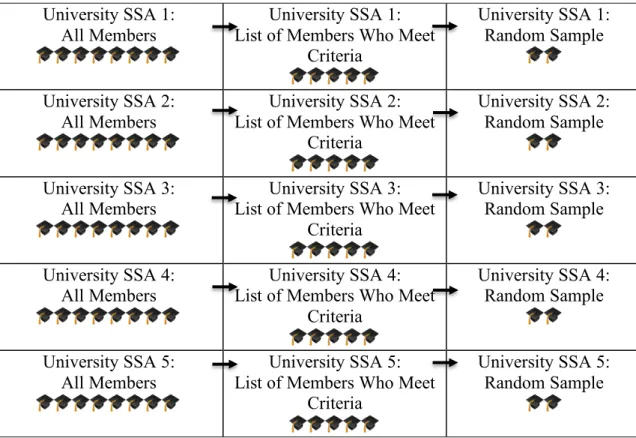
For books on Christianity that relate to Gen Z, see White, Rise of the Nones;. Based on the phenomenological nature of the study, insights were limited to participants meeting the aforementioned criteria. Christians use rhetorical elements as revealed in the biblical metanarrative to convince their neighbors of the truth and beauty of the gospel.
Due to the qualitative nature of the study, open-ended questions were developed to assess secularists' perceptions of Christian rhetoric. God showed his love to people by sending his Son into the world, and Christians are likewise sent into the world to exploit the rhythm of the gospel, the attractive person and work of Christ Jesus.54 Furthermore, as Christians people the teaching truth about God and the world, moving people to moral goodness, and delighting others with the beauty of the gospel, they portray the Master Rhetoric who speaks the universe into being, raises the dead, and declares forgiveness to those who in believe him 55 Because secularism is increasing, secularists' perceptions of how Christians present the gospel message must be examined.
LITERATURE REVIEW
Instead, Christians use rhetoric to convince their fellow men of the highest truth—the gospel—and accomplish this by imitating the Bible. In short: "The wife listens to the snake, the husband listens to the wife, but no one listens to God."30. Throughout the Old Testament, "the word of the LORD" went out through prophets, priests, kings and judges, but people remained convinced of what was right in their eyes and worshiped dumb idols.32 But God's promise stood.
Wenham adds: “The NT also alludes to this passage [Gen. 3:15] and understands it in a broad messianic sense. Quintilian wrote that rhetoric is "the art of a good man who speaks well" and Jesus was the epitome of his definition.44. Leon Morris notes, “The gospel is not about some mythical figure like the shadowy shapes in Green Mysteries, but about a real historical person.
Twenge, "Have smartphones destroyed a generation?" The Atlantic, September 2017, https://www.theatlantic.com/magazine/archive/2017/09/has-the-smartphone-destroyed-a-generation/. In particular, the proposed study will attempt to answer the following question: "What are secular, Gen Z students' perceptions of their experiences with the phenomenon of Christian rhetoric?" The methodology for achieving this goal follows in Chapter 3. 7 The Secular Student Alliance, "Find a Chapter." The list used for this research was accessed on February 18, 2019 and is subject to change over time.
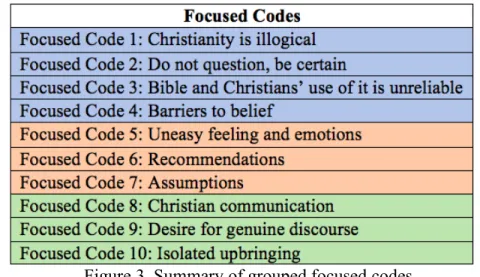
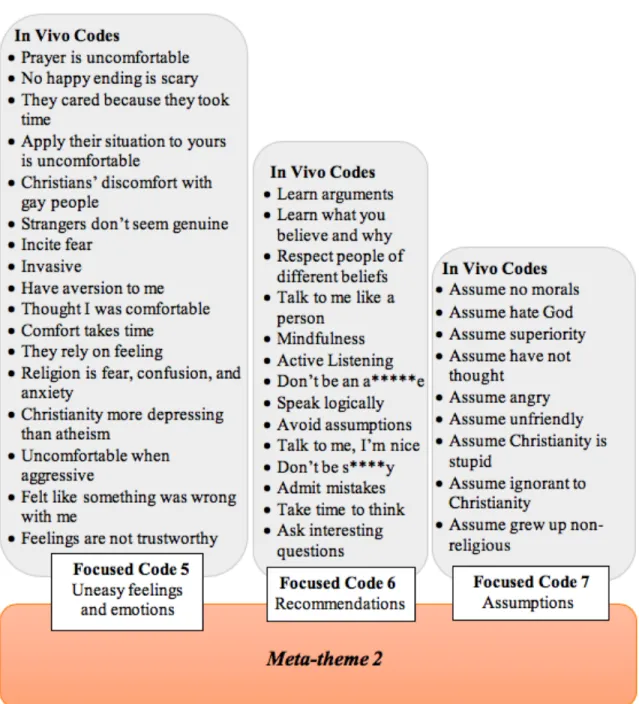
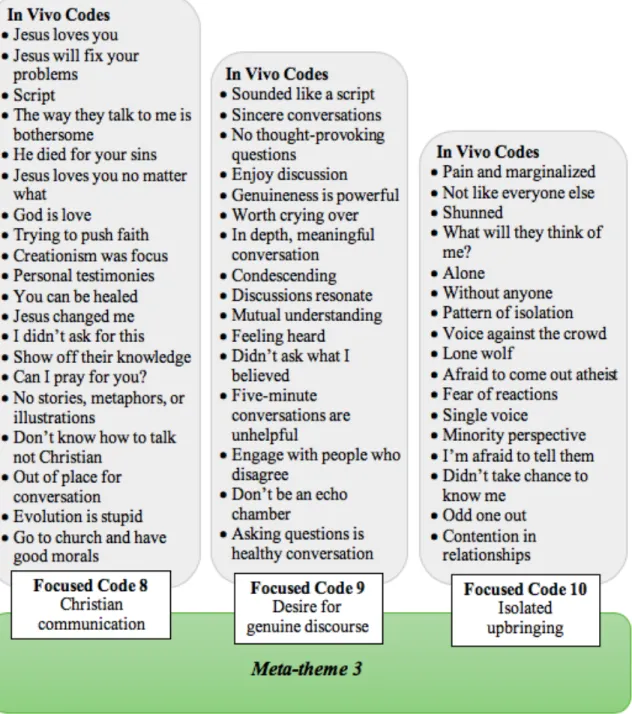
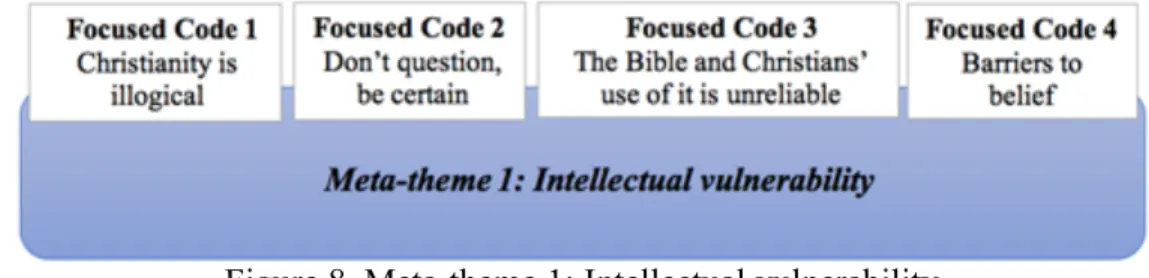
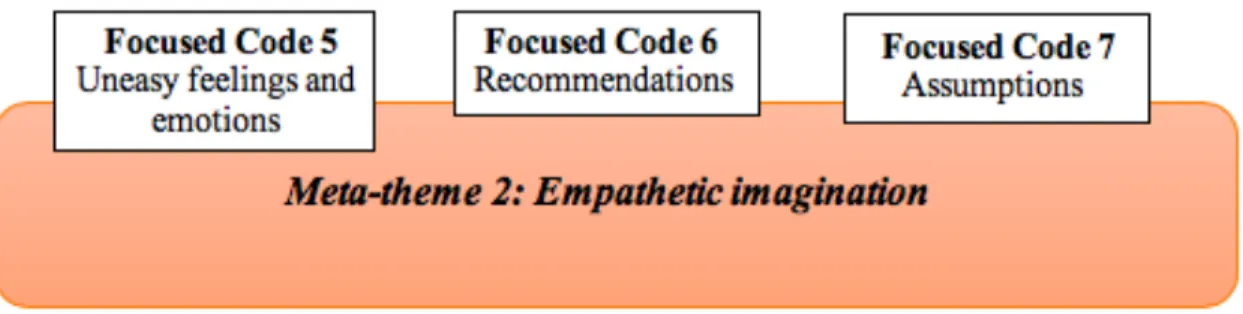
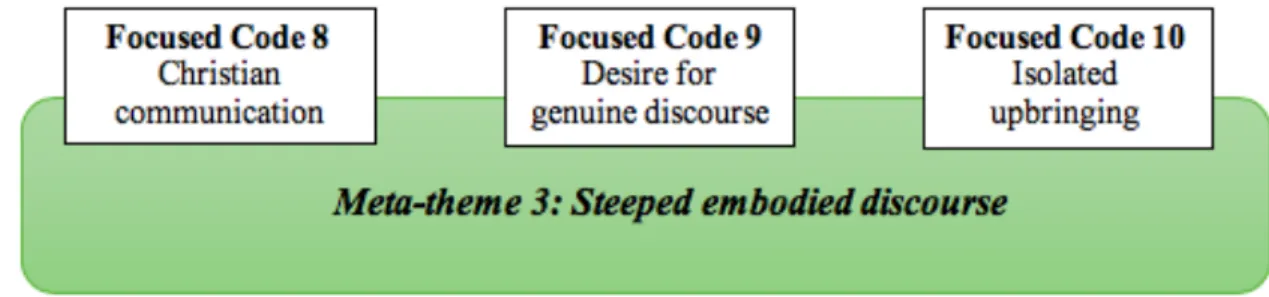
12 The Secular Student Union was chosen because it is "the largest atheist, humanist and non-theistic student organization in the country." According to the SSA, there are a total of 304 secular student unions in the United States, 28 in Texas and 14 on Texas university campuses. Although SSA is the “largest non-theistic student organization” in the United States and suggestions have been made for best practices for contextualizing Christian rhetoric for secular students in Gen Z, it is understood that the data and results do not necessarily apply to all undergraduate students. students in Texas who were born before 1995 and who are. After the In Vivo coding was completed, Focused Coding was used to find the “most frequent or important codes to develop the most important categories” or themes. There were 8 Top 10 Focused Codes (themes).
Oh, it was in God's plan." And I'm like, "Then what's the point of praying if his plan was already going to go to his plan?" Like, if you pray and your prayer doesn't come true, "Oh, it was just, God just decided," you know. I don't think it's the word of God because I don't believe there was a God to breathe it. For example, “The [Christian] scripture gets broken because they think they know what I'm going to say.
16 Walter Jackson Bate, “The Sympathetic Imagination in Eighteenth-Century English Criticism,” The John Hopkins Press University 12, No. Solemn” isn't the right word, but it's like it felt real if that makes sense. from God - the exalted - is "come hither", and the invitation comes to mankind, face to face, in the form of a man - the humble.
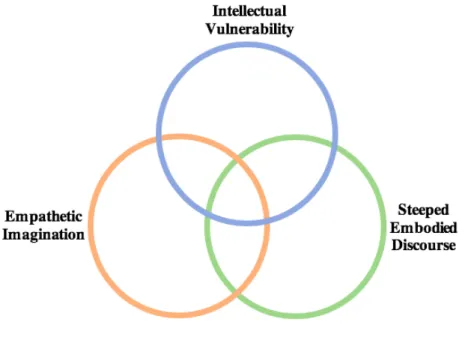
Imbued embodied discourse involves face-to-face, intellectually vulnerable conversations and is unscripted, as participants described.
CONCLUSIONS
Building on the analysis of the findings in Chapter 4, the next section examines the implications of the data for the rhetorical elements stated in the sub-questions of the study. For example, Timothy Keller's Reason for God addresses some of the most common comments and questions from survey participants: There can't be just one true religion. I want to wrestle with tough questions.”8 The survey findings confirmed this sentiment; participants want to engage in a rigorous, logical dialogue with Christians, but they want to do so without fear.
Finally, all participants questioned the ethos of the Bible with comments such as “contradictory” and “inconsistent” being seen. Aristotle called ethos “the most effective means of persuasion that [the rhetorician] possesses,” and Ryan N. According to Holly Ordway, “stories have the advantage of being relational”; The more vividly the story is told, the more likely the audience will "want to 'inhabit' that story and experience" the affections of the characters themselves.13 The study found that Christians have failed to convey the grand narrative or macro story of the Bible.
The study's trinity of intellectual vulnerability, empathic imagination, and deeply embodied discourse are lifestyle liturgies rooted in the study's center of time. When Jesus used metaphors, stories, and language familiar to his audience, he was more than rhetorically accommodating; he showed empathetic imagination.24 He adapted his message to the people he encountered, treated them as unique individuals and "never spoke to two people in the same way."25 For example, Jesus referred metaphorically to the spiritually blind and lost . himself as "the light of the world" and "the good shepherd".26 In addition, in the presence of Pharisees and. Participants often blamed Christians for taking a piecemeal approach to the Bible and consequently did not trust Christians' use or knowledge of the Bible.
It is here that the Christian must learn to embrace what James Sire calls "the intellectual life".31. Vaughan Roberts, God's Big Picture: Tracing the Storyline of the Bible (Downers Grove, IL: IVP, 2002). In each of the mentioned examples, churches and/or organizations must offer a time for exposure and questions. 37.
Such insight will contribute to a better contextualization of the Gospel message for the population of the study and improve Christian rhetorical practice. The results of this proposed study will then be compared with the results of the current study. In a similar way, this study tried to determine whether Christians "tap" the gospel clearly, and the analysis of the results suggests that this does not happen.38 May Christians take the necessary steps to clearly tap the beautiful rhythm of the gospel, so that it will teach, move and delight listeners in such a way that they would see the relationship with the living Jesus Christ, the master rhetorician and the one who compassionately beckons all peoples to the table of his grace.
You and one other member from your university have been selected to participate in the study. Biracial/Multiracial Student Perceptions of Student Academic Support Services at a Predominantly White Public Institution.” PhD diss., University of Toledo, 2012.