All rights reserved. The Southern Baptist Theological Seminary has permission to Sand disseminate this document in any form by any means for purposes chosen by the
Seminary, including, without limitation, preservation or instruction.
DEVELOPING LEADERS: A MODEL OF BIBLICAL SERVANTHOOD AT THE PROGRESSIVE
MISSIONARY BAPTIST CHURCH IN COLUMBIA, MISSOURI
__________________
A Project Presented to the Faculty of
The Southern Baptist Theological Seminary
__________________
In Partial Fulfillment
of the Requirements for the Degree Doctor of Ministry
__________________
by
Roderick Lee Williams May 2018
DEVELOPING LEADERS: A MODEL OF BIBLICAL SERVANTHOOD AT THE PROGRESSIVE
MISSIONARY BAPTIST CHURCH IN COLUMBIA, MISSOURI
Roderick Lee Williams
Read and Approved by:
__________________________________________
T. Vaughn Walker (Faculty Supervisor)
__________________________________________
Shane W. Parker
Date March 7, 2018
I dedicate this project to my parents, Edward Lee Williams and Jacqueline Ann Simpson Williams (deceased), who demonstrated to me at an early age that serving God through
serving others exemplifies the love of God, which entails true greatness.
Page
LIST OF TABLES . . . vii
PREFACE . . . viii
Chapter 1. INTRODUCTION . . . 1
Context . . . 1
Rationale . . . 8
Purpose . . . 9
Goals . . . 10
Research Methodology . . . 11
Definitions . . . 12
Limitations/Delimitations . . . 13
Conclusion . . . 13
2. THE BIBLICAL AND THEOLOGICAL BASIS FOR SERVANT LEADERSHIP . . . 15
The Ultimate Model of a Servant Leader (John 13:1-30) . . . 15
The Heart of Jesus Is Revealed in the Lesson on Foot Washing (John 13:4-11) . . . 20
The Appeal for Loyalty and Unity of the Community (Phil 1: 27-2:1-4) . . . 25
The Willing Servant . . . 32
The Servant Was Faithful Although He Was Despised (Isa 53:1-3; 7-9) . . . 39
Conclusion . . . 43
3. PRINCIPLES FOR SERVANT LEADERSHIP DEVELOPMENT . . . 45
What Is Leadership? . . . 46
Biblical and Historical Leadership . . . 48
Jesus Modeled and Practiced Servant Leadership . . . 51
Developing Healthy Servant Leaders . . . 57
Building a Trusting Environment for Servant Leaders . . . 72
4. FUNDAMENTALS OF THE PROJECT . . . 80
A Chronological Outline of Events . . . 80
The Initial Gathering of the Leadership . . . 81
Evaluation of the Leadership Seminar and Survey . . . 83
An Introduction to the Concept of Servant Leadership . . . 83
An Overview on the Seven-Week Study and a Retreat . . . 84
5. EVALUATION OF THE PROJECT . . . 92
Introduction . . . 92
Evaluation of the Project Goals . . . 96
Evaluation of the Project Process . . . 98
Theological Reflections . . . 99
Personal Reflections . . . 101
Conclusion . . . 105
Appendix 1. SERVANT LEADERSHIP SURVEY . . . 106
2. CURRICULUM EVALUATION RUBRIC . . . 110
3. CURRICULUM OUTLINE . . . 111
4. SEMINAR OUTLINE 1 . . . 112
5. SEMINAR OUTLINE 2 . . . 113
6. SERVANT LEADERSHIP SURVEY RESPONSES . . . 114 7. CURRICULUM EVALUATION RESULTS . . . 118 BIBLIOGRAPHY . . . 124
Table Page
A1. Responses to questions 1-4 . . . 114
A2. Responses to questions 7-21 . . . 114
A3. Responses to questions 22-30 . . . 116
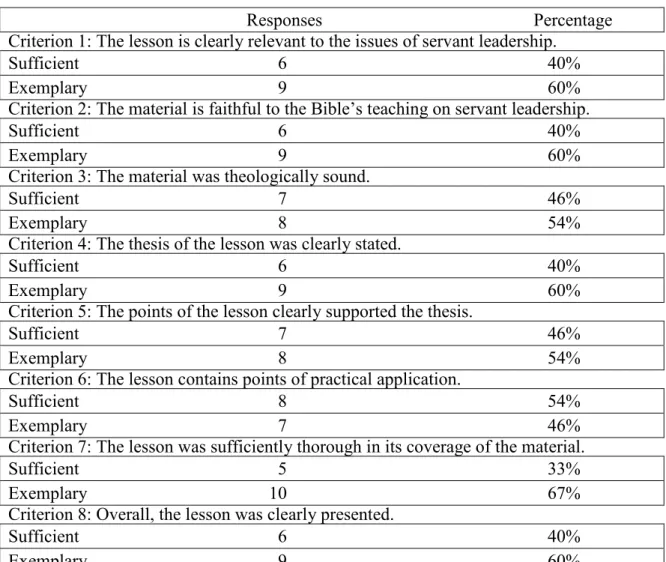
A4. Responses to lesson 1 criteria . . . 118
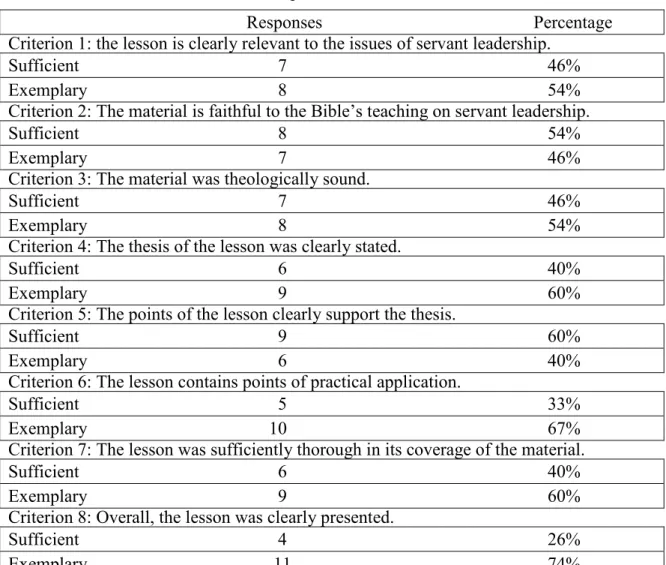
A5. Responses to lesson 2 criteria . . . 119
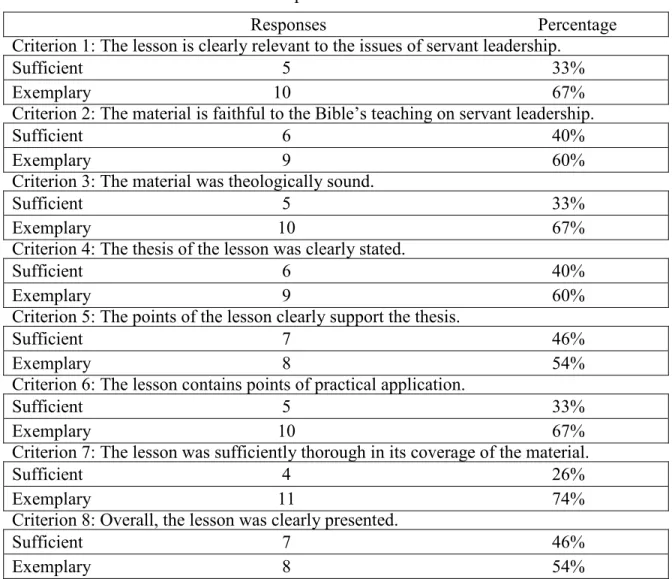
A6. Responses to lesson 3 criteria . . . 120
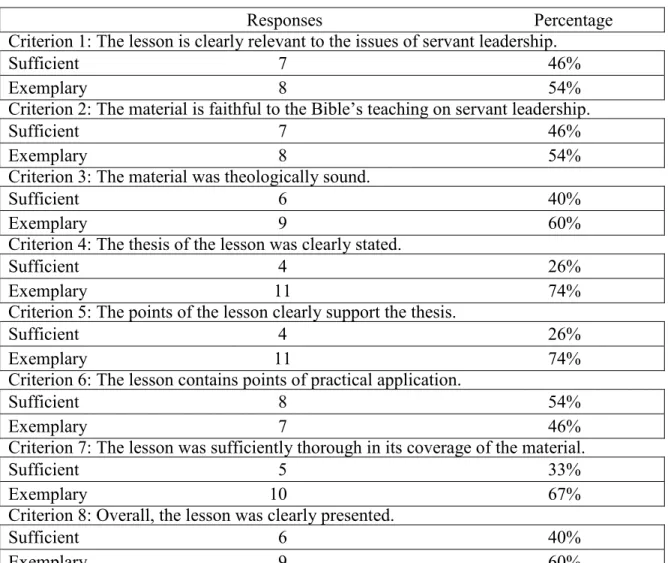
A7. Responses to lesson 4 criteria . . . 121
A8. Responses to lesson 5 criteria . . . 122
A9. Responses to lesson 6 criteria . . . 123
PREFACE
In appreciation to my wife, Denise, for over thirty-five years of love and encouragement I thank you. To T. Vaughn Walker my supervisor and the other faculty of the Southern Baptist Theological Seminary, I appreciate the untold hours of sacrificial dedication spent in preparing students such as myself to continue to stretch and grow academically. Without your guidance and direction, this degree would not be possible. In addition, I would like to acknowledge Shawn T. May for his charitable assistance and friendship. Thank you to my church, Progressive Missionary Baptist Church, for your constant encouragement and patience with me in this undertaking. Your inspiration and support have assisted in my growth and the advancement of the kingdom of God.
Roderick Lee Williams Columbia, Missouri
May 2018
CHAPTER 1 INTRODUCTION
The black church in the twenty-first century needs strong leaders who model biblical servanthood. Servant leaders are essential for transitioning a traditional black church. After reading, all of the shocking stories related to the black church, and leadership in general, it is time to develop a model of biblical leadership, with the objective of growing healthy servant leaders in the church where I currently serve as pastor. Our church community needs servant leaders who will model biblical attributes through connecting to God, connecting to each other, and connecting to serve this present age. The black church indeed needs a different leadership model. The leadership model that Christ offers is a bottom up rather than top down pattern. A ministry project of this magnitude will improve our existing contextual setting and the Christian community at Progressive Missionary Baptist Church. Andy Stanley observes that nothing has stolen more dreams, dashed more hopes, broken up more families, and messed up more people psychologically than our propensity to disregard God’s commandment regarding sexual purity.1 In order for the black church to return to a posture of growth and effectiveness in the black community, a paradigm shift has to take place among its leaders.
Context
Progressive Missionary Baptist Church (PMBC) of Columbia, Missouri originated from Log Providence Missionary Baptist Church located in southern Boone Country in April 1974. On Sunday, April 7, 1974, the Progressive Missionary Baptist
1Elizabeth Khuri Chandler and Otis Chandler, “Christian Morality Quotes,”
Church held its first worship service in the Rising Sun Lodge at 301 Sexton Road. Since its inception in April of 1974, PMBC exists as a community-based church situated in the heart of the city with a heart for the city. The primary purpose for the existence of PMBC centers on fulfilling the “Great Commission,” through connecting people to God,
connecting to each other, and connecting to serve this present age.
The church’s plan involves expanding outreach; developing committed disciples through modeling the example of Jesus Christ. Progressive Missionary Baptist Church intentionally networks and collaborates with other agencies or organization to provide a safe place in the community. PMBC seeks to improve its image within the church community as well as the larger community. PMBC seeks to identify skills, spiritual gifts within the fellowship. PMBC values the Word of God as its standard of faith and living. PMBC believes in the leadership of its under-shepherd as the Holy Spirit directs. Furthermore, PMBC believe in treating people, as Christ would have them
treated. PMBC values inclusiveness and diversity of its congregation. PMBC has a rich heritage of being compassionate, which enables the church to reach out and minister to the needs of the community. This project is crucial because a biblical model of servant leadership has proven to be invaluable in growing a healthy mature church. To put it another way, developing servant leaders produces strong and devoted churches. In addition, the church’s knowledge of servant leadership enhances the unity of the church, which helps to reduce contention and conflicts.
A Caring Community at PMBC
Worship service at PMBC continues as a major force in the church body and endures as central to the life and future of the church. Sunday worship service directly affects every component of the whole, for with each effort of movement there is focus on God, which attempts to connect the worshipper not only with the Lord Jesus Christ, but also with the mission statement of the church. The PMBC mission statement affirms our
evolved from the twentieth century model, which involves a passive role of the congregation and the preacher doing all the talking. Today the worship experience includes a more visualized worship with surround sound, technology, and participatory worship through drama, dance and testimonies. Furthermore, worship has a style that incorporates more emotion, and expression than the traditional machine-like style.
Worship matters because Sunday services are the first interaction “visitors” experience as we celebrate together as a church.
The church values worship because worship demonstrates our love for God.
The objective of worship at PMBC connects the worshipper to God through praise, music, solid biblical teaching, honoring God through songs, preaching and dance.
Likewise, worship is not about a posture, a certain style of music, or whether worshippers stand, clap their hands or not. Jesus instructed the woman at Jacob’s well that true
worshippers worship the father in spirit and truth (John 4:23). True worship includes the inside, and not just going through the outward motions. Moreover, in worship at PMBC each week, members seek to experience the presence of God. As the church moves further into the twenty-first century, worship will become sensory seeking to involve all the senses in celebrating the grace of God; and PMBC will continue to transition in worship to assist the worshippers in experiencing God.
Another positive attribute of PMBC includes reaching out to the community through ministering holistically to the needs in the city of Columbia. PMBC offers a Food Pantry, which offers aid and assistance to Columbia’s most vulnerable the working poor, their families, and the unemployed. The Food Pantry at Progressive is an incredibly solid ministry. The church remains a beacon of light in the midst of a diverse
neighborhood. The church has been faithful to the task of meeting the needs of the “least of these my brethren” (Matt 25:40).
Furthermore, keep in mind that a number of scholars such as Scot McKnight
disciples are Jesus’ brothers (12:50; 28:10; compare also the least – 5:19; 11:11; 18:3-6, 10-14).
Keener declares that the way one treats Jesus is the way that person also treats his representatives.2 Nevertheless; Ronald J. Sider offers an alternative view on verse 40 that the exegesis of the words of Jesus is uncertain. He argues that even if the primary word refers only to Christians, there are other aspects of Jesus’ teaching, which require that we readers extend the meaning of (Matt 25). The story of the Good Samaritan teaches that anyone in need is our neighbor.3 Loving one’s neighbor David Garland confirms, embraces not a slogan or a proverb, but a command. To say I love and not be willing to help a brother in spite of the cost indicates a lack of fulfilling the command to love.4
For followers of Jesus, calling entails serving not just Christian brothers, but also anyone no matter the distance or sacrifice. Progressive participates in meeting both the spiritual and physical needs of those who attend the church as well as the larger community. Furthermore, feeding people with wholesome food has blessed our church with the experience of a’s much greater fulfillment. Food may appear to be the main item; however, a closer look reveals that food represents just a glimpse of a greater need to share life together. Do not be alarmed if after a visit on a Tuesday laughter saturates the room, for it is truly a delightful place.
Every week people tell us what a great ministry the church provides, and how much he or she appreciates what we do, and how he or she is treated. I think that is what this ministry is about relationships, whether it is getting food, or just having someone to
2Craig S. Keener, Matthew, IVP New Testament Commentary, vol. 1 (Downers Grove, IL: IVP, 2011), 361.
3Ronald J. Sider, Rich Christians in an Age of Hunger (Downers Grove, IL:
Inter-Varsity, 1984), 73.
4David E. Garland, Luke, Zondervan Exegetical Commentary, vol. 3 (Grand Rapids: Zondervan 2011), 449.
listen and care. The ministry aims at helping people feel better after coming to our pantry.
The people who serve in this ministry do so because they want to help others. Progressive Soup Kitchen (PSK) fills a vital gap in the nutritional services in the city of Columbia.
Demographic changes in central Columbia have allowed PSK to fulfill a core objective:
to minister to the needs of a culturally diverse population. In addition, one of the key components generated in the soup kitchen success revolves around the rich relationships, which have developed over a meal. Relationships consist of a connection between two people or objects. Relationships at the Progressive Soup Kitchen are more than that. It is a place of comfort and feels like home. It is not an elaborate place; however, it has been home for the homeless for a couple of hours. There is no place like home. The
relationships that surround the Lord’s Kitchen entail not just a meal, but also a warm, close-knit atmosphere for the regulars and volunteers.
The socioeconomic combination is great; people who visit the soup kitchen do not view themselves as outsiders. In an environment of heartfelt care and love, you will find all races, and religious groups eating, and joking as a family. It is evident that the volunteer staff value connecting and building lasting relationships for Christ. Matthew 25:35-36 (KJV): “For I was an hungred, and ye gave me meat: I was thirsty, and ye gave me drink: I was a stranger, and ye took me in: Naked, and ye clothed me: I was sick, and ye visited me: I was in prison, and ye came unto me.” Jesus concludes this section of the parable by saying, inasmuch as you have done it unto one of the least of these my brethren, and you have done it unto me (Matt 25:40). Progressive’s Soup Kitchen integrates sharing faith and meeting social needs. Furthermore, evangelism is more than proclaiming God’s love; it also involves demonstrating God's love through example. God demonstrated his love by his actions (Rom 5:8). Christians illustrate faith in God through
“charity to others.” The one ministry issue that permeated my thinking revolves around the point that compassion is caught and not taught, conversely compassion flows from a
utilizing this model. The one thing gleaned from this event is that one person can make a difference. A smile, hug, and a word of encouragement go a long way in lifting another person’s self-worth. Eating and participating in a conversation with the homeless indubitably illustrates the Love of God. (1 John 4:11-12 KJV) says, “Beloved, if God so loved us, we ought also to love one another. No man hath seen God at any time. If we love one another, God dwelleth in us, and his love is perfected in us.”
In short, the last positive, tangible attribute of PMBC involves networking and collaborating with other ministries and church groups. The people at PMBC truly believe in transforming people’s lives physically and spiritually, breaking the cycle of poverty and dependency in our community. The church has built a multipurpose facility that houses a full basketball court and classrooms with administrative offices. The church looks forward to providing educational opportunities through collaborative efforts throughout the community. Several of the classes in the planning stage are recovery groups for alcohol and drug addiction, budgeting, parenting skills, home buying, and a health and wellness program. In collaboration with the city of Columbia.
Areas of Concern in the Ministry
In over twenty years of pastoral ministry, there is one point that I have learned in serving the Lord and his people there is certainly more to learn. When we stop learning and growing it is time for a transition to take place in the leadership, God is constantly moving his church from mediocre to excellence. Therefore, in assessing PMBC several concerns come to mind. The first concern revolved around the issue of the deficiency in developing spiritually strong disciples. The theological principles of discipleship, which entails reproducing ourselves have been studied and reaffirmed in numerous settings through discipleship classes, training sessions, sermons, and Bible studies.
Our Bible studies are limited because members do not take advantage of the opportunities for growth and deepening their relationship with God. At one time, we
making, where a mature disciple did one-on-one training for six weeks with a new disciple. In fact, the limitation of A Call to Joy Ministry was due to a lack of spiritually mature disciples who could mentor young believers. Moreover, what occurred was two immature disciples attempted to disciple each other; therefore, that ministry received a proper burial. The church has developed a process- mission statement, which moves people through a process of maturity by connecting them to God, through corporate worship and prayer, to connecting them to others through small groups, Sunday school, and fellowship activities. The church’s goal entails moving people through the process in order for disciples to connect with serving this present age through one of the community outreach ministries.
The second concern revolved around the famine in church wide practicing of the spiritual disciplines. God’s desire for the church corporately and individually centered on becoming godly through shaping a person’s character into Christlikeness. Hence, godliness is God’s goal and each believer’s responsibility to train themselves in godliness. Paul offers instructions in (1Tim 4:7) to exercise, train, or discipline
yourselves in godliness. The church has promoted, taught, and modeled throughout the years the value of Spiritual Discipline for Christlikeness. However, the majority of the members has not embraced all of the Spiritual Disciplines. The members certainly have embraced worship, serving, praying and corporate study. Some of the other disciplines like fasting, simplicity, solitude, and meditation, several of the members disregard.
The third concern centered on the lack of commitment to serve in the ministries of the church. PMBC has four paid staff, thus the church relies on volunteer staff, which creates a ministry void at times since several of the members lack
commitment to the church, due to family responsibility and outside interests. Therefore, the church winds up with 20 percent of the members carrying the ministry load.
Therefore, after all these years as a pastor, I find it difficult that the thinking in our
the senior pastor being Superman. The expectation for the pastor centers on visiting the sick and making house calls, teaching, counseling, being upbeat, always with a smile on his face. In our setting, the statement has been heard multiple times a month, “Pastor you are the Chief Executive Officer (CEO) of the church.” “You are the professional, the minister. It is your job to have your hands in every ministry and the congregation enjoys the scintillating ministry of superman.” Therefore, a nauseous feeling comes every time the statement is heard “you are the CEO” which denotes that the church should function similar to a Fortune 500 company. Concisely, PMBC needs to develop servant leaders revolving around biblical leadership principles. Servant leaders consist of those who serve not out of a power top down mentality, but work as a team member to assist in building up others. A servant leader is one who leads by example, by following the model set forth by Jesus, who is the ultimate model.
The objection centers on developing servant leaders through using the spiritual disciplines to strengthen the current leadership. Consequently, developing servant leaders realigned our traditional form of understanding leadership, as juxtaposed against servant leadership. As servant leadership has been a model, a culture of unity, teamwork, and a cooperative spirit has moved to the forefront of the leaderships thinking.
Rationale
The above concerns reveal PMBC’s tremendous opportunity in developing servant leaders, which has moved the church away from the philosophy of the senior pastor being superman and develop a culture of teamwork whereby more has been
accomplish as a team rather than independently. The project attempted to develop healthy leaders who comprehended their role as leaders, the question, which emerged, asked why strong servant leadership, and how the bible illustrates leadership.
The project utilized a thorough written theology of servant leadership from a biblical perspective in the contextual setting at PMBC. The written theology revolved
10:43-44; Luke 22:25-27. The model of servant leadership for the project centered on Jesus Christ, who revealed himself as the ultimate model of a servant.
In addition, this project focus revolved around existing leaders and potential leaders at PMBC. Furthermore, the project has attempted to model biblical servant leadership to the membership of PMBC and the community. Therefore, a spirit of teamwork has emerged through developing trust, loyalty as well as an atmosphere of growth. Thus, this project has endeavored to dismantle the dysfunction of non- biblical leadership, which has hindered PMBC from being an even greater church. In addition to confirming the theological core of servant leadership, the project attempted to build unity and a culture of teamwork through enhancing disciples, committed to serving and
changing the environment where Christ is manifested for the world to see God incarnate through the church. Healthy leaders have the potential for fostering teamwork, unity and greater fellowship. As a result, of teamwork and unity healthy leaders establish a culture, which aid in developing future servant leaders.
Purpose
The purpose of this project was to develop servant leaders at Progressive Missionary Baptist Church with the resolve of building a culture of servanthood for effective teamwork and greater unity. Therefore, a productive relationship has helped in motivating trust, which has helped each team member work toward a common purpose.
What does teamwork look like at PMBC? Teamwork has developed servant leaders, which has facilitated a culture of trust and connection. A culture of teamwork has improved the disciple making process through growing healthy servant leaders.
Goals
This project attempted to accomplish four goals, which were progressive steps, required in the development of servant leaders at PMBC. The first goal aimed at
disciplines. The growth of the leadership team was measured by their desire for a deeper relationship with God, through practicing particular spiritual disciplines for instance fasting, solitude, and meditation on the word of God.
The second goal was to develop a six-week curriculum for training servant leaders utilizing the biblical model of servanthood. This goal helped in transforming the unhealthy idea of the pastor as superman. The Leadership team discovered afresh that kingdom greatness involves serving others. In addition, the leadership team recognized that teamwork is the biblical pattern designed to enhance the work of the church.
The third goal was to increase the spiritual health of the current leaders at PMBC as they grow and develop in their personal spiritual growth. In this project, a Spiritual Inventory helped to shed light on unhealthy attitudes and conduct. The leadership team developed several core values, which aided in cultivating unity and accountability. A culture has been developed to increase the overall health of the leadership team and church.
The fourth goal was to develop a ministry plan to increase personal spiritual growth among the leadership at PMBC. The leadership team developed a ministry plan, which helped in building the kingdom of God through building the people of God. The biblical and theological perspective along with the practical perspective has helped in developing two teams. The purpose of the first team was to focus on community outreach, through maximizing the churches outreach opportunities. The first team
examined the churches niche, by analyzing two questions, one why anyone should attend our church, and why should anyone join PMBC. The second team developed curriculums designed to enriched spiritual growth.
Research Methodology
The emphasis of this project assessed the current leadership and their passion for the spiritual disciplines at Progressive Missionary Baptist Church. The measurement
Joseph Hall method on meditation (BRD and JHMM) to a group of 10 to 15 leaders.5 The goals, success was clearly demonstrated by a deeper passion for exercising spiritual disciplines.
The emphasis of this second goal concentrated on developing a six-week curriculum for training servant leaders utilizing biblical models of servanthood. The execution of this goal utilizing a survey to determine the areas of spiritual growth for existing leaders and any adjustment needed to develop spiritually.
Accordingly, the success of this goal moved the current leadership to put into practice biblical character traits. The training offered afforded the leadership team an opportunity to evaluate the training at the end of the presentation. The outcomes of the evaluations were break down to determine any changers resulting from this project.
The emphasis of the third goal focused on increasing the spiritual health of the current leadership at PMBC. The third goal employed a personal spiritual health
assessment to determine if spiritual growth had occurred among the leaders. The results of this assessment clearly revealed that the leadership team recognized their unhealthy behavior and took responsibility for their actions. The results of the assessment motivated the leadership team in developing seven core values to govern the decision-making process. The leadership team has created a culture of accountability, which improved the overall health of the leadership as well as the church. Although there is no statistical data from the assessment to measure the success of this goal, the results from the pre-survey questionnaire and the post-survey questionnaire indicate that an atmosphere of
partnership signaled clear growth in Christ-likeness.
The emphasis of the fourth goal centered on developing a ministry plan to increase and model spiritual leadership to the members at PMBC. The leadership team’s
5All of the research instruments used in this project were performed in compliance with and approved by the Southern Baptist Theological Seminary Research
commitment to building the kingdom of God through building the people of God has focused on developing a culture of training to enhance spiritual leadership, and spiritual development and growth. The ministry plan has a curriculum designed to move each student through a process to maximize spiritual growth. The process consists of four phases with the final phases designed to help the student demonstrated an understanding of servant leadership.
Definitions
The terms described offer clarification to their meaning as used in this project.
Leadership. Leadership is influence, the ability of one person influencing others to follow his or her lead. Leadership entails a course of motivation. Anytime you seek to motivate the thinking, behavior, or development of people toward accomplishing a goal in their personal or professional lives, you are taking on the role of a leader.6
Spiritual leadership.Spiritual leadership is a leader who influences others spiritually by the empowering of the Holy Spirit to deeper Christ-likeness. Spiritual leadership requires superior spiritual power, generated by the Holy Spirit. There is no such thing as a self- made spiritual leader. A true leader influences other spiritually only because the Spirit works in and through him to a greater degree than in those, he leads.
We can lead others only as far along the road as we ourselves have traveled.7 Servant leader. A servant leader is a servant first and leading flow from
servanthood.8 The servant leader is servant first. It begins with the natural feeling that one
6J. Oswald Sanders, Spiritual Leadership: Commitment to Spiritual Growth (Chicago: Moody, 1980), 27.
7Ken Blanchard and Phil Hodges, Lead Like Jesus: Lessons from the Greatest Leadership Role Model of All Time (Nashville: W Publishing Group, 2005), 5.
8Sanders, Spiritual Leadership, 27, 28. Spiritual leadership induces followers to reach goals, which benefit both the follower and leader.
wants to serve first. Then conscious choice brings one to aspire to lead.9
Limitations/Delimitations
Two limitations were required in retaining the project integrity. The first limitation was contingent upon the accuracy and reliability of participants in responding to the survey regarding their spiritual maturity with liberty and anonymity. Leader were not required to identify themselves, neither have any answers been publicly disclosed.
Only one person had the privilege of examining the personal results. The second limitation focused on the availability of the leaders in completing the six-week training session. Due to other commitments and family responsibilities, if a third of the leadership completed all of the training that would have been beneficial to the church.
There were two delimitations assigned to this project. The first delimitation which affecting the research was because of the nonexistence of one-on-one interviewing of the participants. The second delimitation revolved around the exclusion of layperson from participating in the research.
Conclusion
Progressive Missionary Baptist Church from its genesis has been a transformational church. Change exists at the core of the church’s identity since the church is going through the process of becoming what God has designed it to be. The name itself advocates or implies reform or newness. To be progressive signals a process of moving or change. The project attempted to empower PMBC to elevate its care and reach to people with God’s love and grace. Progressive stands as a church in touch with the community. Having put in motion a culture for change and not knowing what the future holds, nevertheless knowing who holds the future. The church with unwavering dedication continues to endeavor to change lives through God’s Holy Word! The church
remains aware and responsive to the needs of the community. In addition, the church continues to stand as a church where evangelism and discipleship are seriously the concern of the leaders and each member. The church has attempted to be a church, which develops servant leaders who will model biblical attributes for the present day and future generations.
As a body of believers in Jesus Christ, PMBC continues to love, teach, nurture and serve the church, community and world in the development of faith for the
fulfillment of the kingdom. With and through God the kingdom has been expanding.
Through connecting to God, connecting to others, and connecting to serve this present age.
CHAPTER 2
THE BIBLICAL AND THEOLOGICAL BASIS FOR SERVANT LEADERSHIP
Chapter 1 offered the background for this project and described the need at Progressive Missionary Baptist Church to focus on the development of servant leaders.
Chapter 2 will utilize three primary, as well as secondary, passages from both testaments revealing the ultimate model of a servant leader (Isa 40-55; John 13; Phil 2:1-11).
Additionally, I will identify Jesus as the servant leader through his actions and attitude as revealed in washing the disciple’s feet.
The Ultimate Model of a Servant Leader (John 13:1-30)
John 13:1-30 offers John’s perspective on how Jesus exemplified the essence of a servant. Jesus demonstrated the actions as well as the attitude of a menial servant when he washes the disciple’s feet. Permit me to disclose to the readers that this author does not view foot washing as an ordinance for the church today. However, what Jesus modeled on the night before going to the cross has practical implications for anyone who desires to live and serve like Jesus. Moreover, the setting is in the upper room as a part of Jesus’ farewell discourse, which inaugurates in chapter thirteen and concludes in chapter seventeen. The actions of Jesus in the upper room after supper are significant actions, pointing to the cross, which models the action of a genuine servant.
Jesus’ Knowledge of His “Hour”
(John 13:1-3)
Foot washing anticipates the cross and represents the death of Jesus, which demonstrates an act of love.Love was the focus of Jesus; this is what Ernst Haenchen,
Passover meal. The knowing helps the reader to reflect upon what Jesus knew and what the reader must know: the decisive (ὥρα) hour, the hour of his death.1 Jesus acted with love Frederick Louis Godet, confirms, that Jesus’ knowledge was with perfect
consciousness of his impending departure that Jesus acted with love. He saw the (ὥρα) hour of separation approaching and demonstrated tenderness toward those whom he loved.2 J.H. Bernard, notes that the incidents which occurred in the upper room was on the eve of the Passover. With special attention in this narrative given (vv. 3, 11, 18) to the perfect insight and foresight, which, Jesus exhibited at the time and the circumstances of the Passion (18-19) he knew that his (ὥρα) hour had come.3 Jesus was not surprised by any of the events which transpired Leon Morrie, comments that the time or hour, did not take Jesus by surprise. He knew that this was the hour and he acted accordingly.4
The “Hour” has been linked with the Passover season. Craig Keener remarks that Jesus’ closing hours before his arrest in John’s Gospel occur “before” Passover (13:1). The Passover account suits John’s chronology (13:29; 18:28; 19:14, 31, 42), therefore John’s narrative supports the portrayal of Jesus as the paschal lamb (1:29, 36;
19:36).5
Hence, Jesus’ actions identify him as the Suffering Servant who loved his own to the end. Although Jesus knew that, the hour was a time of suffering and separation
1Ernst Haenchen, A Commentary on the Gospel of John: Chapters 7-21, Hermeneia (Philadelphia: Fortress, 1984), 105.
2Frederick L. Godet, Commentary on The Gospel of John, vol. 2, 3rd ed. (1893, repr., Grand Rapids: Zondervan, 1969), 243.
3J. H. Bernard, A Critical and Exegetical Commentary on the Gospel
according to St. John, The International Critical Commentary, vol. 2 (New York: Charles Scribner’s Sons, 1929), 454.
4Leon Morris, The Gospel according to John, The New International Commentary on the New Testament, rev. ed. (Grand Rapids: Eerdmans, 1995), 545.
5Craig S. Keener, The Gospel of John: A Commentary, vol.2 (Peabody, MA:
Hendrickson 2003), 899.
from God the Father, nevertheless, Jesus acted in love to model the essence of a servant.
Love was the motivating reason Peter Ellis, contends, that the foreknowledge of the events included Judas’ betrayal, which leads to Jesus’ passion and death. With Jesus knowing what Judas was about to do, Jesus’ act of foot washing demonstrated how much he loved his disciples.6 The knowledge of Jesus’ hour included understanding the plans of the devil. Ellis, also points out that Jesus’ knowledge about Judas’ betrayal points to the approaching death of Jesus. Therefore, Jesus acted the way he acted because he knew he had come from God and was going to God, again pointing to his death.7 Urban von Wahlde notes that the phrase “having put it in the heart” has created some dispute about whose heart John referred to, “the devil or Judas.” This ambiguity exists because of the lack of a possessive after καρδία (heart).8 The question raised by Godet into whose heart? If you say the devil’s heart, as Meyer and Reuss suggest, this is not acceptable since nowhere in Scripture is the devil’s heart spoken of.9 Morris notes, however, that the best text reads, “The devil had already made up his mind that Judas would betray Jesus.” The “his” in the text clearly points to Judas and not the devil’s heart.
Morris maintains that if it were the devil’s heart this point would stand in contradiction with verse 27. It is here that John is discussing the devil’s thoughts.10
J. H. Bernard highlights the idea ὁ διάβολος ἤδη βεβληκότος, “the devil having already put into the heart of Judas, to betray him.” The synoptic gospels undoubtedly disclose the bargain made by and with the religious leaders before that night (Mk. 14:10,
6Peter F. Ellis, The Genius of John: A Composition-Critical Commentary on the Fourth Gospel (Collegeville, MN: Liturgical Press, 1984), 212.
7Ibid.
8Urban C. von Wahlde, The Gospel and Letters of John, Eerdmans Critical Commentary, vol. 2 (Grand Rapids: Eerdmans, 2010), 577.
9Godet, Commentary on the Gospel of John, 245.
Mt. 26:14, Lk 22:3). Hence, what John does simply points to the treachery of Judas, instigated by the devil; John repeats this in verse 27, when Judas decides on the final and fatal step.11
D. A. Carson focuses on Judas’ heart, incited by Satan; as a result, Judas wills what Satan wills. The plot against Jesus, Satan encouraged it and Judas carried it out. In addition, the devil and Judas coexist now as coconspirators of this evil deed, which resulted in the death on the cross (vv. 18, 19, 21-30; Ch. 18).12 Judas chosen as one of the twelve Philip Wesley Comfort affirms that Judas had already been in a league with the devil. Even though Jesus declared that, he had chosen the twelve and one was in league with the devil: namely, Judas Iscariot the son of Simon.13 To put it succinctly, clearly Satan initiated the plot and Judas willingly carries out the wicked deed, which did not surprise Jesus because of his foreknowledge. Although Satan instigated the plot to turn Jesus over to the religious leaders, Judas’ actions reveal the true nature of his heart. The question that reminds is why Judas would betray Jesus after spending so such time with him. The gospels of (John 12:6) indicates greed lead Judas to betrayal, since he was stealing money from the bag. The things people will do for money, people will murder sell their bodies and betray a friend. The knowledge that Jesus had about Judas and the other disciples revealed the depth of God’s love for his creation.
Thomas Schreiner continues by pointing out that the inference of Jesus’ death also conveys the terms “hour and glorify.” The hour is the implementation of redemptive history found in Jesus Christ (John 4:21, 23; 5:25, 28). God’s plan for history, however, turns upon the death of Jesus. Hence, the hour in John often represents the time of his
11Bernard, The Gospel according to St. John, 455-56.
12D. A. Carson, The Gospel according to John (Grand Rapids: Eerdmans, 1991), 462.
13Philip Wesley Comfort, I Am the Way: A Spiritual Journey through the Gospel of John (Grand Rapids: Baker 1994), 11.
death. The death of Jesus confirms the time when he would depart from the world to the Father (John 13:1). As Jesus’ arrest drew near he acknowledged that the hour had come (17:1), which describes the acclaim of the son John does not reconcile Jesus’ humiliation, but rather his glorification (John 13:31-32; 14:4-5), for his modesty denotes his undying love for his disciples (John 13:1). That which appears disgraceful to human eyes is beautiful to the eyes of God, for the humiliation of Jesus displayed the love and character of God.14
Jesus knows he came from God and would return to Him (John 13:3) reveals knowledge of origin and destiny. Frederick Godet highlights Jesus knowing divulges the consciousness of his preeminence which compels him to act upon that which he will accomplish. Because of this consciousness, Jesus understood that he would model real greatness by humbling himself as a menial servant; for real greatness as he will
demonstrate consists in voluntary humiliation.15 The world’s standard of greatness does not include humility. However, the world identifies success and greatness by money and fame. Jesus, on the other hand, revealed to his disciples (and all believers) that real greatness revolves around serving others.
The insight that Morris provides accurately points to the sovereignty and the preexistence of Jesus. John conveys Jesus’ authority and command of the situation. For his knowing centers on not what Judas would do, rather on the father putting all things under his power. Hence, the father exists not as a spectator at the Passion; instead, the fathers will took place. The events, which, will transpire, signify a return to God.16 Peter Ellis remarks that Jesus acted this way because he knew “he had come from God and was
14Thomas R. Schreiner, New Testament Theology: Magnifying God in Christ (Grand Rapids: Baker, 2008), 284.
15Godet, Commentary on the Gospel of John, 246.
16Morris, The Gospel according to John, 546.
going to God,” which points to his death and preexistence.17 Urban C. Von Wahlde also notes well, the description of Jesus as εἴδω… ὅτι ἀπό θεός ἐξέρχομαι καί πρός ὁ θεός ὑπάγω. The translation “knowing… that he had come out, from God, and that he was going to God. Here the knowledge involves recognition of a previous state of existence, which means that he will return to where he was before. This clearly speaks of the
preexistence of Jesus, which is one of the major theological themes in John’ gospel.18 The preexistent Son of God enters the world he created to implement and complete
redemption, which was inaugurated in Genesis 3, after the fall of Adam and Eve. Jesus’
hour included a life of suffering for others, and betrayal by one that he loved. Therefore, his knowledge and actions demonstrate a person who is a servant at heart. On the other hand, Judas’ heart exposes the actions of a person who is acquainted with Jesus; however, he does not have a genuine relationship with Jesus.
The Heart of Jesus Is Revealed in the Lesson on Foot Washing (John 13:4-11)
In this section, Jesus takes some time to teach his disciples’ a lesson on servanthood that still rings true today. Furthermore, Jesus exposes his heart and his mission. Jesus demonstrates to his disciples that he did not “come to be served, but to serve, and give his life as a ransom for many” (Mark 10:45). In addition, in establishing himself as the servant of men, he provides a vivid portrait of the kind of heart we should have for others. Moreover, in the process the disciples (as well as all Christians) hearts are revealed. The Lord of Lords teaches on how to become a servant. Urban C. Von Wahlde quotes Culpepper and Koester by pointing out that the two verbs lay down and take up symbolizing Jesus laying down his life and taking up his life (John 10:11; 15, 17,
17Ellis, The Genius of John, 213.
18Von Wahlde, The Gospel and Letters of John, 584.
18).19 Washing the disciples’ feet truly revealed the heart of Jesus as Ernst Haenchen skillfully underscores a pungent question on how Jesus the teacher and Lord could wash the feet of the student.20
The cross reveals the immeasurable love that Haenchen insightfully stresses when he declares that Jesus’ actions centered on condescending love, which reaches an apex in the cross.21 Although the disciples’ stood confused and did not understand the significance of what Jesus was doing. Jesus performs foot washing on all of the disciples, Peter as well as the one who would betray him because of his love for them. Therefore, Jesus teachers the disciples (and all believers) a valuable lesson in servanthood that entails loving people who are undesiring of love.
The implication of Christ’s actions reveals that he undeniably is the prophesied suffering servant in (Isa 53). J. H. Bernard emphasizes the object lesson where Jesus rises from his place at the table and make known the lesson on greatest to his disciples.
Whether is greater, he that sitteth at meat, or he that serveth? Is not he that serveth (Luke 22:27) But I am in the midst of you as he that serveth (Mark 10:45).22 Leon Morris comments that “wash” in the Johannine text has a double meaning. In the context, it refers to washing of the feet. Washing of the feet is necessary for one to be free from sin.
Apart from foot washing no one can be Christ’s disciple.23 Thus foot washing in the Johannine context is designed to reveal the nature, as well as the heart of Jesus. D. A.
Carson responded conceptually, having a part with Jesus brought to light in the fourth gospel in (14:1-3 and 17:24). Whether you examine Peter’s statement literally or
19Von Wahlde, The Gospel and Letters of John, 578.
20Haenchen, A Commentary on the Gospel of John: Chapters 7-21, 107-8.
21Ibid., 108.
22Bernard, The Gospel according to St. John, 459.
eschatologically, Peter understood that he wanted a connection with Jesus. To have a part with another, or to be his partner, is to share in his work and ultimately in his reward.24 Hence Peter’s response “Lord, wash not my feet only, but also my hands and my head”
(John 13:9). Even though Peter consents to the actions of Jesus, Leon Morris highlights, the point that Peter’s answer is a product of self-will. Once again, Peter is attempting to keep Jesus from doing what he wants.25 Ellis has ably pointed out that Peter’s
misunderstood that more washing would increase his lot with Jesus. What Jesus said in response confirms that foot washing was essential because it symbolized Jesus’ death and the cleansing of sin.26
The word “wash” is a customary theological symbol of spiritual cleansing (Ps 51:2, 7; Isa 4:4; Ezek 36:25; Jer 33:8; Zech 13:1; Acts 22: 16; 1 Cor 6:11; Eph 5:26;
Titus 3:5; Heb 10:22). Moreover, when we place our faith in Jesus and confess our sins, cleaning takes place. After washing all of the disciples’ feet, including Judas Iscariot, Simon’s son, the betrayer. Jesus put on the outer garments, sat down again, and said, γινώσκω τίς ποιέω σύ (do you know what I have done to you). “You call me teacher and Lord.”
Teacher and Lord characterize titles of respect that placed Jesus on another plane above that of the disciples. Jesus underlined the fact if he, whom they regarded as their leader, had stooped to serve their needs, they should do the same for one another.
Jesus as teacher and Lord implied he was on a different plane than the disciples;
nevertheless, he assumed a position of humility and service because he loved the people he served. Therefore, Jesus endeavored to teach the disciples and all Christians that we
24Carson, The Gospel according to John, 464.
25Morris, The Gospel according to John, 549.
26Ellis, The Genius of John, 214.
are never too big or too small “to serve or be served”. Jesus is a model worthy of following.
Jesus Is a Model Worthy of Following:
The Example of the Savior (John 13:12-17)
The example Jesus set regarding serving others he encourage his disciples to do likewise. Peter Ellis comments that foot washing is an example for the apostles. The example, set be Jesus calls on the disciples and all Christians to love each other unto the
“end” just as Jesus did. As Jesus says… “You also should do as I have done to you.”27 Foot washing, Ernst Haenchen highlights that Jesus has given the disciples an example, which they should follow. The disciples should “wash each other’s feet,” that is, they should not exalt themselves above one another.28 The moral principle behind the act of washing feet focuses on humility. Therefore, Godet famously remarks, that Jesus shows than that, in this Kingdom, the means of mounting higher revolves around descending, and the way to the first-place centers on positioning a person without hesitation in the last place. To humble oneself in order to serve and to serve in order to save: such is the moral essence of this act, its permanent element.29
Leon Morris continues, by pointing out how clear Jesus’s actions set an example for the disciples to follow.30 Furthermore, Jesus reminds his followers of their status as “slaves” and “men sent”, “servant” and “messenger.” The point Morris
articulates so brilliantly centered on the actions of their master who perform menial tasks,
27Ellis, The Genius of John, 214.
28Haenchen, A Commentary on the Gospel of John: Chapters 7-21, 109.
29Godet, Commentary on the Gospel of John, 251.
30Morris, The Gospel according to John, 551.
therefore, as the slaves and sent ones, menial tasks should not be beneath a disciple.31 Nevertheless, it is one thing to know and another to act on that knowledge. Jesus’ actions remind the disciples of the importance of acting on what they known.32 Therefore, a blessing as J. H. Bernard, describes that if the disciples know these things, if they completely understand what Jesus was talking about, they would receive a blessing, if they do them.33
Submitting to each other. As Philip Comfort indicated, Jesus’ caution to act as he did was a reinforcement for the disciples to submit to one another. It was their position to be submissive to one another, even as Jesus had submitted to his Father and was the absolute embodiment of servitude.34 Foot washing was a model, a pattern to follow in servanthood. The reluctance of the disciples to volunteer for such a mission simply reveals a sense of embarrassment because to wash feet signified a cultural taboo because only slaves washed feet. Jesus shattered the cultural norms by reversing the slave, master roles. Jesus’ actions plainly clarify his knowledge about his hour. His actions pointed to his death on the cross, which models the actions of a genuine servant. Furthermore, by modeling the actions of a servant, Jesus revealed the heart of God by loving his own until the end. In addition, by revealing his heart, Jesus demonstrated that he did not come “to be served, but to serve.” In serving others, Jesus delivered the example all believers should follow. As teacher and Lord, Jesus did not just offer his students a number of theocratic lessons on servanthood; instead, Jesus provided practical trainings for all to follow. In short, emulating Jesus requires that we set aside our self-will and pride and humble ourselves as Jesus did because we are never too small or big to serve.
31Morris, The Gospel according to John, 552.
32Ibid.
33Bernard, The Gospel according to St. John, 467.
34Comfort, I Am the Way, 116.
The Appeal for Loyalty and Unity of the Community (Phil 1: 27-2:1-4)
A house or church divided against itself cannot stand (Matt 12:25). Therefore, unity, and not a spirit of divisiveness, empower the church to do more than survive. In this particular section of Scripture, the Apostle Paul presents a warning for the
Philippians (as well as all Christians) to conduct themselves worthy of the gospel of Christ. In addition, unity in the community demonstrates that believers are not to be self- seeking with a lifestyle or behavior, which does not model the gospel of Christ. Paul outlines the tremendous privilege of modeling the gospel, even in the face of affliction and suffering. When Christians live out the gospel, we stand in Christ as worthy soldiers and discipline athletes trained to fight and defeat all opponents, those on the inside as well as those on the outside.
A clear sign of loyalty in the face of suffering William Hendriksen declares that this exhortation to steadfastness, unity, and fearlessness transpires in keeping with Paul’s optimistic character as a prisoner; therefore, Paul exhorts the Philippians to remain steadfast, united, and unafraid, because suffering for Christ counts as a privilege to the follower of Christ. Nevertheless, continue to exercise your citizenship in a manner worthy of the gospel of Christ.35 Ralph P. Martin, confirms, that this section, verses 27- 30 gives birth to metaphors rich in military terms. For instance, stand firm (as resolute as soldiers set at their post; striving which carries the association of a military contest, either in battle or in the arena where the gladiators struggled with a life and death contest). The call here is to stand firm in one spirit, with one mind, striving side by side and not frightened as opponents.36
35William Hendriksen, Exposition of Philippians, New Testament Commentary (Grand Rapids: Baker, 1962), 80.
36Ralph P. Martin, Philippians, New Century Bible (London: Oliphant’s 1976), 82-83.
Holding one’s ground declares Kenneth S. Wuest, insists that stand firm means to hold one’s ground in the face of enemy oppositions, with one spirit and one mind, striving together as in an athletic contest. Furthermore, in this athletic contest disciples co-operate as a group or team against another team. Paul here exhorts the church to work together in perfect coordination. Therefore do not live in fear of the adversaries because you have clear proof of your deliverance and their destruction.37 Gordon D. Fee reasons with regards to three overlapping themes of hope pertain to “their affairs”: that by standing firm in the one spirit, they are contending together as one person for the faith of the gospel; and that in so doing they are not themselves intimidated in any way by the opposition responsible for their present suffering.38
Charles B. Cousar, verifies that there are two metaphors: “Stand firm”
(stekete), a military figure that depicts soldiers standing in order and not breaking ranks.
“Striving hard” (synathlountes), an athletic figure, which symbolizes a more forceful or determined stance. Furthermore, this description highlights the shared nature of the struggle in which the Philippians find themselves39 Merida and Chan point out that the metaphor “stand” is a military term, which indicates the determination of a soldier to stand their ground. Likewise, as an athletic team working together and striving or laboring side by side in the strength of the Lord, which confirms union with Christ.40 Standing firm against opposition requires having the right attitude that is walking or living by the power of the one spirit and one mind, fearlessly serving the Lord. Kenneth
37Kenneth S. Wuest, Philippians, Word Studies in the Greek New Testament, vol. 5 (Grand Rapids: Wm. B. Eerdmans, 1942), 51-52.
38Gordon D. Fee, Paul’s Letter to the Philippians, The New International Commentary on the New Testament (Grand Rapids: William B. Eerdmans 1995), 163.
39Charles B. Cousar, Philippians and Philemon: A Commentary (Louisville:
Westminster John Knox, 2009), 45.
40Tony Merida and Francis Chan, Exalting Jesus in Philippians, Christ- Centered Exposition (Nashville: Holman, 2016), 77-79.
Grayston, affirms that the key phrase in chapter 2 and verses 1 through 4 centered on the word humble. Moreover, humility is the subservient attitude reflected in the work of Christ.41 Fred Craddock comments that Paul says what he has to say in four phases, being of the same mind, having common attitudes, have the same love, and one mind. The key here is having the mindset of a servant.42 William Hendriksen, points out that the fourfold incentive of encouragement, love, fellowship and tender mercy are a stirring appeal which points to the ultimate cross-bearer Jesus Christ. Furthermore, Hendriksen outlined a threefold directive of oneness, lowliness, and helpfulness reveals the fundamental attitude of Christ.43
The bottom line of Philippians 1:27-30; 2:1-4 revolves around the Philippian Christians and all Christians exhorted as models of the gospel through unity, and
meekness, which confirms the privilege since we know the outcome. The disapproval and suffering for Christ sake offers proof of the new birth that reveals participation in Christ’s victory. Therefore, such knowledge should spur believers on to live worthy of the gospel.
Furthermore, unity cannot occur without humility coupled with the mindset of Christ.
Therefore, Jesus’ mindset entails serving others through humble love. The next portion of this section will highlight this attitude.
A Christ Centered Mind Set (Phil 2:5-8)
In society power, possessions, prestige, and position are signs of greatness. In fact, everyone desires recognition and positions. In this world, the prevailing mindset centers on “If I cannot be first, then no one else will be.” Additionally, our tendency to
41Kenneth Grayston, The Letters of Paul to the Philippians and to the Thessalonians, Cambridge Bible Commentary, vol. 10 (New York: Cambridge University Press 1967), 26.
42Fred B. Craddock, Philippians (Atlanta: John Knox, 1985), 36.
43Hendriksen, Exposition of Philippians, 97-98.
thirst involves being first not last. As Martin Luther King, Jr. said, deep down within all of us is an instinct. It is a kind of drum major instinct—a desire to be out front, a desire to lead the parade, a desire to be first.44 Furthermore, Jesus taught that in His kingdom self- abandonment and not self-will are the indicators of genuine greatness. The Lord said the last shall be first and the first shall be last (Matt 20:16; Mark 9:35). The Lord taught that the people we should esteem and imitate humble themselves and serve others. The apostle Paul illustrates this humble service by pointing to the attitude of Jesus Christ.
The disciples calling entails as states Hendriksen in imitating Christ, there exist certain actions a follower cannot pursue. For instance, we cannot copy Jesus’ act of redemption nor his vicarious death. Conversely, our call entails following his spirit which requires that we have an attitude of self-abasement, with the view of helping others.45 Kenneth S. Wuest reasons that the mind of Christ consist of a spirit of meekness and self- denial and an interest in the well-being of another. Hence, the lack of unity among the Philippians believer’s entails perhaps one of the greatest Christological texts in the New Testament scholars has labeled this passage as the kenosis passage. The self-emptying of the Son of God.46 Tony Merida and Francis Chan, indicate that Paul magnifies the humility of Jesus and encourages disciples to emulate his example. The example that we should follow involves the frame of mind or attitudes of Jesus.47 Jesus lived as our example of having the right attitude. Whenever we are angry with fellow believers, upset with the church, or incensed with others, we need to look to Christ as our example of the kind of attitude we need to cultivate. Jesus possessed an attitude of inconvenience. Verses
44Clayborne Carson, “Martin Luther King, Jr., and the Global Freedom
Struggle,” March 3, 2017, accessed March 8, 2017, http://kingencyclopedia.stanford.edu/
encyclopedia/documentsentry/doc_the_drum_major_instinct/.
45Hendriksen, Exposition of Philippians, 103.
46Wuest, Philippians, 60-61.
47Merida and Chan, Exalting Jesus in Philippians, 91.
six and seven affirms that Jesus was in the form of God, although he did not count
equality with God a thing grasped, but emptied himself, by taking upon him the form of a servant ESV. Jesus as Lord was completely God and completely man. Therefore, he existed in God’s form (morphe) μορφή, the essential nature of a person or thing. Besides the form of God, he existed in the fashion of a man (schema) σχῆμα, the external
appearance of a servant. Therefore, the greatness of the Lord’s sacrifice points to the fact that He was God (2 Cor 8:9; John 1:1).48
Kenneth S. Wuest, points out that the Greek word for form refers to the outward expression, which a person gives to his inmost nature. Wuest illustrates this point brilliantly by using the analogy of a winning tennis player whose form was excellent. To put it succinctly, his outward expression gave way to his inward ability to play tennis with excellence.49 Merida and Chan, explain that Jesus was in the form of God. Morphe, the (form) speaks of the essential attributes and very nature or essence of God.50 Kenneth S. Wuest, claims that instead of Jesus asserting his rights, he willingly relinquished his rights and became a servant. Jesus exemplified this willingness of surrendering his rights in serving the disciples (John 13:1-17). Although he did the work of an oriented slave and remain master, by serving as a bond slave he did not relinquish his deity. As a result, someday, the entire universe will agree with God the Father and publicly declare him Lord of Lord’s and King of Kings.51 Merida and Chan, indicated that the Messiah did not please himself, therefore, Paul was encouraging the Philippians, (as well as all Christians) to follow Jesus’ example of service in our relationships with one another. Likewise, he could have held on to his rights, his blessing, and his benefits
48Hendriksen, Exposition of Philippians, 103-4.
49Wuest, Philippians, 62-63.
50Merida and Chan, Exalting Jesus in Philippians, 94.
as King of Glory. Instead, he emptied himself in humble love through servicing others.
Jesus did not renounce his deity; he forfeited his rights and privilege as God.52 Jesus exists as a servant and Lord at the same time Hendriksen argues that Jesus became a servant, and yet remains master. He did not change his form. He took the form of a servant while he retained the form of God. Additionally, as the willing servant pictured by Isaiah (42; 1-9; 49:1-9; 50:4-1; and 52; 13-53:12) as God, only Jesus has the right to assert his rights, yet he waived them (Luke 22:27). As the servant of men (Matt 20:28; Mark 10:45), Jesus took a towel and washed the disciples’ feet (John 13:12-15).
The point that Paul conveys to the Philippians and to all Christians centered on the example of the Lord. Therefore, with Jesus’s humble sacrifice and service everyone will confess that Jesus Christ is LORD.53 Jesus’s attitude was one of obedience. This was not a forced obedience; however, it was a form of self-surrender, which reveals the true spirit of a servant. In short, obedience subsists as an outward action predicated on an inward attitude. Therefore, authentic obedience involves a desire to please God. If obedience revolves around selfish motives, selfishness will contribute to having the wrong mind-set.
Jesus modeled the right attitude therefore God highly exalted him and rewarded him with glory. Likewise, as his disciples we share in his exaltation, if in this life we walk in obedience, living as servants with an attitude and desire to please God. Jesus set the example for the disciples to follow which exemplifies the willingness to serve, no matter a person’s position or status in life.
The exaltation of Christ (Phil 2:9-11). Jesus’ exaltation made him Lord of all, enthroned on high. Additionally, the name of Jesus remains exalted above every other name. There is no other name given among men, whereby we experience salvation. Every knee will bow before the Lord. Every tongue will one day confess that Jesus Christ is
52Merida and Chan, Exalting Jesus in Philippians, 95-97.
53Hendriksen, Exposition of Philippians, 109-16.
Lord. Ralph Martin, remarks, that the reward for obedience to God entails a name worthy of worship because every knee should bow and everyone will show fidelity (Isa 45:23), everyone will surrender to Christ. This includes those of the underworld, inhabitants of heaven, and those on earth. Therefore, the entire cosmos will surrender to the Lordship of Christ.54 Kenneth Grayston comments at the triumphant conclusion of the approval of Jesus as a model regarding God’s promise found in (Isa 45:23, 25). All of the unseen powers, which sway human life will offer honor to Christ. Furthermore, Grayston points out that the exaltation of Jesus’s name signifies an exclusive activity of God.55 Gordon D.
Fee notes that the account covers the whole gamut by beginning in eternity past with Christ being in the form of God, then you have his incarnation (John 1:1). Moreover, his exaltation which presupposes his resurrection and ascension; which finally points to the eschatological future, when all of creation will recognize his Lordship.56
I agree with Craddock when he articulates that up to this point in the narrative, Jesus relinquishes his claims, emptying himself, becoming human, serving, obeying, and dying. Now, after his resurrection and ascension, God exalted Christ. The enthronement of Jesus recorded in (Ps 110:1), where the Lord sits at the right hand of God, until his enemies become his footstool. In addition, all of creation will worship him, as the willing servant whose act of humble service became the central event in salvation.57 William Hendriksen maintains that after Jesus receives his reward, every knee should bend, of those in heaven, and of those on earth, and of those under the earth. Subsequently because of his exaltation, all of creation will worship and confess that Jesus Christ is
54Martin, Philippians, 101.
55Grayston, The Letters of Paul to the Philippians and to the Thessalonians, 28-29.
56Fee, Paul’s Letter to the Philippians, 223.
57Craddock, Philippians, 41.
Lord, Ἰησοῦς Χριστός κύριος.58 Meanwhile because of Jesus’ triumph he lives as the object of adoration and Lordship. Jesus is the greatest example of servanthood. The Christians calling involves emulating his attitude of giving ourselves in serving others for the glory of God. Jesus was faithful in being a humble servant and God has highly
honored him. Therefore, imitating Christ is the road by which we attain the glory of God.
God will reward every believer who walks in a Christ like lifestyle, which brings glory to God. The Christ like life remains the life of fulfillment, therefore the more like Christ, we become; the more we will experience the blessings of God.
The Willing Servant
The book of Isaiah influences several of the Johannine themes. One in particular includes the suffering servant who died on the cross for the sins of the world.
The example of washing the disciples’ feet bares out that Jesus did not come to earth as a conquering king, however as the suffering servant of Isaiah, particularly Isaiah 53. Isaiah 53 unites Jesus with the Lamb of God who takes away the sins of the world. The humble act of washing the disciples’ feet foreshadows his ultimate work of love on the cross. The book of Isaiah contains prophecy, which provides detail information about the
foreknowledge of the Messiah and the future reign of Jesus Christ over the nations. The Book of Isaiah offers two sections with part one consisting of chapters 1-39 which deal with the rebellion and sin of the people. Furthermore, he elaborates on the punishment as well as the hope of the coming Savior. Additionally, in this portion the prophet Isaiah proclaims the coming of the Savior (7:14). Christians, hold to the conviction that this passage finds fulfilled in the Gospel of Matthew 1:22-24; ESV “All this took place to fulfill what the Lord had spoken by the prophet:” “Behold, the virgin shall conceive and bear a son, and they shall call his name Immanuel” (which means, God with us). When Joseph woke from sleep, he did as the angel of the Lord commanded him: “he took his
58Hendriksen, Exposition of Philippians, 115-16.