All rights reserved. The Southern Baptist Theological Seminary has permission to reproduce and disseminate this document in any form by any means for purposes chosen by the Seminary, including, without limitation, preservation or instruction.
TO A CHRISTIAN UNIVERSITY IN EAST AFRICAN CONTEXT: A MULTI-CASE STUDY
MY SUBTITLE IS FORMATTED AS AN INVERTED PYRAMID
A Dissertation Presented to the Faculty of
The Southern Baptist Theological Seminary
In Partial Fulfillment
of the Requirements for the Degree Doctor of Philosophy
by Semeon Mulatu
May 2012
APPROVAL SHEET
TRANSITIONING FROM A THEOLOGICAL COLLEGE TO A CHRISTIAN UNIVERSITY IN EAST AFRICAN
CONTEXT: A MULTI-CASE STUDY
Semeon Mulatu
Read and Approved by:
__________________________________________
Hal K. Pettegrew (Chair)
__________________________________________
Brian C. Richardson
Date______________________________
To Meaza, my dear wife and best friend, always supporting and encouraging me, and to our son, Bruk, a great joy of
my life, and my parents, who showed me the way of following the Lord wholeheartedly.
iv
TABLE OF CONTENTS
Page
LIST OF ABBREVIATIONS . . . ix
LIST OF TABLES AND FIGURES . . . xi
PREFACE . . . xii
Chapter 1. INTRODUCTION . . . 1
Christian Higher Education in Africa . . . 4
Research Purpose . . . 9
Delimitations of the Study . . . 9
Research Questions . . . 10
Terminology . . . 11
Procedural Overview . . . 12
Research Assumption . . . 14
2. PRECEDENT LITERATURE . . . 15
Biblical-Theological Foundations . . . 15
What Makes Higher Education Distinctly Christian? . . . 18
Curriculum that Integrates Faith and Learning . . . 21
Leadership Committed to a Christian Mission . . . 22
Relationship with Founding and Sponsoring Churches . . . 23
Clearly Stated Christian Mission . . . 30
Committed Christian Faculty . . . 31
v
Strong and Central Faculty of Theology . . . 31
The Role and Purpose of Christian Higher Education . . . 33
Integration of Faith and Learning . . . 33
Developing a Christian Worldview in Students . . . 37
Helping the Church to Withstand the Waves of Secularism . . . 37
Spiritual Formation of Students . . . 38
Preparing Students for a Life of Service . . . 39
Threats of Secularization . . . 40
Higher Education in Africa . . . 42
Church Affiliated Higher Educational Institutes in Africa . . . 46
Conclusion . . . 50
3. METHODOLOGICAL DESIGN . . . 52
Research Question Synopsis . . . 52
Design Overview . . . 53
Population . . . 55
Sample and Sampling Technique . . . 55
Delimitation of the Sample . . . 57
Limitation of Generalization . . . 57
Instrumentation . . . 57
Procedures . . . 59
Interview Questions and Protocol . . . 60
Expert Panel Review . . . 60
Ethics Approval . . . 61
Seeking Permission and Arranging Visits . . . 61
Conducting the Interview . . . 62
Transcribing the Interview . . . 62
vi
Visitation and Collection of Other Data . . . 63
Analyzing the Data . . . 63
4. ANALYSIS OF FINDINGS . . . 65
Compilation Protocol . . . 65
Findings and Displays . . . 67
Mekane Yesus Seminary . . . 70
Reasons for Transition . . . . . . 72
External and Internal Challenges . . . 76
Effects of the Transition on the Mission . . . 82
Effects of the Transition on the Relationship with EECMY . . . 90
Effects of the Transition on the Theology Program . . . 94
Mekane Yesus Seminary Summary . . . 100
Africa International University . . . 103
Reasons for Transition . . . 104
External and Internal Challenges . . . 110
Effects of the Transition on the Mission . . . 113
Effects of the Transition on the Relationship with AEA . . . 119
Effects of the Transition on the Theology Program . . . 120
Africa International University Summary. . . 122
Saint Paul’s University . . . 125
Reasons for the Transition . . . . . . . 126
External and Internal Challenges . . . 130
Effects of the Transition on the Mission . . . 133
Effects of the Transition on the Relationship with Churches . . . 139
Effects of the Transition on the Theology Program . . . 142
St. Paul’s University Summary . . . 147
vii
Uganda Christian University . . . 149
Reasons for Transition . . . . . . 150
External and Internal Challenges . . . 151
Effects of the Transition on the Mission . . . 154
Effects of the Transition on the Relationship with Churches . . . 164
Effects of the Transition on the Theology Program . . . 167
Uganda Christian University Summary . . . 173
Shalom University of Bunia . . . 174
Reasons for Transition . . . . . . 176
External and Internal Challenges . . . 182
Effects of the Transition on the Mission . . . 185
Effects of the Transition on the Relationship with Churches . . . 190
Effects of the Transition on the Theology Program . . . 193
Shalom University of Bunia Summary . . . 197
Evaluation of the Research Design . . . 199
5. CONCLUSION . . . . . . 201
Research Purpose . . . 201
Research Questions . . . 201
Reasons for the Transition . . . 202
External and Internal Challenges . . . 204
Effects of the Transition on the Mission . . . 208
Effects of the Transition on the Relationship with Churches . . . 211
Effects of the Transition on the Theology Program . . . 212
Research Implications . . . 215
Research Applications . . . 218
Research Limitations . . . 219
viii
Further Research . . . 220
Appendix 1. SEMI-STRUCTURED INTERVIEW QUESTIONS . . . 221
2. EXPERT PANEL SELECTION . . . 224
3. LETTER FROM THE RESEARCHER . . . 225
REFERENCE LIST . . . 227
ix
LIST OF ABBREVIATIONS ACK Anglican Church of Kenya
AEA Association of Evangelicals in Africa
AEAM Association of Evangelicals in Africa and Madagascar AIU Africa International University
ACTEA Accrediting Council for Theological Education in Africa DRC Democratic Republic of Congo
EECMY Ethiopian Evangelical Church Mekane Yesus GER Gross Enrollment Ratio
ISAR Institute for the Study of African Realities MCK Methodist Church of Kenya
MKC Meserete Kirstos College
MY-MLC Mekane Yesus Management and Leadership College MYS Mekane Yesus Seminary
NCCK National Council of Churches of Kenya
NEGST Nairobi Evangelical Graduate School of Theology PCEA Presbyterian Church of East Africa
RCEA Reformed Church of East Africa SPU Saint Paul’s University
SUB Shalom University of Bunia SSA Sub-Saharan Africa
x UIS UNESCO Institute of Statistics
UNESCO United Nations Education, Scientific and Cultural Organization
xi
LIST OF TABLES AND FIGURES
Tables Page
1. Types of church-related colleges . . . . . . 27
2. Church affiliated universities in Kenya . . . 48
3. Church affiliated universities in Uganda . . . 48
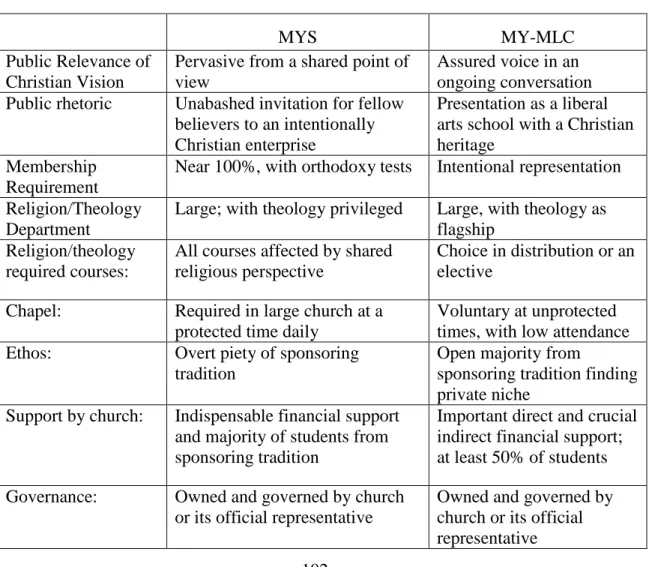
4. Changes due to transition in MYS and MY-MLC . . . 102
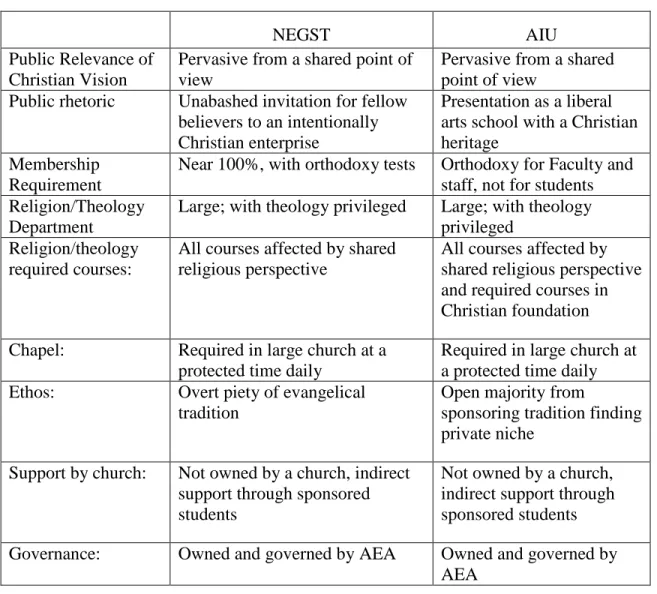
5. Changes due to transition from NEGST to AIU . . . 124
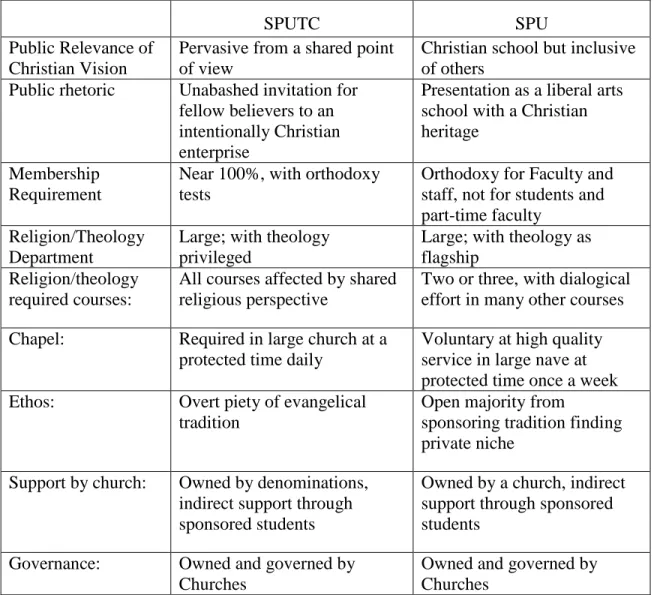
6. Changes due to transition from SPUTC to SPU . . . 148
7. Changes due to transition from BTTC to UCU . . . 174
8. Changes due to transition from ISTB to UBS . . . 198
9. Reasons for transition . . . 201
10. External Challenges . . . 204
11. Internal Challenges . . . 205
Figure Enrolment of higher educational institutions in sub-Saharan Africa . . . 44
xii
PREFACE
I would like to express my sincere appreciation to Dr. Hal Pettegrew, my supervising professor, for his guidance, support, and encouragement. I am also very grateful to Dr. Michael Wilder for guiding me through the process of finishing my course work and for helping me in the initial stages of developing my research topic and method.
I am thankful to Dr. Brian Richardson, who gave me helpful guidance as a member of my dissertation committee.
I am indebted to the leaders of Mekane Yesus Seminary, Africa International University, St. Paul’s University, Uganda Christian University, and Shalom University of Bunia, for allowing me to include their institutions in my research. I am also thankful for their participation in my interviews.
My sincere thanks to the members of my expert panel, Dr. Robert Benne, Dr.
Perry Glanzer and Dr. John Jussu, for their willingness to read through my interview questions and for giving me constructive comments.
I owe a great debt to Christian Fellowship Church in Evansville, Indiana, for supporting me and my family financially and for providing for our needs. I am especially thankful to Dr. Gary Vincelette, the Director of Outreach ministry at the church, and his wife, Terri Vincelette, for their constant support and encouragement. I am also very grateful to the Lamb Foundation for their financial support and encouragement.
I do not have words to express my appreciation for my dear wife, closest friend, and partner for her encouragement and support, with great sacrifice, without which I would not be able to do my studies.
xiii
Finally but most importantly, I praise my God and Savior Jesus Christ, who called me to work in His kingdom and for giving me this opportunity to study so that I can be better prepared for His work.
Semeon Mulatu Louisville, Kentucky
May 2012
1 CHAPTER 1 INTRODUCTION
Several theological colleges and seminaries in Africa are transitioning or considering transitioning to Christian liberal arts colleges or universities. These are colleges, originally established to train ministers in biblical, theological, and ministry skills for a vocational ministry in churches and Christian organizations. These institutions have expanded or will expand their purposes and programs in this transition.
Such transitions have taken place in many higher educational institutes in the West. Many universities in the United States and England were originally established by faith communities to train ministers for the churches. Holmes says, “American higher education was the child of religion, and the history both of the church denomination and of the westward expansion can be traced through the history of America’s colleges and universities” (Holmes 1975, 19). Holmes mentions Harvard, Yale, Princeton, and Columbia as examples of such institutions (Holmes 1975, 19).
Though these and many other higher educational institutions were started by churches, through the years many of them have abandoned their religious distinctiveness.
Burtchaell, in his book, The Dying of the Light: The Disengagement of Colleges and Universities (Burtchaell 1998), gives an account of how colleges that began as
denominational colleges have now become secular. Burtchaell gives a good summary of how these colleges slowly drifted away from their denominational roots to secular academic institutions (Burtchaell 1991). He argues that the drifting started when educators in these institutions, who felt that the leaders of the church might use their influence to hinder their reform agendas, managed to pull out the institutions from church
2
governance. Reacting to the “sectarian” narrowness, they moved the intellectual and disciplinary life of their institutions away from any specific church to a generic
Christianity. Burtchaell observes that these educators, who were themselves observant believers, failed to foresee “that the academy had no way to remain Christian without vital membership in an ecclesiastical fellowship” (Burtchaell 1991, 24). These educators eventually brought secularization of their institutions.
The effects of secularization continued to grow when many academic
institutions started emphasizing “scientific inquiry as separate from the development of character or moral precepts” (Reuben 1996, 126). Describing how secularization impacted liberal arts college campuses, Gomes writes,
The elite residential liberal arts colleges have responded to rapid social changes by distancing themselves from their more particular pasts, most noticeably in the role that religion is seen to play in the total mission of the institution, and by fashioning themselves as best they can in the image of the larger, secular research universities.
. . . The formative consensus of these institutions and the ethical dimensions that flowed from it has been broken, and for some time there has not been anything to take its place. (Gomes 2000, 103)
Not all schools that were started by faith groups followed the same path. There are some who kept their Christian traditions and religious vision. Benne explains how six institutions from different Christian traditions kept their religious vision. He argues that the strong religious traditions that sponsored those schools “have provided the resources for a compelling vision on the part of each college or university, which has become the organizing paradigm for the life and mission of each school. That religious vision constitutes a comprehensive, unsurpassable, and central Christian account of life and reality” (Benne 2001, 140).
By the middle of the twentieth century, several evangelical institutions had emerged that undertook the challenge of integrating knowledge and value that their secular counterparts have abandoned (Carlberg 2002, 228). Describing the emergence of
3
such evangelical colleges that have returned the Christian commitment to education, Carlberg writes,
Most evangelical institutions started as Bible colleges funded, supported, and guided by a denomination or strong independent Christian leader. Others began as smaller replicas of established liberal arts colleges or secular universities where research, service, and teaching were prominent. Whether rooted in the Bible school
movement or modeled after the historic liberal arts college, most embraced Christian piety and required chapel attendance, prayer before class, mission outreach, and courses in Bible and theology studies. (Carlberg 2002, 228)
Though these institutions are small, they have become an important force for diversity in the American educational system (Carlburg 2002, 229). Mark Noll, pointing out the growth of such institutions writes, “In the twentieth century, evangelical colleges and (since the 1960s) universities have constituted one of the most important alternatives to the burgeoning sweep of state-sponsored higher education” (Noll 1997, 195-96).
Secularization has also taken place in many higher educational institutes in England. Until the 1990s England had four universities considered Christian. Oxford, Cambridge, Durham, and King’s College London (Glanzer 2008, 164). Bebbington (1992) and D’Costa (2005) discuss in their books how these English universities were secularized. According to Bebbington, what makes the secularization of the universities in England different from those in the United States is the role played by the state (Bebbington 1992, 265). The various laws that were passed by parliament played a big role in changing these universities from Church of England universities to secular universities (Bebbington 1992, 265). Since the state controls almost all of these institutions, they were forced to expand or contract according to the desires of the state (Glanzer 2008, 178). These universities face constant pressure to accommodate all kinds of citizens in England. They cannot discriminate among students for admission on the basis of religion and in appointing academic staff unless they can clearly make a case that certain belief is necessary to teach that specific subject. Regarding the place of theology in the curriculum of these institutions, Glanzer says, “Unlike America, the practice of
4
general education or core curriculum that would allow universities to require all students to take theology classes does not exist in England” (Glanzer 2008, 173).
Describing the other two challenges higher educational institutions founded by Christian organizations in England face, Glazaer says,
With the secularization of the English population, it is difficult for universities to market themselves as Christian institutions. Moreover, the Anglican and English culture appears to shy away from such overt claims to particularity. As a result, it would appear that the church’s resources, influence and attention are too broadly scattered for it to create a number of institutions that retain a strong sense of Christian identity. (Glanzer 2008, 179)
Christian Higher Education in Africa
Africa, especially the Sub-Saharan Africa, is a region with the lowest enrolment of higher educational institutions. The countries that this study focuses on, Ethiopia, Kenya, Uganda, and Democratic Republic of Congo (DRC) are part of the region called the sub-Saharan Africa (SSA). This region has one of the lowest gross enrollment ratios (GERs) in tertiary education. Explaining the situation in the region, Varghese says, “In 2000, the GER in higher education in SSA was only 3.5 per cent (UIS, 2003). A majority of the African countries in 2000 have an enrolment ratio of less than 5 per cent. More importantly, the distance between African countries and countries in other regions has widened due to the slow progress made in this region” (Varghese 2006, 29).
Several higher educational institutions in Africa have their roots and precursors in missionary ventures and religious organizations (Otieno 2007, 175). The church played a pivotal role in the establishment of several higher educational institutions (Otieno 2007, 175). In most sub-Saharan countries, formal educational programs were part of the Christian mission for many years (Asamoah-Gyadu 2007,
http.//iapche.org/gyadu-paper.htm). Many elementary and high schools were established and run by Christian organizations or churches, and these organizations included
5
education as an integral part of the Christian mission. “In venturing into higher education at the tertiary level, therefore, the churches are building on a rich intellectual and
religious heritage that has always seen formal education and Christian mission as inseparable entities in the building of society” (Asamoah-Gyadu 2007,
http.//iapche.org/gyadu-paper.htm).
There are twelve church-affiliated universities and Christian liberal arts colleges in Kenya (Abagi 2006, 75). Most of these universities and Christian liberal arts colleges started as Bible/theological colleges to train ministers for the church and
Christian organizations. They eventually added other programs and transitioned to Christian universities and liberal arts colleges. Two of these universities, Africa International University (formerly Nairobi Evangelical Graduate School of Theology) and St. Paul’s University (formerly St. Paul’s United Theological College) are included in this multi-case study.
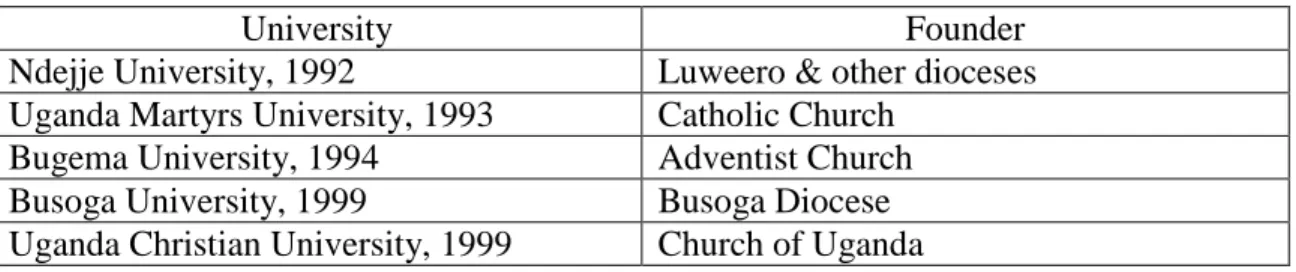
Uganda has six private universities and university colleges that are founded by churches and recognized by the government. Four of these universities were founded by the Church of Uganda, one by the Catholic Church and one by the Seventh Day Adventist Church (www. unche.or.ug). Uganda Christian University that was founded by the
Church of Uganda in 1991 as Bishop Tucker Theological College and transitioned to a Christian university in 1999 (www. ucu.ac.ug) is included in this study.
In Democratic Republic of Congo there are six Christian Universities (Glanzer, Carpenter, and Lantinga 2011, 17). One of these institutions is Shalom University of Bunia which was first founded in 1961 as a Bible school, owned by five different church denominations. In 1972 its name was changed to Institut Supérieur Théologique de Bunia (Bunia Theological Seminary). After five decades of existence, Bunia Theological
Seminary made an important transition to Shalom University of Bunia in 2001
(www.unishabunia.org). Shalom University of Bunia is included in this multi-case study.
6
There are no Christian universities that are established in Ethiopia yet.
However, two colleges that started as Bible/theological colleges have started the transition process to become Christian universities. The first one is the Mekane Yesus Seminary (MYS) that was founded in 1960. When MYS was established, its aim was “to assist in the extension of the Kingdom of God in Ethiopia by training and offering to the church pastors, evangelists and church leaders” (www.myes.org). In 1995 the seminary added a Leadership, Management and Communication College to its theology and music programs. MYS also have plans to add other programs in the future and become a Christian university (www.myes.org). MYS is included in this multi-case study.
The other theological college that is in the process of becoming a Christian university is Meserete Kirstos College (www.mkcollege.org). It was founded in 1994 as
“Meserete Kirstos Church Bible Institute” for the purpose of “providing relevant and contextualized biblical training for pastors, evangelists, and lay leaders within Ethiopia”
(www.mkcollege.org). In 1995 the institute was recognized as Meserete Kirstos College (MKC). Currently it runs diploma and degree level programs in Bible and Christian ministries. Its vision statement says, “The College envisions becoming a full ‘Christian University,’ offering a broad range of undergraduate and graduate programs relevant to impacting the Ethiopian societies and beyond towards a more honest, just, compassionate and prosperous future” (www.mkcollege.org).
The Christian higher educational institutes in Africa also face the challenge of secularization as seen in the West. What happened to the University of Ghana gives an example of what is taking place in many similar institutes in Africa. Although the University of Ghana was established on Christian moral foundations, after the independence, it was pressured by the government to broaden its divinity faculty to include the study of non-Christian religions. That eventually led to the religious neutrality of all its programs (Asamoah-Gyadu 2007, http.//iapche.org/gyadu-paper.htm).
7
Christian higher educational institutions also face competition from other private and public higher educational institutions. In order to compete, expand, and stay financially viable in this environment, some Christian higher educational institutions chose to be lenient on their religious requirements and to start programs that are in demand for job-oriented fields (Levy 2007, 206).
Though the common trend in higher educational institutes that were
established by churches and Christian organizations is to gradually lose their religious distinctiveness over many years, there are exceptions in Africa. Levy argues that there are several higher educational institutions that kept their religious missions. Daystar
University and the Kabarak Universities are two of the institutions he mentioned as examples (Levy 2007, 205). The mission statement of Daystar University says, “Daystar University seeks to develop managers, professionals, researchers, and scholars to be effective, Christian servant-leaders through the integration of Christian faith and holistic learning for the transformation of church and society in Africa and the world”
(www.daystar.ac.ke).
As many theological colleges and seminaries in Africa are rushing to transition to Christian universities, is secularization a possible unintended consequence for these institutions? Have the experiences of those institutions that have transitioned or are transitioning shown an evidence of drifting away from their evangelical mission and values? In what ways has the transition affected the mission, evangelical values, and theological programs of the institutions? Considering the threat of secularization and other unintended consequences of such transitions, does the church in Africa need to use its valuable resources to transition her theological and Bible colleges to liberal arts
colleges or universities? These and similar questions need to be addressed to determine if the church needs to involve itself in liberal arts education.
After a thorough research of the literature, this researcher has not found any
8
significant research that is done in East African context on how transitions from a Bible/theological college to Christian liberal arts colleges or universities affect the transitioning institutions. This research is specially driven by the desire to find out the reasons for such transitions, the challenges of the transition process and how such
transitions affect the mission of the institutions, the theological training programs, and the relationship of the institutions with their founding or sponsoring churches.
The reason this research focuses on how the transitions affect the mission of the institutions is that the institutional mission is where institutions articulate their identity and role in higher education that directs all educational activities of the institution. Changes in the institutional mission affect everything that goes on in the institution (Diekema 2000, 57).
This research also focuses on how the transitions affect the theology program of these institutions because it is through their theology that Christian higher education institutions articulate how their faith is integrated with learning that is offered in their institutions. Benne, explaining the importance of theology in Christian higher educational institutions says,
Christianity as a living tradition is an account of life that is comprehensive,
unsurpassable, and central. Theology gives an articulated account of that faith; it too aims to be comprehensive, unsurpassable, and central. One would think, then, that theology would be amply employed by Christian colleges and universities to
articulate their identity and mission, to stipulate the relation of revelation and reason in their particular tradition, to gather a theology department in which its members would gladly carry that vision on behalf of the school and the faculty, to construct a curriculum, to elaborate a public justification for the school’s ethos, and to provide a Christian intellectual tradition with which the whole school in its many departments could engage. (Benne 2001, 15)
This research also analyzes how transitioning from a theological college to a Christian liberal arts college or university affects the institution’s relationship with its founding church or organization in East African context. As indicated above, one of the reasons secularization took place in many academic institutions in the West that were founded by churches and Christian organizations is that these institutions started
9
distancing themselves from their particular past (Gomes 2000) and moved to a generic Christianity instead of relating to actual church (Burtchaell 1991). On the contrary, those institutions that maintained their strong ties with their founding churches also kept their religious vision as central to their mission (Benne 2001).
For this study, the researcher selected five institutions from Ethiopia, Kenya, Uganda and Democratic Republic of Congo (DRC) that began as theological (Bible) colleges or seminaries and now are transitioning or have transitioned to Christian liberal arts colleges or universities. The researcher used certain key factors such as location, denominational affiliation, or sponsorship, and stages in the transition process to choose the institutions. These institutions are Mekane Yesus Seminary (Ethiopia), Africa International University (Kenya), St. Paul’s University (Kenya), Uganda Christian University (Uganda) and Shalom University of Bunia (DRC). Out of the five institutions, Mekane Yesus Seminary is in transition to become a Christian university while the other four have already transitioned to Christian universities. All these institutions have added at least two additional programs to their theology program and have made clear plans to add more programs in the next five to seven years.
Research Purpose
The purpose of this qualitative multi-case study was to analyze and describe transitions from a theological college or seminary to a Christian liberal arts college or university in East African context.
Delimitations of the Study
This study is delimited to institutions in Ethiopia, Kenya, Uganda and DRC that are transitioning or have transitioned from a theological college or seminary to a liberal arts college. Though a transition from a Bible (theological) college to Christian liberal arts college or university brings many changes to an institution, this study is
10
delimited to the reasons and challenges of the transitions and how such a transitions affect the overall mission of the institution, its relationship with the founding or sponsoring churches and its theology program.
The study is delimited to institutions that have added at least two additional programs to their theology program and have made clear plans to add more programs in the next five to seven years. This study is also delimited to Protestant evangelical Bible or theological colleges that have transitioned or are transitioning to liberal arts colleges or universities. The findings, therefore, do not generalize to all church affiliated institutions that belong to other Christian traditions. Though this qualitative study attempts to
consider the phenomenon in several institutions in the region that are transitioning or have transitioned, it will be limited in its representation because all transitions are different and dependent on the nature of the institutions and their specific context.
Research Questions The following five questions guided this study.
1. What are the reasons for the transition from a theological college to a liberal arts college or university?
2. What are the external and internal challenges these Christian higher educational institutions face as they go through this transition?
3. In what ways is the mission of the institution affected by the transition from a theological college to Christian liberal arts?
4. In what ways has the transition affected the relationship between the institution and the sponsoring church(es) or Christian organization(s)?
5. In what ways has the transition from a theological college to a Christian liberal arts college or university affected the theology program of the institution?
Terminology
The following terms and definitions are presented to clarify the way they are
11 used in this dissertation.
Bible college. Bible college also has a similar meaning to theological college in this research. Some colleges use the title Bible college instead of theological college but they are similar institutions (Dockery 2007, 9).
Christian higher education. Christian higher education refers to education offered at post-secondary colleges and universities within an evangelical Protestant tradition where ‘‘the Christian vision is the organizing paradigm” and “Christian account of life and reality is publicly and comprehensively relevant to the life of the school by requiring that all adult members of the ongoing academic community subscribe to a statement of belief” (Benne 2001, 50).
Faculty. The word faculty is used in two ways in this research. Depending on the context, the word faculty refers to “the teaching and administrative staff and those members of the administration having academic rank in an educational institution” or “a branch of teaching and learning in an educational institution.” Example: Faculty of Social Sciences (www.merriam-webster.com).
Christian liberal arts college. Christian liberal arts college is a college that prepares students in arts and science from a Christian world-view perspective for life’s work rather than for specific profession or vocation (Holmes 1975 18, 106).
Evangelical. Evangelical is a noun or an adjective that refers to Protestant Christians who hold to the doctrinal ideas such as the authority of the Scriptures, the completeness of the atoning work of Christ, justification by grace through faith, and the necessity of the work of the Holy Spirit in regeneration and change of the human heart (Nettles 2001, 265).
Institutional mission. Institutional mission of a higher educational institution is a statement that defines the institution and its role in higher education. It directs all
educational activities of the institution including student body, admission policies, faculty
12
recruitment, and planning. The institutional mission has to be adopted by the governing board and all the administrators of the institution and appears in all appropriate
publications of the institution, including its catalogue (www.nwccu.org/Standards).
Leaders. “Leaders” in this study refers to those people who are employed by an institution of higher education at the level of president (principal), vice president, Academic Dean, and the Board Chairperson.
Liberal arts colleges. Liberal arts colleges are colleges that mainly have undergraduate programs offering a bachelor’s degree. They are small (1000-2,500 students). Their curriculum is aimed at imparting general knowledge and developing general intellectual capacities in contrast to a professional, vocational, or technical curriculum (www.about.com).
Secularization. Secularization in higher educational institutions refers to the activity of moving education away from the control or influence of religion
(www.thefreedictionary.com). It refers to the declining importance of faith, diminished influence of religious organizations on the institution and diminishing of religious commitments (Mixon, Lyon, and Beaty 2004, 403).
Theological college. Theological college is a college that is established for the purpose of preparing students for church-related vocations. They are generally
undergraduate programs and their focus of study is Christian materials (Dockery 2007, 9).
Theological program. Theological program in this study refers to the program within a Christian higher educational institution that focuses on biblical, theological, and ministry studies area that prepares students for church-related vocations.
Procedural Overview
The research methodology that was used in this study is a qualitative, multi- case study method. This method was chosen because it helps to answer research
13
questions that are descriptive in nature that analyze the effects of change in the institutions that are selected for this study. For this multiple-case study research, the researcher selected five institutions in Ethiopia, Kenya, Uganda and DRC that have started as theological colleges and have added at least two additional programs to their theology program and have made clear plans to add more programs in the next five to seven years. Four of these institutions have already become Christian universities and one of them is in transition. The researcher contacted the presidents of institutions that meet these criteria and asked their willingness to participate in this study and selected the five institutions that are willing and accessible to the researcher. The data for this research was gathered from in-depth interviews, the official documents of the institutions, and from on-campus observation notes of the researcher.
The in-depth interviews were conducted with the President (Principal, Vice- Chancellor, Rector), the Academic Dean (Deputy Vice-Chancellor for Academic
Affairs), and the Deans of the theology program and other senior leaders of each of these institutions. The interviews were designed to bring to the fore the experiences and
perceptions of the leaders of these higher educational institutions about the reasons, effects, challenges, and the impacts of the transitions. The data that was collected from the interview sessions was recorded and transcribed. The transcripts were sent to the interviewees for their validation. Once the validations were received, the data was analyzed and coded for patterns and themes and the findings from the interviews are analyzed, summarized, and reported.
The document research was conducted by examining the institutions’
catalogues, published newspapers, brochures, and official documents. The researcher also visited all the five academic institutions to gain a perspective of the educational
environment. While on campus the researcher attended campus activities such as chapel when in session, made informal discussions with faculty members and students, and
14
made observations. The researcher collected resources through all these activities that would provide information on the effects of the transition on the institutions.
Research Assumptions
The following is the list of assumptions that are central to the current study.
1. Christian higher education that is based on a biblical foundation that integrates faith and learning helps the church influence the culture for Christ.
2. Church affiliated higher educational institutions do not necessarily provide Christian higher education.
3. The commitment of a Christian higher educational institute should be to the Lord and His Word, then to the church and then to the society, in that order (Dockery 2007).
4. The published official documents of the institutions give an accurate reflection of the institutions’ ethos, vision, and curriculum emphasis of the institutions.
5. The leaders of the institutions that were interviewed for this research answered the questions in an accurate manner.
15 CHAPTER 2
PRECEDENT LITERATURE
The precedent literature review that is presented in this chapter has five sections. The first section reviews the biblical/theological basis for Christian higher education that is presented in the literature. The second section deals with the literature that describes the distinctive factors in Christian higher education. Section three focuses on the role and purpose of Christian higher education. The fourth section discusses the literature that describes how secularization became a threat to many higher educational institutions that were started by churches and Christian groups. The context of Christian higher education in Africa, especially in East Africa, is discussed in section five.
Biblical-Theological Foundation
God has revealed himself to man in different ways. One of the ways He
revealed Himself is through His creation, and this revelation is available to all (Ps 19.1-4;
Rom 1.20). This is what theologians call general revelation (Grudem 1994, 123).
Erickson states that there are three traditional modes of general revelation: nature, history, and the constitution of the human being (Erikson 1992, 34). Through His creation, God has revealed His power and divine nature to all human beings (Rom 1.
19-20). God created man with the capacity to perceive the existence of a Supreme Being from observing the universe around him (Ryrie 1999, 33; Thissen 2006, 8). Through general revelation, God calls mankind to “respond by acknowledging that there has to be behind it all a living, powerful, intelligent, super-human Being” (Ryrie 1999, 37). “The person who views the beauty of a sunset and the biology student dissecting a complex organism are exposed to indications of the greatness of God” (Erikson 1992, 34).
16
The second way God revealed Himself in general revelation is through history.
Erikson, explaining how God revealed Himself in history, says, “If God is at work in the world and is moving toward certain goals, it should be possible to detect the trend of his work in events that occur as part of history” (Erikson 1992, 34).
The third way of God’s general revelation is through human beings
themselves. God has given man moral and spiritual qualities that help him make moral judgment. This has great significance for education. God’s creation is a source of knowledge and through scientific studies of nature and interaction with people, man can learn about God and things He has created.
Though what God has revealed through general revelation is sufficient to lead man to some knowledge about God, it does not give sufficient information about God and our relationship with Him. That is why God has also revealed Himself in a special way though the Bible and his Son, Jesus Christ.
The Bible is God’s written Word that is contained both in the Old Testament (Rom 15.4) and New Testament (2 Tim 3.16). Everything that is necessary for our salvation and Christian life and growth are clearly revealed in the Scriptures (Grudem 1994). God’s Word is Truth (John 17.17) without error (Ps 12.6), sure (Ps 119.89), and the ultimate standard of truthfulness (Matt 4.4; 2 Pet 1.20-21) (Grudem 1994). Describing the authority of God’s Word, Knight writes, “For the Christian, the Bible is the foremost source of knowledge and the most essential epistemological authority. All other sources of knowledge must be tested and verified in the light of scripture” (Knight 2006, 179).
The other way God has also revealed Himself in a special way is through His Son, Jesus Christ. The Bible teaches that Christ is the center of all things. One of the key passages that teach Christ’s centrality is Colossians 1.15-17, which says, “He is the image of the invisible God, the firstborn over all creation. For by him all things were created:
things in heaven and on earth, visible and invisible, whether thrones or powers or rulers
17
or authorities; all things were created by him and for him. He is before all things, and in him all things hold together.” Christ, as this passage describes Him, is the Creator of all things, the Sustainer of all things, the Goal of all things, the Redeemer of all things and the Judge of all things (Liftin 2004, 39-42). Since Christ is the center of all things, all Christian education should be Christ-centered.
For many Christians, Christ-centered education is related to education that is offered in the church, Bible colleges or seminaries that are mainly established to train people for evangelism, church ministry, and missions. Can liberal arts education be Christ centered? Is it possible to teach chemistry, sociology, history, music, physics, and English literature in a way that is Christ centered? Liftin says,
To speak of Christ-centered liberal arts education is to make the claim that Jesus is the centerpiece of all human knowledge, the reference point for all our experience.
It directs our attention to the only One who can serve as the centerpiece of an entire curriculum, the One to whom we must relate everything and without whom no fact, no theory, no subject matter can be fully appreciated. It is the claim that every field of study, every discipline, every course, requires Jesus Christ to be understood aright. (Litfin 2004, 64-65)
Since God is the creator of everything and is the source of all true knowledge that is revealed through general revelation and special revelation, we can agree with the early church fathers who stated, “All truth is God’s truth, wherever it is found” (Holmes 1975, 25).
The Bible teaches that man is created in the image of God and he is created to be God’s vice-regent to rule and subdue the earth (Gen 1.26-27). Since man is created in God’s image, he has the capacity to be rational, moral, and relational. Even though all these capacities are affected by the Fall, man still is the bearer of God’s image and God’s image in man is not completely lost (Jas 3.9). Explaining the implications of this in relation to education Holmes says,
Man has a God-given, God-preserved, God restorable potential, a potential to be developed, disciplined and invested in response to God. Such development, discipline and direction are the Christian’s responsibility and stewardship. To
18
educate the whole person, to encourage disciplined learning and the quest for excellence is a sacred trust. The Christian should give himself contagiously to looking around him and to thinking, to the exploration of nature and to the
transmission of cultural heritage, as well as to teaching Christian beliefs and values.
The educator’s task is to inspire and equip individuals to think and act for
themselves in the dignity of men created in God’s image. There is no room here for a dichotomy what is secular and what is sacred, for everything about men created in God’s image belongs to God—that is, it is sacred. (Holmes 1975, 23-24)
In what He called the first and the greatest commandment, Jesus said, “Love the Lord your God with all your heart and with all your soul and with all your mind”
(Matt 22. 37). This commandment includes loving the Lord with our minds and has implication for our mission in Christian higher education. “To love God with our minds means that we think differently about the way we live and love, the way we worship and serve, the way we work to earn our livelihood, the way we learn and teach” (Dockery 2007, 11).
Many passages in the Old Testament wisdom literature declare that the
beginning of all wisdom, knowledge, and understanding is the fear of the Lord (Prov 1.7;
Prov 2.5; Prov 9.10; Ps 111.10; Job 28:28). These passages teach that a reverence for God, the maker of heaven and earth, has to be our beginning point for all our inquiries, thinking, learning, and teaching.
Christian higher education, therefore, is more than providing education in different subject areas. It is providing Christ-centered education to men and women so that they develop their God given potential to learn and interpret the world around them with reverence for God, from “the vantage point of God’s revelation” (Dockery 1999, 13).
What Makes Higher Education Distinctly Christian?
Are Christian liberal arts colleges necessary? Should not the church’s focus be on education that is offered in churches, Bible colleges, or seminaries that are mainly established to train people for evangelism, church ministry, and missions? If churches
19
disciple their members, equip them well to serve God and His people, and train them to engage their culture with the truth of the Word of God, why can’t believers use the secular colleges and universities to get education in arts and sciences? These and similar questions need to be addressed to determine if the Church needs to be involved in liberal arts education.
Several reasons are proposed for establishing Christian liberal arts colleges or Christian universities. Holmes, in his book The Idea of a Christian College, gives some of these reasons (Holmes 1975, 14-16).
The first reason given for the need for Christian higher educational institutions is that these colleges protect young people from the influence of sin and heresy. Some consider Christian colleges as “defenders of the faith” (Pattillo and MacKenzie 1966) that provide safe environment to students, where they receive answers to the questions raised by the critics of their faith and Christian values. Though this view has some truth in it, not all education offered in the Christian liberal arts colleges is designed to protect students against sin and heresy. Describing one of the weaknesses of this argument Holmes says, “The trouble with it is that there often are no ready-made answers, new problems arise constantly, and the critics are perplexingly creative” (Holmes 1975, 14).
The other shortcoming of this reason is that Christian higher educational institutes cannot provide a sin-proof environment to students because sin is not just a problem coming from outside; it is also a heart issue (Holmes 1975, 14).
The second reason given for the need of Christian liberal arts colleges is that they offer courses in Bible and theology in addition to good education in liberal arts in a Christian environment (Holmes 1975, 15). Though this is another good purpose, this need can be met by offering courses in Bible and theology in churches or seminaries that are close to secular universities students attend. Churches can also provide spiritual support for students. A truly Christian liberal arts education should not just offer what is
20
basically a secular education with Bible and theology courses offered on the side without properly integrating faith with all the subjects offered (Mosoma 1994, 146).
The third reason given by some is that Christian colleges provide social and extracurricular benefits to students (Holmes 1975, 16). It is true that most Christian colleges have smaller sizes than the big secular universities, and that difference allows students and faculty to build closer relationships and provide opportunities to serve one another. As important as this reason is, it is not adequate reason for establishing such colleges because these needs can be met in other ways (Holmes 1975, 16).
The fourth reason given for Christian higher education is that it helps the church to withstand the waves of secularism that is taking over our cultures and our higher educational institutions. In the West and in most other regions of the world,
secularism is becoming a dominant force in higher educational institutes. Though this is a very valid reason, the church’s involvement in higher education does not necessarily guarantee that it makes the church capable of withstanding the waves of secularism. We learn from history that even those institutions that were established by church groups were taken away by secularism. Harvard, Yale, Princeton, and Columbia, in the United States (Holmes 1975, 19) Oxford, Cambridge, Durham, and King’s College London in the UK are only a few examples of such institutions (Glanzer 2008, 164). This chapter later discusses how some higher educational institutions were able to withstand the effects of secularism.
All the reasons given above are good reasons for establishing Christian liberal arts colleges or universities. However, they are inadequate and are not comprehensive enough. Identifying the key factors that make higher education distinctly Christian is important to clearly define the purpose of Christian higher education.
21
Robert B. Sloan, Jr., addressing the question, What is Distinctively Christian Higher Education?, lists the six ways in which the notion of Christian higher education is employed (Sloan 1999, 26-28).
1. When people refer to a Christian higher education, they simply are making reference to the history and tradition of the institution. That could be a reference to their founding documents, intention of the founders or founding organizations.
2. Others use the expression Christian institution simply to refer to the composition of the members of the governing board that meet certain religious qualification for membership.
3. It is also used as a frame of reference for Christian higher education to describe the relationship the institution has with a church or Christian denomination.
4. Others use the expression Christian higher education as a reference to “the atmosphere or the environment of the institution” referring to the way things are done or the values that the institution holds.
5. Another way of thinking of Christian higher educational institutions is in terms of the “Christian or religious activities” of the institution. These activities include chapel services, annual conferences, seminars or extracurricular activities that have Christian emphasis.
6. The sixth way Christian higher education has to do with the curriculum that is reflected in subject areas connected to the institutions Christian identity or required courses in Bible and theology.
Though the six frames of reference given above to describe Christian higher education are legitimate, they are not comprehensive enough to describe Christian higher education. There are other additional factors that make Christian higher education
distinct.
Curriculum that Integrates Faith and Learning
Describing how the notion of Christian higher education is broader than the what is mentioned above, Sloan writes, “Christian education comes ultimately into every classroom. It involves our worldview; it involves how we think and how we live. It
22
involves not only how we teach and how we live, but also it involves what we teach. It involves the very substance of our intellectual pursuits.” (Sloan 1999, 30).
Holmes (1975) argues that the work of a Christian college is different from Christian involvement in higher education and it is different from giving Christian
witness in conjunction with secular education. Explaining what makes a Christian college distinct from other liberal arts colleges and why we need a Christian college Holmes writes,
Its distinctive should be an education that cultivates the creative and active integration of faith and learning, of faith and culture. This is its unique task in higher education today. While the reality is often more like an interaction of faith and learning, a dialogue, than a completely ideal integration, it must under no circumstance become a disjunction between piety and scholarship, faith and reason, religion and science, Christianity and the arts, theology and philosophy, or whatever the differing points of reference may be. (Holmes 1975, 16)
In a similar note, Mosma argues that a truly Christian university “is marked by courses and curricula which are rooted in and are permeated by a Christian worldview, rather than a secular worldview (often disguised as a supposedly neutral worldview)” (Mosma 1994, 146).
Leadership Committed to a Christian Mission
Leadership that is committed to a Christian vision and mission plays a major role in making a higher educational institution distinctly Christian. Mark Schwehn’s description of what a Christian university leadership should look like is helpful. Schwehn says,
It must have a board of trustees composed of a substantial majority of Christian men and women, clergy and lay, whose primary task is to attend to the Christian character of the institution. They will do this primarily but not exclusively by appointing to the major leadership positions persons who are actively committed to the ideal of a Christian university. (Schwehn 1999, 26)
23
Schwehn then lists the kind of things the leadership needs to make sure are present in the institution.
1. A department of theology that offers courses in biblical studies and Christian intellectual tradition;
2. An active chapel ministry that offers worship service in the tradition of the faith community that supports the school but that also makes provisions for worship by those of other faiths;
3. A critical mass of faculty members who in addition to being excellent teacher- scholars carry in among themselves the DNA of the school, and for the perpetuation of its mission as a Christian community of inquiry;
4. A curriculum that includes a large number of courses, required for all students, that are compellingly as parts of a larger whole that taken together constitute a liberal education. (Schwehn 1999, 26-27)
The board of trustees and the senior leadership of a Christian higher educational institution also play a crucial role in helping the institution to maintain a strong relationship with the founding or sponsoring church and its religious heritage (Arthur 2008, 200).
Relationship with Founding and Sponsoring Churches
The other vital element in Christian higher educational institutes is their
relationship with the founding or sponsoring churches. Merrimon Cuninggim, in his book Uneasy partners: The College and the Church, describes the shift that has taken place in the relationship between colleges and their founding churches in the United States in the twentieth century (Cuninggim 1994, 33). The first status of relationship between the colleges and the churches that arrived by the end of the nineteen century was that the church was the senior partner, and the college the junior. The second form of
relationship, that was common between the thirties to sometime in the sixties, can be described as roughly even, where neither had upper hand over the other. The third form
24
of relationship that exists to this day is that the colleges are in primary positions while the churches play the junior role (Cuninggim 1994, 33).
Summarizing the current relationship between church-related colleges and churches, Cuninggim says, “The overwhelming majority of the church-related colleges are still in genuine touch with their longtime founding churches, but for the last twenty- five years or so they have come to be the primary entity of academic decision-making for themselves, with the churches thereby relegated to playing, often unhappily only a
secondary role” (Cuninggim 1994, 38-39). Most of these institutions according to Cuninggim openly state their church connections but they work as autonomous educational institutions and they rejoice in that fact (Cuninggim 1994, 39).
The relationship between the academic institutions and the founding or sponsoring churches can also be seen in how the academic institutions hold on to the religious heritage of the founding churches. Some of them have nominal relationship with their founding churches and can no longer be considered Christian, while others maintain strong relationships and hold on to the religious heritage of the founding churches.
O’Conell, describing what kind of influence the church should have on these institutions, says,
The expression “religious colleges” refers to those institutions of higher learning where the religion of the founding or sponsoring religious group has some direct influence upon the institution itself. By “direct” I mean real, observable, clear, and effective, with an active connection between a particular religion and a particular academic institution. It is not a “religious college” simply because its origins were religious, or its founders were clergymen or other religious women or men, or because the campus is peppered with religious symbols and works of art, or because there is a chapel. The direct influence to which I refer can be seen in terms of
institutional identity, mission, governance, administration, criteria for faculty hiring, curricula, student life, campus ministries, policies, operations and procedures, and so forth. (O’Conell 2002, 63-64)
Though Christian higher educational institutions relate differently to their founding or sponsoring churches, their main purpose has to be serving churches.
25
Discussing the relationship of Christian higher educational institutions with churches Dockery says,
We also need fresh thinking about the relationship of Christian higher education to the church, for it is central to God’s working in history. The church is not only central to history but to the gospel and Christian living as well. Thus, theology is more than God’s words for us, the community of faith. It is vitally important that we understand theology not merely in individualistic terms. We need to move to a corporate and community understanding of these ideas. For these reasons the early years of Christian higher education placed their focus first in terms of service for the churches and then more broadly for society. (Dockery 2007, 175)
Different authors have tried to categorize institutions by the way they relate to their founding or sponsoring churches or religious groups. A report done by Danforth Commission, Church-Sponsored Higher Education in the United States (Pattillo and Mackenzie 1966), categorizes higher educational institutions that are associated with religious bodies in the United States into four categories. The report categorizes institutions based on their “purpose, clientele, faculty, educational program, financial support, treatment of religion and church affiliation” (Pattillo and Mackenzie 1966, 196).
The four categories of church related institutions according to the report are (1) “the defender of the faith college,” (2) “the non-affirming college,” (3) “the free Christian college,” and (4) “the church related university” (Pattillo and Mackenzie 1966, 191-96).
The report indicates that these categories do not cover all possibilities and some institutions may fall into more than one category.
Those that are described as “defender of the faith college” are those institutions whose main purpose is providing education in arts and sciences for people who will later take lay or clerical leadership positions in a particular religious tradition. These
institutions recruit students and faculty exclusively from their sponsoring groups “who will be staunchly loyal” to their tradition and go out to “defend and advance a clearly- defined religious position in a secular society” (Pattillo and Mackenzie 1966, 192).
The second institutional pattern, the “non-affirming college,” refers to church
26
related higher educational institutions that give relatively little attention to religion. They admit students and appoint faculty without giving consideration to their religious interest or faith. Although their publications may mention their church affiliation, their purpose or mission statements omit any reference to religious or spiritual values (Pattillo and
Mackenzie 1966, 192).
The third institutional pattern is called “free Christian college.” This type of college is considered free because it does not tell its students what they must believe.
However, it has a definite Christian commitment that is reflected in its focus on chapel, its strong department of religion that offers courses in religion, and the attention it gives to integrating faith with the learning. Majority of the faculty members share the religious purposes of the institution and some of them hold position of leadership in the sponsoring church. Prospective students are attracted to such institutions because of their dual
emphasis on academic excellence and religious vitality. These institutions also have close association with their sponsoring churches, and the churches make substantial financial contribution to the institutions (Pattillo and Mackenzie 1966).
The fourth pattern is the “church-related university.” The institutions that belong to this category are large urban based institutions with student enrolment between 5000 and 20,000 that provide programs in many professional and occupational fields.
Religiously, they are pluralistic and they do not have religious requirements that apply to all students. They have tenuous relationship with their sponsoring churches (Pattillo and Mackenzie 1966, 196).
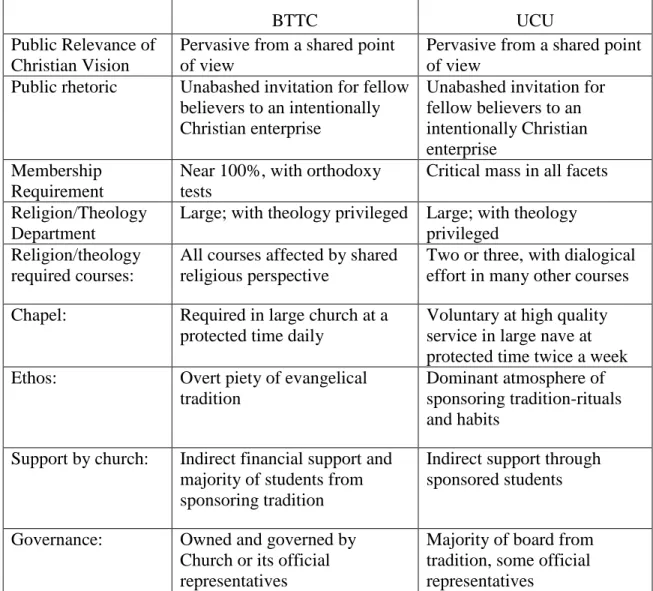
Rober Benne, in his book Quality with Soul, proposes four categories of church-related colleges. They are orthodox, critical mass, intentionally pluralist, and accidentally pluralist (Benne 2001, 49). Benne describes these categories using eight aspects of institutions’ life: (1) public relevance of Christian vision; (2) public rhetoric;
(3) membership requirements; (4) Religion/Theology Department; Religion/Theology
27
Table 1. Types of church-related colleges (Benne 2001, 49) Orthodox Critical Mass Intentionally
Pluralist
Accidentally Pluralist Major Divide: the Christian vision as the
verses organizing paradigm
verses secular sources as the organizing paradigm Public relevance
of Christian Vision:
Pervasive form a shared point of view
Privileged voice in an ongoing conversation
Assured voice in an ongoing conversation
Random or absent in an ongoing conversation Public rhetoric: Unabashed
invitation for fellow
believers to an intentionally Christian enterprise
Straightforward presentation as a Christian school but inclusive of others
Presentation as a liberal arts school with a Christian heritage
Presentation as a secular school with little or no allusion to Christian heritage Membership
requirements:
Near 100%, with orthodoxy tests
Critical mass in all facets
Intentional representation
Haphazard sprinkling Religion/
theology department:
Large; with theology privileged
Large, with theology as flagship
Small, mixed department, some
theology, but mostly religious studies
Small, exclusively religious studies
Religion/theology required courses:
All courses affected by shared religious perspective
Two or three, with dialogical effort in many other courses
One course in general education
Choice in distribution or an elective
Chapel: Required in large church at a protected time daily
Voluntary at high quality services in large nave at protected time daily
Voluntary at unprotected times, with low
attendance
For few, on special occasions
(Dominantly secular atmosphere)
28
Table 2— Continued. Types of church-related colleges Ethos: Overt piety of
sponsoring tradition
Dominant atmosphere of sponsoring tradition—rituals and habits
Open
majority from sponsoring tradition finding private niche
Reclusive and
unorganized minority from sponsoring tradition Support by
church:
Indispensable financial support and majority of students from sponsoring tradition
Important direct and crucial indirect financial support; at least 50% of students
Important focused, indirect support;
small minority of students
Token indirect support;
student numbers no longer recorded Governance: Owned and
governed by church or its official representative
Majority of board from tradition, some official representatives
Minority of board from tradition by unofficial agreement
Token membership from
tradition (College or university is autonomously owned
and governed)
required courses; (5) chapel; (6) ethos; (7) support by church; (8) governance (Benne 2001, 49). Table 1 above shows Benne’s Types of Church-Related Colleges.
Liftin suggests two categories of church affiliated academic institutions, namely, the umbrella model and the systemic model, focusing only on those that can be called truly Christian higher educational institutions (Liftin 2004, 14). In the umbrella model, though variety of voices can thrive under the Christian “umbrella,” the voice of the sponsoring Christian tradition, that is represented by the “critical mass” remains a privileged one. Those with different voices are at least expected to “support the board educational mission of the school” (Liftin 2004, 14-15). Describing this model further, Liftin says, “In such institutions the sponsoring perspective will typically be kept more or
29
less discernable. It may show itself in such things as the school’s architecture, traditions, curriculum, and extracurricular activities, as well as in the makeup of its governing board, faculty and student body” (Liftin 2004, 15).
The second model Liftin talks about is the systemic model. Describing this model, Liftin writes, “As the name suggests, they seek to make Christian thinking systemic throughout the institution, root, branch, and leaf. Their curriculum is typically all-encompassing. Their goal is to engage any and all ideas from every perspective, but they attempt to do so from a particular intellectual location, that of the sponsoring Christian tradition” (Liftin 2004, 18). These institutions recruit their faculty exclusively from those who embody their own tradition. “What is true of the critical mass in the Umbrella model is to be true to all of the scholars in the Systemic model. They seek to live and work as Christians” (Liftin 2004, 18). Liftin’s umbrella model and systemic model roughly correspond to Benne’s critical-mass and orthodox categories respectively.
Though both the umbrella model and the systemic model are acceptable models for Christian higher educational institutions, institutions that follow the umbrella model may face serious challenges as they try to be more open to students and employees from different backgrounds. Describing how this has eventually led toward secularization for some schools, Benne says,
One of the most obvious characteristics of the colleges and universities that have moved toward pervasive secularization is their flight from what they called a
“sectarian” identity and approach. Their fateful move toward openness in personnel, vision, and ethos was prompted by, among other things, a felt need to expand their appeal to many sorts of students. While some of the colleges began with large majorities from their own traditions, they in time noticed that they had competition for those students from many sources, not least of which were the public institutions of higher education. Many also decided that students from their own traditions alone could not long make for a valuable enterprise in a competitive environment, so they opened themselves to all corners. Something similar could be said for the failure to recruit administrators and faculty of the sponsoring tradition, though that would have seemed a more feasible task. (Benne 2001, 20)
This comment shows that the board and administration of Christian higher