All rights reserved. The Southern Baptist Theological Seminary has permission to reproduce and disseminate this document in any form by any means for purposes chosen by the Seminary, including, without limitation, preservation, or instruction
CITY ENVIRONMENT AT JAKARTA INTERNATIONAL BAPTIST CHURCH
__________________
A Proposal Presented to the Faculty of
The Southern Baptist Theological Seminary __________________
In Partial Fulfillment
of the Requirements for the Degree Doctor of Educational Ministry
__________________
by
Steven Lynn Schroeder May 2022
APPROVAL SHEET
INCREASING PARTICIPATION IN SMALL GROUPS IN A CITY ENVIRONMENT AT JAKARTA INTERNATIONAL
BAPTIST CHURCH
Steven Lynn Schroeder
Read and approved by:
___________________________________________
Jay D. Owens (Faculty Supervisor)
___________________________________________
Matthew D. Haste
Date_______________________________
This thesis is dedicated to those pastors who cannot seem to motivate church attendance and involvement beyond Sunday morning, who have tried different ideas to get more
participation in ministry ideas and service but have continually heard that the church members are just too busy with work and school and life.
TABLE OF CONTENTS
Page
LIST OF TABLES ... viii
PREFACE ... ix
Chapter 1. INTRODUCTION ...1
Context ...2
Rationale ...3
Purpose ...9
Goals ...9
Research Methodology...9
Definitions and Limitations/Delimitations ...11
Conclusion ...13
2. BIBLICAL AND THEOLOGICAL BASIS ...14
Expected Christian Maturity: Exegesis of Ephesians 4:10-16 ...14
The “One Anothers” of the New Testament: Exegesis of Hebrews 10:19-25 ...20
The Apostle John on the “One Anothers” ...30
Exegesis of 1 John 3:11 ...31
Exegesis of 1 John 3:18 ...32
Exegesis of 1 John 4:7-8 ...34
Exegesis of 2 John 6 ...36
Chapter Page 3. PRACTICAL AND THEORETICAL FOUNDATIONS: SMALL GROUP
DISCIPLESHIP IS EFFECTIVE IN CITIES BECAUSE IT ADDRESSES THE MATURING DISCIPLESHIP
OF CHURCH MEMBERS ...40
Church-Led Small Groups Need to Fit the Culture in Which They Exist ...43
Church-Led Small Groups Address the Discipleship of Those Who Participate ...50
Church-Led Small Groups Mature Participants as They Serve One Another Outside Sunday Morning Church ...54
Church-Led Small Groups Train Leaders in the Church ...58
Church-Led Small Groups in the City Environment Will Need to Be Sensitive to the Unique Struggles of City-Dwellers ...59
Power Distance ...64
Collectivism-Individualism ...65
Uncertainty Avoidance Index ...65
4. DETAILS AND DESCRIPTIONS OF THE PROJECT ...71
Project Details ...71
Small Group Curriculum Development—Survey Analysis ...76
Small Group Curriculum: Scope and Sequence ...77
Scope ...77
Sequence ...78
Week 1—Maturity, Maturity, and More Maturity: We Will Not Remain Spiritual Children ...78
Week 2—Part 2, Abounding in Maturity ...79
Week 3—Maturing Success, Failure, and Success: Bringing the Ark of God Back to Jerusalem ...80
Week 4—Maturing Success, Failure, and Success: Lessons from Young King Josiah and from Job ...81 Week 5—Maturing into Obedience to the Lordship of Christ:
Following Our Hearts or Following God’s Word, the
Chapter Page Week 6—Maturing away from Human Examples: The Human
Example of the Philistines and the Christian’s Call to
Live under the Lordship of Christ ...83
The Development of the JIBC Life Fellowship Vision ...83
5. EVALUATION OF THE PROJECT ...85
Introduction ...85
Evaluation of the Project’s Purpose ...85
Goal One and Results ...86
Goal Two and Results ...86
Goal Three and Results ...87
Goal Four and Results ...88
Statistical Analysis of the Project ...89
Evaluation of the Project’s Goals ...90
Strengths of the Project ...90
Weaknesses of the Project ...92
What I Would Do Differently ...93
Theological Reflections ...95
Personal Reflections ...97
Conclusion ...98
Appendix 1. JIBC LIFE FELLOWSHIP VISION STATEMENT ...100
2. DATA ANALYSIS PLAN ...103
3. INCREASING INVOLVEMENT IN SMALL GROUPS ASSESSMENT ...105
4. GROWTH OF SMALL GROUP ASSESSMENT ...107 5. CONTEXT TO THE ANALYSIS OF QUESTIONS 15, 26, 27,
Appendix Page 7. SERMON EVALUATION TOOL ...118 BIBLIOGRAPHY ... 121
LIST OF TABLES
Table Page
1. Hebrews 10...21
2. Churches studied in Home Groups for Urban Cultures ...44
3. New Life Community Church small group structure ...55
4. Research population demographics...88
5. Improvements in research population ...99
A1. Question 15: I can encourage others to greater faith when bad things happen in their lives ...112
A2. Question 26: Jesus is man ...112
A3. Question 27: I am confident that I can explain my answer above ...113
A4. Question 28: Man can only come to God through the Person and work of Jesus Christ ...113
PREFACE
Thanks to the men and women who have influenced my life to this point.
Thanks to my dad who faithfully pastored and proclaimed God’s Word for over sixty years. In many ways, he is the one who began this DEdMin project. Special thanks to Dr.
Owens for his help as my Southern Seminary faculty advisor.
Steven Schroeder Jakarta, Indonesia
May 2022
CHAPTER 1 INTRODUCTON
The cities of the world are amazing places of gospel opportunity. In the cities, living within blocks of the church of Jesus Christ, nations are coming together with people of many ethnic, cultural, religious, and economic backgrounds. In their book, Why Cities Matter, Steven Um and Justin Buzzard contend that cities today are shaping the world. For the Christian, they contend, “This new world presents Christians and the church with an unprecedented opportunity to bring the gospel of Jesus Christ into every dimension of human life. God is doing something new and big in our cities, and he’s calling some of us to participate in it.”1 City people attend city churches and struggle with daily realities unique to city life. These busy city churches are poised to participate in God’s great work.
One great difficulty that the city church faces is intentionally maturing the saints whose busy lives do not easily surrender time for discipleship. While the church members are interested in maturing in their faith and in serving God’s kingdom, they cannot risk their jobs nor their children’s education. The church, which in years past had three services each week plus revival meetings and other activities, seems only able to plan one service a week. Church led small groups tend to struggle unless those coming have a good reason to make the small group a priority.
1 Steven T. Um and Justin Buzzard, Why Cities Matter to God, the Culture, and the Church (Wheaton, IL: Crossway, 2013), 16.
Context
Jakarta International Baptist Church (JIBC) is an international church that began in the 1960’s. The church has seen seasons of growth and decline due to the loss of rented locations and due to the transient nature of expat church members. In 2014, the church planted roots when they renovated the fourth floor of a four-story office building in the South Jakarta area of Kemang. The church is comprised of mature believers whose commitment to Christ maintains the ministry of JIBC. I have been the pastor here since December 2018 and desire to lead the church intto spiritual maturing opportunities, i.e.
small groups, outside of Sunday morning services. This desire has led to the goal of this project.
Jakarta is a city of over ten million people. Greater Jakarta raises that to thirty million. Jakarta was not designed for the traffic of thirty million people and is known as one of the world’s worst places for traffic. Ranked as one of the most congested cities in the world,2 those who live here often cite travel time and work schedules as reasons for minimal participation in ministry and fellowship that take place outside of the Sunday service. The people at JIBC who have the gifts and the heart to grow and serve struggle with carving out time for more than a weekly Sunday morning service.
Regardless of the struggles of their busy city lives, as their pastor I desire the church members to mature in their faith and to use their gifts for the church, the Lord’s eternal kingdom. The Ephesians 4:11-16 structure of maturing the saints is my goal for JIBC. The church elders desire the membership to know Christ, to grow into a passionate faith in him, to become equipped to zealously serve the Lord, to continue their
discipleship, and to learn to disciple others.
Big cities are all over the world; living in these cities presents challenges to
2 Nick Van Mead, “The World’s Worst Traffic: Can Jakarta Find an Alternative to the Car?,”
The Guardian, November 23, 2016, https://www.theguardian.com/cities/2016/nov/23/world-worst-traffic- jakarta-alternative.
those who live in them. City people need the church of Jesus Christ while facing their unique city challenges. The goals of this project are first to develop a sermon series designed to increase the population’s desire to study maturing Scriptural topics and secondly to provide busy church members with realistic opportunities to participate in small groups designed for their maturing process.
Rationale
Spiritual maturity, according to Ephesians 4:11-16, happens when people who are equipped for service—unified in faith and knowledge of Christ—attain to the measure of the stature of the fullness of Christ. Growing Christians attain spiritual maturity when they leave their infancy, are rooted and grounded in the promises of God, and are unable to be swayed by false teachers. Mature believers speak the truth in love and grow up in Christ, who is the head of their faith, and from Him know how to serve in the body supporting one another in love as each part does its work.
In the Sermon on the Mount, Jesus taught the need of seeking his kingdom and his righteousness as our priority. In Colossians 3:1-2, Paul teaches that since we have been made alive in Christ, we are to set our affections and our constant thoughts on the things that are above, not on the things of this earth. While teaching on values, Jesus asked what benefit it was to gain the whole world but to lose one’s soul (Mark 8:36). We can assume that in the first century, people were busy. Without the benefits of modernity, they worked, ran their homes, ran their businesses, raised their children, and went to church.
There were busy people in the early church. Barnabas was able to sell a piece of property to care for the poor in the church (Acts 4:36-37). He was so involved in people’s lives that he became known as the “the son of comfort.” Aquila and Priscilla
15:43). We can also note that the New Testament epistles were written to city churches.
Though we were not there, we can be sure that working city-people led busy lives. When Paul was in Troas (Acts 20) he preached through the night. F. F. Bruce observes that the slaves could only come to a church service after they had finished their master’s
workday:
The meeting was held in the evening—a convenient time for many members of the Gentile churches, who were not their own masters and were not free in the
daytime—and Paul conversed with them. Church meetings were not regulated by the clock and the opportunity of listening to Paul was not one to be cut short; what did it matter if his conversation went on until midnight?3
Though the members of the church of Troas led busy lives, they arranged their schedules to gather for church. According to Um and Buzzard, “The book of Acts is a story about the geographic expansion of the gospel through cities. Jerusalem, Ephesus, Corinth, and Rome represent where the gospel was preached, disciples were made, and churches were established. These cities became healthier communities because Christians were there.”4 The modern city church must realize its importance, train its membership, and send them out into the cities as disciples of Jesus Christ. As they do, their
communities, their cities will become healthier, better places to live.
People living in the city have vastly different pressures on their lives. Living with the pressure of making enough money to live, longer commutes, and less time at home, requires a different schedule and a different way of life. The current writing on churches and Christians in the city clearly paints a picture of the need for mature churches participating with God’s Spirit in the cities of the world. God has called city dwelling Christian to mature in their faith and to look beyond their own busyness to those in darkness all around them. Peter Willis and Len Simmonds, in their chapter of The
3 F. F. Bruce, The Book of the Acts (Grand Rapids: Eerdmans, 1988), 384-85.
4 Um and Buzzard, Why Cities Matter, 18.
Church at the Centre of the City, wrote,
Mission is no longer about structures, policies, grand plans or great campaigns. It is about lifestyle and journey. If Christians are to have any effective credibility in a twenty-first century city centre, the Church will need a strong network built on trust, using every resource, as wise stewards; a precision ministry that brooks no
duplication, but capitalized on co-operation. We must invest not in denominational preservation but in a mission focused on the Kingdom of God. It will mean moving resources to where the need is greatest. It will mean investing in the people more than real estate . . . . It will mean empowering the laity.5
Willis and Simmonds are presuming a mature city church to be able to see and act in this wonderful missional task. This paper presumes that the immature church, whose members only attend Sunday morning, will not serve at the level of maturity Willis and Simmonds’ mission requires. Jakarta International Baptist Church needs an intentional structure of maturing the saints past their initial faith in Christ to the place where God calls them, according to Ephesians 4, to be
equipped for the work of the ministry, built up in the body of Christ, attained to the unity of the faith and of the knowledge of the Son of God, to mature manhood [and womanhood] to the measure of the stature of the fullness of Christ. In that maturity the whole body is joined and held together by every joint with which it is equipped, when each part is working properly, so that the body grows and builds itself up in love.6
Cities are great places of human gathering and achievement. Because of the sheer number of people living in cities, they become centers of great power. The enemies of the gospel have claimed the cities for darkness. Gea Gort, however, sees the cities as places of God’s great moving. In these great places of humanity, the church needs to be a place of God at work:
Do we come into the city with our little light, as the lyric from the well-known children’s song implies—“You in your small corner and I in mine”? At first it sounds good, but it assumes that we light a small candle somewhere in a small
5 Peter Willis and Len Simmonds, “City Centre Living: A Twenty-First Century Icon,” in The Church at the Centre of the City, ed. Peter Ballard (Peterborough, UK: Epworth Press, 2008), 181.
corner of a dark city. That’s not how Robert Calvert views the city. This minister of the Scottish Church of Rotterdam believes that God’s Spirit has been and continues to work in the city, even before any church was established. Robert explains: “In the creation story we read that God’s Spirit hovered over the waters before he had created anything. He loves to create order out of chaos. We need to learn to see where God is already working.7
When city churches begin to see themselves as important to their city, they will begin to reach outside the church’s box with compassionate care. In the city, people live in the margin of life, not in the center of the light. They get lost in their own darkness.
Gort added this about God’s love to those in the margins of life: “God’s heart beats for the man in the margin. A loving mission that brings forth justice is therefore high on his agenda. We should keep in mind that mission first and foremost is born in and from the heart of God.”8 The maturing Christian in the city church will see beyond his or her own busy and difficult life to gaze on those in the shadow of the margins around them. While growing into the measure of the stature of the fullness of Christ, the maturing Christian will have Christ’s compassion and reach out to the city in love and truth.
Cities are important places. They are centers of the arts, centers of business and finance, centers of judicial decisions, seats of governments, sites of foreign embassies, sports centers, industrial centers, places of malls and foods, and entertainment. In discussing cities of the world, Noah J. Toly stated,
With so many today recognizing the waxing influence of cities in global affairs, nearly everywhere we turn, people are studying cities to explain the world. As sociologist Richard Florida writes, ‘Cities shape and structure our increasingly interconnected planet.’ Or as I have argued elsewhere, ‘Cities make the world.’9
7 Gea Gort, God in the City: A Missional Way of Life in an Urban Context (n.p.: Harmon Digital Press, 2011), chap. 2, “How Do We View the City,” sub. 5, Kindle.
8 Gort, God in the City, chap. 5, “God with a Mission,” sub. 5.
9 Noah J. Toly, Cities of Tomorrow and the City to Come (Grand Rapids: Zondervan, 2015), chap. 1, “What Has Chicago to Do with Jerusalem?,” para. 6, Kindle.
As cities grow and take up urban spaces, many churches abandoned the cities for the comparative comfort of the suburbs. Have city churches considered a theology of city ministry? Do cities and theology have a seat together? Toly continued,
As a Christian who studied cities and urban life, exploring these intersections is not optional. Christian theology is closely related to my practice of urban studies. How I study urban life and how I think about Christian doctrine must be connected . . . . The question is not whether cities and urban life are related to theology, but how?10
Connecting urban life and Christian doctrine is not a casual conversation for a Sunday school class. Relating urban life and theology is even less discussed. Perhaps Toly and Gort have uncovered the reason that city churches seem to have little impact on the city itself. If the church is content just to be a small light in the corner instead of a moving of God’s Spirit, then these conversations will probably never happen.
In his book, Downtown Church: The Heart of the City, Howard Edington tells the story of the First Presbyterian Church of Orlando and how they made a conscious decision to remain in the city when their demographic was changing. A key reason for staying in the heart of the city, he says, was, “We strive to be a church that has an impact on the quality of life in this community.”11 While staying in the city center was expensive and cost members who moved away, Edington said that their position and mission had enabled them to maintain a position of influence, which the city would have lost if they had moved to the suburbs:
We strive to be a church waging war against loneliness, injustice, poverty,
oppression, and anything else that diminishes the human spirit, devalues human life, and tarnishes the image of God in us all. We strive to be a church embracing our city with the love of Christ, believing that, in time and in turn, our city will embrace that same Christ. So here at the heart of the city, we have a heart for that city.12
11 Toly, Cities of Tomorrow, chap. 1, “What Has Chicago to Do with Jerusalem?,” para. 10.
11 Howard Edington, Downtown Church: The Heart of the City (Nashville: Abingdon Press,
In Jakarta, the city ministry of JIBC has not practiced a strong evangelistic vision. The church does give to missions that are focused on gospel-centered mission work in Indonesia. When JIBC develops a strong city-ministry focus, they can have an even greater influence on the rural areas of Indonesia. In his study on the early church in City Vision, Tim Keller shows how Paul’s city vision eventually affected the known world:
The early church was largely an urban movement that won the people of the Roman cities to Christ, while most of the rural countryside remained pagan. Because the Christian faith captured the cities, however, it eventually captured the ancient Greco-Roman world. As the city went, so went the culture.13
If the church is going to be an “urban movement that reaches the culture, spiritual maturity requires more than one piece of the puzzle. That is, the Sunday morning attendance piece alone is not sufficient spiritual food for sustained Christian growth.
When weekly small group attendance is combined with Sunday morning attendance, the opportunity for Ephesians 4 maturity multiplies. In small group attendance there is one- on-one teaching, questioning, explaining, worshiping, outreach, friendship, and prayer.
It is the goal of this project to increase the small group participation of the Sunday morning attendees of JIBC by 50 percent. As these gathering believers mature in their faith, they should be able to discern false teachers, show godly love to one another, and participate in the body, the local church, with specific goals and purposes for their service. I would also like to see the now-maturing believers recognize immaturity in others and strive to call them into small group participation for their spiritual maturity. At that point, JIBC will be in a better position to lead a spiritual movement to reach their city.
13 Timothy J. Keller, City Vision, part 4 of Center Church: Doing Balanced, Gospel-Centered Ministry in Your City (Grand Rapids: Zondervan, 2013), chap. 2, “Redemption and the City,” para. 15, Kindle.
Purpose
The purpose of this project is to increase the spiritual understanding and maturity of the survey population by participation in adult small group discipleship at Jakarta International Baptist Church.
Goals The following goals define this project.
1. The first goal is to count the number of JIBC people actively involved in small groups and determine what percentage of church attendees is actively involved in spiritual growth through small groups.
2. The second goal is to prepare a sermon series designed to motivate the hearts of spiritual adults so that they will value growing toward measurable maturity, the stature of the fulness of Christ.
3. The third goal involves using a survey instrument before and after the project to measure the maturity of the research population to determine the value of maturing activities (e.g., small group participation) outside Sunday morning church.
4. The final goal will be the development of a maturing curriculum designed from the survey analysis. This curriculum should reflect the specific needs of this population thus (hopefully) motivating them to commit to the six small groups where this curriculum will be taught.
Research Methodology
The first goal is to count the number of JIBC people actively involved in small groups and determine what percentage of church attendees is actively involved in
spiritual growth through small groups. With this measurement, the percent of the church body who are involved in spiritual maturity through small groups can be determined and a benchmark for growth can be set.
The second goal is to prepare a sermon series designed to motivate the hearts of spiritual adults so that they will value growing toward measurable maturity, the stature of the fulness of Christ.
The third goal involves using a survey instrument14 before and after the project
to measure the maturity of the research population. The details of this measurable maturity will be determined by the results of both the qualitative and quantitative data.
The goal is to determine the value of maturing activities (e.g., small group participation) outside Sunday morning church. The second survey will have two additional questions to indicate the number of sermons and small group meeting the population attended and will ask if the population would continue in small group participation after the project ended.
This project goal will be considered successfully met when the small group attendance has been increased by 50 percent and there is a statistically measurable difference in the spiritual maturity of the population.
The final goal will be the development of a maturing curriculum designed from the survey analysis. This curriculum should reflect the specific needs of this population thus (hopefully) motivating them to commit to the six small groups where this curriculum will be taught. Adults will desire to learn when they believe the learning opportunity will meet their specific needs. In Creative Bible Teaching, Richards and Bredfeldt
commented, “It is imperative that adult education in the church be designed to meet the diverse characteristics and needs of adults.”15 They continued: “Adults seek continued education for three basic reasons: pleasure, need, or knowledge. Although adults may not be interested in learning some highly theoretical information, they are often interested in understanding theory as it relates to life.”16
The methodology of this project will consider these unique characteristics of adult learners. The following six characteristics from Creative Bible Teaching will be considered: (1) Adults want to learn, (2) adults are motivated to learn, (3) adults are practical and problem-oriented, (4) adults are self-directed, (5) adults fear failure, and (6)
15 Larry Richards and Gary J. Bredfeldt, Creative Bible Teaching (Chicago: Moody, 2020), chap. 15, “Teaching the Bible to Adults: Can We Get Practical Here?,” sub. “Principles for Teaching Adults,” para. 5, Kindle.
16 Richards and Bredfelt, Creative Bible Teaching, chap. 15, sub. “Principles for Teaching Adults,” para. 2.
adult education must offer diversity.17 Based on the results of the pre-project survey instrument,18 I will develop and introduce a curriculum designed specifically for these adult learners. The church will then offer an opportunity to attend small groups where this maturing curriculum will be taught.
In the church—the Bride of Christ—men and women are spiritually beautified as they grow in grace and in the knowledge of our Lord and Savior, Jesus Christ (2 Pet 3:18). Busy city-dwelling Christians want to grow, but do not always see the need or see how they can possibly attend something else in their busy week. To beautify the Bride of Christ, this project intends to identify, with the help of the Bride, what their maturing needs are and then to work with them on creative opportunities for small group
participation that will be worth overcoming the difficulties of their schedules. It is worth noting that the Covid-19 pandemic changed one aspect of the rationale of this project.
Due to the change of my context, from busy city life to city people locked down at home, the busy city issues became mute as we used Zoom for all small groups.19
I enlisted a panel of experts to advise me on the sermon series and the curriculum. These five men—one Indonesian church elder, one Indonesian pastor, two American missionaries in Indonesia, and an American pastor who has taught discipleship on the seminary level—agreed to take part in my project by evaluating the sermon series and the curriculum for the small groups.20
Definitions and Limitations/Delimitations
I have defined certain terms used throughout this ministry project to aid the
17 Richards and Bredfeldt, chap. 15, sub. “Principles for Teaching Adults.”
18 See Appendix 3.
19 When the groups are free to gather in person again, we will probably use a hybrid model
reader’s understanding of the project.
Church culture. In this project, refers to the opportunities that the church provides for gathering for growth in grace, instruction in righteousness, and loving fellowship.
Small groups. Small groups are gatherings of the church outside the Sunday morning church service. These can include weekly or bi-monthly gatherings. The JIBC small group research committee introduced the name “Life Fellowship” as a replacement for “small groups”21
Urban context/city culture. The urban context/city culture includes living in and traveling in a major city where traffic is busy, life is hectic, and pollution is normal.
In their book, Why Cities Matter, Um and Buzzard realize this about the cities of the world: “They are packed with students, singles, young marrieds, entrepreneurs, high class achievers, immigrants, and what has been termed the ‘creative class.’”22 As we know, cities are highly populated, highly energized places to live, work, and worship. With a constant movement of people to cities, the church today needs to re-examine the best way to bring city Christians to maturity in the faith.
There are two limitations to this project. First, the accuracy of the pre- and post-series surveys will depend on the willingness of the respondents to be honest about their knowledge and understanding of the survey’s questions. To mitigate this limitation, the respondents will be given the option that their answers remain nameless. Second, the effectiveness of the training will be limited by the constancy of attendance. If the
participants do not attend all the training sessions, it will be difficult to measure how beneficial the curriculum has been. To mitigate this limitation, each respondent will be asked to agree to the full experience of the project including five small group meetings
21 See Appendix 1, JIBC Life Fellowship Vision Statement.
22 Um and Buzzard, Why Cities Matter, 40.
over ten weeks.
There are two delimitations in this project. The people involved in this project will be those adults who attended JIBC between June 2021 and December 2021. Second, all who will be involved in the project must be weekly attendees of church services either in person or online.23
Conclusion
The call to grow in grace and in the knowledge of our Lord and Savior Jesus Christ is as relevant as it was the day the apostle Peter penned it (2 Pet 3:18). To seek to establish maturing discipleship as the priority of the New Testament church at JIBC, this project will look at New Testament passages on maturing, discipleship, and gathering together. This study will be the basis for the initial sermon series designed to pique the spiritual interest and appetite of adult believers to commit to participate in the upcoming five-week maturity series.
CHAPTER 2
THE BIBLICAL AND THEOLOGICAL BASIS
Discipleship was modeled by Jesus to his disciples, who when Jesus told them to go and to make disciples did what he had modeled for them. Paul stated that his ministry in Ephesus was both public and from house to house as he proclaimed repentance, a message of salvation, and faith, a message of maturing (Acts 20:20-21).
Paul’s discipleship ministry paid off as the church in Ephesus became a strong church. I would like to overlay the modern small group effort onto Paul’s house to house
discipleship. For believers to come to maturity, they need someone following Paul’s model of ministering Christ beyond Sunday morning.
Expected Christian Maturity:
Exegesis of Ephesians 4:10-16
The New Testament describes God as giving everything needed to the church to mature its members. An exegesis of Ephesians 4:11-16 will demonstrate that it is the function of the church’s ministry to bring its members to maturity; as Paul demonstrated, this maturing work needs to take place from house to house.
The spiritual maturity of the people of God has always been important to God.
As the people of Israel left Egypt, God brought them to Mount Sinai where he gave Moses the instructions for his people to live as he wanted them to live. God did not leave his people to figure out life for themselves, he gave them exact instructions for many areas of life. Jesus took three and half years to bring his disciples to maturity so that they would know how to live after he left.
This section will examine the call to the church as a whole to “attain to the unity of the faith and of the knowledge of the Son of God to mature manhood, the measure of the stature of the fullness of Christ” (Eph 4:13). If the congregation of the church understands their calling–that is, they receive it as God’s call to them–they should demonstrate an increased desire for continued maturity and the congregation should demonstrate an increased participation in small groups designed to bring them to God’s call to Ephesians 4 maturity.
In Ephesians 4:13, the word fullness is the Greek word πλήρωμα which shows that the fullness of Christ can be illustrated by a ship filled with cargo and crew.24 It was the word used to describe the baskets that the disciples filled after Christ fed the four thousand. In Mark 2:21, the patch that filled the hole in the lesson on new wine in old wineskins was the word πλήρωμα, teaching that the patch filled the hole. In this text, Paul describes maturity as our being filled, πλήρωμα, to the fullness of Christ. Then, Paul, led by the Holy Spirit, told the church that God gave them teachers to bring them to this level of maturity: “the stature of the fullness of Christ.”
What if the church today does not understand the call of God to maturity and what if the church does not understand the level of maturity that the New Testament calls them to. Without these understandings front and center in the attention of those leaders whom God has sent to the church, the church can become busy pursuing other emphases, not necessarily bad, while missing their first emphasis of “maturing to the stature of the fullness of Christ.”
In his commentary on Ephesians, Clinton Arnold states, “Christ has given gifted leaders to the church not merely to do the ministry, but to invest their time heavily in developing and preparing fellow believers to engage in ministry to the body. The
model Paul presents is therefore one of mutual service in the community and not of professionals serving a group of consumers.”25 If the church hires the professional pastor/teacher to bring a message every week, then the job of the congregation is simply to come and consume a message every week. The shift in emphasis takes away from the purpose of the initial calling of the pastors. Again, Arnold adds, “The resurrected Christ has bestowed his grace on every member of the body. . . . Christ gives these gifted leaders to the church not to do the ministry for the various members of the body while they passively receive, but to help prepare each of them to actively serve in the ways he has gifted them.”26 These gifted leaders are to disciple others so that when they leave the church will continue to have gifted leaders.
The Ephesians 4:15 church that “grows up in all things into Him” should be the maturity to the fulness of Christ of its entire membership. In reference to Ephesians 4:12-13, Martin Lloyd-Jones comments, “That is all one great statement, and what a mighty statement it is! Its purpose is to tell us why our Lord and Savior Jesus Christ has appointed in the Church the various offices and the men to fill those offices. It is in order to perfect the Church, to make her entire and complete in every respect.”27 The maturity of the membership of the church then lies in those gifted to bring the church to maturity.
In his commentary on Ephesians, Brian Chapell states,
Christ does not want us to spend his gifts upon ourselves, nor let them lie dormant;
we are to use them to build up the body of Christ (Eph. 4:12b); our lives are purchased with Christ’s blood and not our own (Rev. 5:9). Already in verse 11 the leaders themselves have been identified as gifts to the church. The leaders receive from the Lord the capacity to do their roles, and thus these Spirit-gifted leaders are themselves equipped to embody God’s gifts to the church.28
25 Clinton E. Arnold, ed., Ephesians, Zondervan Exegetical Commentary on the New Testament (Grand Rapids: Zondervan, 2010), 262.
26 Arnold, Ephesians, 255.
27 Martin D. Lloyd-Jones, Christian Unity (Grand Rapids: Baker Books, 2000), 196.
28 Bryan Chapell, Ephesians, Reformed Expository Commentary (Phillipsburg, NJ: P&R,
The church leaders therefore have one primary purpose for which their gifts are to be used, and that is the maturing of every member of the church.
In explaining Ephesians 4:11-16, Chapell continues, “The sentence literally says Christ gave some to be pastors and teachers ‘to the equipping of the saints unto works of service, unto the building up of the body of Christ.’ The first phrase states the purpose of the leaders equipping the saints; and the last phrase gives the overall result of the leaders and (other) saints working together in the body.”29 As the body matures more and more into the stature of the fullness of Christ, they begin to use their gifts as
encouraged by the Holy Spirit-gifted leadership. Leaders in the church then equip others so that more and more become involved in the service of the Lord through the local church. James Montgomery Boice, in his commentary on Ephesians, breaks it down into a clear outline:
1. Those who have been given the gifts of teaching are to use those gifts to equip or
“prepare” the saints, so that, as a first objective,
2. Believers may do the work of “ministry” or “service,” and that, as an ultimate objective,
3. The church may be “built up,” “reach unity in the faith,” and “become mature, attaining to the whole measure of the fullness of Christ.”30
Paul’s emphasis on unity and maturity then rests in the Holy Spirit-gifted leaders whose primary job is to equip the saints for the work of the ministry and to guide them into greater maturity in faith, grace, love, knowledge, and compassion until they come to that glorious goal, “the measure of the stature of the fullness of Christ.”
As Chapel points out, the church is called to a unity of mind and a maturing of ministry: “In summary, we have different gifts authorized by Christ to be used to build us
2009), 190-91.
up in unity of mind regarding his commitment to truth and to build us up in maturity of ministry for world-transforming expressing of his truth, so that all will be under the headship of Christ.”31 As the modern church has erected steeples, projects, and schools, while supporting foreign and home missions, the call to the members for greater maturity and unity in service is a call that we should reopen, study, emphasize, and pursue. The church, through its God-given leaders, is called to maturity.
The nature of the church, according to Ephesians 4, is the maturing of the saints. Lloyd-Jones laments, “It is only as we who are in the Church have a right view of the Church that she will begin to function truly. The real problem is still the nature of the church.”32 Once the church understands its nature, it should then begin a desire to become all that God intends for them to become. Lloyd-Jones laments that many ministers build up themselves instead of the body of Christ,33 while the body of Christ remains in spiritual babyhood. If the church meets its budget while filling the nursery schedule and keeping the choir filled, the church is assumed to be doing well. People are often asked to be involved in programs instead of being called to greater maturity. Being busy in church and maturing to the fullness of Christ have two different results.
Professionalism in the pastorate has to do with the division between the laity and the congregation. College and seminary degrees can keep the pastors in high esteem as though in a hospital or a professional office. Dr. Martin Lloyd-Jones, a highly
educated man, makes this salient point: “The work of the ministry, the Apostle says, is to promote spiritual growth and development. Let no one think that this subject is only appropriate for a theological seminary or for a gather of ministers, and that it has nothing
31 Chapel, Ephesians, 191.
32 Lloyd-Jones, Christian Unity, 197.
33 Lloyd-Jones, Christian Unity, 202.
to do with members of the Church who are not called into any ministerial office.”34 Indeed, Paul makes no such separation. From generation to generation, those gifted by the Holy Spirit are to bring to maturity those whose faith is still young so that they, having determined their spiritual gifts, can train the next generation to spiritual maturity.
There is no mention of a professional degree nor of a space between those who are Holy Spirit-gifted and those who are being brought up, nurtured, in their gifts.
The maturity then sought after is the growth of the young saint into full adulthood, into the measure of the stature of the fullness of Christ. For something to be measured, it must be measurable by “an instrument for measuring.”35 Paul states that spiritual growth is measurable. Boice added, “The church may be ‘built up,’ ‘reach unity in the faith,’ and ‘become mature, attaining to the whole measure of the fullness of Christ.’”36 Since fullness is πλήρωμα and means to be completely filled, then we should be able to identify when one who is maturing has attained to the fullness of the stature of Christ.
Strong’s lexicon illustrates the word “filled,” πλήρωμα, by a ship filled with soldiers, slaves, and supplies. This usage suggests the picture of the ocean freighters filled with containers. You wonder if they could possibly put one more container on those over-loaded ships. They are πλήρωμα. This usage might recollect a state of mind after a wonderful meal. The food, the drinks, the desserts, the companionship, have all together brought you to a place of πλήρωμα. With these word pictures in mind, it begs the
question, which of us is πλήρωμα to the fullness of Christ?
Rightfully understood, Ephesians 4:10-16 should lead the church to know the mind of God for their maturity. When this maturity to the fulness of Christ is understood,
34 Lloyd-Jones, Christian Unity, 201.
the church should strive for this measurable spiritual growth. As pastors understand that they are God’s gifts to the church for their maturity their focus should be clear regarding their own time and church programs.
The “One Anothers” of the New Testament:
Exegesis of Hebrews 10:19-25
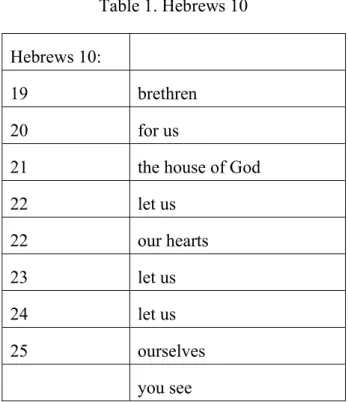
The writer of Hebrews gives an active plan for the Christian life. In opposition to the idea that the Christian life is passive or purely individual, he gives the church, as a body, several actions to take in Hebrews 10:19-25 (see table 1 below). He also makes our Christian life personal with many instructions directed to us, our church, the house of God, and one another. Each of these words and phrases refers either to the individual or to the family of Christ. The Christian faith does not nor cannot operate apart from the
“one anothers” of Scripture. Christ’s work was for us, the collective “us” of “the house of God.” We then, are to (1) draw near with true hearts and full assurance of faith, having (2) our hearts sprinkled from an evil conscience, and (3) our bodies washed with pure water. We are to (4) consider one another to stir up love and good works. We are (5) not to forsake the assembling of ourselves together but are to (6) exhort one another and even more often as we see the Day of Christ approaching.
A study about the “one anothers” in the New Testament will teach that the church of Christ needs one another to act in such a way that builds up each other to measurable Christian maturity. The Christian life is not the life of a loner but the life of the body living and growing together.
The enemy of God has worked through history to hinder the growth of the body of Christ, the church. One of Satan’s lies is that ultimate spirituality is in the clergy, not the laity. F. F. Bruce, in his commentary on Hebrews, explains why coming boldly was not normal thinking, and still may not be:
The “boldness” which believers in Christ have to enter the heavenly sanctuary through him is set in contrast with the restrictions which hedged about the privilege
the people could exercise this privilege, but the high priest only, as their
representative; and even he could not exercise the privilege any time he chose, but at fixed times and under fixed conditions.37
Table 1. Hebrews 10 Hebrews 10:
19 brethren
20 for us
21 the house of God
22 let us
22 our hearts
23 let us
24 let us
25 ourselves
you see
Hebrews 4:16 gives the church instruction to come with confidence, to come boldly before the throne of grace that they may find mercy and grace to help in time of need.
There are no restrictions for the Christ follower in coming to God; any assumed privilege of the clergy was removed by Christ. Every saved follower of Christ is called to this measurable maturity, the fullness of the stature of Christ.
Entering the holy place was unheard of in the Jewish temple, yet entering God’s holy presence is exactly what the writer of Hebrews calls Christians to do. Donald Guthrie, in his commentary on Hebrews, parallels the holy place in the temple with the presence of God: “This confidence is here specifically related to approach to God, to the
entry into the sanctuary or holy place, understood symbolically of the presence of God.
The picture is of all believers now having an open invitation to come into the holy place, which is no longer reserved for the priesthood.”38 This call to bold entry is important to the one-another teaching, in that each of us has come into the holy place where together, before the throne of God, we edify one another. Guthrie adds, “However it should be noted that access is available only to those who are classified as brethren, those who, according to 3:1, ‘share in a heavenly call’. It is important to note that those who discover this new approach to God through Jesus Christ also discover a new relationship to each other.”39
Our relationship with God through Christ is the basis of our “one another”
actions. We do not nor cannot maintain the “one anothers” of Scripture apart from our relationship with God through the blood of Jesus. Those who do not participate in these
“one another” activities are not enjoying this shared connection in the holy presence of God. While we can come boldly alone into God’s presence, when we come together, we enjoy another level of holy fellowship.
Bruce addresses the boldness we have through Christ and thus the ability to bring “one another” boldly in prayer to the throne of grace:
But those who have been cleansed within, consecrated and made perfect by the sacrifice of Christ, have received a free right of access into the holy presence; and our author urges his readers to avail themselves fully of this free right. Now a further assurance is given: the way by which this high priest has entered into the presence of God is a way which remains open for his people to follow him there.40 As we follow Christ boldly into the throne-room of God, we bring others with us, letting them know that they too can freely enter apart from any of Satan’s lies. Christ became the
38 Donald Guthrie, Hebrews: An Introduction and Commentary (Downers Grove, IL:
InterVarsity Press, 1983), 213.
39 Guthrie, Hebrews, 213.
40 Bruce, The Epistle to the Hebrews, 249.
living way in full contrast to the old and dead way. Christ, our living sacrifice, though typified by the lambs sacrificed on the temple alter, did not remain dead but by His resurrection became the new and living way. In John 14:6, Jesus calls himself the way.
He thus becomes the new and living way, the truth, and the life. It was Jesus himself who took Peter, James, and John with him to the Mount of Transfiguration. The Lamb brought with him those who previously did not belong into his holy place. As our perfect
example, Christ set a pattern for the “one anothers” of the New Testament.
Different from the Old Testament temple, Christ is now the new and living way. Simon Kistemaker, in his commentary on Hebrews, makes an interesting linguistic point:
Unfortunately, the translation of “new” is incomplete, for the Greek word actually means “just slaughtered.” It is a term relating to religious sacrifices.
The adjective living signifies that the way Christ has opened up for us is not a road without an exit: a dead-end street. Rather, this road leads us to salvation, into the very presence of God.41
Christ, the “just slaughtered” one is our new and living eternal way. This Way is important news to share with one another, to rejoice in together. When the church gathers, we gather to remember that Christ is the way through his body, broken for us.
Kistemaker explains:
Christ has dedicated the way by opening the curtain, “that is, his body.” At his death, the curtain to the Most Holy Place had to be torn from top to bottom.
Likewise, the body of Jesus had to be broken, and his blood had to be shed to open for us the way to God. By his sacrifice on the cross, Christ has removed the veil between God and his people.42
41 S. J. Kistemaker, Exposition of Hebrews, New Testament Commentary (Grand Rapids:
Baker Book House, 1984), 287.
42 Kistemaker, Exposition of Hebrews, 287.
From gathering to edify to gathering to remember the shed blood and the broken body of Christ, the one-another call of the New Testament is both functional and vital to our Christian walk (1 Cor 11:23-26).
While sin separates us from God (Isa 59:2), it also separates us from each other. As the wage of sin is death (Rom 3:23), sin brings death to human relationships as well as relationship with God. The first attack on Adam and Eve’s unity came after they sinned (Gen 3:12). The opening of the veil in the temple signified a new opportunity for relationships with God and with man. Bruce commented well on this:
The veil which, from one point of view, kept God and mankind apart, can be
thought of from another point of view, as bringing them together; for it was one and the same veil which on one side was in contact with the glory of God and on the other side with the need of men and women. In our Lord, Godhead and manhood were brought together; he is the true “daysman” or umpire who can lay his hand upon both because he shares the nature of both.43
Thus, in Christ, the “one anothers” of the New Testament unify the body of Christ. It is the blood of Christ that opened the way for us to God and for us to be restored to one another.
The position of Christ as the “great” (Greek μέγας) or “high” Priest is vital.
Bruce clarifies “great” and “high:”
The expression “great priest” is the literal rendering of the most common Hebrew title for the high priest; “great” has here comparative or superlative force, denoting
“the priest that is great above [i.e., greater than] his brethren” (according to the more literal rendering of Lev. 21:10). “God’s house” over which he exercises his high priesthood is, of course, the community of God’s people.44
The Great Priest who is over the house of God is over the church today. Since we gather in local churches as the body of Christ, he gathers with us, his people. G. L.
Cockerill, in his commentary on Hebrews, states,
43 Bruce, The Epistle to the Hebrews, 252.
44 Bruce, The Epistle to the Hebrews, 253.
The imagery of Christ the High Priest ‘consecrating’ a ‘way’ into the Most Holy Place fits smoothly with Christ the Pioneer, who opens the way for the faithful (11:1-40) to persevere until entrance into the heavenly homeland. Thus, this terminology anticipates the urgency of faithful perseverance that dominates the remainder of Hebrews (10:32-12:29).45
Where are the faithful to gather and to edify one another? We gather under our Great Priest and do so today in the house of God, the local church, over which our High Priest has complete oversight and rule.
Christ is the “High Priest over the house of God” (Heb 10:21). Guthrie ties this to Hebrews 3: “The expression over the house of God is a recollection of the statements in 3:1-6, where the superiority of Jesus over Moses is seen in relation to God’s house.
Here the words are comprehensive including both the church on earth and the church in heaven, but the main emphasis is on the earthly community as the sequel shows.”46 This earthly community sets the stage for the one-another actions to take place in the local church, the new household of faith opened by Christ for all who believe and are justified in Him.
How do we know who to gather with, who to enjoy the one-another fellowship with? Verse 22 makes this fellowship dependent upon those who have been cleansed and whose hearts are true, or sincere. Kistemaker brings clarity here:
When the author of Hebrews writes that we draw near to God with “hearts sprinkled to cleanse us from a guilty conscience” and with “bodies washed with pure water,”
he refers to the internal (hearts) and the external (bodies). The phrase washed with pure water reminds us of baptism. But baptism by itself is only an external act objectively experienced. Its counterpart is the sprinkling of our hearts with the blood of Christ (Heb. 9:14). This sprinkling is an internal act that is subjectively
appropriated. We are exhorted to approach God with body and soul cleansed from sin.47
45 G. L. Cockerill, The Epistle to the Hebrews (Grand Rapids: Eerdmans, 2012), 471.
46 Guthrie, Hebrews, 215.
47 Kistemaker, Exposition of Hebrews, 288.
These great truths are taught in the church where the believer gathers with others of the same convictions and learns to “draw near with hearts in full assurance of faith.” The one-another unity and edification in the church will push us toward greater spiritual understanding and necessary maturity.
Verse 23 calls us to do something with our newly cleansed lives, that is, we are called to hold fast to our confession. Bruce identifies a three-fold approach:
The exhortation is threefold: “let us approach . . . let us maintain . . . let us cultivate mutual consideration.” The importance of holding fast the Christian confession has already been emphasized: it is only “if we maintain our confidence and the hope in which we boast” that we are the house of God (3:6); it is only “if we maintain the beginning of our steadfastness firm to the end” that we are partakers or companions of Christ (3:14).48
Christianity is a confessional system; we are to confess Jesus Christ as Lord (Rom 10:9- 13). In the early church, to confess Christ was to deny any other self-proclaimed god as lord. Since Christ is our Great High Priest, since he has opened the way to God through the veil of his flesh, and since he has washed us clean with pure water, we are to hold fast to our confession of Jesus as Lord. Kistemaker pulls this together well:
We are told to keep on voicing our hope and to do so unfalteringly. God himself unfailingly has honored his promises. In fact, to make his promises unbreakable, God added an oath (Heb. 6:17). “He can as soon cease to exist as cease to be faithful to His promise.” The God who saved the believer through the sacrificial death of Christ has promised never to leave “the soul that on Jesus has leaned for repose.”
And God is faithful, for he promises the believer, Never will I leave you; never will I forsake you. [Heb. 13:5]49
God is unwavering in his faithfulness toward us. We are to be unwavering in our confession of him.
48 Bruce, The Epistle to the Hebrews, 256.
49 Kistemaker, Exposition of Hebrews, 289.
The writer of Hebrews calls the church to consider, to give concentrated thought,50 to provoking one another to love and to good works (10:24). Guthrie adds,
“The target set out is to stir up one another to love and good works. Some thought is clearly necessary to decide how this can best be done. Something more than individual effort is needed if love and good works are to be fostered. Christians must be alert to the needs of their fellows.”51 Rare is the church that gives careful thought and attention to stirring up one another to love and to good works. The church might be careful to correct those in the wrong while missing the responsibility to encourage those who are in the right. When the church emphasizes stirring up love, they “will be the more apt to confess their hope courageously and unhesitatingly if they encourage one another. Christian faith and witness will flourish the more vigorously in an atmosphere of Christian
fellowship.”52
Guthrie notes, “The word for stirring up (eis paroxysmon) is a striking term meaning ‘incitement’ and is either used, as here, in a good sense or, as in Acts 15:39, in a bad sense (i.e., contention). It seems to suggest that loving one another will not just happen. It needs to be worked at, even provoked, in the same way as good works.”53 The modern church member needs this same provoking, stirring up, or incitement to love one another more. Lives are full, people are busy; they bump from one activity to another and coming to church can become just something else to do. Preparing ourselves to
intentionally incite more love to one another will make church attendance something looked forward to.54
50 Guthrie, Hebrews, 217.
51 Guthrie, Hebrews, 217. Emphasis added.
52 Bruce, The Epistle to the Hebrews, 256.
53 Guthrie, Hebrews, 218.
The church today needs to ‘“carefully consider how we may ardently incite one another to love and to do good works,’ says the writer. Put your mind to work to find ways to provoke—in the good sense of the word—each other to increase your
expressions of love that result in doing noble works.”55 In the church and toward the church family is where we can carefully consider just how we may ardently incite one another to love and good works. Within the church family—among those we know, see, and love—we must put our minds to work to find ways to provoke one another to increased love and continued noble works of love. This “continuing debt” stays with us throughout this life, wherever we live, whatever we do, with whatever body of believers we belong. We should be looking for others to provoke, to stir up, to ardently incite to love and to good works.
Bruce defines “stirring up:”
The word “stimulate” (AV/KJV, ERV/ARV “provoke”; RSV “stir up”; NEB
“arouse”) is a strong one; it appears in one other place in the New Testament, and there in a very different way, of the “sharp contention” that broke out between Paul and Barnabas when they could not agree on taking Mark with them on a second apostolic visit to Cyprus and South Galatia (Acts 15:39). Perhaps this Greek word paroxysmos, like our English “provocation,” is more commonly used in the unfavorable sense of irritation than in the more pleasant sense used here by our author. It is the former sense that Paul has in mind in 1 Cor. 13:5 when, using the cognate verb paroxynō, he says that love “is not provoked.” But here love is provoked in the sense of being stimulated in the lives of Christians by the considerateness and example of other members of their fellowship.56
The idea of “provoking one another to love and good works” is a provocation to greater spiritual maturity. Having recently walked through my dad’s death, it was clear to us all that a pastor’s service to his congregation goes well beyond Sunday mornings.
pastor was quite surprised to hear from many that day that they were going to miss Sandra’s hugs and love that they counted on every week. Sandra loved people well and thus fulfilled this call to her church.
55 Kistemaker, Exposition of Hebrews, 289.
56 Bruce, The Epistle to the Hebrews, 256-57.
My dad, Pastor Bill Schroeder, was a pastor for over sixty years. “Pastor Bill” spent much of his life provoking people to follow Christ at a greater level. He encouraged young men to the ministry and young women to be good ministers of the gospel. In simple conversations, he provoked people to love and to good works encouraging them to greater spiritual maturity. Positive provocation is our job, our responsibility, not just as pastors but as brothers and sisters of those whose sins Christ has forgiven and whose lives he has washed. We then must provoke, stir up, one another with a provoking that affects all that we do.
Love is communal. For man, love extends to God and one’s neighbor.
Moreover, “God shows his love for us in that while we were still sinners, Christ died for us” (Rom 5:8). Loving one another as we love ourselves is also the fulfillment of the royal law spoken of in James 2:8. Christ called his followers to love the Lord with all their hearts and to love their neighbors as themselves (Matt 22:39). The writer of Hebrews is then building on the teaching of Christ, calling the church to give
concentrated thought on how, when they gather, they are going to stimulate one another to love and good works.
Entering Hebrews 10:25 with one another instruction enables us to clearly understand that a church that does not gather cannot fulfill these instructions.57
Kistemaker emphasizes that the church body has the responsibility to love one another by encouragement and edification:
The author [of Hebrews] exhorts the readers to “encourage one another daily . . . so that none of you may be hardened by sin’s deceitfulness” (3:13). He realizes that among some of the members, spiritual zeal has declined. Therefore, once more he says, “But let us encourage one another” (10:25). Not only the writer of this epistle
57 The year 2020 has given the church a new opportunity to understand the value of gathering.
Governments around the world restricted churches gathering due to the threat of Covid-19. While a pandemic forced the church into the electronic age, the people missed gathering. Yes, the church can find
but also all the members of the church have the communal task of encouraging one another daily.58
Christ is coming; as that day draws near, the church needs more from one another, not less. Paul’s teaching on the unity of the body of Christ is worth bringing up (1 Cor 12:12- 26). If the church is one body with each member uniquely fitted for the full function of the body, then the fully functioning body exists as love flows through its spiritual DNA from one part to another. In 1 Corinthians 12:25, Paul’s call is “that there may be no division in the body, but that the members may have the same care for one another.” The goal of the members of the body then is to care one for another while living in spiritual unity.
Kistemaker concludes,
Christianity is a religion of love that reaches out and brings people together. Sports, performances on the stage or screen, and politics draw large crowds. But
Christianity holds people together because it emphasizes participation in worship, praise, and work. Christians need each other to strengthen the wonderful bond of love they share in Jesus Christ.59
No other system of faith shares this emphasis. They cannot because they are the creations of selfish men. Only when a God whose steadfast love is from everlasting to everlasting (Ps 103:17), who has demonstrated his love by the giving of his Son (John 3:16), can his followers, his church filled with his love, effectively love one another.
The Apostle John on the “One Another’s”
“This is my commandment, that you love one another as I have loved you.
Greater love has no one than this, that someone lay down his life for his friends” (John 15:12-13). “A new commandment I give to you, that you love one another: just as I have loved you, you also are to love one another” (John 13:34). “Beloved, let us love one another: for love is of God; and everyone that loveth is born of God, and knoweth God”
58 Kistemaker, Exposition of Hebrews, 290-91.
59 Kistemaker, Exposition of Hebrews, 291.
(1 John 4:7, KJV). Other Johannine references (1 John 3:11, 23; 4:11, 12; 2 John 5) speak to loving one another.
Having considered the one another teaching from Hebrews 10, this love so clearly spoken in John’s writings seem to carry even more weight. Jesus’ teachings on loving one another were pre-ekklesia. After Pentecost and the inauguration of the ekklesia, the disciples of Christ put his teachings into practice. In the church, the “one another” teachings took on greater understanding as brothers and sisters in Christ were called into action. In Romans, we find these one-another teachings: we are to excuse one another in 2:15, prefer one another in 12:10, love one another in 13:8, not to judge one another in 14:13, to receive one another in 15:7, and to admonish one another in 15:14.
The writer of Hebrews calls us to exhort one another in 3:13, to consider one another in 10:24, and to exhort one another in 10:25.
Exegesis of 1 John 3:11. The apostle John adds to the call to love one another.
1 John 3:11 says, “For this is the message that you have heard from the beginning, that we should love one another.” In 1 John 4:7-8 John again calls us to love one another and to do so because we are born of God and God is love. In I. H. Marshall’s commentary on the Epistle of John he addresses our capacity to love: “But, although this is their character (v. 14), it is nevertheless necessary to urge them to love one another (vv. 11, 18). The nature of brotherly love is illustrated negatively by the contrast with Cain who murdered his brother and positively by the example of Jesus Christ who laid down his own life for us.”60 So then, while we possess the Holy Spirit of God and have experienced the steadfast love of God, he reminds us to intentionally and continually love one another.
Even though the Christian is a new creation in Christ (2 Cor 5:17) and has a new heart from God (Ezek 36:26), the selfish attitudes of the sinful flesh are not