BULLETIN OF MARINE SCIENCE, 69(1): 79-109, 2001
CORAL BLEACHING AND MORTALITY IN PANAMA AND ECUADOR DURING THE 1997-1998 EL NINO-SOUTHERN OSCILLATION EVENT: SPATIAL/TEMPORAL PATTERNS AND
COMPARISONS WITH THE 1982-1983 EVENT
Peter W. Glynn, Juan L. Mate, Andrew C. Baker and Magnolia O. Calderon
ABSTRACT
Bleaching and mortality of zooxanthellate corals during the 1997-98 El Nino-South- ern Oscillation (ENSO) event are documented for eastern equatorial Pacific localities in Panama (Gulf of Chiriqui and Gulf of Panama) and Ecuador (Galapagos Islands and mainland coast). Overall, the very strong 1997-98 and 1982-83 ENSOs were similar in magnitude and duration, but varied spatially, resulting in different patterns of elevated sea temperature stress and coral responses during the two disturbance events. Two bleach- ing episodes occurred in the Gulf of Chiriqui, each coincident with high (>30°C) in situ temperatures and warm water filaments visible in NOAA/NCEP SST fields. Coral mor- tality was significantly different among localities: Galapagos Islands (26.2%) > Gulf of Chiriqui (13.1%) > coastal Ecuador (7.0%) > Gulf of Panama (0%). Coral mortality was notably higher (52-97%) in the eastern equatorial Pacific in 1982-83 than in 1997-98.
Coral mortality among most sites within localities was also significantly different. High- est coral mortalities occurred at offshore compared with nearshore sites in Panama, and at the Galapagos Islands compared with mainland Ecuador. Although species responses varied among localities, tissue death was especially high in Millepora spp., Pavona spp., Pocillopora spp., waAPorites spp. Corals present in relatively deep (12-18 m), inter-reef habitats suffered lower rates of bleaching and mortality than similar and different species present in shallow (1-10 m) habitats. Bleached coral tissues in the Gulf of Chiriqui dem- onstrated a significant increase in zooxanthella density, but only a slight increase in chlo- rophyll a concentration over a 5 mo respite, from the end of the first bleaching event (October 1997) to the beginning of the second event (March 1998). The use of molecular DNA techniques to compare algal symbionts in bleached and healthy coral colonies re- vealed a strong correlation between bleaching severity and symbiont genotype, regard- less of depth. In particular, one symbiont genotype (commonly found in the scleractinian genus Pocillopora in the Gulf of Chiriqui) was particularly resistant to bleaching, indi- cating that symbiont diversity can play an important role in explaining spatial and host systematic patterns of bleaching. Extreme reductions in abundance of some species popu- lations in Panama have resulted in local extirpations. It is possible that Millepora boschmai, a Gulf of Chiriqui endemic hydrocoral, is now extinct. Remnant patches ofGardineroseris planulata that survived the 1982-83 ENSO in the Galapagos Islands have also disap- peared following the 1997-98 event, causing local extinctions. Marked declines in exter- nal bioerosion and corallivore abundances in Panama before and after the 1997-98 ENSO should have less of an effect on surviving corals than in 1982-83 when such effects continued to degrade reefs long after the initial disturbance. Surviving corals in the Galapagos Islands are still subject to heavy grazing pressure by abundant echinoid popu- lations. The response of eastern Pacific coral reefs to the 1997-98 El Nino cannot be fully understood without an appreciation of spatial/temporal variability and the historical stresses to which these reefs have been subject over the past 25+ yrs.
79
By several measures, the 1997-98 El Nino-Southern Oscillation (ENSO) has been judged to be the strongest event of the century (McPhaden, 1999; Chavez et al., 1999; but see Wolter and Timlin, 1998; Enfield, this issue). In the equatorial eastern Pacific, in the NINO 1+2 region (0-10°S, 80-90°W) off Ecuador and Peru, the 1997-98 ENSO ex- ceeded the magnitude and duration of the sea surface temperature (SST) anomalies of the 1982-83 ENSO event (Enfield, this issue). However, the 1982-83 ENSO also was un- usually strong, and at that time was claimed to have been the strongest documented ENSO ever (e.g., Gill and Rasmusson, 1983; Cane, 1986; Hansen, 1990). Both events have probably been enhanced by anthropogenic decadal warming during the 1980s and 1990s (Crowley, 2000; Karl et al., 2000; Stott et al., 2000). These extraordinary perturbations, causing elevated SSTs and other potentially stressful conditions to reef-building corals (e.g., increased solar insolation and penetration through the water column, river discharge, sedimentation, altered storm activity, increased incidence of pathogens), have been im- plicated in numerous coral reef bleaching and mortality events over the world's tropical seas during the past two decades (Brown, 1987; Coffroth et al., 1990; Williams and Bunkley-Williams, 1990; Glynn, 1993, 1996; Goreau and Hayes, 1994; Kushmaro et al, 1996). Since assessments of reef deterioration in the mid 1990s, which emphasized a dominant role for such direct anthropogenic stresses as nutrient pollution, sedimentation and over-exploitation (Smith and Buddemeier, 1992; Ginsburg, 1994), the recent height- ened effects of sea warming have altered the opinion of several workers who now main- tain that global climate change poses the greatest threat to coral reefs (Hoegh-Guldberg,
1999; Goreau et al, 2000; Wilkinson, 2000).
This contribution deals primarily with the effects of the 1997-98 ENSO event on east- ern Pacific zooxanthellate corals in Panama and Ecuador. The occurrence and progres- sion of SST anomalies in relation to zooxanthellate coral bleaching and mortality are examined. Quantitative comparisons are made of the various coral species affected in nonupwelling (Gulf of Chiriqui) and upwelling (Gulf of Panama) localities in Panama, the Galapagos Islands and the mainland coast of Ecuador. The responses of some small and threatened coral species populations are examined in detail. Observed variability in coral bleaching is examined in terms of the molecular identification of their dinoflagel- late symbionts. The zooxanthellae found in scleractinian corals are a diverse assemblage of symbiotic dinoflagellates in the genus Symbiodinium (Rowan and Powers, 1991; Trench, 1997). Multiple symbiont taxa can often be found within single species (and colonies) of coral host (Rowan and Knowlton, 1995; Baker, 1999) and this information has been used to explain bleaching variability in Caribbean Montastmea (Rowan et al, 1997). We adopt a similar approach to test the generality of these findings and explore variation in bleach- ing response in the reef-building corals of the far eastern Pacific.
Finally, comparisons are made of the effects of the 1982-83 and 1997-98 ENSO dis- turbances on equatorial eastern Pacific coral communities. Since the moderately strong ENSOs of 1987 and 1990-95 (Trenberth and Hoar, 1996) caused only moderate to light coral bleaching in Panama and the Galapagos Islands (Podesta and Glynn, 1997), with no apparent lasting effects, they are not considered in this study. Corals adversely affected during the 1997-98 and earlier ENSO events in other parts of the eastern Pacific (Colom- bia, Costa Rica, Mexico) are considered elsewhere in this special issue. Recent ENSO disturbances to corals and coral reefs in other tropical regions worldwide are documented in Wilkinson (1998, 2000), Berkelmans and Oliver (1999), Hoegh-Guldberg (1999), Marshall and Baird (2000), McClanahan et al. (2000), and Souter et al. (2000).
GLYNN ET AL.: CORAL BLEACHING AND MORTALITY IN PANAMA AND ECUADOR g 1
STUDY SITES AND METHODS
STUDY SITES AND SAMPLING SCHEDULE.—This study embraces four localities (Gulf of Chiriqui and Gulf of Panama in Panama, the Galapagos Islands, and mainland Ecuador), each comprising sev- eral sampling sites (Fig. 1). The majority of the principal study sites have been monitored since the early 1970s in Panama and the mid-1970s in the Galapagos Islands (Glynn and Wellington, 1983;
Glynn, 1990,1994). Sampling sites in Panama are located in the nonupwelling Gulf of Chiriqui and the seasonally (mid-December to April) upwelling Gulf of Panama (Glynn and Stewart, 1973;
Glynn, 1977) (Fig. 1A). These localities have been observed approximately annually during non- ENSO conditions and more frequently (two to four times per year) during ENSO activity. Begin- ning in 1997, quantitative surveys in Panama were conducted in March, September, October and November, in 1998 in March and April, and in 1999 in May. Sampling sites in the Galapagos Islands range from the southern and central archipelago to the northernmost islands (Fig. IB). Field sampling also has been conducted approximately yearly in the Galapagos, except for the northern islands, which have been visited only every 3^4 yrs. Additionally, observations are noted from the central coastal area of mainland Ecuador, from La Plata and Islote Islands in the north to Ayangiie in the south (Fig. 1C). Coastal areas in Ecuador were surveyed on 31 January 1975, 19 August
1986, 7-9 March 1991, and 19-21 May 1998.
SEA WATER TEMPERATURE.—In situ sea temperatures were recorded at 2 m depth (relative to MLLW) at the Uva Island and Saboga Island coral reefs in Panama, and at 1.5-7 m at four sites in the Galapagos Islands, utilizing calibrated (±0.53°C) Hobo, Stowaway and Tidbit temperature loggers (Onset Computer Corporation). Recording frequency varied from 36 min to 192 min, depending on the sensor memory capacity and the time the recorders were left in the field. In the Galapagos Islands, temperature recorders were maintained at (1) Xarifa Island, east end of Espanola Island, 2 m depth; (2) Devil's Crown, north side of Floreana Island, 1.5 m; (3) northeast anchorage of Santa Fe Island, 2 m; and (4) east side of Marchena Island, 7 m; Figure IB. The temperature loggers were all located at sites with pre-1983 (Xarifa, Espanola, Santa Fe) or current (Marchena) abundant coral populations. To help plan site visits during the 1997-98 ENSO event, SSTs and SST anomalies (optimum interpolation analysis produced weekly on a one-degree grid) were also reviewed at the NOAAweb site: www.cdc.noaa.gov/ENSO/. Weekly mean SST data off coastal Chiriqui (Panama), in the Gulf of Panama, Galapagos Islands and coastal Ecuador, from a 1 x 1° grid, were obtained from Reynolds NCEP optimal interpolation (01) analysis that combines ship reports, buoys and satellite measurements. The 01 analysis uses in situ and satellite SSTs plus SSTs simulated by sea- ice cover. Before the analysis is computed, the satellite data are adjusted for biases (see Reynolds and Smith, 1994).
CORAL RESPONSES.—Coral condition was assessed for areas within single colonies displaying different health states. For example, the scoring of the condition of a patchily affected single colony might be 20% pale, 40% bleached, and 40% dead. Coral tissue pigmentation was scored as normal (N, full color characteristic of any given species in a healthy state), pale (P, evident loss of colora- tion), bleached (B, stark white with no obvious pigmentation), and dead (D). The dead category was further subdivided into recently dead, usually with filamentous algae invading the skeleton, and old dead, with macroalgae, coralline algae, bryozoans, barnacles, interalia, invading an often bioeroded skeleton. A flexible measuring tape calibrated in millimeters or a square wire mesh (2.5 cm x 2.5 cm) was used to measure colony surfaces. Monitoring results in Panama and the Galapagos indicated that recently dead coralla had succumbed over a period of a few to several weeks, whereas old dead coralla had been dead for several months to a few years. We suspect that bleaching in the Gulf of Chiriqui began at the end of July because all Millepora intricata Milne Edwards colonies were dead and covered with filamentous algae in September, 1997. Changes in live coral cover were determined by tracing the outlines of coral species in situ on gridded, water-resistant data sheets in permanently marked quadrats. Scanned coral images were imported into Sigma Scan Pro (SPSS) to obtain live surface areas. Sampling in the Galapagos Islands was performed 6 months after the first observed coral bleaching (10-20 May 1998). Coral condition in Panama was sampled
Darwin 1
1 k
100 Km
A
isabela l
4 Marcheno I
#OEP -Genoveso I
<^\ \ Sqntiogo I o°-
Ferncrid'no i ^>
N ^^ ; ^-~**QSanta Cruz I CUPC H »f CD JOCR
J PE'Santa Fe I €^
. p San Cristobal I
Floreana I ,_ - 5 , tspanola I
92° 90°
i Salango I Los Ahoroados Is.
Bajo Montanita
Islote I.,
pafMachalilla FR Og?&i. Puerto Lopez
Ayangue 2o.
Banco Cope., Salinas iJ^La Libertad
Figure 1. Equatorial eastern Pacific study localities in Panama (A), Galapagos Islands (B) and central mainland coast of Ecuador (C). See Figure 10 and Tables 1,3,4 and 5 for identity of 2-letter site codes. Panama - CO, Contadora I; SA, Saboga I; IG, Iguana I; CB, Coiba I. Galapagos Is - CI, Canal de Itabaca.
quantitatively on 11-15 March 1998, during the second bout of bleaching then about 14 mo later (19-21 May 1999). Coral condition at coastal sites in mainland Ecuador was assessed from 19-21 May 1998, an undetermined time after initial coral bleaching.
ZOOXANTHELLAE AND CHLOROPHYLL.—Zooxanthella densities and chlorophyll concentrations were determined in branching and massive coral species in normal, pale and bleached condition from Jicaron and Uva Islands (Gulf of Chiriqui, Panama) in October 1997 and March 1998 respectively (Fig. 1 A). Samples were removed with hammer and chisel or pliers, wrapped in aluminum foil and frozen (-20°C) until processing. Coral tissues were separated from the skeleton with jets of dis- tilled water from an air brush at low pressure (60 psi). Surface areas of corals were determined by the aluminum foil technique of Marsh (1970). The concentrations of chlorophyll a and c were calculated according to Jeffrey and Haxo (1968).
ALGAL SYMBIONT TAXA.—Samples of 13 species of scleractinian corals were collected from Uva Island reef (Gulf of Chiriqui, Panama) under normal (non-bleached) conditions (12-17 July 1995;
n = 58), and from the same site when El Nino bleaching was first documented (18 September 1997;
n = 61). These samples were compared with a similar collection of healthy (non-bleached) corals from the Canal de Itabaca, Marchena and Espanola Islands (Galapagos Islands) made prior to El Nino bleaching (24-28 May 1997; n = 18). All samples were removed from colonies in situ by
GLYNN ETAL.: CORAL BLEACHING AND MORTALITY IN PANAMA AND ECUADOR gg
SCUBA divers. Samples of pocilloporid corals [Pocillopora damicornis (Linnaeus), Pocillopora elegans Dana and Pocillopora inflata Glynn] were removed from the end termini (distal 2 cm) of outer branches. Samples from non-pocilloporid corals [Psammocora stellata (Verrill), Psammocora superficial Gardiner, Pavona clavus Dana, Pavona varians Verrill, Pavona sp. a, Pavona gigantea Verrill, Pavona frondifera Lamarck, Porites panamensis Verrill, Porites lobata Dana, and Gardineroseris planulata (Dana)] were collected as small branch nubbins (Psammocora spp.) or shallow cores taken with a hollow steel punch (all other species). Samples were classified visually as N (normal), P (pale), B (bleached), and additionally M (mottled or patchy pigmentation). Colo- nies from Panama in 1997 that showed extreme variation in their bleaching were sampled once from a 'healthy' region and once from a 'bleached' region (see Fig. 2). All samples were preserved in liquid nitrogen (Uva Island) or saline DMSO buffer (Galapagos) at the surface within 1 h.
Tissue was removed from the skeleton of preserved samples by jetting with modified 'zooxan- thella isolation buffer' (Rowan and Knowlton, 1995) using an airbrush, and DNA was extracted from the resulting tissue slurry using established methods (Rowan and Powers, 1991; Baker et al., 1997). Large subunit rRNA genes (IsrDNA) were PCR-amplified from the genomic DNA prepara- tions using the primers 2415F4 (or 2415F1) and 2423R1. In some cases, mixtures of symbiont- and coral-derived PCR products were obtained; in these cases zooxanthella products were separated from the coral-derived products by gel purification and subsequently re-analyzed (Baker, 1999).
Restriction Fragment Length Polymorphisms (RFLPs) in amplified dinoftagellate IsrDNA were obtained using the enzymes TaqI and Hhal (New England Biolabs) following established protocols (Baker and Rowan, 1997). Representative RFLP genotypes were cloned into the vector pGEM-T and their sequence obtained on an ABI 377 using primers that bordered the cloned insert (Baker,
1999) (see Fig. 3).
RESULTS
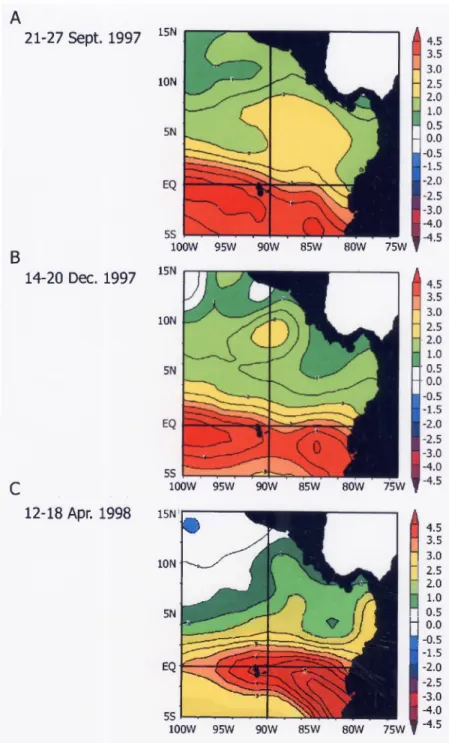
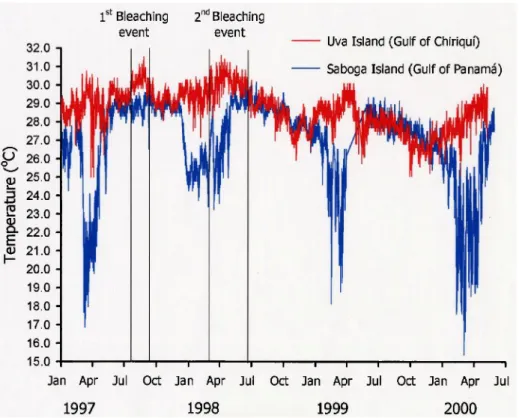
IN SITU SEA TEMPERATURES AND CORAL BLEACHING.—The development and propagation of SST anomalies (SSTA) along the equator and coastal areas of the eastern Pacific oc- curred from mid March 1997 to the end of June 1998. Of relevance to this study are the 3 to 4°C positive anomalies that extended unbroken from the Galapagos Islands to the mainland coast of Ecuador, and warm filaments, appearing during two periods (mid- 1997, early to mid-1998), that moved from the equatorial warm pool in a northeasterly direction toward the Central American coast (Fig. 4). Positive SSTAs in the Panama Bight, present from the Colombian coast to the Gulf of Panama, were notably lower (~1°C) than surrounding anomalies to the south and west. In Panama (Gulf of Chiriqui), sea tempera- tures potentially stressful to corals (>30°C) first reached 30°C in March and April 1997, declined slightly to around 29°C, and then increased to 30-31°C from late July to Octo- ber 1997. The latter period coincided with the first coral bleaching event, which was observed on 17 September 1997 (Fig. 5). All zooxanthellate corals showed some signs of bleaching, to their depth limits of 18-20 m. The most severely bleached (stark white) colonies still had extended polyps and no signs of algal overgrowth, suggesting the event occurred relatively recently. Since most shallow-occurring colonies of M. Intrlcata were already dead and covered with a thin film of filamentous algae, it is probable that these zooxanthellate hydrocorals bleached as early as late July. Temperatures then fell slightly below 30°C in October, and began to rise gradually in December, and remained mostly between 29-31°C from March to the end of July 1998. This period marked the second coral bleaching episode (Fig. 5), which included corals that bleached earlier and recov- ered (i.e., regained their normal pigmentation in the intervening 4 mo) as well as corals that did not bleach earlier. Over the same 2 yr period, upwelling in the Gulf of Panama
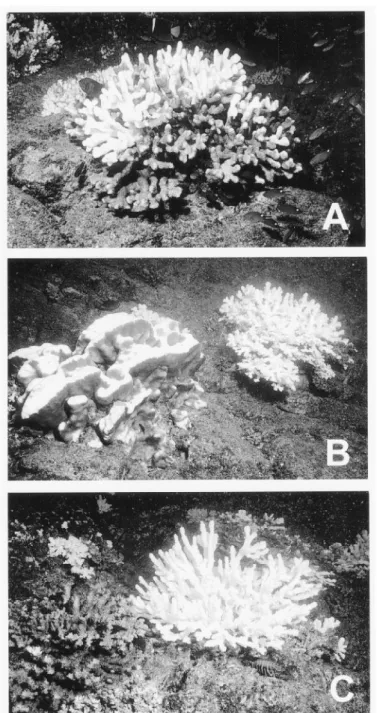
Figure 2. Bleaching variability in scleractinian corals at Uva Island, Gulf of Chiriqui, 15 October 1997. (A) (Apparent) single colony of Pocillopora showing distinct 'mottled' bleaching, with part of colony appearing severely bleached and remainder of colony unaffected. Bleaching severity appears independent of irradiance. (B) Colony of Pavona clavus (left) showing clear light-related patterns of bleaching, with top (brightly lit) surfaces significantly more bleached than side (dimly lit) surfaces. Pocillopora colony (right) completely bleached on all surfaces. (C) Two colonies of Pocillopora showing very different degrees of bleaching. Left-hand colony is apparently entirely unaffected; right-hand colony is severely bleached throughout.
GLYNN ETAL.: CORAL BLEACHING AND MORTALITY IN PANAMA AND ECUADOR KS
Figure 3. Diversity of symbiotic dinoflagellates in eastern Pacific coral reef cnidarians revealed by surveys of Restriction Fragment Length Polymorphisms (RFLPs) in symbiont large subunit ribosomal DNA. Two enzymes—TaqI (top left panel) and Hhal (right-hand panel)—distinguish eight distinct taxa within four clades of Symbiodinium (A, B, C and D) in these hosts. First lane of each gel is a molecular size marker with sizes (in bp) indicated. Nomenclature for RFLP genotypes in clade C uses numerals (1, 2, 5) or letters (pi, pp) to differentiate genotypes. Algal symbiont phylogeny (bottom left panel), inferred from partial large subunit rDNA sequences, reconstructs evolutionary relationships between these four clades. Scale bar indicates number of substitutions per nucleotide.
See Baker (1999) for further details.
was pronounced in March and April 1997, with SSTs sometimes a full 10°C lower than in the Gulf of Chiriqui (Fig. 5). Also, after the upwelling season, during the two periods of coral bleaching in the Gulf of Chiriqui, Gulf of Panama SSTs reached only about 29°C and no evidence of bleaching was observed.
Reynolds SST data, centered at 7.5°N, 82.5°W, and the Uva reef in situ data were in good agreement during 1997-1998 (Figs. 5,6A). The peak SSTs of ~30°C and above, and their timing, are evident in both temperature records. The Reynolds SST record during the 1982-83 ENSO is also shown, revealing a generally lower warming trend
21-27 Sept. 1997
15NION
B
14-20 Dec. 1997
100W 95W 90W 85W SOW 75W 15N
ION
100W 95W 90W 85W SOW 75W
12-18 Apr. 1998 ISN
ION
5N
EQ
5S
# ^
t^+jj j
-^Es^5~S
^—__#^4^
^fl
100W 95W 90W 85W SOW 75W 4.5 3.5 3.0 2.5 2.0 1.0 0.5 0.0 -0.5 -1.5 -2.0 -2.5 -3.0 -4.0 -4.5
Figure 4. Sea surface temperature anomalies in the equatorial eastern Pacific for three periods during the 1997-98 El Nino: (a) 21-27 September 1997, (b) 14-20 December 1997, and (c) 12-18 April 1998. Data are NOAA/NCEP weekly SST fields (Reynolds and Smith, 1994), created by C.
Mark Eakin using the NOAA-CIRES Climate Diagnostics Center, Boulder, Colorado, USA, from their Web site at http://www.cdc.noaa.gov/. Anomalies are relative to the base period of 1961—
1990. Note the nonlinear color-coded temperature scale.
GLYNN ETAL.: CORAL BLEACHING AND MORTALITY IN PANAMA AND ECUADOR X7
1st Bleaching 2nd Bleaching event event
Uva Island (Gulf of Chiriquf) Saboga Island (Gulf of Panama)
u
26.0 -%.x
2 25.0 -
4-> 3 24.0 -
2 23.0 - a>
a. E
,(U 22.0 - 21.0 - h- 20.0 - 19.0 - 18.0 - 17.0 - 16.0 - 15.0 -
Apr Jul Oct Jan Apr Jul Oct Jan Apr Jul Oct Jan Apr Jul
1997 1998 1999 2000
Figure 5. Sea temperature variability at Uva Island (red) and Saboga Island (blue) study reefs, January 1997-May 2000, 2 m depth. Coral bleaching events are denoted for Uva Island. Data are missing from the April-May 1999 period.
than during the more recent event. The mean weekly SST during the 1982-83 period was 28.9°C (SD = 0.64, n = 104) and 29.1°C (SD = 0.81, n = 105) during the 1997-98 period. The persistence of SSTs above 30°C, considered a bleaching threshold in the Gulf of Chiriqui, spanned 3 wks in April 1983 and 6 wks in April-May 1998. The single bleaching episode during the 1982-83 ENSO occurred only in 1983, near and over the interval of maximum SSTs. Gulf of Panama in situ SSTs were notably lower than Reynolds SSTs during upwelling, by -8.5°C in 1997 and -2.0°C in 1998 (Figs. 5,6B). Reynolds SSTs in the Gulf of Panama were also lower in 1982-83 than in 1997-98, especially during the first year (Fig. 6B). Coral bleaching in the Gulf of Panama in 1983 occurred when SSTs exceeded 29°C.
Galapagos Reynolds SSTs were nearly 2°C above (~28°C) the climatological seasonal cycle by April 1997, and maintained a high level (~27°C) from May to August, during the normally cool season in this area (Fig. 7A; Podesta and Glynn, this issue). Potentially stressful SSTs in the Galapagos are >28°C (Glynn et al, 1988; Podesta and Glynn, 1997).
By late December 1997, temperatures recorded at 2 m depth at Xarifa Island (Fig. IB, east end of Espanola Island) began to increase sharply and fluctuated between 29 to 31 °C until the first of June, a period of about 4.5 mo (Fig. 8). The first report of coral bleaching by Eric Eisenhardt, issued over the internet (fttp://coral.aoml.gov/pub/champ/bleach/
B980106.dat), occurred during 18-30 December 1997. At this time, SSTs were nearly 28°C and SSTAs of 3.5-4.5°C had persisted in the area for about 3 mo (Figs. 4,7A).
u to to
31
30
29-
28
27 -
26
1997-98 ENSO 1982-83 ENSO Jan Mar May Jul Sep Nov Jan Mar May Jul Sep Nov Jan
31
30 29 U to to
28- 27 26 -
25
1997-98 ENSO 1982-83 ENSO Jan Mar May Jul Sep Nov Jan Mar May Jul Sep Nov Jan
Figure 6. (A) weekly mean SSTs (Reynolds NCEP optimal interpolation analysis) in the Gulf of Chiriqui, Panama (07°N, 82°W), 1982-1983 and 1997-1998, and (B) Gulf of Panama (08°N, 79°W).
Coral bleaching periods in A and B are denoted by thin (1982-83) and thick (1997-98) lines at the tops of the temperature plots.
Bleaching was observed in the southern (Espanola) and central (Santa Fe, Santa Cruz and Bartolome) Galapagos Islands, and involved the upper surfaces (-20%) of about 80% of the colonies of IPorites lobata (species identity questionable). In all likelihoods lobata was the species affected according to the brief description noted. Surveys conducted from 25 January to 7 February 1998 at Floreana Island, Santa Cruz Island, and two western island sites (Isabela and Fernandina Islands), documented high levels of community- wide bleaching (R. H. Bustamante, R Martinez and F. Rivera, pers. comm.). Overall, between 70 to 90% of all corals were bleached, including species in the genera Pocillopora, Porites, Pavona, Psammocora, Diaseris and Cycloseris. Additionally, some colonies of
GLYNN ET AL.: CORAL BLEACHING AND MORTALITY IN PANAMA AND ECUADOR
u
32 30 - 28 -
26 -
24 22 20
1997-98 ENSO 1982-83 ENSO
Jan Mar May Jul Sep Nov Jan Mar May Jul Sep Nov Jan
32 i B
1997-98 ENSO 30 - 1982-83 ENSO
28-
A /f\\
G 26-
/UA, tr l\
5 24- 22 -
J f^vf \Vu vv w
20 - 18
vy
Jan Mar May Jul Sep Nov Jan Mar May Jul Sep Nov Jan
Figure 7. (A) Weekly mean SSTs (Reynolds NCEP optimal interpolation analysis) in the Galapagos Islands (00°, 90°W), 1982-83 and 1997-98, and (B) off the central Ecuadorean coast (02°S, 82°W).
Coral bleaching periods in A are denoted by thin (1982-83) and thick (1997-98) lines at the top of the temperature plots.
the azooxanthellate coral Tubastraea coccinea Lesson appeared to lose their normal pig- mentation, numerous barnacles died, and black corals and gorgonians experienced tissue loss and invasion by filamentous algae. Coral bleaching began in mid January 1983, affecting all species, but at slightly lower Reynolds SSTs than in 1998 (Fig. 7A).
In terms of timing, the in situ 1997-98 temperatures at Xarifa Island were similar to those recorded at Santa Fe, Devil's Crown and Marchena Islands. A correlation analysis (Pearson product moment correlation) of the temperatures at these four sites, comparing only identical time intervals (Santa Fe omitted due to three missing months), revealed highly significant (P < 0.0001) correlation coefficients, ranging from 0.909 to 0.987.
Table 1. Statistical comparison of temperature differences among sites in Galapagos Islands.
Dunn's a posteriori multiple comparisons testing indicated significant mean differences (P < 0.05) among all sites.
Site Code Mean Median H
Marchena Island EP 1687 26.5 27.1
Xarifa Island ES 1687 25.7 26.1
Devil's Crown Island DC 1687 25.9 26.6
210.06 <0.001
However, statistical testing indicated significant temperature differences among sites (P
< 0.001, Kruskal-Wallis anova on ranks). A multiple comparison procedure (Dunn's method, P < 0.05) demonstrated that the highest median (Md) temperature at Marchena (Md = 27.10°C, mean = 26.52°C) was statistically higher than those at Xarifa (Md = 26.10°C, mean = 25.72°C) or Devil's Crown (Md = 26.60°C, mean = 25.97°C). The me- dian temperature at Devil's Crown was also significantly higher than at Xarifa (Table 1).
A comparison of Xarifa temperatures at 2 m depth with Reynolds SSTs from coastal Ecuador (centered at 1.5°S, 81.5°W) during the 1997-98 event indicates that near-shore sea warming was not so pronounced as in the Galapagos Islands (Figs. 7B,8). Sea tem- peratures at Xarifa and coastal Ecuador demonstrated similar excursions in 1997, show- ing sudden increases to about 28° C by April and then marked fluctuations of 3-4°C soon after. However, in early to mid-1998, Xarifa temperatures climbed to and remained at 30°C for about 3 mo whereas off mainland Ecuador SSTs never quite reached 30°C over the same period. A comparison of 1982 with 1997 shows the latter period to be 2-3°C higher on several occasions (Fig. 7B). However, 1998 and 1983 demonstrated similar high temperatures, both with weekly means near 30°C, with the recent ENSO maximum SSTs occurring 1—1.5 mo earlier in the year. The mean weekly SST during 1982-83 was 25.3°C (SO = 2.47, n = 104) and 25.9°C (SD = 2.30, n = 105) during 1997-98. Notably high SSTs of >29°C persisted for 11 wks during May-July 1983 and for 10 wks during March-May 1998 (Fig. 7B). The timing of mainland bleaching episodes is not known.
32 -,
O
-I—'—i-
Jan Mar May Jul Sep Nov Jan Mar May Jul Sep Nov Jan
1997 1998 1999
Figure 8. Approximately hourly sea water temperatures at Xarifa Island (2 m depth), eastern end of Espanola Island, Galapagos Islands, 1997-1998.
GLYNN ET AL.: CORAL BLEACHING AND MORTALITY IN PANAMA AND ECUADOR 91
fully bleached partially bleached normally pigmented
Uva Island, October 1997 Uva Island, October 1997
Pc Pd Pe PI Pc Pd Pe PI
Figure 9. Zooxanthella densities (crrr2) and chlorophyll a concentrations in corals at Uva Island, October 1997 and March 1998, and at Jicaron Island, March 1998, Gulf of Chiriqui, Panama. Pc - Pavona clavus, Pd - Pocillopora damicornis, Pe - Pocillopora elegans, PI - Porites lobata.
TISSUE BIOMASS ATTRIBUTES.—At the end of the first bleaching event (October 1997) in the Gulf of Chiriqui (Panama), normally pigmented tissues in P. clavus, P. damicornis and P. elegans contained between 106 to 107 zooxanthellae cnr2, and partially bleached tissues around 106 zooxanthellae cnr2 or slightly less (Fig. 9). Mean zooxanthella densi- ties in bleached tissues were around 104 cells cnr2. Chlorophyll a concentrations were more variable, demonstrating highest levels (0.8 Ug cnr2) in normally pigmented Pocillopora species to values of less than one-half of the former in P. clavus. Photo syn- thetic pigments in partially bleached tissues ranged from about 0.2 to 0.3 Ug cnr2, and were barely detectable (~ 0.03 ug cnr2) in bleached tissues. Zooxanthella densities exhib-
3,552 12 13.1 428.14 <0.001
1,163 13 262
917 9 7.0
Table 2. Statistical comparison of percent coral mortality among localities.
Site n (colonies) n (species) mean mortality (%) H Panama (Gulf of Chiriqui)
Galapagos Islands Ecuador (mainland coast)
ited a marked increase in the bleached tissues of Pocillopora spp. after the first bleaching event (by March 1998), with between 105 to nearly 106 cells cirr2. P. lobata demonstrated similar zooxanthella densities as Pocillopora spp. at this time. Chlorophyll a concentra- tion did not show any consistent change over the 5 mo period, but was lower (<0.2 ug cirr2) in partially bleached colonies of P. clavus than after the first bleaching event. P.
elegans exhibited an increase in chlorophyll a in bleached tissues, to a mean concentra- tion of 0.1 \lg cirr2 after 5 mo. Tissue biomass parameters sampled at Jicaron Island in March 1998, also in the Gulf of Chiriqui (Fig. 1 A), generally demonstrated similar values to those reported at Uva Island.
COMPARISON OF AREAS.—Differences in coral condition were examined in relation to localities, sites within localities, and species within sites. The condition of all zooxanthellate scleractinian corals, ranging from nine to 13 species per locality, was compared among three localities: Panama (Gulf of Chiriqui), the Galapagos Islands, and mainland Ecua- dor. Since corals in the Gulf of Panama (Panama) showed no signs of bleaching or mor- tality at three sites (Iguana Island, Saboga Island, Contadora Island) during the 1997-98 warming period, this upwelling locality was omitted from the statistical treatment. Mean coral mortality was highly significantly different among localities (P < 0.001, Kruskal- Wallis anova on ranks). Corals in the Galapagos Islands suffered the highest mortalities (26.2%), followed by Panama (13.1%), then coastal Ecuador (7.0%). A posteriori testing indicated that all of these mean mortality values were significantly different (Table 2).
Mean instead of median values are reported due to the high numbers of colonies showing no (zero) mortality.
Coral mortalities among four sites in Panama were significantly higher at the offshore islands of Montuosa (54.8%) and Jicaron/Jicarita (11.9%) than mortalities of less than 4% at the inshore islands of Uva and Silva de Afuera (Table 3). Of the 10 island sites examined in the Galapagos Islands, Espanola and Santa Fe islands demonstrated the highest coral mortalities, 75.5% and 49.1% respectively, which were not statistically dissimilar (Table 4). A second group of relatively high mortalities occurred in Academy Bay, Santa Cruz Island, off the Charles Darwin Research Station (45.6%) and at Punta Estrada (29.0%), at the entrance of Academy Bay. Mortality values declined steadily at three sites on or near Floreana Island, from 23.3% at Devil's Crown to 19.7% at Playa La Picona. The Table 3. Statistical comparison of percent coral mortality among sites in Panama (Gulf of Chiriqui). Dunn's a posteriori multiple comparisons testing indicated significant mean differences (P < 0.05) among all sites except for Silva de Afuera Island and Uva Island.
Site Code n (species) n (colonies) mean mortality (%) H P 391.06 <0.001
Montuosa Island MO 2 90 54.8
Jicaron/Jicarita Islands JI 10 1,071 11.9
Uva Island UV 10 636 3.2
Silva de Afuera Island SI 6 245 3.8
ES 5 105 75.5"
SF 3 49 49.1"
CD 6 123 45.6"
PE 5 81 29.0"
DC 6 181 233
CH 2 51 22.3
LP 6 51 19.7
PC 3 49 11.6
EP 3 447 11.6
CR 4 24 10.4
344.78 <0.001
GLYNN ET AL.: CORAL BLEACHING AND MORTALITY IN PANAMA AND ECUADOR 93
Table 4. Statistical comparison of percent coral mortality among sites in the Galapagos Islands (Ecuador). a,b identify mean values that are not significantly different (Dunn's method, P <
0.05).
Site Code n n mean H P (species) (colonies) mortality
(%) Espanola Island
Santa Fe Island
Charles Darwin Research Station Pta. Estrada (Santa Cruz Island) Devil's Crown (Floreana Island) Champion Island
Playa La Picona (Floreana Island) Pta. Carrion (Santa Cruz Island) Pta. Espejo (Marchena Island) Caleta Robinson (Santa Cruz Island)
lowest mortalities (10.4-11.6%) occurred at two sites on the northeast corner of Santa Cruz Island, and at Marchena Island, the northernmost island sampled in the Galapagos in 1998. Only one of five sites surveyed along the mainland coast of Ecuador, namely Los Frailes, revealed exceptionally high coral mortality with 75.6% of the surface area af- fected (Table 5). This high value occurred in P. damicornis, a particularly sensitive spe- cies which was the only one present at this site. Mortality was relatively low at the re- maining four sites, ranging from 1.4% at Cabuya to 6.8% at Machalilla.
COMPARISON OF SPECIES.—The condition of five abundant and widely distributed east- ern Pacific coral species contributing most to reef building is summarized in Figure 10 for all sites surveyed in the principal study localities. Two pocilloporid species, P.
damicornis and P. elegans, suffered moderate to high incidences of bleaching and high mortalities at several sites, particularly in the Galapagos Islands. P. elegans appears to have suffered less bleaching than P. damicornis in the Galapagos. P. damicornis was heavily affected at Los Frailes in mainland Ecuador. The massive species, P. clavus, ex- perienced frequent bleaching and relatively high mortality, especially in the Galapagos Islands. Extensive bleaching, but relatively lower levels of mortality, also occurred in P.
gigantea and P. lobata.
ENDANGERED SPECIES.—Three hydrocoral species {Millepora platyphylla, Millepora boschmai, M. intricatd) and three scleractinian species (Pavona sp. a, P. panamensis, G.
planulata) that experienced presumed extinctions, local extirpations or severe reductions Table 5. Statistical comparison of percent coral mortality among sites at mainland Ecuador.
a identifies mean values that are not significantly different (Dunn's method, P < 0.05).
Site Code n n mean H P (species) (colonies) mortality
(%)
263.68 <0.001
La Plata Island PL 9 570 4.8
Pta. Los Plcaros PI 1 93 3.3
Los Frailes FR 1 34 75.6
Machalilla MA 5 183 6.8'
Cabuya CA 3 155 L4"_
P. damicornis P. elegans
CA MA FR PL CD LP ES SF PC CR SI Jl SE UV MA PL CD DC LP ES SF PC CR SI Jl SE UV
100 80
o 40 O
P. clavus P. gigantea
I II
#
CA MA PI PL CD PE DC PC EP SI Jl MO SE UV CA MA PL PE DC LP CH PC CR EP SI Jl SE UV
100 80 60 - 6 40 O
P. lobata
I'l
Dead Bleached NormalMainland Ecuador CA: Cabuya MA: Machalilla FR: Los Frailes PI: Pta. Los Picaros PL: Isla La Plata Panama
SI: Silva de Afuera Island UV: Uva Island SE: Secas Island
Jl: Jicaron and Jicarita Islands
Galapagos CD: Charles Darwin CH: Champion CR: Caleta Robinson DC: Devil's Crown EP: Pta. Espejo ES: Espanola LP: La Picona PC: Pta Carrion PE: Pta. Estrada SF: Santa Fe
PE DC LP CH EP SI Jl SE UV
Figure 10. Coral colony condition in five zooxanthellate species sampled at several sites in Panama (Gulf of Chiriqui), 10-15 March 1998; the Galapagos Islands, 10-20 May 1998; and the mainland coast of Ecuador, 19-21 May 1998. The dead, bleached and normal categories refer to the mean condition of numerous colonies surveyed at each site. Colony sample sizes are noted in Tables 4—6.
in abundances following recent very strong ENSOs (Glynn, 1997) are considered here.
Due to the difficulty of establishing the population status of coral species over their ranges, these corals are tentatively regarded as endangered, i.e., they would seem to face "... a very high risk of extinction in the wild in the near future" (IUCN, 1994). Since M. boschmai, Pavona sp. a and P. panamensis are likely eastern Pacific endemics, these species would appear to be the greatest at risk.
No live colonies of the zooxanthellate hydro coral M. platyphylla Hemprich and Ehrenberg have been seen in the Gulf of Chiriqui since 1983. The five live colonies of M.
boschmai discovered at Uva Island (Lazarus Cove) in 1992, the first since the 1982-83 ENSO disturbance (Glynn and Feingold, 1992), were all dead on 13 March 1998. These were last observed alive on 29 January 1997. Lazarus Cove was again searched on 19
26,35 100
80,86, 112 100
56 100
21,36 100
54, 55, 75 100
GLYNN ETAL.: CORAL BLEACHING AND MORTALITY IN PANAMA AND ECUADOR 95
Table 6. Millepora intricata patch sizes, numbers of colonies and maximum colony dimensions in a 1 ha area at the north/northwest sector of Uva reef, 23-29 January 1997, 4-8 m depth.
Patch area Number of colonies Maximum linear Coral mortality
(m2) growth axis (cm) (%)
1 3 2 3 4 26 20 63
288 76
May 2000 (7 man-h) and 18 February 2001 (1 man-h), but no live colonies were found. In the May 2000 and February 2001 surveys, 58 and 35 dead colonies were found respec- tively, and none contained live tissue. Three live colonies of M. boschmai were also present at the north end of Coiba Island (Fig. 1 A) in the early 1990s (Anonymous, 1993). Only a single dead colony was found in this area after 8 sites were searched with SCUBA for 25.5 man-h on 26-27 May 2000. Following the nearly total elimination of M. intricata in 1983 (Glynn and Weerdt, 1991), the Uva reef population demonstrated moderate recov- ery, through sexual and asexual recruitment, by January 1997 (Fig. 11 A). Most of the recruitment occurred at the north/northwest sector of the reef, chiefly in five patches comprising from three to 76 colonies each (Table 6). By 13 October 1997, 90% of the hydrocoral surface cover was dead with the remaining 10% bleached, a result of the first bleaching episode in late July-September 1997 (Fig. 5). By 25 May 1999, only a single 2 cm branch tip was alive in the 288 m2 patch. Several 8-12 cm diameter colonies survived both bleaching episodes intact in deeper water: 9 colonies at 10-13 m off the Uva reef (23 May 2000); 10 colonies at 18 m off the Secas reef (16 May 2000); 2 colonies at 12 m off Isla Rancheria (26 May 2000). One of the colonies at Rancheria measured 30 cm in diameter. More recent and extensive surveys at the Secas reef (20 and 21 February 2001), from 12 to 20 m depth, have revealed hundreds of live colonies of M. intricata.
Scleractinian coral mortality in the Gulf of Chiriqui fell heaviest on Pavona sp. a (Fig.
1 IB, Table 7) and P. panamensis (Table 8). The following quantitative measurements are from the Uva Island reef and surroundings, but are generally representative of several areas surveyed in the Gulf of Chiriqui. Pavona sp. a suffered high losses of live tissue, with six colonies revealing losses ranging from 47.3 to 99.4% 1 yr after the bleaching event (Table 7). However, colony regeneration by the lateral growth of surviving patches was rapid, with five colonies showing increases of 37.9 to 548.3% by May 2000. One colony showed a small decrease in live surface cover of 14.8%. P. panamensis demon- strated a severe reduction in colony densities that ranged from pre-disturbance densities of three to 52 colonies per m2 to 0 to 1 colony per m2 by May 2000 (Table 8). Live tissue losses ranged from 96.4 to 100% in four monitored plots. G. planulata demonstrated widespread bleaching in the Gulf of Chiriqui, especially on upper colony surfaces, but mainly experienced only patchy mortality (Fig. 11C). The single known living colony of G. planulata in the southern and central Galapagos Islands (present at Punta Estrada, Academy Bay, Santa Cruz Island, see fig. 2 in Glynn, 1994), with a combined total of -550 cm2 live tissue, was totally bleached on 11 May 1998. This colony could not be found in May, 1999; it was buried beneath a pile of boulders that apparently resulted from a natural rock slide (J. Feingold, pers. comm.).
be-
2 X T3
x> _£j
<D (N
k C3 's
B< 3 cJ
ON J2 %
J
30 73 C .>
u >
CH a
B o 3
t
-G1
s o
23 u u
a. E
00 e
a
1
Z w T3 g 3o
< 3 3
1
ON -o u§ •-I M
a. 3
s
3O
•c
s
O c2 O
<4-
m 1
CN
53 -c o
1
gCt- 3 "-:
l
jsa 3 '-r 3
T3 a ^ g
| &,> X
*K o
3 O
> $ o 3 3
a _o
O p
CO o
Z a.
CJ
w u
1
a
30 ON
r—
ON
c
GO z
CJ >
— w O X)
_£j 3 J= <*•
o 00 t— t5
O o
1
ON t3 CJ UT3
s
|g 9
CJ
CJ
s
|o
"a
5
JD a M _>-,
O c- O o
T3 a
a
a P a
5 cd >N
>
s a g
1
_o 03 O
3 S Eij
15 O 5
O
GO z
w
i
T3 o ca >3
<L) d
2 T3 iH
JJ O 5 c
3 00 ON
ON "3 >
fe-ca, C3
GLYNN ETAL.: CORAL BLEACHING AND MORTALITY IN PANAMA AND ECUADOR 97
Table 7. Pre- and post-1997-98 ENSO Pavona sp. a live coral tissue area (Uva Island, Panama).
Colony Pre 1997-98 ENSO Live coral size Coral Live coral size Live tissue live coral size May 1999 mortality May 2000 increase from
(m^) (of) (%) (m^) 1999-2000(%)
1 2.574 0.660 74.36 0.562 -14.85
2 0.549 0.169 69.21 0.233 37.86
3 0.132 0.028 78.79 0.057 103.57
4 0.150 0.077 4733 0.147 90.99
5 0.385 0.042 89.09 0.077 83.33
6 10.150 0.058 99.43 0.376 548.28
DISTRIBUTION OF SYMBIONT GENOTYPES IN BLEACHED AND HEALTHY CORALS.—Six distinct algal symbiont taxa were found in the scleractinian coral communities sampled from the far eastern Pacific (Fig. 3). Based on analysis of large subunit ribosomal DNA sequences (Genbank accession nos. AF170129, AF170142, AF170143, AF170145-170150, AF170152-170155) and/or comparison with RFLP standards (Baker, 1999), five of the RFLP genotypes are members of Symbiodinium clade C and one is a member of clade D (sensu Baker, 1999).
At Uva Island, Pocillopora hosts a mixed community of algal symbionts that includes Symbiodinium RFLP genotypes Cl, C2, C5 and D. Additionally, two RFLP genotypes, C and C;, are found in the non-pocilloporid species P. panamensis and P. lobata, respec- tively (Baker, 1999). All other coral hosts contain only Symbiodinium Cl (although a single colony of P. lobata sampled in 1995 contained a mixture of Symbiodinium C2 and D). In the Galapagos, Pocillopora (P. damicornis, P. elegans and P. inflata) contained Symbiodinium Cl (n = 4) or C2 (n = 11), while P. varians (n = 2) and Pavona sp. a (n = 1) contained only Cl. The distribution of Symbiodinium clades C and D in relation to coral host, location and time of sampling is shown in Figure 12. Symbiodinium A and B, al- though absent from the scleractinian corals surveyed here (Baker and Rowan, 1997), are found in other cnidarians at Uva reef: examples are the hydrocoral M. intricata (which was the first zooxanthellate coral to bleach at this site, where it contains the unusual Symbiodinium A), and the anemone Aiptasia sp. {Symbiodinium B) (Baker and Rowan,
1997).
Bleaching at Uva Island was characterized by extreme variability among the affected coral hosts (Figs. 2 and 10 show normal/bleached/dead data for each site). Some species (e.g., Millepora spp.) were highly sensitive to the bleaching event, while others (e.g., Psammocora spp.) appeared highly resistant. Most scleractinian species (e.g., P. lobata, P. gigantea) showed patchy bleaching, with upper (high irradiance) surfaces more bleached
Table 8. Reduction in Porites panamensis colony density and live surface cover, Uva Island reef.
Plot area Colony density (No./m2) Live tissue Pre-ENSO
(cm2) Post-ENSO
Loss (%)
(m=) Jan. 1997 May 2000
20 4.2 0.05 2,035 74 96.4
1 3 0 128 0 100
1 49 0 559 0 100
1 52 0 489 0 100
1 37 1 377 10 97.4
1 20 0 211 0 100
Gulf of Chiriqui 1995
Pocillopora
^*
N=34
1997
N=42
#
Pavona, Porites, Gardineroseris,
Psammocora
N=24 N=25
Galapagos 1997
Pocillopora, Pavona
NO POST BLEACHING
DATA
N=18
Symbiodinium: Q Clade C ^ Clade D
Figure 12. Distribution of symbiont RFLP genotypes in reef-building scleractinian corals of the far eastern Pacific as a function of host species, location and time of sampling. For clarity, RFLP genotypes are pooled by clade (07, C2, C5, C t and C l = Symbiodinium clade O). Samples from Uva Island (Gulf of Chiriqui, Panama) are compared from 1995 (prior to El Nino, all samples classified as N - 'normal') and 1997 (after onset of El Nino, samples classified as either N or B - 'bleached'). Uva Island samples are further divided into corals in the genus Pocillopora, and corals in all other genera (Porites, Pavona, Gardineroseris, Psammocora). Samples from the Galapagos are from May 1997 only (prior to El Nino bleaching, all samples classified as N). Pie charts represent proportion of colonies sampled containing Symbiodinium RFLP genotypes in clades C and D. Pie chart bleaching classifications in parentheses (N, B, N or B) represent bleaching status of each pie slice.
than lower surfaces or colony sides. In general, at Uva Island, conspecific corals at simi- lar depths showed similar bleaching incidence and severity. However, corals in the genus Pocillopora were unusual in two respects: (1) conspecific colonies at similar depths showed dramatic differences in bleaching severity, with some colonies appearing entirely unaf- fected while neighboring colonies were severely bleached; (2) there was little or no evi- dence of upper surfaces being more severely bleached—instead, some colonies showed distinct 'mottled' or 'patchy' bleaching (Fig. 2).
GLYNN ET AL.: CORAL BLEACHING AND MORTALITY IN PANAMA AND ECUADOR 99
Identification of Symbiodinium communities in Pocillopora revealed that colonies (or parts of colonies) classified as N ('normal') contained only Symbiodinium D (n = 33).
Pocillopora colonies (or parts of colonies) classified as B ('bleached') contained either Symbiodinium Cl or Symbiodinium C2+D (n = 9). See Fig. 12 top right hand panel. In contrast, non-pocilloporid colonies contained Symbiodinium RFLP taxa in clade C re- gardless of bleaching status (Fig. 12, center right hand panel). In the Galapagos, all coral samples collected prior to bleaching contained Symbiodinium RFLP genotypes in clade C only (Fig. 12, lower left hand panel).
DISCUSSION
PATTERNS ACROSS LOCALITIES AND SITES.—It is difficult to report definitive overall com- munity mortality effects for particular sites or localities. Obvious confounding factors are variable species specific responses and differences in species relative abundances among sites (Marshall and Baird, 2000). In addition, different coral species demonstrate varying response times to elevated temperature stress. For example, M. intricata is one of the first corals to bleach and die, usually 2 mo before bleaching is apparent in other zooxanthellate species. And bleaching and mortality are markedly delayed in P. panamensis, occurring 2 to 3 mo or more after other species have died. These different response times have been observed in the eastern equatorial Pacific during both very strong ENSOs (1982-83,1997—
98). Moreover, coral tissue loss does not end with the demise of an ENSO event and the moderation of sea temperatures. In the Caribbean, damage to corals was reported for more than a year beyond the first documentation of sea warming and bleaching in 1987 (Bunkley-Williams et al., 1991). Numerous delayed effects, such as predator concentra- tion (Glynn, 1985a, 1990), increased bioerosion (Glynn, 1988; Eakin, 1996, this issue;
Reaka-Kudla et al., 1996), susceptibility to disease by parasites and pathogens (Santavy and Peters, 1997), and a decreased capacity for wound healing (Mascarelli and Bunkley- Williams, 1999) continue to take a toll long after the initial bleaching responses. In spite of these complications, the several sites and large numbers of colonies assessed near the end of the 1997-98 ENSO event, increases confidence in the reality of the trend ob- served, namely increasing bleaching-related mortality from the Gulf of Panama, Panama (0% mortality), to coastal Ecuador (7.0%), the Gulf of Chiriqui, Panama (13.1%), and the Galapagos Islands (26.2%).
The two coral bleaching episodes observed in the Gulf of Chiriqui also occurred in Costa Rica (Jimenez et al., this issue) and Colombia (Vargas Angel et al., this issue), overlapping temporally but of varying duration at the different localities. The longest bleaching intervals occurred in Costa Rica (June-October 1997, April-August 1998) and the shortest in Colombia (July-August 1997, April-May 1998). Corals began to regain their normal pigmentation at all localities during the 5 mo respite (November 1997—
March 1998) between the two bleaching events. Each bleaching episode corresponded with peak in situ SSTs and SSTAs portrayed in the NOAA/NCEP weekly plots (Fig. 4).
Highest coral mortalities in Panama and Ecuador tended to occur at offshore or oceanic sites compared with nearshore areas. For example, in the Gulf of Chiriqui, overall coral mortality was significantly higher at Montuosa (55%) and Jicaron (12%) islands than at Uva (3%) and Silva (4%) islands, which are located relatively close to the mainland. In Ecuador, all 10 Galapagos sites revealed over 10% coral mortality each whereas four of
five mainland sites experienced less than 7% mortality. Los Frailes, an exceptional main- land site, experienced 76% mortality. This high value is based on only 34 colonies of P.
damicornis, a particularly vulnerable species to high temperature stress. We propose that the offshore-to-inshore decline in mortality is a result of higher stressful SSTs that are prevalent in more oceanic settings during ENSO activity. Additionally, water clarity would be higher offshore, thus allowing for greater light penetration and irradiance stress. This hypothesis is supported by the occurrence of the largest accumulations of coral reef frame- works in near-shore eastern Pacific areas that are partly or completely sheltered from El Nino warming events and cool upwelling conditions (Macintyre et al., 1993).
COMPARISON OF 1982-83 AND 1997-98 ENSOs.—On the Uva Island reef (Gulf of Chiriqui), temperatures at 2 m depth were 30°C or slightly higher during 2 mo in 1997 and for 3 mo in 1998. It appears that the potential for high temperature stress during 1997-98 was comparable, if not slightly greater, than during the 1982-83 ENSO. For example, Reynolds mean weekly SSTs (center of sampling grid about 80 km from Uva Island) were, on several occasions, 0.5 to 1.0°C higher in 1997-98 than in 1982-83. Also, the 2 yr mean weekly SST in 1997-98 was 29.1°C compared with 28.9°C during 1982- 83. Finally, the rate of warming, calculated as the slope of Reynold's SSTAs, was 0.306 from April to August 1997 (Fong and Glynn, this issue). The slope of sea warming in 1982-83 was 0.161, from June 1982 to March 1983 (Glynn et al., 1988). The in situ daily SSTs recorded in the Gulf of Panama and the Galapagos Islands since the early 1970s also offer an opportunity to contrast the two very strong ENSO events at these localities (Podesta and Glynn, this issue). Bivariate plots of a degree days index—the number of days of heating stress, i.e., the time above a site-specific bleaching threshold (see Gleeson and Strong, 1995)—and the annual maximum monthly mean SST demonstrated signifi- cantly lower thermal stress in the Gulf of Panama in 1998 compared with 1983. The Galapagos comparison indicated that the 1982-83 and 1997-98 values were very similar at nearly 700 degree days with maximum monthly mean yearly SSTs of ~28.5°C.
Unlike the high overall coral mortality of 85% observed in the Gulf of Panama during the 1982-83 ENSO, no detectable ENSO-related bleaching or mortality occurred there during the 1997-98 ENSO event. The reason for this, we propose, is because of the sea- sonal upwelling in 1997 and 1998, which occurred on schedule and suppressed local SSTs. Reynolds upwelling SSTs were about 1°C lower in 1997-98 compared with 1982- 83. Upwelling was minimal in 1983, resulting in 9 mo of positive SSTAs, which reached 3°C in March (Glynn et al., 1988; Glynn, 1990). Not only were SSTs markedly lower in 1997-98 compared with 1982-83, but the rate of temperature rise in 1997-98, measured by the slope of the longest run of positive anomalies, was 0.077 compared with 0.201 in 1982-83 (Fong and Glynn, this issue). Relatively low SSTs occurred throughout the Panama Bight in 1997 and 1998, thus also alleviating high temperature stress along the Colombian coast and at Malpelo Island (Vargas-Angel et al., this issue).
The relatively low coral mortality observed along the central Ecuadorean coast was unexpected considering the location of this area within NINO zones 1+2, which are usu- ally characterized by the highest SSTs and SSTAs during ENSO events. Although the coral reefs in this area were not examined after the 1982-83 ENSO until 1986, the dead and heavily eroded pocilloporid frameworks were in a similar state to those damaged by the 1982-83 ENSO in the Galapagos Islands and Panama (Glynn, in press a). Thus, it is likely that the 1982-83 ENSO warming event had a severe effect in this area. A small proportion of the 7% coral mortality observed in 1998 consisted of branching and mas-