A CRITICAL DISCOURSE ANALYSIS ON NADIEM MAKARIM’S VIDEO CONFERENCE OF YIDAN
PRIZE ASIA-PACIFIC CONFERENCE
“EDUCATION INDONESIA DURING COVID- ”
A Thesis
Submitted as a Partial Fulfillment of the Requirement for S- degree
By:
Study Program : English Education
TARBIYAH AND TEACHER TRAINING FACULTY STATE ISLAMIC UNIVERSITY
RADEN INTAN LAMPUNG H / M Dewi Prita KusumaNingrum
A CRITICAL DISCOURSE ANALYSIS ON NADIEM MAKARIM’S VIDEO CONFERENCE OF YIDAN
PRIZE ASIA-PACIFIC CONFERENCE
“EDUCATION INDONESIA DURING COVID- ”
An Undergraduate Thesis
Submitted as a Partial Fulfillment of the Requirements for S- Degree
By:
Dewi Prita KusumaNingrum
Advisor : Dr. Moh. Muhassin, M. Hum.
Co-Advisor : Yulan Puspita Rini, M.A.
Study Program : English Education
TARBIYAH AND TEACHER TRAINING FACULTY STATE ISLAMIC UNIVERSITY
RADEN INTAN LAMPUNG H / M
iii ABSTRACT
Critical Discourse Analysis focuses on linguistic characteristics in connection to the broader social, cultural, political, and ideological contexts in which language is employed. The objectives of this research is to analyze discourse analysis on the Nadiem Makarim’s video conference of Yidan Prize Asia-Pacific Conference “Education Indonesia During Covid- ” based on the theory critical discourse analysis of Teun A. Van Dijk.
The method of this research was qualitative research. The instrument of this research is researcher itself. The data comprised utterances of the video conference participants examined through three levels of analysis: description of textual structure, interpretation of social cognition, and explanation of social context. The data analysis then was performed in three different processes, data reduction, data display and conclusion drawing.
The result of this research was from the structure of the text Nadiem always pointing his answer by stating the rationale for every steps and decisions he has taken that support the theme. From Social Cognition, Nadiem Makarim as the minister of education has had a lot of pros and cons in society. Which he then communicated to the public through knowledge, attitude, and ideology. The Social Context that influences this discourse is the representation of Nadiem Makarim's power and access as the minister of education to make changes in education in Indonesia. This research contributes to the subject of linguistics, specifically critical discourse analysis of political discourse through interview sessions with Nadiem Makarim.
It has a variety of linguistic elements that serve to reinforce the discourse theme.
Keywords: Critical Discourse Analysis, Teun A. Van Dijk, Nadiem Makarim
iv DECLARATION
I am a student of English Education Study Program with the identify below :
Name : Dewi Prita KusumaNingrum
Npm :
Title of the thesis : A Critical Discourse Analysis on Nadiem Makarim’s Video Conference of Yidan Prize Asia-Pacific Conference “EDUCATION INDONESIA DURING COVID- ”
I hereby certify that thesis is definitely my own work. I am completely responsible for the contents of this thesis. Other researchers’ opinions and research findings include in this undergraduate thesis are quoted or citied in accordance with ethical standards.
Bandar Lampung, July Declared by,
Dewi Prita KusumaNingrum NPM.
vii MOTTO
َُفِّلاكُي َالَ
َُللا َ
َ اسْفا ن َ
َ
َالِا اهاعْسُو َ
َ
ىلق
َاَ
َ[
َةرقبلا : ٦٨٢ ]
Allah does not charge a soul except [with that within] its capacity. [Q.S. Al-Baqarah: ]
viii DEDICATION This thesis is dedicated to :
. My beloved Mother Mrs. Warniati,A.Md. The strongest woman in the world, who always pray for my success, always fight for me, give me a true love, and never got tired of supporting me in anyway of doing this thesis.
. My beloved Grandmother Mrs. Hj. Hamidah who always pray for me and give a motivation for me.
. My beloved sister from another mom Veny Gemvalia Fanova,S.T, M.T. who always protect me and become my human diary, and
. My beloved Almamater UIN Raden Intan Lampung.
ix
CURRICULUM VITAE
Dewi Prita KusumaNingrum was born on September, . In Talang Padang Tanggamus. Dewi is the one and only child from Mr. Anton Setyawan and Mrs. Warniati. In her background, Dewi began her study at TK Aisiyah Talang Padang and finished in . Then, she continued her study at SD N Banding Agung and graduated in . In the same years, she continued her study in Mts N Model Talang Padang and finished in . At the same year, she continued her study in SMA N Talang Padang and finished in . Then in , she was accepted to be a student in English Education Study Program of Teacher Training Faculty through UM-PTKIN at State Islamic University of Raden Intan Lampung. And graduates in .
x
ACKNOWLEDGEMENT
Alhamdulillahirobil’alamin, all praises due to Allah. SWT, the Most Gracious and the Most Merciful. None of the best word to express my gratitude until this thesis could be finished. Then Shalawat and Salam never forget to convey to our prophet Muhammad SAW who always brings us from the darkness to the lightness. By the grace of Allah, so that this thesis could finish her thesis entitled “A Critical Discourse Analysis on Nadiem Makarim’s Video Conference of Yidan Prize Asia-Pacific Conference “EDUCATION INDONESIA DURING COVID- ”. This thesis submitted as one of the fulfilments of the requirements for the award of an undergraduate degree of English Education Study Program at State Islamic University of Raden Intan Lampung.
In doing this thesis, the researcher could not finish this thesis alone. The researcher has obtained help, motivation, suggestion, support, and many valuable things from various sides. Therefore, the researcher would like to express the deepest feeling of heart for people who always care for her, and she would like to convey thankfulness in-depth to:
. Prof. Wan Jamaluddin, Ph.D as the Rector of State Islamic University Raden Intan Lampung.
. Prof. Dr. Hj. Nirva Diana, M.Pd, the Dean of Tarbiyah and Teacher Training Faculty of Raden Intan State Islamic University Lampung.
. Dr. Mohammad Muhassin, M.Hum as the head of the English Education Study Program of state Islamic University Raden Intan Lampung and also as the Advisor who has recommended, advised, and directed this thesis from the beginning until the end.
. Yulan Puspita Rini, M.A as the co-advisor who has patiently guided and helped a lot until the completion of this thesis.
. All lecturers in English Education Study Program who taught me many things in academic field.
. All friends of English Education Program of Raden Intan State Islamic University Lampung, especially D class that can’t to be mentioned one by one.
. All friends in teacher training (PPL) at MAN Bandar Lampung and all friends of KKN in Margodadi, meeting all of you is the finest thing I ever had.
xi
. My Best Friends Agnes Yuni Septi Anggraini, Devi Sekar Ayu, Fitri Mela Laelasari, Syifa Anastasia Ardhea, and Rima Indriani Thank you for never leaving me alone in my lowest times, I feel blessed everyday. I love you guys.
. In addition, everyone who comes and goes in my life plays a part in the research, both consciously and unconsciously. Happiness, experience, learning, and memories are all things that have brought me a thousand smiles while completing this study.
. Last but not least, I want to thank me, I want to thank me for believing in me, I want to thank me for doing all this hard work, I want to thank me for never quitting, I want to thank me for trying your best, I want to thank me for trying give more than I receive, I want to thank me for trying do more right than wrong, I want to thank me for just being me at all times.
However, Any other person who cannot be mentioned one by one for this their contribution to the researcher during finishing her thesis. Finally nothing is perfect neither this thesis. Any correction, comments, and criticism for the goodness of this undergraduate thesis are always open heartedly welcome.
Bandar Lampung, June The Researcher,
Dewi Prita KusumaNingrum NPM.
xii
TABLE OF CONTENTS
COVER ... i
ABSTRACT ... iii
DECLARATION ... iv
APROVAL ... v
ADMISSION ... vi
MOTTO ... vii
DEDDICATION ... viii
CURRICULUM VITAE ... ix
ACKNOWLEDGMENT ... x
TABLE OF CONTENTS ... xii
LIST OF TABLE ... xiv
LIST OF FIGURE ... xv CHAPTER I INTRODUCTION
A. Title Confirmation ...
B. Background of the Research ...
C. Focus and Sub Focus of the Research ...
D. Research Questions ...
E. Objectives of the Research ...
F. Significant of the Research ...
G. Previous Related Studies ...
H. Research Methodology ...
. Research Design ...
. Data and Data Source ...
. Research Instrument ...
. Technique of Data Collection ...
. Research Procedure ...
. Data Analysis ...
. The Trustworthiness of the Data ...
I. Systematic of Discussion ...
xiii
CHAPTER II REVIEW OF RELATED LITERATURE
A. Discourse Analysis ...
B. Critical Discourse Analysis ...
C. Van Dijk Theory of Critical Discourse Analysis ...
. CDA ...
. Structure of the Text ...
. Social Cognition ...
. Social Context ...
D. Yidan Prize Asia-Pacific Conference ...
E. Nadiem Makarim ...
CHAPTER III DESCRIPTION OF RESEARCH OBJECT A. General Description of the Object ...
B. Fact and Data Display ...
CHAPTER IV RESULTS AND DISCUSSION
A. Results ...
B. Discussion ...
CHAPTER V CONCLUSION AND RECOMMENDATION A. Conclusion ...
B. Recommendation ...
REFERENCES ...
APPENDICES ...
xiv LIST OF TABLE
Table . ...
Table . ...
Table . ...
Table . ...
Table . ...
Table . ...
Table . ...
Table . ...
Table . ...
Table . ...
Table . ...
Table . ...
Table . ...
Table . ...
Table . ...
Table . ...
Table . ...
Table . ...
xv LIST OF FIGURE
Figure . ...
Figure . ...
Figure . ...
CHAPTER I INTRODUCTION A. Title Confirmation
In this undergraduate thesis proposal titled "A Critical Discourse Analysis on Nadiem Makarim's Video Conference of Yidan Prize Asia-Pacific Conference "Education Indonesia During Covid- "" there is a rationale of how diverse terms and concepts should be used as a first step towards gaining a comprehension in order to mitigate the procedures of writing this undergraduate thesis proposal. The rationale is as follows:
. Critical Discourse Analysis
Critical discourse analysis is an approach that allows for a thorough examination of what is meant when words are used to describe and explain things. It looks at the structure, shape, and content of speech, from the language and terminology used in its formation to how it is received and interpreted by a larger audience.
. Nadiem Makarim
Nadiem Anwar Makarim, B.A., M.B.A. is an Indonesian businessman who presently serves as Minister of Education, Culture, Research, and Technology in President Joko Widodo- K.H Ma'ruf Amin's administration's Indonesia Forward Cabinet, which was inaugurated on October , .
. Video Conference
Video conference is an internet tool that allows people in various areas to hold face-to-face meetings without having to go to the same place. Because it reduces time, money, and headaches involved with business travel, this technology is especially useful for business users in various cities or even nations. Routine meetings, business negotiations, and job interviews are all examples of video conferencing applications.
. Yidan Prize Asia-Pacific Conference
The Yidan Prize is an inclusive education prize that honors individuals or groups of up to three people who have made
important contributions to educational research and development. The prize aspires to advance learning by fostering a global community dedicated to advancing educational ideas.
. Education Indonesia During Covid-
It is the tittle of the Yidan Prize Asia-Pacific Conference presented by Nadiem Makarim, the minister of education of Indonesia. Mr. Makarim presented his point of view on the education in Indonesia during pandemic pointed out the steps and strategies need to be done for the Indonesia‘s education.
B. Background of the Research
President Joko "Jokowi" Widodo has inaugurated in Nadiem Makarim, co-founder of Gojek, as the next Minister of Education and Culture for the - term. Many people were taken aback by Nadiem's appointment. For the first time in Indonesian history, a sitting president has appointed a digital ventures entrepreneur to a ministry position. Nadiem started Gojek, an app-based transportation service, in . Gojek, under his guidance, developed to become one of Indonesia's most valuable startups, with a market capitalization of at least US$
billion. Nadiem Makarim was challenged with a major hurdle right away when he assumed charge, precisely the outbreak of the COVID- pandemic. However, he stated that the Covid- outbreak closed schools across the archipelago's islands, exacerbating inequality. It did, as a matter of a fact, give impetus for substantial reforms in Indonesia's educational system.1 Students in areas with little to no access to the internet and stable energy suffered the hardest as the country battled one of Asia's biggest Covid- outbreaks and schools remained shuttered. For the first time this year, his ministry is giving financing to schools
1Lee, Yoolim and Amin, Haslinda. ( ). Gojek Founder Makarim
Pushes for School Reform in Indonesia.
https://www.bloomberg.com/news/articles/ - - /gojek-founder- makarim-pushes-for-school-reform-in-indonesia. Accessed on January th .
based on the poverty index, with schools in poorer areas receiving more funding than those in urban areas. The ministry also started an initiative to deploy university students to distant locations to assist instructors for a semester. Next year, there will be more participants. In secondary school, the minister has taken steps to replace testing with school assessment based on numeracy, reading, and diverse principles, which includes religious tolerance and gender equality surveys.
Nadiem Makarim has become a focal point of public attention as one of the state personalities surrounded by controversy. Since from the start of his career as the Indonesian minister of education, he has released several controversial policies such as the demolition of national examination, the total changes of the core curriculum in ―Merdeka‖ curriculum which had been carried out for decades, that people questioned about.
Many questioned the selection of Nadiem Makarim as the minister of education, who actually an entrepreneur and not come from the academicist. The public is eagerly anticipating his policies and pronouncements through various media. Take for example when the Ministry of Education, Culture, Research and Technology (Mendikbudristek) released the Permendikbudristek Number of concerning the Prevention and Handling of Sexual Violence in Higher Education (Permendikbudristek PPKS). This rule sparked debate among the general public. Some speculated that it implied that as long as there is no duress, the deviation will be true and justified later, even if it was committed outside of a legal marriage.
According to the minister, his party has never encouraged free sex or adultery, as the public has accused this Permendikbud of doing. Kemendikbudristek, he said, never advocates free sex or adultery. Because of phrases taken out of context, the charge of advocating unrestricted sex arises. He went on to say that one of Permendikbudristek Number of 's objectives is to establish a safe and comfortable learning environment for campus residents.
As a result, he added, the word "with consent" is not used outside of the context of sexual violence. Nadiem stated that his party
would work with a number of other parties to provide their perspectives on the issue.2
This very example showed that one statement might be implied into several point of view depending on what context was being used. This very example also indicated that, from the languistic point of view, understanding one statement requires not only the language competence but also discourse competence.
Language competence relates to the knowledge of language structure and grammar, meanwhile, discourse competency, as defined by Delliinger in Hazalea and Alzubi, is concerned with the perception, creation, and consumption of texts, as well as intertextuality. The writer's point of view and the text's sociocultural backdrop are "explained" through critical discourse analysis. In truth, meaning is entrenched in texts; it represents the author's viewpoint as well as the perspective of the reader.3
From this point of view, the understanding of discourse turns into crucial. As it is stated by Muhassin in his study of the discourse during the presidential election in Indonesia,through the discourse analysis, the public may get a complete picture of the coalition discourse initiated by political elites who projected the coalition within the framework of national unity. Accordingly, the coalition will reduce the community friction and polarization as negative excesses of the presidential election.4 In addition, Nasution et.al also stated that discourse analysis has a significant role to explore linguistics unit, socio-cultural context, and ideology of the text learners need to understand. A discourse analysis enables the readers to broader information rather than
2 Editorial Team. ( ). Rejection and Support of Permendikbudristek No. Concerning PPKS. https://voi.id/en/news/ /rejection-and- support-of-permendikbudristek-number- -of- -concerning-ppks.
Accessed on January th .
3 Hazaea, Abduljalil Nasr and Alzubi, Ali Abbas. ( ). Effect of CDA Instruction on EFL Analytical Reading Practices. Research on Youth and Languages Journal.
4 Muhassin, Mohammad. ( ). A Critical Discourse Analysis of a Political Talkshow on the Indonesian Presidential Election. English Education: Jurnal Tadris Bahasa Inggris.
what language structure of the text offers.5 Further, Mogashoa claimed that the reason and politics involved in advocating for or against a given study method, statement, or value are revealed through discourse analysis. It is based on the need to describe, interpret, analyze, and critique social life as it is mirrored in writing.6
However, in language learning, the main focus has always been weighed on the grammatical features of the language alone, sometimes without considering the context and the discourse eventhough many studies have been conducteed in the attempt of proofing the cruciality of discourse analysis. Critical Discourse Analysis, according to Hazea and Alzubi, is a method that provides EFL teachers and students with three levels of analysis (text analysis, discourse analysis, and critical discourse analysis) in order to better equip EFL students with critical thinking and language abilities. It transformed the pupil from a passive to an engaged learner. Critical Discourse Analysis (CDA) is a method of discourse study that goes beyond textual analysis of language to look at what's going on between the lines. CDA focuses on linguistic characteristics in connection to the broader social, cultural, political, and ideological contexts in which language is employed.
Regarding to Nadiem Makarim as the Minister of Education of Indonesia, it will be beneficial to analyze his speeches, opinion or point of view on certain topic, beyond the textual analysis of language. It is important to get a deeper comprehension of the minister, in connection to the broader social, cultural, political and ideological context through the critical discourse analysis. This research, therefore, is conducted
5 Nasution, Sukma Septian., Sukmawati, Nur Najibah., Lubis, Azhar Aiz., Hastomo, Tommy., Sesriyani, Lodya. ( ). Using CDA to Explore an Authentic Teaching Material: A Focus on Language Power. Journal of Studies in English Language and Education.
6 Mogashoa, Tebogo. ( ). Understanding Critical Discourse Analysis in Qualitative Reasearch. International Journal of Humanities Social science and Education.
to find out the critical discourse analysis, in particular on the Nadiem Makarim‘s video conference of Yidan Prize Asia-Pacific Conference "Education Indonesia During Covid- ". In addition, the analysis will be based on Van Dijk theory of critical discouse analysis.
C. Focus and Sub Focus of the Research
This research focused on the critical discourse analysis on the Nadiem Makarim‘s video conference of Yidan Prize Asia- Pacific Conference "Education Indonesia During Covid- " based on the theory critical discourse analysis of Teun A.Van Dijk.In addition, the sub focused in this research is the social cognition and social context of Nadiem Makarim‘s video conference on Yidan Prize Asia-Pacific Conference ―Education During Covid- ‖.
D. Research Questions
In accordance to the description stated on the background, the formulation of the research questions for this study are as follow:
. How is the textual structure of Nadiem Makarim‘s video conference on Yidan Prize Asia-Pacific Conference
―Education During Covid- ‖.
. How is the social cognition of Nadiem Makarim‘s video conference on Yidan Prize Asia-Pacific Conference
―Education During Covid- ‖.
. How is the social context of Nadiem Makarim‘s video conference on Yidan Prize Asia-Pacific Conference
―Education During Covid- ‖.
E. Objectives of the Research
In accordance to the research question, the objective of the study is to find out the text structure, social cognition, and social context of Nadiem Makarim‘s video conference on Yidan Prize Asia-Pacific Conference ―Education During Covid- ‖.
F. Significance of the Research
This study was conducted with several objectives that are expected to have contribution for several aspects. The contributions are as follows:
. Theoretical Contribution
This study is expected to offer information and knowledge regarding the critical discourse analysis based on the theory of Van Dijk, so that they may be used as learning resources in English language learning.
. Practical Contribution
This study is intended to add to English research by improving the critical discourse analysis skill and understanding.
a. For students: The findings of this study are quite beneficial in comprehending information regarding the critical discourse analysis in order to get a better understanding of the language.
b. For teachers: This study will be beneficial in developing novel impressions or techniques for comprehending the critical discourse analysis. As a result, the benefits of this research may be felt by the teacher while teaching students how to employ the knowledge of critical discourse analysis.
c. For other researchers: This research will provide benefits and knowledge about the critical discourse analysis
G. Previous Related Studies
Several researches have been conducted regarding the critical discourse analysis. The first research I the one that was conducted by Calista and Nafiah in .7 The case of violence on Ahmadiyah Lombok on May , prompted the critical
7 Calista, Almira Rahma and Nafiah, Rizka. ( ). Critical Discourse Analysis: Exclusion and Inclusion in CNN Indonesia Online News on Aggression on Ahmadiyah. LoroNG Journal: Media Pengkajian Sosial Budaya.
discourse analysis in this study. Because most internet news outlets were either neutral or supportive of the government, CNN Indonesia's top story for this case specifically stated that the police were not anticipating the attack as a means of standing up for Ahmadiyah people. This demonstrated that the government's viewpoint is underrepresented in the article. In this context, the researchers were drawn to employ Theo van Leeuwen's exclusion and inclusion analysis to examine CNN Indonesia's linguistic strategy on the Ahmadiyah case. The goal was to determine or investigate how the author of this piece marginalized one party while supporting another in the debate. Passivation and nominalization, objectification, identification, and indeterminacy were found to be utilized in both exclusion and inclusion strategies, according to the researchers. This study has limitations as a result of study components that focus on only one text.
The second research is the research conducted by Hartanto et.al in .8 The purpose of this research was to describe the author's attitudes and perspectives on Indonesia's recent common criminality, which was expressed in anti criminality. Using a study analysis of Theo Van Leeuwen's critical discourse, the research focused on the preaching of crime contained in the Postal City daily issue of February . The research approach employed in this study was qualitative research employing content analysis tools. The criminality news from the Postal City newspaper on February , was used as the data source for this investigation. The research data was based on five news pieces about criminality from the City Post's daily newspaper. According to the findings, Leeuwen's inclusion strategy was discovered in the Post Kota newspaper's February issue with an anti-criminality theme of seven sentences: ( ) assimilation, ( ) determinations, ( ) dissociation, ( ) The
8 Hartanta, Bagus Hady., Rochmah, Erlina Chamalia., Goziyah. ( ).
Critical Discourse Analysis of The Van Leeuwen‘s Inclusion Theory on Anti- Crime Editorials in Daily Newspapers Pos Kota February Edition.
AKSIS: Jurnal Pendidikan Bahasa dan Sastra Indonesia.
identification of, ( ) Individualization, ( ) identifications, and ( ) categorization.
The third research is the research conducted by Ardiyansyah et.al in .9The purpose of this research was to examine an intriguing occurrence presented in literacy media: the roles of dads or men's images in the narrative or tale of Adhitya Mulya's novel Sabtu Bersama Bapak (Saturday Together with Father). This study combined Norman Fairclough's critical discourse analysis method, such as text analysis, with Sylvia Walby's patriarchal cultural analysis. Furthermore, even though he (father) had died, the dominant father's image was manifested from above to ensure the survival of all members of his family.
Based on this, the tale in this novel expressed patriarchal ideology through the consumption of the literature, namely the viewpoint of the researcher himself. The picture of men as masters of power and women as controlled, in general, was depicted in this novel through the position of wife and kid under patriarchal ideology's dominion.
H. Research Methodology . Research Design
This research was conducted employing descriptive qualitative content analysis, which is a research method for collecting data in the form of text, images, symbols, and other visual representations. According to Lac, content analysis is a scientific method for examining content from media like as television shows, newspaper columns, books, photographs, and the Internet. The content analysis method is performed to obtain data from a communication that has been acquired or that may be displayed. Content analysis requires more than merely transforming the message's content into an object; it's
9 Ardiyansyah, Bagus., Putri, Chintya Maharani., Kartono, Drajat Tri., Marcelawati, Yeni., Demartoto, Argyo. ( ). The Cricitcal Discourse Analysis on Novel ―Sabtu Bersama Bapak‖ by Adhitya Mulya. Journal of Advances on Social Science, Education and Humanities Research.
also tied to a more modern understanding of communication's symbolic phenomena.10
. Data and Data Source
This research employed primary and secondary data source. According to Fraenkel and Wallen a primary data source is one that was created by someone who was a direct participant in or witness to the event being described. An eyewitness narrative of the opening of a new school, or a researcher's report on the results of his or her own experiment, are both examples. A secondary source, on the other hand, is a document written by someone who was not a firsthand witness to an event but received information about it from someone else.11 Hence, this research will focus on the video conference and the text. For this study, primary data (principal data) come from the video conference and the text. Secondary data (background material) for this study, on the other hand, contains some theoretical texts as well as any information acquired from the internet that could help the researcher learn more about critical discourse analysis. All of this data is gathered as supporting data.
. Research Instrument
The term research instrument refers to all of the instruments used in doing research utilizing a certain technique. Creswell and Creswell also described the qualitative method's qualities, as well as the instrument that was rationally employed in this approach. Natural context, researcher as main instrument, numerous sources of data, inductive data analysis, participant's meaning, emergent
10 Lac, A. ( ). Content analysis. In R. J. R. Levesque (Ed.), Encyclopedia of Adolesence ( nd ed., pp. - ). Switzerland: Springer International.
11 Fraenkel, Jack R and Wallen, Norman E. ( ). How to Design and Evaluate Research in Education. New York: McGraw-Hill Companies Inc.
design, theoretical lens, and interpretative are the eight characteristics of qualitative approach.12 As a result, the researcher is the most important instrument in this study; yet, the researcher also requires a supporting instrument to do the analysis. Notes, computer, and transcription and transcription of the video conference will be used as secondary instruments.
. Technique of Data Collection
The data collection approach used in this study is documentation research. Documentation research is defined by Gay, Mills, and Airasian as records of past occurrences.
Writings, paintings, and monumental works by a person can all be considered documents.13 Hence, the data collecting technique conducted as followings:
) Find and download the video conference.
The first step of the data collecting technique is finding the video conference. After finding the video conference the next step is downloading the video.
) Watch the video conference.
The next step is watching the video conference. This step is done to get the whole understanding of video.
) List the data
Data listing is the final step. This step relates to the critical discourse analysis of the video.
. Research Procedure
In order to gain the best result of the study, the procedure of the study conducted in accordance to the research procedure proposed by Creswell,14 as follows:
) Determining the Subject of the Research
12 Creswell, John W., and Creswell, J. David. ( ). Research Design:
Quantitative, Qualitative and Mixed Method. London: SAGE Publication.
13 Gay, L.R., Mills, Geoffrey E., Airasian, Peter. ( ). Educational Research: Competencies for Analysis and Application. Boston: Pearson edication Inc.
14Ibid p.
The subject of the research in this study is the critical discourse analysis on the Nadiem Makarim‘s video conference of Yidan Prize Asia-Pacific Conference
"Education Indonesia During Covid- "
) Collecting the Data
This is the process of taking notes for the critical discourse analysis on the Nadiem Makarim‘s video conference of Yidan Prize Asia-Pacific Conference "Education Indonesia During Covid- "
) Analyzing the Data
It is the process of inspecting, cleansing, transforming, and modeling data with the goal of discovering useful information, informing conclusions, and supporting decision-making.
) Reporting the Data
It is the stage of reporting and summarizing the research findings as the last procedure of the study.
. Data Analysis
In this study, the data analysis stage performed in three different processes as it is suggested by Miles and Huberman.15 The processes are data reduction, data display, and conclusion drawing or verification.
) Data Reduction
Data reduction becomes the first steps to do in analyzing the data in this research. Data reduction refers to the process of selecting, focusing, simplifying, abstracting, and transforming the data in written up field note or transcript.
) Data Display
The data is then shown in the second phase. In general, a display is a well-organized, condensed collection of data that allows for conclusion formulation and execution. The facts contained in the deixis in this phase will be exposed
15 Miles, M. B., & Huberman, A. M. ( ). Qualitative Data Analysis:
A Method Sourcebook. Thousand Oaks, CA: Sage Publications.
or exhibited, not merely broadly but precisely and explicitly.
) Conclusion Drawing
After completing data reduction and data display, the final phase in this research's data analysis is to make conclusions. Depending on the size of the corpus of field notes; the funding agency's coding storage and retrieval procedures, the final conclusion may not emerge until data collecting is completed, even when the study professes to be working inductively, it is frequently foreshadowed from the start. In this phase, conclusion will be drawn about the research's findings based on the research questions and deixis theory employed.
. The Trustworthiness of the Data
In a study, the data collected must be valid. This section of the study focuses on how data may be trusted.
To gain the trustworthiness of research, the data must have the credibility, transferability, conformability and dependability.16
) Credibility
In qualitative research, credibility refers to the accuracy of the findings. The degree to which the research has built trust in the findings based on the research methodology, participants, and environment is referred to as credibility or truth value. To maintain the credibility of the data, triangulation was conducted. Triangulation is a method of exploiting something else by relying on the veracity of data.
Outside the data is used for verification or as a comparison to the data. Triangulation is a method for increasing an understanding of the issue under research.
16ibid
) Transferability
Transferability refers to how a qualitative researcher shows that the findings of a study may be applied to similar circumstances, groups, or phenomena.
Researchers can utilize thorough explanations to demonstrate that the findings of a research study can be applied to various locations, conditions, and scenarios.
) Conformability
Conformability refers to the degree of objectivity in the research study's conclusions. This occurs when the conclusions are based on the replies of the participants rather than the researcher's potential bias or personal interests. Researchers can offer an audit trail that details each stage of the data analysis process and explains why certain conclusions were taken.
) Dependability
The degree to which the study might be replicated by other researchers and the results would be consistent is referred to as dependability. If someone else wants to repeat the study, they should be able to do so with adequate information from the paper and come up with identical results.
In a qualitative research, one of the ways to maintain the trustworthiness of the data is by conducting triangulation.
According to Frankael and Wallen, triangulation is the process of using a different point of view to confirm, dispute, or extend previous discoveries. When the field of research is hard and demanding, triangulation is applied. Presence research is tough, demanding, and contentious in equal measure.17 Further, they also explain that there are five types of triangulation, as follow:
17 Ibid p.
) Data Triangulation
Data triangulation entails the utilization of many data/information sources. The categorization of each category is an important technique. Then, in the evaluation research, make sure you include a comparable number of persons from each group. This is the most common and straightforward method of triangulation.
) Investigator Triangulation
In an evaluation plan, investigator triangulation entails using several distinct investigators/ evaluators. To triangulate, each investigator would use the same qualitative method to evaluate the program. Each evaluator's findings would be compared. When the findings of different investigators lead to the same conclusion, validity has been demonstrated.
) Theory Triangulation
The utilization of various expert views to understand a single set of data/information is known as theory triangulation. Unlike investigator triangulation, this strategy usually includes enlisting the help of experts from outside your expertise.
) Methodological Triangulation
The employment of various qualitative and/or quantitative approaches to study the program is known as methodological triangulation. Validity is established when the conclusions from each approach are the same.
) Environmental Triangulation
Different locations, settings, and other significant aspects connected to the environment in which the study took place, such as time of day, day of week, or season of the year, are used in this sort of triangulation. The objective is to figure out which environmental factors, if any, may have influenced the data you received throughout the research.
To see if the results are the same, the environmental element is modified. Validity is established when the
results stay consistent under different environmental conditions.
This research, in addition, employed the investigator triangulation in order to maintain the trustworthiness of the data. Thus, a validator involved in the process of the data analysis.
I. Systematic of Discussion
In this study, the discussion divided into several chapters.
Each chapter discussed and elaborated particular topics, as follows:
. Chapter I
Chapter I present the introduction, which consists of title confirmation, background of the research, focus and sub focus of the research, identification of the research, limitation of the research, research questions, the objectives of research, significant of research, scope of the research, relevance studies, research methodology, and systematic discussion.
. Chapter II
Chapter II contains a literature review of several theories and references that form the basis for supporting studies. in this study, chapter ii presents the theories of discourse, critical discourse analysis and theory of Van Dijk.
. Chapter III
Chapter III presents the research object description. This chapter presents general description of critical discourse analysis on the Nadiem Makarim‘s video conference of Yidan Prize Asia-Pacific Conference "Education Indonesia During Covid- " as an object of the research and presentation of facts and data collected in the study
. Chapter IV
Chapter IV presents research data and research findings. This chapter presents all the data obtained along with the result of the data analysis with the interpretation of the data.
. Chapter V
Chapter V presents the conclusion and suggestion of the research. This chapter presents what can be concluded from the result of the study and provides suggestion related to the conclusion.
CHAPTER II
REVIEW OF LITERATURE A. Discourse Analysis
As it has been acknowledged, every aspect of society requires the use of a language in order to go about their daily lives, as evidenced by sign symbols or actual communication. A study of discourse from its inception can assist academia in better understanding the role of numerous discourse occurrences within the community. Discourse analysis appears in the midst of the communication to analyze the substance of the messages.
Conversations, materials such as books, speech scripts, and transcripts on forums, articles in newspapers, and adverts, or even other languages and technology media, are all examples of communication. Furthermore, discourse analysis is utilized by scholars to study the message that is used and comprehended. It is also feasible to investigate the tactics employed by communicators such as writers and presenters in expressing aims and messages through their discourse.
Discourse analysis improves critical thinking skills, which equips language learners with relevant, practical, and, in some cases, marketable skills. Furthermore, the discourse analysis covers an appropriate subject for advanced English learners, particularly in a multicultural setting In the framework of EFL, language learning success is dependent on communication between students or between the teacher and pupils in the class, where foreign languages are regarded a requirement for learning.
This is because to the fact that the subject's nature necessitates the continual use and practice of language as a means of communication. Discourse analysis teaches students new abilities and strengthens existing ones in language interpretation within their individual environment, whether social or cultural. Discourse analysis is particularly important in the teaching process, where the teacher's role as a facilitator for the students in the classroom can be enhanced by examining the language used both within and
outside the classroom, such as students' online and informal contacts.
The term discourse, according to Bilal et al., refers to everything written or spoken in the ordinary use of language.
Surface meanings are always different from true meanings, and the goal of discourse is to show how speech patterns work in a given context and how they are used in society. Furthermore, they claim that utterances in natural discourses, particularly spoken discourses, are always unplanned. That is, they are rife with false starts, pauses, and unfinished sentences, among other things. They are not grammatically accurate, and grammarians never regard them to be so.18
Without significant features like coherence and cohesion, discourse analysis is incomplete, and the entire process of studying the discourse in written form or in speech is incomplete.
The former refers to the concept of deriving a particular context through the interaction of text with the participant. Context is important because it informs the reader about the relationship, culture, intentions, and so on in which anything was written or said. Cohesion can refer to the connecting devices that contribute to the meaning of coherences in text or discourse. Discourse analysis aids in the discovery of hidden meanings in any circumstance or text, according to the International Journal of Linguistics. One of its main objectives is to show how specific linguistic components tend to improve language users' communication effectiveness.
According to Hodges et.al discourse analysis is the study and analysis of how people use language. Because the phrase is used in a variety of ways, the methods to discourse analysis are grouped into three categories:19
18Bilal, Hafiz Ahmad., Ahsan, Hina Mujeeb., Gohar, Sundus., Younis, Sehreen., Awan, Saqib Javed. ( ). Critical Discourse Analysis of Political TV Talk Show of Pakistani Media. International Journal of Linguistic.
19 Hodges, Brian & Kuper, Ayelet & Reeves, Scott. ( ). Discourse analysis. BMJ (Clinical research ed.)
Table .
Discourse Analysis Categories
The first method, formal linguistic discourse analysis, is conducting a structured examination of text in attempt to uncover general underlying laws of linguistic or communicative function.
Rresearchers who employ empirical discourse analysis, on the other hand, do not use highly structured methodologies to code individual words and utterances in detail. Rather, they use approaches like conversation analysis (the study of "talk-in- interaction") and genre analysis (the study of recurrent patterns, or genres of language that share similar structure and context—such as the case report, the scientific article) to look for broad themes and functions of language in action. Further more, critical discourse analysis is a term used by researchers in cultural studies, sociology, and philosophy to refer to a broader sphere that includes all of the social practices, individuals, and institutions that make it possible or legitimate to understand phenomena in a particular way and to make certain statements about what is
"true." Critical discourse analysis is rooted in "constructivism"
and is particularly concerned with power.
B. Critical Discourse Analysis
Critical Discourse Analysis (CDA) is a discipline that examines written and spoken texts in order to uncover the discursive causes of power, inequality, and bias. Critical Discourse Analysis investigates the relationship between language use and social environment and differences. The majority of Critical Discourse Analysis focused on socioeconomic inequalities, which included religion aspect, gender, and other beliefs are only a few examples. The focus of Critical Discourse Analysis is also on how linguistic aspects are used in political speech to convince considering the current state of power in society. In addition, Critical Discourse Analysis is one of the approaches for analyzing linguistics in a social setting. Critical Discourse Analysis could be used to expose the social construction's authority and social domination.
Bilal et.al claim that when seen with a micro-eye, critical discourse analysis emphasizes the facts. These facts are crucial in deciphering the dominant powers, which can be found in the form of organizations or on an individual level. Manipulations or remarks that might normally be employed in the political environment are amplified by CDA. These manipulations are useful in determining a group's social strength over society or another group. CDA attempts to assist the analyst in deciphering the society's hidden borders and ideals, as well as maintaining their own school of thought. Attitudes are thought to have an impact on how we act in society.20 Van Dijk in Bukhari and Xiaoyang states that CDA examines how the discursive materials are preserved and reproduced in different social, political, and historical contexts. CDA is a discourse analysis that strives to systematically explore the often saturation of correlational and perseverance between (a) cultural forms, situations, and documents, and (b) broader social and cultural frameworks,
20 Bilal, Hafiz Ahmad., Ahsan, Hina Mujeeb., Gohar, Sundus., Younis, Sehreen., Awan, Saqib Javed. ( ). Critical Discourse Analysis of Political TV Talk Show of Pakistani Media. International Journal of Linguistic.
interactions, and methodology; to explore how such practices, events, and texts spring up from and are ideologically shaped by power relations and struggles over power; and to explore how the opacity of these relationships between discourse and society affects the opacity of these relationships between discourse and society.21
According to Fairclough CDA views language as a social practice that requires careful examination of the context in which it is used. Furthermore, CDA is fascinated by the relationship between language and power. The term CDA is now more precisely used to refer to the critical linguistic approach of researchers who believe that the broader discursive unit of text is the fundamental unit of communication. CDA makes an effort to avoid assuming a basic causal relationship between texts and the social. The sophisticated approach propounded by proponents of CDA allows for analysis of demands from above and potentials of opposition to unequal authority relationships that emerge as sociological norms, factoring the ideas that discourse is framed by supremacy; that every discourse is traditionally generated and inferred, that is, it is rooted in time and space; and that supremacy frameworks are affirmed by ideologies of powerful groups.22
Further Fairclough explains that relational, dialectical, and transdisciplinary are the three essential aspects of CDA. It is a relational form of research in the sense that it focuses on social relations rather than entities or persons. Social relationships are intricate and deep in the sense that they include relations amongst relations.' Although "discourse" is sometimes viewed as a "entity"
or "object," it actually refers to a complex web of relationships, including those between individuals who converse, write, and interact in other ways, as well as those that describe relationships
21 Bukhari, Nasir H.S. and Wang, Xiaoyang. ( ). Critical Discourse Analysis and Educational Research. Journal of research & Method in Education.
22Fairclough, Norman. ( ). Critical Discourse Analysis: The Critical Study of Language. New York: Routledge.
between more abstract and long-lasting complex discursive
"objects" (with their own complex relationships), such as languages, discourses, and genres. However, there are also connections between discourse and other equally complex
"objects," such as real-world things, people, power dynamics, and institutions, which are integral parts of social practice. Discourse is not only something we can define on our own; understanding it requires analyzing sets of relations. Having said that, we can identify what specifically speech contributes to the intricate relationships that make up social life: meaning and the creation of meaning.
Dialectical interactions are relationships between items that are distinct but not 'discrete,' that is, not completely separate in the sense that one excludes the other. The 'dialogues' between disciplines, theories, and frameworks that occur during analysis and research are a source of theoretical and methodological advancements within the specific disciplines, theories, and frameworks in dialogue – including CDA itself. Relationships between objects that are distinct from one another but not what I'll term "discrete," or not totally separate in the sense that one excludes the other, are known as dialectical relations. This seems contradictory, and in some ways it is. The relationship of power between the people in charge of a modern state, for example, and the rest of the populace, is largely discursive in nature. As an illustration, it is dependent on maintaining the "legitimacy" of the state and its officials, which is mostly accomplished through conversation. However, state authority also involves the ability to commit violent acts and utilize physical force. Power, then, is not just discourse and cannot be reduced to discourse; rather, it is a different component of the social process (or, to use dialectical terms, a different "moment"). However, power is partially discourse and discourse is partially power. They are distinct but not discrete, they "flow into" one another. Discourse can be
"internalized" in power and vice versa. Discourse "condenses" and simplifies the complicated reality of power interactions.
Transdisciplinary refers to both examination of the
"internal relations" of speech and analysis of the dialectical relationships between discourse and other objects, elements, or moments. Additionally, CDA is an interdisciplinary kind of analysis because it crosses traditional barriers between disciplines (such as those between linguistics, politics, sociology, and other fields). Transdisciplinary refers to both examination of the
"internal relations" of speech and analysis of the dialectical relationships between discourse and other objects, elements, or moments. Additionally, CDA is an interdisciplinary kind of analysis because it crosses traditional barriers between disciplines (such as those between linguistics, politics, sociology, and other fields).
In addition, Fairclough proposes the CDA model as described in the following Figure.
Figure
Fairclough’s CDA Model
Three interconnected analytical procedures are linked to three interconnected discourse aspects in the CDA paradigm. The element of analysis (including verbal, visual, or verbal and visual texts), the operations by which the object is generated and obtained by human subjects (writing/speaking/designing and reading/listening/viewing), and the socio-historical conditions that
regulate these operations are the three dimensions. Text analysis (description), processing analysis (interpretation), and social analysis are all required for each of these domains (explanation).
The main goals of CDA according to Fairclough was to learn more about knowledge and comprehend it as a system.
Events have partially surpassed that agenda. Neo-inadequacies, liberalism's paradoxes, and other shortcomings that had previously gone largely unnoticed by anyone except its detractors are now generally acknowledged. Former defenders of "free markets" have even admitted to them. This also applies to its speech. Since strategies have a strong discursive character, CDA plays a crucial role in critical research on strategies. Strategies include imaginaries for change, new practices, and systems, as well as discourses, narratives, and arguments that interpret, explain, and justify the area of social life they are focused upon — its past, its present, and its potential future. These discursive characteristics of strategies are essential for evaluating and demonstrating both their practical applicability to the situation we are in and the state of the world as it is as well as its viability and desirability with respect to specific conceptions of human well-being. With a relational focus on the dialectical relationships between discourse and other social factors, CDA can add a distinctively discursive or semiotic "point of entry" to such critical analysis while underlining the characteristics of discourse. Analysis of the proliferation of strategies, strategic conflict, the dominance of certain strategies, and their application in social transitions can benefit greatly from this narrowly semiotic approach.
Similarly, Wodak and Meyer claim that CDA is a term that refers to non-linguistic variables such as culture, society, and ideology. In any event, the concept of context is critical for CDA because it expressly encompasses social psychological, political, and ideological components, implying an interdisciplinary approach. Beyond that, CDA analyzes relationships with other texts utilizing intertextuality and inter discursivity notions, which are not followed by other approaches. It is possible to conclude from CDA's core understanding of discourse that it is open to the
widest range of circumstances that influence texts.23 The specific integration of linguistic categories into CDA's analyses is another unique aspect. CDA does not cover a wide range of linguistic categories, giving the perception that just a small number of linguistic devices are important in CDA research. As a result, while categories like deixis and pronouns can be studied using any language method, they are not critical for CDA.
Power relations, norms, values, and ideologies all influence the development of discourse, according to Wodak and Meyer. Discourse creation is influenced by sociocultural relationships and practices. When someone speaks or writes, he or she is actually reproducing cultural norms and social interactions in their discourse. The production of discourse is influenced by historical processes as well as power relations and social norms.
History's synchronic and diachronic processes have an impact on discourse. Synchronistically, the in question speech interacts with a comparable form of contemporaneous discourse that justifies its validity and gives it life. Furthermore, the development of modern discourses is influenced by earlier (diachronic) discourses. As a result, speech interacts with its past in order to substantiate its assertions. In addition, Wodak and Meyer propose the CDA model as described in the following figure.
23 Wodak, Ruth and Meyer, Michael. ( ). Methods of Critical Discourse Analysis. London: SAGE Pu blication.
Figure
Wodak and Meyer’s CDA Model
CDA views its technique as a hermeneutic process.
Hermeneutics can be seen as a way of grasping and constructing meaning relations, as opposed to the (causal) explanations of the natural sciences. The hermeneutic circle, which means that the meaning of one part can only be grasped in the context of the whole, which is only accessible through its component parts, demonstrates the difficulty of hermeneutic interpretation intelligibility. As a result, thorough documentation is required for hermeneutic interpretation in particular. Many CDA-oriented studies do not make the specifics of the hermeneutic interpretation process totally accessible. If a crude distinction must be made between 'text-tending' and 'text-reducing' techniques of analysis, CDA can be classified as 'text-reducing' due to its focus on very explicit formal features and the compression of texts during analysis.
From the explanation it can be concluded that CDA investigates the linguistic nature of social and cultural processes and structures in order to solve social problems. CDA can be interpreted and described, and it extends beyond description. New readings and contextual information may have an impact on the
interpretation and explanations. It also reveals power dynamics and initiates social action to intervene and effect change in communication and sociopolitical practices.
C. Van Dijk Theory of Critical Discourse Analysis . CDA
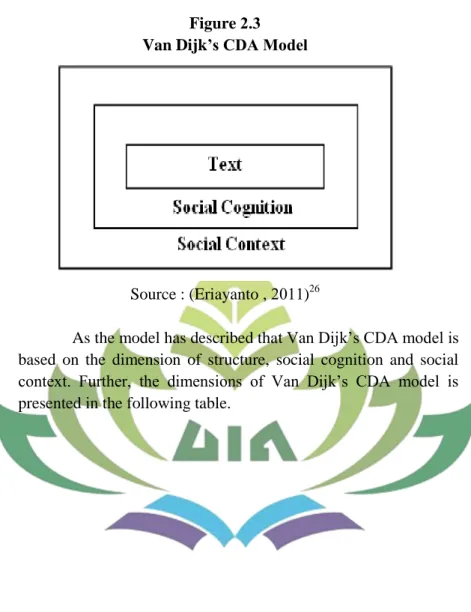
Critical Discourse Analysis (CDA) is clearly not a single model, school, or paradigm, but rather a shared approach to linguistics, semiotics, and discourse analysis. In a nutshell, Critical Discourse Analysis investigates the relationship between textual structures and social context before applying it to a larger social structure. Critical Discourse Analysis, according to Van Dijk, is limited to the relationship between discourse, power, domination, and social inequality.24FurtherVan Dijk suggests that a single study of discourse is insufficient if it is based solely on the text, because the text is the result of a broad social structure's production practice. This social cognition technique is effective for mapping how text generation is explained in terms of complicated processes. The term "social cognition" has two meanings: it describes how journalists write text and how its values are communicated and interpreted by journalists as news materials. Van Dijk examines how social structure, dominance, and power existed in the public domain, as well as how certain writings shaped and altered cognition consciousness. Van Dijk suggests the CDA model as described in the following figure.25
24 Van Dijk, Teun A. ( ). Discourse and knowledge; A Siciocognitive Approach. United Kingdom: Cambridge University Press.
25 Van Dijk, Teun A. ( ). Society and Discourse; How Social Context Influence Society and Talk. United Kingdom: Cambridge university Press.
Figure Van Dijk’s CDA Model
Source : (Eriayanto , )26
As the model has described that Van Dijk‘s CDA model is based on the dimension of structure, social cognition and social context. Further the dimensions of Van Dijk‘s CDA model is presented in the following table.
26 Eriyanto. . Analisis Isi: Pengantar Metodologi untuk Penelitian Ilmu Komunikasi dan Ilmu-ilmu Sosial Lainnya. Jakarta:
Kencana,p.
Table
Van Dijk’s CDA Dimension
Dimensions Observation
Points
Elements Text Macrostructure Thematic;
Meaning in global sense
Theme / Topic
Superstructure Schematic;
Meaning in local sense
Scheme
Microstructure Semantic;
Meaning that wants to be emphasized.
Background, Detail Purpose,
Presupposition Nominalization Syntax; Sentence
form
Sentence form, Coherence Pronouns Style; Selected
words
Lexicon
Rethoric;
Conducted emphasis
Graphic, Metaphor, Repetition,
Expression Social Cognition The representation
of discourse maker belief, knowledge and prejudice
Knowledge, Attitude Ideology
Social Context The production and construction of discourse in society
Power Access