Cross Border SMEs:
E D I T E D B Y:
MOHA ASRI ABDULLAH \ RIZAL YAYA DZULJASTRI ABDUL RAZAK
Malaysia & Indonesia
Cross Border SMEs: Malaysia Indonesia
Editor MOHA ASRI ABDULLAH, RIZAL YAYA, DZULJASTRI ABDUL RAZAK
Design JOKO SUPRIYANTO
UMY PRESS, May 2020 First Print
UMY Press, Universitas Muhammadiyah Yogyakarta
Jalan Brawijaya, Tamantirto, Kasihan, Bantul, Yogyakarta 55183 Telpon : +62.274-387656 pesawat 159
Cross Border SMEs: Malaysia Indonesia
Editor Moha Asri Abdullah, Rizal Yaya, Dzuljastri Abdul Razak, 16,5 x 24 cm, XII + 284 hlm
Yogyakarta, UMY PRESS 2019
Preface
M
uch have been written in various forms with re spect to Micro, Small and Medium Enterprises (MSMEs). In spite of this, a compilation of works on “cross border SMEs”, especially between Malaysia and Indonesia, has still not been made available to the pub- lic. Prior to addressing the issue at hand, let us look at what we mean by MSMEs for Malaysia and Indonesia? Micro, Small and Medium Enterprises (MSMEs) have been defined differently in both countries.So far, there has not been a unified definition that is accepted by all.
In Malaysia, SME Corp, a coordinating body on SMEs, refers to micro size SMEs as companies with sales turnover of less than RM300,000 and employees less than five. However, for small size SMEs in the manufacturing sector, it refers to companies that have sales turnover between RM300,000 and RM15 million and employ- ees between 5 and 75 people, while in the services sector it is de- scribed as companies that have sales turnover between RM300,000 and RM3 million, and employees between 5 and 30 people. As for medium size SMEs, in the manufacturing sector, it includes compa- nies with sales turnover between RM15 million and 50 million, and
employees between 75 and 200 people. However, in the services sec- tor, companies that have sales turnover between 15 million and RM 20 million and employees between 30 and 75 people are already con- sidered as medium size SMEs. In Indonesia, MSMEs are defined as those enterprises which have full time employment of less than 100 employees with a substantial proportion of them consisting of micro enterprises with not more than five full-time employees.
Elsewhere in these two nations, SMEs are much regarded as “un- sung heroes” as they play significant economic and social roles by offering new job opportunities, lowering unemployment rate, increas- ing competition and productivity, and providing substantial benefits to the economy of the two countries, Malaysia and Indonesia alike.
The SMEs in both the neighboring nations are considered to be the backbone of the modern-day economy. Thus, it is far from being a surely not a “fish bone” anymore. The importance of this segment is undisputed. For instance, a total of 98.5 percent of the Malaysian business establishments are SMEs. In 2017, these businesses were re- sponsible for 37.1 percent of the country’s GDP, 66 percent the total employment of the country, and 17.3 percent of the total Malaysian export. The annual growth of these SMEs’ contributions towards the GDP, employment and export are 7.2 percent, 3.4 percent and 7.9 percent respectively. A more or less similar example can be illustrated for the Indonesian counterpart. The importance of MSMEs in the Indonesian national economy has been well noted. There are more than 56.8 million MSMEs establishments and they consist of approxi- mately 99.9 percent of the total number of enterprises. It can be further emphasized that within MSMEs, microenterprises seem to be more dominant compared to small and medium enterprises. It covers about 98.7 percent, while small and medium enterprises represent only about 1.13 percent and 0.09 percent respectively.
Having those figures are insufficient as there is a yawning gap be- tween the needs, demands and policy responses in SMEs that often dampen their prospects. The recent economic turbulence has only added to SMEs’ problems. In this regard, SMEs in both nations have also been struggling for the improvement in the cost reducing indus- tries by providing relatively lower prices which bring transformation to the industrial structure and development of new markets along with large and multinational corporations (MNCs). SMEs directly and indirectly assist and facilitate growth, multiply and replicate into sufficient mass across industries and sectors. Starting in the late 70s and early 80s, SMEs have started to become more innovative and flexible in terms of reducing cost, technology adoption and diversifi- cation of products. Hence, it becomes imperative for us to ensure that SMEs, which are facing one of the toughest times in the indus- trial history, are strongly supported by the relevant stakeholders; gov- ernments, financial agencies, institutions and associations.
Realizing the need to leverage further on the development of small and medium enterprises (SMEs) in these two brotherly countries, Malaysia and Indonesia, a small group of scholars/researchers from IIUM, UMY, UNIDA Gontor and UNISSULA have collaboratively embarked on a little-known project known as the Research Matching Grant Schemes (RMGS), International Islamic University Malaysia (IIUM), Project ID: RMGS 17-001-0027. After a successful Malay- sia-Indonesia Workshop on SMEs in 2019, that was conducted to present all the RMGS findings, a subsequent effort is to compile the selected-relevant papers in the form of a book to enable the knowl- edge and the latest findings to be shared with the public at large.
Thus, the book, “Cross Border SMEs: Malaysia and Indonesia”, is put forward as an extension of a compilation of works designed to foster the status, growth, progress and development of SMEs, espe-
cially in Malaysia and Indonesia. Such an effort has not been made elsewhere.
In view of this, we would like to extend our appreciation to the Research Management Center (RMC) of the International Islamic University Malaysia (IIUM), the research centers of Universitas Muhammadiyah Yogyakarta (UMY), Universitas Darussalam (UNIDA) Gontor, and Universitas Islam Sultan Agung (UNISSULA) for undoubt- edly giving us the opportunity by providing research grants under RMGS. The grants from our respective institutions enabled us to generate and integrate these research papers into an edited book.
Therefore, special thanks and the flagship’s appreciation to those who have contributed their papers and their efforts and unquestionable support which have eventually led to this edited book.
Edited By:
Moha Asri Abdullah Rizal Yaya
Dzuljastri Abdul Razak
Author , s Biodata
International Islamic University Malaysia (IIUM) Assoc. Prof. Dr. Dzuljastri bin Abdul Razak obtained his PhD
in Islamic Banking and Finance from University Sains Malaysia (USM) in 2011. He has undertaken several research and consultancy project with the industry. He has completed leading a research grant on the study of Abandoned Housing Project amounting to RM 78,000 under FRGS. To date, he has published more than 10 articles on refereed and indexed journals. He has also won several awards for his submissions in the University re- search and exhibitions projects. In addition, he has examined sev- eral PhD theses and has supervised numerous post graduate stu- dents.
Asst. Prof. Dr. Khairunisah Ibrahim obtained her Bachelor’s degree in Business Administration from the International Islamic University Malaysia (IIUM) in 2000 and MSc in Operational Re- search from The Strathclyde University, UK in 2002. Dr.
Khairunisah obtained her Doctorate in Business Administration (DBA - Finance) from University Kebangsaan Malaysia (UKM) in
2015. Her areas of expertise include corporate finance, capital structure, market risk and social finance. She has published her research works in local and international refereed journals such as the Global Business Review, Jurnal Pengurusan, Intellectual Dis- course, Journal of Islamic Finance, Planning Malaysia Journal and International Journal of Bank Marketing. She also actively pro- vides courses and data analysis workshops, among others, on both time series and cross-sectional analysis using SPSS and SEM. Her recent research works and postgraduate supervisions are essentially on Social Finance, focusing on Microfinance and Small and Me- dium Enterprises (SMEs).
Dr Maliah Sulaiman is a Fellow of the Association of Chartered Certified Accountants (UK), and was the former Dean of the Kulliyyah of Economics and Management Sciences (KENMS), International Islamic University Malaysia (IIUM). She is currently a Professor of Accounting at the Department of Accounting, KENMS. She holds a PhD in Accounting from the University of Otago, New Zealand. Her research interests are in Islamic Ac- counting, Managerial Accounting as well as Environmental Ac- counting. On Islamic Accounting, she has written three books; Is- lamic Corporate Reporting: Between the Desirable and the De- sired, Accounting for Islamic Banks and Principles of Islamic Ac- counting. She sits on various editorial committees both locally and abroad. At the international level, she sits on the ISO TC 207 working group on Material Flow Cost Accounting (MFCA). She is an executive council member of the Malaysian Institute of Ac- countants (MIA). At MIA, she chaired the Islamic Finance Com- mittee in 2018 as well as the MIA Qualifying Exams Committee from 2016 to 2018.
Fodol Mohamed Zakaria, holds an MSc in Finance (Malaysia)
and is a research assistant in SMEs and their Accessibility to Is- lamic Financing project, Kulliyah of Economics and Management Sciences (KENMS), International Islamic University Malaysia (IIUM). Zakaria has contributed to some publications and confer- ences at national and international levels. Zakaria obtained his Bachelor’s degree from Imam Muhammad Ibn Saud Islamic Uni- versity (IMAMU), Saudi Arabia in Finance and Investment. He is interested in social finance, entrepreneurship, and Islamic finance.
Zakaria has the vision to contribute to knowledge transfer, social activities, and research development for the virtue of Muslim soci- eties and humanity.
Md. Siddique E Azam, is currently pursuing his Ph.D. at the In- ternational Institute for Halal Research and Training (INHART), IIUM after completing his MBA in January 2018 from IIUM as well. He obtained his M.Sc. in Agriculture Education from Sher- e-Bangla Agricultural University, Dhaka, Bangladesh. He obtained his Bachelor’s degree in agriculture science from Hajee Mohammad Danesh Science and Technology University, Bangladesh. Along- side serving in the banking industry in Bangladesh, he has contrib- uted a few publications in different journals. He foresees Muslim entrepreneurs receiving action civics education which will provide them with the knowledge and skills to develop the economy as practicing Muslims.
Moha Asri Abdullah, Professor (Ph.D.) at KENMS, IIUM; Deputy dean of INHART, IIUM; Director of IEC Sdn. Bhd., and Na- tional Panel of Evaluation Committee for Research Grants, MOHE. He is a for mer Director of Innovation and Commercialisation Office at the university, a former Deputy Dean at the Research Management Centre (IIUM) and Head of the Department of Economics. He was a Visiting Research Scholars
of Economic Research Centre, Japan and University of Auckland, AUT and Massey University, New Zealand. He has presented more than 60 papers in renowned journals and presented a number of papers at international conferences/forums. He has conducted more than 35 research projects from different funding agencies, local and international alike. He also has been a consultant to a number of agencies and involved in a wide range of consultancy works. He has been an editor and author of more than 15 books.
His expertise is in Small Business/SMEs, Entrepreneurship and Venture Capital, Economic Development, and Halal Industry. His research interest areas include Halal entrepreneurship and capital venture, Small Business/SMEs, and Halal Micro-credit.
Mohamed Asmy Bin Mohd Thas Thaker obtained his Bach- elor of Economics (Hons), Master of Economics and PhD in Eco- nomics from the International Islamic University Malaysia (IIUM).
Upon completion of his PhD, he joined IIUM in October 2014 as an Assistant Professor at the Department of Economics. His re- search interests include economic development, SMEs, Islamic eco- nomics, Waqf, Zakat and Islamic banking, and finance. Currently, he is a member and a research fellow at the Centre of Islamic Economics, IIUM and Malaysian Economic Association. He has published a number of publications in cited refereed journals, and chapters in books and presented papers at national and interna- tional conferences. Some of his papers have won Distinguished and Best Paper awards. Recently, his thesis also won Bronze award at the international exhibition. His works have been made pos- sible by his receipt of support in the form of grants from various agencies and organizations nationally and internationally.
Norhayati Mohd Alwi has been an Assistant Professor at the De- partment of Accounting, International Islamic University Malay-
sia since 2000. Prior to that, she had worked with a manufacturing firm as a financial controller. To date, she has published articles in reputable journals, presented at many international conferences and has been actively involved in sponsored research and consultancy work. Her research interests include performance management system, management accounting practices, environ- mental management accounting, organizational change, zakat, and waqf. Her research works landed her several awards including an MIA-Articles of Merit Award in 2012, IIUM Research, Invention and Innovation Exhibition (IRIIE 2012 and 2013) and the 2nd Best Paper Award JAKI Accounting Paper Awards 2018. Profes- sionally, she is an associate member of the Malaysia Institute of Accountants.
Suharni Maulan is an Assistant Professor in the Department of Business Administration, Kuliyyah of Economics and Manage- ment Sciences, International Islamic University Malaysia. She obtained her PhD in Business Administration from the Graduate School of Business, UKM where she specialised in halal branding and service marketing. She has more than 20 years experience in teaching and the subjects she lectured in include marketing, man- agement and economics. Her research interests are in areas re- lated to Islamic marketing, branding and entrepreneurship. She has authored numerous academic and professional articles in repu- table journals and presented at various international conferences.
She is also actively involved in supervisory and consultancy works as well as community services.
Yusof Ismail obtained his Diploma in Accountancy from ITM, Shah Alam, and worked with auditing organizations before con- tinuing his studies in the fields of Finance, Marketing and Man- agement in the United States. He has authored a number of books
on Management and translated a few titles on Islam from English into Malay. His research and journal publications include Islamic Management, Human Resource Management, and Knowledge Management. He served on the technical and working groups on Shari’ah standards with the Malaysian standards body, SIRIM.
He has been associated with the International Islamic University Malaysia since 1986.
Universitas Islam Sultan Agung, Semarang, In- donesia (UNISSULA)
Ardian Adhiatma is a senior lecturer and researcher at the De- partment of Management, Faculty of Economics and Business, Universitas Islam Sultan Agung, Semarang, Indonesia. He received his Doctoral degree from Airlangga University, Indonesia and Masters in Management from Gadjah Mada University, Indone- sia. He has published several articles in international journal and proceedings. His teaching and research interests include Islamic Economics, Human Resource Management and Knowledge Man- agement.
Bedjo Santoso obtained his Ph.D in Islamic Banking and Finance from the International Islamic University Malaysia (IIUM) in 2015.
He is currently the Deputy/Vice Rector for Academic and Col- laboration Affairs at the Islamic University Sultan Agung Semarang- Indonesia. He is active in the fields of Islamic Banking and Finance. Besides that, he is the heads quarter ICIFE (Interna- tional Council For Islamic Finance Educators) Central Java – In- donesia. He is also the secretary of Islamic Studies on Economic and Finance for Indonesian Development (ISEFID) for Central Java and he is also in the ICMI committee (Muslim Scholars Indo- nesian Association). He is active in writing articles on Islamic Bank-
ing and Finance. He has published some articles on Islamic eco- nomic stability, Islamic Banking and Finance strategy and prod- ucts, Sukuk, Digital Finance, and Gold Dinar as Future Lancape on Global finance. Lastly, he was also invited as a speaker for the Plenary Session during the 6th AICIF (ASEAN University Inter- national Conference on Islamic Finance) in Manila in November 2018.
Hendar is a senior lecturer and researcher at the Department of Management, Faculty of Economics and Business, Universitas Is- lam Sultan Agung, Semarang, Indonesia. He received his Doc- toral degree from Diponegoro University, Indonesia and Magister Saint from Padjadjaran University, Indonesia. He has published several articles in international journal and proceedings. His teach- ing and research interests include Marketing Management, Entre- preneurial Marketing and Cooperative Management
Olivia Fachrunnisa is a senior lecturer and researcher at the De- partment of Management, Faculty of Economics and Business, Universitas Islam Sultan Agung, Semarang, Indonesia. She received her Ph.D from Curtin University, Australia and Masters in Hu- man Resource Management from Gadjah Mada University, Indo- nesia. She has published several articles and books in high reputa- tion publication outlets. Her teaching and research interests in- clude Human Resource Management, Organizational Behavior, Knowledge Management and Digital Business.
Winarsih is a senior lecturer and researcher at the Department of Accounting, Faculty of Economics and Business, Universitas Islam Sultan Agung, Semarang, Indonesia. He received his Doc- toral degree from Diponegoro University, Indonesia and Masters in Accountingfrom Padjadjaran University, Indonesia. She has published several articles in international journal and proceedings.
Her teaching and research interests include Behaviour Account- ing, Islamic Finance and Accounting and Knowledge Accounting.
University of Darussalam Gontor UNIDA
Atika Rukminastiti Masifah, M.E.Sy. is a graduate of Tazkia University. She holds a Bachelor’s degree in Islamic Economics (2013) and obtained Masters degree in Sharia Economics in 2017.
She was recruited to join Bank Indonesia and served the bank from 2014 to 2017 as an Assistant Researcher in Islamic Econom- ics and Finance Department, Bank Indonesia. She joined Univer- sity of Darussalam Gontor in 2018 as a lecturer in the Depart- ment of Islamic Economics, in the Faculty of Economics and Man- agement. She has published a number of academic papers in do- mestic and international journals, including papers on micro, macro and financial sector issues. In addition, she has received the Best Paper Awards in the 6th Sharia Banking Research Paper Forum in the category of Young Researchers di Banjarmasin.
Dhika Amalia Kurniawan is a senior lecturer in the Manage- ment Department at the University of Darussalam Gontor (UNIDA) Indonesia. She holds a Magister Management in the Faculty of Economics and Business from the University of Sebelas Maret Surakarta, Indonesia. Dhika Amalia has published various research papers in refereed journals such as Journal of Business, Journal of Economics and Management, and International pro- ceedings. Her research interests include Marketing and Islamic Marketing. Dhika Amalia is the corresponding author and can be contacted at: [email protected]
Eko Nur Cahyo is currently working as Director of International Affairs and Relations, University of Darussalam Gontor. He is also an associate researcher at the Centre for Islamic and Occidental
Studies (CIOS), University of Darussalam Gontor. He has pre- sented various research papers in some international conferences such as the International Conference on Integration of Contem- porary and Islamic Knowledge in Islamic Universities in Malay- sia, International Thematic Workshop “Revival of Waqf for Socio Economic Development”, IRTI-IDB in Surabaya. In addition, he has received an International Research grant from the Ministry of Religious Affairs of Republic of Indonesia (MORA) on Curricu- lum Design of Islamic Economics which was conducted at some universities in Turkey, Pakistan, Malaysia, and Indonesia. His re- search interests include Islamic economics, Islamic economics law, and waqf. Eko Nur Cahyo can be contacted at [email protected]
Ely Windarti Hastuti is a Lecturer in the Management Depart- ment at the Universitas Darussalam Gontor (UNIDA Gontor), In- donesia. She holds a MSc in Public Sector Accounting from Uni- versitas Gadjah Mada, Indonesia. Her research interests include Islamic finance, sharia governance, Islamic accounting, and Pub- lic sector accounting.
Fajar Surya Ari Anggara is a Senior Lecturer in the Management Department at the Universitas Darussalam Gontor (UNIDA Gontor), Indonesia. He holds a master’s degree in management from the State University of Malang. Fajar has published various research papers such as Potential Analysis of Bromo Tengger as an International Tourist Attraction Through the Canvas Business Model Approach in refereed journals and in the community ser- vice in the East Java area.. His research and community service interests include Management, Entrepreneurship and International Business. Fajar Surya Ari Anggara is the corresponding author and can be contacted at: [email protected]
Hartomi Maulana is a Senior Lecturer in the Management De- partment at the Universitas Darussalam Gontor (UNIDA Gontor), Indonesia. He holds a PhD in Business Administration from the International Islamic University Malaysia. Hartomi has published various research papers in refereed journal such as the Gadjah Mada International Journal of Business, International Journal of Business, Economics and Law, International Journal of Islamic and Middle Eastern Finance and Management. His research in- terests include Islamic finance, financial inclusion and Islamic microfinance. Hartomi Maulana is the corresponding author and can be contacted at: [email protected]
Khoirul Umam is the Dean of the UNIDA Gontor Faculty of Eco- nomics and Management, where he started teaching Islamic eco- nomics, Islamic monetary economics and other courses. He re- ceived his B.A. in Islamic Finance from ISID Gontor in 2003, and his M.A. in Economics from the International Islamic University, Malaysia in 2007 and takes doctoral program in Islamic Econom- ics at Islamic University of Indonesia, Yogyakarta. He has pub- lished a number of articles in the areas of Islamic financial and monetary economics. He co-authored his latest book with Dr.
Hamid and this book has been published by LAP, Germany.
Umam’s email is [email protected].
Rahma Yudi Astuti is a Senior Lecturer in the Management De- partment at the Universitas Darussalam Gontor (UNIDA Gontor), Indonesia. She holds a M.E.Sy Institut Agama Islam Negeri Ponorogo. Rahma Yudi Astuti has published various research pa- pers in refered journals such as Altijarah Unida Gontor, Islamic Economics Journal and Khodimul Ummah. Her research inter- ests include Islamic finance and financial inclusion. Rahma Yudi Astuti is the corresponding author and can be contacted at:
Roghiebah Jadwa Faradisi is a Junior Lecturer in the Manage- ment Department at the Universitas Darussalam Gontor (UNIDA Gontor), Indonesia. She earned her Masters of Accountant de- gree from Universitas Indonesia in 2018. Roghiebah also holds a Chartered Accountancy qualification from the Indonesian Accoun- tant Association at the prior year. She has published various re- search papers in refereed journal, especially in financial account- ing areas such as corporate performance and corporate governance relations in Indonesia. Her research interests include Auditing, Financial and Sharia Accounting. Roghiebah Jadwa Faradisi is the corresponding author and can be contacted at:
Royyan Ramdhani Djayusman is currently a lecturer and head of the Department of Islamic Economics at the University of Darussalam Gontor. He has contributed to many publications and conferences on Islamic economics, finance, and public economics and, in particular, Islamic philanthropy. He has the vision to en- hance the model of Islamic economics education system in order to increase the implementation of Islamic economics both among the academicians and the community. In this regard, he and his colleagues established the Institute of Mudharabah Funds (IMF) promoting and educating the mudharabah contract whose prac- tice is nowadays less popular than the murabahah contract in the mainstream Islamic financial institutions.
Universitas Muhammadiyah Yogyakarta UMY Rizal Yaya is an Associate Professor in the Department of Account-
ing, Universitas Muhammadiyah Yogyakarta. He is currently Dean of the Faculty of Economics and Business, Universitas
Muhammadiyah Yogyakarta. Rizal obtained his Bachelor’s de- gree from Universitas Gadjah Mada, his Master of Science de- gree in Accounting from the International Islamic University Malaysia and his Doctor of Philosophy in Accountancy from Uni- versity of Aberdeen. He is the author of textbook on Accounting for Islamic Banks published by Salemba Empat, Jakarta. He re- ceived an award from UMY as the best lecturer in 2017 and also received an award for the best paper at the International Confer- ence on Islamic Perspective of Accounting, Finance, Economics and Management in Istanbul Turkey in 2017.
Susilo Nur Aji Cokro Darsono, is Lecturer in the Department of Economics, Universitas Muhammadiyah Yogyakarta, Indonesia.
Susilo received his master’s degree in Rural Development Man- agement from Khon Kaen University, Thailand and bachelor’s degree in Economics from Universitas Muhammadiyah, Yogyakarta. Currently, Susilo is a Ph.D student at the College of Management, Department of Business Administration, Asia Uni- versity Taiwan. Susilo has contributed to many publications and conferences at both national and international levels. He conducts research in the broad area of development economics and Islamic investment. He is also serving in the editorial board of Jurnal Ekonomi & Studi Pembangunan.
Taufik Akhbar, SE., holds an MBA in financial management (In- donesia) and is a lecturer in the management department, Univer- sitas Muhammadiyah Yogyakarta. Taufik obtained his Bachelor’s degree from the management department, Universitas Gadjah Mada in 2011 and graduated with Masters of Business Adminis- tration in Magister Management, Universitas Gadjah Mada in 2014. His research interest is on corporate finance.
Chapter-1: “Profile of Entrepreneurs and SMEs: Issues & Challenges” By Suharni Binti Maulan, Yusof Ismail, Royyan Ramdani Djayusman, Roghiebah Jadwa Faradisi, and Bedjo Santoso — 1
Chapter-2: “Profile of MSMEs in East Java: challenges and prospects” By Dhika Amalia Kurniawan, Eko Nur Cahyo, Suharni Binti Maluan, Rizal Yaya, and Winarsih — 18
Chapter-3: “Business Success Factors of SMEs in Malaysia: An Empirical Study”
By Mohamed Asmy Bin Mohd Thas Thaker, Moha Asri Abdullah, Fodol Mohamed Zakaria, Atika R. Masrifah, and Ardian Adhiatma
— 39
Chapter-4: “Measuring Sharia Financial Inclusion: Evidence from Indonesia” By Atika R. Masrifah, Khoirul Umam, Yusof Ismail, Bedjo Santoso, Lil- ies Setariti — 67
Chapter-5: “Identifying accessibility of financing for MSMEs in East Java Indo- nesia” By Hartomi Maulana, Ely Windarti Hastuti, Lilies Setiartiti, Dzuljastri Abdul Razak, and Olivia Fachrunnisa — 91
Table of Contents
Capter-6: “Capacity Building for SMEs: Realizing the Training Gap Amongst SMEs in Malaysia” By Moha Asri Abdullah, Dzuljastri Abdul Razak, Md. Siddique E Azam, Winarsih, and Taufik Akhbar — 107
Chapter-7: “Training Needs: How SMEs Improve Their Competitiveness.” By Taufik Akhbar, Susilo Nur Aji Coko Darsono, Mohamed Asmy, Hendar, and Fajar Surya — 132
Chapter-8: “A Gap Analysis of SMEs’ Training Needs and Knowledge of Chal- lenges to Enter Global Market” By Olivia Fachrunnisa, Ardian Adhiatma, Rizal Yaya, Rahma Yudi, and Norhayati Mohd Alwi — 148
Chapter-9: “Examining Issues and Challenges in Integrating SMEs into Global Value Chains: Malaysia Evidence” By Khairunisah Ibrahim, Moha Asri Abdullah, Maliah Sulaiman, Ardian Adhiatma, and Royyan Ramdani Djayusman — 172
Chapter-10: “Determinants of Small and Medium Enterprises (SMEs) Com- petitiveness in Global Market” By Susilo Nur Aji Cokro Darsono, Taufik Akhbar, Khairunisah Ibrahim, Dhika Amalia, and Hendar — 192
Chapter-11: “Financial Literacy for SMEs in Yogyakarta after a Decade of SMEs Act” By Rizal Yaya, Lilies Setiartiti, Susilo Nur Aji Cokro Darsono, Taufik Akbar, and Norhayati Mohd Alwi — 209
04
MEASURING SHARIA FINANCIAL
INCLUSION: Evidence From Indonesia
By: Atika R. Masrifah, Khoirul Umam, Yusof Ismail, Bedjo Santoso, and Lilies Setariti
ABSTRACT
Micro Enterprises’ (MEs) contribution towards absorbing the labor for about 88.90% of total enterprises in Indonesia, but almost all MEs called as an unbanked or non-bankable people. This chapter aims to calculate and analyse the Index of Syariah Financial Inclusion (ISFI) covering two dimen- sions; the accessibility and the usage of Islamic financial services, using field survey. Assessing 250 household of MSMEs across the region in Indonesia, this paper found that the utilisation of Islamic financial institutions, even cooperative, is generally low in Indonesia (0.384 for usage dimension and 0.438 for accessibility dimension). It has been proven by the respondents’
profile that MSMEs prefer conventional loan (75%), while others (25%) pre- fer Islamic financing. Furthermore, the results show that the enterprise’s source of financing at the first time is different from the last condition significantly when the survey was conducted. MSMEs prefer to use loans from relatives, their personal saving, rotating scheme and even loans from moneylenders.
This study recommends that the education and promotion of Sharia Finan- cial Inclusion be given a policy priority in Indonesia to gain the main goals of financial inclusion, inclusive growth, welfare as well as economic develop- ment.
JEL Classification: G2, G21, O17
Keywords: Financial Inclusion, Sharia Financial Inclusion Index, MSMEs C H A P T E R
1. INTRODUCTION
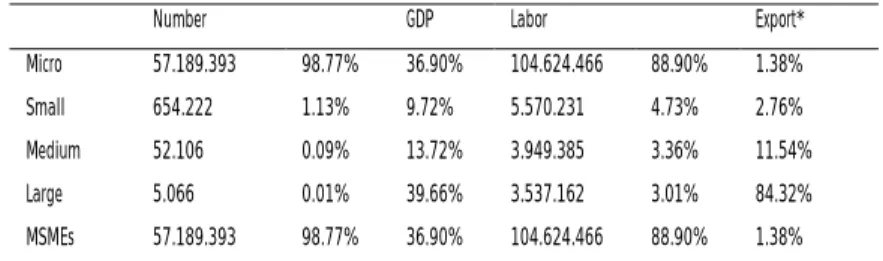
Several data show the significance of MEs’ contribution towards absorbing about 88.90% of the labor in 2013, placing MEs far above everything in the Statistics of Micro, Small and Medium Enterprises in Indonesia, and especially, therefore, above large enterprises (3.01%
in 2013). The MEs’ sector also contributed about 36.90% towards the growth of domestic product in 2013. This is almost close to the contribution of large enterprises (39.66%) towards GDP. Moreover, the MEs sector has not been able to contribute much to exports (1.38%
in 2013).
TABLE 4. 1 STATISTICS OF MICRO, SMALL AND MEDIUM ENTERPRISES*
Number GDP Labor Export*
Micro 57.189.393 98.77% 36.90% 104.624.466 88.90% 1.38%
Small 654.222 1.13% 9.72% 5.570.231 4.73% 2.76%
Medium 52.106 0.09% 13.72% 3.949.385 3.36% 11.54%
Large 5.066 0.01% 39.66% 3.537.162 3.01% 84.32%
MSMEs 57.189.393 98.77% 36.90% 104.624.466 88.90% 1.38%
Source: Ministry of Cooperation and SMEs; *2013 data.
Despite the statistical success of MEs, there is an unresolved mat- ter that need to be further consideed and this unresolved matter is that members of MEs are referred to as “nonbanked” or “non-bank- able” people. MEs have always been in difficulties to access financing from the banking industry (conventional as well as Islamic financial institutions) for several reasons. The financial access to formal finan- cial institutions is still relatively low. This is based on a World Bank survey which shows that only 20% of people use the services of for- mal financial institutions, while in the household sector, only 49% of the total national households (Karim, 2014).
In the Household Balance Sheet Survey 2011 conducted by Bank Indonesia, it was also found that the percentage of household saving
in formal and non-formal financial institutions was 48%. Thus the people who do not have savings accounts are still relatively very high at 52%. The condition of people who have not utilised the services of formal financial institutions is a significant market which can become the target market, because unbanked people are not 100% because they are unbankable and they also need loans.
Based on this background, this chapter attempted to analyse the prospects for expanding ûnancial access to the MSMEs, and the au- thors assessed 250 MSMEs in several regions in Indonesia to judge their level of financial inclusion. Using the indicator of financial in- clusion from several sources, this chapter measured the level of Sharia financial inclusion across regions in Indonesia.
The highlights of this article are as follows: (1) improvements in measuring Sharia financial inclusion, and (2) proposing of feasible ways to enhance the prospect of Islamic finance institutions for MSMEs.
This chapter is organized as follows: Part II provides a brief re- view on the framework of Islamic microfinance and financial inclu- sion which is in accordance with Islamic perspective. Part III discuss the data and methodology to create an index of Sharia financial in- clusion (IFI) to measure Sharia financial inclusion. Part IV presents the measurement results and discusses the results. Section V concludes the chapter.
2. LITERATURE REVIEW
Islamic microfinance could be pointed to microfinance in Islamic view. Profit oriented is the main goal in conventional microfinance, while Islamic microfinance can not only stand for profit orientation but also for social orientation. Therefore, this part will question a brief review on the framework of Islamic microfinance by first ques-
tioning microfinance in common, then microfinance which is in ac- cordance with Islamic view.
There are many studies which have focused on the definitions of microfinance. Some of these studies include, among others, Abdul- Rahman (2007), Khan (2008), Kaleem and Ahmed (2010), as well as Shahinpoor (2009). In summary, microfinance could be defined as making minor loans prepared for poor people through programmes designed in particular to fulfill their particular needs and circum- stances.
Lower poor, poor, and upper poor are also vulnerable and nonpoor people who work in informal sector or micro enterprises become the main customer of microfinance. The poor mainly start their own micro enterprises out of needs, because of the lack of jobs that they find suitable. However, some of them are actually entrepreneurs, and they enjoy producing and running their own businesses.
Furthermore, there is growing studies addressing the definition of financial inclusion, and among others are studies by Beck, Demirguc- Kunt and Martinez Peria (2007), Sarma (2008), Demirguc-Kunt and Klapper (2012), as well as Chakravarty and Pal (2013). Financial in- clusion, which means the delivery of financial services at affordable costs to sections of the disadvantaged and low income segments of the society, is an integral part of Islamic microfinance to provide vari- ous Islamic financial services that are needed (Obaidullah (2008:p.13- 24); Consultative Group to Assist the Poor Helms (CGAP, 2006: p.27).
Moreover, according to CGAP (2010:p.16), financial inclusion refers to a state in which all working age adults have effective access to credit, savings, payments, and insurance from formal service providers.
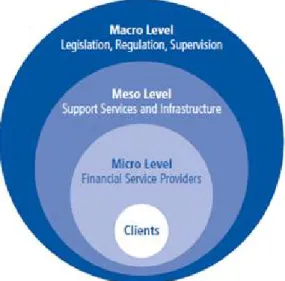
Moreover, CGAP has also built some principles into the frame- work for an inclusive financial system. That framework is divided into three levels of financial system, namely: micro, meso and macro (see
figure 2.1). It recognses that more people will have access only if fi- nancial services for the poor are integrated into all three.
FIGURE 4. 1 AN INCLUSIVE FINANCIAL SYSTEM1 Source: Helms (CGAP, 2006: p.14)
The hub of micro financial systems that work for the poor is on building market places, where numerous strong and viable financial service providers compete for the business of the poor and the low- income people. These micro financial service providers ideally gain financing from funding sources. However, up to now microfinance has depended heavily on external donor funding, even international donor funding. In fact, international funding could be helpful at all levels of the financial system—micro, meso, and macro—to jump- start and speed up the process of building market places.
In this article, we agree with the definition of financial inclusion.
This means that everyone not only has access to financial services but also can enjoy various types of financial services, such as saving de- posits, time deposits, financing, payment, and other products and ser- vices of financial institutions.
The measure of Sharia financial inclusion in this paper covers two dimensions; the accessibility and the usage of Islamic banking ser- vices. Moreover, to avoid correlations between dimensions (in Sarma (2008), ‘accessibility’ is similar to ‘availability’, which may cause multicollinearity in the calculations), the authors have used two indi- cators, namely, the accessibility and the usage of Islamic banking ser- vices. The authors have also differentially weighted every dimension.
TABLE 4.
2
Categories Indicator
Existing global source (if relevant)
Dimension of financial inclusion
measured
%of adults with an account at a formal financial
institution Global Findex
Numer of depositors per 1000 adults OR number
of deposit accounts per 1000 adoults IMF FAS
% of adults with at least one loan outstanding from
a regulated financial institution Global Findex Number of borrowers per 1000 adults OR number
of outstanding loans per 1000 adults IMF FAS
% of MSEs with an account at a formal financial institution
WB enterprise surveys deposit accounts OR number of SME
depositors/number of depositors IMF FAS
%of SMEs with an outstanding loan or line of credit
WB enterprise surveys Number of SMEs with outstanding loan/number of
outstanding loan OR number of outstanding loans to SMEs/ number of outstanding loans
IMF FAS
Points of service Number of branches per 100000 adults IMF FAS Access Access,usage Formally banked adults
Adults with credit by regulated institutions
Formally banked enterprises
Enterprises with outstanding loan or line of
credit by regulated institutions
Access,usage
Access,usage
Access,usage
INDICATORS OF FINANCIAL INCLUSION
Source: Global Findex; IMF FAS; WB enterprise surveys; modified by Authors
Access: This measure evaluates the outreach of sharia financial services. In this chapter, the authors measured the access to sharia finance mainly by using the perception questionnaire, and this ques- tionnaire used the likert scale, namely, 1) Not Accessible; 2) Can be accessed; 3) Neutral; 4)Accessible; 5) Satisfied with the Accessibility.
However, some reference conclude that commercial banks take a lead- ing role in providing access to finance.
Usage: This measure evaluates the frequency with which custom- ers use sharia financial services. Indicators of this dimension are de- veloped from saving deposits, time deposits, financing, payment, and other products and services of financial institutions, which are key functions of finance. In this chapter, the authors also measured the frequency of the usage to sharia finance mainly using the perception questionnaire and the scale of measurement used the likert scale, namely, 1) Rare; 2) Unlikely; 3) Possible; 4) Likely; and 5) Almost Certain. Table 2.1 shows all the indicators considered in the index based on some literature.
With regard to financial inclusion, several studies have tried to measure the extent of inclusive finance found in several countries.
Honohan (2008) used an econometric approach by combining survey based data and secondary data to estimate the proportion of households that can access formal financial services or services in 160 countries in the world. Honohan found that the financial access index significantly affected to reduce income inequality.
The study of Beck et al. (2007) in 99 countries in 2003-2004 showed that the factors that determine the reach of the financial sector are the same as the factors that determine the depth of the financial sec- tor. These factors are the level of development which is proxied by GDP per capita, the quality of institutions that is proxied by gover- nance index, and credit information that is proxied by credit infor- mation index.
Demirguc-Kent and Klapper (2012), in a study that measured the use of adult financial products (micro level) in 148 countries in 2011, found that 50% of adults worldwide (samples) used formal financial services, and more than 2 5 billion adults worldwide do not have for- mal financial services accounts. However, partial and incomplete in- formation from micro-level analysis can lead to misinterpretations of
the macro perspective.
Sarma (2012) developed a method for calculating the Index Fi- nancial Inclusion (IFI) that can be used to compare the level of finan- cial inclusion between countries or provinces in a country over a cer- tain period of time. This method fulfills the assumptions of compara- bility, mathematical property, and three dimensions (accessibility, avail- ability, and use of banking services). The low IFI is indicated by the low income of the middle class, while most high-income countries have high IFIs.
Sanjaya and Nursechafia (2016) in their research measured and analysed the level of inclusive finance and inclusive growth in Indo- nesia. The study found that inclusive finance in Indonesia was strongly influenced by the dimensions of accessibility, while the dimensions of availability and use only had a small proportion. This brings us to the conclusion that the poor are quite limited in utilising financial sector services.
Umar (2018) measured the Index of Syariah Financial Inclusion (ISFI) covering three dimensions: the availability, the accessibility, and the usage of Sharia banking services. Using the annual data at the provincial level during 2010-2015, this paper found that the Index of Sharia Financial Inclusion was generally low and Bangka Belitung was the most financially inclusive province of Indonesia. Furthermore, this conclusion suggests the promotion of Sharia Financial Inclusion to be a policy priority in Indonesia to achieve the central goals of inclusive growth, welfare and economic development.
3. RESEARCH METHOD
This chapter applied quantitative methods, namely, chi-square test, correspondence analysis and paired samples t-test, which needed qualitative data. Chi-square test method was applied to evaluate
whether there is a significant association between the groups of the two variables. Moreover, correspondence analysis is not much differ- ent from chi-square test. Correspondence analysis provides a graphic method of exploring the association or relationship between variables in a contingency table. The primary data needed in this chapter were obtained from field survey in several regions in Indoensia, where 250 MSMEs were selected from customers of Islamic and Conventional financial institutions, including those who received loans from con- ventional financial institutions and financing from Islamic financial institutions, as well as those who did not receive any loan or financ- ing.
Moreover, this chapter also used the Index of Sharia Financial Inclusion (ISFI) method developed by Sarma (2012) in analysing and measuring the Index of Sharia Financial Inclusion in Indonesia, where the research variable used refers to the dimension of measurement of ISFI, namely, accessibility and usage. The authors measured each indicator by using the following formula (Wang and Guan, 2017:
p.1754).:
where xij is the transformed value of indicator j in dimension i; Aij is the actual value; Mij and mij are the maximum and minimum of each indicator, respectively. After transformation, the value of each indicator lies between 0 and 1. The ISFI in dimension i is computed as follows (Wang and Guan, 2017: p.1754).:
= 1− 1
2(1− 1)2+ 22(1− 2)2+⋯+ 2 (1− )2
( 21+ 22+⋯+ 2 ) (3)
where xij is the transformed value (0 < xij < 1). wij stands for the weight of indicator j in dimension i. In contrast to those scholars who set weights subjectively (Sarma, 2008; Chakravarty and Pal, 2013;
Wang and Guan, 2017), in this chapter, the authors measured the weight with an objective weighting method called CV (i.e. coefficient of variation). CV was initially used in probability theory and statistics to measure the dispersion in a probability distribution or frequency distribution and is defined as the ratio of the standard deviation ó to the mean value ì. Thus, the weight of each indicator is defined as the proportion of its CV to the sum of all indictors’ CV numerically.
That is, (Wang and Guan, 2017: p.1754)
where wij stands for the weight of indicator j in dimension i, and vij stands for the CV. Then, the final IFI is computed using the following formula (Wang and Guan, 2017: p.1754):
= 1−
2(1− 1)2+ 22(1− 2)2
( 12+ 22)
where w1 and w2 are the weight of dimension 1 (access) and 2 (us- age), and the computation follows the CV method. The aim of this chapter was to measure the level of Sharia financial inclusion across regions in Indonesia, as well as to analyse the prospects for expanding ûnancial access to the MSMEs. Moreover, this chapter can propose the feasible ways to enhance the prospect of Islamic finance institu- tions for MSMEs. This chapter covers three groups of MSMEs which are customers of Islamic and conventional financial institutions.
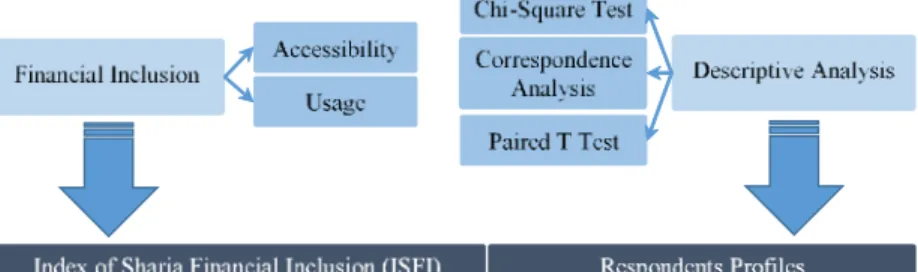
Based on the literature review summarized above, the research framework of this chapter can be seen in figure 3.1. There are two
variables, namely: 1) Accessibility; and 2) Usage, which can be used to calculate the Index of Sharia Financial Inclusion. Moreover, this chapter also used chi-square test, correspondence analysis and paired t test to describe the respondents profile of MSMEs.
FIGURE 4. 2 RESEARCH FRAMEWORK
4. RESULTS AND ANALYSIS
There are three categories of respondents’ profiles, viewed from:
1) Scale of Enterprises: Micro Enterprise (MEs; 191 respondents);
Small Enterprise (SEs: 54 respondents); and Medium Enterprise (MDEs; 5 respondents); 2) Source of financing: MSMEs which re- ceived financing from conventional banks (188 respondents) and MSMEs which received financing from Islamic banks (62 respondents);
and 3) Profit performance: MSMEs whose net profit increased for the last three years (108 respondents); MSMEs whose net profit was stagnant for the last three years (128 respondents); and MSMEs whose net profit decreased for the last three years (14 respondents).
TABLE 4. 3 GROUPING OF RESPONDENT PROFILE
Shariah Convent. TOTAL
MEs 41 150 191
SEs 19 35 54
MdEs 2 3 5
TOTAL 62 188 250
Decrease Stagnant Increase TOTAL
MEs 11 100 80 191
SEs 3 25 26 54
MdEs 0 3 2 5
TOTAL 14 128 108 250
Table 4.2, which is based on Chi-Square (association) tests, shows that MSMEs are very diverse business enterprises, which have almost no specific significant association revealing their business patterns.
TABLE 4. 4 SUMMARY OF RESPONDENT PROFILE’S ASSOCIATION (CHI-SQUARE) TESTS
Employees Gender Age Education Expertise LegalForm Sector Scale of enterprises 0.090 0.376 0.619 0.694 0.742 0.284 0.733 Source of financing 0.000 0.188 0.016 0.024 0.174 0.000 0.008 Profit performance 0.004 0.660 0.217 0.055 0.066 0.000 0.631
Asset Scale of enterprises 0.000 Source of financing 0.892
Profit performance 0.017 0.900 0.870 - Scale of enterprises
- 0.460 0.900 Profit performance
0.460 - 0.870 Source of financing
The category of enterprises of MSMEs, based on either the scale of enterprises or profit performance, mostly, have no association with their characteristics or their source of financing. Only the number of employees has significant association with MSMEs source of financ- ing and profit performance (0.000; 0.004 < 0.05). Some MSMEs’
characteristics also have significant association with their source of financing, such as: age (0.016), education (0.024), legal form (0.000), and bussiness sector (0.008). Meanwhile, some MSMEs’ characteris- tics also have significant association with their profit performance, such as: legal form (0.000) and their asset (0.017). Moreover, some MSMEs’ characteristics have almost significant association, such as:
employees (0.090) with scale of enterprises, education (0.055) and their past expertise (0.066) with profit performance.
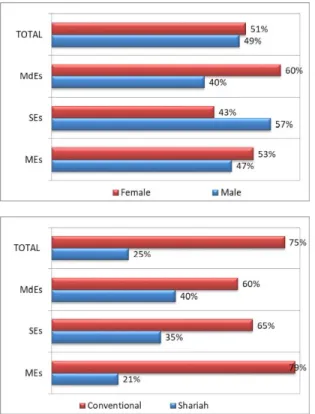
The survey shows at the owners of MSMEs almost split in half between male (49%) and female (51%). However, MEs are mostly owned by females (53%). Meanwhile, viewed from source of financ- ing, figure 4.1 (left) shows that MSMEs prefer conventional loan (75%), while others prefer Islamic financing (25%). Moreover, chi-square results show that there is no association between the scale of enter-
prises and owner’s gender (0.376 > 0.05). However, there is a low tendency that MSMEs correspond not only with conventional loan but also with Islamic fianncing (0.870 > 0.05).
FIGURE 4. 3 GENDER (ABOVE) AND SOURCE OF FINANCING (BELOW)
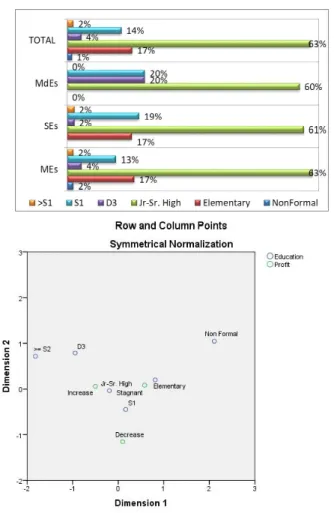
Moreover, based on owner’s the education, figure 4.2 (left) shows that most owners of MSMEs graduated from Junior – Senior High School (63%) and Elementary School (17%), especially owners of MEs where 63% graduated from Junior – Senior High School and 17% graduated from Elementary School. Meanwhile, most owners of MDEs graduated with bachelors degrees and diplomas (20%).
Moreover, chi-square results (0.055 < 0.10) show that there is associa- tion between net profit performance for the last three years and owner’s education. However, there is a strong tendency that those who gradu-
ated from elementary and high school correspond with a stagnant profit performance.
FIGURE 4. 4 EDUCATION (ABOVE) AND ITS CORRESPONDENCE ANALYSIS (BELOW)
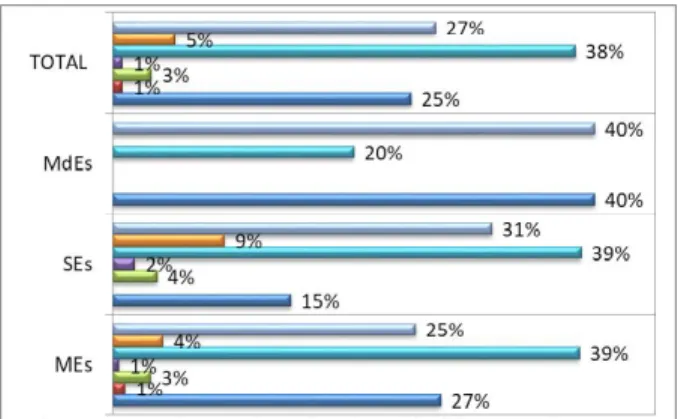
Viewed from the sector of business, figure 4.3 (left) shows that most MEs entered the trading and services sector (39%), and only MDEs entered the consumer sector (10%). Moreover, chi-square results (0.631
> 0.05) show that there is no association between the sector of busi- ness and MSMEs’ net profit performance. However, there is a ten- dency that MEs and SEs entered the trade and service sectors, while MDEs entered the consumer sector.
FIGURE 4. 5 SECTOR OF BUSINESS (ABOVE) AND ITS CORRESPONDENCE ANALYSIS (BELOW)
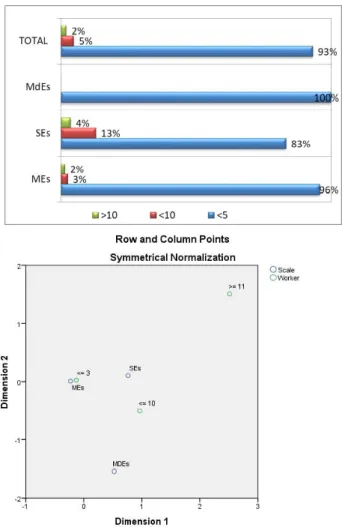
In terms of the number of employees, figure 4.3 (left) shows that most MSMEs (83%) have less than five employees (93%), especially ME (96%). Chi-square results (0.090 > 0.10) show that there is asso- ciation between the number of employees and the scale of MSMEs’
enterprises as well as the source of financing (0.000 < 0.05) and profit performance (0.004 < 0.05). However, there is a strong tendency that MEs have less than 5 employees, while SEs have less than 11 employ- ees and MEDs have more than a dozen employees. Moreover, the more employees is associated with more net profit performance and
more employees will influence the type of business financing, as we know that MSMEs prefer conventional loan (75%), while the rest (25%) prefer Islamic financing. So, having no employees corresponds to be- ing stagnant and a decrease in profit.
FIGURE 4. 6 NUMBER OF EMPLOYEE (ABOVE) AND ITS CORRESPONDENCE ANALYSIS (BELOW)
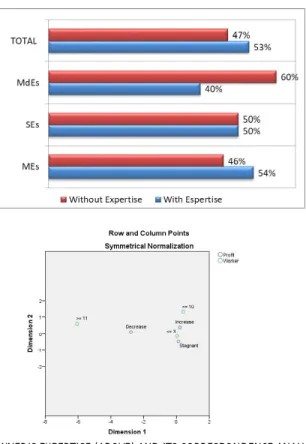
The survey shows that the owner’s expertise of MSMEs is almost split in half between skilled employees (53%) and unskilled employ- ees (47%). However, MEs are mostly owned by skilled owners and employees (54%), because most MSEs are personally owned and
managed by themselves. Meanwhile, MDEs are mostly owned by unskilled owners (60%). Only less than half of the owners are skilled (40%) because most MDEs are not personally owned and not man- aged by themselves, as they have many skilled workers to manage the enterprises. Moreover, chi-square results (0.066 < 0.10) show that there is association between the number of skilled owners and MSEs’ profit performance for the last three years. However, there is a tendency that MEs have employees all of whom are skilled while SEs have mostly skilled employees to increase their profits.
FIGURE 4. 7 OWNER’S EXPERTISE (ABOVE) AND ITS CORRESPONDENCE ANALYSIS (BELOW)
Viewed from the perspective of legal form of business, figure 4.4 (left) shows that most MSMEs open their business as sole proprietor-
ship (60%), especially MEs (64%) and Ses (48%). Only a small part of them choose co-operatives (5%), private limited companies (8%), and partnerships (8%) as their legal form of business. Moreover, chi- square results (0.000 < 0.05) show that there is an association be- tween the legal form of enterprise and MSEs’ profit performance for the last three years. However, there is a tendency that sole proprietorships and private enterprises correspond to being stagnant and increase in profit performance.
FIGURE 4. 8 ENTERPRISE’S LEGAL FORM (ABOVE) AND ITS CORRESPONDENCE ANALYSIS (BELOW)
Moreover, viewed from net profit performance for the last three years, figure 4.4 (right) shows that most MSMEs (51%) experienced stagnation in profit performance, especially MEs (52%) and MDEs (60%). Only SEs experienced increse in profit performance (48%).
Chi-square results (0.900 > 0.05) show that there is no association between net profit performance for the last three years and MSMEs’
scale of enterprises. Moreover, other chi-square results (0.460 > 0.05) show that there is a low tendency between net profit performance for the last three years and MSMEs’ source of financing.
FIGURE 4. 9 NET PROFIT PERFORMANCE (ABOVE) AND ITS CORRESPONDENCE ANALYSIS (BELOW)
As shown in table 4.3, financial institution practised by sharia as well as conventional in Indonesia is able to enhance business perfor- mance of MSMEs. The results of paired sample t test show that the mean of the source of financing, such as Bank Loan, Coop Society, Crowd Funding, Loan Relative, Micro Finance, Non-Government, Personal Savings, Registered Moneylenders, Rotating Sheme, Un- registered Moneylenders and others (condition 1 or initial condition) differed significantly from the second condition when the survey was conducted (condition 2 or current condition). The difference could be seen in column six in this table below.
TABLE 4. 5 THE SUMMARY OF THE PAIRED SAMPLES T-TEST OF SOURCE OF FINANCING
Indicators Mean
(Initial)
Mean (Current)
Differences
of Mean T-value df Sig. (2- tailed)
Bank Loan 2.283 2.830 -0.547 -6.357 247 [0.000]***
Coop Society 2.552 2.608 -0.056 -1.291 250 [0.198]
Crowd Funding 2.460 2.512 -0.052 -1.183 250 [0.238]
Loan Relative 2.756 2.408 0.348 5.007 250 [0.000]***
Micro Finance 2.460 2.676 -0.216 -5.491 250 [0.000]***
Non-Government 2.587 2.579 0.008 0.19 247 [0.849]
Personal Savings 2.320 2.664 -0.344 -4.027 247 [0.000]***
Reg. Moneylenders 2.728 2.544 0.184 3.705 250 [0.000]***
Rotating Sheme 2.692 2.520 0.172 3.799 250 [0.000]***
Unreg. Moneylenders 2.592 2.388 0.204 4.175 250 [0.000]***
Others 2.628 2.532 0.096 3.001 250 [0.003]***
***significant at the 0.01 level; **significant at the 0.05 level; *significant at the 0.10 level
The result of paired sample t-test show that the household or enterprise’s source of financing of the respondents at the first time was different from the last condition significantly when the survey was conducted. Generally, MSMEs are also able to enlarge the net profit performance, even the number of employees from three em- ployees to five employees after utilising the financial institution, espe- cially micro finance.
Financing or credit in a financial institution do not always corre- spond to the needs of the micro enterprises, because financing or
credit would be concentrated between the largest enterprises and wealthiest enterpreneurs. Indeed, based on these results, mostly, they still find barriers to the use of financial accounts. The barriers of formal financial institutions have forced MSMEs to go to moneylenders to borrow money, although they charge high interest. Not surpris- ingly, most MSMEs in the traditional market are heavily indebted to moneylenders, registered as well as unregistered, and do not have money left as resource for their business capital and as such they con- sider themselves as micro enterprises and poor people.
Inclusive finance must be supported by empirical analysis of how to measure inclusive finance on aggregate economic indicators. Fur- thermore, this can increase the participation of the poor in economic growth and ultimately create inclusive growth.
TABLE 4. 6 MEASURING THE ISFI RESULTS
Dimension Topic Detailed Indicator ISFI Results
MSMEs with at least one loan outstanding from a regulated financial institution Satisfied with the accessibility of bank loan
MSMEs with at least one loan outstanding from a cooperative institution Satisfied with the accessibility of coop society
MSMEs with at least one loan outstanding from a micro financial institution Satisfied with the accessibility of microfin
MSMEs who saved at a financial institution in the current year Satisfied with the accessibility of saving account
MSMEs with an account at a Islamic financial institution Satisfied with the accessibility of shariah account
0.384
0.438 Usage
Accessibility Shariah Account Savings MicroFin
Coop Society Bank Loan
Table 4.4 shows the results of the ISFI measurement of two di- mensions of Sharia financial inclusion measurement in 250 MSMEs in Indonesia that were estimated in 2018. The results found that the utilisation of Islamic financial institutions, even cooperatives, is gen- erally low in Indonesia (0,384 for usage dimension and 0,438 for ac- cessibility dimension). This has been proven by the respondents’ pro- file that MSMEs prefers conventional loan (75%), while others (25%) prefer Islamic financing. MSMEs also prefer to use loan from rela- tives, their personal saving, rotating scheme or other forms of loans.
5. CONCLUSION AND RECOMMENDATION
5.1 Conclusion
MSMEs are very diverse business enterprises (mostly in trade-ser- vices, consumer and transportation sectors), which should not be gen- eralized and should be treated accordingly. However, MSEs (in this sample) have some common features, such as:
1. Most MSMEs’ Owners hold Junior – Senior High (63%) degrees, elementary (17%) degrees and Undergraduate (14%) degrees.
2. Most MSMEs entered the trade-services sector (38%), which is easy to enter and easy to exit with simple technology, and only MDEs entered the consumer sector (20%).
3. Most MSMEs have less than 5 employees (93%), especially MEs (96%), and they all have skilled employees (53%), especially MEs (54%).
4. Most MSMEs have legal form as sole proprietorship (60%), pri- vate and partnership (7%, each).
5. Most MSMEs (51%) experienced stagnation in profit performance, especially MEs (52%). Only 43% of MSMEs experienced an in- crease in profit performance, and 6% experienced a decrease.
6. Most MSMEs (75%) started their businesses with loan/financing from conventional financial institutions, and only 25% of them received financing from Islamic financial institutions.
Meanwhile, the results of the survey show that the source of fi- nancing of the enterprises differed significantly between the first time and the last condition. MSMEs prefer to use loans from relatives, their personal savings, rotating scheme and even moneylenders. They are financed by their own capital because they are unbankable or view debt as an uncommon practice. Furthermore, the utilisation of Islamic financial institutions, even cooperatives, is generally low in Indonesia (0,384 for usage dimension and 0,438 for accessibility di- mension).