crown dinosaurs, and the name “Aves”
Jacques Gauthier
Department of Geology and Geophysics, P. O. Box 208109 Yale University, New Haven, CT 06520-8109 U.S.A.
Peabody Museum of Natural History, Yale University P. O. Box 208118, New Haven, CT 06520-8118 U.S.A.
E-mail:[email protected]
Kevin de Queiroz
Department of Vertebrate Zoology, National Museum of Natural History Smithsonian Institution, Washington, DC 20560 U.S.A.
E-mail: [email protected]
Abstract
The taxon name “Aves” is currently used for several different clades, a situation that violates the fundamental nomenclatural principle that, to minimize ambiguity, each taxon name should refer to a single taxon. To clarify this situation, we explore some general issues concerning the properties of the three classes of phylogenetic definitions, including: how names can be tied to clades through composition or characters; the relationships between “total” and “crown” com- pared to “stem” and “node” clades; how taxa can be referred to clades whose names are defined using different classes of phylogenetic definitions; perceived problems with apomorphy-based definitions; whether and in what senses taxon names have traditional meanings; and the con- sequences of restricting Aves to each one of the four clades to which it is most commonly ap- plied. We then propose a taxonomy that resolves current nomenclatural ambiguity by using a different name for each of the clades that everyone wants to talk about—namely, those com- posed of bird-line archosaurs, the feathered dinosaurs, the flying dinosaurs, and the crown di- nosaurs—instead of referring to all of them as “Aves.” Our proposed taxonomy also fixes the clade references for six additional names—“Carinatae,” “Ornithurae,” “Palaeognathae,”
“Tinamidae,” “Ratitae” and “Neognathae”—that are no less than a century old, as well as two newer ones—“Galloanserae” and “Neoaves.”
Keywords
Birds, taxonomy, nomenclature, feathers, flight, phylogeny, systematics, evolution, node-based, stem-based, apomorphy-based, phylogenetic definitions, PhyloCode, taxon names, Reptilia, Ar- chosauria, Panaves, Dinosauria, Theropoda, Coelurosauria, Avifilopluma, Maniraptora, Avialae, Carinatae, Ornithurae, Aves, Palaeognathae, Tinamidae, Ratitae, Neognathae, Gal- loanserae, Neoaves
Introduction
What is a bird? This question was raised in the latter half of the 19th century by the discovery of Archaeopteryx fossils in late Jurassic sediments from southern Germany. The ensuing debate focused on where to “draw the line” between reptiles (in the paraphyletic sense) and birds. An analogous debate has resurfaced with the equally spectacular fossils of feathered dinosaurs re- cently discovered in early Cretaceous deposits of northeastern China. But in the modern con- text, in which higher taxa are conceptualized as clades, the question has been reformulated as:
Which clade is to be designated by the taxon name “Aves”? In the recent literature, four different answers are commonly given to this question. That is to say, the name “Aves” (hereafter equiv-
© 2001 Jacques Gauthier and Kevin de Querioz. All rights reserved.
From New Perspectives on the Origin and Early Evolution of Birds: Proceedings of the International Symposium in Honor of John H. Ostrom.
J. Gauthier and L. F. Gall, eds. New Haven: Peabody Mus. Nat. Hist., Yale Univ. ISBN 0-912532-57-2.
© 2001 Peabody Museum of Natural History, Yale University. All rights reserved.
alent to “birds”) is used, either explicitly or implicitly, for at least four different, albeit in- ternested, clades. Thus, “Aves” has been used for (1) the clade of feathered dinosaurs (e.g., Paul 1988; Lee and Spencer 1997), (2) the clade of flying dinosaurs (e.g., Ji and Ji 2001), (3) the clade stemming from the most recent common ancestor of Archaeopteryx and crown dinosaurs, here- after referred to as the “Archaeopteryx node” (e.g., Padian and Chiappe 1998), and (4) the clade of crown dinosaurs (e.g., Perle et al. 1993). The name has occasionally been used in other ways:
Patterson (1993), for example, applied “Aves” to the entire clade of bird-line Archosauria, while Thulborn (1975) applied it to only part of that clade, namely, Theropoda. Nevertheless, the four alternatives listed above continue to be the most popular uses of the name “Aves.”
Even with all the remarkable fossils described in the past two decades, there are still sizable morphological and temporal gaps among these four internested clades. Nevertheless, even ex- perts who are well aware of the differences among them have confused these clades. It has been argued, for example, that the smaller Eichstätt and larger London Archaeopteryx specimens rep- resent different species (Martin 1991). The chain of inference on which this conclusion is based begins with the observations that both specimens have a full set of tail feathers (rectrices). Birds (i.e., Aves), however, as represented by extant species, do not have completely developed rectrices until they are fully grown. Because Archaeopteryx is considered a bird, it is inferred to have grown and developed in much the same way as other birds. It then follows that the presence of a full set of rectrices indicates that both a small and a large species have mistakenly been included in what is usually thought to be a single species, Archaeopteryx lithographica (e.g., Houck et al. 1990).
That inference would be justified if Archaeopteryx could be shown to be part of the crown clade, in which case it could reasonably be expected to have grown and developed like a living bird. But Archaeopteryx existed many tens of millions of years before the ancestor of the di- nosaur crown (Gauthier 1986). And it may be that the temporal association between skeletal maturity and tail plumage development had itself evolved during the course of phylogeny, and along with it, the ontogeny of flight. In other words, it may have been the case that an individual Archaeopteryx with fully developed rectrices was able to fly long before it reached maximum adult size. That is quite unlike the case for species in the crown clade, in which flight capability and maximum size are tightly coupled in ontogeny, as Martin (1991) observed.
This class of errors—the “unjustified inferences” of de Queiroz and Gauthier (1992)—is common in the literature (for example, flight ability = adult size in Enantiornithes; Sereno and Rao 1992), particularly in cases where taxa in question are species. In Quaternary studies, for ex- ample, attributes observed in the crowns of extant species are regularly presumed to extend un- changed down into their stems (e.g., Campbell 1980; Van Devender and Bradley 1994). In the absence of additional information (such as correlated characters), parsimoniously justified, or
“safe,” inferences are those for which the taxon inferred to have possessed a particular trait is de- scended from an ancestral node whose primary subclades can be observed to possess that trait.
For example, extinct pseudodontorns, which are thought to be pelecaniforms (Olson 1985) and thus part of the crown clade, can safely be inferred to have developed rectrices after they were fully grown. That inference follows from the observation that tail feather development and skeletal maturity are closely linked in all living members of the crown clade that develop rec- trices, including other pelecaniforms. But without additional evidence such an inference cannot be extended to taxa—including Ichthyornis, Confuciusornis and Archaeopteryx—that diverged before the most recent common ancestor of taxa observed to possess that trait.
Such confusions are closely tied to taxonomy in that they involve the reference of the name “Aves.” In this context, it seems relevant that part of scientific progress involves making distinctions not made previously, commonly accompanied by the introduction of terms re- flecting those distinctions (e.g., Gould and Vrba 1982). Given that terminological precision is an ever-increasing phenomenon, some level of imprecision in scientific terminology is in- escapable. It is nevertheless clear that, at this point in the history of taxonomy, there is little benefit in continuing to tolerate the current level of imprecision in the meaning of “Aves.” So it seems that for the sake of effective communication—the ultimate goal of biological tax-
onomy—comparative biologists face an important (if arbitrary) decision: Which of the four currently popular references should be associated with the name “Aves”? Given that “Aves” has been applied to all four of these clades, we take it for granted that all four are worthy of being named. Nevertheless, even among those who adopt phylogenetic nomenclature, precisely which clade should be called “Aves” is currently a matter of debate (Gauthier 1986; Chiappe 1991, 1995, 1996; Perle et al. 1993, 1994; Chiappe and Calvo 1994; Holtz 1994, 1996; Lee 1996;
Lee and Spencer 1997; Padian 1998a, 1998b; Padian and Chiappe 1998; Sereno 1998, 1999a, 1999b; Gauthier and Gall 2001).
In this paper we examine different classes of definitions as they bear on naming the four clades in question and the reference of the name “Aves.” We first explore some general issues concerning the properties of three classes of phylogenetic definitions. These include how names can be tied to clades either through composition or characters, as well as the relationships be- tween Hennig’s (1965) “total” and “crown” clades compared to our “stem” and “node” clades.
We then describe how taxa are to be referred to clades whose names are defined using different classes of phylogenetic definitions, and discuss perceived problems with apomorphy-based de- finitions. Then we address the issue of whether and in what sense taxon names have traditional meanings. We conclude with an examination of the consequences of restricting “Aves” to each of the four clades to which it is most commonly applied, and propose a novel taxonomy that re- solves current nomenclatural ambiguity.
Properties of Different Classes of Phylogenetic Definitions
Classes of phylogenetic definitions based on composition and characters
To appreciate the consequences of attaching “Aves” to different clades, we must first consider the different ways in which names can be tied to clades. This can be accomplished in one of two general approaches: (1) by specifying an ancestor (and thus the clade stemming from it) through reference to a particular apomorphy, or (2) by specifying an ancestor through reference to particular descendant taxa. De Queiroz and Gauthier (1990) described three methods for defining taxon names conforming to these two general approaches. Apomorphy-based defini- tions specify clades in the first way; namely, “Aves” is defined as the clade stemming from the ancestor in which a particular character first evolved. Node- and stem-based definitions specify clades in the second way, either: (1) in the case of node-based definitions, by defining a name (for example, “Aves”) as referring to the clade stemming from the most recent common ancestor of specified descendants (= internal “reference taxa” of Sereno 1999a, or “specifiers” of Cantino and de Queiroz 2000), which must necessarily share a single most recent common ancestor at some point in their genealogies; or (2) in the case of stem-based definitions, by defining a name (such as “Aves”) as referring to the clade composed of a particular descendant or descendants (internal specifier), as well as all other taxa that share a more recent common ancestor with that descendant(s) than they do with some other taxon or taxa (external specifiers). Selecting one kind of definition rather than another amounts to applying that name to one clade rather than to another. This does not mean that clades described by node- or stem- or apomorphy-based definitions cannot be the same in theory; for example, it is possible that the origin of an apo- morphy coincides with the initial divergence of one lineage from another. On the other hand, the origins of apomorphies and lineages need not, and usually will not, be coincident.
The distinctions made by these classes of definitions are obvious when they involve clades that differ markedly in inclusiveness (and therefore in secondary properties such as time and place of origin [de Queiroz and Gauthier 1990; Rowe and Gauthier 1992]). Consider, for ex- ample, the differences among the clade stemming from the most recent common ancestor of Passer and Struthio (= node based), the clade composed of Passer and Struthio plus all ar- chosaurs more closely related to them than to Crocodylus (= stem-based), and the clade stem- ming from the first flying dinosaur (= apomorphy-based). But the distinctions obtain even when there are only minor differences in inclusiveness—for example, if Ichthyornis is used as
the external reference taxon in the stem-based definition, and an ossified supratendinal bridge on the tibiotarsus is regarded as the defining attribute in the apomorphy-based definition. In these cases, the three definitions might seem to refer to the same taxon in terms of known com- position (that is, the crown clade). But the taxa specified by those definitions would neverthe- less be different in actual composition, which would be revealed, for example, if a species were to be discovered that is outside of the crown but more closely related to the crown than is Ichthyornis (de Queiroz and Gauthier 1992). The distinction in question holds even when the external specifier of the stem-based definition is the true sister species (or one of its descen- dants) of the ancestral species terminating at the node specified by the node-based definition, provided that one is willing to allow the “last common ancestor” of the node-based definition to be a part of a species, rather than the entire species (see de Queiroz and Donoghue 1988).
Frost and Kluge (1994) and Sereno (1999a) argued for an alternative view in which node- and stem-based taxa are regarded as the same, which is correct under the constraint that the last
“common ancestor” refers to an entire species. We agree that all organisms in the final unitary lineage segment ancestral to Aves are parts of the same species (sensu de Queiroz 1998, 1999).
Nevertheless, that lineage segment could have undergone considerable evolutionary change, in which case its later populations might show clear evidence of their closer relationship to the node and its descendants than to the sister species, or even to earlier parts of their own species (de Queiroz and Donoghue 1990). Moreover, in practice, one can never be sure to have found (for use as a reference point) the true sister species to any ancestral species. That is to say, a stem-based version of “Aves” using Ichthyornis, currently the closest known outgroup to the crown (Norell and Clarke 2001), as an external specifier may not (and probably does not) refer to the same entity as a node-based version of “Aves” attached to the crown. Some specimens currently referred to Ichthyornis may prove closer to the crown than to the type specimen of Ichthyornis (Clarke 2000). Or an as yet unknown species may be found that is closer to the crown than is Ichthyornis. Indeed, even under the constraint that ancestors are entire species, the only way to force a stem-based definition of “Aves” to refer to the crown clade (and thus be equivalent to a node-based definition) would be to formulate the definition using the following wording or some variant of it: “the clade including Passer and Struthio [for example] and all taxa more closely related to Passer and Struthio than to the sister species of their most recent common ancestor.” Although technically stem-based, this definition incorporates elements of a node-based definition in referring to the most recent common ancestor of two descendant taxa.
Moreover, it has the undesirable property of using a hypothetical rather than a known taxon as an external specifier, thus severely compromising its practical utility.
Crown and total clades are kinds of node and stem clades
Some authors (e.g., Patterson 1994) have confused stem- and node-based definitions of taxon names with Hennig’s (1965, 1966, 1981) distinction between clades that Jefferies (1979) termed
“total groups” and “crown groups.” (The word “total” is an unfortunate choice if it implies that other clades are somehow incomplete.) “Total groups” are only a subset of the stems that can be designated by stem-based definitions, and “crown groups” are only a subset of the nodes that can be designated by node-based definitions (de Queiroz and Gauthier 1990). A node-based de- finition can as easily describe an entirely extinct clade, or one in which only one of the two pri- mary subclades has survived to the present time, as one in which both primary subclades are represented by extant organisms. Likewise, a stem-based definition can describe either an en- tirely extinct clade, or a clade that contains only part of the stem of a crown, or a clade that con- tains the entire stem of a crown.
Moreover, just as stem- and node-based definitions are both valid, so are total-clade and crown-clade definitions in that both explicitly tie names to clades (de Queiroz and Gauthier 1990, 1992, 1994; Rowe and Gauthier 1992; Bryant 1994, Lee 1996, Sereno 1998, 1999a, 1999b).
Thus, “total groups” are not the only clades, nor are they (contrary to the opinion of Smith [1994:97]) the only ones worthy of naming. Systematists may have good reasons—such as con-
flicting data or weak support—for naming some clades and not others, but such complications are hardly unique to crown-based names alone. Moreover, there are good reasons for naming both crown and total clades (de Queiroz and Gauthier 1992). Thus, although we are sympa- thetic with Patterson’s (1993) view that applying the name “Aves” to the total stem clade con- taining Struthio and Passer but not Crocodylus might force ornithologists to confront the deep history of the lineage leading to the crown, that is not to say that the crown clade should go un- named. Indeed, there may be equally compelling reasons for using “Aves” for the crown, which is the focus of so much biological research.
Given these differences, it should be clear that the three classes of phylogenetic definitions are not alternative ways of naming the same thing. On the other hand, they can be thought of as alternative ways of defining the same name; which is to say that “Aves” can be tied to different taxa using node-based, stem-based or apomorphy-based definitions. As it now stands, all three types of definition have, in effect, already been proposed: node-based for the “Archaeopteryx node” and the “crown clade,” stem-based in the case of the “total clade,” and apomorphy-based for “feathers” and “flight.” A more complete understanding of the effects of fixing the name
“Aves” to just one of these clades requires consideration of some consequences for taxon as- signment attendant to the different classes of phylogenetic definitions.
Referring species to clades named using different classes of phylogenetic definitions Each of the three classes of phylogenetic definitions has certain properties that dictate how its associated clades are to be diagnosed, thereby determining how species and organisms can be referred to them. These properties are necessary consequences of the particular kind of defini- tions chosen, so they must be kept in mind when using different definitions to avoid unjusti- fied referrals of species and organisms to the clades specified by them. Homoplasy and incomplete data present general challenges for taxon reference; these issues will be discussed separately (see below under “Ambiguity from missing data” and “Ambiguity from homoplasy”).
To simplify the rest of the discussion in this section, we will assume absence of homoplasy.
Node-based definitions. Although a node is diagnosed by the apomorphies arising on its sub- tending branch, possession of those apomorphies is insufficient for referral of specimens to the clade stemming from that node. Consider, for example, a node-based definition of “Aves” for the dinosaur crown. That clade may possess synapomorphies relative to various outgroups, in- cluding Ichthyornis. Nevertheless, a given fossil can only be referred to that “Aves” (node) if it also possesses at least one apomorphy of one of the crown’s primary total subclades (i.e., there must also be evidence that the fossil is part of total clade versions of either “Palaeognathae” or “Neog- nathae”). Possession of crown-clade apomorphies alone is insufficient for referral to the crown because they could have arisen within the ancestral lineage after its divergence from Ichthyornis but before its divergence into palaeognath and neognath total subclades. Consequently, reference of a particular fossil to a node-based clade requires evidence of membership in a subclade. A corollary of this conclusion is that the common ancestor from which a node-based clade origi- nates, which logically belongs to that clade but not to any of its subclades (Hennig 1966), can never be definitely referred to its own clade on the basis of character evidence alone.
Stem-based definitions. At least one apomorphy is sufficient when referring specimens to stem-based clades. That apomorphy could be any one of those arising in the stem lineage subse- quent to its divergence from its sister group. Thus, in Patterson’s (1993) stem-based version of
“Aves,” any one of the apomorphies of bird-line archosaurs would do. On the other hand, as is generally the case with stem-based names, one might not be able to assign the earliest organisms of the stem lineage; that is, those existing before any apomorphies arose—or became fixed—to such a stem-based version of “Aves.” A consequence of this observation, in conjunction with the discussion above, is that these organisms would not even be referable to the larger node-based clade of which this “Aves” is a primary total subclade (that is, a crown version of “Archosauria”).
Apomorphy-based definitions. Possession of the definitive apomorphy is all that is required for taxon reference in the case of apomorphy-based definitions. If “Aves” is defined with respect to “feathers,” for example, then any organism possessing this definitive apomorphy would be part of Aves. That being said, the Chinese feathered dinosaurs remind us just how wrong we can be when equating a particular node (that is, the Archaeopteryx node) with the origin of a particular apomorphy. “[F]eathers, wings, and the capacity for flight” may have always been regarded as
“key” avian characters (Sereno 1999a:332), but treating these characters as apomorphies of a single node was possible only because of the notorious incompleteness of the fossil record. In ret- rospect, it seems especially fortuitous that Archaeopteryx—only the second Mesozoic coelurosaur discovered—was fossilized in an exceptional depositional environment that preserved feather impressions. And for more than 100 years feathers have been regarded as the “key” apomorphy distinguishing the Archaeopteryx node from more distantly related dinosaurs (Lee and Spencer 1997). Nevertheless, new theropod fossils from the Liaoning lagerstätten (Chen et al. 1998; Ji et al. 1998, 2001; Xu, Tang et al. 1999; Xu, Wang et al. 1999) now reveal that feathers diagnose a far more inclusive clade than that stemming from the Archaeopteryx node.
Perceived problems with apomorphy-based definitions
Throughout the history of taxonomy, organismal traits have played central roles in taxon con- cepts, and by implication, the meanings of taxon names (Stevens 1994). Nevertheless, apo- morphy-based definitions have been widely criticized, and it has been argued that this class of definitions should be avoided (Rowe and Gauthier 1992; Bryant 1994; Schander and Thollesson 1995; Padian et al. 1999; Sereno 1999a). Despite our sympathy with some of the problems raised, none is a compelling reason for avoiding apomorphy-based definitions.
There are three reasons why apomorphy-based definitions are thought to pose special ob- stacles (Sereno 1999a): (1) they are prone to ambiguities stemming from ambiguous character concepts (such as the precise definition of “feather”); (2) they are subject to ambiguities in- volving missing data (for example, integumentary structures are preserved in only a tiny frac- tion of fossil dinosaurs); and (3) they are vulnerable to problems caused by homoplasy (such as parallelism, convergence and reversal) or obliteration through subsequent evolutionary trans- Figure 1. Depending on the definition of “feather,” an apomorphy-based definition of “Aves” could be tied to one of three internested clades of theropod dinosaurs. Although the clade referred to by the name
“Aves” in each instance is unambiguous (e.g., “Aves” = all theropods with remiges and rectrices), name ap- plication may not always be clear (for example, missing data render the avian status of tyrannosaurs un- certain by this definition). No system of taxonomy that depends on data for taxon assignment can escape the consequences of imperfect knowledge. Cladogram depicting phylogenetic relationships among select theropod dinosaurs modified from Sereno (1999b) and Norell et al. (2001).
formation. One might be tempted to regard these as unique problems for apomorphy-based de- finitions to which node- and stem-based definitions are somehow immune. But as long as char- acters play a role in taxon assignment, systematists will face practical problems implementing any kind of definition. Indeed, the precise phylogenetic relationships of some specimens may simply not be determinable, regardless of how taxon names might be defined. Such problems are, however, general to phylogenetic inference, rather than being specific to phylogenetic tax- onomy per se; regardless of taxonomic philosophy, there can be no guarantee that the available data will be sufficient to enable reference of every specimen to its exact phylogenetic position.
Moreover, because phylogenetic taxonomy, in contrast with traditional practice, rejects the idea that certain categorical ranks are mandatory, specimens and taxa need not be referred to taxa beyond what the data will support (de Queiroz and Gauthier 1992).
Ambiguity in character concepts. Systematists might agree on all details of tree topology and loci of character transformation yet still disagree about which clade to name “Aves” be- cause they cannot agree on which state in a transformation series should be called (for ex- ample) a “feather” (Figure 1). Systematists would be ill-advised to become too concerned with the “essence” or “true nature” of any apomorphy, but that still leaves the problem of ar- bitrarily deciding which state in a transformation series is to be designated by the name
“feather.”
In a situation analogous to the muddled state of affairs with the taxon name “Aves,” the ho- mologue name “feather” can be associated with several different morphologies (Figure 1). Evo- lutionists should have expected that such a suite of novel morphologies summarized by the term “feather” might not have arisen in a single macromutation. And from what is known of the ontogeny and phylogeny of feathers, that certainly seems to be the case (Prum 1999; Ji et al.
2001). Thus, short, hollow-based filaments occur in the basal coelurosaur Sinosauropteryx (Currie and Norell 1998) as well as in dromaeosaurs (Prum 1999; Ji et al. 2001). Branched ap- pendages with long filaments (barbs) emanating from a short base (calamus) are also known in dromaeosaurs (Xu et al. 2001). Bipinnately branched filaments (barbs) emanating from a long, hollow, central rachis have been observed in oviraptors (Ji et al. 1998), dromaeosaurs (Ji et al.
2001; Xu et al. 2001), and Archaeopteryx (Owen 1863; Heilmann 1927). And those appendages may bear open vanes, as on the shank of Archaeopteryx, or closed vanes (and thus presumably barbules with hooked distal pennulae), as do those lying atop the second finger and trailing edge of the ulna and fanning from the tail in both Archaeopteryx and Caudipteryx (Ji et al. 1998;
Wagner and Gauthier 1999). Finally, some closed-vaned pennaceous appendages may have stout, curved shafts—furrowed along the ventral side—supporting asymmetrically developed vanes, as do those borne on the hand of Archaeopteryx and many members of the dinosaur crown (Norberg 1985; Rietschel 1985).
Hollow-based, unbranched filaments—structures that Prum (1999) homologized with the thin epidermal sheaths that temporarily enclose developing feathers (pin feathers) in the crown clade—appear in basal coelurosaurs (Figure 1; Currie and Norell 1998). Unbranched filaments, as well as natal down and pennaceous feathers with open and closed vanes (= remiges and rec- trices) appear in basal maniraptors (Figure 1; Ji et al. 1998, 2001; Xu et al. 2001). Fully func- tional flight feathers came later, originating after basal raptors such as Sinornithosaurus, but before the Archaeopteryx-node (Figure 1). In our estimation, any one of these morphologies could quite justifiably be called a “feather.” Different workers may prefer one definition, such as the inferred presence of the feather follicle itself (Prum 1999), or another, such as the more readily observable herringbone pattern of pennaceous feathers (for example, Caudipteryx; Ji et al. 1998). The choice is arbitrary.
Of course, identifying feathers in fossils is sure to incite controversy. Ruben and Jones (2000), for example, expressed doubt that the structures identified as feathers in Sinosaurop- teryx (Currie and Norell 1998) were feathers, or indeed, that they were even of epidermal origin.
Moreover, Jones, Ruben and co-workers (2000) claimed that the epidermal appendages in
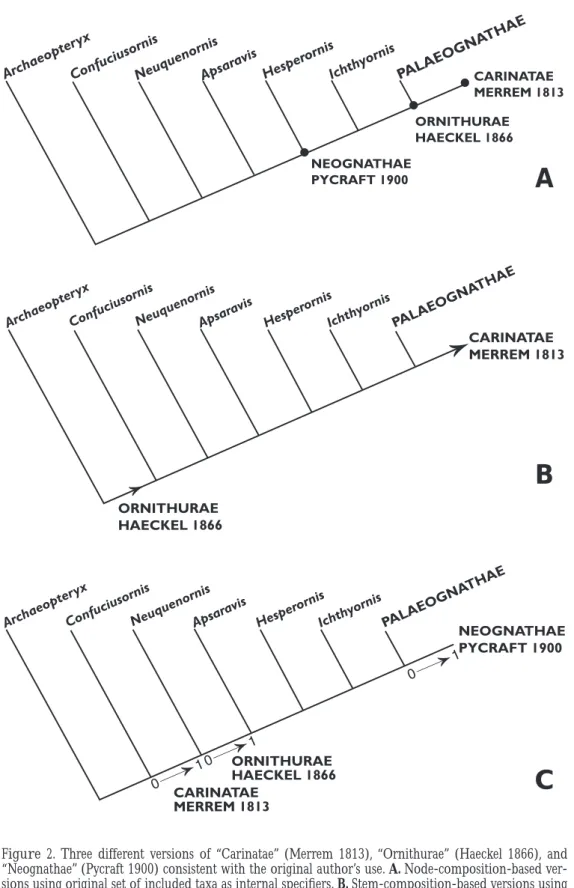
Figure 2. Three different versions of “Carinatae” (Merrem 1813), “Ornithurae” (Haeckel 1866), and
“Neognathae” (Pycraft 1900) consistent with the original author’s use. A. Node-composition-based ver- sions using original set of included taxa as internal specifiers. B. Stem-composition-based versions using original set of included and excluded taxa as internal and external specifiers, respectively. C. Apomorphy- character-based versions using eponymous synapomorphies as specifiers. Cladogram depicting phyloge- netic relationships among select flying dinosaurs modified from Clarke (2001).
B
C
Longisquama are pennaceous feathers (or their “precursors”), while Reisz and Sues (2000) ar- gued that although these have some superficially feather-like attributes—such as a thickened central axis with ridges diverging from it—they are nonetheless typical reptilian scales. Con- troversies of this sort stem from conflicting primary homology assessments, exacerbated by in- complete data, rather than the definition of the homologue name “feather” per se. The structures in question could be called feathers if they are found to satisfy criteria for primary and secondary homology assessment (Patterson 1982; de Pinna 1992), thus making these taxa part of a feather-based “Aves.” But if those structures fail to satisfy homology criteria, then there would be no basis for calling them feathers, and no basis for referral of the taxa bearing them to “Aves.” And finally, if the data are too poor or contradictory to enable a decision one way or the other, then homology of these structures, and referral of the taxa that bear them, would like- wise be uncertain (barring other evidence of relationships).
Ambiguity from missing data. Another potential problem with apomorphy-based definitions is that they could be based on attributes that are unlikely to leave a trace in the fossil record, and thus be inapplicable to many extinct taxa (Lee 1998). If “Neoaves,” for example, was defined in terms of the unique 5-codon deletion in the RAG-1 nuclear gene identified by Groth and Bar- rowclough (1999), one might never be able to refer certain fossil members to that clade. Never- theless, if any “soft” (less preservable) character can contain phylogenetic information, the absence of these data in fossils seems an inadequate justification for rejecting their use in apo- morphy-based definitions. Indeed, feathers have commonly been regarded as a defining avian character despite their low preservation potential. And even the “hard” (more preservable) apo- morphies favored by paleontologists are not preserved in every fossil. For example, the only clearly diagnostic character of Archaeopteryx—a foramen passing through the ischium—can only be scored in one (the London specimen) among the seven skeletons currently referred to that taxon. Likewise, the distinctive palatal morphologies that characterize major avian clades (Huxley 1867) cannot be observed in most fossil specimens.
Related to the problem of missing data is that the precise point of origin of any character will always be beset with some uncertainty. For example, if feathers are defined as hollow-based, follicular epidermal appendages, we know only that they arose after the divergence of Carno- taurus and before that of Sinosauropteryx (Figure 1). Furthermore, although systematists often distinguish between “ambiguous” and “unambiguous” synapomorphies, even the latter are sub- ject to this problem (see below). For example, although considered an unambiguous synapo- morphy of the crown clade (Gauthier 1986), an ossified supratendinal bridge on the tibiotarsus can only be inferred to have arisen sometime after the divergence of Ichthyornis but before the origin of the crown (Figure 2).
Even with “complete” knowledge one could still be left with making arbitrary divisions along a continuum for characters exhibiting continuous variation or for those exhibiting dis- continuous variation and arising as population-level polymorphisms. The latter case is nicely illustrated by Confuciusornis, in which a few specimens possess a slight ridge on the pos- teroventral midline of the sternum, while most others do not (Chiappe et al. 1999). This ridge hardly matches the prominent keel (carina)—the site of origin for hypertrophied pectoral mus- cles—that originated along the branch subtending the Neuquenornis node (Chiappe and Calvo 1994; Figure 2). Nevertheless, Chiappe and co-workers (1999) regarded the feature in some specimens of Confuciusornis as a potential homologue, even if only in an incipient form, of the carina seen in the clade stemming from the Neuquenornis node. But even if one is willing to ac- cept the condition seen in Confuciusornis as a “carina,” there is still ambiguity regarding criteria for considering a character as present or absent, which affects inclusion of that taxon in an apo- morphy-based version of “Carinatae.” Thus, if one elects to view a character as being absent until it becomes fixed in a lineage (Nixon and Wheeler 1992), then Confuciusornis would not be part of “Carinatae.” Alternatively, one could treat the polymorphism as missing data (Kluge 1995), in which case taxon assignment will be uncertain. Finally, if one considers a character to
be present if any part of a population has it (Kron and Judd 1990), then Confuciusornis would be part of “Carinatae.”
Despite these potential problems with apomorphy-based definitions, stem- and node- based definitions are no less subject to ambiguity in specimen referral, because that activity de- pends on character data, which may be fallible for all the reasons outlined above. For example, under a stem-based version of “Carinatae”—defined with respect to (keel-less) Archaeopteryx as an external reference taxon—at least some Confuciusornis specimens could mistakenly be ex- cluded (for example, if the sternal keel was the only informative attribute or the sternum the only fossil remains). Similarly, under a node-based version of “Carinatae”—defined using a member of the crown and Confuciusornis as internal reference taxa—those same specimens might once again be mistakenly excluded. Even without the complications resulting from poly- morphism and continuous variation, the earliest members of a stem lineage might have none of the apomorphies arising subsequently in their descendants, so they will often be mistakenly excluded from the stem-based clades of which they are parts and, thereby, from the node-based taxon composed of those stems.
Evolutionists are obliged to accept that common ancestry relations hold even when they might never be discovered in particular instances (Ghiselin 1984). Thus, all flying dinosaurs arising from an ancestor with a keeled sternum would, by definition, be part of a “Carinatae”
based on that apomorphy. Whether one can correctly refer specimens in every case is beside the point, as no phylogenetic definition or, for that matter, any other nomenclatural system, can guarantee that.
Ambiguity from homoplasy. Some authors think that homoplasy places a special burden on apomorphy-based definitions (Bryant 1994; Schander and Thollesson 1995; Sereno 1998, 1999a). Suppose, for example, that “Aves” is defined using the flight apomorphy and that the capacity for aerial flight arose more than once in dinosaurs. Some have mistakenly interpreted this to mean, using this example, that “Aves” would be polyphyletic (Bryant 1994). Others have suggested that it would generate ambiguity (Sereno 1999a); namely, if two dinosaur clades evolved flight, which one should be called “Aves”? These problems are perceived rather than real, though they are related to a genuine problem. As originally proposed by de Queiroz and Gauthier (1990:310), an apomorphy-based definition is used to associate a name with “the clade stemming from the first ancestor to possess a particular synapomorphy” (emphasis added). The qualifier “first” is needed because there will often be many ancestors possessing the character. But it also ensures that the name will neither refer to a polyphyletic taxon nor be ambiguous. Thus, two origins of flight in dinosaurs would not result in “Aves” referring to a diphyletic taxon, because only one of two clades would be properly referred to by that name (that is, the one that first evolved flight). And for the same reason, the reference of “Aves”
would not be ambiguous. Of course, it might not always be possible to infer the relative times of origin of states that arose homoplastically, but that is a problem with the data rather than the definition.
Nevertheless, there is a potential problem with apomorphy-based definitions as originally stated by de Queiroz and Gauthier (1990)—namely, that such definitions could result in the ap- plication of a name to an unintended clade. For example, the name “Aves” might end up refer- ring to a small early clade of extinct flying dinosaurs rather than to the large clade that includes all living taxa currently considered birds. But this problem can be remedied by adding a clause to the definition specifying that the “flight” apomorphy must be homologous to flight in a par- ticular descendant, such as Passer. If flight was then seen to have arisen twice in dinosaurs, then the clade of flying dinosaurs including Passer would be “Aves,” and the other clade of flying di- nosaurs would not, even if it evolved flight earlier.
It should be clear that if some “flying dinosaurs” were to lose the capacity for aerial flight, they would still be part of Aves (Gauthier 1986). That is to say, even in the case of apomorphy- based definitions, the possession of characters per se is secondary to common ancestry rela-
tionships (de Queiroz and Gauthier 1990). To paraphrase Darwin (1859), who was himself paraphrasing Linnaeus, a canary has feathers because it is a bird, rather than being a bird be- cause it has feathers.
In conclusion, incomplete, variable and conflicting data pose genuine problems when re- ferring specimens to taxa of any kind. Apomorphy-based definitions are no more or less prone to such problems than are node- or stem-based definitions. Moreover, in terms of communi- cating ideas about common ancestry relationships, none of the three classes of phylogenetic de- finitions is any less clear, stable or universal than is any other (Lee 1996). Finally, apomorphy-based definitions should not be avoided, if for no other reason that many of the clades people want to talk about and name are conceptualized in terms of apomorphies.
Do Taxon Names Have Traditional Meanings?
For reasons described below (see “Aves = crown dinosaurs”), de Queiroz and Gauthier (1992;
see also Gauthier 1986) proposed that widely used names be tied to crown clades. This proposal has been criticized for seeming to violate traditional associations between names and particular sets of taxa (Chiappe 1991) or particular apomorphies (Lee and Spencer 1997). But as Sereno (1999a) observed, it has seldom been clear whether a given taxon name was to be associated with a particular organismal trait or a specific set of included species. For example, when Huxley (1867:424) explained that Merrem’s (1813) “Carinatae” included “all existing birds, ex- cept the Ratitae,” in which the “sternum possesses a keel,” did he conceptualize the taxon in terms of its composition or its characters (or both)? And if he had composition in mind, is that composition to be interpreted as node-based (that is, only in terms of included taxa) or stem- based (that is, also considering the excluded taxa)? Uncertainty on these points undermines ar- guments in favor of maintaining “traditional use” advanced by some authors (Gauthier 1986;
Benton 1990, 1999; Chiappe 1991, 1995, 1996; Chiappe and Calvo 1994; Lee 1996; Lee and Spencer 1997; Padian 1998a; Padian and Chiappe 1998; Sereno 1998, 1999a, 1999b).
Figure 2 illustrates this point on a cladogram for selected basal flying dinosaurs. Three taxon names—“Carinatae” (Merrem 1813), “Ornithurae” (Haeckel 1866), and “Neognathae”
(Pycraft 1900)—are of special relevance because the names themselves (which translate as
“keeled,” “bird tail,” and “new jaw,” respectively) indicate that the original authors had specific characters (now thought to be apomorphies) in mind when they coined them. And it is no less clear from their lists of included taxa, and sometimes excluded taxa, that these authors also ap- plied each name to a particular set of taxa. In Figure 2 each name is applied to three different clades in the context of a current phylogenetic hypothesis: the first is a node-composition-based version using the original set of included taxa as internal specifiers (Figure 2A); the second is a stem-composition-based version using the original set of included and excluded taxa as internal and external specifiers, respectively (Fig. 2B); and the third is an apomorphy-character-based version using the eponymic synapomorphies as specifiers (Fig. 2C).
Note that node-composition, stem-composition and apomorphy-character versions of the same names often differ markedly in terms of the clades to which they refer (Figure 2). Al- though these different interpretations generally coincided when the names were first proposed, they tended to diverge in light of new discoveries. For example, when Merrem (1813) coined
“Carinatae,” extant tinamous and extinct crown outgroups with keeled sterna were unknown to him, while the only keel-less birds that Merrem knew of were members of the “anomalous Os- trich tribe,” which he called “Ratitae” ( = Struthio of Linnaeus 1758 = ostriches, cassowaries and rheas). Thus, “Carinatae” first referred to all then-known members of the crown except Ratitae (Figure 2A and B). Because tinamous were not included in “Carinatae” by Merrem, and because they now appear closer to ratites than to other members of the crown (Cracraft and Clarke 2001), stem- and node-composition-based versions of “Carinatae” now refer to all or part of the sister group to the ratite–tinamid stem clade. Subsequent finds—tinamous, Ichthyornis, Neuquenornis—and phylogenetic analyses (Chiappe and Calvo 1994) led eventually to the con- clusion that a keeled sternum applied to a far more inclusive set of taxa than Merrem originally
envisioned (Figure 2C). Consequently, an apomorphy-character version of “Carinatae” now refers to a clade that arose sometime between the Confuciusornis and Neuquenornis nodes.
Therefore, Merrem’s “Carinatae” would now be associated with very different clades depending on whether one retained its association with his original set of included and excluded taxa (Figure 2A and B), or with the character of a keeled sternum (Figure 2C).
Likewise, the stem-composition, node-composition, and apomorphy-character versions of
“Ornithurae” have also diverged over time. When Haeckel (1866) coined “Ornithurae,” the only known flying dinosaurs were Archaeopteryx and members of the crown. Subsequent discoveries of noncrown fossils that were closer than Archaeopteryx to the crown (such as Ichthyornis [Marsh 1872a]) posed several possible associations for that name. Thus, should “Ornithurae”
be used for the clade with a “bird tail,” as the name suggests (Figure 2C; see Ornithurae under
“Proposed Taxonomy,” below, for a discussion of “bird tail”)? Or should it apply to all flying di- nosaurs other than Archaeopteryx, the only taxon that Haeckel explicitly excluded from “Or- nithurae” (Figure 2B)? Or should it refer to the crown clade, the only flying dinosaurs that he explicitly included in “Ornithurae” (Figure 2A)? Any one of these alternatives would be consis- tent with Haeckel’s (1866) original use of that name.
Finally, an apomorphy-character version (Figure 2C) of Pycraft’s (1900) “Neognathae”
refers to the clade stemming from the first ancestor to possess Huxley’s (1867) “pterygo-pala- tine…arthrosis” (Pycraft 1900:171), “a point of great difference between Palaeo- and Neog- nathine skulls” (Pycraft 1900:208). But Pycraft included Ichthyornis and Hesperornis in his
“Neognathae” (Figure 2A), even though “Huxley’s arthrosis” could not be determined in these fossils. Pycraft, like most ornithologists of that era, seems to have been swayed by Fürbringer’s (1888) conclusion that Hesperornis and Ichthyornis were respectively allied to foot-propelled divers and shore birds, implying that they were parts of what is now termed the crown. Al- though it was acknowledged from the outset that these “toothed birds” were very primitive (Marsh 1880), ornithologists did not begin to take seriously the idea that Ichthyornis and Hes- perornis were outside of the crown until the latter half of the 20th century (Wetmore 1956; Har- rison 1973; Martin 1984). In this light, regarding the issue of composition versus characters, should “Neognathae” refer to the clade that includes Ichthyornis and Hesperornis, as specified by Pycraft? Or should “Neognathae” apply to the clade diagnosed by Huxley’s arthrosis, and thus exclude those taxa? Given Pycraft’s aversion to “inaccurate” names (he substituted “Neog- nathae” for “Carinatae” because some members of the latter taxon lack a keel), we think it likely that he would have excluded from “Neognathae” taxa (such as Hesperornis [Elzanowski 1991]) that could be shown to lack Huxley’s arthrosis. Unfortunately, inferences about the intentions of original authors are not always so straightforward.
These examples indicate that node-composition, stem-composition, and apomorphy-char- acter interpretations of the same names may differ markedly in terms of their references. For example, the node- and stem-composition versions of “Carinatae” (Figure 2A and B) refer to internested parts of the crown clade (which currently happen to have the same known compo- sition). In the apomorphy-character version (Figure 2C), however, “Carinatae” refers to a much larger clade. Indeed, under the apomorphy-character interpretation, “Carinatae” includes “Or- nithurae,” just the opposite hierarchical relation among the taxa designated by these names as in the node- and stem-composition versions, in which “Carinatae” is included within “Or- nithurae.” Likewise, the node-composition version of “Ornithurae” (Figure 2A) refers to the crown, while its stem-composition version refers to a much larger clade that includes all flying dinosaurs other than Archaeopteryx. Finally, the crown is only one part of a node-composition interpretation of “Neognathae” (Figure 2A), whereas an apomorphy-character version of
“Neognathae” (Figure 2C) refers to only a part of the crown. And “Neognathae” refers to nothing in the stem-composition version (Figure 2B) because, according to current thought, there is no clade of flying dinosaurs that excludes Palaeognathae but includes the rest of the crown as well as Hesperornis and Ichthyornis (Figure 2B).
Thus, although taxon names do indeed have traditional meanings or references, it is not al-
ways clear how those references are to be interpreted in the face of newly discovered taxa. In particular, it is unclear whether those references are to be interpreted as ideas about composi- tion as opposed to ideas about characters. Thus, it is unclear which “tradition” should be hon- ored first, the implied association between a name and a set of taxa, or the implied association between a name and a character or set of characters, and the issue is further complicated by the finer distinctions (that is, nodes compared to stems) of contemporary phylogenetic theory.
Many early ornithologists may have conceptualized taxa as philosophical classes (that is, as groups defined by the attributes of their members), in which case associations between names and characters might be argued to have primacy (Pycraft 1900). There are, however, examples involving post-Darwinian authors (if not pre-Darwinian as well) that cast doubt on that inter- pretation. Huxley (1867), for example, was well aware that certain flightless birds lacked keeled sterna, yet he still considered them members of “Carinatae.” In any case, different interpreta- tions of the traditional meanings of taxon names are clearly possible.
In light of the range of possible interpretations concerning traditional meanings, it is not surprising that ornithologists currently seem divided regarding their preferences for characters versus composition. Sometimes they conserve “traditional” character associations and ignore
“traditional” ideas about composition. For example, Martin’s (1984) use of “Ornithurae” con- serves Haeckel’s (1866) association of that name with a group possessing a more bird-like tail than that seen in “Sauriurae” (i.e., Archaeopteryx). But that use disregards Haeckel’s (1866) as- sociation of “Ornithurae” with a specific composition—at least under the node interpreta- tion—in that Martin included a series of successive outgroups to the crown that were not included by Haeckel. In other cases, “traditional” character associations have been ignored in favor of “traditional” associations regarding composition. In the case of “Palaeognathae,” for ex- ample, Pycraft’s (1900) composition (under the node interpretation) has been conserved (Cracraft 1974; Lee et al. 1997), even though many characters marking an “old jaw” are now known to apply to far more inclusive vertebrate clades. Interestingly, conserving traditional ideas about composition under the node interpretation now seems of paramount concern for many authors (Benton 1990, 1999; Lee 1996; Lee and Spencer 1997; Sereno 1998, 1999a). For example, Chiappe and co-workers (1999) excluded Confuciusornis and Neuquenornis from “Or- nithurae” to preserve “traditional” ideas about the composition of that taxon despite the oc- currence of several distinctly “bird-like” apomorphies in the tails of those taxa, which could have been used to justify their inclusion within “Ornithurae” (Sereno 1998). (It is also worth noting that “traditional” ideas about composition for Chiappe and his colleagues [1999] refer to the tradition of Fürbringer [1888], Martin [1984] and Chiappe [1996], rather than the orig- inal tradition of Haeckel [1866].) Thus, different authors have different ideas concerning how taxon names ought to be applied to best preserve their “traditional” meanings. By now, it should also now be abundantly clear that taxon names defined by apomorphies and those defined based on composition seldom refer to the same clades.
Alternative Definitions of the Taxon Name “Aves”
The importance of the taxon name “Aves” (and its equivalent English vernacular, “bird”) is in- dicated by the fact that the Zoological Record lists no less than 206,238 records for that name from 1978 to 1999. During that same 21-year period, there are only nine references to “Or- nithurae” (Ornithur*) and seven to its junior synonym “Neornithes” (Neornith*; see comments under Ornithurae in “Proposed Taxonomy,” below). With a ratio of use of Aves : Ornithurae + Neornithes of 12,890 : 1, it seems clear that as a practical matter the distinctions between the clade named “Aves” and those named either “Ornithurae” or “Neornithes” are of little relevance to most ornithologists. On the other hand, it seems doubtful that Archaeopteryx and other fos- sils from outside of the dinosaur crown are the intended subjects of most recent publications (e.g., Avian Development, Avian Molecular Systematics, etc.). Such imprecision may not be par- ticularly problematic in many instances; one may, for example, intend no more than to describe
“avian” development in all species in which it can be studied. If so, it hardly matters whether
Archaeopteryx, or any other fossil whose prehatching development can seldom be studied, is called a “bird.”
On the other hand, precision is vital when one is interested in deriving inferences about an- cestral states, especially inferences about “soft” characters that are well justified only for the crown clade. Nevertheless, although it may be widely agreed that Archaeopteryx is part of Aves, the name “Aves” is often used when describing biological properties that cannot be studied in Archaeopteryx, or worse yet, are known not to occur in that taxon. For example, although Zusi (1993:411) considered Archaeopteryx and other Mesozoic flying dinosaurs to be birds, Zusi and Livezey (2000) described criteria for determining the ontogenetic stage of “bird skeletons” that apply only to the crown; thus, “[c]hicks are birds within a few days of hatching with fully evi- dent suturae cranii” (Zusi and Livezey 2000:162) Of course, no Archaeopteryx specimen is small enough to qualify as a neonate, and most of its cranial sutures remain unfused throughout on- togeny, as is generally the case in basal flying dinosaurs.
To promote effective communication, everyone should use the same names for the same clades (insofar as they agree on the clades). The problem is, although there is broad conformity on many details of Mesozoic theropod phylogeny (Gauthier and Gall 2001), there is little agree- ment on which clade is to be designated as “Aves.” A precise and universally accepted definition of “Aves” is desirable, if for no other reasons than that it facilitates communication and reduces purely semantic disagreements. Granted that traditions naturally lend themselves to that goal, in light of our previous discussion, it is not clear which “tradition” should be universal: ideas about the composition of “Aves,” or ideas about its “key” character(s)? If the former, which com- position is to be conserved: Linnaeus’ (1758) original set of species, all of which belongs to the crown clade, or Haeckel’s (1866) subsequent expansion to include Archaeopteryx? If it is the latter “tradition,” which apomorphy, feathers or flight, is to be conserved? We next consider some consequences of each of the four popular definitions of “Aves.”
Aves = Archaeopteryx node
A close association between “Aves” and the Archaeopteryx node has been accepted by most biol- ogists. But that association is perhaps the most unsatisfactory alternative, for it seems that apo- morphy—feathers, flight or both—lies at the heart of this connection (Lee 1996; Lee and Spencer 1997; Sereno 1998, 1999a), rather than a specific set of taxa per se. This interpretation is supported by the fact that the century-old link between “Aves” and a set of species belonging to the crown clade was so soon abandoned (Haeckel 1866) after the description of the London Archaeopteryx (von Meyer 1861b; Owen 1863), along with the contrasting fates of Compsog- nathus and Archaeopteryx. The first skeletal remains of these taxa—the Munich Compsognathus (Wagner 1861) and the London Archaeopteryx (von Meyer 1861b)—were described from the lithographic beds of Solnhofen in the same year. And both fossils had a mosaic of ancestral
“reptilian” and derived “avian” features (Gauthier and Gall 2001). Indeed, Gegenbaur’s (1863) comparisons of the hind limbs of Compsognathus with those of embryonic birds are now re- garded as the origin of the “bird-dinosaur” hypothesis (e.g., Rowe in Dingus and Rowe 1998).
Nevertheless, Compsognathus has always been classified as a “reptile,” while Archaeopteryx ulti- mately came to be accepted as a bird. This cannot be attributed to a striking morphological gap, for as noted by Romer (1966:166), “[t]he remains [of Archaeopteryx] so closely resemble those of some of the smaller bipedal dinosaurs that they might well have been taken for reptiles were it not for the impressions of feathers.” In fact, the Eichstätt Archaeopteryx was initially identified as a juvenile Compsognathus (Ostrom 1985). The keys here are the short arms and (apparently) featherless form of Compsognathus in contrast to the long arms and feathers of Archaeopteryx, suggesting the capability of flight.
One might well want to preserve this “traditional” association between “Aves” and either feathers or flight in dinosaurs. But it must be understood that neither node- nor stem-based de- finitions can be counted on to tie that name to the clade stemming from the ancestor that first evolved one or the other of these apomorphies. If one chooses, say, Sinornithosaurus as an ex-
ternal reference taxon for a stem-based definition, then the avian stem might include some (not yet discovered) dinosaurs from before the origin of flight. And tying the name to the Archaeop- teryx node—that is, to the last ancestor shared by Archaeopteryx and Gallus—hardly guarantees that it will refer to all flying dinosaurs, and it certainly does not apply to all feathered dinosaurs.
Indeed, the only way to ensure that all feathered or flying dinosaurs, and only feathered or flying dinosaurs, are included in the taxon named “Aves” is to use an apomorphy-based definition for that name.
In our view, the Archaeopteryx node is significant primarily from a historical rather than a biological perspective. That is to say, the significance of this node derives from the fact that Ar- chaeopteryx was the earliest noncrown dinosaur discovered that clearly possessed feathers and was probably capable of flight. And that historical significance was further reinforced by the fact that for well over 100 years, Archaeopteryx held the privileged position of being the most dis- tant relative of the crown known to possess feathers and (probably) flight. Nevertheless, more distantly related feathered dinosaurs were eventually discovered, so that now feathers are no longer diagnostic of the clade stemming from the Archaeopteryx node. More distantly related flying dinosaurs may eventually be discovered as well, in which case neither of these “key avian”
features will be associated with the Archaeopteryx node.
Aves = feathered dinosaurs
As Linnaeus (1758) and many others have observed, birds are bipedal, warm-blooded creatures with feathers and wing-powered flight. But birds are not the only bipedal animals, nor are they the only animals that are warm-blooded, and some birds are incapable of flight. So in terms of
“key” or “essential” avian characters, feathers have been central to traditional notions of “Aves,”
because in the extant biota at least, all 10,000 species of birds, and only birds, possess feathers (Paul 1988; Brush 1996, 2001; Lee and Spencer 1997). There is a certain appeal to using that most remarkable evolutionary novelty—the feather—which appears unique and unreversed in the long history of life, as the basis for an apomorphy-based definition of “Aves.” Fossilized feather impressions were, after all, the reason why von Meyer (1861a, 1861b) concluded that the London Archaeopteryx was a bird in the first place.
Fossilized skin impressions indicate that a plesiomorphic integument composed of typical archosaur scales was present in the basal neotheropod Carnotaurus (Bonaparte et al. 1990), in sauropods (Bonaparte and Powell 1980), and in ornithischians (Osborn 1912). Nevertheless, in- tegumentary impressions are almost unknown among theropods that separated from the avian line between the divergence of scaled Carnotaurus and the feathered (according to some defin- itions) basal coelurosaur Sinosauropteryx (see Figure 1). The integumentary structures of ex- tinct theropods that diverged after Sinosauropteryx but before Caudipteryx are also poorly known. But given that their preserved anatomy is adequate to infer that they are closer to the crown than is Sinosauropteryx, they can be safely inferred to belong in a feather-based version of “Aves.” Reasoning of this sort is the basis on which Tyrannosaurus can be safely inferred, even in the absence of skin impressions, to have had feathers (Figure 1) and thus also to be part of a feather-based “Aves.” The same cannot be said for taxa more distantly related than Sinosaurop- teryx. Allosaurus, for example, stands as one of the best known Mesozoic theropods, but so long as its integument is unknown (and feathers are unknown in any more distant outgroup), by this definition one would be unable to determine whether it was part of Aves.
On the other hand, if feathers are truly the “key character” for Aves, it is striking that so few authors have been tempted to call all of the Chinese feathered dinosaurs birds. Most of those who accept that Sinosauropteryx had feathers, or at least protofeathers, do not consider it a bird.
And although no one disputes that the basal oviraptor Caudipteryx had pennaceous feathers, only those who consider it secondarily flightless entertain the possibility that it was a bird (e.g., Jones, Farlow et al. 2000). Looking back across the last 250 years of avian taxonomy, the reason seems clear enough. As Padian (1998b:729)—who did not consider either Sinosauropteryx or Caudipteryx to be birds—observed, “[t]hese animals were clearly not…capable of flight.” Con-
fuciusornis, on the other hand, possesses an unquestioned—if still in many ways plesiomorphic (Norell and Clarke 2001)—flight apparatus, and this taxon is generally regarded as “avian.”
Aves = flying dinosaurs?
It should be clear by now that those who want to use the name “Aves” for the clade of flying di- nosaurs are really pointing at the “flight” apomorphy (using hypothesized morphological cor- relates) and not at a node or stem. Thus, when a flighted taxon outside of the Archaeopteryx node is eventually found, as we suspect it will, we would be surprised if it failed to supplant Ar- chaeopteryx as “the earliest bird” in many minds. Unlike feathers, flight has the advantage of being correlated with modifications in hard anatomy that are more likely to be fossilized. That, in turn, would provide a more broadly applicable basis for taxon assignment to an apomorphy- based version of “Aves” defined with respect to flight. For example, although several modifica- tions to the pectoral appendages that enable Archaeopteryx to fly are now known to antedate the origin of flight (Ostrom 1974a, 1974b, 1976, 1997; Gauthier 1986; Gishlick 2001), one flight-re- lated feature that distinguishes Archaeopteryx is the enormous size of its forelimbs relative to body size.
Nevertheless, the utility of this definition still depends largely on a gap in the fossil record;
there remains a sizable morphological gap between the shorter-armed early dinosaurs and the longer-armed flying dinosaurs that is only partly bridged by the currently known forms. Inter- mediates will likely be found. Indeed, some participants at the Graves Museum dinosaur sym- posium held 7–9 April 2000 suggested that Bambiraptor (Burnham et al. 2000) may have had arms long enough to support flight. So was Bambiraptor a bird? Opinions are sure to vary. And although Archaeopteryx is now generally regarded to have been a flyer (Feduccia and Tordoff 1979; Norberg 1985), that point has been a matter of contention over the years (Speakman and Thomson 1994, 1995; Norberg 1995). So although flight has an advantage over feathers in that its morphological correlates have a better potential for preservation, correlations between those features and flight are themselves open to question. As was argued above, however, no defini- tion (phylogenetic or traditional) can be immune to problems with taxon referral.
Aves = crown dinosaurs?
We have previously advocated tying the name “Aves” to the dinosaur crown (Gauthier 1986; de Queiroz and Gauthier 1992). The advantage of a crown clade definition is that it maximizes safe inferences regarding the biology of extinct members of the clade designated by that name. This statement has been misinterpreted as making the claim—which we agree is false—that those in- ferred “avian” characters are “unambiguous” synapomorphies of the crown relative to all pos- sible outgroups, extinct and extant, known or unknown (Lee 1996; Sereno 1998, 1999a). As pointed out by Lee (1996), those synapomorphies, which are currently unobservable and could remain so in extinct taxa, might well apply to more inclusive clades than the crown alone. In- deed, chains of inference can sometimes be developed to suggest that soft attributes were in fact present in extinct outgroups (for example, amniote egg in diadectomorphs; Lee and Spencer 1997). On the other hand, some characters (such as molecular sequences) may not lend them- selves to such chains of inference. And even when possible, they sometimes require exceptional circumstances of fossilization that rarely occur in nature (for example, behavioral inferences based on finding an oviraptor sitting on its nest [Clark et al. 1999]). Finally, these inferential chains may themselves depend on questionable assumptions about morphological correlates.
And even if the assumptions seem reasonable, the inferences are less safe in resting on an extra layer of assumptions (that is, beyond those involved in character optimization based on ob- served occurrences). All of these points lead to the conclusion that synapomorphy is in practice a relative concept. That is to say, homeothermic endothermy is no less a synapomorphy of the dinosaur crown clade relative to Crocodylia just because it is unclear whether it is synapomor- phic of the crown relative to Ichthyornis. One may never know exactly when that physiology arose within dinosaurs. But that does not alter the fact that it is safe to infer that the last
common ancestor shared by all living dinosaurs was an endotherm, while the last common an- cestor of living dinosaurs and crocodilians was an ectotherm. Similar inferences concerning the physiology of the Archaeopteryx node, the first flying dinosaur, and the first feathered dinosaur, though not impossible, are not nearly as secure. For these reasons, attaching the name “Aves” to the dinosaur crown maximizes the number of safe inferences that can be made about the an- cestor of the clade designated by that name; it therefore also maximizes the number of general- izations that can safely be made about birds as the group composed of that ancestor and all of its descendants.
Of course, the crown clade definition of “Aves” would result in significant departures from certain traditions regarding both characters (that is, flight would not be a synapomorphy of Aves but of a more inclusive clade) and composition (that is, fossils such as Archaeopteryx, Hes- perornis and Ichthyornis would not be included in Aves). On the other hand, these departures would be deliberate; the change would be made because of its advantages regarding safe infer- ences and generalizations as well as common use of the name in association with characters that are unknown, or are known not to be present, outside of the crown. Moreover, although the ref- erence of “Aves” under the crown clade definition would depart from some traditions, it would nonetheless be consistent with others. That is to say, it would more closely approximate both the composition and the full set of diagnostic characters of Linnaeus’ (1758) “Aves,” which did not include any taxa outside of the crown clade and included such characters as “absence of teeth” in its diagnosis. In addition, under the crown clade definition, nothing would be called a bird that had not previously been considered a bird (unlike the case with a feather-based defi- nition), and because all excluded taxa previously considered birds are known only from fossils, this change probably would not greatly affect the research of most ornithologists, who for the most part confine their studies to extant birds. Finally, the name “Aves” does not itself describe a particular character but is simply the Latin name of a kind of organism, so tying it to the crown would not create a misnomer.
Proposed Taxonomy
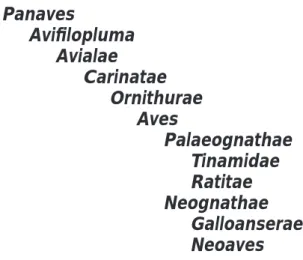
As a potential solution to the problems addressed above, we propose a new taxonomy, with new names as well as new definitions for old names. Our primary objective is to eliminate ambiguity caused by using the same name, “Aves,” for several different clades. A second, closely related goal is to suggest names for clades that everyone seems to want to talk about: the feathered di- nosaurs, the flying dinosaurs, and the crown dinosaurs. To accomplish these goals, we will use a different name for each of the clades that other authors have referred to previously by the taxon name “Aves.” And to prevent other existing names from suffering from the confusion that previously plagued “Aves,” we will explicitly tie five additional names, each of which has been a fixture in the ornithological lexicon for at least a century, to specific clades: “Carinatae” and
“Ratitae” of Merrem (1813), “Ornithurae” of Haeckel (1866), and “Palaeognathae” and “Neog- nathae” of Pycraft (1900). We also take this opportunity to rename the stem clade of bird-line archosaurs and to define names for the basalmost subclades within the crown. It is beyond the scope of this paper to consider some names, including “Ornithopectae,” “Ornithothoraces,”
“Metornithes” and “Euornithes,” which have been proposed recently for various basal clades of (putatively) flying dinosaurs.
The principles underlying our choice of names and definitions are currently under devel- opment and will be described here only briefly. For reasons discussed in this paper and else- where (e.g., Gauthier 1986; Gauthier, Estes et al. 1988; Gauthier, Kluge et al. 1988; de Queiroz and Gauthier 1992), we retain widely used names for crown clades. As a help to remembering associations between names and particular clades, we tried to use names that accurately de- scribe, or at least are consistent with, their references (though violation of this principle should not be taken as a reason for rejecting a name or a definition). Thus, in the case of apomorphy- based definitions, names describe the apomorphies of the clades whose names are defined by those apomorphies (e.g., “Avialae” [= bird wing] for the clade of flying [winged] dinosaurs). For