
Cultural Anthropology: Global Forces, Local Lives is an accessible, ethnographically rich textbook of cultural anthropology that provides a coherent and refreshing new vision of the discipline and its content—human diversity. FROM CULTURE TO CULTURAL MOVEMENT 369 THE FUTURE OF CULTURE AND THE CULTURE OF THE FUTURE 377.
PLATES
MAPS
PHILOSOPHY AND HISTORY OF THE BOOK
COVERAGE OF THE BOOK
FEATURES OF THE BOOK
The world of the twenty-first century (according to the Western reckoning of time; according to the Muslim calendar it is the 15th century, according to the Hebrew calendar it is the fifty-eighth century) is a complex world of difference and connectedness. Above all, the conditions of the modern world virtually guarantee that individuals will meet and treat others in different and important ways.
THE SCIENCE(S) OF ANTHROPOLOGY
Given these questions, we can think of anthropology as not just the study of people, but the study of human diversity. Therefore, the definition of anthropology can be refined or expanded to include the study of the diversity of human bodies and behavior in the past and the present.
Physical or biological anthropology
Archaeology
Archaeologists try to go from the objects themselves to the minds and hearts of the people who lived among these objects long ago.
Linguistic anthropology
Cultural anthropology
Of course, observers can appreciate the sheer spectacle of such people and their behavior, but cultural anthropology is more than the observation and collection of behavioral curiosities. It's about getting to the hearts and minds of people who are very different from yourself in at least some ways.
TRADITIONAL ANTHROPOLOGY AND BEYOND
The goal of cultural anthropology is still to learn about the thoughts and feelings of people that lead to their behavior, but now we can ask them, "Why did you do that?" or "How did you make it?" or "What does this mean to you?" Cultural anthropology is the activity that many people associate with National Geographic magazine, the Discover Channel, or similar media, where strange (to us) people are depicted doing exotic or unfamiliar or perhaps even shocking (to us) things. Developmental Anthropology, or the study of, as well as the practical contribution to, how "modern" forces influence and change societies.
Applied anthropology
Even within the confines of professional anthropology, there are many important and even critical applications of the discipline. Some of the specific tasks that anthropologists may perform include training, supervision, administration, consultation, interviewing, grant writing, and expert testimony.
The continuing evolution of cultural anthropology
The three main phenomena that have forced a reconceptualization of cultural anthropology are colonialism, postcolonial independence and nationalist and indigenous movements, and modernization and globalization. The message is that even within a global context, cultural realities are local, and therefore cultural anthropology's questions, perspectives and methods still apply.
THE “ANTHROPOLOGICAL PERSPECTIVE”
There is no theoretical limit to what cultural anthropology can put under its microscope, and the more examples of human cultural diversity it includes, and the more practitioners it engages, the fuller will be our understanding of humanity— that is, for ourselves. .
Comparative or cross-cultural study
Commonalities or "universals" that occur across cultures—that is, is there anything that most or all cultures do that seems to be necessary for people. The full range of variation between cultures—that is, how different people can be.
Holism
In a traditional or classical anthropological description of a specific culture – known as eetthhnnooggrraapphhyy – the writer usually begins by discussing the environment in which the group lives (mountain, desert, jungle, island) and then goes on to give details about each aspect. of the culture. In other words, a single ethnography prepared by a cultural anthropologist might not cover every single aspect of the culture, but collectively, the study of the culture would.
Cultural relativism
Therefore, a value statement like "polygamy is good" isn't, can't be true or false, because it isn't even a full statement yet. It is not to say that culture is good, or cultural relativism is good, or multiple values are good.
THE RELEVANCE OF ANTHROPOLOGY
The first was to redefine the situation – to think about the subject and get the subject to think about himself, “as out of the war, out of the picture, and thus in some way not for the enemy” (quoted in Budiansky 2005). : 34). As Shakespeare said, we are all mere actors on a stage, but we work together to keep the reality of the act (and the stage) ongoing – and convincing.
SUMMARY
Comparative or cross-cultural study, or the description and analysis of the full range of variations of people and our ways. Holism, or the interconnectedness of all 'parts' of culture and of the culture with its natural environment.
DEFINING CULTURE
Sometimes scholars have used it in an even more inclusive sense, as the total social heritage of the human species, capitalized as Culture. But no single person, or even any single human society, possesses the sum total of the heritage of mankind.
Culture is learned
Contemporary encounters with culture in the modern globalized context suggest that these standard features do not quite capture its full richness. The American anthropologist Clifford Geertz has argued that culture is necessary: humans are “incomplete or unfinished animals who complete or complete themselves through culture—and not through culture in general, but through very particular forms of it.
Culture is shared
Western societies are accustomed to the idea that cultural knowledge is "public" and accessible to all. Of course, such knowledge is also stratified by age: young people will and cannot possess it all, and they will achieve greater and greater.
Culture is symbolic
Similarly, shaking the head can mean "yes" in one culture and "no" in another—and nothing at all in a third. Culture is therefore a large system of meaning – a “web of meanings” in which we are suspended, as Geertz said.
Culture is integrated
Wherever cultural anthropology starts its research and analysis, it will inevitably be drawn into consideration by all the other domains. More importantly, adding, removing or changing one part can and sometimes will have consequences for the functioning of the other parts and the whole – often unforeseen and unwanted consequences.
Culture is an adaptation
For another, when societies migrate, as they often do, they bring with them practices and values that may have been adapted to a previous environment but are less adapted to the new environment; over time, they may adapt more to the demands of their new location, but not always or quickly enough. Societies engaged in practices and activities ranging from war to slavery, human sacrifice to the destruction of twins that were certainly not beneficial to the victims of such practices.
Culture is produced, practiced, and circulated
Finally, it cannot be said that culture is always beneficial for all its members. It is undeniable that a cultural object (art, technique, style of dress, word, song, religion) is not trapped within the boundaries of a particular society.
THE BIOCULTURAL BASIS OF HUMAN BEHAVIOR
A tendency toward spinal eerreekcttnnenessss, with the head "on top of" rather than "in front of" the spine. What seemed to be happening here was innovation and then the learning and sharing of a new behavior as an adaptation to a new environmental circumstance—the key qualities of culture.
STUDYING CULTURE: METHOD IN CULTURAL ANTHROPOLOGY
But if all goes well, the anthropologist slowly wins his way into the trust and friendship of the people. Structured interview A fieldwork method in which the anthropologist administers a prepared set of questions to an informant/consultant.
Fieldwork in a globalized world: multi-sited ethnography
The ethics of fieldwork
In today's context, one of the best exchanges of information - while also being a great way to learn - is to provide some useful services that the local population needs. Ultimately, it is inevitable that one will have some influence on the society in which one lives.
WHAT MAKES CULTURAL ANTHROPOLOGY POSSIBLE – AND NECESSARY
WHAT MAKES CULTURAL ANTHROPOLOGY POSSIBLE – AND NECESSARY. different cities and states and their political forms, something like political science was quite clear. Looking around at the events that happened before and during one's life, something like history was quite clear.
ENCOUNTERING THE OTHER
The “voyages of discovery” and the rise of colonization
The "conservative" position was that they had no soul and therefore were not human; if this were the case, then they could be classified and treated as animals (also believed to have no soul) - chased, kidnapped, enslaved or killed as the conquerors saw fit. The "liberal" position, supported by Bartolome de las Casas, was that they had souls and were therefore human.
Encounters with other Eurasian civilizations
But they could not be left alone either; their human souls required "saving" and they deserved and needed the benefits of the "true" culture and the "true" religion. The exploration of the late 1400s and early 1500s, which continued into the late 1800s, brought new otherness to the attention of Europeans who were well satisfied with the truth and goodness of their own society.
The “Renaissance”
The “Protestant Reformation”
He called the pope and all Catholics blasphemers and atheists, and he said he could prove it: just go back to the "source", to the Bible itself. Note that the peace did not allow all religions to exist, only Catholicism and Lutheranism.
The scientific revolution
Luther claimed (often in the most shocking language) that the Church was wrong about many of its beliefs and was, in fact, anti-Christian. Other "Protestant" sects such as Unitarians, Shakers, Quakers, Anabaptists, as well as non-Christian religions such as Judaism, were still off limits.
RETHINKING SOCIETY: SEVENTEENTH- AND EIGHTEENTH-CENTURY SOCIAL THEORY
In addition, he in no way recommended a return to the primitive state, but simply pointed out the two possible states of humanity and the cost of the evolution from one to the other. In such a state there is no room for industry; for its fruit is uncertain; and consequently no cultivation of the earth; no navigation or use of the convenient buildings; no tools to move and remove such things that require a lot of power; no knowledge of the face of the earth; no account of time; no art; no literature; no society; and what is worst of all, constant fear and danger of violent death; and the life of man lonely, poor, filthy, brutal and short.
TOWARD AN ETHNOLOGICAL SCIENCE IN THE NINETEENTH CENTURY
By taking the various primitive peoples of the world today as representatives, if not actual frozen specimens, of bygone days, they could reconstruct cultural history. Thus, Lewis Henry Morgan (1877) distilled the stages of cultural evolution down to three—savagery, barbarism (each divided into lower, middle, and upper), and civilization—characterized by certain diagnostic cultural features (e.g., bow and arrow, agriculture). , writing).
THE TWENTIETH CENTURY AND THE FOUNDING OF MODERN ANTHROPOLOGY
Accordingly, Malinowski proposed one that would become extremely influential in the first half of the twentieth century. For Malinowski, the essence of functioning was found in the needs of the individuals that make up a society.
THE ANTHROPOLOGICAL CRISIS OF THE MID-TWENTIETH CENTURY AND BEYOND
Especially in the second half of the twentieth century, Marxist or "critical" theory had a strong influence on cultural anthropology. Hobbes and Rousseau were the first to do so, with diametrically opposite results.
HUMAN LANGUAGE AS A COMMUNICATION SYSTEM
Finally, and amazingly, people can talk about things that are "not here" in different senses. For example, humans can talk about things that are not directly in front of us—behind us or in the other room or on the other side of the planet.
THE STRUCTURE OF LANGUAGE
In language, as in culture in general, people invent their own worlds and live in them.
Phonology
Bit” and “well” would be the same word to them, but neither would be pronounced quite correctly. In French, explicit standards of linking and elision connect one syllable or word with another: ils ont ("they have") is pronounced "eel zon" ("on" pronounced nasally, not as in English), somewhat similar to the English tendency to run sounds together ("the mall" . sometimes sounds like "they all").
Morphology or semantics
English is an accented language in which each word has its own unique accent pattern, creating a kind of "rhythm" in speech that can be used in poetry (known professionally as "meter"). There is no consistent rule about how English accent works, but a common pattern is to stress the final vowel (by stressing or "lengthening") in verbs and other vowels in nouns or adjectives.
Grammar or syntax
The sentence "The dog hit the man", with exactly the same words in a different order, has a specific but different meaning. If an English speaker said "You love", the meaning would be ambiguous, since "you" can be a subject pronoun or an object pronoun (as opposed to "I" and "me").
Pragmatics or sociolinguistics
In French, there are two forms of the pronoun "you" - the singular or familiar tuform (for friends and equals) and the plural or formal vousform (for strangers and superiors). In Thai, for example, there are thirteen different forms of the first person pronoun ("I"), depending on who is being addressed.
MAKING SOCIETY THROUGH LANGUAGE: LANGUAGE AND THE CONSTRUCTION OF SOCIAL REALITY
As we noted, English has a set of possibilities for communicating relative status and prestige and the formality of the situation, albeit limited compared to Thai and Japanese. Much of the rest of this chapter will explore the forms and occasions of pragmatic language use.
Language as performance
Language and political power
Box 4.1 illustrates a clear contrast between the form and purpose of public oratory based on political relations within society. In the descriptions by Atkinson and Firth, the Wana of Sulawesi (Indonesia) and Tikopia had very different ways of speaking in public, reflecting their very different social and political systems.
Oral literature and specialized language styles
In contemporary American society, riddles are usually told for fun and usually by or to children. Two holes that don't want to be filled; that's where people, oxen, goats and other things come in. Answer: eyes.
Paralanguage and non-verbal language
Political speech or mostly (sakla kaya), healing song or "stick puppet language" (suar miimi kaya), and girls. Divergence from these standard distances can communicate intimacy, respect, avoidance, or invasiveness depending on culture and distance.
Language change, loss, and competition
Young people may stop learning it, and older men may be the last to speak it. Finally, language can be a focus of struggle between two societies, communities or subcultures, or it can be a medium for projecting separate and competing or resistant identities towards the dominant society.
LANGUAGE ACQUISITION AND THE LINGUISTIC RELATIVITY HYPOTHESIS
The fact of the matter is that the "real world" is to a large extent unconsciously built upon the language habits of the group. In the ultimate formulation of the hypothesis, speakers of different languages live in very different ways.
CULTURES AND PERSONS, OR CULTURAL PERSONS
Instead, in each moment the person is recreated, the previous moment lighting the candle that is the "self" for this moment. Lee makes some interesting claims: based on Wintu linguistic practices, she suggests that the Wintu did not share the Western sense of "an established separate self". On the contrary, "A Wintu self is identical with the parts of his body and is not related to them as 'other', so long as they are physically part of him" (135).
Blank slates, elementary ideas, and human nature
Back in front of the mirror, they quickly realized that "they" were different and explored the place, including touching it and sniffing their fingers to find out what was going on. Chimpanzees who had never seen a mirror did not respond to the dot at all - they had not yet acquired a "sense of self". Other experiments have suggested that chimpanzees may also have a sense of "intersubjectivity"—that is, an awareness that other creatures have minds and even what may be in those minds.
American “culture and personality”
How else, he asked, can we explain the "strange" and ultimately "false" things that people in "primitive" societies did or thought. Thus she was able to summarize a culture with a few key personality or temperament traits, such as "egocentric", "individualistic" and "ecstatic" for the Kwakiutl.
Personality as a cultural construction
Enculturation, as discussed earlier, is the process by which an individual learns the culture of his society—that is, by which culture comes "into" the individual. During enculturation, the ideas, beliefs, values, norms, meanings, and so on that exist before, apart from, and outside the individual are internalized and become part of and "inside" the individual.
GENDER AND PERSON, OR GENDERED PERSONS
Until fairly recently, most Westerners assumed that they did not - and were not even within the reach of scientific investigation. Perhaps Abu-Lughod (1985) reports that emotions such as tahashshum (embarrassment/modesty/shame) among Egyptian Bedouin not only have strategic functions - as in Kaluli, Javanese and Western societies - but that the distinction between "real" and "conventional" or.
Gender divisions and differences
Furthermore, a person's gender is not always determined in the same way (by which genitalia they possess) or in a binary way. Men, who did almost all the work outside the home, owned the town square, the cafes and the mayor's office at night.
The oppression of women across cultures
The practice of "wearing the veil" in many Muslim countries, in which women are required to keep certain parts of their body covered in public - in some cases the head, in other cases the whole body except the eyes. It is also widely believed that removing parts of the female genitalia reduces sexual desire and pleasure, increasing chastity.
The construction of masculinity
It is not the case in all cultures that 'homosexuality' is a total and permanent identity or 'lifestyle'; it may be a temporary situation or a cultural achievement that neither defines the man nor constitutes an alternative or deviant gender role. Of course, male children also had a female influence – physical and spiritual – on them thanks to their coming out of the womb, contact with the mother's skin, and the infant's diet of "soft" foods.
The construction of “alternate” genders
According to Grémaux (1994), there was a custom by which women could become "social men" in the Balkans. The ancestors of the Maroon societies were brought as slaves by the Dutch from Africa to South America to work in the new Dutch colony.
THE ANTHROPOLOGY OF RACE
As anthropologists, we are indeed interested in human differences—the characteristics of different human groups—but we are equally, if not more, interested in the systems by which these groups are structured, the relationships between those groups, and the social practices by which and the social purposes for which these groups are and relationships created, maintained, challenged or changed. Brazilian anthropologists Sergio Pena and Telma de Souza Birchal insist that race is not a scientific idea; rather, "The concept of race has been imported from common sense into science since its inception."
The evolution of the race concept
For example, not long ago, English speakers used (and sometimes still use) the term race in reference to "the French race" or "the Scandinavian race" or "the Jewish race" or "the Arab race", or even "the human race." Groups that never thought of themselves as a single identity ("the Native American race") are lumped into one category, as are people who are quite physically diverse, such as the "Hispanic race" which includes "white" people, "black" people," Indian" people, and every conceivable mix of these and more. George Cuvier succeeded in narrowing them down to three – Caucasian, Mongolian and Negroid – with White Caucasians as the optimum form of humanity and Black Negroids as “the most degraded race among men, whose forms most closely approximate those of the inferior animals, and whose intellect has not yet arrived at the establishment of a regular form of government, nor at anything that has the slightest semblance of systematic knowledge” (cited in Green 1959: 235).
Measuring and managing mankind
Indeed, John Haller, in his study of the science of race, suggests that "the hallmark of nineteenth-century anthropology was anthropometry" (1971: 7). The tilt of the lower face and jaw away from the flatness of the forehead, used by "scientific racists".
THE MODERN ANTHROPOLOGICAL CRITIQUE OF RACE
In terms of social relations, so-called 'race problems' in the modern world are essentially caste problems” (67). Like Montagu, Frank Livingstone insisted on the “non-existence” of races in the human species, arguing that “there are excellent arguments for abandoning the concept of race in relation to living populations of Homo sapiens.
THE ANTHROPOLOGY OF ETHNICITY
Strong moralistic fervor for such ideals and values, combined with a sense of being persecuted by those who do not share them and are therefore not members of the ethnic group. Finally, a strong tendency of members of an ethnic group to see themselves and their circle as the whole of reality, or at least the whole of reality that matters.
Ethnic culture, ethnic boundary, and ethnic mobilization
Ethnogenesis The process by which ethnic groups come into being and/or acquire their cultural characteristics. Ethnic groups do not exist in isolation; a group in itself is not an ethnic group in the true sense.
Types of ethnic organization and mobilization
In the ultimate analysis, ethnicity is a style of social action, specifically and generally political and economic action. Two or more ethnic groups share a social space in which they are in a specific (if changing) social, political or economic relationship to each other.
RACIAL AND ETHNIC GROUPS AND RELATIONS IN CROSS-CULTURAL PERSPECTIVE
Dominant groups may have no desire, and no awareness of a need, to change the subordinate position of other groups in society or the country. In such cases, the dominant group may institutionalize hierarchical relationships (such as slavery or ghettos), pass laws and enact entire systems of exclusion (such as segregation in the U.S. or aappaarrtthheeiiddin South Africa), or even use force to suppress groups and any opposition they might organize.
The race regime of South Africa
Interestingly, Dunbar Moodie finds that the "tribal identity" of many black South African groups is a recent development largely shaped by colonialism. Tribes" and "tribalism" were to a large extent products of colonial administration, with Europeans introducing the notion of the tribe (as a primordial, distinct, culturally bounded system) and even creating "tribal authorities" such as "chiefs" for " tribes" that had never had a chief before.
Racial democracy in Brazil?
Finally, labor turnover, especially the migration of men to the cities, led them to organize and find local leaders in completely non-traditional ways, inventing. ethnicity' or 'tribal identity' in the process. And, especially in the interior of the country, many indigenous peoples live on the fringes of Brazilian society, their land and lives at risk from exploitation and latter-day colonialism.
Mestizaje: the future of race in Mexico
The white race, or more precisely the Latin race, is considered the only one capable of civilization and transcending current racial limitations; the characteristics of the white race were to dominate the new cosmic race as well. But if there is a real target of the cosmic race, it is the "Indians", the native peoples of the Americas.
The Burakumin of Japan
Of course, other peoples and cultures reside within the territory of the Japanese state, including Koreans, Chinese, Ainu, Okinawans, Iranians (usually as guest workers), even some Americans and a group known as the Burakumin. In a society as diverse as the United States (with six racial categories, approximately sixty racial combinations, and almost forty languages reported in the 2000 census), it is inevitable that culture and cultural diversity are a social and political issue, perhaps especially in the most responsible institution for the preparation and unification of the country's citizens - the education system.
Personhood, Race, and Health in a Brazilian Community
Many solved the dilemma by simply stopping: "Hire a kardiya (white person)", they would say, "they can say no." Further, economic facts are seldom purely "practical"; they also have value and prestige and even 'symbolic' and ritual significance that influence the social significance of the products and of the relationships in which those products are made, distributed and used.
ECONOMICS AS THE BASE OR CORE OF CULTURE
Although our house model therefore appears somewhat static, it is necessary to understand that the relationship between the economy and the other aspects of a culture is quite dynamic. The means of production are the tasks, the tools and the knowledge and skills that people use to get their daily bread (or kangaroo or whatever).
THE ANTHROPOLOGY OF ECONOMICS
In the following sections we will discuss production and distribution and try to make a contribution to the growing anthropology of consumption. We will return to examine the contemporary condition of many of these societies in the final chapters of this book.
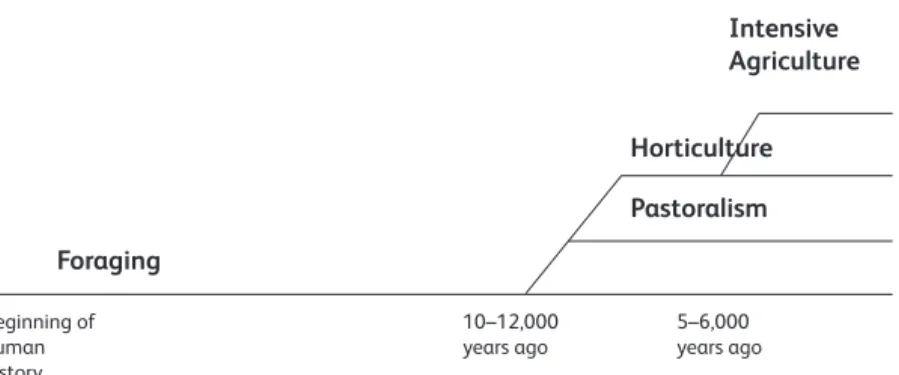
Systems of production
In earlier foraging times, it was practiced in all environments of the Earth. Especially in the industrialized world, cities really do contain the majority of society; in the USA
Systems of distribution
Professional priests led the cult of the gods from the center of the city, collecting tribute (what we would call taxes) for the benefit of the god(s) which was used to finance all the activities of the society. In this form, the goods are given without any particular calculation of the value of the goods or any particular expectation of a "return" of equal value in a certain time frame.
Consumption
However, we can begin to outline some of the issues that would be part of any systematic anthropological study of consumption. Who buys the goods and services for consumption by the group, and how/where (ie the cultural phenomenon of "buying").

