Volume 13 • Number 2 • 2023
OTORITAS : Jurnal Ilmu Pemerintahan
Published by the Department of Government Studies,
Faculty of Social and Political Sciences, Muhammadiyah University of Makassar
For further information, please visit: https://journal.unismuh.ac.id/otoritas ISSN: 2088-3706 (Print) | 2502-9320 (Online) | DOI : 10.26618
Firstpublished in April 2011
Please send all articles, essays, reviews, and documents to:
Regular Mail:
Department of Government Studies Faculty of Social and Political Sciences
5th Floor of Menara Iqra, Muhammadiyah University of Makassar Jl. Sultan Alauddin No.259 Makassar, 90221
South Sulawesi, Indonesia E-Mail:
OTORITAS : Jurnal Ilmu Pemerintahan is an internationally peer-reviewed open access journal published triannual in April, August and December, aims to publishes significant
and cutting-edge research drawn from all areas of politics and governmental studies and promotes scholarly, theoretical, pragmatic, and contemporary research, which makes a clear conceptual and methodological contribution to existing international
literature.
OTORITAS : Jurnal Ilmu Pemerintahan indexed by :
OTORITAS : Jurnal Ilmu Pemerintahan have been double blind-reviewed by international peer reviewers. The decision on whether the scientific article is accepted
or not in this journal will be the Editorial Board’s right based on peer reviewer's recommendation.
About the Journal
OTORITAS : Jurnal Ilmu Pemerintahan, with registered number ISSN 2088-
3706 (Print), ISSN 2502-9320 (Online), is an internationally peer-reviewed open access journal published triannual in April, August and December by Department of Government Studies, Faculty of Social and Political Sciences, Universitas Muhammadiyah Makassar in collaboration with Muhammadiyah’s College Association of Government Studies (AIPPTM) and Asia Pacific Society for Public Affairs (APSPA).
OTORITAS : Jurnal Ilmu Pemerintahan aims to publishes significant and
cutting-edge research drawn from all areas of politics and governmental studies and promotes scholarly, theoretical, pragmatic, and contemporary research, which makes a clear conceptual and methodological contribution to existing international literature.
OTORITAS : Jurnal Ilmu Pemerintahan Starting from 2015 it is available in e-
journal version and has been currently indexed by both national and international indexer institutions such as: ESCI Web of Science (International), DOAJ (International), ASEAN Citation Index (International), Dimensions (International), Garba Rujukan Digital (National), Google Scholar (International), Crossref (International), BASE (International), SINTA (National), and Indonesia One Search (National).
OTORITAS : Jurnal Ilmu Pemerintahan Starting from 2016 and for the
upcoming years, the process of manuscript submission and other management processes will be conducted online through Otoritas : Jurnal Ilmu Pemerintahan website and for the betterment of the quality and quantity of Otoritas : Jurnal Ilmu Pemerintahan qualified reviewers and editors are recruited. Besides that in the same year we collaborated with Muhammadiyah's College Association of Government Studies (AIPPTM) on the publication of this journal.
OTORITAS : Jurnal Ilmu Pemerintahan Starting from 2018, we collaborated
with Asia Pacific Society for Public Affairs (APSPA) on the publication and has
been accredited by National Journal Accreditation (ARJUNA) Managed by Ministry
of Research, Technology, and Higher Education of Republic Indonesia.
Focus and Scope
Otoritas: Jurnal Ilmu Pemerintahan (Journal of Political Science and
Government) promotes scholarly, theoretical, pragmatic, and contemporary research, making a clear conceptual and methodological contribution to existing international literature. Its spesific aim is to enhance the broad scholarly understanding of governance, public administration, public law, religion and politics, comparative politics, international studies, and democratic institutions in emerging countries.
Otoritas : Jurnal Ilmu Pemerintahan (Journal of Political Science and
Government) is committed to disseminating rigorous, high-quality research and
debate with a scientific influence on the international society. To that purpose,
the Editorial team follows a meticulous editorial procedure, bringing the most
sophisticated research on modern politics and governance to the academic
community and policymakers. The journal is online and has open access, and its
internal publication procedure enables it to distribute its research findings
internationally promptly.
Editorial Board
EDITOR-IN-CHIEF
Andi Luhur Prianto, Scopus ID: 57208214401, Universitas Muhammadiyah Makassar, Indonesia
MANAGING EDITORS
Nur Khaerah, Scopus ID: 57708938300, Universitas Muhammadiyah Makassar, Indonesia
ACCOCIATE EDITORS
Abel Kinyondo, Scopus ID: 55293738000, University of Dar Es Salaam, Tanzania Abel Polese, Scopus ID: 57201804952, Dublin City University, Ireland
Ilyas Mohammed, Scopus ID: 57221933986, University of Liverpool, United Kingdom Michael Hatherell, Scopus ID: 56433408300, Deakin University, Australia
Nursaleh Hartaman, Scopus ID: 57395318100, Universitas Muhammadiyah Makassar, Indonesia Riccardo Pelizzo, Scopus ID: 6507727385, Nazarbayev University, Kazakhstan
INTERNATIONAL EDITORIAL
Adam Tyson, Scopus ID: 35337925000, University of Leeds, United Kingdom
AKM Ahsan Ullah, Scopus ID: 10043791400, Universiti Brunei Darussalam, Brunei Darussalam Ahmad Harakan, Scopus ID: 57203222670, Universitas Muhammadiyah Makassar, Indonesia Andreas Ufen, Scopus ID: 24280605600, German Institute of Global and Area Studies, Germany
Farida Tadjine, Scopus ID: 57678049100, University of Kasdi Merbah Ouargla, Algeria Mergen Dyussenov, Scopus ID: 57190342068, National University of Singapore, Singapore
Mohd Afandi Salleh, Scopus ID: 55582821500, Universiti Sultan Zainal Abidin, Malaysia Mubashar Hasan, Scopus ID: 45861188500, Oslo University, Norway
Muh Firyal Akbar, Scopus ID: 57210750267, Universitas Muhammadiyah Gorontalo, Indonesia Ni Putu Tirka Widanti, Scopus ID: 57970637000, Universitas Ngurah Rai, Indonesia Nuryanti Mustari, Scopus ID: 57395318000, Universitas Muhammadiyah Makassar, Indonesia
Önder KUTLU, Necmettin Erbakan Universitesi, Turkey
Rudi Hardi, Scopus ID: 57395626900, Universitas Muhammadiyah Makassar, Indonesia Wolfgang Drechsler, Scopus ID: 36840148600, University College London, United Kingdom
EDITORIAL ASSISTANTS
Abdillah Abdillah, Scopus ID: 57697035900, Universitas Muhammadiyah Makassar, Indonesia Hamrun Hamrun, Scopus ID: 57395116400, Universitas Muhammadiyah Makassar, Indonesia
Table of Contents
How does the government improve the competitiveness of SMEs?
lesson learned from Thailand
Andrie Elia1, Basrowi2, Buncha Chinnasri3
1Departement of Sociology, Faculty Social and Political Science, Universitas Palangka Raya, Indonesia
2Department of Management Studies, Graduate Program, Universitas Bina Bangsa, Indonesia
3Faculty of Agriculture Kasetsart University, Thailand
182-202
Indonesia’s pro-people foreign policy: the protection of Indonesian women migrant workers in Malaysia in 2022
Arie Kusuma Paksi1, Pebria Prakarsa Renta2
1,2Department of International Relations, Universitas Muhammadiyah Yogyakarta, Indonesia
203-216
The insignificance of GDP growth rate to people’s welfare: a political economy analysis of China’s impressive GDP
Asmarawati Handoyo1, Yuli Isnadi2
1Graduate Institute of Political Economy, College of Social Sciences, National Cheng Kung University, Taiwan.
2Department of Management and Public Policy, Universitas Gadjah Mada, Indonesia.
217-232
Policy process in Indonesia during COVID-19: a cross-sectoral policy Perspective
Evi Satispi1, Ma’mun Murod2
1Department of Public Administration, Universitas Muhammadiyah Jakarta, Indonesia
2Deparment of Political Science, Universitas Muhammadiyah Jakarta, Indonesia
233-245
How does buy service-based policy attract public transportation customers in Yogyakarta, Indonesia ?
Fitriani1, Achmad Nurmandi2, Muhammad Lutfi3, Mujizatullah4, Abu Muslim5
1,2 Department of Government Affairs and Administration, Jusuf Kalla School of Government,Universitas Muhammadiyah Yogyakarta, Indonesia
3Department of Government Studies, Universitas Muhammadiyah Sinjai, Indonesia
4,5Research Center for Religious Treasures and Civilizations, National Research and InnovationAgency, Indonesia
246-260
Local government strategy in managing traditional markets in The City of Pariaman, Indonesia
Herza Netti1, Erianjoni2
1,2 Department of Public Administration, Universitas Negeri Padang, Indonesia
261-276
Disputing land: argumentative turn in local land policy conflict in Central Java, Indonesia
Laila Kholid Alfirdaus1, Dzunuwanus Ghulam Manar2, Teguh Yuwono3
123Department of Politics and Governance Studies, Faculty of Social and Political Sciences,Universitas Diponegoro, Indonesia
277-288
Policy and innovation network: a study of inter-agency collaboration in post-disaster rehabilitation and reconstruction in the Central Sulawesi, Indonesia
Mohammad Rusli Syuaib
Department of Public Administration, Universitas Sintuwu Maroso, Indonesia
289-301
Local government innovation model in Pekanbaru City, Indonesia: a study of public service mall
Ranggi Ade Febrian1, Khairul Rahman2, Ahmad Fitra Yuza3, Zainal4
1234Department of Government Studies, Faculty of Social and Political Sciences, Universitas Islam Riau, Indonesia
302-314
Civil Service Police Unit principle : no punishment and no taxation without representation
Sarip1, Diana Fitriana2, Absori3, Khudzaifah Dimyati4, Harun5
1 Faculty of Law, Universitas Muhammadiyah Cirebon, Indonesia
2 Faculty of Law, Universitas Bhayangkara Jakarta Raya, Indonesia
3,4,5Faculty of Law, Universitas Muhammadiyah Surakarta, Indonesia
315-332
Declining democracy: autocratization in Indonesia during the Jokowi years
Taufik1,2, Muhamad M.N. Nadzri3, Jamaie Hj. Hamil4
1,3,4 Center for Research in History, Politics and International Affairs, Faculty of Social Science and Humanities,
Universiti Kebangsaan Malaysia, Malaysia
2Department of International Relations, Faculty of Social and Political Sciences, Universitas Pasundan, Indonesia
333-351
The Bretton Woods institutions and the quest for development in Africa
Zekeri Momoh
Department of Political Science, Faculty of Social Sciences, Veritas University, Nigeria
352-363
Article Guidelines
Article Title: Segoe UI, 14pt Bold, alignment centered, single-line spacing and All Caps. Article title should be written briefly and clearly. It shows exactly the issue to be discussed and should not create misinterpretations. Article title is written in capital letters symmetrically and does not contain unusual abbreviations. Express the main idea of a new article and followed by another explanation.
Author Details: Segoe UI, alignment centered, Article title, author's name (without academic degree(s)), and author's affiliate address are written in the center on the first page under the article title. The distance between title and author's name is double-spacing; meanwhile the distance between author's affiliate address and abstract title is single-spacing. Keywords should be written under abstract for each language. It is arranged alphabetically and separated by a semicolon consisted of 3-5 words. For Indonesian article, the title is translated into English at the beginning of English abstract (see the example above).
Corresponding Author should be marked with an asterisk and followed by a comma "*)" as the example above. At the bottom of the left column on the first page/abstract, it is written the Corresponding Author’s mark and his/her email address (see example). Article revisions and final decisions will only be communicated through the Corresponding Author’s email.
If there is more than one author, write the authors’ names separated by a comma (,). If the author's name consists of two words, the first name should not be abbreviated. If the author’s name consists of only one word, write his/her actual name in one word. However, the online version (HTML) will be written in two words consisting of the same name (repeatedly) for metadata indexation purpose (Camdali & Tunc, 2006; Fridman, 2008).
Introduction: Introduction consists of (in sequence) general background, state of the art as the basis for the scientific novelty statement of the article, scientific novelty statement, and research problem or hypothesis. In the end, introduction should mention the purpose of article review.
Literature review is not allowed in the scientific article format, so it is replaced by the state of the art to prove the novelty of the article.
Research Methods: Method is implemented to solve problems, including analytical method.
The method used to solve the research problems is described in this section.
Results and Discussion: This section consists of results and discussion. Every result should be supported by sufficient data. Then, result should be able to answer the research question or hypothesis stated earlier in the introduction.
Conclusion: Conclusion states the answer of the hypothesis and/or research objective or scientific finding. Conclusion is not the repetition of findings and discussion, but it is the summary of findings as expected in the objective or hypothesis. If necessary, conclusion can also be ended with the next idea to be implemented to the study.
Acknowledgment: Acknowledgment are primarily addressed to research funders or donors.
Acknowledgment can also be dedicated to people who contribute in the study.
References: All references used in the article should be listed in the References section.
References should contain reference literature originating from primary sources (scientific journals at least 80% of the entire references) published in the last 10 (ten) years. Each article contains at least 10 (ten) references. It is better to write the reference system in the article and in the references section using the reference management programs such as Mendeley, EndNote, Zotero, or others.
Publication Ethics
Otoritas : Jurnal Ilmu Pemerintahan, with registered number ISSN 2088-3706 (Print), ISSN 2502-9320 (Online) is a peer-reviewed journal, available in print and online and published tri-annual. This statement clarifies ethical behaviour of all parties involved in the act of publishing an article in this journal, including the author, the chief editor, the Editorial Board, the peer-reviewer and the publisher (Department of Government Studies, Faculty of Social and Political Sciences, Universitas Muhammadiyah Makassar in collaboration with Muhammadiyah’s College Association of Government Studies (AIPPTM) and Asia Pacific Society for Public Affairs).
This statement is based on COPE’s Best Practice Guidelines for Journal Editors.
ETHICAL GUIDELINE FOR JOURNAL PUBLICATION
The publication of an article in a peer-reviewed Otoritas : Jurnal Ilmu Pemerintahan is an essential building block in the development of a coherent and respected network of knowledge.
It is a direct reflection of the quality of the work of the authors and the institutions that support them. Peer-reviewed articles support and embody the scientific method. It is therefore important to agree upon standards of expected ethical behaviour for all parties involved in the act of publishing: the author, the journal editor, the peer reviewer, the publisher and the society.
Department of Government Studies, Faculty of Social and Political Sciences, Universitas Muhammadiyah Makassar in collaboration with Muhammadiyah’s College Association of Government Studies (AIPPTM) and Asia Pacific Society for Public Affairs as publisher of Otoritas : Jurnal Ilmu Pemerintahan takes its duties of guardianship over all stages of publishing seriously and we recognize our ethical and other responsibilities. We are committed to ensuring that advertising, reprint or other commercial revenue has no impact or influence on editorial decisions.
PUBLICATION DECISIONS
The editor of the Otoritas : Jurnal Ilmu Pemerintahan is responsible for deciding which of the articles submitted to the journal should be published. The validation of the work in question and its importance to researchers and readers must always drive such decisions. The editors may be guided by the policies of the journal's editorial board and constrained by such legal requirements as shall then be in force regarding libel, copyright infringement and plagiarism.
The editors may confer with other editors or reviewers in making this decision.
FAIR PLAY
An editor at any time evaluate manuscripts for their intellectual content without regard to race, gender, sexual orientation, religious belief, ethnic origin, citizenship, or political philosophy of the authors.
CONFIDENTIALITY
The editor and any editorial staff must not disclose any information about a submitted manuscript to anyone other than the corresponding author, reviewers, potential reviewers, other editorial advisers, and the publisher, as appropriate.
DISCLOSURE AND CONFLICTS OF INTEREST
Unpublished materials disclosed in a submitted manuscript must not be used in an editor's own research without the express written consent of the author.
DUTIES OF REVIEWERS:
Contribution to Editorial Decisions
Peer review assists the editor in making editorial decisions and through the editorial communications with the author may also assist the author in improving the paper.
Promptness
Any selected referee who feels unqualified to review the research reported in a manuscript or knows that its prompt review will be impossible should notify the editor and excuse himself from the review process.
Confidentiality
Any manuscripts received for review must be treated as confidential documents. They must not be shown to or discussed with others except as authorized by the editor.
Standards of Objectivity
Reviews should be conducted objectively. Personal criticism of the author is inappropriate.
Referees should express their views clearly with supporting arguments.
Acknowledgement of Sources
Reviewers should identify relevant published work that has not been cited by the authors. Any statement that an observation, derivation, or argument had been previously reported should be accompanied by the relevant citation. A reviewer should also call to the editor's attention any substantial similarity or overlap between the manuscript under consideration and any other published paper of which they have personal knowledge.
Disclosure and Conflict of Interest
Privileged information or ideas obtained through peer review must be kept confidential and not used for personal advantage. Reviewers should not consider manuscripts in which they have conflicts of interest resulting from competitive, collaborative, or other relationships or connections with any of the authors, companies, or institutions connected to the papers.
DUTIES OF AUTHORS Reporting standards
Authors of reports of original research should present an accurate account of the work performed as well as an objective discussion of its significance. Underlying data should be represented accurately in the paper. A paper should contain sufficient detail and references to permit others to replicate the work. Fraudulent or knowingly inaccurate statements constitute unethical behaviour and are unacceptable.
Originality and Plagiarism
The authors should ensure that they have written entirely original works, and if the authors have used the work and/or words of others that this has been appropriately cited or quoted.
Multiple, Redundant or Concurrent Publication
An author should not in general publish manuscripts describing essentially the same research in more than one journal or primary publication. Submitting the same manuscript to more than one journal concurrently constitutes unethical publishing behaviour and is unacceptable.
Acknowledgment of Sources
Proper acknowledgment of the work of others must always be given. Authors should cite publications that have been influential in determining the nature of the reported work.
Authorship of the Paper
Authorship should be limited to those who have made a significant contribution to the conception, design, execution, or interpretation of the reported study. All those who have made significant contributions should be listed as co-authors. Where there are others who have participated in certain substantive aspects of the research project, they should be acknowledged or listed as contributors. The corresponding author should ensure that all appropriate co- authors and no inappropriate co-authors are included on the paper, and that all co-authors have seen and approved the final version of the paper and have agreed to its submission for publication.
Disclosure and Conflicts of Interest
All authors should disclose in their manuscript any financial or other substantive conflict of interest that might be construed to influence the results or interpretation of their manuscript. All sources of financial support for the project should be disclosed.
Fundamental errors in published works
When an author discovers a significant error or inaccuracy in his/her own published work, it is the author’s obligation to promptly notify the journal editor or publisher and cooperate with the editor to retract or correct the paper.
333 Otoritas : Jurnal Ilmu Pemerintahan Vol 13. No. 2, 2023
DOI: https://doi.org/10.26618/ojip.v12i2.9277
Declining democracy: autocratization in Indonesia during the Jokowi years
Taufik1,2, Muhamad M.N. Nadzri3*), Jamaie Hj. Hamil4
1,3,4 Center for Research in History, Politics and International Affairs, Faculty of Social Science and Humanities, Universiti Kebangsaan Malaysia, Malaysia
2Department of International Relations, Faculty of Social and Political Sciences, Universitas Pasundan, Indonesia
Abstract
Keywords: autocratization, conditional democrat, democracy decline, Indonesian politics, Jokowi.
Introduction
After the 1998 Reformasi, several scholars have provided positive assessments of the process of transition to democracy (Diamond, 2010; Horowitz, 2013; Macintyre &
Ramage, 2008). However, some also criticize that Indonesia's political and economic system is still controlled by the old elites of the New Order regime (Boudreau, 2009;
Robison & Hadiz, 2004). Indonesia's current democratic system has worked well but has been crippled by the corrupt behaviour of elites and the weakening of laws. Many countries have successfully passed the democratic transition but have been unable to maintain a democratic system that protects the people. In addition, many scholars see the democratic process of authoritarian countries and democratic decline in democratic countries, such as military coups (Mudde & Kaltwasser, 2017). The democratic process occurs because state leaders can no longer consolidate politics with various interest groups to maintain their power. However, the threat of democratic setbacks comes from military coups such as those in Egypt and Thailand, which even appeared in the presidential election. The rise of authoritarian regimes can occur in countries with democratic electoral systems (Mietzner, 2014). The risk of the emergence of an authoritarian regime with a democratic electoral system also occurs in Indonesia This article explores the decline of democracy in contemporary Indonesia during the Jokowi years. Jokowi's lukewarm commitment to democratic norms and illiberal attitude in running the government have made him an essentially conditional democrat, who is heavily influenced by the old political elite within a transitional political framework. As the result, Indonesia under the Jokowi's administration is entrapped with the old political practices, particularly oligarchic rules and political manipulation which awaken a new autocratization episode in its contemporary political history. This article is based on interviews with eight key informants and supported with numerous secondary data from various sources. The article highlights three important points: first, the decline of democracy was caused by the old oligarchic, and cartelism practices. Second, Jokowi's superficial commitment to democracy essentially makes him a conditional democrat, rather than a progressive liberal. Third, Jokowi's leadership led to a new style of autocratization and authoritarianism in Indonesia which was influenced by the manoeuvring of the old political elite.
*) Corresponding Author E-mail : [email protected]
334 because of the behaviour of elites who adapt to the political system and become the successors of the old authoritarianism or Authoritarian Successor Parties (ASP) (Loxton, 2016, 2018). This elite adaptation impacts the erosion of democratic institutions, rules and norms. ASPs take part in the electoral system, undermine weak institutions and law enforcement, and even get involved in making regulations and drafting laws in a veiled orthodox manner: in which they demonstrate to the public that the process of making laws is carried out democratically, when in fact carried out autocratically (Haggard &
Kaufman, 2021; Haryati et al., 2003). In this context, the electoral system in Indonesia is the result of the consolidation of elites who seek to maintain themselves in the circle of government power.
During the administration of President Susilo Bambang Yudhoyono (SBY), Indonesian democracy was considered relatively stable but tended to stagnate (T.
Power & Warburton, 2020; Tomsa, 2010). Then, it experienced polarisation in the 2014 and 2019 presidential elections, especially after populist figures appeared, Prabowo Subianto (Suharto's former son-in-law) as Ultra-Populism and Joko Widodo (Jokowi) as technocratic populism (Mietzner, 2015). Jokowi won elections and consolidated politics with various parties, such as political parties, mass organisations and moderate Islamic groups. However, some of Jokowi's policies after the Ahok incident show illegal steps similar to those carried out during the New Order era. He has shown an authoritarian attitude that has reduced the quality of democracy (Hadiz, 2017; Warburton, 2016).
Thus, what is of concern is the use of a democratic political system by populist leaders to implement policies that can undermine democracy or take advantage of electoral authoritarianism (Mudde & Kaltwasser, 2017; Schedler, 2006).
Jokowi's populism has raised new spirit for pro-democracy among activists and civil society alliances. It is because Jokowi is seen as opposed to the domination of the oligarchic elite, which has taken root in Indonesia. However, its emergence was exploited by the old political elite, who adapted to the political system and consolidated with various elements of the old authoritarianism (Taufik et al., 2023). The domination of the elite within Jokowi's power circle has created disappointment for civil society alliances because the policies and actions of the Jokowi government have been contradictory and illiberal (Bland, 2020; Warburton & Aspinall, 2019). Thus, democracy in Indonesia during Jokowi's administration experienced a setback and has become a deepening phase for elites adapting to the Indonesian political system (Taufik et al., 2023). The decline of democracy continued until the second term of Jokowi's leadership, which showed that he was not committed to democratic values and principles. In this case, every politician tends to show the impression of adherence to democratic values when campaigning but when elected based on the democratic process instead of leaving the prevailing norms (Levitsky & Ziblatt, 2018). It allows them to act democrat during campaigns and autocrats when they become president, as happened in the emergence of populism in the Philippines, Duterte and Thailand, Takhsin (Kurlantzick, 2018). Thus, what happens is autocratization even though the state is obedient to the electoral democratic system (Mudde & Kaltwasser, 2017;
Skaaning, 2020).
This article focuses on Jokowi's democratic conditional stance as president and the tendency for the emergence of a new style of autocratization in Indonesia.
Comprehensively this article consists of several discussion sections. First, discussing the process of autocratization as opposed to the process of democratization. Second, the dominance of the elite and oligarchs under Jokowi's leadership. Third, an analysis of Jokowi as a conditional democrat who does not commit to democracy.
335 Research Method
This study uses a qualitative approach, a research strategy emphasising words rather than quantification. Qualitative research is a process of inquiry by exploring and understanding social and human issues (Creswell, 2014). This research utilized the qualitative approach to discuss the phenomenon of democratic decline in Indonesia and the tendency for the emergence of an authoritarian leadership pattern under Jokowi's administration. The data collections include primary and secondary sources.
There are eight informants, but a number of them has been made anonymous due to the nature of sensitivity in Indonesian politics. The informants include the researchers from the National Research and Innovation Agency, Firman Noor; Director of Charta Politica, Yunarto Wijaya; Economist at the University of Indonesia, Faisal Basri;
Politicians from several parties, such as the Prosperous Justice Party (PKS), the Democratic Party (PD), the Democratic National Party (Nasdem), the Indonesian Democratic Party of Struggle (PDI-P); and Former Minister of Jokowi's Working Cabinet.
In addition, this study uses literature studies from various sources such as journals, books, online news articles and other internet sources. Furthermore, experts' opinions are also used in building proportional arguments in this study.
Results and Discussion Autocratization revisited
Authoritarian comes from the Latin 'auctoritas' or authority in English which means 'influence', 'power', 'authority'. Someone who has authority can influence opinions, thoughts, ideas, and behaviour individually and in groups. Meanwhile, authoritarianism is an understanding that holds tight control, power, and dignity (Mangunhardjana, 1997). Also, authoritarianism is known as an ideological and political regime construction that refers to specific psychological characteristics. Thus, authoritarianism is seen as a form of government that monopolizes state authority without guaranteeing political pluralism or civil defence; with little or no accountability to the people (Vaillant, 2012). This makes a leader or a small group the centre of an authoritarian government that tends to exercise power arbitrarily. So that to legitimize the exclusive clique of power, authoritarian regimes usually use unconstitutional or illegal means such as force or intimidation (Vaillant, 2012).
In addition, authoritarianism is a personality tendency to submit and obey authority manifested in people in power and tends to behave or act aggressively towards other people or groups that are considered different or contradictory (Altemeyer, 2006). According to Erich Fromm, there are two tendencies of authoritarianism from a psychological perspective: a person's tendency to eliminate one's independence (self-reliance); and the tendency of a person to dominate others to gain power that he feels less than himself. In this context, the proper forms of authoritarianism are 'submission' and 'domination'. (Fromm, 1969). Meanwhile, according to Furio Cerruti, there are three main characteristics of authoritarianism, namely: 1) it’s not accepting conflict and plurality as standard elements in politics; 2) the desire to maintain the status quo and prevent change by keeping all political dynamics under the control of a solid central authority; 3) there has been a deterioration of laws, distribution of power and democratic voting procedures (Cerutti, 2017).
In this context, countries that adopt a democratic system are not immune from the threat of democratic decline. The emergence of a wave of autocratization is
336 described as the decline of democracy, while autocratization is often described as de- democratization (Skaaning, 2020). Even the decline of democratic regimes is a feature of the emergence of contemporary autocracies. Even gradually eroded and disguised under the umbrella of law; previously, the collapse of democracy in a country was measurable and easy to identify empirically, such as a 'military coup'. However, when it has become a country with a multi-party system, slowly its practice in democracy becomes less meaningful; this is due to fraud in politics, including in elections, and the weakening of democratic institutions (Bermeo, 2016a; Lührmann & Lindberg, 2019).
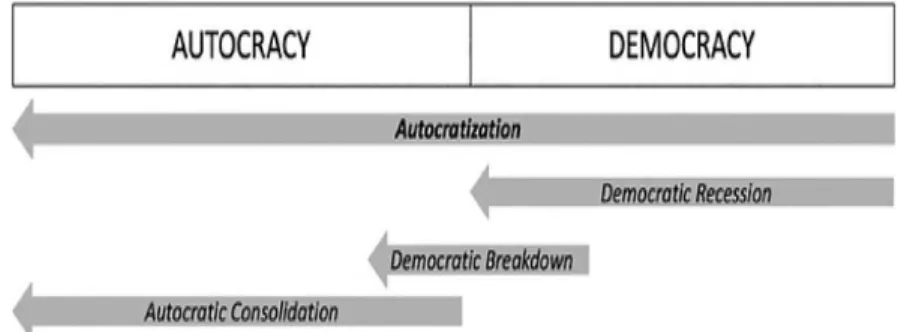
Lührmann and Lindberg define that an autocratization wave as the period during which the number of countries undergoing democratization declines. At the same time autocratization affects more and more countries (Lührmann & Lindberg, 2019).
In this case, a wave of autocratization appears due to, namely: 1) a democratic recession or a decline in the quality of democracy in countries that adhere to a democratic system; 2) followed by the destruction of democracy ―breakdown of democracy‖, in which democratic countries have begun to lead to autocracy practices;
and 3) the existence of autocratic consolidation in which the characteristics of democracy have gradually declined in an already authoritarian situation (Lührmann &
Lindberg, 2019). See figure 1.
Figure 1. Autocratization as democratization Source : Lührmann & Lindberg, 2019 Democratic decline under Jokowi
In Indonesian history, Jokowi became the first president who was 'truly a product of the Reformation era, where he was not affiliated with the previous regime.
The Indonesian people expect Jokowi to become a president who can gain the dignity of Reform for the sake of Advanced Indonesia. However, Jokowi's dream takes work to realize. Since taking office as president in 2014, Jokowi has had to face continuous political shocks, starting from the oligarchic trap (Muhtadi, 2015), the issue of massive polarization because there are two poles in the election (Mietzner, 2015), to authoritarian innovation practices (Mietzner, 2019) which reduce the quality of democracy.
Oligarchy and political cartel
The practice of oligarchy and political cartels in Indonesia has occurred since the Suharto government. Oligarchy is powerful and very influential in politics in Indonesia, including its significant role in overthrowing the New Order regime (Winters, 2013).
According to Leach, oligarchy is a centre of power and influence (illegitimate) rooted in minority groups. So that de facto everything desired by the minority group, in general, can be granted. Even though – actually – against the will of the majority group (Leach, 2005). Meanwhile Winters stated that oligarchy refers to the concentration of wealth
337 and power, resulting in a politics of wealth defence by material wealth actors (Winters, 2011).
In the context of Indonesia, Winters (2011) mentions that the New Order era was an oligarchy-sultanistic political experience, which developed through three main stages: First, the Chinese-Military phase in 1965 after Suharto succeeded in subduing military and political competitors. Suharto attracted businessmen or investors to encourage economic growth, including accommodating Chinese businessmen as a source of cash for Suharto; Second, in the Indigenous phase, wherein 1974, world oil prices rose, thus depending on the Indonesian economy. Finally, Suharto also accommodated indigenous businessmen. In this phase, the indigenous oligarchs began to steal state resources, which was carried out through the control of Pertamina – government oil company – by Suharto's cronies; Third, the family phase in the 1980s, in which Suharto began to concentrate his wealth defence politics on family figures. This phase creates friction due to dissatisfaction among other oligarch actors. Third, the family phase in the 1980s, in which Suharto began to concentrate his wealth defence politics on family figures. This phase creates friction due to dissatisfaction among other oligarch actors.
After the New Order regime collapsed in 1998, oligarchs did not just disappear even though the elections went well. There are two interesting facts in Indonesia: First, the public has the right to choose candidates with a multi-party and multi-candidate system. Second, each future candidate has been determined by the oligarch group.
Then, the people can vote after being selected by the oligarch. So, everyone interested in becoming president or vice president candidate will only be able to go up if they have their own money or if there is baking from oligarchs or wealth owners (Informant 3, 2022). The Indonesian government ultimately serves the oligarchs (Jakartincus, 2016).
As a populist (Hamid, 2014; Mietzner, 2015), Jokowi won the election in Indonesia with a good image and was considered a president of the original product of democracy. However, Jokowi is trapped in the oligarchic circle; he has been "raised" by an oligarchic group and "entrusted" to the PDI-P (Informant 2, 2022; Informant 3, 2022).
In the 2014 election, Jokowi was pushed by oligarchs to become a presidential candidate. In Jokowi's administration, there was a competition between oligarchs, and every competing oligarch would always ask for a share or part of his services, making Jokowi the President. It prompted Jokowi to consolidate to strengthen his government because he had faced various problems in the cabinet to the point where he was not in harmony with the PDI-P. In this context, both the opposition and the coalition considered it weak, especially when Indonesia's economic growth was experiencing delays and rising inflation. Thus, for the first time in 2016, Jokowi consolidated power for the sake of political stability and the 'security of his development program (Warburton, 2016). Since taking office as President, Jokowi has offered various programs, including economic reform and development. He believes that eradicating corruption will discourage local and national officials from starting development projects. On the other hand, the reformist ideas promoted by Jokowi made him leave the oligarchy and political transactions in Indonesia. So, the consolidation of power carried out by Jokowi has forced him to enter and be 'trapped' in the circle of oligarchs.
As a result, Jokowi continues to adhere to old-style politics of horse-trading for important positions in the cabinet and other high places (Muhtadi, 2015; Warburton, 2016). Moreover, Jokowi asserted that he has the authority to reshuffle the cabinet and remove several ministers who are deemed not obstructive or too ambitious with personal interests (not the President's desire). So, to smooth out development goals,
338 Jokowi put a group of business-political elites (having financial resources) and former generals (having access to political networks as a substitute for party machines) into the cabinet (Slater, 2018; Warburton, 2016).
In this context, Jokowi is politically paralyzed by the oligarchy rooted in the party coalition and is very problematic for Jokowi to tame (Muhtadi, 2015). Even the role of party oligarchs influences political functions in the DPR (Asrinaldi et al., 2022). It then impacts the pattern of enactment of laws taken in a veiled orthodox manner (Haryati et al., 2003), in which oligarchs have influenced party elites to manipulate laws, such as the Omnibus Law on Job Creation (Mochtar & Rishan, 2022). Furthemore, in the first and second periods of Jokowi's administration, he has still overshadowed the oligarchs and continued to carry out 'who gets what' political transactions.
Conditional democrat: Jokowi's politics of democratization
Many countries have shifted their political systems from authoritarian, dictatorial or totalitarian to democratic systems. The democratization process continues to develop in various countries (Huntington, 1991), including Indonesia. It has even become a big agenda of the United Nations (UN) (Boutros-Ghali, 1996). However, several countries that adhere to a democratic system even have leaders who do not adhere to democratic values. They tend to take actions that are not liberal. According to Rustow (1970) he political elite who initially agreed to follow democratic procedures instead became pragmatic. Even the pattern of this political elite is to follow procedures deliberately but for their purposes. The starting point of a country's democratization process is marked by holding elections, hoping that elections can create political actors conducive to developing a democratic country.
Some leaders of countries that adhere to a democratic system do not show the leadership characteristics of democracy and act in an illiberal or autocratic manner. This illiberal action then raises the question, is there any great power beyond the character and power of a leader in leading and governing? Or is the process of electoral democracy and the popularity of the elite only used as a springboard to fulfil personal and group interests without any commitment to democracy after the elections? It shows that the commitment to holding elections orderly and periodically has been consistent, but authoritarian and democratic political practices have also not been abandoned. So that an authoritarian regime emerged in the electoral system (electoral authoritarianism) because of the weak commitment of the elite to democratic values (Gandhi & Ong, 2019; Manning, 2008; Schedler, 2006) in this case, the existing electoral system, in turn, does not produce a democrat who adheres to democratic values but leads to a conditional democracy. However, encouraging elites to form coalitions by consolidating and compromising commitments to remain on the same platform (Gandhi & Ong, 2019). Often the consolidation of elites results in promiscuous power- sharing after bargaining politics (Slater & Simmons, 2013). In such situations, elites become pragmatic, opportunistic and ignore democratic values.
Since the beginning of Jokowi's emergence in Indonesian politics, he has been valued as a true democrat. However, gradually, Jokowi could not balance the the elite's power, so he had to adopt a pragmatic attitude and sacrifice democracy. In this context, Jokowi does not commit to democracy and tends to be conditional in the early days of his administration. Therefore, there are three main indications of Jokowi as a conditional democrat: political costs, power and authority (see Table 1).
339 Tabel 1. Jokowi as Conditonal Democrat
Indicator Conditional Behavior of Conditional
High political cost Cartelism
Maintain power Extension of the presidential tenure and political dynasties
Maximize authority The exploitation of the power of the presidential system
Source: designed by the authors
Pseudo Commitment in Eradicating Corruption and Cartelism
During the presidential leadership period, it was Jokowi who became the beacon of hope for civil society. He is trapped in the pragmatic politics of the elites. After becoming president, Jokowi has disappointed many people's expectations. This is because during the campaign period Jokowi's preference was economic development, and based on his belief that economic goals could conflict with anti-corruption measures. An example is when Jokowi stated that efforts to eradicate corruption and enforce the law made officials, regional heads and business people unable to innovate for development (Ihsanuddin, 2015). In addition, Jokowi believes that economic development needs to be carried out by de-bureaucratization and deregulation (Yunarto Wijaya, 2022). However, to achieve successful implementation of the development vision, it is necessary to have a strong institutional structure, which since the beginning of his administration this structure has never been successfully controlled by him. This case indicates that Jokowi has a pseudo and fake commitment to eradicating corruption. Moreover, at the start of his second term, parliament passed the Corruption Eradication Commission Law to amend Law No. 30 of 2022 concerning the Corruption Eradication Commission. Jokowi was reluctant to issue the presidential regulation in lieu of law Corruption Eradication Commission after gathering several figures at the palace to get input. However, until the time limit stipulated in the law, Jokowi as president did not sign the law passed by the Parliament, so it automatically took effect after 30 days after it was ratified in the plenary session of the Parliament (Farisa, 2021; Ihsanuddin, 2019a).
At the beginning of Jokowi's administration, he tried to follow the people's interests and chose ministers from professional circles more than politicians. This move made him vulnerable to political attacks from both within his party and the opposition.
Jokowi's efforts to control power have not yielded maximum results in controlling oligarchs and cartel politics. In this case, Jokowi failed to control the executive institutional structure because there was too much pressure and interest from the elites. Thus, encouraging him to implement a pragmatic strategy: catch-all parties.
Jokowi's pragmatic thinking is basically due to being influenced by the elite, so he becomes a conditional democrat. Also, the existing parties have been filled with business elites and oligarchs who have manoeuvred themselves to stay in the regime's circle of power (whomever the president is). The elites consolidate to produce a compromise decision in one political platform by considering the costs and benefits. It was done because of the high political costs, especially regarding campaign infrastructure and resources. The result is that Jokowi, who shows himself as a Democrat, has turned to a Democrat who adapts to the situation: a haphazard division of power is carried out among supporting parties and volunteers.
The politics of distributing Jokowi's seats is a political form of Jokowi's return:
after previously only showing a "carefree" attitude. One respondent said that during the
340 2014 presidential election, Jokowi was assisted by a group of oligarchs. However, after being assisted, Jokowi only came with the usual expression "thank you for helping";
then considered Jokowi ungrateful (Informant 1, 2022). In this context, the oligarchs were on a political adventure (Informant 2, 2022) and wanted to suggest that "there is no free lunch" in every aid given. Thus, Jokowi's politics of reciprocity is still billed by campaign funders, both in the form of positions and projects. It shows that the pattern of cartel politics or Jokowi's return of favour also impacts his low commitment to democratic values.
Regime maintenance: discourse over presidential tenure and political dynasty Ruhut Sitompul, member of the parliement from the PD, also appeared in this discourse because he was the one who pushed for a limit of two terms for the president's term of office. For SBY, the old power can cause problems; namely, the bigger and more absolute power, what happens is the temptation to abuse power (Anon, 2010). The issue of extending precidential tenure in the SBY era lasted only a short time in the public sphere after receiving a firm answer from SBY. It is because the discourse comes from the democratic cadres themselves, and the function of checks and balances between the executive and the legislature is still quite balance.
Similar discourses also emerged regarding the tenure of the vice president in the 2018 political years (Manurung, 2018; Saputra, 2021). Meanwhile, after the 2019 election, the discourse on three presidential terms has re-emerged in the public sphere under the pretext of economic development. In this case, Jokowi responded that he obeys the Constitution. From 2019 to 2022, the issue of presidential extensions continued to surface to the public. In 2022, the discourse came from the Association of Indonesian Village Governments at the Association gathering event in Jakarta on March 29 2022. Association of Indonesian Village Governments even supported Jokowi to serve three terms; Jokowi's response became ambiguous after the endorsement. Jokowi stated that anyone might propose a discourse on postponing the election and presidential term, both ministers and political parties, under the pretext of democracy.
This statement differs from the previous statement, which he firmly refused to even mention as an attempt to plunge himself (Ihsanuddin, 2019b).
It indicates that Jokowi is slowly getting massive promptings from elites around the palace to ―agree‖, even with the ―ambiguous‖ statement that he obeys the constitution. In this context, Jokowi’s attitude cannot be separated from the elite’s efforts to perpetuate power by appointing ―operators‖ as issue drivers to work on these issues (Informant 3, 2022; Informant 4, 2023). Luhut Panjaitan (Coordinating Minister for Maritime Affairs and Investment) claims to have big data about the public wants to postpone the 2024 elections. Several ministers and leaders have joined in calling for a presidential term (Ristiyanti, 2023).
If the discourse on extending the president's tenure succeeds in being discussed in parliament (turns into law), it will set back and even kill democracy in Indonesia. It can be seen how countries have succeeded in consolidating authority and changing constitutions by providing opportunities for their country's leaders to rule for years or abolish terms of office, instead experiencing a decline in per capita Gross Domestic Product (GDP). Economic development does not deserve to be a guarantee and an excuse for any party to extend the president's tenure. It happened in the countries of the former Soviet Union, such as Turkmenistan in 1999, Kazakhstan and Uzbekistan in 2007, Russia in 2008, and Azerbaijan in 2009 (Gelfeld 2018: 41). Even the results of Gelfeld's study (2018) show that political rights and civil liberties have experienced a
341 decline of 5 to 10 years. In this case, Indonesia also has a murky history when there were no presidential term restrictions. Even though the reform era has been limited to two periods or for five years each period, there will still be opportunities for arbitrary actions (Mardani Ali Sera, 2022). Even the discourse on three presidential terms will provide opportunities for political elites and oligarchs to take advantage of Jokowi. It would also give the impression that Jokowi was cementing his legitimate power as an autocrat.
The pattern of maintaining power with the discourse on extending the president's term of office has yet to be successful due to many objections from various elements of society. However, Jokowi could not avoid accusations that he had played a role in and participated in the practice of a political dynasty after his son, Gibran Rakabuming Raka and son-in-law, Bobby Nasution, ran for and were elected mayors of Solo and Medan.
Even though Gibran and Bobby received the right to vote and be elected in an election contest, their candidacy is considered to have injured political ethics and the spirit of reform (Firman Noor, 2022; Yunarto Wijaya, 2022; Mardani Ali Sera, 2022). In this context, there are two things related to political ethics: capability and time (Firman Noor, 2022). Capability refers to the ability or capacity of Gibran and Bobby to become regional leaders: those who had never been involved in politics before and did not even care about politics were instead put forward as candidates simply because they had family ties. Thus, measuring a person's capability to lead takes much time to gain experience and long hours of experience in politics. In addition, Jokowi has been deemed to have "deliberately" violated the spirit of the times: eliminating corruption, collusion and nepotism—the active presidential family's rise as regional heads have given rise to nepotism in the reformasi era.
In this case, Gibran and Bobby's candidacy indicates that PDIP cadres who are far more qualified are only parish (Firman Noor, 2022). Also, Jokowi demonstrated dynastic politics without objection and regret, which is considered normal in a democracy.
According to Mardani Ali Sera (2022), he should have prohibited his son from being used as the centre of power. Gibran should be refused by stating, "As long as my father is president, I will not nominate for anything". In addition, Jokowi's attitude of letting his children and in-laws while still in power shows that there is encouragement from the consolidated results of the dominating political and business elites. They manoeuvred to take advantage of Jokowi's popularity so that he could not provide other alternatives in the nomination. This indication strengthened when Achmad Purnomo chose to withdraw from the PDIP candidate for mayor of Solo after being summoned by Jokowi to the palace. One of the informants (5, 2022) stated that Gibran and Bobby's promotion was at Jokowi's request and was influenced by several people closest to the palace. In this context, the results of elite consolidation smoothed out plans to maintain influence and power through two important issues: the presidential term and encouraging Jokowi's alliance to occupy public office, including political dynastic patterns (see Figure 1).
Figure 2. Elites Efforts to Maintain Jokowi’s Power Source: designed by the authors
Elites Consolidation Maintain Influence and Power
Extending of presidential tenure Encouraging the Jokowi alliance
to occuping public office
342 Maximizing authority: the manipulation of the presidential system
As a leader who has a shallow commitment to democracy, Jokowi does not only act based on his beliefs, namely: economic development is the key to the progress of the country. However, this development vision has been implemented to maximize the bureaucracy (Yunarto Wijaya, 2022). It should be appreciated that the Jokowi government has made efforts to provide infrastructure to facilitate the flow of trade and services. Of course, this is because it fits the needs of community accessibility. It means, for Jokowi, that infrastructure will be directly proportional to economic improvement. However, this idea is considered by some to be very simple, considering that every president in Indonesia will do the same thing: of course, it would be very extraordinary if infrastructure were built without foreign debt (Firman Noor, 2022; Faisal Basri, 2022; Informant 3, 2022). However, this idea led him to an authoritarian attitude by maximizing the bureaucracy and authority he had as president.
Moreover, this tendency towards authoritarianism is caused by the involvement of elites who manoeuvre to manipulate policies and regulations; they take advantage of Jokowi's weaknesses and even control information and resources. According to Albertus and Menaldo (2018) that democracy has historical roots in past political power. Thus, political elites who are strong and stable in authoritarian systems tend to maintain their power after the transition to democracy. In this case, democracy originating from political elites sometimes does not benefit the state because political elites tend to maintain their power by exploiting political and economic resources (predatory practices) and limiting other groups' political participation. In the case of Indonesia, political power by elites in a democratic system has led to a decline in democracy. In this context, political elites and oligarchs have utilised Jokowi's vision of development to achieve their goals and interests: wealth defence.
Constitutionally, Jokowi has presidential authority to make various policies. In this case, in the presidential system in Indonesia, a president has an important position as the head of state and head of government, which is regulated in Article 4 paragraph (1), and as the holder of legislative powers, which is regulated in Article 20 paragraph (2) provided that parliament and the president for approval discuss each bill. It indicates that any law passed by parliament has been approved and reviewed jointly with the president or ministries under the president. Thus, a president knows the process and pattern of decision-making and ratification of laws in parliament, including the autocratic style of legalism in the Job Creation Omnibus Law (Mochtar & Rishan, 2022).
For this reason, as president, Jokowi has also maximized his authority so that the wheels of his government can run stably without any major political shocks. He has also maximized his authority to mobilize state institutions and assets to accommodate the interests of his political groups or alliances through public policies. In this context, Jokowi in backing down democracy by making use of his authority, namely: 1) increasing executive power, 2) utilizing state institutions, and 3) wide coalitions with power sharing.
The regime ultimately uses Elite manoeuvres in weakening democratic institutions (Bermeo, 2016b) o maintain its power. Even Jokowi, as an executive body, has attempted to enlarge his executive power (executive aggrandizement) by overcoming supervision of executive power, namely by carrying out institutional changes (laws and regulations) to hinder opposing forces if they want to attack the executive. With changes to the law, the government can sue critics from all walks of life, including students and journalists. In this context, the Jokowi government has used the Polri institution under the president to get involved in politics and business. Jokowi even
343 carried out the politics of reciprocation to the National Police, who had helped Jokowi win the Presidential Election (Puspitasri & Irfani, 2020). As an institution under the president, the National Police must indeed obey the President's orders, but what has happened to the Police has given the impression that the Police institution has a dual role by criminalizing government critics and committing human rights violations: this is done as an attempt to silence criticism (Anon, 2019; Putri, 2019). In addition, the government uses the judiciary as a political weapon to control politicians from the opposition. The Attorney General's Office handles investigations and prosecutions of corruption, which are larger in number than the Corruption Eradication Commission.
Unlike the Corruption Eradication Commission, the Attorney General's Office does not publish every case they handle and has the authority to open and dismiss cases at its sole discretion (Power 2018).
In addition, Jokowi has maximized his authority to stabilize his power by distributing power haphazardly among party elites (Ambardi, 2019; Slater, 2018).
Jokowi seeks to eliminate checks and balances by directing cartelization or cartel politics. In this context, Jokowi's behaviour endangered the presidential system in Indonesia, especially when Jokowi used his authority to issue a Perppu that was deemed unconstitutional by Constitutional Court, even though the Perppu eventually returned to the Parliament for ratification (Bünte & Thompson, 2018; Dressel & Susilo, 2023). Thus, this allows for compromise between parliament and the president to "trick or manipulate" the rules. More than that, using institutions directly under the president's power have been used as partisan goals and political shields in the event of a dangerous political upheaval. For this reason, Jokowi also carried out the politics of reciprocation to the elite group who had helped him.
Overall the president has the prerogative and authority to legitimize things that are not democratic under his power and authority by manipulating laws. It can even mobilize ministers to achieve executive government ambitions through rules. So in a presidential system, there must be a coalition and a regime-based approach. Although, in turn, the multi-party presidential system in Indonesia is not only a manifestation of oligarchic domination or party political cartelization, what happens is the existence of a complex regime configuration in which President Jokowi, in turn, regulates the demands of the people, the interests of the powerful elite using democratic procedures. It is done to maintain power, especially for material interests. Thus, the political institutions that developed became inefficient and even failed to ensure accountability and transparency to the public. In this context, Dirk Tomsa (2018) sees that the presidency in Indonesia has become consolidated and can survive due to efforts to strengthen its relations with key strategic groups, including the oligarchy and the military. Also, it is tightening its grip on institutional arrangements that have the potential to limit executive power in multi-party presidential systems. In this turn, Jokowi has adopted several contradictory policies to implement executive ambitions, such as the RKUHP regarding the article on insulting the president or such as the revision of the ITE Law, which the government used to repress critics to issue the Perppu Omnibus Law. Thus, overall, Aspinall and Berenschot (2019) state that political manipulation of laws and regulations does not come from outside actors such as political parties but starts from within the bureaucracy, at the push of the bureaucratic high officials themselves.
344 New authoritarian tendency under Jokowi
Davidson (2018) explained that Jokowi's leadership period was an era of polarization. The polarisations happen because of the mainstream groups' existence from conservative Islamic groups and hyper-nationalism reactions in Indonesia's political discourse and practice. Since the 2014 presidential election, polarisation has occurred where Jokowi became a new phenomenon for Indonesian politics. Jokowi's name has soared after becoming mayor in 2005, Governor of DKI Jakarta in 2012 and becoming President in 2014, which is supported by massive media coverage (Topsell, 2015). Polarisation re-emerged and repeated in 2017 during the 2017 DKI Jakarta gubernatorial election (Hadiz, 2017). In this electoral event, it was obvious that the voters were patterned into two opposing camps, namely: pro-Jokowi vs pro-Prabowo and pro-Ahok vs pro-Anies. Meanwhile, in the Muslim group, the support for the candidate pair is known as the moderate vs radical Islam group. Even the potential for polarisation has been seen in his political map when Prabowo made Hatta Rajasa a candidate for a vice president to attract Muhammadiya's vote, and Jokowi made Jusuf Kalla win votes from Eastern Indonesia and part of the Golkar base. At the same time, Jokowi is also supported by most NU residents (Hadiz, 2017; Karim, 2019).
The polarizing moment in the 2017 Pilkada was caused by Ahok's remarks (who became Jokowi's replacement governor) on Pramuka Island, the Seribu Islands, in September 2016 regarding the capital program for grouper fish farming. Ahok's comments were widely quoted by various media and went viral, such as::
―It's possible that in your heart. You don't choose me because you were lied to using Surah Al-Maidah: 51 all kinds of things. That's your right. If you feel you can't vote for fear of going to hell, you'll be fooled, oh well, that's okay, because this is your personal calling‖ (Emir, 2017, p. 118).
Since Ahok quoted Al-Qur'an Al-Maidah: 51 – basically whether a Muslim can support a non-Muslim to become a leader or not (Hadiz, 2017), Ahok (Christians and Chinese) are considered insulting Islam. The Indonesian Ulema Council initially supports the police to investigate Ahok's motives and mistakes. The fatwa resulted in the National Movement for Fatwa Guard-Indonesian Ulema Council, followed by the Islamic Defenders Front and Hizbut Tahrir Indonesia. The movement was attended by millions of people, which led to the verdict of Ahok being sentenced to prison and losing against Anis Baswedan – a moderate Muslim intellectual – in the governor election of DKI Jakarta 2017 (Hadiz, 2017).
The further polarising momentum in Indonesia was during the 2019 presidential election, which only brought up two pairs of candidates, namely, Jokowi-Ma'ruf Amin (Rais Aam PB NU and the General Chairperson of MUI) and Prabowo-Sandi. This is the third wave of polarisation, after the 2014 presidential election and the 2017 DKI gubernatorial election. In which, the narrative and diction during Jokowi's campaign echoed Islam Nusantara, which is considered to embrace pluralism and moderate Islam. Meanwhile, the narrative and diction of Prabowo's campaign reflected the Islamic Republic of Indonesia more after groups with conservative Islam supported Prabowo in total, such as; the support of HTI and FPI (later dissolved by the Jokowi government because they were deemed not to be Pancasila). The narrative of the NKRI with sharia is considered quite scary for traditional Islamic groups such as Nahdatul Ulama (NU), nationalists, and minorities (Sihidi et al., 2020).
The emergence of a wave of autocratization in democratic countries shows that democracy is limited to recession or decline and experiencing systematic collapse. This