It was a notable conference in that two of the early pioneers in the field of rare earths gave invited speeches. At that time, the structural principle of the homologous series of the rare earth higher oxides was proposed by Professors B. Jie Zhang to collect neutron diffraction data of the main five phases of the rare earth higher oxides.
In the last six years of his life, he was excited about the possible application of the rare earth higher oxides for hydrogen production. Electron Beam-Induced Reduction of Higher Oxides of the Rare Earths: A High-Resolution Electron Microscopic Study, H.A. Nanostructures of the product range in the dissolution of mixed rare earth hydroxycarbonate colloidal particles, Z.C.
Some aspects of the fluorite-related homologous series of rare earth oxides and their mixtures, L. The prediction of the structure of members of the homologous series of the higher rare earth oxides, Z.C.
CONTENTS
CONTENTS OF VOLUMES 1–35
Zuckermann, Transport properties (electrical resistance, thermal conductivity of thermoelectric power) of intermetallic compounds of rare earths 117. Chabot, Crystal structures and crystal chemistry of ternary borides, silicides and homologues of rare earths 113. Rogl, Phase equilibria in ternaries and systems of higher order with rare earth elements and boron 335 50.
Rogl, Phase equilibria in ternary and higher order systems with rare earth elements and silicon 1 52. Vallarino, Macrocycle complexes of the lanthanide(III) yttrium(III) and dioxouranium(VI) ions from metal-formed syntheses 443. Suski, The ThMn12 -type compounds of rare earth metals and actinides: structure, magnetic and related properties 143.
Satoshi Shinoda, Hiroyuki Miyake, and Hiroshi Tsukube, Molecular Recognition and Sensing via Rare Earth Complexes 273 .
INDEX OF CONTENTS OF VOLUMES 1–36
Introduction
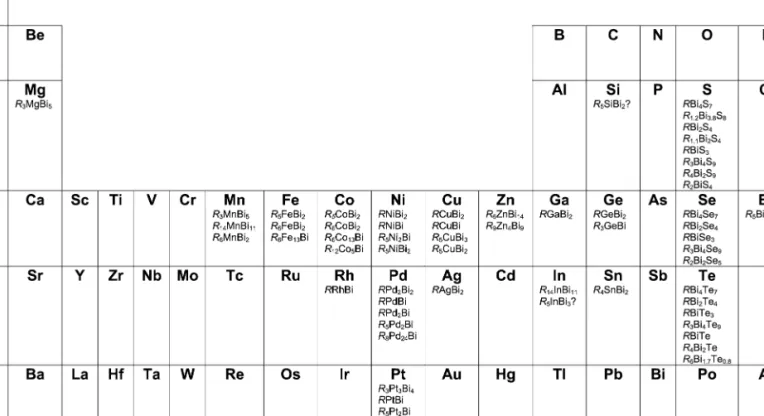
Compared to other rare earth–pnicogen systems previously reviewed in other chapters of this handbook [pnictides (Hulliger, 1979a); nitrides (Marchand, 1998);. This chapter reviews the known rare earth–bismuth phases and focuses on compositional and structural data, accompanied by brief descriptions of physical property data where available. Sections 4–6 review the three-component rare earth–bismuth phases organized with respect to the third component (M) in the R–M–Bi systems, as the differences in bonding character are more clearly highlighted in this way.
For Bi-poor phases, the standard synthetic procedure of arc-melting mixtures of the elements followed by annealing has been commonly applied, despite the ease of evaporation of Bi. For example, R6MBi2(M=Mn,Fe,Co),R5M2Bi (M=Ni,Pd,Pt), andR12Co5Bi can be prepared by this route, with a moderate excess of Bi added to compensate for evaporation losses. For Bi-rich phases this becomes less of a viable method, although compounds such as RRhBi and NdNi1−xBi2 have been prepared accordingly with the addition of as much as a 10 wt% excess of Bi during arc melting.
Growth of crystals generally proceeds through solid-state reactions or through cooling of the melt, and only in rare cases has the use of a Bi flux been successful (e.g. RAgBi2, R3Pt3Bi4). As expected from the trends of continuing down the periodic table, the vast majority of rare earth bismuth phases can be considered true intermetallic compounds, given the smaller difference in electronegativity between rare earth elements (1.1–1.3) and bismuth ( 1.9), com. - paired with rare earth phosphides, arsenides or even antimonides.
Binary systems
Eu4Bi3 was prepared in quantitative yield in a Ta (but not Nb) pot, and its structure (anti-Th3P4 type) was determined from single-crystal data (Wang et al., 1996). Photoelectron spectroscopy and band structure calculations were also performed on these compounds (Drzyzga et al., 2003). Single crystals of LaCeBi were prepared by heating stoichiometric mixtures of the elements in a Mo crucible at 1200◦C for 7 days (Oyamada et al., 1993).
Several LaxCe1−xBi solid solution members have also been prepared (Kasuya et al., 1993). Crystal structures were later refined from single crystal X-ray diffraction data for SmRhBi and DyRhBi (Haase et al., 2002). CePtBi and PrPtBi crystals were grown from Pb flux instead of Bi flux (Canfield et al., 1991).
LaPtBi Transport and thermoelectric properties have been measured in single crystals of LaPtBi (Jung et al., 2001). PrPtBi measurements were first made on powder samples prepared by arc fusion (Suzuki et al., 1997). NdPtBi Transport and magnetic properties have been measured in single crystals of NdPtBi (Morelli et al., 1996).
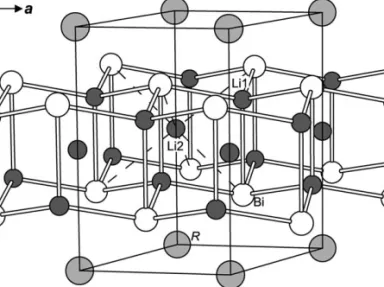
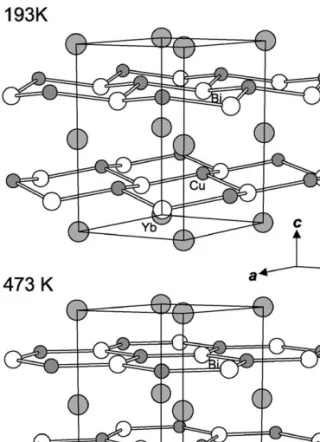
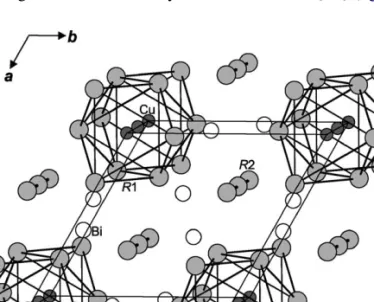
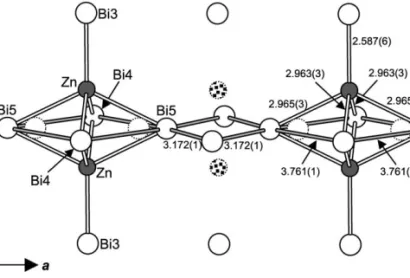
SmPtBi Measurements have been made on powder samples of SmPtBi, a semi-metal (Kim, M.-S. et al., 2001). Variable temperature structure determination on a single crystal of YbCuBi confirmed that the ∞2[CuBi] nets are strictly flat in the high temperature phase (ZrBeSi type), but kinked in the low temperature phase (LiGaGe type) (Fig. 15) (Tkachuk et al., 2006a). The compound Ho5Cu0.7Bi2.3 was recently prepared by arc melting the elements, followed by annealing at 830◦C for 240 hours and quenching in water (Morozkin et al., 2005).
With the availability of these large crystals, extensive characterization of the electrical and magnetic properties was performed, as summarized in table 20 (Petrovic et al., 2003). Attempts have been made to fit the trends using a multiband model (Matlak and Zieli´nski, 1991) and LMTO calculations (Ufer et al., 1994). The isothermal portion of the La–In–Bi phase diagram at 600◦C was investigated (Désévédavy et al., 2004).
The ternary Ce–Ge–Bi system was investigated by analysis of samples prepared by arc melting of the elements followed by annealing at 400◦C for 500 h (Stetskiv et al., 1998). The powder X-ray diffraction pattern reported for TmBiSe3 appears to be consistent with a Sb2S3-type structure (Sadygov et al., 2001).
Conclusion
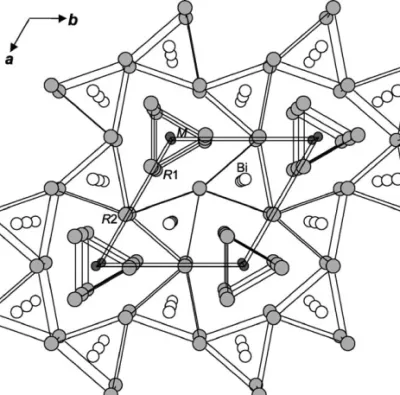
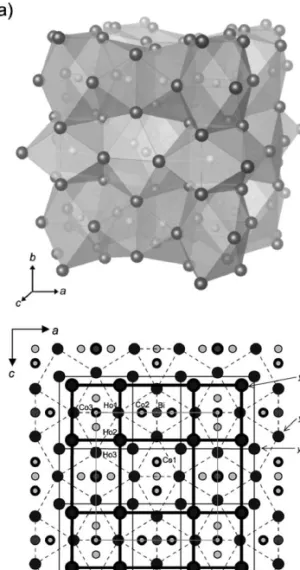
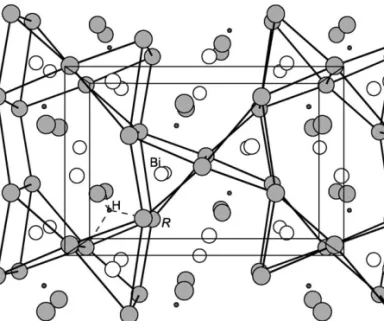
The structure is similar to that depicted for Gd5CuBi3 (see Fig. 16 in Section 5.8.3), with chains of face-split La6 octahedra (whose centers are filled with Br atoms and whose edges are bridged by Bi atoms) and chains of La atoms extends along the c direction. The development of current research in the bismuthides parallels but lags behind that of the antimonides. With new opportunities in this area identified in this review, further connections are expected to be present in the future.
Much of the writing was completed during part of a sabbatical leave supported by the University of Alberta, at 1 Université de Rennes, kindly received by Dr.
SWITCHABLE METAL HYDRIDE FILMS
First generation switchable mirrors
The effect of the Pd over layer thickness on the link properties is reviewed later in section 2.3. The measured optical transmittance was mapped onto the hydrogen concentrations measured using the results of the electrochemical charging experiments. The wave-like behavior of the transmission in the transparent state was attributed to the interference of light reflected by the substrate/Y and Y/Pd interfaces.
The Hall coefficient value estimated from room temperature measurements in the deposited sample (x ~0.08) was obsd. This was interpreted in terms of an electrostatic shielding effect due to free charge carriers in yttrium hydride. The optical properties of YHx as a function of hydrogen concentration were also studied by van Gogh et al.
The switching time and film morphology were shown to be strongly dependent on the film thickness. It was observed that the magnitude of the displacement increases with the increase in the thickness of the cover layer. Ellipsometric measurements were performed to determine the dielectric constants of discharged Pd-capped PrHx films (Mor et al., 2001).
From the estimated values, it was concluded that increased thickness of the Pd-coated layer leads to a decrease in the value ofx in PrHx films during unloading. 39(ii) shows the variation in working electrode potential (U), transmission (Topt) and χ during spontaneous discharge of the films. The appearance of these regions was explained in terms of the variation in the simultaneously measured transmission enχ.
The dark brown color of the dihydride state was observed to change reversibly to the golden greenish color of the trihydride state by changing the hydrogen concentration in the films. The potential was observed to drop sharply in each case during cathodic polarization of the working electrode. At low energies, the magnitude of the reflectance was observed to increase with increasing thickness of the Pd overlay.
The initial decrease in optical transmission was attributed to the presence of the optical window. A clear dependence of the switching time (τ) and the diffusion coefficient (Df) on temperature, potential, concentration and film thickness was observed.