Deferred Tax On Real Profit Management With Tax Planning As Moderating
Marlina Permatasari1 and Estralita Trisnawati2
1,2Magister Accounting Program, Faculty of Economics and Business, Tarumanegara University, Jakarta Indonesia
Email Address:
[email protected]; [email protected]
*Corresponding author
Abstract: This research examines the.effect.of current taxes, deferred.tax.and.tax amnesty on real earnings management.and tax planning as moderating. The sample is from.the property;and;real;estate;companies;listed;on;IDX-IC during 2013 until 2019. Based on purposive sampling, the selected sample is 23 companies, the total sample is 138 observations. The hypothesis is carried out using MRA through Eviews 10. The;results;of this;study;indicate;that;current;taxes, deferred;tax;expense, ;tax amnesty;and;tax;planning have;a;positive;effect;on;real;earnings;management. In addition, this study reveals that there is moderating effect of tax planning on the relationship;between;current;tax;and deferred;tax;expense;with;real;earnings;management. In addition, management can use the results of this study as consideration in deciding whether to take real earnings management actions or not, which in turn will affect the sustainability of the company.
Keywords: Current Tax; Deferred Tax; Tax Amnesty; Tax Planning; Real Earning Management.
Abstrak: Penelitian;ini;menguji;pengaruh;pajak;kini, pajak.tangguhan.dan.pengampunan pajaklterhadap manajemen laba riil dan perencanaan pajak sebagai moderasi. Sampel berasal dari perusahaan.properti.dan.real.estate.yang.terdaftar.di.BEI.selama.periode 2013 sampai 2019. Berdasarkan.purposive.sampling, sampel.yang.dipilih adalah 23 perusahaan, sehingga total sampel adalah 138 observasi. Hipotesis dilakukan dengan menggunakan MRA melalui Eviews 10. Hasil penelitian ini menunjukkan bahwa pajak kini, kewajiban pajak.tangguhan, pengampunan pajak.dan.perencanaan pajak berpengaruh positif terhadap manajemen.laba.riil. Selain itu, penelitian ini mengungkapkan bahwa terdapat pengaruh moderasi perencanaan pajak terhadap hubungan antara pajakkkinikdankbebankpajak tangguhan;dengan manajemen laba riil. Selain itu, manajemen dapat;menggunakan;hasil penelitiankiniksebagaikbahankpertimbangan;dalam memutuskan apakah akan melakukan tindakan manajemen laba yang riil atau tidak, yang pada akhirnya akan mempengaruhi keberlangsungan perusahaan.
Kata Kunci: Pajak Kini; Pajak Tangguhan; Pengampunan Pajak; Perencanaan Pajak;
Manajemen Laba Riil.
INTRODUCTION
The infrastructure plan encourages the government to increase national income by 1882,5 trillion rupiah for 2016, with a tax revenue target of 1360,2 trillion rupiah, which is 74 percent of national income. However, as of May 2016 the total tax revenue received was only 364,1 trillion rupiah, which is only 26.800 percent of the targeted amount according to the 2016 State Revenue and Expenditure Budget (Mulyani, 2017). From the last two years, the amount of tax revenue has decreased to 82 percent, which is illustrated in Figure 1. This condition encourages the government to look for alternative fiscal policy as a new source of funds (Mahestyanti et al., 2018).
Figure 1. Target and Realization of Indonesia's Tax Revenue for 2006-2016
Source: Directorate General of Taxes, 2016
Challenged by the need for income for infrastructure development and low taxes in Indonesia, the government chose to carry out a tax amnesty program (tax amnesty) volume 1 which was held from July 1, 2016 to March 31, 2017 (Ismi, 2017). Based on Law;Number;11;of;2016, tax;amnesty;is;the;abolition;of;taxes;that;should;be;owed. This actkisknotksubjectktoktaxkadministrationksanctionskandkcriminalksanctionskinftaxation of assets.obtained in 2015 and.previously reported in the.SPT with.all.tax.arrears.owned and.paying.a.certain amount of tax ransom (Mahestyanti et al., 2018). At the end of the tax amnesty program period, taxpayers who pass the examination and are proven not to have reported all their assets will be given 200 percent penalty (Ismi, 2017).
Reflecting on the tax amnesty program, it has brought success such as increasing the number of state revenues and tax compliance. Apart from increasing revenues in a short period of time, the tax amnesty also acts as a smooth transition to a stricter tax system (Kurniawati, 2017). Several countries have implemented tax amnesty programs such as Argentina, Italy, South Africa and including Indonesia itself (Aliandu, 2016). According to (Ragimun, 2014), tax amnesty in South Africa applies pull and push. The pull strategy is to provide incentives to taxpayers to attract them to participate in the program, namely by canceling tax interest and providing tax redemption at the lowest possible rate. The
push strategy is to put pressure on tax violators by increasing the quantity and quality of possible tax audits. This strategy led to a succession of tax amnesty in South Africa.
The tax amnesty program is closely related to operating profit and income from outside the business is an element of the income statement and assets and liabilities are elements of the balance sheet. Reported operating profits for tax purposes and which are intentionally not reported with the aim of companies being reluctant to pay taxes are too large (Annisa, 2018). The company's performance appraisal can simply be reflected in the company's profit achievement. Related parties in one company use profit information in determining decisions to be taken for.the.continuity.of.the.company's.operations (Bunaca and Nurdayadi, 2019).
Currently, companies are faced with very tight competition.to.survive.in.the.global market. Companieskarekrequiredktokhavekvariouskcompetitivekadvantageskinkorderkto compete.with.other.companies, not.only.from.the.quantity.and quality of.the products and services offered but also include good financial management, which means that various policies in financial.management.must be able to ensure the sustainability of the company's business, indicatedkbyfthefamountfoffprofitfthat is highkachievedkbykakcompany. This situationkusuallykencourages manager tokcarry out devianthbehaviorhinhpresentinggand reportinglearningslinformationlknownlaslearningslmanagement (Bunaca and Nurdayadi, 2019). Earnings management actions are not just management mistakes. Thisjisjbecause International Financial.Accounting Standards (IFRS) allow.management to choose various alternative.accounting methods to manage company profits (Widiatmoko and Mayangsari, 2016).
Realkearningskmanagementkisjajdeviationjfromjthejcompany'sknormaljoperating practices.which.is.motivated.by.management's desire to provide a wrong.understanding.to stakeholdersgbygensuringmthatkfinancialmreportingkobjectiveskhavekbeenkachievedkin accordancekwithkthekcompany'sknormalkoperatingkactivities (Machdar and Nurdiniah, 2021). Realkearningskmanagementkpracticeskarekcarriedkoutktofacceleratefearningsfby changing several business activities, for example manipulation of research and development costs, overproduction, manipulation of advertising costs, and manipulation of sales (Roychowdhury, 2006).
The phenomenon that makes researchers interested in taking this research is the fact that only around 194 (34.700 percent) companies.listed.on.the Indonesia Stock Exchange participated in the.2016.tax.amnesty.program, and among these 194 companies, 46 (23.710 percent) companies do not.disclose.the.net.value.of.their.tax.amnesty.assets.
Companies that.participate.in the tax amnesty program tend to be companies that used to be tax evaders whose financial statements indicate fraud (Hermawan et al., 2020).
(Geraldina and Jasmine, 2019) also say that companies.that.participate.in.the tax.amnesty program tend.to be companies that carry out earnings management. According to (Ferdiawan and Firmansyah, 2017), multinational companies have a great opportunity to practice earnings management and tax planning to avoid income tax (withholding tax) by placing their operations in countries that have low income tax rates. MNC companies can withhold dividends from overseas subsidiaries to reduce the value of global sales mitigated by PMK-256/PMK.03/2008.
CorporationsminmIndonesiampreparemfinancialmstatementsgusingkthekbasiskof Indonesian.gaccounting.gstandards.gknowngasgthegStatementgofgFinancialgAccounting Standardsk(PSAK)kand the taxation law. Companiesgcannotgcalculategtaxablegincome
directly..Thisgisgduegtogtheldifferencelbetweenltaxablelincomelaccording to the taxation law and income before tax accordingktokPSAK. Thiskdifferencekaffectskthekfinancial statements,jsogitgisgnecessarygtogadjustgthegbalance,between,taxable,income,and,profit before taxjthroughjfiscaljreconciliation (Machdar and Nurdiniah, 2021).
In the context of accounting for income tax, these differences result in two types of differences, namely temporary differences and permanent differences (Amanda and Febrianti, 2015). The difference arising from the difference between commercial profit and fiscal profit is called a fiscal correction whichjcanjbejinjthejformjofjajpositivejfiscal correction and aknegativekfiscal correction. The.temporary.difference between accounting profit and.fiscal.profit.gives.rise to deferred.tax (Purnamasari, 2019).
The implication of PSAK 46 is related to the issue of earnings management where many manager take advantage of this opportunity to manage profit figures in their companies with an accrual approach to get bonuses or rewards for good performance by minimizing the income.tax.burden.that.must.be.paid. The first factor that is tested for its effectjonjrealjearningsjmanagementjinjthisjstudy is the current tax burden, which is the amountjofjtaxjthatjmustjbejpaidjbyjtaxpayers for one period (Suandy, 2016). The amount of current tax must be self-calculatedkbykthektaxpayerkbasedkonkthektaxablejincome multiplied.by.the.tax.rate, then.self-paid.and.reported.in.the.tax.return.in.accordance.with the applicable tax.laws.and.regulations (Setia et al., 2020).
Tax planning is a major tax consideration that can be associated with earnings management. According.to.(Hoffman, 1961), tax.planning.is.defined.as.the.ability.of taxpayers tokarrangekfinancialktransactionskinkakwaykthatkreducesktheltaxlburden. Tax planninggisgtheoreticallyjknowngasgeffectivegtaxgplanninglthat one should try to.get.tax savingsmthroughmtaxmavoidancemproceduresksystematicallykinkaccordancemwithg tax regulations (Mei, 2019). Although.tax planning actions are mostly legal, some tax planning actions may fall into the gray zone.in.terms.of.legal.definitions, such.as.using.procedures that violate tax.evasion laws, understate taxable income or overstate expenses (Abdalla et al., 2018)
Other researches on earnings management have been carried out by researchers (Kurnia and Pradipta, 2016; Baig and Khan, 2016; Bortoluzzo et al., 2016; Elnahass et al., 2018; Geraldina and Jasmine, 2019; Li et al., 2018). However, according to the researcher's knowledge, it is still rare to link it with the tax amnesty program. For this reason, this study examines how real earnings management exists in the company in the period before and after the tax amnesty volume 1.
THEORETICAL REVIEW
Signalling Theory. Signalingjtheoryjwasjfirstjpublishedjby (Spence, 1973) in which the sender. (the.owner.of.the.information) tries.to.provide.relevant.pieces.of.information.that cankbekutilizedkbykthekrecipient. Signalktheorykiskbasedkonkthekassumptionkthatkthe informationjreceivedlbyleachlpartylisldifferent, injotherjwords, linformationhasymmetry occurs between.the.company's.management.and.the parties with an interest in information.
According to (Guest et al., 2020) signal theory explains how.a.company.should give.signals.to.users.of.financial.statements (users). The.signal.given by.the.company.can be.in.the.form.of.a.good.signal (good news) or the signal theory explains how.a.company should.give.a.signal.to.usersloflfinanciallstatements (users) with bad signals (bad news).
Good signals indicate management actions that are in line with user interests as well as other information stating that the company's profits are in good condition and also predictable in the future. Investors will be attracted to invest their capital. On the other hand, if the bad signal is reflected in the company's information, investors will switch to other companies that have complete, relevant,.accurate.and timely information (Connelly et al., 2011).
Signal theory by manager to reduce information asymmetry through financial statements. Complete, relevant, accurate and timely.information.is.needed.by.investors.in thejcapitaljmarketjasjanhanalyticalhtoolhforhmakinghinvestmentjdecisionsj(Yassar et al., 2020). This theoryjalso provides a signal to prevent companies from taking earnings management actions such as presenting profits and assets that are not overstate (Abdalla et al., 2018). The signal theory in this study is the grand theory of the dependent variable, namely earnings management.
Agency Theory. Agency theory was initiated by (Ross, 1973) which was later expanded by (Jansen and Meckling, 1976). (Jansen and Meckling, 1976) define agency.theory.as.the relationshipmbetweenmbusinessmmanagementk(agent)mand shareholders (principal).
(Eisenhardt, 1989)kstatesgthatgagencygtheorygusesgthreegassumptionsjoflhuman.nature, namely: (1).humans.are.generally.self-interested (self-interested), (2) humans have limited thinkinglpowerhabouthperceptionshofhthehfutureg(bounded rationality), and (3) Humans alwayslavoidlriskl(risk averse).
Inlanlagencylrelationship, therekislalworklagreementl(contract) inkwhichkonekor more people (principal) arrange for anotherlpersonl(agent) tolperform services onlbehalf oflthelprincipallandlagentlwholislauthorizedltolprovidelthe best decision for shareholders.
Agencygtheorygstatesgthatgmanagementlandlownerslhaveldifferentlinterestsl(Jansen and Meckling, 1976). True shareholders also play a vital role in the company and therefore their interests cannot be underestimated (Amidu et al., 2019).
When the agent and principal have different interests and goals, a conflict of interest between the two cannot be avoided. Conflicts of interest are increasing because shareholders cannot monitor the day-to-dayjactivitiesjofjmanagerjtojensurejthatjmanager actsmasjexpectedjbyjshareholders. Managerkwhokarekdirectlykinvolvedkwithkcompany activities have more information than shareholders. This.is.calledlinformationjasymmetry.
Conflicts of interest and information asymmetry can encourage agents not tohconvey true information.to.the.principal.and.may.affect.the presentation of financialgstatements. The financialmstatementskmadekmaykbekirrelevantkandknotkneutralkbecausekthemfinancial statementskare for thelbenefit of thelagent. This condition tends to be used by agents to take inappropriate actions (manipulation).
According to (Yusof, 2016), the auditor is one of the parties capableloflbridging thelinterestsloflthelshareholders (principal) withlthelinterests of thelmanagement (agent) in managing company finances. Thislthirdlpartylfunctionsltolmonitorlthelbehaviorloflthe manager (agent) whetherlitlhaslacted appropriately inlaccordancelwithlthe wishes of the owner or shareholder (principal). Thelauditorlperformslthelfunctionloflmonitoringlthe manager's worklthroughlalfacility, namelylthelannuallreport. Companyldatalwilllbelmore easilyltrustedlbyginvestorsgandgusersgofgfinanciallstatementslthatlreflectlthejcompany's performance and the company's financialjconditionjhas received ajfairjstatementjfrom the auditor (Kazemiana and Zuraidah, 2015). Agency theory in this study as a theory that
explains the independent variables namely current tax, deferredjtaxjassets, deferredjtax liabilities and tax amnesty and the moderating variable is tax planning.
Effect of Current Tax on Real Earnings Management. The current tax variable has something to do with agency theory with the assumption that human nature is risk averse which means that manager always avoids risk. Manager tend to avoid the risk of paying a high tax burden. Agency theory states that in minimizing the level of misinformation, direct supervision is needed so that it becomes evidence of weak supervision from the principal. According to (Natalia, 2017) the high motivation of management to carry out earnings management will cause a differencehbetweenhaccountinghprofithand taxation profit.
Current.tax.burden is.the.amount of tax.that.must.be paid by the.taxpayer which is calculated from the taxable income resulting from the fiscal reconciliation multiplied by the tax rate (Setia et al., 2020). Fiscal.corrections.mustlbelmadelbecause of the different treatment.of income and costs between accounting standards and applicable tax regulations (Amanda and Febrianti, 2015). In some cases, taxpayers have the freedom to make accounting policies related to determining the time of recognition of income and expenses, although the accounting policies that have been set must be applied in a consistent manner from year to year (Junery, 2016).
When the current tax burden is high, it will reduce the company's profits so as to provide greater opportunities.for manager to.carry.out.earnings.management. On the other hand, when the current tax burden is low, it will increase company profits so as to provide smaller opportunities.for manager to.carry.out.earnings.management (Tanra et al., 2017)
(Setia et al., 2020; Warsono, 2017; Mansyur et al., 2017; Annisa, 2018; Junery, 2016;
Amanda and Febrianti, 2015) is able to.prove.that the current tax has a positive effect on.earnings.management. Research conducted by (Rahmi and Hasan, 2019; Fajarwati et al., 2020; Wijaya et al., 2017; Natalia, 2017) proves that current taxes have a negative effect.on.earnings.management. Based on the previous discussion, the.first.hypothesis.in this study is:
H1: Current tax has a positive effect on real earnings management.
Effect of Deferred Tax Asset on Real Earnings Management. The.positive.difference between accounting profit and fiscal profit makes a positive correction resulting in deferred tax assets (Widiatmoko and Mayangsari, 2016). Deferred.tax.assets.are.recognized.as.a temporary.difference.that.can be reduced, as long as it is probable that the difference.can be.used.to.reduce taxable profit in.the.future. PSAK 46.states.that.the.value.of deferred tax assets.must.be.reviewed.at.the.end.of.each.reporting period, thus providing an opportunity forlmanagementltolreviewlandldeterminegthegnewgvaluegofgdeferredhtaxhassets, which islsubjective.
The flexibilityjofkdeferredktaxkassetkvaluationkwill provide anfopportunityffor manager tolmanipulate this value forltheirlown benefit (Warsono, 2017). This is in line with agency theory on the assumption that human nature is self-interested, meaning that manager will act as agents to maximize their needs. According to (Rahma, 2020), a higher valuelofldeferredltaxlassetslwill minimize future tax debts. Then,kinkthekend, itkwill increaselthelcompany'slprofitslinlthelfuture, so that manager will get a good appraisal
from shareholders and get compensated for their performance. This reasoning is in line with the research of (Warsono, 2017; Rassang, 2020; Timuriana et al., 2015; Machdar and Nurdiniah, 2021; Rahma, 2020) which.prove.that.deferred.tax assets have.a.positive.effect on.earnings.management. Not in line with the five studies, (Widiatmoko and Mayangsari, 2016; Nuning et al., 2019; Setia et al., 2020; Fajarwati et al., 2020) states that deferred.tax assets.have.a.negative.effect.on.earnings.management. Based.on.the.previous discussion, the.second.hypothesis.in this study is:
H2: Deferred tax assets have a positive effect on real earnings management.
Effect of Deferred tax expense on Real Earnings Management. Earnings.management practice is.based.on.agency.theory.which.causes.information.asymmetry.and.conflicts.of interestkbetweenkagentskandkprincipals. According to (Annisa, 2018), information asymmetry occurs due to differences inkthelinterestsloflthe agent andlthelprincipal so that thelagent hideslinformation that is not known to the principal and presents irrelevant information. This condition is supported by the freedom of SAK (Financial Accounting Standards) to companies in choosing accounting methods to prepare commercial financial reports, while fiscal financial statements are prepared based on tax rules which do not give management the freedom to choose accounting methods. That way the company can regulate the size of the accounting profit through the tax burden (Junery, 2016).
Deferredgtaxgexpensegcangbegusedgto.detect.earnings.management.practices.by looking.at.the.results.of.fiscal.corrections.in.the.form.of.negative.corrections (Negara and Suputra, 2017). Negative.correction.is.a.condition.in.which.the.income.according.to fiscal accountinggisgsmallergthangcommercialgaccounting. Thisgisgwhatgcausesgangincrease injdeferredjtaxjliabilitiesjonjthejbalancejsheet (Nuning et al., 2019).
(Mulyani et al., 2018; Destiana et al., 2020; Soliman and Ali, 2020; Timuriana et al., 2015; Negara and Suputra, 2017; Machdar and Nurdiniah, 2021; Kisno and Istianingsih, 2016; Rahma, 2020; Wijaya et al., 2017; Annisa, 2018) show that deferred tax expense has a positive effect on earnings management. Thisjmeansjthatjeveryjincrease injdeferredjtaxjexpense, thejpossibilityjofjthejcompanyjmakingjmanagementjprofitsjwill increasejandjvice versa. This is not in line with research conducted by (Alfian and Nuryadi, 2019; Nuning et al., 2019; Setia et al., 2020; Rassang, 2020; Amanda and Febrianti, 2015;
Rahmi and Hasan, 2019; Dwi et al., 2019; Fadillah, 2020; Setyawan and Harnovinsah, 2015) which show that deferred tax liabilities have a negative effect on earnings management. Based on the previous discussion, the third hypothesis in this study is:
H3: Deferred tax expense has a positive effect on real earnings management.
Effect of Tax Amnesty on Real Earnings Management. Tax amnesty is tax relief for taxpayers by reporting their wealth and paying taxes owed at a lower tax rate (Ulfanur et al., 2016). Many rich people in Indonesia park their money abroad to avoid tax obligations (Tundjung and Haryanto, 2015). Therefore, this study categorizes tax amnesty as a substantive tax on tax avoidance planning.
The government considers that company owners participate in the tax amnesty program as an indication that their company may be tax evasion, although there is no formal evidence of such tax avoidance behavior (Geraldina and Jasmine, 2019). Therefore,
thislstudylinvestigatesltheleffectloflearningslmanagementlon the likelihood of company owners participatinglinltheltaxlamnestylprogram.
In particular, signal theory investigates whether the incentives of corporate owners tolparticipatelinltaxlamnestylprograms signal thelquality of corporate financial reporting.
Higher quality of financial reporting means lower earnings management (Arief and Paramita, 2019). This reasoning is in line with the research by (Mappadang, 2020) thatltax amnestylhaslalpositiveleffectlonlearningslmanagement. However, this research is not in linelwithlthelresearchlby (Geraldina and Jasmine, 2019) that tax amnesty has a negative effect onlearningslmanagement. Based on the previous discussion, thelfourthlhypothesis inlthislstudy is:
H4: Tax amnesty has a positive effect on real earnings management.
Effect of Tax Planning on Real Earnings Management. Theltaxlplanninglvariable is related to the managerial extraction agency theory, namely the justification for the opportinistic behavior of manager manipulating profits or inappropriate resource placement which creates opportunities for management to cover up bad information and mislead stakeholders. Tax planning activities can be carried out by making explicit tax deductions (Saputra, 2020).
Tax planning can be explained as a management effort in minimizing tax payments asllonglaslitlislstilllwithinlthelapplicable tax rules. Companies that have good tax planning will have a significant impact on decreasing profits through tax obligations (Alfian and Nuryadi, 2019).
Tax planning is related to corporate profit reporting. High profits will also result in a high tax burden. Earnings planninglandlmanagementlare interrelated with eachlother, becauselbothlhavelthelsamelgoal, namelylachievinglprofitltargetslwithlengineeringlprofit figureslinlfinanciallreports (Nuning et al., 2019).
Previous research (Purnamasari, 2019; Mei, 2019; Memory and Tipa, 2020; Negara and Suputra, 2017; Alfian and Nuryadi, 2019; Nuning et al., 2019; Rahmi & Hasan, 2019;
Negara and Suputra, 2017; Ika et al., 2016; Annisa, 2018) which showlthatltaxlplanning haslalpositiveleffectlonlearningslmanagement. earnings management is getting bigger.
However, this ishdifferenthfromhthehresultshofhresearchhby (Mulyani et al., 2018;
Widiatmoko and Mayangsari, 2016; Warsono, 2017; Setyawan and Harnovinsah, 2015;
Khotimah, 2014) which show thathtaxhplanninghhashahnegativeheffecthonhearnings management. Based on the previous discussion, the fifth hypothesis in this study is:
H5: Tax planning has a positive effect on real earnings management.
Tax Planning Moderates the Effect of Current Taxes on Real Earnings Management.
Companies carry out tax.planning as effectively as possible, not only to gain fiscal benefits, but.in fact the.company.also.gains profits in.obtaining.additional.capital.from.investors through.the.sale.of.company.shares (Junery, 2016).The.status of companies that have gone public generally tends to be high profile than companies that have.not.gone.public. In.order to.increase.the.value.of the.company's shares, management is motivated to provide the best possible.company.performance.information. Therefore, current tax and deferred tax which is.an.element.of.profit.deduction.that.is.available.to.be.sharedgwithginvestorslorlinvested
bylthelcompany, will.be.managed.by management to be minimized to optimize the amount of.the.company's.net.profit (Baraja et al., 2019). Based.on.the.previous.discussion, the sixth hypothesis in this study is:
H6: Tax planning moderates the relationship between current taxes and real earnings management.
Tax Planning Moderates the Effect of Deferred Tax Asset on Real Earnings Management. Ingcarryinggoutgearningsgmanagement, management.will.be.faced.with.a condition.where.if.profits.are.increased.it.will.reflect.good.company.performance, but.on the.other.hand.it.will.also.have.an.impact.on.increasing.corporate.income.tax. In.the.case ofltaxlrevenuelbetweenlthelgovernmentlandlcorporateltaxpayers, inlparticularltheylhave differentlperspectives.kThe.lgovernmentlexpectslanlincreaselinlincomelfromlincomeltax, whilelbusinesslentitieslminimizelthelcompany'sltaxlburden, byhdoinghtaxhplanning. Tax planningkrefersktokthekprocesskofkminimizingkthektaxfburdenfbutfdoesfnotfviolatefthe applicable.tax.regulations (Tundjung and Haryanto, 2015).
The.calculation.of.the.amount.of.income.tax.is.caused.by the difference in revenue and expense recognition between commercial and fiscal. These differences must be recorded.and.reflected.in.commercial.financial.statements, in.a.deferred.tax.account, both deferred.tax.assets.and.deferred.tax.liabilities (Rahma, 2020). The assets.contained.in.the company's balance.sheet.can.be.used.to.reduce.taxable.income.so.that it can reduce the tax imposed.on.the.company. If deferred.tax assets are high, earnings management actions will be reduced (Machdar and Nurdiniah, 2021). Based.on the previous discussion, the seventh hypothesis in this study is:
H7: Tax planning Tax moderates the relationship between deferred tax assets and real earnings management.
Tax Planning Moderates the Effect of Deferred Tax Expense on Real Earnings Management. Thekinformationkcontainedkin.financial.statements.is.often.engineered.by management.to.optimize.company.profits.and.alsohforhtheirhownhinterests.orkknownjas earningsjmanagement (Serdarevic and Muratovic, 2021). Therejarejseveraljmethodsjused tojtestjearningsjmanagement.and.earnings management is often related to tax planning and deferred.tax.expense. The.company.carries.out.tax.planning.as.effectively.as.possible, not only.to.obtain fiscal benefits, but actually the company also benefits in obtaining additional capital.from.investors.through.the.sale.of.each.share (Purnamasari, 2019). Therefore, the tax, which.is.a.reduction.in.profits.available.to.be.shared.with.investors.or.invested.by.the company, will.be.sought.by.management.to.be.minimized.in.order.to optimize the amount of the company's net income (Mulyani et al., 2018). In this case, there.are.indications.that management.carries.out.earnings.management.in.thektaxjplanningjprocess, andhdeferred taxkexpensekiskonekapproach.lthatlcanlbelusedltoldetectlearningslmanagementlpractices (Serdarevic and Muratovic, 2021).
(Suandy, 2016) explains.that.if.the.purpose.of.planning.tax.is.to.engineer.so.that the.tax.burdenkcankbekreducedkasklowkaskpossiblekbykutilizingkexistingkbutjdifferent regulations.for.the.purpose.of.making.laws, then.tax.planning.seeks.to.maximize.after.tax income.because.tax.is.a.deduction of profits available, both for distribution to shareholders
and for reinvestment. Based on the previous discussion, the eighth hypothesis in this study is:
H8: Tax planning moderates the relationship between deferred tax expense and real earnings management.
Tax Planning Moderates the Effect of Deferred tax expense on Real Earnings Management. Based on The Organization for Economic Cooperation and Development/OECD Year 2013, BEPS.is.a.tax.planning.strategy.that.takes.advantage.of gapskandkweaknesseskcontainedkinktaxklawskandkregulationsktokeliminatekorjtransfer company profitsjtojotherjcountries with low tax rates or even free taxation. The end goal is that companies do not have to pay taxes or the taxes paid are of very small value to the company's overall income (Rakhmindyarto, 2014).
BEPS strategy is one of the earningsgmanagementgpracticesgcarriedgoutgby the company. Earnings managementgpractices are supported by information asymmetry, manager knows more about financial information and company conditions than the government which collects taxes. This condition is used by the company'slmanagementlto carryloutlearningslmanagement solthat the reported profit information is in accordance with the interests of management and does not describe the actual profit (Fitri and Mulyaningtyas, 2018).
Companies as corporate taxpayers have an obligation to pay taxes for the state as regulated in the law. However, there are still many companies that carry out tax planning to reduce the taxes that must be paid, this is because tax payments are considered a cost burden for the company and its owners.
Another effort that can be made to minimize earnings management practices is monitoring. One of them is by auditing financial statements on a regular basis, especially by external auditors (Rahma, 2020). The main purpose of the audit of financial statements is to identify errors and irregularities in the financial statements that will have a material impact. Financial statement audits can also reduce the information asymmetry that exists between manager and stakeholders (Widyasari et al., 2018). Based on the previous discussion, the ninth hypothesis in this study is:
H9: Tax planning moderates the relationship between tax amnesty and real earnings management.
METHODS
This research methodology uses quantitative methods. This study uses financial data.
The.population.in.this.study.are.property.and.real estate sector companies registered as public companies listed on IDX-IC in the 2015 until 2019 period. The data will be obtainedkfromkthekIDXjofficial website at https://www.idx.co.id/. This study also uses cross-sectional data.
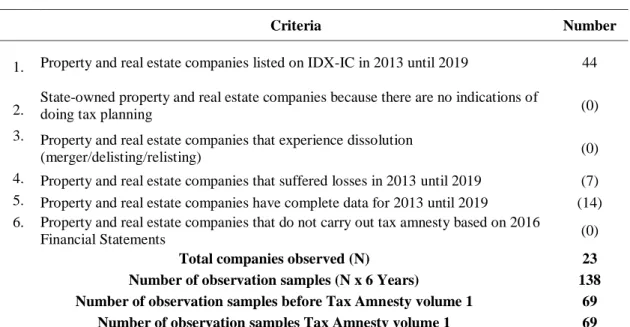
The sample selection method used.in.this.research.is.purposive sampling. Based on purposiveksampling, the selected sample is 23 companies, so the total sample is 138 observations. The hypothesis is carriedloutlusinglModeratedlRegressionlAnalysislthrough
Eviews 10. Thelsamplelselectionlprocesslusinglpurposivelsamplinglmethodlinlthislstudy withlthelfollowinglcriteria:
Table 1. Research Sample
Criteria Number
1. Property and real estate companies listed on IDX-IC in 2013 until 2019 44
2. State-owned property and real estate companies because there are no indications of
doing tax planning (0)
3. Property and real estate companies that experience dissolution
(merger/delisting/relisting) (0)
4. Property and real estate companies that suffered losses in 2013 until 2019 (7) 5. Property and real estate companies have complete data for 2013 until 2019 (14) 6. Property and real estate companies that do not carry out tax amnesty based on 2016
Financial Statements (0)
Total companies observed (N) 23
Number of observation samples (N x 6 Years) 138 Number of observation samples before Tax Amnesty volume 1 69
Number of observation samples Tax Amnesty volume 1 69
Source: Processed
The dependent variable in this study is real earnings management, while the independent variables are current taxes, deferred tax assets, deferred tax liabilities, and tax amnesty. The moderating variable of this research is tax planning. This study also uses a control variable, namely leverage.
In this study, real earnings management was measured using 3 proxies as used by (Roychowdhury, 2006):
Abnormal cash flow operations (Abnormal CFO)
CFOt/At-1 = α0 + α1(1/At-1) + β1(St/At-1) + β2(∆St/At-1) + єt... (1) Where:
CFOt/At-1 = cashlflowlfromloperatinglactivitieslinlyearltlwhichlislscaledltola totallassetslinlyear t-1.
α1(1/At-1) = interceptlwhichlislscaledlbyltotallassetslinlyear t-1 withlthelaim thatloperatinglcashlflowldoeslnotlhavelalvaluelofl0lwhen sales and sales lag is 0.
St/At-1 = sales in year t scaled by total assets in year t-1.
∆St/At-1 = sales in year t minus sales in year t-1 which scaled by total assets in year t-1.
α0 = constant.
єt = error term in year t.
Abnormal production cost (Abnormal PROD)
PRODt/At-1 = α0 + α1(1/At-1) + β1(St/At-1) + β2(∆St/At-1) + β3(∆St-1/At-1) + єt.. (2) Where:
PRODt/At-1 = production cost in year t scaled by total assets in year t-1, where PRODt = COGSt + INVt
α(1/At-1) = intercept scaled by total assets in year t-1 with the aim that the value of production costs does not have a value of 0 when sales and sales lag are 0.
St/At-1 = saleslinlyearltlscaledlbyltotallassetslinlyearlt-1.
∆St/At-1 = sales in year tlminuslsaleslinlyearlt-1lwhich scaledlbyltotallassets in year t-1.
∆St-1/At-1 = saleslchangelinlyear t-1lscaledlbyltotallassetslinlyear t-1.
α0 = constant
єt = errorltermlin yearlt.
Abnormal discretionary expenses (Abnormal DISC)
DISEXPt/At-1 = α0 + α1(1/At-1) + β(St-1/At-1) + єt... (3) Where:
DISEXPt/At-1 = discretionarylexpenselinlyearltlscaledlbyltotallassetslyear t-1 (1/At-1) = intercept scaled by total assets in year t-1 withlthelgoallislthat
discretionary costs do not have a value of 0 when sales and sales lag is 0.
St-1/At-1 = saleslinlyearlt-1lscaledlbyltotallassetslinlyearlt-1.
The independent tax variable now uses the current tax proxy, the same as the proxy used by research by (Amanda and Febrianti, 2015; Warsono, 2017; Setia et al., 2020). The current tax burden referred to in this study is measured using the following ratio scale:
CT = Current Tax Expenseit
Total Assett−1 ... (4)
The independent variable of deferred tax assets uses the same proxy as the proxies used by research by (Waluyo, 2008; Rassang, 2020; Timuriana et al., 2015). The deferred tax assets referred to in this study are measured using the following ratio scale:
DTA = ΔDeferred Tax Asetit
Deferred Tax Assett−1... (5)
The independent variable deferred tax expense uses the same proxy as the research used by (Harnanto, 2003; Nuning et al., 2019; Setia et al., 2020). The deferred tax expense referred to in this study is measured using the following ratio scale:
DTE = Deferred Tax Expenseit
Total Assett−1 ... (6)
To test the hypothesis, whether or not the company participates in tax amnesty during the tax amnesty period, this study uses the same nominal scale as the proxy used by (Trisnawati et al., 2021). If the company participates in the tax amnesty, it will be given a point of 1. Otherwise, it will be given a number of 0. The moderating variable is tax planning using the tax retention rate formula. This research proxy is the same as the proxy
used in the study of (Wild et al., 2004):
TRR = Pretax Income (EBIT)Net Incomeit it... (7)
The leverage proxy in this study is the same as the proxy used by (Setyawan and Harnovinsah, 2015; Gunawan, 2015; Khotimah, 2014). The leverage referred to in this study was measured using a ratio scale according to (Kasmir, 2013) as follows:
DER = Total EquityTotal Debt ... (8) The main research model of this research can be described in the following equation:
Model 1 (Multiple Regression)
REM = β0 + β1 CT + β2 DTA + β3 DTE + β4 TA + β5 TRR + β6 DER + ε... (9) Model 2 (MRA)
REM = β0 + β1 CT + β2 DTA + β3 DTE + β4 TA + β5 TRR + β6 DER + β7 CT*TRR + β8
DTA*TRR + β9 DTE*TRR + β10 TA*TRR + ε... (10) Explanation:
REM = Real Earnings Management (dependent variable) β = Constant
CT = Current Tax (independent variable)
DTA = Deferred Tax Assets (independent variable) DTE = Deferred tax expense (independent variable) TA = Tax Amnesty (independent variable)
TRR = Tax Planning (moderation variable) DER = Leverage (control variable)
ε = Error
RESULT
Assumption Test Results Before Tax Amnesty Momentum Period Volume 1.
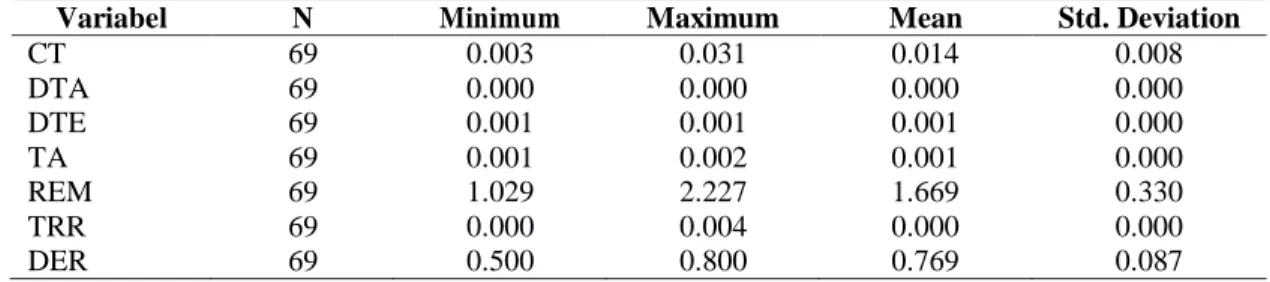
Descriptive statistical analysis is used to explain some of the data characteristics of the research variables contained in Table 2:
Table 2. Descriptive Statistics
Variabel N Minimum Maximum Mean Std. Deviation
CT 69 0.003 0.031 0.014 0.008
DTA 69 0.000 0.000 0.000 0.000
DTE 69 0.001 0.001 0.001 0.000
TA 69 0.001 0.002 0.001 0.000
REM 69 1.029 2.227 1.669 0.330
TRR 69 0.000 0.004 0.000 0.000
DER 69 0.500 0.800 0.769 0.087
Source: Processed
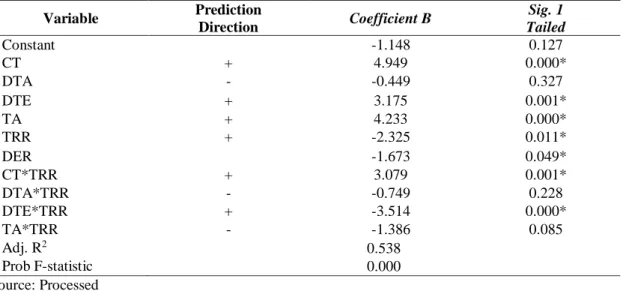
Furthermore, the results of the cross section data regression test using multiple regression are shown in Table 3:
Table 3. The Summary of Hypothesis Tests
Variable Prediction
Direction Coefficient B Sig. 1
Tailed
Constant -1.148 0.127
CT + 4.949 0.000*
DTA - -0.449 0.327
DTE + 3.175 0.001*
TA + 4.233 0.000*
TRR + -2.325 0.011*
DER -1.673 0.049*
CT*TRR + 3.079 0.001*
DTA*TRR - -0.749 0.228
DTE*TRR + -3.514 0.000*
TA*TRR - -1.386 0.085
Adj. R2 0.538
Prob F-statistic 0.000
Source: Processed
* level of significant = 0.050
Assumption Test Results After Tax Amnesty Momentum Period Volume 1.
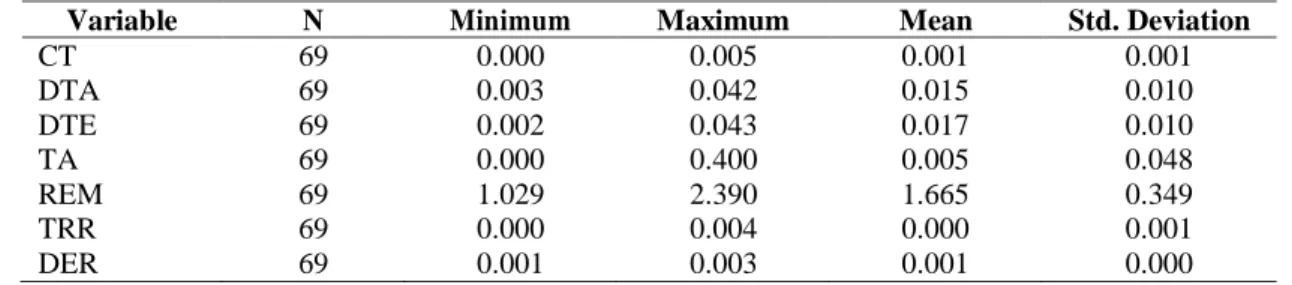
Descriptive statistical analysis is used to explain some of the data characteristics of the research variables contained in Table 4:
Table 4. Descriptive Statistics
Variable N Minimum Maximum Mean Std. Deviation
CT 69 0.000 0.005 0.001 0.001
DTA 69 0.003 0.042 0.015 0.010
DTE 69 0.002 0.043 0.017 0.010
TA 69 0.000 0.400 0.005 0.048
REM 69 1.029 2.390 1.665 0.349
TRR 69 0.000 0.004 0.000 0.001
DER 69 0.001 0.003 0.001 0.000
Source: Processed
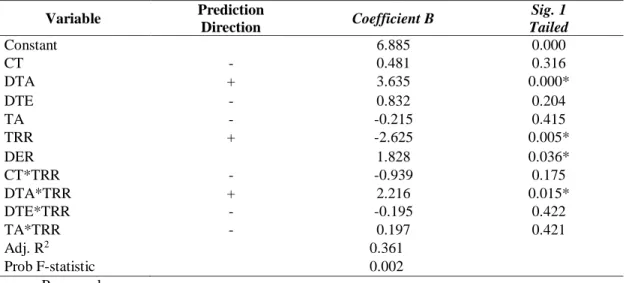
The results of the cross section data regression test using multiple regression are shown in Table 5:
Table 5. The Summary of Hypothesis Tests
Variable Prediction
Direction Coefficient B Sig. 1
Tailed
Constant 6.885 0.000
CT - 0.481 0.316
DTA + 3.635 0.000*
DTE - 0.832 0.204
TA - -0.215 0.415
TRR + -2.625 0.005*
DER 1.828 0.036*
CT*TRR - -0.939 0.175
DTA*TRR + 2.216 0.015*
DTE*TRR - -0.195 0.422
TA*TRR - 0.197 0.421
Adj. R2 0.361
Prob F-statistic 0.002
Source: Processed
* level of significant = 0.050
DISCUSSIONS
Assumption Test Results Before Tax Amnesty Momentum Period Volume 1. Based on Table 3, the value of R square is 0.5385, which means that the independent variable can affect the dependent variable by 53.850 percent. While 46.150 percent or the remaining value is influenced by other variables outside the regression model of this study. The calculated F value in the regression model of this study with a significance value of 0.000.
Proven simultaneously to have a significant effect because the significance value less than alpha value 0.05.
The independent variable of current tax has a significance value of 0.0000 less than 0.05 with a significance rate of 5 percent. Statistically, it can be concluded that at the 95 percent confidence level there is a positive effect of current tax on real earnings management so that H1 is accepted. A large current tax burden will reduce the level of profit earned by a company, and conversely a small current tax burden will increase company profits (Amanda and Febrianti, 2015). The amount of current tax must be calculated by the taxpayer himself based on the taxable income multiplied by the tax rate.
Current tax calculation where the results obtained are self-calculated figures by this taxpayer which provides management opportunities as taxpayers to carry out real earnings management (Rahma, 2020). In the current condition that the tax burden is large, real earnings management is carried out with the aim of reducing the tax burden. Therefore, if the company has a large amount of tax burden in the current year, then the company's management practices real earnings management so that it can reduce the tax burden (Mansyur et al., 2017). These results are in accordance with research conducted by (Setia et al., 2020; Warsono, 2017; Mansyur et al., 2017; Annisa, 2018; Junery, 2016; Amanda and Febrianti, 2015) who state that there is a positive relationship between current taxes and real earnings management.
The independent variable of deferred tax asset has a significance value of 0.327 greater than 0.05 with a significance rate of 5 percent. Statistically, it can be concluded
that at the 95 percent confidence level there is a negative effect of deferred tax asset on real earnings management so that H2 is rejected. There are several possibilities that can be used as reasons for management not to use deferred tax assets as a tool for earnings management. First, management does not take advantage of the opportunity to determine the value of deferred tax assets at the end of each reporting period as stipulated in PSAK 46 because it can harm the company when it is revealed that management has manipulated the value of earnings because of suspicion of fiscal. Second, earnings management practices by management have been discovered by internal and external auditors and will be revised prior to publication. These results are in accordance with research conducted by (Widiatmoko and Mayangsari, 2016; Nuning et al., 2019; Setia et al., 2020; Fajarwati et al., 2020) states that there is a negative relationship between deferred tax assets and real earnings management.
The independent variable of deferred tax expense has a significance value of 0.001 less than 0.050 with a significance rate of 5 percent. Statistically, it can be concluded that at the 95 percent confidence level there is a positive effect of deferred tax expense on real earnings management so that H3 is accepted. Every increase in deferred tax expense, the probability of the company doing earnings management will increase, and vice versa. In this study, it was also found that real earnings management did occur with the aim of avoiding reporting losses on property and real estate sector companies listed on IDX-IC in 2013 until 2015. These results are in accordance with research conducted by (Purnamasari, 2019; Mulyani et al., 2018; Destiana et al., 2020; Soliman and Ali, 2020; Timuriana et al., 2015; Negara and Suputra, 2017; Machdar and Nurdiniah, 2021; Kisno and Istianingsih, 2016; Rahma, 2020; Wijaya et al., 2017; Annisa, 2018) which state that there is a positive relationship between deferred tax assets and real earnings management.
The independent variable of tax amnesty has a significance value of 0.000 less than 0.050 with a significance rate of 5 percent. Statistically, it can be concluded that at the 95 percent confidence level there is a positive effect of tax amnesty on real earnings management so that H4 is accepted. This shows that there is a tendency for real earnings management behavior in the period before the tax amnesty volume 1 and companies tend to reduce profits. These results are in accordance with research conducted by (Geraldina and Jasmine, 2019) which states that there is a negative relationship between tax amnesty and real earnings management.
The independent variable of tax planning has a significance value of 0.011 less than 0.050 with a significance rate of 5 percent. Statistically, it can be concluded that at the 95 percent confidence level there is a positive effect of tax planning on real earnings management so that H5 is accepted. Manager in making profit decisions considers tax planning as a reference for achieving profit targets with engineered profit figures in financial statements (Nuning et al., 2019). This shows that tax planning can be used as an indicator in detecting earnings management and has a high influence on earnings management. These results are consistent with research conducted by (Purnamasari, 2019;
Mei, 2019; Memory and Tipa, 2020; Negara and Suputra, 2017; Alfian and Nuryadi, 2017;
Nuning et al., 2019; Rahmi and Hasan, 2019; Negara and Suputra, 2017; Ika et al., 2016;
Annisa, 2018) which state that there is a positive relationship between tax planning and real earnings management.
The moderating variable of tax planning between current tax and real earnings management has a significance value of 0.001 less than 0.05 with a significance rate of 5
percent. Statistically, it can be concluded that at the 95 percent confidence level, tax planning is able to moderate the effect of current taxes on real earnings management so that H6 is accepted. These results support the hypothesis which means that the lower the tax retention rate value achieved by the company, it means that the company's desired profit achievement is low. A large current tax burden will reduce the level of profit earned by a company, and conversely a small current tax burden will increase company profits (Amanda and Febrianti, 2015). Current tax calculation where the results obtained are self- calculated figures by this taxpayer which provides management opportunities as taxpayers to carry out real earnings management (Rahma, 2020).
The moderating variable of tax planning between deferred tax asset and real earnings management has a significance value of 0.228 greater than 0.050 with a significance rate of 5 percent. Statistically, it can be concluded that at the 95 percent confidence level, tax planning is able to moderate the effect of deferred tax asset on real earnings management so that H7 is rejected. The reason management does not use deferred tax assets as a tool for earnings management is that management does not determine the value of deferred tax assets at the end of each reporting period because management has manipulated the value of earnings and earnings management practices have been discovered by auditors before being issued.
The moderating variable of tax planning between deferred tax expense and real earnings management has a significance value of 0.000 less than 0.050 with a significance rate of 5 percent. Statistically, it can be concluded that at the 95 percent confidence level, tax planning is able to moderate the effect of deferred tax expense on real earnings management so that H8 is accepted. (Alfian and Nuryadi, 2019) explain that manager tend to complete earnings management practices using their own policies and usually manager will follow accounting standards rather than laws and tax regulations in making these policies and manager will look for loopholes in appropriate accounting standards to increase earnings company, so management behavior will result in a higher temporary difference which leads to a higher deferred tax expense because management tends to increase the company's income without paying attention to the applicable tax laws and regulations. It can be concluded that the increasing deferred tax expense, high earnings will lead to earnings management practices carried out by management in accordance with an increase in company income.
The moderating variable of tax planning between tax amnesty and real earnings management has a significance value of 0.085 greater than 0.05 with a significance rate of 5 percent. Statistically, it can be concluded that at the 95 percent confidence level, tax planning is able to moderate the effect of tax amnesty on real earnings management so that H9 is rejected. This is because there are few companies that do tax planning to reduce the taxes that must be paid. Tax payments are not too considered as a burden for the company and its owners.
Assumption Test Results After Tax Amnesty Momentum Period Volume 1. Based on Table 5, the value of R square is 0.361, which means that the independent variable can affect the dependent variable by 36.110 percent. While 63.890 percent or the remaining value is influenced by other variables outside the regression model of this study. The calculated F value in the regression model of this study with a significance value of 0.002.
Proven simultaneously to have a significant effect because the significance value less than alpha value 0.050.
The independent variable of current tax has a significance value of 0.316 greater than 0.050 with a significance rate of 5 percent. Statistically, it can be concluded that at the 95 percent confidence level there is a negative effect of current tax on real earnings management so that H1 is rejected. Fiscal correction on the current tax expense there is a difference in treatment between accounting standards and tax regulations. However, this difference does not provide an opportunity for manager to carry out real earnings management because the current tax burden is charged based on taxable income multiplied by the corporate income tax rate. However, the corporate income tax rate of each company can be different depending on the amount of gross sales, so manager are not free to do earnings management. These results are consistent with research conducted by (Rahmi and Hasan, 2019; Fajarwati et al., 2020; Wijaya et al., 2017; Natalia, 2017) which state that there is a negative relationship between current taxes and real earnings management.
The independent variable of deferred tax asset has a significance value of 0.000 less than 0.050 with a significance rate of 5 percent. Statistically, it can be concluded that at the 95 percent confidence level there is a positive effect of deferred tax asset on real earnings management so that H2 is accepted. The amount of deferred tax assets that is enlarged by the manager motivates to minimize the tax to be paid so that the company is not harmed. Taxes that should be paid in the current year are transferred to the following year thereby increasing the profit of a company because the tax burden to be paid is smaller (Rassang, 2020). To indicate the existence of earnings management actions taken by the company on the reported financial statements, manager is given the freedom to determine the accounting policies used in assessing deferred tax assets in their financial statements.
These results are in accordance with research conducted by (Warsono, 2017; Rassang, 2020; Timuriana et al., 2015; Machdar and Nurdiniah, 2021; Rahma, 2020) which state that there is a positive relationship between deferred tax assets and real earnings management.
The independent variable of deferred tax expense has a significance value of 0.2043 greater than 0.050 with a significance rate of 5 percent. Statistically, it can be concluded that at the 95 percent confidence level there is a negative effect of deferred tax expense on real earnings management so that H3 is rejected. The sample companies in the observation period do not use deferred tax liabilities as a means to take earnings management actions, this is possible because in general the company's income statement which is fiscally reconciled will result in a positive correction where expenses are lower, so that the taxable income results are higher. higher than the commercial tax burden. Deferred tax expense cannot provide an illustration that the company performs earnings management because deferred tax expense is not effective in detecting earnings management. These results are in accordance with research conducted by (Alfian and Nuryadi, 2019; Nuning et al., 2019;
Setia et al., 2020; Rassang, 2020; Amanda and Febrianti, 2015; Rahmi and Hasan, 2019;
Dwi et al., 2019; Fadillah, 2020; Setyawan and Harnovinsah, 2015), which state that there is a negative relationship between deferred tax expense and real earnings management.
The independent variable of tax amnesty has a significance value of 0.415 greater than 0.050 with a significance rate of 5 percent. Statistically, it can be concluded that at the 95 percent confidence level there is a negative effect of tax amnesty on real earnings management so that H4 is rejected. This shows that there is a tendency that there is no real
earnings management behavior in the period before the tax amnesty volume 1 and companies tend to increase profits. These results are in accordance with research conducted by (Geraldina and Jasmine, 2019) which states that there is a negative relationship between tax amnesty and real earnings management.
The independent variable of tax planning has a significance value of 0.005 less than 0.05 with a significance rate of 5 percent. Statistically, it can be concluded that at the 95 percent confidence level there is a positive effect of tax planning on real earnings management so that H5 is accepted. The company does not want to be subject to too large a tax so that the company carries out earnings management with tax planning activities so that the tax will be smaller (Negara and Suputra, 2017). Tax planning affects earnings management, where the implementation of tax planning in the company goes well, the earnings management applied in the company also becomes better. These results are consistent with research conducted by (Purnamasari, 2019; Mei, 2019; Memory and Tipa, 2020; Negara and Suputra, 2017; Alfian and Nuryadi, 2019; Nuning et al., 2019; Rahmi and Hasan, 2019; Ika et al., 2016; Annisa, 2018) which state that there is a positive relationship between tax planning and real earnings management.
The moderating variable of tax planning between current tax and real earnings management has a significance value of 0.175 greater than 0.050 with a significance rate of 5 percent. Statistically, it can be concluded that at the 95 percent confidence level, tax planning is not able to moderate the effect of current taxes on real earnings management so that H6 is rejected. Fiscal correction on the current tax expense there is a difference in treatment between accounting standards and tax regulations. However, this difference does not provide an opportunity for manager to carry out earnings management because the current tax burden is charged based on taxable income multiplied by the corporate income tax rate. However, the corporate income tax rate for each company can be different depending on the gross sales amount. So that manager is not free to do earnings management.
The moderating variable of tax planning between deferred tax asset and real earnings management has a significance value of 0.015 less than 0.050 with a significance rate of 5 percent. Statistically, it can be concluded that at the 95 percent confidence level, tax planning is able to moderate the effect of deferred tax asset on real earnings management so that H7 is accepted. Business entities minimize the company's tax burden, by doing tax planning. Tax planning refers to the process of minimizing the tax burden but does not violate the applicable tax regulations (Tundjung and Haryanto, 2015). Deferred tax assets can be used to reduce taxable income so that it can reduce the tax imposed on the company.
The moderating variable of tax planning between deferred tax expense and real earnings management has a significance value of 0.4227 greater than 0.050 with a significance rate of 5 percent. Statistically, it can be concluded that at the 95 percent confidence level, tax planning is not able to moderate the effect of deferred tax expense on real earnings management so that H8 is rejected. The sample companies in the observation period did not carry out tax planning by making deferred tax liabilities as a means to take earnings management actions, this is possible because in general the company's income statement which is fiscally reconciled will result in a positive correction in which the expenses are lower, so that the resulting income taxable income becomes higher than the commercial tax burden.
The moderating variable of tax planning between tax amnesty and real earnings management has a significance value of 0.421 greater than 0.050 with a significance rate of 5 percent. Statistically, it can be concluded that at the 95 percent confidence level, tax planning is not able to moderate the effect of tax amnesty on real earnings management so that H9 is rejected. This is because there are few companies that do tax planning to reduce the taxes that must be paid. Tax payments are not too considered as a burden for the company and its owners.
CONCLUSION
Based on the results of tests that have been conducted, it can be concluded that: (1) Before the tax amnesty momentum period volume 1, current tax, deferred tax expense and tax amnesty has a positive effect on real earnings management. Deferred tax assets have a negative effect on real earnings management. Tax planning is able to moderate by strengthening the relationship between current taxes and deferred tax expense on real earnings management. (2) After the tax amnesty momentum period volume 1, deferred tax asset has a positive effect on real earnings management. Current tax, deferred tax expense and tax amnesty have a negative effect on real earnings management. Tax planning is able to moderate by strengthening the relationship between deferred tax asset on real earnings management.
Limitation. Based on this results of tests, there are still some limitations of the study. The results of the study only produced a coefficient of determination of less than 50 percent.
This shows that there are other variables that can influence the company's decision to take real earnings management actions.
Recommendation. Based on the discussion and conclusions, the authors suggest the future research is expected to add other variables, especially factors that can affect real earnings management. Variables that can be added are related to factors that can affect real earnings management such as company performance, corporate governance, free cash flow and firm value. This is intended so that the results of subsequent studies can be used more broadly.
REFERENCES
Abdalla, A., Hijattulah, A., Hasnah, A.-J., Tunku, S., & Intan, P. (2018). Real Earnings Management and Tax Considerations: A Conceptual Analysis. In International Journal of Business Management and Commerce 3(2), 25-35. Retrieved from https://www.ijbmcnet.com/images/Vol3No2/4.pdf.
Amanda, F., & Febrianti, M. (2015). Analisis Pengaruh Beban Pajak Kini, Beban Pajak Tangguhan, Dan Basis Akrual Terhadap Manajemen Laba. Journal Akuntansi
Universitas Multimedia Nusantara, 7(1), 1–17.
https://doi.org/10.31937/akuntansi.v7i1.83.
Amidu, M., Coffie, W., & Acquah, P. (2019). Transfer Pricing, Earnings Management, And Tax Avoidance Of Firms In Ghana. Journal of Financial Crime, 26(1), 235–
259.https://doi.org/10.1108/JFC-10-2017-0091.
Annisa, Y. (2018). Pengaruh Beban Pajak Tangguhan, Beban Pajak Kini, Perencanaan Pajak, Leverage Dan Kompensasi Manajemen Terhadap Manajemen Laba (Studi Pada Perusahaan LQ 45 Yang Terdaftar di Bursa Efek Indonesia Periode 2013- 2016). Journal Faculty of Economic Riau University Pekanbaru, 1(1), 1–15.
Retrieved from
https://jom.unri.ac.id/index.php/JOMFEKON/article/view/21060/20382.
Baig dan Khan. (2016). Impact of IFRS on Earnings Management: Comparison of Pre- Post IFRS Era in Pakistan. Procedia - Social and Behavioral Sciences, 230(1), 343–
350. http://dx.doi.org/10.1016/j.sbspro.2016.09.043.
Baraja, L. M., Basri, Y. Z., & Sasmi, V. (2019). Pengaruh Beban Pajak Tangguhan, Perencanaan Pajak Dan Aktiva Pajak Tangguhan Terhadap Manajemen Laba. Jurnal Akuntansi Trisakti, 4(2), 191-206. https://doi.org/10.25105/jat.v4i2.4853.
Aliandu, K. (2016, Juni 21). Ekonomi Dunia Melambat, Banyak Negara Terapkan Tax
Amnesty. Berita Satu. Retrieved from
https://www.beritasatu.com/ekonomi/370953/ekonomi-dunia-melambat-banyak- negara-terapkan-tax-amnesty.
Bortoluzzo, Sheng dan Gomes. (2016). Earning management in Brazilian financial institutions. Revista de Administração, 51(2), 182–197.
https://doi.org/10.5700/rausp1233.
Bunaca, R., & Nurdayadi. (2019). The Impact of Deferred Tax Expense And Tax Planning Toward Earnings Management And Profitability. Jurnal Bisnis dan Akuntansi, 21(2), 215-236. Retrieved from http://jurnaltsm.id/index.php/JBA.
Connelly, B. L., Certo, S. T., Ireland, R. D., & Reutzel, C. R. (2011). Signaling Theory: A Review And Assessment. Journal of Management, 37(1), 39-67.
http://dx.doi.org/10.1177/0149206310388419.
Destiana, S., Luhgiatno dan Widaryanti. (2020). Analisis Pengaruh Pertumbuhan Penjualan, Leverage, Profitabilitas dan Beban Pajak Tangguhan Terhadap Manajemen Laba Pada Perusahaan Manufaktur Periode 2016-2018. Jurnal STIE Pelita Nusantara Semarang, 3(1) 2654-3257. Retrieved from http://prosiding.unimus.ac.id.
Dwi, P., Indrayono, Y., & Fadillah, H. (2019). Pengaruh Beban Pajak Tangguhan Dan Akrual Terhadap Manajemen Laba Pada Perusahaan Manufaktur Yang Terdaftar di Bursa Efek Indonesia Periode 2013-2017. Jurnal Akuntansi Fakultas Ekonomi Universitas Pakuan, 6(4), 1-11. Retrieved from https://jom.unpak.ac.id/index.php/akuntansi/article/view/1564/1281.
Eisenhardt, K. M. (1989). Agency Theory : An Assessment and Review. Academy of Management, 14(1), 57–74. https://doi.org/10.2307/258191.
Elnahass, Izzeldin anD Steele. (2018). Capital And Earnings Management: Evidence From Alternative Banking Business Models. The International Journal of Accounting, 53(1), 20–32. https://doi.org/10.1016/j.intacc.2018.02.002.
Fajarwati, D., Maysaroh, N. C., Indra Tama, A., & Eko Putranto, I. (2020). The Effect of Deferred Tax Assets, Current Tax Expenses and Leverage on Profit Management.
Business and Accounting Research (IJEBAR) Peer Reviewed-International Journal, 4(4), 1–8. https://jurnal.stie-aas.ac.id/index.php/IJEBAR.