A Conceptual Base for Teaching Reading
and Writing in School Settings
A Conceptual Base for Teaching Reading and Writing in School Settings
Second Edition
Stephen B. Kucer
Fordham University—Lincoln Center
LAWRENCE ERLBAUM ASSOCIATES, PUBLISHERS 2005 Mahwah, New Jersey London
Textbook Production Manager: Paul Smolenski Full-Service Compositor: TechBooks Text and Cover Printer: Sheridan Books, Inc.
This book was typeset in 10/12 pt. Times, Italic, Bold, Bold Italic. The heads were typeset in Zapf Humanist, Zapf Humanist Bold, and Zapf Humanist Bold Italic.
Copyright © 2005 by Lawrence Erlbaum Associates, Inc.
All rights reserved. No part of this book may be reproduced in any form, by photostat, microform, retrieval system, or any other means, without prior written permission of the publisher.
Lawrence Erlbaum Associates, Inc., Publishers 10 Industrial Avenue
Mahwah, New Jersey 07430 www.erlbaum.com
Library of Congress Cataloging-in-Publication Data Kucer, Stephen B., 1950-
Dimensions of literacy : a conceptual base for teaching reading and writing in school settings / Stephen B. Kucer.—2nd ed.
p. cm.
Includes bibliographical references and index.
ISBN 0-8058-4940-8 (case : alk. paper)—ISBN 0-8058-4941-6 (pbk. : alk. paper)
1. Language arts. 2. Reading. 3. English language—Composition and exercises—Study and teaching. 4. Literacy—Social aspects. 5. Sociolinguistics. I. Title.
LB1576.K83 2005 428.6—dc22
2004016811 Books published by Lawrence Erlbaum Associates are printed on
acid-free paper, and their bindings are chosen for strength and durability.
Printed in the United States of America 1 0 9 8 7 6 5 4 3 2 1
Preface ix I: Introduction
1 A Multidimensional View of Reading and Writing 3 Disciplinary Perspectives Versus Literacy Dimensions 6
A Literacy Beliefs Profile 7 A Literacy Story 7
About This Book 10
II: The Linguistic Dimension of Literacy
2 The Nature of Language 17 What Makes Language Language? 17
The Systems of Language 22
Context, Situation, and the Systems of Language 42 Conclusions 45
3 Oral andWritten Language Relationships 46 The Language Expressions, Context, and Processing
Demands 46
Oral and Written Language Distinctions 50
v
The Link Among Letters, Sounds, and Spelling 53 A Little History on the Development of the English Spelling
System 65 Conclusions 66
4 Language Variation 67 What Is Language Variation? 68
Causes of Language Variation 73 Language Variation and the Reading and
Writing Processes 74
The Impact of Various Forms of Spoken English on Literacy Development 81
Conclusions 85
Revisiting What Makes Language Language 85 The Linguistic Dimension of the Literacy Story 86
III: The Cognitive Dimension of Literacy
5 The Constructive Nature of Perception 91 Perceptual Experiments 91
The Systems of Language, Memory, and Perception 102 Visual Processing and Memory 105
"A Pin for Dan" and "The Great Big Enormous Turnip" 108 Conclusions 117
6 TheReading Processes 118 Factors Influencing the Reader-Text-Writer
Transaction 118
What Do Theories and Models Have to Do With Teaching Reading and Writing? 722
A Theory and Model of the Reading Process 123 An Examination of Proficient and Nonproficient
Readers 133 Biliterate Readers 142
Reading: An Alternate View 145 Conclusions 750
7 Understanding Written Discourse 151 The Nature and Role of Background Knowledge
in Understanding 151
Word Knowledge and Comprehension 757 Context, Meaning, and Recall 767
Conclusions 766
8 The Writing Process 167 Revisiting the Reader-Text-Writer Transaction 767
A Theory and Model of the Writing Process 769 An Examination of Proficient and Nonproficient
Writers 183
Cognitive Interrelationships Between the Reading and Writing Processes 797
Conclusions 792
The Cognitive Dimension of the Literacy Story 193 IV: The Sociocultural Dimension of Literacy
9 Understanding Literacy as Social Practices 197 Examining Our Own Literacy Practices 198
Group Memberships and Social Identities 205
Multiple Literacies, Identities, and Social Practices 206 Literacy in School and Out 208
Literacy and Its Relationship to Cognitive and Socioeconomic Development 220
Conclusions 224
I 0 The Authority of Written Discourse 225 The Nature of Knowledge 226
The Nature of Texts and Text Interpretation 232
Conclusions 243
The Sociocultural Dimension of the Literacy Story 243 V: The Developmental Dimension of Literacy
11 Constructing the Written Language System 249 Why Learn Language? 257
Developmental Patterns and Principles 252 Interrelationships Between Reading
and Writing Development 277 Variations on a Theme: Culture and Literacy
Development 282 The Phonics Question 285 Conclusions 287
The Developmental Dimension of the Literacy Story 257 VI: The Educational Dimension of Literacy 1 2 The Dimensions of Literacy: Implications for Reading
and Writing Instruction 291 Summarizing the Dimensions of Literacy 291
Reexamining Our Beliefs About Literacy 292 The Literacy Debates: Old and New 292 Teaching the Dimensions of Literacy 300
Challenges to Teaching the Dimensions of Literacy: The Politics of Instruction 308
Conclusions 310
References 311 Author Index 335 Subject Index 343
Since my days as a doctoral student, the field of literacy and literacy education has expanded significantly. In fact, until recently, referring to literacy as a field or a discipline was not commonplace. Today, however, literacy studies—under a variety of names—can be found at most major universities across the United States. Accompanying this ongoing expansion of the domain of literacy—as well as promoting it—has been an evolution of our understanding of literacy itself.
I entered graduate school when cognition was all the rage, having recently sup- planted or at least overshadowed the linguistic revolution for those of us with an interest in text processing. Since leaving graduate school as a student and returning as a faculty member, literacy has continued to evolve from a language process to an act of cognition, and currently, to a sociocultural expression. What has been lacking in this evolutionary process, however, is a synthesis of what we know—or at least what we think we know—literacy to be. Too often, each new view of literacy has re- placed rather than extended and reformulated prior views. Conceptualizing literacy in a more harmonic and holistic manner, therefore, is the primary goal of this book.
Paradoxically, although this book highlights theory and research more than practice, teachers and teacher educators are its primary audience. Never in my lifetime have educational institutions, and teachers in particular, come under such scrutiny by the public. In many respects the standards movement, high-stakes test- ing, and leaving no children behind are holding classrooms hostage, determining what is taught, when it is taught, and how it is taught. If teachers of literacy are to have a voice in these policies, it is critical that they have an understanding of what literacy entails. Although politicians may understand literacy in reduced ways, teachers have an intuitive sense of the complexities of the literacy processes because they work with students who are reading and writing on a daily basis. This book attempts to make this teacher knowledge explicit and to more fully develop it.
The book is organized around four interrelated themes: linguistic, cognitive, sociocultural, and developmental. Each theme represents an aspect or dimension ix
of literacy that is utilized as readers and writers construct meaning through writ- ten language. These dimensions of literacy, however, operate in a transactive and symbiotic manner—each impacts and is impacted by all the others. The challenge in writing this book, therefore, has been to fully explain each dimension in a com- prehensible manner, yet also to demonstrate the interrelations among them. I have tried to meet this challenge by progressively drawing on information discussed in previous dimensions as later dimensions are introduced and addressed. Conclud- ing the book is a discussion about what all of this theory and research means for the classroom, for the teacher, and most of all, for the students.
THE SECOND EDITION
In writing the second edition, I have tried to be cognizant of the needs of the reader as well as where the field of literacy is taking us. To these ends, the second edition:
• addresses the nature of language and oral-written language relationships in two chapters rather than in one;
• similarly separates the discussion of the reading process and reading com- prehension into two distinct although interrelated chapters;
• adds recent theory and research on technology and literacy throughout the relevant chapters;
• expands the discussion of the "reading wars" and the points of contention among the participants;
• more fully addresses instructional issues and implications throughout the book rather than primarily in the final chapter; and
• updates the references throughout the entire book.
ACKNOWLEDGMENTS
In true sociocultural fashion, many individuals and institutions have contributed to the writing of this book. First, I acknowledge the early contributions of my Indi- ana University graduate school mentors, Jerry Harste and Carolyn Burke, who ex- panded my view of literacy beyond simple letter, sound, and word recognition. My colleagues in the Graduate School of Education at Fordham University-Lincoln Center have been immensely supportive and encouraging. Angela Carrasquillo first urged me to submit for review the chapters I had drafted rather than wait until I had written the entire book. Rita Brause's continued faith in my ideas for the book gave me the confidence necessary to keep writing when I hit that wall known as writer's block. I would be remiss if I failed to highlight the friendship of faculty members Eric Chen and Fran Blumberg. They not only provided me with
intellectual liveliness, but more important, they provided camaraderie and good times.
I am also indebted to the diligent work and support of graduate student as- sistants in the Division of Curriculum and Teaching. Tim Gerken, in particular, tirelessly searched for bibliographic information, contacted authors and publishers, and created—and recreated!—many of the figures found throughout this book. In a more general sense, I thank the students—undergraduate and graduate—whom I have taught. Over the years I have used with my classes many of the ideas, activities, and tables and figures found throughout the book. The opportunity to
"field test" my thinking before sharing it with a wider audience helped immeasur- ably. Additionally, student feedback on the first edition provided me with valuable information for revisions in the second edition.
The initial reviewers for the first edition of the book—Mary Heller, Kansas State University, and Sally Oran, Northern Arizona University—as well as the re- viewers for the second edition—Sara Ann (Sally) Beach, University of Oklahoma, and Choon Kim, St. Cloud State University—contributed significant insights and suggestions for revision. I am grateful for their time and efforts. Finally, I thank my editor, Naomi Silverman. Naomi's respect for the concept of text ownership and her collaborative stance continually amazed me. It was also largely due to her prodding that a second edition was undertaken. She truly is a demonstration that some of "the Sixties people" have made it into the new millennium largely intact.
A Conceptual Base for Teaching Reading
and Writing in School Settings
Introduction
1
A Multidimensional View of Reading and Writing
The interest in the nature and consequences of literacy and its instruction has ex- ploded during the last several decades. This explosion goes far beyond the perennial educational concerns about why Johnny (and Susie) can't (or won't) read. Disci- plines as diverse as linguistics, cultural studies, and psychology have all come to view an understanding of the processes of reading and writing as critical to their fields. Not surprisingly, there has been a tendency for each discipline to create literacy in its own image. Linguists emphasize the language or textual dimensions of reading and writing. Cognitive psychologists explore the mental processes that are used to generate meaning through and from print. Socioculturalists view acts of literacy as expressions of group identity that signal power relationships. Devel- opmentalists focus on the strategies employed and the patterns displayed in the learning of reading and writing.
Historically, these various disciplines have had a significant impact on how educators both define and teach literacy in classroom settings. This has been par- ticularly true for those teachers working in elementary schools. During the 1960s, due largely to the seminal work of Noam Chomsky (1957), the field of linguistics rose to prominence. The discipline explicitly rejected the long-standing behav- ioristic paradigm for understanding the nature of language and documented the rule-governed and transformational nature of oral language production. Education- ally, the rise of linguistics in the academic community resulted in the development and use of so-called linguistic and dialect readers that emphasized the teaching and learning of letter-sound patterns, morphological features, and the syntactic relations represented in the language. Similarly, instructional strategies such as sentence combining were touted as avenues through which to improve student writing.
Following and building on the ground broken by the linguists was the ascen- dancy of cognitive psychologists, who began to document how readers and writers construct meaning through written language. Emerging from this research was a 3
fuller understanding of the active role of the individual in meaning making and of the critical differences in the strategies employed by proficient and less pro- ficient readers and writers. Strategy instruction that helped students access and use appropriate background knowledge and to self-monitor their unfolding worlds of meaning as they interacted with print soon found its way into the curriculum.
Reader response groups and process writing conferences also became common- place in many classrooms.
Most recently, with the increasing acknowledgment of the linguistic and cultural diversity within the United States, various researchers have begun to examine the sociocultural dimension of literacy. The ways in which literacy is defined and used as a social practice by various communities (e.g., cultural, occupational, gender) are being documented. The nature of knowledge, its production, and its use as linked to literacy, ideology, and power are being uncovered. The educational impact of these explorations has been an increased sensitivity to the range of socially based experiences and meanings that students bring to the classroom. Additionally, educators have worked to ensure a more diverse representation of knowledges in the curriculum and more equitable access to these knowledges. Culturally responsive instruction and critical literacy are two routes through which this new sensitivity to diversity has been explored.
Accompanying and paralleling these trends were developmentalists' explo- rations of how young children construct the linguistic, cognitive, and sociocultural dimensions of written language. This examination has helped educatorsunderstand and appreciate the active, hypothesis-generating, testing, and modifying behaviors of the learners they teach. As a result of these new understandings, developmen- tally appropriate curricula and instructional mediation through scaffolding have come to be seen as critical components in the teaching of literacy.
Of course, these historical trends are not as linear as they may appear—nor are they isolated by discipline. Obviously, various fields have investigated literacy at the same time. Also, each discipline has drawn from other disciplines when nec- essary. For example, cognitive psychologists utilized linguistic analyses of texts as they attempted to understand readers' interactions with various types of written language. Similarly, socioculturalists have drawn on text processing research as they have explored how various cultural groups define and use literacy to mediate their interactions with the world. Consequently, we have psycholinguists, devel- opmental linguists, social psychologists, and the like. Even so, if one looks at the trends in literacy instruction during the last several decades, it is fairly easy to discern which discipline was dominant at any particular point in time.
If literacy education is to be effective, it is important that literacy be conceived as dynamic and multidimensional in nature. Becoming or being literate means learn- ing to effectively, efficiently, and simultaneously control the linguistic, cognitive, sociocultural, and developmental dimensions of written language in a transactive fashion. In a very real sense, every act of real-world use of literacy—that is, liter- acy events—involves these four dimensions (Kucer, 1991, 1994; Kucer, Silva, &
Delgado-Larocco, 1995). Figure 1.1 illustrates the relation among these four di- mensions. These four dimensions of literacy can perhaps best be captured by the various roles or positions readers and writers inhabit as they transact with writ- ten language. There is the role of code breaker (linguistic dimension), the role of meaning maker (cognitive dimension), the role of text user and critic (sociocultural dimension), and the role of scientist and construction worker (developmental di- mension). Other researchers have made similar distinctions (e.g., Gee, 1996; Luke,
1995, 1998; New London Group, 1996).
At the center of the literacy act is the cognitive dimension, the desire of the language user to explore, discover, construct, and share meaning. Even in those circumstances in which there is no intended "outside" audience, such as in the writing of a diary or the reading of a novel for pure enjoyment, there is an "inside"
audience—the language users themselves. Their generation of cognitive meanings involves the employment of a variety of mental processes and strategies. Surround- ing the cognitive dimension is the linguistic, the language vehicle through which these meanings are expressed. As illustrated in chapter 2, language consists of var- ious systems, and the reader or writer must coordinate these transacting systems with the meanings being constructed.
Literacy events, however, are more than individual acts of meaning making and language use. Literacy is a social act as well. Therefore, the meaning and language
FIG. 1.1. Dimensions of literacy. From Kucer, S. B., Silva, C, &
Delgado-Larocco, E. (1995). Curricular conversations: Themes in multilingual and monolingual classrooms (p. 59). York, ME: Stenhouse.
that are built and used are always framed by the social identity (e.g., ethnic, cul- tural, gender) of the individual and the social context in which the language is being employed. Finally, encompassing the cognitive, linguistic, and sociocultural dimensions is the developmental. Each act of literacy reflects those aspects of literacy that the individual does and does not control in any given context. Poten- tially, development never ends, and individuals may encounter literacy events that involve using literacy in new and novel ways. These experiences offer the oppor- tunity for additional literacy learning that results in developmental advancements.
Becoming literate rather than being literate more accurately describes our ongoing relationship with written language (Leu, 2000).
DISCIPLINARY PERSPECTIVES VERSUS LITERACY DIMENSIONS Each disciplinary perspective has contributed significantly to our understanding of literacy. Unfortunately, as previously noted, all too often these contributions have failed to consider, at least explicitly, the existence and impact of other per- spectives. Each lens privileged a particular aspect of literacy for analysis and often ignored others. Stated somewhat differently, who was doing the looking and how the looking was accomplished determined what was ultimately seen. However, if each act of literacy is conceived as involving various dimensions, it is critical that literacy as a multidimensional process not be confused with disciplinary perspec- tives. Disciplinary perspectives frequently result in viewing reading and writing from a singular angle that may obscure an understanding of how literacy operates in the real world.
Many cognitive psychologists, for example, in an attempt to understand the op- eration of perception in the reading process, have frequently examined the reader's ability to identify letters and words. Individual letters or words are presented un- der timed conditions, and the responses of the readers are noted. Based on the responses and the time required for identification, particular understandings of the role and nature of perception in the reading process have been developed. Not surprisingly, particular features of letters and words were found to be especially critical to effective and efficient perception. Such views have resulted in bottom-up theories of perception and the reading process.
In authentic situations—the reading of real texts in the real world for real reasons—language is not stripped of its internal and external contexts. Rather, language is embedded in both a textual and situational environment that provides additional perceptual cues. An advertisement on a billboard, for example, will typically include letters and words that are framed by larger units of text, such as sentences. Although sentences are composed of letters and words, they also contain syntactic and semantic information. In addition, advertisements often incorporate other communication systems, such as illustrations, photographs, and numerals.
The use of color and print size may also contribute to the message being conveyed.
Finally, most readers understand the pragmatic nature of advertisements—that is,
purchase this now; you need it! All of these textual and situational cues are sampled by readers as they generate meaning from print. Therefore, how the reader perceives isolated letters or words in tachistoscopic experiments may say little about how letters and words are perceived or utilized when they are embedded in broader situational and linguistic contexts (Cattell, 1885; Rumelhart, 1994). Such context- reduced research is reminiscent of the joke about a drunken man who was looking for his keys under a streetlight: He hadn't lost his keys there, but the light was good.
In contrast, a dimensional approach to literacy acknowledges the various, in- tertwined, and symbiotic aspects of language and the need to search for the keys where they were actually lost. When reading and writing are conceived as mul- tidimensional in nature, the tendency to reduce literacy to, or understand literacy from, a single disciplinary perspective is avoided. The acknowledgment of the complex nature of literacy that must be viewed from multiple lenses is more than an intellectual or academic necessity; it is an instructional one as well. Such a view can serve as a foundation for literacy education and help ensure that curricula and instructional strategies begin to account for all that must be learned if proficiency in reading and writing is to be developed in our students. The creation of a continuity of experience between the school and home, as advocated by Dewey (1938), and the linking of learning in school and out, as suggested by Resnick (1987), through real-world literacy instruction for real-world literacy users is the ultimate goal of this book.
A LITERACY BELIEFS PROFILE
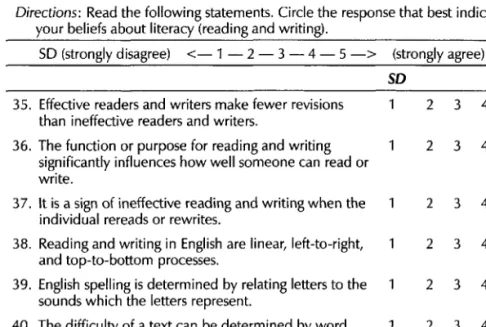
Before reading on, it might be helpful to first consider your current beliefs about literacy. Table 1.1 contains a literacy beliefs profile, a questionnaire that is intended to help you reflect on your current conceptions of reading and writing. I am grateful to DeFord (1985) for her early efforts at developing such profiles to examine instructional beliefs for the teaching of reading. Take a few minutes to consider each question, and mark the extent to which you agree or disagree with the assertion.
If you are unsure of some of your beliefs, you can always mark number three.
If possible, after you complete the profile, compare, contrast, and discuss your beliefs with others who are also reading this book. After the book has been read, you will be asked to return to the beliefs profile and mark your answers a second time. Then compare and contrast your two sets of answers and examine how your views have or have not changed.
A LITERACY STORY
A literacy story is a true event that demonstrates how literacy operates in the real world. As defined by Heath (1982a), a literacy event is "any action sequence involving one or more persons, in which the production and/or comprehension
Directions: Read the following statements. Circle the response that best indicates your beliefs about literacy (reading and writing).
SD (strongly disagree) < — 1 — 2 — 3 — 4 — 5 — > (strongly agree) SA
1.
2.
3.
4.
5.
6.
7.
8.
9.
10.
11.
12.
13.
14.
15.
Being labeled as a "proficient" reader and writer is a subjective process.
Becoming literate may have a negative impact on the individual's sociocultural identity.
The perception of individual letters within words is a significant part of reading and writing.
Reading and writing are developed from the part to the whole: letters — > words — > sentences — >
paragraphs — > stories.
A major difference between effective and ineffective readers and writers is that effective readers and writers make fewer mistakes.
The development and use of literacy is influenced as much by sociocultural demands as by the schools.
Reading and writing can be mastered and perfected.
There is a positive relationship between being literate and an individual'ssocioeconomic development and/or status.
Effective readers and writers initially focus on the overall meaning of what they are reading and writing rather than on correct word identification, spelling, punctuation, capitalization, and individual facts and details.
English spelling reflects the meanings of words.
What it means to be literate varies from group to group and from era to era.
Children learn literacy more quickly when their errors or mistakes are corrected.
Comprehension involves getting the author's intended meanings from the print.
A lack of print in the home is a significant reason why children have difficulty learning to read and write in school.
Writing is speech written down; reading is translating print to speech.
SD SA 1
1 1 1
1
1 1 1
1
1 1 1 1 1
1 2 2 2 2
2
2 2 2
2
2 2 2 2 2
2 3 3 3 3
3
3 3 3
3
3 3 3 3 3
3 4 4 4 4
4
4 4 4
4
4 4 4 4 4
4 5 5 5 5
5
5 5 5
5
5 5 5 5 5
5
8
17. The use of letter and sound relationships (phonics) isa 1 2 3 4 5 significant part of reading and writing.
18. Literacy is learned through imitation, practice, and 1 2 3 4 5 mastery.
19. Writing is a process of first "thinking it" and then 1 2 3 4 5
"saying it"; reading is a process of first "saying it" and then "thinking it."
20. Learning to read and write ensures a more equitable 1 2 3 4 5 and just society.
21. What a text "means" is significantly influenced and at 1 2 3 4 5 times controlled by those in positions of power and
influence.
22. Texts have meaning in and of themselves. 1 2 3 4 5 23. Speaking a dialect can cause problems when learning 1 2 3 4 5
to read and write.
24. Becoming literate significantly changes the individual's 1 2 3 4 5 intellectual capacities.
25. Individuals who are literate are likely to be more 1 2 3 4 5 ethical and moral.
26. Reading and writing involve making "guesses." 1 2 3 4 5 28. It is possible to accurately determine a person's 1 2 3 4 5
reading and writing "grade level."
27. The culture of the poor is a significant reason why 1 2 3 4 5 some children have difficulty learning to read and
write in school.
28. All texts, even fictional stories, reflect particular beliefs 1 2 3 4 5 or ideologies.
29. It is usually best to slow down when encountering 1 2 3 4 5 problems during reading and writing.
30. Being bilingual frequently causes difficulty when 1 2 3 4 5 learning to read and write in English.
31. Being a good speller is positively related to being a 1 2 3 4 5 good reader and writer.
32. Comprehension or understanding is relative. 1 2 3 4 5 33. Learning and knowing how to read and write in one 1 2 3 4 5
context, such as in the home or in the
church/mosque/synagogue/temple, supports learning and knowing how to read and write in school.
34. Everyone speaks a dialect. 1 2 3 4 5 (continued on next page)
9
TABLE 1.1 (continued)
Directions: Read the following statements. Circle the response that best indicates your beliefs about literacy (reading and writing).
SD (strongly disagree) < — 1 — 2 — 3 — 4 — 5 — > (strongly agree) SA SD SA 35.
36.
37.
38.
39.
40.
Effective readers and writers make fewer revisions than ineffective readers and writers.
The function or purpose for reading and writing significantly influences how well someone can read or write.
It is a sign of ineffective reading and writing when the individual rereads or rewrites.
Reading and writing in English are linear, left-to-right, and top-to-bottom processes.
English spelling is determined by relating letters to the sounds which the letters represent.
The difficulty of a text can be determined by word length, word difficulty, sentence length, and number of words and sentences in the text.
1 1
1 1 1 1
2 3 4 5 2 3 4 5
2 3 4 5 2 3 4 5 2 3 4 5 2 3 4 5
of print plays a role" (p. 92). As has been illustrated, acts of literacy involve various dimensions: linguistic, cognitive, sociocultural, and developmental. These four dimensions are represented in the language story found in Table 1.2. The power of such stories is that they help those of us interested in literacy education to keep our focus on the use of literacy in authentic contexts. In a sense, they help us avoid reductionistic, single-discipline-based understandings of reading and writing.
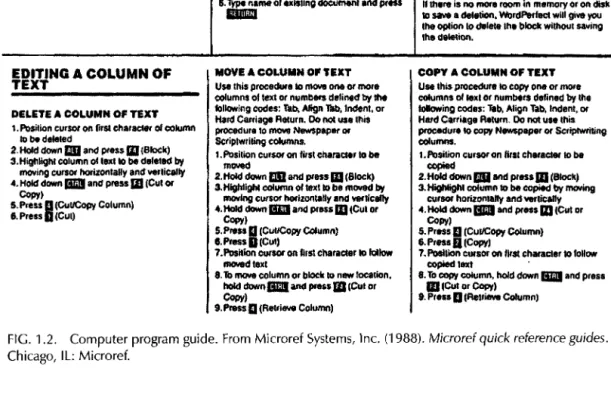
The story presented in Table 1.2 concerns an initial encounter with a computer program guide that was being used to learn a new software program. Figure 1.2 contains a portion of the guide on which the story is based. This literacy story is used throughout the book to highlight the multidimensional nature of literacy. After each dimension has been discussed, the story will be analyzed from that particular dimension. In chapter 12, the story is revisited and the various dimensions are summarized and synthesized.
ABOUT THIS BOOK
This book grew out of a concern that literacy is too often viewed in reductionistic ways. One dimension, such as linguistic, or even a particular feature of a dimension, such as graphophonemics within the linguistic dimension, is highlighted and used
Many years ago, when I first began using IBM's personal computer software program WordPerfect to write academic papers, I purchased a copy of Microref Quick Reference Guide (Microref Systems, 1988). Although I had no experience with WordPerfect and limited experience with computer reference guides, I did have knowledge of other IBM software programs and had been using an IBM personal computer for several years. I therefore had a basic notion of how WordPerfect might work and was able to make sense from some of the print based on this background knowledge.
At this point in the story, I must confess that I disdain reading and following directions. I avoid such contexts when possible. When avoidance is not an option, I will usually attempt to discover what needs to be done on my own, ignoring the directions or using them selectively. Or, if I can get a family member or friend to help me, I will do so. On the other hand, I tend to prefer learning in context. In this case, I wanted to learn the software program as I used it to write a paper. The purpose or function drove my engagement with the program.
As I read through the guide and attempted to use different aspects of the program to write a paper, I engaged in numerous revision (rethinking/rereading)strategies.
However, there were numerous points in the Reference Guide that puzzled or confused me and I found rereading and rethinking to be of little help. Basically, I was unable to "read" the text.
To overcome this problem, I frequently called a professor at another university who was familiar with the program. This colleague "talked me through" certain points in the guide, explained areas of confusion, and suggested possible solutions to problems that I encountered. At times, she ignored the guide altogether and directed me to execute certain commands based on her personal knowledge of and experience with the program. As I began to learn the program, myquestions changed and became more sophisticated as I moved beyond "plugging and chugging" to more advanced executions. Over time, with numerous experiences using WordPerfect to write academic papers, and with help from my colleague, I eventually became an independent user of both the Guide and the software program.
to define reading or writing. Such a reductionistic stance is especially damaging to elementary teachers and their students. All too often, the view finds its way into the classroom and is used to frame instructional materials, privileging particular aspects of literacy and ignoring others. This is especially true in today's educational climate where the federal government, through the No Child Left Behind legislation (United States Department of Education, 2001), is funding reading programs that are limited in their instructional scope. However, as Young (1992) reminded us in Seven Blind Mice, "Knowing in part may make a fine tale, but wisdom comes from seeing the whole."
My initial attempt to move beyond the telling of a fine tale was to develop and teach both an undergraduate and a graduate course on the multidimensional nature
TABLE 1.2 A Literacy Story
SAVE A BLOCK OF TEXT AS A DOCUMENT
1. Position cursor at beginning or end of text to be sawed as a document
2. Hold down QQ and press Q| (Block) 3. Highlight block of text to be saved 4. Press BE) (Save)
5. Type a new document name and press
|p>PftgJ
APPEND A BLOCK OP TEXT Use this procedure to copy text to the end of an existing document.
1. Position cursor at beginning or end of text to be appended
2. Hold down QQ and press Q (Block) 3. Highlight block ol text to be appended 4. Hold down QQ| and press Q| (Cut or
Copy)
5. Press {f (Append)
6. Type name of existing document and press Hfl{ff:1||
DELETE A BLOCK OF TEXT 1. Position cursor at beginning or end of text
to be deleted
2. Hold down QQ and press Q (Block) 3. Highlight block of text to be deleted 4. Press EJI
5. To delete text, press Q (Yes) NOTES:
WordPerfect saves up to three deletions so that you can undelete text (Q) if desired.
If there is no more room in memory or on disk to save a deletion, WordPerfect will give you the option to delete the block without saving the deletion.
EDITING A COLUMN OF TEXT
DELETE A COLUMN OF TEXT 1. Position cursor on first character of column
to be deleted
2. Hold down QQ and press (JQ (Block) 3.Highlight column of text to be deleted by
moving cursor horizontally and vertically 4. Hold down fiERI and press Q (Cut or
Copy)
5. Press Q (Cut/Copy Column) 6. PressQ (Cut)
MOVE A COLUMN OF TEXT Use this procedure to move one or more columns of text or numbers defined by the following codes: lab, Align Tab, Indent, or Hard Carriage Return. Do not use this procedure to move Newspaper or Scriptwriting columns.
1.Position cursor on first character to be moved
2.Hold down QQ andpress Q| (Block) 3. Highlight column of text to be moved by
moving cursor horizontally and vertically 4. Hold down QQ| and press fflj (Cut or
Copy)
5.Press Q (Cut/Copy Column) 6.Press Q (Cut)
7. Position cursor on first character to follow moved text
8.To move column or block to new location.
hold down jpEM and press JQ (Cut or Copy)
9. Press Q (Retrieve Column)
COPY A COLUMN OF TEXT Use this procedure to copy one or more columns of text or numbers defined by the following codes: Tab, Align Tab, Indent, or Hard Carriage Return. Do not use this procedure to copy Newspaper or Scriptwriting columns.
1. Position cursor on first character to be copied
2. Hold down QQ and press Q (Block) 3. Highlight column to be copied by moving
cursor horizontally and vertically 4. Hold down QQ| and press QJ (Cut or
Copy)
5. Press Q (Cut/Copy Column) 6- Press Q (Copy)
7. Position cursor on first character to follow copied text
8. To copy column, hold down IST-fl and press d (Cut or Copy)
9. Press Q (Retrieve Column)
FIG. 1.2. Computer program guide. From Microref Systems, Inc. (1988). Microref quick reference guides.
Chicago, IL: Microref.
of literacy. A variety of students enrolled in the course, but many, if not most, planned to become or were elementary teachers. The response to the course was so positive and the insights gained by the students so significant that I decided a more formal presentation of the course content was warranted. Thus, the genesis of the book and its primary audience: those individuals who will become or currently are involved in literacy teaching and learning with children. The book is intended to provide these readers with conceptual knowledge about the nature of reading and writing that can serve as a base for written language instruction. Although the book is focused primarily on English literacy, research on biliteracy—reading and writing in two languages—is included. The increasing linguistic diversity in the United States has made this research all the more critical. Regardless of where one teaches, bilingual learners are sitting in our classrooms.
In writing this book, I have tried to be cognizant of the fact that most readers are not—nor will they become—linguists, psychologists, cultural theorists, or the like. I have attempted, therefore, to keep discussions on a level that will be useful to readers as they develop, implement, and evaluate literacy curricula and instruction for the students they teach. General understandings about literacy are presented, accompanied by specific examples for illustrative purposes. On the other hand, I have also attempted to be respectful of the knowledge and expertise that teachers bring to their craft and to their reading of this book, so I have tried to avoid oversimplifying complex issues or controversies in the field.
Despite the tremendous gains that have been made in our understanding of literacy during the last several decades, debate about the very nature of literacy continues. I am not neutral in this debate; in fact, I believe that neutrality is neither desirable nor possible. Therefore, my analysis and discussion of literacy reflect a particular vantage point that has emerged from researchers studying literacy within contextualized situations. Like Young (1992), I believe that various literacy "parts"
can only be fully understood when they are considered within the whole. When there is disagreement in the field about a particular issue, however, I acknowledge this fact and provide a general sense of alternative perspectives.
Throughout the book, I include numerous demonstrations and "hands-on" expe- riences through which particular literacy concepts are introduced. Debriefings and more formal discussions of the concepts under consideration follow the demonstra- tions and hands-on experiences. Initially, most of the activities were developed for my interdisciplinary university courses. I have found that these experiences provide an avenue through which current beliefs about literacy can be suspended and ex- amined, thus allowing for new insights that might contradict currently held views.
The remainder of the book is organized around the four dimensions of liter- acy previously introduced. So as to not isolate each dimension from the other, and fall into the same trap as disciplinary perspectives, throughout the discussion of each dimension, links are made to the previous dimensions addressed. Within the linguistic dimension, chapter 2 focuses on the nature of language, chapter 3 addresses oral and written language relationships, and chapter 4 discusses language
variation. Chapters 5, 6, 7, and 8 explore the cognitive dimension of literacy, re- spectively, the constructive characteristics of perception, reading, comprehending, and writing. The sociocultural dimension of literacy is represented in chapters 9 and 10. Finally, the developmental dimension, which considers the learning of literacy and the various factors that impact the process, is discussed in chapter 11.
Because the primary audience of the book is classroom teachers, chapter 12 ad- dresses the teaching and learning implications that emerge from an understanding of the multidimensional nature of reading and writing.
The Linguistic Dimension
of Literacy
2
The Nature of Language
Language is the vehicle or avenue through which ideas are constructed during reading and writing. Because the use of language for the generation of ideas is so deeply embedded in our everyday activities, we seldom consider the nature of language itself. We often fail to ponder the internal characteristics of written language and what must be known about these characteristics for the effective and efficient use of language to occur. However, although we may be unaware of its attributes on a conscious, explicit level, our implicit (unconscious) knowledge of language is employed every time we make meaning through print. The focus in this chapter is on the properties of language that are understood and used (at least on the implicit level) by the proficient language user when creating meaning through written discourse. Or, stated somewhat differently, what must readers and writers know about language that allows them to "crack the code" as they transact with written discourse?
Two aspects of literacy as a language process are considered. The first is the internal, physical properties of written language. Second, the impact of the situa- tional context on the language user's understanding of these physical properties is demonstrated.
WHAT MAKES LANGUAGE LANGUAGE?
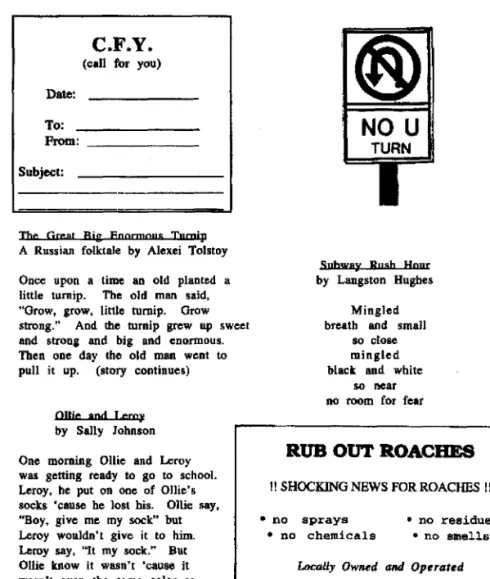
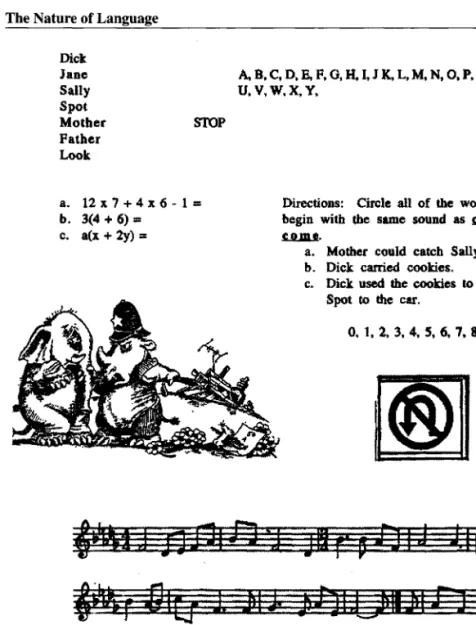
The linguistic dimension of language is concerned with the analysis of text as an object of study. Just as a connoisseur of fine arts might analyze the internal proper- ties of a painting or musical score, a linguist focuses on the various physical properties of language itself. To be fully understood, not only must these vari- ous properties be identified and defined, but also the relation of each property to all of the others must be explained. However, before the properties of language are explored, let us take a few minutes to analyze the linguistic texts (language events) and nonlinguistictexts (nonlanguage events) illustrated in Figs. 2.1 and 2.2.
17
Date:
To:
From:
Subject:
C.F.Y.
(call for you)
The Great Rio Fnormous Turnip A Russian folktale by Alexei Tolstoy Once upon a time an old planted a little turnip. The old man said,
"Grow, grow, little turnip. Grow strong." And the turnip grew up sweet and strong and big and enormous.
Then one day the old man went to pull it up. (story continues)
Qllie and L.eroy by Sally Johnson
Subway Rush Hour by Langston Hughes
Mingled breath and small
so close mingled black and white
so near no room for fear
One morning Ollie and Leroy was getting ready to go to school.
Leroy, he put on one of Ollie's socks 'cause he lost his. Ollie say,
"Boy, give me my sock" but Leroy wouldn't give it to him.
Leroy say, "It my sock," But Ollie know it wasn't 'cause it wasn't even the same color as Leroy. (story continues)
RUB OUT ROACHES
1! SHOCKING NEWS FOR ROACHES !!
* no sprays
• no chemicals
• no residues
• no smells Locally Owned and Operated
1-888-999-9999
FIG. 2.1. Language events. The poem, "Subway Rush Hour" is from Collected Poems by Langston Hughes. Copyright © 1994 by the Estate of Langston Hughes. Reprinted by permission of Alfred A. Knopf, a Division of Random House Inc.British Commonwealth rights granted by Harold Ober Associates.
As you examine these examples, consider which features are present across all the language events. At the same time, consider which of these identified features are missing in the nonlanguage events.
First and foremost, language is a meaning-based system of communication. Its use involves a language user with intentions to construct meaning that ultimately is made visible through the linguistic system. Meaning is at the heart of language and its use. This characteristic, although necessary, is not sufficient for defining what
Dick Jane Sally Spot Mother Father Look
A,B,C,D,E,F,G,H,I,JK,L,M,N,O,P,Q,R,S,T, U,V,W,X,Y,
STOP
a. 12x7 + 4 x 6 - 1 = b. 3(4 + 6) =
c. a(x + 2y) =
Directions: Circle all of the words that begin with the same sound as can and come
a. Mother could catch Sally.
b. Dick carried cookies, c. Dick used the cookies to call
Spot to the car.
0, 1, 2, 3, 4, 5, 6, 7, 8, 9
FIG. 2.2. Nonlanguage events. From AH-CHOO by Mercer Mayer (1976).
Copyright © Mercer Mayer. Used by permission of Dial Books for Young Readers, a division of Penguin Putnam Inc.
is and is not language. Artists, mathematicians, musicians, and dancers would all claim to be involved in meaning making.
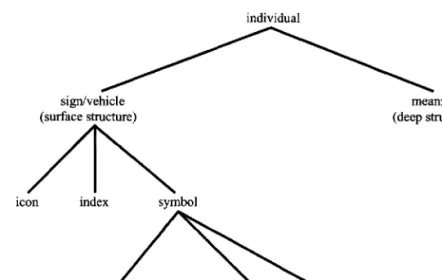
A second aspect of language as a meaning-making system is that it has a dual structure. Language operates on two levels, surface and deep. Semioticians, individuals who study how meaning is generated and shared, have proposed that all meaning making involves the use of signs. Signs are the physical vehicles (e.g., sight, touch, hearing, smell) through which meanings are expressed. A sign, therefore, is something that stands for something else (Smagorinsky, 2001). This relation between the vehicle and its meaning is often referred to as the relation between the surface structure and the deep structure (Smith, 1994a, 2004). As
FIG. 2.3. Signs and their various expressions.
indicated in Fig. 2.3, the surface structure is another name for the physical vehicle through which meaning is conveyed. The surface structure is that aspect that can be seen, felt, heard, or smelled. The deep structure is the meaning that the vehicle is representing. The construction of meaning involves, among other things, the building of links between the surface structure and a corresponding deep structure.
Three types of signs have been identified. The first is iconic. Icons are signs in which the physical property of the surface structure resembles the meaning being conveyed. Illustrations and pictures are typically iconic in nature. They look like that for which they stand. For example, a photograph of a clock is iconic because many of its physical properties—shape, numerals, and hands—are similar to those of an actual clock. In fact, the similarity between some icons and what they represent is so strong that when shown a photograph of a clock and asked to identify what it is, most of us would quickly say, "clock," even though on a subconscious level we realize that what we are viewing is not actually a clock. Rather, it is an iconic representation of a clock. Language is not iconic because there is nothing in its nature, such as the way a word looks or sounds, that resembles what it is representing. The physical aspects—sound or visual configuration—of the word clock are unrelated to the physical characteristics of the clock on a kitchen wall.
A second kind of sign is indexical. An index is a sign that points to what is being represented. It contains physical aspects that are related to the conveyed concept. A ticking sound might be an index pointing to a clock because many clocks emit that sound. Smoke coming out of a kitchen window might be an index that points to a fire, because "where there is smoke, there is fire." Physicians make frequent use of indexical signs as they attempt to discover to what bacteria or virus a fever, rash, or headache might point. Forensic science makes use of indexical signs to determine who may have been involved in a crime to which there were no
witnesses. Although an index does not physically resemble the meaning for which it stands, as does an icon, the properties of an index are related to the properties of the meaning being represented. Again, language is not indexical because there is nothing in its physical nature that indicates what it means.
The third kind of sign is symbolic; language is a symbolic sign system. A sym- bol is an arbitrary yet systematic correspondence between the symbol's physical properties and what it represents. There is no inherent reason why the spoken word /clock/ or the written word <clock> represents an instrument that keeps track of time. (When referring to sound categories in the language, the category is desig- nated with the // marking; when referring to letter categories, the < > designation is used.) This fact is easily demonstrated by the various ways in which the concept of a clock are represented in different languages. However, although arbitrary, the rela- tion is systematic. All language users within a particular discourse communitymust agree to accept—if only for a limited period of time or within particular contexts—
the relation between the surface and deep structure once it has been established.
Language is also a rule-governed, creative, and generative system. Most in- stances of language use are unique;they do not represent a limited list of memorized words or sentences that are used over and over again in different combinations.
Rather, through the use of rule-governed or systematic combinations, a limited number of elements—such as the 26 letters of the English alphabet or a finite number of grammatical rules—generate an infinite number of ideas and ways to ex- press them. For the most part, knowledge of these rules is implicit (not conscious);
the users of language cannot necessarily explain them or their operation even though they use them. As many teachers can attest, it is not an uncommon ex- perience for high school or college students to have difficulty learning traditional English grammar (explicit knowledge) and yet at the same time demonstrate their implicit understandingof English syntax in their writings.Decades of research have documented this as well (e.g., Hillocks, 1986; Hillocks & Smith, 2003; Weaver, 1998). It is through the knowledge and use of these various rule-governed systems that texts are generated.
The outcome of any literacy event is typically the construction of a "text"; that is, a meaningful unit of language that is intended to communicate (de Beaugrande, 1980). Gee (1996) has defined "discourse" in a similar way: "Connected stretches of language which hang together so as to make sense to some community of people"
(p. 90). It is important to note at this point that texts may also be nonlinguistic and nonsymbolic in nature. Paintings, photographs, buildings, and flags can all be texts or "configurations of signs that provide a potential for meaning" (Smagorinsky, 2001, p. 137). Even more importantly for our purposes, many texts are multimodal;
they contain linguistic as well as nonlinguistic signs. The use of pictures, tables, figures, color, various font sizes and shapes are frequently part of what makes a text a text (Waller, 1996).
The multimodality of texts has been considerably enhanced with the advent of computer technology. The use of sound and video, along with the embedding of hypertexts, expands the notion of what texts are traditionally thought to be. As we
Any size unit of language that forms a unified whole. To be unified, the text must be coherent externally and internally. External coherence refers to the relationship between the text and the context of situation. A text must be relevant within a particular environment. To be internally coherent, all systems
of language must be present or implied and working together.
Magazine articles, letters, stories, traffic signs, newspaper articles, advertisements, poems, novels, e-mails, shopping lists
shall see in the cognitive dimension of literacy, multimodality and hypertext com- puter capabilities also challenge the linear, right-to-left and top-down processing that was the norm for most written texts (Kinzer & Leander, 2003; Lankshear &
Knobel, 2002; Leu, 2000; Wysocki, 2004).
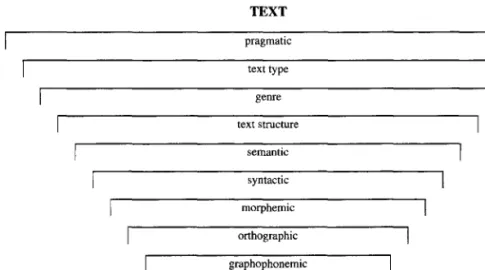
As indicated in Table 2.1, according to Halliday (1973, 1974) and Halliday and Hasan (1976, 1980), a text is a linguistic unit of any size that forms a unified whole. To be unified, a text must display both external and internal coherence. To be externally coherent, a text must be situated in an appropriate context; it must be relevant to its location. A traffic sign at an intersection, a menu in a restaurant, and a children's book in a library would all be examples of a text, a linguistic unit embedded in a plausible environment.
To be internally coherent, a text must reflect, either implicitly or explicitly, the systems of language shown in Tables 2.2 to 2.15 and these systems must be working together. Even seemingly isolated words as those found on traffic signs, such as
<STOP> or <YIELD>, in fact, have an implied linguistic wholeness based on the situation in which they are encountered. The command <STOP> means, "You, the driver, halt your vehicle at this point. Do not proceed until it is your turn and then look both ways before moving forward." The command <YIELD> tells the driver of the vehicle, "Be careful; the oncoming traffic has the right of way. Proceed with caution." Words on shopping lists represent a similar kind of situation.
It is these various systems—what K. Goodman (1996) termed cue systems—
that readers and writers employ when interacting with written language to build meaning. Readers, or code breakers, use the cues as a blueprint or guide to construct meaning as they transact with a text. Writers, or code makers, use the cues to express the meanings they are generating. Because the systems of language are such a significant part of what makes language language—and oftentimes the prime focus of literacy instruction—a separate section in this chapter is devoted to them.
THE SYSTEMS OF LANGUAGE
The systems of language in Tables 2.2 to 2.15 represent a synthesis of ideas taken from a variety of sources that are referenced throughout the next portion of this
TABLE 2.1
Text and the Systems of Language
chapter. The tables summarize the ideas to be presented, provide examples, and serve as reference points for future use. My intent here is to provide a general overview of what readers and writers know and utilize as they interact with print.
No attempt has been made to make the synthesis exhaustive; nor are claims made that the various definitions presented are universally accepted by all linguists. In fact, there is a lack of consensus as to the exact nature of the systems of language and the rules that govern their operation (e.g., Graessner, Golding, & Long, 1996;
Weaver & Kintsch, 1996). Although one goal of linguists is to delineate necessary and sufficient conditions for the systems that make language language, linguists readily admit that they have yet to generate all of the rules that govern these systems.
Finally, although readers and writers utilize their knowledge of the systems of language to construct text, this is not to say that all systems are equally controlled by all readers and writers in all situations. Based on experiences—or lack thereof—in various communicative contexts, particular systems may be more or less controlled than others.
Pragmatic
The pragmatic system expresses the various functions, uses, and intentions that the language can serve. It governs what forms of language are appropriate in particular contexts. Just as furniture has various functions—to sit or lie on, to eat or write on, to place items in—language also serves various purposes. Proficient readers and writers have implicit knowledge of these functions and when and how to employ them in appropriate ways in particular contexts. All other systems of language are embedded within, and governed by, the pragmatics of the situation, the most powerful system. The purpose underlying the use of literacy will influence the type of text read or written, the structure of the text, its genre, the meaning and the structure of the sentences within the text, the words selected, and so on.
Teachers, because they play a significant role in structuring the context in which their students read and write, have a significant impact on the pragmatics of the situation (Kucer, 1994). When I was a junior in high school, for example, one of my favorite English teachers required her students to write in a journal on a regular basis. In evaluating our journals, she gave us two grades, one for content and one for form. Although every journal entry was evaluated for content, only particular entries received a grade for such written language conventions as spelling and punctuation. Additionally, the teacher would inform us ahead of time when an entry was to receive a form grade. I had little difficulty with content, but I was not a very proficient speller. Consequently, my form grades were rather low due to all of the "unconventional" spellings.
My response to this problem was not to become a better speller, as I am sure my teacher intended. Rather, on those days in which our entries were to be evaluated for form, I focused little attention on the content of my writing. I would select a topic that would allow me to use words that I was fairly certain I could spell
TABLE 2.2
The Pragmatic System of Language
The functions, uses, and intentions of the language user as they relate to particular contexts.
Instrumental (I want)
Literacy used as a means of getting things; satisfying material needs.
Regulatory
(Do as I tell you/How it must be)
Literacy used to control the behaviors, feelings, or attitudes of others.
Interactional (Me and you/Me against you)
Literacy used to interact with others; forming and maintaining personal relationships; establishing separateness.
Personal (Here I come)
Literacy used to express individuality and uniqueness; awareness of self; pride.
Heuristic (Tell me why)
Literacy used to explore the environment; to ask questions; to seek and test knowledge.
Imaginative (Let's pretend)
Literacy used to create new worlds.
Informative
(I'vegot something to tell you)
Literacy used as a means of communicating information to someone who does not possess that information.
conventionally. If, in the process of writing, I came to a word I was unable to spell, I changed the word to one I knew how to spell, regardless of the impact on my intentions and meanings. Although these entries were rather trite in content and stilted in form, I was able to raise my grade for written language conventions.
A number of researchers have delineated various taxonomies for the functions that language can serve (K. Goodman, 1996; Halliday, 1973; Heath, 1983; Smith, 1977; Taylor & Dorsey-Gaines, 1988). Halliday's list of functions has perhaps received the most attention and is presented in Table 2.2. Regardless of which scheme is employed to describe the uses of language, what is significant is that readers and writers have an understanding of the various functions of language and the rules for their appropriate use.
Halliday (1973) proposed that the text evolved during a language event always fulfills at least one of seven functions, although in many cases multiple purposes are served. Again, because it is the language user who must link the surface structure
with the deep structure, the understood function(s) of a particular text may vary from individual to individual and from situation to situation.
The instrumental, or "I want," function is the use of literacy to obtain things, to satisfy material needs. Language serves this function when we fill out an order form or make a shopping list before we go to the grocery store. It is the language of requests or demands. The regulatory, or "do as I tell you/how it must be," function is the use of literacy to control the behavior, feelings, or attitudes of others. A note to one's daughter to clean her room, laws passed by the U.S. Congress to govern human behavior, and traffic signs are examples of using literacy in a regulatory manner. Literacy used to interact with others, to form, maintain, and dissolve personal relationships, represents the interactional, or "me and you/me against you," function of language. Letters or e-mails to friends and family, many greeting cards, letters to Dear Abby or Ann Landers, and postcards sent while on vacation can be interactional in nature.
The personal, or "here I come," function is the use of literacy to express individ- uality or the sense of self. Autobiographies, journals, and diaries frequently express the personal function of language. The heuristic, or "tell me why," function is the use of literacy to explore the environment and world. It involves asking questions and seeking and testing knowledge. Scientists and other types of researchers often make use of this function through surveys, interviews, and the like. In contrast, the use of reading and writing to create new worlds and to leave the here and now is the imaginative, or "let's pretend," function. Reading for enjoyment and the writing of creative stories or poems are examples of the imaginative use of literacy.
The final function of language is the informative, the "I've got something to tell you" function. It is the use of literacy to communicate or discoverinformation that is not already known. The literacy used in schools most often reflects the informative function. However, because the effective and efficient use of literacy involves the use of print for various purposes and functions, it is critical that schools provide students with a range of literacy activities so they have the opportunity to develop proficiency with all of these functions. In the final chapter, we will examine various instructional strategies (see Table 12.5) that classroom teachers might use to engage their students in the various functions that written language can serve.
As previously noted, texts can express or serve multiple functions. This mul- tiplicity can be represented in a number of ways. In one of the more well-known examples, the book Alice in Wonderland by Lewis Carroll (1988), was explicitly written by the author for at least two reasons. One fulfills the imaginative function:
the reader enters a fantasy world as the adventures of Alice are played out. On another level, the text serves as a critique of British society and royalty, Queen Victoria in particular. Carroll essentially used an imaginative function as a "cover"
for informative purposes. This is not to imply, of course, that readers are necessar- ily aware of these multiple functions. It is probably the case that many readers of Alice in Wonderland, young or old, understand the text to be a fantasy.
A second way in which the multiplicity of functions is realized relates to the concept of stance. Stance represents the purpose that the language user brings to the discourse. Just as Carroll brought at least two stances to his writing of Alice in Wonderland—to tell an engaging story and to critique society—the reader brings a stance as well. This stance may or may not correspond with that of the author. The writers of weekly news magazines such as Newsweek or Time probably intend their discourse to serve informative and heuristic purposes. Readers can encounter unknown information about world and national events and also have their questions answered. However, "news junkies" also read such magazines for enjoyment and pleasure. Although not imaginative in the Alice in Wonderland sense, their enjoyment does take them away from the here and now. In this case, the stance of the writer and the stance of the reader may not be in complete alignment.
The various functions that te