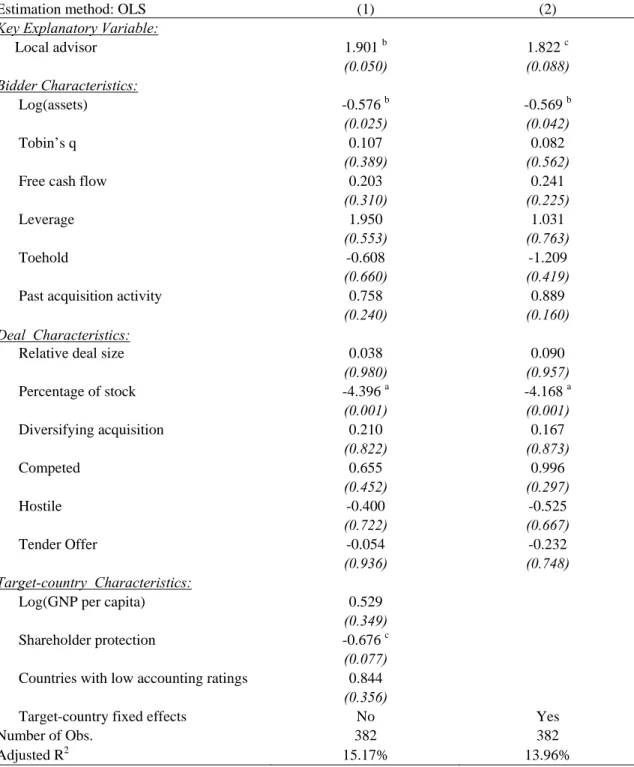
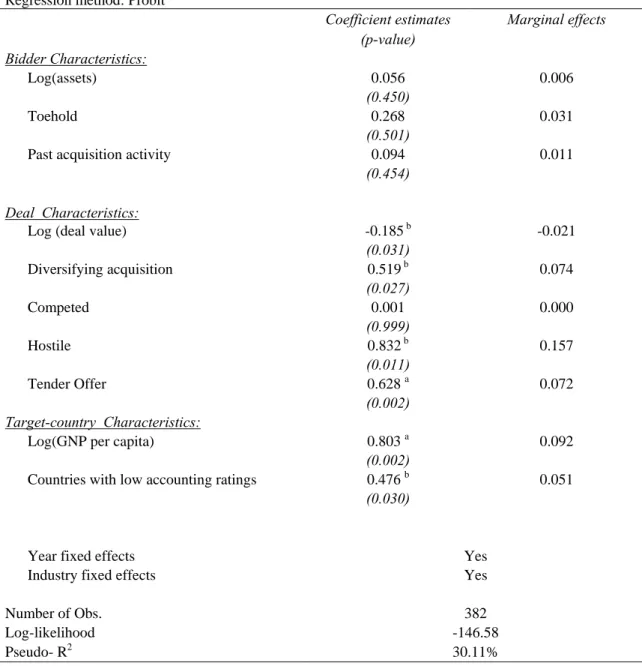
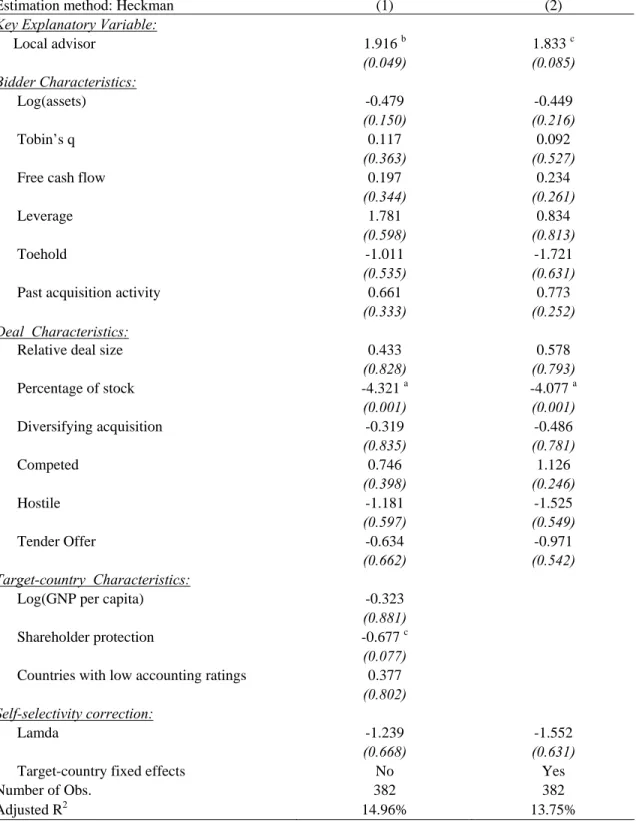
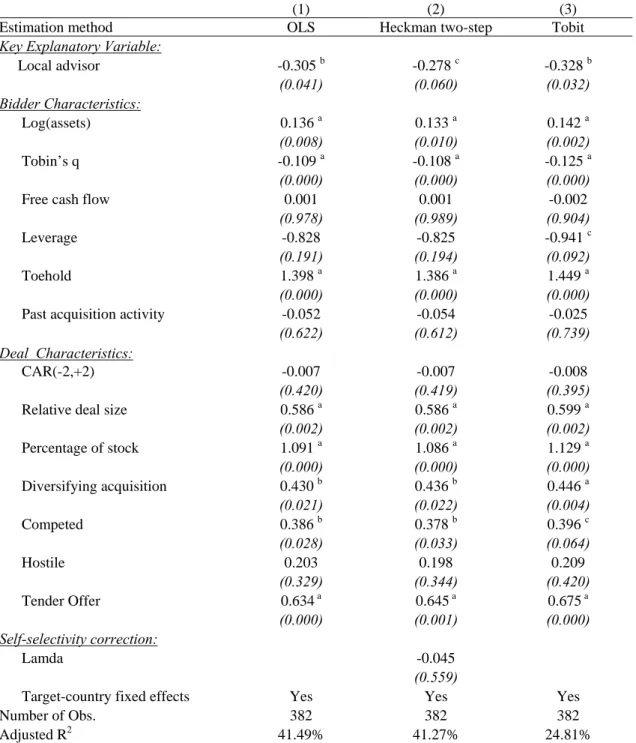
All this can increase the level of asymmetric information about the value of the target assets. They document a 'local bias' in mutual fund investment portfolios and higher returns on local investments. Local advisors are financial advisors of providers located in the same countries as the target companies.
Empirical results
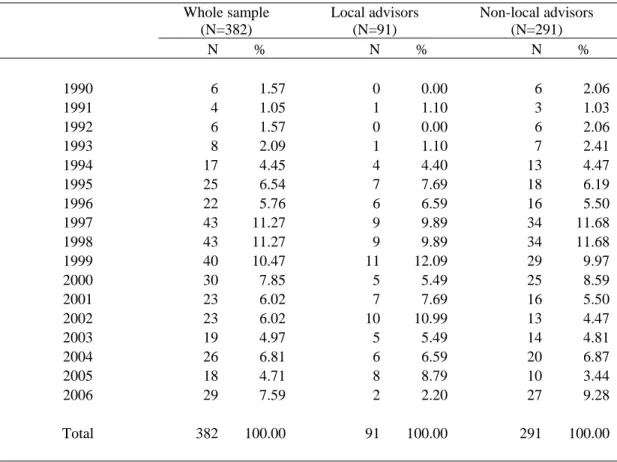
It is well known that bidders experience significantly negative abnormal returns when they pay for their acquisitions with equity, and this is generally attributed to the adverse selection problem in equity issuance analyzed by Myers and Majluf (1984).3 We control for the mode of payment per including the percentage of the offeror's inventory used in the transaction. Among the target country characteristics included in the first column, we find that the abnormal return of US GDP per per capita can represent the capital market development in the target country.
Conclusion
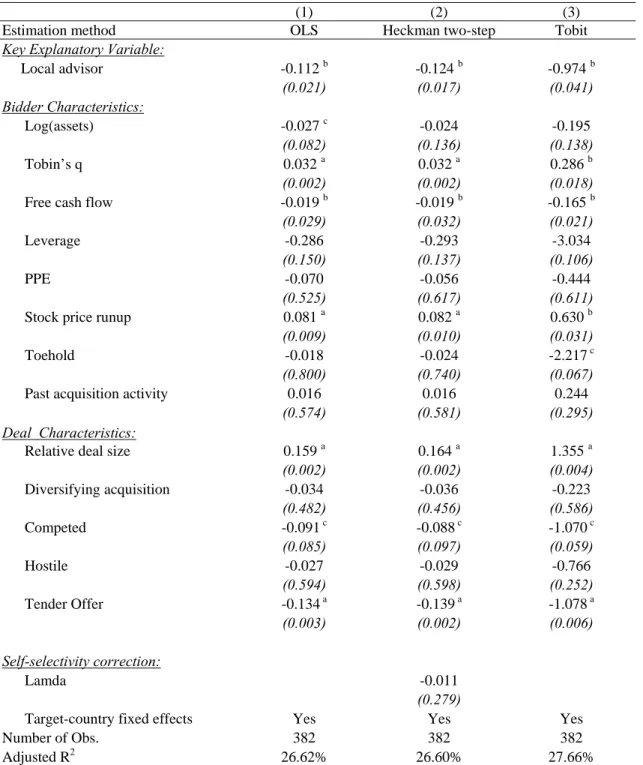
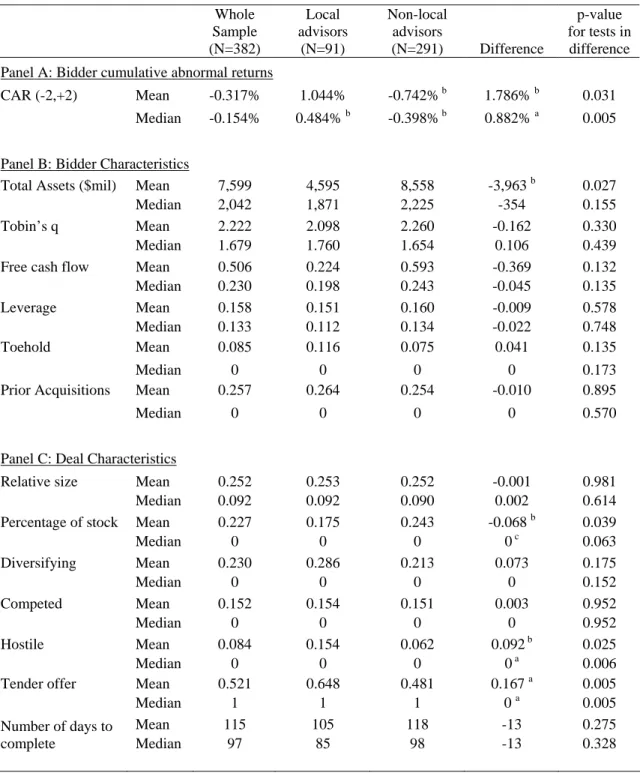
Finally, we find that larger buyers, firms with higher Tobin's q, and firms with higher supports tend to take longer to complete transactions. Finally, we document that acquirers with local advisors close deals faster than other acquirers.
Variable Definitions
Synergistic gains from corporate acquisitions and their distribution between the shareholders of target and acquiring firms. Local does as local is: Information content of the geography of individual investors Common stock investments.
ARE FOREIGN DIRECTORS EFFECTIVE MONITORS?
Introduction
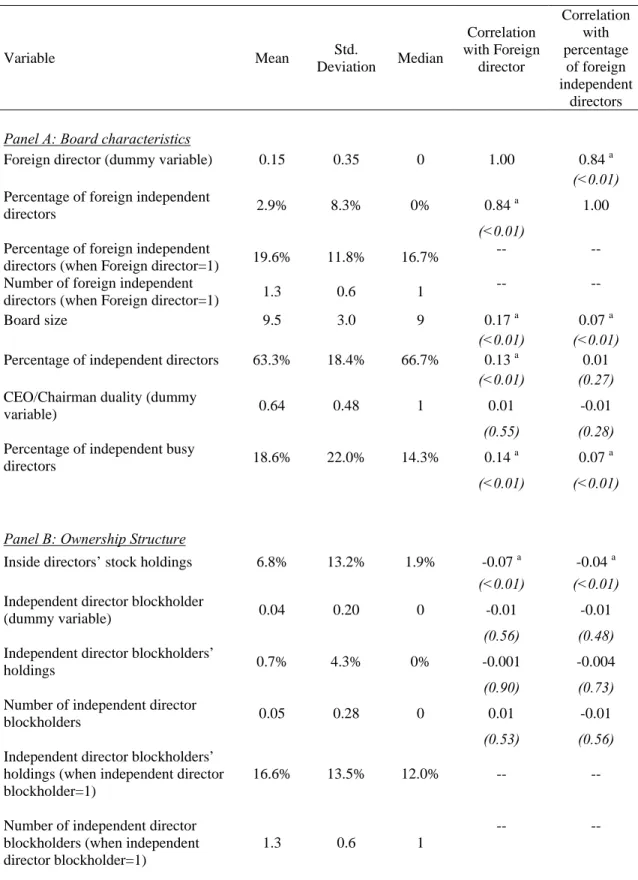
Boards with foreign directors have on average one fifth of their independent directors from abroad, representing 13% of all board members. This is not an insignificant percentage given that on average independent directors represent only 63% of board members. Thus, if foreign independent directors are less effective than their local counterparts, the average proportion of active independent directors who can closely monitor management on behalf of shareholders drops from 63% to 50%.
In the baseline test, we estimate a fixed effects regression of firm value at the firm level to the extent that foreign independent directors are on the board. The results show that firms with foreign independent directors have lower firm value relative to Tobin's Q. Since on average 20% of firms' independent directors are busy directors, combined with foreign independent directors, the proportion of active independent directors is able to closely monitor management drops to significantly below 50%.
To investigate this possibility, we focus on the appointment of new independent directors and examine whether prior poor performance leads to the appointment of foreign independent directors. In our second test, we investigate how attendance records of foreign independent directors at board meetings differ from those of domestic independent directors. Finally, we examine whether firms with foreign independent directors are more likely to misreport their earnings.
The results show that firms with independent foreign directors are more likely to misreport income, and especially when they are part of audit committees, where they are unlikely to make a serious contribution to the oversight of financial accounting reports.

Baseline test—foreign directors and Tobin’s Q
The average percentage of foreign independent directors is relatively small due to the fact that almost 85% of observations have no foreign independent directors. In model (2), the indicator for foreign directors is replaced by the percentage of independent directors from abroad. These findings are consistent with the conjecture that foreign independent directors are associated with lower firm value.
Since the average of foreign operations in the entire sample is only 19%, the total effect of foreign independent directors on firm value is still negative on average. Furthermore, if a firm has no foreign operations, the negative incremental effect of foreign independent directors on firm value is much larger than documented in model (1) of Table 2.3. Similarly, in regression (4), the coefficient of the interaction term between the percentage of foreign independent directors and foreign operations is positive and significant.
At the same time, the coefficient on the percentage of independent foreign directors remains negative and becomes more significant (p-value decreases from 0.023 to 0.009). However, the estimated coefficients for the indicator of foreign directors and the percentage of independent foreign directors are not significant. To address this possibility, we use a logit model to examine which factors contribute to the appointment of independent foreign directors.
Therefore, the negative relationship between foreign independent directors and firm performance is unlikely to be the result of large foreign acquisitions.
Board meeting attendance
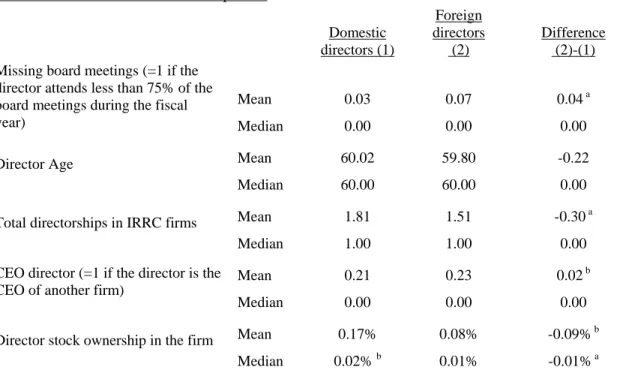
In Panel A of Table 2.6, we first present a comparison of the characteristics of foreign independent directors and domestic independent directors. As shown in the first row, 7% of foreign independent directors attend less than 75% of board meetings, while 3% of domestic independent directors fall into this category. We also compare the foreign directors' share ownership with domestic directors who sit on the same board.
The dependent variable is 1 if the independent director attended fewer than 75 percent of board meetings during the fiscal year, otherwise 0. In both specifications, the estimated coefficients of the indicator for foreign directors are positive and highly significant, indicating that foreign directors miss board meetings more often than domestic directors. Turning to other director characteristics, we find that directors who are also CEOs of other companies and directors who have a larger number of other board memberships are more likely to miss board meetings.
Among firm characteristics, we observe that independent directors in large firms and/or older firms have better attendance records than those in small and/or young firms. A possible explanation for the positive coefficient is that leverage acts as another management mechanism and it is a substitute for intensive monitoring by independent directors. Specifically, independent directors sitting on large boards have a greater propensity to miss board meetings than those sitting on small boards.
Of course, independent directors can obtain more information by visiting the company's headquarters and meeting other senior managers (Lerner (1995)).
Foreign directors and earnings restatements
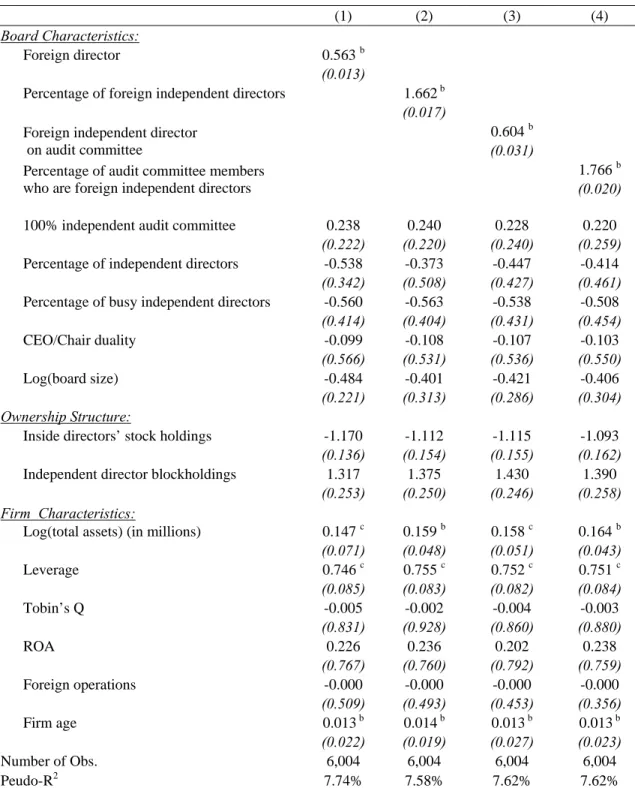
Of the board characteristics and ownership structure variables included in model (2), only board size and total share ownership held by insiders have significant coefficients. We obtain the fiscal years and quarters that were misreported and the direction of the restatements from Burns and Kedia (2005).25 We match the restatement sample with the IRRC director database to obtain 195 firm-years with misreported earnings. This represents approximately 3% of the 6,004 firm years, which is similar to the percentage of misreporting of firm years reported by Burns and Kedia (266 misreported firm years out of a sample of 8,208 firm years).
In model (2), the indicator of foreign directors is replaced by the percentage of independent foreign directors. These results suggest that firms with independent foreign directors sitting on boards are more likely to misreport earnings. In model (3), we construct a second indicator variable that is one if at least one foreign independent director sits on the audit committee at the time of the misstatement and zero otherwise.
Finally, in model (4) we control for the percentage of audit committee members who are foreign independent directors. To measure audit committee independence, we include an additional indicator variable equal to one if all the audit committee members are independent directors, and zero otherwise. However, consistent with Agrawal and Chadha (2005) , the estimated coefficient for the audit committee independence indicator is not significant in any of the four specifications.
In summary, firms with foreign independent directors and firms with foreign independent directors on their audit committees are more likely to misreport their earnings.
Conclusion
Overall, this evidence suggests that foreign directors are less effective monitors of management and less effective shareholder representatives, at least when firms do not have substantial foreign operations.
Variable Definitions
Determinants of board size and composition: An empirical analysis, Journal of Financial Economics, forthcoming. Directors' and officers' insurance premium: An external assessment of corporate governance effectiveness. Zenner, 1997, Do independent directors increase target shareholder wealth during tender offers, Journal of Financial Economics.
Wells, 1998, Larger board size and declining firm value in small firms, Journal of Financial Economics 48, 35-54. Board of Directors as an Endogenously Determined Institution: A Survey of the Economic Literature, FRBNY Economic Policy Review, April 2003, 7-26. Determinants of board size and composition: a theory of corporate boards, Journal of Financial and Quantitative Analysis.
CORPORATE GOVERNANCE TRANSFER AND SYNERGISTIC GAINS FROM MERGERS AND ACQUISITIONS
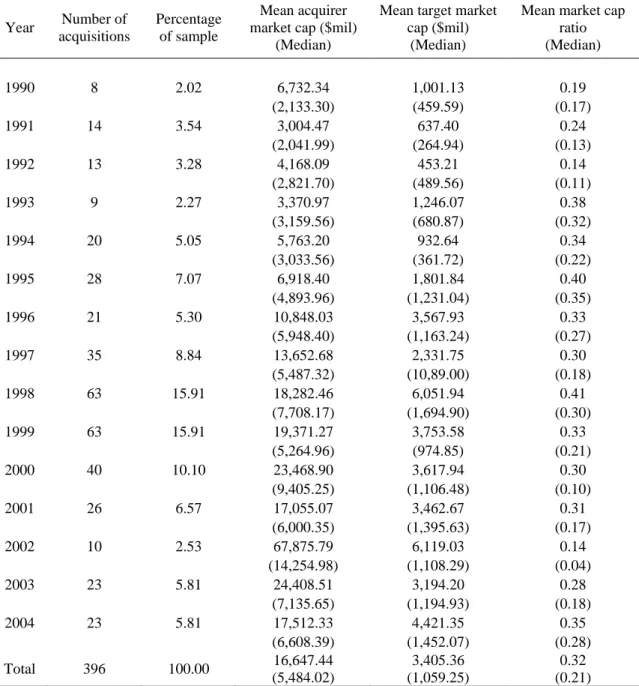
Sample description
The correlation matrix in Table 3.3 shows that the shareholder rights differential is positively related to acquisition synergy (PCAR), target returns (TCAR), acquisition premiums (PREM) and acquirer returns (ACAR). In the first two columns, the only explanatory variables we include are the shareholder rights differential and bidder size. For example, the coefficient estimate of the shareholder rights difference is 0.320 with a t-statistic of 3.10 in column (2).
We find that the difference in shareholder rights still has a significant positive effect on acquisition synergy, but neither the bidder's Q nor the target's Q appear to be related to acquisition synergy. Replacing the raw Qs of the target and the acquirer with these variables hardly changes the size and significance level of the coefficient of the shareholder-rights difference (unreported but available on request). This censoring-based hypothesis predicts a positive relationship between acquisition synergy and the target's shareholder rights index.
However, our efficiency-based hypothesis predicts a positive relationship between acquisition synergy and the shareholder rights difference. In all four regressions, the shareholder rights difference still has a positive and significant coefficient, while the coefficient of the target's shareholder rights index never turns out to be significant. But more importantly for our purpose, we find that the shareholder rights difference still has a significantly positive effect on acquisition synergy.
Despite the small sample size, the effect of the difference in shareholder rights on synergy is still significantly positive. In other words, the stronger the acquirer's shareholder rights relative to the target, the higher the synergy of the acquisition. We find that the difference in shareholder rights has a significant and positive effect on changes in the operating performance of the combined company.
Variable Definitions
Synergistic gains from company acquisitions and their distribution between the shareholders of target and acquiring companies. Cross-border mergers and acquisitions in emerging markets: the stock market assessment of corporate control.