THE UTILITY PLAYER: AN EXAMINATION OF THE ROLE OF BASEBALL IN CUBAN SOCIETY
By
Emily June Harral
A thesis submitted in partial fulfillment ofthe requirements for completion of the Bachelors of Arts degree in International Studies
Croft Institute for International Studies Sally McDonnell Barksdale Honors College.
The University of Mississippi
University, Mississippi May 2018
Approved by
____________________________________
Advisor: Dr. Douglass Sullivan- Gonzalez ____________________________________
Reader: Dr. Oliver Dinius ____________________________________
Reader: Dr. Jesse Cromwell
2
© 2018 Emily Harral
ALL RIGHTS RESERVED
3
ABSTRACT:
In this thesis, I will address the role of baseball in Cuba from 1898-2016. I split the thesis into three distinct time periods: Country inception (1898-1953), Revolution (1953-1989), Special Period (1989-2016). Each of these times periods represents a historically significant shift in the political history of Cuba. Every chapter seeks to define the role and significance of baseball in that time period. Through the use of newspapers, magazines, and speeches, I analyze the importance of baseball in society.
Additionally, I include information from notable historians to provide contextual information. Cuban baseball served as a form of connection for the sharing of ideas between the US in the early 20th century. It served as a symbol of industrialization and the political and economic advancements that occur. During the revolutionary period,
baseball served as a way to legitimize the Revolutionary Government. In transition to the Special Period baseball became a symbol that holds the Cuban nation together. Through economic and political struggles baseball remained a support system. In the end, I found that baseball plays a contributory role in Cuban Society from 1898 to 2016.
4
Table of Contents
Introduction... 1
Chapter 1:Cuban Baseball and The United States ...7
Background... 7
Baseball On The Island...9
The Early Professional League...13
The Amateur League...16
The Transition of the Leagues...18
What it Means to Be Cuban...20
The United States and Cuban Identity...21
Brink of Revolution...22
Chapter 2: The Revolution and Baseball ...24
Revolution Context...24
From Professional League to Amateurs...27
The Politics of Baseball...29
Popularity and Patria of Baseball...34
Fidel and his Influence...36
The Next Chapter...38
Chapter 3 The Special Period to President Obama...39
Special Period Historical Context...40
Fidel’s Perspective of Baseball...42
The two perspectives of the Cuban People...49
Baseball Diplomacy...54
Conclusion... 58
5
Introduction
“Before the republic, there was baseball. After the revolution, there was baseball. And during tall the years in between – there was baseball.”
-Milton Jamail1 Every country searches for an identity that makes it unique from others, but identity is not always easily defined. At times, it is a culmination of various elements of society that provides a clear explanation for what it means to have pride for one’s country. Cuba serves as a perfect example for a nation striving to find an identity.
Cubans searched for something that created a distinction between them and their colonial rulers, Spain. As a result, they were pulled closer in line with the United States. In 1953, Fidel Castro used national identity as a major tool in his revolution and the trend
continued into the post-revolution period. Lastly, Cubans sought something to bring them together during the Special Period when they had nothing and needed a glimmer of hope.
In all of these times, baseball acted as unifier, underlying the grand political movements.
Baseball provided people with an emotional connection with Cuba and made them feel Cuban.
Since the inception of the country, Cubans have faced various situations that forced them to question their nationalism, their sense of belonging to a greater
community. Each time they faced a new challenge, Cubans reconfigured what it meant to be Cuban at that specific moment. Nationalism served as the foundation for defining what 1 Milton H. Jamail, Full Count: Inside Cuban Baseball (United States:Southern Illinois University Press, 2000), 77.
it meant to be Cubans because they lacked a consistent political or economic system. In turn, social elements, for example sports and music, became the leading factors in the challenge to define what it means to be Cuban. There are various components that contribute to being Cuban. One of the prominent factors that continually stand out throughout the history of the island is baseball. Baseball plays an important role in the independence movement, revolution, and Cuba today. Many other countries within this region were not as deeply entrenched in the baseball world during the late 19th century as Cuba. As a result of its prevalence, baseball continues to play a transformative role in Cuba and its influence is not limited by political or economic factors.
The importance of baseball for Cuba is unprecedented in other nations; it acts as a unifier for this country. Cuba is unlike other countries in the region, since many of these other countries prefer soccer. From 1898 to 2016, the nation of Cuba made drastic changes. The one consistent factor over the entire time is baseball. While the country around baseball changes, baseball continues to find a way to remain an intricate part of daily life in Cuba, from the lower class to upper class to government officials. The question then becomes what role does baseball play? How does it constantly change and remain relevant in society, what allows it to take a foothold in Cuba, but not in other nations? Ultimately, what makes baseball Cuban and what makes Cubans go insane for baseball?
From 1898 to present day, baseball contributes to the Cuban culture. At the inception of the country, baseball served as a distinguishing factor. As examined in Chapter one, Baseball allowed a unique relationship between the US and Cuba to develop beyond the typical political and economic boundaries. Baseball flourished and served as a
cultural connector beyond the industrialization and political and economic advancements that occurred in the first fifty years of the 20th century. Chapter two examines the way in which Fidel Castro transformed and employed baseball as a mechanism of his revolution.
During the revolution period baseball becomes Cuban with Castro’s restriction on the professionalism of sports. Transitioning into the later part of the 20th century the Special Period presented Cuba with mounting difficulties politically, economically, and socially.
Baseball contributed to society when people had nothing and served as a way for the government to gain revenue throughout a difficult period. The third chapter of this work examines the contributions baseball made during the Special Period and the effects it had on the emerging relationship with the United States. In short, over the course of the century baseball continually maintained connections between the greater community despite social and political upheavals.
Literature Review
Within the last fifty years, sports have played an increasingly important role in the understanding of national identity. Scholars have begun to examine the ways in which sports proves to be a unifier for many nations. The expansion of this idea ranges from sports playing an almost insignificant role in national identity to being one of the main contributing factors to “patria.” (Nationhood). By creating a sense of nationhood, the people develop connections with one another aside from any political and social challenges that plague a country. Historian Eric Hobsbawm states, “ the imagined community of millions seems more real as a team of eleven named people.”2 He is directly referring to Europeans and their relation with soccer. “Belonging to” a nation is 2 Gregg Bocketti, “Sports Culture and the Varieties of Latin American Identity,” Latin American Research Review 52, (2017) pp. 157-163. doi: https://doi.org/10.25222/larr.93.
easily seen with jerseys and key people who represent that idea. Another historian Antonio Sotomayor describes the relation between nation and sport as a “ need to see the nation performed.”3 Sports demonstrate the true spirit, emotional connectivity, when a nation performs, or plays, in competitions. The outward display of nationalism that is enhanced through sports activities is the central element of Sotomayor’s understanding.
Typically, for many people sports are an area without severe controversy; the disagreements are about different teams rather than politics and economic downfalls.
Alternatively, Pablo Albarces believes that sports are “cultural machine… a producer of national narratives.”4 He is arguing that the sports narrative is the backing power to the entire national narrative. The sports narrative creates a sense of national pride. For example, Edurardo Archetti highlights the role that sports play when defining masculinity in a society. He focuses on elements of sport that foster relationships between fathers and sons along with the distinction it creates between men and women from an intellectual and societal perspective.5
The development of national identity in Cuba, the role of baseball, intrigues historians. For Louis Pérez he specifically examines the role that baseball plays in the national identity narrative. He investigates how baseball influences Cuban society and people, while not solely limiting it to one faction of society: “Baseball captures the Cuban imagination early and permanently: as a sport, as a state of mind, as a statement – sometimes as all three at once.”6 Continuing in the same article he states, “ In fact, 3 Ibid., 160
4 Ibid., 161
5 Joseph L. Arbena, "Meaning And Joy In Latin American Sports." International Review for the Sociology of Sport 35, no. 1 (2000): 83-91.
6 Louis A. Perez, “Between Baseball and Bullfighting: The Quest for Nationality in Cuba 1868-1898,” The Journal of American History 81, No. 2 (September, 1994), pp. 493-551,
baseball has long served to give expression to Cuban nationality, both as a means to nationhood and as a metaphor for nation.”7 In one article he also cites José Sixto de Sola who said: “Athletic sport was one of the factors that made Cubans feel free and obtain their liberty.”8 Sport, particularly baseball, enabled Cubans to imagine liberty, from independence movement to the revolution. Perez illustrates the connection between baseball and nationalism in Cuba, while simultaneously offering different perspectives for the connections that exist between the two. In another work, Pérez provides an answer to the question, why baseball: “Baseball offers the possibility of national integration of all Cubans, of all classes, black and white, young and old, men and
women.”9 Assuring the distinction between each of these groups illuminates the strengths of baseball because baseball surpasses the typical factors that divide nations. Milton Jamail asserts similar ideas to Pérez and agrees that baseball plays a key role in the national identity narrative. “It is difficult to find a family in Cuba that not include a member who loves baseball.”10 Jamail claims that baseball plays a key role not only in culture and connecting baseball and national identity, but in all elements of society.
Baseball is deeply entrenched within all aspects of Cuban society and through out his work this idea is illustrated. Each of these historians examines the relationship between society and sport. Perez and Eric Hobsbawm focused on the way sport fits into the preexisting society. While Milton Jamail examined how society fit into the baseball
https://www.jstor.org/stable/2081169?seq=1#page_scan_tab_contents 7 Ibid.
8 Ibid.
9 Ibid.
10 Milton H. Jamail, Full Count: Inside Cuban Baseball (United States:Southern Illinois University Press, 2000), 8.
narrative. In each perspective, the two components develop an intertwined relationship that allows sports to become a transformative faction of society.
Chapter 1
Cuban Baseball and The United States 1898-1953
“Cuban baseball was writing its history with a view towards establishing the sport as part of the foundation of the nation.”
- Roberto González Echevarría11
Background
Cuba officially became a country in 1898 after war with Spain. In this moment it was burdened by the weight of its neighbor to the North. The United States worked in conjunction with Cubans in order to help them gain independence. The Teller Agreement ensured that the United States would not be able to annex Cuba, but simply be there to assist Cuba during the war and then the United States, intended to remove all troops from the island. As a result, Cuba would feel the influence of the United States for years to come. The United States remained in control of Cuba until 1902 when the United States,
“formally inaugurating the Cuban republic.”12 Even though, the United States had
formally acknowledge Cuba as an independent country they still continued to intervene in the politics of the island and play an important role in Cuban Society.
11 Roberto Gonzaléz Echevarría, The Pride of Havana: A History of Cuban Baseball (Oxford: Oxford University Press, 2001), 90.
12 Steven J. Green School of International& Public Affairs,"Chronology of U.S.-Cuba Relations”, Cuban Research Institute. Accessed December 04, 2017.
https://cri.fiu.edu/us-cuba/chronology-of-us-cuba-relations/.
The United States influence began, prior to the beginning of the Cuban War for Independence, most notably with the inception of baseball on the island. In the 1860s, two Cuban college students returned from Spring Hill College in Mobile, Alabama. At the time, these two students would never know the true effect they would have on Cuba.
Cuba experience the first baseball ban issued from Spain, in 1869, during the outbreak of the first war between Cuba and Spain, the Ten Years War. Upon the conclusion of this war, the Cuban League was officially born and remains a staple to this day. During the few years prior and during the Spanish-American War, baseball became extremely popular for two reasons. One, the distaste the Spanish had for the game, and secondly the connection baseball gave Cuba to the United States. Historian Louis Perez in his book, On Becoming Cuban, states “Baseball in nineteenth-century Cuba presented one means of taking the measure of colonial society in transition- baseball as an expression of change and as agent of change.”13 Baseball functioned in a new country because it allowed Cubans to have a tradition independent of Spain. The game of baseball contributed to the Cuban spirit through the war and into independence.
At the beginning of the new country, Cuba, the United States remained in control of the island and aided with the process of development of various sectors, necessities for countries to exist. The United States attempted to begin the process of development for an island that lacked the level of industrialization as the United States due to the
preexisting colonial relationship with Spain. The economic sector of Cuba benefited from the industrialization brought to the island by the United States. The desire for political, economic, and social advancements contributed to the development of baseball during the 13 Louis A. Pérez, On Becoming Cuban: Identity, Nationality, and Culture (Chapel Hill:
University of North Carolina Press, 1999), 78.
early twentieth century. The United States influence was seen in the game of baseball, the structure and success of leagues, newspapers, and much more.
Baseball On The Island
The love of baseball preceded the independence movement. Not long after baseball came the island, the Ernesto brothers developed a baseball team, The Havana Baseball Club, in 1872. While The Havana Baseball Club was the original baseball club, baseball existed well beforehand. Previously, the Spanish Crown banned baseball,
because the Spanish Crown saw baseball as a definite against their sport of bullfighting.
When the Spanish banned baseball it pushed Cuba further towards independence. During the second attempt for independence, the Spanish-American War, the Cuban people needed a distinguishing factor to separate their culture from the one forced upon them by Spain. Louis Pérez addressed the distancing factor, baseball, when he says: “Cubans were in search of new forms to express discontent, new ways to draw differences between themselves as a people apart and a nation distinct from Spain.”14 One of the forms of discontent and distinction the Cuban people chose was baseball. Baseball served as the functioning power to completely eliminate the Spanish sport of choice, bullfighting.
“Baseball in the nineteenth century Cuba presented one means of taking the measure of colonial society in transition-baseball as an expression of change and as agent of change.”15 At the time, baseball made its first statement as an agent of society. Rather than simply being a game, it became a contributing factor in a wartime society that needed an escape. The role that baseball plays at the time of the independence movement
14 Ibid., 80.
15 Ibid., 78.
is the first example of its contribution to society, and over the next one hundred years, baseball will contribute to aid in Cuban society.
The desire to create a diaspora between the Spanish Cuba and the free Cuba fueled the interest in the game. The United States showed commitment and their
influence contributed greatly to the success of Cuba during the Spanish-American War.
Not only were they supporting the war through manpower and funding, they played an intricate role in the first few years of Cuba. Roberto González Echevarría addressed the American influence, and how baseball connected the United States and Cuba while at the same time distancing Cuba from Spain: “Baseball was a sport played in defiance of Spanish authorities, who viewed this American invention as vaguely secessionist and dangerously violent because of the use of sticks.” 16 One major distinction made the transition from bullfighting to baseball, and in the end baseball replaced bullfighting.17
From there, beginning in 1898 baseball became the source for the United States and Cuba to be on a level playing field; while simultaneously serving the Cuban people in their process of discovering what it means to be Cuban. The United States perceived that they played a major role in the creation of the free country of Cuba and as a result of this perception they did not immediately relinquish power in Cuba. They remained in Cuba until 1909. In order to help sustain a country that could fend for itself, they
attempted to help Cuba develop political, social and economic order, “After 1898, United States officials came to see baseball as a potential instrument of political order and social
16 Roberto Gonzaléz Echevarría, The Pride of Havana: A History of Cuban Baseball (Oxford: Oxford University Press, 2001), 90.
17 Louis A. Perez, “Between Baseball and Bullfighting: The Quest for Nationality in Cuba 1868-1898,” The Journal of American History 81, No. 2 (September, 1994), pp.
493-551, https://www.jstor.org/stable/2081169?seq=1#page_scan_tab_contents
control.” 18 Baseball created a social link that allowed the United States control without having to take it forcefully. While Cubans shared the game of baseball with the United States, they did not intend for it to perform and contribute to society in the same manner:
“ They (Cubans) could derive from baseball what they needed and discard the rest, that the meanings, values, and symbols ascribed to baseball could be radically different in a Cuban context than in a North American one, and they could serve Cuban needs as defined by Cubans.” 19
Baseball contributed to all classes with in Cuba, and the structure of the league illustrated how this was a reality. Moving forward from these two initial ideas, it is important to understand the structure of Cuban baseball. There is not, simply, a
professional league with a farm system below to continually feed players into the major leagues. During the first fifty years of the 20th century, four distinct categories existed: the professional game, semi-pro baseball, sugar mill baseball, and amateur baseball. The professional game mainly existed in Havana, but not exclusively. The semi-professional league received funding from companies, and were much more inclusive than the professional counterparts. Sugar mill baseball extended from the sugar production industry. These were teams that formed from the employees of sugar mills and existed in the areas around the mills all over the island. The social clubs in Havana sponsored the amateur leagues, and importantly, these clubs excluded blacks from playing for them. 20 Four distinct sections exist in Cuban baseball, but records and details regarding each of their individual structure do not exist. Specifically, sugar mill baseball records 18 Ibid,. 517.
19 Ibid,. 517.
20 Roberto Gonzaléz Echevarría, The Pride of Havana: A History of Cuban Baseball (Oxford: Oxford University Press, 2001),115.
are practically non-existent. Enough evidence exists to show sugar mill baseball once existed, but the lack of evidence proves detrimental when attempting to determine the leagues influence on society. Semi-pro baseball functioned similar to the other sections, and semi-pro baseball does play an important role in society: it falls in the shadows of the professional league and amateur league. A key social scientist of the region, Milton Jamail, notes his struggles with tracking and remaining up to date on Cuban baseball,
“What surprised me though, as I immersed myself in the island’s baseball culture, was that keeping up with Cuban Baseball isn’t always easy either.”21 While Jamail is directly referring to his specific time spent during the eighties and nineties in Cuba, the records of baseball on the island are difficult to come across.
The amateur league and the professional league, the Cuban league, formed the two types of baseball where some evidence of record keeping exists. These two leagues, created a unique relationship within the baseball community, and faced off with one another during the first part of the 20th century.22 The lack of records and communication regarding baseball on the island shows the lack of development between leagues across the island during the early 20th century. By the mid 1920s baseball became much more documented. The professional league and the amateur league were heavily recorded, due to the central location on the island, the center of the industrialization on the island. Even with the lack of evidence, the country was enamored by baseball, and even though baseball was influenced by Cuba’s northern counterparts, baseball in Cuba had a flare of its own.
21 Milton H. Jamail, Full Count: Inside Cuban Baseball (United States:Southern Illinois University Press, 2000), 48.
22 Roberto Gonzaléz Echevarría, The Pride of Havana: A History of Cuban Baseball (Oxford: Oxford University Press, 2001),90.
The Early Professional League
The Cuban League, professional baseball, began in 1878 with three teams:
Almendares, Havana, and Matanzas. All of these teams were centrally located within and around the capital city of Havana. The importance of baseball to Havana can be seen in the way they marketed Havana to others outside of Cuba. The city, Havana, mentioned baseball in the list of city attraction in tourist brochure in the early 1890s. 23 Throughout the first fifty years of the 20th century, teams fluctuated in and out of the Cuban League.
Typically, the third team played the role of a rotating element, while Almendares and Havana remained constant. A growth in teams, three to five teams, occurred from 1900 to 1906.24 The constant transition of the Cuba League plagued the development of
professional baseball throughout the early part of the century. Even with the geographic spread of teams across the island, prominent newspapers covered Cuban baseball. In 1901 till 1920 Diario de la Mariana, the professional league in Cuba appeared almost everyday between November and February. The newspapers covered the scores and the upcoming games. The mention of baseball, in daily newspapers, is common in the years that follow. Two other highly renowned newspapers, La Lucha and El Mundo, reported the scores and upcoming situations of the Cuban professional league. Specifically, it touched on the upcoming championships. Interestingly, the teams in the Cuban League called Havana their home, when it came to ballparks, but these newspapers were for the entire country. The growth of teams around Havana did not represent the interest across the island.25
23 Ibid., 97.
24 Ibid., 122.
25 World News Paper Archive. Advertisement. World Newspaper Archive. Accessed October 4, 2017. https://newspaperarchive.com/.
An important element, regarding the role that baseball played during the early 20th century, was the influence and collaboration with the United States. Following the Spanish-American War and the United States occupation, baseball culture in the two nations became completely intermingled. While the connection with the United States expanded far beyond the baseball diamond, the interconnectivity is shown through the game of baseball. One of the major examples of the importance of United States baseball in Cuba was the newspaper report in Cuba. Every newspaper previously mentioned documented the regular and postseason of Major League Baseball in the United States.
The baseball season in Cuba was built to fit in the off- season of Major League Baseball.
The cycle of newspaper reporting shows the influence of United States baseball. During March or April until October, there was virtually no mention of Cuban League, players or teams; the entire reports were schedules and stats of major league baseball teams. The articles during the major league season were typically similar in length to the Cuban League ones, but contained more statistics about players and games. The similarities of these articles demonstrate the interconnectivity between the US’s major league and Cuba’s baseball league that exist as a result of the industrialization of Cuba.
Along with the documentation of the team, the players that came from the Major Leagues replicated American customs and ideas. Without the Cuban League, the transfer of ideas potentially would not have occurred in some social sectors. While in Cuba, American players acted differently than within the United States. These actions illustrated the illusive grandeur of Cuba. Americans saw Cuba as a place full of
gambling, girls, and booze.26 Baseball served as a way for Cubans to examine Americans in their country, and also provided a pathway for many players to make it to America.
While there, they were capable of examining these features one-on-one. The inclusion of American baseball players in Cuban baseball created the foundation for the recruitment of Cuban players to the MLB. The inclusion was not important from the standpoint of Cubans recruiting others, but for Major League baseball teams recruiting Cubans. This inclusion marked the first influence of Cuban baseball on an international stage. Milton Jamail, points out the international element when he says, “For the baseball industry, Cuba represents the most important frontier in the increasingly important global search for players.”27 Individuals from all over would come to discover the wonder of Cuban baseball. It gave Cubans an opportunity to go to America and it gave Cuba a way to learn more from America.
Even with all of the factors listed above, the Cuban League was not a powerhouse for Cuban baseball during this time. It did not expand, but rather remained consistent with anywhere from three to five teams. Although there was a “furor” for baseball in Havana, baseball served a strong purpose in politics and the economy based on the intertwined relationship with the United States.28 The Pride of Havana author commented on the views of the professional league during 1930s and 1940s, “The Cuban League’s disarray was considered a national disgrace.”29 Although it was not all bad, in the late
26 Louis A. Pérez, On Becoming Cuban: Identity, Nationality, and Culture (Chapel Hill: University of North Carolina Press, 1999)
27 Milton H. Jamail, Full Count: Inside Cuban Baseball (United States:Southern Illinois University Press, 2000), 2.
28 Roberto Gonzaléz Echevarría The pride of Havana: a history of Cuban baseball (Oxford: Oxford University Press, 2001), 93.
29 Ibid., 272.
1930s and 1940s the Cuban League began to capitalize on “the emergence of players, mostly pitchers, from the provinces.”30 The Cuban League began to represent all of Cuba.
The integration of people from all over the island is exemplifies the way the Cuban League was Cuban, but also the professional league deeply entrenched relationship with the United States.
The Amateur League
The Amateur League mainly existed in Havana and spread into the surrounding provinces. The Amateur League helped to distinguish baseball as something Cuban. The development of these Amateur leagues were in communities within social clubs. While they covered the same geographical area as the professional league, the amateur league remained the home of sports for the elite.
Baseball existed outside of the captain of Havana and this spread of baseball helped to bring baseball outside of the typical industrialized city. Roberto González Echevarría touched on the existence of baseball outside of Havana: “The borderline region where baseball thrived was neither totally urban nor entirely rural but a combination.”31 The regions that the author discussed provides an example of the
influence of the United States on Cuba. The spread of baseball across the island helped to illustrate the influence of the US. The growth of the amateur league spread from about 1914-1920s. Within the six-year span, a documented number of teams developed and showed the importance of the amateur league. In 1914 the amateur league was founded with four teams: Vedado Tennis Club, Instituto de la Habana, Sociedad de Mariano, Club
30 Ibid., 220.
31 Ibid., 94.
Athletico de Cuba, along with teams that came from the province close to Havana. 32 The league expanded again in 1919 by adding another five teams and another 2 teams in 1920.33 All of these teams were located near Havana, but were not exclusively limited to central Havana. The major distinction between these two leagues showed the difference between private versus public: “The amateur game, which was the origin of it all remained a sport played among private, exclusive social clubs.”34 In 1910 El Fígaro, a Cuban newspaper, discussed the atmosphere of amateur baseball on the island, and the overpowering enthusiasm on the island.35 The exclusiveness of the amateur league showed that while baseball was popular, there still existed a distinction between classes.
The amateur league served to show the importance of baseball to the elites.
Sugarmill Leagues
The Sugarmill Leagues typically developed in the towns that surrounded the sugar plantation, the more rural areas of the island where the plantations were located.
With the influence of the United States technology, the distance between the eastern region of the island and the city of Havana no longer seemed so far away. The Sugarmill League, ligas azucrareras, existed in the Las Villas (central) all the way to Oriente (east).36 Historian Roberto Echevarría described the Sugarmill league and the economy that propelled the Sugarmill League: “During this period, Sugarmill produced both sugar and baseball players in record quantities, owners and entrepreneurs had money to pay
32 Paula J. Pettavino, Sport in Cuba (Pennsylvania: University of Pittsburgh, 1994), 38.
33 Roberto Gonzaléz Echevarría, The Pride of Havana: A History of Cuban Baseball (Oxford: Oxford University Press, 2001), 188.
34 Ibid., 190.
35 Ibid., 209.
36 Ibid., 201.
top-notch performers, and ordinary Cubans had cash to buy tickets to see them.”37 The Sugarmill teams thrived well into the early 1950s. The economy was booming with the result of modern technology that helped to produce more sugar and transport sugar more effectively. Baseball spread throughout the island because of the industrialization promoted baseball on the island, but also helped baseball become Cuban.
The Transition of the Leagues
The leagues continued to grow and transition throughout the 19th century and such growth allowed the relationship with the United States to further develop. The quality of sugarmill baseball competed with that of the semi-professional. Moving into the 1930s and 1940s the three baseball leagues remained separate, but the gap between them began to close, “ The lines dividing amateur, sugarmill, and semipro baseball38 were not sharply drawn.” 39 Prior to the 1930s and 1940s it is important to understand the different roles that the leagues played. The sugarmill and semi-pro league served as a place for Cubans to play almost exclusively except for Americans from the Negro league, but in many ways these two leagues were Cuban. Their inclusive nature and the spirit and comradery of these leagues proved to be more Cuban than anyone expected. Railroads connected the towns of these sugarmills that distances previously separated. The amateur league served as a place for the wealthy to have their baseball. In many ways, the amateur league was a 37 Ibid., 139.
While the Sugarmill Leagues served the largest spread of people on the island, it is difficult to examine the interworking of the leagues because no record of them exist. It is believed by historians that the Sugarmill records were confiscated during the
revolutionary period and were never seen again.
38 Although, this is not explicitly mentioned with a section. Semi-pro baseball is an important factor to Cuban baseball, but serves similar functions to the other three elements of baseball. The evidence for the semi-pro league did not provide neat records either.
39 Ibid.,152.
purely Cuban league as well. The professional league was another story. It had its fair share of Cuban players, but also was the main place for American players to play in Cuba. As a result of this, the author of The Pride of Havana, addressed the situation with the professional league by saying:
In the first third of the twentieth century Cuba baseball, particularly the professional kind, was deeply affected by the close political, economic and cultural relations between the island and The United States (close is something of a misnomer, since the politics and business of the United States and Cuba were sometimes really one and the same).40
The late 1890s until the early 1930s is known as the golden age of baseball.
Baseball was a common factor that helped to unite the United States and Cuba. During the 1940s and the early 1950s the true value of baseball in Cuba revealed itself. Even though baseball served as an agent to the relations with the United States and helped to link Cuba to the US, it had found its way into all levels of Cuban society. The United States helped to spread baseball across the island further during the 1940s and 1950s. The radio helped to spread baseball and the obsession that came with it: “An immediate Cuban ‘imagined community became manifest, as never before in the voice of broadcasters…’”41 Baseball became an integral part of the Cuban identity. The
relationship between Cuba and the United States remained intertwined and the influence of the United States can be seen through many aspects of Cuban culture, especially baseball.
40 Ibid., 112.
41 Ibid., 279.
What it Means to Be Cuban
The influence of Spanish culture quickly disappeared and replaced by the culture of the independence movement. At the moment the question of the nation of Cuba came to the forefront. One of the major pushbacks against the Spanish government was baseball, and to some, the use of baseball as opposition to the Spanish crown is the beginning of Cuban national identity. The beginning of the country and the United States influence led to the entanglement of Cuba and the United States, but the Cuban national identity found its own place. Cubans sought to distinguish themselves from Spain and the United States provided the perfect opposition. Between Cuba and the United States, baseball served as a common ground; baseball was something that was important to everyone of every social class, color, and gender. More importantly sports, specifically baseball in this case, “offered the basis on which to stake a claim to membership in the community of civilized nations of the world.”42
The reason many consider baseball to be a pivotal part of national identity is because of the many purposes it serves in society. Baseball is not limited to culture. It is culture, politics, economics, morals, a unifier, and so much more. Politically and
economically, baseball served to connected the United States through a meeting ground for state negotiations to the economic profit Cuba received as a result of baseball related visitors. Cubans at the time were searching for meaning, a feeling of Cuba, and as Louis Perez puts it in his book, On Becoming Cuban: “They sought to define nationality through forms that were most immediately available, one of which happened to be
42 Louis A. Pérez, On Becoming Cuban: Identity, Nationality, and Culture (Chapel Hill:
University of North Carolina Press, 1999) 273.
baseball.”43 What made baseball appealing to many on the island was the inclusion mechanism that baseball had to offer. Cuba, a changing society, needed to find ways to become a nation for all of its peoples, “Baseball offered the possibility of national integration of all Cubans of all classes, black and white, young and old, men and women.” 44 By unifying all people, the country could move forward and become a sustainable place.
The United States and Cuban Identity
As with any part of the early 20th century, the United States played a major contributing role to the construction of Cuban national identity. Baseball served as a catalyst for these desires and became the translator between these two societies. The presence of the United States shone through in business designs, product marketing and selling, people even began to desire to learn English. Historian Louis Perez illustrated the source of what became Cuban national identity as linked to the US: “Much of what passed for Cuban, and from which national identity was derived after 1898 was drawn from an environment dominated by North American cultural forms.”45 Continuing until the mid 1940s the American way was what some Cubans sought after. They wanted more than anything to be American.
But, the control of the United States could only go so far, until a country that wanted its own place in the world would realize that they were not actually on their own.
Even though the United States had handed over Cuba to its government in the early
43 Ibid., 80 44 Ibid., 79.
45 Ibid., 142.
1900s, their constant hand in everything began to present an issue in Cuba. At this time, baseball was caught in the cross hairs of the United States and Cuban relations.
The complicated relationship between Cuba and the United States led to many questions on how these relations would continue in the future. Whether people viewed Cuba as an independent country or one barely clinging on even with the assistance of the United States, Cuba sustained a place in the world and issues arose for Cuba as a result of this fact, but Cuba will find its own way. The issues that existed between Cuba and the United States are derived from their differing views during the first fifty years of the 20th century. 46The divide that was created would become the underlying factor for years to come.
Brink of Revolution
Cubans profited from the United States while baseball flourished. They benefitted from the technological advances brought from the United States. The connection between Cuban baseball and Major League baseball was well established and flourished. A Cuban team had even become a part of the minor league system. Cuba sought the path of a new leader, Fidel Castro, and with this choice the United States and Cuban relations would change forever. What is important to remember going forward with Cuban national identity is that
[n]ational identity constantly adjusts to and reconciles perceptions of reality with changing needs, and vice versa, with its own particular history, specifically a way to experience the meaning of inclusion of previously disparate constitutes within the notion of nationality.47
46 Ibid., 78.
47 Ibid., 8.
While the structure of Cuba looked differently going into the revolution period, the technological changes by the United States remained and at the end of it all baseball expanded its popularity beyond the elites.
Chapter 2
The Revolution and Baseball 1953-1989
“El mejor beisbol amareo de mundo! El mejor espectataculo deportivo!”
“The best amateur baseball in the world! The best sport spectacle!”
-Thomas F. Carter48
Revolution Context
The revolution attempted to use baseball to defend their ideologies and values.
The initial actions of the Cuban Revolution began in 1953; the events that occurred over the next six years shaped Cuba, and ultimately Cuban baseball, into what it is today. The actions that occurred from 1953 until 1959 provide a link between what Cuba was and what Cuba became. Although many researchers do not deal with the sports context during the "revolutionary" period, the significance of the political events provides an
introduction to what later became baseball in Cuba. Baseball provided domestic and international legitimacy to the Cuban revolutionary project.
Beginning in 1952, Fidel Castro started to develop the plans for a non-peaceful end to the Batista regime. Batista's government, like many before it, faced disapproval
48 Thomas F. Carter, The Quality of Home Runs: The Passion, Politics, and Language of Cuban Baseball ( Duke University Press, 2008), 73.
due to the corrupt nature of the state itself. The dissatisfaction became the driving force for Fidel Castro, and in 1953 decided on the first official target, Moncada military
barracks. So, on July 26th, 1953 Castro and his men attacked the Moncada barracks. They were defeated, and the few that could escape sought refuge in the mountains along the eastern side of the island. Later the same year, 1953, Castro along with eight of his counterparts were tried in court and sentenced to prison.49 For Castro, 1954 and much of 1955 he sat in a prison cell lacking the freedom to continue to plan his revolution. While he did not idly during his time in prison, the revolutionary planning lagged. In May of 1955, Castro regained his freedom due to Batista freeing all political prisoners. In turn, he would spend the next year in Mexico planning his return and ultimately his revolution.
Castro officially moved from revolutionary planning to action in November of 1956. His remarkable return, along with forces, to Cuba began on November 25th in a boat named the Granma. The group made landfall in Oriente Province on December 2nd; they were attacked and eventually found their way into nearby mountains, Sierra Maestra
Mountains. Castro and the few men still alive spent much of the early part of 1957 in a game of cat and mouse with the Cuban military.
Many in Cuba believed that Fidel Castro died on December 3rd, but they soon learned of his survival. An article published in the New York Time not only proved Fidel was alive and well, but it also fostered a sense of public support for Castro and his rebels.
The popularity of Castro and his Rebels expanded further than the Cuban bordered, specifically into "that country up north" the US; the perception of Batista in the United 49 Evan K. Nagel "Beyond the Sports Page: Baseball, The Cuban Revolution, and Rochester, New York Newspapers, 1954-1960" Electronic Thesis and Dissertation Repository. (2014), http://ir.lib.uwo.ca/etd/2564. 58.
Peter C. Bjarkman, History of Cuban Baseball, (McFarland, 2014)
States shifted substantially at the same time. Following the shift in support in early 1957 Castro and his rebels spent much of 1957 combatting against Batista forces, with much success. While in 1957 the public opinion shifted against Batista, in 1958 the United States government continued to fund the Batista regime. Batista, through his continual actions, created a significant situation for the United States. In March, he discontinued the right to freedom of the press by suspended constitutional rights. A clash with the rebel forces in April, fed into the public relations crisis that already existed. Castro and his rebels, M-26-7, and the National Police fought, and the National Police brutally killed many of the M-26-7 fighters. The actions of the police led to further criticism of the Batista regime. Between April and November of 1958, the rebel forces continued to gain ground in Cuba, and by November they controlled a majority of the battles while simultaneously holding public support. The winner of the election, which occurred in 1959, showed the corrupt nature of the government even more; Batista handpicked his predecessor. The United States officially removed their support of Batista in late 1958.
The last few months of 1958 Castro's forces captured essential cities and weighed more substantial and more cumbersome on Batista's forces. The final day of 1958, Batista fled the country with no plans to ever return to Cuba. On January 8th, 1959 Fidel Castro and troops arrived in Cuba. The capital was theirs, more importantly, Cuba was theirs.50
Beginning in 1960, Fidel controlled Cuba. He spent the next two years making the Cuban government his own. The first few months Castro sought to eliminate the Batista supporters that still called Cuba home. He began with reforms and many of the actions he took following the revolution provided insight into the future inclusion of communism.
50 Ibid., 58
He spent from April to July traveling as the new face of Cuba. During the middle to later part of the year, the Cuban-US relationship began to fragment. President Eisenhower pushed for the CIA to wage attacks against the Castro Regime. The actions that occurred in 1960 lay the foundation for the implosion of the relationship between Cuba and the US. Beginning in early 1960 Castro aligned himself with the Soviet Union by signing a trade agreement, later that year Castro seized the oil refineries. The US retaliated by only allowing about 5% of sugar, which is in the US economy, to come from Cuba.
Eventually, the Revolutionary Government nationalized oil, electricity, and sugar. Fidel Castro drew a line in the sand with the United States marking the end of relations and simultaneously the beginning of a new Cuba. 51
From Professional League to Amateurs
Fidel moved quickly to utilize baseball for his own political advantages. Although they remained the same, Castro wasted no time inserting his image, the image of the new revolutionary government, into the baseball diamond. According to Thomas Carter, a historian, “At the culminating series in Havana Castro threw out the ceremonial first pitch and despite the escalations from the crowd for a speech, he insisted that he was like any other fan here to the game.” 52 Through his reaction, Castro aligned himself with the game of baseball.
While the 1959-1960 seasons and 1960-1961 season continued under the new revolutionary government, baseball soon became another nationalized industry. The shift in baseball occurs in two ways, most notably, the elimination of the professional baseball
51 Ibid., 61.
52 Thomas F. Carter, The Quality of Home Runs: The Passion, Politics, and Language of Cuban Baseball ( Duke University Press, 2008), 59.
league. In 1961, the government created a new branch that served to facilitate and manage the new INDER, National Institute for Sports, Education, and Recreation. The government organization decided that the professional league no longer had a place on the island and was replaced by the Cuban League, amateur baseball. In creating INDER, Fidel Castro showed the importance of sports in his new Cuba. Castro successfully triumphed in the political revolution in Cuba; he faced more significant hills in the transition of society under the new government. The game of baseball, inherently tied to America, served as a foundation in Cuban psyche Castro's government redefined the game of baseball to help satisfy their political agenda.53
The IBAF Amateur World Series took place in April of 1961 and played directly into the hands of the redevelopment of Cuban baseball, Cuba threw a team together and even without lengthy preparation the team succeeded. While the Amateur World Series unfolded, the Cuban military successful demolished the counter-insurgency, backed by the United States, in the famous Bay of Pigs.54 The coincidental timing of the successful Cuban amateur baseball and the defeat of the counterinsurgency helped to consolidate the revolutionary government’s appeal. The revolutionary government spent time and energy on the game of baseball in years to come, and every time a team took the field they became a physical embodiment of the state of Cuba.
The first official season of the new National Series occurred in 1962. INDER kept the same structure. The league only had four teams, but ideas of expansion were not out of the question and soon became a reality. The league expanded three times over the next decade: 1965 six teams, 1967 twelve teams, and finally in 1972 every province on the 53 Peter C. Bjarkman, History of Cuban Baseball, (McFarland, 2014) 235.
54 Ibid., 240.
island enjoyed a team of their own.55 By creating and fostering clubs across the island, the revolutionary government built a fan base that supported the people from their province but also strove to have their players in the all-star game and more importantly as part of the Cuban National Team. The Cuban National Team competed and won several international competitions over the next twenty years. The game of baseball found a place in the new revolutionary society. It remained a significant element of Cuban identity, while simultaneously acting to support the revolution.
The Politics of Baseball
The new revolutionary government employed the use of sports to develop a sense of nationhood and national pride, while distancing themselves from their new northern enemy. During the years of transition, the sports industry grew institutionally and
politically. The creation of INDER showed the governments commitment to sports on the island. While INDER monitored all sports, baseball dominated INDER throughout the years. From attention to funding, the sport of baseball became a central focus of INDER.
A distinct character in history, Fidel redefined the nature of the relationship between the head of state and sport. "There has never been a case in which a head of state has been involved so prominently and for such a long period in a nation's favored sport as Fidel Castro been with baseball in Cuba."56 Fidel did not shy away from the diamond, and Cubans' created their legends about the connections between baseball and Fidel. Legend has it that Fidel Castro as a young player performed exceptionally well, and many major league teams sought to sign him. In one instance, he even received an offer from Major 55 Milton H. Jamail, Full Count: Inside Cuban Baseball (United States:Southern Illinois University Press, 2000), 30.
56 Roberto Gonzaléz Echevarría, The Pride of Havana: A History of Cuban Baseball (Oxford: Oxford University Press, 2001), 352.
League teams, but in the end, the teams never put ink to paper.57 The myth of Fidel Castro continues to this day. Many reporters have researched, and written articles on the old wives’ tale, but research all ended without confirming the exact nature of the story.
Beyond the myths of the superstar pitcher, Fidel Castro and baseball have always been connected. Fidel's interests never deserved questioning: "Fidel Castro has long been viewed as the country's number one baseball and sports fan, and he has had life-long involvement in sport."58 The passion that Fidel showed for baseball created a unique situation explicitly at the top of the government.
In the previous chapter, baseball functioned as a link between the United States and Cuba. Baseball created a direct line for shared ideas to flow between the island and the north. Following Cuban independence, baseball facilitated the transfer of technology.
As Cuba transitioned out of the shadows of the United States the government sought to redefine many existing intuitions and ideas. The government began with the
nationalization of various industries and companies, and then they nationalized sports.
The Cuban people did not riot in the streets but quietly waited to see the new faction of sports on the island. INDER served to fill the void that people needed, and with the creation of a bureaucratic institution, ensured that the government messages and ideas would find their way onto the baseball diamond. Historian Eric Wagner points out the ramifications that are created by the government bringing sports to the people: “Most Cuban people, without active insurrectionary participation, waited for sport to be brought
57 "Fidel Castro and Baseball" Society for American Baseball Research, accessed February 05, 2018, http://sabr.org/bioproj/topic/fidel-castro-and-baseball.
58 Eric A. Wagner “Cuba and Nicaragua,” in Sport and Society in Latin America:
Diffusion, Dependency, and the Rise of Mass Culture, ed. Joseph L. Arbena (Westport, CT: Greenwood Press,1988), 131.
to them by the government. When it did come, sport could be structured in ways that support wide social and political goals of the government.” 59 As with the creation of any new government, the revolutionary government sought to recreate and continually foster a new sense of what it meant to be Cuban.
It is common for revolutionary governments to turn to sports to help provide a foundation for the creation, or even enhancement, of national identity. The revolutionary government successfully created a connection between people and baseball that enhanced the legitimacy of the government in the eyes of the people.
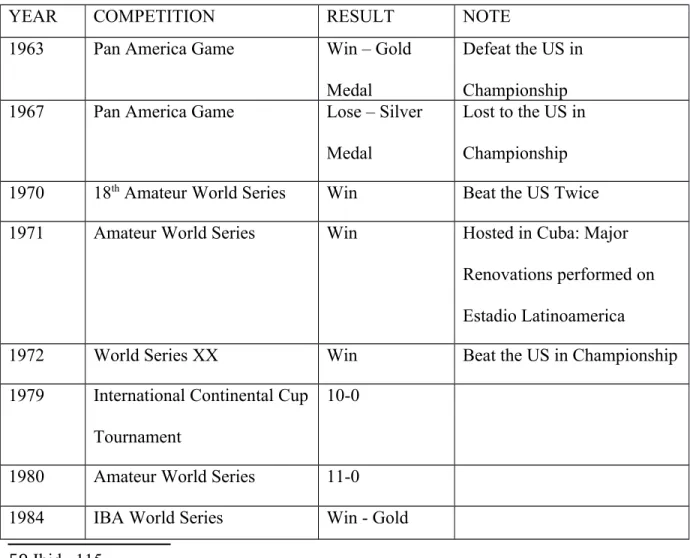
Table 1: A Summary of Notable International Baseball Competition for Cuba60
YEAR COMPETITION RESULT NOTE
1963 Pan America Game Win – Gold
Medal
Defeat the US in Championship
1967 Pan America Game Lose – Silver
Medal
Lost to the US in Championship 1970 18th Amateur World Series Win Beat the US Twice
1971 Amateur World Series Win Hosted in Cuba: Major
Renovations performed on Estadio Latinoamerica
1972 World Series XX Win Beat the US in Championship
1979 International Continental Cup Tournament
10-0
1980 Amateur World Series 11-0
1984 IBA World Series Win - Gold
59 Ibid., 115.
60 Peter C. Bjarkman, History of Cuban Baseball, (McFarland, 2014) Appendices A
Medal
1987 Pan American Games Win
Every win against the United States solidified Fidel’s power. The win in 1963 against the United States served to completely distance Cuba from the United States.
They beat their much stronger neighbor to the North at their own game. Wins and loses became a line on the legacy of Fidel Castro. Fidel continually proved, during this time period, that his way of baseball, and his way of life, established a foundation for success and respect on the international level.
The Cuban government not only recreated the structure of sport, but they also created a connection with each province on the island to the National Series. The players that participated in the National Series are the ones to go on and compete internationally.
In creating the fever for the game and the connection to the players, the government developed that feeling of being Cuban.61 A sense of nationhood is created with baseball.
For Fidel Castro, international competition meant that he could show the success of his government structure to the world. Historians continually note how Fidel used baseball to demonstrate the achievement of the new Cuba, "As prominent producers of nationalist discourse, government leader, especially Fidel Castro, explicitly use sport in general and baseball, in particular, to establish a socialist-based position for being Cuban."62 Cuba’s performance on an international level provided evidence to the Castro regime that their
61 Thomas F. Carter, The Quality of Home Runs: The Passion, Politics, and Language of Cuban Baseball ( Duke University Press, 2008), 161.
62 Ibid., 97.
government was better than the US. Athletes were treated similarly to military personnel because each group, in its way, defended the Patria of Cuba.63
Castro proved to be successful in his desires to perform at a high level. He held a mounting number of international victories under his tenure especially before 1989.
The success over the years showed the continual development and importance of the game to the island. In all of these wins, Castro proved to the world the success of his government. He demonstrated explicitly to the United States that the Cuban baseball system continually performed better at America's game than Americans. Baseball created a two-fold power statement to the United States. In the first instance, baseball
distinguished Cuba from the United States.64 The political structure of Cuba differed significantly from the political structure of the United States, and when Cuba performed on the baseball diamond against America, they distinguish themselves from their former counterpart. Cuba benefits greatly from clear-cut success over the Untied States, and with each win they continued to diminish the United States attempts to discredit their revolutionary government.65 Baseball served as an original tool for the government to create the feeling of being Cuban and eventually became the tool for dominating one of their most hated enemies.
63 Eric A. Wagner “Cuba and Nicaragua,” in Sport and Society in Latin America:
Diffusion, Dependency, and the Rise of Mass Culture, ed. Joseph L. Arbena (Westport, CT: Greenwood Press,1988), 131
64 Roberto Gonzaléz Echevarría, The Pride of Havana: A History of Cuban Baseball (Oxford: Oxford University Press, 2001), 535.
65 Ibd. 354.
Thomas F. Carter, The Quality of Home Runs: The Passion, Politics, and Language of Cuban Baseball ( Duke University Press, 2008), 13.
Popularity and Patria of Baseball
The question then becomes how do we measure the depth of popularity of sports in Cuba? Before the revolution, one of the primary elements that defined society was baseball. The foundation existed for the new revolutionary government to incorporate sports and specifically baseball into their plan. Eric Wagner examines sport in a revolutionary context, and he notes that the Cuban government acted similarly to other revolutionary governments in relation to sports: "Sport is a deeply entrenched social institution, and revolution is not likely to change fundamental interest in sport. People who have been involved in sport continue to be involved." 66 While Wagner makes this claim, evidence demonstrates that baseball enhanced the revolution to ensure that Baseball remained a faction of Cuba. The interest existed in Cuba during the revolution and far beyond and the revolutionary government created an entire government sector responsible for sports. What cannot easily be measured during the revolutionary period and afterward is the interest that exists from the perspective of an everyday person. As a result of this, frequency in news publications becomes the best tool to identifying and verifying people’s everyday interest. Finding evidence to demonstrate that the
government found value in sports, measuring people’s interest is slightly more complicated.
An examination of the content covered in Semanario Deportivo LPV, a weekly- published popular sports magazine, provides a hint of what Cubans cared about during the period. Although the chart expands beyond the years of this chapter, the data
66 Eric A. Wagner “Cuba and Nicaragua,” in Sport and Society in Latin America:
Diffusion, Dependency, and the Rise of Mass Culture, ed. Joseph L. Arbena (Westport, CT: Greenwood Press,1988), 115.
examined in the table shows the importance of a sport based on the number of times the
magazine covered it.67
67 Eric A. Wagner “Cuba and Nicaragua,” in Sport and Society in Latin America:
Diffusion, Dependency, and the Rise of Mass Culture, ed. Joseph L. Arbena (Westport, CT: Greenwood Press,1988), 125.
Through my research, I did not have access to enough of these magazines to have
substantial evidence to examine them across time. The author of an article that I used for my research did have access to them. He created the chart above for his report. While he analyzes the above chart in his work, the table provides merely a set of condensed information about the magazines content.
Baseball dominates. Baseball appears in both time periods on more pages than any other sport. It only holds the front cover five times and falls short as the top appearing sport.
While the chart easily shows the interest that people enjoyed in sports generally, it illustrates explicitly the importance that people continued to have in the game of baseball.
People from any part of Cuban Society, before the revolution, attended baseball games.
The evening of the playing field that occurred during Castro's socialist revolution even more so closed the gap that existed between people in Cuba. When an individual attended a baseball game, they felt at one with the people around them and even identified with government officials that participated in the game. The Cuban
revolutionary government sought to give people equal access to resources on the island.
Baseball served as one of the government’s resources and the people responded to the
accessibility of the game. The author of the chart above explained that the interest of baseball relied heavily on the interest of the “masses” and how it continued throughout the revolutionary period. 68 The setting and ascetics of attending a baseball game contributed to the countries interest, but also added to the purpose of baseball for the nation; a sense of community and belonging fostered within the walls of a stadium.
People escaped their daily lives while simultaneously stating their opinions in an uninhibited form at baseball games. Baseball served the government as a way promote political views but also remained the most popular sport on the island.
Fidel and his Influence
Fidel Castro delivers two notable speeches to athletes in 1961 and again in 1970.
His message in each of them served similar purposes. The initial speech served to show the place of Cuban sports in the success of the revolution, and the ways in which the revolution benefited from sports. He continued on the discuss the transition that sports made along side the revolution and how that in turn benefited sports in the long run. He placed a lot of emphasis on the fact that Cuban baseball no longer represented the commercialization of sports, baseball in Cuba truly sought to provide a good game without diminishing the human nature of any ball player. Specifically, players were no longer forced to be bought and sold as a way to play in the league. He touched on the importance of this new wave of baseball and the lasting effects it would have in Cuba,
"You will be the pioneers of sane sports in our country and you will set the marks and the successes which will be the goals that coming generations will have to exceed."69
68 Ibid., 131.
69 "Castro: 1962 Speech to the Athletes." PBS, accessed February 28, 2018.
http://www.pbs.org/stealinghome/sport/castro62.html.
In 1971, Castro more frequently mentioned baseball specifically. He touched on the elimination of professional sports in Cuba. He heavily noted the success that Cuban teams had over the United States. Interestingly, he pointed out an announcer that initially praised the Cuban team and then turned around to say that Cuban baseball lacked the competitive nature of professionalism, “Recently, a sports commentator, who had recently been praising our baseball players--perhaps a little too much--was apparently given a warning.”70 Fidel condemned this way of thinking and noted that in the moment of an announcer’s comments, Cuban sports performed at a high level due to their lack of professionalism. He continued to spend a large portion of time focused on the baseball team at an upcoming festival. The importance of this commentary served to show that baseball was an important topic in Cuba.
Each of these speeches help to prove the importance of baseball to Cuban society.
The interest of people can be seen through the magazine publications, but the importance to the overall government is shown through these speeches. The creation of INDER showed the interest in sports, but Fidel’s diligence to address athletes during these years displayed his continued attention and support of Cuban athletes. Baseball served all people during the revolutionary period, politically and socially.
The Next Chapter
Sports appear to have functioned well within the post-revolutionary society. The support of the Soviet Union aided the Cuban economy and provided an ideological friend to the Cuban government. Cuba and the Soviet Union used sports as a way to project the success of their ideologies on an international stage. The collapse of the Soviet Union 70 "Castro: 1970 Speech to the Athletes." PBS, accessed February 28, 2018.
http://www.pbs.org/stealinghome/sport/castro70.html.
proved to be a defining shift in Cuba as a country and a nation. The collapse changed Cuba as a whole. How would baseball remain an important aspect given the rapid economic decline in Cuba during the Special Period? Castro and his revolutionary government profited from the preexisting relationship that existed between Cubans and baseball and heightened it into a sense of national pride not only on the island but abroad.
Baseball would be forced to shift to the new social and political reality, but it also remained an entity for Cubans to hold tight to.
Chapter 3
The Special Period to President Obama 1989-2016
“But in 1997, like Cuban baseball itself, it (estadiolatinoameria) was undergoing an overhaul. The dirt and grass on the playing field were new, but upon closer inspection