C H A P T E R 9
E-Commerce Sites
In this chapter you will learn about:
What e-commerce is, who uses it, and how
The various sources of revenue that e-commerce
marketers rely on to generate profi ts
The means and methods of online store development within
the context of social media
In Chapter 2, we discussed many of the diff erent types of sites that can be found on the Web, including business-to-consumer, or e-commerce, sites. E-commerce is an extremely important factor in the ongoing development of the Web. It has already proven able to alter consumer habits and generate signifi cant revenue. It also holds the promise of changing the future of retailing. Th us, e-commerce is a topic that any successful Web developer needs to fully understand.
An Overview of E-Commerce
E-commerce is the buying and selling of services through any electronic medium. For our purposes, we focus on e-commerce as it exists on the Web, where sites provide the ability to shop for, research, and purchase products via electronic payment transaction (either directly through their site or through a third-party payment processing site).
Th e aggressive global growth of e-commerce is captivating. Although media attention has been more squarely focused on social media, the rapid growth of e-commerce is truly remarkable. Over 86% of all Web users worldwide have made at least one online purchase. Th at represents a 40% increase in the past two years, and it includes a staggering 93% of all Web users in Europe and 92% of Web users in North America.1 Th e chart in Figure 9-1 provides a breakdown of how prevalent e-commerce usage is within various world regions, as a percentage of overall Web users.
Global Total EEMEA
Latin America Asia Pacific
North America Europe
0%
10%
20%
30%
40%
50%
60%
70%
80%
90%
93% 92%
7% 8%
100%
Have made at least one purchase over the Internet Have never made a purchase over the Internet
84%
16%
79%
21%
67%
33%
86%
14%
Figure 9-1 Breakdown of e-commerce usage in various world regions, along with the global total. SOURCE: Nielsen Global Online Survey, Nielsen, Jan. 2008.
299
With virtually everything available online that can be found offl ine, marketers are particularly interested in understanding which prod- uct types are most interesting to shoppers online. As Amazon.com continues to be ranked one of the top ten most visited sites on the Web, it should not be too surprising that books rank among the most popular products being purchased on the Web.
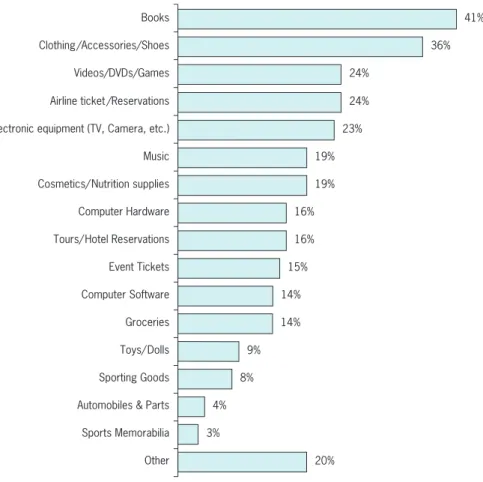
Th e list of popular online purchases shown in Figure 9-2 provides an interesting insight into the minds of e-commerce shoppers. Books and video games (ranking fi rst and third, respectively) would seem to make sense as online purchases since they can be reviewed online prior to the purchase. However, the fact that the “clothing, accessories, and shoes” category (items that typically need to be tried on prior to purchase) ranks a solid second place makes clear that for many people, the convenience of Web shopping is enough to overcome the inconve- niences of not being able to experience the items fi rst-hand.2
Event Tickets 15%
Computer Software 14%
Groceries 14%
Toys/ Dolls 9%
Sporting Goods 8%
Automobiles & Parts 4%
Sports Memorabilia 3%
Other 20%
Airline ticket /Reservations 24%
Electronic equipment (TV, Camera, etc.) 23%
Music 19%
Cosmetics/ Nutrition supplies 19%
Computer Hardware 16%
Tours/ Hotel Reservations 16%
Books 41%
Clothing /Accessories/Shoes 36%
Videos/DVDs/Games 24%
Figure 9-2 Most popular online purchases. SOURCE: Nielsen Global Online Survey, Nielsen, Jan. 2008.
300
Th is observation raises the larger question: why do people shop online? What are the benefi ts and drawbacks when compared to tra- ditional, in-store shopping? Marketers need to understand the pros and cons from the perspective of the shopper, before undertaking an e-commerce eff ort.
For many shopping, the pros of online shopping include:
Convenience
• : According to Nielson research, 81% of all online shoppers cited convenience as their number one reason for shop- ping online. Convenience goes beyond being able to shop in one’s pajamas—it includes being able to shop at any time of day, not having to wait in lines or push through crowds. In 2008, as gas prices soared past $4/gallon in most parts of the U.S., convenience also included driving less and saving on gas.
Not being bothered
• : One of the more annoying parts of shopping is having pushy salespeople constantly interrupting consumers.
Shoppers can avoid this by shopping online.
Online reviews
• : As more online stores add social media com- ponents, shoppers can read what other consumers thought of a product before making a purchase and post their own opinion for others.
Easy comparison shopping
• : Online shopping gives consumers
the ability to compare prices and features between retailers far more quickly than they could by going from store to store. Some sites have been established to provide comparison-shopping ser- vices for consumers, saving shoppers even more time.
Less expensive
• : In most cases, retailers would prefer that consum- ers purchase online, as it helps to reduce the retailer’s overhead (fewer sales people means less salary expense). To help promote online shopping, many retailers off er reduced prices for making online purchases. Th is has been particularly true and successful in the travel industry.
Personalized selection
• : When a consumer makes a purchase in
a store, that is typically the end of the transaction. Th e next time that person comes to the same store the salespeople are not likely to have any recollection of that shopper’s purchasing habits. How- ever, online searching and buying habits can be tracked, stored, and used to off er a more personalized selection.
Wider selection
• : Retail stores have limited shelf space, so they need to limit the selection they off er. Web retailers do not have to contend with shelf space issues and can therefore off er a wider selection. Plus, if one site does not off er what a consumer wants, that consumer can broaden their selection by visiting other sites.
301
No sales tax
• : Most states still do not charge sales tax for online purchases (although this is changing in some states). Th is makes it less expensive to buy products online.
Historical order record
• : If shoppers lose their receipts after a
purchase from a traditional retailer, they are typically out of luck—
especially if they used cash. When purchases are made online, however, an historical record is kept of all transactions.
Marketers also need to have a solid understanding of the aspects of online shopping that consumers might view as drawbacks to purchas- ing. Th ese can include:
Shipping payments
• : Online shoppers typically incur a shipping charge, which they would not have to pay when shopping in a store (except for large purchases, such as furniture). Shipping charges can be fairly pricey, and the quicker the desired shipping, the more expensive it usually is.
Delivery wait time
• : Online shoppers usually have to accept a lag time in receipt of material. Depending on how much they are will- ing to pay, consumers may have to wait anywhere from 24 hours to a month or more before they get their purchases. Th is is far diff er- ent than the immediate gratifi cation that shoppers get when they shop in a store and can take their purchases home with them.
Lack of a non-cash payment option
• : Cash is not an option for
online shoppers, who must pay through credit card or other non- cash methods.
Inability to experience
• : Th ere is a big diff erence between touch- ing, feeling, tasting, wearing, and trying products prior to pur- chase, and simply looking at their picture and reading about them.
Online shopping does not give the consumer the ability to try on clothes, smell perfume, or feel a texture before buying, which heav- ily reduces the product experience.
Lack of trust
• : Although online transactions are largely secure, online shoppers need to trust that their private information will not be stolen by hackers or sold by the retailer. In the case of less well-known sites, customers need to trust that they will receive their purchases in the time guaranteed (in some cases customers have to worry if they will receive their purchase at all).
Wider selection
• : How can a wider selection be both a pro and a con?
While wider selections give shoppers more to choose from, the addi- tional choices can be overwhelming. Traditional retailers, with their limited shelf space, do part of the selection work for the consumer by off ering only the best products available from manufacturers. Th is helps reduce consumers’ confusion and saves them time.
302
Unsocial
• : With social media, online shoppers have the ability to interact with other people by leaving comments on products, writ- ing and responding to blog entries, etc. Th at is still a far diff erent social experience than shopping with friends and interacting with others in real life.
Lack of assistance
• : Although sales people at traditional retailers can be intrusive, they are also available when shoppers have a question. Even e-commerce sites that have online chat (and not all do) would have a hard time providing the same level of service as traditional stores with in-person sales people.
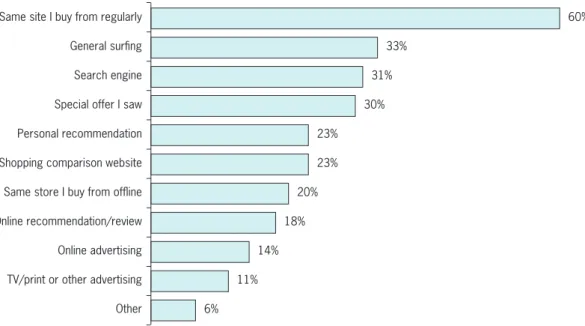
Without question, online shopping provides compelling reasons for consumers to make their purchases over the Web. In the discussion above, we touched upon the issue of selection, which can be viewed as both a positive and negative aspect of e-commerce. Th e issue of increased selection applies to the number of products off ered by stores as well as the number of stores available to a consumer. A single mall, no matter how large, can only off er as many stores as there is physical space for retailers to rent. Even the Mall of America in Minnesota (by most counts the largest mall in the U.S. at the time of this writing) can only off er a fraction of the retail options available online. As Figure 9-3 shows, there are a number of reasons why shop- pers may choose one online store over another when it comes time to make their purchases.
Same site I buy from regularly 60%
TV/print or other advertising 11%
Other 6%
General surfing 33%
Search engine 31%
Special offer I saw 30%
Personal recommendation 23%
Shopping comparison website 23%
Same store I buy from offline 20%
Online recommendation/review 18%
Online advertising 14%
Figure 9-3 A breakdown, as reported by Nielson, of how shoppers decide from which online stores to buy. SOURCE: Nielsen Global Online Survey, Nielsen, Jan. 2008.
303
Some of these answers should look vaguely familiar. Both the number one reason, “the same site I buy from regularly,” which topped the list by a wide margin, and the number five reason,
“personal recommendation,” refl ect back to our discussion of brand building in Chapter 7. For marketers, one of the most important outcomes of developing a brand is building trust among their poten- tial market base. Each time a shopper has a positive experience on an e-commerce site, which includes fi nding the information they were looking for, being satisfi ed with the prices, having a relatively easy check-out procedure, and receiving their purchases on time, they build a little more trust equity in that brand. Th at means they are more apt to revisit the site and purchase there again. Further, as that trust equity evolves into brand loyalty, shoppers are more likely to spread the word of their positive experiences to others, and that word of mouth plays heavily in helping to drive new traffi c. As we look more deeply into the specifi c means by which e-commerce sites engage their visitors and move them to purchase, it is important to consider the importance of how each shopping experience is refl ec- tive of the overall brand.
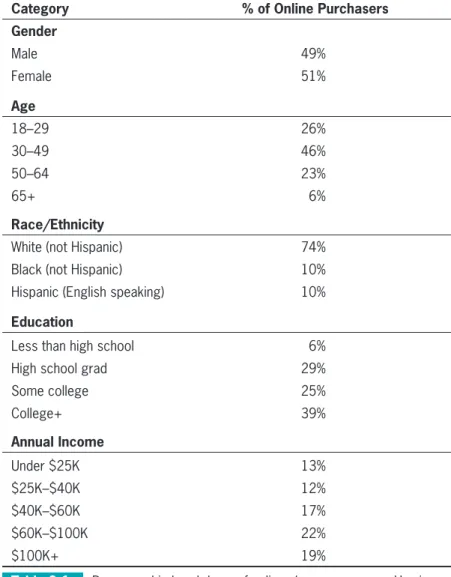
Th e demographic breakdown of online shoppers, shown in Table 9-1, is also very telling. Th is breakdown can give marketers an insight into how their specifi c audience reacts to online shopping. Whereas younger audiences are more likely to be involved in social networking sites, such as video sharing and blogging, it is the slightly older, 30-49 year-old market that is more apt to engage in online shopping—by nearly twice as much as the 18-29 year olds who have dominated the social media revolution.3 It should not be surprising, then, that people with higher yearly incomes and higher levels of education tend to be more inclined to purchase online.
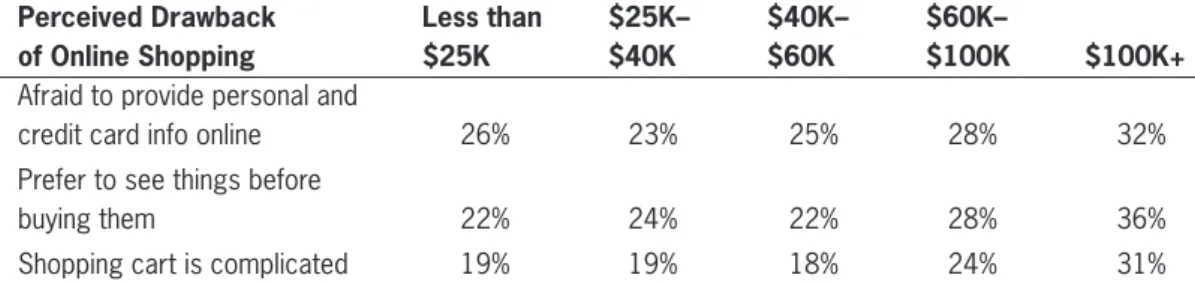
Of course, as we learned earlier, demographics are only part of the picture. Understanding the psychographic behavioral patterns and similarities is equally important. Table 9-2 presents some of the reasons that people engage in online shopping, broken down by income. Notice again how the more an individual earns, the more likely he or she is to appreciate the positive aspects of online shopping. Now compare this to Table 9-3, which shows how people react to the drawbacks of online shopping. Individu- als earning higher incomes are just as likely to be dissuaded from online shopping due to specific drawbacks. This demographic, which is more engaged in online shopping, is more likely to have their behavior more widely swayed by either pros or cons of online shopping.
Armed with this information, marketers can develop their sites in specifi c ways to deliberately appeal to key audience demographics to more eff ectively promote their products.
304
Category % of Online Purchasers Gender
Male 49%
Female 51%
Age
18–29 26%
30–49 46%
50–64 23%
65+ 6%
Race/Ethnicity
White (not Hispanic) 74%
Black (not Hispanic) 10%
Hispanic (English speaking) 10%
Education
Less than high school 6%
High school grad 29%
Some college 25%
College+ 39%
Annual Income
Under $25K 13%
$25K–$40K 12%
$40K–$60K 17%
$60K–$100K 22%
$100K+ 19%
Table 9-1 Demographic breakdown of online shoppers. S O U R C E : Horrigan, John B. “Online Shopping.” Pew Internet & American Life Project, 13 Feb. 2008.
Reason for Shopping Less than $25K– $40K– $60K–
Online $25K $40K $60K $100K $100K+
The Web is the best place to
buy hard to fi nd items 26% 23% 25% 28% 32%
Online shopping is convenient 22% 24% 22% 28% 36%
Shopping online saves time 19% 19% 18% 24% 31%
The Web is the best place to
fi nd a bargain 12% 10% 8% 8% 13%
Table 9-2 The percentage of online shoppers that strongly agreed with certain positive statements about online shopping, broken down by annual income. S O U R C E : Horrigan, John B. “Online Shopping.”
305
Sources of Revenue
While many of the site categories reviewed in Chapter 2 exist solely for the purposes of providing entertainment or information, business- oriented sites have one end goal upon which all other decisions are ultimately based—that is to generate a profi t. Without getting too deep into the business aspect of site development, profit, for our purposes, is defi ned as the diff erence between the cost of an item and the price for which it is ultimately sold. Th e cost of any given item may be made up of any number of variables, including the price of any raw materials needed, manufacturing costs, warehousing, energy costs, and salary expenses. Other costs that need to be considered are offi ce and equip- ment leases, marketing costs, shipping, travel, research and develop- ment, etc. While some of these costs might not be directly related to any one particular product (such as the salary expense for administra- tive assistance), they still represent a cost to the company and need to be recovered through the sales of product or other revenue streams.
In determining prices for products, advertising, or any other revenue stream, businesses need to consider the following:
Th e overall cost of doing business
•
Th e volume of business they expect to do
•
Th e overall demand for what they are selling
•
Prices set by competing companies
•
What the market will bear—how much are consumers willing to
•
pay for what a business is selling
How well established the brand is—the more people trust the
•
brand, the more they will be willing to pay for it
Business managers consider each of these points in setting their prices, and, because margins (the diff erence between revenue and cost) Perceived Drawback Less than $25K– $40K– $60K–
of Online Shopping $25K $40K $60K $100K $100K+
Afraid to provide personal and
credit card info online 26% 23% 25% 28% 32%
Prefer to see things before
buying them 22% 24% 22% 28% 36%
Shopping cart is complicated 19% 19% 18% 24% 31%
Table 9-3 The percentage of online shoppers that strongly agreed with certain negative statements about online shopping, broken down by annual income. S O U R C E : Horrigan, John B. “Online Shopping” Pew Internet & American Life Project, 13 Feb. 2008.
306
are often very tight, they are always on the lookout for new ways of generating additional revenue, especially if they can do so with little increase to their own expenditure.
Pricing issues can be far more complex than these points, as issues beyond the cost of doing business often infl uence pricing. Th ese issues may include the decision by one company to deliberately sus- tain a loss on the products they sell, in hopes of driving poorer com- petitors out of business, or the decision to sell one product at a loss (such as a razors) so that the company can make a larger profi t later on associated products (razor blades). Th ese issues, while beyond the scope of this book, play an important role in the pricing and promo- tion of online products and the ability to turn a profi t.
Online stores have a number of opportunities to generate revenue—
some of which (advertising, in particular) also represent revenue opportunities for non e-commerce sites, such as media content pro- viders or social networks.
Direct Sales
Direct sales represent the largest and most important revenue stream for e-commerce sites. Th e simple and straight-forward mission of an e-commerce site is to sell as many products to as many online shop- pers as possible. Products can be tangible, such as shampoo, sneakers, and groceries, or intangible, such as digital music or the purchase of a reserved seat on a fl ight. Typically, the direct sale of products is made in numbers of units, with each unit multiplied by the advertised price (three bottles of shampoo at $5 each is a grand total of $15, plus any shipping, taxes, and other charges that may apply).
Typically, consumers who purchase products do so for one of three reasons:
Th ey have a
• need for a certain type of product. Although they may switch brands from time to time, they have decided in advance that they have a need for a specifi c product (for example, a new car if their old one is dying, or a tube of toothpaste once the current one is used up).
Th ey
• want a certain type of product. Th is want may linger for a while, depending on how expensive or frivolous the product is (such as jewelry), or may be satisfi ed more quickly depending on how great the want is (such as the latest video game console). In the mind of the consumer, the decision-making process in terms of where and when to buy is less urgent because there is not an abso- lute necessity to make the purchase.
Th ey are
• compelled to buy an item at or around the time of purchase.
Some of the most valuable real estate in any traditional retailer is the
307
space near the cash register, where consumers may make last-minute purchases of items that are within their line of vision. Th ese items tend to be smaller, lower priced items, such as gum, chocolate bars, bottles of water or soda, batteries, and similar items that people are more likely to decide they want at the last moment.
A successful e-commerce company will consider each of these purchas- ing reasons in the development of its site. Because online stores do not have fl oor space for displays, salespeople to point the shopper in a spe- cifi c direction, or signage hanging from the ceiling, e-commerce market- ers have only two means of pushing their products to consumers: the page layout and a compelling presentation of their product. We will dis- cuss the set-up of the page for maximum effi ciency later in this chapter.
In the presentation of the product, marketers generally rely on three elements:
Copy, which can be used to describe the product, its attributes, its
•
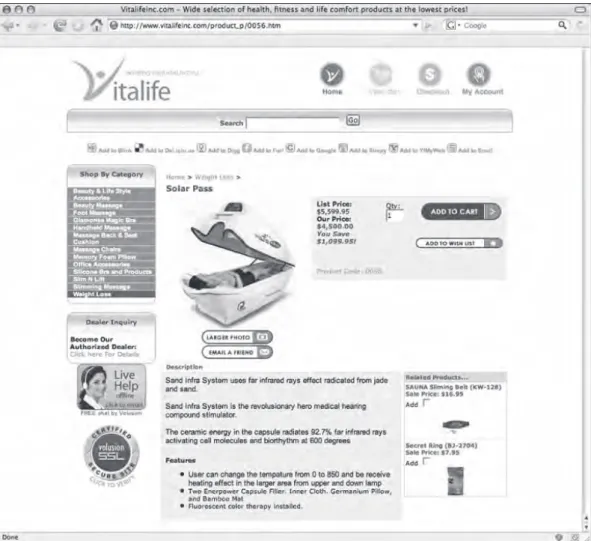
value, and any other important information that the marketer feels will be appropriate to boost sales. Copy also includes information such as the price of the product, size, weight, and other such vital info. As Figures 9-4 and 9-5 show, a small amount of copy is pro- vided upfront to entice the buyer to investigate further. As custom- ers dig deeper, more detailed copy is then presented.
Figure 9-4 This e-commerce site sells a variety of health-related products.
Notice that each product is shown with only a small amount of information—just enough to interest the shopper.
308
Pictures, which are used to provide a visual reference so that shop-
•
pers can see what they are buying. In the case of products that might be less familiar, or whose appeal might be in the way they look (picture frames or decorative candle holders, for example), marketers may decide to show the product from a number of dif- ferent angles. As with copy, smaller images, called thumbnails, are shown initially, and larger images are often provided upon further consumer investigation. Other times, application shots are pro- vided to show how the product might look in its fi nal environment or when being used by a representative consumer. Figures 9-6 through 9-8 provide examples.
Figure 9-5 Once a shopper investigates a particular product more closely by clicking on it on the previous page, the store provides more information, including a detailed product description and a list of features.
309
Figure 9-6 This page of the e-commerce site Ecomowers shows thumbnails of products to give shoppers a preview of what the products look like.
310
Figure 9-7 Once a product’s thumbnail is clicked on, a larger picture of the product is shown. Notice that below the main image are other thumbnails of the same product shot from different angles.
311
Video of the product is sometimes used to demonstrate how the
•
product works, market its benefi ts, or generally build excitement for the product. As we discussed in Chapter 5, online videos can increase audience retention time—a big benefi t to e-commerce marketers who want to keep audiences on their site for as long as possible while providing them with valuable and engaging product information.
By eff ectively managing the presentation of products, e-commerce marketers can capture their audiences’ attention, feed them the nec- essary information, and potentially drive them to take action.
Figure 9-8 When a shopper clicks on one of the smaller thumbnails of the product shown from a different angle, that image is enlarged to provide greater detail.
312
Indirect Sales
E-commerce marketers fall into one of two categories: those that are an extension of traditional offl ine retailers (such as American Apparel, Sears, and Target), and those that are their own entity and do not have an offl ine component (such as Amazon.com and CafePress.com). Sites without an offl ine component need to secure sales from visitors to their sites, either on current or future visits, in order to generate revenue. E-commerce sites that also have an offl ine retailing extension, however, may serve as a point of research for shoppers to investigate products, promotional off ers, and in-stock inventory before going to the retailer and making their purchases offl ine. According to a February, 2008 report by the Pew Internet &
American Life Project, 81% of Internet users have used the Web to do research on a product they are considering purchasing—and a full 20% do this type of research on a daily basis. Th is means that while online shopping rates are defi nitely growing, e-commerce stores are even more eff ective in helping to increase sales at offl ine entities.
Th e importance that Web-generated information has in the decision to buy increases as the value of the product (such as a home) or the weight of the commitment (such as a long-term cell phone contract) increases.
The relationship between offline and online information in a customer’s purchasing decision can be far more complex than a shopper sitting down to review product information online before going to a store and making a purchase. For example, a consumer watching a movie sees one of the main characters using a new Apple laptop model in one of the scenes. He goes home and jumps online to visit the Apple store where he finds more infor- mation about that particular laptop. The detailed information, images from different angles, and streaming video pique his inter- est even further, but rather than buy it online, he decides that he wants to try it out first. He uses the store locator feature on the site to find the closest Apple store, the hours that it is open, and directions to the store. Once there, armed with information gathered from the site, the consumer discusses the computer fur- ther with a live sales person who shows him even more features, talks about programs that the consumer should also consider, and explains insurance policies that are available to protect the purchase in case of malfunction. In the end, the consumer makes his purchase, but only after the combination of media, online information, and offline interaction work together to make a compelling case. The epilogue to this story, in some cases, is that the shopper will later post his review of his new laptop on a social shopping site.
313
Paid Memberships and Subscriptions
Some e-commerce sites sell paid memberships and subscriptions as well as (or instead of ) actual physical products. Typically, these subscriptions are for information or usage that can be accessed on a Web site only after payment has been made. Dating sites such as Match.com or eHarmony give users limited access to see other users’ profi les, but require a monthly payment in order to contact people. Figure 9-9 shows a page from the Marketwatch.com Web site, which provides free stock- related news and information, with the exception of highly detailed and in-depth investment newsletters, which are available by subscrip- tion only. Figure 9-10 shows the subscription page from the JDate.
com online dating service. Th is page pops up when a non-paying user tries to contact another user on the site. Interestingly, while only 17%
of Web users have purchased a membership or subscription for online content4, this is the one area of e-commerce where younger users eclipse older users, and men are far more likely to be customers than women.
Figure 9-9 Although most of the Marketwatch.com Web site provides free investment information, paid subscriptions offer more in-depth and expert information.
314
Paid online subscriptions are often tough sells, but they can provide a strong revenue stream. Subscriptions are an ongoing source of income, and the Web site owners typically do not continually incur new costs associated with the subscription. Th e downside is that savvy Web users can often fi nd similar subscription-based informa- tion or services elsewhere on the Web (social networks, for example, can be used for dating purposes and are usually free), so market- ers have to make a compelling case for why a user should pay every month or year for a particular service.
Figure 9-10 The online dating site JDate.com allows users to post a profi le and search other user profi les for free, but this subscription screen shows up as soon as a non-paying user tries to contact someone else on the site.
315
Advertising
Although not typically the primary source of revenue for e-commerce sites, online advertising can still provide a strong revenue stream to marketers. Often, this advertising may not be transparent to the online shopper. Big box retailers, for example, may receive co-op dol- lars (money that manufacturers provide to retailers as an incentive to advertise more aggressively or in specifi c ways) in exchange for giving certain products better placement on a page or running promotions through the retailer’s site. Figure 9-11 shows the bottom part of the Target site, where the Jell-O brand is more heavily promoted due to co-op dollars provided by the manufacturer.
Figure 9-11 The bottom of the Target site features the Jell-O brand front and center, generating co-op revenue from the manufacturer for better, more visible page placement.
In addition, some e-commerce sites may allow banner ads or other ads from outside sources, although this is not a common practice.
316
Shopping on the Social Web
While the basic premise of shopping in a social media-focused World Wide Web is the same as shopping online in the early days of the Web’s commercialization (i.e., consumer logs on, fi nds the products he or she is looking for, and makes a purchase), there is no question that e-commerce has gone through a maturation process. Th e Web now off ers a far more sophisticated shopping experience. Th e advent of social media tools has had a signifi cant impact on changing the online shopping experience, and any study of e-commerce needs to be done with these tools in mind. Specifi cally, consumers expect the online stores they purchase from to go beyond simply off ering prod- ucts to buy. Customers expect Web sites to create an intimate envi- ronment with personalized service and peer-to-peer communication tools to aid product research and allow avenues of honest feedback.
The Store Layout
How an online store is laid out will play a large role in the actions that shoppers take while shopping online. Here, organization is the key.
Th ere is no fl oor expanse, no store clerk, no shelves or aisles. Th ere is simply a Web page. Th e shopper is only able to get as much informa- tion as can be seen on his or her computer monitor at any given time.
With this understanding, e-commerce marketers need to design and organize their online stores to do the following:
Spotlight specifi c items that the marketer wants to sell, either
•
because they produce a greater profi t, there is an overstock, the manufacturer has paid for the item to be more heavily promoted, or some other such reason.
Promote other saleable items to entice the consumer to make
•
specifi c purchases.
Lead customers to other non-product promotional areas (such as
•
pages where a person can sign up for a credit card or newsletter).
Provide clear and uncomplicated navigation that organizes
•
products into categories (much like the aisles of a supermarket).
Remember—if the shopper cannot fi nd a product, then he or she cannot buy it.
Off er easily accessible help, whether through live chat, e-mail, or
•
another method of contact.
Give easy access to the shopper’s account information.
•
Present a shopping cart that can be easily accessed at all times for
•
item inclusion, removal, or purchase.
317
As discussed earlier, the most valuable space on an e-commerce site (or any site, for that matter) is the Home page above the fold. Th is is the area that will garner the most attention. Marketers pay particular attention to how this space is presented, because it is the most pivotal point of consumer decision making, and it will typically determine whether or not a person explores the site further or shops elsewhere.
Figure 9-12 shows the Home page of BJ’s, the big box retailer, with each of the important elements listed above pointed out.
Spotlight on specific items that the marketer is more anxious to sell Navigation, breaking the products down into categories
Access to account info Access to shopping cart Access to shopping help
Non-product promotions
Visible promotion of other important saleable items
Figure 9-12 The layout of the BJ’s e-commerce site highlights important products, while also providing access to non-product information, account info, shopping cart, and help.
318
The Shopping Cart and Check-Out Process
No matter how compelling an online store is, most customers will not buy if they cannot easily make their desired purchase. Every store needs a shopping cart and check-out process that is as effi cient and painless as possible.
Just as it would in a supermarket, the shopping cart on an e-commerce site holds the items that the consumer wants to purchase. It will calcu- late the price times the quantity of each item, add all the items in the shopping cart together, and maintain a running total of all of the items being purchased. A well-organized site will give the user access to his or her shopping cart at all times to review their intended purchases, and a well-executed shopping cart will allow products to be removed as easily as they are put into the cart. Figure 9-13 shows a sample shopping cart from Amazon.com.
Figure 9-13 The shopping cart on Amazon.com. Like any quality shopping cart, this one shows the shopper the item(s) they have already selected and calculates the subtotal based on the price multiplied by the quantity.
319
As the fi gure shows, the shopping cart area of an e-commerce site can be one of the best opportunities to increase sales. Once an item has been placed into the cart, marketers understand that the consumer has already, at least in part, made a decision to purchase that product. Th e area around the cart gives the marketer a chance to off er a consumer related products or entice customers with discounts if they order more.
Notice that in Figure 9-13, the large banner across the top off ers a sav- ings if the consumer signs up for the Amazon.com Visa card. Directly above the shopping cart, the light bulb icon off ers the chance to see items that are similar to the one currently in the cart. Off to the right, a small display ad prompts the consumer to purchase $15.01 more to qualify for free shipping. Th e remainder of the space around the cart is dedicated to showing featured items that may be of interest to the consumer—based on what is currently in the shopping cart and what other consumers that have bought the same item have also purchased.
Once satisfi ed with their order, the consumer then goes on to make their purchase—possibly the most precarious part of the online buying process. According to a 2007 report by DoubleClick, nearly 75% of all online shoppers abandon their shopping carts before making the fi nal purchase. Th ere are a number of reasons why con- sumers abandon their orders at this stage:
Th e process is too long, confusing, and cumbersome. Shoppers
•
understand that there are steps that need to be taken, but if the process is too long or broken into too many steps, the marketer runs the risk of losing the consumer’s interest.
Th e site requires too much personal information. Marketers need
•
to balance the desire to gather as much consumer information as possible with the reality that many people will resist giving per- sonal information (such as a phone number) that is not relevant to receiving their order.
Th e marketer adds too many extra charges to the sub-total before
•
fi nal check-out (such as heavy shipping costs, excessive handling fees, etc.).
Th e page layout of the shopping cart and/or the check-out process
•
is poor and disorganized, causing the consumer to question the legitimacy of the site overall. Page design for the check-out process is extremely important, as a disorganized check-out will lead users to feel that the store itself is disorganized.
Th e brand has not built up enough trust with the consumer to
•
encourage them to take the risk and purchase the product online.
Th ese last two points are especially important and refl ect back not only on early discussions of site design, but also on the importance of building the brand. Recall that building the brand is equivalent to 320
building trust—an important element when you consider that 75%
of all Web users do not like to give sensitive personal and credit card information over the Web.5 However, if this population felt more con- fi dent about the security of their information—if they trusted the site or the brand—the amount of people who would use e-commerce as a means of making regular purchases would increase by a full 7%.6 Th is is a signifi cant increase that could potentially push millions more dol- lars into the pockets of online marketers through e-commerce sites.
At a minimum, a successful check-out system needs to gather the following information:
Th e shopper’s shipping address (where the items should be
•
delivered)
Th e method of payment; Web sites typically off er a variety of
•
options, including:
Credit or debit card
•
Electronic check (this pulls funds directly from the shopper’s
•
checking account and requires customers to provide their per- sonal checking account information)
Payment from a third party facilitator, such as PayPal; shoppers
•
can move funds into their PayPal account and use those funds for online payments without having to give sensitive credit card or checking account information to a number of diff erent vendors Payment from an invoice sent to the customer; this is not a popu-
•
lar choice, as Web sites typically will not ship items until after pay- ment has been received.
Th e desired shipping method (faster shipping options, like over-
•
night delivery, are usually more expensive)
Th e billing address, if the shopper intends to pay by credit or debit
•
card, or electronic check (this is for security purposes)
Shipping can be a sticking point for many shoppers, and the shipping charges (a cost that shoppers do not have to incur if they go directly to the store) can quickly turn online shoppers away. In fact, of the 75% of shoppers that abandon their shopping carts, 72% did so because the shipping rates were too high.7 Savvy marketers will use clever promo- tions that eliminate shipping costs altogether if the consumer agrees to make purchases over a pre-set amount.
Once all of this information has been submitted, e-commerce sites typically allow the shopper to review all of the information that they have submitted, the list of items ordered, and the grand total one last time. Customers will usually have an opportunity to edit any errors
321
or make changes before fi nalizing the order. Figure 9-14 shows the pre-purchase summation page on Amazon, which provides the grand total for the order, the products that are being purchased, their quan- tities, the shipping and billing addresses, shipping method, and how the order will be paid for.
Figure 9-14 The pre-order summation page on Amazon.com gives shoppers the ability to review their order and their account before placing the fi nal order.
322
Upon completion of the order and processing of the payment, effi - cient e-commerce sites provide a printable receipt. Most sites then send an e-mail to the shopper thanking them for their purchase, summarizing their order, and providing a tracking number for the shipment.
INTERVIEW WITH...
Kevin Sproles: Founder of Volusion.com
In 1999, Kevin Sproles turned his passion for coding and designing shopping carts and Web sites into Volusion.com, one of the larg- est and most successful e-commerce providers on the Web. (See Figure 9-15.) Volusion software is the engine behind online stores across a large number of industries, and brands, including the offi cial store for the well-known candy brand Pez (Figure 9-16) and Barack Obama during his 2008 presidential run (Figure 9-17). Volusion’s success has been so great that BusinessWeek named Kevin among their “Best 25 Entrepreneurs under 25.”
Kevin was good enough to spend some time talking to me about his take on e-commerce, the issues that marketers face reaching their audiences, and what he sees as the future of the online shopping.
Jason: Thanks for talking with me, Kevin. Tell me a little bit about Volusion and how you got started programming shopping carts?
Kevin: I started programming back when I was in high school and was about 16 when I started Volusion. I started programming Web sites in general. Th en I realized that there are a lot of people that really need a shopping cart, so I built the fi rst version of Volusion. It had obviously a very small client base, so we really listened to what our clients needed and grew from there, one client at a time. Now Volusion has over 20,000 customers.
Jason: Tell me more about the Volusion site, how it works, and who it is meant for.
Kevin: Sure. Clients pay us a low monthly fee and they get every- thing they need to build and run an entire online business. We provide the software that they use to build their Web site with a par- ticular focus on online stores. So they use our software, which builds their Web site with a shopping cart, the one page check-out system, everything they need to accept payments and to sell their products.
We also do a lot of their hosting, and we give them a lot of tools for Internet marketing.
323
Jason: Talk to me about some of the online marketing tools.
Kevin: One of the important things for a low budget is that the Web site is SEO [Search Engine Optimized] and our software has a lot of built-in methods that help you link well. Your pages, for example, have to be in a certain format that is attractive to Google and all the other search engines. We also put all the right words in your title tags, which gets you linked well through search engines.
I also suggest that store owners get involved with e-mail marketing and even partnering with similar Web sites for cross-promotional purposes.
Jason: As an expert in e-commerce, what advice would you give to a storeowner for increasing sales and discouraging cart abandonment?
Kevin: Well that’s all about the usability of a site. You want to make sure that the site is easy. So, for example, say you’re selling a pair of shoes or another product where people are going to need to not only settle on a design and style, but also on a specifi c size.
Th e site needs to allow users to fi lter out search responses by your desired shoe size. Having those kind of features makes it easier for a person to fi nd what they want, which is really important. Volu- sion stores also get to use a feature that zooms in on a product when the user rolls over it. So if you roll over a shoe image, for example, the photo will magnify the image, give the user more details about the product, and provide other information that will help increase the confi dence of the customer. Once you’ve gained the consumer’s confi dence, store owners should encourage them to add reviews to their store about the products they buy, which encourages other people to buy.
In terms of cart abandonment, that mostly comes down to ease of check-out. Th e research we’ve done is that one page check-out, which we use on Volusion stores, reduces cart abandonment. In the past, people had to go through up to fi ve pages on average to check out and make their payment. But, we came up with the one page that includes fi lling out all vital information, making the payment, and hitting the Submit button. Now you’ve captured the customer, and after the sale, store owners should do some e-mail marketing to keep bringing that customer back.
Jason: You mentioned consumer confi dence. When I think of con- sumer confi dence, I think of brand building. When it comes to online marketing and online store ownership, how important is it for a store- owner to build their brand?
324
Kevin: Making sure that your Web site presents a strong brand is really important. You can do that in a lot of ways. Having an organized, attractive Web site is one of the keys—most people decide from the moment they come to your Home page whether or not you’re a reputable company just by the look and feel. They also can tell that once they get into the check-out page. If that check-out is too confusing or difficult the brand is going to look incompetent. It’s also important to provide some information about the store and the brand behind it, such as an “about us”
page with a company history, contact information—anything that legitimizes the brand in the mind of the consumer and gains their trust.
Jason: You also mentioned encouraging customers to leave reviews on products. That gets us into social media. In your opinion, how is online shopping evolving given the social media environment?
Kevin: Well, social media has quite a large array of defi nitions. One perspective is about the usability and how social media makes online shopping easier to use. It can put a store owner off balance, of course, because customer reviews aren’t always going to be positive. But, the ability for consumers to voice their opinion about a product or brand is great, and it’s defi nitely had a big impact on online shopping. A lot of people look at reviews—whether on a shopping-specifi c site or just generally on the Net like in the blogosphere.
Jason: Predict the future for me. How is e-commerce going to evolve moving forward?
Kevin: It’s going to become infinitely more convenient. In the past five years, we’ve seen that convenience improve, and over the next five years it’s going to be that much more impressive.
It’ll be cheaper, more mobile, and it’ll be the single most impor- tant means that consumers find products and information that they need.
325
Figure 9-15 The Volusion home page 326
Figure 9-16 Popular candy brand PEZ uses the Volusion software as the foundation for their online store.
327
Intuitive and Personal Content Provision
Online stores can off er a benefi t that traditional offl ine retail outlets can rarely do: retain an intimate knowledge of each and every customer.
Armed with this knowledge—which is housed in massive databases—
marketers can gain a signifi cant advantage by arranging the home page of their stores in such a way that the products off ered are the products most likely to be desired by individual customers.
Th e psychology behind personal content provision is fairly simple:
A male shopper who has visited a sporting goods site twice before to browse the fi shing equipment on the site is more likely to be driven to action if, on his third visit, the Home page features the store’s new line of fi shing polls or a weekend fi shing trip rather than a line of women’s tennis sneakers.
Similarly, by understanding where, geographically, a user’s search is taking place, online marketers can run purposeful promotions to encourage increased sales. Geotargeting, which is the practice of Figure 9-17 Barack Obama’s store during his 2008 presidential run also used Volusion software for its store and shopping cart.
328
defi ning of a target audience based on their geographical location, is often used by marketers to off er specifi c options. Based on the user’s IP address, a marketer may determine that a shopper is located in Venice Beach, near Los Angeles. When summertime approaches, the products they push on their home page may be beach-related—sun screen, beach towels, surfi ng gear—while a shopper in Denver, shopping at the same online store, is off ered products that are not beach-related.
However, suppose that same Denver shopper searches the store while poolside during his vacation to Orlando. Th e store understands who the shopper is, but, because the IP address is diff erent, it also now knows that the shopper is on vacation. Th e site would then likely off er diff erent products, such as discount tickets to a local theme park. If the e-com- merce store has a mashup application, it could tap into Google Maps, and provide directions to that theme park or connect with the site for a local bus company to provide information on public transportation.
Th ese methods provide both improved service as well as help increase the potential for increased spending. In addition, personalized atten- tion helps to increase consumer trust in the brand, as it shows tech- nological legitimacy. It also helps to create a stronger, more personal one-to-one connection.
Feedback and Reviews
Th e social Web has allowed people across all boundaries to interact and provide opinions. Consumers, saturated with marketing, have come to realize that advertising, whether in print, on TV, or on the Web, is a one-sided message, written and produced from the mar- keter’s perspective. While these ads are useful in communicating a message, building brand awareness and promoting the brand’s per- sonality, they are rarely a means of establishing trust.
Consumers are more apt to trust their peers than they are to trust marketers—even if those peers are faceless, nameless, and similar only in the sense that they have similar buying habits. With the popu- larization of social media, e-commerce stores are increasingly com- pelled to allow users to communicate their feelings about individual products. Th ese opinions are typically expressed in two ways:
Ratings
• : Users can rate a product or media (such as downloadable songs or movies), usually on a one to fi ve scale, with a fi ve rating being the best. Each person’s individual rating is usually displayed along with the average of all the ratings.
Reviews
• : Users are allowed to leave their reviews of the product or media, expressing their opinions in their own words, whether posi- tive or negative. Many stores will also allow other users to digitally appeal certain reviews by letting readers rate each review as help- ful or not helpful or by fl agging reviews for removal if they feel one
329
Figure 9-18 provides a sample of a product on Target.com. Notice how the site provides the average rating, along with individual cus- tomers’ ratings and reviews and other users’ feedback as to the help- fulness of those reviews.
Figure 9-18 The customer review area for a product on Target.com. The average review rating is shown directly below the product picture, and full reviews are shown a bit lower. Each review also shows how many other shoppers found that review helpful.
330
According to the Pew Internet & American Life Project, a full third of all online shoppers have posted reviews about a product after they have purchased it.8 This is a significant level of involve- ment by online shoppers. This statistic paints a picture of how personal the relationship between brands and consumers really is. It also illustrates how important it is for shoppers to have a voice in the future use (or disuse) of the products that are on the market.
Chapter Summary
E-commerce is used by consumers across practically all demo-
•
graphic boundaries, although adults over age 30 and with higher annual income are more apt to make use of e-commerce tools.
Brand and trust equity play a large role in shoppers’ decisions about where to make their purchases. Th ese factors are especially important to customers because concerns about providing sensi- tive information are often a deterrent to shopping online. While there are many pros and cons associated with shopping on the Web, convenience, time savings, and the potential for lower prices are among the biggest reasons why consumers look to the Web to buy their products.
E-commerce marketers generate revenue online in a variety of
•
ways. While direct sales are the primary means of turning a profi t, other avenues also exist. Th ese include indirect sales in the case of consumers visiting an online store to do research before making their purchases at an offl ine store, the sale of membership sub- scriptions, and advertising.
The way an online store is designed is the key to whether or
•
not marketers can move their shoppers to take action. With limited real estate, e-commerce stores need to promote their most important products up front, give consumers access to other key products, and divide all products into easily acces- sible categories. Marketers can also increase sales through the use of social media applications such as the ability for users to leave and read product reviews, personalizing each store visit based on the individual consumer’s shopping history, and making the cart and check-out process as easy and trustworthy as possible.
331
Key Terms
e-commerce—Th e buying and selling of services through any elec- tronic medium.
geotargeting—Th e practice of defi ning an audience based on their geographical location.
margin—Th e diff erence between revenue and cost.
profit—Th e diff erence between the cost of an item and the price for which that the item is ultimately sold.
thumbnails—Small images that represent a larger image on a Web site.
Review Questions
1. Which of the following is more likely to make a purchase over the Web?
A 19-year-old male, earning $30,000 per year a.
A 21-year-old woman with a college degree b.
A 28-year-old man with a college education c.
A 48-year-old woman earning $99,000 per year d.
2. Which of the following regions of the world is least likely to make a purchase online?
North America a.
Latin America b.
Asia Pacifi c c.
Europe d.
3. Th e popularity of clothes and shoes being purchased online is surprising because:
Fashions change faster than sites can be updated a.
People cannot try them on prior to making a purchase b.
Th e government charges higher taxes for clothing c.
Most people are not interested in clothing d.
332
4. What percentage of online shoppers is likely to leave a review about a particular product after they have purchased it?
33%
a.
50%
b.
72%
c.
92%
d.
5. According to 81% of all online shoppers, the main reason for shopping online is:
Rising cost of gas a.
Not being bothered by a sales person at the store b.
Convenience c.
Lower prices d.
6. Th e main reason shoppers will abandon their carts without making a purchase is:
Th ey do not want to wait for delivery a.
Th ey get a phone call that knocks them offl ine b.
Th ey read a bad review of the product c.
Th ey do not want to pay the high shipping costs d.
7. Increased selection is:
A positive aspect of e-commerce a.
A negative aspect of e-commerce b.
Neither c.
Both d.
8. Trust equity in the brand plays an important role in which store people choose to buy from. True or False?
9. People with lower incomes are more likely to see the positive attributes of online shopping. True or False?
10. Which of the following does not usually need to be considered when determining the cost of a product?
Prices set by competitors a.
Th e anticipated volume of sales b.
333
How nicely designed the packaging is c.
How well established the brand is d.
11. Which product would retail shoppers most likely feel com- pelled to buy without too much thought before purchase?
A new car a.
Light bulbs b.
Th e latest Elvis Costello CD c.
A pack of gum d.
12. As online shoppers do further research (navigate into lower tiers) on a specifi c product on a Web site, they will fi nd that the amount of copy on a page typically:
Increases a.
Decreases b.
Stays the same c.
13. As online shoppers do further research (navigate into lower tiers) on a specifi c product on a Web site, they will fi nd that the size of product photography on a page:
Increases a.
Decreases b.
Stays the same c.
14. Marketers with traditional, offl ine retail locations have an advantage over retailers that are only online because:
A signifi cant number of shoppers use e-commerce site to a.
do research but make their purchases offl ine Traditional locations can usually off er lower prices b.
People usually enjoy being approached by live salespeople c.
Fewer people can fi t into an offl ine store, so they are d.
promised better attention
15. Which of the following is more likely to be purchased online?
A subscription to an online humor magazine a.
A new fi ction book b.
334
A ticket to Europe c.
A pair of sneakers d.
16. Th e most important real estate on a shopping site is:
Th e space directly next to the brand logo a.
Th e bottom of the page b.
Th e area of the Home page above the fold c.
Th e area of the Home page below the fold d.
17. Th e shopping cart is a good place to try to increase sales.
True or False?
18. If the check-out process is too long, consumers are most likely to:
Struggle through it, but leave a nasty review about their a.
experience somewhere Abandon their cart b.
Leave the site for a while and fi nish their purchase later c.
Shop for more items—if they have to go through a long d.
check-out process, they may as well buy more
19. Which of the following is the least common method of paying for products online?
Credit card a.
Debit Card b.
Electronic check c.
Being billed for the items d.
20. Online product ratings are usually done on a scale of:
1 to 3 a.
1 to 5 b.
1 to 7 c.
1 to 10 d.
335
Projects
1. One of the topics we discussed in this chapter was how important it is for shoppers to feel safe and secure when providing sensitive personal and credit card information.
Research the ways that e-commerce sites provide this security and detail them in a paper no longer than three pages.
2. Choose an online store and spend some time exploring it. In a two-page paper, describe your experience. Make sure you dis- cuss the positives and negatives, how easy it was to fi nd infor- mation, and any methods the marketer took to compel you to buy. Would you make future purchases from that store? Why or why not?
3. Using pretend products (copy some images off of your favor- ite online store), program and design the home page of your own store. You do not need to build a working shopping cart, but create the page in such a way that it would interest shoppers.
4. In a three-page paper, detail how you designed the site in Project #3.
Why did you design it the way you did?
•
Who do you consider your target audience?
•
What steps did you take to make that audience buy from
•
your store?
Endnotes
1. Nielsen Global Online Survey, Nielsen, Jan. 2008.
2. Ibid.
3. Horrigan, John B. “Online Shopping.” Pew Internet & American Life Project, 13 Feb. 2008.
4. Ibid.
5. Ibid.
6. Ibid.
7. Ibid.
8. Ibid.
336