EMPLOYMENT
INTRODUCTION
The gaps between women and men in economic participation and compensation are seen around the world and hold the global economy back from increased development, while also keeping women at a social disadvantage (Organisation for Economic Co-operation and Development [OECD], 2012, p. .74).
THE LACK OF GENDER PARITY IN EMPLOYMENT
Another problem with women's economic participation is the segregation of women into certain employment sectors (OECD, 2012, p. 76). Participation rates of young children in formal childcare are also related to the wage gap (OECD, 2012, p. 89). Furthermore, 38% of the productivity gap can be explained by lower capital intensity in women-owned firms (OECD, 2012, p. 132).

THE BENEFITS OF EMPLOYMENT EQUALITY
When women are not given the same employment opportunities as men, the economic prosperity they could create is neglected (World Bank, 2011, p.3). Women's agency is influenced by economic development and a woman's ability to participate in economic prosperity by earning her own income, thereby increasing her bargaining power in a household and obtaining her own personal assets (World Bank, 2011, p.150). When household income increases as a result of men's increased earnings, it turns out that the effects of women's freedom of action decrease (World Bank, 2011, p.153).
The assets a woman owns give her greater freedom to manage to leave a marriage and invest in her own financial opportunities (World Bank, 2011, p.154). Also, women who have a higher contribution to the household income are less likely to be victims of domestic violence (World Bank, 2011, p.154). For example, in the USA, women's wages account for 10% of the observed reductions in domestic violence (World Bank, 2011, p.154).
Furthermore, women who are incorporated into the economy can benefit from expanding their social networks and increasing their connections to people outside their household and family (World Bank, 2011, p.155). Firstly, agency is important in itself, because people's ability to make decisions about their own personal lives is important (World Bank, 2011, p.151).

CONCLUSION
Knowledge stocks are defined as "accumulation of productive information in the form of education and technology" and quantified as the amount of patents per inhabitant and the proportion of the population that acquires a secondary or secondary education (Bauer et al., 2006, p.2). The researchers recognize the endogeneity of these factors, which means that income can result in an increase in the amount spent on education and technology (Bauer et al., 2006, p.4). The study uses statistical analysis to establish a causal relationship between female education and increased longevity (Bundy et al., 2018, p. 212).
Furthermore, the study found that under-five mortality decreased by 4.2% with a one-year increase in female education (Bundy et al., 2018, p.215). Returns were assessed as a multiple of the average years of increased longevity due to female schooling (Bundy et al., 2018, p. 220). The value of health-related improvements due to female education was then added to the original returns of female education to calculate a new IRR (Bundy et al., 2018, p.218).
The returns were then divided into different categories based on each country's education level and income (Bundy et al., 2018, p.218). When female education rates are higher, adolescent fertility is lower (Bundy et al., 2018, p.191). These interventions are designed to increase women's access to school and are part of improving women's completion and participation rates (Kwauk et al., 2016, p. 149).
Furthermore, girls are particularly vulnerable to gender-based violence more than their male peers (Kwauk et al., 2016, p. 152).
EDUCATION
INTRONDUCTION
DISADVANTAGES IN FEMALE EDUCATION
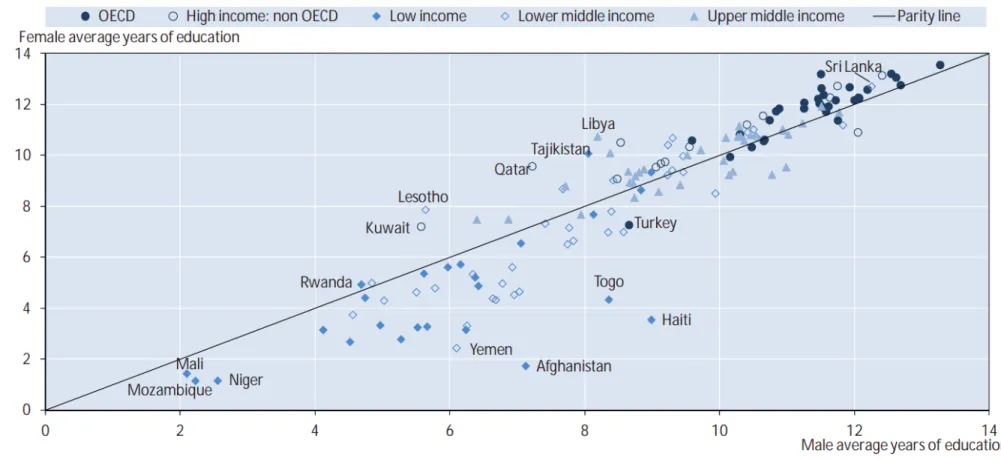
On average, women enroll and complete less primary, secondary and tertiary school than men (World Economic Forum [WEF], 2012, p.6). A survey conducted by the World Economic Forum (WEF) (2017) analyzed and scored all countries for which data was available for gender equality in terms of literacy, primary, secondary and tertiary school enrollments (p.6). Using gender equality scores in literacy, primary, secondary and tertiary education enrollments, each country was then given a composite weighted average4 gender equality in education score (WEF, 2017, p.12). Of all countries worldwide, Chad was the country that scored the lowest in terms of gender equality in education, with a score of 0.572 (WEF, 2017, p.12).
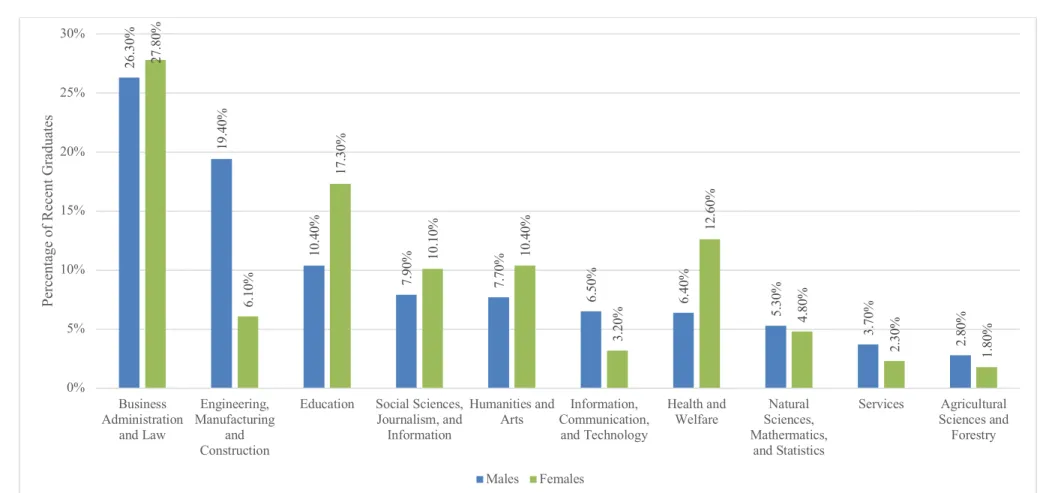
Nevertheless, inequality in education is not an insignificant issue, as there are large differences that exist in many countries (WEF, 2017, p. 6). In countries with higher levels of gender equality in educational attainment, there is still a large gap in the types of education women and men have (WEF, 2017, p. 35). In addition, communication and technology account for 6.5% of male graduates, which is more than double the 3.2% of female graduates (WEF, 2017, p. 32).
For example, it has been found that women in many countries are limited in their access to technology and therefore do not develop skills or interest in technological fields (WEF, 2017, p.31). Such discriminatory factors relate to the likelihood that girls and women will pursue education in certain fields (WEF, 2017, p.31).
ECONOMIC IMPACTS
Montenegro and Patrinos also found that as the average education level of the population increases, the private returns to schooling decrease (Montenegro & Patrinos, 2014, p.13). To understand this problem, Bundy et al. 2018) use data from countries around the world to try to understand and quantify the health-related economic impacts of increased female education (p.218). The study compares the education level of different countries and the effects that education level has on health variables, while controlling for time, technological progress and income (Bundy et al., 2018. p.212).
However, the effect of one additional year of male schooling was found to be insignificant on any mortality rate in the study (Bundy et al., 2018, p. further quantify the health benefits of increased female education to include in the original return estimates education (p. 218).For example, if a country had an average of five years of schooling for women, returns were calculated based on improvements in health outcomes associated with five years of schooling for women (Bundy et al., 2018, p. 218). Benefits also existed for lower- and upper-middle-income countries, providing a 2.3% and 1.7% increase, respectively, as measured in Table 2-2 (Bundy et al., 2018, p.220) .
Reduced teenage fertility leads to reduced maternal mortality, because teenagers have a five times higher risk of dying during childbirth (Bundy et al., 2018, p.191.). Furthermore, young people often have more complicated births that require a significant outlay of cash, which can be devastating to an already poor family (Bundy et al., 2018, p. 191). Using the countries of Niger and India, Bundy et al. 2018) quantify the impact of an extra year of education on the rate of teenage fertility and the subsequent improvements in impoverishment and maternal mortality (p.192).
It is estimated that if every girl received one additional year of schooling, it would cost $15 million in Niger, home to around one million adolescent girls, and $3 billion in India, with 58 million adolescent girls (Bundy et al., 2018, p.195 ).
COUNTERARGUMENTS
Main goals that have been shown to lead to improving women's educational attainment are to increase the affordability and accessibility of school and create more inclusive and safe school environments (Kwauk et al., 2016, p. 104). Across the globe, primary, secondary and tertiary education costs are not always fully subsidized by government, leaving families to cover tuition, books, uniforms and other opportunity costs of education (Kwauk et al., 2016, p.107). In addition to the physical barrier that distance creates to schooling, it also creates a social barrier for children who must travel outside their home communities to attend school (Kwauk et al., 2016, p. 141).
Small schools within the communities they serve help create a partnership between the school and the community and increase the participation of community members and parents (Kwauk et al., 2016, p. 141). In Bangladesh, small community schools were created to increase enrollment and help children transition to larger schools outside their community (Kwauk et al., 2016, p. 142). Steps must also be taken to eliminate violence (physical, sexual and psychological) against women in and around schools (Kwauk et al., 2016, p. 152).
Sexual assault in and around schools is common in many societies with many women being abused in exchange for better grades (Kwauk et al., 2016, p. 152). More research and implementation needs to be done to fully understand the implications and methods of ameliorating violence against women in schools (Kwauk et al., 2016, p. 160).

FACTORS THAT IMPEDED EDUCATIONAL PARITY
SOLUTIONS
Both the financial and opportunity costs of education affect the likelihood that a family will send their children to school, and boys are often favored over girls (UNESCO, 2018, p. 48). To address this issue, bursaries, bursaries, cash transfers, and tuition waivers were introduced to try to alleviate the financial barrier to female education (Kwauk, 2016, p. 108). Another intervention in Bangladesh established a scholarship for women that covered tuition and books, uniforms, supplies, and transportation if the girls attended regularly, achieved minimum grades, and did not marry while in school (Kwauk et al., 2016, p. 114). . .
In Zimbabwe, providing a stipend for school fees and supplies for orphaned girls reduced the dropout rate of participating girls by 50% (UNESCO, 2018, p.48). Increasing the accessibility of schools by reducing the time needed to get to school and the distance to school has proven to be a particular advantage. By building 2,000 new primary schools in Egypt's rural areas, the country has increased the number of female students in rural primary schools by 60% and increased the overall share of female students from 35% to 42% of students (Kwauk et al ., 2016, p. 139).
Creating "women-friendly" schools can include having separate facilities (schools and other facilities, such as bathrooms), classes, female teachers, protection in school and other related measures that help women feel safe from violence and prejudice and include women in a learning environment (Kwauk et al., 2016, p. 147). Establishing clear mechanisms for reporting violence and training teachers and students about violence reporting systems help improve reporting of abuse and hold perpetrators accountable (Kwauk et al., 2016, p. 153).
CONCLUSION
In addition, women's education should be a particularly important goal for regions seeking to improve development and prosperity (Patrinos & Psacharopoulos) due to the fact that women's education has higher returns and can lead to better education and health for the entire family in the future. , 2018, p.11). To fully address the problem of women not entering or completing school, financial aid and incentives for women's schooling, better access to schools in local communities and better practices that make women feel safe and welcome in school are needed. the environment. (Kwauk et al., 2016, p. 104).