SOMETHING QUEER IN HIS MAKE-UP: GENDERBENDING, OMEGAVERSES, AND FANDOM'S DISCONTENTS
Elliot Aaron Director
A Dissertation
Submitted to the Graduate College of Bowling Green State University in partial fulfillment of
the requirements for the degree of DOCTOR OF PHILOSOPHY
August 2017 Committee:
Susana Peña, Advisor Ellen Gorsevski
Graduate Faculty Representative Bill Albertini
Radhika Gajjala
© 2017 Elliot Aaron Director
All Rights Reserved
iii ABSTRACT
Susana Peña, Advisor
Although fan fiction as a literary and cultural phenomenon has a rich and well-studied history – transformative works have been published as far back as the time of Don Quixote – more taboo subcultures of the genre have gone largely unexplored within academia, as has the relationship between fans and authors within such genres. This dissertation examines several unique subgenres of fan participation within the BBC’s Sherlock fandom and J. R. R. Tolkien’s The Hobbit fandom, including genres that focus on genderbending and genderswapping, non- consent, and male reproduction. I draw on the work of Gerard Genette and the concept of paratextuality to argue that readers of fan fiction have a far greater impact upon their
communities – and even the texts they read – than previous scholars have observed. Furthermore, using both this concept and a literary analysis approach, I examine what narratives about gender roles, sexual orientation, and even reproduction emerge within the text, highlighting both transgressive rhetoric and instances where hegemonic ideologies are upheld, consciously or otherwise, through both authorial and fan-contributed content. Ultimately I suggest that although some fics may end up reinforcing restrictive normative gender models or ideas about
reproduction, these genres nonetheless offer both writers and readers a literary framework through which they can push back against rigid gender roles and question the legitimacy of our established understandings of gender, sex, and even reproduction itself.
iv
For Colleen.
v ACKNOWLEDGMENTS
My thanks first and foremost go to my committee members, Doctors Susana Peña, Bill Albertini, Radhika Gajjala, and Ellen Gorsevksi, whose support, encouragement, and insights since my proposal have proven invaluable to me as I’ve moved through the writing process.
Among them, I am especially thankful for the frequent advice and the wisdom of my advisor, Dr.
Susana Peña, for agreeing to take on an additional advisee and being willing to work with him over multiple mediums and time zones, and across thousands of miles. I also owe thanks to my mentors, Dr. Esther Rothblum and Dr. Ellen Berry, who though uninvolved with this particular project, nonetheless encouraged and supported me throughout my doctoral work.
I would be remiss if I did not thank the friends who have supported me throughout the process, listened and offered advice when I needed it. My colleague and friend, Kristen Reynolds, has listened to me vent far more than my share and has patiently offered advice and perspective, as well as just the right word I needed whenever I needed it. I am especially thankful to Dr. Aisha McGriff, whose calm responses to more than a reasonable number of frantic instant messages have helped inch me away from panic on more instances than I can count, and who plied me with a perfectly curated selection of gifs when I just needed to laugh.
Finally, none of this would have been completed (and it may not even have been started) without the encouragement, love, support, and belief of my partner and wife, Colleen Miller. Her endless advice, patience, faith, and willingness to read this chapter or listen to that paragraph one more time have been the key to my being able to complete this work. Over the years that I have been in this doctoral program, she has supported me through more than any human can
reasonably be expected to endure, and has done so with grace, strength, and an unwavering belief that I could finish – even when I didn’t believe that myself.
vi TABLE OF CONTENTS
Page
INTRODUCTION………... 1
Aca-fans and Honesty, or: Why I Worry About Everything to Follow………. 3
Literature Review………... 6
Dionysius to De Sade: Fanfiction’s Early Origins………… ...…………. 6
Slashing: Fanfiction’s Queer Histories and Transformations……… 9
Genderbending, Trans Fanfiction, and Community Dissent……… . 13
Methods and Methodologies………. . 18
Cyberethnography……… ... 20
Textual Analysis……… ... 21
Survey……… .... 23
Relevance………. .. 23
Chapter Outline……… .. 26
Chapter 1: Paratextuality, Epitextuality, and Intra-Fandom Engagement…. 26 Chapter 2: Genderbending in The Hobbit…… ... 28
Chapter 3: Male Reproduction and Omegaverses in Sherlock and The Hobbit 30 Conclusion………… ... 32
CHAPTER 1: PARATEXTUALITY, EPITEXTUALITY, AND INTRA-FANDOM ENGAGEMENT……….. ... 33
What is Paratext?... ... 33
Epitext, Fanfiction, and Fans as Critics………. ... 36
Epitext, Sherlock, and Wendymarlowe’s Dear John……. ... 41
vii
Participation Study Methods……… ... 45
Themes, Tags, and Tributes: Fan Participation as Paratext…… ... 49
Conclusion……… ... 67
CHAPTER 2: GENDERBENDING IN THE HOBBIT………. ... 69
Terminology…… ... 70
Scholarship on Genderswapping…… ... 72
Criteria for Story Selection…….. ... 76
Story Analysis……… ... 83
Conclusion……. ... 126
CHAPTER 3: MALE REPRODUCTION AND OMEGAVERSES IN SHERLOCK AND THE HOBBIT………. ... 130
Theoretical Predecessors: Literature, Mythology, Medicine ... 132
Story Discussion: Male Pregnancies / Male “Pregnancies” ... 142
Story Discussion: Omegaverses ... 153
Omegaverse and Sherlock ... 154
Omegaverse and The Hobbit ... 157
Participatory Culture, Fanart, and the Shame of Knotting... 164
Conclusions and Questions ... 166
CONCLUSION……… ... 170
Failures, Fics, and Fandom’s Gender/Queer Futures ... 170
The Survey…….. ... 171
What Went Wrong? ... 171
Rethinking Future Surveys ... 172
viii
Survey Data ... 173
Research Summary ... 178
Directions for Future Research ... 184
Conclusions…… ... 186
REFERENCES……… 188
APPENDIX A: COMMON TERMS………203
APPENDIX B: HSRB APPROVAL LETTER...……… 206
APPENDIX C: AO3 AND TUMBLR RECRUITMENT POST ... 207
APPENDIX D: AO3 PERMISSION REQUEST EMAIL ... 208
APPENDIX E: IRB APPROVED STATEMENT OF CONSENT ... 209
APPENDIX F: FAN SURVEY ... 211
ix LIST OF FIGURES
Figure Page
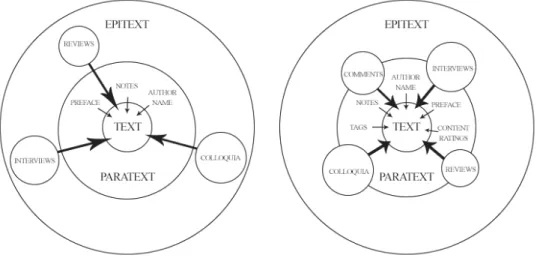
1 Comparing proximity and impact of epitext and paratext upon texts ... 40
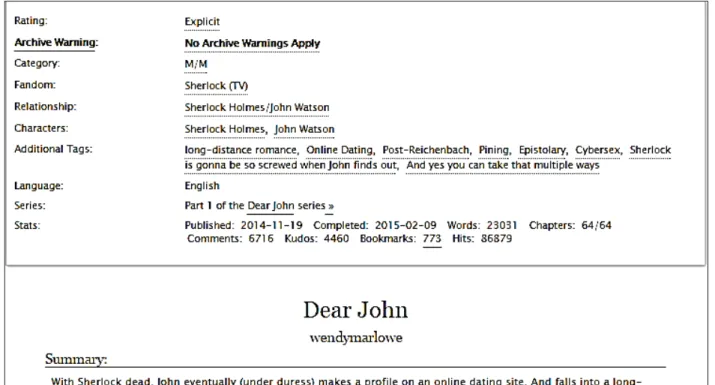
2 Paratextual elements at the beginning of each chapter give readers a framework for how to approach the text ... 42
3 Distribution of feedback themes on AO3 versus Tumblr ... 51
4 Distribution of tags on Tumblr postings for “Dear John” and “The Apology” ... 58
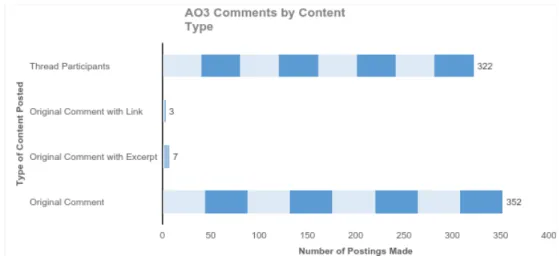
5 AO3 comments by content type ... 61
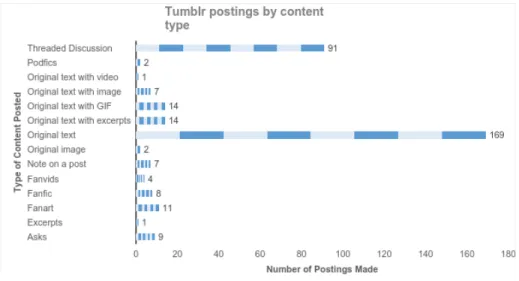
6 Tumblr postings by content type... 62
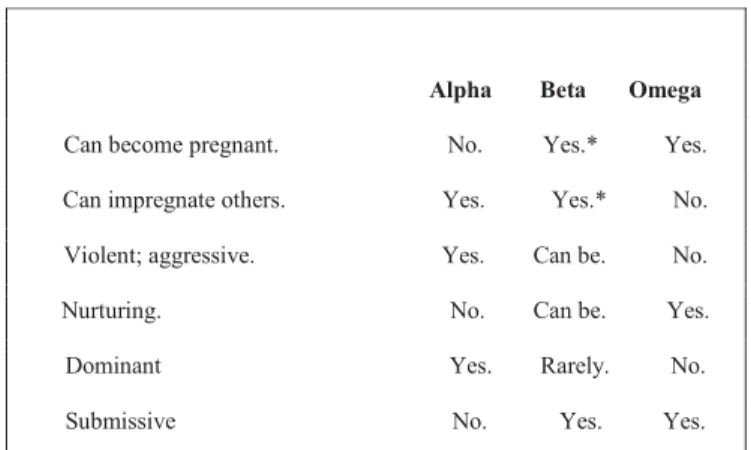
7 Common traits of Alphas, Betas, and Omegas ... 131
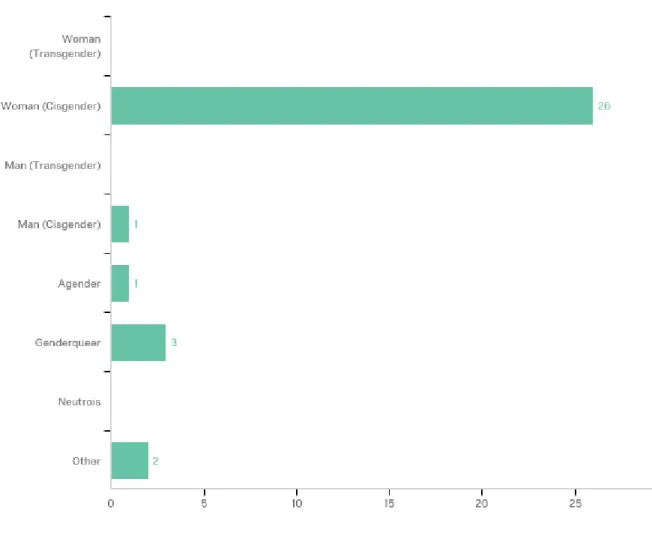
8 Responses to the question, “Which term most closely fits your gender identity?” ... 179
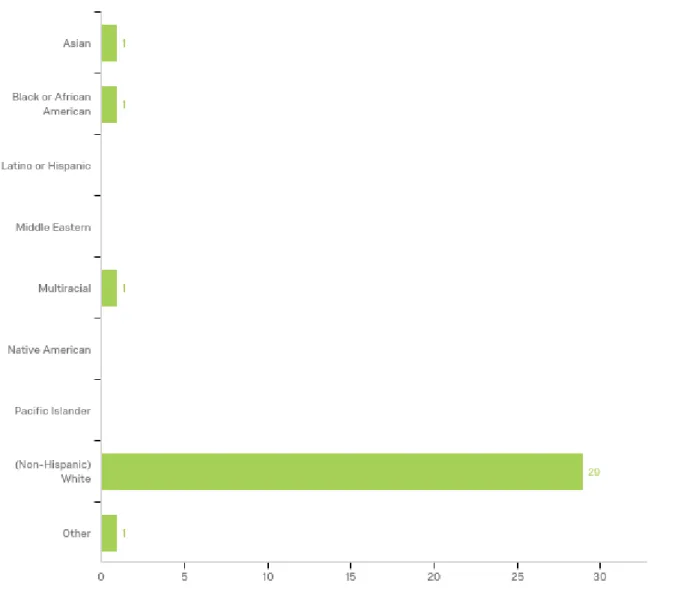
9 Responses to the question, “Which term most closely fits your racial identity?” ... 180
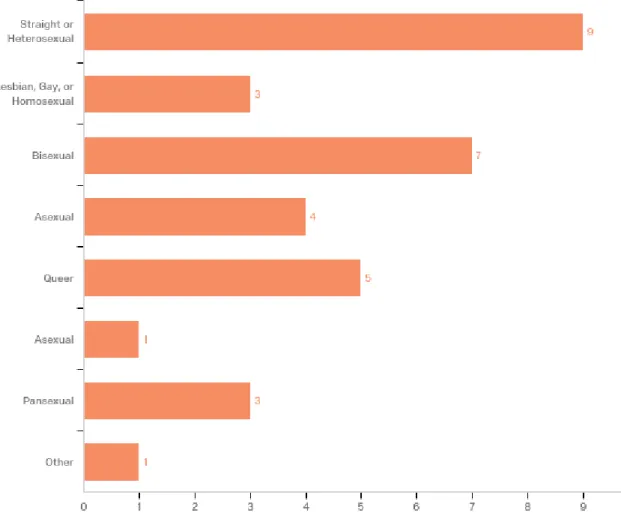
10 Responses to the question, “Which term most closely fits your sexual orientation identity?”……. ... 181
1 INTRODUCTION
I first came to fan fiction in the latter half of the 1990’s; as a young queer person in the American southwest, I was deeply closeted and also deeply hungry for representations of queer life and relationships. As a fan of the series Xena: Warrior Princess and Hercules: The
Legendary Journeys, I relished the few times the creators danced around the edges of queerness in their text, and although I might never have willingly admitted it to those with whom I watched the show, I found myself captivated by the idea of a secret homosexuality, a lesbian narrative taking place just out of frame. Still, it was purely by chance that my adolescent internet searches resulted in my first encounter with fan fiction, in the form of the combined Xena and Hercules:
The Legendary Journeys fanfiction archive. From there, I encountered vivid descriptions of non- heterosexual sexual expression – along with lesbian pairings of Xena and her sidekick Gabrielle, Hercules was often paired with his own sidekick, Iolaus. Far more than just the illicit experience of reading graphic sexual depictions, I was impacted especially by the depiction of queer
intimacy, by the shared experience of secrecy; stories often touched on the need for characters’
relationships to be kept quiet all the while depicting loving, functional romantic partnerships.
Although gay characters were already present on television, their interactions (at least on network programming) were generally limited to chaste kisses or handholding; fanfiction presented experiences I could previously only scarcely imagine. My readings of these stories only lasted a few months, but they had a profound impact upon me, reminding me that there were hundreds of others out there who also valued queer sexual expression and that the practice of imagining other possibilities for the characters mainstream television presented me with wasn’t inherently wrong or bizarre. Far from it, such forays made me a part of a community, if only briefly.
2 I drifted away from fan communities after I stopped reading Xena fanfiction; by the time I began my undergraduate work, I had all but forgotten the genre. It was not until nearly fifteen years later that I happened upon fanfiction again, when a comic author and artist I had just discovered began posting fan art and links to fanfic from The Hobbit and, later, the British Broadcasting Company’s Sherlock series. Where the fiction I had encountered in the late 1990’s was part of a relatively small, niche community, the writers and artists I now discovered
numbered in the tens of thousands, and the community that had blossomed up around that was even more massive. Websites like Archive of Our Own and Fanfiction.net hosted works from thousands of fandoms, featured robust systems for interaction with fanfiction creators, and acted as outspoken defenders of fans’ rights as creators of fanart and fanfic.
This new technology has done more than simply invite new creators into fan communities; it has enabled fans to interact with authors and artists in ways that previous technology never allowed. Where authors of fanfic publishing in zines might need to wait for written responses to their stories or for interaction at fan gatherings, the existence of online fanfic archives allows for more rapid feedback between both author and reader of fic. Additionally, sophisticated, user-friendly UI’s allow readers to easily search for very specific genres, themes, and content ratings, allowing quick and easy access to a comparatively large array of results, versus those one might have historically found compiled in a printed fan zine. As I discuss in Chapter 1, I explore how, through their interactions with the authors as well as their own comments and blog posting, fans are shaping fan creations in multiple new ways. Importantly, these discussions often tackle issues that have broader cultural relevance outside of the stories around which they are centered. For example, the fans I discuss in Chapter 1 draw attention to issues of consent and potential partner violence within the story, while some in Chapter 2
3 discusses the presence of cross-gender and transgender narratives within fanfiction, and I explore the way that fans engage both affirmationally and critically with such narratives, interrogating gender normativity and transphobia where they emerge. Finally, fans highlighted in Chapter 3 celebrate alternative reproductive methods, envisioning worlds where male-male reproduction is not only natural but also revered. In each instance, fans engage with complex gendered issues, whether as authors and artists of fanart and fanfic, or as commenters or bloggers engaging in public discussion around such works. At its core, my dissertation explores the way that fans engage with dominant ideologies around gender, sex, sexual orientation, consent and reproduction. I argue that, while these engagements may not always directly undermine hegemonic or normative discourses or ideologies, that they nonetheless offer both writers, readers, and artists in fan culture the opportunity to engage in dialogue about sensitive and potentially taboo topics, to assert themselves not only as readers but as cultural critics, and, in some instances, to engage with authors of fan fiction in ways that materially change the texts themselves.
Aca-fans and Honesty, or: Why I Worry About Everything to Follow
Although he didn’t coin the term, the concept of the “aca-fan” was popularized in large part thanks to Henry Jenkins, who himself defines it briefly on his website as “a hybrid creature which is part fan and part academic” (n.d.). While I appreciate tremendously Jenkins’
contributions to the field of fan studies, as well as his efforts to bridge the divide between academia, which used (and in some circles, still does) to perceive popular culture as base and unworthy of scholarship, and fan communities, I hesitate to identify myself as an aca-fan. In part, it feels inaccurate to me, especially if I identify the “aca-fan” with Matthew Hill’s concept
4 of the similarly-termed “scholar-fan,” one who “professional academic who draws on their fandom as a badge of distinction within the academy” (2002, p. 2). Hill contrasts this with the
“fan-academic,” who he says, “uses academic theorising within their fan writing and within the construction of a scholarly fan identity” (Ibid.). The difference is subtle, but the shortest
explanation might be where one’s primary identity lies - in thinking about myself, am I a scholar first (thus fitting into the scholar-fan or aca-fan mode), or a fan? Certainly I’ve been a fan far longer than a scholar - after all, I started reading fan fiction as a child. However, as the major work of my doctoral career, it feels dishonest to say that my “first” or “primary” identity in undertaking these works is as a fan; I didn’t use my fic-writing AO3 account to collect and comb through the AO3 archives, and I didn’t put that fan pseudonym on the survey I attempted, but rather in both instances publicly positioned myself as a scholar.
If anything, I still find myself struggling to bridge those two worlds within myself, and it is a struggle that permeates this work, though I hope not too noticeably at times. The question – am I writing as a scholar, or a fan, or both? – emerges time and again regarding considerations about what to include or omit, how far to take critique, and when (and when it is ethically appropriate) to take measures to safeguard a community I consider myself a part of against exploitation or derision. In that other world – where I write my own hobbit slash fics or shower praise on an author in an AO3 comment – I am free of the eyes of colleagues and those in my field who I realize might view such activities with distaste (or worse); how, then, can I expose the writers and artists whose work I appreciate to such public criticism (including criticism by myself)? Is it reasonable to expose others in such a way, without first putting my own fan creations up for consumption and critique?
5 Ultimately, I’ve found there are no definitive answers, and while Henry Jenkins may navigate the blurred boundary between fan and academic with ease, I have found no such clear path. Instead, throughout this text I have attempted to present each text as honestly as possible, and have made every attempt to acknowledge that, even when they are problematic or when I am critical of the results, these works still have value. Part of recognizing this value entailed
conscious work to identify how and when I was reading a story as a “fan,” purely for recreation and pleasure, and when I was reading it critically as a scholar, looking for recurring themes or unique plot devices. The framework with which I read each text - as a scholar, or as a fan, and sometimes returning as one and the other - meant that I was able on the one hand to appreciate aesthetic choices or to recognize an author whose genre has traditionally been very kink-positive attempting to play with power dynamics (for example), while on the other hand evaluating the work for how it contrasted or aligned with common genre practices, how and if the author
engaged with a consent model, etc. Finally, as a fan and a fic author who himself has commented frequently and received and responded to comments on my own work, I approached the project from a position where I already had some sense of the impact that commenting can have upon both the author, the readers, and the way the story is interpreted; although I did not have the terminology to explain this phenomenon until Genette, it nonetheless seemed somehow intuitive, and I suspect (though without a more extensive interviewing and/or survey work, can’t
definitively prove) that many readers and authors of fan fiction would concur - even if they may not always agree that commenting can impact the text itself, I believe many would acknowledge that these modes of engagement and feedback do have a lasting impact upon both author and reader alike.
6 It has been my goal, furthermore, to highlight the agency and value, not only of fans-as- authors in the form of the creators of fanfic, but to show how commenters and readers who blog critically about topics also contribute meaningfully to the community, and sometimes to the text itself. Ultimately I realize that it is impossible to represent any genre or sub-genre of literature or art, and indeed any community in its entirety with perfect accuracy and authenticity; as such, I have attempted to portray these communities and genres in their diversity, to show and celebrate both the more socially acceptable works among them (PG stories like “Gardening,” for example, or massively popular works like “Dear John” that became, for a time, cultural phenomenon) as well as those that might garner the same laughter or lack of understanding that I myself fear in being “out” as a fan and fic writer – stories with explicit sex or troubling frameworks for
consent, visual art that, while of great value to the community, is also graphically explicit enough that even the artists creating it take jabs at their own work1. As a scholar, I believe it is important to show the breadth and depth of these communities and their creations, as much as is possible;
as a fan, I am consistently moved by the tremendous amount of time and love that my fellow creators put into their work, and so it is with no small amount of trepidation that I attempt to do both of these worlds justice in the research I present hereafter.
Literature Review Dionysius to De Sade: Fanfiction's Early Origins
Although fanfiction's origins are often spoken of in the same breath as the emergence of Star Trek fanfiction in the 1960's and 1970's, the phenomenon of fans producing transformative
1 Reapersun, one artist whose work I reference several times, themselves linked to an image they’d created with the words “click for incredibly nsfw squicky weird dirty omegaverse kink” (Reapersun, 2013).
7 (or, as some have argued, derivative) texts based on original work has a much longer history in English literature. In the 2013 book Fic: Why Fanfiction is Taking Over the World, editor Anne Jamison explores this early history of fanfiction, tracing the history of imitative and
transformative cultural productions as far back as the Ancient Greek philosophers. There, she specifically highlights Aristotle's concept of mimesis and Dionysius's similar notion of imitatio as early evidence that, even prior to the establishment of the novel itself, philosophy had already begun to tangle with the concept (and the potential legitimacy) of transformative works (p. 26).
She goes on to cast doubt on the notion of Shakespeare as the singular force behind his own literary productions, commenting that, "[his] plays incorporated the innovations of actors and others involved with his company, the King's Men, as well as multiple sources, including histories, romances, and other plays" (p. 28). De Cervantes himself had an imitator who penned (and published) an entire sequel to Don Quixote in the early seventeenth century, but it is not until the eighteenth century publication of Samuel Richardson's novel Clarissa that the first not- for-profit transformative text seems to emerge (p. 29).
Jamison discusses a woman pseudonymously known as "Belfour" who, upon hearing that a sequel to Carissa is in production, writes to Richardson to plead with him for a specific outcome (notably, she wishes to see the "rake," Lovelace, be morally redeemed and prevented from raping and despoiling the title character). To this, Jamison says, Richardson responds by denying her request and asserting that, "there cannot be a more pernicious notion, than that which is so
commonly received, that a reformed vampire rake makes the best husband. This notion it was my intent to combat and expose" (p. 31). Belfour (also known as Lady Bradshlaigh), unsatisfied with the response, rewrote the novel to suit her own interests (as did her sister, Lady Echlin). Jamison adds that the scholar Judge once described Richardson’s response to fanfiction as one of
8 tremendous displeasure, suggesting that his distaste at the "bawdy rewritings" of his first novel, Pamela, led to him killing off the protagonist of his next novel. She notes that it is fortunate, perhaps, that Richardson didn't live to see the most famous retelling of his novel Pamela, or Virtue Rewarded, described here in a manner traditional of contemporary fanfic postings:
In comparison, Richardson might have been happy to settle for any of Belfour's alternate comic happy endings, which Justine decidedly doesn't get. As an erotic fic writer on a roll can tend to do, @TheDivineMarquis let his fic (Justine/Everyone - NC-17, NSFW, warnings for every single thing (Jamison, p. 32).
The author was the Marquis de Sade; his "fic" was Justine, or the Misfortunes of Virtue.
This is not to suggest, of course, that all transformative fiction or "fic" is exclusively preoccupied with the erotic; although sexual fanfic clearly has a long history, neither the entirety of the genre, nor the exclusive focus of this dissertation, is on the practice of creating same-sex sexual encounters, or otherwise shifting what contours sexual scenarios take. Some of the most notable fanfiction can be found in the emergence of Sherlock fan culture in the late nineteenth and early twentieth centuries –fanfictions which seemed to leave behind sexual components altogether. George Elliot, William Makepeace Thackeray, and myriad fans of the original Sherlock publications by Sir Arthur Conan Doyle (Lantagne, 2015; Fries, 2013) all attest to the diverse interests in transformative literature well before the concept of slash, omegaverses (universes where men may become impregnated and sex is impacted by dominance roles as well as normative male/female sexual characteristics), or "hurt/comfort" entered - and, arguably, dominated - the realm of fanfiction, as I'll discuss later. And, as Jamison says, although "none of these earlier literary practices are exactly the equivalent of what we understand as fanfiction today" (p. 35), they still point to a far longer history for the practice of fans extending,
9 transforming, or elaborating upon existing cultural productions. Thus while authors of these earlier stories may not have widely circulated them or gathered at fan conventions to discuss their writing, while they may not have created “slash” or even have called their writings “fan fiction,” these earlier texts are nonetheless the literary predecessors of the contemporary genre of fan fiction. That this history exists at all is a testament to the urge to transform, to rework, to resignify existing cultural materials that are beloved, but of which something more is desired. It is a history that says that, while “fan fic” may be only decades long in its current iteration (and the concept of the “fan” itself only marginally older), people have been engaging in these (arguably, previously unnamed) fannish practices for far longer.
"Fic" as we think of it today is thus hardly a new genre; it would be difficult to even point to it as a newly studied genre of cultural production, given that Henry Jenkins began using the term "participatory culture" in his work with fan cultures in the 1980's (Brough, Emerson, &
Robertson, 2014, p. 382), and both his and Camille Bacon-Smith's germinal works (Textual Poachers: Television Fans and Participatory Culture (1992) and Enterprising Women:
Television Fandom and the Creation of Popular Myth (1991), respectively) were published in the early 1990's, two and a half decades ago. The genre - of literary pursuit as well as academic scholarship - has veritably exploded over the past two decades, with a substantial focus on the genre of "slash" fanfiction.
Slashing: Fanfiction’s Queer Histories and Transformations
Despite a comparatively long history of academic examination, the concept of "slash" is still far from established in mainstream culture and everyday lexicons; thus, a brief definition of this particular subset of fanfiction is merited. Although definitions vary from scholar to scholar -
10 and even within individual works of scholarship - I begin with the definition offered by the fan writer Joan Martin, as quoted in Jenkins's 2013 volume Textual Poachers. She says:
In slash, the protagonists not only love each other but become (or are) lovers. Most commonly, slash tells first time stories (i.e. stories about the initial sexual encounter between a particular set of partners), but some stories involve an already established
relationship. Slash includes anything from soft romance to varying amounts of explicit sex.
Sometimes it includes very little but sex… Generally, slash offers strong characters who are able to cope with their world and who aren't victims of it. It combines love and
sensuality. It may include violence, but warmth and love transcend the violence… It offers detailed and loving descriptions of beautiful men making love willingly. It presents love as entailing mutual respect and possible only between equals; sex as a mutually undertaken, freely chosen, fully conscious interaction; and love and sex together as a source of great joy to the protagonists (Jenkins, p. 188).
Importantly, Martin offers a number of clear assertions about what slash is - and what it isn't. Foremost, slash (for Martin) is about "love," one which includes "mutual respect… between equals," and where sex occurs it is "mutually undertaken, freely chosen, fully conscious." I suggest - as have some others, notably Robin Anne Reid in her 2009 article, "Thrusts in the Dark: Slasher's Queer Practices," that scenes of sexual non-consent (commonly referred to as
“non-con” or dubiously consensual – “dub-con”), of violence, of promiscuity and portrayals of non-monogamous sexual expression are not so much proscribed in slash - they're simply ignored, glossed over by critics in favor of what are celebrated as the more acceptable, less ethically problematic categories of fanfiction. Martin's definition, while commonly accepted, actually fails to encompass the breadth of what slash has come to include. Jenkins, in collaboration with
11 Shoshanna Green and Cynthia Jenkins, notes that, "the relationships are not always romantic, that the characters are not always drawn from other media, and that the central characters are not always male" (2006, p. 63). This opens the realm of acceptable uses of slash even more broadly - gone are the limitations on love, on romance, and even on the gender (male/male, or m/m) of the characters portrayed within. Given the restrictions on what can and cannot be included as
"slash," then, the question remains: what is slash?
I draw on Rhiannon Bury, in her 2005 book Cyberspaces of Their Own: Female Fandoms Online, whose discussion of female fan culture approaches a concept that I believe is central to the contemporary body of literature known as "slash." She references the term "queer" as having
"a multiplicity of non-normative sexualities, including gay and lesbian, that don't necessarily rely on homosexual practice" (p. 13) and goes on to reference Eve Kosofsky Sedgewick's discussion of queer as “the open mesh of possibilities, gaps, overlaps, dissonances and resonances, lapses and excesses of meaning when the constituent elements of anyone's gender, of anyone's
sexuality, are made (or can't be made) to signify monolithically” (Hall, 2003, p. 70). Bury goes on to note that:
making connections with other women, both straight and bisexual, who write about emotional and sexual relationships between male characters written as straight in the primary text is thus less a rejection of gender norms than a rejection of heterosexual norms.
These "misalignments" of desire, as represented in slash texts and as experienced and discussed by its readers and writers, are parodic performances as defined by [queer theorist Judith] Butler (p. 13).
Taking my cue then from both Bury and the queer theorists she references (Sedgewick and Judith Butler, notably), I suggest that slash is far from limited by specific gender constraints or
12 confined to specific sexual or non-sexual practices. Rather, slash is a genre predicated upon dissonances of gender and sexuality, where the modus operandi of its authors necessitates that, whatever else it does, slash challenges, destabilizes, undermines - in effect, queers the
established rhetoric (or canon) from which it derives its primary inspiration. I might go so far to suggest, then, that literature that follows a normative path that remains wholly authentic to the gender and sexual presentation within canonical texts - even if that presentation is itself bisexual, homosexual, or otherwise queer - is not actually "slash" fiction. To put it symbolically: we might think of slash as less its original inspiration - that "/" symbol interjected between Kirk and
Spock2 in erotic fanfiction that suddenly put them into same-sex relationships - and more the actual act, the author's oppositional slash-ing apart of established gender and sexual roles. Slash does not just make two formerly straight, cisgender, male characters gay – it makes two
characters engage each other in relational modes (whether sexual or romantic) not previously depicted in their canonical texts. Thus we might see two cisgender heterosexual characters rendered in slash as a straight couple with one cis man and one trans woman, as two trans gay men, as two thirds of a polyamorous, panromantic, asexual triad, or in myriad other relationship configurations. And lastly, importantly, the simple act writing “slash” does not ensure that those depictions will be politically transgressive, feminist, or socially justice – it simply means that they will contrast with the canonical representations of sex, gender, and/or sexual orientation.
2 Kirk and Spock, two characters from Star Trek: The Original Series, are believed to be the first fictional characters to be rendered in a “slash” dynamic in fan fiction in the early 1970’s. The term “slash” actually comes from how these stories were originally labeled – “K/S,” the “/” symbol indicating a sexual or romantic relationship between the pair (Jenkins, Greene, & Jenkins, 2006).
13 Following this definition, the broad category of slash might be said to have origins even farther back than those first published Kirk/Spock zines in the early 1970’s. In Fic, Jamison discusses the mystery novelist Rex Stout’s 1941 address to members of the Baker Street
Irregulars, a fan society dedicated to Doyle’s Sherlock Holmes stories. Commonly referred to as
“tongue-in-cheek,” Stout nonetheless puts forth a radical reimagining of both a main character in the Sherlock Holmes canon, as well as a reading of the main characters’ relationship that scholars today might justifiably read as “queering.” Jamison says that Stout’s speech
made waves with this close reading, finding abundant evidence in "The Sacred Writings" of Watson's female gender in her nagging Holmes about drugs and smoking and pestering him to talk - and if that weren't enough, "Imagine a man asking another man to play him some of Mendelssohn's Lieder on a violin!" (p. 45).
While Stout’s treatment of Watson (and the latter’s relationship with Holmes) is certainly, as mentioned above and in other recounting of his speech, intended as a tongue-in-cheek jest, it is nonetheless an early example of the phenomenon of “genderswapping,” a slash sub-genre wherein one or more character’s gender(s) changes from those assigned in canonical text. The practice is one that has gained momentum in recent years in online fan communities, where postings of “genderswap,” “genderbending,” and “genderswitching” fan stories have prompted heated discussions from bloggers across multiple fandoms.
Genderbending, Trans Fanfiction, and Community Dissent
As noted above, the phenomenon of genderswapping is hardly a new one in either literature more broadly, or fanfiction specifically. Stout hinted at a genderswapped John Watson in the Sherlock series, and Elementary, a recent CBS rendition of the Sherlock lore, features Lucy Liu in the role of Dr. Joan Watson. More broadly, speculative fiction (fiction which includes fantasy
14 or science-fiction elements) as a genre has a long history of challenging binary and static gender roles, from Ursula K. LeGuin’s “potentials,” who change their sex periodically in order to reproduce (2000), to Iain M. Banks’s Culture series, where although sex is still binary, characters can fully change it at will (1997). Within the world of fanfiction, however, the notion of
genderswap – or “genderbending” as it is sometimes called – has a relatively specific use, one which is capable of both teasing at non-normative possibilities and reinforcing cissexist, binary understanding of sex and gender.
Problematically, the term “genderswap” often has very little to do with the concept of gender as it is commonly understood among queer, feminist, and trans theorists, as evidenced by this definition of the practice on the community-run encyclopedia Fanlore:
Genderswap is a fanfiction and fanart trope in which one or more characters switch binary sexes, such as depicting a male character as a cis woman. Genderswap as a term actually covers several different fandom tropes. In fanart, it often it often indicates works in which the fan artist depicts a binary-gendered character as a cis person of a different gender.
Genderswap fic is a subset of the more general genderfuck type of fic and can include several different scenarios. In one, a "swap" of the character's sex is usually carried out by some magical or technological device, making the trope popular in sci-fi or fantasy stories.
In most genderswap stories, the character is restored to their original sex by the end, although some stories consciously subvert this trope. As in fanart, though, sometimes a genderswap fic involves writing a binary-gendered character as a cis person of a different gender (Genderswap, 2015).
15 Notably, the dominant mechanic in genderswap – one character changing their physical body, while retaining their gendered subjectivity – is at odds with the term itself, suggesting that gender identity and sexual embodiment are one and the same. When a character is identified as
“genderswapped,” more commonly, the actual result is that their physical sex has changed, while their mental, emotional, and psychological understanding of their internal gender has not. Such conflations have been roundly criticized by queer, trans, and gender activists within the fan community. Among such critics was the blogger and fic writer Sherrold, who in a Livejournal entry posed the question:
Hey, why do we call that kind of story "genderswaps"? They aren't swapping gender -- they're swapping biological sex. Admittedly, in most cases, they then make some sort of half-assed effort to acquire new gender habits and reflexes...maybe that's why? We're more interested in the part of the story where they're trying to acquire the new gender than we are in the part where they're suddenly a new sex, and that's why we call them genderswaps rather than sexswaps? (Sherrold, 2008).
Others, meanwhile, have taken the enduring concept of “genderswap” within fandom to initiate a dialogue about trans identities, to not only interrogate the meaning of the specific term
“genderbend” but to call into question the harm such a concept can have on the broader fan community, which increasingly includes out, self-identified trans, genderqueer, and gender non- binary authors, commentators, artists and independent scholars. Avery, author of the blog “Just Messing,” responded to a series of comments in an exchange about writing “genderbend” with zir own brief essay on the topic. In response to another blogger and fanfic author’s earlier comments questioning the concept of “genderswapping” as transphobic, Avery notes that:
16 It has a lot of potential to be a positive thing. However. There is literally only one way we ever see this word used… you almost NEVER see genderbend used to describe anything besides ‘female character is now male’ and vice versa. Which is binary-upholding, erasing everything that isn’t these two genders, and transphobic…
Genderbent is not being used to its proper potential, whatsoever. And it’s a shame. To me, the word has been soiled because of how absurdly often people use it to uphold the false gender binary. If the word were actually used to change a character’s presentation to something that showed an agendered person or a genderfluid person or a trans* person, or just anything that isn’t cis woman and cis man, then this would be a different story.
The word itself isn’t transphobic, but the way it is used the overwhelming majority of the time is transphobic, or at the very least cissexist (Avery, 2015).
I tend to echo Avery’s understanding of the standard implementation of “genderbending” as being problematic at the very least; as Avery suggests, character’s bodies being “switched” or
“swapped” to have a different sex (one which is almost always identified as the “opposite” sex, male bodies turn into female bodies, female bodies turn into male bodies) ultimately serves to reinforce binary gender constructs, especially when done uncritically or without substantive engagement in the character’s psychological, emotional, and intellectual understanding of their identity, gendered and otherwise. Stories in which characters’ behaviors start to change simply by virtue of their transformed sex serve to further entrench both binary gender roles and essentialized ideologies around gender – if a coarse, uncaring, suspicious male character
suddenly becomes friendly, nurturing, and trusting simply by virtue of the shift in their physical
17 embodiment, then the author has effectively put forth an argument that these personality traits are inherently gendered.
In addition to my exploration of the practice of genderbending/genderswap fanfiction, it is my hope that my work will engage critically with topics that have heretofore had minimal scholarly inquiry in the past: what are the implications of “race swapping” a character, depending on the way the author attempts it? In what ways are fans finding both literary and sexual value in discussions and depictions of male-male sexual reproduction? And importantly why does it matter that (and how) readers engage with authors of fanfic, whether through comments, transformative works of their own, or fanart inspired by the texts? While there have been brief explorations of all of the topics discussed herein in other texts, I hope for my
dissertation to serve as an in-depth discussion of each practice, and to highlight such practices in their diversity, focusing neither exclusively on the “good” (conventionally well-written and/or socially transgressive) texts, nor on the “bad” (less conventionally well-written or incorporating stereotypical or oppressive practices and ideologies) stories, but rather offering examples of each. In this way, I hope to put forth a more well-rounded portrait of different fan sub-cultures, as well as to highlight the ways that they engage with one another beyond the initial publication of their stories. As a field, much of fan studies has concerned itself with questions of authorial gender – specifically, the question of why so many women are writing fan fiction. While I question this assumption in the first place (as I’ll discuss in one fan-initiated study below, gender in fan culture is far more diverse than many scholars give credit), I also suggest that there may be questions more fruitful in analyzing participatory culture – instead of asking, “why is a woman writing this?” my line of inquiry asks, “what is the impact of what this person has written?” In this way, I hope to build upon existing scholarship by theorists like Kristina Busse, whose
18 exploration of the origins of mpreg and omegaverse fan fiction lays the groundwork for my own discussion of the contemporary moment in such genres, as well as questions about what the future of these genres might entail.
Methods and Methodologies
As a hybrid phenomenon, the fan fiction and fan communities I am studying cannot easily be approached through a singular method. Rather, my approach is a hybrid one, incorporating diverse frameworks to approach different components of the project. I have
endeavored to incorporate a feminist methodological approach to all of my research, whether that research included textual analysis, cyber-ethnography, or other research methods. One of my challenges has been to articulate a methodological approach which is both aligned with my American Culture Studies background and which respects my strong desire to undertake feminist research; although the two might seem often to complement each other, I have found the former field less disposed to espouse explicitly preferred methodologies, rather favoring the concepts of discourse analysis and literary criticism, when methods were discussed at all (not to mention their ideological predecessor, methodologies). Even in 2016, I find myself agreeing with Michael Pickering, who nearly a decade ago noted that “there has long been a reluctance to bring any explicit discussion of methods and methodology into cultural studies” (2008, p. 1). Pickering goes on to note that the field has heavily relied on textual analysis – one of my own primary methods in this dissertation, as I’ll discuss below – as well as a tendency toward robust
theoretical analysis and criticism. He suggests that this is in part due to cultural studies tradition of repudiating established or rigidly prescribed methodological frameworks in favor of the hybrid, interdisciplinary, and non-traditional (Pickering, 2008).
19 Although I don’t dispute Pickering’s claim about the interdisciplinary nature of cultural studies in regards to methodologies, my own hybrid approach is guided more by a feminist perspective, one inspired by the writings of feminist, queer, and women of color theorists who articulate theories of scholarship, research, and activism that incorporate as a central component an oppositional consciousness, an approach which Chela Sandoval suggests is “capable of aligning such divided theoretical domains,” like U.S. third world feminist scholarship,
postcolonial criticism, and queer theory, “into intellectual and political coalition” (2000, pp. 69-- 70). I follow Sandoval’s rejection of what she identifies as an emerging academic apartheid in favor of a theoretical and methodological position which joins multiple methods and
methodologies in a theoretical, methodological, and political approach to scholarship which challenges not only sexism, but racism, colonialism, neo-liberalism and heterosexism, and to which I would include a rejection of cissexism, a topic this dissertation will address at multiple points. Underlying all of my research is a desire to engage in what Luce Irigaray described as
“jamming the theoretical machinery,” a desire summarized by Sharlene Nagy Hesse-Biber, Patricia Leavy, and Michelle L. Yaiser which seeks not to
reconstruct another view of the social world (an exercise in power and colonization) but rather to unravel the social processes and relations that have constructed the social world in hierarchical ways. This process is a new form of political creation that occurs by creating resistant to dominant knowledge and then allowing that resistance to disrupt the social system thereby necessitating change (2004, p. 19).
20 Cyberethnography
I would be remiss in attempting an ethnographic study of this unique community without also highlighting the important contributions of those who pioneered this form of research, and especially those whose work in queer spaces and engaging with queer politics, narratives, and theories helped challenge heterosexism within digital communities and spaces. Specifically, I am indebted to scholars like Kate O’Riordan (2002, 2007) and Elizabeth H. Bassett (2002), whose discussion of their ethnographic work with “Gaygirls.com” in 2000 provided an early ethical framework for the intersection of cyberethnography and LGBTQ populations and spaces.
Another work of O’Riordan’s, her 2007 chapter “Queer Theories and Cybersubjects: Intersecting Figures” in the collection Queer Online, offered a useful history of the practice of presenting gender online differently from how it is assigned/presented by individuals offline/in physical interactions. She discusses the “continued anxieties about authenticity online,” and then goes on to contrast these anxieties with highlighting trans narratives where there is an experience of the body as a “site of deceit” (O’Riordan refers to this as “wrong body narratives” - I would simply describe it as gender dysphoria) (p. 22). She then goes on to explain how these cyber
representations, “separated from the morphology of the body,” operate as “site[s] of authenticity”
- essentially, that trans individuals may be able to ameliorate dysphoria feelings by inhabiting spaces where their gender identity is consistent with their gender as it is (re)presented in a given space (Ibid). In considering my own worries about whether authors were depicting “authentic”
representations of trans- and non-binary embodied experiences, such narratives proved a useful reminder both to avoid assumptions about the author’s own experience, and that authenticity itself is complex and shifting and cannot be “owned” by any single individual or group. In this way, I was able to approach texts with a more open mind, and to allow for the possibility of
21 authentic representations from authors of diverse identities. Other valuable contributors to the field include David Phillips (2007), Jenny Sunden (2003), Lisa Nakamura (2007), Tom Boellstorff (2008), and Chris Ashford (2009), whose writings (whether on the subject of cyberethnography or utilizing cyberethnography in their work) provide valuable guideposts for would-be cyberethnographers to follow, including myself.
Textual Analysis
One of the major components of this research project is the collection and analysis of diverse fan-generated texts, which I have explored and coded for ideological and sociological meaning. I include as “texts” any iteration created in relation to the topics being discussed; this includes posts on Tumblr, comments on Tumblr blogs and on Archive of Our Own stories, fan- created art posted both on Tumblr and AO3, fan-created stories and fan-conducted interviews, as well as postings featuring only static or moving images (GIFs) meant to convey meaning.
Additionally, I have included as texts all of the paratextual3 elements associated with the above texts: tags posted at the bottom of Tumblr entries, content warnings posted at the top of AO3 stories, and footnotes, endnotes, and author notes (or A/N’s) are all fan-created texts which I have selected for inclusion in my analysis. At the moment I write this, I have identified just over 3,000 unique texts; although the bulk of them are brief comments or blog entries, some, such as the fan stories included for discussion, incorporate many chapters or even many “volumes,”
some having been collected into online series of stories.
3 Although I’ll delve into paratext and paratextuality in greater length in the following chapter, for the purposes of this introduction paratext can best be defined as all those visual (written or graphically depicted) components which surround a text (either immediately, as in the foreword / title page / editor’s introduction to a book, or secondarily, as in popularly read reviews, etc.).
22 Following Martin Baker, I acknowledge that one of the potential pitfalls of attempting an analysis of certain texts, often in the name of discourse analysis, is that the researcher may select texts relevant only to their interests or particular project, forgoing those that may contradict them (Barker, 2008). To this end, I have instead read the top 20 English-language stories in each fandom and sub-genre, when sorted by “kudos” (an AO3-implemented measurement of popularity, wherein fans can give a “kudos” to a story to indicate their enjoyment of the text), selecting one or two among these for analysis based on both comment participation, uniqueness of concept or content (did the authors do something unusual for the genre? Did they mix/mingle tropes, themes, or genres in unconventional or challenging ways?), and availability of narrative content to analyze. In this way, I hope to mitigate the problem of choosing texts that are only relevant to myself as the analyst; by default, the entire body of texts I will be examining are those that the community members themselves have already selected as valuable fan creations.
In each chapter, I analyze both commenting responses and Tumblr postings using parallel codes for theme, where possible. Given that each group of texts presents distinct methodological challenges, I address these issues (such as criteria for selection) in greater detail in each
substantive chapter. In some chapters – notably, Chapters 3 and 4 – I also offer an extended textual analysis of the stories themselves, discussing relevant themes, ideological frameworks at play within the worlds where the stories take place, and the presence of transgressive political discourse vis a vis structures of gender, sex, sexual orientation, and reproduction. Additionally, because I recognize that a wholly transgressive text is unlikely, I have made a point of
undertaking a rigorous critique of each text, exploring where feminist and queer political frameworks may be undermined by language, themes, or imagery that reinforce sexism,
23 cissexism, heterosexism or racism, or further marginalize underrepresented subjectivities and experiences.
Survey
Initially, I planned to analyze surveys of fan fiction participants. Due to a very low response rate (37 respondents out of several hundred anticipated), I did not feel responses collected were substantive enough to warrant discussion on behalf of a much larger community of writers, artists, and readers. In the conclusion, I further discuss both the creation and release of the survey, some of the interesting findings that the limited number of respondents did yield, as well as my specific plans to revise and rethink my approach to an updated survey in the future.
Relevance
The question that lingers at the end of such a proposed exploration is perhaps the most obvious one: why does this matter? In genres of fanfiction already marginalized within their fandoms, what import is there in highlighting such radically niche texts (especially when decades have already been spent discussing fanfiction – even slash fanfiction)? Why does it matter how fans are engaging with each other and the texts they are creating, if these discussions, debates, and dialogues are only ever encountered by those within their fandoms?
The answers to these remain, for me, in the silences that have been sustained within fan studies around these issues. Niche texts, like those dealing with omegaverses, genderbending and genderswapping, consent and non-consent, are created within and celebrated by vital, thriving communities, providing spaces where writers are most likely to test the boundaries of gender, to insert trans and genderswapped subjects. Transgender characters are still far from commonplace in mainstream media, and although visibility is increasing for both characters and transgender
24 people themselves, representation is scarce at best. And yet, within fanfiction communities, online discussion is perhaps most vibrant and passionate specifically about these issues; while more conventional slash fanfiction may be beloved by fans, it is these subcultures – atypically gendered, sexually transformed, sometimes loved, and very often loathed – that prompt the fiercest debates within their fandoms.
Here, too, is the importance of studying these discussions themselves: they call into question previous assumptions about the gender identity, sex, and sexual orientation of the authors, commentators, and participants in fan cultures. Jenkins, in his updated 2013 edition of Textual Poachers, comments on the phenomenon of “academic accounts” which “seem
preoccupied with the question of why straight women write stories about gay male characters, seeing slash as an appropriation of queerness.” He then acknowledges – a fact supported by fan- initiated studies of the same period (Lulu, 2013) – that “in fact, lesbian and bisexual women have always participated alongside straight women in slash fandom, and people of all sexual
orientations have found slash a place for exploring their differences and commonalities” (p. 64).
The above-mentioned study by fan blogger Lulu of the blog “The Slow Dance of the Infinite Stars” was a survey of 10,005 fans whose results were posted in late 2013. Lulu, herself an author of nearly 90 works on AO3, launched the census specifically targeting fans who were members of Archive of Our Own; by the time the survey closed, she had collected over ten thousand responses. Among the demographic information revealed in the study, Lulu found that only between 25% and 38% of all “slash” fans identify as both “female” and “heterosexual,”
while only 29% of respondents overall identified as “heterosexual” (the next most common were
“bisexual” at 23% and “pansexual” at 12%). Perhaps more interesting, she noted that while those who identified as “female” made up 80% of survey respondents, that left 20% choosing other
25 (and sometimes multiple) options, including 6% selecting “genderqueer”, 4% selecting “male”, and the remaining 10% spread between “transgender,” “androgynous,” “neutrois,” “agender,”
and “other.” The presence here of trans, genderqueer, and non-normatively gendered fanfiction authors calls into question previous assumptions about the gender and sexual orientation of fandom’s diverse population, suggesting that those who engage with these creations are now more diverse – and more visible – than they have been at any other time in the study of fanfiction.
Her study likewise contested the image of fanfiction authors as exclusively white, showing that while 76% of survey respondents did self-identify as “White,” 7% identified as Asian, 5% as each “Hispanic/Latino/Latina” and “Mixed/Multiple,” 2% as “Black” and “Other,”
and a final 1% identifying as either “Native American” or “Pacific Islander.” It is, coincidentally, a time when the discussion about fandom’s diversity seems to be the most missing: there have been few studies published about racial diversity in fan communities, and seemingly fewer about actual fan engagement with concepts around ethnicity, race, and nationality. Even Lulu’s own study seems to ignore the issue of race among her respondents; while she has analyzed
demographics around sexuality and gender identity at length, examining their relationship to each other as well as within various genres of fanfiction, no parallel examination of the racial demographic of her respondents – as they intersect with gender and sexual orientation, as they relate to fandoms, or to genres of fanfiction – has been posted in the nearly two years since her results were first released.
I suggest that through effectively erasing fans of color from the body of data considered relevant for discussion, through a persistent disengagement with characters of color within canon and fanfiction texts, scholars and members of fan communities are perpetuating systems of white
26 privilege and further marginalizing fans of color. In my discussion of genderbending in Chapter 3, I hope to address some of these silences, specifically with regard to the potentiality of race changing and fans’ own reactions to the politics of race within their texts; of the six texts
discussed in the chapter, two incorporate characters whose races were altered from the canonical text, and each addresses these racialized characters in very different ways. It had been my hope, initially, to incorporate survey data sufficient to demonstrate a more diverse fandom than is generally acknowledged by critics of the genre; however, given flaws in both survey design and advertisement, I felt the resulting data (as I mentioned above, there were only 37 respondents) was insufficient to make any sort of broad-based claims about the diversity (or lack thereof) of fan communities. I plan, in future research, to revisit this survey, to substantially alter it to be both more inclusive and more accessible to wider audiences. Despite these failures, it is my hope that through shedding light on some of the ways that fans have problematically (or positively) engaged with concepts of race and racialization, that I might encourage both future scholars and future fans to think more critically about the assumptions made about race, as well as the way it is deployed in fan creations.
Chapter Outline
Chapter 1: Paratextuality, Epitextuality, and Intra-Fandom Engagement
In this chapter, I explore the concept of paratext as it occurs on and around fanfiction, and its ensuing impact upon perceived meaning. Maria Lindgren Leavenworth, in her article “The Paratext of Fan Fiction,” (Leavenworth, 2015) builds upon the work of the French literary theorist Gérard Genette to explore the way that paratextual content includes both the elements immediately adjacent to/surrounding fanfiction – things like comments, tags, author notes
27 (commonly shortened to A/N or A/Ns) – as well as fan-contributed content, like popular fanart or podfics, comments posted directly on the AO3 stories, and critical feedback in blogs. Genette believed that paratextual elements could inform the reading of the texts themselves, since readers often first encounter and read the paratext prior to tackling the texts themselves.
Wendymarlowe’s story “Dear John” was, in the author’s words, “a bit of an
experiment,” written as a hybrid epistolary series of sixty-four chapters that included everything from text message exchanges to emails to instant messages between characters, all updated in
“real time” and taking place between November of 2014 and February of 2015. The story quickly gained a massive following – to date, “Dear John” has over 6500 comments and is among the top ten most-commented-upon stories on AO3 – and has generated hundreds of fan- created blog postings on Tumblr. Immediately following the publication of “Dear John,”
Wendymarlowe published a series of companion stories, each incorporating a more traditional third-person narrative structure to “fill in” gaps in the epistolary about the encounters between Watson and Sherlock at the culmination of “Dear John” (2015). These subsequent stories also met with a tremendous amount of fan participation, with nearly 700 comments posted on one story alone (which only consisted of three chapters, a fraction as many as in the original work) and several Tumblr postings and fan creations. Wendymarlowe’s story is notable here because of how fervent fans were in pleading with the author – via comments as well as blog posts
contesting what they saw as undertones of dub-con and non-con in an otherwise consensual love story. Emblematic of these concerns are the words of Cupid, who in a February 9, 2015 posting to her blog (in between one update to Wendymarlowe’s sequel and another) discusses the experience of simultaneously feeling like they are entitled to have and voice and opinion on the texts while still acknowledging that the author has “the final say.”
28 This chapter explores the relationship between the original fanfiction and its epi- and paratextual complements, as well as the way those components shaped and inspired further transformations of the text (via the “fixit” and subsequent fan creations inspired by
Wendymarlowe’s original text). Here, I identify both the importance and frequency of fan engagement with fan-created texts, up to and including fans having a sense of agency in determining how authors craft their stories; while “Dear John” and “The Apology” are perhaps some of the most prominent recent examples of this, the phenomenon of fan critique and engagement is an altogether frequent one.
Chapter 2: Genderbending in The Hobbit
As discussed above, the concept of “genderswapping” and “genderbending” are hardly new to literature – gender play and transformation have a long history in science fiction and other genres, as well as that early treatment of Sherlock by Rex Stout. This chapter will draw on scholarship on gender, trans identities and experiences, and queer theory, as well as the limited work already available on “genderswap” fanfiction to examine the way genderswap has emerged within the Hobbit fandom. Within this community, authors regularly pen alternate telling of Tolkien’s story featuring characters whose genders and sexes diverge from those portrayed in the source material. Thus, Bilbo is often presented as “Bilba” or “Billa” (or sometimes even just
“Bilbo”), a cisgender, heterosexual hobbit who encounters her love interest in the character of Thorin Oakenshield. Interestingly, genderswap fanfiction in this genre overwhelmingly leans toward changing the sex of one character – Bilbo – and very rarely of his/her love interest, Thorin. For this reason, I will be exploring multiple texts from within the genre, including one each where Bilbo and Thorin have been “swapped.”
29 Discussions of “genderswap” necessarily must include attention to the presence – or absence – of trans experience and narratives. Commonly within genderswapped or genderbent fanfictions, characters will simply wake up one morning in a body sexed differently from that they had grown up in and identified with; much to his chagrin, Captain Kirk may learn that that strange fruit consumed on an alien planet actually causes one to “swap” sexes, while the titular character in Indiana Jones might be roused one morning to find the religious relic he’d obtained had the unexpected magical side effect of changing his sex. Within the Hobbit fandom,
however, characters are overwhelmingly cisgender, never experiencing the dysphoric sensations common in other genres where, through magic, technology, or fate, characters “wake up” or are transformed into other (usually binary) sexes. In genderswap fanfiction in The Hobbit,
characters overwhelmingly fit into one of two categories: they are either born identified as one of two binary genders, never experiencing any incongruousness between their embodiment and their gendered subjectivity; or they are actual transgender characters, who may – or may not – have undertaken various degrees of gender transition prior to or during the story portrayed in the text. While other genres do have transgender characters, I have yet to find any other fandom where the presence of “genderswap” is also marked by the relative absence of the “magical transformation” plot device; while these are present, they seem to be by far in the minority.
For this reason, I focus in this chapter on some of the Hobbit fan stories that feature or explicitly acknowledge transgender characters; here, I’ve analyzed one story for each major character (Bilbo and Thorin), as well as the paratext and epitext surrounding these stories. My interests are twofold: first, I have attempted to highlight the ways in which genderswap
fanfiction often ends up reinforcing normative gender roles and erasing trans identity, as well as how its parallel, trans fanfiction, encourages acceptance of and legitimizes those with
30 transgender life experiences and identities. Second, through comments and commentary
collected through both blog postings and comments, I have highlighted the impact that participation in this sub-genre can have, encouraging new understandings of gender and sex.
Chapter 3: Male Reproduction and Omegaverses in Sherlock and The Hobbit Perhaps one of the least-studied corners of any fandom, the genre of Omegaverse fanfiction has only recently gained mainstream media attention. In these universes, both gender and sex can be read as multi-layered, or at the very least, less binary – women may be born Alpha, Beta, or Omega, and men as well may be born as either Alpha, Beta, or Omega . Alphas, as a sex, are only capable of impregnating other Betas and Omegas and may never themselves be impregnated; they are dominant, aggressive, powerful, and often physically intimidating.
Omegas – usually coded as the “opposite” of Alphas – may only ever be impregnated, and are biologically incapable of impregnating other Omegas or Betas (the latter of which occupy a space in between – their sex/gender configuration fits most closely with what we might consider conventional heteronormative ideals); like Alphas, Omegas are associated with a specific array of physical, emotional, and intellectual traits, including being more physically weak and delicate, more nurturing, and intuitively submissive.
My interests in this unique alternate universe - and others in these fandoms where reproduction is not limited to a traditional, binary, even sexual intercourse - are multiple, and at times conflicting. To begin with, I explore the concept of reproduction, the celebration of male pregnancy and childbirth a well as the way cultural scripts within these alternate universes celebrate, rather than vilify, male pregnancy and same-sex parenting units. This genre is compelling for me in part because it is so absent from academic discussions of slash; while the
31 violence and consent issues in “hurt/comfort” have been discussed, as have the fetishization of gay men and even the transphobia implicit in some genderswap fanfiction, academics have remained almost universally silent on the phenomenon of Omegaverse.
In addition, there is a troubling trend of biological essentialism interwoven through much of the fanfiction that has emerged in the male reproduction, male pregnancy (often shortened to
“mpreg”), omegaverse, and alternate-parenting genres. Such fictions often (though not always) incorporate normatively gendered parenting roles; the parent who becomes impregnated is loving, submissive, gentle and nurturing, while the parent who impregnates is often aggressive, dominant, powerful, and physically imposing. Those who embody an “omega” gender are often inescapably oriented toward pregnancy and birth, to the point that these fictions are often tagged
“dub-con” – because while intellectually, psychologically, and emotionally, a character may not wish to mate or become pregnant, their bodies often cannot help themselves. What are the consequences of an alternatively gendered universe whose rules regarding gender performance and reproduction may be even more rigid than those found in everyday culture?
Finally, I discuss how members of this fan community interact with such concepts, both in the fanfiction and fanart they write and produce and in the comments and blog entries written about such content. For all the criticism volleyed at non-consensual fanfiction, slash fanfiction as fetishizing, and genderbending fanfiction as erasing, thus far fannish engagement with the harsh political landscapes in these universes has been surprisingly absent from online discussions. In this chapter, I explore the limited instances of critical fan engagement with omegaverse and mpreg fanfiction and discuss why I believe these critical utterances are so rare in the genre.
32 Conclusion
In my conclusion, I touch again briefly on existing chapters, summarizing findings and highlighting areas where, despite the research undertaken, there may still be silences and omissions in the text. Given the limited scope of the project, I have also discussed other
emerging research which, though related, was not able to be included in this essay – notably, an abundance of scholarship on queerness in particular fandoms, such as Supernatural and Doctor Who, the two remaining fandoms in the “Holy Trinity” mentioned earlier. Finally, I briefly highlight the questions still lingering – topics related to this dissertation that still need
exploration, and areas that fandom in general – and fan studies in particular – have, so far, left untouched.
33 CHAPTER 1: PARATEXTUALITY, EPITEXTUALITY, AND INTRA-FANDOM
ENGAGEMENT
The concept of paratext, first put forward by the French theorist Gerard Genette in his 1997 Paratexts: Thresholds of Interpretation, describes elements normally positioned in close proximity to the text of a given story that (whether subtly or overtly) serve to frame how the reader approaches the story and impact the meanings drawn from the text. In the wake of Genette’s work, several theorists have expanded upon the idea of paratext to examine the way that it operates in modern culture, with some even suggesting that the paratexts of unique genres, such as fanfiction, can serve to reinforce authorial intent in an era when that intent is regularly questioned, if not dismissed entirely. Here I explore the work of one fan author, Wendymarlowe, the community that gr