Joumlllof EXPERIMENTAL MARINE BIOLOGY Journal of Experimental Marine Biology and Ecology AND ECOLOGY
ELSEVIER 288 (2003) 181 -20 1
www.elscvicr.com/locatc/jcmbc
Effects of pressure on swimming behavior in planula larvae of the coral Porites astreoides
(Cnidaria, Scleractinia)
Joel L. Stake *, Paul W. Sammarco
Department of B;%g,J: University ofLouisiana lit LlIli,yelle. Lafayette, LA 7115114. USA Louisiana Universities Marine Consortium (LUMCON). 8/24 Ilwv. 56. Chauvin, LA 711344. USA Received 8 August 2002 ; received in revised form 20 November 2002 ; accepted 15 December 2002
Abstract
Mechanisms governing the behavior of coral planulae are not well understood. particularly those manifesting themselves between the time when the larvae are released and when they settle. Larvae from the hermatypic coral Porites astreoides Lamarck were exposed to different levels of hydrostatic pressure- J03.4, 206.9. 310.3, 413.8. and 517.1 kPa (including ambient pressure). Data were collected at stops of the above pressures for 15 min each, respectively. This was done in both an increasing sequence and a decreasing one. When exposed to increases in pressure from 103.4 kl'a, larvae swam upward (negative barotaxis) in a spiraling motion. Upon exposure to decreasing pressure [rom 517.1 k l'a, larvae moved downward (positive barotaxis). but the magnitude of the vertical movement was much less than in the case of increasing pressure. This suggests that these larvae are more sensitive to increased pressure than decreasing pressure. High variance was also observed in the responses of these larvae at both the intra- and inter-colony levels. Thus. this behavioral trait is variable within the population. The trait may be genetically based. and thus may be susceptible to alteration by natural selection. although this remains to be demonstrated. This study is the first to document these behavioral mechanisms in coral larvae.
:D 2003 Elsevier Science S.Y. All rights reserved.
Keywords: Coral; Planula; Pressure; Larval behavior: Porites astreoides; Barotaxis
* Corresponding author. Department of Biology, University of Louisiana at Lafayette, Lafayette, LA 70504, USA. Tel.: +1-337-482-524 6; t~IX:+ 1-337-482-5834.
E-lJIlii/liddres.'"s: jstake(i])yahoo.eom (LL. Stake). psammat'eo@lullleon.edu (P.W. Sammarco).
0022-09811031$ -see front matter ('; 2003 Elsevier Science B.V. All rights reserved.
doi:10.10 16/S0022-098 I(03 )000 I8-2
182 ./L Slake. P. II: SlIlIIlIIlIl'm / ./. Exp. Min: BioI. Ecol. 288 (2003) /8/-20/
1. Introduction
One of the means by which sclerac tinian cora ls maintain their popul ation s is throug h the release of swim ming larvae that are carried by currents to settle and estab lish nearby reefs, as well as to help maintain the natal ree fs from which they were released (Samma rco, I994b). Swimming lar vae can act as a means of disp ersal in man y mar ine ben thic organis ms (Thorson, 196 1, 1964; Doyle, 197 5), particularly sedentary or sessile organis ms (Harrison and Wallace, 1990). Such dispersal can provide a means by whic h to colonize new habitats, recolonize old habitats, and promo te gene flow (Tho rson, 1961;
Scheltema, 1977 ; Gerrodette, 1981 ; Ayre et al., 1997 ).
The impact of plankt on ic dispersal,however,has been the subjec t of controve rsy.One view is that reefs are depende nt upon each other for larval recruits (Ha rriso n et aI., 1983, 1984; William s et al., 19R4; Babcock and Heyw ard, 1986), and the other is that man y larvae are retained on their natal reef (Do ne, 1982 ; Sammarc o and Andrew s, 198R). This appare nt controve rsy has been revi ew ed in detail by Sammarco (1994a, b); he has demon strated, in fact, that both short-and lon g-di stance dispersal can be sim ultaneo us ly occurring. The many quest ions regarding what happens to these larvae between the time they are released and the time that they are cued to settle remains open.
Much research has been perfor med on adult coral reprod uction, particu larly over the past 20 years (e.g. Rinkevich and Loya, 1979; Koj is and Quinn, 1980; Fadlalla h and Pearse, 1982; Fad lallah, 1983; Chornesky and Peters, 19R7; Harrison and Wallace, 1990;
Richm ond and Hunter, 1990; McGu ire, 1997; Shlesinger et aI., 1998), and larval disp ersal mechan isms (e.g. Richm ond , 1987; Samma rco and Andrews, 1988, 1989 ; Harrison and Wallace, 1990; Sammarco, I994a,b, 1996). Research on physical oceanographic mecha
nisms has provided for predi ction of larval dispersal (Samm arco, 1994b).
There are man y mod es of reprodu ction in the Scleractinia (see Samma rco, 1982 ; Harrison and Wallace, 1990), but two are generally used in this orde r. The first is the release of game tes foll owed by externa l fertilization, generally term ed "broa dcas ting ". The second is the developmen t of planul a larvae within the polyp followed by release of fully developed larvae, termed "brooding". Once formed, either by broadcast spawning or broodin g, the planu la larva is simple in struc ture. Similar to the adults, they cons ist of on ly two cell layers, an ectode rm and an endo de rm (Ba rnes et aI., 1993). The composi tion and interna l structures of the larvae have been identifi ed by Pennata et al.
(2000) .
The majorit y of studies conducted on planulae have been perform ed on brooding species (Atoda, 1953; Harri gan , )972; Fadlalla h, 1983). The planula 's biochemical compos ition has been found to contain large amo unts of lipids (70% by dry weight ), protein (17%), and carbo hydrates (13% ; Richm ond , 19R7). Developm ent periods differ between broadcast and brooded larvae. For broadcas t larvae, a minimum of 48- 72 h is require d before they are competent to settle (Hodgson, 1985; Babcock and Heyward, 1986). Brooded larvae are fully developed at release, and a minimum of only -4 h is requi red until they are compe tent to settle (Ha rriga n, 1972). Larvae derived from either form of reproductio n, however, may have a larval period of up to 90 days (Richmo nd, 1987 ) (althoug h some inves tiga tors bel ieve 90 days is an overestimate; Mundy and Babcock , 1998).
1.L. Slake. PlY Sammarco / 1. Exp. Mar . Bioi. Em/. 288 (2003) 181-201 IR3
After release, the ciliated planulae can swim through the water column in any direction, and a number of swimming patterns have been described (Harrigan, 1972; Rinkevich and Loya, 1979). Planular swimming rates average from I to 5 mm s" I (Atoda, 1951 a.b,c;
Harrigan, 1972; Tranter et al., 1982; Fadlallah, 1983). Direction of movement can be horizontal or vertical. At a horizontal swimming rate of 5 mm s" I, however, this velocity would be exceeded by several orders of magnitude by the current velocity of the water in which it is swimming; for example,current velocities of 8-1
a
cm/s have been commonly measured in the central region of the Great Barrier Reef. Thus, a planula is under the primary inf1uence of currents in the horizontal plane, as are many planktonic larvae (Sammarco, 1994b).Many planktonic larvae have the ability to regulate their vertical position (Mileikovsky, 1973). Mileikovsky concludes that because some pelagic larvae can swim at reasonable speeds (> I em min - I), they are able to control, to some degree, their vertical distribution in the water column. This allows them to position themselves vertically even in areas with strong tidal currents such as estuarine and marine nearshore areas.
Mass mortality of corals has been documented at an increasing rate in recent decades (Antonius, 1985; Munro, 1983 ; Bythell and Sheppard, 1993; Ohman et al., 1983; Miller, 1996; Sammarco, 1996; Santavy and Peters, 1997; Green and Bruckner, 2000; White et aI., 2000; Porter et al., 200 I; Riegl, 200 I). In some cases, this has been attributed to increased sea surface temperatures (SSTs) and the resultant bleaching of corals (Brown, 1990; Goreau and Hayes, 1994; Huppert and Stone, 1998). Because higher seawater temperatures generally occur in shallow depths, an understanding of any behavior that assists a coral larva to regulate its depth becomes important. Recruitment of coral planulae to a disturbed area is critical to the reestablishment and recovery of reef ecosystems. Thus, understanding the factors that influence these larvae as they are dispersed is also critical to predicting reef regeneration processes.
1.1. Sensitivity to pressure
Some larvae are known to be sensitive to changes in hydrostatic pressure at certain developmental stages (Rice, 1964; Knight-Jones and Morgan, 1966; Morgan, 1984). In general, larvae move up when pressure is increased and move down when pressure is decreased (Forward, 1989). It is possible that coral planulae have similar sensitivities and behaviors, although to date, this has not been investigated. Some researchers suggest that, because a coral species is found generally at 6-8 m depth on inshore fringing reefs and rarely found below 20 m on the outer continental shelf, biological factors-such as settlement behavior-rather than physical factors may be limiting their distribution (Mundy and Babcock, (998). Information on the effects of hydrostatic pressure on vertical swimming behavior in coral planulae would provide valuable information on the sensory abilities of coral planulae, i.e., whether they are able to perceive and react to pressure in their surrounding environment.
The purpose of this investigation was to determine whether planulae from the scleractinian coral Porites astreoides Lamarck are sensitive to changes in hydrostatic pressure, and to determine the effects of variation in pressure on the vertical swimming behavior of the larvae. The results of this study provide insight into the evolution and
184 ./.L. Slake. P 11' Snmmarco / 1. Exp. 111m: etot. Em!. 288 (2003) 181-2111
adaptive significa nce of this beh av ior al traitandsho u ldopen ques tions regarding associated sensory mech ani sm s. This study may also pro vide insight into physiol ogical mechan ism s contrib uting to dep th-d ep end ent settlemen t of cora l planul a larvae.
2. Materials and methods
A to tal of 20 adu lt col o nies of P. astreoides were collec ted from a depth of 1- 4 m on bridge suppo rts and sea walls in the lo wer Flor ida Keys. P. astreoides is known to occur at depths rang ing from I to 50 rn, but is most freq ue ntly found at 1- 10 m. The cha nne ls and areas used as sam p le sites were Little Duck -Missou ri Cha nne l, Spa nish Harbour Cha nne l, Bahi a Honda Channe l, Moser Chan ne l, and Ohio - M isso uri Cha nne l. All P astreo ides colon ies were of the "gre en " mo rphoCoral col on ies were collect ed - 10 days before the new moon, to allow coll ect ion of larvae fro m adult colonies upon their release, which norma lly occurs at or near the new moon (McGuire, 1998).
Colon ies were maintained at the Mote Marine Labora tor y-Cente r for Tropical Research, Summerland Key, FL, in 10- and 20-g al aqua ria outdoo rs on wet tables . Maxi-je t')') pow erhead s were used to pro vide water flow and aeration in each of the aqua ria. Colonies were kept outside to ex pose them to natu ral lunar reproductive cues.
Water tables were covered with 60% shade cloth to redu ce the amo unt of solar irradia tio n.
Aquaria temperatu res were ma intain ed at a mean of 26
±
2°C. Tem pera tu re was main tained by usin g chilled seawater to cool the tank s and heated seawater to heat them, whe n necessary. Salin ity was kept between 34 and 37 ppt and mainta ined by addition of fre shwa ter to decre ase salinity.Nylon mesh deri ved from stockings was used to collec t coral larvae. The mesh was placed on pyramid al PYC fra mes for support. Ad ult colon ies were covered with the net s each even ing for 7 days before and after the new moon and were checked each morning for larvae. Larvae were rem oved by pipet ting, placed in separate holding cha m bers, one for each colony, and cou nted. Lar vae were held in glass via ls and placed in a wa ter bath to hel p maintain a con stant temperature. Each via l was aerated from a sing le air pump. Lar vae were labeled accord ing to par ent colony and date of release.
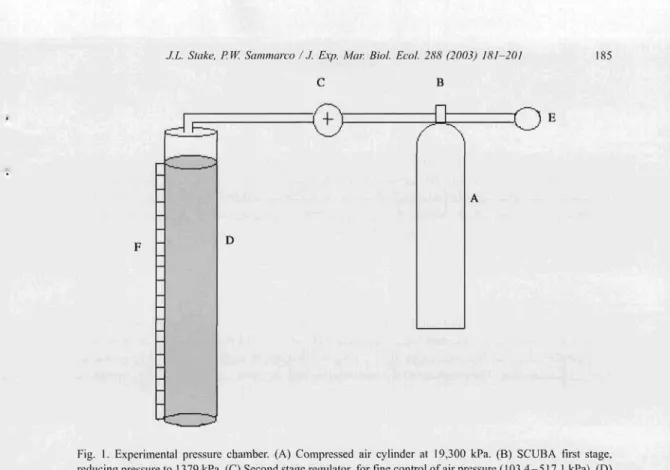
The pressur e chambe r (Fig . I) was cons tructed from transparent PYC pipe, 0.80 m in len gth (0.0.
=
7.62 em; J.D.=
6.99 ern). It was sea led at the bott om using a PYC end cap secured with Oatey'" Clea r PVC ceme nt. The top was sea led using PVC bushings, again glued with Oatey'" Clear PYC cemen t. A 2.54 -cm hol e in the cap serve d as both an access point for the introduction and remova l of larvae, and an attachment poin t for tubing from the pressure regulator and air source. The side of the appa ratus was fitted with a metric ruler as a referen ce guide for record ing the vert ical positi on of each larv a. Compressed air fro m a SCUBA tank was used to regul ate pressure in the chamber. A Victorw SR250 sing le-st age regulator was used to contro l cha m be r pressure. The first stage of the regul ator was used to reduce the air pressure from 19,300 to < 137 9 kPa. A second stage was also used as a pressure-r elease valve .The expe rime nt followed a one -w ay ANOYA design using rep eated measures. The experime nta lly varied factor was pressure. The respon se variable was the vertical positi on ofthe larva e in the tank, The pressures used were 103.4, 206 .9, 310.3, 41 3.8, and 517.1. 1
.l.L. Slake, P. HI Sammarco / J. £1'". Mill: Bial. Em!. 288 (2003) /8/ -20/ IRS
C B
(+'1 ("
E~
F=, \....J'/"G .:»
...--
A
F D
Fig. I. Experimental pressure chamber. (A) Compressed air cylinder at 19,300 kPa. (B) SCUBA first stage, reducing pressure to 1379 kPa. (C) Second stage regulator, for tine control of air pressure (103.4 -517.1 kPa). (D) Observation chamber. (E) SCUBA second stage, used as release valve. (F) Metric ruler, used as reference for vertical position of larvae,
kPa (total pressure, including ambient). The pressures were applied stepwise in ascending and descending order. The experiment was repeated 10 times, using planulae from separate colonies each time (II; = 10).
Larvae < 24 h old were used for the experiment, to ensure that they were all at approximately the same stage of development. Ten randomly selected larvae from one adult colony were placed inside the pressure apparatus, which was filled with seawater.
The larvae were permitted 15 min to acclimate. At the end of this IS-min period, a timer was started and observations were taken. The vertical position of each larva was recorded every 5 min starting at 0 min and ending at 130 min. Qualitative observations were also made regarding planular swimming behavior. During this time , the pressure was increased by 103.4 kPa every 15 min until a maximum of 5 J7. J kPa (the equivalent of 40 m depth) was attained. After this pressure had been reached and the 15 min was allowed for a response to that pressure, the pressure was reduced by 103.4 kPa every 15 min until it once again reached ambient. Larvae were only used once, and no colony was used as a source of larvae more than once during the experiment.
The data were analyzed using repeated-measures ANOYA for both individual trials and pooled data. Data were log-transformed before analysis for purposes of normalization (Sokal and Rohlf, 1995). Statistical details may be found in figure legends. Only significant results will be discussed.
186 .J.L. Stake, I~ WSIII/II / lim'O / .1. Exp. ;\1/1/: Bioi. £1'01. 288 (2003) 181 -201
3. Results
3.1. Effects I?I' increasing pressure
Larvae derived from all colonies exhibited a significant response to increas ing pressure (significant movem ent of the larvae either upward or downward was cons idered a response). On average, larvae derived fro m all colonies exhibited an upward respon se as press ure was increased. Althoug h the response was variable, no larvae from any sing le colony exhibited an average downward response to increasing pressure.
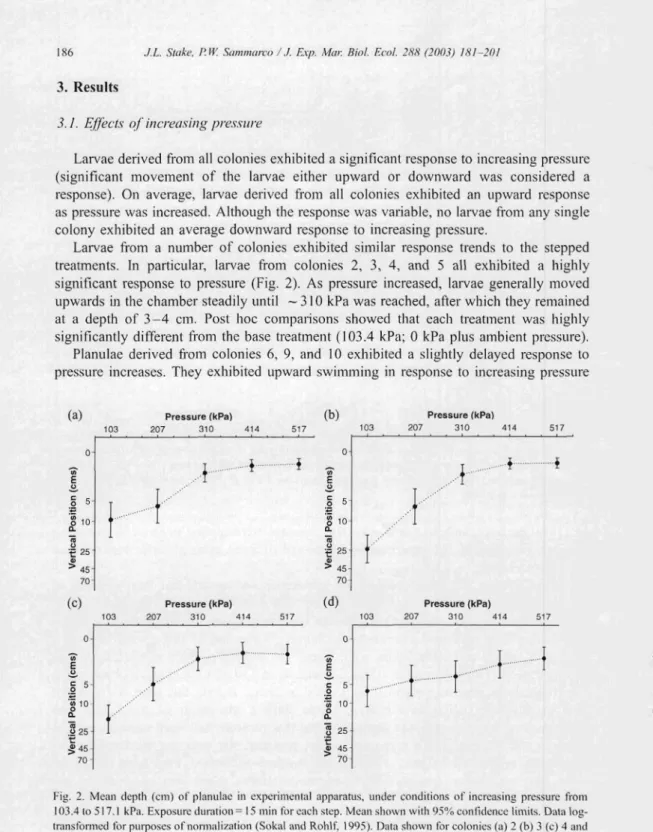
Larvae from a number of colonies exhibited similar response trends to the stepped treatments. In particular, larv ae from colonies 2, 3, 4, and 5 all exhibited a highly significant response to pressure (Fig. 2). As pressure increased, larvae generally moved upwards in the chamber steadily until - 310 kPa was reached, after which they remained at a depth or 3-4 ern. Post hoc comparisons showed that each treatment was highly significa ntly different from the base treatment (103.4 kPa; 0 kPa plus ambient pressure).
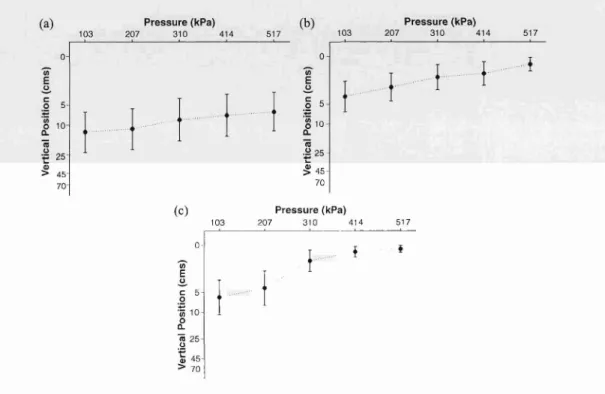
Planul ae derived from colonies 6, 9, and 10 exh ibited a slightly delayed response to pressure increases . They exhibited upward swimming in response to increasing pressure
(a) Pressure (kPa) (b) Pressure (kPa)
10 3 20 7 310 414 517 103 207 310 414 517
o o
Ul Ul
E E
~ ~
.g
S·.~ 5
.~ 10
.~10
D. D.
'iii iii
~25
't:
.,
lJ25.,
> 45
> 45 70 ' 70
(c)
o
Ul
~ E
g 5
.,
'iii 10
s
'iii
lJ 25
1: ~ 45 70
Pressure (kPa) (d) Pressure (kPa)
103 207 310 414 517 103 207 310 414 517
o
1 / / I · · ··· ··j·· ·· 1
UlE~ l: 5
.g
'iii 10
g,
~ 25
~
4570
Fig. 2. Mean depth (e m) of planulae in experimental apparatus. under cond itions of increasing pressure from 103.4 to 517.1 kPa. Exposure duration = 15 min for each step. Mean shown with 95% con fidence limits. Data log
transfo rmed for purposes of normalization(Sokal and Rohlf, 1995).Data show nforcolonies (a) 2 (b) 3 (c) 4 and (d) 5. Significant diffe rences between pressures (H-
r:
adj . I' value < 0.00 I. one-way ANOVA with repea ted measures).Post hoc contrastssignifica ntbetween the tirsttreatm ent andallothers(103.4vs.206.9.310.3.413.8.and517. 1kPa. respec tively: p<O.OO! in allcases).
./L Slake. PW Sammarco / .1. £.'1" M{II~ BioI. Ecol. 288 (2003) /8/ -20/ 187
(Fig. 3); however, the change in vertical position between the first and second treatments (206 .9 and 310.3 kPa) was less pronounced than in the previous group (post hoc contrast,
p < 0.05). Post hoc contrasts between the first vs. third, fourth , and fifth treatments were
significantly different.
The larvae derived from colonies I and 8 also elicited a significant but somewhat delayed response to increasing pressure (Fig. 4). The initial differences in response between treatments I and 2 were not significant (p>0.05). All other post hoc comparisons between treatment I and the others were highly significantly different (p < 0.00 I).
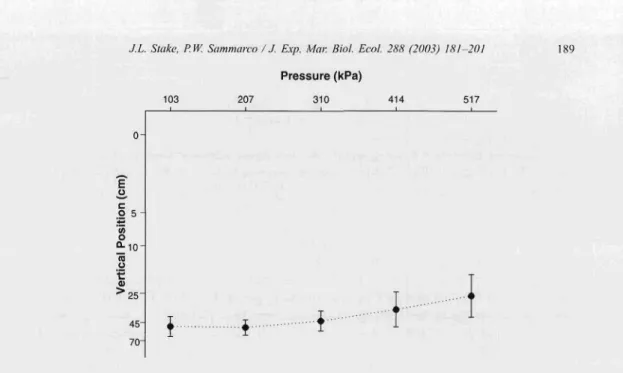
Larvae from colony 7 also showed a significant response to increasing pressure by swimming upward (Fig. 5), but post hoc contrasts indicated no significant change in vertical position until the onset of treatment 4. This difference was significant, but less pronounced than in previous colonies (p < 0.05). Treatments I and 5 were also highly significantly different (p < 0.00 I).
An analysis of larvae from all 10 colonies combined demonstrated that, as a group, all larvae responded significantly to increases in pressure by swimming upward (Fig. 6).
There was also a highly significant difference in response between larvae derived from different colonies (p < 0.00 I). Post hoc contrasts showed that the baseline treatment was significantly different from all other treatments (p < 0.00 I).
(a) Pressure (kPa) (b) Pressure (kPa)
103 207 310 414 517 103 207 310 414 517
Ui Ui
E E
~ <: <:
!
2
5· .g 5t'
'iii
f
.~ 10 ·0 10
e, e,
! I I
~
iii iii
u
~ 25 ~~ 25 45
70
> 45
70
(c) Pressure (kPa)
103 207 310 414 517
c
Ui
f ··· · ·
E
~
<: 5 .Q
~0 10
t t
n,
iii 25
i
o 45> 70
Fig. 3. Mean depth (em) of planulae in experimental apparatus. under conditions of increasing pressure from I03.4 to 517.1 kPa. Data shown for colonies (a) (, (b) 9 and (c) 10. Mean shown with 95'X, confidence limits.
Significant differences between pressures (H-F adj. p <O.OOI. one-way ANOVA with repeated measures). Post hoc contrasts were significant between the first treatment and all others (p < 0.00 I). except for treatment I vs.
treatment 2. which were significant at a lower level (p<O.OI).
I RS 1.L. Slake. P.W Sammarco / 1. Exp. Mar. Bio/. Eco/. 288 (2003) 181-201 Pressure (kPa)
(a)
103 207 310 414 517
o
45 70
Pressure (kPa)
(b)
103 207 310 414 517
o
45 70
Fig . 4. Mean depth (cm) of planu lae in experi mental apparatus. under cond itions of increas ing pressure from 103.4 to 517.1kl'a. Datashown forcolon ies(a) I and (b) X.Menusho wn with 95%confidencelim its. Significant differe nces between pressures (H -·F adj." < 0.00 I. one-way ANOVA withrepeated measures).Post hoc contrasts were signifi cant betwe en the first treatm ent and all othc rs
t»
< D.OO I). except for treat me nt I vs. treat ment 2, which were not significant.3.2. Effects ofdecreasing pressure
Larvae from individu al colon ies showed high within-co lo ny varia bi lity and also high bet ween- colon y variability under cond itio ns ofdecreas ing press ure . Larvae fro m all of the colonies except two (colonies 3 and 6) were found to exhibit a significa nt resp on se to decreas ing pressure.The movem ent s oflarvae derived from anygiven colonywere hig hly variable. On the average, however, the larvae mo ved significan tly downwa rd. In no case were planul ae observed to move upward when pressure was decreased.
.J.L. Slake, P W Sammarco / .J. Exp. Mar. Bio!. Ecol. 21i1i (2IJIJ3) /1i/-2IJ/ IS9 Pressure (kPa)
103 207 310 414 517
0
E
~ l:~ 5 'iii
0 D.10 ii o
t
Gl>25
f ! ! I !
45 70
Fig. 5. Mean depth (em) ofplanulac in experimental apparatus, under conditions of increasing pressure from 103.4 to 517.1 kPa . Data shown for colony 7. Mean shown with 95% confidence limits. Significant differences between pressures (H -F adj. I' < 0.00 I, one-way ANOYA with repeated measures). Post hoc contrasts were significant between the tirst treatment and all others (I' < 0.00 I), except between treatment I vs. treatments 2 and 3.
Pressure (kPa)
103 207 310 414 517
o
45
I---+---
All coloniesI
70
Fig. 6. Mean depth (em) of planulae in experimental apparatus. under conditions of increasing pressure from 103.4 to 517.1 kPa. Data shown for all coral colonies exposed to this set of treatments. Mean shown with 95%
confidence limits. Significant differences between pressures (1-1 -F adj. I' < 0.00 I, one-way ANOYA with repeated measures), Post hoc contrasts were significant between the tirst treatment and all others (I' < 0.00 I).
190 1.L. Slake. P. W Sammarco / 1. EIp. M(//: Bioi. Ecol. 2811 (2003) 1111 -201
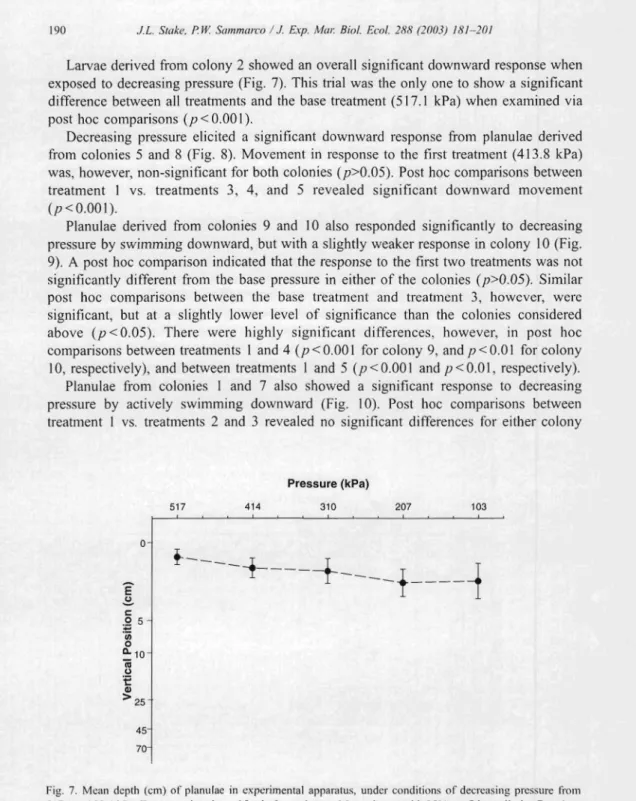
Larvae derived from colony 2 showed an overall significa nt down ward response when exposed to decr easing pressure (Fig. 7). This trial was the only one to show a significant difference betw een all treatments and the base treatment (5 17. 1 kPa) when examined via post hoc comparisons (p < 0.00 I) .
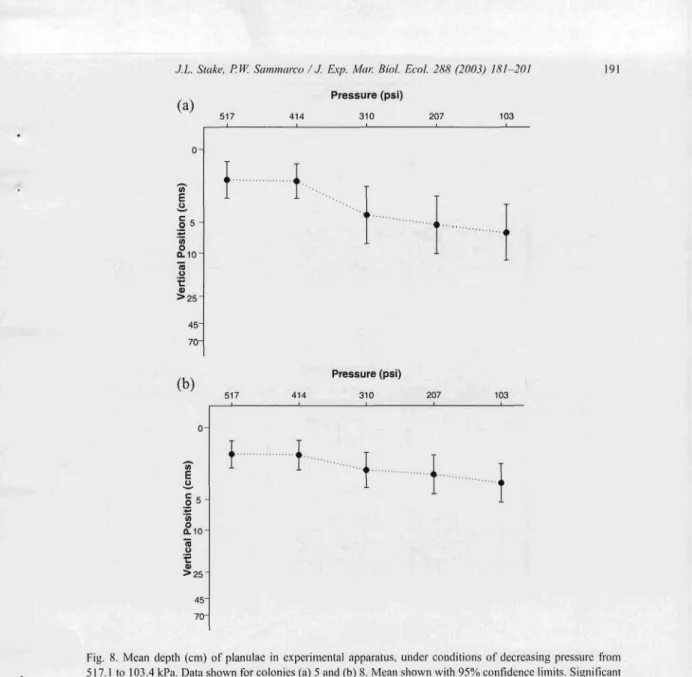
Decreasing pressure elicited a significant downward response from planulae derived from col onie s 5 and 8 (Fig. 8). Movem ent in respons e to the first treatm ent (4 13.8 kPa) was, howe ver, non-si gnifi cant for both colonies (p>0.05). Post hoc comparison s between treatm ent I vs. treatm ent s 3, 4, and 5 reveal ed significa nt downward movem ent
(p < 0.001 ).
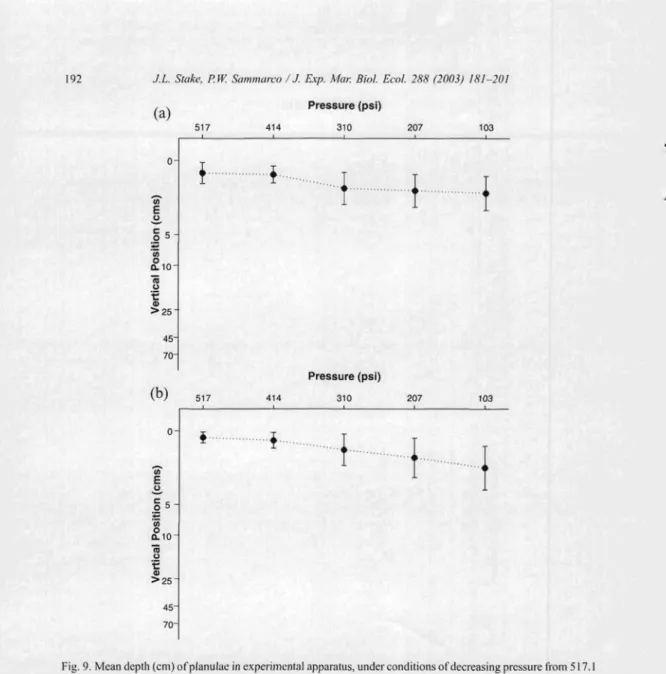
Planulae derived from colonies 9 and 10 also resp ond ed significantly to decreasin g pressure by swimming down ward , but with a slightly weaker resp onse in colony 10 (Fig.
9). A post hoc compa rison indicated that the respon se to the first two treatm ents was not significa ntly different from the base pressu re in either of the colonies (p>O.05). Similar post hoc comparisons betw een the base treatment and treatment 3, how ever, were significant , but at a slightly lower level of significa nce than the coloni es consid ered above (p < 0.05 ). There were highl y significant differ enc es , how ev er, in post hoc compa risons between treatm ent s I and 4 (p < 0.00 I for co lony 9, and p < 0.0 I for co lony 10, respectively),and between treatments Iand 5 (p<O.OO Iand p<O.OI ,respe ctively).
Planulae from coloni es I and 7 also showed a significa nt response to decreasing pressu re by actively swimming downw ard (Fig. 10). Post hoc comparisons betw een treatment I vs. treatm ent s 2 and 3 reveal ed no sign ificant differ ences tor either colony
Pressure (kPa)
517 414 310 207 103
o
i-- -
-.II
--1---r----f----1
45 70
Fig. 7. Mean depth (em) of planul ae in experi me nta l appara tus, und er condi tions of decreasing pressure from 517.1 to 103 .4 kPa. Expos ure duration = 15 min lo r each step. Mcan shown wilh 95% confide nce limits. Data log
tran sform ed tor purposes of norma liza tio n (Soka l and Rohlf, 1995). Data shown fo r colony 2. Signiflca nt differences between pressur es (H-F adj ." < 0.00 I,one-way ANOVA withrepea ted measu res),Posthoc contrasts were signifi cant between the first treatm ent and all others (" < o.on I).
.J.L. Slake. P W Sammarco / J. Exp. Mur: Bioi. EC'o!. 288 (2003) /8/-20/ 191 Pressure (psi)
(a)
517 414 310 207 103
0
Ul E
~
~5
f f ... · · · · f
. .. . ...
" ' .f
" ... . .. ... .. ..f
'0 0.10 0
OJ o
'E CIl
>25
45 70
(b)
517 414
Pressure (psi)
310 207 103
o
45 70
Fig. X. Mean depth (em) of planulae in experimental apparatus. under conditions of decreasing pressure from 517.1 to 103.4 kPa. Data shown for colonies (a) 5 and (b) X. Mean shown with 95% confidence limits. Significant differences between pressures (H --F adj. jJ < 0.00 I, one-way ANOVA with repeated measures). Post hoc contrasts were significant between the first treatment and all others (jJ < 0.00 I), except between treatment I vs. treatment 2.
(p>0.05). Post hoc comparisons did demonstrate a significant difference between the base treatment and treatment 4 for both colonies, although the level of significance was different for each colony (p < 0.05 for colony I and p < 0.00 I for colony 7). This was also true for comparisons between treatments I and 5 (p < 0.0 I and p < 0.00 I, respectively).
Planulae from colony 4 showed an overall significant downward swimming response to decreasing pressure, but less pronounced than that exhibited by larvae from the other colonies (Fig. II). Post hoc contrasts only revealed significant differences between treatments I and 2 (p < 0.0 I); all other comparisons were non-significant (p>0 .05).
192 J.L. Slake, Po W Sammarco / J. Exp Mar; Bioi. Em /. 288 (200]) 181-2111 Pressure (psi)
(a)
517 414 310 207 103
o
Ul E
~
~5
'iii 0.10 o iU o 'f:
Gl
> 25
45 70
Pressure (psi)
(b) 517 414 310 207 103
o
45 70
Fig.9.Mean depth (em) ofplanulaeinexperime ntalappara tus,unde rconditio ns ofdecreasing pressure from517.1 to 103.4 kl'a. Data shown for colonies (a) 9 and (b) 10. Mean shown with 95%. confide nce lim its. Sign ifican t diff erences betwee n pressures (H-F adj . I' < 0.00 I, one-way ANOVA with repeated measu res). Post hoc con trasts were significan t between the first treatm ent and all others (I' < n,ooI), except betwee n treatm ent I vs, treatm ent 2.
Post hoc contrast betwee n treatm ent I vs. treatment 3 is less sign ific ant (1' <0.05) tha n other comparisons.
When data fr om the larvae of all colonies were pooled, the repeated-measures ANOYA revealed a highly significant downward swimming response to decreasing pressure (Fig.
12).There was a highlysignificantdifference between the responses of larv aederived from different colonies. In addition, a significant two-way interaction was detected between pressure and parent colony (p < 0.00 I).That is,planulae responded significantly to pressure changes, but the nature of that response varied highly significantly between colonies. Post hoc comparisons revealed a significant difference between treatment I and all other treatments (p < 0.00 1). Larvae were also demonstrated to exhibit a significant downward
J.L. Slake. t:HI Sammarco / J. Exp. AIm: Bin!. Eco!. 288 (2003j /8/-20/ 193
Pressure (psi)
(a)
517 414 310 207 103
0
"'
~ Ec: 5 :;: 0 'iii 0.10 0
f · ·· ···· ! ... ... .... !
f ··· ···· ·f
(ij
t: 0 Ql
>25
45 70
Pressure (psi)
(b) 517 414 310 207 103
0
"'
E~
B
5'iii 0.10 0 (ij
t: 0 Ql
>25
f f . . ....··· ···f
45
f f
70
Fig. 10. Mean depth (em) of planulae in experimental apparatus, under conditions of decreasing pressure limn 5/7.1to 103,4 kPa. Data shown forcolonies(a) I and(b)7.Mean shown with 95'1., confidencelimits. Signifi cant differences between pressures (H- F adj.!, < 0.00 I. one-way ANOVA with repeated measures). Post hoc contrasts were significant betw een the firs: treatment and all others (I' .:0.00I),except for treatment Ivs. treatments 2 and3.
swimming response (vs. simple random movement) in association with decreasing pressure (Kendall's coefficient of rank correlation, T, P < 0.00 I, for all treatments).
3.3. Planular swimming behavior
When exposed to increases in pressure, planulae began to actively swim toward the surface in a spiraling motion. Although not all larvae were observed swimming in this pattern, for those traveling longer distances, a spiraling pattern was most frequently observed. Larvae were clearly not moving toward the surface passively, but active ly
194 J.L. Stake, P. W Sammarco / J. Exp. Mill: Bio/. Eco!. 288 (21103) /8/-211/
Pressure (kPa)
517 414 310 207 103
o
t - - -- J r---- - r L ----t-- -- j r
E
~ c: o 5 :.;::'iii 0.. o 10 Oi u
'E CI>
> 25
45 70
Fig. II. Meandepth(cm) ofplanul aeinexperimental apparatus,under cond itions of decreasing pressure from 517.1 to 103.4 kPa. Data shown for colony 4. Mean shown with 95% co nfi dence limits. Significant differences between pressures (H -F adj. P < 0.00I, one-way ANOVA with repeated measures). Post hoc contrasts were signi fi cant between treatments I and 2 ip < 0.00 J); all other contrasts non-s ignificant.
swimmi ng upward under condi tions of increasing pressure. When exposed to decreasing pressu re, planul ae actively moved down ward. No larvae were observed to sink pass ively under cond itions of decreasin g pressure. This sugges ts that larvae actively regulate their position in the water column dep endin g upon which stimulus is being applied.
Pressure (kPa)
517 4 14 310 207 103
o
45 70
~ - - - -f - - - _+
- - --f
-.I- - - -y
"
1 ...-
All coloniesI
Fig. 12. Mean depth (em ) of planulaeinexperimental apparatus.under conditions of decreasingpressure from 51 7.1 to (OJA kPa. Data sho wn lor all coral colonies exposed to decreasing pressure. Mean shown with 95%
confi de nce limits. Significant differences between pressures (H -F adj. J1 < 0.00 I. one-way ANOVA with repeated measures). Posthoc contrastswere signi fica ntbetwee nthefirst treatment andall others (p<O.OOI).
JL Slake, PW Sammarco / .1. Ex!'. M01: BioI. Eml. 288 (2003) /8/-20/ 195
4. Discussion
The results of this study indicate that, when exposed to increases in pressure, coral planulae respond on the average by actively swimming upward in the water column. When exposed to decreases in pressure, they also show a significant downward swimming response, although to a lesser extent. The general response of barokinesis and/or negative barotaxis (actively moving away from increased pressure) has been demonstrated in several planktonic animals, including planktonic larvae (e.g. Rice, 1964; Knight-Jones and Morgan, 1966; Schembri, 1982; Morgan, 1984; Forward, 1989; Tankersley et al., 1995).
Before this study, however, this behavior had never been demonstrated in the larvae of scleractinian corals. These data indicate that pressure may well be a factor that influences coral dispersal and settlement, and that settlement of coral larvae may not be simply light
or substrate-limited (Mundy and Babcock, 1998) but may also be heavily influenced by pressure or depth. That is, the planulae may have control over the depth to which they will be transported by currents and in which they will settle. Their response to pressure is not simply a passive buoyancy-controlled response, but rather an active swimming movement of the larva to ascend under conditions of increasing pressure (negative barotaxis) and descend under conditions of decreasing pressure (positive barotaxis). The larvae actively swim up in a spiraling motion to regulate their vertical position with regard to increasing pressure. With respect to decreasing pressure, larvae do not passively sink, but rather swim in a simple fashion to a suitable deeper position in the water column.
4.1. Negative barotaxis
Most planktonic animals are dependent upon food found in the shallower euphotic zone for survival. Field as well as theoretical studies have shown that it is essential that many planktonic animals spend at least some of their time in or near the surface layer, and therefore, must exercise some level of active depth regulation (Rayrnont, 1963 ; Enright and Hamner, 1967; Vlyrnan, 1970) . Coral planulae and , more importantly, adult corals are dependent upon the euphotic zone because of their need for solar energy to drive photosynthesis in their zooxanthellae (Muscatine, 1980, 1990; Cook, 1983; Falkowski et al., 1984; Leletkin et al., 1996; Goodson et al., 200 I). If the larvae either actively swim or are carried to waters too deep, photosynthesis within their zooxanthellae becomes light limited. Non-feeding zooxanthellate planulae, dependent upon these symbiotic dinofla
gellates for energy, may not survive, particularly if their lipid stores are inadequate to support them for long periods of time (Richmond, 1987).
In waters where corals exist, there are two factors that may act as environmental indicators of depth: light and pressure. As depth increases in the ocean, light decreases in intensity and changes in spectral composition, due to absorbance by the water and particles therein. This relationship, however, is dynamic ancl can be highly variable over short periods of time, For example, light is affected naturally by diurnal/nocturnal shifts, clouds blocking the sun during the day, storms causing periods of low light, etc. Changes in turbidity can also heavily influence the relationship between light and depth. In the long term, light intensity and quality is affected by season, day length, and turbidity. The natural dynamics of atmospheric light are probably too variable to serve as a reliable indicator of
196 J.L. Stake. P. W. Sammarco / J. E\]J. M<I1: Bid Ecot. 288 (2003) t8t-201
depth for larvae. Under very low light conditions (e.g. night), light is of little or no use as a depth indicator (Rice, 1964), except perhaps in the presence of strong lunar light.
In contrast to light, the relationship between depth and pressure is highly predictable.
This consistency may allow behavioral responses to pressure to be operating at all times equally so during the day and night. Pressure provides an accurate measure of vertical position in the water column, irrespective of light conditions.
Negative barotaxis may serve to keep larvae from moving below depths where suitable settlement substratum may be found and below the euphotic zone, where sufficient photosynthetically active radiation exists to enable their survival (Shick et al., 1995). It provides a means by which larvae that have been swept too deep by currents may return to their preferred depth. If larvae were using only light as a depth indicator under similar conditions, they may not be able to reorient and return to the euphotic zone before the consumption of energy reserves, required for respiration, exceed the rate of production of energy products derived from zooxanthellar photosynthesis. If increases in pressure stimulate coral planulae to actively move upward, then pressure may serve as a lower depth-limiting factor for settlement. Pressure and light may work together to provide a depth limit for settlement in some species.
4.2. Positive barotaxis
The response of larvae to decreasing pressure was, on the average, to move downward when exposed to decreasing pressure. Although the response was not as great in magnitude as it was for increasing pressure, it was nonetheless significant. This difference in level of response to increasing vs. decreasing pressure may be indicative of an upper limit for preferred depth of coral larvae. The results suggest that larvae, when too close to the surface layer, actively swim toward deeper waters. This would allow them to maintain a position at an optimal depth where environmental factors are more suitable for survival. Such behavior might enable them to avoid the surface layer of the water, which can be too warm for survival (Bassim, 1997; Bassim et al., 2002; Bassim and Sammarco, 2003). It can also keep the larvae out of shallow depths where harmful ultraviolet radiation can penetrate and cause mortality. The response of larvae to decreasing pressure was significant, but it was characterized by high variance between planulae. It is possible that additional experimen
tation using larger numbers of larvae per run may provide a better estimate of variance.
4.3. Evolutionary implications
The high variance in planular behavior observed here is similar to high variance observed in morphological and physiological characters in coral larvae (Isomura and Nishihira, 200 I; F. Yohannes, unpublished data). Analyses have shown that different colonies produced larvae with different biochemical compositions as well as different numbers of zooxanthellac per larvae. It is also known that the density of zooxanthellae in the parent colony and its larvae are not correlated (F. Yohannes, unpublished data). There is also a high degree of variatio n in the size of planulae produced by a colony, as well as comparative sizes between conspecific colonies (Isomura and Nishihira, 2001). If different colonies are producing differently sized larvae with different amounts of protein and lipid
197 1.L. Slak e. P W Sammarco / .J. E.I1'. Mw : Bio!. Eco!. 21111 (20{)]) 1111-201
content, and zooxanthellar densities, then these differences may well contribute to the observed variance of other traits dependent upon these factors, including behavior.
In addition, the high variance observed in this behavior indicates that it may well be susceptible to natural selection if it is genetically based. The adaptive value of an upward swimming response to an increase in pressure is clear keeping the larva in the euphotic zone.
The high variability in this response, however, indicates that this may not always be adaptive. Perhaps upward movement sometimes carries larvae into surface layers that are too warm or where salinity is too low, causing mortality. Thus,lack of response may be selected for at times, characteristic of normalizing selection (Futuyma, 1998). This was particularly evident through intra-colony variance where larvae derived from the same colony demon
strated a wide range of responses to pressure, as well as through intercolony variance where planulae from some colonies exhibited marked responses, and others more subdued ones.
4.4. Sensory mechanisms
One mechanism by which planula larvae may be able to sense pressure is through lipid vacuoles, which may also act as buoyancy devices. Although larvae from different colonies have significantly different lipid content, the lipid/protein ratio remains consistent between colonies (F. Yohannes, unpublished data) . The most common types of lipids found in corals are wax esters and triacylglycerol, with the most common fatty acid being palmitic acid (a.k.a. hexadecanoic acid; see Yamashiro et al., 1999). Because organic compounds such as palmitic acid vary from other organic compounds and from seawater in their isothermal compressible characteristics (Lide, 1991), it is possible that the lipid vacuoles may expand or contract in response to pressure differentially with respect to the aqueous environment around them. This could provide a cue indicating that the planula should swim up or down.
The compression coefficients of these compounds may be sufficiently disparate to provide a signal to the larva for depth change. The mechanism by which planulae sense depth and regulate their vertical position at this point remains unknown.
It is also possible that the planulae are not responding to pressure, but to some other factor that is correlated with pressure. For example, in this experimental setup, pressure is varied by changing air or atmospheric pressure. This method introduces an oxygen gradient in the water, at least partially with respect to depth. It is possible that the larvae are responding to an oxygen gradient rather than pressure. If this were the case, however, the response to decreasing oxygen should be similar in intensity to that of increasing oxygen. This, however, was not the case. This question can be investigated in future experiments either by using nitrogen as the experimental gas , placing a diffusion barrier at the meniscus of the water, or by eliminating gases from the chamber by increasing pressure via a water pump.
The pressure changes implemented in this experiment were relatively rapid-i-on the order of 103.4 kPa over a 5- to 10-s interval. The probability of a coral larva encountering a similar change in the field is low, occurring only where there might be strong convergences or divergences, or possibly in connection with the breaking of large ocean waves.
Therefore, some caution should be used when interpreting these laboratory results in terms of its direct application in the field. Nonetheless, we can say that when coral larvae of P astreoides are exposed to increases in pressure-they will respond by actively swimming to
198 J.L. Stake. P. W Sammarco I J. Exp. Mw: Bia/. Ecol. 288 (200]) 181 -2()1
reach a sha llowe r depth within the water colu mn. When exposed to decreases in pressu re, they will respond by active ly swimm ing to reach a deep er depth. This represent s the first study of its kind to demonstrate that coral lar vae possess amech ani sm bywhich to sen se changes in pressure and respond to it throu gh a swimming reaction.
Acknowledgements
We thank the followin g for their assistan ce in this proj ect : D. Felder, P. Klerk s, and J.
Ne ige l for their adv ice and suppo rt during the proj ect; 1. Spring and E. Bartels for assistance in designin g the pressure appara tus; and J. Hawkridge for assistance in collec tio n and maintenance of the co rals. 1.L.S. also than ks his wile, K. Stake, to r her unerring suppo rt during the proj ec t, Collec tio ns were mad e unde r provision s of NO AA FloridaKeys Nation al Marin e San ctu ary (FKNM S) Perm it no.200 1-0 11,and the Florida Fish and Wildlife Conse rva tion Comm issi on. This study was suppo rted by a Link Foundation/Smithsoni an Institution Gradu at e Fellowship, a Sigma Xi grant-in-a id, and University of Loui siana at La fayette (ULL) Graduate Stude nt Orga nization (GSO) Grant
in-Aid. This pape r rep resen ts co ntribu tion no. 555 from the Sm ithso nian Marin e Statio n at Fon Pierce, Fort Pierce, Florida. [SSI
References
Anton ius, A., 19X5. Coral diseases in the Indo-Pacific: a fir st record. Mar. Ecol. 6 (3), 197-2 18.
Aroda, K., 19 51a. The larv a and post-larval developm ent of reef-bu ilding cora ls: III. Acropo ra brueggma in (Brook ). J. Morph ol . 89 (I ). 1-13 .
Aroda,K., 1951 b.The larva andpost larva ldevelop ment oftheree f-building corals: IV. Cralaxca asp era Quelch.
J. Morph o l. S9 (I), 17 -35.
Aroda. K.,1951e.The larva andpostlarval developmentof thereef- building corals:V. Seriutopora hystrex Dana . Sci. Rep. Tohok u Univ., Scr. 4 19, 33 -39 .
Aroda, K., 1953.Thclarva and postlarval developme nt ofthe reef-buildingcora ls: VI. Sci.Rep.TohokuUniv., Scr. 4 20, 105 - 12 1.
Ayre, DJ., Hugh es, T.P., Stand ish, RJ., 1997. Genetic differentiation, reproduc tive mode, and gene flow in the brood ing coral Pocillopora dum icornis along the Great Barrier Reef , Austra lia. Mar. Ecol., Prog. Scr, 159 (I).
175 -187.
Bab cock,R.C. ,Heyward, AJ., 1986.Larvaldevelop mentincertai n gamete-s pawn ingsclcrac tinia ncorals.Coral Reefs 5 (3), 111--116.
Barnes, R.S.K., Ca low, P., Olive, P.W., Golding, D.W., 1993. The Invert ebrat es: A New Synthes is. 2nd cu.
Blac kwe ll, Oxford .
Bassim ,K.M.. 1997. Effects oftemperat ure and ammoniumon the earlydevelo pmentalsta ges nf a sclcrac tinian coral: im plications fo r globa l warm ing and nutri en t enrichment. MSc Thes is, Depart me nt or Biology, Uni
vcrsity of Lou isian a at Lafaye tte, 51 pp.
Bassim,K.M.. Sammarco,P.W.. 2003.Effects oftemperature andammon iumonlarval deve lopment andsurvi
vorship in a sc lc ractinian coral. Mar. Bio I. 14 2 (2), 241 -252.
Bassim, K.M., Sam marco, P.W., Snell, T., 2002. Eff ec ts or temp erature on fertilization success and embryo
genes is in Diploria strigosa (Coelenterata, Scleractinia). Mar. BioI. 140 (3), 479 -488.
Brown. RE. (Ed.), 1990. Coral Blea chin g. Coral Reels X. 153 -232.
Bythell , J.. Sheppar d, C .. 1993. Mass mortalit y of Caribbean sha llow corals. Mar. Pollut. Bull. 26 (6), 296 -297.
Chorncs ky, E., Pete rs. E.. 19 S7. Sex ua l reprodu cti on and col on y grow th in the sclcrac tinian coral Porites astreoides. BioI. Bull. 172 (2), 16 1-177 .
.l.L. Slak e, PW Sanunarco / .1. F\jJ. MlII: Bio!. Em /. 288 (2()()3) /8/ -20/ 199
Coo k, C13.,19X3. Metabolicinte rc ha ng e in algac invcrtcbrate symbiosis.e Int. Rev, Cytol. Suppl. 14 (I),177-210, Done, 'Ll., 19R2. Patterns in the distribution of coral communities across the central Great Ba rrier Reef. Coral
Reefs I (2) ,95 -107.
Doyle, R.W., 1975. Settlement of planktonic larvae: a theory of habitat selection in varying environments. Am.
Nal. 109 (966), 113-126 .
Enright , IT, Hamner, W.M., 1967. Vertical diurnal migration and endogenous rhythmicity, Science 157 (3791), 937 -941.
Fadlallah, Y, 19R3. Sexual reproduction, development and larval biology in scleractinian corals. A rev iew. Coral Reefs 2 (2) , 129 - 150.
Fadlallah, Y, Pearse, .I., 19X2. Sexual reproduction in solitarycorals: overlapping oogenic and brooding cycles, and benthic planulae in Balanophyllia elegans. Mar. BioI. 71 (3), 223 -231.
Falkowski, P., Dubinsky, Z., Muscatine, L.. P0I1er, J. w., 19X4. Light and the bioenergetics of a sym b io tic coral.
BioScicnce 34 (II), 705 -709.
Forward. R,B .• 19R9. Depth regulation of larval marine decapod crustaceans: test of a hypothesis. Mar. BioI. 102 (2),195 -201.
Futuyma, DJ., 199X, Evolutionary Biology, 3rd ed, Sinaucr Associates. Sunderland, MA. USA.
Gerrodcuc, T, 19XI. Dispersal of the solitary coral Balanophyllia elegans by demersal planular larvae. Ecology 62 (3) .611 -619.
Goodson, M.S. Whitehead, L.F., Douglas, A.E., 200 I, Symbiotic dinoflagellates in marine Cnidaria: diversity and function , Hydrobiologia 461 (I), 79 -X2,
Goreau, TJ" Hayes, R.L., 1994. Coral bleaching and ocean "hot spots". Ambio 23. 176-1 XO.
Green, E.P.. Bruckner, A.W., 2000, The significance of coral disease epizootiology for coral reef conservation, 13iol. Conscrv. 96 (3),347-361.
Harrigan, .I., 1972. The planula larva of