One of the biggest conflicts in Sino-Japanese relations in the post-normalization era is the territorial dispute over eight small islands and rocks in the East China Sea. In recent years, conflicts involving the islands have taken many forms, but none have reached the scale of the 2012-2013 dispute, which will be the focus of this thesis. For a relationship that has long followed the general rule that politics and economics occupy separate spheres, this rapid economic decline has called into question the applicability of the assessment "cold politics, hot economics" in terms of Sino-Japanese relations.
4 Some previous disputes have included economic boycotts and protests, but none were on the scale of the 2012–2013 dispute, and none were so powerful as to endanger entire Sino-Japanese relations. The Diaoyu Island dispute, its effects on Sino-Japanese economic relations, the nationalism it fuels, and how “cold politics, hot economics” characterizes Sino-Japanese relations. Japan gains administrative power over the Senkaku/Diao yu Islands End of the First Sino-Japanese War;
Now that insight has been gained into the existing literature on nationalism in China and Japan, it is important to understand what the existing literature has to say about the “cold politics, hot economics” characterization of Sino-Japanese relations. Whenever the effect of politics on economics is questioned in Sino-Japanese relations, an inherent judgment is made on the “cold politics, hot economics” framework. Cold Politics, Hot Economics: Refers to the popular characterization of Sino-Japanese relations after diplomatic normalization in the 1970s.
How Nationalism Shapes the Dispute
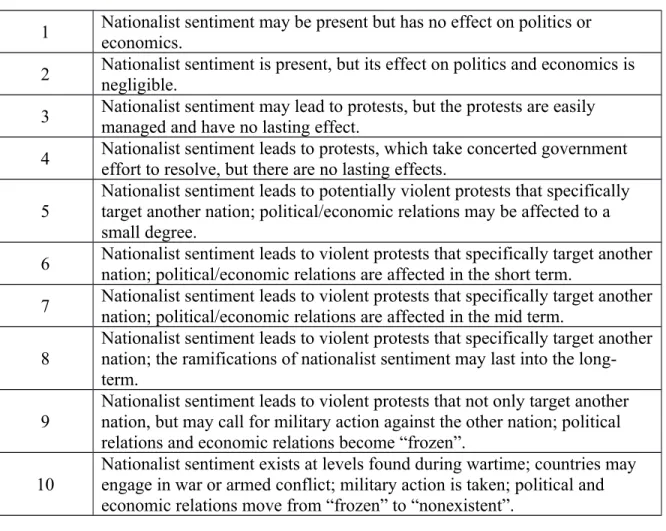
Events like Yasukuni Shrine visits don't really add any comparative value to the 2012-2013 Senkaku/Diaoyu dispute; they serve only as a catalyst for short-term nationalist sentiments and animosity. The disputes analyzed before 2012 will be used to create a scale for effective nationalist sentiment (see: “Figure 2”). The nationalist sentiments found in 1996 did not develop in the same way as in 2012.
Using the same scale of 1 to 10 used to determine the effectiveness of nationalist sentiment would amount to something like a 5. 3 Nationalistic sentiment can lead to protests, but protests are easily managed and have no lasting effect. 4 Nationalist sentiments lead to protests, which require concerted government efforts to resolve, but have no lasting effects.
5 Nationalist sentiment leads to potentially violent protests specifically aimed at another country; political-economic relations can be influenced to a small extent. 6 Nationalist sentiment leads to violent protests that specifically target another country; political-economic relations are affected in the short term. 7 Nationalist sentiment leads to violent protests that specifically target another country; political-economic relations are affected in the medium term.
8 Nationalist sentiment leads to violent protests that specifically target another country; the consequences of nationalist sentiment may persist in the longer term. 9 Nationalist sentiment leads to violent protests that are not only directed against another country, but can also call for military action against the other country; political relations and economic relations are 'frozen'. The timing of the event also did nothing to limit the growth of nationalist sentiment in response.
This raises the question of where the 2012 incident ranks on the 1 to 10 scale of effective nationalist sentiment. Not only was nationalist sentiment present, but it only went unchecked until it became a threat at home.
The Effects of the Dispute on Bilateral Trade
As the largest source of imports in Japan and one of the largest destinations for Japanese exports, Japan's dependence on the Chinese markets is clear, although in decline after 2012. If Japan's dependence on the Chinese markets is as strong as many believe, this would give China greater leverage over Japan.46 Regardless of whether China's ability to hold leverage over the Japanese economy is as strong as many Chinese believe or not, there is no doubt that the Japanese economy in 2012, when the Senkaku/Diaoyu dispute broke out, was heavily dependent on Chinese markets. Brands such as Toyota, Honda, Nissan, Subaru and Mitsubishi are the cornerstone of the Japanese economy.
With 13% of Japanese exports, the automotive industry represents the largest share of the Japanese economy, followed by automotive parts with 4.7%.48 But the most recognizable symbol of Japan's economic power and the most recognizable "Japanese" commodity is the car. it is also the first industry affected by country of origin bias. The Japanese automotive industry felt the consequences of nationalist protests and boycotts in China. Nationalist violence was directed specifically against the cornerstone of the Japanese economy, but in some cases nationalist violence was directed against those who were perceived to support the Japanese economy.
In one case, a Chinese man driving a Japanese-made car was repeatedly attacked and beaten, putting him in the hospital with brain damage.49 While scenarios like this 48 Observatory for Economic Complexity, "Japan", 2014. Of course, the boycott included more than just Japanese-made cars, but as mentioned above, the automobile industry is the cornerstone of the Japanese economy and therefore the most identifiable Japanese product. In a manner similar to that of the Japanese automobile industry, the Japanese tourism industry took a hit immediately after the September 2012 Senkaku/Diaoyu.
As of 2014, China accounts for about 22% of Japan's mass tourism industry and holds the number one spot among foreign visitors to Japan.55 Although the number of Chinese tourists to Japan is generally increasing, the number of Chinese tourists to Japan has declined sharply. .56 According to one expert, the biggest mid-term damage from consumer boycotts in 2012 was in Japan's auto industry and tourism.57. According to some statistics, All Nippon Airways (ANA), one of Japan's largest airlines, had 43,000 seat cancellations between September and November 2012, most of them on flights from China. 40% decline in Chinese tourist group visits to Japan.59 Between 2012 and 2013, the number of foreign visitors from China to Japan decreased by 110,663 visitors, one of the largest declines in Chinese tourists to Japan ever.60. As the consumer boycott began to affect the Japanese economy, it became in Japan's interest to find a substitute for Chinese consumers.
The substitution of Chinese consumers is not only visible in the export of material goods, but also in the Japanese tourism industry. Japan has a long-running "Visit Japan" campaign that has attracted tourists from all over the world to Japan.

The Effects of the Dispute on Foreign Direct Investment
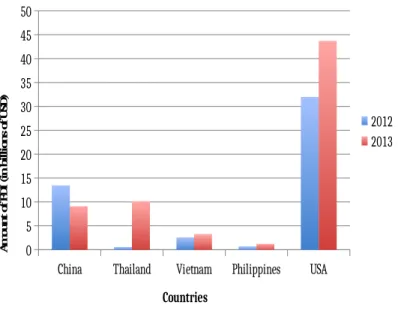
In his 2005 study, Severine Blaise explained the relationship between Japanese ODA and FDI in China by saying, "One might expect that ODA will. In fact, Blaise's finding turns out to be true: Japanese ODA in China has Japanese investment in China is strengthening, especially in areas targeted for ODA, which included many of China's coastal regions.76 Between 1989 and 2013, China held the position of "most promising destination" of Japanese FDI".77 Between the Japan Foreign Trade Organization's first year of counting Japanese FDI in China, 1987 and 2015, Japanese FDI increased annually from millions to billions of US dollars. These same statistics show that Japanese FDI in China has been fairly steady since 2000, until 2013 (see: "Figure 5").78 There is no denying that Japan has a long history of investment in China.
Also, it cannot be denied that Japanese investors have put a lot of money into their Chinese investments, but in 2013, something changed the status of Japanese investments in China. The decline in Japanese investment in China is an interesting example, as it differs in pattern from the decline in Sino-Japanese trade following the 2012-2013 Senkaku/Diaoyu dispute. Nationalist protests and the subsequent boycott of Japanese goods in China led to an immediate change in trade, but due to the nature of the investment, the decline in Japanese investment in China was not as immediately visible as the change in trade.
The simple answer would be "the 2012-2013 Senkaku/Diaoyu dispute", but this ignores the events and rhetoric that followed the dispute. So far, the nationalist sentiment in China that led to a decline in trade has been extensively explored, but the response of Japan has not been explored as deeply. In an interview in early 2013, Japanese Prime Minister Abe condemned China's use of intimidation against its neighbors and threatened that China could lose Japanese and other foreign investment if China did not change course.85 This kind of rhetoric is not at all unusual from ' a hawkish Japanese politician, but it does help to advance the understanding of how nationalist sentiment manifests itself in Japan and how that nationalist sentiment connects the political with the economic, and in this case the Senkaku/Diaoyu dispute with the decline in Japanese FDI in China in 2013.
The second type of response, the concerns of Japanese businessmen, is more directly related to the nationalistic sentiment of Chinese citizens and the impact that nationalism has on the willingness of citizens of other countries to invest in China. The first is that a decline in Japanese investment in China led to an increase in Japanese investment elsewhere. In the case of Japanese investment in China, we can still say that the nationalist protests in China in 2012 were.
The question still remains whether there has ever been a return to normal levels of Japanese foreign direct investment in China. A key factor implying that “normality” could return to Japanese FDI in China is the number of companies that cited “security/social instability” as their main factor. Drifte, Reinhard, “The Japan-China Confrontation Over the Senkaku/Diaoyu Islands – Between “shelving” and “dispute escalation,” The Asia Pacific Journal, July 27.
Koo, Min Gyo, “The Senkaku/Diaoyu Dispute and Sino-Japanese Political-Economic Relations: Cold Politics and Hot Economics?”, Pacific Review.