The Effects of Terrorism on Public Opinion of Gun Control in the United States
By Emily McKee
A thesis submitted to the faculty of the University of Mississippi in partial fulfillment of the requirements of the Sally McDonnell Barksdale Honors
College Oxford May 2017
Approved By
______________________________
Advisor: Dr. Matthew DiGiuseppe
______________________________
Reader: Dr. Benjamin Jones
______________________________
Reader: Dr. Timothy Nordstrom
© 2017
Emily Katherine McKee ALL RIGHTS RESERVED
ACKNOWLEDGEMENTS
I would like to thank my advisor, Dr. Matt DiGiuseppe, for his patience, understanding, and encouragement throughout this process.
Without his help and guidance, I would not have been able to accomplish such a task. I would also like to thank the Sally McDonnell Barksdale
Honors College for presenting its students with such a challenge that grows, matures, and strengthens its students both academically and personally. The encouragement of my family and friends has been beyond helpful, and I will be forever grateful for their support. This journey has challenged me in many ways and has deepened my appreciation of academics, and I am thankful for everything it has taught me.
ABSTRACT
EMILY KATHERINE MCKEE: The Effects of Terrorism on Public Opinion of Gun Control in the United States
(Under the direction of Matthew DiGiuseppe)
The purpose of this study is to investigate the relationship between terrorist activity and public support for gun control. This thesis tests three hypotheses: 1) that out-group violence causes greater support for gun control than in-group violence, 2) that the method of violence determines support for gun control, and 3) that the results of the first two hypotheses are dependent on the conditional variables of gender, fear of Muslims, and residence in an urban or rural area. To analyze these relationships, a survey experiment was conducted to determine if out-group violence and method of violence had an affect on public support for gun control. The results of this study showed no significant increased support for gun control when violence was perpetrated by an out-group member, and the method of violence also appeared to have no affect in the general population. However, when these relationships were analyzed across conditional variables, certain
characteristics, especially gender, had an affect of gun policy opinions and other security preferences. This study concludes that although no
generalizable results were found in this analysis, there is much room for greater exploration of the topic along other conditional variables.
TABLE OF CONTENTS
Introduction ………1
Literature Review ………..5
Theory ………..27
Method ……….39
Results ………..51
Discussion ………66
List of References………..75
Appendix ………..79
LIST OF TABLES
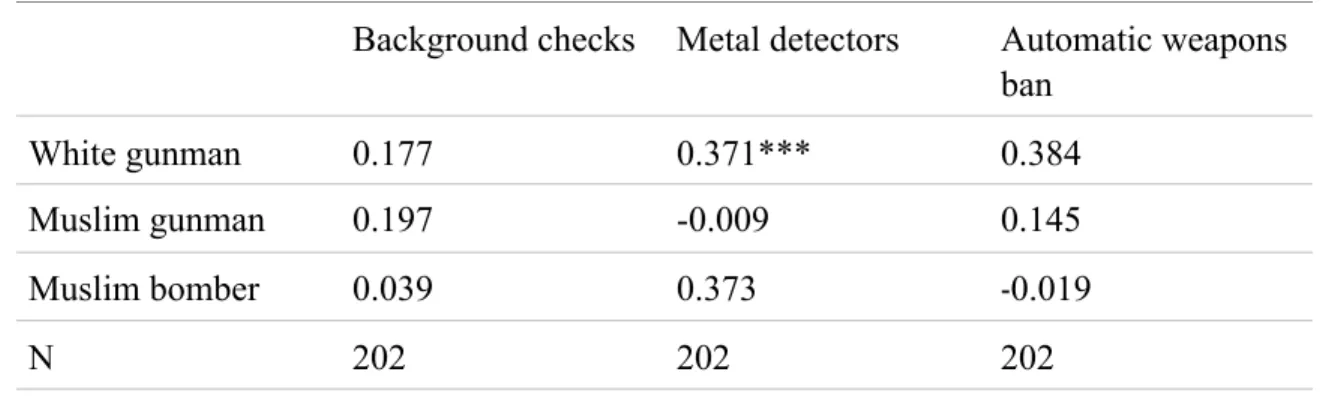
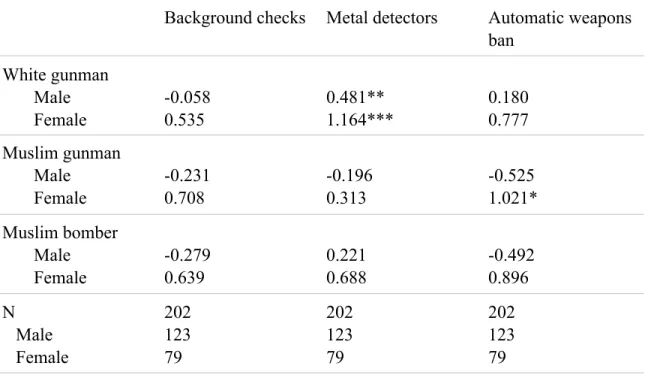
Table 1 Broad support for gun control proposals among those in gun- owning households ………6 Table 2 Experimental conditions and scenario text (N = 202) ………….46 Table 3 Descriptive characteristic percentages of experimental participants (N = 202) ……….50 Table 4 Effect of treatment on gun policy and security preferences ……55 Table 5 Effect of treatment on gun policy and security preferences based
on gender condition ……….57 Table 6 Effect of treatment on gun policy and security preferences based
on overestimation of Muslim population condition ………60 Table 7 Effect of treatment on gun policy and security preferences based
on urban/rural condition ………..64
LIST OF FIGURES
Figure 1 The percentage of terrorist attacks involving firearms,
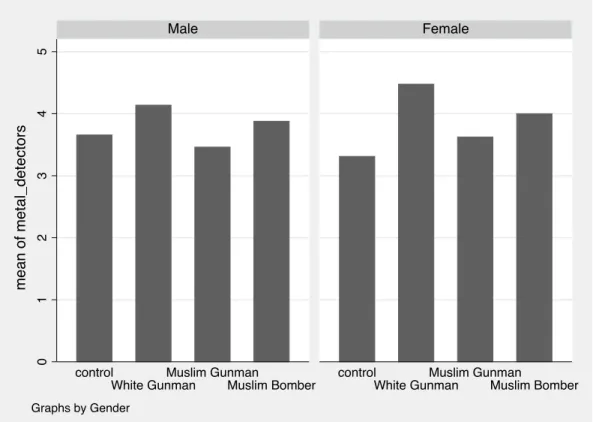
1970-2014 ………30 Figure 2 Mean support of the use of metal detectors across groups …..53 Figure 3 Mean support of the use of metal detectors based on the
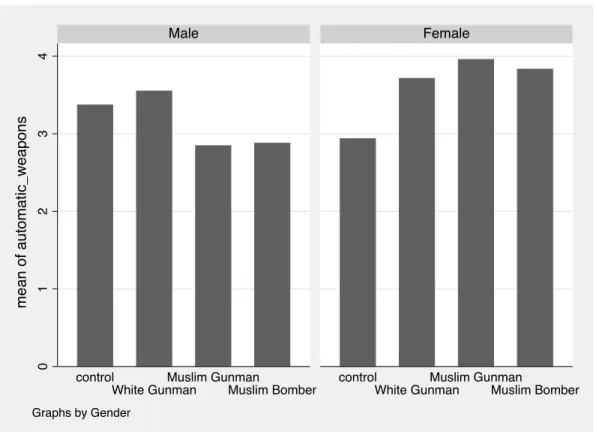
conditional variable of gender ……….58 Figure 4 Mean support for banning automatic weapons based on the
conditional variable of gender ……….59 Figure 5 Mean support of the use of metal detectors based on the
conditional variable of overestimation of the Muslim population
………..62 Figure 6 Mean support for banning automatic weapons based on the
conditional variable of overestimation of the Muslim population
………..63 Figure 7 Mean support of the use of metal detectors based on the
conditional variable of urban/rural ………..65 Figure A1 Mean support of background checks across groups …………80 Figure A2 Mean support of banning automatic weapons across groups ..80
Figure A3 Mean support of background checks based on the conditional variable of gender ………81 Figure A4 Mean support of background checks based on the conditional
variable of overestimation of the Muslim population ………..81 Figure A5 Mean support of background checks based on the conditional
variable of urban/rural ……….82 Figure A6 Mean support for banning automatic weapons based on the
conditional variable of urban/rural ……….82
INTRODUCTION
What impact does terrorist activity involving guns have on public support for gun control? Researchers have extensively studied terrorism and opinion on gun control independently, but little research has yet been done that analyzes the relationship between the two. However, since terrorists are increasingly using guns to perpetrate their attacks in the United States, it is imperative that this potential relationship be explored (Do people associate guns, Miller 2015). Even though terrorism accounts for only a small
percentage of deaths per year in the United States, from 2002 to 2014, 85%
of people killed in the United States by terrorists were killed through the use of a firearm (Do people associate guns).
While there is little research on terrorists and their affect on gun
control, the idea of racial and out-group differences affecting opinion on gun control is not a new one. Throughout the numerous racial divides in the history of the United States, the increased use of guns and gun violence during the Civil Rights Era produced a change in public opinion about gun control unlike any other point in American history. The use and advocacy of
guns by a Black Power group called the Black Panthers increased public support for gun control to an extent hard to match by any other group.
The Black Panthers were one of the main groups advocating the Black Power movement in the Civil Rights Era. They strongly advocated the right to bear loaded weapons in public at a time when the rest of the country was growing in support for gun control in response to the increased violence during the Civil Rights Movement (Winkler 2011). Guns were central to the Panther’s identity and political philosophy, and they taught their young recruits that guns were essential to their freedom and liberty as citizens (Winkler 2011).
The Panthers’ display of loaded weapons in public led conservative politicians in California to propose laws that would ban carrying loaded guns in public (Winkler 2011). When the leaders of the Panthers heard of these policy proposals, they led their activists to the California Capitol building with loaded weapons in hand to demonstrate their opposition (Winkler 2011).
However, this protest provoked backlash. Lawmakers sped the passage of the gun restriction proposals and made them even more strict.
The fear inspired by black people with guns also led the US Congress to consider additional gun control legislation (Winkler 2011). More laws were passed that greatly expanded the federal licensing system for gun dealers and
clarified who could and could not own firearms (Winkler 2011). Critics of the legislation said the laws were passed not to control guns, but were passed to control blacks (Winkler 2011).
In light of public attitude toward blacks in the post Civil Rights Era in their relation to and stereotypical use of guns, their story is significant
because it is plausible that these same attitudes could be applied to Muslim terrorists (Do people associate guns). Similar to how the increased use of guns by blacks in the Civil Rights Era led to increased support for gun control in the 1960s, the situation today of an out-group, specifically
terrorists, increasing their use of guns could again lead to increased support for gun control. In the case of the Black Panthers, out-group use of guns and fear of the out-group led to an increased support for restrictionist policies and an increased willingness to give up civil liberties — specifically a
willingness to give up gun rights. The same public response can be expected today in response to terrorist activity utilizing guns. Out-group use of guns and fear of that out-group, specifically terrorists, should lead to increased public support for gun restrictions.
In this paper, I seek to help improve the understanding of the effects of terrorism and method of terrorism on public opinion of gun control.
Specifically, I intend to analyze if violence perpetrated by an out-group member increases public support for gun control and if that support is
additionally affected by the method of violence a perpetrator utilizes. To do this, I conduct a survey experiment to test if exposure to out-group violence, specifically terrorist activity using a gun, increases support for gun control.
In general, this study found no significant, generalizable evidence that terrorist or out-group violence increases support for gun control more than in-group violence, and there was also no significant evidence found that the method of violence has an effect on the level of support for increased
restrictions. However, some results showed that there were such different levels of support based along different demographic variables, such as gender. There were also some interesting findings in that when there were significant levels of support, it was often in-group member violence as opposed to out-group member violence that spurred such support.
Additionally, security measures that were unrelated to gun control, such as the use of metal detectors, were more likely to receive increased support than gun restriction policies. The results of this study highlight that opinion on gun control is highly divisive and not easily changed, and it leaves many open pathways for future research to build upon the theory based upon other conditional variables (Smith 1980).
LITERATURE REVIEW Public Opinion and Gun Control
In order to be able to determine the significance of terrorist activity on gun control, it is first important to understand what current public opinion is on gun policy in the United States. Many studies and surveys have been conducted to determine public opinion about guns, however, there has been little research done to determine how terrorist activity involving guns plays a part in shaping public opinion on gun policy.
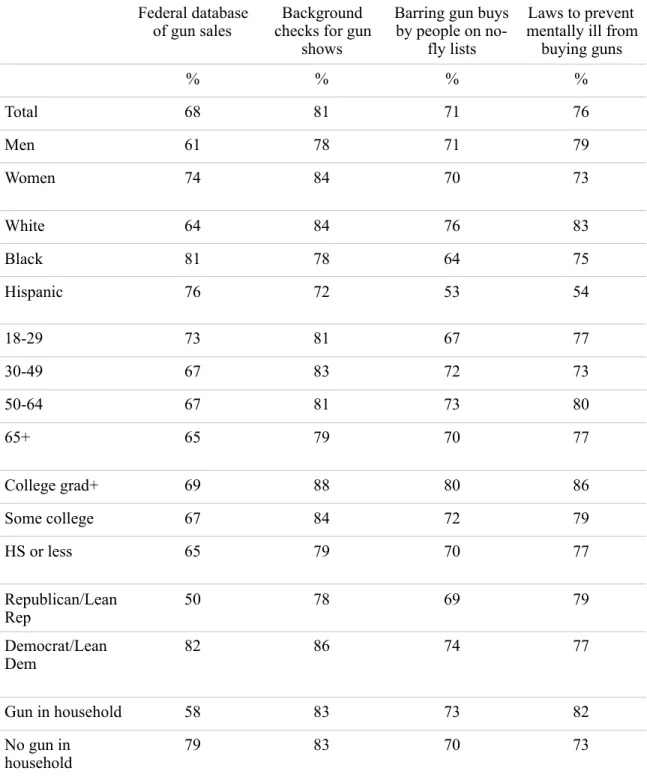
Unsurprisingly, there are strong partisan, demographic, and ideological divides on gun policy and ownership in the United States (Doherty et al. 2016). Table 1, derived from information provided by the Pew Research Center, gives an overview of these differences. While the majority of both the Republican and Democratic parties support background checks for private gun sales and barring people on federal watch lists from purchasing guns, there is a much greater partisan divide regarding proposals of banning assault style weapons, with Republicans being much less likely to support such a ban (Doherty et al. 2016). Such different opinions on gun policy and ownership are also reflected in certain demographic groups, with
Table 1 Broad support for gun control proposals among those in gun-owning households
% who favor each policy proposal Federal database
of gun sales Background checks for gun
shows
Barring gun buys by people on no-
fly lists
Laws to prevent mentally ill from
buying guns
% % % %
Total 68 81 71 76
Men 61 78 71 79
Women 74 84 70 73
White 64 84 76 83
Black 81 78 64 75
Hispanic 76 72 53 54
18-29 73 81 67 77
30-49 67 83 72 73
50-64 67 81 73 80
65+ 65 79 70 77
College grad+ 69 88 80 86
Some college 67 84 72 79
HS or less 65 79 70 77
Republican/Lean
Rep 50 78 69 79
Democrat/Lean
Dem 82 86 74 77
Gun in household 58 83 73 82
No gun in
household 79 83 70 73
Source: Doherty, Carroll, Jocelyn Kiley, and Rachel Weisel. “Opinions on gun policy and the 2016 campaign.” Pew Research Center (August 26, 2016). http://assets.pewresearch.org/wp- content/uploads/sites/5/2016/08/08-26-16-Gun-policy-release.pdf
women, blacks, and college graduates being more likely to support such restrictions and bans (Doherty et al. 2016, Smith 1980). Rural areas are more opposed to regulation than urban areas, and community regional location also affects level of opposition, with the Northeast being less opposed than the South or Midwest (Smith 1980). There are also differences in opinion among different religions, with Protestants being more opposed to regulation than Catholics or Jews (Smith 1980). Fear, gun ownership, and community type characteristics all affect opinion in that greater fear leads to higher support for regulation, gun ownership leads to higher opposition to regulation, and community type characteristics affect both fear and gun ownership (Smith 1980). Such demographic factors relate to gun control attitudes because they stem in large part from different cultural heritages and past experiences (Smith 1980). Ideological divides in the United States are based around groups’ opinions of the purpose of guns - whether they think they do more to help society or harm it. While the majority of Americans believe gun ownership does more to protect the public than put safety at risk, two groups - adults with postgraduate degrees and Democrats/Independents - are more likely to believe gun ownership does more to put safety at risk (Doherty et al. 2016).
Despite the trends in opinion on gun policy that are evidenced in the United States today, the consensus for gun control generally has changed
over time. Even in the midst of numerous and highly publicized mass
shootings, the country is at a time where the public is less willing to restrict gun ownership (Shootings 2015). For the first time in two decades, more Americans believe that guns do more to protect society than to harm it (Doherty et al. 2016, Doherty 2015). Because of this, more Americans support legislation that protects gun ownership rather than legislation that controls ownership, despite highly publicized shootings such as those at Orlando and Sandy Hook (Doherty 2015). In fact, in the year following the shooting at Sandy Hook, more legislation was passed that actually loosened restrictions on guns (Desilver 2013). While it is generally believed that support for gun control increases after such shootings, most instances show that support for stricter legislation increases slightly for only a short period of time, but continues to decline not long afterward (Doherty 2015).
One reason for this decreased support for gun control could be that many Americans have also declined in their belief of the effectiveness of gun control legislation to actually do anything to prevent gun violence and mass shootings such as Sandy Hook (Shootings 2015). After Sandy Hook, up to two-thirds of the public believed the shooting would have happened regardless of the gun control measures that could have been taken
(Shootings 2015).
Another reason for this decreased support for gun control could be based in how society views the act of violence. If a shooting as viewed as a societal problem, it is much more likely to garner public support for more regulation than a shooting that is viewed as an isolated act of violence (Drake 2013). In the past, the majority believed such occurrences were viewed as problems of society. Today, many believe the incidents to be isolated acts, which decreases support for gun control (Shootings 2015).
This difference in how the public views the problem underlying the shooting could potentially be paralleled to terrorist activity - public opinion in favor for gun control after an act of terror may increase if the public views the attack as a societal issue, but may not increase if the attack appears to be isolated.
Another reason for this decline in support for gun control may be due to public misperceptions about what gun regulation measures actually exist (Aronow & Miller 2016). Some researchers suggest that the majority of the public actually supports strong gun regulations, such as universal
background checks and either banning or stricter regulation of assault weapons. However, they argue that the majority of the public believe that such regulations already exist, and therefore do not support “new”
legislation that would include them, hence the decline in support for gun control (Aronow & Miller 2016). This suggests that if the public were better
educated on current gun legislation, there would be an increase in support, or the opposite of what is currently evidenced.
Still, others believe and recognize that there is push from a large portion of the public to increase regulation of gun control and increase restrictions, such as implementing universal background checks. However, many have noticed that there is a gap between what a considerable portion of the public favors and what Congress delivers. This gap was long attributed to the intense feelings of gun regulation opponents blocking any efforts of such legislation to go through Congress. However, it is actually gun
regulation supporters that were found to have the most intense feelings regarding gun policy, but that such intense feeling doesn’t necessarily correlate to action (Schuman, Howard, & Presser 1977; Schuman, Howard,
& Presser 1981). Gun regulation opponents are more likely to participate and take action in supporting their position in some way than proponents are, showing that the feeling of intensity in regard to gun policy and taking
action are more related for regulation opponents (Schuman, Howard, &
Presser 1977; Schuman, Howard, & Presser 1981).
While no research has been done about terrorist activity affecting gun control opinions directly, the shooting in Orlando, Florida, sparked more interest in this area. After the shooting, the majority of Americans believed requiring background checks would help combat terrorism and a little over
half believed making it harder to buy assault weapons would have the same effect (Newport 2016). However, gun control and violence do not appear high on the majority of Americans’ lists of concerns, while combatting terrorism is high on the list (Newport 2016). This could show that there is a disconnect in peoples’ perceptions of terrorists and gun violence - possibly showing that people don’t associate terrorism with guns since they see one as a major concern and not the other.
It is safe to conclude that while some proposals of regulation, such as requiring background checks for all gun sales, are more widely supported, others, such as banning automatic weapons, are highly divisive along
partisan, demographic, and ideological lines. It is also safe to generalize that public support for regulation is declining due to decreased belief that they will be effective coupled with a shift of the majority believing such
shootings to be isolated acts despite an increase in shootings. Others believe it is a result of public misconceptions or attitude-action correlations.
However, even though there is considerable research on attitudes towards gun regulations, there is little understanding of how terrorist activity specifically affects those attitudes toward gun control. The potential effects of terrorism on these attitudes could follow similar patterns of what this literature represents. It is possible that effects of terrorism on public opinion will split along demographic divisions that are already present, and it is also
possible that people’s attitudes toward gun policy will not change no matter the scenario they are presented. Therefore, it is important to understand the current state of public opinion on gun control as well as the basic theories associated with why people form their opinions before attempting to determine how, and if, terrorism affects them.
Terrorism Theories
Before analyzing how terrorist activity relates to gun control opinions, it is important to understand the basic theories of terrorism. Terrorism is defined as the “use of violence against civilians by non state actors to attain political goals” (Kydd & Walter 2006). Groups engage in terrorism because it is successful in getting them what they want, whether it be regime change, territorial change, policy change, social control, or status quo maintenance (Kydd & Walter 2006). Because they are weak actors in the political spectrum, terrorists have to employ a form of costly signaling to impose their will (Kidd & Walter 2006). Because terrorists are smaller
organizations, there are specific strategies they use to attain their goals:
attrition, intimidation, provocation, spoiling, and outbidding (Kidd & Walter 2006).
The strategy of attrition involves sending a costly signal to
demonstrate to the enemy that the group is strong and resolute enough to inflict serious costs so that the enemy yields to the terrorists’ demands (Kydd
& Walter 2006). Suicide terrorism is an example of this. Intimidation is preventing some undesired behavior by means of threats and costly signals.
This shows that the group has power to punish whoever goes against them and that the government is powerless to control them (Kydd & Walter 2006).
The strategy of provocation is designed to persuade the domestic population the the state is untrustworthy and must be resisted. It is an attempt to
provoke a response from the government that harms civilians and portrays the state as evil to get civilians on the terrorists’ side (Kydd & Walter 2006).
Spoiling is a strategy that aims to “spoil” any peace attempts being made between two groups. The key is to play on the mistrust between the two groups and to persuade the enemy that moderates on the terrorists’ side can’t be trusted (Kydd & Walter 2006). Outbidding occurs when two or more domestic parties or terrorist groups are competing for leadership and one group attacks to send a signal that that particular group is strong and the side you want to be on (Kydd & Walter 2006).
Public opinion is important as it relates to terrorist activity because without the public’s attention, terrorist have no leverage (Downes-Le Guin
& Hoffman 1993). In the United States, the issue of terrorism has grabbed the public’s attention at different intensities throughout its history. Generally, only when asked about terrorism specifically do Americans believe terrorism to be a high world problem, and most Americans believe terrorism to be a
greater threat in other parts of the world than in the United States (Downes- Le Guin & Hoffman 1993). However, when attacks happen on home soil, such as the Boston Bombings, Americans are much more likely to feel threatened by terrorism and are less likely to view the government as
effective in preventing it (LeFree 2014). This suggests that terrorist activity within the US affects public opinion more so than when terrorist activity is viewed as a distant threat (LeFree 2014).
Additionally, American attitudes toward terrorist groups and terrorists are not generally as negative as one might think. While the majority of people “despise” terrorist acts and terrorist groups as it pertains to Muslim activity, small proportions show favor to groups such as the Jewish Defense League and the Irish Republican Army (Downes-Le Guin & Hoffman 1993).
Attitudes toward terrorists individually were not held in as low of a regard, with nearly half of respondents believing that individuals could have
legitimate grievances (Downes-Le Guin & Hoffman 1993). In regards to combatting terrorism, the majority believe that the government must act even if the actions are not very effective, and most favor diplomatic
solutions as opposed to use of force (Downes-Le Guin & Hoffman 1993). In light of this, opinion regarding terrorism and terrorists might not be as
generalized or as clear as assumed.
Terrorism and Guns
After understanding the theories and public opinion of terrorism generally, it is important to discuss terrorist activity and their use of guns in order to begin to assess how that activity affects the public’s opinion on gun control legislation, if there is an affect at all.
Overtime, the number of incidents of terror attacks involving firearms across the world has increased (Do people associate guns). However, in the US, the number of such attacks had been decreasing since the 1970’s until recently (Do people associate guns). Even though terrorism accounts for a small percentage of deaths per year in the US, from 2002 to 2014, 85% of people killed in the US by terrorists were killed through the use of a firearm (Do people associate guns). Because of this trend, it is likely that people are beginning to associate terrorism with some use of a firearm.
In further analyzation of terrorist activity since the 1970’s, out of the 2,400 attacks in the US during this period, 324 of those involved firearms, accounting for about 13% of terrorist attacks (Miller 2015). This percentage is approximately one third as common as firearm usage in terror attacks in the rest of the world, where attacks using firearms account for 37%. Even though more than half of all terrorist attacks in the US involved explosives since 1970, attacks involving firearms are more likely to be lethal and are used in attacks that are aimed at causing human casualties (Miller 2015).
This could lead to instilling a higher level of fear, and therefore concern, of attacks using firearms. Additionally, in recent years, none of the 35 terrorist attacks in the US involving firearms were carried out by groups based outside of the US. The majority of these attacks were carried out by
unaffiliated individuals (Miller 2015). If these are seen as isolated attacks, then previous evidence shows that, even though they are perpetrated by self proclaimed terrorists, they might not spur as much public support for gun control as expected.
The fact that terrorists are just recently increasing the use of firearms in perpetrating their attacks could be why the relationship between terrorist activity and public opinion on gun control hasn’t been extensively studied — it is a relatively new phenomenon, especially in the United States.
Additionally, the increase of use of firearms by terrorists also highlights the importance and relevance of this study. Terrorists and guns, while not
extensively researched, is and existent and growing issue, specifically in the United States. However, to assess if there is any change in support for gun control as a result of terrorist violence and shootings, it is important to understand why such activity might spur different reactions from the public than non-terrorist activity.
In-group and Out-group Theories
Understanding the attitudes and perceptions of in-groups and out- groups is the first step in determining and explaining the potential difference in public opinion on gun control as a result of terrorist activity. There has been a multitude of research regarding theories of why different groups feel the way they do about each other. A fundamental element of this is that fearing outsiders and people that are different is instinctual and is one of mans’ oldest, built in psychological tendencies (Resnick 2017).
Additionally, when certain groups fear others, the feared group, or out-group, tends to be dehumanized by members of the in-group. People attribute “outsiders” has having fewer human qualities compared to how they view members of their own group, and they also give them less empathy (Resnick 2017). This is the theory of out-group homogeneity, which predicts that the perception of variability within a group is influenced by one’s status as an in-group or out-group member, specifically that in group members perceive their own group as more varied and complex than the perceive out-group members (Park 1982). Studies have proved this theory of out-group homogeneity in that out-group members were more stereotypic in describing the in-group than the in-group was of describing themselves, that the in-group viewed itself as more varied and counter stereotypic (Park 1982). Additionally, each group is more favorably
evaluated by itself than it is by other groups, suggesting a strong ethnocentrism effect (Park 1982).
When fear is involved, the threat of out-groups is exaggerated.
However, the boundaries of who groups see as “us” and “them” can be easily changed (Resnick 2017). Humans have a need for social constructs and social order, and intergroup discrimination has been found to be a way to satisfy this need (Billig & Tajfel 1973). When there is no distinction between groups, members choose fairness in treatment to all other members (Billig & Tajfel 1973). However, as soon as differentiation evolves, the need for constructs kicks in and members discriminate in favor of the in-group (Billig & Tajfel 1973). If different distinctions are made and groups change, the new in-group is then favored (Billig & Tajfel 1973). This shows that while discrimination is easily triggered, who members view as “us” and
“them” is flexible.
Members’ feelings and emotions toward their own group can effect their feelings and emotions toward out-groups (Brewer 1999). While it was traditionally accepted that in-group identification is independent of negative attitudes toward out-groups and that much intergroup discrimination is motivated by preferential treatment of in-group members rather than
hostility toward out-group members, more recent research has found that in- group favoritism and out-group negativity are reciprocally related (Brewer
1999). There are five instances in which in-group preference can lead to out- group negativity: when an in-group feels morally superior to an out-group, when the out-group is a perceived threat, when there are common goals that promote scapegoating and competition, when groups share common values in which it is difficult for positive distinctions to be made, and when
political leaders exploit existing negative attitudes to gain or maintain power (Brewer 1999).
It is safe to conclude that members of an in-group tend to dehumanize, stereotype, and have negative feelings toward members of an out-group, and therefore apply those attitudes toward the out-group generally. So how could those attitudes and perceptions of out-group members lead to changes in opinion on gun control?
Fear of Out-groups and Support for Security Measures
After understanding basic in-group and out-group theories, it is important to evaluate if those theories of in-group preference, stereotyping, and out-group fear or hate have an affect on preference of public policy.
Multiple studies analyzing public attitudes on out-groups post 9/11 have found similar results of out-group fear and perceived threat leading to greater support of restrictionist policies in order to preserve security.
The terrorist attacks of 9/11 spurred an era of increased national identity and unity that restricted the concept of American identity to being
Anglo, Christian, and English speaking (Branton et al. 2011). This led to the stereotyping of and hostilities toward Muslims, because they were seen as the perpetrators of the terrorist attacks, as well as the stereotyping of and hostilities toward Latinos, because their threat of illegal immigration was becoming a nationalized issue (Branton et al. 2011, Huddy 2005). Fear and perceived threat of these out-groups lead to increased public support for greater restrictive measures in the interest of national security.
For example, growing animosity and fear of Muslims and Latinos led to greater support for stricter immigration policies post 9/11 (Branton et al.
2011, Huddy 2005). In fact, greater fear and anti-out-group attitudes increased the probability that a respondent will prefer increased
restrictionism in order to preserve security (Branton et al. 2011). The out- group threat context post-9/11 amplified hostilities towards the Latino and Arab communities, and therefore increased preferences for strict
immigration policy following 9/11 (Branton et al. 2011, Huddy 2005). In essence, the fear that Latinos and Muslims instilled and the threat they presented led the public to increasingly support restrictive measures to increase security.
More generally, the increase of perceived threat and fear post-9/11 also increased support in limiting civil liberties in the interest of preserving security and preventing a future terrorist attack (Huddy 2005, Davis & Silver
2004). Americans who perceive a high future threat of terrorism are more likely to support civil liberty restrictions and cede their civil liberties in the interest of security (Huddy 2005, Davis & Silver 2004). Furthermore, emotional reactions to threat, such as fear, lead to greater support for personal security and therefore government efforts to reduce the risk of future terrorist attacks, even if it means compromising civil liberties and increasing restrictive policies (Davis & Silver 2004, Lerner 2003). After 9/11, fear enhanced support and preferences for conciliatory policies and investment in precautionary public policy measures (Davis & Silver 2004, Lerner 2003).
Notably, however, women are more likely cede their civil liberties in the interest of security (Lerner 2003). Experiencing anger in response to terrorist attacks activates policy preferences that punish the offenders, and experiencing fear in response to attacks activates conciliatory policy
preferences and greater support for precautionary measures (Lerner 2003).
In addition, anger is associated with perceiving a lower risk of a terrorist attack and more optimism in combating them and fear is associated with perceiving a higher risk of a terrorist attack and more pessimism in combating such attacks (Lerner 2003). Males show more anger, lower perceived risk, and more optimism in combating terrorist attacks, and females show more fear, higher perceived risk, and more pessimism in
combating terrorist attacks, and are therefore more likely to cede their civil liberties (Lerner 2003). These emotional differences explain 60 to 80% of the gender difference on their support for more restrictive policies (Lerner 2003). Essentially, the different emotions males and females feel in response to terrorist attacks affects their perceived threat and therefore their
preferences on policies in response to terrorism.
It is clear that emotional responses to out-group activity, such as fear caused from a greater perceived threat, leads to increased support for greater restrictionist policies and an increased willingness to give up civil liberties in the interest of security. It is important to note, however, that the particular emotion felt has an impact on the type of policy supported. While fear tends to lead to greater support for restrictionism policies, anger does not appear to have the same effect. However, in the issue of gun control, public support goes beyond the reach of terrorist activity and moves from a general notion of perceived out-group threat to a more specific one of racial resentment that stemmed from the Civil Rights Era - several decades before terrorist use of guns became prevalent in American society.
Racial Resentment
Gun control and its relation to race and racial resentment has been an issue since the Civil Rights Era. Racial resentment has grown out of the increased political participation of historically marginalized groups because
many believe that such groups are making illegitimate claims for “special”
rights and not “equal” rights (Dudas 2005). Such resentments continue to flourish because as historically marginalized groups make claims for
“special” rights, or rights beyond what their achievements merit as some see, others’ traditional ways of life and privilege are threatened (Dudas 2005).
Conservative activists have increasingly channeled their resentment over the uncertainty introduced by the participation of historically marginalize people by interpreting their rights claims as illegitimate or special rights that
threaten core American values (Dudas 2005). This contributes to
conservatives advocating rights they believe to be based on individual merit and equal opportunity, such as gun rights (Dudas 2005).
Because of these racial resentments and racial divides, opinion on gun control has increasingly been viewed as a product of cultural traits, and conflicting views can be the result of conflicting traits (Kleck 1996). The notion of conflict can come in many forms, but historically certain groups have held certain policy opinions in order to maintain some type of social prestige or status. Just as the middle class, rural, protestant groups supported the temperance movement to preserve their status in the early 1900s,
generally the same group of people oppose gun control today in order to achieve the same outcome (Kleck 1996).
In relating in-groups and out-groups to gun control, studies have found that racial divides affect opinion on gun control (Filindra & Kaplan 2016). The civil rights era spurred in whites a defense of their privilege as their way of life was threatened, and they began to view the government protections of previously suppressed groups as preferential treatment and a threat to their traditional values (Filindra & Kaplan 2016). This led to racial resentment. Because of the formation of such racial resentment, today there exists a causal relationship between racial considerations and gun policy preference among whites (Filindra & Kaplan 2016).
It is safe to conclude that racial resentment and racial stereotyping have an affect on gun control preferences. Such evidence of racial
resentment and association of blacks with guns has been extensively researched, and has the potential to be applied to people from the Middle East. It is likely that the association that exists between blacks and guns could also have the same effect on Muslims and guns due to terrorists increase use of firearms.
Literature Review Conclusions
Literature on public opinion of gun control finds that, in the United States, such opinions are divided along partisan, demographic, and
ideological lines. While this opinion changes over time, the US is currently at a point where it is less willing to restrict gun control, and shootings, even
if they are highly publicized, do not seem to have a lasting impact on public opinion. This overall decrease for support for stricter gun control has been attributed to declining belief in its effectiveness, how society views the acts of violence, and misperceptions about what gun control measures already exist. These are important implication in how terrorism can affect gun policy opinion. If society believes that gun control measures are ineffective, then there might not be increased support even when there is a terrorist attack involving a shooting. If society views a terrorist attack as isolated, there may be no increased support for gun control, but if they view the attack as a societal problem, they might support increasing gun restrictions.
Additionally, if society is misperceived about what gun regulations are currently in place, that may affect their support for additional policies even when a terrorist shooting occurs.
In addition, literature on terrorism finds that terrorist utilize such violent activity because it is successful in getting them what they want.
Terrorists have one or a combination of one of five goals: regime change, territorial change, policy change, social control, or status quo maintenance.
In order to achieve these goals, terrorists employ a strategy of attrition, intimidation, provocation, spoiling, or outbidding. Literature on terrorism also finds that Americans feel more threatened by terrorist activity when they are directly or more closely affected, such as when there is a terrorist
attack on American soil. When people feel more threatened and emotionally respond to terrorist attacks in fear, they are more likely to support more restrictive policies and more willing to give up civil liberties in interest of security. Therefore, it is reasonable to assume that fear generated from terrorists, members of an out-group, are likely to cause an increase in support for greater gun restrictions and other security measures.
Research has also found that the use of firearms in terrorists attacks is increasing across the world. While such use of firearms in terrorist attacks had been decreasing in the United States, it is now on the rise again. In fact, the majority of deaths caused by a terrorist attack in the United States was perpetrated using a firearm. Because of this increase, terrorism and how it relates to public opinion on gun control is a current issue that warrants investigation and research.
While both gun control and terrorism have been investigated deeply in their own regards, there has been little research done that attempts to combine the two areas. However, with evidence of negative attitudes and fear of out-groups coupled with evidence that fear of out-groups leads to increased support for restrictionist policies and an increased willingness to give up civil liberties, it is reasonable to assume that terrorist violence, activity perpetrated by an out-group member, will have an affect on public opinion of gun control. This study attempts to bridge the gap in current
research and attempts to determine if terrorist activity and the method of terrorist activity have an affect on public opinion of gun control.
THEORY Support for Gun Control based on Weapon
The role of guns in terrorist attacks is changing in that terrorists are increasingly using guns to perpetrate their attacks. Such attacks are also more likely to be lethal and usually result in greater human casualties.
Because of this, I expect that there will be greater support for gun control when terrorists use firearms than when they use other methods to perpetrate violence, such as explosives.
The number of terrorist attacks involving firearms has increased across the globe (Do people associate guns). In the United States, however, terrorist attacks involving firearms have been decreasing until recently, making their use in such attacks a fairly new concern in the United States.
Specifically, from 2002 to 2014, 85% of people killed in the United States by terrorists were killed through use of a firearm (Do people associate guns).
Terrorists are increasing their use of firearms in terrorist attacks because they have different objectives now than they did in the past, such as taking human life, and these objectives are more easily met through the use of a firearm (Spencer 2006). Because of this increased use of guns by terrorists, it is
likely that people are beginning to associate terrorist attacks with the use of a firearm.
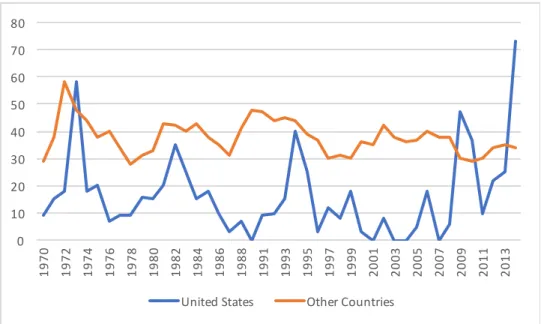
Even though terrorist attacks using explosives are much more common in the United States, attacks involving firearms are much more likely to be lethal (Miller 2015). This trend is represented in Figure 1, which was adopted from the Global Terrorism Database. Attacks using firearms are usually perpetrated with the intent of inflicting human casualties, whereas the use of explosives is usually aimed at causing property damage or achieving some other type of goal, with human
casualties generally not the primary objective (Miller 2015). Terrorism today has become more indiscriminate and is aimed more at the destruction of society and the elimination of large sections of the population, producing as many casualties as possible (Spencer 2006). The threat and fear of lethal violence leads to action and support of increased measures to ensure personal security (Tolnay & Beck 1990). Because the use of firearms in terrorist attacks is becoming more common and tends to be more lethal, and because fear of lethal violence leads to increased support in measures to ensure safety, I theorize that respondents will be more likely to support gun control measures after attacks using firearms as opposed to attacks using explosives.
Support for Gun Control Based on Perpetrator
Research has found that there is a connection between fear of out- groups and increased support of restrictionist policies. Because of this, I expect that there will be a difference in support for gun control depending on the perpetrator, and that support for gun control is not simply a reaction to all violence. Specifically, I predict that there will be greater support for gun control when violence is perpetrated by an out-group member or terrorist than when violence is perpetrated by an in-group member.
The Out-group Homogeneity Theory states that in-group members perceive members of their own group as more varied and complex than they
Figure 1 The percentage of terrorist attacks involving firearms, 1970-2014 Source: Miller, Erin. "Use of Firearms in Terrorist Attacks the United States 1970-2014.” START. Department of Homeland Security. Accessed January 2017.
http://www.start.umd.edu/pubs/
START_FirearmsinTerrorism_BackgroundReport_July2015.pdf
0 10 20 30 40 50 60 70 80
1970 1972 1974 1976 1978 1980 1982 1984 1986 1988 1991 1993 1995 1997 1999 2001 2003 2005 2007 2009 2011 2013
United States Other Countries
do out-group members, leading to dehumanization of the out-group (Resnick 2017, Park 1982). In other words, when in-group members view out-group members as all sharing similar qualities, the out-group members loose their individuality in the eyes of the in-group and are viewed as a whole (Resnick 2017, Park 1982). Those in-group self views of variance and complexity are viewed positively and are preferred among in-group members (Brewer 1999). However, literature has found that this preferential treatment of in- group member is reciprocally related to negative perceptions of out-group members (Brewer 1999). This dehumanization makes it easy to discriminate against out-group members because of the negative way they are naturally viewed by in-group members.
However, these negative views of out-group members are especially significant when an out-group is perceived as a threat (Brewer 1999).
Therefore, if out-groups are perceived as a threat, they are viewed in a negative light. Additionally, since out-groups are “dehumanized” and are perceived as all sharing similar characteristics and qualities, it can be reasoned that when a group is viewed as a threat, these negative emotions and discriminations apply to all members of that out-group.
This effect was evidenced in the post-9/11 era. After the 9/11 terrorists attacks, Americans stereotyped Muslims and viewed them all as a threat to national security (Branton et al. 2011, Huddy 2005). Muslims were a threat,
they were viewed negatively, and the actions and ideals of a few were
attributed to the whole, as explained by the Out-group Homogeneity theory.
Additionally, this perception of threat that causes out-group
discrimination is easily triggered when fear is involved (Resnick 2017, Billig
& Tajfel 1973). Ever since 9/11, there has been a greater perceived threat of Muslims as they relate to terrorist activity, and that greater perceived threat has led to greater fear of terrorism (Branton et al. 2011, Huddy 2005).
Feelings of threat often correlate with policy choices at fairly strong levels (Gordon & Arian 2001). The more threatened people feel, the more intense their policy choices are, and the less threatened they feel, the more subdued their policy preferences are (Gordon & Arian 2001). As more terrorist attacks throughout the world continue to get high publicity and media attention, it is inevitable that with each attack, the perceived threat of
terrorists, and therefore public fear of Muslims and terrorists, increases. The 9/11 terrorist attacks served as a trigger that initiated a greater perceived threat of terrorists and therefore fear of terrorists in American society (Branton et al. 2011, Huddy 2005).
With increased public fear comes increased support of restrictionist policies and a greater willingness to give up civil liberties (Branton et al.
2011, Huddy 2005, Davis & Silver 2004). When people feel threatened, their decision making is dominated by emotion, such as fear (Gordon & Arian
2001). After 9/11, fear and increased negative perceptions of out-groups, specifically anti-Muslim and anti-Latino sentiment, led to increased support for restrictive immigration policies in order to increase security and protect against a future terrorist attack (Branton et al. 2011 & Huddy 2005).
Additionally, fear of terrorists and future terrorist attacks also increased support in limiting civil liberties in the interest of preserving security and preventing a future terrorist attack (Huddy 2005, Davis & Silver 2004). Fear of terrorists, the out-group, led to increased support for measures to increase security.
The Out-Group Homogeneity theory leads to similar perceptions of individuals within an out-group, and natural tendency causes negative attitudes toward out-groups. These negative tendencies are amplified when an out-group is perceived as a threat, and a greater perceived threat increases the fear of an out group. Since fear of out-groups leads to increased public support for more restrictionist policies, I predict that terrorist attacks, perpetrated by a negatively perceived out-group, trigger a deeper fear than attacks and shootings perpetrated by a more favorably perceived in-group, and therefore theorize that there will be greater support for gun control after attacks committed by Muslim terrorists.
However, it is possible that this hypothesis might not hold. Since the boundaries of who is perceived as an in-group member and out-group
member are flexible, it is possible that simply anyone who is a perpetrator of violence could be viewed as an out-group member, therefore causing little variance in levels of support between the treatment groups since they could possibly all be viewed as an out-group (Resnick 2017). Additionally, the treatments may not evoke the same emotional response that real-life terrorist events and shootings evoke in the public, possibly leading to results that are not significant (Branton et al. 2011 & Hudley 2005).
Sub Group Effects
Additionally, I theorize that the effects presented in the first two hypotheses will be conditional on a variety of factors, specifically the
respondent’s gender, their estimation of the percent of Muslim population in the United States, and whether they live in urban or rural areas.
Gender
In regards to gender, I hypothesize that there will be a difference in the level of support for gun control measures between males and females, with females being more likely to support more restrictive policies than males. I base this theory off of research that has found that men and women respond to terrorism in different ways emotionally, and that these different emotional reactions are what determines the type of policies an individual will support (Lerner 2003). For example, Men are more likely to experience anger in response to terrorism (Lerner 2003). Anger is associated with
perceiving a lower risk or threat of a terrorist attack and more optimism in combating such attacks (Lerner 2003). Mens’ likelihood of feeling anger activates policy preferences that punish the offenders, not preferences that focus on improving security (Lerner 2003). However, females are more likely to experience fear in response to terrorism (Lerner 2003). This fear is associated with perceiving a higher risk or threat of a terrorist attack and more pessimism in ability to combat such attacks (Lerner 2003). Feeling fear in response to terrorist attacks activates greater support for precautionary measures (Lerner 2003). Fear of out-groups in general has been found to to increase support of restrictionist policies and has been found to make
individuals more likely to cede their civil liberties in the interest of security (Branton et al. 2011, Huddy 2005, Davis & Silver 2004). Since women are more likely to feel fear in response to terrorist attacks, this fear makes them more likely to support precautionary and restrictive measures to increase security (Lerner 2003, Branton et al. 2011, Huddy 2005, Davis & Silver 2004). Therefore, I predict that women will show a higher support for
increased gun control and security measures because they are more likely to respond to terrorism with fear - an emotive response that has been shown to increase support for restrictive, precautionary measures (Lerner 2003, Branton et al. 2011, Huddy 2005, Davis & Silver 2004).
Fear of Muslims
I also hypothesize that respondents who greatly overestimate the percentage of the Muslim population in the United States will be more likely to support increased gun regulation. I base this theory off of research that has found that fear of out-groups increases support for restrictive policies and makes individuals more likely to be willing to cede their civil liberties in the interest of security (Branton, et al. 2001, Huddy 2005, Davis & Silver 2004).
The 9/11 terrorist attacks spurred a new era of perceived threat of out- groups in the United States, specifically against Muslims and Latinos, because Americans began to view them as a threat to their security and way of live (Branton et al. 2011). This greater perceived threat and fear of these out-groups lead to increased public support for greater restrictive
immigration policies in the interest of national security (Branton et al. 2011, Huddy 2005). In addition, the increased perceived threat and fear of out- groups post-9/11 also increased support in limiting civil liberties in the interest of preserving security and preventing a future terrorist attack
(Hudley 2005, Davis & Silver 2004). Specifically, Americans who perceived a high future threat of terrorism are more likely to support civil liberty
restrictions and cede their civl liberties (Huddy 2005, Davis & Silver 2004).
Therefore, if previous literature has found that fear and threat of an out-
group has led to greater restrictionist policies in the past, such as limiting immigration, and has also led to a greater willingness in ceding civil liberties generally in the interest of national security, then I predict that those same perceived threats and fears of terrorists and out-groups, as evidenced in overestimations of the Muslim population in the US, will lead to greater support of restrictionist policies on gun control. The use of estimation of Muslim population as a proxy for perception of threat is justified in the research design.
Proximity to likely Terrorist Attacks
I also theorize that respondents who live in rural areas will be less likely to support increased gun control measures than respondents who live in urban areas. This theory is based off of research that has found that rural areas are more likely to oppose gun restrictions because they are culturally different from urban areas in how they view gun control and that urban areas are more likely to support gun control because of higher levels of fear
(Smith 1980).
As one moves away from rural areas and toward urban areas, opposition to gun control decreases (Smith 1980). Likewise, opposition increases when one moves away from urban centers toward more rural areas (Smith 1980). One explanation of this difference in opinion is that the “gun culture” changes as one moves from rural to urban areas (Smith 1980,
Wolpert and Gimpel 1998). The gun culture traditionally represents an attachment to firearms due to their historical importance in the United State’s history, their role in the frontier experience, their role in the hunting and sporting experience, and all the traditions that have accompanied these experiences (Smith 1980, Wolpert and Gimpel 1998). However, today the gun culture revolves mainly around hunting, sporting, and other related purposes (Wolpert and Gimpel 1998). Residence in rural localities and regions provides continuing exposure to this traditional gun culture, and gun ownership is prevalent among groups partaking in this culture and living in areas where it is still prevalent (Smith 1980). Therefore, gun owners tend to live in rural areas (Smith 1980, Wolpert and Gimpel 1998). Gun owners in turn show a strong relationship to opposition to gun control because it is a threat to their self interest and preservation of their culture (Smith 1980, Wolpert and Gimpel 1998). Members of the non-gun culture are less opposed to gun control because its members own fewer guns and reside in non rural localities (Smith 1980). Therefore, since rural areas have an
extensive gun culture and since they have higher percentage of gun owners, I predict that rural areas exhibit greater opposition to gun control measures than urban areas, even in response to terrorism, because they have a different cultural perspective of gun usage that is not easily changed.
Additionally, place of residence exerts an influence on gun control attitudes through associated levels of fear (Smith 1980). Members in the non gun culture, those living in urban areas, show less opposition to gun control because they live in areas stimulating more fear through being exposed to higher levels of crime (Smith 1980). Research has shown that fear leads to increased support for restrictive policies and increased willingness to give up civil liberties in the interest of security (Branton et al. 2011, Huddy 2005, Davis & Silver 2004). Therefore, urban areas are less opposed to gun control because they are typically not members of the gun culture and also live in communities causing more fear because of crime levels. Because current fear of crime already exists, respondents who live in urban areas answers to gun policy questions should remain greater than those in rural areas.
Therefore, since rural areas are more entrenched in gun culture and tend to have more gun owners and since urban areas are not as entrenched in the gun culture and already have higher levels of fear even without the threat of terrorism, I predict that, even when exposed to terrorism treatments,
respondents who live in rural areas will be more opposed to gun regulation proposals than those who live in urban areas.
METHOD Research Design
To test the hypotheses, I conducted a survey that builds on another survey experiment that analyzed public opinion about gun control. I modeled my survey and research design after an experiment conducted by McGinty, Webster, and Barry that was published in the American Journal of
Psychiatry. In their experiment, they analyzed the effects of news media messages about mass shootings on attitudes toward people with serious mental illness and public support for gun control policies (McGinty, Webster, and Barry 2013).
The survey-embedded randomized experiment by McGinty, Webster, and Barry was dispersed through an online survey research panel, in which members on the panel were recruited through equal probability sampling.
Members were paid with small cash rewards and gift prizes for their survey responses. (McGinty, Webster, and Barry 2013).
The respondents in their survey were randomly assigned either to one of three groups who read different short news stories or to a no-exposure control group (McGinty, Webster, and Barry 2013). After reading the news stories, respondents were asked questions about their opinions of people
with mental illness, support for gun restrictions for such people, and support for a ban on large-capacity magazines (McGinty, Webster, and Barry 2013).
The no-exposure group answered these questions without reading any of the news stories (McGinty, Webster, and Barry 2013).
Like the experiment conducted by McGinty, Webster, and Barry, this experiment attempts to assess effects of violent actions on public support for gun control, only in this case it analyzes how violent activity perpetrated by terrorists affects those opinions as opposed to the mentally ill. Like the model experiment, this experiment involved dispersing the survey through an online survey panel, Amazon’s Mechanical Turk, and respondents were compensated for their responses. The survey took approximately 4 minutes to complete, and the respondents were paid $0.50 for their time based on the national minimum wage.
Amazon’s Mechanical Turk is a relatively inexpensive survey
platform that allows academics and other professionals easy access to survey respondents (Huff & Tingley 2015). Because of this, it has surged in
popularity, especially among political scientists, as a means for conducting research (Huff & Tingley 2015). However, scholars have criticized the external validity of using the source, questioning the demographic, political, professional, and geographic variability of the respondents (Huff & Tingley 2015). If typical respondents through MTurk are not representative, then
research using the survey platform may not be viewed as valid. However, research has found that when comparing the distributions of age, gender, and race characteristics as well as political, occupational, and geographical information of the respondents, the results generated from the use of MTurk as the survey platform are not significantly different than responses
generated through other survey platforms (Huff & Tingley 2015). Therefore, in this experiment, we view the MTurk survey platform as a valid form of assessing public opinion.
In addition, this experiment was formatted similarly to the model study (McGinty, Webster, and Barry 2013). The test sample of 202 respondents was randomly divided into four groups - either to the no- exposure control group or to one of the three groups that read a short
scenario describing a shooting or an attempted terrorist attack to attempt to asses how each treatment affected responses on opinions of gun control.
Before the respondents were presented with the policy questions and the scenarios, all groups were given an attention check to assess if the
respondent was fully and carefully reading the questions. After the respondents in the treatment groups read the short scenarios, they were asked questions about their opinions on gun policy and other security measures to asses if the scenarios had an affect on respondents’ opinions about gun control and other security measures. Members of the control
group answered the same questions without reading a short scenario
describing a shooting or terrorist activity. This provided a base group of non- affected opinions to compare to affected opinions of respondents in other groups. After respondents answered the policy questions, all treatment groups were presented with a manipulation check that asked them to recall the religion of the perpetrator of violence in the scenario they read as well as the type of weapon that was used.
To further differentiate possible trends among respondents and their answers about their opinion on gun control, demographic questions were asked similar to those asked in the model experiment (McGinty, Webster, and Barry 2013). Before respondents were asked to answer questions about their gun policy opinions, they were asked to identify their age, gender, race, level of education, income, and partisanship to determine if the results of the hypotheses would differ along conditional variables (McGinty, Webster, and Barry 2013). This was done because previous research has shown that
opinions on gun control tend to vary among these demographic lines.
Including those characteristics in this experiment allowed us to test previously found trends along with the hypotheses.
Additionally, at the beginning of the experiment, respondents were also asked to indicate what they believe to be the percentage of Christians, Jews, and Muslims in the United States (Grewal, Cebul, and Kustov 2016).
While this was not part of the model experiment, it was added in this experiment to help determine if fear of Muslims correlated to increased support for gun control measures in groups that read scenarios describing Muslim activity or in the control group. This would help to analyze the hypothesis of greater support for gun control as it relates to terrorists/out- groups as a result of fear.
In addition, since opinion on gun control tends to divide along party lines in the United States, respondents who identified as “Independent” or “I don’t know” to the partisanship question were then asked to indicate if they identified more closely to the Republican or Democratic Party. This was an important distinction because it could help draw connections between party identification and opinion on gun control in the data, and how those groups then differ in opinion among the different groups in how they support/do not support increased gun control.
Treatments
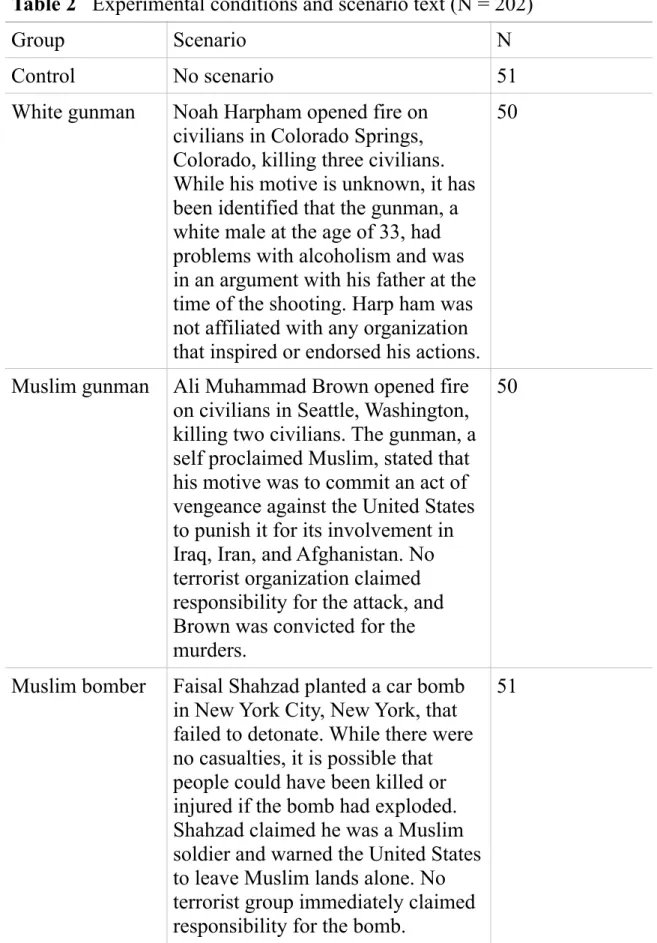
The primary independent variables of interest in this study were the three randomly assigned short scenarios describing a shooting or terrorist attack. All scenarios were about 2-3 sentences and were parallel in structure, giving the name of the attacker, the weapon used, the casualty count, the race/religion of the attacker, his motive for the attack, and how the attack was resolved, respectively. The goal was to make each scenario as similar as
possible, and they were all based off of a real life event. The text of the scenarios can be found in Table 2. Respondents who were assigned to read a scenario were instructed to “Please read the following news statement,” and after they read the scenario read “We would now like to ask you a few questions about public policy.” Respondents would then answer the three questions about gun control and security, followed by the manipulation
check. Members of the control group simply read “We would now like to ask you a few questions about public policy” before answering the gun control and security questions.
The respondents were grouped in the three treatment groups and the control group to assess how each scenario they read (or did not read) affected their opinion on security measures. Assessing the differences in responses across groups was essential in evaluating the hypotheses that out- group violence leads to greater support for gun control and that the method of violence determines support for gun control. A scenario describing a white, non-religiously affiliated shooter was used to determine if
respondents’ opinions would be different after reading a scenario describing a “in-group member” (a white man as the perpetrator), as opposed to an
“out-group member” (a Muslim, terrorist-affiliated perpetrator). This was important in testing the hypothesis of there being greater support for gun