Only a person whose own "legitimate" expectation of privacy has been violated can invoke the "exclusionary rule," the sanction developed by the Court to deter violations of the Fourth Amendment. For the most part, the Court has contented itself with elaborating on the meaning of the phrases "reasonable expectations of privacy" and "reasonable feelings of restraint" through their application to specific cases. Although preliminary findings suggest that some of the Court's rulings regarding the Fourth Amendment threshold and the justification and probable cause requirements do not reflect societal understandings.
RESEARCH DESIGN
Hypotheses
In anticipation of finding this first hypothesis valid, our remaining three hypotheses focused on why the judiciary might underestimate social perceptions of intrusiveness. If so, courts—which typically only evaluate a search and seizure if it has achieved its goal—may again be systematically underestimating the intrusiveness of various police actions, at least relative to the "innocent" person the Supreme Court tells us. to assume. Even warrant-based investigations that, when read by the target of the investigation, are supposed to contain notice of the government's objective can be misleading.
Materials and Administration
If so, the current court, which is decidedly crime-fighting oriented36, will predictably choose less generous assessments of intervention. Schumacher, Measuring Attitudes Toward Crime Control: The Attitudes Toward Crime Control Scales, paper presented at the American Psychological Association Annual Conference (Aug. 1991). They are also valid measures of crime control and due process attitude constructs, as related to authoritarianism, predictors of recidivism, and differential tolerance for errors in judicial decisions.
Subjects
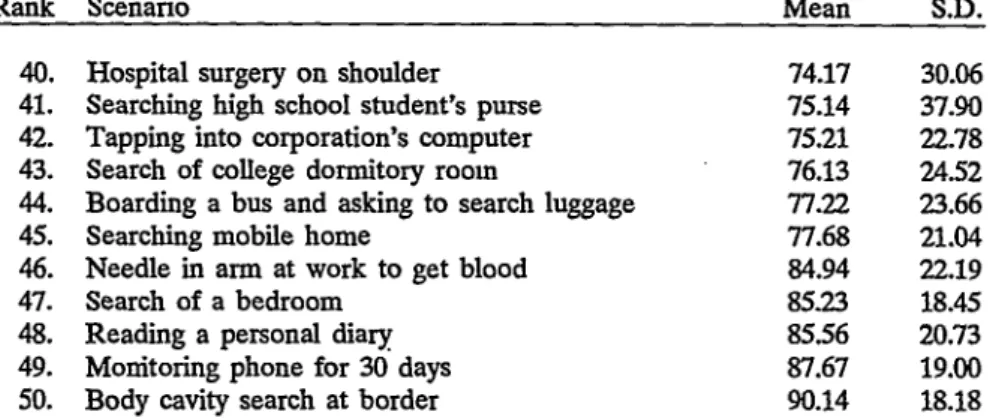
TESTING HYPOTHESIS 1: INTRUSIVENESS RANKINGS . 737
Possible Responses to the Results
Rejection
Changing the Analysis to Avoid the Data
Overruling Previous Decisions
FACTORS AFFECTING PERCEPTIONS OF INTRUSIVE-
Results re Hypotheses 2 and 3
The Inference of Guilt Theory
Forgetting for a moment how this scenario ranks among the conditions, note its counterintuitive place in the overall ranking. This comparison not only contradicts the Court's cases,114 but also seems to contradict "conventional wisdom". The arrest scenario is the only scenario, out of all fifty, that involves a clear decision by the police that the person involved is guilty; in contrast, the other forty-nine scenarios involve either a search to determine if the person is guilty or an "exploratory" seizure following an arrest.
Thus, the strong inference of guilt implicit in the arrest scenario may have offset our study's admonition to assume the target's innocence, which in turn may have influenced perceptions of intrusion. Supporting this claim is the fact that the one significant exception to the arrest scenario's relatively low ranking comes under the First Person condition, in which the subject is presented as the person being arrested and the presumption of innocence is likely to be maintained. Many of the significant differences between the No and Yes evidence conditions in the Focus scenarios may also demonstrate the end of guilt theory.
In particular, note the findings in Focus Scenarios 1, 4, and 9, which produced the largest differences between the No and Yes evidence conditions in a direction opposite to that hypothesized: i.e., the Yes Evidence condition ranked as significantly more. interventionist in these scenarios than in any other. Interestingly, while most of the scenarios in our study involved searches for drugs, weapons, and other obvious evidence of criminal activity, these scenarios were three of only four, in the entire group of fifty, presenting a "target" that was not clearly connected. for the investigation of wrongdoing: Focus Scenarios 1 and 9 involved police action to determine the "destination" and Focus Scenario 4 involved a search for a "photograph". Perhaps subjects exposed to these scenarios in the Yes Evidence condition rated them as more intrusive because they believed that the targets were innocent and that the police had no business being involved in such actions.1. Findings regarding the fourth and final scenario involving "innocent" behavior—using binoculars to see who's in a house's front yard—may contradict this [Vol.
A related possible explanation for many of the variations within the Focus Scenarios is that.
The Dangerousness Theory
The Implied Consent Theory
On the other hand, when the drugs are sought from a drug dealer or under circumstances connoting organized crime (see R), just the opposite result occurs. This pattern fits the dangerousness theory, if one assumes that the subjects do not see private drug use not. as particularly threatening, but reacts strongly to drug trafficking. Note that this scenario changed from "rifling through a suitcase in an airport" in the No Evidence condition - a search that a person could easily suspect was to weapons - after "rifling through a suitcase in an airport an airport for drugs" in the Yes Evidence condition.
If implicit consent theory is correct in predicting that a normally intrusive search will appear less intrusive if it promotes self-protection, the finding that the First Person and No Evidence conditions were ranked less intrusive than their counterparts in this scenario is not surprising. Finally, implicit consent theory can explain the larger-than-average difference between the evidence conditions in Focus Scenario 2, which involved a search of a coal mine in the No Evidence condition and a search of a coal mine for evidence of safety violations in the Yes condition. Evidence condition. When the purpose of government action is to punish or shame (as in seeking school disciplinary violations), it is likely to be seen as intrusive, even if it does not result in criminal prosecution.
But when the goal is to facilitate and assist (such as in fire, safety and health inspections), the typical response may be different. As with the airport screening scenario presented earlier, people subject to such inspections may be grateful for the breach even if nothing is discovered. So the fact that the coal mine scenario received the lowest rating from subjects who were told it involved a search for safety violations is not surprising.
The theory of implied consent may also help explain the low ranking, overall, of inspections of restaurant kitchens (R = 7) and residential plumbing and wiring (R = 11).
Implications of the Theories
In addition to the four conditions used here (First and Third Person, No and Yes Evidence), there may be many other variables that influence the perception of privacy and autonomy, such as the behavior of the police, the time of day and the thoroughness of the search, “and the nature of the evidence sought at a particular location,” none of which were consistently integrated into our investigation. As previously noted, the Court has held that intrusiveness under the Fourth Amendment must be considered from the point of view of an innocent person. If there is guilt toward the specific target or aversion toward the criminal activity being investigated, it should be invalid for Fourth Amendment purposes. So, for example, the mere fact that the police have decided that a person should be arrested, or are investigating organized crime rather than a lesser crime, should not normally affect the measurement of the invasion of privacy or autonomy by the action.
Similarly, the mere fact that the police do not appear to be looking for wrongdoing (but are simply asking, for example, about destination) should not raise the level of intervention above what it would be if the police's purpose was unknown. The question where the relative "guilt" of the target is more obviously relevant is whether, once an investigative action intervention has been established, the police can make it. argues that the place, whether there is physical intrusion into it, and the object of the search are all variables given importance in the Court's cases).
For example, if the police stop a person and ask open-ended questions about destination for ten minutes, it is likely that they did not have concrete suspicion that the person is involved in criminal activity. Less convincingly, one could argue that the nature of the alleged crime should also influence how much suspicion the police need before they may act (for example, our fear of organized crime may allow the police to investigate on less than normal justification). .". Analysis of the Focus Scenarios strongly supports Hypothesis 3's conjecture that judges are more likely to ignore allegations of expectations of privacy and restrictions on freedom under these circumstances than if the person was clearly innocent.'25.
The third theory of intrusiveness supported by this study—the implied consent theory—is more compatible with the rationale of the Fourth Amendment than the inference of guilt and danger theories because it focuses on the response of the target, not the observer. .
Results re Hypothesis 4: The Effect of Attitudes
CONCLUSION
Although its wording merely regulates police efforts to obtain physical evidence, the Fourth Amendment's significance extends far beyond this objective. Security in one's home and person is the foundation without which there can be no freedom. 135. The Supreme Court's conclusions regarding the threshold of the Fourth Amendment and the scope of its protection have a significant impact on the nature of our society.
The Court has therefore rightly stated that community values regarding intrusiveness should have a major influence, or even dictate, when a police investigation infringes on “reasonable expectations of privacy” or arouses “reasonable feelings of restraint.” . To the extent that these types of findings are adopted by methodologically sound research, they may indicate that the Supreme Court's conclusions on the scope of the Fourth Amendment are often inconsistent with commonly held views on police investigative techniques. Assuming this is the case, the Court has four options, the first two of which would require no change in the results of its search and seizure cases, while the last two would.
Given the Court's past reactions to empirical research, the most likely accepted alternative is to reject or ignore the data. Second, the court could declare the data irrelevant either by redefining the concepts of expectation of privacy and restriction of freedom independently of. Paulsen, The Exclusionary Rule and Police Misconduct, in POLICE POWER AND INDIVIDUAL LIBERTY 87, 97 (Claude R. Sowle ed. 1962).