About this chapter
In this last chapter in the book we deal with some emerging issues in management accounting. Basic management accounting practice has hardly changed in over 100 years and although some new techniques were introduced as the twentieth century progressed there were few changes until about 1980. Since that time the discipline of management accounting has begun to be reviewed and reconsidered as a result of major developments in the commercial and industrial world.
Adapting to the environment
Questions relating to this news story can be found on page 000
Chapter
20 Emerging issues
Accountants given green reporting guidance
Rachael Singh
Accountants are being encouraged to improve their knowledge about envi- ronmental reporting as companies and public bodies face growing pres- sure to reduce their carbon footprint.
The climate change bill, which requires the UK to reduce emissions by 80% from 1990 levels by 2050, brings green policies into the corpo- rate mainstream.
To help accountants through the thicket of green regulations and tar- gets the Association of Chartered Certified Accountants has released the second in its series of sustain- ability briefings.
The guide provides guidance to accountants on dealing with envi- ronmental reporting. It includes advice on understanding regulatory and voluntary requirements as well as new legislation, risk manage- ment, establishing a framework for
measurement of financial and non- financial reporting.
It also covers how to adapt envi- ronmental policies into the day-to-day operations of finance departments and how finance staff can provide clear information on the subject to a board of directors.
Steve Priddy, director of technical policy and research at ACCA, said:
‘There is uncertainty and anxiety among our members about carbon, sustainability and green house gas emissions. Our members from around the world have said they want some clarification so they can do their job.’
Later this year, the UK will implement the Carbon Reduction Commitment which requires compa- nies that spend £500,000 or more on its energy bills to pay for their carbon usage prior to using it.
The companies will be ranked in a league table based on how much they cut their carbon consumption. Their position in the table will determine the size of the rebate the companies will receive the following year.
The CRC is expected to have sig- nificant implications for company accounts and auditors.
Rachel Jackson, head of social and environmental issues at ACCA, said: ‘Accountants have always needed to adapt to their evolving professional landscape. The next significant development is the emer- gence of sustainability issues within core business practice.’
The briefings have been pub- lished in association with KPMG and Accountability, a global not-for- profit network.
Accountancy Age, 12 February 2009.
Questions relating to this news story can be found on page 469
Source: Reproduced with permission from Incisive Media Ltd.
This chapter explores some of the changes that have taken place in the business envi- ronment towards the end of the twentieth century and the impact that such changes are having on management accounting. We then review some of the developments that are gradually gaining wider acceptance as the twenty-first century progresses.
Why this chapter is important
This chapter is important for non-accountants for the following reasons.
You will be able to judge the value of any management accounting information pre- sented to you if you have some knowledge of its historical development.
You will be able to contribute to any debate that involves examining whether or not traditional management accounting practices have a place in the new business environment.
You will be able to question your accountants on the proposals that they may have for introducing new management accounting developments into your own entity.
You will be able to determine whether the management accounting function could be reorganized in order to provide managers with a better service.
The Second World War had a profound effect on the financial, economic, political and social life of the United Kingdom. The country had to be rebuilt. A great deal of damage had been done to the infrastructure, there had been a lack of investment in its traditional industries, and the UK (like many other countries in Europe) found it difficult to com- pete with emerging countries in overseas markets. Many of these countries had a large labour force and the UK found that they could sell their goods much more cheaply than it could. Furthermore, as they were able to create entirely new businesses it was much easier to introduce new ways of doing things. By contrast the UK had an industrial base rooted in the nineteenth century with a backward rather than a forward looking approach to business.
The main country that heralded the new business era was Japan. Prior to the Second World War Japan had been a relatively unknown and somewhat primitive country. The impact of the war required it to be almost completely rebuilt and modernized without having the benefit of many indigenous raw materials. Japan’s leaders realized that the coun- try could only survive if it sold high-quality low-cost products to the rest of the world. It had to start from an almost zero industrial base but progress was helped by the close family
The business environment
!
By the end of this chapter, you should be able to:
summarize the changes in the business environment during the last 30 years;
explain why changes in the commercial and industrial environment have affected traditional management accounting practice;
outline the nature and purpose of a number of recent developments in management accounting practice.
Learning
objectives
traditions of Japanese culture and society. It took some time but eventually Japan was able to introduce the most modern practices into its industrial life.
These practices enabled the Japanese to be flexible in offering high-quality and reliable competitive products to its customers and deliver them on time. A detailed discussion of the managerial philosophy and various production techniques used by the Japanese is beyond this book but the following significant developments were pioneered in Japan.
Advanced manufacturing technology (AMT). AMT production incorporates highly automated and highly computerized methods of design and operation. It enables machines to be easily and cheaply adapted for short production runs, thereby enabling the specific requirements of individuals to be met.
Just-in-time (JIT) production. Traditional plant and machinery were often time- consuming and expensive to convert if they needed to be switched from one product to another. Once the plant and machinery was set up, therefore, long production runs were the norm. This meant that goods were often manufactured for stock (resulting in heavy storage and finance costs). By contrast, AMT leads to an overall JIT philos- ophy in which an attempt is made to manufacture goods only when they have been specifically ordered by a customer. The JIT approach has implications for manage- ment accountants. As goods are only manufactured when ordered, raw materials and components are purchased only when they are required for a particular order. So no stock pricing problem arises and stock control becomes less of an issue since stock levels will, by definition, be kept to a minimum.
Total quality management (TQM). Another approach that the Japanese have incorporated into their production methods is TQM. The basic concept reflects two basic objectives:
(1) Getting it right the first time. Whatever task is being undertaken it should be done correctly the first time that it is attempted. This means that there should then be savings on internal failure costs as there is no wastage, reworking, re-inspections, downgrading or discounted prices. There will also be savings on external costs such as repairs, handling, legal expenses, lost sales and warranties. There could, however, be additional preventive costs (e.g. planning, training and operating the system) as well as appraisal costs such as administration, audit and inspection.
(2) The quality of the output should reflect its specification. In this context the concept of ‘quality’ should not be confused with the feeling of ‘luxury’. A small mass- produced car, for example, may be regarded as a quality product (because its performance meets its specification) in exactly the same way that we equate a Rolls-Royce motor car with exceptional quality.
The industrial changes that had taken place in Japan were observed by other countries (especially the United States) and the new developments were subsequently adopted in many countries throughout the world albeit mainly in large international companies rather than in small domestic ones.
Other changes that took place after the end of the Second World War were more gen- eral. Among those that particularly affected the UK were the following:
Decline of manufacturing industry. Traditional extractive and heavy manufacturing industries (such as coal mining, iron and steel, shipbuilding and car manufacturing) Do you think that a just-in-time production system avoids the type of materials pricing problem discussed in Chapter 13? List the reasons why it may do and why it may not.
Activity 20.1
are now much less important and in some cases non-existent. Those manufacturing industries that do still exist are much less labour intensive than they used to be and labour costs themselves can no longer be regarded as a variable cost.
Growth of service industries. There has been a growth of service industries such as finance services, entertainment, information supply and tourism. Service entities do not generally employ the thousands of employees that manufacturing industries used to employ. The service sector now forms a major part of the economy of the UK.
Organization change. Another noticeable development that has taken place in recent years in both the profit-making and not-for-profit sectors is the move to outsourcingor privatization. This means that entities now concentrate on their core activities; every- thing else is bought in or supplied from outside the entity. For example, firms that build bathrooms and kitchens may subcontract electricians, joiners and plumbers to do the basic work on a job-by-job basis and an industrial company may employ an outside organization to look after its payroll.
Automation and computerization. Production processes and administrative backup is now intensively automated and computerized. Indeed, the impact of com- puterization has been phenomenal. Most employees now have a personal computer on their desk giving them ready access to a vast internal and external data bank. This means that if they need (say) a report on a particular issue they can download it immediately without waiting for the accountants to do it for them. These develop- ments are likely to become so significant that management accounting procedures in the near future will hardly be recognizable to today’s practitioners.
The developments that have taken (and are still taking) place in business life in recent years have already had an effect on current management practices. However, as we mentioned in Chapter 12, during the period 1920 to 1980 management accounting changed very little and there were very few new developments. Since 1980 the pace has quickened and many entities have incorporated new ideas into their management accounting procedures. Such changes have tended to be mainly in medium- and large- scale industrial entities. The pace has been much less obvious in smaller service-based and not-for-profit entities.
We should not expect, therefore, a revolutionto take place in management accounting practices over the next few years. We can expect more of a slow evolutionaryprocess and it might take at least another 30 years before nineteenth-century management account- ing practices are phased out gradually.
What changes can we expect? Although the pace will be slow, we suggest the following.
The collection, recording, extraction and summary of data for information purposes will be performed entirely electronically. This management accounting function will no longer be serviced by a large army of management accountants.
As JIT procedures become dominant, stock control, materials pricing and stock valu- ation will become relatively insignificant tasks.
Product costing will still be important but overheard absorption techniques will become more sophisticated and all the basic data will be processed by computer.
Budgeting and budgetary control procedures will also become much more computerized and they will be capable of being subject to a variety of different possible outcomes.
Management accounting changes
Standard costing is likely to become less significant in a TQM environment but if it does survive it will be possible to produce different standard costs for a variety of dif- ferent outcomes.
Management accountants will become more like business analysts specializing in the financial implications of decision making and they will use a wide variety of both internal and externaldata.
Management accountants will constantly be having to develop and incorporate new techniques in order to cope with a commercial and industrial world that will be sub- ject to rapid change.
It follows that if the above changes do take place, future non-accountants are likely to meet a very different type of management accountant from the one that they are familiar with today. Tomorrow’s management accountant will be much more of a team player, less bound to arithmetical recording of past events and more involved in taking highly informed decisions about future events.
Taking into account the changing business environment and the need for manage- ment accounting to adapt to such changes, which of the newer techniquescan we see management accountants developing over the next few years? We review some of the possibilities in the following sections, but remember that progress is likely to be evo- lutionary rather than revolutionary. In the next section we explain how we have come to select the topics that we have chosen for discussion.
As we have indicated earlier in the chapter, there were few new management accounting developments during much of the twentieth century. There are now signs that the pace of change is beginning to quicken, possibly because of rapid and enormous changes in information and production technology. An increase in the number of universities teaching and researching accounting has also possibly helped to awaken an interest in financial reporting and, perhaps to a lesser extent, in management accounting.
We have chosen ten fairly new management accounting techniques to discuss in this chapter. Our selection is somewhat arbitrary although it is based on current discussions in management accounting circles and on the techniques that professional and univer- sity accounting students are now required to study for their examinations. So there is a chance that by the time you become a manager the young accountants of the future may have put them into practice.
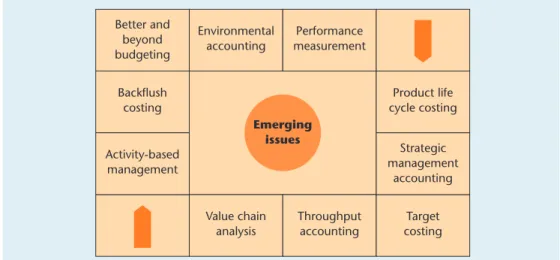
In order to simplify our discussion we will deal with the topics in alphabetical order so that it will be easier for you refer to them quickly if you need to check on a particular technique. They are: (1) activity-based management; (2) backflush costing; (3) better and beyond budgeting; (4) environmental accounting; (5) performance measurement;
(6) product life cycle costing; (7) strategic management accounting; (8) target costing;
(9) throughput accounting; and (10) value chain analysis. These topics are also shown in that order in Figure 20.1.
Selected techniques
By this stage of the book you should have a good knowledge of the purpose of manage- ment accounting and the techniques used. List three changes that you would like to see incorporated into management accounting practice.
Activity 20.2
Activity-based management
Activity-based management (ABM) is a management control technique involving the identification of activities, establishing the cost of those activities and the actual manage- ment of them.
In Chapter 14 we discussed a fairly new development in costing called activity-based costing. ABC is a management accounting technique used to determine how much of an entity’s overhead should be charged to individual products. ABM is a refinement of ABC. There are two main differences: (i) ABM can be used in all types of entity and not just those that manufacture products; and (ii) it encompasses allcosts and not just over- heads. So ABM may be regarded as a means of assessing an entity’s performance.
The basic procedure is as follows.
1 Determine the key activities undertaken by the entity.
2 Collect all the costs attached to each activity.
3 Charge them to appropriate cost pools.
4 Select a cost driver, i.e. identify the main factor that largely determines each activity.
5 Calculate the cost driver rate for each cost pool.
Sometimes the total cost in each cost pool is classified into core, support and diversion- ary activities or into value added or non-value added activities. If the diversionary or non-value added costs appear to be unacceptable, immediate steps would, of course, be taken either to reduce or eliminate them altogether.
It is also possible to calculate the ABM contribution. The concept is very similar to the one we met in marginal costing in Chapter 17. The ABM contribution formulae are as follows:
The activity pool costs include all the costs of making the products, providing the neces- sary services and delivering the products to the customer. The remaining costs must, by
Sales revenue – activity pool costs = ABM contribution ABM contribution – remaining costs = profit/(loss) :. Sales revenue – activity pool cost = remaining costs
Environmental accounting
Performance measurement Better and
beyond budgeting
Value chain analysis
Throughput accounting
Target costing Product life cycle costing Backflush
costing
Strategic management
accounting Activity-based
management
Emerging issues
Figure 20.1 Emerging issues
definition, relate to the provision of future activities (such as research and development) otherwise they would have been included in the pool costs. ABM proponents argue that it would be incorrect to regard such costs as part of current activities because they relate to a future time period. In financial accounting, research expenditure would normally be written off in the period in which it was incurred although in certain circumstances development expenditure may be deferred to a future period.
ABM provides a number of benefits. Among them are the following.
Budgets become more reliable because a closer link is established between demand and the resources required to satisfy that demand.
Diversionary activities can be more easily recognized and costs reduced accordingly.
Profitability is improved because more accurate product costs are established.
Unit output costs can be calculated (activity output costs/output volume) and these can assist in performance measurement.
However, as with most management accounting techniques there are some problems involved in operating an ABM system:
It is difficult to reduce the number of activities to a practical level.
The precise boundary between activities is often difficult to determine.
The method causes resentment and jealousy as it cuts across traditional departmental structures.
It is not always clear to the workforce who is in charge of a particular activity (as opposed to a department).
Not surprisingly, then, although ABM has been a widely discussed topic for the last 20 years it has not been widely adopted. That may be about to change as there are some signs that at least the more forward-thinking companies are now in the process of implementing it.
Backflush costing
Backflush costing is a product costing technique whereby costs are traced back to a product afterits production process has been completed, i.e. flushed back. The conven- tional costing method is to attach costs to products at each stage of the production process. This involves a considerable amount of cost book-keeping but backflush costing cuts out a great deal of it.
The introduction of just-in-time production methods has encouraged the develop- ment of this new costing method. As we commented earlier, JIT purchasing involves ordering materials from a supplier only when a customer has placed an order. So when the materials are received they go straight into production; they are not taken into stock, they do not need to be stored, and it is easy to get them out of stock when they are required. By keeping stock at a minimum (most companies keep somestock) less space is required, waste is reduced, and there is less documentation checking and controlling. So overall store-keeping costs tend to be lower than in a traditional system.
What do you think your reaction would be if a company you worked for switched from being organized on departmental lines to one being based on activities so that you all worked in multidisciplinary teams? List your likely reactions.
Activity 20.3
At some point backflush costing requires a product to have a cost attached to it. So when and at what point does this happen? There are three possible stages (known as trigger points) when the costing could take place. They are as follows.
1 On completion. This is the purest and possibly the simplest form of backflush costing.
No entries would be made in the books of account until the units are transferred to the finished goods store. The accounts used would primarily be the stores ledger account (for direct materials), the conversion cost account (for direct labour and overheads), and the cost of goods sold account,
2 On purchase and completion. This method uses two trigger points: (1) an entry would be made in the purchases account when the raw materials are first purchased. In a JIT system this would almost always be in response to a specific order. And then (2) on completion of the order entries would be made in the conversion cost account and the cost of goods sold account.
3 On purchase and sale. This method also uses two trigger points. (1) on purchase of the materials for a specific order; and (2) when the sale has actually taken place. This method means that if for some reason or other the goods are not immediately sold there could be a considerable delay before the details could be entered in the books of account.
Irrespective of which trigger point is selected the cost charged to the completed units would normally be either the budgeted cost or the standard cost.
Backflush costing has a number of apparent benefits. Among them are:
There is much less book-keeping and what remains is simpler.
It is cheaper to run than the conventional method of costing.
The store-keeping function is much reduced.
However, there are some problems:
There are fewer control signal points such as material mix and yield variances.
The audit trail is made more difficult because there is no sequencing of costs.
For financial reporting purposes it is in conflict with generally accepted accounting principles (GAAP) mainly because there is no work-in-progress account.
Notwithstanding these problems it is argued that backflush is ideally suited when JIT procedures are employed, the production cycle time is short and inventory levels are kept low.
Better and beyond budgeting
In Chapter 15 we examined the nature and purpose of budgeting and budgetary control.
However, our discussion was strictly limited to the traditional approach to the subject – one that has been widely adopted over very many years. This approach is known as incrementalbudgeting. In brief, incremental budgets are prepared by (a) taking last year’s budget (it is usually for a year); (b) adjusting it for any expected changes during the forthcoming year; and then (c) increasing the costs and revenues by the expected rate of inflation during the budget period.
Under a backflush costing system which trigger point would you recommend?
On completion [ ] On purchase and completion [ ] On purchase and sale [ ]
Activity 20.4
This method of budgeting has been increasingly subject to a whole barrage of criti- cism in recent years. Among the many problems that can arise are the following.
It is not related to the strategic aims of the entity.
Budgets are prepared annually and they soon get out of date.
The system is organized on a departmental basis.
The budgets are based largely on last year’s budget.
Inefficiencies and inherent weaknesses are automatically built into the system.
The focus is on financial outcomes and not on operational ones.
Broad sweeping top-down changes are often made at the last minute, e.g. instruction from the managing director: ‘Knock 10% off everyone’s budget’.
Budgeting is a costly exercise in terms of time, energy and resources.
The above defects are just some of the criticisms that can be levelled against incremental budgeting but they should be sufficient for you to appreciate why there is now a demand for something better. Indeed, some accountants call it just that: ‘better budgeting’. But other accountants are keen to go ‘beyond budgeting’. It is not always clear what the differ- ence is between these two approaches but perhaps the better budgeting movement is more evolutionary while the beyond budgeting movement is more much revolutionary.
Better budgeting
The demand for better ways of budgeting is not new but it has intensified in recent years owing to the enormous technological changes that have swept the westernized world.
Some of the proposed changes that have been advocated over the last 30 years or so are summarized below.
Rolling budgets. Budgets are still prepared on an incremental basis but as the year pro- gresses the first month’s budget is knocked off and the first month of the next year is added. This procedure continues month by month as the year goes on. This method means that the budget is less out of date than is the case with a pure incremental budgeting system but otherwise it is still subject to all its other defects.
Zero-based budgeting (ZBB). This method ignores last year’s budget. Budgets are pre- pared on the basis of a complete new set of assumptions and outcomes that relate to the forthcoming year. So changed circumstances are taken into account but ZBB still suffers from most of the problems associated with incremental budgeting.
Activity-based budgeting (ABB). This is a much more recent development following the recent interest in activity-based costing. Assuming that the activities of the entity have been grouped into cost pools and appropriate cost drivers selected, the budgets will be prepared on a cost pool and cost driver basis. ABC has not, as yet, been widely adopted in industry so it follows that ABB is at a very early stage of development. It is clearly an improvement on incremental budgeting but its major weaknesses are that it is still being based largely on a non-strategic approach, it tends to be done only annu- ally, it soon gets out of date, and it is firmly based on last year’s budget.
Beyond budgeting
The beyond budgeting approach is a recognition that the world is very different from what it was in the nineteenth century. In recent years there has been an information technology revolution, plant and machinery have become more sophisticated, and com- panies are managed in a much more participative style than ever they were in Victorian times. Employees too are no longer as submissive as they used to be and their feelings
need to be recognized and their recommendations should be taken seriously. All of these factors have encouraged the growth of the radical ‘beyond budget’ movement.
You might think that the term is rather a strange one. This is because its main propo- nents do not think that it is sufficient to merely have a radical overhaul of budgeting itself. They want a completely new management model albeit with budgeting at the heart of it. As they put it, they want to go beyond budgeting. We do not have the space here to explore this new management model in any depth so we will limit our discussion to some of the basic proposals.
It would be misleading to suggest that the movement is at the stage of being able to recommend a workable substitute for incremental budgeting but we can begin to iden- tify some of the changes that are needed. They are as follows.
Budgets should be related to the entity’s strategy.
They should cover a shorter period of time (perhaps as short as three months).
Rolling forecasts based on various outcomesshould be adopted instead of the tradi- tional cost centre budgets.
There should be a concentration on activities and processes rather than on depart- mental cost centres.
Discretionary costs, such as advertising, marketing, research and training costs from the short-term forecasts, should be excluded.
Non-financial as well as financial data should be included.
Data relating to the company’s competitors should also be included.
Managers should be allowed greater autonomy when preparing their forecasts.
Staff should be given bonuses for meeting the targets set for them.
The above requirements are far-reaching although some of them are beginning to be incorporated into many advanced manufacturing companies. What needs to happen now is for them to be welded together so that they form a workable comprehensive model that can replace incremental budgeting. We wait with interest to see how long it will take.
Environmental accounting
Identify the one crucial factor that in your view makes incremental budgeting ineffective in controlling the revenues and costs of a large industrial company. Give reasons for your choice.
Factor ____________________________________________________________________________
Reasons______________________________________________________________________
Activity 20.5
Global warming information
The world’s big corporations are failing to provide a full account to investors of the risks and potential costs of climate change. A report from the Ceres network of green organizations and investors and
the Environmental Defence Fund has found that shareholders are given only minimal information about global warm- ing and the effect that it might have on their ‘bottom line’.
News clip
Source: Adapted from The Guardian, 4 June 2009, p. 25.
Environmental accounting is a form of accounting that captures, records, extracts, sum- marizes and reports information of both a financial and non-financial nature that specifically relates to the environment. If the information is used mainly for internal purposes it is known as environmental management accountingand simply as environ- ment accountingwhen it is provided for parties external to an entity. For convenience we will refer to both types as environmental accounting or EA.
EA’s primary aim is simple: to provide information for management so that corrective action can be taken in order to reduce the impact of the entity’s activities on the environ- ment. A secondary aim is to report on the entity’s performance in achieving that aim.
EA is a very new branch of accounting. We can trace its origins back to an influential report published in 1975 called The Corporate Report. This report broke new ground when it argued that companies had a wider responsibility to the community than simply reporting to shareholders. It identified six main user groups that have an interest in a company’s performance (see Chapter 2). It argued that such groups are not just inter- ested in having some financial information: they also want to know how the company fits in to the social, economic and political environment in which it operates. This sug- gestion was valid in 1975 but it is even more so today.
Over the last 20 years there has been a growing interest in and concern about the physicalenvironment as the vast majority of scientists have given starker and starker warnings about its future, largely because of the apparent threat to the world caused by global warming. Some observers do not agree with this view but two almost indisputable facts are clear:
1 The world’s population has got bigger and bigger.
2 There is a general clamour for living standards to rise.
As a result of these two phenomena a number of consequences arise:
Natural resources become scarcer because some cannot be replaced as quickly as they are being consumed.
The switch from a largely agrarian world to an advanced technological one has resulted in considerable air, land and water pollution.
The climate does appear to be changing as more and more carbon is released into the atmosphere.
It becomes more difficult to find the means of disposing of huge amounts of human waste without spoiling huge tracts of land and polluting water supplies.
No doubt as you worked your way through school you became very well aware of these problems. You probably feel very concerned about them and you might possibly be cam- paigning to get something done to stop them happening. By contrast to the attitude of young people, it has taken accountants, at least in their professional role, some time to accept that there is a problem. Credit is due in part to a number of academic account- ants who have produced a great deal of research on this subject. The various professional accountancy bodies eventually began to support them and now EA often features in their respective syllabi.
In the meantime many companies had also begun to collect data about environmental matters. One sign indicating that they are now being taken much more seriously is that almost any large manufacturing company’s annual report and accounts contains some sort of environmental report. Indeed, Cairn Energy, for example, an oil company, pub- lishes a separate ‘Corporate Responsibility Report’. The one for 2008 is 44 pages long. It has a separate section called ‘Behaving responsibly towards the environment’ which is six
pages long. Its main headings include: (a) environmental impacts; air quality, energy consumption, water consumption, waste and prevention of spills; (b) environmental compliance; and (c) climate change. The contents of this report give you some idea of what is involved in EA.
As the public become more concerned about environmental matters, many compa- nies have set up an environment management team. Until recently accountants were not generally members of such a team. That is now changing. What part do they play in the work of such a team? We can identify four specific responsibilities:
1 Converting the environmental implications of proposed projects into financial terms.
2 Providing financial data identifying environmental benefits and costs of ongoing projects.
3 Preparing both financial and non-financial environmental performance measures.
4 Ensuring that all environment reports comply with statutory and professional accounting requirements.
A traditional accounting system would not and cannot identify those costs and revenues that we might now describe as being ‘environmental’. So when an EA system is intro- duced into an entity the existing accounting system needs to be adapted so that it provides the required information about environmental costs and possible benefits. But what are they? We will deal first with the costs.
Some environmental costs will be tangible such as direct materials and direct labour costs. Other costs will be intangible such as the costs of dealing with the opposition to a proposed addition to a factory. Once it has been agreed what is ‘environmental’, the accountants should not have undue difficulty in identifying the tangible costs, although it almost certainly will be more difficult to quantify the intangible costs. Once all the costs have been isolated they may then be classified under appropriate headings. The US Environment Protection Agency has suggested the following classification. We have also included some examples of what might be included in each category.
Conventional company costs: capital equipment, materials, salvage value.
Upfront: site preparation, R&D, installation.
Regulatory: monitoring, training, pollution control.
Voluntary: community outreach, annual reports, landscaping.
Back-end: closure, disposal of inventory, site survey.
Contingent: penalties and fines, personal injury damage, natural resource damage.
Image and relationship costs: corporate image, relationship with workers, relationship with host communities.
We now turn to examine some environmental benefits. Among them are the following:
Capital cost savings: these may arise from better project design resulting in increased production, less pollution and less wastage.
Revenue savings: such savings could come through more efficient use of resources, e.g.
materials, energy, water and the sale of waste products.
Intangible savings: these may be very difficult to identify and to put a monetary value on them but environmental considerations may result in better labour relations, improved corporate image and enhanced acceptance of the brand image.
As far as accountants are concerned the collection, recording and reporting of the poss- ible recognizable costs and revenues are what accountants are skilled at doing but, as we have indicated, many (if not most) of the environmental costs and revenues are difficult
to quantify and so to cost in financial terms. A move towards environmental accounting takes accountants into almost unknown territory but it is a journey that should be as exciting as it is important.
Performance measurement
Performance measurement is a collective term embracing a whole range of techniques which incorporate both financial and non-financial data as a means of assessing an entity’s performance in achieving its objectives.
The concept and practice of measuring the performance of an entity is not new.
Indeed, traditional profit and loss accounts and balance sheets that include the previous year’s results is one form of performance measurement. If data are extracted from such a source and converted into ‘ratios’ (as we demonstrated in Chapter 10) then we have incorporated both financial and to some extent non-financial information into our analysis. Such an exercise meets our definition of performance measurement. But the methods that have been practised for decades are increasingly seen to be inadequate and unsatisfactory? Why?
A number of reasons can be identified. They are as follows.
The traditional methods of performance measurement rely almost exclusively on accounting information.
Accounting information is based on (a) questionable assumptions, assertions and arguments; (b) it is historical; and (c) non-financial data are largely ignored.
External data are not included.
Advocates of change argue that what is needed is:
Non-financial data should be included.
Comparison should be made with the entity’s competitors.
Greater use should be made of statistical information.
As a result of the deficiencies of the traditional method of measuring performance and the changes that need to be made, a number of possible replacements have been sug- gested. We will review briefly just two of the leading contenders: benchmarking and the balanced scorecard.
Benchmarking
Benchmarking simply means the incorporation of comparative data into performance measurement. According to CIMA (2005), benchmarking can take four different forms:
1 Internal: comparisons are made between different units or functions within the same industry.
Answer the following questions. Tick as appropriate.
1 Do you think that global warming is a major worry? Yes/no 2 How bad is it (on a scale of 1 to 10)?
Very bad Not at all
1 ___________________________________________________________________________ 10 3 Do you think that there is a need for some form of
environmental accounting? Yes/no
4 If yes, what should it include? If no, why not?
Activity 20.6
2 Functional: comparisons are made with the best external practitioners regardless of the industry.
3 Competitive: comparisons are made with the entity’s direct competitors.
4 Strategic: a form of competitive benchmarking but its purpose is to take strategic action and to make organizational changes.
There is a danger of information overloadin extending performance measurement beyond financial data and by including comparisons with other entities. Information overload is not a problem with another idea: the balanced scorecard.
The balance scorecard
The balanced scorecard is a performance measurement device that aims to link an entity’s objectives with its performance. The idea was put forward by two American aca- demics, Kaplan and Norton, in a series of articles and books (see, for example Kaplan, R.S. and Norton, D.P. (1992) ‘The Balanced Scorecard – Measures That Drive Performance’, Harvard Business Review, January/February).
An adapted version of Kaplan and Norton’s balanced scorecard is illustrated in Figure 20.2. It has four perspectives. These relate to the organizational activity of the entity. Each perspective has a basic question linked to it:
1 Financial: how do we look to shareholders?
2 Internal business process: what must we excel at?
3 Innovation and learning: can we continue to improve value?
4 Customer: how do customers see us?
Each perspective then has a number of objectives. In turn each objective has ameasure (such as the staff turnover ratio) and a targetset for it (say 3 per cent per annum). In addition, managers are expected to come up with an initiative, i.e. what measures they would take to achieve each objective.
Financial perspective 1
2 3
Objectives Measures Targets Initiatives
Internal business process perspective 1
2 3
Innovation and learning perspective 1
2 3
Customer perspective 1
2 3
Figure 20.2 A balanced scorecard
Source: Adapted from Kaplan, R.S. and Norton, D.P. (1996) ‘Using the balanced scorecard as a strategic management system’, Harvard Business Review, January/February. With permission from Harvard Business School Publishing.
The model is flexible and can be adapted to individual circumstances so there could be any number of objectives attached to each perspective. But this would, of course, increase the number of measures, targets and initiatives and this could lead to informa- tion overload.
Some academic observers suggest that the balanced scorecard idea has now become part of mainstream management practice. If that is so then you are highly likely to come across it when you become a manager in almost any type of entity. However, we would be cautious about just how widely it has been adopted. The idea might now be more than 20 years old but the evidence so far suggests that it is still appropriate to treat it is as an emerging issue.
Product life cycle costing
Product life cycle costing is a costing technique that captures, records and reports on the cost of making a product from the moment that someone has an idea until the time that there is no sign that it ever existed. The essence of this form of costing is captured in its description as ‘cradle to grave’ costing (see Figure 20.3). In those entities that do not manufacture a physical product it is known simply as ‘life cycle costing’. It should be noted that although it might be thought of as a costing methodits primary purpose is cost management. We start with a description of a product’s ‘life cycle’.
Just as humans go through various stages during their life (childhood, adolescence, adulthood, youth, middle age, old age) so do products. We can distinguish three main phases that most products go through. They are as follows.
1 Development. An initial idea is worked up into a design, a prototype is built and then tested. If successful the prototype goes into production. This phase can account for up to 80 per cent of the overall cost in many advanced technological industries.
2 Manufacturing. The product is manufactured and goes on to the market. Some prod- ucts have a short life, perhaps only a few days, whereas others may last for decades.
Irrespective of the length of their life it is possible to recognize four distinct stages, as shown in Figure 20.3: (a) an introductory period when it takes some time before the product begins to take off; (b) a growth period as sales begin to climb; (c) a period of maturity when sales are at their height; (d) finally a period of decline as sales begin to fall off (sometimes quite rapidly).
3 Disposal. The product is eventually taken off the market and it is no longer manufac- tured. The product line has to be dismantled, the plant and possibly the building demolished, and any left-over materials and waste products buried or dumped (one hopes safely although, alas, that is not always the case).
Bearing in mind all the problems that there are in obtaining reliable data, for perform- ance measurement purposes, which of the following options would you prefer (tick as appropriate)?
(a) Financial performance measures only [ ] (b) Non-financial performance measures only [ ] (c) A combination of both financial and non-financial performance measures [ ] Reasons: __________________________________________________________________________
___________________________________________________________________________________
Activity 20.7
All three of these phases, of course, incur costs. In a traditional costing system the research and development costs would be written off (or charged) in the period in which they were incurred. Disposal costs would be treated similarly. There would normally be no attempt to charge either the initial costs or the disposal costs directly to the product during the manufacturing stage. This means, of course, that the units being manufactured are in effect being undercharged and the profit that they generate is being overstated.
The American defence industry in the early 1960s is credited with being one of the first organizations to recognize this deficiency and to do something about it. And so product life cycle costing was born. The justification for it is that it gives a more accurate assessment of product profitability if both the development costs of a product and its eventual disposal costs are included in the production costs.
Among the perceived benefits of product life cycle costing are the following:
The technique minimizes the possibility that the research team will be carried away with ‘a great idea’ regardless of whether it is likely to be profitable.
Emphasis is placed on the impact of cost at every stage of development.
A more realistic assessment is provided of product profitability.
Greater consideration is given to the eventual treatment of waste and its disposal cost.
But equally there are some obvious problems:
Good ideas might be stifled at an early stage because of their apparent high cost.
It is not easy to estimate the length of a product’s life.
The three phases of the life cycle are difficult to cost especially the disposal costs.
Perhaps these problems are such that even 50 years after its introduction product life cycle costing has still not been widely adopted. Nonetheless, it has several factors going for it and perhaps this is why it is included in accounting examination syllabi.
Introduction Growth Maturity Decline
Figure 20.3 The product life cycle
Source: Fox, H. (1973) ‘A framework for functional coordination’, Atlanta Economic Review, 23(6): 8 –11. With permission from the Federal Reserve Bank of Atlanta.
Suppose you were asked to work out the costs of disposing of nuclear waste. List all the possible factors that you would have to take into account.
How realistic would such an exercise be in practice?
Not at all Quite possible
1 ______________________________________________________________________________ 10
Activity 20.8
Strategic management accounting
SMA is an advanced form of management accounting that includes internally gener- ated financial and non-financial data along with comparable data relating to an entity’s competitors.
The term has been generally adopted since 1981 when Simmonds introduced it to a wider audience in a magazine article (Management Accounting,59, pp. 26–29). SMA is not strictly a ‘technique’ but a development of the conventional form of management accounting. SMA has the potential to change the existing practice quite radically while at the same time turning management accountants into sophisticated business managers instead of remaining as number-crunching back-room technicians.
It is possible to distinguish three distinct differences between traditional management accounting and SMA. They are as follows.
1 SMA places a greater emphasis on relating management accounting information to the strategiesof the entity.
2 It includes much more non-financialdata about an entity’s operating activities.
3 It incorporates data about the entity’s direct competitors.
We will now comment briefly about each of these differences.
Recent accounting literature is full of references to ‘strategy’. Strategy is usually described in terms of its military usage. A workable dictionary definition is as follows:
Or perhaps more relevant for our purposes:
If we apply these definitions to education you will probably find that your module has probably got an aim (what are we trying to do in this module?) and a number of objec- tives (how are we going to achieve that aim?). Similarly the aim of a profit-making business might be (say) to make a minimum return of 20 per cent on capital employed per annum.The management would then have to work out how to achieve that aim. It might, for example, plan to do so by working towards achieving a gross profit of 50 per cent per annum and attempt reducing overheads by 5 per cent per annum.
So in simple terms, if an entity has adopted an SMA approach, the management accountants would have provided information that compares the actual results with the set objectives. For example, ‘We aimed for a reduction in overheads of 5 per cent over the
The use of stratagem or artifice in business or politics.
Source: Funk, 1946.
The science and art of conducting a military campaign by the combination and employment of means on a broad scale for gaining advantage in war.
Source: Funk, C.E., Editor (1946) New Standard Dictionary of the English Language. New York: Funk and Wagnall’s Company.
Bean counters no longer
As the British public sector heads for recession, Charles Tilley, Chief Executive of the Chartered Institute of Management
Accountants (CIMA), stresses the impor- tance of putting strategy and management into accounting, not just bean counting.
News clip
Source: Adapted from Accountancy Age, 24 October 2008.
year as a whole but we are operating at a level of only 3 per cent’. Under a conventional management accounting system the accountants would compare the 3 per cent reduc- tion this year with last year’s 2 per cent (say). The company is clearly doing better this year than it did last year but it is not meeting its objective, i.e. that of making 5 per cent for the year as a whole. This point might be further emphasized, or course, if the external competitors were reducing their overheads by 7 per cent.
Just as in education, where lecturers set module aims and objectives which force them into thinking deeply about what they are trying to do and how they are going to go about it, it is so in business. That is a useful exercise in itself, but it is even more useful if you then compare how the business is doing with what you wanted it to do. In that sense the past is irrelevant: what has gone has gone. It is the future that matters.
Unfortunately SMA is not easy to put into practice. Setting aims and objectives should be fairly easy, as is the collection of internal data. The difficult bit is in obtaining comparable information about the entity’s competitors. But even if this is a problem there is no reason why an SMA approach should not be tried. Comparing actual data with data based on objectives is still a highly valuable way to control costs and to take better decisions. Nonetheless, management accounting is slow to change and as yet there is little evidence to suggest that SMA has been widely adopted.
Target costing
Target costing is a costing technique that establishes the cost of a product by first deter- mining the selling price and then deducting a desired profit margin from that selling price. The balance is the total maximum cost allowable for developing, manufacturing and selling the product. Or, if we put it in equation terms:
Traditional absorption costing works the other way round: the selling price is deter- mined by first working out how much a product may take to make and sell and then adding on a desired profit level, i.e.:
In reality, of course, the selling price cannot always be determined this way because com- petitors’ prices have to be taken into account. That may mean going back to see whether any cost reductions can be made or possibly cutting back on the desired profit level.
A target costing approach is similar to the conventional costing approach except it is much more intensive and inclusive, involving employees, suppliers and customers.
Suppose, for example, that a company is proposing to launch a new product on to the market. After some sophisticated market research it is believed that it could be sold at
(Direct material costs + direct labour costs + overheads) + desired profit = selling price.
Target selling price – desired profit = target cost
What future do you think there is for strategic management accounting? Is it perhaps just a passing fancy of university accounting lecturers? Mark your response on the scale below: 0 = no future at all; 10 = a great future for it.
0 ______________________________________________________________________________ 10
Activity 20.9
£10 per unit. The company wishes to achieve a profit of £1 per unit. So no more than £9 per unit can be incurred in making and selling it. However, the initial estimates suggest that it would cost £11 per unit. That means that a rigorous cost cutting exercise would have to be undertaken, examining every stage of the product’s life cycle starting from the original design to the eventual scrapping of the product. Its specification, the manufac- turing process, and the selling and distribution procedure would all have to be thoroughly investigated and re-costed to see if they could be eliminated, minimized or improved and the cost of them reduced.
This process often needs to be so rigorous in order to get the cost down that target costing goes way beyond traditional cost accounting practices. Indeed, some accountants argue that target costing should be renamed target cost management. We will, however, stick to the term by which it is best known.
Target costing originated in the automobile industry in Japan. Its main objectives were to reduce costs, improve product quality, provide what customers wanted, and bring new products on to the market when the time was right. The technique is believed to have a great deal going for it although as yet it does not appear to have caught on in the Western world. The following are some of its perceived benefits.
An emphasis is placed on customersbeing a key factor in an entity’s survival.
Cooperation among staff is enhanced.
A culture of and a search for continuous improvement is created.
New ideas are brought forward for the development of new products and processes.
But naturally there are some problems in operating a target costing system.
Problems arise in forecasting changes in market and technological developments.
It is difficult to determine a whole range of factors: customers’ needs, predict com- petitors’ activities and responses, derive an accurate target price (even with the use of sophisticated market research techniques), and estimate a share of development costs and non-production overheads.
Throughput accounting
Throughput accounting/costing is a costing technique that enables the throughput of a process to be calculated, throughputbeing defined as the difference between sales rev- enue and direct material cost.
In principle, therefore, it is very similar to marginal costing except that in marginal costing allvariable costs are deducted from sales revenue and the balance is referred to as contribution. Indeed, an alternative name for throughput accounting (or costing) is super variable costing. Throughput accounting also recognizes that in the modern world it is
How realistic (on a scale of 1 to 10) do you think it is to expect managers to achieve a target set for them when it is based on an estimated selling price and an expected profit margin?
Completely realistic Quite unrealistic
1 ______________________________________________________________________________ 10 How would managers behave if given such a target?
Try to meet it: Yes [ ] Ignore it [ ] Try to work to it [ ]
Activity 20.10
unrealistic to assume that labour costs can be regarded as a direct expense. The two tech- niques are contrasted in Figure 20.4 below.
Throughput costing is a technique developed by Goldratt and Cox in their book The Goal(1986, North River Press). It revolves around the concept that all activities at some time or other are restricted by constraints, thereby leading to the development of a theory known as the theory of constraints(TOC). For example, a company might be able to sell all it can produce but it is limited or constrained by a shortage of skilled labour. It may also be limited by a bottleneckin the production process.
A bottleneck is a resource that cannot supply all that is demanded of it. Suppose, for example, that Machine A produces units that are then transferred to Machine B. A manufactures 100 units per hour but B can only cope with 50 units an hour. If A con- tinues to produce 100 units per hour, large stocks of the unfinished units will be built up until such time that B can deal with them. They will then have to be stored some- where and storage is expensive. Management must seek to remove the bottleneck occurring at B as quickly as possible. In the meantime A must limit its output to 50 units per hour. This would be quite a radical approach and one that is contrary to tradi- tional practice. It means that staff working on A will become ‘idle’ (the term is not meant to be pejorative) and no manager likes to see his staff hanging around doing nothing. If the problem is not resolved quickly then eventually the staff might have to be laid off albeit, one hopes, temporarily.
The elimination of bottlenecks means that more and more materials can be processed without being held up. The more that are processed, the more that can be sold and the more profitable an entity becomes. So the main aim of management should be to con- centrate on increasing thethroughput of materials and that means that managers need to be constantly making sure that there are no bottlenecks.
Throughput accounting is at an early stage of development and it is perhaps too soon to know whether it is likely to be widely adopted. Some of its claimed advantages are as follows:
Throughput contribution Operating expenses
14000 9000
Profit 5000
Contribution Fixed costs
10000 10000
5000 Other direct expense 1000
Direct labour 3000
Direct materials 6000
Direct materials 6000
Sales revenue 20000
Sales revenue 20000
£
£
Throughput accounting statement Marginal cost statement
Profit 5000
Figure 20.4 Simplified marginal cost and throughput accounting systems
It is easy to understand and to implement.
Direct material costs can be easily identified.
Labour costs are not treated as a variable cost.
Variable costs do not have to be identified and costed.
An emphasis is placed on value added coming from selling and not by continuing to increase output.
Attention is focused on eliminating constraints and bottlenecks.
Products can be easily ranked on the basis of their profitability.
The basic concept of throughput accounting is so simple and so intuitively appealing that there would appear to be few problems in putting it into practice. But there are some; among them are the following:
It is difficult to accept that sometimes it is appropriate to stop production.
Coping with staff lay-offs (even on a temporary basis) is a major labour relations problem.
Less attention may be given to the control of ‘other operating expenses’.
Concentrating on throughput contribution may draw attention away from overall profitability.
Value chain analysis
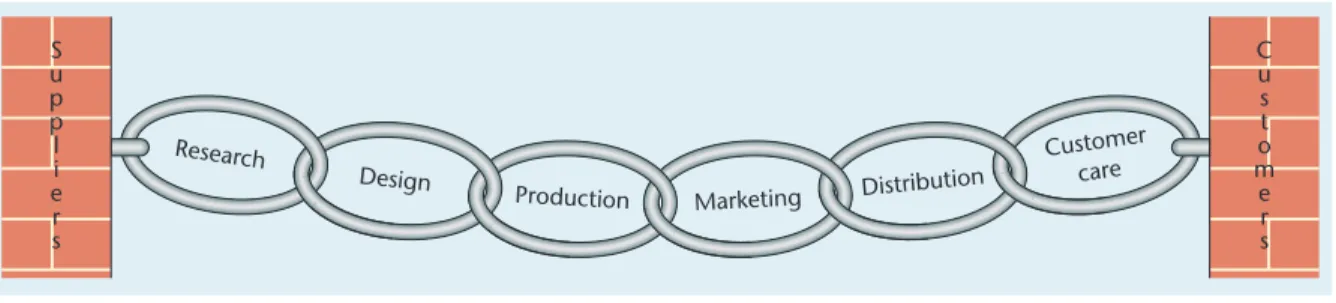
Value chain analysis (VCA) is an investigatory technique used to assess the value added to a product as it goes through a sequence of activities right from the development stage through to the point when it is delivered to the customer. The sequence of activities is known as the value chain(see Figure 20.5).
On a scale of 1 to 10, how appealing is the concept behind throughput accounting?
(a) As an idea:
Not at all Very highly 1 _________________________________________________________________________ 10 (b) As a practical proposition:
Not at all Very highly 1 _________________________________________________________________________ 10
Activity 20.11
Customer care Distribution
Marketing Production
Design Research
S u pp l i e r s
C u st o m e r s
Figure 20.5 A production company’s value chain
Source: Based on Porter, M.E. (1985) Competitive Advantage: Creating and Sustaining Superior Performance. New York, NY: Free Press.
VCA was developed by M.E. Porter in a book calledCompetitor Advantage: Creating and Sustaining Superior Performance published in 1985. The title of the book gives a clue about the technique’s objective. It is argued that by determining the value added to the product at every stage of the manufacturing process a company can gain an advan- tage over its competitors. Porter distinguished between primaryactivities (such as operations, marketing and sales) and supportactivities, e.g. procurement and human resource management.
A value chain analysis involves six basic steps. In summary they are as follows.
1 Divide the entity into strategic business units (SBUs).An SBU is a part of an entity responsible for a defined activity such as planning, development, production and marketing. Note that VCA may be used in service entities but the value chain will not then be as long or as complicated as it is for a manufacturing entity.
2 Identify those activities within each SBU that add value. These activities will be similar to the ones illustrated in Figure 20.5.
3 Allocate revenue, costs and assets to each value-creating activity. The procedures required here are basically the same as those accountants use to set up an investment cost centre.
4 Identify a cost driver for each value activity. The cost driver cost is obtained by dividing the value added by the cost driver.
5 Compare the result for each value added activity. You should now be able to spot fairly quickly those activities that appear to add little value. You can then consider whether the activity can be made more efficient, whether it could be bought-in (‘outsourced’) or even eliminated altogether.
6 Compare the overall results with other similar entities. This will not be easy because the information required may be difficult to get and even then it may not be strictly comparable.
You may have spotted that the above procedure is very similar to activity-based costing.
Perhaps the major difference is basically between the way that the costs and revenues are classified: ABC classifies them into activity cost pools while VCA puts them into stages or sequences.
VCA is a complicated exercise. It involves identifying and distinguishing between dif- ferent ‘sequences’ and then costing them. The next step after that involves selecting just one factor that drives the activity in each sequence. However, while there may be some difficulties in putting VCA into practice it is probably a worthwhile exercise since non- value adding activities can be quickly spotted. But then something has to be done about them and that certainly will not be easy.
List the similarities that you can spot between activity-based costing/management and value chain analysis.