Blind Review Artikel yang di submit pada tanggal 27 Oktober 2023 dengan judul awal
“ Uncovering the Truth: The Low Wages of King's
Tomb Servants in Yogyakarta Palace”
Uncovering the Truth: The Low Wages of King's Tomb Servants in Yogyakarta Palace
No 261- Fh
11
Faculty of Law,
Ωemail correspondence: f.id
ABSTRACT
This research explores the implementation of the wages of the king's tomb in the Yogyakarta Palace. The study was based on the findings of wage payments below the Minimum Wage of Bantul Regency and Yogyakarta Province. This research used empirical legal research based on primary and secondary data. The results showed that wage payments were very far below the standard minimum wage of districts and provinces. The study also found that Abdi Dalem worked three days a week, namely Monday, Friday, and Sunday, from 9 a.m. to 12:00 p.m. Based on working time, the courtier of the king's tomb is categorized as a freelance day laborer. So the fact that the low wages of the servants of the king's tomb are not contrary to the provisions of Indonesian labor law governing wages, namely in Law No. 11 of 2020 on Job Creation, which has been amended into Law Number 6 of 2023 concerning Stipulation of Government Regulations in replacement of Law Number 2 of 2022 concerning Job Creation to become Law, as well as Government Regulation of the Republic of Indonesia Number 36 of 2021 on Wages, as well as provisions on the implementation of Specific Time Work Agreements which also regulate about employment relations in Freelance Daily Workers, contained in the Decree of the Minister of Manpower and Transmigration of the Republic of Indonesia Number Kep.100 / Men / VI / 2004.
Because for the daily labor relationship, granting wage rights depends on the parties' agreement by using the principle of ius contra legem as the basis for the improvement.
Keywords: Minimum Wage; Abdi Dalem; Working Relationships.
Date of Submission: Month DD, 2021 Date of Publication: Month DD, 2022 DOI: http://dx.doi.org/10.56087/substantivejustice.vxix.xx
INTRODUCTION
The province of Yogyakarta Special Region is among those granted special autonomous status, and Aceh, Papua, and the Special Region of the Capital Jakarta because of its special privileges. Article 18 of the Constitution of the Republic of Indonesia of 1945 guarantees the regulation of the four regions above, recognizing areas with still traditional governments as
unique.1 Yogyakarta's particular status was recognized long before Indonesia gained independence as a cultural heritage.2 One of the specialties of Yogyakarta is that it maintains its cultural legitimacy during the development of an increasingly modern era.3 In addition, the system of government led by a King made him look different from other regional heads. In running the wheels of government, a courtier assisted the Sultan.4 Abdi Dalem is an aide to the Sultan as both a mover in the field of government and a guard in charge of preserving Javanese culture in the palace environment.5
Abdi dalem's position is the same as that of a worker. As a worker, Abdi dalem is entitled to wages to meet the needs of his daily life. Law No. 13 of 2003 on Employment relating to Law No. 11 of 2020 on Job Creation, which has been amended into Law Number 6 of 2023 concerning Stipulation of Government Regulations in replacement of Law Number 2 of 2022 concerning Job Creation to become Law, as well as Government Regulation of the Republic of Indonesia Number 36 of 2021 on Wages, guarantee this provision. Article 88 describes Abdi dalem's right to earn income to fulfill a decent livelihood. With fulfilling the needs of a decent life, the welfare of life is not a dream. The Labor Act guarantees the implementation of activities in the field of employment well in addressing gaps related to the rights of unprotected workers through bargaining for political and economic purposes.6
On the other hand, the government seeks to improve the welfare of life through improvements related to the minimum wage.7 Minimum wage policies are in place for a better
1 O A N Hidayah, “Sistem Pemerintahan Kraton Yogyakarta Pada Masa Perang Kemerdekaan Tahun 1945-1951,” Risalah, 2017, 33.
2 A Wijayanti and J Damanik, “Analysis of the Tourist Experience of Management of a Heritage Tourism Product: Case Study of the Sultan Palace of Yogyakarta, Indonesia,”
Journal of Heritage Tourism 14, no. 2 (2019): 167, https://doi.org/10.1080/1743873X.2018.1494182.
3 H Ikhwan and F Aidulsyah, “Sultanates and the Making of Nationhood in Indonesia and Malaysia,” Asian Journal of Social Science 48, no. 3–4 (2020): 340, https://brill.com/view/journals/ajss/48/3-4/article-p339_8.xml.
4 P G Susila and Z Abidin, “Pengalaman Menjadi Abdidalem Punokawan Keraton Ngayogyakarta Hadiningrat: Studi Kualitatif Dengan Interpretative Phenomenological
Analysis,” Jurnal Empati 5, no. 1 (2017): 107,
https://doi.org/10.14710/empati.2016.15062.
5 W D Paramita, “Makna Dan Fungsi Jemparingan Mataraman Bagi Abdi Dalem Karaton Ngayogyakarta Hadiningrat,” Acintya Jurnal Penelitian Seni Budaya 12, no. 1 (2020):
104, https://doi.org/10.33153/acy.v12i1.2816.
6 Donald L McMurry, “Labor and the Law. By Charles O. Gregory. (New York: W. W.
Norton & Co., 1946. 448 Pp. Appendix, Bibliography, and Index. $5.00.),” Journal of American History 33, no. 3 (December 1, 1946): 483, https://doi.org/10.2307/1898075.
7 B Ni and K Kurita, “The Minimum Wage, Exports, and Firm Performance: Evidence from Indonesia,” Journal of Asian Economics, 2020, 4, https://www.sciencedirect.com/science/article/pii/S1049007820300981.
life.8 With wage increases reaching the minimum wage standard, additional funds seen as gifts can be reconsidered concerning total wages.9 The existence of minimum wage policies narrows the gap.10 Setting a minimum wage can also reduce the growth rate of job needs within a few years.11
Abdi Dalem was positioned as a volunteer worker. The meaning of volunteering gives the sense that a small amount of money does not judge every job they do. No free volunteer work is included as freelancers campaigning in New York.12 Although still paid in the form of money, the wages given to Abdi dalem are not comparable to the work done. Low wages can lead to social problems.13 Low wages can also destroy low-skilled jobs.14 Even low wages tend to affect the work done.15 Abdi Dalem is a skilled worker. They are also many who come from the highly educated class and even have rank.
As someone with skills, Abdi dalem's wage determination cannot be aligned with workers without skills. According to Law No. 11 of 2020 on Copyright Work, article 88C, the Governor shall determine the minimum wage for the province and the wages in each district and city, subject to certain limitations, such as inflation or growth in the local economy. Based on the geographical conditions of the king's tomb in the Bantul Regency area, the minimum salary used is the Bantul Regency Minimum salary. Thus, this determination can improve the quality of life.16
8 Nur Hidayah Che Ahmat, Susan W Arendt, and Daniel W Russell, “Effects of Minimum Wage Policy Implementation: Compensation, Work Behaviors, and Quality of Life,”
International Journal of Hospitality Management 81 (2019): 230, https://doi.org/https://doi.org/10.1016/j.ijhm.2019.04.019.
9 W Brink, X J Kuang, and M Majerczyk, “The Effects of Minimum-Wage Increases on Wage Offers, Wage Premiums and Employee Effort under Incomplete Contracts,”
Accounting, Organizations and Society, 2021, 2,
https://www.sciencedirect.com/science/article/pii/S0361368220300799.
10 S Katzkowicz et al., “Low-Skilled Workers and the Effects of Minimum Wage in a Developing Country: Evidence Based on a Density-Discontinuity Approach,” World
Development, 2021, 2,
https://www.sciencedirect.com/science/article/pii/S0305750X2030406X.
11 J Meer and J West, “Effects of the Minimum Wage on Employment Dynamics,” Journal
of Human Resources 51, no. 2 (2016): 512,
http://jhr.uwpress.org/content/51/2/500.short.
12 J Merkel, “’Freelance Isn’t Free.’Co-Working as a Critical Urban Practice to Cope with Informality in Creative Labour Markets,” Urban Studies 56, no. 3 (2019): 547, https://doi.org/10.1177/0042098018782374.
13 S Pantea, “The Effect of Minimum Wage Hikes on Employment: Evidence from Regional Panel Data from Romania,” Economic Systems 44, no. 3 (2020): 4, https://www.sciencedirect.com/science/article/pii/S0939362518300487.
14 D Neumark and L F M Corella, “Do Minimum Wages Reduce Employment in Developing Countries? A Survey and Exploration of Conflicting Evidence,” World Development 137 (2021): 26, https://doi.org/10.1016/j.worlddev.2020.105165.
15 D J Galvin, “Deterring Wage Theft: Alt-Labor, State Politics, and the Policy Determinants of Minimum Wage Compliance,” Perspectives on Politics 14, no. 2 (2016):
335, doi:10.1017/S1537592716000050.
16 Nur Hidayah Che Ahmat, Susan W. Arendt, and Daniel W. Russell, op.cit., 237.
Low wages have the potential to disrupt mental health.17 This phenomenon was later challenged through previous research. This phenomenon was later challenged through previous research18, where the minimum wage does not affect Abdi Dalem's life to damage their mentality.
The Abdi Dalem showed different circumstances and received such low wages with joy. The phenomenon becomes enjoyable, and from previous research it can be said that the Abdi Dalem do not have a problem with the wages for the work performed, but this is related to the work of the Abdi Dalem, which is seen as the application of cultural values by the Abdi Dalem as something related to the loyalty of the Abdi Dalem to the Kraton.19 This phenomenon becomes interesting to study so that the formulation of the problem appears: whether giving wages to servants in the royal tomb violates the laws and regulations in force in the Unitary State of the Republic of Indonesia or can specific legal reasons justify it. This research aims to determine whether giving wages to servants in the royal tomb violates the laws and regulations in force in the Unitary State of the Republic of Indonesia or can be justified by specific legal reasons.
The study uses empirical legal research by collecting primary and secondary data. The primary data was obtained through interviews with several respondents consisting of 11 (eleven) Abdi dalem placed in the Tomb of King Imogiri with the braids of wedono, penewu, bekel, and jajar.20 In this primary data collection, the informational saturation point takes precedence. If data collection from respondents no longer has new information, then the data is considered sufficient and stopped. Because if it continues to add data, it will result in redundancy.21
The secondary data used in the study is primary legal material derived from national human rights and employment law regulations. The author also uses secondary legal materials derived from previous searches of literature and research results and tertiary materials in determining terms.
17 C Kronenberg, R Jacobs, and E Zucchelli, “The Impact of the UK National Minimum Wage on Mental Health,” SSM-Population Health 3 (2017): 749, https://doi.org/10.1016/j.ssmph.2017.08.007.
18 A Wijayanti and A Nafiah, “Payment of Wage under Minimum Wage for Abdi Dalem of Keraton in Daerah Istimewa Yogyakarta,” Sociological Jurisprudence Journal 2, no. 1 (2019): 62, https://www.ejournal.warmadewa.ac.id/index.php/sjj/article/view/933.
19 Agung, “TIM PKM RSH UGM Teliti Loyalitas Abdi Dalem Keraton Dalam Bekerja,”
Universitas Gadjah Mada, 2022, https://ugm.ac.id/id/berita/22911-tim-pkm-rsh- ugm-teliti-loyalitas-abdi-dalem-keraton-dalam-bekerja.
20 Fithriatus Shalihah, “Wawancara Abdi Dalem Makam Imogiri” (Yogyakarta,19 Oktober 2022). The Eleven (11) name of the Abdi Dalem is with the Author, during the interview session conducted by the Author, found a fact that the Abdi Dalem do the work they are doing is a tribute and devotion to the Kraton and the king and is a form of instilling cultural values, so that the Abdi Dalem do not prioritize wages than what has been done.
21 Schensul Stephen L, Jean J Schensul, and Margaret Diane LeCompte, “Essential Ethnographic Methods : Observations Interviews and Questionnaires,” Walnut Creek Calif: AltaMira Press., 1999, 5-6.
METHOD
This research uses participatory methods, especially legal research” (Susanto, 2015).
Participatory legal research in this study includes two main activities, namely (1) experience and (2) action. These two activities are supported through reflection and supervision. Experiential activities include a) activities to identify issues, steps to formulate research questions, in-depth studies of the issues being discussed, and b) research strategy development activities. The action activities include a) retrieval, collection, coding, editing, and data analysis and conclusions; b) utilization of research results and sharing with the community. In this sense, legal research can only be carried out on himself, individually and socially, interpreting himself and his actions in social reality and the legal reality in which he lives. Participating in legal research is also an effort to provide broader and open access to the community to support their independence through involvement with the community. Therefore, legal research efforts in this model are also directed at strengthening groups in society where they perform activities. In this legal research, all parties involved have equal positions in terms of their rights and obligations. Emancipation implies that community involvement (collaborative) in this activity is carried out from the beginning, from preparing research instruments to collecting and analyzing data, even in the form of an action agenda.
ANALYSIS AND DISCUSSION
The life of the Yogyakarta palace cannot be separated from the role of Abdi Dalem. Abdi Dalem's position is as the state civil apparatus that handles government issues and as a servant of culture. Being a courtier is the soul's call to devote itself to a glorified palace. This devotion is considered a hereditary habit in the family. Not infrequently, the sentence following in parents' footsteps becomes one of the main reasons to become a servant of culture or devote themselves to the palace.
A courtier is not limited by age and class. Everyone can become a courtier, even if the person is not a local native. However, Abdi dalem must know everything about the culture and behave like a cultured person. Abdi dalem is a role model of society in general. Therefore, every prospective Abdi dalem must understand the traditions, norms, ethics, and values that apply etiquette to Abdi Dalem Punakawan and Abdi Dalem Kaprajan. The difference between Abdi dalem punakawan and kaprajan lies in the origin of prospective Abdi dalem. Abdi dalem punakawan comes from ordinary people, while Abdi dalem kaprajan is a retired Indonesian National Army (Tentara Nasional Indonesia, TNI), Police of the Republic of Indonesia (Polisi Republik Indonesia, POLRI), and Civil Servant (Aparatur Sipil Negara, ASN).
Concerning Abdi dalem, serat kekancingan Is a kind of legality that signifies that Abdi dalem is part of the citizens of Kraton Yogyakarta. Through serat kekancingan, Kraton Yogyakarta has the right to regulate monitoring and controlling courtiers. Serat kekancingan This became the
basis of the sting for abdi dalem. This means that the court must carry the rights and obligations depending on the rank/kalenggahan of each of the courtiers. Moreover, through serat kekancingan, is also Abdi dalem entitled to bear the title, the name of the gift, kekucah/wages, and kalenggahan, which reflects the rank and position of Abdi dalem in the existing structure in the Kraton Yogyakarta. At the same time, responsibility that must be carried by Abdi dalem is to act as a cultural servant. This means they devote their lives to being the guardians of the Yogyakarta Kraton's culture who can preserve the culture of the Yogyakarta Kraton.22
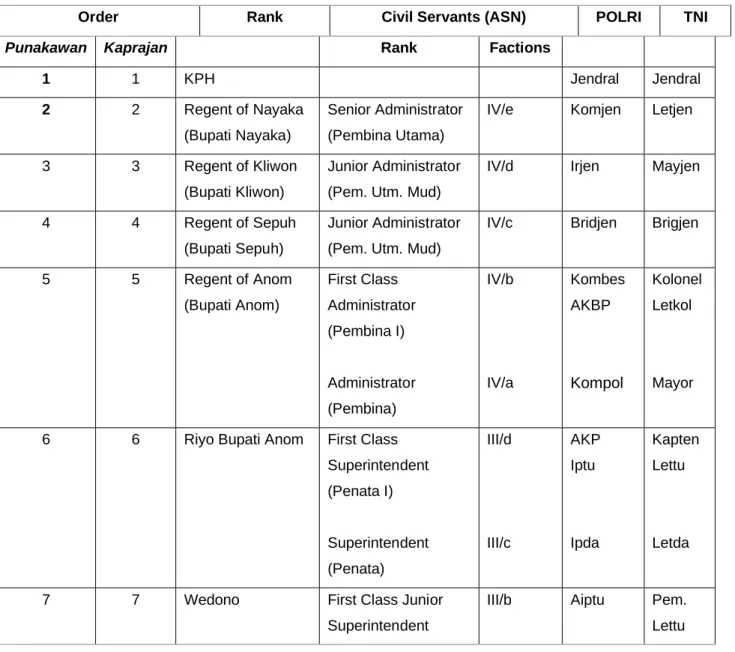
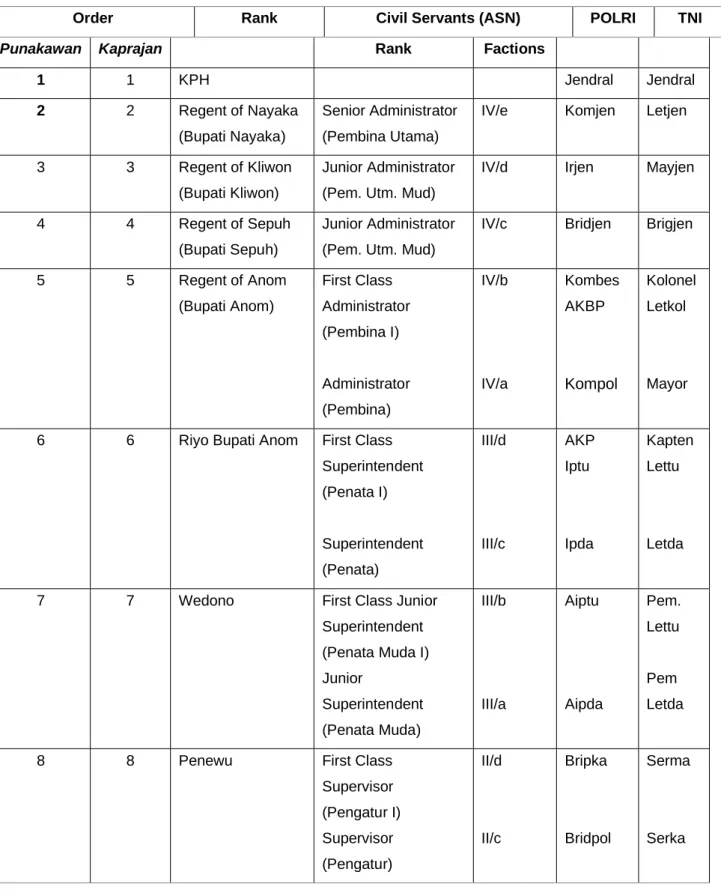
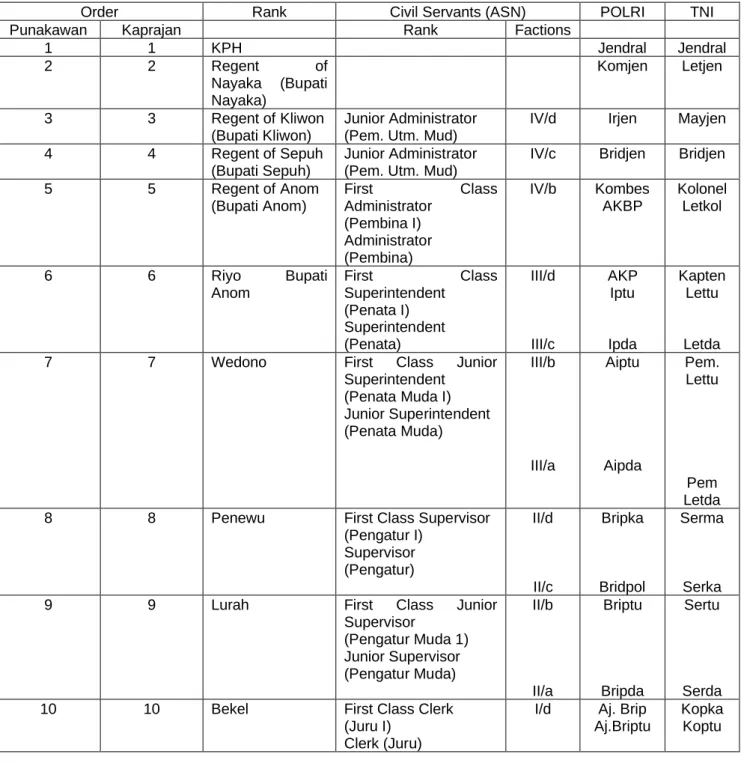
Table 1. Pranatan Kalenggahan Number 01/Pran/KHPP/XII/2004 Chapter of Abdi Dalem Rank 15 Dulkaidah Wawu 1937 Suryo Kaping December 27, 2004
Order Rank Civil Servants (ASN) POLRI TNI
Punakawan Kaprajan Rank Factions
1 1 KPH Jendral Jendral
2 2 Regent of Nayaka
(Bupati Nayaka)
Senior Administrator (Pembina Utama)
IV/e Komjen Letjen
3 3 Regent of Kliwon
(Bupati Kliwon)
Junior Administrator (Pem. Utm. Mud)
IV/d Irjen Mayjen
4 4 Regent of Sepuh
(Bupati Sepuh)
Junior Administrator (Pem. Utm. Mud)
IV/c Bridjen Brigjen
5 5 Regent of Anom
(Bupati Anom)
First Class Administrator (Pembina I) Administrator (Pembina)
IV/b
IV/a
Kombes AKBP
Kompol
Kolonel Letkol
Mayor
6 6 Riyo Bupati Anom First Class Superintendent (Penata I) Superintendent (Penata)
III/d
III/c
AKP Iptu
Ipda
Kapten Lettu
Letda
7 7 Wedono First Class Junior
Superintendent
III/b Aiptu Pem.
Lettu
22 S Satriani, “Peranakan Dan Serat Kekancingan: Sebuah Identitas Abdi Dalem Kraton Jogjakarta,” Jurnal Penelitian Politik 14, no. 1 (2018): 47, https://doi.org/10.14203/jpp.v14i1.699.
(Penata Muda I) Junior
Superintendent (Penata Muda)
III/a Aipda
Pem Letda
8 8 Penewu First Class
Supervisor (Pengatur I) Supervisor (Pengatur)
II/d
II/c
Bripka
Bridpol
Serma
Serka
9 9 Lurah First Class Junior
Supervisor
(Pengatur Muda 1) Junior Supervisor (Pengatur Muda)
II/b
II/a
Briptu
Bripda
Sertu
Serda
10 10 Bekel First Class Clerk
(Juru I) Clerk (Juru)
I/d
I/c
Aj. Brip Aj.Briptu Aj. Bripda
Kopka Koptu Kopda
11 11 Jajar First Class Junior
Clerk
(Juru Muda I) Junior Clerk (Juru Muda)
I/b
I/a
Bharaka Bharatu
Bharada
Praka Pratu
Prada
The table above shows the various rankings that Abdi Dalem can hold, ranging from Jajar to KPH. The rank of KPH is the highest, and therefore, KPH is rarely held by Abdi Dalem; this is because it depends on the sultan's policy (kawicaksanaan-mirunggan).23
2.1. Abdi Dalem Tomb of the King in Imogiri
Someone with the potential to serve culture is Abdi Dalem. One can be said to be a servant dalem after obtaining a decree or serat kekancingan (Decree or Confirmation Letter) issued by
23 Agus Sudaryanto, “Hak Dan Kewajiban Abdi Dalem Dalam Pemerintahan Kraton Yogyakarta,” Mimbar Hukum 20, no. 1 (2018): 163–77, https://journal.ugm.ac.id/jmh/article/view/16321/10867.
the Yogyakarta Kraton. Based on Pranatan Kalenggahan Number 01/Pran/KHPP/XII/2004, the status of abdi dalem is divided into two, namely abdi dalem punakawan and abdi dalem kaprajan.
Abdi dalem punakawan, the courtier, gets the wages (kekucah) from the Kraton side through Tepas Danartopuro (served in receipt, expenditure, and storage of money). At the same time, Abdi dalem Kaprajan, in principle, they are not entitled to get wages from Kraton but gets it from the government of the Republic of Indonesia. Thus, Abdi dalem Kaprajan, in principle, is just as Abdi dalem caos (who came to the Kraton as recognition as a courtier) and did not have the burden of duty on the part of the Kraton. It is different with Abdi dalem Punakawan, for this group is institutionally recognized by the Kraton as one of the devices of the Kraton government.
Therefore, they get specific tasks or jobs.24
Abdi dalem, placed in the tomb of the king of Imogiri Yogyakarta, currently numbers 99 (Ninety-Nine) people. The amount is the calculation of Abdi dalem, who has served for a long time, and Abdi dalem, who is still an apprentice. When viewed from the rank level, eleven ranks are entitled to be held by courtiers, both Abdi dalem punakawan And Abdi dalem kaprajan. The type of rank is jajar, bekel, lurah, penewu, wedono, riyo bupati anom, bupati anom, bupati sepuh, bupati kliwon, bupati nayoko and Kanjeng Pangeran Haryo (KPH). The determination of this rank and title is the prerogative of the Sultan. However, for Abdi dalem punakawan, it can be ascertained that the power must be through an internship from jajar, bekel, etc. In general, the internship period for prospective courtiers ranges from 2-5 years. The sultanate set this pre- employment provision to consider its discipline and loyalty to devote itself to the Yogyakarta Kraton. The procession of being abdi dalem is marked by graduation. As for Abdi dalem kaprajan, in general, not through internships. Once entered Abdi dalem, the rank has been adjusted to the rank or class in the government office or rank while serving as a member of POLRI and TNI. A courtier, either during the trial period or having passed, is simultaneously charged with rights and obligations due to tying himself to the palace. These rights and obligations are born because of working relationships.
Like two coins with two opposite sides, a relationship has two inversely proportional things.
Duty must accompany every right. Like workers in general, Abdi dalem also has obligations that must be fulfilled. Abdi dalem, placed in the tomb of the king of Imogiri, should maintain security and preserve the tomb. A tomb is where previous kings lived and became a religious tour that many people often visit. In addition to being a confidant to guard the tomb, Abdi dalem was also ordered to be a guide when visitors visited the king's tomb.
24 Satriani, “Peranakan Dan Serat Kekancingan: Sebuah Identitas Abdi Dalem Kraton Jogjakarta.”
Before opening the tomb area to the public, Abdi dalem usually cleans the tomb area first.
Each courtier is responsible for his or her territory. In carrying out duties, Abdi dalem must wear clothes mataraman complete, for men must wear striated clothes and Javanese blangkon. In contrast, women wear long cloth kebaya, and some wear kemben (jarik). In addition, neither men nor women are allowed to wear footwear when wearing clothing. mataraman. Waluyo, as Mas Penewu Jogo, who has been a courtier for 15 years, said that this provision applies not only to the king's tomb in Imogiri but to all Abdi dalem, whether in the palace environment or not. In addition to cleaning, Abdi dalem has a ritual nyekar to the tomb of Sultan Agung. Based on the presentation of Mr. Diarjo, who ranked as Mas Penewu Jogo, this routine is a form of respect for the Great Sultan. This agenda is one of the obligations that cannot be missed.
The following obligation is regarding the presence of the courtiers at the tomb of the king of Imogiri. A courtier was asked to be present at the Kraton. Although they do not serve in the Kraton, they must show their face for ten days. His presence assesses the performance that has been done and has fulfilled each Abdi dalem. Sapingi, one of the tomb guards who ranked Mas Penewu Jogo juga, added that the presence is evidence that can be used so that a courtier dalem rises through the ranks. Thus, the presence used to rise through the ranks was a collection of attendance for five years. This is because Abdi dalem can be promoted for five years unless specified by the Sultan. In general, the presentation contains a list of activities that have been carried out. Furthermore, he also describes Abdi dalem's obedience, discipline, and karmic system in carrying out his duties. In two years, the tomb of King Abdi Dalem must be present as many as 8 (eight) times to the Kraton.
The last obligation of a servant dalem tomb of the king of imogiri is to follow the traditional ceremony. As a still thick with culture, Kraton Yogyakarta often holds cultural events, one of which is a traditional ceremony. All Abdi dalem, including the tomb of king Abdi Dalem in Imogiri, must attend this ceremony. Abdi dalem in each series of ceremonies becomes an independent assessment for Dalem Abdi. If they do not attend traditional ceremonies for no reason, sanctions will be given. The sanctions were brutal in applying for their promotion. The Kraton considers it very important to involve courtiers in this traditional ceremony because it is expected to understand and carry out the teachings. P. Samber Nyawa Known as Tri Darma, that is. mulat sarira, hangrasa wani (introspection), rumangsa melu handarbeni (Feeling you have), and wajib melu hanggondeli (follow defense).25
2.2. Wages (Kekucah) Abdi Dalem Tomb of the King in Imogiri
25 A Sudaryanto, “Hak Dan Kewajiban Abdi Dalem Dalam Pemerintahan Kraton Yogyakarta,” Mimbar Hukum 20, no. 1 (2008): 173, https://doi.org/10.22146/jmh.16321.
In addition to the right to hold a certain rank, as mentioned above, the courtier, Abdi dalem, is also entitled to bear the title of name aligned with the field of work or expertise. Usually, this title is granted to Abdi dalem in the name of the Sultan, who is known and signed by the head of his work section (kawedanan/tepas). In addition, the courtiers are also entitled to get a salary/wage. However, Abdi dalem kaprajan does not have the right to get a salary/wage from the Yogyakarta Kraton. This provision can be seen in the assignment letter (kekancingan) as a Kraton courtier because Abdi dalem, with this type, usually gets wages/salaries from the government of the Republic of Indonesia. Abdi dalem punakawan is Entitled to get a salary/wage from the Kraton Yogyakarta with a certain amount of money. Salary/wages (kekucah) given Kraton to Abdi dalem punakawan vary, depending on the type.
Abdi dalem punakawan Divided into two types, namely punakawan caos and punakawan tepas. Punakawan caos is a courtier who generally works in a designated place following the rules and is obliged to sowan or come to the Kraton every ten days and come on Tuesday Wage when wiyosipun dalem. At the same time, Abdi dalem punakawan tepas is Abdi dalem who works in the office of the Kraton government, so that it can be sowan or come to the Kraton every day.
These courtiers must come to the Kraton at least 1-3 times a week from 09.00 to 12.00 WIB.
Before performing his responsibilities, Abdi Dalam and Kraton agreed on a working partnership. According to Law No. 13 of 2003's Article 1 number 14, the working relationship began with an employment agreement between employers (Kraton) and workers (Abdi dalem), which included the following components:
1. Existence of work
2. Under command/command 3. Certain wages/loans, and 4. Some periods limit work.
The number of wages, or kekucah, is determined by the degree and rank of Abdi dalem.
The wages given vary with the lowest nominal of USD 0,65 month, and the highest USD 2,67 month, the amount is only allocated to abdi dalem punakawan caos.
Figure 1. Wages (Kekucah) Abdi Dalem Tomb of the King in Imogiri (Caos dan Tepas) The table above shows the nominal amount of Abdi Dalem's power shows a different number. Not only against Abdi Dalem with a separate rank but the payment of the kekucah is also distinguished by the type of Abdi dalem. Although the ratio was twice as large as Abdi Dalem Punakawan Caos, the wage payment was still not worth it. However, regardless of the amount of kekucah given, they still accepted happily. Abdi dalem, assigned to the Tomb of King Imogiri, also asserted that being a courtier is not a job but a devotion. Therefore, no matter how strong it is, it will not hinder Abdi dalem's motivation to continue serving in the Kraton. The motivation to become a servant lies not in the material obtained but, in the blessings, and peace. According to them, being a courtier is a fortune. With a relatively small strength, Abdi dalem can still meet the needs of his life, both primary and secondary.
Related to the wage (kekucah) of the king's tomb in Imogiri, of course, it is still far from the minimum wage standard of Yogyakarta regency and province. The Special Region of Yogyakarta (Daerah Istimewa Yogyakarta, DIY) provincial minimum wage limit indicates a sizable amount. In 2020, the minimum wage of DIY province amounted to USD 113,87; the amount became the standard so that employers do not provide wages based on existing provisions. Because referring to the purpose of wages is to give the welfare of life. The achievement of a prosperous life is seen in fulfilling daily living needs such as eating, clothing, and others.
Rp10,000
Rp15,000
Rp20,000
Rp25,000
Rp30,000
Rp35,000 Rp20,000
Rp30,000
Rp40,000
Rp50,000
Rp60,000
Rp70,000
Rp0 Rp10,000 Rp20,000 Rp30,000 Rp40,000 Rp50,000 Rp60,000 Rp70,000 Rp80,000
Jajar Bekel Nom Bekel Sepuh Lurah Penewu Wedono
WAGES/KEKUCAH
Rank Caos Tepas
The minimum pay in a district is set in addition to the minimum wage for the province. The minimum wage of the Bantul district is relatively higher than the minimum wage of DIY provinces.
In 2020, the amount of the minimum wage of the Bantul regency amounted to USD 119,61;
because the tomb of the king of Imogiri is in the Bantul regency, the wage given must refer to the amount of the minimum wage of the Bantul regency. Law No. 11 of 2020's Article 88E, paragraph (2) forbids firms from paying employees less than the minimum wage. Let's say the employer transgresses the clause. In that scenario, the employer might face penalties outlined in Article 185 paragraph (1), which upholds the validity of jail sentences and fines imposed on companies.
Realizing the small amount given, Kraton then increases the fees for Abdi dalem caos, whose funds are sourced from special allocation funds/Special Funds. The Special Allocation Fund (Dana Alokasi Keistimewaan, DAK) is a budget derived from the State Revenue and Expenditure Budget (Anggaran Pendapatan dan Belanja Negara, APBN) and the Diy Regional Revenue and Spending Budget (Anggaran Pendapatan dan Belanja Daerah, APBD). This provision is stipulated in article 44 of Law No. 13 of 2012 on Special Region Privileges of Yogyakarta, which reads, "the costs intended to carry out duties as in article 43 are charged to the State Budget and APBD DIY". As mentioned in Article 43 Law, the task charged is about the activities of the Yogyakarta palace government.
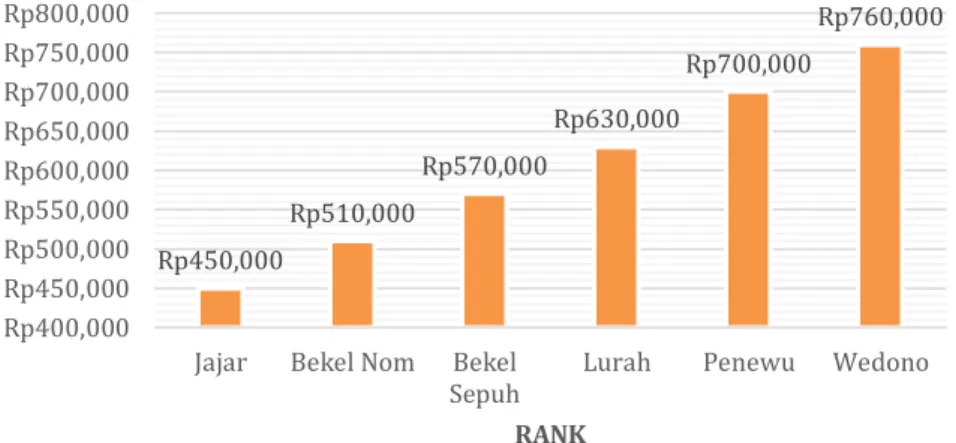
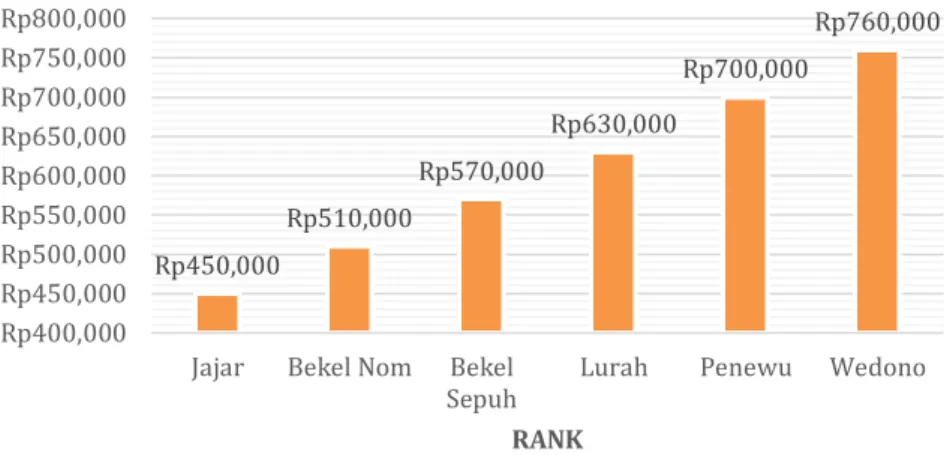
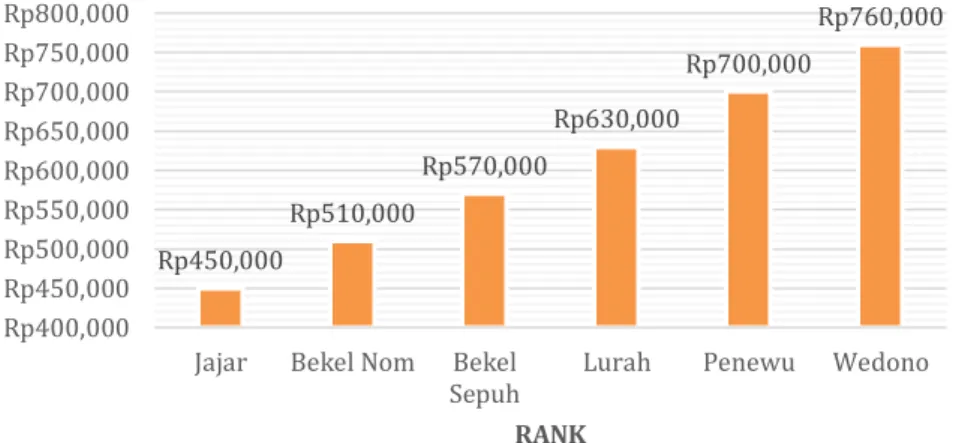
However, special allocation funds are only given to Abdi dalem every four months, meaning that Abdi dalem only receives an additional fee three times a year. Awarding this bonus is nominally based on the title and rank of Abdi dalem. The higher the rank, the greater the additional wages received. The number of funds given is as follows:
Figure 2. Abdi Dalem Caos Special Allocation Fund
The figure 2, contains a list of special funds for Caos Abdi Dalem starting from Jajar, Bekel Nom, Bekel Sepuh, Lurah, Penewu, to Wedono.The Special Allocation Fund above is one of the
Rp450,000
Rp510,000
Rp570,000
Rp630,000
Rp700,000
Rp760,000
Rp400,000 Rp450,000 Rp500,000 Rp550,000 Rp600,000 Rp650,000 Rp700,000 Rp750,000 Rp800,000
Jajar Bekel Nom Bekel
Sepuh Lurah Penewu Wedono RANK
caos
additional blessings that does not affect Abdi dalem's sincerity to the Sultan.26 Although welcomed with joy, Abdi dalem still did not expect the number of bonuses obtained. All that is given to them is gratitude, regardless of the amount. The nominal difference in each rank of Abdi dalem is only around USD 4,01.
Explanations related to wages (kekucah) and additional funds received by Abdi Dalem still show minimal numbers to meet a decent life. Article 88 of Law No. 11 of 2020 states that wage policies are applied to protect workers, including the minimum wage, to complete a decent livelihood for humanity. So, the sultan of Yogyakarta Kraton, as an employer, must provide wages based on the minimum wage of districts and provinces.
For a courtier, devoting himself to Kraton is a high honor. The reason for becoming a courtier is to gain inner peace and happiness. Abdi Dalem was also grateful to have been allowed to live on the Sultan's estate. One of the factors obtained from being a courtier is getting Dalem's blessing. In addition, they believe that only the chosen ones can be servants of dalem, and there is luck that comes and can meet his family's needs after becoming a courtier dalem. Therefore, it is okay if they are paid very low. However, by signing an employment contract, Kraton and Abdi Dalem have an agreed working relationship. That means there are laws in place because of such actions.
Regarding working time, Article 77 paragraph (1) of Law No. 11 of 2020 on Work Copyright mentions that every employer must implement the working time provisions. The provisions of the active time are stipulated in Article 77 paragraph (2), namely:
1. 7 hours a day and 40 hours a week for six working days a week, or
2. Eight hours a day and 40 hours a week for a working period of 5 days a week.
Interestingly, the system arranged in such a way is not applied in the working environment of Abdi Dalem's tomb of the king of Imogiri. Based on the study results, the authors found that the courtier of the tomb of the king of Imogiri only worked for 3 (three) days a week. Designated workdays are Sundays, Mondays, and Fridays. Working time also needs to meet the standards in the law provisions above. They only work from 10 am to 12 pm, meaning the working time of Abdi Dalem Tomb of King Imogiri is only 3 (three) hours a day. This situation violates the provisions of Article 77, paragraph (2). However, based on the exposure, Mr. Pancolo, one of the courtiers of the tomb of the king of Imogiri, said that Kraton's work system did not provide working
26 N Sa’adah, “Nilai Kerja Lansia Abdi Dalem Keraton Yogyakarta Pasca UU Keistimewaan Yogyakarta,” Panangkaran: Jurnal Penelitian Agama Dan Masyarakat 1, no. 1 (2017): 150, https://doi.org/10.14421/panangkaran.2017.0101-08.
time provisions. Abdi Dalem can work at any time. If there is a situation where the Sultan and his family need the help of a servant, then they should have time.
The reason for this policy is that the Kraton has no compulsion for someone to become a courtier. They agreed with the provisions provided by the Kraton because they believed that if they devoted themselves wholeheartedly to the Sultan and his family, the work done would feel light, and courtiers' lives would be guaranteed. Thus, the working time stated in Article 77 paragraph (2) never occurred or did not apply to Abdi dalem. Abdi Dalem is not a conceptual volunteer worker. Although only working briefly in labor law, Abdi Dalem was categorized as a freelance day laborer. As in Article 10 of the Decree of the Minister of Manpower and Transmigration of the Republic of Indonesia Number Kep.100/Men/VI/2004, freelance day labor is only reserved for specific jobs that change in time and volume of work and wages based on attendance. Freelance day laborers are included in Specific Time Work Agreements, so agreements tied through oral agreements contradict the Act. The verbal agreement also regulates the fulfillment of rights and obligations. Although freelance day laborers are not guaranteed permanent, the life satisfaction given to freelance day laborers should be equivalent to that of a permanent worker, such as the wages employers give to workers.
The author understands that as a freelance day laborer, wages and work implementation provisions are based on mutual agreement. All binding provisions are permitted not to refer to the applicable rules. In the implementation of Abdi dalem, it is clearly stated that the wages based on the Sultan's decree do not list the nominal given. Even the reward for Abdi dalem is based on something other than the provincial and county minimum wage. This means that the provision of wages is based on the decision of the Sultan as the leader of the Yogyakarta palace by first conveying it to Abdi Dalem. Thus, an employment agreement from an employment relationship signifies the parties' agreement to the clauses, including wages or salaries provided.
When referring to Government Regulation No. 36 of 2021 on Wages, the freelance daily worker will get a monthly wage based on daily calculations as long as he works under the following conditions:
1. Working time lasts for 6 (six) days a week, monthly wage divided by 25 (twenty- five)
2. Working time for 5 (five days) a week, wages divided by 21 (twenty-one)
Whereas if the determination of wages is based on the calculation of hourly wages, then the calculation of hourly wages is as follows:
Monthly Wages
Hourly Wage =
126
Although Abdi Dalem thought that his life had prospered with the availability of facilities as described earlier, it did not mean that a small amount of the problem of wages became neglected.
As a human being, the fulfillment of life needs must continue. Fulfillment can only be done if one has enough money. How will survival continue if a worker does not have adequate wages?
Therefore, there needs to be a minimum wage for Abdi Dalem, especially those in the king's tomb in Imogiri. This arrangement aims to protect workers from arbitrary ratings in earning a living wage to eradicate poverty and reduce economic inequality.
Standardization of the minimum wage is critical in determining the need for a decent living because improving welfare can also increase workers' productivity if the minimum wage is high.27 This statement contradicts previous research that stated that changes in wages for workers would result in 3 (three) things, one of which is a decrease in quality, including benefits and flexibility of schedules.28 The above statement affirms the selfishness that shackles workers. The existence of adequate wages will encourage the spirit of workers to do the best thing. In addition, the nature of the work is to provide opportunities for workers to improve their quality of life.
The standardization of the welfare of life is not money, but without money, a prosperous life is just wishful thinking. Based on the above facts, creating welfare as another right that Abdi Dalem has is challenging to explain. In theory, the welfare obtained by Abdi Dalem can be said to have not been fulfilled because the wages given to Abdi dalem are still below the minimum wage. This is undoubtedly a criminal act that receives the threat of punishment. However, different circumstances are shown in practice. Abdi Dalem, tomb king in Imogiri, claimed to have earned welfare even with the provision of wages below the minimum wage. It was considered fair by them when it was an act that violated the law. This is a form of ius contra legem, whichever ius contra legem. It is a legal principle that is the Act of overriding the law when the laws and regulations cause injustice so that the judge must side with justice by the rule of law or laws that have been established.
27 O Holtemöller and F Pohle, “Employment Effects of Introducing a Minimum Wage: The Case of Germany,” Economic Modelling 83 (2020): 116, https://doi.org/10.1016/j.econmod.2019.10.006.
28 K Regmi, “The Effect of the Minimum Wage on Children’s Cognitive Achievement,”
Labour Economics 65 (2020): 2, https://doi.org/10.1016/j.labeco.2020.101844.
In this case, the regulation of the law regarding employment, primarily related to wages, was ruled out based on an agreement made by the Yogyakarta Kraton with the king's tomb in Imogiri, which has been poured in the form of a seat kekancingan/determination letter that the Yogyakarta Kraton has issued.
CONCLUSION
The low wages (kekucah) received by the courtiers of the king's tomb in Imogiri are certainly far below the minimum wage of the Province and Regency. However, look at the status of the courtier, who can be categorized as a freelance day laborer. In that instance, there would be no conflict here with the wage-regulating provisions of Indonesian labor law, specifically Law No. 11 of 2020 on Work Copyright, Government Regulation of the Republic of Indonesia Number 36 of 2021 on Wages, and provisions about the implementation of Specific Time Work Agreements, which govern employment relations for freelance daily workers. As contained in the Decree of the Minister of Manpower and Transmigration of the Republic of Indonesia Number Kep.100/Men/VI/2004.
REFERENCE BOOKS
L, Schensul Stephen, Jean J Schensul, and Margaret Diane LeCompte. “Essential Ethnographic Methods : Observations Interviews and Questionnaires.” Walnut Creek Calif: AltaMira Press., 1999.
JOURNAL ARTICLES
Brink, W, X J Kuang, and M Majerczyk. “The Effects of Minimum-Wage Increases on Wage Offers, Wage Premiums and Employee Effort under Incomplete Contracts.” Accounting, Organizations and Society, 2021.
Che Ahmat, Nur Hidayah, Susan W. Arendt, and Daniel W. Russell. “Effects of Minimum Wage Policy Implementation: Compensation, Work Behaviors, and Quality of Life.” International Journal of Hospitality Management 81 (2019): 229–38.
https://doi.org/10.1016/j.ijhm.2019.04.019.
Galvin, D J. “Deterring Wage Theft: Alt-Labor, State Politics, and the Policy Determinants of Minimum Wage Compliance.” Perspectives on Politics 14, no. 2 (2016): 324–50.
Hidayah, O A N. “Sistem Pemerintahan Kraton Yogyakarta Pada Masa Perang Kemerdekaan Tahun 1945-1951.” Risalah, 2017.
Holtemöller, O, and F Pohle. “Employment Effects of Introducing a Minimum Wage: The Case of Germany.” Economic Modelling 83 (2020): 108–21.
Ikhwan, H, and F Aidulsyah. “Sultanates and the Making of Nationhood in Indonesia and Malaysia.” Asian Journal of Social Science 48, no. 3–4 (2020): 339–52.
Katzkowicz, S, G Pedetti, M Querejeta, and M Bergolo. “Low-Skilled Workers and the Effects of Minimum Wage in a Developing Country: Evidence Based on a Density-Discontinuity Approach.” World Development, 2021.
Kronenberg, C, R Jacobs, and E Zucchelli. “The Impact of the UK National Minimum Wage on Mental Health.” SSM-Population Health 3 (2017): 749–55.
McMurry, Donald L. “Labor and the Law. By Charles O. Gregory. (New York: W. W. Norton &
Co., 1946. 448 Pp. Appendix, Bibliography, and Index. $5.00.).” Journal of American History 33, no. 3 (December 1946): 482–83. https://doi.org/10.2307/1898075.
Meer, J, and J West. “Effects of the Minimum Wage on Employment Dynamics.” Journal of Human Resources 51, no. 2 (2016): 500–522.
Merkel, J. “’Freelance Isn’t Free.’Co-Working as a Critical Urban Practice to Cope with Informality in Creative Labour Markets.” Urban Studies 56, no. 3 (2019): 526–547.
https://doi.org/10.1177/0042098018782374.
Neumark, D, and L F M Corella. “Do Minimum Wages Reduce Employment in Developing Countries? A Survey and Exploration of Conflicting Evidence.” World Development 137 (2021).
Ni, B, and K Kurita. “The Minimum Wage, Exports, and Firm Performance: Evidence from Indonesia.” Journal of Asian Economics 69 (2020).
Pantea, S. “The Effect of Minimum Wage Hikes on Employment: Evidence from Regional Panel Data from Romania.” Economic Systems 44, no. 3 (2020).
Paramita, W D. “Makna Dan Fungsi Jemparingan Mataraman Bagi Abdi Dalem Karaton Ngayogyakarta Hadiningrat.” Acintya Jurnal Penelitian Seni Budaya 12, no. 1 (2020): 104–
15.
Regmi, K. “The Effect of the Minimum Wage on Children’s Cognitive Achievement.” Labour Economics 65 (2020).
Sa’adah, N. “Nilai Kerja Lansia Abdi Dalem Keraton Yogyakarta Pasca UU Keistimewaan Yogyakarta.” Panangkaran: Jurnal Penelitian Agama Dan Masyarakat 1, no. 1 (2017): 139–
52.
Satriani, S. “Peranakan Dan Serat Kekancingan: Sebuah Identitas Abdi Dalem Kraton Jogjakarta.” Jurnal Penelitian Politik 14, no. 1 (2018): 45–54.
Susila, P G, and Z Abidin. “Pengalaman Menjadi Abdidalem Punokawan Keraton Ngayogyakarta Hadiningrat: Studi Kualitatif Dengan Interpretative Phenomenological Analysis.” Jurnal Empati 5, no. 1 (2017): 106–12.
Wijayanti, A, and J Damanik. “Analysis of the Tourist Experience of Management of a Heritage Tourism Product: Case Study of the Sultan Palace of Yogyakarta, Indonesia.” Journal of
Heritage Tourism 14, no. 2 (2019): 166–77.
https://doi.org/10.1080/1743873X.2018.1494182.
Wijayanti, A, and A Nafiah. “Payment of Wage under Minimum Wage for Abdi Dalem of Keraton in Daerah Istimewa Yogyakarta.” Sociological Jurisprudence Journal 2, no. 1 (2019): 62–
66.
LEGAL DOCUMENT
Law Number 13 of 2003 concerning Manpower
Law Number 11 of 2020 concerning Job Creation which has been amended to become Law Number 6 of 2023 concerning the Stipulation of Government Regulations in lieu of Law Number 2 of 2022 concerning Job Creation to become Law
Government Regulation of the Republic of Indonesia Number 36 of 2021 concerning Wages, as well as provisions regarding wages
Decree of the Minister of Manpower and Transmigration of the Republic of Indonesia Number Kep.100/Men/VI/2004
WEBSITE CONTENT
Agung. “TIM PKM RSH UGM Teliti Loyalitas Abdi Dalem Keraton Dalam Bekerja.” Universitas Gadjah Mada, 2022. https://ugm.ac.id/id/berita/22911-tim-pkm-rsh-ugm-teliti-loyalitas-abdi- dalem-keraton-dalam-bekerja.
Brink, W, X J Kuang, and M Majerczyk. “The Effects of Minimum-Wage Increases on Wage Offers, Wage Premiums and Employee Effort under Incomplete Contracts.” Accounting, Organizations and Society, 2021.
Che Ahmat, Nur Hidayah, Susan W. Arendt, and Daniel W. Russell. “Effects of Minimum Wage Policy Implementation: Compensation, Work Behaviors, and Quality of Life.” International Journal of Hospitality Management 81 (2019): 229–38. https://doi.org/10.1016.
Galvin, D J. “Deterring Wage Theft: Alt-Labor, State Politics, and the Policy Determinants of Minimum Wage Compliance.” Perspectives on Politics 14, no. 2 (2016): 324–50.
Hidayah, O A N. “Sistem Pemerintahan Kraton Yogyakarta Pada Masa Perang Kemerdekaan Tahun 1945-1951.” Risalah, 2017.
Holtemöller, O, and F Pohle. “Employment Effects of Introducing a Minimum Wage: The Case of Germany.” Economic Modelling 83 (2020): 108–21.
Ikhwan, H, and F Aidulsyah. “Sultanates and the Making of Nationhood in Indonesia and Malaysia.” Asian Journal of Social Science 48, no. 3–4 (2020): 339–52.
Katzkowicz, S, G Pedetti, M Querejeta, and M Bergolo. “Low-Skilled Workers and the Effects of Minimum Wage in a Developing Country: Evidence Based on a Density-Discontinuity Approach.” World Development, 2021.
Kronenberg, C, R Jacobs, and E Zucchelli. “The Impact of the UK National Minimum Wage on Mental Health.” SSM-Population Health 3 (2017): 749–55.
L, Schensul Stephen, Jean J Schensul, and Margaret Diane LeCompte. “Essential Ethnographic Methods : Observations Interviews and Questionnaires.” Walnut Creek Calif: AltaMira Press., 1999.
McMurry, Donald L. “Labor and the Law. By Charles O. Gregory. (New York: W. W. Norton &
Co., 1946. 448 Pp. Appendix, Bibliography, and Index. $5.00.).” Journal of American History 33, no. 3 (December 1946): 482–83. https://doi.org/10.2307/1898075.
Meer, J, and J West. “Effects of the Minimum Wage on Employment Dynamics.” Journal of Human Resources 51, no. 2 (2016): 500–522.
Merkel, J. “’Freelance Isn’t Free.’Co-Working as a Critical Urban Practice to Cope with Informality in Creative Labour Markets.” Urban Studies 56, no. 3 (2019): 526–547.
https://doi.org/10.1177/0042098018782374.
Neumark, D, and L F M Corella. “Do Minimum Wages Reduce Employment in Developing Countries? A Survey and Exploration of Conflicting Evidence.” World Development 137 (2021).
Ni, B, and K Kurita. “The Minimum Wage, Exports, and Firm Performance: Evidence from Indonesia.” Journal of Asian Economics 69 (2020).
Pantea, S. “The Effect of Minimum Wage Hikes on Employment: Evidence from Regional Panel Data from Romania.” Economic Systems 44, no. 3 (2020).
Paramita, W D. “Makna Dan Fungsi Jemparingan Mataraman Bagi Abdi Dalem Karaton Ngayogyakarta Hadiningrat.” Acintya Jurnal Penelitian Seni Budaya 12, no. 1 (2020): 104–
15.
Regmi, K. “The Effect of the Minimum Wage on Children’s Cognitive Achievement.” Labour Economics 65 (2020).
Sa’adah, N. “Nilai Kerja Lansia Abdi Dalem Keraton Yogyakarta Pasca UU Keistimewaan Yogyakarta.” Panangkaran: Jurnal Penelitian Agama Dan Masyarakat 1, no. 1 (2017): 139–
52.
Satriani, S. “Peranakan Dan Serat Kekancingan: Sebuah Identitas Abdi Dalem Kraton Jogjakarta.” Jurnal Penelitian Politik 14, no. 1 (2018): 45–54.
Shalihah, Fithriatus. “Wawancara Abdi Dalem Makam Imogiri.” Yogyakarta, 2022.
Sudaryanto, A. “Hak Dan Kewajiban Abdi Dalem Dalam Pemerintahan Kraton Yogyakarta.”
Mimbar Hukum 20, no. 1 (2008): 163–77.
Sudaryanto, Agus. “Hak Dan Kewajiban Abdi Dalem Dalam Pemerintahan Kraton Yogyakarta.”
Mimbar Hukum 20, no. 1 (2018): 163–77.
https://journal.ugm.ac.id/jmh/article/view/16321/10867.
Susila, P G, and Z Abidin. “Pengalaman Menjadi Abdidalem Punokawan Keraton Ngayogyakarta Hadiningrat: Studi Kualitatif Dengan Interpretative Phenomenological Analysis.” Jurnal Empati 5, no. 1 (2017): 106–12.
Wijayanti, A, and J Damanik. “Analysis of the Tourist Experience of Management of a Heritage Tourism Product: Case Study of the Sultan Palace of Yogyakarta, Indonesia.” Journal of
Heritage Tourism 14, no. 2 (2019): 166–77.
https://doi.org/10.1080/1743873X.2018.1494182.
Wijayanti, A, and A Nafiah. “Payment of Wage under Minimum Wage for Abdi Dalem of Keraton in Daerah Istimewa Yogyakarta.” Sociological Jurisprudence Journal 2, no. 1 (2019): 62–
66.
Setelah saya cek file yang di kirim oleh reviewer tidak ada catatan hasil revisi yang di berikan oleh pihak reviewer, oleh sebab itu saya menanggapi pesan tersebut pada tanggal 25 November 2023 yakni:
Kemudian Pada tanggal 03 Desember 2023 pihak reviewer memberikan catatan revisi pada artikel langsung
This work is licensed under a Creative Commons Attribution 4.0 International License.
The Urgency Of Enforcing The Omnibus Law On Investment In Indonesia With A Perspective On The
Manpower Law
An1Faculty of Law, email correspondence:
ABSTRACT
Investment is one of the driving means of strengthening the country's economy. One of the expected ways to increase investment is through foreign investment. Various regulated steps have been taken by evaluating and analysing regulations and policies related to investment activities. A new legal breakthrough is in the form of the enactment of the Omnibus Law which is being pursued by the government. The question is whether with the implementation of the Omnibus Law, investment activities in Indonesia can increase and How is the omnibus law regulated so that it does not conflict with laws and regulations. This study aims to analyze the urgency of the implementation of the Omnibus Law on investment in Indonesia. This research is a normative legal research, which uses primary, secondary, and tertiary legal materials. The results of the study show that the implementation of the Omnibus Law must be based on the provisions of laws and regulations to avoid overlapping a rule.
Keywords: Investment; Law and Regulations; Omnibus Law;
Date of Submission: Month DD, 2021 Date of Publication: Month DD, 2022 DOI: http://dx.doi.org/10.56087/substantivejustice.vxix.xx
INTRODUCTION
The main source of national development funds in Indonesia is domestic funds. However, the amount of domestic funds available is very limited, so the government utilizes funds from abroad. One of the sources of funds from abroad that can be used to finance Indonesia’s national development is foreign investment. (Winata, 2018) Indonesia has a lot of potential resources, both natural resources and human resources. Limited capital makes the state unable to properly process and manage existing resources so that this limitation hinders the process of strengthening the country’s economy. Investment is one of the drivers of the process of strengthening the country’s economy, therefore in the framework of its economic policies some countries are trying hard to increase their investment. One of the expected ways of increasing investment is through foreign investment. Investors invited to enter a country are expected to
Commented [1]: The phrase Perspective of Manpower Law in the title is less relevant because in the abstract and content it discusses more about investment and capital market law.
Commented [2]: Abstracts do not describe the study in terms of labor law, nor do keywords.
2 | Title in English
bring fresh funds directly in the hope that the incoming capital can move the wheels of industry which in turn can drive a country’s economy. (Andani, 2019)
Indonesia is not yet an attractive option for investment compared to other Asian countries, such as Vietnam, Taiwan, Bangladesh and South Korea. (Utomo, 2019) Investment is the act of assigning capital as cash or other important resources into an item, organization, or party in the hope that financial backers will benefit after a certain period of time. As a result of the desire to make a profit from now on, this business is called speculation. The term speculation comes from the Italian language, investire which means to utilize or utilize. (Mutia Evi Kristhy, 2022) The Asian countries with the largest investment value in Indonesia are Singapore, Japan, China, Malaysia, South Korea, and Thailand, while the non-Asian countries with the most investment value are the Netherlands, America, and the United Kingdom, and Virgin Island, which overall fulfilled the top 10. The realization of domestic investment and foreign investment in 2016 experienced a growth of 12.4 percent compared to 2015 with the realization of foreign investment increasing by 2.1 percent compared to 2015. This is also presumably the impact of Presidential Regulation Number 44 of 2016 concerning the List of Closed Business Fields and Open Business Fields with Regulations in the Investment Sector which updates the list of open businesses to foreign investment. (NandangSutrisno, 2020)
At the inauguration of the President and Vice President for the 2019-2024 period which was held on October 20, 2019, President Joko Widodo in his speech said that Indonesia is currently experiencing a demographic bonus, where the number of people of productive age is much higher than the number of people of unproductive age. (Suriadinata, 2019)President Joko Widodo complained about the many regulations that Indonesia has. The regulation, ranges from around 42 thousand rules that include laws, government regulations, presidential regulations, ministerial regulations to governors, mayors and regents in the regions. 42 thousand of these regulations are contradictory. The large number of regulations makes the speed of the government's attitude to make decisions slow. The President's concern is reasonable, because given that the production of legislation is too partially regulated. (Fitryantica, 2019) Various deregulation measures have been carried out by evaluating and analyzing various regulations and policies regarding investment activities. (Kristianti, 2021) A new legal breakthrough in the form of an omnibus law is being pursued by the government. Omnibus in the claim can overcome the overlapping regulations that exist in our country, especially in the field of investment. Omnibus law is a form of law that regulates various complex subjects, then united in a legal forum. Omnibus law generally takes over previously existing regulations because they are considered to have to be improved and refined. The spirit of the Job Creation Bill is relaxation in various fields comprehensively and quickly. A common belief in how to increase productivity and competitiveness the fastest is relaxation or liberalization. Relaxation is believed to attract more investment so as to create more job opportunities. (Muqsith, 2020) Omnibus Law is known in
Title in English | 3
Indonesia after the President of the Republic of Indonesia delivered it in a state of the nation address at his inauguration as President before the MPR session on October 20, 2019. Omnibus law is the focus of the president with the aim of solving the problem of overlapping regulations and bureaucracy. It is hoped that the omnibus law can provide good services for the community and attract foreign investors to invest in Indonesia. During President Joko Widodo's first term (2014-2019), legal reforms and government policies on foreign investment tended to aim to cut administrative processes, ease of doing business, and incentivize investors to invest in Indonesia.
(NandangSutrisno, 2020) Omnibus law has captured the attention of the public because of the purpose of the omnibus law to replace the existing law with a new law. The new law was created as a legal umbrella for all relevant legal provisions and could be cross-sectoral in nature. (Adhi Setyo Prabowo, 2020)
If you look closely, there are several negative implications of the establishment of the Omnibus Law (Job Creation Bill), including harming workers, harming agriculture, land monopolies, trimming and changing administrative concepts, market-oriented education, and the existence of transparency. In the context of harming workers, the Omnibus Law harms workers because it extends working hours and overtime, the establishment of a low minimum wage, the potential for violations of the right to unionize, the existence of cuts in the authority of trade unions;
and the loss of women's workers’ rights to menstrual leave, pregnancy and miscarriage.
(Darmawan, 2020) Every country is always trying to improve the development, welfare and prosperity of its people. These efforts are carried out in various ways that are different from one country to another. From the purpose of the formation of the Indonesian State, there are noble ideals, namely creating a just and prosperous society. In this regard, just and prosperous are two couples who are inseparable in the philosophy of society and are the purpose of their lives.
(Hernawati RAS, 2020) It is hoped that the omnibus law can provide good services for the community and attract foreign investors to invest in Indonesia The background of the emergence of the omnibus law idea is the complexity of investing in Indonesia. This complexity arises in several ways, namely licensing, taxation, land acquisition, and other aspects related to investment. The presence of the omnibus law is expected to make it easier for investors to invest.
(Ali, 2021) The strong desire of the center for increased investment is not necessarily accepted by the region, because it is considered to be able to fade the cultural value of the local community.
So that the role of regional autonomy is very dominant in the will of the regions in regulating their regions. This has been slowly improved through the One-Stop Integrated Service, so this omnibus law may not be necessary to simplify the central and regional licensing systems. Omnibus law seems authoritarian, because with one law this can cut all other laws, while the legal culture of each region is very different. This omnibus law consists of two major laws, namely the Job Creation Law and the Tax Law. If the main purpose of the birth of omnibus law ni as strengthening and improving the investment ecosystem, basically all that is needed is the improvement of
4 | Title in English
investment law, trade law and the renewal of economic law. Because if only investment is the main basis for the birth of this omnibus law, it will definitely reap the process, because investment is considered to soften the culture/culture of the local area directly or indirectly. That's where various protests arise when a new rule is born that is not in accordance with the local legal culture.
Therefore, the role of regional autonomy is one of the efforts in shaping the legal culture in the region. (Jatmika, 2020)
Seeing the Actual Phenomenon that is currently still hot in our public conversation is about the government's plan to initiate the implementation of the Omnibus Law in our country.
For legal scholars, both academics and practitioners, not a few have commented on the government's plan which he considers to be contradictory to apply to the current state of our country. Omnibus Law or known as Omnibus Bill which is often used in countries that adhere to the common law system such as the United States in making regulations. The regulation in this concept is to create one new law to amend several laws at once. The pros and cons of the opinion that enlivened the government's plan, among those who supported the government's plan, stated that the Omnibus Law was the right solution to answer the problem of overlapping several laws and regulations in the country. But opponents or cons consider that the omnibus law plan is regarded as an attempt to deligitimize the rights of every sector of the nation’s life, especially regarding Employment and other sectors that can be affected as a result of its applicability.
(SuwandiArham, 2019) From this background, there is a formulation of the problem obtained, namely: can with the enactment of the Omnibus Law, investment activities in Indonesia can increase? What is the policy of regulating omnibus law so that it does not conflict with laws and regulations?
. METHOD
The type of research method used is normative legal research. It is said to be normative, since the law is assumed to be something autonomous so that its enforceability is determined by the law itself not by factors outside the law. Based on this assumption, the law has been deemed perfect and final so that it remains to be implemented. (Barus, 2016) Technical analysis of legal materials in normative legal research is: Descriptive-analysis with techniques: evaluative, intepretative, systematic, constructive, argumentative. Descriptive: basic analytical techniques that cannot be avoided its use.
.
Technical analysis of legal materials in normative legal research is: Descriptive-analysis with techniques: evaluative, intepretative, systematic, constructive, argumentative. Descriptive:
basic analytical techniques that cannot be avoided its use.
Commented [3]: There is no affirmation from the author actually on which part of the Indonesian omnibuslaw cluster wants to be the object of research. What legal problems create gaps or phenomena must be detailed and detailed. Is there a correlation between the enforcement of the intended investment law that has implications for labor legislation? In which part it is still very ambiguous
Title in English | 5
a. Description means the as-is description of a condition or position of legal or non-legal propositions.
b. Evaluative is to assess / evaluate whether it is appropriate or incorrect, true or false, false or not wrong to a view, proposition, statement, formulation of norms, decisions both stated in primary and secondary legal materials.
c. Interpretive uses types of interpretation (note the order of interpretation). (Ariawan, 2017) The thing that needs to be emphasized in normative legal research is on how the data (legal material) is obtained by the researcher, as well as the role of the legal material in helping researchers analyze the research problems raised. The emphasis in normative legal research is on how to combine legal materials, research results and research discussions as well as the basis for analysis based on a theoretical approach (legal theory). (Tan, 2021)
ANALYSIS AND DISCUSSION
A. Application of Omnibus Law in Indonesia Based on Law No. 12 of 2011 Concerning the Establishment of Laws and Regulations
Law No. 12 of 2011 does not recognize the term Omnibus Law. However, the provisions of the Omnibus Law as a law should be subject to the regulation of Law No. 12 of 2011 both regarding i