20
Engagement and Commitment
Key concepts and terms
Commitment
•
Discretionary learning
•
Job satisfaction
•
Organization climate
•
Organizational citizenship
•
Discretionary behaviour
•
Engagement
•
Learning culture
•
Unitary frame of reference
•
On completing this chapter you should be able to defi ne these key concepts.
You should also know about:
Learning outcomes
Comparison of the concepts of
•
engagement and commitment The factors that infl uence
•
engagement
Measuring engagement
•
The meaning of organizational
•
commitment
Problems with the concept of
•
commitment
Developing a commitment strategy
•
The signifi cance of employee
•
engagement
Engagement strategy
•
Engagement and job satisfaction
•
The signifi cance of commitment
•
Factors affecting commitment
•
The contribution of HR to
•
developing commitment
Introduction
The term ‘commitment’ in the shape of loyalty to and identifi cation with the fi rm has been around for a long time as has the notion of organizational citizenship, which is behaviour that benefi ts the organization but is not required as part of the job description and is therefore discretionary.
However, more recently the term ‘engagement’ has come to the fore. It is sometimes used very loosely as a powerful notion that embraces pretty well everything the organization is seeking with regard to the contribution and behaviour of its employees in terms of levels of job per- formance, willingness to do that much more and identifi cation with the organization. It is a useful mantra for management in organizations to chant – ‘We want more engagement’ – without always being clear about what they mean by engagement or how it can be achieved.
Confusion is further confounded when defi nitions of engagement are produced that make it syn- onymous with commitment. For example, Porter et al (1974) defi ned commitment as: ‘The relative strength of the individual’s identifi cation with and involvement in a particular organization’. But the well-respected Conference Board in the United States defi ned employee engagement in 2006 as
‘a heightened connection that an employee feels for his or her organization’. And the equally well- respected Institute for Employment Studies in the United Kingdom stated in 2004 (Robinson et al) that an engaged employee is someone who believes in, and identifi es with, the organization.
Of course, there is some overlap between the ideas of engagement, commitment and motivation.
It could be argued that this confusion may not create much real harm – as mentioned above,
‘engagement, more engagement’ is a worthy slogan. But unless some attempt is made to disen- tangle these concepts there is a real risk that progress in putting them to good use will be slow. It is necessary, for example, to appreciate that engaged employees are not necessarily committed to their organization; that a committed employee is not necessarily motivated to work harder; and that people may be committed to the organization in terms of wanting to stay with it, possibly because they may have nowhere else to go, but are still disenchanted with their jobs.
This chapter focuses on the area where most confusion lies: engagement and commitment.
The aim is to clarify what these concepts really mean – the extent to which they are different;
the extent to which they overlap. This is dealt with in the fi rst section of the chapter. The next two sections concentrate on job engagement and organizational commitment in more detail;
defi ning what each of them means and discussing what organizations can do about them.
The concepts of engagement and commitment compared
Employee engagement and organizational commitment are two important concepts affecting work performance and the attraction and retention of employees. Essentially, as explained in
more detail later in this chapter, engagement is job-oriented and commitment is organization- oriented.
This is a clear distinction, although as mentioned above, the terms can be confused. They can indeed be closely linked – high organizational commitment can be associated with increased engagement and high engagement can be associated with increased commitment. But people can be engaged with their work even when they are not committed to the organization except in so far as it gives them the opportunity to use and develop their skills. This may be the case with some knowledge workers. For example, researchers may be mainly interested in the facili- ties for research they are given and the opportunity to make a name for themselves. They therefore join and stay with an organization only if it gives them the opportunities they seek.
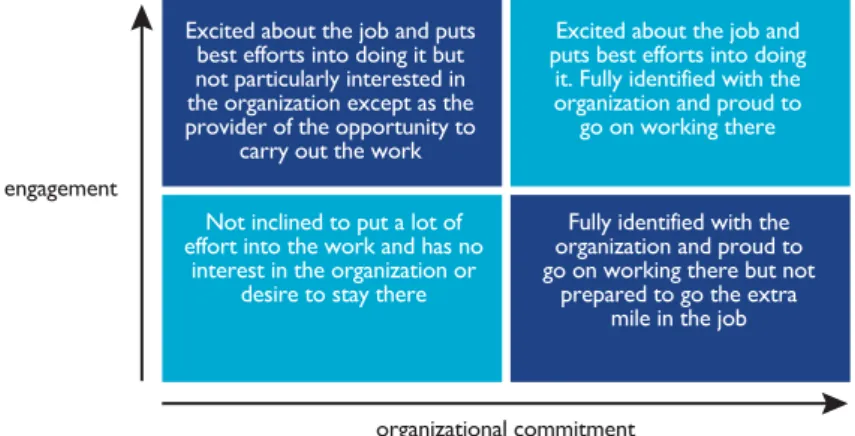
It is useful to distinguish between the two because different policies may be required to enhance job engagement than those need to increase organizational commitment. Combinations of engagement and organizational commitment are illustrated in Figure 20.1.
Excited about the job and puts best efforts into doing it but not particularly interested in the organization except as the provider of the opportunity to
carry out the work
Excited about the job and puts best efforts into doing
it. Fully identified with the organization and proud to
go on working there
Not inclined to put a lot of effort into the work and has no
interest in the organization or desire to stay there
Fully identified with the organization and proud to go on working there but not
prepared to go the extra mile in the job engagement
organizational commitment
Figure 20.1 Combinations of the impact of engagement and organizational commitment
Employee engagement
Employee engagement takes place when people at work are interested in and positive, even excited about their jobs and are prepared to go the extra mile to get them done to the best of their ability. An engaged employee as defi ned by Bevan et al (1997) is someone ‘who is aware of business context, and works closely with colleagues to improve performance within the job for the benefi t of the organization’.
Interest in the notion of engagement was originally generated by The Hay Group which referred to it as ‘engaged performance’. This was defi ned by Murlis and Watson (2001) as follows.
The Hay Group defi nition of engaged performance
A result that is achieved by stimulating employees’ enthusiasm for their work and directing it towards organizational success. This result can only be achieved when employers offer an implied contract to their employees that elicits spe- cifi c positive behaviours aligned with the organization’s goals.
SOURCE REVIEW
This defi nition quite clearly focuses on performance in the job and not commitment to the organization.
Another fi rm of management consultants, Towers Perrin (2007), adopts a similar approach when it defi ned employee engagement as ‘the extent to which employees put discretionary effort into their work, beyond the minimum to get the job done, in the form of extra time, brainpower or energy’.
The signifi cance of employee engagement
The signifi cance of employee engagement is that it is at the heart of the employment relationship. It is about what people do and how they behave in their roles and what makes them act in ways that further the achievement of the objectives of both the organization and themselves. Research reported by Watkin (2002) found that there were considerable differences in value-added discretionary per- formance between ‘superior’ and ‘standard’ performers. The difference in low complexity jobs was 19 per cent, in moderate-complexity jobs 32 per cent and in high-complexity jobs 48 per cent.
Engagement and discretionary behaviour
There is a close link between high levels of engagement and positive discretionary behaviour.
As described by Purcell et al (2003) discretionary behaviour refers to the choices that people at work often have in the way they do the job and the amount of effort, care, innovation and pro- ductive behaviour they display. It can be positive when people ‘go the extra mile’ to achieve high levels of performance. It can be negative when they exercise their discretion to slack at their work. Discretionary behaviour is hard for the employer to defi ne and monitor and to control the amount required. But positive discretionary behaviour is more likely to happen when people are engaged with their work.
Propositions on discretionary behaviour, Purcell et al (2003)
Performance-related practices only work if they positively induce dis-
•
cretionary behaviour, once basic staffi ng requirements have been met.
Discretionary behaviour is more likely to occur when enough individu-
•
als have commitment to their organization and/or when they feel moti- vated to do so and/or when they gain high levels of job satisfaction.
Commitment, motivation and job satisfaction, either together or sepa-
•
rately, will be higher when people positively experience the application of HR policies concerned with creating an able workforce, motivating valued behaviours and providing opportunities to participate.
This positive experience will be higher if the wide range of HR policies
•
necessary to develop ability, motivation, and opportunity are both in place and are mutually reinforcing.
The way HR and reward policies and practices are implemented by front
•
line managers and the way top-level espoused values and organizational cultures are enacted by them will enhance or weaken the effect of HR policies in triggering discretionary behaviour by infl uencing attitudes.
The experience of success seen in performance outcomes helps rein-
•
force positive attitudes.
SOURCE REVIEW
The factors that infl uence engagement
Research cited by IDS (2007a) has identifi ed two key elements that have to be present if genuine engagement is to exist. The fi rst is the rational aspect, which relates to employees’ understand- ing of their role, where it fi ts in the wider organization, and how it aligns with business objec- tives. The second is the emotional aspect, which has to do with how people feel about the organization, whether their work gives them a sense of personal accomplishment and how they relate to their manager.
These two overall aspects can be analysed into a number of factors that infl uence levels of engagement, as set out below.
The work itself
The work itself can create job satisfaction leading to intrinsic motivation and increased engage- ment. The factors involved are interesting and challenging work, responsibility (feeling that the work is important and having control over one’s own resources), autonomy (freedom to
act), scope to use and develop skills and abilities, the availability of the resources required to carry out the work, and opportunities for advancement.
The work environment
An enabling, supportive and inspirational work environment creates experiences that impact on engagement by infl uencing how people regard their roles and carry them out. An enabling environ- ment will create the conditions that encourage high performance and effective discretionary behav- iour. These include work processes, equipment and facilities, and the physical conditions in which people work. A supportive environment will be one in which proper attention is paid to achieving a satisfactory work–life balance, emotional demands are not excessive, attention is paid to provid- ing healthy and safe working conditions, job security is a major consideration and personal growth needs are taken into consideration. An inspirational environment will be where what John Purcell and his colleagues refer to as ‘the big idea’ is present – the organization has a clear vision and a set of integrated values that are ‘embedded, collective, measured and managed’.
The environment is affected by the organization’s climate which, as defi ned by French et al (1985), is ‘the relatively persistent set of perceptions held by organization members concerning the characteristics and quality of organizational culture’. It is also directly infl uenced by its work and HR practices. As Purcell (2001) stated, the way HR practices are experienced by employees is affected by organizational values and operational strategies, such as staffi ng poli- cies or hours of work, as well as the way they are implemented. He also emphasized that work climate – how people get on in the organization – and the experience of actually doing the job – pace, demand and stress – all infl uence the way employees experience the work environment.
This has an important effect on how they react to HR and reward practices and how these infl uence organizational outcomes. Employees react in a number of different ways to practices in their organization and this affects the extent to which they want to learn more, are commit- ted and satisfi ed with their jobs. This, in turn, infl uences engagement – how well they do their jobs and whether they are prepared to contribute discretionary effort.
Leadership
The degree to which jobs encourage engagement and positive discretionary behaviour very much depends upon the ways in which job holders are led and managed. Managers and team leaders often have considerable discretion over how jobs are designed, how they allocate work and how much they delegate and provide autonomy. They can spell out the signifi cance of the work people do. They can give them the opportunity to achieve and develop, and provide feed- back that recognizes their contribution.
Opportunities for personal growth
Most people want to get on. As Lawler put it in 2003: ‘People enjoy learning – there’s no doubt about it – and it touches on an important “treat people right” principle for both organizations
and people: the value of continuous, ongoing training and development.’ Learning is a satisfy- ing and rewarding experience and makes a signifi cant contribution to intrinsic motivation.
Alderfer (1972) emphasized the importance of the chance to grow as a means of rewarding people. He wrote: ‘Satisfaction of growth needs depends on a person fi nding the opportunity to be what he or she is most fully and become what he or she can.’ The opportunity to grow and develop is a motivating factor that directly impacts on engagement when it is an intrinsic element of the work.
Opportunities to contribute
Engagement is enhanced if employees have a voice that is listened to. This enables them to feed their ideas and views upwards and feel that they are making a contribution.
Strategies for enhancing engagement
Engagement strategies can be developed under the headings of the factors affecting engage- ment set out above.
The work itself
Intrinsic motivation through the work itself and therefore engagement depends basically on the way in which work or jobs are designed which, as Lawler (1969) stressed, must provide for feedback, use of abilities and autonomy.
Approaches based on these principles, as described in Chapter 27, should be used when setting up new work systems or jobs and the strategy should include provision for guidance and advice along these lines to those responsible for such developments. But the greatest impact on the levels of engagement arising from the design of work systems or jobs is made by line managers on a day-to-day basis. The strategy should therefore include arrangements for educating them as part of a leadership development programme in the importance of good work and job design, the part they can play and the benefi ts to them arising from thereby enhancing engage- ment. Performance management, with its emphasis on agreeing role expectations, is a useful means of doing this.
The work environment
A strategy for increasing engagement through the work environment will be generally con- cerned with developing a culture that encourages positive attitudes to work, promoting inter- est and excitement in the jobs people do and reducing stress. Lands’ End believes that staff who are enjoying themselves, who are being supported and developed and who feel fulfi lled and respected at work, will provide the best service to customers. The thinking behind why the company wants to inspire staff is straightforward – employees’ willingness to do that little bit
extra arises from their sense of pride in what the organization stands for, ie quality, service and value. It makes the difference between a good experience for customers and a poor one.
The strategy also needs to consider particular aspects of the work environment, especially com- munication, involvement, work–life balance and working conditions. It can include the formula- tion and application of ‘talent relationship management’ policies, which are concerned with building effective relationships with people in their roles, treating individual employees fairly, recognizing their value, giving them a voice and providing opportunities for growth.
Leadership
The leadership strategy should concentrate on what line managers have to do as leaders in order to play their vital and immediate part in increasing levels of engagement. This will include the implementation of learning programmes that help them to understand how they are expected to act and the skills they need to use. The programmes can include formal train- ing (especially for potential managers or those in their fi rst leadership role) but more impact will be made by ‘blending’ various learning methods such as e-learning, coaching and mentoring.
It should also be recognized that a performance management process can provide line manag- ers with a useful framework in which they can deploy their skills in improving performance though increased engagement. This applies particularly to the performance management activities of role defi nition, performance improvement planning, joint involvement in moni- toring performance, and feedback. The strategy should therefore include the steps required to make performance management more effective by increasing the commitment of managers to it and developing the skills they require.
Opportunities for personal growth
A strategy for providing development and growth opportunities should be based on the crea- tion of a learning culture. This is one that promotes learning because it is recognized by top management, line managers and employees generally as an essential organizational process to which they are committed and in which they engage continuously. Reynolds (2004) describes a learning culture as a ‘growth medium’ that will ‘encourage employees to commit to a range of positive discretionary behaviours, including learning’ and which has the following charac- teristics: empowerment not supervision, self-managed learning not instruction, long-term capacity building not short-term fi xes. It will encourage discretionary learning, which Sloman (2003) believes takes place when individuals actively seek to acquire the knowledge and skills that promote the organization’s objectives.
Specifi cally, the strategy should defi ne the steps required to ensure that people have the oppor- tunity and are given the encouragement to learn and grow in their roles. This includes the use of policies that focus on role fl exibility – giving people the chance to develop their roles by
making better and extended use of their talents. This means going beyond talent management for the favoured few and developing the abilities of the core people on whom the organization depends. The philosophy should be that everyone has the ability to succeed and the aim should be to ‘achieve extraordinary results with ordinary people’. It includes using performance man- agement primarily as a developmental process with an emphasis on personal development planning.
The strategy should also cover career development opportunities and how individuals can be given the guidance, support and encouragement they need if they are to fulfi l their potential and achieve a successful career with the organization in tune with their talents and aspirations.
The actions required to provide men and women of promise with a sequence of learning activ- ities and experiences that will equip them for whatever level of responsibility they have the ability to reach should be included in the strategy.
Opportunities to contribute
Providing people with the opportunity to contribute is not just a matter of setting up formal consultative processes, although they can be important. It is also about creating a work envi- ronment that gives people a voice by encouraging them to have their say, and emphasizes as a core value of the organization that management at all levels must be prepared to listen and respond to any contributions their people make.
Measuring engagement
When developing engagement strategies the fi rst step is to establish what is happening now and, in the light of that, determine what should happen in each of the areas described above.
This means measuring levels of engagement regularly to identify successes and failures and analyse any gaps between what is wanted and what is actually going on. This can be done through published surveys such as those operated by Gallop, which enable benchmarking to take place with the levels of engagement achieved in other organizations. Alternatively, organi- zations can develop their own surveys to suit their circumstances. An example of such a survey is provided in Appendix A.
Engagement and job satisfaction
The concept of job satisfaction is closely linked to that of engagement. Job satisfaction refers to the attitudes and feelings people have about their work. Positive and favourable attitudes towards the job lead to engagement and therefore job satisfaction. Negative and unfavourable attitudes towards the job indicate job dissatisfaction.
Morale is often defi ned as being equivalent to job satisfaction. Thus Guion (1958) defi nes morale as ‘the extent to which an individual’s needs are satisfi ed and the extent to which the
individual perceives that satisfaction as stemming from his [sic] total work situation’. Other defi nitions stress the group aspects of morale. Gilmer (1961) suggests that morale ‘is a feeling of being accepted by and belonging to a group of employees through adherence to common goals’. He distinguishes between morale as a group variable, related to the degree to which group members feel attracted to their group and desire to remain a member of it, and job atti- tude as an individual variable related to the feelings employees have about their job.
Factors affecting job satisfaction
The level of job satisfaction is affected by intrinsic and extrinsic motivating factors, the quality of supervision, social relationships with the work group and the degree to which individuals succeed or fail in their work. Purcell et al (2003) believe that discretionary behaviour that helps the fi rm to be successful is most likely to happen when employees are well motivated and feel committed to the organization and when the job gives them high levels of satisfaction. Their research found that the key factors affecting job satisfaction were career opportunities, job infl uence, teamwork and job challenge.
Job satisfaction and performance
It is a commonly held and a seemingly not unreasonable belief that an increase in job satisfac- tion will result in improved performance. But research has not established any strongly posi- tive connection between satisfaction and performance. A review of the extensive literature on this subject by Brayfi eld and Crockett (1955) concluded that there was little evidence of any simple or appreciable relationship between employee satisfaction and performance. An updated review of their analysis by Vroom (1964) covered 20 studies, in each of which one or more measures of job satisfaction or employee attitudes were correlated with one or more cri- teria of performance. The median correlation of all these studies was 0.14, which is not high enough to suggest a marked relationship between satisfaction and performance.
It can be argued that it is not job satisfaction that produces high performance but high per- formance that produces job satisfaction, and that a satisfi ed worker is not necessarily a produc- tive worker and a high producer is not necessarily a satisfi ed worker. People are motivated to achieve certain goals and will be satisfi ed if they achieve these goals through improved per- formance. They may be even more satisfi ed if they are then rewarded by extrinsic recognition or an intrinsic sense of achievement. This suggests that performance improvements can be achieved by giving people the opportunity to perform, ensuring that they have the knowledge and skill required to perform, and rewarding them by fi nancial or non-fi nancial means when they do perform. It can also be argued that some people may be complacently satisfi ed with their job and will not be inspired to work harder or better. They may fi nd other ways to satisfy their needs.
Organizational commitment
The concept of commitment plays an important part in HRM philosophy. As Guest (1987) has suggested, HRM policies are designed to ‘maximize organizational integration, employee com- mitment, fl exibility and quality of work’.
The meaning of organizational commitment
Commitment refers to attachment and loyalty. It is associated with the feelings of individuals about their organization. As defi ned by Porter et al (1974), commitment is the relative strength of the individual’s identifi cation with, and involvement in, a particular organization. The three characteristics of commitment identifi ed by Mowday et al (1982) are:
1. A strong desire to remain a member of the organization.
2. A strong belief in, and acceptance of, the values and goals of the organization.
3. A readiness to exert considerable effort on behalf of the organization.
An alternative, although closely related, defi nition of commitment emphasizes the importance of behaviour in creating commitment. As Salancik (1977) put it: ‘Commitment is a state of being in which an individual becomes bound by his [sic] actions to beliefs that sustain his activities and his own involvement.’ Three features of behaviour are important in binding indi- viduals to their acts: the visibility of the acts, the extent to which the outcomes are irrevocable, and the degree to which the person undertakes the action voluntarily. Commitment, according to Salancik, can be increased and harnessed ‘to obtain support for organizational ends and interests’ through such ploys as participation in decisions about actions.
The importance of commitment
There have been two schools of thought about what makes commitment important. One, the
‘from control to commitment’ school, was led by Walton (1985a, 1985b), the other, ‘Japanese/
excellence’ school, is represented by writers such as Ouchi (1981), Pascale and Athos (1981) and Peters and Waterman (1982).
From control to commitment
The importance of commitment was highlighted by Walton (1985a, 1985b). His theme was that improved performance would result if the organization moved away from the traditional control-oriented approach to workforce management, which relies upon establishing order, exercising control and ‘achieving effi ciency in the application of the workforce’. He proposed that this approach should be replaced by a commitment strategy. Workers respond best – and
most creatively – not when they are tightly controlled by management, placed in narrowly defi ned jobs, and treated like an unwelcome necessity, but, instead, when they are given broader responsibilities, encouraged to contribute and helped to achieve satisfaction in their work.
The commitment-based approach, Walton (1985a, 1985b)
Jobs are designed to be broader than before, to combine planning and imple- mentation, and to include efforts to upgrade operations, not just to maintain them. Individual responsibilities are expected to change as conditions change, and teams, not individuals, often are the organizational units accountable for performance. With management hierarchies relatively fl at and differences in status minimized, control and lateral coordination depend on shared goals.
And expertise rather than formal position determines infl uence.
SOURCE REVIEW
Put like this, a commitment strategy may sound idealistic but does not appear to be a crude attempt to manipulate people to accept management’s values and goals as some have sug- gested. In fact, Walton does not describe it as being instrumental in this manner. His prescrip- tion is for a broad HRM approach to the ways in which people are treated, jobs are designed and organizations are managed. He believes that the aim should be to develop ‘mutuality’, a state that exists when management and employees are interdependent and both benefi t from this interdependency.
The Japanese/excellence school
Attempts made to explain the secret of Japanese business success in the 1970s by such writers as Ouchi (1981) and Pascale and Athos (1981) led to the theory that the best way to motivate people is to get their full commitment to the values of the organization by leadership and involvement. This might be called the ‘hearts and minds’ approach to motivation and, among other things, it popularized such devices as quality circles.
The baton was taken up by their imitators later in the 1980s. This approach to excellence was summed up by Peters and Waterman (1982) when they wrote, again, somewhat idealistically, as follows.
Approach to excellence, Peters and Waterman (1982)
Trust people and treat them like adults, enthuse them by lively and imaginative leadership, develop and demonstrate an obsession for quality, make them feel they own the business, and your workforce will respond with total commitment.
SOURCE REVIEW
Problems with the concept of commitment
A number of commentators have raised questions about the concept of commitment. These relate to three main problem areas: 1) its unitary frame of reference, 2) commitment as an inhibitor of fl exibility, and 3) whether high commitment does in practice result in improved organizational performance.
Unitary frame of reference
A comment frequently made about the concept of commitment is that it is too simplistic in adopting a unitary frame of reference; in other words, it assumes unrealistically that an organi- zation consists of people with shared interests. It has been suggested by people like Cyert and March (1963), Mangham (1979) and Mintzberg (1983a) that an organization is really a coali- tion of interest groups where political processes are an inevitable part of everyday life. The pluralistic perspective recognizes the legitimacy of different interests and values and therefore asks the question, ‘Commitment to what?’ Thus, as Coopey and Hartley (1991) put it, ‘com- mitment is not an all-or-nothing affair (though many managers might like it to be) but a ques- tion of multiple or competing commitments for the individual’. Legge (1989) also raises this question in her discussion of strong culture as a key requirement of HRM through ‘a shared set of managerially sanctioned values’.
However, values concerned with performance, quality, service, equal opportunity and innova- tion are not necessarily wrong because they are managerial values. But it is not unreasonable to believe that pursuing a value such as innovation could work against the interests of employ- ees by, for example, resulting in redundancies. And it would be quite reasonable for any employee encouraged to behave in accordance with a value supported by management to ask,
‘What’s in it for me?’ It can also be argued that the imposition of management’s values on
employees without their having any part to play in discussing and agreeing them is a form of coercion.
Commitment and fl exibility
It was pointed out by Coopey and Hartley (1991) that: ‘The problem for a unitarist notion of organizational commitment is that it fosters a conformist approach which not only fails to refl ect organizational reality, but can be narrowing and limiting for the organization.’ They argue that if employees are expected and encouraged to commit themselves tightly to a single set of values and goals they will not be able to cope with the ambiguities and uncertainties that are endemic in organizational life in times of change. Conformity to ‘imposed’ values will inhibit creative problem solving, and high commitment to present courses of action will increase both resistance to change and the stress that invariably occurs when change takes place.
If commitment is related to tightly defi ned plans then this will become a real problem. To avoid it, the emphasis should be on overall strategic directions. These would be communicated to employees with the proviso that changing circumstances will require their amendment. In the meantime, however, everyone can at least be informed in general terms where the organi- zation is heading and, more specifi cally, the part they are expected to play in helping the organ- ization to get there. And if they can be involved in the decision-making processes on matters that affect them (including management’s values for performance, quality and customer service), so much the better.
Values need not necessarily be restrictive. They can be defi ned in ways that allow for freedom of choice within broad guidelines. In fact, the values themselves can refer to such processes as fl exibility, innovation and responsiveness to change. Thus, far from inhibiting creative problem solving, they can encourage it.
The positive value of commitment, Walton (1985a)
Underlying all these (human resource) policies is a management philosophy, often embedded in a published statement, that acknowledges the legitimate claims of a company’s multiple stakeholders – owners, employees, customers and the public. At the centre of this philosophy is a belief that eliciting employee commitment will lead to enhanced performance. The evidence shows this belief to be well founded.
SOURCE REVIEW
However, a review by Guest (1991) of the mainly North American literature, reinforced by the limited UK research available, led him to the conclusion that: ‘High organizational commitment is associated with lower labour turnover and absence, but there is no clear link to performance.’
It is probably wise not to expect too much from commitment as a means of making a direct and immediate impact on performance. It is not the same as motivation or engagement.
Commitment is a wider concept and tends to be more stable over a period of time and less responsive to transitory aspects of an employee’s job. It is possible to be dissatisfi ed with a par- ticular feature of a job while retaining a reasonably high level of commitment to the organiza- tion as a whole.
Three perspectives on relating commitment to motivation, Buchanan and Huczynski (1985)
1. The goals towards which people aim. From this perspective, goals such as the good of the company, or effective performance at work, may provide a degree of motivation for some employees, who could be regarded as com- mitted in so far as they feel they own the goals.
2. The process by which goals and objectives at work are selected, which is quite distinct from the way in which commitment arises within individuals.
3. The social process of motivating others to perform effectively. From this viewpoint, strategies aimed at increasing motivation also affect commit- ment. It may be true to say that where commitment is present, motivation is likely to be strong, particularly if a long-term view is taken of effective performance.
SOURCE REVIEW
It is reasonable to believe that strong commitment to work is likely to result in conscientious and self-directed application to do the job, regular attendance, nominal supervision and a high level of effort. Commitment to the organization will certainly be related to the intention to stay – in other words, loyalty to the company.
Factors affecting commitment
Kochan and Dyer (1993) have indicated that the factors affecting the level of commitment in what they call ‘mutual commitment fi rms’ are as follows:
Strategic level: supportive business strategies, top management value commitment and
•
effective voice for HR in strategy making and governance.
Functional (human resource policy) level: staffi ng based on employment stabilization,
•
investment in training and development and contingent compensation that reinforces cooperation, participation and contribution.
Workplace level: selection based on high standards, broad task design and teamwork,
•
employee involvement in problem solving and a climate of cooperation and trust.
Key policy and practice factors infl uencing levels of commitment, Purcell et al (2003)
Received training last year.
•
Satisfi ed with career opportunities.
•
Satisfi ed with the performance appraisal system.
•
Think managers are good in people management (leadership).
•
Find their work challenging.
•
Think their fi rm helps them achieve a work–life balance.
•
Satisfi ed with communication or company performance.
•
SOURCE REVIEW
Developing a commitment strategy
A commitment strategy will be based on the high-commitment model described in Chapter 3.
It will aim to develop commitment using, as appropriate, approaches such as those described below. When formulating the strategy, account should be taken of the reservations expressed earlier in this chapter and too much should not be expected from it. The aim will be to increase identifi cation with the organization, develop feelings of loyalty amongst its employees, provide a context within which motivation and therefore performance will increase, reduce employee turnover, and increase job satisfaction. But too much should not be expected from campaigns to increase commitment the level of which is infl uenced by many factors that cannot always be manipulated as the organization would wish. It is naïve to believe that ‘hearts and minds’ cam- paigns to win commitment will transform organizational behaviour overnight.
Steps to create commitment will be concerned with both strategic goals and values. They may include initiatives to increase involvement and ‘ownership’, communication, leadership devel- opment, developing a sense of excitement in the job, and developing various HR policy and practice initiatives.
Developing ownership
Commitment – a sense of belonging – is enhanced if there is a feeling of ‘ownership’ among employees: not just in the literal sense of owning shares (although this can help) but in the sense of believing they are genuinely accepted by management as key stakeholders in the organization. This concept of ‘ownership’ extends to participating in decisions on new devel- opments and changes in working practices that affect the individuals concerned. They should take part in making those decisions and feel that their ideas have been listened to and that they have contributed to the outcome.
Communication programmes
It may seem to be strikingly obvious that commitment will only be gained if people under- stand what they are expected to commit to. But management too often fail to pay suffi cient attention to delivering the message in terms that recognize that the frame of reference for those who receive it is likely to be quite different from their own. Management’s expectations will not necessarily coincide with those of employees. Pluralism prevails. And in delivering the message, the use of different and complementary channels of communication such as newslet- ters, briefi ng groups, videos, notice boards, etc is often neglected.
Leadership development
Commitment is enhanced if managers can gain the confi dence and respect of their teams, and development programmes to improve the quality of leadership should form an important part of any strategy for increasing commitment. Management training can also be focused on increasing the competence of managers in specifi c areas of their responsibility for gaining commitment, eg performance management.
Developing HR practices that enhance commitment
The policies and practices that may contribute to the increase of commitment are learning and development, career planning, performance management, reward management, work–life balance policies and job design. Engagement strategies, as described in Chapter 19, will create feelings of excitement in the job and therefore commitment.
The contribution of HR to developing commitment
The HR function can play a major part in developing a high-commitment organization. The 10 steps it can take are:
1. Advise on methods of communicating the values and aims of management and the achievements of the organization so that employees are more likely to identify with it as one they are proud to work for.
2. Emphasize to management that commitment is a two-way process; employees cannot be expected to be committed to the organization unless management demonstrates that it is committed to them and recognizes their contribution as stakeholders.
3. Impress on management the need to develop a climate of trust by being honest with people, treating them fairly, justly and consistently, keeping its word, and showing willing- ness to listen to the comments and suggestions made by employees during processes of consultation and participation.
4. Develop a positive psychological contract (see Chapter 16) by treating people as stake- holders, relying on consensus and cooperation rather than control and coercion, and focusing on the provision of opportunities for learning, development and career progression.
5. Advise and assist on the establishment of partnership agreements with trade unions that emphasize unity of purpose, common approaches to working together and the impor- tance of giving employees a voice in matters that concern them.
6. Recommend and take part in the achievement of single status for all employees (often included in a partnership agreement) so that there is no longer an ‘us and them’ culture.
7. Encourage management to declare a policy of employment security and ensure that steps are taken to avoid involuntary redundancies.
8. Develop performance management processes that provide for the alignment of organiza- tional and individual objectives.
9. Advise on means of increasing employee identifi cation with the company through rewards related to organizational performance (profi t sharing or gainsharing) or employee share ownership schemes.
10. Enhance employee engagement, ie identifi cation of employees with the job they are doing, through job design processes that aim to create higher levels of job satisfaction (job enrichment).
Engagement and commitment – key learning points
Comparison of the concepts of engagement and commitment Engagement is job-oriented and commit- ment is organization-oriented. This is a clear distinction but the terms are often confused.
The signifi cance of employee engagement
There is a close link between high levels of engagement and positive discretionary behaviour.
Engagement and commitment – key learning points (continued)
The factors that infl uence engagement The fi rst factor is the rational aspect, which relates to employees’ understanding of their role, where it fi ts in the wider organization, and how it aligns with business objectives.
The second is the emotional aspect, which has to do with how people feel about the organization, whether their work gives them a sense of personal accomplishment and how they relate to their manager.
Engagement strategy
Enhance motivation through the work itself, the work environment, leadership and opportunities for growth.
Measuring engagement
This can be done through published surveys that enable benchmarking to take place with the levels of engagement achieved in other organizations. Alternatively organi- zations can develop their own surveys to suit their circumstances.
Engagement and job satisfaction The concept of job satisfaction is closely linked to that of engagement. Job satisfac- tion refers to the attitudes and feelings people have about their work. Positive and favour- able attitudes towards the job lead to engage- ment and therefore job satisfaction. The level of job satisfaction is affected by intrinsic and extrinsic motivating factors, the quality of supervision, social relationships with the work group and the degree to which individ- uals succeed or fail in their work.
The meaning of organizational com mitment
Commitment refers to attachment and loyalty. It is associated with the feelings of individuals about their organization. As defi ned by Porter et al (1974), commitment is the relative strength of the individual’s identifi cation with, and involvement in, a particular organization.
The importance of commitment There have been two schools of thought about what makes commitment important.
One, the ‘from control to commitment’
school, was led by Walton (1985a, 1985b);
the other, ‘Japanese/excellence’ school, is represented by writers such as Ouchi (1981), Pascale and Athos (1981) and Peters and Waterman (1982).
Problems with the concept of commitment
There are three main problem areas: 1) its unitary frame of reference, 2) it might inhibit fl exibility, and 3) it does not neces- sarily result in improved organizational performance.
Factors affecting commitment
Kochan and Dyer (1993) have indicated that the factors affecting the level of com- mitment are:
Strategic level: supportive business
•
strategies, top management value com- mitment and an effective voice for HR in strategy making and governance.
Questions
1. What is the difference between engagement and commitment?
2. Your boss e-mails you as follows: ‘I keep on hearing about employee engagement but what does it really mean? Is it just another piece of HR jargon as an alternative to moti- vation? Is there anything we should or can do about it?’ Reply.
3. You have been asked to give a talk to your colleagues in the HR department on ‘What can we do to increase commitment?’ Draft your presentation.
References
Alderfer, C (1972) Existence, Relatedness and Growth, The Free Press, New York
Bevan S, Barber, L and Robinson, D (1997) Keeping the Best: A practical guide to retaining key employees, Institute for Employment Studies, Brighton
Engagement and commitment – key learning points (continued)
Functional (human resource policy)
•
level: staffi ng based on employment stabilization, investment in training and development and contingent compensation that reinforces coop- eration, participation and con- tribution.
Workplace level: selection based on
•
high standards, broad task design and teamwork, employee involve- ment in problem solving and a climate of cooperation and trust.
Developing a commitment strategy Steps to create commitment may include initiatives to increase involvement and
‘ownership’, communication, leadership development, developing a sense of excite- ment in the job, and developing various HR policy and practice initiatives.
The contribution of HR to developing commitment
HR can provide advice and guidance on communicating corporate values, building trust, making commitment a two-way process, developing a positive psychological contract, the development of partnership agreements, single status and increased employment security, and the use of per- formance management to align individual and organizational goals.
Brayfi eld, A H and Crockett, W H (1955) Employee attitudes and employee performance, Psychological Bulletin, 52, pp 346–424
Buchanan, D and Huczynski, A (1985) Organizational Behaviour, Prentice Hall, Englewood Cliffs, NJ Conference Board (2006) Employee Engagement: A review of current research and its implications,
Conference Board, New York
Coopey, J and Hartley, J (1991) Reconsidering the case for organizational commitment, Human Resource Management Journal, 3, Spring, pp 18–31
Cyert, R M and March, J G (1963) A Behavioural Theory of the Firm, Prentice Hall, Englewood Cliffs, NJ
French, W L, Kast, F E and Rosenzweig, J E (1985) Understanding Human Behaviour in Organizations, Harper & Row, New York
Gilmer, B (1961) Industrial Psychology, McGraw-Hill, New York
Guest, D E (1984) What’s new in motivation, Personnel Management, May, pp 30–33
Guest, D E (1987) Human resource management and industrial relations, Journal of Management Studies, 14 (5), pp 503–21
Guest, D E (1991) Personnel management: the end of orthodoxy, British Journal of Industrial Relations, 29 (2), pp 149–76
Guion, R M (1958) Industrial morale (a symposium) – the problems of terminology, Personnel Psychology, 11, pp 59–64
IDS (2007a) Building an engaged workforce, HR Studies Update, IDS London
Kochan, T A and Dyer, L (1993) Managing transformational change: the role of human resource professionals, International Journal of Human Resource Management, 4 (3), pp 569–90
Lawler, E E (1969) Job design and employee motivation, Personnel Psychology, 22, pp 426–35
Lawler E E (2003) Treat People Right! How organisations and individuals can propel each other into a virtuous spiral of success, Jossey-Bass, San Francisco, CA
Legge, K (1989) Human resource management: a critical analysis, in (ed) J Storey, New Perspectives in Human Resource Management, Routledge, London
Mangham, L L (1979) The Politics of Organizational Change, Associated Business Press, London Mintzberg, H (1983a) Power in and Around Organizations, Prentice Hall, Englewood Cliffs, NJ
Mowday, R, Porter, L and Steers, R (1982) Employee–organization Linkages: The psychology of commitment, absenteeism and turnover, Academic Press, London
Murlis, H and Watson, S (2001) Creating employee engagement – transforming the employment deal, Benefi ts and Compensation International, 30 (8), pp 6–17
Ouchi, W G (1981) Theory Z, Addison-Wesley, Reading, MA
Pascale, R and Athos, A (1981) The Art of Japanese Management, Simon & Schuster, New York Peters, T and Austin, N (1985) A Passion for Excellence, Collins, Glasgow
Peters, T and Waterman, R (1982) In Search of Excellence, Harper & Row, New York
Porter, L W, Steers, R, Mowday, R and Boulian, P (1974) Organizational commitment: job satisfaction and turnover amongst psychiatric technicians, Journal of Applied Psychology, 59, pp 603–9
Purcell, J (2001) The meaning of strategy in human resource management, in (ed) J Storey, Human Resource Management: A critical text, Thompson Learning, London
Purcell, J, Kinnie, K, Hutchinson, S, Rayton, B and Swart, J (2003) People and Performance: How people management impacts on organisational performance, CIPD, London
Reynolds, J (2004) Helping People Learn, CIPD, London
Robinson, D, Perryman, S and Hayday, S (2004) The Drivers of Employee Engagement, Institute of Employment Studies, Brighton
Salancik, G R (1977) Commitment and the control of organizational behaviour and belief, in (eds) B M Staw and G R Salancik, New Directions in Organizational Behaviour, St Clair Press, Chicago, IL Sloman, M (2003) E-learning: stepping up the learning curve, Impact, CIPD, January, pp 16–17 Towers Perrin (2007) Global Workforce Study at http://www.towersperrin.com
Vroom, V (1964) Work and Motivation, Wiley, New York
Walton, R E (1985a) From control to commitment in the workplace, Harvard Business Review, March–
April, pp 77–84
Walton, R E (1985b) Towards a strategy of eliciting employee commitment based on principles of mutuality, in (eds) R E Walton and P R Lawrence, HRM Trends and Challenges, Harvard Business School Press, Boston, MA
Watkin, C (2002) Engage employees to boost performance, Selection & Development Review, 18 (2), pp 3–6