MAROS BARU)
A THESIS
Submitted to the Faculty of Teacher Training and Education Muhammadiyah University of Makassar in Partial Fulfillment of the Requirement for Degree of
Education in English Department
NURLIAH 10535624615
ENGLISH EDUCATION DEPARTMENT FACULTY OF TEACHERS TRAINING AND EDUCATION MAKASSAR
MUHAMMADIYAH UNIVERSITY
2020
ii
iii
iv
SURAT PERNYATAAN Saya yang bertandatangan di bawah ini:
Nama : NURLIAH
NIM : 10535 6246 15
Jurusan : Pendidikan Bahasa Inggris
Judul Skripsi :
The Implementation of Clustering Technique to Improve Students’ Writing Skill (A Pre-Experimental Research Design at the 8
thGrade Students’ in SMPN 11 MAROS BARU)
Dengan ini menyatakan bahwa skripsi yang saya buat di depan Tim penguji adalah hasil karya saya sendiri bukan hasil ciptaan orang lain dan dibuatkan oleh siapapun.
Demikianlah pernyataaan ini saya buat dengan sebenar-benarnya dan saya bersedia menerima sanksi apabila pernyataan ini tidak benar.
Makassar, Januari 2020 Yang Membuat Pernyataan
NURLIAH
v
SURAT PERJANJIAN
Saya yang bertandatangan di bawah ini:
Nama : NURLIAH
NIM : 10535 6246 15
Jurusan : Pendidikan Bahasa Inggris Fakultas : Keguruan dan Ilmu Pendidikan Dengan ini menyatakan perjanjian sebagai berikut:
1. Mulai dari penyusunan proposal sampai dengan selesainya skripsi saya, saya akan menyusun sendiri skripsi saya, tidak dibuatkan oleh siapapun.
2. Dalam menyusun skripsi, saya akan selalu melakukan konsultasi dengan pembimbing.
3. Saya tidak akan melakukan penjiplakan (plagiat) dalam menyusun skripsi ini.
4. Apabila saya melanggar perjanjian saya seperti yang tertera pada butir 1, 2 dan 3 maka saya bersedia menerima sanksi sesuai dengan aturan yang berlaku.
Demikian perjanjian ini saya buat dengan penuh kesadaran.
Makassar, Januari 2020 Yang Membuat Perjanjian
NURLIAH
vi
MOTTOS AND DEDICATIONS
o Everything Who Comes From Our Heart Exactly Will Be In Every Heart.
o Learn From The Mistakes In The Past, Try By Using A Different Way And Always Hope For A Successful In The Future.
o Q.S. Al- Insyirah 5-6
o Prayer Can Change Our Destiny And Goodness Can Extent Our Age.
This little words I dedicated to:
My beloved parents, My hero, My beloved brothers, My beloved sister and all of My best friends, British Class, UKM SB Talas, Rumah Ceria.
“Thanks for always support me everyday”
vii ABSTRACT
Nurliah. 2020. The Implementation of Clustering Technique to Improve Students’
Writing Skill (A Pre-Experimental Research Design at the 8th Grade Students’ in SMPN 11 Maros Baru). A study of English Education Department, Faculty of Teacher Training and Education, Universitas Muhammadiyah Makassar. Supervised by Syamsiarna Nappu and Farisha Andi Baso.
The study aimed at finding out whether or not clustering technique improves students‟ writing in terms of content and vocabulary. The method of this study was A Pre-Experimental design. The population of this study was the first semester students‟
in academic years 2019/2020 at the 8th Grade Students‟ in SMPN 11 Maros Baru, which selected by using cluster random sampling technique, while the sample of this study was 30 students. The instrument of this study was a test that used pre-test and post-test.
The mean score of the pre-test in content 74,1 was greater than post-test 69,1. While the mean score of the pre-test in vocabulary 72,7 was lower than post-test 76,3. From t-test, the study found that the value of t-test in content 4,47 was greater than t-table 2,045 and the value of t-test in vocabulary 9,66 was greater than t-table 2,045. There was a different between the students‟ writing before and after applying clustering technique in the class. It shows that the null Hypothesis ) was rejected and alternative hypothesis ) was accepted. The result of the data show that writing in terms of content and vocabulary through clustering technique was fairly effective method to improving students‟ writing in terms of content and vocabulary.
Key Words: Clustering Technique, Writing, Content and Vocabulary.
viii ABSTRAK
Nurliah. 2020. Pelaksanaan Teknik Clustering untuk Mengembangkan Kemampuan Menulis Siswa (Rancangan Penelitian Pre-Experimental pada Siswa Kelas Delapan di SMPN 11 Maros Baru). Sebuah Penelitian Pendidikan Bahasa Inggris, Fakultas Keguruan dan Ilmu Pendidikan, Universitas Muhammadiyah Makassar. Dibimbing oleh Syamsiarna Nappu dan Farisha Andi Baso.
Penelitian ini bertujuan untuk mengetahui apakah Teknik clustering mengembangkan kemampuan menulis siswa dalam hal konten dan kosa kata. Metode penelitian ini adalah rancangan Pre-Experimental. Populasi penelitian ini adalah siswa semester pertama tahun akademik 2019/2020 pada siswa kelas 8 di SMPN 11 Maros Baru, yang dipilih dengan menggunakan Teknik cluster random sampling, sedangkan sampel aaaapenelitian ini adalah 30 siswa. Instrumen penelitian ini adalah tes yang menggunakan pre-test dan post-test. Skor rata-rata dari pre-test pada konten 74,1 lebih besar dari post-test 69,1. Sedangkan skor rata- rata pre-test pada kosakata 72,7 lebih rendah dari poast-test 76,3. Dari t-test, penelitian ini menemukan bahwa nilai t-test dalam konten 4,47 lebih besar dari t-tabel 2,045 dan nilai t-test dalam kosakata 9,66 lebih besar dari t-tabel 2,045. Ada perbedaan antara tulisan siswa sebelum dan sesudah menerapkan teknik clustering di kelas. Ini menunjukkan bahwa Hipotesis nol ) ditolak dan hipotesis alternative ) diterima. Hasil data menunjukkan bahwa menulis dalam hal konten dan kosa kata melalui teknik clustering adalah metode yang cukup efektif untuk meningkatkan tulisan siswa dalam hal konten dan kosa kata.
Kata Kunci: Teknik Clustering, Penulisan, Konten dan Kosakata.
ix
ACKNOWLEDGMENT
Bismillahirrahmanirrahim.
Alhamdulillahirabbil‟alamin, the writer expresses her highest gratitude to Allah subhanahu wata‟ala for blessing, love, opportunity, health, and mercy to complete this undergraduate thesis. This undergraduate thesis entitled “The Implementation of Clustering Technique to Improve Students‟ Writing Skill (A Pre-Experimental Research Design at the 8th Grade Students‟ in SMPN 11 Maros Baru)”.
In arranging this thesis, a lot of people have provided motivation, advice, and support for the writer. In this valuable chance, the writer intended to express her gratitude and appreciation to all of them. First, the writer‟s deepest appreciation goes to her beloved parents for the endless love, pray, and support and call every week in order to remind me to keep going and never give up.
The writer would like to express her gratitude to advisor Dr. Syamsiarna Nappu, M.Pd. and Farisha Andi Baso, S.Pd., M.Pd. for their patient guidance, kindness, valuable advice, and correction of this thesis. Writer would like to express her deep appreciation and gratitude to:
1. All of the lectures of English Education Department who have taught a new knowledge.
2. Ummi Khaerati Syam, S.Pd., M.Pd., the head of English Education Department.
3. Erwin Akib, S.Pd., Ph.D., the dean of Faculty of Teacher Training and Education.
4. Idrus, S.Pd., head master of SMPN 11 Maros Baru.
x
5. All of the teachers, especially Nur Aeni Darwis, SS., as a English teacher of SMPN 11 Maros Baru.
6. All of students‟ of SMPN 11 Maros Baru.
7. Some close friends who always support writer and always a good listener for her every problem, opinions never stop surprise her and also allow her to see her problem from a different angle.
8. Her beloved brother and sister who always pray, support, and motivate.
9. The last all of her P2K friends‟ in Rumah Ceria and English Education Department British Class 2015.
May Allah, the Almighty bless them all. Aamiin.
Finally, writer would like to thank everybody who was important to the successful realization of this undergraduate thesis. This undergraduate thesis is far from perfect, but it is expected that it will be useful not only for the writer, but also for the readers. For this reason, constructive thoughtful suggestion and critics are welcomed.
Makassar, January 2020
Writer
xi
TABLE OF CONTENT
COVER ... i
TITTLE PAGE ... ii
LEMBAR PENGESAHAN ... iii
APPROVAL SHEET ... iv
COUNSELLING SHEET ... v
SURAT PERNYATAAN ………. ... vii
SURAT PERJANJIAN ………. . viii
MOTTO AND DEDICATION ……….……. ix
ABSTRACT ……… x
ACKNOWLEDMENT ………. ... xii
TABLE OF CONTENT ... xiv
LIST OF TABLE ……… xvi
LIST OF FIGURE ……… .. xvii
LIST OF APPENDICES ... xviii
CHAPTER I: INTRODUCTION ... 1
A. Background ... 1
B. Problem Statement ... 3
C. Objective of the Research ... 3
D. Significance of the Study ... 4
E. Scope of the Research ... 4
CHAPTER II: REVIEW THE RELATED LITERATURE ... 5
A. Previous of Related Findings ... 5
B. Definition of Writing ... 6
C. Content ... 11
D. Vocabulary ... 12
E. Clustering Technique ... 16
F. Conceptual Framework ... 22
G. Research Hypothesis ... 23
xii
CHAPTER III: RESEARCH METHOD ... 24
A. Research Design ... 23
B. Population and Sample ... 25
C. Research Variables and Indicators ... 25
D. Research Instrument ... 25
E. Procedure for Collecting Data ... 26
F. Data Analysis ... 27
CHAPTER IV: FINDING AND DISCUSSION ... 31
A. Findings ………. 31
B. Discussion ………. . 35
CHAPTER V: CONCLUSION AND SUGGESTION ... 39
A. Conclusion ... 39
B. Suggestion ... 39
BIBLIOGRAPHY………. 41 CURRICULUM VITAE
APPENDICES
DOCUMENTATION
xiii
LIST OF TABLE
Table 3.1: Score of the content ... 27
Table 3.2: Score of the vocabulary ... 27
Table 4.1: The students’ score in content ... 30
Table 4.2 : The students’ score in vocabulary ... 31
Table 4.3 : The students’ mean score in term of content ... 31
Table 4.4 : The students’ mean score in term of vocabulary ... 32
Table 4.5 : The calculating t-test of the students‟ improvement ... 34
xiv
LIST OF FIGURES
Figure 2.1 : The Application of the Clusterig Technique Relate of the Word
Classes ... 19
Figure 2.4 : Conseptual Framework ... 21
Figure 3.1 : Research Design ... 22
Figure 4.1 : The Mean Score in Term of Content ... 32
Figure 4.2 : The Mean Score in Term of Vocabulary ... 33
xv
LIST OF APPENDIXES
Appendix A: RPP ...
Appendix B: Writing Test of Pre-Test ...
Appendix C: Writing Test of Post-Test ...
Appendix D: The List of Students‟ Score Pre-Test and Post-Test in Terms of Content and Vocabulary ...
Appendix E: Table of Writing Component ...
Appendix F: Documentation ...
1 CHAPTER I
INTRODUCTION
A. Background
English is an international language that very important and many relationships with various aspect of life owned by human being. In Indonesia, English is one of foreign language. Foreign language is a subject matter in the school. Being successful in teaching English is the dominant factor that the English teacher should pay attention to.
People can get a good English if they have four skill mastery. There are listening, speaking, reading and writing.
Writing is one of four basic skills in learning foreign language besides listening, reading, and speaking. In fact, writing becomes the most difficult lesson to understand by the students, so that the writing always becomes passive class in every meeting.
People should have English writing skill because it easier them toward era globalization. Writing ability not only for students‟ English education program, but all of people can be used like children, teenager, and adults.
In this research, the writer improved the students‟ writing skill by guiding them in writing a content. Content is a part of writing containing of someone‟s ideas in written form. It consists of several sentences which talk about one topic. It includes some information or message for reader. Content has some type such as descriptive, narrative, procedure, recount and report paragraph. The writer limited the discussion on writing in terms of content and vocabulary. People have a problem when they want to write English text to other people because their lack of vocabulary and they are not understand how to make a content in English.
There are three of language aspects, that is; structure, vocabulary, and pronunciation. Because the knowledge of those aspects are important to help students in building more effective and understandable communication with other. The three aspect are always connected with each other but one of the important aspects of language learning is vocabulary. Mastering vocabulary can help to get easier to use of language.
Wilkins in Indriani (2007) found that the students‟ learning depends upon the effectiveness of the teachers‟ technique.
Interest is one of the successful keys in learning English vocabulary mastery.
There were many factors that make the students‟ lack vocabulary, that is internal and external factor. The internal is the factors from inside of the students themselves like motivation and interest. While external is the factors from outside of the students like learning material and teachers‟ performance including their teaching methods or strategy. Pieter (1991) said that vocabulary can be taught by using different techniques, for example: games, translation, text, picture, etc.
Building vocabulary is necessary in today‟s age. Use of strong vocabulary plays a very important to build a good interaction with anyone. Strong vocabulary gave a positive touch of students. It is so important to pay attention to the way the people talk about things in personal relations. By those condition above, the writer assumes that the teaching of English vocabulary must be improve with some practical and easy ways, for example by using clustering technique, so that such problems appear above can be solved. Learning vocabulary with this technique was more enjoyable and the students would learn them more easily.
From those problem, the writer finding out the solution to improve the students‟
writing vocabulary mastery by using clustering technique. Clustering technique is a technique to divide some related ideas and write down in a blank of paper without evaluating the truth or value of the ideas themselves. This technique can help the student to develop their vocabularies and make the students to think creativity and also stimulus their mind.
In the clustering technique, classroom much vocabulary was not taught on the form of word list of isolated words anymore but taught in different ways. Clustering makes the students easier to acquire vocabulary knowledge naturally, rather than learning internationally. Considering from the background above, the writer intent to research under the topic “The Implementation of Clustering Technique to Improve Students‟ Writing Skill at the 8th Grade Students‟ of SMPN 11 Maros Baru”.
B. Problem Statement
Based on the background above, the writer formulates the questions of problem as follow: Does clustering technique improve the students‟ writing in terms of content and vocabulary?
C. Objective of the Research
Based on the problem statement above, the objective of this research as follow:
To find out whether or not clustering technique improves students‟ writing in terms of content and vocabulary.
D. Significance of the Study
The significance of this research was classifying into theoretically and practically. Theoretically, this research was expected to give information by teachers
as effectiveness and as an alternative to enrich their teaching technique. It can gave contribution theory especially the lesson to learn. For the next researcher, the result of this research was expected to be reference for them in doing their investigation.
Practically, this research was expected to gave meaningful information and more reference for the students to motivate students‟ in learning English especially writing vocabulary. It can be improved students‟ ability to increase their interest about writing content and vocabulary by using clustering technique.
E. Scope of the Study
This research was restricted to use of clustering technique in taught writing skill for 8th grade of the students‟ at SMPN 11 Maros Baru in 2019/2020 academic year. The kinds of writing represent in this research would focus on content and vocabulary.
CHAPTER II
REVIEW OF RELATED LITERATURE
A. Preview Related Findings
There were some researcher who have conducted similar research namely:
1. Hayati (2017) conducted a research entitle “The Use of Clustering Technique to Improve Students Achievement in Writing Recount Text at MAS. PAB 1 Sampali”
found that the result of post-test in cycle 1, there are 17 or 60% students who pass KKM considering their mean score of the test is 68.96. The result of post-test in cycle II, the are 29 or 90% students who pass the KKM in which their mean is 81,72. It means that the students‟ achievement in writing recount text is improving significantly. Based on the result of data, the researcher concludes that the use of clustering technique to improve students‟ achievement in writing recount text.
2. Andayani (2017) conducted a research entitle “The Effectiveness of Using Clustering Technique to Teach Vocabulary to the Students” found that clustering technique helped the students easier to understand the material. the result of Sig.
(2-tailed) of the equal variance was 0.000 < α = 0.05. It means that H0 is rejected and Ha is accepted. Based on the computation, it can be concluded that there was effectiveness of using clustering technique to teach vocabulary to the students at the first semester of the tenth grade of SMA Muhammadiyah Gisting in the academic year of 2017/2018.
3. Styati (2010) conducted a research entitle “The Effectiveness of Clustering Technique to Teach Writing Skill Viewed from Students’ Linguistic Intelligence”
found that the use of clustering technique can affect the student‟s writing competence optimally. It is proved from the research findings showing that students who are taught using clustering technique have better writing competence that those who are taught using direct instruction.
The similarities between this research and previous research finding above was the using of clustering technique to improve the students‟ skill in English learning. There were some differences between this research and previous research.
Previous research used clustering technique to improve the students writing and the clustering as a media. Previous research did not focus on the effectiveness of using clustering technique. While this research was going to focus on writing skill and how to improve the students writing in terms of content and vocabulary through clustering technique.
B. Definition of Writing
Writing is the important of language skill, writing is a productive skill of language learning. Writing very important for the students to practice their capability and their understanding, how to send ideas, and how to spell word well; in this case the students‟ motivation and interest were very need to make the process of their understanding more easily. Writing is a process, and it has to be done little by little, not instantly. Sometime, we are as a teacher still face a little bit difficult in starting writing. It is also still very difficult for the students as a beginner. Writing a content or genre, students‟ have to get the keywords or main idea first. The teachers know
that in the process of writing, students‟ have some stages or steps to produce final text. One of them is through clustering technique. It is the first step to generate students‟ ideas by making such cluster after students got their keywords for the content.
According to Suheni (2011: 22) Writing is a process, which may refer into two activities: the inscribing characters on a medium, with the intention of forming words and other lingual constructs that represent language and recording information to be conveyed through written language. It means that the writers need a process to record something and write about it. Written text is considered as a product of communication. Communication in writing tends to involve a thinking process.
Writer need to think about what topic or idea should choose, think and consider about the choice of words, vocabulary, content, and grammar. It is a thinking process to make unity all components to produce a written product.
Another definition of writing skill is also defined by Harmer (2004) stated that writing encourages students to focus on accurate language use. It is because students consider the language use when the students engage in their writing process.
This activity will provoke language development because the students resolve problems what writing puts in students‟ minds. Based on the definition above, it can be said that writing is one of the productive activities in developing ideas, feelings and anything in writing. Teaching writing cannot be apart from writing process for achieving expected text.
a. Process of Writing
This section includes a description of the activities leading to thewriting of the previous essay. This activities include prewriting, writing and re-writing.
1) Prewriting
Graham and Perin (2007: 18) explain that pre-writing engages students in activities designed to help them generate or organize ideas for their composition. Involving students in these activities before writing the draft aims to improve the quality of student writing. The pre-writing activity consists of gathering information through reading and developing a visual representation of students' ideas before sitting down to write. Students register subtopics for two or three choices and then choose topics that produce the largest number of subtopics. Students will be easier to write ideas when students think of general topics or specific topics.
2) Writing
Graham and Perin (2007:20) state that the process of writing approach stress activities that emphasize extend opportunities for writing. Writing for real audiences, self-reflection, personalize, instruction and goals, and cycles of planning, and reviewing.
3) Rewriting
At the process stage caution is need. Reread what has been write and then correct if there is an error. after the writing is considered correct and clear, then the next is to write back more carefully and as neatly as possible.
b. Characteristics of Good Writing
There are several characteristics of a good writing. White (1986: 7) said that there are four characteristics of a good writing as follows:
a) The appeal to a target audience, it means that writer should know that his or her writing is wanted to read by many readers and it appropriates with the readers‟
desire.
b) A coherent structure, it means that writing have organizational scheme or outline.
c) A smooth detail development, it means that a writer should build his idea like discussing the idea in detail
d) An appropriate, well-articulated style. It means that a writer should be able to choose the appropriate words to explain his idea. It is also called diction. It also means that a writer should avoid such as ambiguous sentence or necessary complicated wording.
c. Components of Writing
Jacob et al (1981: 31) state that there are five significant components in writing, they are:
a) Content
There are at least four things that can be measured in connecting with content, the composition should contain one central purpose only, should have unity, should have coherence, completeness and continuity, and should be adequately developed.
b) Organization
The purpose of organizing material in writing involves coherence, order of importance, general to specific, specific to general, chronological, order and spatial order of pattern. When writing, the learner should arrange their writing chronologically. They should present their ideas based on the order of which happened from the beginning to the end.
c) Vocabulary
The effective use of words will always result good writing both specific and technical writing, the dictionary is very considerable. Vocabulary is one in writing to express ideas people always deal with vocabulary. The lack of vocabulary makes it difficult to express ideas.
d) Language Use
Language use in writing description and other from writing involves correct languages and point of grammar. An adequate grammar should be one that is capable of producing writing. We should not be able to do anything more that utter separate items of language for separate function. While grammar can help students improve the use of formal language.
e) Mechanics
There were at least two main parts of mechanics in writing namely punctuation and capitalization. Punctuation is important as the way to clarify meaning. In English writing capital letters have two principals, first they are used to distinguish between particulars and things. Second, it is used as first word in questions, a formal statement and proper adjectives.
C. Content
The content of writing should be clear for the readers so that the readers can understand the message convey and gain information from it. In order to have a good content of writing, its content should be well unified and completed.
Jacob in Nawir (2019: 11) state that there are two point that usually known as unity and completeness, which become characteristic of good writing.
a. Unity
The writing regards to have unity, if it has some main ideas and the sentences contained in it develop that idea. The main idea is stated in the topic sentences and each or every supported sentences and related to that idea of the topic sentences. If a writer wants his writing is unified, her or she should not include the sentences that do not support the main idea of the topic sentences.
b. Completeness
Writing is said to have completeness if the main idea have been explained and developed fully completeness. The controlling idea with develop thoroughly by these of particular information. It is relative to know how complex or general the topic sentences by having a complete writing. It is expected that the content of writing will be clear and understandable for readers.
D. Vocabulary
1. The Definition of Vocabulary
Vocabulary is one of important thing to make easy to writing. Hayati (2017) said that the master vocabulary can support the students‟ to speaking communication. In learning English vocabulary people have to know the meaning of the other people say and it is makes understand quickly. According to Wilkins (1972) Vocabulary learning is learning to discriminate progressing the meaning of words in the target language from the meaning of their nearest
„equivalent‟ in the mother tongue. It is also learning to make the most appropriate lexical choices for particular linguistic and situational context.
According to Hatch and Brown (1995), vocabulary is a list or set of words for a particular language or list or set of words that individual speakers of language might use. Moreover, Harmer (1991) states that if language structures make up the skeleton of a language, then it is vocabulary that provides that vital organs and the flesh. That is clear that vocabulary is very important. Several definitions of vocabulary or word have given by different researcher. vocabulary is knowlegde that study about word, part of word that gives clues to the meaning of whole words.
Richard and Renandya (2002) state that vocabulary is a core component of language proficiency and provides much of the basis for how well learners speak, listen, read and write. It means that the first think people should learn is vocabulary because with vocabulary people can learn the language skills easier and will be usefull for the process of achieving language teaching objectives.
Cambridge learner‟s dictionary (2001: 708) said that vocabulary is all the words people know in a particular language; all the words that exist in language, or that are used when discussing a particular subject; a list of words and their meanings.
Vocabulary sometimes is the course. This usually happens when the new words are labels for concepts and the teacher wants to teach for concepts development.
Building vocabulary is necessary in today‟s age. Use of strong vocabulary plays a very important to build a good interaction with anyone.
Strong vocabulary give a positive touch of students‟. It is so important to pay attention to the way the people talk about things in personal relations. By those condition above, the researcher assumes that the teaching of English vocabulary must be improve with some practical and easy ways, for example by using clustering technique, so that such problems appear above can be solved.
Learning vocabulary with this technique was more enjoyable and the students will learn them more easily. Richards (2002: 255) state that vocabulary is the core component of language proficiency and provides much of the basis for how well learners speak, listen, read, and write. However, learning vocabulary is not only write about words, but also about how to use the vocabulary into correct usage. The word book sometimes means the kind of thing you read from, but it can also mean a number of other things.
2. Definition of Vocabulary Mastery
Vocabulary is a total number of the word to make the languages, it means that vocabulary is the basic element of language. Vocabulary important
part in learning it will make languages meaningful. Vocabulary in this study is the words that we use in English. Andayani (2017: 18) said that mastery means understanding well of the vocabulary or simply reaching a certain level of understanding of particular content, whereas competence represents the ability to apply what has been mastered.
According to Dictionary of Education in Natsir (2015: 15) vocabulary is the content and function words language, which are learn so thoroughly, that become a part students‟ understanding, speaking and later reading and writing.
Graves in Dewang (2017) ideal vocabulary that must be owned by the novice learner is between 2500 or 5000 words to support language learning. However, this is not own by most of students in our country because there are some differences between Bahasa and English.
Ur (1996) said that vocabulary can be defined, roughly, as the words we reach in the foreign language. However, a new item of vocabulary may be more than single words, for example, post office and mother in low, which are made up of two of three words but express a single idea.
3. Types of Vocabulary
There are many classifications by experts about types of vocabulary based on many aspects. Aeborsold and Lee (1997), divides vocabulary into active vocabulary and passive vocabulary:
a. Active vocabulary; is also called as productive vocabulary. Students must know how to pronounce vocabulary well, they must know and be
able how to use grammar of the target language. This type is often used in speaking skill.
b. Passive vocabulary; refers to language items that can be recognized and understood in the context of reading and listening, and it also as receptive vocabulary.
4. Problem in Teaching Vocabulary
In teaching and learning vocabulary, many problems that can be found, from difficult words until applying the words. Even though students realize the importance of vocabulary when learning English, most Indonesia students learn vocabulary passively due to several factors. According to Surya (2014:8) there are several factors, 1) They consider the teacher‟s explanation for meaning or definition, pronunciation, spelling and grammatical functions boring. In this case, language learners have nothing to do in a vocabulary learning section but to listen of their teacher. 2) Students only think of vocabulary learning as knowing the primary meaning of new words. Therefore, they ignore other functions of the words. 3) Students usually only acquire new vocabulary through new words in their textbooks or when gave by teachers during classroom lessons. 4) Many Indonesia learners do not want to take risks in applying what they have learnt.
5. Clustering Technique
1. The Definition of Clustering Technique
Clustering is a brainstorming activity that can be used to generate ideas and feelings around a topic or stimulus words. According to Langan in
Fitriani (2018), clustering also known as diagramming or mapping is another strategy that can be used to generate material for a paper. Clustering is very important to know so that it can be used well. According to Hartina (2013) clustering technique is a part of writing and to tap the “secret reserves of imaginative power” has aroused must enthusiasm among writing teachers.
This technique was precisely and clearly explained with many valuable examples, clustering makes use of the imaginative mind letter in the process.
To make clustering the students must wrote in the paper and make a circles or balloon around the topic. The students wrote topic of vocabulary into circle or balloon. More cluster associate with the activities aimed at a group of people.
Oshima and Hogue in Styati (2010: 15) said that clustering technique is another brainstorming activity that the students can use to generate ideas.
This technique was hoped to solve the problem because usually students get difficulties to develop their idea in speaking activity because they were still poor in vocabulary. Coffin, et al. (2005: 37) said that clustering technique can help to see a visual representation of ideas. Kalandadze (2007: 6) state that clustering is a technique used to see a visual map of our ideas and able to make us think more creatively in making new association. This technique would lead the students to more creatively in writing.
Talking about technique there were three point that must be differentiated. They were approach, method, and technique. Technique is the implementation that used in a classroom. Technique must be consistent with
a method and an approach as well. Method is an overall plan for orderly presentation of language material and all of which is based upon the selected approach. While an approach is a set of correlative assumptions dealing with the nature of language teaching and in learning. Technique was method of doing something expertly or needs skill. Referring of the ideas above, clustering was one of technique in teaching writing skill by using English vocabulary.
2. The Function of Clustering Technique
According to Rico (2000: 2) the function of clustering that are:
a. Clustering is the process like free association. Clustering should help you find and generate ideas and having found them to structure and restructure then long before any ordering actually takes place.
b. Clustering helps unblock our mind and generates inspiration.
c. Clustering helps overcome anxiousness about where to store and what to write.
d. Clustering evokes association unique to each individual.
e. Clustering is a technique for collecting thoughts around some stimulus, for finding a focus and for allowing a sense of the whole configuration to emerge even though all the details are not yet apparent.
3. Types of Clustering Technique
Although the structure of clustering technique by certain writers to the slightly different but the working principle are basically the same. Gaunt
(2002) state that clustering technique such concept forms of spider web and brainstorming. And how they work in presented as follows:
a. Spider Web
Spider web or semantic mapping is a technique for make notes at random on paper. Spider web a drawing used to show topics, words, ideas, task, or other things. Everything is writing around a words or ideas in the middle. Burns and Rose in Warni (2010) state that spider web or semantic webbing is a process for constructing visual display of categories. This words and ideas is the main topic of the mind mapping, and the things linked to it a related to the main idea. The mind map strategy can be used to explore almost any topic, though discursive essays and narrative work particularly well as they from students‟ ideas and lend them to discussing ideas in groups.
Gaunt (2002) state that spider web or semantic mapping is a technique that can be used in all disciplines to demonstrate the relationships between ideas. When teaching vocabulary explicitly, it can be used as a tool for students to discover the relationship between vocabulary words. As semantic mapping builds on prior knowledge, and is an active form of learning, it is very effective teaching tool for the teacher.
b. Brainstorming
Brainstorming is a technique that used to gather a large quantity of ideas. The ideas generated are geared towards solving a specific problem.
There are different brainstorming techniques which have been used.
However, often group creativity techniques, where by a group of individual join together so as to find a solution to a specific problem. According to White and Arndt (1991: 18) brainstorming is a widely used a word and effective way to getting ideas flowing. Its ideas may be ideal for actual content or ideas for organizing the content.
The use of brainstorming is becoming an exceedingly common technique to gather ideas for both academic and business purpose. The group approach used in brainstorming is several vary benefits such as improving relationship amidst colleagues and participants. Advance models of brainstorming that have and are being developed are geared towards bring even further benefits in the productiveness in the process of gathering ideas.
The related of clustering technique and both of type above, the students were able to provide ideas and motivation students easily to understand English vocabulary by using that technique. Hopefully, using this technique the students were expected to have an interest in continuing to cultivate their writing abilities by increasing their knowledge about English vocabulary. And in this case, the writer using a clustering technique to improve students‟ writing vocabulary mastery.
4. Application of Clustering Technique in Teaching
Based on the statement above, it can be said that clustering is a strategy that can be generating or connecting ideas related to one for developing subtopics by using material for a paper.
The steps of clustering technique in this research were:
1. The student taken a sheet of blank paper and wrote down the topic in the middle of a sheet paper and circle it.
2. The students made a connecting line to show how they related as well.
3. Made a circle on each connecting line and wrote down ideas in the circle.
4. Wrote down examples, facts, or other details relating to each idea, and join them to the appropriate circles.
5. Made a new circle inside of the ideas and wrote down each example for each idea. Keep going until the students cannot think anymore relating to the topic.
6. After completion, the students made a content or paragraph about the ideas.
7. The Student come forward according to the group and present what they got.
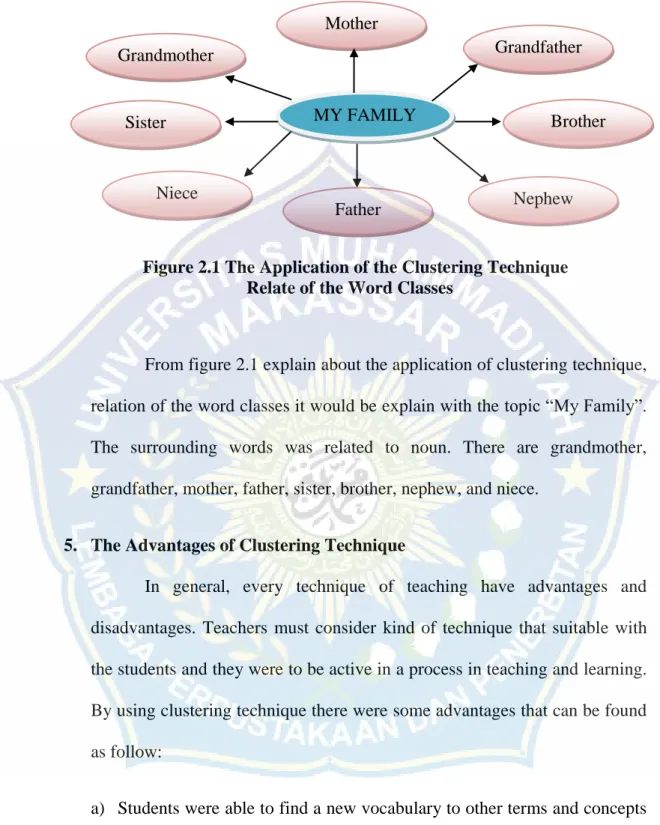
For examples of the topic My Family. Think of ideas and details relate to this topic. And wrote words to connecting with the “My Family” in the cluster. The picture below as example of the clustering technique.
Figure 2.1 The Application of the Clustering Technique Relate of the Word Classes
From figure 2.1 explain about the application of clustering technique, relation of the word classes it would be explain with the topic “My Family”.
The surrounding words was related to noun. There are grandmother, grandfather, mother, father, sister, brother, nephew, and niece.
5. The Advantages of Clustering Technique
In general, every technique of teaching have advantages and disadvantages. Teachers must consider kind of technique that suitable with the students and they were to be active in a process in teaching and learning.
By using clustering technique there were some advantages that can be found as follow:
a) Students were able to find a new vocabulary to other terms and concepts they were already familiar with, it helping them to connecting a new vocabulary into their knowledge.
b) Students more creative to connect new words to what they know before.
MY FAMILY
Grandmother Grandfather
Mother
Father
Sister Brother
Niece Nephew
c) Clustering technique can gave the students motivation in learning process.
d) Clustering technique can help the students to organize the student mind and their interest.
6. The Weakness of Clustering Technique
a) The students were difficult to find words related to the topic because lack of vocabulary.
b) Not all the students can think fast to find the ideas from the topic.
c) Class might would be noisy during learning for all group because students were busy to discussing.
d) The students need more control and it would be taken a lot of time to make the students understand.
7. Conceptual Framework
The mastery of vocabulary was not easy to do because there were several words that difficult to understand the meanings, it was need time to remember it words. In teaching English vocabulary there were many techniques that the teacher can apply in the class. One of them was the use of clustering technique, by using this technique the students were more interested and would be motivated to learning English vocabulary.
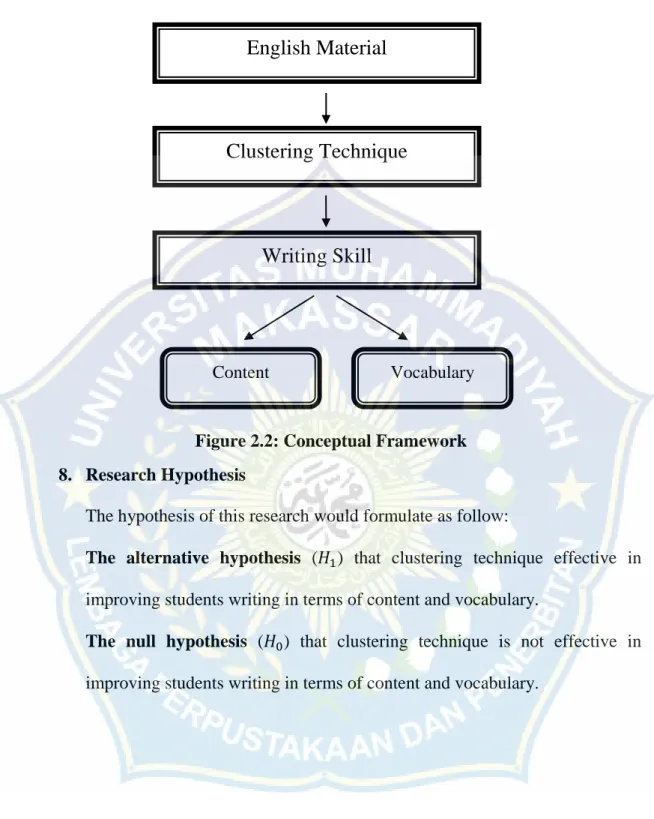
The conceptual framework underlying this research would given in the following diagram.
The diagram of conceptual framework, as below:
8. Research Hypothesis
The hypothesis of this research would formulate as follow:
The alternative hypothesis ( ) that clustering technique effective in improving students writing in terms of content and vocabulary.
The null hypothesis ( ) that clustering technique is not effective in improving students writing in terms of content and vocabulary.
English Material
Clustering Technique
Writing Skill
Vocabulary Content
Figure 2.2: Conceptual Framework
CHAPTER III
RESEARCH METHODOLOGY
This chapter consist of research design, population and sample, research variable and indicator, instrument of research, procedure for collecting data and data analysis.
A. Research Design
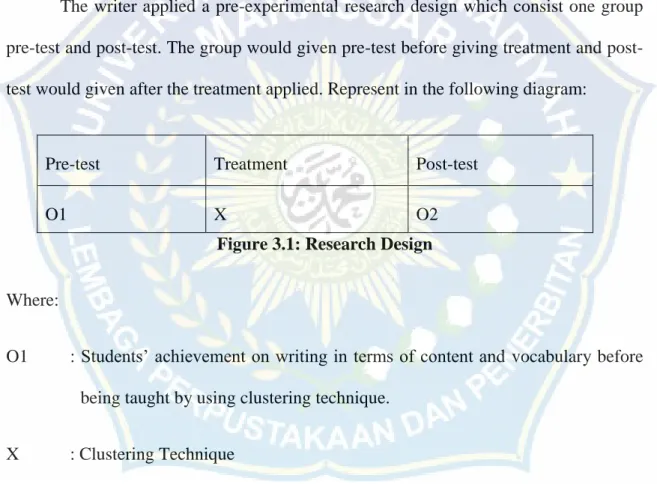
The writer applied a pre-experimental research design which consist one group pre-test and post-test. The group would given pre-test before giving treatment and post- test would given after the treatment applied. Represent in the following diagram:
Pre-test Treatment Post-test
O1 X O2
Figure 3.1: Research Design
Where:
O1 : Students‟ achievement on writing in terms of content and vocabulary before being taught by using clustering technique.
X : Clustering Technique
O2 : Students‟ achievement on writing in terms of content and vocabulary after being taught by using clustering
Gay, (2012)
B. Population and Sample 1. Population
The population of this research was the 8th grade of the students‟ at SMPN 11 Maros Baru, in 2019-2020 academic years.
2. Sample
This research was applied cluster random sampling technique. The writer was chosen one class of the 8th grade students‟ at SMPN 11 Maros Baru, that consist of 30 students. The writer was divided those students into 4 group, each group consist of 8 students.
C. Research Variables and Indicators a. Variable
A variable is everything that would become that object of research or the influencing that would study. Variable is everything to which the writer expects.
There are two variables in this research, namely:
a) Independent variable, that is the using of clustering technique.
b) Dependent variable in this research that was improving the students writing in terms of content and vocabulary.
b. Indicators
The indicators of this research was the improvement of students writing in terms of content and vocabulary.
D. Research Instrument
The instrument of this research was writing test. The writing test was used to find out the students writing. The writer gave pre-test to get data on the students’ prior
knowledge before treatment and the post-test gave to identify the students’ improvement in writing content and vocabulary after treatment. The function here was to knowthe improvement of students’ writing content and vocabulary test.
E. Procedure for Collecting Data
In collecting the data, the writer follows the procedure below:
1. Pre-test
Before giving treatment, the writer gave a pre-test for each students‟ in the pre-experimental class. The pre-test intend to know the students writing in terms of content and vocabulary before giving a treatment.
2. Treatment
After the pre-test, the writer taught the students for 6 meetings. Teaching and learning about the objective of material and writer gave the information about the procedure of using clustering technique.
Opening activities
1) The writer introduced the rules or system of learning to the students.
2) The writer introduced Clustering Technique to the students.
Lesson activity
1) The writer explained what is Clustering Technique.
2) The writer explained the benefit of Clustering Technique in terms of content and vocabulary for teaching and learning process.
3) The writer explained the materials of content and vocabulary in teaching and learning process.
4) The writer divided the students into four groups and each group should choose one of topic. After getting one topic to be collect, than students‟ find out the ideas of the topic. Before that the students take a sheet of blank paper and wrote down the topic in the middle of sheet paper and circle it. The students made several connecting lines and made a circle on each connecting lines than wrote down the ideas. The students made a new circle inside of the ideas and wrote down each example for each ideas. The students‟ made a content from the ideas. After completion, each group came forward according to the group and present what they got.
Closing activities
1) The writer summarized the learning material.
2) The writer closed the class.
3. Post-test
Post-test was given to the class after the last treatment, the procedure of the post-test was the same with the pre-test. Functions of the post-test that was to know the students‟ knowledge and ability in writing content and vocabulary after teaching by using clustering technique.
F. Data Analysis
In analyzing the data from writing test, the writer applied some steps as follows:
1. Scoring the result of the students‟ test classify
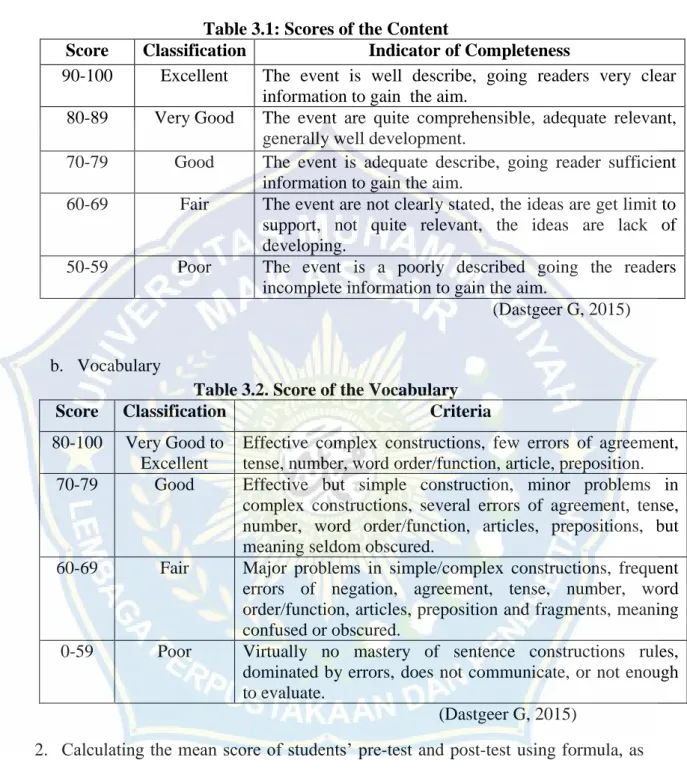
The writer correct the students writing based on the analogies scale for writing.
a. Content (Completeness)
Table 3.1: Scores of the Content
Score Classification Indicator of Completeness
90-100 Excellent The event is well describe, going readers very clear information to gain the aim.
80-89 Very Good The event are quite comprehensible, adequate relevant, generally well development.
70-79 Good The event is adequate describe, going reader sufficient information to gain the aim.
60-69 Fair The event are not clearly stated, the ideas are get limit to support, not quite relevant, the ideas are lack of developing.
50-59 Poor The event is a poorly described going the readers incomplete information to gain the aim.
(Dastgeer G, 2015) b. Vocabulary
Table 3.2. Score of the Vocabulary
Score Classification Criteria
80-100 Very Good to Excellent
Effective complex constructions, few errors of agreement, tense, number, word order/function, article, preposition.
70-79 Good Effective but simple construction, minor problems in complex constructions, several errors of agreement, tense, number, word order/function, articles, prepositions, but meaning seldom obscured.
60-69 Fair Major problems in simple/complex constructions, frequent errors of negation, agreement, tense, number, word order/function, articles, preposition and fragments, meaning confused or obscured.
0-59 Poor Virtually no mastery of sentence constructions rules, dominated by errors, does not communicate, or not enough to evaluate.
(Dastgeer G, 2015)
2. Calculating the mean score of students‟ pre-test and post-test using formula, as follow:
Where:
X = Mean score
= The sum of all score
N = The total number of subject
Gay (1981) 3. Find out the standard deviation of the students‟ answer by using the following
formula:
√ )
Where:
SD = Standard Deviation = Total raw score
N = Total number of students‟
Gay (1981) 4. Finding the significant difference between the mean score of pre-test and post-
test by calculating the value of t-test by using the following formula:
̅
√ ( )
)
Where:
T = Test of significance
̅ = The mean of different score
= The sum of total score significance = The square of the sum for difference = The total number of subject
Gay (1981)
CHAPTER IV
FINDINGS AND DISCUSSION
This chapter presents the findings of the research and discussion. The findings of the research covered with the result of the data collected through the test. In discussion part, the writer described the interpretation of the findings.
A. Findings
1. Clustering Technique Improve the Students’ Writing in Terms of Content and Vocabulary
In findings section, the writer has calculated the result of research at SMPN 11 MAROS BARU. The findings of this research deal with the students‟
score which cover students‟ score classification, the mean score and standard deviation of pre-test and post-test, and hypothesis testing. These finding describe as follows:
a. The Classification of Students Scores Writing in Term of Content Table 4.1: The Students’ Score
in Content
No. Classification Score Frequency Percentage
1. Excellent 90-100 3 5%
2. Very Good 80-89 12 45%
3. Good 70-79 7 30%
4. Fair 60-69 4 10%
5. Poor 50-59 4 10%
Total 30 100%
While, the rate percentage of score pre-experimental class in content from 30 students as table 4.1 shows that there are students got excellent score.
There were 3 (5%) students got excellent score, 12 (45%) students got very good students, 7 (30) students got good score, 4 (10%) students got fair score, and 4 (10%) students acquired poor score.
b. The Classification of Students Scores Writing in Term of Vocabulary Table 4.2: The Students Score
in Vocabulary
No. Classification Score Frequency Percentage
1. Excellent 90-100 0 0%
2. Very Good 80-89 7 20%
3. Good 70-79 9 30%
4. Fair 60-69 12 45%
5. Poor 50-59 2 5%
Total 30 100%
Table 4.2 shows the rate percentage scores of pre-experimental class in Vocabulary from 30 students, there are students got very good and good score and there is no got excellent. There were 7(20%) students got very good score, 9 (30%) students got Good Score, 12 (45%) students got Fair score and 2 (5%) students acquired poor score.
Base on the result above, writer conclude that the rate percentage in post- test was greater than the rate of percentage in pre-test.
2) The Mean Score and Standard Deviation of Pre-Test and Post-Test
The following figure shows the distribution of mean score and standard deviation in pre-test and post-test.
a. The Mean Score and Standard Deviation of Pre-Test and Post-Test in Term of Content
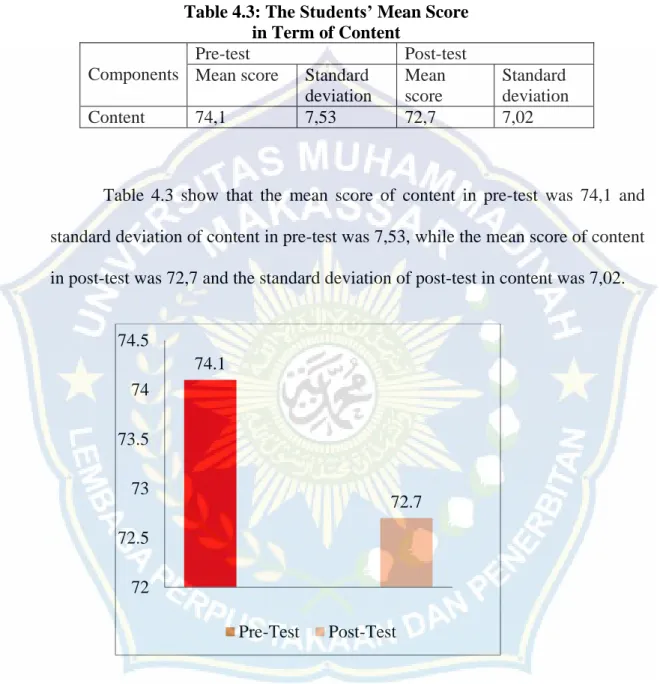
Table 4.3: The Students’ Mean Score in Term of Content
Components
Pre-test Post-test
Mean score Standard deviation
Mean score
Standard deviation
Content 74,1 7,53 72,7 7,02
Table 4.3 show that the mean score of content in pre-test was 74,1 and standard deviation of content in pre-test was 7,53, while the mean score of content in post-test was 72,7 and the standard deviation of post-test in content was 7,02.
Figure 4.1 The Mean Score in Term of Content 74.1
72.7
72 72.5 73 73.5 74 74.5
Pre-Test Post-Test
Figure 4.1 showed that none improvement of the students‟ writing in term of content through clustering technique, from pre-test with the mean score was 74,1 while post-test with the mean score was 72,7.
b. The Mean Score and Standard Deviation of Pre-Test and Post-Test in Term of Vocabulary
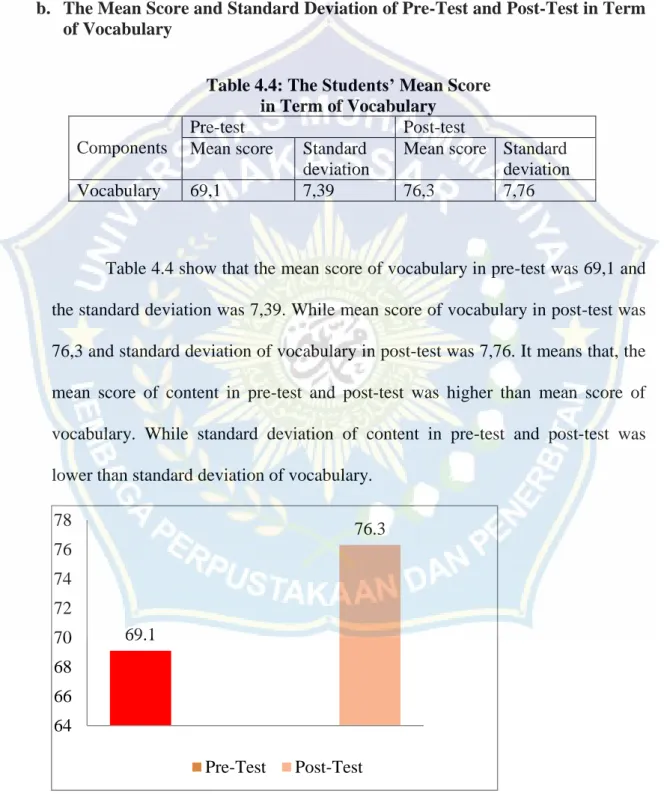
Table 4.4: The Students’ Mean Score in Term of Vocabulary
Components
Pre-test Post-test
Mean score Standard deviation
Mean score Standard deviation
Vocabulary 69,1 7,39 76,3 7,76
Table 4.4 show that the mean score of vocabulary in pre-test was 69,1 and the standard deviation was 7,39. While mean score of vocabulary in post-test was 76,3 and standard deviation of vocabulary in post-test was 7,76. It means that, the mean score of content in pre-test and post-test was higher than mean score of vocabulary. While standard deviation of content in pre-test and post-test was lower than standard deviation of vocabulary.
69.1
76.3
64 66 68 70 72 74 76 78
Pre-Test Post-Test
Figure 4.2 The Mean Score in Term of Vocabulary
Figure 4.2 showed that there was improvement of the students‟
writing in term of vocabulary through clustering technique, from pre-test with the mean score was 69,1 while post-test with the mean score was 76,3.
2. Hypothesis Testing
To know the level of significance of the pre-test and post-test, the writer uses t-test analysis on the level of significance (p) = 0.05 with the degree of freedom (df) = N-1 (30-1=29), where N = number of subject (30 subject) and the value of t-table is 2.045. the following figure show the result of t-test calculation:
Table 4.5: The Calculating T-Test of the Students’
Improvement
Component t-test value t-table value
Content 4,47 2.045
Vocabulary 9,66 2.045
Table 4.5 shows that the t-test value of content was higher than t-table that was (4,47>2,045). it means that there was a significance difference between the students‟ writing in content before and after applied the clustering technique in the class. While t-test in vocabulary also higher than t-table (9,66>2.045). it means that there was a significance different between the students‟ writing before and after applied clustering technique. From the statement above shows that the null hypothesis ) was rejected and the alternative hypothesis ) was accepted.
Based on the statement above, the writer conclude that there was a significant difference between the result of the students‟ pre-test and post-test achievement after given treatment through clustering technique, Thus, teaching writing in terms of content and vocabulary through clustering technique was fairly effective method in improving the students‟ writing skill at the 8th grade students‟
in SMPN 11 MAROS BARU.
B. Discussion
Clustering Technique Improves the Students’ Writing in Terms of Content and Vocabulary
The description of the data collected through test as explained in the previous section shows that the students‟ writing in terms of content and vocabulary improved considerably. It was supported by the mean score rate of the students‟ pre-test and post-test. The used of clustering technique and implementation it in the classroom, help the students could know more about how makes a content and vocabulary. It can be inferred statistically based on t-test value that clustering technique was fairly effective in improving students‟ writing in terms of content and vocabulary.
Teaching content and vocabulary is not easy to do. There were some problems encountered by the writer during the teach content and vocabulary in the classroom; the first they were not interested in learning and the second the students‟
difficulties to improve their vocabulary words because lack of vocabularies. Almost of them were confused, spend much time to think. Clustering technique is one of the technique that can help the students to improve their writing content and vocabularies. Moreover, the clustering technique can stimulus their mind. The
finding of this research is same with what Oshima and Hogue in Styati, (2010: 15) point out that clustering technique is another brainstorming activity that the students can use to generate ideas. This technique was hoped to solve the problem because usually students get difficulties to develop their ideas in writing activity because they were still poor in vocabulary. This technique was helpful for the students‟ to improve their writing content and vocabulary. In furthermore Smalley and Mary in Andayani, (2017: 67) state that there are some procedure of using clustering technique namely;
first the students‟ wrote the topic in the middle of a blank paper and made a circle around it. Then made a line out from the circle and wrote an idea with the topic.
Continue to map or cluster until the students‟ cannot think anymore ideas. Clustering technique helped the students‟ easier to understand the material. The students‟ were more interested and making students‟ think creatively in learning English especially content and vocabulary.
To overcome the problem, clustering technique in term of content and vocabulary was proposed to be applied in teaching writing. Students become increasingly motivated to complete a writing in term of vocabulary as their ideas emerge in organized form. Significant difference in writing content and vocabulary were found between learners who received traditional writing that depended on the text books only and those who were trained to use clustering technique to brainstorm, generate and organize idea. It means that use of clustering technique proved to be a powerful way for improving students‟ writing in terms of content and vocabulary to generate the ideas. It made the topic more structured. Students‟ were using clustering technique became faster and more efficient in generating and organizing ideas in the
content and were able to generate more detailed ideas than students‟ who did not use clustering technique. Moreover, the present study revealed positive effect of clustering technique on students‟ attitudes towards clustering technique activity.
The using of clustering technique was fairly effective in improving the students‟ writing skill in content and vocabulary. It was supported by the mean score of students‟ on pre-test in content 74,1 which were categorized as good and the mean score of the students‟ on the post-test was 69,1 where categorized as fairly. The mean score on pre-test in vocabulary was 72,7 which were categorized as good classification and the mean score of the students on the pos-test was 76,3 which were categorized as very good. It means that the using of clustering technique fairly effective in improving the students‟ writing in terms of content and vocabulary. This finding of this research is similarities with Surya (2014: 45) state that after conducting the action, the researcher gave positive responses about the action. The researcher felt satisfied with the improvement made by the students‟ focus on vocabulary score. The researcher also motivated to use vocabulary clustering technique because it could facilitate the students‟ in improving their vocabulary.
Based on the result of the students‟ vocabulary score, it was found out that the students‟ vocabulary score was improving. It was indicated that the use of vocabulary cluster could motivate to retain and enrich their vocabulary. Most of the students‟ gained good score at the end of each cycle. The students‟ average score in preliminary study was 59.3 in the first cycle, and the average score in the first cycle was 68.9 second cycle was 75.1.
The result of the t-test also supported this technique. The pre-test and post- test result from content and vocabulary shows that t-test value for pre-test and post test score of students writing was (4,47>2,045) for content and vocabulary (9,66>2,045). It was said that the null hypothesis ) was rejected and the alternative hypothesis ) was accepted. It means that there was a significant difference between the result of the students‟ pre-test and post-test achievement after giving treatment through clustering technique, Thus, teaching writing content and vocabulary through clustering technique was fairly effective method in improving the students‟ writing skill at the 8th grade students in SMPN 11 MAROS BARU.
CHAPTER V
CONCLUSION AND SUGGESTION
A. Conclusion
Based on the research findings in the previous chapter, the writer concludes that using clustering technique as teaching media was fairly effective to improve students‟ writing skill in terms of content and vocabulary at the 8th grade students‟ in SMPN 11 Maros Baru. It was supported by the mean score of students on pre-test in content was 74,1. This was categorized as good and after post-test was 69,1 become fairly. The mean score on pre-test in vocabulary was 72,7. This was categorized as good and after post-test was 76,3 become good too.
B. Suggestion
Based on the conclusion that has been written, the writer would like to recommend some suggestion as follows:
1. For the teacher
a. The teacher should know the students‟ difficulties in vocabulary.
b. The teacher should use Clustering technique as interesting method in teaching learning process to motivate the students‟ writing in content and vocabulary.
c. The teacher should give more exercise to the students in vocabulary, so that they don‟t have any difficulties when doing exercise more.
d. The teacher should be creative to create a new media and new method in learning process.
2. For the Students‟
a. The students should pay attention to the teacher when they are gives the lesson.
b. The students should enrich their writing vocabulary.
c. The students should more practice in writing content and vocabulary.
d. The students should consult the difficulties that they got in content and vocabulary to the teacher.
e. The student should be brave to express their idea and share about their opinion.
3. For the Researcher
a. The researcher should be able to take the benefit of this research such as using this final project as a reference to do the research on content and vocabulary.
b. The researcher should be more creative in creating an interesting media to teach and improve the students‟ content and vocabulary.