1
THE EVOLUTION OF CHINESE STUDENTS’ MOTIVATIONS TO STUDY ABROAD IN THE U.S.
©2015 By Alison E. Bartel
A thesis presented in partial fulfillment of the requirements for completion of the Bachelor of Arts degree in International Studies
Croft Institute for International Studies Sally McDonnell Barksdale Honors College Center for Intelligence and Security Studies
The University of Mississippi
University, Mississippi February 2015
Approved:
____________________________________
Advisor: Dr. Weixing Chen
____________________________________
Reader: Dr. William Schenck
____________________________________
Reader: Dr. Carl Jensen
2
ABSTRACT
ALISON BARTEL: The Evolution of Chinese Students’ Motivations to Study Abroad in the U.S.
(Under the direction of Weixing Chen)
Through interviews conducted in Nanjing, China during Fall 2014, this thesis sought to examine Chinese students’ motivations to study abroad in the U.S. and how those motivations have changed over time in the context of Chinese and U.S. policy since reform and opening. Research showed that since 1979, Chinese students have more freedom of choice and economic means to expand their study abroad opportunities. Until now, the United States has been Chinese students’ primary destination of choice, but according to modern-day Chinese college students, other similarly developed countries are beginning to draw more and more Chinese students, who may choose countries like Europe, Japan, Australia, and Canada in place of, or in addition to, the U.S. Furthermore, as Chinese students see more countries’ study abroad programs as equal, they are more likely to consider more practical factors such as program costs, preferential visa policies, and existing connections within the country as they make their destination choices.
3
TABLE OF CONTENTS
Introduction……….…4
Ch. 1: A Brief History of China’s Educational Exchange (Qing Dynasty- 1978)………..19
Ch. 2: Chinese Students in the US in the Context of Sino- US Relations…….27
Ch. 3: Observations from US Consulate General Guangzhou……….53
Ch. 4: Interviews……….64
Conclusions………78
Bibliography………..90
Appendix A: Interview Protocol (Chinese)………...104
Appendix A: Interview Protocol (English)………....105
Appendix B: Primary Interview Questions (Chinese)………106
Appendix B: Primary Interview Questions (English)………..108
Appendix C: Online Interview Request Letter………111
4 Introduction:
In December 2012, the National Intelligence Council published “Global Trends 2030”. As an alternative futures analysis of how the world will look in 2030, it identifies multiple trends that will emerge in the next fifteen years and how they will change the world as we know it. One of these trends is profound demographic change, including international migration (2012). In the coming years, as countries cope with an increased number of immigrants, or emigrants, in the case of this thesis, each country’s broader policies towards this wave of people going abroad will reveal both their policy objectives and relations with the outside world. A country’s stance towards emigration ultimately dictates through what mechanisms its people interact with the rest of the world. As this trend emerges, no countries will be more characteristic of the complex challenges governments face in formulating these policies than China and the United States.
Since economic reform in the 1980s, thousands of Chinese nationals have traveled to the U.S. and other Western nations for study, business, and tourism in a large scale diaspora that the Chinese government struggles to regulate. The most significant group within this set is China’s students, many of whom in the past chose never to return. In the late 1980s and early 1990s, China was hemorrhaging talented students and professionals, costing the Chinese economy opportunities for innovation and development. Whether China has fully recovered from these losses remains unclear.
But more recently, the number of Chinese students who study abroad, primarily in the United States, and return to contribute to China’s developing economy is rocketing upwards. An estimated 450,000 Chinese students will study abroad in 2014, with U.S.
5
schools remaining their top destination (“Chinese Students Flock to US”, 2013). And unlike students who participated in the study abroad waves of the 1980s, the Wall Street Journal reports that approximately 72% of Chinese foreign exchange students return after graduation or after a short stint in the U.S. job force (Zhao, 2013). However, other statistics suggest that students who receive a doctorate degree in science and engineering fields are more likely to stay in the United States, especially students from China and India. In 2009, the percentage of students from China and India who were still working in the U.S. 5 years after receiving a doctorate degree was 89 percent and 79 percent respectively (Finn, 2009). This evidence raises questions about the quality of students returning to China, an issue I will address later in this thesis. Nonetheless, the sheer number of students participating in these exchanges alone highlights the
emerging changes within the Sino-U.S. study abroad connection as a topic worth researching.
Furthermore, China’s close economic partnership with the United States, the primary recipient of its foreign exchange student outflow, is many times benefitted by such large scale exchange of culture and ideas. Throughout history, this relationship always occupied a sort of middle ground. Despite strained political relations, Sino-U.S.
bilateral ties were always maintained because of deepening economic cooperation post- 1979. In modern society, the state of bilateral relations between two countries does not necessarily directly correlate with those countries’ educational exchange trends.
However, examining how different phases of Sino-U.S. relations intersect with overall study abroad trends of the time provides context for gradual development of Sino-U.S.
6
foreign exchange, as well as gives today’s scholars insight into how students’ individual choices fit into a global policy-dominated environment. The establishment of bilateral relations allows for student exchange in the first place, but beyond that basic starting point, a number of factors intersect to affect the volume of exchange, such as
preferential policies, how one country’s people view another country, economic conditions etc. At an even deeper level, these factors play into individuals’ decisions to study abroad. That being said, when researching Sino-U.S. foreign exchange trends, there are two overall analytic viewpoints: government and individual. In this thesis, I primarily aim to study individuals’ experiences throughout the study abroad process, supplemented by research on Sino-U.S. relations to provide context.
Both large scale government policy stances and China’s domestic state of affairs have profound effects on Chinese students’ individual rationale behind and ultimate decision to study abroad, whether they realize it or not. In a certain sense, the current Chinese government faces a study abroad paradox when pandering to said students. On one hand, as the government prepares for a gradual shift from a manufacturing- based economy to a service- based economy, it is in desperate need of bright students who gain advanced knowledge through accelerated programs abroad. On the other hand, China needs prevent the outflow of knowledge and capital that occurred in the 1980s and 1990s. Fortunately for China, its economic boom has formed a natural remedy to the problem. Though an increasing number of Chinese students are studying abroad, a growing number of students are also either returning to China or setting up companies abroad that interact with China after their overseas education ends. Thus, China is
7
taking advantage of its “diaspora option,” attempting to take advantage of students’
talents from afar, rather than limiting the number of students studying abroad (Zweig, Fung, & Han, 2008). Additionally, since Deng Xiaoping’s reform and opening policies in 1979, otherwise known as gaige kaifang (改革开放), the Chinese government has established extensive study abroad scholarships and incentive programs to encourage young people to study abroad and come back with advanced knowledge, particularly in the STEM fields.
Even so, Chinese students’ decisions to study abroad are complex, depending on a variety of factors, such as their attitude towards China’s rigid style education system versus the critical thinking-based Western education system, (“Chinese demand for overseas education remains strong”, 2013), a flooded job market in which study abroad returnees are no longer necessarily as competitive as in past years, (“Plight of the sea turtles”, 2013), the rising costs associated with foreign exchange programs, and the incentives not to return, adding to the existing pool of Chinese emigrant professionals (He & Yang, 2013). Thus, this thesis seeks to answer the following questions:
Why do modern day Chinese students choose to study abroad?
Why did Chinese students choose to study abroad in the United States in the 1980s, 1990s, and the new millennium respectively? How have students’ motivations changed over time?
Since reform and opening in 1979, how has the changing state of Sino-U.S.
relations affected bilateral study abroad trends in general?
8
Why, specifically, do modern-day students choose to study abroad in the United States?
What are students’ expectations of both the country and the overall experience before they go? And for students who have already studied abroad and returned to China, were their expectations and the reality of their experiences the same?
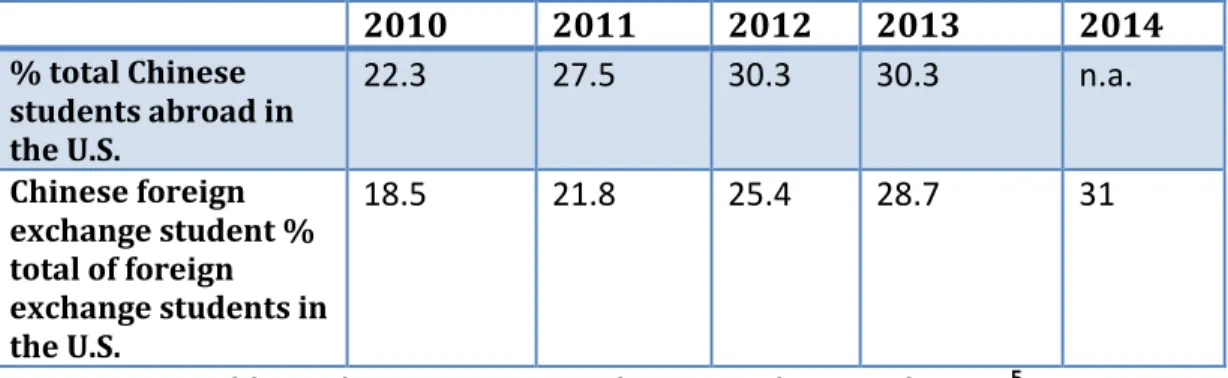
Individual decisions make up trends. Examining the evolution of Chinese students’ motivations to study abroad will contribute to forecasts of the volume and composure of future waves of Chinese study abroad students to the U.S., as well as the nature of their connections with the U.S. in the future. The sheer volume of Chinese students alone makes the case for their importance and economic impact. Continuing to attract foreign students, especially from China which currently supplies 28.7 percent of international students in the U.S., will be essential to maintaining an economic
advantage. In 2013, international students generated over 300,000 jobs and $24 billion in the U.S. economy (“The Growing Trends and Economic Impact”, 2013). Not to
mention, Chinese study abroad trends give us many insights, albeit generalized, into the larger international migration picture. As we move towards a globally integrated labor market where skilled workers transcend borders, study abroad trends provide clues to future connections and investments. Students eventually become skilled workers, and the connections they make while abroad will many times transfer to their professional careers. Thus, while this thesis specifically examines individual decisions, it also helps
9
predict Chinese students’ future interactions with the U.S. and that impact on the U.S.
economy as a whole.
Thesis Format:
This study will begin with a historical contextualization, providing a brief overview of waves of Chinese study abroad students before the 1980s, followed by a more detailed examination of the fluctuations in Sino-U.S. relations since normalization in 1979 and how the state of bilateral relations correlates with the number of Chinese students studying abroad in the U.S. To determine the “state” of bilateral relations, this study will use literature on major events such as the 1978 reform and opening (改革开 放), 1989 Tiananmen Square student uprising and China’s induction into the World Trade Organization in 2001 as fluctuation points in China’s foreign relations with the U.S.
Then, this study will use open source data on Chinese students studying abroad at these specific fluctuation points and compare the two countries’ overall policies towards educational exchanges. By doing this, this study aims not only to provide a historical basis on how the changing state of Sino-U.S. relations has affected bilateral study abroad trends, but also make broader statements about how the foreign diplomacy between two countries affects international exchange.
The second part of this study will be primarily anecdotal research, a personal narrative on working as a Consular Intern at the U.S. Consulate in Guangzhou, China.
These are my observations at the place where foreign policy is implemented and serve to describe the interactions between Chinese individuals and U.S. migration policy.
10
The third part of this study aims to examine students’ changes in motives for studying in the U.S. over time, as well as address questions of individual experiences through qualitative based interviews. Four groups of interviews will be completed:
students who studied in the U.S. in the 1980s, students who studied abroad in the U.S.
in the 1990s, students who studied abroad post-2000 and current students who are preparing to participate in a foreign exchange program in the U.S.
Previous Study Abroad Participants
Students who studied abroad in the 1980s, 1990s, or post-2000 primarily
followed one of two paths. Many stayed in the U.S. on a long-term basis. They make up the group of Chinese professionals in the 1980s and 1990s who contributed to China’s severe brain drain problem until recently. I hope to capture a qualitative snapshot first of their reasoning behind why they specifically came to the U.S. to study abroad. By including their accounts, this study seeks to understand the changing benefits over time of coming to the U.S. to study abroad. In summary, why did they choose to study abroad, why the U.S., and what changes do they see in the China-U.S. foreign exchange trend?
Others, however, either returned to China permanently or continue to straddle the Pacific, traveling back and forth from China to their previous study abroad and/or research destinations. These students are referred to as “sea turtles” (海归,haigui) and “sea gulls” (海鸥,hai’ou). While completing these interviews, I saw a range in the study abroad experiences, reentry experiences, and continued impact of international
11 educational exchange for each individual.
Students Preparing to Study Abroad
In addition to gaining a sense of students’ reasoning for studying abroad in the U.S. over the past few decades, I will also interview students who are still preparing for their study abroad experience in the United States. This group is made up of students who are actively planning on studying abroad in the near future.
The variety in qualitative data from interviewees in each of the groups will first yield results that will allow me to compare and contrast the expectations and
experiences of Chinese students in the United States over different time periods.
Secondly, by interviewing current students who have yet to go abroad, this study captures the reasoning behind and expectations of the newest group of Chinese foreign exchange students that plan to study in the U.S.
Literature Review
This thesis employs a two-pronged approach, first giving an overview of the changes in state policies in the context of bilateral relations since reform and opening, then, through original qualitative research, examines how, in this shifting environment, motivations to study abroad in the U.S. have changed on an individual level. Following a similar structure, the existing scholarship related to this topic can be divided into two groups: literature on the evolution of policies affecting Chinese study abroad students in
12
China and the U.S. respectively and literature on how these individuals make their decisions to study abroad.
Evolution of Chinese Migration Policies
China’s policies affecting study abroad students have experienced monumental change since Deng Xiaoping’s 1978 economic reforms. The underlying trend is that China has gradually opened up, but through examining the evolution of China’s policies towards international migration, both temporary and permanent, we can see that the Chinese government’s nuanced responses according to domestic politics of the time and the brain drain phenomenon. During China’s Maoist Era, from 1949 to 1976, Chinese students were only allowed to go to socialist states, primarily the Soviet Union, and even then, only under strict government control (explained further in Chapter 1). Since the end of this era, China’s policies have relaxed to compensate for economic growth and globalization. However, Guofu Liu argues that even with this change, China’s
migration policies are not consistent with international migration law standards, stating that in order to bring adapt a migration law suitable for the modern flow of peoples across borders, China needs to transform its simple exit and entry administration laws into a full-fledged migration platform (2009). On the other hand, many scholars also argue that China actually has reason to worry about the level of openness of its
international migration policies. Students are considered skilled migrants, or depending on age, skilled migrants to be. As Docquier and Rapoport point out, these skilled
migrants and the skills and capital they either take away from or contribute to their
13
home countries are beginning to define the process of economic globalization, but unlike in the past, do not necessarily imply a complete depletion of talent, creating networks of trans-Pacific contacts (2011).
Until the late 1990s and early 2000s, brain drain, though difficult to measure, had devastating effects on China’s economy and influenced Chinese policy decisions. In an empirical analysis on the causal relationship between brain drain and poor
governance and economic opportunity, de la Croix and Docquier find that there is a causal relationship between the two, which in small countries is aggravated by
governmental “coordination failures”, or lack of comprehensive development policies (2011). Though China is certainly not categorized as a “small country”, its situation does fall into the sort of vicious circle de la Croix and Docquier describe—if the country’s best and brightest are emigrating, how will the economy develop to keep future generations from doing the same? Cong Cao addresses this phenomenon in a broader- based
research article, concluding that in spite of many policies implemented to encourage the return of Chinese academics, existing cultural institutions such as reliance on guanxi, or
“relationships”, in the job market, impede the success of academic returnees and thereby discourage their return (Cao, 2008). The interview responses described in chapter 4 will address this issue.
Chinese policies aimed at combatting brain drain date back to the late 1980s.
These policies encourage students to study abroad, providing stipends and support organizations, but with the stipulation that after the student receives ample training abroad, he/ she will return to China to work for a domestic company. Other policies also
14
establish research subsidies and industrial parks to attract “talented” Chinese expats back to the mainland. This initiative is still referred to as the “Thousand Talents Program,” or 千人计划。In a study examining the success of this policy push, David Zweig and Huiyao Wang express extreme doubt. Zweig and Wang argue that faced with a non-transparent bureaucracy with permeating corruption, Chinese expatriates will more likely “opt for an environment that allows free thinking, debating, and writing” (p.
613). Even so, with corporations that span the globe, local economic contributions are difficult to define. As mentioned above, China can also take advantage of a “brain diaspora,” in which Chinese nationals remain overseas to work after their studies, contributing to China’s economic development from abroad (Zweig, Fung, & Han 2008).
Many students interviewed in Katalin Szelényi’s study echoed this sentiment. Szelényi noted that some exchange students plan to contribute to their home countries’
economies by participating in transnational activities, concluding that “The loss of bodies, therefore, does not always imply the loss of brains as well,” (p. 84).
Evolution of U.S. Migration Policies
Another strain of existing scholarship focuses on the evolution of U.S. migration policies, specifically those pertaining to Chinese foreign exchange students. These policies form an institutional hurdle that Chinese students must leap over before studying in the U.S. Politics of the time determined the height of the hurdle. For example, from 1882 to 1943, the U.S. government upheld the Chinese Exclusion Act, banning virtually all Chinese immigration into the U.S. That hurdle was more like a stone
15
wall. Though the Act was repealed in 1943, Chinese immigrants could not enter the U.S.
without restrictions until the amendments to the Immigration and Nationality Act in 1965. The amendments removed racial quotas and formed the foundation of modern- day U.S. immigration law (Green, 2002). U.S. migration law did not begin to affect the Chinese on a large scale until they began to trickle into the country in the late 1980s.
Since then, U.S. policy towards Chinese temporary immigrants, loosely defined as foreign nationals such as students and business people who come and stay
temporarily, has been relatively stable, but fluctuating in response to domestic needs and international events, rather than political relations with other nations. In their analysis on the effects of immigration laws on Chinese temporary immigrants, especially students, Dudley Poston and Hua Luo point out two laws of note (2007). The first is the Immigration Act of 1990, which set higher caps on immigration than the Immigration Reform and Control Act. This act affected all immigrant categories across the board and was an important milestone in American immigration law that was hailed as a “return to the pre-1920s open door immigration policy of the United States” (Bell, 2012, par. 1).
The second law, even more salient to the Chinese, was the Chinese Protection Act of 1992, implemented in reaction to China’s Tiananmen Square crackdown in 1989. This Act granted Chinese temporary immigrants (emphasizing students) permanent resident status to prevent their political repression upon return to Mainland China. Much
argument focuses on the effectiveness of the Act. Though directed towards students, Poston and Luo conclude that this act actually ended up benefitting many skilled, but potentially illegal, workers from China’s coastal provinces (Poston & Luo, 2007).
16
However, others conclude that suddenly switching to permanent resident status gave students (who made up about half of the applicants) significant economic benefits (Orrenius, Zavodny, & Kerr, 2012).
U.S. immigration policy entered a more conservative stage after the terrorist attacks on Sept. 11, 2001. A large volume of scholarship is dedicated to chronicling the policy changes that took place after the commencement of the war on terror. After the attack, U.S. immigration institutions were used as tools for maintaining national security, functioning both as a gateway and a net. As a gateway, U.S. immigration institutions continued to accept a large number of foreign tourists, students, and business people, though there was a noticeable dip in visitors until after 2004. At the same time, these institutions also functioned as a net, rewired to catch potential threats to homeland security (Frederking, 2012; Iyer & Rathod, 2011). However, after a rebound in foreign immigration after 2004, U.S. immigration law towards Chinese immigrants has remained relatively stable and open, becoming even more liberal with President Obama’s planned immigration reforms following the November 2014 APEC Summit.
Individual Motivations to Study Abroad
The following content includes both material on general factors influencing the choice to study abroad and material on factors that applies to Chinese students’
decisions specifically. One study creates a useful framework in analyzing the various components of the student’s decision making process determining whether he/she travels abroad. The student considers factors that determine whether or not he/she
17
should study abroad, factors that influence the location decision, and factors beyond his/her control such as money constraints or visa barriers (Eder, Smith, & Pitts, 2010).
Additionally, another study finds support for the strong pull of an existing network of foreign students in the area of choice (Beine, Noël, & Ragot, 2014). This literature is important to keep in mind when analyzing the decision making processes of Chinese students specifically.
Vast existing literature on the factors influencing Chinese students’ decisions to study abroad suggests that these decisions are a complex mix of cultural, domestic, and international factors. These factors commonly include a desire to improve economic position or societal status, disillusionment with the Chinese education system, curiosity about foreign cultures or languages, and a lack of choice—if a student does not test high enough on the Chinese college entrance exams or is studying a subject that he/she cannot get enough information about in China, the student will have no choice but to go abroad (Yao, 2004). The U.S. has always been a beacon for Chinese study abroad
students, who flocked there for economic opportunity in a merit-based system (Yan &
Berliner, 2010).
Though a broad selection of literature on Chinese study abroad trends exists, there are a few gaps that this study aims to fill. First, this study will provide a broader analysis of the connection between Sino-U.S. relations and Chinese study abroad trends.
Secondly, this study will also yield some insight into individual experiences after students study abroad. Many studies focus on the experience of Chinese foreign
18
exchange students in their country of study, but fail to address the challenges these students face once returning. Most importantly, this study will use qualitative data to compare and contrast Chinese students’ motivations to study abroad in the U.S. since reform and opening. As pointed out above, the literature on individual motivations to study abroad is vast, but very few studies examine how these motivations and factors changed over time in the context of Sino-U.S. relations and Chinese educational exchanges with the U.S.
19
Ch. 1: A Brief History of China’s Educational Exchanges (Qing Dynasty- 1978) Qing Dynasty
The foundations for the wave of study abroad students between the end of the 19th century and the beginning of the 20th century began with China’s increased
international trade before the Opium Wars. In the 17th century, the British Empire imported large volumes of goods like tea and porcelain to China, primarily regulated through the Qing Dynasty’s trading post of Canton (or present-day Guangzhou).
However, amid growing concerns that they were flooding the Chinese market with currency, Britain sought to balance their trade deficit by planting then exporting large quantities of opium to China (Perdue, 2011). However, the Chinese military and
government officials’ increasing addiction to opium, combined with the outflow of silver to the British Empire that destabilized the economy, led to the government’s eventual ban on opium and the ensuing Anglo-Chinese conflicts from 1839-1842 and 1856-1860.
It was in this atmosphere of increased trade and contact with the West and Western culture that China’s first group of study abroad students, notably Yung Wing (or Rong Hong, 容閎, by some accounts) ventured to America in January of 1847. Yung was afforded unusual educational opportunities at an early age, attending a missionary school in Macao rather than the Chinese Confucian schools that were the norm. The school was closed during the first Opium War from 1839 to 1842, but reopened
afterwards under the leadership of Reverend Brown, a graduate of Yale University, who ultimately ferried Yung to his alma mater (“Imperial Students,” n.d.). Yung became a U.S.
citizen in 1852, graduated from Yale in 1854, and returned to China in 1855 with the
20
goal of establishing a program called the Chinese Educational Mission to provide other Chinese students the same opportunities to go abroad. Though some conservatives in the Qing court protested Yung’s program, wary of foreign imperialist influences, the Chinese Educational Mission in the U.S. was ultimately successful. After humiliating defeats in both Opium Wars, the Qing Dynasty realized that in order to survive on an increasingly connected international stage, they had no choice but to adopt the modern technology and ideology of their Western counterparts. In 1870 and 1871, Yung himself selected students to attend a preparatory school in Shanghai to study English and Western culture. This became one of the first 培训班 (peixunban, or “specialized pre- departure programs”), which are now commonplace in China and will be discussed in later chapters (“This Month in History: Chinese Educational Mission Students in the 19th Century,” 2010). Beginning in August of 1872, every year for four years, the Qing Dynasty sent 30 Chinese students between the ages of 10 and 16 to America to study for a total of 15 years at top rated American institutions such as Yale and Harvard while hosted by American families (Zhang, 2011). After four years, the program was
discontinued due to an increasingly large conservative influence in the Qing courts, but the students, then totaling 120, returned to China to become professionals that led modernization efforts in naval, railroad, and telecommunications industries (Peng, 2004).
Yung’s work paved the way for study abroad efforts that continued until the demise of the Qing Dynasty. As Japan rose on the world stage, physically and
economically intact after avoiding the equivalent of China’s Opium Wars, the country became more of a threat to Chinese sovereignty. Aware that the modernization of the
21
navy and industrial sectors had become a policy priority, Qing officials sent more than a hundred students to naval academies in Germany, France, and Britain in the late 1870s and 1880s (“Imperial Students”, n.d.). Some of the first negative affects the government felt as a result of the influences of foreign education came after the study abroad wave to Japan in the late 1890s and early 20th century. At this time, a mix of both
government-sponsored and self-sponsored students flocked to Japan to learn about its Meiji Restoration. As these students grew in numbers and began trickling back into China, they formed the backbone of the Xinhai Revolution that overthrew the
government in 1911 and the constituency of Sun Yat-Sen’s United League Party (Zhang, 2011). Thus, the Qing Dynasty offers interesting parallels to the Chinese government’s study abroad paradox today. Though China’s study abroad students were a tool for modernization, in certain cases, some contend, they also endangered the legitimacy of the Chinese Communist Party (Sheehan, 2013).
New Cultural Movement Era, 新文化运动 (Xin Wenhua Yundong)
After the fall of the Qing Dynasty, a new republic was established in China, but it was still riddled by some of the same problems as the feudal society under the dynastic system: “lack of a healthy economy and an educated middle class, elements necessary to sustain any strong democracy,” (Butler, 2007, par. 14). This era was characterized by a rebellion against traditional Chinese ideologies in favor of philosophies, such as
Marxism, that originated abroad, as well as scientific developments. Its culmination, the May Fourth Movement in 1919, is generally viewed as the point in Chinese history that
22
divides “modern Chinese history,” 1840-1919, and “contemporary Chinese history,”
1919- present-day (Wang, 2010).
This Movement not only introduced the ideas that provided the foundation for modern China’s system of governance, but also spurred another wave of study abroad students to both the Soviet Union and Europe, many of whom eventually became prominent Communist Party leaders. These leaders included notables such as Deng Xiaoping and Zhou Enlai, and increased cooperation with the Soviet Union’s Leninist Party produced a group of intellectuals dedicated to Marxist ideology, which by 1930 numbered at over 2,000 (“The legacy of overseas study for China’s early leaders: Deng Xiaoping”, 2011; Zhang, 2011).
Kuomintang Era
Authors Ma Ying and Hans-Michael Trautwein refer to the decade of 1927 to 1937 as “the golden era of China’s economic development,” (2013, p. 181). The
Kuomintang had established itself as a government after the end of China’s Warlord Era and was still pursuing policies of industrial modernization, an epic upheaval in an
agrarian society. Because of this, most Chinese students studying abroad pursued higher education degrees in fields related to economics (Ma & Trautwein, 2013). Additionally, after the Boxer Rebellion in 1901, an uprising aimed at combatting imperialist foreign intervention, China was forced to pay approximately $300 million of indemnity to the
“Great Powers” that intervened: Britain, France, Germany, Japan, Russia, and the U.S.
The U.S. then diverted part of the money to the Boxer Rebellion Indemnity Scholarship
23
Program, a scholarship fund for Chinese foreign exchange students studying abroad in America, which Ma and Trautwein identify as the primary study abroad destination during this time (2013). In preparation for the wave of outgoing exchange students, China established another school dedicated to preparing students to study abroad, Tsing Hua College in Beijing (“Archives: Boxer Rebellion Indemnity and First Student at Beloit,”
n.d.). The push for industrialization and development, along with readily available funding led to the exodus of hundreds of Chinese exchange students per year starting in the decade of 1927 to 1937 (Zhang, 2011).
After WWII, or what the Chinese refer to as the Anti-Japanese War, began to wane in 1945, the Kuomintang once again began prompting students to go abroad to continue gaining technical training to modernize the nation. However, just one year later in 1946, the Chinese Civil War between the Communists and the Nationalists broke out, once again stalling foreign exchange program efforts (Zhang, 2011).
Maoist Era
After the establishment of the People’s Republic of China under the Chinese Communist Party in October 1949, the Party strove to use the Soviet Union’s
bureaucratic model to reorganize the remnants of the Nationalist government structure and continue efforts aimed at large-scale mobilization and industrialization. In the September 1949 Common Program of the Chinese People’s Political Consultative Conference, the government laid out a plan to embark on agrarian reform and the nationalization of enterprises for “development of the nation’s power and for its
24
industrialization,” (Chinese People’s PCC, 1949). To develop the scientific tools
necessary, China sent approximately 10,000 people to the Soviet Union to study abroad in the 1950s, about 7,500 students and 2,500 university teachers and scientists pursuing higher education degrees. The early 1950s marked the peak in Sino-Soviet relations. In addition to high numbers of foreign exchange students from both countries, China and the U.S.S.R. signed a bilateral agreement in 1957 to cooperate on hundreds of
industrialization projects in fields such as military technology, mining, and heavy industry (“China-Soviet Influence in the 1950s,” 1987). The few Chinese students who returned from studying in the U.S. and England during this time period went on to play pioneering roles in establishing China’s atomic and hydrogen bomb programs (Hannas, Mulvenon & Puglisi, 2013).
However, China’s suspicion towards the Soviet Union’s security policies,
economic policies, and what Mao saw as a watered down strain of Communism began to emerge in the late 1950s and gained momentum throughout the 1960s. In the late 1950s, from the Chinese government’s point of view, the Soviet Union did not
sufficiently support the mainland in re-annexing Taiwan, and further aggravated ties by remaining neutral throughout conflicts on the Sino-Indian border (“China- Sino-Soviet Relations”, n.d.). Ideological divides were even starker. In his speech criticizing the Soviet Union in 1959, Mao pointed out the leadership’s revisionist policies and
condemned the Soviet Union for “organizing a big anti-Chinese chorus together with the imperialists and reactionary nationalists, and the Tito revisionists” (“Mao Zedong- Outline…”, 1959). Sino-Soviet relations reached a final freezing point in the midst of the
25
Great Leap Forward, a manifestation of Mao’s extreme version of Communism. Though the close alliance with USSR was eventually severed, the Soviet Union’s influence on China’s government structure and the cadres who filled it was unparalleled. China inherited its nomenklatura system, the governmental structure in which the Communist Party maintains power through its ability to grant and take away the leadership
positions in all government spheres, from the Soviet Union, sometimes still referred to by the Chinese as “big brother”, or da gege (大哥哥) (Heilmann & Kirchberger, 2000).
Also, such influential figures as former President Jiang Zemin, Premier Li Peng, and Vice Premier Zou Jiahua all studied abroad in the Soviet Union in the 1950s (Zhang, 2011).
A few brief years later, the Cultural Revolution from 1966-1976 marked a dry spell for Chinese educational exchange. Because before the Cultural Revolution, a university education was reserved for young people with well-connected families, the Mao- encouraged battle against all things bourgeoisie also included a concentrated effort to overturn the education itself, which succeeded with the abolition of the Education Ministry in 1966 (Milner, n.d.). With the domestic education bureaucracy crumbling from within, continued international educational exchange was out of the question. A whole generation of students, referred to as the “lost generation,” were deprived of an education, many sent to perform manual labor in the countryside to learn from farmers and peasants about a quintessentially non-bourgeois way of life (You, 2012). International exchange would only start to trickle again once China opened up to the West in the 1970s, forming the foundation of the world’s largest educational
exchange.
26
China’s history of international educational exchange, or in some time periods lack thereof, served as a primary motivation to interview participants who studied abroad in the 1980s and 1990s, as I will discuss in later chapters. Furthermore, the early history I outline above serves to underline the stark contrast between Chinese students’
study abroad opportunities in the 1970s and their opportunities now, just a few decades later. In the next chapter, I describe both the U.S. and China’s foreign exchange policies during the 1980s, 1990s, and post-2000, the time periods during which my interviewees studied abroad. This will provide context for my observations at the Consulate, the venue where these policies are implemented, as well as my interviews.
27
Chapter 2: Chinese Students in the U.S. in the Context of Sino-U.S. Relations
As China and the U.S. become even closer via cultural and educational exchange, it is important to understand the context on which this relationship was built.
Furthermore, this chapter serves as a foundation as I compare and contrast Chinese students’ motivations to study abroad in the U.S. and general impressions of the American society and educational system in later chapters. Below, I introduce major events in Sino-U.S. relations, corresponding educational and cultural exchange policies, and data that illustrate the volume and characteristics of students studying abroad at the time.
From Deng Xiaoping’s reform and opening policies in 1978 to the present time, the scope of this project’s research, the general trend in Sino-U.S. ties can be
characterized by increasingly high volume of educational exchange. The chart below provides an overview of the total number of Chinese students in the U.S. as far back as reliable data is recorded. This data represents the manifestation of the international events and policies governing Sino-U.S. educational exchange described in the following pages.
Year Total Number of Chinese Students in the U.S.
1949 0
1954 0
1959 0
1964 5
1969 19
1974 22
1979 1,000
1984 10,100
1989 33,390
1994 39,403
28
1995 39,613
1996 42,503
1997 46,958
1998 51,001
1999 54,466
2000 59,939
2001 63,211
2002 64,757
2003 61,765
2004 62,523
2005 62,582
2006 67,723
2007 81,127
2008 98,235
2009 127,628
2010 157,558
2011 194,029
2012 235,597
Institute of International Education: Open Doors Data Report1 Table 1: Total number of Chinese students in the U.S., 1949-2012
The 1980s: Normalization and Initiation
Throughout World War 2 and the Cold War, formally establishing ties with China was only a slim possibility mired with political trip wires. America’s support of the Nationalists during World War 2 wed the U.S. to Taiwan after China’s Civil War, and to an extent, this relationship continues today. American support of Taiwan combined with China’s extreme ideology and alliance with the Soviet Union in the early stages of the Cold War made establishing ties tricky at best. However, after the Communist Party
1 The data used to represent the total number of Chinese students in the U.S. is from the Open Doors Data Report published annually by the Institute of International Education (IIE), as I judge this to be the most complete and accurate statistical report. In the chart, the year 1949 is represents the time span of the years 1949 to 1950 (2009). Please note that data for the 1980s and early 1990s is less complete than the data in more recent years, in the sense that it is either nonexistent, does not include as many details about student demographics, or both. Working under these limitations, in the following pages I summarize the three time periods my interviews will cover.
29
solidified itself as a governing body in the mainland and began to splinter from the Soviet Union in the late 1950s, forming an alliance with the People’s Republic of China became more and more appealing (Sutter, 2010).
Additionally, America’s economic boom introduced a need for highly skilled immigrants including students, leading to a series of new laws encouraging increased international exchange, especially with Asian countries, whose immigrant quotas had until then been severely limited by the Chinese Exclusion Act. These laws included the 1952 Immigration and Nationality Act and its 1962 revisions, as well as the 1965
Immigration Reform and Nationality Act, which put an end to the caps on the number of immigrants per country that were allowed entry into the U.S., thereby further
liberalizing U.S. immigration law (Green, 2002).
In 1969, the Nixon Doctrine limited American military presence in Asia, resulting in decreased regular naval patrols of the Taiwan Strait as the U.S. began looking towards relations with China. Two years later, in 1971, the U.S. and China engaged in “Ping-Pong diplomacy,” an exchange of the two countries’ Ping-Pong teams that served as the first semi-official delegation from the U.S. sent to China in over 20 years (“U.S.- China
Chronology”, n.d.). This people-to-people exchange paved the way for President Nixon’s official visit to the People’s Republic of China in 1972, making history as the first
American president to ever visit mainland China. While in country, the American
delegation was highly monitored, and many times the Chinese people were not allowed to approach any of the diplomats. Footage from Ambassador Nicholas Platt showed empty streets that would have usually been bustling with bikers, vendors, and
30
pedestrians (Platt, 2014). This only goes to show the extent of the contrast that would soon emerge between the alien nature of foreign relations between the U.S. and China during this inaugural visit and the ever more familiar relations in visits to come. In 1972, President Nixon and Chairman Mao stated their positions on a number of outstanding political issues through the Shanghai Communiqué. Finally, in 1978, then President Carter and Premiere Deng Xiaoping reached an agreement on the normalization of U.S.- China relations, formally establishing diplomatic ties. These ties formed an essential part of Deng’s reform and opening policies, or 改革开放, “a great revolution aimed at
liberalizing and developing China’s societal productive forces and realizing China’s modernization,” (“改革开放”, n.d.).
China’s economic modernization was also very closely related to its development of the higher education sector. Following reform and opening in 1978, there was a large push to upgrade vocational schools to colleges, colleges to universities, and so on, thereby expanding higher education opportunities for the masses. However, this also revealed China’s lack of qualified teachers and professionals. One way to address this problem was by educating new teachers via international exchange, leading to what students at the time referred to as 出国热 (chuguo re), or the craze to study abroad (Ma, 2003).
Shortly after, in 1978, the U.S. and China came to a number of agreements on student and scholar exchange. At the time, only about 50 Chinese students were enrolled in universities across the U.S., but with the “Open Door Policy,” the number of Chinese students in the United States rose exponentially (Yan & Berliner, 2011). In 1979,
31
there were approximately 1,000 Chinese students in the U.S., up from just over 20 in 1974, and by the mid- 1980s, this number had increased tenfold. By 1989, the number of exchange students stood at 33,390 (“International Student Totals by Place of Origin, 2009). At the time, these students were primarily PhD students. Though their numbers fluctuated slightly with the U.S. economy’s downturns in 1970, from 1973 to 1975, and from 1980 to 1982, by 1990, the number of Chinese students who had come to the U.S.
for a doctorate degree totaled at over 35,000 (Liang, 2011).
In 1984, there was a fundamental shift in the nature of the study abroad process.
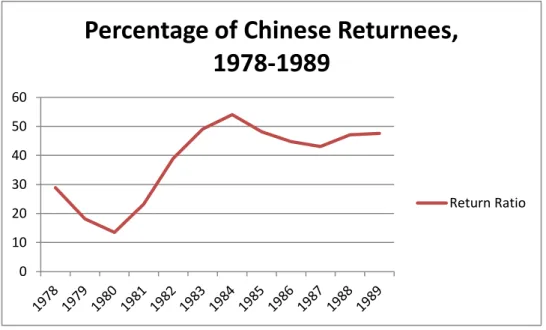
During China’s Maoist era, it was customary for the Chinese government to fund its best and brightest to go abroad either to fellow socialist states such as the USSR or to Europe where leftist ideas were also blossoming. However, in 1984, the State Council of China stated that any student who received admission to a foreign institution and was receiving outside financial support could apply to go abroad through means other than Chinese government scholarship (Yan & Berliner, 2011). By 1985, only 17 percent of Chinese students traveling abroad were government-funded (Orleans, 1988). During the 1980s, the United States, which was enjoying a sort of technological revolution, also reaped the benefits from these highly skilled temporary immigrants. In fact, many of the graduate students who came to study the high level sciences that China needed decided to stay in the United States. From 1978 to 1989, the average ratio of returnees to total number of Chinese students abroad was only approximately 37.98 percent. Some of the participants in this study are part of this majority group, still living and working in the
32
U.S. As illustrated by the graph below, the return ratio reached above 50 percent only once, in 1984 (Cao, 2008).
Figure 1: Chinese student return ratio after studying abroad2
By the late 1980s, Chinese officials began to realize that the country was quickly hemorrhaging talented students in a severe “brain drain”. However, how the Chinese government dealt with the brain drain phenomenon had just as much to do with domestic political struggles as it did with the economic factors associated with brain drain. By 1986, to the Communist Party, it seemed that even students who remained in Mainland China were absorbing Western ideas and using them to weaken the Party’s grip on power. In 1986, a protest began in Hebei, Anhui Province over the officials slated
2 Ratio calculated by comparing the total number of Chinese students departing to study abroad and the total number of Chinese students returning from studying abroad in a particular year. For example, in 1978, 860 students departed and 248 students returned, resulting in a return ratio of 28.84 percent.
0 10 20 30 40 50 60
Percentage of Chinese Returnees, 1978-1989
Return Ratio
33
for election in the local People’s Congress. Students demanded more direct participation in elections, calling for direct election of candidates. The protests in Hebei sparked other pro-democracy protests on college campuses in major cities across China, creating an ideological crisis for the Chinese government (“China- The Third Wave of Reform”, n.d.).
Even considering the threat this posed for the Chinese Communist Party, at that time there was still some conflict within the government over how to deal with the brain drain problem—the State Education Commission advocated greater restrictions on students studying abroad, while the State Science and Technology Commission wanted to try and take advantage of overseas educated students—after the series of protests, Party conservatives won out (Zweig, Fung, & Han, 2008).
In 1987, Premier Deng Xiao Ping made a speech arguing for tighter restrictions on international student exchange, especially to the United States. This speech, and its more formal written version dubbed Document No. 749, proposed lowering the number of Chinese students studying abroad in the United States from the current 68 percent of the total number of Chinese students abroad to 20 percent of total students abroad.
The document also pressured students then studying in the United States to return to China (Zweig & Wang, 2013). These policies continued for the next few years and from the Chinese government’s point of view, they were galvanized by the Tiananmen Square protests in 1989. Immediately following the Tiananmen Square incident, the
government mandated a “country service period,” or a period of time spent working in mainland China, for students that wished to bear the costs of studying abroad—five years for undergraduates and seven years for graduate students (Cao, 2008). Thus,
34
statistics reflect a slight dip in the number of Chinese students studying abroad in this time period.
However, it is worth noting that these overarching policies only reflect the conservative slant that temporarily won out in Chinese politics of the time. Other government backed initiatives reflected the varying views on the brain drain phenomenon briefly mentioned in the paragraph above. For example, in 1989, postdoctoral research centers were established as an incentive for talented students abroad to return to China, and students with an overseas STEM field education were given hiring preference at research institutes and state enterprises (Zweig, Fung, & Han, 2008). Though the initiative to attract students, or at least the knowledge they had gained while abroad, back to China continues to the present day, the conservative isolationism phase was quickly dismantled. By the fall of the Soviet Union in 1991, the Chinese government realized that global exchange was essential in not only economic success, but also survival.
The 1990s: Taking Advantage of Exchange
If the 1980s were characterized by a mass exodus of Chinese study abroad students, then the 1990s marked the beginning of a return migration of “sea turtles,” or 海归 (haigui), the Chinese name for students returned from an education abroad.
Though China did not fully rebound from brain drain crisis of the late 1980s and early 1990s, the returnee trend made a significant step in balancing the exchange with the U.S. While China worked to reap the benefits of expanding Sino-U.S. exchange, the
35
United States also further liberalized its immigration laws to supplement its severely depleted skilled worker population. This expansion in educational exchange developed in tandem with events signifying China’s rise on the global stage. Thus, the 1990s served as a link between the infant stage Sino-U.S. relations of the 1980s and the increasingly close partnership we see today.
Following the Tiananmen Square protests in 1989, the U.S. Bush Administration enacted two major immigration laws. The first law, the Immigration Act of 1990, further liberalized American immigration policy, increasing the caps on the number of legal immigrants to the U.S. It also provided more channels for immigrants hoping to become permanent U.S. residents to obtain worker visas, especially in priority fields like
scientific research and medicine (Bell, 2012). This would have also been of interest to students at the time, who could then with the sponsorship of either a family member or employer, more easily gain lawful permanent resident (LPR) status in the United States.
In 1992, U.S. Congress enacted the Chinese Protection Act of 1992, providing an entirely different channel of immigration for Chinese students still in China and Chinese students already studying in the United States. Preluded by Executive Order 12711, which was issued April 11, 1990 and allowed students in the United States during or immediately after the protests to stay until January 1, 1994, the Chinese Protection Act of 1992 allowed Chinese citizens who entered the United States before Executive Order 12711, regardless of visa type, to apply for LPR status (“Executive Order of April 11”, 1990). Approximately 75 percent of those who applied for LPR status under this law entered the United States on skilled visas, and about half of the total number of
36
applicants were foreign exchange students (Orrenius, Zavodny, & Kerr, 2012). The combination of these two laws created an incentive for Chinese students and skilled workers already in the United States to stay, while also attracting additional students from China, contributing to an acute brain drain that China struggled to plug.
For China, the first step to stemming the talent outflow, or 人才外流 (rencai wailiu) was addressing the restrictive policies implemented in response to the
Tiananmen Square incident in 1989. Liberal policies implemented in the United States in the early 1990s aggravated China’s already existing problem by providing its emigrating nationals more avenues for immigration. However, the fall of the Soviet Union in 1991 showed the Chinese government that in order to merely survive in a globalizing
economy, international educational exchange was necessary. This sentiment to quickly internationalize manifested itself in China’s bid in 1993 to host the 2000 Olympic Games, the largest and most prestigious international exchange that would serve as China’s global unveiling. China lost to Sydney, Australia by a mere two votes (“China & Oly Mov”, n.d.). Even when occasionally shrouded by tense upper-level Sino-U.S. relations,
exchanges continued virtually unhindered. In May 1995, President Clinton agreed to allow Taiwan’s president to visit the U.S., sowing distrust in Sino-U.S. relations (Sutter, 1996). Even so, in the fiscal year 1994-1995, almost 40,000 Chinese students went abroad to study in the U.S., up from just over 33,000 in the year 1988-1989
(“International Student Totals by Place of Origin”, 2009). China’s domestic policies in the context of international events show that the early 1990s marked the beginning of a fundamental shift in China’s strategy to cope with brain drain. Rather than put
37
restrictions on foreign study, the Chinese government would enact policies that encouraged students to return.
In 1992, during a tour throughout Southeast China promoting economic development through international exchange, Premier Deng invited back students abroad, beckoning them with the promise that all the “class enemy” stereotypes touted after the Tiananmen Square demonstrations would be forgotten (Cao, 2008; Zweig, Fung, & Han, 2008). Furthermore, after these students returned to China, they would be granted significantly greater freedom of movement including the freedom to travel abroad again, as well as the freedom to move to a city outside their hukou registered city3 for work (Zweig & Rosen, 2003). This was cemented in public opinion through the Central Committee’s November 1993 slogan, “Support overseas study, encourage returnees to China, grant the freedom to come and go.” (Zweig, Fung, & Han, 2008).
Government initiatives aimed at pooling Chinese academic talent from abroad are summarized in Table 2 below and explained in more detail in the following paragraphs.
Name of
Program Year Implemente
d
Program
Benefits Governmen
t Agency Estimated # of Beneficiarie
s
One Hundred Talents Program
1994; Expanded in 1998
2 million RMB research fund, housing, salary
Chinese Academy of Sciences
800
3 The Chinese household registration system, or hukou system, governs Chinese citizens’ services such as health care and education based on their geographic area of residence.
38 National
Science Fund for
Distinguishe d Young Scholars
1994; Expanded in 1999
Research funding
National
Natural Science Fund of China
1,200
Spring Light Project
1996; Expanded in 1998
Financial support for short-term visits
Ministry of Education
12,000
Changjiang Scholars Program
1998 Professorship
s and Changjiang Scholar Achievement Awards
Ministry of Education
14,000
HOME (Help our
Motherland through Elite Intellectual Resources from Overseas) Program
2004 Funds for
startup projects in various industries (agriculture, biomedical, IT, etc.)
Chinese
Association for Science and Technology
375 persons, 165 enterprises (as of 2008)
Thousand Talents Program
2009 Short-term:
500,000 RMB
&
professorship with 3-yr.
contract Long-term: 1- 2 million RMB
&
professorship
Organization Dept. of Central Committee of the Communist Party
Goal: 1000 professors in the next five to ten years
This table is a combination of statistics pulled from the following sources: Zweig, Fung,
& Han 2008; Cao, 2008; Wang, H. , 2010, and Cai, 2009.
Table 2: Chinese government initiatives aimed at attracting and retaining Chinese academics
39
The Chinese government’s statements on liberalization were then backed by a number of programs geared towards attracting scholars to Chinese universities. The inaugural program, the Chinese Academy of Science’s “One Hundred Talent Program”
initiated in 1994, enjoyed great success. Aimed at attracting at least one hundred young scientists abroad back to China by the end of the century with offers of upwards of 2 million RMB for research, housing, and salary, the program had succeeded in enrolling over 800 scientists in the program by September 2002 (“100 Talents Program”, 2012;
Cao, 2008). In 1998, as a testament to its success, the Chinese Academy of Science expanded the program’s resources and aimed to recruit one hundred elite scientists each year from 1998 to 2001, which is one explanation for the overall increase in returned scientists at that time (Zweig, Fung, & Han, 2008).
Also aimed at attracting young talented scientists, the National Science Fund for Distinguished Young Scholars, or sometimes referred to as the National Outstanding Youth Foundation, provided funding for scientists’ individual research interests. After proving its efficacy, in 1999 the program was granted a large funding increase, from an annual $70 million before 1999 to an annual $180 million afterwards (Cao, 2008). The program is also fairly competitive. From 1994 to 2001, only 710 out of 3000 applications were approved for research, the vast majority of which were young men from Chinese Academy of Science affiliated universities (Cao & Suttmeier, 2001). From 1994 to 2004, the program funded research for 1,174 scholars (Cai, 2009).
Similar programs include the Cheung Kong Scholars Program, launched in 1998 to cater to the same demographic as the two other scholarship programs explained
40
above: talented scientists abroad under the age of 45 (Cao, 2008).These scientists could engage in scientific research in areas the government deemed strategic, as well as serve as visiting professors at elite universities (Zweig, Fung, & Han, 2008). From 1998 to 2007, the program recruited 1,308 scholars (Cai, 2009). Another related program dubbed the
“Spring Light Program,” or 春晖计划 (chunhui jihua), beckoned scientists from abroad for shorter stints—mere months at a time—to conduct research at Chinese universities.
Over 12,000 scientists have become recipients of this grant since 1996 when it was established (Wang, H., 2010).
However, it is difficult to measure the actual impact of these programs because of two main phenomena. First, the large number of overlapping programs aimed at recruiting top scientists resulted in many scientists being simultaneously enrolled in more than one scholarship program. For example, one scientist may have received a grant for individual research under the “Spring Light Program,” while also enjoying elite status as a professor in the Cheung Kong Scholars Program. Therefore, the number of recruits does not fully reflect the efficacy of each policy. Second, most of the above listed grants were geared towards research on a temporary basis, for instance either for three years under the One Hundred Talents Program, or as short as a few months under the Spring Light Program. A Ministry of Education survey conducted in 2000 revealed that only 44 percent of the 551 scientists that had established enterprises in the Chinese
41
government constructed specialized scientific research parks were permanent Chinese residents (Zweig, Fung, & Han, 2008). 4
So what, then, was the significance of these initiatives for students either preparing to go abroad or already studying abroad in the 1990s? Keep in mind that during the 1990s, the majority of students studying abroad were still post- graduate students. On the whole, these programs offered a broader swath of options for potential returnees, options that did not necessarily provide all the human capital benefits of the talented students to either the United States or China exclusively.
Instead, they formed the foundation for what the Chinese Communist Party moderates’
strategy beginning in the late 1980s: take advantage of the knowledge students gained abroad, rather than engage in a futile attempt to stop the ever increasing outflow of students. The 1990s thus saw the rise of two different groups of students that would become even more prominent after the turn of the century: “sea turtles,” or returnees from overseas exchange and “sea gulls,” students who straddle the Pacific, contributing to the human capital of both the U.S. and China and triggered the brain circulation that would become more common in the 2000s (Wang, H., 2010).
The New Millennium: Full Scale Brain Circulation
4 Ministry of Education report titled, ‘留学人员回国创业的发展状况及政策建议’ [The Situation of the Returned Overseas Students and Policy Suggestions: A Research Report on Returned Overseas Students], 2000, cited in Zweig, Fung, & Han, 2008, p.10
42 Current Chinese Policies and Trends
The 2000s saw China’s full integration into the global economy. After Asia rebounded from its 1997-1998 economic bust, China made significant developments in global trade, first by gaining Permanent Normal Trade Status with the U.S. in 2000, then with its official entry into the World Trade Organization in 2001 (“U.S.- China
Chronology”, n.d. ; “China and the WTO”, n.d.). In 2008, China’s deepening economic ties with the U.S. were realized when China surpassed Japan to become the U.S.’s largest foreign creditor (“China’s US Treasury Holdings”, 2013). Chinese educational exchange trends in the 2000s were largely a continuation of the trends established in the 1990s, the only major difference being their mass commercialization. Businesses on both sides of the Pacific were spawned in response to the growing level of exchange, especially in China where a market emerged dedicated to training students in skills necessary to succeed in the U.S. education system, consulting families on college
decisions, and even helping write portions of Chinese students’ applications to overseas universities.
China’s government further developed policies that encouraged brain
circulation rather than brain drain, which were spurred on by a growing middle class and an exponential growth in the number of students studying abroad in the U.S. The
Chinese government even developed a slogan for this strategy, “Serve the nation
without returning to the nation,” (Zweig, Fung, & Han, 2008). Some international events tested Sino-U.S. relations at the higher levels, but this tension did not trickle down into people-to-people educational exchanges. For instance, some claim that the 1999
43
bombing of the Chinese embassy in Belgrade allowed the Chinese government to ferment widespread anti-Americanism at the time, but even if that was the case, it is neither reflected in statistics showing Chinese students abroad in the U.S. nor in this study’s interview responses (Griffiths, 2014). The number of foreign exchange students rose from 51,000 to over 63,000 in the years 1998 to 2001 (“International Student Totals by Place of Origin”, 2009).
Throughout the 2000s, Chinese institutions developed various programs designed to attract overseas talent, both Chinese and foreign. These were built on the tenets of original programs developed in the 1990s— emphasis on science and
technology and temporary travel to China, but at the same time encouraging continued dialogue and shared research. Worth mentioning are the “HOME: Help Our Motherland Through Elite Resources Overseas” Program of 2004, which spawned over 150 projects focusing on agriculture, medicine, and other high tech industries, as well as the “1,000 Talents Scheme” of 2008, which aimed to recruit 1,000 distinguished scholars by 2018 (Cai, 2009). The still continuing “1,000 Talents Scheme,” like other similar programs of the past, offers a $150,000 lump sum, housing funds, and office space for talented academics looking to conduct research and/or business in China (Ford, 2012).
As it turns out, China may have exceedingly high expectations for its talent development programs. According to the country’s mid- to long-term talent
development program, or”国家中长期人才发展规划纲要(2010-2020年)”, by 2020 China will have 180 million “talented persons,” a broad category that includes graduate students, high level managers, and STEM field professionals ("2020年:我国人才总量