Testing one's knowledge or review practice is one of the most effective techniques for learning. Since then, the benefits of retrieval practice on subsequent memory have been firmly established through a number of studies (for reviews, see Rowland, 2014; McDermott, 2021).
Theories of the Testing Effect
Descriptive Accounts of the Testing Effect
- Retrieval Effort Hypothesis
- Dual Memory Theory
- Bifurcation Account
Along the same strength of memory trace, Kornell, Bjork, and Garcia (2011) proposed a bifurcation account, which explains both positive and negative test effects from retrieval practice without feedback. Negative test effect refers to a phenomenon where restudy produces better memory than retrieval practice: when memory is tested after a shorter retention interval, restudy produces higher recall accuracy than retrieval practice.
Mechanistic Accounts of the Testing Effect
- Primary and Convergent Retrieval
- Elaborative Retrieval Hypothesis
- Episodic Context Account
Since the semantically related items generated during retrieval are not provided during the final test, generating more items related to the cue is unlikely to help retain the word, but rather make it more difficult to retrieve the original target to recover. While the episodic context account provides a feasible mechanism of how retrieval practice strengthens memory, the details of the account have yet to be clarified.
Discussion
On the other hand, the episodic context account is one that has received a lot of attention in recent years and has also been directly tested and not yet fully refuted. In the next section, we discuss the mechanisms underlying the episodic context account and the implications of studies that directly tested the account.
A Closer Examination of the Episodic Context Account
Effects of Context Reinstatement during Recall
First, Brewer and colleagues (2010) found that retrieval practice did not improve memory for context features of the items themselves. However, a recent study by Akan, Stanley, and Benjamin (2018) found evidence that retrieval practice improves memory for context features of the items themselves.
Limitations
During retrieval practice, participants were presented with one word of the pair in the center of the screen and asked to recall the second word. There is some evidence that retrieval practice improves memory for temporal context, but mixed results for the contextual aspects of the item itself.
Direct testing of the Episodic Context Account
Across four Experiments 1, we tested predictions from the episodic context account: would retrieval practice of an item also improve memory for its context. Examining the episodic context account: Does retrieval practice improve memory for context? Cognitive Research: Principles and Implications, 4(1), 46.
Experiment 1
Method
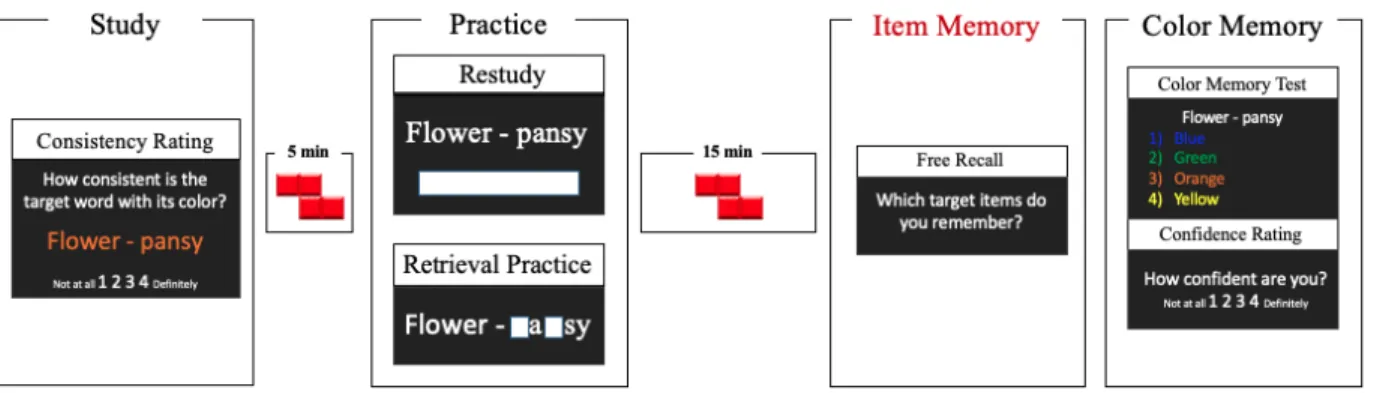
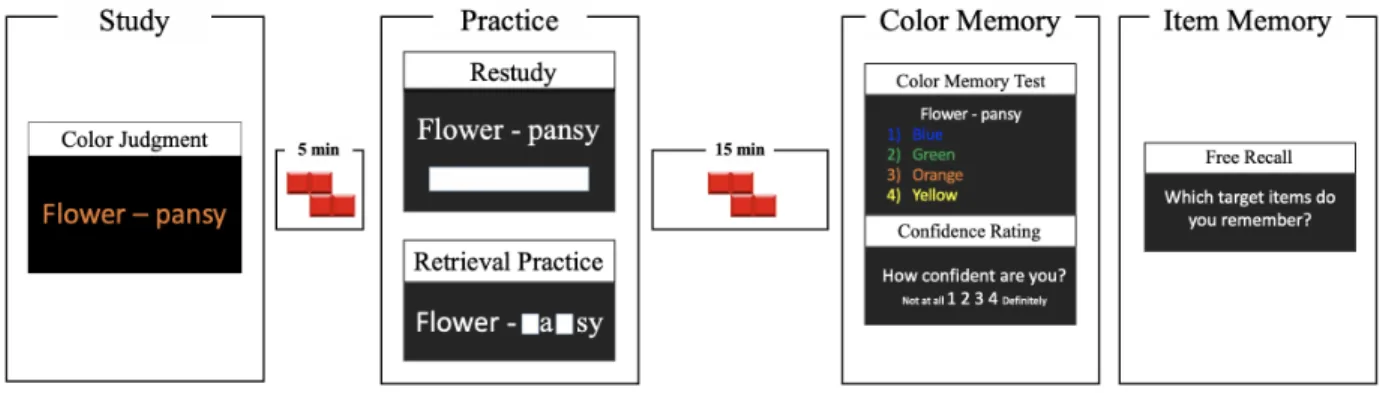
Then, in the color memory test, participants were again shown each of the pairs and were asked to indicate in which of the four colors the pair was presented during the study phase. Finally, participants were asked to recall as many of the target words as possible, in any order (free recall phase).
Results
This final free recall test occurred immediately after participants re-experienced all word pairs in the color test and thus is not a pure measure of the effects of retrieval practice on memory. While this analysis may suffer from item effects (successfully retrieved items are likely to be the items that are easiest to remember), this should work in favor of the episodic context account—improving recall of colors for previously received items.
Discussion
This was intended to make the font color a more integral part of the study context. If the episodic context account is true, we should see improved memory for font color in the retrieval practice condition.
Experiment 2
Method
It is possible that details of the episodic context were indeed recovered during the retrieval exercise, but that the font color was poorly integrated into the study context and as such was not preferentially recovered. Therefore, in Experiment 2 we used a deeper encoding task that required integrating the target word and font color.
Results
Discussion
Experiment 3
Method
Results
Discussion
Experiment 4
Method
Results
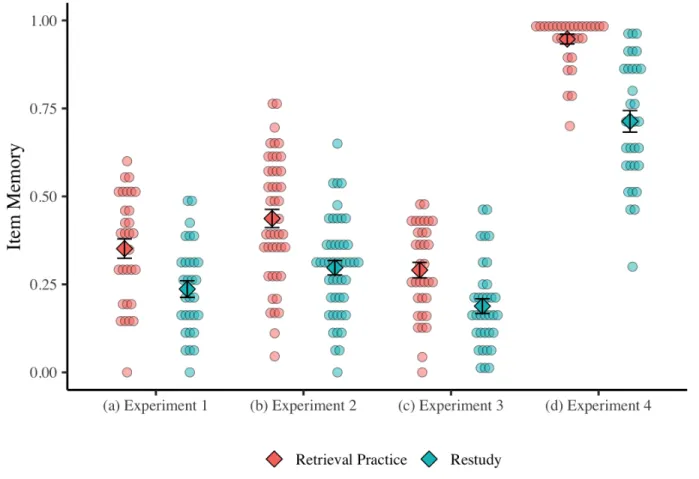
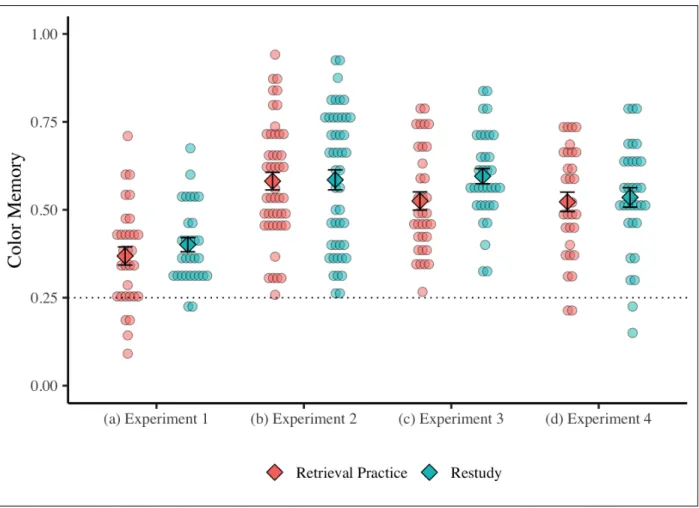
Once again, contrary to the episodic context account, there was no difference in color memory between participants who restudied the target items (M=.54, SD=.16) and those who successfully retrieved them during the practice phase ( M= .52, SD=.15),t(61) =0.32,p=. Items that were successfully retrieved during the practice phase were remembered better than items in the restudy condition (retrieval practice success M=.95,SD=.19vs.
Discussion
1, 2, and 3, we again found no evidence of improvements in memory for the source context (i.e., original font colors) following successful retrieval practice.
Discussion of Experiments 1, 2, 3, & 4
As previously mentioned, however, there is evidence that memory for certain types of context is strengthened during retrieval practice. However, it appears that certain contextual characteristics of the study event (voice gender and font color) are not more memorable after retrieval practice. However, it is also possible that the benefit of retrieval practice is unrelated to the successful retrieval of episodic contextual details.
Temporal Context as a Guide for Memory Search
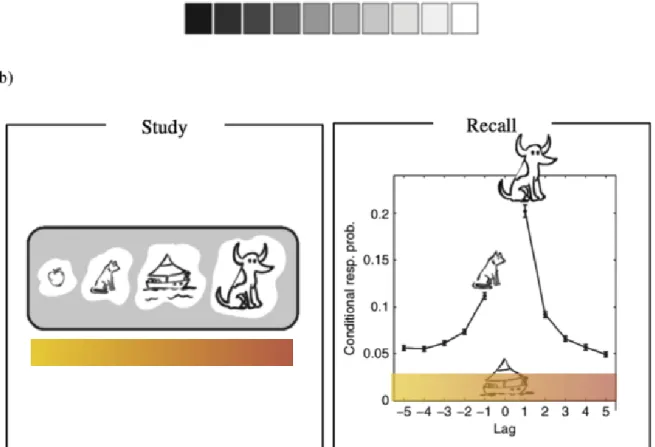
Behaviorally, this effect is seen in participants' recall transitions: after recalling an item, the next recall is likely to be selected from among its temporal neighbors due to similarity in temporal context. Each number represents an element during the study, and the gray represents the associated temporal context. Because of this memory retrieval process, it is reasonable to assume that recalling an item would also reestablish its temporal context.
Context Reinstatement during Episodic Retrieval: Facilitation vs. Forgetting
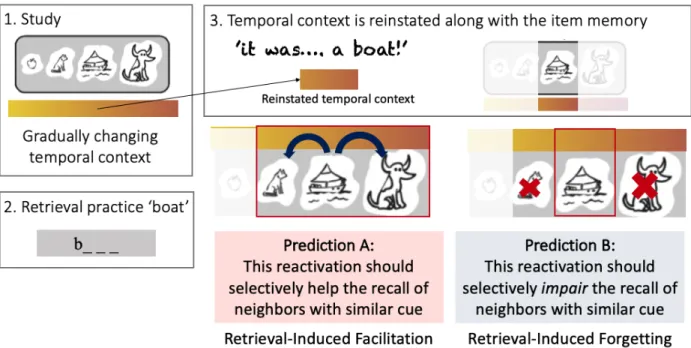
Retrieval-Induced Facilitation from Context Reinstatement
Such ubiquity of the temporal contiguity effect illustrates its role as a reliable guide to memory search and recall. Such a finding is This makes sense under our hypothesis that context reinstatement is the result of the memory retrieval process. Therefore, it is reasonable to predict that recall of items from a study list with strong semantic associations would result in semantic rather than temporal coherence.
Retrieval-Induced Forgetting from Context Reinstatement
The results of the participants' final free-recall test indicated that recall practice improved memory not only for practiced items (i.e., the testing effect), but also for unpracticed items sharing the same scene context compared to the relearning condition. Jonker and colleagues (2018) suggested that this effect was related to the reactivation of the shared encoding context during retrieval practice.
Facilitation or Forgetting: Factors that modulate the effects of reinstated
Similarly, recall of an item can indirectly improve one's memory for items studied close in time, producing an indirect testing effect (Rowland & DeLosh, 2014). This boost in memory for a particular temporal context then links these items together in the shared context (Liu & Ranganath, 2021). Conversely, without context reinstatement, memory for the contextually related items would not differ from items that were not practiced.
Overview of Experiments 5 and 6
When the temporal context associated with the point 'willow', the adjacent points 'clarinet' and. In summary, Experiment 5 was designed to test the presence of temporal context reinstatement, and Experiment 6 was designed to examine temporal and/or semantic context reinstatement during recall. For temporal context, a neighboring item of the retrieved context is one that was studied immediately before or after the retrieved item, whose associated temporal context is very similar to the retrieved item.
Experiment 5
- Method
- Simulated results
- Results
- Discussion
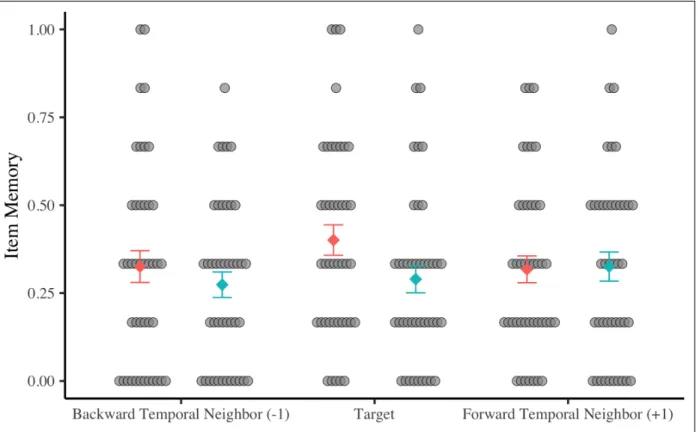
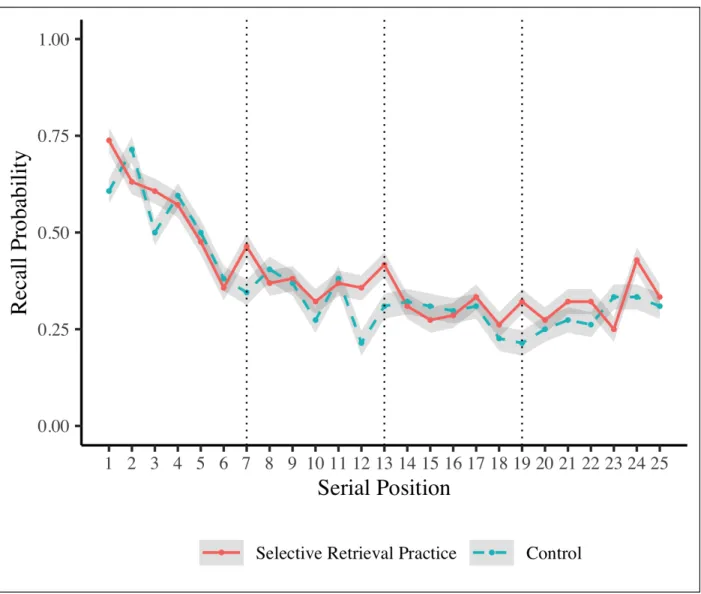
The 7th, 13th, and 19th items from the study list are selected for retrieval practice in the experimental condition (in red). For the target items, items that underwent selective retrieval were recalled significantly better than those in the control condition. However, selective retrieval practice did not result in better or worse item memory for either backward or forward temporal neighbors of the target items.
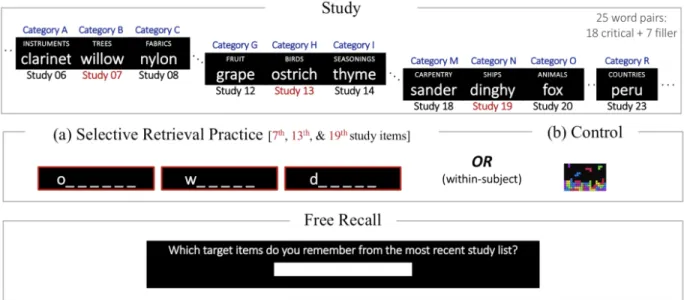
Experiment 6
Procedure
Predicted results and analysis plan
In such a case, we predict that reinstating the context through selective retrieval of the three category B items will benefit participants. Conversely, based on retrieval-induced forgetting theory, it is also possible that untrained B-category items are suppressed from memory as a result of selective retrieval practice of the three category B items. In such a case, we expect to observe the opposite, with the untrained B-category items showing a lower recall rate than other A-category items in the same condition.
Discussion
As observed in Experiment 5, we aim to observe 30–40% accuracies during the selective retrieval practice phase such that participants complete at least one or more items. First, if temporal context is reinstated during retrieval practice, the predicted results are the same as what we predicted in Experiment 4, where temporal neighbors (in the forward direction) benefit from the retrieval practice event.
Summary of Findings
Based on our results from Experiments 1, 2, 3, and 4, we concluded that if the episodic context account is true, context reinstatement may be limited to features more intrinsic to encoding an item, such as semantic or temporal context. Therefore, in Experiment 5 we tested for the presence of retrieval-induced benefit or forgetting from temporal context reinstatement. Similarly, from Experiments 1, 2, 3, and 4, while observing the test effect for practiced items, we found no evidence of benefit or impoverishment from reinstatement of temporal context.
Theoretical Implications
Context Reinstatement during Retrieval: Only Some, but not All
It is possible that context reinstatement is beneficial only when the reinstated context features are relevant to the original encoding event. In summary, these studies indicate that reinstatement of context facilitates recall only when the reinstated context is relevant to the item to be recalled. Spatial context is a type of context that has been shown to be integrated and retrieved regardless of its relevance to the encoding task.
Alternative Theories of the Testing Effect
Akan, Stanley, and Benjamin (2018) showed that participants improved memory for the original spatial context of each studied item (i.e., where each word was presented on the screen during study) after retrieval practice compared to restudy. In other words, while the observation of enhanced memory for source details is consistent with an episodic context account of retrieval practice, it is also consistent with alternative theories in which source details are sometimes retrieved but are not mechanistically involved in prioritizing retrieval practice. Under the episodic context account, the benefits of recall practice derive from a better match between the target memory and its contextual cues during recall.
Cue Binding Hypothesis
Moreover, as noted above, the episodic context account would predict faster recall after successful retrieval practice, based on the assumption that the item is more likely to be sampled from a pool of context-appropriate memories (Lehman , Smith, & Karpicke, 2014; Rohrer and Wixted. If a recall cue can be anything, why does existing research focus primarily on the role of temporal or semantic context during memory search and retrieval. When sitting in a quiet room without changes other than what is presented on the screen, features that reflect the sequence of presentation of an item or its meaning may be the most salient or memorable feature for remembering those items.
Limitations: Correlation, Not a Causation
Furthermore, even if the causal relations were already established, the original description of the account should be revised to clarify the details about context recovery and updating. Descriptions of the version of Karpicke, Lehman and Aue (2014) infer that an item's association with its initial study context and context at retrieval would be equally strong. Furthermore, from the current version of the account, it is also unclear how memory for context is distributed as a function of retrieval frequency (i.e., would a participant have equally strong context memory for each retrieval event? If so, would this cause any interference?) and how many retrieval attempts it may take to decontextualize an item.
Conclusion and Future Directions
Semantic information activated during retrieval contributes to subsequent retention: support for the hypothesis of a mediator efficacy for the testing effect. Impoverished cue support improves subsequent retention: Support for detailing the recall of the testing effect. The effect of testing versus restudying on retention: A meta-analytic review of the effect of testing.
Experiment 1 study design
Source recall performance from Experiments 1, 2, 3, & 4
Free recall performance from Experiments 1, 2, 3, & 4
Experiment 4 study design
Context Maintenance and Retrieval (CMR) Model
Predicted effects of retrieval practice on non-practiced items
Experiment 5 study design
Simulated recall probabilities
Item recall performance from Experiment 5
Recall probability as a function of serial position
Temporal contiguity during free recall
Experiment 6 study design