DON’T MAKE THE SAME MISTAKE TWICE: EXAMINING THE RELATIONSHIP BETWEEN MEMORY FOR ERRORS AND LEARNING
By
Abbey Loehr
Dissertation
Submitted to the Faculty of the Graduate School of Vanderbilt University
in partial fulfillment of the requirements for the degree of
DOCTOR OF PHILOSPHY in
Psychology August 10, 2018 Nashville, Tennessee
Approved:
Bethany Rittle-Johnson, Ph.D.
Lisa Fazio, Ph.D.
Gavin Price, Ph.D.
Lynn Fuchs, Ph.D.
ACKNOWLEDGEMENTS
To Bethany Rittle-Johnson, thank you for your sound advice, support,
encouragement, understanding, and for being a good and decent human being. This would have been so much harder without you. I’ve loved working with you for the past 7 years and will always remember to celebrate the small things. Thanks also to Lisa Fazio for adopting me (especially while Bethany was on sabbatical) and helping me navigate these last few years. Your guidance allowed me to explore an area of research that I find truly engaging and exciting. To my other committee members, Gavin Price and Lynn Fuchs, thanks for always having my back and for taking the time to make my work better and push me on the important issues.
Thank you also to all of Bethany’s past graduate students, Percival Matthews, Kelley Durkin, Katie McEldoon, and Emily Fyfe, who all have and continue to be influential role models in ever-changing ways.
Sofia Jimenez, you’re the best grad school companion I could have asked for.
Thanks for making the most of it with me. Mackenzie Greenwell and Lainey Bell, you’ll both always help me keep it together. Lindsey Hart, may you continue to encourage me and tempt me with your creative pursuits and entrepreneurial spirit. To my parents who have and always will believe in me. Thanks for getting me through the ankle saga. To my big brothers, Marc and Zac Loehr, for sharing your love of learning with me. Zac, this is my biggest report yet.
And to Ralph Noyes, who kept me fed and the dishes clean. Thanks for always reminding me that I would do it and do it well, and for taking me to get ice cream when it’s
TABLE OF CONTENTS
Page
ACKNOWLEDGEMENTS ... ii
LIST OF TABLES ... v
LIST OF FIGURES ... vi
Chapter I. INTRODUCTION ... 1
Debate on Whether Errors Should be Avoided or Leveraged ... 1
Negative Effects of Committing Errors ... 3
Neutral Effects of Committing Errors ... 5
Positive Effects of Committing Errors ... 6
Role of Memory for Past Errors in Error Correction ... 9
Theory of Change ... 11
Role of Age in Memory for Errors and Error Correction ... 13
Current Study ... 17
II. STUDY 1 ... 19
Method ... 20
Results ... 26
Discussion ... 32
III. STUDY 2 ... 35
Method ... 37
Results ... 41
Discussion ... 49
IV. GENERAL DISCUSSION ... 52
Contributions to Existing Memory Literature ... 53
Potential Constraints on the Facilitative Effect of Memory for Errors and Error Correction ... 56
Age ... 56
Adequate Memory for Errors ... 57
Active Generation of Errors ... 59
Educational Relevance of the Task ... 60
Conclusions ... 62
Appendix
A. Math Terms and Definitions ... 63
B. List of Terms Included in Word Banks ... 64
C. Recognition Test Options ... 65
D. Study 2 Post Survey ... 66
REFERENCES ... 67
LIST OF TABLES
Table Page
1. Raw Correlations Between Memory for Errors and Error Correction
in Study 1 ... 31 2. Correlations Between Number of Initial Errors, Memory for Errors,
and Error Correction in Study 1 ... 32 3. Error Correction on the Final Tests by Condition and Word Bank Usage
in Study 2 ... 49
LIST OF FIGURES
Figure Page
1. Overview of Study 1 Design and Procedure ... 23 2. Screenshot of the Word Bank Displayed with an Example Definition ... 24 3. Proportion of Initial Test Responses Recalled in Study 1 ... 27 4. Error Correction on the Final Test as a Function of Whether or Not
the Error was Remembered in Study 1 ... 28 5. Scatterplot Showing the Linear Relationship Between Memory for Errors
and Error Correction in Study 1 ... 29 6. Example of Feedback Presented in Each Condition in Study 2 ... 39 7. Error correction at final test in Study 2 ... 43 8. Scatterplot Showing the Linear Relationship Between Memory for Errors
and Error Correction in Study 2 ... 46
CHAPTER I
INTRODUCTION
Committing errors is a common part of the learning process. A longstanding debate in psychology and education has focused on whether errors should be avoided during learning or if there might be beneficial effects of making and correcting errors. There is a significant body of research that suggests that committing and correcting errors can be beneficial for learning.
Studies examining factors that influence whether errors are corrected on a later test have found that adults’ ability to recall their past errors (i.e., memory for errors) facilitates error correction.
However, evidence suggests preadolescent children’s memory for errors will be worse than adults’, which may impact the relationship between memory for errors and error correction. The current study examines preadolescent children’s memory for errors and if their memory for past errors facilitates error correction. In what follows, I first review the debate on whether errors should be avoided or leveraged. Second, I review theory and evidence for the potentially
important role that memory for past errors plays in error correction. Third, I review evidence that suggests age may play a role in memory for past errors, and may influence the relationship between memory for errors and error correction. Finally, I give an overview of how the current study will answer these open questions.
Debate on Whether Errors Should be Avoided or Leveraged
Classrooms are often adorned with posters stressing the importance of learning from mistakes, highlighting how common errors are during learning. However, there is great debate
researchers in psychology and education argue efficient learning is achieved by avoiding errors as much as possible (e.g., Bandura, 1986; Skinner, 1961; Sweller & Cooper, 1985). Others claim that making and correcting errors can be beneficial for learning (e.g., Janet Metcalfe, 2017;
Schwartz & Bransford, 1998). Unfortunately, past research has used a variety of methods and theoretical framings that can make it difficult to integrate past research on committing and correcting errors. For example, considering differences in learning materials and target populations is important for interpreting results from past research. First, I review theory and evidence supporting the claim that errors should be avoided, and that there are negative effects of committing errors. Second, I review research suggesting there is no cost to committing errors on learning and performance. For these studies, while there is no negative effect of committing errors, there is also no benefit, so evidence in this case reflects neutral effects. Finally, I review theory and evidence that has found positive effects of making and correcting errors. My careful review of the literature leads me to propose that the impact of committing errors depends on the nature of the learning materials. Specifically, there are beneficial effects of committing and correcting errors on learning, at least for adults, so long as the learning materials are semantically rich.
The concern that there are harmful effects of committing errors on learning and performance includes situations in which accuracy feedback is provided. Feedback plays a critical role in error correction (e.g., Anderson, Kulhavy, & Andre, 1971; Bangert-Drowns, Kulik, Kulik, & Morgan, 1991; Kornell & Metcalfe, 2014; Janet Metcalfe & Kornell, 2007).
Unsurprisingly, errors often perseverate if corrective feedback is not provided (Butler &
Roediger, 2008; Kulhavy, 1977; Marsh, Fazio, & Goswick, 2012), and simply providing right/wrong feedback is often not enough for error correction to occur (Bangert-Drowns et al.,
1991; Mullet & Marsh, 2016; Pashler, Cepeda, Wixted, & Rohrer, 2005). Therefore, unless otherwise noted, I only review research in which corrective feedback was provided after errors were committed, and I use the term feedback to refer to correct-answer feedback (i.e., being told the correct answer, without an explanation).
Negative Effects of Committing Errors
The idea that errors should be avoided originates from a behaviorist approach to learning, which suggests that reinforcing correct responses will increase the likelihood of correct
responses being produced again in the future (e.g., Skinner, 1961). Committing errors was said to detract from practicing and reinforcing correct responses, and once errors were made they were thought to persist. Accordingly, making an error was thought to be detrimental to learning.
Similarly, Bandura (1986) stressed the importance of learning from others and practicing correct methods. He argued that without guidance from a more knowledgeable other, learning is
inefficient and time spent making “costly” errors is unnecessarily discouraging and painful for the learner (p. 47). A related learning approach, consistent with practices commonly found in U.S. classrooms, focuses on practicing explicitly taught correct procedures, with the goal of producing relatively errorless learning (Hiebert et al., 2003; Sweller & Cooper, 1985). Focusing student efforts on practicing correct procedures is thought to promote learning by increasing available cognitive resources and supporting the development of accurate knowledge (Kirschner, Sweller, & Clark, 2006; Klahr & Nigam, 2004; Koenig & Harris, 2005; Sweller, van
Merrienboer, & Paas, 1998; Tomasello, Carpenter, Call, Behne, & Moll, 2005). Learning new information taxes working memory, and practicing correct procedures should free up working memory and increase the amount of information that gets stored in long-term memory compared
to trial-and-error learning (Kirschner et al., 2006). Further, students avoid practicing incorrect and inefficient methods that may be difficult to change in the future (e.g., Ausubel, 1964).
One reason committing errors is thought to be harmful is that errors will interfere with learning of correct information, and as a result, errors will persist (Kulhavy & Anderson, 1972).
Further, this interference may make it harder to distinguish between a previously generated error and the correct answer (Kulhavy, 1977). Indirect evidence in support of this concern comes from studies on the persistence of errors. Despite providing feedback or repeatedly presenting correct information, sometimes errors do persist. Errors that adults make when asked to freely recall information from text passages are consistently reproduced on later recall attempts, even after additional presentations of the target text (Fritz, Morris, Bjork, Gelman, & Wickens, 2000;
Howe, 1970; Kay, 1955). Errors that elementary-school children and adults selected from incorrect alternatives on a multiple-choice test sometimes reappear on a later test (Elley, 1966;
Kulhavy & Anderson, 1972). There is also evidence that suggests some errors may be more likely to perseverate than others. For example, elementary-school children are somewhat more likely to reproduce the same error on a later test as compared to a different error (Peeck, van den Bosch, & Kreupeling, 1985). Errors that adults strongly believe to be correct are more likely to reappear after a delay than errors endorsed with lower confidence, such as guesses (Butler, Fazio, & Marsh, 2011). Further, errors reflecting deep-seated misconceptions persist into adulthood, even after years of corrective instruction (McNeil & Alibali, 2005; Siegler & Lortie- Forgues, 2015).
There is some direct evidence that committing errors reduces learning. This research compares learning from making and correcting errors to studying correct information only (sometimes called errorless learning). In these studies, participants learn arbitrary information
(e.g., memorizing English translations of French words). Errors committed during rote learning of arbitrary associations are unlikely (if not impossible) to be semantically related to the correct answers. In these studies, committed errors persisted and interfered with learning for both adults and elementary-school children (Elley, 1966; Warmington & Hitch, 2014; Warmington, Hitch, &
Gathercole, 2013). In addition, amnesic patients struggle to correct errors regardless of the learning material (see Kessels & Haan, 2003, for a review). These individuals likely rely on rote learning processes for all types of learning materials, similar to how typical adults memorize arbitrary information, which may explain why committing errors harms their learning.
Neutral Effects of Committing Errors
Although the negative effects of committing errors seem to be limited to learning of arbitrary associations, errors do sometimes persist for other types of learning materials (Butler et al., 2011; Kulhavy & Anderson, 1972; Peeck et al., 1985). However, just because some errors persist or reappear after a delay, does not mean committing errors is detrimental to learning. In fact, several studies have shown that committing errors does not interfere with learning when learning materials are semantically rich and meaningful (e.g., general knowledge facts, paired associates, or definitions and terms). Two studies examined if exposing individuals to their previous errors while studying feedback interferes with learning (Iwaki, Nara, & Tanaka, 2017;
Peeck & Tillema, 1978). After studying semantically rich materials (e.g., a text passage) and taking a test, individuals received either feedback that included correct answers only or feedback that included reminders of their past test answers along with correct-answer feedback. In both studies, there was no difference in final test performance between these two feedback conditions.
Thus, committing errors, even when these errors are brought to mind while studying the correct answers, does not seem to harm learning.
Studies manipulating whether or not errors are generated before studying the correct answers have also found that committing errors does not interfere with learning. Preschoolers’
learning of slightly associated word pairs was not impacted by whether or not errors were
generated (Carneiro, Lapa, & Finn, 2018). Generating errors before studying the correct answers while learning definitions also had neutral effects on learning relative to studying the correct answers only for middle-school children and undergraduates (Kornell & Metcalfe, 2014).
However, in these experiments, participants in the correct-answer-only study conditions were first shown the definition for a few seconds before the correct answer was displayed. This delay in presentation of the correct answer may have resulted in participants attempting to retrieve the correct answers (generating errors) for the definitions without being instructed to do so. Indeed, in an experiment with adults, delaying the presentation of the correct answer in this way
enhanced learning relative to presenting the definitions and correct answers simultaneously.
Thus, the neutral effects of generating errors in these experiments was likely due to there being positive effects of generating errors in both conditions before studying the correct answers. To summarize, if learning materials are semantically rich, there is little or no evidence that errors will negatively impact learning.
Positive Effects of Committing Errors
In contrast to the view that errors should be avoided, a growing body of research has demonstrated positive effects of committing errors. This research includes a range of
semantically rich learning materials, from related word pairs to math problems, and has been conducted using a variety of paradigms and research goals. One line of research focuses on instructional activities that involve errors. For example, engaging students in exploratory problem-solving activities in which many errors are made relative to activities in which fewer
errors are made (i.e., practicing taught solution methods) promotes retention and transfer after instruction (Bjork, 1994; Kapur & Bielaczyc, 2012). Solving problems before instruction is theorized to support learning by activating relevant knowledge (Schwartz & Bransford, 1998;
Schwartz, Lindgren, & Lewis, 2009), which may make errors more susceptible to correction.
Further, providing opportunities to correct errors after instruction seems necessary for this approach to be effective (Loehr, Fyfe, & Rittle-Johnson, 2014). Relatedly, bringing to mind and directly disputing errors reflecting deep-seated misconceptions supports error correction (e.g., Durkin & Rittle-Johnson, 2012; Guzzetti, Snyder, Glass, & Gamas, 1993; Huang, Liu, & Shiu, 2008).
Error management training (EMT) is another effective instructional activity that has demonstrated positive effects of making and correcting errors for acquiring software skills. EMT has been shown to support robust learning compared to avoiding errors by practicing the correct solution (see Keith & Frese, 2008, for a meta-analysis). During EMT, adults receive little information about task solutions and are encouraged to make errors and use corrective feedback to learn from them. In contrast, error avoidant training involves practice implementing step-by- step instructions or procedures either with or without guidance. A meta-analysis of 24 studies showed EMT supports learning and transfer relative to error avoidant training (Keith & Frese, 2008). Thus, making errors during learning does not impede the construction of correct knowledge. On the contrary, making and correcting errors seems to support deep learning, resulting in knowledge that generalizes to new tasks.
Memory research with adults has also shown a facilitative effect of generating and correcting errors for learning when materials are semantically rich (see Janet Metcalfe, 2017, for a review). The most direct evidence comes from studies that examine learning after manipulating
whether or not errors are generated before receiving feedback. In the typical paradigm, adults are either instructed to generate an answer or not for items in which the correct answer was highly unlikely to be guessed (e.g., weakly related word pairs). Adults exhibited greater learning after generating an answer (which was almost always an error) before receiving feedback compared to studying the correct answer only (Kornell, Hays, & Bjork, 2009). Later studies replicated this effect and identified important boundary conditions for the beneficial effects of generating errors. In particular, the errors need to be at least somewhat semantically related to the correct answer (e.g., Huelser & Metcalfe, 2012; Kang et al., 2011), and the studied word pairs need to be related (Grimaldi & Karpicke, 2012; Knight, Hunter Ball, Brewer, DeWitt, & Marsh, 2012).
These boundary conditions help explain why it is important for learning materials to be semantically rich in order for committing and correcting errors to be beneficial for learning.
Active generation of errors seems to aid memory for the correct answer by activating related knowledge within a semantic network, creating a rich encoding context (e.g., Kornell, Klein, &
Rawson, 2015). When attempting to retrieve the correct answer on a later test, strengthened associations between the error and correct answer and related knowledge provide multiple pathways to the correct answer, resulting in better memory for the correct answer.
While the beneficial effect of generating errors before studying feedback has been well- replicated in adults in the memory literature, few studies have examined this effect with children.
In two experiments that followed the same paradigm used with adults, generating errors
facilitated learning of slightly related word pairs relative to studying the correct answers only for 7- and 9-year-olds but not 5-year-olds (Carneiro et al., 2018). Preschoolers did not benefit from generating and correcting errors, suggesting they may lack the prior knowledge necessary to benefit from activating semantic networks before studying the correct answers. Middle-school
children also benefited from committing and correcting errors while studying synonyms (Kornell
& Metcalfe, 2014). Combined with the evidence for neutral effects of committing errors conducted with children and reviewed above, generating and correcting errors either poses no threat to learning or can facilitate learning of semantically rich information, even in
preadolescent children.
In summary, despite concerns that committing errors will increase the likelihood of perseveration and interfere with learning correct information, a large body of evidence suggests committing errors is not detrimental to learning. The concern that errors will persist and interfere with learning seems to be limited to rote learning of arbitrary associations or when feedback is not provided. The semantic relatedness both within learning materials and between committed errors and the learning materials seems to impact learning. Generating errors reduces learning relative to studying the correct answers when learning materials are unrelated but facilitates learning when they are semantically related (Knight et al., 2012). Further, research has shown that generating errors is not beneficial if the errors are completely unrelated to the correct answers (e.g., Huelser & Metcalfe, 2012; Kang et al., 2011; but see Potts & Shanks, 2014).
When learning materials are semantically rich and meaningful associations can be made, evidence has shown generating errors can facilitate learning, at least for adult learners. The processes of retrieving an answer and activating related knowledge before learning the correct answer seems to support memory for the correct answer.
Role of Memory for Past Errors in Error Correction
While there is good evidence that committing errors can be beneficial for adults’ learning of semantically related information, and neutral or beneficial for children’s learning of similar
material, less is known about what factors influence error correction. Factors commonly
examined include the type and timing of feedback, as well as the effects of instructional activities on correcting errors. In addition, past work has identified the importance of semantic relatedness for error correction (e.g., Huelser & Metcalfe, 2012; Knight et al., 2012), which aligns with my proposal that learning materials need to be semantically rich in order for there to be beneficial effects of committing and correcting errors. While these are all important external factors that influence error correction, the current study focuses on a potentially important internal factor.
Some current evidence and theory suggests an individuals’ memory for their past errors may be an important factor that facilitates error correction. However, most previous research has focused on adults’ later memory for the correct answer after generating errors without examining memory for the previously committed errors. If memory for errors was examined, it was almost always included as a supplemental analysis to determine if errors interfere with memory for the correct answer. Thus, the potentially important role of memory for past errors in error correction has received little attention, and has not been tested with children.
Several studies have shown that adults are more likely to correct an error when they remember the error compared to when they do not remember the error (Butler et al., 2011; Iwaki et al., 2017; Knight et al., 2012; Vaughn & Rawson, 2012; Yan, Yu, Garcia, & Bjork, 2014). In these studies, adults took an initial test on semantically rich information (i.e., general knowledge questions, idioms, or related word pairs) and studied correct-answer feedback. After a brief delay, participants took a final test and were asked to recall their initial test answers. Adults demonstrated accurate memory for both initially correct and incorrect responses. Importantly, a greater proportion of errors were corrected if they accurately recalled the initial error than if they did not accurately recall the error. Thus, when an individual remembers a past error it seems to
facilitate memory for the correct answer. In fact, the beneficial effect of generating errors relative to studying correct answers only has been shown to be limited to cases in which initial errors are remembered (Yan et al., 2014).
Indirect evidence with 11-year-olds also suggests memory for errors plays a role in error correction. In particular, children remembered more of their errors that were later corrected compared to errors that were not corrected (Peeck, 1979; Peeck & Tillema, 1978, 1979; as reported in Peeck et al., 1985; Peeck, van den Bosch, & Kreupeling, 1981). In these studies, children studied a text and answered questions about the text on a multiple-choice test. They received correct-answer feedback and took a final multiple-choice test. After the final test, children were asked to identify their previous test responses by underlining the answer they had chosen on the initial test. Children accurately identified a greater proportion of initial errors that were later corrected on the final test compared to initial errors that were not corrected on the final test (65% vs. 36%). In line with adult research, this pattern of findings suggests memory for errors may be an important factor that supports error correction. However, the measured
outcomes are not the same. The adult research compared the proportion of errors that were corrected as a function of whether or not the error was recalled. In contrast, this research with 11-year-olds compared the proportion of errors that were recalled as a function of whether or not the error was corrected. Thus, there is no clear evidence with children of any age that memory for errors facilitates error correction.
Theory of Change
Although there is limited direct evidence for the effect of memory for past errors on error correction, theoretical frameworks of how memory functions strongly support the hypothesis that memory for errors should enhance error correction. These theories of how memory functions
provide explanations for the processes by which memory for errors may facilitate learning.
Specifically, errors may serve as retrieval cues and support recursive reminding.
First, consider how memory for errors may serve as retrieval cues, sometimes called mediators. Often referred to as verbal mediation or chaining, linking semantically related information to a cue (question) and target (answer) facilitates retention (e.g., Barnes &
Underwood, 1959; Pyc & Rawson, 2010; W. A. Russell & Storms, 1955). Adults seem to spontaneously use mediating cues to aid memory for the correct answer (e.g., Carpenter, 2011;
Pyc & Rawson, 2010). For example, when learning paired associates, adults reported remembering A-B to help them remember A-D by forming an A-B-D chain (Barnes &
Underwood, 1959). Thus, effective mediators are more likely to be remembered along with the correct answers (Pyc & Rawson, 2010). Although this research does not examine errors per say, these findings may generalize such that generated errors function as retrieval cues. For example, if an error that was generated in response to a question becomes linked to the correct answer presented during feedback, remembering the error on a final test may aid retrieval of the correct answer. In fact, some researchers have proposed mediation as an explanation for the beneficial effects of generating errors on later memory for the correct answer compared to studying correct answers only. These researchers have demonstrated that memory for errors facilitates error correction, which is consistent with the mediation hypothesis (Butler et al., 2011; Knight et al., 2012; Vaughn & Rawson, 2012; Yan et al., 2014).
Second, errors may also aid memory for the correct answer through the process of recursive reminding. The process of recursive reminding involves detecting and remembering a change that occurred between two learning events, with memory for each event acting as a reminder of the other (Jacoby & Wahlheim, 2013). Support for this theory comes from a set of
experiments in which adults were tasked with replacing their memory of previously studied A-B word pairs with new A-D word pairs (Wahlheim & Jacoby, 2013). Memory for the new word pairs was better when the corresponding old word pair was remembered than when it was not remembered. Further, when adults detected a change between the old and new word pairs they were very accurate at recalling the old word pair. Thus, the process of detecting and
remembering a change while updating information during learning seems to enhance retention. A similar process may enhance memory for correct information when errors are generated and corrected during learning. If individuals detect a change between their previous incorrect answer and the correct answer, memory for the error should facilitate memory for the correct answer.
There is direct, indirect, and theoretical evidence for the important role of memory for errors in error correction with adults. Adults correct more errors when they remember the error compared to when they do not remember the error (Butler et al., 2011; Iwaki et al., 2017; Knight et al., 2012; Vaughn & Rawson, 2012; Yan et al., 2014). Further, the beneficial effect of
generating and correcting errors seems to depend on an individual’s memory for their past errors (Yan et al., 2014). When errors that are generated during learning are remembered, errors may aid error correction by serving as retrieval cues and supporting recursive reminding. Given that this work has been conducted only with adults, the current studies directly test the relationship between memory for errors and error correction in preadolescent children.
Role of Age in Memory for Past Errors
The adult cognition literature has demonstrated that memory for errors facilitates error correction. This literature has also demonstrated that adults are good at discriminating previously correct and incorrect responses (e.g. Finn & Metcalfe, 2008; Gardiner & Klee, 1976; Robinson &
Kulp, 1970). For example, after studying a list of words and recalling them, adults accurately identified 91% of previously recalled words and 95% of previously unrecalled words from the list (Robinson & Kulp, 1970). Further, after taking a general knowledge test and receiving feedback, adults accurately recalled 98% of their initially correct answers and 85% of their previous errors (Butler et al., 2011). While there has been much less memory research conducted with children (especially in middle childhood), several pieces of evidence suggest preadolescent children’s memory for errors likely differs from adults’. Although definitions vary some, I considered preadolescence to occur from ages 10 to 13. First, I review evidence suggesting preadolescent children’s memory for errors may be less accurate than their memory for
previously correct responses. Second, I review memory development research on broader aspects of children’s memory that may influence memory for errors. Some aspects of preadolescent children’s memory are nearing adult levels, but others continue to develop into adolescence.
First, children’s memory for errors may be less accurate than their memory for previously correct responses (Peeck et al., 1985). Peeck and colleagues have conducted several studies examining 11-year-olds students’ ability to identify their previous multiple-choice test responses.
In these studies, children studied a text, took a multiple-choice test, and received correct-answer feedback. After a delay ranging from one day to one week, students took a final test and were asked to underline the answer they had chosen on the initial test. Students in Peeck et al. (1985) accurately identified 90% of their initially correct responses but only 63% of their initial errors after a one-week delay, which was consistent with identification rates from four prior studies (Peeck, 1979; Peeck & Tillema, 1978, 1979; Peeck et al., 1981). In comparison, adults accurately recalled 98% of their initially correct general knowledge test responses and 61% of their errors after a one-week delay (Butler et al., 2011). While adult’s and 11-year-old children’s memory for
past responses appear to be similar after a one-week delay, the rates for children should be considered an overestimation. It is unlikely recall rates will be as good as identification rates, but no prior study has measured children’s recall of their past responses. Therefore, it is reasonable to expect that children’s recall of their past errors will be worse than adults’.
Additional evidence suggesting preadolescent children may have faulty memory for errors comes from research demonstrating that children overestimate the accuracy of their past responses (Finn & Metcalfe, 2014). After studying social studies and science definitions and taking a cued recall test, 8- and 10-year-old children were shown the correct answer and asked to judge whether their answer on the initial test was correct or incorrect. Children accurately judged definitions they had previously generated a correct response for as being correct 97% of the time.
For a given item initially answered incorrectly, children inaccurately judged their response as being correct 19% of the time. This pattern of results was true for children in both age groups. In contrast, adults inaccurately judge their past errors as having been correct only 3% of the time (Finn & Metcalfe, 2008 Experiment 3). Note that these are conditional probabilities, which can’t be directly compared to children and adults’ previous response recall rates presented earlier.
Nonetheless, it is clear that children were overestimating the accuracy of their past performance more so than adults, which may result in less accurate memory for errors.
Second, some aspects of memory that may influence children’s memory for errors are approaching adult levels during preadolescence, while others continue to develop into
adolescence. Not until age 12 do children’s memory processes become similar to adults’ (see Schneider & Pressley, 1997). For example, performance on a free recall task continually
improves from ages 8 to 12, with 12-year-olds performing similarly to adults (Schneider, Knopf,
& Stefanek, 2002). Thus, memory processes that are recruited during free recall of information, such as encoding, storage, and retrieval, are still exhibiting some growth during preadolescence.
Source monitoring, which includes the ability to remember the sources of memories or knowledge, is another aspect of memory that exhibits clear developmental improvements from preschool to preadolescence (Schneider & Pressley, 1997). Source monitoring may influence children’s ability to discriminate between their previous responses and correct answer feedback.
Indeed, 9-year-olds were more likely than 12-year-olds or adults to confuse their previous incorrect response with the correct answer that was presented during feedback, but 12-year-olds did not differ from adults (Pohl, Bayen, & Martin, 2010). Thus, 9-year-olds exhibit a recollection bias in which correct answer feedback impairs their ability to recall their previous responses.
Other aspects of children’s memory are still developing even later into adolescence, such as episodic memory processes and metamemory monitoring. Basic episodic binding mechanisms contribute to the ability to form detailed memory representations about events or episodes that happened in the past (Eichenbaum & Cohen, 2001; Tulving, 1985). In particular, associative binding is one type of episodic binding mechanism that should contribute to children’s memory for errors. Associative binding involves integrating information about an event that includes details about other events that occurred at the same time (Giovanello, Schnyer, & Verfaellie, 2004; J. Russell, Cheke, Clayton, & Meltzoff, 2011), and continues to improve into adulthood (Lee, Wendelken, Bunge, & Ghetti, 2016). The extent to which children are able to accurately recall a past error depends on how well they remember the episode in which a given cue or question was presented as well as the response they provided. Metamemory monitoring, an individual’s ability to examine the accuracy of their memory, also continues to improve into adolescence (Fandakova et al., 2017). Memory for errors should critically depend on children’s
ability to monitor the accuracy of their memories about their past responses. Thus, preadolescent children are likely to have poorer memory for their errors than adults given weaker episodic memory processes and metamemory monitoring.
To summarize, while adults are good at recalling previous correct and incorrect
responses, evidence suggests preadolescent children may have limited memory of their errors. In part, this may be due to a tendency to misremember their errors as having been correct or
difficulty discriminating between their previous error and the correct answer presented during feedback. Weaker episodic binding and metamemory monitoring than adults may also reduce memory for errors. The current studies are the first to directly examine preadolescent children’s memory for errors by asking children to recall their previous test responses.
The Current Study
Given the important role memory for past errors has been shown to play in error correction with adults (Butler et al., 2011; Iwaki et al., 2017; Knight et al., 2012; Vaughn &
Rawson, 2012; Yan et al., 2014), the current study examined if children’s memory for their past errors facilitates error correction. In Study 1, I examined if preadolescent children were more likely to correct their errors when they remembered the error than if they did not remember the error. Thus, I tested whether previous findings with adults generalize to preadolescent children.
In Study 2, I tested the role of memory for errors in error correction by manipulating the
feedback children received. Specifically, I tested if providing reminders of past errors along with the correct answer facilitated error correction relative to studying the correct answer only or recalling past responses as was done in Study 1. This allowed me to control for individual differences in memory for errors.
Preadolescent children were chosen for two main reasons. First, this age group is very similar to those included in both Finn & Metcalfe (2014) and Peeck et al. (1985), the two prior studies that examined children’s memory for errors. Second, they are nearing adult-levels on some memory process, such as encoding, storage, and retrieval (Schneider & Pressley, 1997), but their source monitoring (e.g., Pohl et al., 2010), episodic memory processes (Lee et al., 2016) and metamemory monitoring (Fandakova et al., 2017) are still developing, indicating that their memory for errors will not be as good as adults. Thus, it is important to test whether previous findings that memory for their past errors facilitates error correction with adults generalizes to preadolescent children.
CHAPTER II
STUDY 1
Children studied math definitions and their terms and took an initial cued recall test.
Immediately following the test, children reviewed the correct answers. To measure children’s memory for errors, children were asked to recall their initial test answers. A final cued recall test and recognition test were given in order to examine error correction.
The first goal of Study 1 was to examine preadolescent children’s memory for errors.
While there is evidence that adults are good at recalling previous correct and incorrect responses (Finn & Metcalfe, 2014; Gardiner & Klee, 1976; Robinson & Kulp, 1970), children’s recall of past errors has not been previously examined. Evidence suggests children’s memory for errors will be worse than adults’. Therefore, I predicted preadolescent children’s memory for errors would be worse than their memory for previously correct responses.
The second goal of Study 1 was to test the relationship between memory for past errors and error correction in preadolescent children. Adults are more likely to correct a greater proportion of previously committed errors if they remembered the error than if they did not (Butler et al., 2011; Iwaki et al., 2017; Knight et al., 2012; Vaughn & Rawson, 2012; Yan et al., 2014), but little is known about how children’s memory for errors influences error correction.
Some research suggests 11-year-old children’s memory for errors is related to error correction (Peeck et al., 1985). According to research suggesting errors may serve as retrieval cues (Barnes
& Underwood, 1959; Carpenter, 2011; Pyc & Rawson, 2010) and support recursive reminding (Wahlheim & Jacoby, 2013), thinking of the initial error should act as a retrieval cue or reminder
of the correct answer, and children’s memory for errors should facilitate error correction. Finally, while past research has used a variety of learning materials, this is the first study to test the effects of committing and correcting errors while learning definitions.
Method
I adopted a similar design and procedure as used in Finn & Metcalfe (2014) Experiment 2. In that experiment, children studied and were tested on their memory for definitions. After reviewing the correct answers, children judged their initial test answers as having been correct or incorrect. Then, children took a final cued recall test, as well as a final recognition test. In the current study, instead of asking children to judge the accuracy of their initial test responses, children were asked to recall their initial responses. This provided a direct measure of memory for past responses. In addition, to test the generalizability of the findings to a new topic, the target content was math definitions rather than science and social studies definitions.
Participants
Participants were 112 middle-school children recruited from 15 fifth-, sixth-, and seventh-grade classrooms at three suburban private and parochial schools and one summer program in Tennessee. Data from 10 children were excluded. Six children’s data were not recorded due to an experiment software error, two children’s responses indicated they did not take the task seriously (e.g., typed “a” for several responses), one child’s session was interrupted, and one child took an unusually long time and did not finish. The final sample (N = 102 children;
66% female) consisted of 53 children who participated at the end of their fifth- or sixth-grade school year and 49 children who participated at the beginning of their sixth- or seventh-grade school year. The average age was 11.9 years (range 10.6-14.2). Approximately 14% of children
were ethnic minorities. Children’s scores on the previous year’s standardized test were at the 76th percentile for math (range = 19th to 99th percentile) and 74th percentile for reading (range = 26th to 99th percentile; scores for 7 children were not available).
None of the children had severe reading disabilities and all children spoke English as their first language. Four children did not have enough time to complete the final recognition test, so they are omitted from those analyses.
Procedure
The study occurred during a single one-on-one session lasting approximately 45 minutes and was conducted on a laptop computer. Children were told that they were going to learn definitions of math terms. They were told to study the definitions so that later they would be able to give the correct word for the definition on a test. Children wore headphones and heard all instructions and definitions read aloud to control for any differences in reading ability between children.
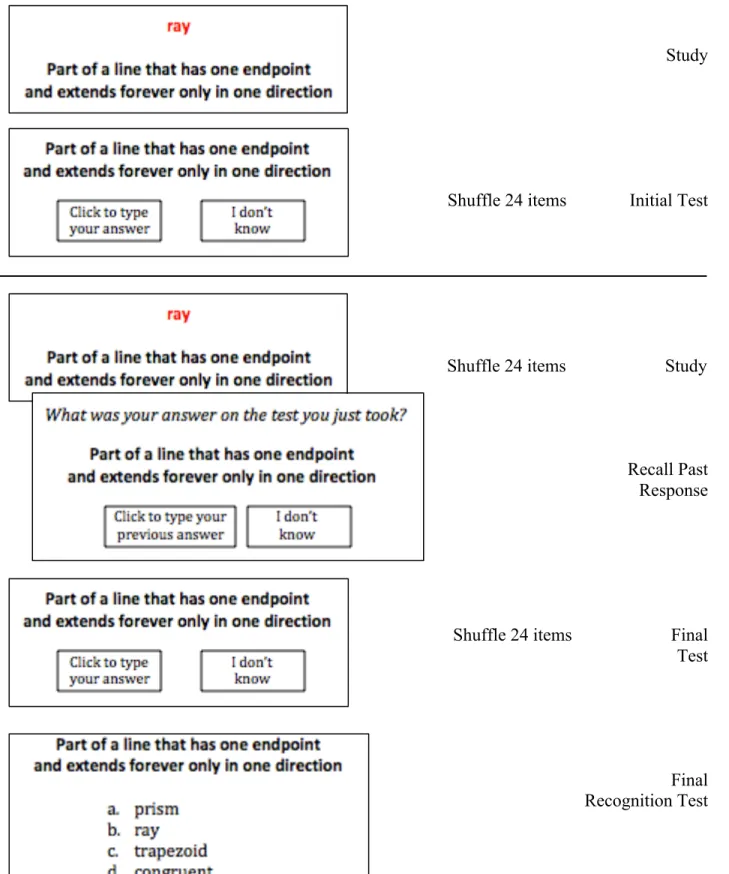
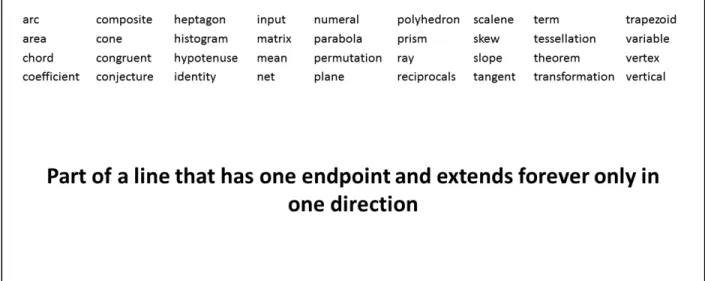
See Figure 1 for an overview of the procedure and examples of how the tasks appeared on the computer screen. During the first study-test cycle, children heard each term and its definition read aloud, which also appeared in writing on the screen. Each term was presented in red above its definition on the screen for 10 seconds. After the study phase, the definitions were shuffled and children took an immediate cued recall test in which the definition was read aloud and children were required to recall the matching term. Children were encouraged to guess if they did not know an answer. If they could not guess they had the option of requesting a word bank to encourage answering. When requested, the word bank appeared across the top of the screen and included a list of 36 math terms (see Figure 2 and Appendix B). Twelve of these terms had not been presented during the study and test phases. This list was presented in
alphabetical order and every term shared the same first letter with at least one other term so that the correct answer could not be identified by only remembering the first letter of the term.
Although a word bank has not been used in previous research in this area, one was added after pilot data demonstrated that instead of generating an error, children often responded with “I don’t know.”
The second study-test cycle immediately followed the first. Children re-studied the definitions and were asked to recall their initial test answer after the correct term disappeared. If children were unable to recall their initial answer, they were instructed to use the same 36-item word bank to help them remember. The definitions were shuffled again, and children took a final cued recall test as well as a final 4-option multiple-choice recognition test (see Figure 1). The word bank was made available upon request during the final recall test to aid retrieval of the correct answer. The recognition test was included in case performance was low on the cued- recall test. While each term and its definition was presented for a fixed amount of time during the study phases, the recall past response phase and all test phases were self-paced.
Study
Shuffle 24 items Initial Test
Shuffle 24 items Study
Recall Past Response
Shuffle 24 items Final Test
Final Recognition Test
Figure 1. Overview of Study 1 design and procedure. If student clicked on “I don’t know” a
Figure 2. Screenshot of the word bank displayed with an example definition
Materials
Children studied and were tested on 24 math definitions (see Appendix A). The definitions were taken from the glossary of middle-school math textbooks, with the majority taken from 8th grade textbooks so that few of the definitions would be known to children before the beginning of the study. See Figure 1 for an example of one of the definitions. The incorrect options for each definition on the final recognition test were randomly chosen from the list of terms included in the word bank (see Appendix C).
Measured Outcomes
Test performance was calculated as the proportion correct on the initial and final tests.
Responses were scored as correct ignoring misspellings. A response was scored as correct if it was spelled phonetically similar or close to the correct term. If a response was close to the correct term but was a different word (i.e., theory instead of theorem), it was scored as incorrect.
Occasionally, it was difficult to tell what the child was trying to spell and these responses was scored as incorrect.
Two primary measures of memory for past responses were calculated for each child based on their responses during the recall past responses phase. First, correct response memory was calculated as the proportion of correct responses on the initial test that were accurately recalled. Second, memory for errors was calculated as the proportion of errors on the initial test that were accurately recalled. I also explored whether children displayed a recollection bias, which was calculated as the proportion of errors on the initial test that were inaccurately reported as the correct answer. Past research suggests that by age 12, recollection bias should not be a substantive issue (Pohl et al., 2010), but recollection bias has not been examined in children between the ages of 9 and 12. Therefore, I did not have a specific hypothesis about whether preadolescent children would exhibit a recollection bias.
Error correction was calculated as the proportion of errors on the initial test that were corrected on the final cued recall and recognition tests. To investigate how memory for errors influences error correction, for each child I calculated the proportion of initial errors corrected given that they remembered the error:
number of initial errors that were remembered and corrected total number of initial errors remembered
, as well as the proportion of initial errors corrected given that they did not remember the error:
number of initial errors that were NOT remembered but were corrected total number of initial errors NOT remembered
Given that the denominators of the measures are based on the proportion of initial errors remembered or not remembered, children who remembered less than three initial errors (n = 26
children) and did not remember less than three errors (n = 3 children) were excluded. This left 74 children who were included in the analysis of error correction.
Results Memory for Past Responses
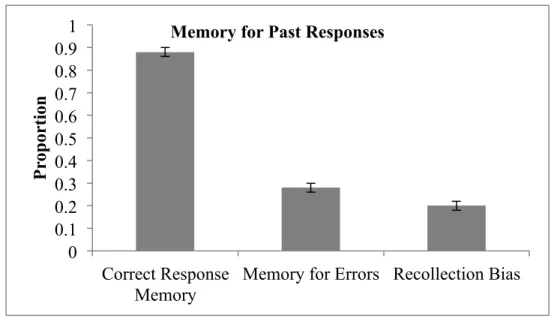
The task was designed so that most of the definitions would be unknown to children, and as expected children made many errors on the initial test (M proportion of initial test errors = .65, SE = .02). Figure 3 shows the proportion of initial test responses that were accurately recalled during the recall-past-response phase. Children’s correct response memory was accurate (M = .88, SE = .01). As expected, memory for errors was dramatically lower than correct response memory (M = .28, SE = .02). In comparison, adults accurately recalled .98 of initially correct responses and .85 of initial errors in a similar study (Butler et al., 2011).
I next explored whether memory for errors was low due to children’s tendency to confuse the correct answer and their previous error, which may reflect a recollection bias (see Figure 3).
Children inaccurately reported the correct answer instead of their past error for 20% (SE = 2%) of their initial errors. Similarly, Finn & Metcalfe (2014) found that 8- and 10-year-olds
misremembered 22% of their initial errors as having been correct. Thus, preadolescent children’s memory for errors in the current study was positively biased to a similar extent.
Figure 3. Proportion of initial test responses recalled in Study 1
Initial and Final Test Performance
Children’s proportion of correct answers increased from the initial recall test (M = .35, SE
= .02), to both the final recall (M = .46, SE = .02) and recognition test (M = .75, SE = .02), t(101)
= 10.4, p < .001, t(97) = 30.9, p < .001, respectively. However, accuracy remained fairly low on the final recall task, and thus error correction was only modest (M = .28, SE = .02, range = .00 to .88) and lower than expected. Error correction was greater on the recognition test (M = .66, SE = .03, range = .00 to 1.00).
Memory for Errors and Error Correction
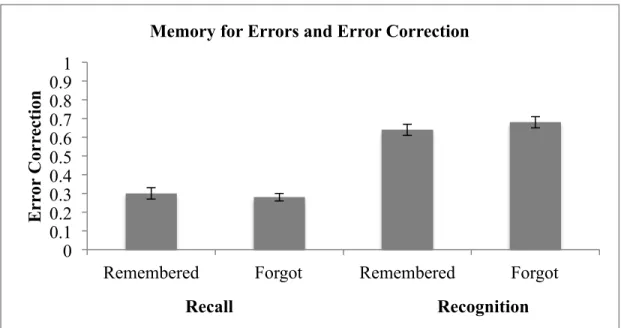
To determine if memory for errors facilitates error correction, a paired samples t-test between the proportion of initial errors corrected given that the error was remembered and the proportion of initial errors corrected given that the error was not remembered was conducted, as was done in Butler et al. (2011). Contrary to my hypothesis that memory for errors would facilitate error correction, children were equally likely to correct their errors on the final cued
0 0.1 0.2 0.3 0.4 0.5 0.6 0.7 0.8 0.9 1
Correct Response Memory
Memory for Errors Recollection Bias
Proportion
Memory for Past Responses
recall test when they remembered the errors (M = .30, SE = .03), as when they did not remember the errors (M = .28, SE = .02), t(73) = .81, p = .42 (see Figure 4). While error correction rates were higher on the final recognition test, again there was no difference between error correction when children remembered the errors (M = .64, SE = .03) compared to when they did not (M = .68, SE = .03), t(73) = -1.1, p = .27.
Figure 4. Error correction on the final test as a function of whether or not the error was remembered in Study 1
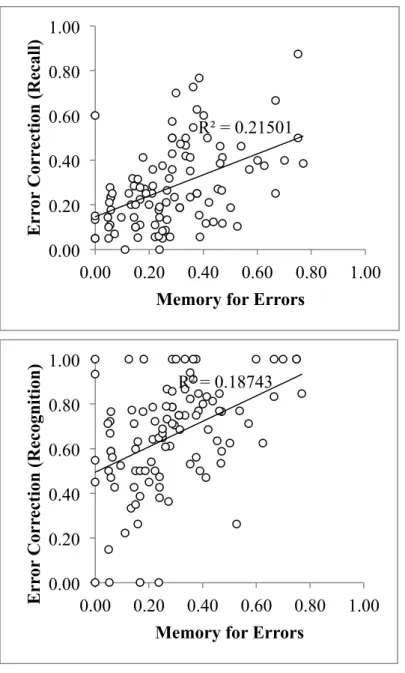
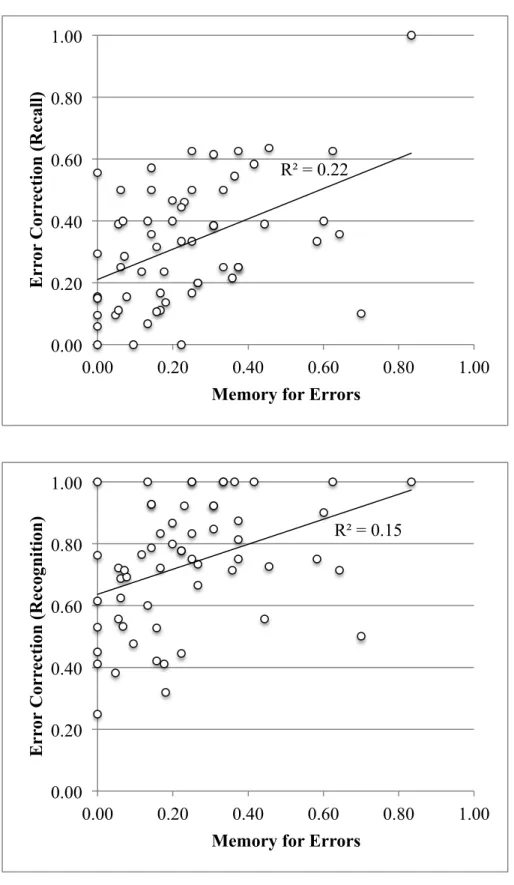
Because children’s memory for errors was much lower than expected, the relationship between memory for errors and error correction was also examined by conducting an exploratory between-subjects correlation analysis. Children’s memory for errors was strongly, positively correlated with error correction on the final recall test, r(100) = .46, p < .001, and the final recognition test, r(100) = .43, p < .001 (see Figure 5). The correlations remained significant even
0.1 0 0.2 0.3 0.4 0.5 0.6 0.7 0.8 0.9 1
Remembered Forgot Remembered Forgot
Error Correction
Recall Recognition Memory for Errors and Error Correction
reading tests, r(89) = .26, p = .01 and r(89) = .25, p = .02, respectively. Thus, children who were better at remembering their errors corrected more errors on the final tests, providing some support for my hypothesis that memory for errors plays an important role in error correction.
Figure 5. Scatterplots showing the linear relationship between memory for errors and error correction in Study 1 on both the final recall test (top) and final recognition test (bottom)
R² = 0.21501
0.00 0.20 0.40 0.60 0.80 1.00
0.00 0.20 0.40 0.60 0.80 1.00
Error Correction (Recall)
Memory for Errors
R² = 0.18743
0.00 0.20 0.40 0.60 0.80 1.00
0.00 0.20 0.40 0.60 0.80 1.00
Error Correction (Recognition)
Memory for Errors
Supplemental Analyses
Word bank usage. Children often requested the word bank on the initial test (M = .64, SE
= .02), final test (M = .55, SE = .03) and recall phase (M = .39, SE = .02). Additionally, a greater proportion of initial errors were chosen from the word bank than were generated (M = .78, SE = .02 vs. M = .22, SE = .02). Thus, I explored how word bank usage influenced memory for errors and error correction. Forty-nine children who generated at least three errors and chose at least three errors from the word bank were included in these analyses. Memory for errors was better for errors that were generated (M = .43, SE = .04) compared to errors that were chosen from the word bank (M = .21, SE = .03), t(48) = 5.1, p < .001. Similarly, a greater proportion of errors that were generated were corrected on the final cued recall test than errors chosen from the word bank (M = .32, SE = .04 vs. M = .23, SE = .02), t(48) = 2.7, p = .01. However on the final recognition test, no differences in error correction were found for errors that were generated versus chosen from the word bank (M = .62, SE = .04 vs. M = .63, SE = .03), t(48) = -.33, p = .75.
Interestingly, memory for errors was positively associated with error correction for generated errors but not for errors that were chosen from the word bank (see Table 1). There was a significant, positive correlation between memory for errors and error correction on the final cued recall and recognition tests for generated errors, r(47) = .55, p < .001, r(47) = .35, p = .01, respectively. The correlation for the final cued recall test remained significant after controlling for age, grade, and performance on the previous year’s standardized math and reading tests, r(39)
= .37, p = .02, but not the recognition test, r(39) = .08, p = .60. However, no relation between memory for errors and error correction on either the final cued recall or recognition test was found for errors that were chosen from the word bank, r(47) = .07, p = .63, r(47) = -.01, p = .94,
respectively. Unfortunately, I could not extend analyses on the proportion of initial errors corrected given that the error was remembered versus not remembered for generated errors. The number of children who committed and remembered a sufficient number of generated errors to be considered in this analysis was too small (n = 10 children).
Table 1: Raw correlations between memory for errors and error correction
Final Test
Generated Error (.22 of initial errors)
Chosen Error (.78 of initial errors)
Recall .55* .07
Recognition .35* -.01
Note. *Correlations significant at the p < .05 level.
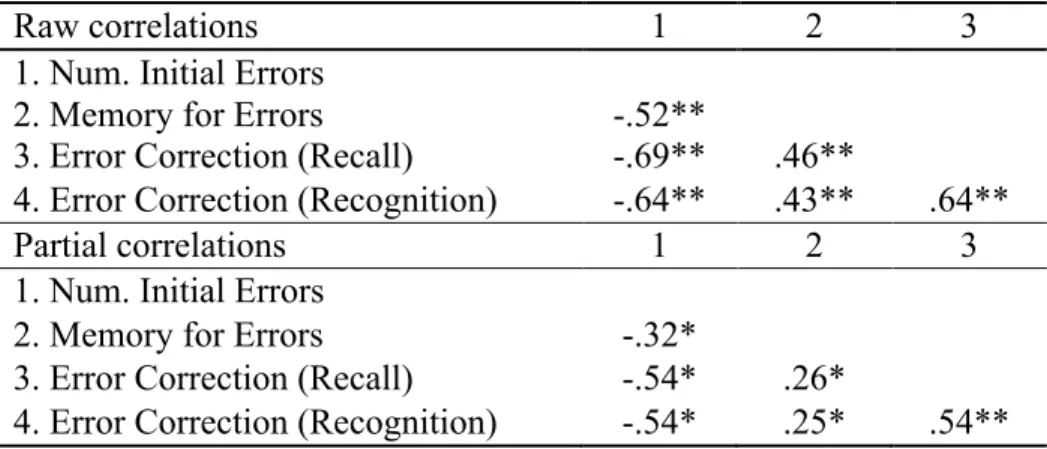
Role of quantity of errors. The role of memory for errors in error correction may depend on the number of errors an individual commits. For example, an individual who commits several errors has more errors to remember compared to an individual who commits few errors, which is likely to impact their memory for errors. Similarly, the number of initial errors committed likely influences error correction. The more initial errors an individual commits, the more correct answers there are to be remembered. Therefore, I conducted an exploratory analysis of how individual differences in the number of errors committed influenced memory for errors and error correction. The number of initial errors committed was negatively related to memory for errors, r(100) = -.52, p < .001, and error correction on both the final recall r(100) = -.69, p < .001, and recognition, r(100) = -.64, p < .001, tests (see Table 2). Indeed, children who committed more errors on the initial test recalled fewer of those errors and corrected fewer errors on both the final recall and recognition tests. These correlations remained significant after controlling for age,
grade, and performance on the previous year’s standardized math and reading tests, r(89) = -.32, p < .01, r(89) = -.54, p < .001, r(89) = -.54, p < .001, respectively (see Table 2).
Table 2: Correlations between number of initial errors, memory for errors, and error correction
Raw correlations 1 2 3
1. Num. Initial Errors
2. Memory for Errors -.52**
3. Error Correction (Recall) -.69** .46**
4. Error Correction (Recognition) -.64** .43** .64**
Partial correlations 1 2 3
1. Num. Initial Errors
2. Memory for Errors -.32*
3. Error Correction (Recall) -.54* .26*
4. Error Correction (Recognition) -.54* .25* .54**
Note. **Correlations significant at the p < .001 level and *p < .05 level.
Discussion
Study 1 is the first study to examine children’s recall of past correct and incorrect test answers. After studying and being tested on mathematics definitions, preadolescent children reviewed the correct answers and recalled their previous test answers. Error correction was examined on a final recall and recognition test. As expected, children demonstrated good correct response memory and their memory for errors was lower than their correct response memory.
But, memory for errors turned out to be much lower than expected. In part, children’s memory for errors was low because they misremembered 20% of their past errors as having been the correct answer, which may reflect a recollection bias (Pohl et al., 2010). Nearly as often as children accurately recalled their past errors, children inaccurately reported the correct answer instead of their past error. Similar to 8- and 10-year-olds in Finn & Metcalfe (2014), 11- to 13-
children’s poor memory for errors may have been due to weaker episodic binding processes and metamemory monitoring, which continues to improve into adolescence (Fandakova et al., 2017;
Lee et al., 2016).
I conducted a follow-up study with 21 undergraduate adults to explore whether poor memory for errors is due to the nature of the task (studying math definitions), which has not been used in past research. Adults committed significantly fewer errors on the initial test than children (.25 vs. .65), but were far from ceiling. Adults accurately recalled only .63 of their initial errors, compared to .76-.85 in past research with adults (Butler et al., 2011; Iwaki et al., 2017; Yan et al., 2014). However, children’s memory for errors was still much lower than adults’ (.28 vs. .63).
I found mixed findings for the importance of memory for errors in error correction.
Contrary to expectations, error correction did not vary depending on whether children remembered the error or did not remember the error. However, children’s poor memory for errors may have impacted the relation between memory for errors and error correction. Memory for errors facilitates error correction in adults (Butler et al., 2011; Iwaki et al., 2017; Knight et al., 2012; Vaughn & Rawson, 2012; Yan et al., 2014), but adults are able to recall many of their initial errors. In order for memory for errors to facilitate error correction, either by providing retrieval cues or supporting recursive reminding (e.g., Barnes & Underwood, 1959; Wahlheim &
Jacoby, 2013), an individual must first be able to accurately recall the error. In Study 2, reminders of past errors were provided along with the correct answer to ensure sufficient memory for errors.
Although remembering a specific error did not facilitate later correction of that error, children who were better at remembering their past errors tended to correct more errors overall.
Memory for errors potentially reflects a more general metacognitive skill that learners use to
monitor the accuracy of their past performance. Children who are better at remembering which items they got wrong may focus more attention on studying correct-answer feedback for these items. Indeed, Fandakova et al. (2017) found reciprocal relations between metamemory monitoring and cognitive ability, suggesting monitoring the accuracy of previous performance plays a critical role in learning.
Supplemental analyses suggest the relationship between memory for errors and error correction may be influenced by children’s confidence in the error, as indicated by their use of the word bank. Errors that were generated may have been endorsed with higher confidence than errors that were chosen from the word bank, which may have reflected guesses. Adults are more likely to recall and correct errors endorsed with higher confidence than errors endorsed with lower confidence (Butler et al., 2011). I found that memory for errors, error correction, and the relation between the two varied depending on whether errors were generated or chosen from the word bank. Children were better at remembering errors that were generated and were also more likely to correct generated errors. Further, the positive relationship between memory for errors and error correction was only present for generated errors. Thus, memory for errors may only aid error correction for errors that are endorsed with at least some confidence compared to errors that are wild guesses. To investigate this hypothesis, I measured children’s confidence in their initial test answers in Study 2.
CHAPTER III
STUDY 2
The goal of Study 2 was to examine the relationship between memory for errors and error correction by manipulating the feedback children received to ensure sufficient memory for errors. Given the difficulty children in Study 1 had recalling their initial errors, one form of feedback provided reminders of children’s past responses along with the correct answers (past- response-reminder condition). In a second condition, feedback included the correct answers only and no reminders or prompts to think about past responses or performance (correct-answer-only condition). In a third condition, children recalled their past response after the correct answer was presented as occurred in Study 1 (recall-past-response condition). This condition provided an opportunity to replicate findings from Study 1.
Reminders of past errors should serve as retrieval cues that help children remember the correct answer. While adults spontaneously use mediating or retrieval cues to aid retention (Carpenter, 2011; Pyc & Rawson, 2010), preadolescent children may need additional support to use this sophisticated memory strategy. Reminders of past errors should also enhance detection of change between their error and the correction answer, supporting recursive reminding (Wahlheim & Jacoby, 2013). Thus, I predicted that children in the past-response-reminder condition would correct more errors on the final test compared to children in the correct-answer- only and recall-past-response conditions.
Alternatively, there is a possibility that error correction depends on the process of retrieving past errors, in which case error correction will be higher in the recall-past-response
condition. Retrieving information from memory, regardless of whether or not retrieval attempts are successful, supports robust learning for a variety of semantically rich learning materials (e.g., Goossens, Camp, Verkoeijen, Tabbers, & Zwaan, 2014; Kornell et al., 2015; Kornell & Vaughn, 2016; Lipko-Speed, Dunlosky, & Rawson, 2014).
There may also be advantages of providing correct answers only. Reminders of past errors may distract children from focusing on the correct answer by overloading their limited working memory capacities (e.g., Sweller et al., 1998). This may be particularly relevant given the low performance of children on my task. Further, there is some evidence that focusing on errors may reduce learning. Instructing adults to notice and keep track of when they had made an error while studying correct feedback reduced recall compared to not prompting adults to notice their errors (Fritz et al., 2000). Adults studied text passages and were asked to recall as much meaningful content as possible. The text passages were represented after a one-week delay, during which some adults were instructed to make a tally mark on a study sheet when they noticed they had made an error on the previous test. Adults in the comparison conditions were instructed to focus on studying and recalling as much as they could from the text passages. On a final free recall task, adults who were asked to notice and keep track of their past errors
performed significantly worse than the other groups. Thus, contrary to my hypothesis, children in the correct answer only condition may perform the best.
Alternatively, given that children need to only remember the correct answer to perform well on the final test, providing any additional information may be unnecessary for error correction to occur. For example, 11-year-old children and adults who received correct-answer feedback along with their previous responses (which functioned as a reminder of their past errors) performed equally well on a final test as those who received feedback without their
previous responses (Iwaki et al., 2017; Peeck & Tillema, 1979). Thus, contrary to my hypothesis, children in all three conditions may perform equally well on the final test.
Method Participants
Participants were 184 middle-school children recruited from sixth- and seventh-grade classrooms at seven suburban private and parochial schools and one public charter school in Tennessee. Data from 6 children were excluded. Three children’s data were not recorded due to a computer error, one child’s responses indicated they did not take the task seriously (e.g., typed random letters for several responses), one child ran out of time, and one child had a severe diagnosed reading disability. Four children did not meet my criteria of committing at least three errors on the initial test to be included in error correction analyses, so they were also excluded.
The final sample (N = 174 children; 48% female) consisted of 78 children in sixth grade and 96 children in seventh grade. The average age was 12.7 years (range 11.2-14.3). Approximately 23% of children were ethnic minorities. Children’s scores on the previous year’s standardized test were at the 69th percentile for math (range = 2nd to 99th percentile) and 73rd percentile for reading (range: 9th to 99th percentile; scores for 32 children were not available). None of the children had severe reading disabilities and all children spoke English as their first language.
Chi-square tests confirmed that gender did not differ significantly by condition, χ2 (2, N = 174) = .32, p = .85, but ethnicity did, χ2 (10, N = 174) = 22.5, p = .01. Therefore, ethnicity was included as a covariate in all models testing condition differences. An ANOVA confirmed that age and previous standardized test percentiles for math and reading did not differ significantly by
condition F(2, 171) = .10, p = .90, F(2, 139) = 1.1, p = .34, F(2, 139) = .78, p = .46, respectively.
Design and Procedure
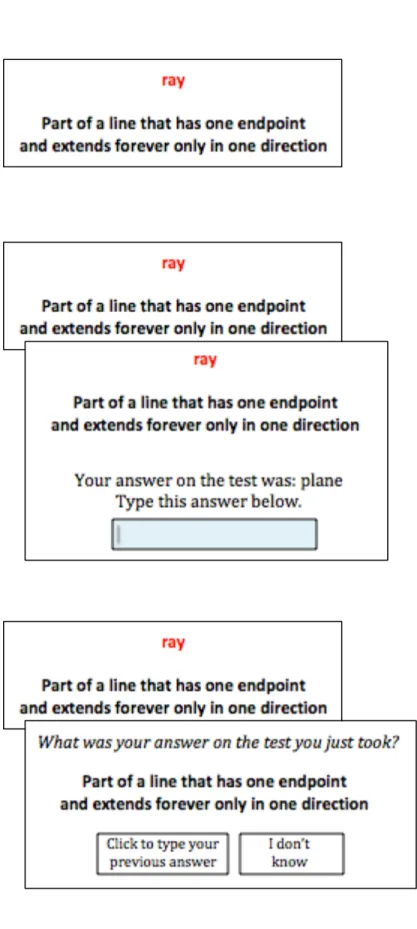
The procedure was identical to Study 1 with two exceptions. First, on the initial test children were asked how confident they were that their answer was correct on a scale from 1 (not sure) to 4 (very sure). Second, the type of feedback presented during the second study phase varied by condition (see Figure 6). Children were randomly assigned to one of three feedback conditions: past response reminder (n = 57), recall past response (n = 59), or correct answer only (n = 58). Each definition and term was presented for 10 seconds in all three conditions. Children in the past-response-reminder condition were then shown their previous test answer while the correct term remained on the screen and were asked to type their previous test answer. This was done to ensure that they processed both the correct answer as well as their previous test answer.
Detailed instructions were provided along with an example to ensure children understood that they were to enter their previous test answer instead of the correct answer for items they an