With this idea, the work at Casa Grande was therefore continued—the idea of restoring for posterity a representative prehistoric settlement of the deserts of southern Arizona. Needless to say, this plan deserves the support of the settlements near which the ruins lie.
COMPOUNDS
COMPOUND A
The eastern wall of the six ceremonial rooms extends east of Casa Grande, and once roughly formed a retaining wall. It extended south and formed the main wall of the central building and the eastern wall of the southwest plaza.
FEWKES] EXCAVATIONS AT CASA GRANDE, ARIZONA 297 tween the end of one wall and the face of another upon which it
BUILDINGS
Southwest Building
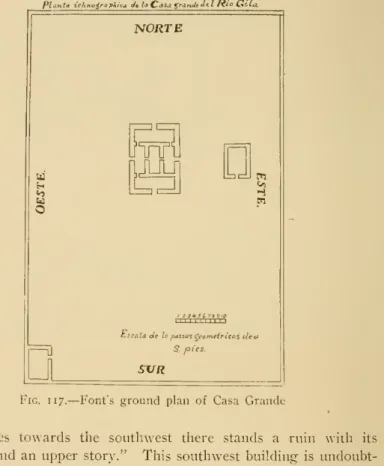
Father Font wrote of Casa Grande as follows: “The house Casa Grande forms an oblong square facing the four cardinal points, east, west, north, and south, and surrounding it are ruins indicative of a fence or wall that surrounded the house. house and other buildings, especially in the corners, where it looks as if there had been a building such as an inner castle or watchtower, because in the corner.
NORTE
FEWKES] EXCAVATIONS AT CASA GRANDE, ARIZONA 299
Northeast Building
The arrangement of the rooms in the northeastern building (Plate xxvii, a, b, c) is different from that of Casa Grande,1 but is typical of others, especially the outer-mural clan houses. The typical shape referred to is that of a carpenter's square, or that of two sides of a rectangle – a shape that is also reflected in the rectangle. Since one arm of the northeastern cluster is formed by the eastern wall of the compound.
There are five chambers in the east-west arm of the northeastern cluster (Plate xxiv), two at each end, separated by a single chamber. Room A, on the west side of the eastern arm of this experimental square, had been partially excavated before the government began work. Casa Grande, but was left in such poor condition that parts of the east and south walls were practically destroyed.
It was open to the level of the floor, which was hard and well plastered.
EEWKES] EXCAVATIONS AT CASA GRANDE, ARIZONA 3OI
Rooms on the West Wale
SOthey indicated a room of large size.1 In one corner there stood a they indicated a room of large size.1 In one corner there stood a large vase, too fragile to remove , which was consequently left where it was found. One of these rooms, J, is situated at the north-west corner of the ruin, and has its west wall continuous with that which forms the retaining wall of the north terrace. There are also two rooms on the south-west corner which are similarly connected to the terrace wall of the south side.
There does not appear to have been a building directly west of the main ruins and no sign of a terrace. As shown in the plan (plate xxiv), there are walls in that part of the compound; There is also a level space called the southwest square, located between the wall of the southernmost room in the southwest corner of the main ruins and the northern wall of the room in the west wall adjacent to the building in the southwest corner.
Six Ceremonial Rooms
TEWKES] EXCAVATIONS AT CASA GRANDE, ARIZONA 303 isted, and that they were probably united to a solid terrace which we
Central Building
TEWKES] EXCAVATIONS AT CASA GRANDE, ARIZONA 303and that they were probably combined into a solid terrace which we. The southeast corner of the main building, the Casa Grande, is broken in much the same way as the northeast corner near the six ceremonial rooms, probably from the same cause.
Font's Room
FEWKES] EXCAVATIONS AT CASA GRANDE, ARIZONA 305building above ground, except for two walls on the south-.
FEWKES] EXCAVATIONS AT CASA GRANDE, ARIZONA 305 building above ground, with exception of the two walls at the south-
- Rooms between Casa Grande and Font's Room
- Rooms Adjoining the Most Northern oe the Six Cere- monial Rooms
- Northwest Room
- Rooms near East Wall
A bricked-up doorway, reminiscent of a similar feature of the west room of the main building, occurs in the wall that separates this room from the northernmost of the six ritual rooms. On the surface of the west wall of this room, at floor level, a deep erosion of the wall is visible, due to former weathering, which is shown in Plate xxix. The south wall of this enclosure was evidently built when the erosion occurred, as its end is built to extend into the eroded area, traces of imperfections in the surface without itself being weathered at that level.
No evidence of roofs occurs and side doors are absent except on the east side of I. This room is one-storey with free walls on two sides, the other sides being the walls of the building. Near this corner room there is an entrance to the property on the north side.
South of the plaza that lies eastward from the two-story building known as Font's room are the remains of some massive walls that formed a large square enclosure separated from the eastern wall only by a narrow passage.1 . 1 The old stage road from Florence to Casa Grande took advantage of a low spot in the eastern wall for its entrance to the complex.
EEWKES] EXCAVATIONS AT CASA GRANDE), ARIZONA 307 This building was evidently formerly one story high. Its size is
- The Northeast Peaza
- Central Peaza
- East Plaza
- Southwest Plaza
- South Court
5a In this square, near the passage west of the high wall of Font's room, the skeleton of an eagle and several rabbit bones were unearthed. From the roof of the main building you could probably look over Font's room to this square. The mounded earth was cut to its original level and removed from the site.
This square adjoins the west wall of the complex, extending from the rooms southwest of the main ruins to the first of the group of rooms in the southwest corner. Although large quantities of earth were removed from this enclosure, it has not been completely leveled with the floor, especially on the east side, near a wall which is a continuation of the rooms in the south-west corner of the main ruin. A long courtyard runs across the southern end of the complex from the southwestern group of rooms to the eastern wall.
2 A ridge of earth joining this wall to the east wall, on which the caretaker's tents stand, probably marks the position of a row of one-story rooms, the walls of which were placed on the inner side of the east wall (see plate xxrv) .
RELATION OF EXCAVATED ROOMS TO CASA GRANDE
3IO SMITHSONIAN MISCELLANEOUS COLLECTIONS [VOL. 50
FEWKES] EXCAVATIONS AT CASA GRANDE, ARIZONA 311The roofs of the six ceremonial rooms, as well as the roofs of.
FEWKES] EXCAVATIONS AT CASA GRANDE, ARIZONA 311 The roofs of the six ceremonial rooms, as well as the roofs of the
COMPOUND B
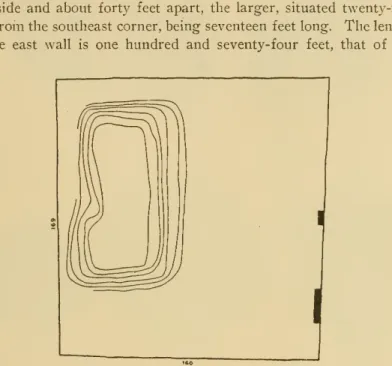
So in addition to these two larger elevations, other small mounds in Com- in addition to these two larger elevations, other small mounds in Compound B, indicating rooms, and also floors marking the position of squares, but the boundaries of these can only be determined by excavation . The height of the highest hill is such that we have every reason to believe that when the collected rubble is removed from the squares and buildings, houses with high walls in a good state of repair will be revealed. The course of the surrounding wall, especially in the corners, is well marked, as is the evidence.
Due to the large size of the rubbish mounds surrounding this area it appears to have been inhabited for a long time, but the fact that none of the walls are now standing above ground suggests that it has been deserted for many year.
COMPOUND C
FEWKES] EXCAVATIONS AT CASA GRANDE, ARIZONA 313 measurement from north to south. The width from east to west is
OVAL MOUND OR WELL
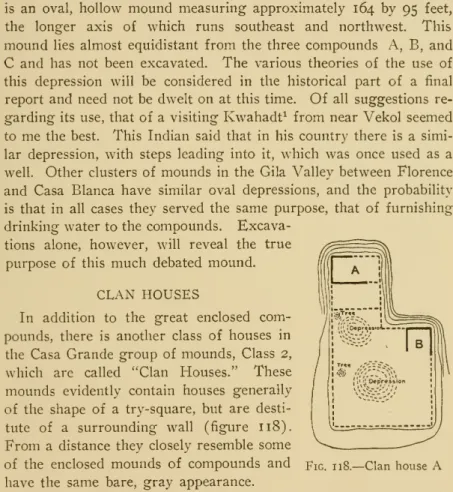
CLAN HOUSES
3H SMITHSONIAN MISCELLANEOUS COLLECTIONS [VOL. 50
OBJECTS FOUND IN WORK
FEWKES] EXCAVATIONS AT CASA GRANDE, ARIZONA 315 the architecture and method of construction of buildings in the two
FEWKES] EXCAVATIONS AT CASA GRANDE, ARIZONA 315architecture and method of constructing buildings in both. Some of the Kwahadti beyond Vekol said that similar sticks still existed in their country, and the author succeeded in obtaining two Spanish hoes at Casa Blanca. Several wooden paddles were found with hoes or planting sticks (plate xxxix, b), which were used in the manufacture of pottery, and one or
It was probably a pigment mill, but is reminiscent of the rolled stone cast of the inside of a fossil shell, at the shrine at Walla, which is halfway along the eastern Mesa Hopi trail from the plains to Hano. 34;Heart Twister,” or rolled stone fetish from the Awatobi Mazrau Society, now in the Berlin Museum. The object shown in plate xl, d is a paint plate surrounded by a border containing parallel grooves, as in the ceremonial stone slabs from Pueblo Viejo, which the author has described elsewhere1.
Plate xl, represents a stone figure, similar to several others in the collection, made of lava rock with a pit on each side, but of unknown use.
FEWKES] EXCAVATIONS AT CASA GRANDE, ARIZONA 317 (plate XL, a) and another representing a bird indicate that the
SKELETONS
OTHER RUINS NEAR THE CASA GRANDE GROUP
318 SMITHSONIAN MISCELLANEOUS COLLECTIONS [VOL. 50 vegetation and easily distinguished from natural hills by the frag-
FEWKES] EXCAVATIONS AT CASA GRANDE, ARIZONA 319Located on the mesa, about a mile south of Adamsville and five.
FEWKES] EXCAVATIONS AT CASA GRANDE, ARIZONA 319 Situated on the mesa, about a mile south of Adamsville and five
The guide said that his father used to make sacrifices at this place and that he believed that the medicine man's magical power could control the sun. 50. Pl. XXXVIII. a Angle of surrounding wall, as indicated by failure of vegetation. FEWKES] EXCAVATIONS AT CASA GRANDE), ARIZONA 321In sight of the Adamsville cluster, a mile to the west, rises a large.
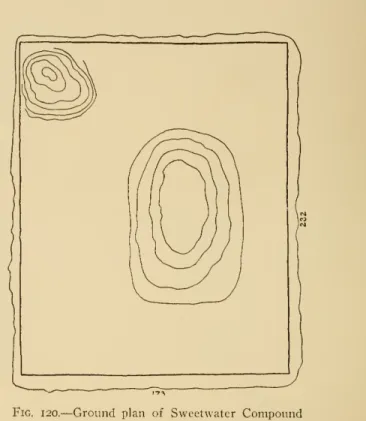
FEWKES] EXCAVATIONS AT CASA GRANDE), ARIZONA 321 In sight of the Adamsville cluster, a mile to the west, rises a large
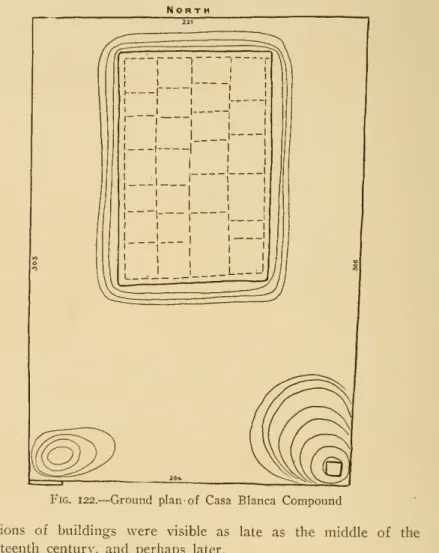
The companion plate (xxxvni, a, b) represents the Casa Blanca from the east, showing, a, one corner of the unexcavated rampart as it appeared to the author in March, 1907. 413, "There is one large round fence still visible near the stage road and within gunshot of the Casa Blanca trading post.". FEWKES] EXCAVATIONS AT CASA GRANDE, ARIZONA 323side and 306 feet on the opposite side.1 North is 221 feet.
324 SMITHSONIAN MISCELLANEOUS COLLECTIONS [VOL. 5°
FEWKES] EXCAVATIONS AT CASA GRANDE, ARIZONA 325
The people of Casas Grandes were not very distant relations of the Aztecs and. Pima legends tell of the southward migration of the so-called Rabbit Eaters, a descendant of the Pimas. None of the Pimas the author interviewed attribute the building of Casa Grande to the Hopi alone, because they know too much.
It is instructive in this connection to note that the Pimas have a legend which resembles a story repeated among the members of the patki clans of the Hopis. Practically the same story told to Font in 1775 was repeated to the author, a very suggestive illustration of the persistence of folk-tales. The root of wordpima is probably the same as Hopi wordpii, I don't know.
2The ancestors of the Patki tribes of the Hopis were closely related to, if not identical with, the ancient Pimas.
FEWKES] EXCAVATIONS AT CASA GRANDE, ARIZONA 329 These great houses were places for refuge, ceremony and trade