In the spirit of the static Heckscher-Ohlin model, we will assume that all countries have the same tastes and technologies, so that the only differences between countries are in their initial state (in units of efficiency) physical and human capital. The dynamic model of physical and human capital accumulation that we are studying can result in violations of both the static and the dynamic Heckscher-Ohlin theorem. We show that part (a) of the static Heckscher-Ohlin theorem can be violated if the growth rate of human capital varies across countries.
A violation of part (b) of the static Heckscher-Ohlin theorem can also arise in the dynamic model due to intertemporal couplings. We show that in this case relative autarkic prices will be independent of local factor supply and (b) of the static Heckscher-Ohlin theorem will fail. The potential failure of the dynamic version of the H-O theorem arises in cases where international trade results in the equalization of factor prices (per units of factor efficiency) between countries.
The investment (educational) good will provide additions to the stock of physical (human) capital, and the stock's development will then be given by. This difference between the two adaptation processes will be exploited below in the comparison of the autarky-price relationships.
Equilibrium in the World Economy with International Trade
We first derive the conditions for which the equilibrium with free trade in consumption and investment goods will equal the IWE equilibrium. With the free trade of the output of sectors X and Z, the consumption and accumulation of human physical capital is now governed by the state of the trade balance. The necessary conditions for this problem are easily derived by applying the techniques used in the previous section.
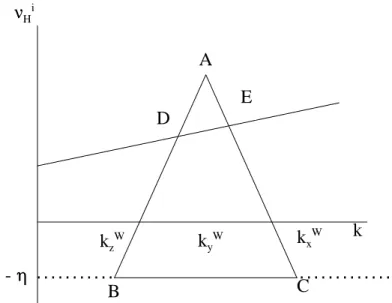
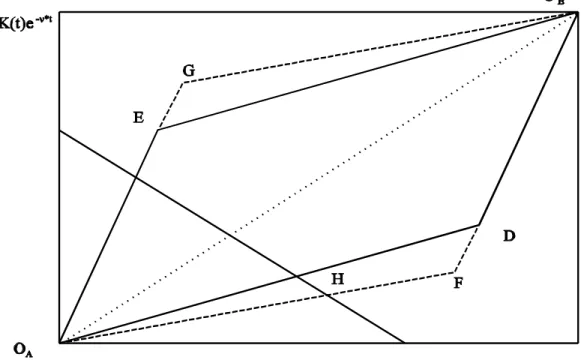
Proposition 4(b) shows that any relationship between physical and human capital within a region is consistent with balanced growth. If ki(t) does not satisfy (14), initially for state i achieving the BGP utility level with a balanced growth equilibrium is not possible. However, in such a case, unbalanced growth can be consistent with factor price leveling and achieving the BGP utility level provided that there exists a time path for { When the non-traded good uses physical capital relatively intensively compared to min(kX*,kZ*), a decrease in production of the non-traded good increases the relative amount of physical capital available to produce traded goods by to 'relax' entire production. employment conditions. In this case, a decrease in production of the non-traded good will completely increase (decrease) the relative amount of human (physical) capital available to produce traded goods. The IWE equilibrium can be duplicated by free trade in X and Z if the initial endowments k0i for all countries are within the range identified in statements 4 and 5. The dimensions of the box are the supplies of physical and human capital in the world economy at time t, normalized by dividing by e<(t, which will be constant in the equilibrium of the IWE. So if the initial endowments are contained in the parallelogram OACOBD, the equilibrium with international trade will yield for each household the same level of utility as could be achieved on the BGP of the IWE. It should be noted that the characterization of the trade pattern in (15) only requires that the free trade equilibrium duplicates the IWE , and not that the world is on the BGP. If the consumption good is physical (human) capital intensive compared to the investment good, then the first term will be positive if country i has abundant human (physical) capital compared to the rest of the world. The failure of the H-O theorem occurs because variations in the rate of human capital growth change the relative supply of physical capital available to produce traded goods, because the educational good must be produced locally. The analysis of section 3.2 has shown the indeterminacy of the pattern of factor accumulation when the world is at the BGP. This stems from the fact that the open economy can absorb the increase in supply of physical capital by increasing its exports of goods that use physical capital more intensively. When there is unbalanced growth, violations of the static H-O theorem arise as there exist paths through which a physical capital-abundant country at time t can import the physical capital-intensive good at time t for certain factor proportions. The dynamic H-O theorem is violated since there can exist an unbalanced growth path along which a country that initially has an abundance of physical capital can become abundant in human capital. If the IWE path { Assuming that the resources of the countries are such that both countries are incompletely specialized in autarky, we must have (pX/pY)A < (pX/pY )B. Thus, a reduction in the relative price of the capital-intensive good (when X and Y are both produced using human and physical capital) will result in a decrease in the return to capital (see Appendix for evidence). Finally, an examination of the conditions of competition shows that if both traded goods ]. This proves that the price of a physical capital-intensive market good will be higher in autarky in a country with abundant physical capital, which is consistent with (b) of the static theorem of H-O.7. Part (b) of the static H-O theorem will not apply in this region, since local factors do not affect prices and there will be no gains from trade. Note that the range of factor endowments in (16) is a subset of the range consistent with achieving the BGP utility function as derived in Propositions 4 and 5. This means that the opening of trade will expand the range of initial endowments for which the BGP utility level is achievable in this case. a) When the capital goods sector is physically capital intensive compared to the education sector, part (b) of the Heckscher-Ohlin static theorem holds. This indeterminacy results in the potential failure of the dynamic H-O theorem, as a change in the composition of factor accumulation can lead to an eventual reversal of an economy's factor abundance relative to the rest of the world. Baxter, “Fiscal Policy, Specialization, and Trade in the Two-Sector Model: The Return of Ricardo.” To prove that part (b) uses the fact that since the outputs of all three goods are strictly positive within the range defined in (14), it is possible to increase or decrease The condition is necessary for one of the traded goods to be physically capital intensive. Proof of Proposition 8: For the case of kY > kX, the proof simply follows the arguments in the text. Evidence to support the role of human capital for the case of Taiwan was found by Tallman and Wang (1994), who calculate that growth in the stock of human capital accounted for fully 45% of output growth during their study period . Young (1995) argues that almost all output growth in the East Asian economies can be explained by traditional measures of input growth when these inputs include human capital. For example, Smith (1984) shows that in models of capital accumulation with fixed savings rates, the high level of savings will export the capital-intensive good in the long run. Stiglitz (1970) analyzes the case where patience is reflected in different rates of time preference of consumers who lived indefinitely and shows that the patient country will export the capital-intensive good in the steady state. At least one country will specialize in steady-state production in Stiglitz's model, and international factor prices will not equalize. In contrast, Galor and Lin (1997) show that in an overlapping generations model, differences in time preference levels can be consistent with factor price equalization in long-run equilibrium, even though the patient country still exports capital-intensive goods. Alternatively, a country's steady-state factor of supply converges to different ratios, allowing international trade (and differences in per capita income) to remain steady-state. Their model differs from ours in that knowledge is the engine of growth because of the presence of scale. In this section we establish the existence of a unique BGP in which the control variables are within the feasible set. These cases can be easily handled by including the constraints on the control variables in P and making appropriate changes to the Hamiltonian.Gains from Trade and the Price Version of the Heckscher-Ohlin Theorem
Concluding Remarks