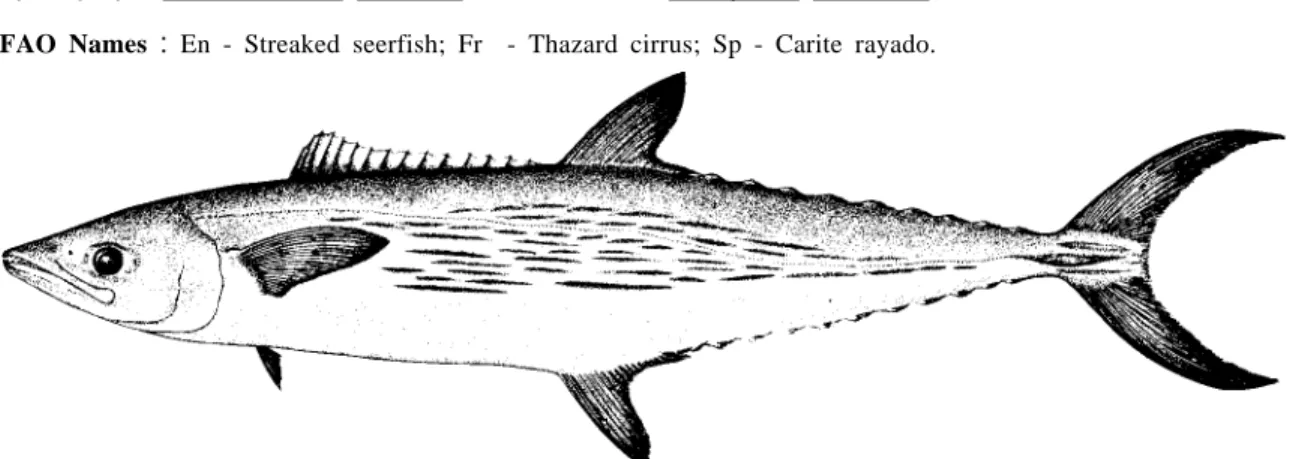
The present catalog represents the first attempt by FAO towards a worldwide labeled and illustrated census of all representatives of the Scombridae family. Please send all suggestions and additional information to the series editor, Dr. W. Diagnostic features : Characteristic characters of the species are given to aid identification, together with appropriate illustrations.
Species identification should only be attempted after consulting the illustrated key to genera and species. Here again, the quality and quantity of available information varies considerably with the species. The local species name is preceded by the name of the country concerned (in capital letters) and, if necessary, by geographical specifications (in lower case letters).
Notes : Important information related to the species not covered by any of the previous paragraphs is given here. Scombrids are active predators. Mackerel (Scomber and Rastrelliger) filter plankton from the water with their long gills.
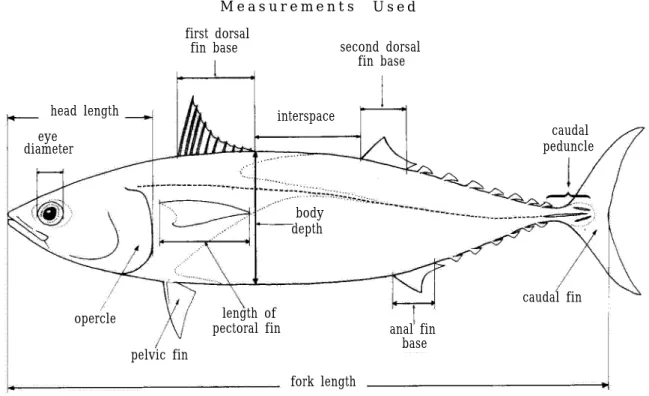
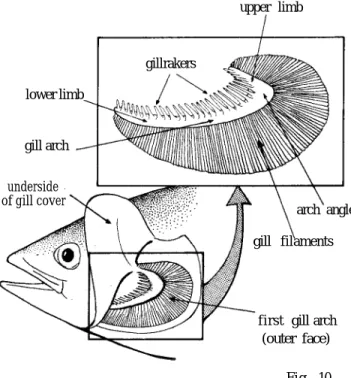
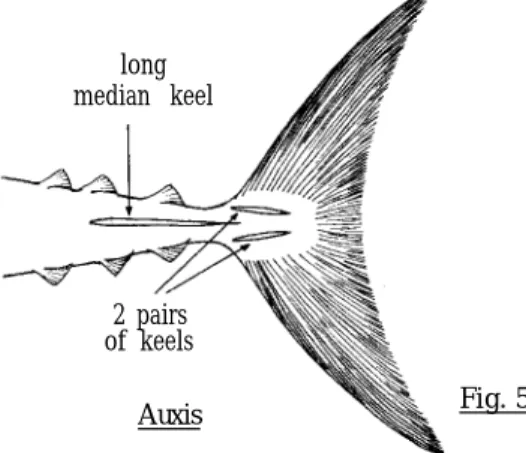
Push Keel - All members of the Scombridae have a pair of small obliquely oriented keels at the base of the caudal fin. C a u d a l p e d u n c l e - The narrow part of the body just anterior to the caudal fin (see illustration of measurements). Counted as the gills, teeth on the upper limb plus those on the lower limb of the arch.
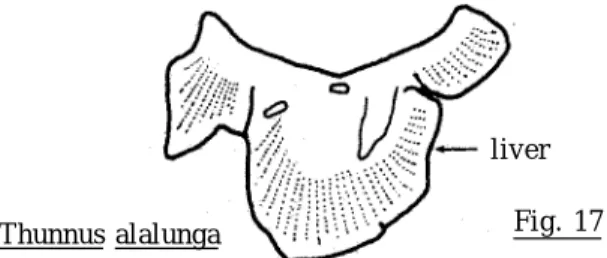
Hemal spines - The spine that extends ventrally from the center of the caudal vertebrae (Fig. 6b). Hypural plate - The widened ends of the hypural bones form a wide plate on which the rays of the caudal fins are inserted (Fig. 12). Liver striations - The ventral surface of the liver of 4 species of tuna has prominent striations.
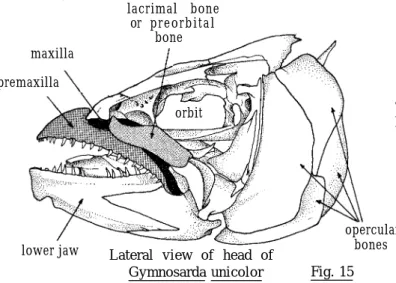
Palatine - A plough-shaped bone whose ventral edge lies in the palate. V o m e r - A midcranial bone, the ventral surface of which lies in the palate.
SYSTEMATIC CATALOGUE
Illustrated Key to Genera and Species of Scombridae 1 a. Body covered with large cycloid scales;
This is reflected in the large number of local names found in the literature for A. In the southern Indian Ocean, the spawning season extends from August to April; north of the equator it is reported from January to April. In the first quarter of the year, black jumpers are often found along Central America and north to the top of Baja California.
Spawning in western Baja California is limited to the summer months, while at the mouth of the Gulf of California it peaks from October to December. In the Philippines it is taken in commercial quantities from fish corals (ibaklad), purse seines and round seines (sapiao) (Manacop, 1958:84). It is uncommon around southern Florida, present in the northern Gulf of Mexico, but apparently absent from most of the Caribbean Sea.
December in eastern Thailand, late December/January in the northern part of the Gulf and January-March in the western part of it (Tongyai, 1970). Interest in Fisheries: Papuan seer fish is fished in the Gulf of Papua, but lacks commercial importance. It is a seasonal migrant in the Gulf of Carpentaria (Rainer & Munro, 1982) habits lacking.
Geographical distribution: Tropical and subtropical waters of the western Atlantic from Massachusetts to Brazil, especially in the Bahamas and the West Indies (Collette & Russo, 1979: Fig. 8). Habitat and Biology: An epipelagic species, most abundant in clear waters around coral reefs. Geographic distribution: There are at least 2 subspecies, one in the Atlantic and one in the Pacific.
In recent research, larvae have been detected east of the Kuroshio, at the transition fronts.
BIBLIOGRAPHY
1979 Gulf of Mexico Spanish and King Mackerel Resources Colloquium, edited by E.L. In 1979 Proceedings of a colloquium on resources of Spanish and king mackerel in the Gulf of Mexico. Rosa, Jr., Synopsis of biological data on fishes of the genus Rastrelliger Jordan & Starks, 1908 1967.
Kramer, D., Synopsis of biological data on the Pacific mackerel Scomber japonicus Houttuyn (Northeast 1969 Pacific). Observations of the spawning season and fishing of the spotted whiting Scomberomorus 1958 guttatus (Bloch and Schneider). In Proceedings of the Colloquium on Resources of Spanish and King Mackerel in the Gulf of Mexico, edited by E.L.
Additional observations on the biology of the northern bluefin tuna, Kishinoella tonggol (Bleeker) 1956a in Australia.
INDEX OF SCIENTIFIC AND INTERNATIONAL FAO NAMES
Geverfde Cazón Carite Chinigua Carite Koreaanse Carite Monterey Carite Queensland Carite Indo-Stille Oseaan Carite Gestreepte Carite. Indochinese Carite Lucio Carite Lusitanian Carite Oosterse Carite Papoea Carite Rayado Carite Sierra Carite Tiger Carite Casarte ojón. Thazard atlantique Thazard australien Thazard blanc Thazard cirrus Thazard coréen Thazard de Monterey Thazard du Queensland Thazard franc.
Cute tuna Nalukmeg a tuna Butterfly tuna Nalabaga a tuna Abagatan a nalabaga a tuna Gagangay a tuna Nangisit a tuna Daya a tuna. Albacore Albacore Albacore Albacore Yellowfin Bluefin Gagangay a kita Ara-lunga Artiko napintas Asa-asa Atavalla Taaw Atlantiko napintas Atlantiko bassit a tuna Atlanticheskaya. Tuna amarillo Tuna azul tuna Longfin Tuna atiddog a tuna Bigeye Tuna a taba a mata Bigeye tuna Nalabaga a tuna Atuncito Augalai Auhopu Auksida.
Atún blanco del sur Atún blanco negro Bonito partido Bonito Atún blanco del sur Buen itol Buen iton Bueno itou Buen itu Bueno n ic o u Boo hoo. Cá bac ma Cá bao ma Cá be lau Cá bo Cá bo Vang Cá chan. Caballa Caballa Caballa Caballa Caballa Tormenta Maladyong Malyi tunets Malyj tunets Malyj tunets-pn Manba.
Leadenall Little Bonito Little Tuna Little Tuna Linchay Listado Listao Listaoune Little bonito Little Tuna Little Tuna Llampua. P e l a m i s Striped Belly Loaf Striped Belly Edge Striped Mackerel Striped Mackerel Spotted Tuna Striped Tuna Strombo Strumbo SuboS u b o t a.