INTRODUCTION
Background
It's called anxiety, and the way in which anxiety is addressed varies from person to person and depends on their own assessment of ability, called self-efficacy. Bandura (1997) defined self-efficacy as an individual's belief that he can control the situation and achieve positive results. When faced with a difficult task, in this case public speaking, an individual's self-efficacy beliefs can influence the way people respond to stressful situations Bandura (2017, as cited in Paradewara).
An individual's high self-efficacy could cognitively motivate the individual to act more resiliently and focused, especially when the goal to be achieved is a clear goal. People with low self-efficacy believe that a given task is difficult, and they build a strong disapproval of the choice to complete the task. On the contrary, people with high self-efficacy usually enjoy the task and perform it with pleasure.
Self-efficacy plays an important role in solving certain challenges because it can influence achievement settings (Bandura, 1977; Schunk, 1984). I agree that there has been so much research on this issue, but there is still very little research that focuses on how we can influence the self-efficacy and influence of English as a Foreign Language (EFL) learners in the domain of public speaking. . .
Problem Statement
Bandura in Dirtya Sunyi, 2017) defines self-efficacy as people's beliefs "about their abilities to produce certain levels of performance that exert influence over the events that affect their lives" (p.71). What is the influencing factor of Self-efficacy towards English language learners in the field of public speaking.
Objective of the Research
Significance of the Research
Scope of the Research
Nuvitasari (2017) focused her research on identifying factors that influence students' self-efficacy in prepared speech. The similarities of the previous studies with the current study are discussed on students' self-efficacy in public speaking. The findings of this study related to EFL students' self-efficacy in public speaking English.
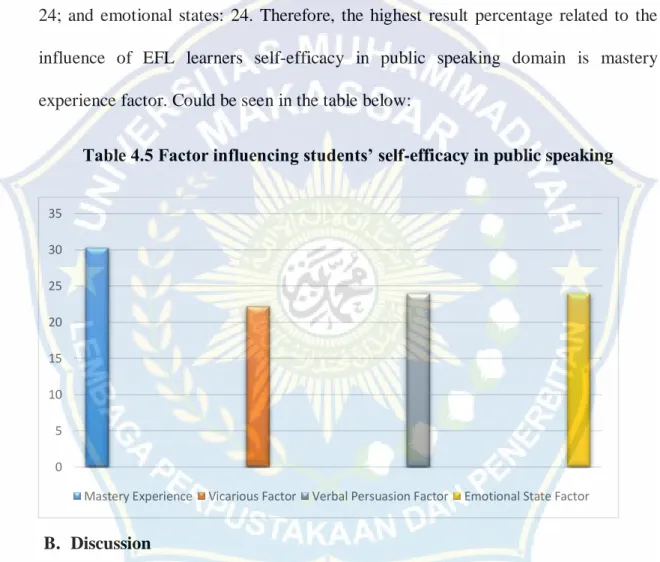
The result of the data research is to investigate the influence of self-efficacy on EFL learners in the domain of public speaking. Therefore, the highest percentage of scores related to the influence of EFL learners' self-efficacy in the public speaking domain is the mastery experience factor. Based on the data analysis, the students were aware of their own self-efficacy in public speaking.
The results showed that the students had a self-efficacy and showed a positive study of self-efficacy in public speaking (Paradewari, 2017). They are already aware of their own self-efficacy in giving a speech in public speaking class.
REVIEW OF RELATED LITERATURE
Previous of Related Research Findings
Her study aims to investigate whether college students moderate public speaking self-efficacy. The difference is that the researcher wants to analyze the effect of self-efficacy on EFL learners in the domain of public speaking in the fifth semester at Muhammadiyah University, Makassar. Ghoonsoly, Elahi and Golparvar (2012) investigate the relationship between students' self-efficacy and their achievement in English.
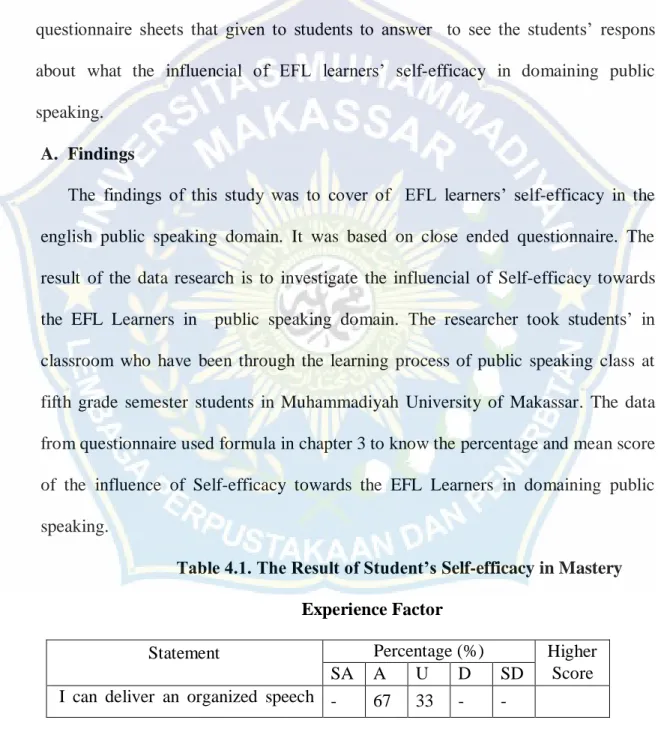
It was described EFL learners' Self-efficacy in the English language domain at Muhammadiyah University of Makassar during the academic year 2019/2020. The results consisted of data obtained through questionnaire sheets which were given to the students to answer to see the students' responses on what the influence of EFL students' self-efficacy in dominating public speaking. The data from the questionnaire used the formula in Chapter 3 to know the percentage and mean score of the influence of Self-efficacy towards the EFL learners in dominating public speaking.
From all the data analysis on the self-efficacy of English language learners in the domain of English public speaking, it was concluded that the influence of self-efficacy on English language learners in the domain of public speaking is mastery experience. On the relationship between self-efficacy and English achievement among Iranian third grade high school students.
Some Partinent Ideas
- Concept of English as Foreign Language
- Concept of Self-Efficacy
- Concept of Public Speaking
Conceptual Framework
It was not because they lacked English language skills, they were unaware of their own effectiveness. In this case, self-efficacy is an individual conviction to control the situation and achieve a positive outcome. The result of this descriptive study was about the answer to the problem statement, which aimed to investigate the influence of self-efficacy on EFL learners.
Mastery experiences can be the most effective way to be a self-efficacy enhancer for people because they already had pre-existing knowledge (Bandura, 1997). These beliefs can influence how they feel, think, and respond to their own self-efficacy. In level of self-efficacy they are still influenced in a positive way, such as: verbal persuasion and confidence in building their self-efficacy, but different from the student in high level of self-efficacy, most of them are influenced by mastery experience which is the strongest way to build self-efficacy because people are most likely to believe that they can do something new if it is similar to something they have already done before.
Especially the EFL (English Foreign Language) students could learn about self-efficacy and reward their self-efficacy if they know more about their own self-efficacy. The effectiveness of verbal self-guidance as a transfer of training intervention: Its impact on presentation performance, self-efficacy, and anxiety. Exploring the relationship between international students' English self-efficacy, the use of English to teach self-efficacy, and academic self-efficacy.
Implications of self-efficacy and attribution theories for understanding undergraduate student motivation in a foreign language course.
RESEARCH METHOD
Research Design
Independent variable is a variable that affects or becomes the cause of the appearance of the dependent variable. The subjects of this research were students majoring in English in the fifth semester at Muhammadiyah University of Makassar. The students were the ones who have gone through the learning process in the public speaking class.
Research instrument is a tool used by researchers to collect data so that their work is easier and the results are better, in the sense of being careful, complete and systematic so that it is easier to process Suharsimi Arikunto. The researcher conducted an observation as the first tool to observe the population to find the most active students who will become the most representative sample for this research. The responses of each instrument item using a Likert scale have gradations from very positive to very negative (Sugiyono.
Procedure of Collecting Data
Technique for Data Analysis
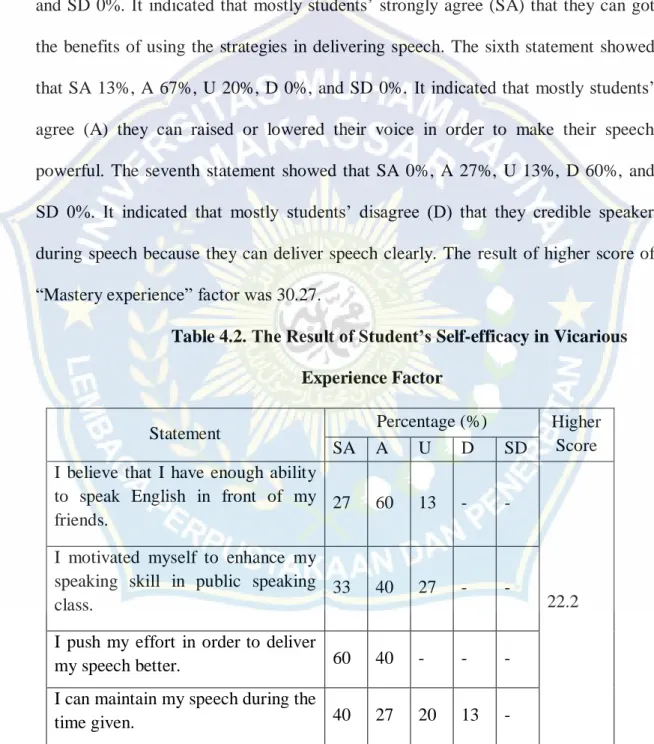
It was shown that mostly students agree (A) that they can perform an organized speech in public speaking classes. It showed that most students agreed (A) that they were motivated to improve their speaking skills in public speaking classes.
FINDINGS AND DISCUSSIONS
Findings
This showed that most students agree (A) that they can maintain their posture while giving the speech. It indicated that most of the students strongly agree (SA) that they can explain the speech material clearly for their friends to understand. It indicated that most of the students strongly agree (SA) that they can get the benefits of using the speech holding strategies.
It has been shown that students mostly disagree (D) that they are authentic speakers during a speech because they can speak clearly. It showed that most students agree (A) that they believe they have enough ability to speak English in front of their friends. It was shown that the majority of students strongly agreed (SA) that they are striving for better speaking.
This indicated that students mostly strongly agree (SA) that they can sustain their speech during the given time. This indicated that mostly students' undecided (U) that they could limit the content of their speech to two to four main ideas. This indicated that students mostly did not decide (U) that they had a role model to deliver the speech effectively.
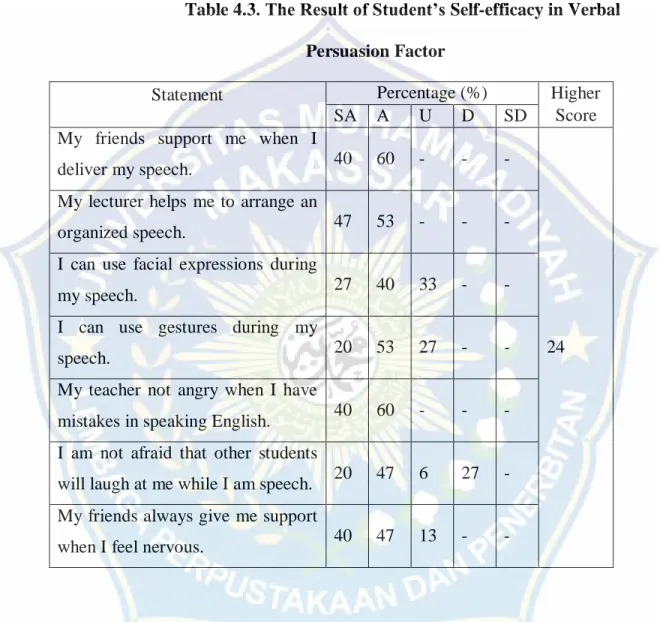
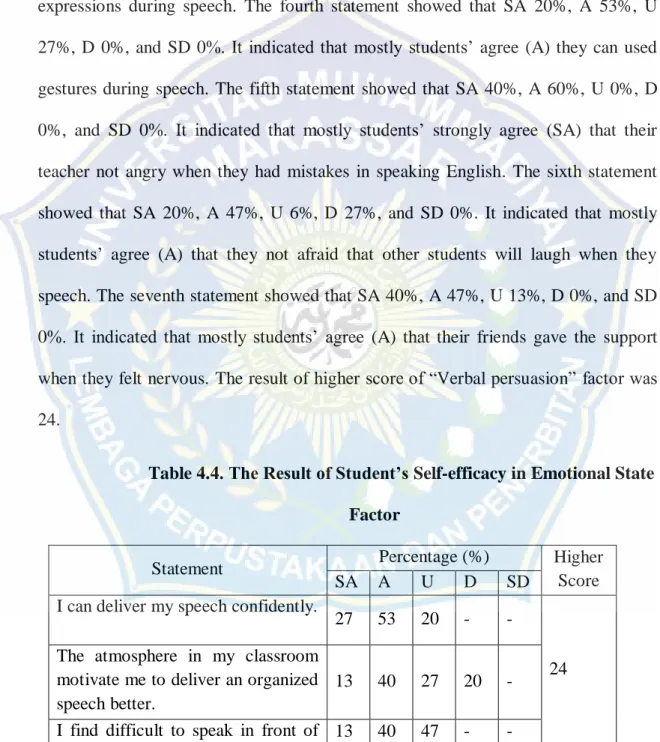
It indicated that most students agree (A) that their friends were supportive while giving a speech. This showed that most students agree (A) that they are not afraid that other students will laugh when they say something. It indicated that most students agree (A) that their friends were supportive when they felt nervous.
This indicated that mostly students' undecided (U) who find it difficult to speak in front of other students. This indicated that students mostly agree (A) that they can handle all situations with a positive attitude. This indicated that students mostly strongly agree (SA) that they always motivate themselves when they want to speak.
Discussion
CONCLUSIONS AND SUGGESTIONS
Conclusions
Based on the findings and discussion, the conclusion of the researcher is presented according to the data analyzed in the previous chapter.
Suggestions
I can limit the content of my speech to two to four main ideas Frequency Strongly agree (SA).