A THESIS
Submitted to the faculty of Teacher Training and Education Makassar Muhammadiyah University in part Fulfillment of the Requirement for the
degree of education in English Department
NUR AENI 10535629015
ENGLISH EDUCATION DEPARTMENT FACULTY OF TEACHER TRAINING AND EDUCATION MUHAMMADIYAH UNIVERSITY OF
MAKASSAR 2020
“ WITH GOD ALL THINGS ARE POSSIBLE “
“ This thesis is dedicated to beloved my parents, Kamaruddin and Faisah
“
vii ABSTRACT
NUR AENI. 2020. An Analysis Students’ Strategies In Overcoming Anxiety In Speaking English(A Descriptive Research of the Third Semester English Department at Muhammadiyah University of Makassar)supervised by Hasnawati Latiefand Awalia Azis.
This study aimed to find the students’ strategies in overcoming their anxiety inspeaking English. The data was collected from third semester students of English Department who learned Speaking English Subject.
This study used descriptive quantitative research design. The instruments used were interviewand questionnaire. The interview was distributed to 21 students from class BG3B, based on the result of interview the researcher took 4 students who had not anxiousand 17 students had anxious to gave questionnaire.
The interview used as got sample. The questionnaire used was Likert’ scale.
Based on the result of questionnaire, the students preferred to relexation strategy to overcome their anxiety in speaking English. The percentage of relaxation were 97,5%. The second strategy was preparation there were 93,01%.
The third strategy was positive thinking, there were 75,2%. The fourth strategy was peer seeking, there were 63,5%. And the lowest strategy was resignation, there were 34,3%.
Keywords: speaking, strategy, anxiety
viii
Penelitian ini bertujuan untuk menemukan strategi siswa dalam mengatasi kecemasan mereka dalam berbicara bahasa inggris. data dikumpulkan dari mahasiswa semester tiga jurusan bahasa inggris. penelitian ini menggunakan penelitian kuantitatif deskriptif. Instrumen yang digunakan adalah wawancara dan kuesioner. Wawancara dilakukan kepada 21 siswa dari kelas bg3b, berdasarkan hasil wawancara, peneliti mendapatkanl 4 siswa yang tidak cemas dan 17 siswa yang merasa cemas selanjutnya peneliti memberikan kuesioner terhadapa siswa yang memiliki rasa kecemasan.
Wawancara digunakan sebagai sampel dan kuesioner di gunakan untuk mencari strategis siswa. Kuesioner yang digunakan adalah skala likert.
Berdasarkan hasil kuesioner, siswa lebih suka menggunakan strategi relexation untuk mengatasi kecemasan mereka dalam berbicara bahasa inggris. Persentase relaksasi adalah 97,5%. Strategi kedua adalah persiapan sengan persentase 93,01%. strategi ketiga adalah berpikir positif, yaitu 75,2%. Strategi keempat adalah pencarian teman yaitu 63,5%. dan strategi terendah adalah pengunduran diri yaitu 34,3%.
Keywords: berbicara, strategi, kecemasan
ix
ACKNOWLEDGEMENT
Alhamdulillahi Robbil Alamin. The researcher expresses her highest gratitude to the almighty Allah SWT, Who has given His guidance, blessing, and mercy to her in completing this thesis. Salam and Shalawat are addressed to the last prophet Muhammad SAW
The researcher expresses her sincerely deepest gratitude to her parents Kamaruddin and Faisah who always pray, motivate and sacrifice everything for her success. Further, the researcher express her gratitude for all of her sister Norma Yanti for her support in education.
The researcher realized that in carrying out the research and writing this thesis, many people have contributed their valuable suggestion, guidance, assistance, and advice for the completion of this thesis. Therefore, she would like to acknowledge them:
1. Prof. Dr. H. Abd. Rahman Rahim, SE., MM, Rector of Muhammadiyah University of Makassar for his advices during her study at the university
2. Erwin Akib, M.Pd., Ph. D, Dean of Teacher Training and Education Faculty for all advices and motivation.
3. Ummi Khaeraty Syam, S.Pd., M.Pd, Head of English Education Department for all advices and motivation.
x
invaluable knowledge, professional expertise, and motivation along the researcher finished this thesis.
6. All of lecturer and staff of English Education Department who cannot be named one by one for all of the suggestions and advices.
7. All of her family specially mom, dad and older sister who always support her.
8. The awesome bestfriends: Rafiqah Nur Rahman and Nurul Sri Setiawati for the great cooperation, support, and sharing in studying and writing this thesis
9. The supporters system, HN squad specially Aisyah who always helps her, stay loyal in everytime and suport her to finished this thesis.
10.CHAZTALS English Department 2015 for sweet memories and unforgettable moment during her study in the university
11.For all who gave valuable suggestion, guidance, assistance, and advice in completing this thesis.
Makassar, January 2020 Researcher
Nur Aeni
xi
TABLE OF CONTENTS
Pages
TITLE OF PAGE ... i
LEMBAR PENGESAHAN ... ii
APPROVAL SHEET ... iii
COUSELLING SHEET ... iv
SURAT PERJANJIAN ... vi
SURAT PERNYATAAN ... vii
ABSTRACT ... viii
ACKNOWLEDGEMENT ... ix
TABLE OF CONTENTS ... xi
LIST OF TABLE ... xiii
LIST OF GRAPHICS ... xiv
LIST OF FIGURES ... xx
LIST OF APPENDICES ... xvi
CHAPTER I INTRODUCTION ... 1
A. Background ... 1
B. Problem Statement ... 3
C. Objective Research ... 3
D. Significance of the Research ... 3
E. Scope of the Research ... 4
xii
C. Conceptual Framework...19
CHAPTER III RESEARCH METHOD ... 20
A. Research Design ... 20
B. Variable and Indicator ... 20
C. Population and Sample ... 20
D. Instrument of Research ... 21
E. Technique of Data Collection ... 21
F. Technique of Data Analysis ... 22
CHAPTER IV FINDINGS AND DISCUSSION ... 24
A. Findings ... 24
B. Discussion ... 29
CHAPTER V CONCLUSION AND SUGGESTION ... 36
A.Conclusion ... 36
B.Suggestion ... 37
BIBLIOGRAPHY ... 38
APPENDICES ... 41 CURRICULUM VITAE
xiii
LIST OF TABLES
Pages Table 3.1 Likert’s scoring table ... 25 Table 4.1 The Result of Interviewed...27
Table 4.2 The result of students strategies in overcoming their anxiety in
speaking English... 29
xiv
in speaking English ... 28
Graphic 4.2 Percentage of students’ strategies in overcoming
their anxiety in speaking English... 30
xv
LIST OF FIGURE
Pages Figure 2.1 Conceptual Framework ... 20
xvi
APPENDIX B Questionnaire... 46
APPENDIX CInterview Transcriptions... 48
APPENDIX DData Analysis for Questionnaire... 54
APPENDIX EThe list of students name English department... 56
APPENDIX F Documentation... 57
1 CHAPTER I
INTRODUCTION
This chapter deals with background, problem statement, the objective of the research, the significance of the research, and the scope of the research.
A.Background
Speaking is the first way to do the interaction and communication. The people express their ideas and communicate what they want orally. Harmer (2007) states that speaking is the ability to speak fluently and presupposes not only knowledge of language features, but also the ability to procces the information and language. And accordings to Bahrani and Soltani (2012) as a real communication, speaking allows the interlocutor to accomplish a task, such as conveying a message, obtaining the information, or expressing an opinion.
In addition, Gebhard (2000) states that there are some problems in teaching students to speak English. Those problems are the students won’t talk, the error treatment and any native speaker can teach conversation. On the other hand, Juhana (2012) revealed that psychological factors that hinder students from speaking are fear of making mistake, shyness, anxiety, lack confidence and lack of motivation. In the reality, anxiety is the common problem experienced by most of students.
Anxiety is the most dominant factor influencing students not to speak English. Elliott and smith (2010) says that anxiety involves feelings of uneasines, worry, apprehension, or fear and it is the most common of all the so- called mental disorders. On the other side, Zeidner M and Matthews G (2011) stated that anxiety is considered to be a basic negative emotions, along with anger, sadness, disgust and perhaps others.
Anxiety is divide into two categories such as state anxiety and trait anxiety.
State anxiety makes individuals to feel fear under stressful situations and additionally causes individuals to experience psychological difficulties such as blushing and trembling due to stimulation of nervous system. When stress level is high, state anxiety level increases as well. On the other hand, trait anxiety is the state of constant state of discontent and sadness in individuals without a certain reason (Yokus T, 2013)
Santriza (2018) States that the factors of students anxiety are categoried into three major problems, firstly, the factors are categorized as communication apprehension. In this case, the students feel anxious because of embrace feeling when speak in front of class. Secondly, the factors are called as test anxiety. It means that the students feel worry when they have to face the English test. It is due to the level of difficulty of the test. Lastly, the anxiety is appeared because fear of negative evaluation. It can be implied that someone feels anxious when he or she to speak in every social evaluate situation, such as interview for a job.
According to Sulastiani (2018) there are several effect of students’ anxiety such us students forget their preperation, students were confused, stop to speak
3
and made the students uncomfortable to speak English. Furtheremore, there are such strategies that students’ can use to overcome their anxiety in speaking English. Strategies are the behaviours and technique they adopt in their efforts to learn.
Kondo (2004) stated that the students need strategies to overcome anxiety in speaking. The first strategy, preparation that refers to the attempts at controlling the impending threat by improving learning and study strategies.
The second, relaxation which involves tactics at reducing anxiety symptoms.
The third, positive thinking is characterized by its palliative function of suppressing problematic cognitive processes that underlie students’ anxiety.
The fourth strategy, peer seeking is distinguished by the students’ willingness to look for other students who seems to have trouble understanding the class and/or controlling their anxiety. And the last is resignation. It is characterized by students’ reluctance to do anything to alleviate their language anxiety.
Based on the reason above, the researcher interested to conducting research untitled “ An analysis Students’ Startegies in Overcoming Anxiety in Speaking English”
B.Problem Statment
Based on the background above, the resercher formulated the research question as the following “What strategies do students’ apply in overcoming their anxiety in speaking English?’’
C.Objective of the Research
Related the problem statments above, the objective of this research is to find out the strategies to minimize anxiety for the students in speaking English.
D.Significance of the Research
The significance of this researche were theoretically and Practically.
Theoretically, for researcher could be as reference to make relate research.
Practically, for the teachers the result of this research could give contribution to choosing appropriate solution and effective models to learning teaching process. For the students, the result of this research could help to improve their teaching so that the student to be able to speak without having feeling anxious in speaking English.
E. Scope of the Research
In this research, the resercher just focused on students have anxiety and students strategies to overcome anxiety in speaking English, such us preperation, relaxation, positive thinking, peer seeking and resignation.
Specifically, this research focused on the third semester (BG 3B) students who already learn speaking 3 as on their subject in the previous semester.
5
CHAPTER II
REVIEW OF RELATED LITERATURE
This chapter deals with the previous findings, some pertinent ideas, and conceptual framework.
A.Previous Related Research Findings
There are some reserchers which attempt to study the topic and the related research has been analyzed and observed by the the resercher related to the technique, approach and etc. Here are the preview research
Wahdaniyat ( 2015 ) in her research “Students’ Strategies in Overcoming Their Anxiety in Speaking English At SMA Muhammadiyah, “talks about students’ reasons of speaking anxiety are lack of preparation, lack of vocabulary and the attention from the classmate. And students try to apply five strategies to overcome their anxiety in speaking English, namely preparation strategy, relaxation strategy, positive thinking strategy, peer seeking strategy, resignation strategy, nonverbal communication.
Sari Darmaida ( 2017 ) in his research“Speaking Anxiety As A Factor In Studying Efl “ talks about communication apprehension factors lead to 71% of students’ speaking anxiety followed by fear of negative evaluations, 53%; then test anxiety, 48%, and the lowest was 39% for anxiety about English classes.
English teachers are expected to be able to understand the character of each of their students in the classroom, because the anxiety level for each student can be different, one from the other.
5
Weni, Zul and Don ( 2018 ) in their research “An Analysis Of Students’
Speaking Anxiety Faced by yhe fourth semester students of English education study program of English Department of Universitas Negeri Padang” talk about there are three types of speaking anxiety such as communication apprehension, fear of speaking test, and fear of feedback by peers and lecturer, the dominant type of speaking anxiety is in the fear of speaking test. It is happen because of their inability about English for overall. They feel nervousness whenever having no idea to say. They do not know to say anything among the speech because of their comprehension about the topic, the lack of vocabulary, their pronunciation and their speech speed while the speech or conversation.
Based on the previous research findings above, the resercher assume that there are many factors which influences the students to doing speaking English.
First, performances namely the students shy to speak English, lack of self- confidence and lack of preparation. Last, English language practice factors, where the students do not apply to practice their English in the classroom.
B.Some Pertinent Ideas
1. The Concept of Speaking a. Definition of Speaking
Speaking is the process of communication to share the information between the speaker and the listener. The information sent by speaker should be clear so the listener can understand the content of information.
The statement is supported by some theories below. Speaking is the same
7
as oral interaction which are conventional ways of speaking information, expressing our idea, and thought have in our mind (Nunan, 1991: 40).
Chaney in Nurhilaliah, 2018 argues that speaking is the process of building and sharing meaning through the use of verbal and non-verbal symbols, in a variety of contexts.
According to Burns & Joyce, 1997 that speaking is defined as an interactive process of constructing meaning that involves producing, receiving and processing information. Its form and meaning are dependent on the context in which it occurs, the participants, and the purposes of speaking.
b. Element of Speaking
According to Harmer (2007) speaking is a complex skill because at least it is concerned with components of grammar, vocabulary, pronunciation, and fluency. Speaking has some important components, there are:
a) Grammar
One factor in influencing the students’ speaking proficiency is the functional grammar, the frequency of the students’ activity is that the students’ sometimes want to speak with other people but they have luck functional grammar. According Ur P (1991: 75) grammar is sometimes defined as ‘the way words are put together to correct sentences’. This is, as we shall see presently, an over-simplification, but t is a good starting-point (and an easy way to explain the term to
young learners). While, Webster (1996: 275) defines that grammar is branch of linguistics study that deal with classes of words, their inflection or their means of indicating relation to each other function and relation in the sentences as employed according to established usage and that is sometimes extended include related matter.
b) Vocabulary
According to Ur P (1991: 60) vocabulary can be defined, roughly, as the words we teach in thye foreign language. However, a new item of vocabulary may be more than a single word. While, Oxford Dictionary (2008: 495), vocabulary is all the words that a person knows or uses or list of words with their meaning, especially in a book for learning a foreign language. Vocabulary is a very important language element to be learned before doing speaking. It is impossible to do conversation without mastering vocabulary.
Meanwhile students sometimes get trouble in memorizing vocabularies that they have known because they lack of practicing and use them.
c) Pronunciation
Pronunciation is an act or result of producing the sound of speech, including articulation, vowel information, accent and inflection, often with reference to some standard of correctness or acceptability (Webster, 1998:237). According to Ur P (1991: 47) the concept of pronunciation include the sound of the language or
9
phonology, stress and rhythm and intonation. Then, Harmer (1991:
11), pronunciation is how to say a word in which made of sound, stress, and intonation. Pronunciation is an important element of speaking. The lack of pronunciation proficiency will make the listener cannot understand what the message of the speaker want to deliver to.
d) Fluency
According to Marcel in Johan (2008: 11) defines that, fluency is someone is way of speaking dealing with how to produce words in certain period of tones without missing any words on their speech.
Fluency refers to how well the learners communicate meaning rather than how many mistakes that they make in grammar, pronunciation and vocabulary. The continuity and the smoothness of speaking to deliver the message are emphasized. According to Random House Webster Collage Dictionary (1997: 500), fluency refers to be able to speak or write smoothly, easily, or readily to an easy flow.
e) Comprehension.
Comprehension also is the one components of speaking. Hornby (2000, p.194) states that comprehension is the mind, act power of understanding exercise aimed in improving is testing ones. For oral communication certainly requires a subject to respond to speech as well as to initiate.
2. The Concept of Anxiety a. Definition of Anxiety
Anxiety is defined as someone’s fearness in facing something that can be a serious problem for him/ her. Anxiety’ tends to be used to describe worry, or when fear is nagging and persists over time. It is used when the fear is about something in the future rather than what is happening right now. Anxiety is a word often used by health professionals when they’re describing persistent fear. The ways that you feel when you are frightened and anxious are very similar, as the basic emotion is the same.
Brown in Maulidiyah, 2014 argues that anxiety has different meaning with worry and nervous. Anxiety, associated with feelings of being uneasy, frustrated, apprehensive, or worried, plays an important affective role in language learning. Rholes, Riskind, and Neville in Mulidiyah, 2014 submitted that anxiety may arise following a loss, anxiety on its own appears when a loss is anticipated. May in Mulidiyah, 2014 saw it as “an emotional response to threat to some value that the individual holds essential to his existence as personality.
According to Zeiner (1998: 17) Anxiety is a complex phenomenon and there has been wide disagreement about its definition and criteria.
Thus, anxiety has been variously conceptualized as a stimulus condition, as a probability of a harmful future outcome, and as response to a stressful condition
11
According to Devito, 1986 anxiety can be understand into two perspectives, namely:
1. Cognitive perspective, anxiety (communication apprehension) is a fear of engaging in communication transaction. In this perspective, someone tent to build their negative feeling and predict negative outcome when they are speaking exactly in front of the public
2. Behavioral perspective, anxiety (communication apprehension) is a decrease in the frequency, the strength, and likelihood in engaging communication transaction. In this perspective, someone tent to avoid the situation when they have to speech or actively engage to the communication transaction. This perspective includes state fright, speech anxiety, and performance stress.
b. Type of Anxiety
There are two kinds of anxiety. They are clarified as the follows:
1. Trait Anxiety
Generally, trait anxiety is a kind of anxiety where a subject is generally anxious in many things. According to Zeidner (1998: 293) states that trait anxiety is a relatively stable condition of the individual, best conceived as a latent disposition or probability to respond with elevated levels of state anxiety under stress. Trait anxiety has also recently been shown to be a multidimensional construct which interacts with specific types of situational stress to influence the level of state anxiety experienced.
According Abdillah V (2018) states that trait anxiety is more intense that depends on ones individual regardless of the situation.
Then, Brown (1994) revealed that trait anxiety is more permanent predisposition to be anxious. In this case, someone with trait anxiety experiences anxious in every time. In other word, Ormrod (2011) clarified trait anxiety may appeared even in nonthreatening situation.
He continued that this kind of the anxiety can be a character of a person.
2. State Anxiety
State anxiety is defined as a kind of anxiety which is appeared when a person accepted a condition as dangerous, harmful, and threatening him/ her (Spielberg,1992). It means that the person only experience the anxiety in a given situation. The kind of this anxiety is also temporary. It is because the person only feels anxious in an event which can be dangerous for him.
Briefly, the trait and the state anxiety are differed by the situation and duration. Someone with trait anxiety may feels anxious in every condition in long duration. It can be happened when the other people feel relax. On the other hand, a person with state anxiety will only feel anxious when they think that the situation will risk him. That is why the kind of this anxiety is happened temporary. The anxious feeling will disappeared when the person passed the dangerous event.
13
c. Kinds of Anxiety
Horwitz, Horwitz, and Cope (1986) figure out that there are three kinds of anxiety in language learning. They are communication apprehension, test anxiety, and fear of negative evaluation.
1) Communication Apprehension.
Communication apprehension is defined as a feeling of shy as the impact of fear to communicate with other people. In this case, the students who have problem in speaking in group usually have difficulties in speaking in foreign language class. The students have less of control in communicative situation. Thus, it influences their speaking performance.
2) Test Anxiety
Commonly, the test anxiety is appeared when the students worry to fail in a test. The students who feel anxious in test of foreign language class may get difficulty test and quizzes since the test.
Even, the students who most prepared often make errors in the test.
3) Fear of negative evaluation
Fear of negative evaluation is defined as the students who are not only get anxiety in taking test. They can feel anxious in every social evaluative situation, for instance interviewing for a job or speaking in foreign language class.
d. Possible Factors Contributing to Anxiety in Speaking Performance.
Commonly, the anxious feeling can be appeared by a number of factors. The anxiety can be caused by individual and social factor.
Individual factor involves students’ self- confident. However, social factor involve teachers’ instruction in teaching and the used of material by the teacher. As stated by Price (in Horwitz and Dolly, 1991), being laughed is the biggest factor that causes students’ anxiety in speaking.
In other references, Worde (2003) argued that students’ fear in misunderstanding what is being said in classroom can lead to communication apprehension. Besides, the way of teaching also can cause the students feel anxious in learning process. For this reason, the teacher should make the comfortable class without threatening them in practicing speaking English (Oxford, 1991).
According to Marwan (2007), the lack of preparation is a big deal toward students’ worries in speaking English. In this case, they are scare not perform well in their speaking performance. Horwitz, Horwitz, and Cope (1986) also clarified the factors that contribute the students feel anxious in speaking English. They categorize the factors into three major factors, such as from teacher, material, and from students.
The factor from teacher involves classroom speaking activity and inappropriate ways of teaching. The classroom speaking activity can evoke the fear of negative evaluation by teacher or peers. However, the
15
inappropriate ways in teaching is risky to threatening acts and incomprehensible input. The students’ anxiety is also determined by material used in learning process. The excessive and the difficulty level of learning material strongly affect students’ worries in speaking activity in class.
The factor from students includes belief about language learning. In this case, the students believe that language is difficult. So, they feel unable to face the difficulties. The students also think that they should always show the perfect performing in speaking. Moreover, low self esteem, stressful learning experience, and the lack of preparation also often become factors toward students’ anxiety in speaking performance.
3. Strategy to Overcome Anxiety
According to Kondo & Ling (2004) that there are five strategies used by the students to overcoming their anxiety in speaking English, namely relaxation strategy, Preparation Strategy, positive thinking strategy, peer seeking strategy and resignation strategy.
a. Preparation,
Preparation refers to attempts at controlling the impending threat by improving learning and study strategies. There are several typical items such as : try to get used to using english study hard, prepare self better, peruse the material before called on the teacher, ask for help from friends, check dictionary, ask the teacher some questions, practice english in mind, think carefully about where having trouble, concentrate
on the class, listen carefully to what classmates say in class, try to perform the best, try to read carefully, ask the teacher to speak more slowly, try to guess the meaning of a dificult passage, try to obtain good summaries of lecture notes, try to make a habit of studying English every day.
Use of these strategies would be expected to increase students’
subjectively estimated mastery of the subject matter, and hence reduce the anxiety associated with the language class.
b. Relaxation
Relaxation is involves tactics that aim at reducing somatic anxiety symptoms. There are several typical items such as : take a deep breath,try to relax, try to calm down, close eyes, pretend to be calm, shake body, touch hair, play with hands, look at watch, write “people”
on palm and swallow it.
c. Positive Thinking
Positive Thinking is characterized by its palliative function of suppressing problematic cognitive processes that underlie students’
anxiety.
The items of positive thinking are ; try to be confident, tell our self that english is not so important, try to think positively, tell our self that we will be ok, try not to think of people around, believe in our self, try to enjoy the tension, think of favorite song, cheer up, imagine our self
17
giving a great performance, tell our self that we can do it, tell our self that we be better than the others.
These strategies is intended to divert attention from the stressful situation to positive and pleasant cues, and bring relief to the anxious student.
d. Peer Seeking
Peer Seeking is distinguished by students’ willingness to look for other students who seem to have trouble understanding the class and/or controlling their anxiety. For the anxious student, the realization that others are having the same problem may serve as a source of emotional regulation by social comparison.
The typical items of peer seeking are : tell our self that dificult problems for us are also dificult for the others, tell our self that the others must also be anxious, look for others who are having dificulty understanding the class, look for others who are having dificulty controlling their anxiety, ask students around us if they understand the class, talk with friends around us, look around and deliberately perform poorly.
e. Resignation
This category is characterized by students’ reluctance to do anything to alleviate their language anxiety. Students reporting examples of resignation seem intent on minimizing the impact of anxiety by refusing to face the problem. The typical items of
resignation are : give up, don’t make useless resistance, accept the situation, just try to put up with the situation, sleep in class and stop paying attention.
C.Conceptual Framework
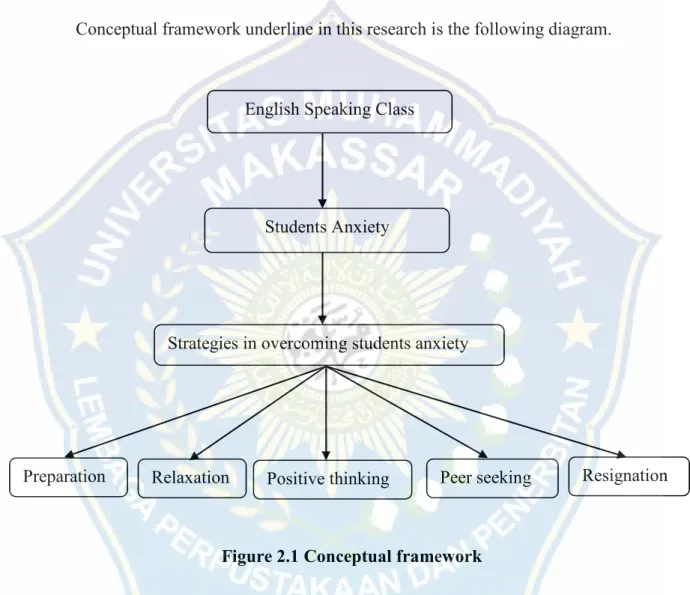
Conceptual framework underline in this research is the following diagram.
Figure 2.1 Conceptual framework
The conceptual framework gave information of English Speaking class refers to the speaking class in the teaching and learning process. Speaking in the class is one of the ways to reach of the learning goal for mastering speaking skill.
Speaking is the most difficult one for the students in language skills.
English Speaking Class
Students Anxiety
Strategies in overcoming students anxiety
Preparation Relaxation Positive thinking Peer seeking Resignation
19
In the speaking class, students felt can not to speak English and it’s cause students anxiety. Students who felt anxious think that they were afraid of producing something and felt ashamed if they do mistake. So that the researcher refers to the strategies apply by the students to overcome their anxiety in speak English. There were five strategies students’ use namely; preparation, relaxation, positive thinking, peer seeking, and resignation,
CHAPTER III
RESEARCH METHODOLOGY
This chapter deals with research design, variable and their operational definition, population and sample, instrument of the research, procedure of collecting data, and technique of data analysis.
A.Research Design
In this research, the researcher used descriptive quantitative method. It means that the research identified a research problem based on trends in the field or on the need to explain why something occurs. It was along with the objective of this research which is to found out the strategies used by the students’ in overcoming their anxiety in speaking English.
B.Research Variables and Indicators
This research had two variables there were dependent variable and independent variable. Dependent variable was the students strategies and independent variable was the language anxiety in speaking English.
C.Population and Sample 1. Population
The population of the research were the students of English Education Department of Muhammadiyah University of Makassar consist of the third semester in the academic year of 2019/2020. It consists of 8 classes. The total numbers of population were 220 students.
20
21
2. Sample
This research used purposive sampling. According to D Basri M (2016:74) Purposive sampling is the researcher should know the characteristics of informants and assume that the selected informants will be able to give information or data in relation to the research problems based on the research design.
The researcher only took one class (3B) each consist of 21 students as respondents to interview and based on the result of interview, Sample the students with anxiety then gave questionnaire. Thus, the total of sample were 21 students in the academic year of 2019/2020.
D.Research Instrument
The instrument of this research were interview and questionnaire. The researcher gave first interview, its used to find out the students’ with anxiety of the class as a sample. After that gave questionnaire to the students as the primary data to found out what strategies students applied in overcome their anxiety in speaking English in the clasroom.
E.Data Collection
In collected the data, the researcher used some procedures, as follow : 1. Interview
Data collection procedures in the interview:
a) The researcher explained the aim of interview
b) The researcher gave some questions based on the interview guideline c) The researcher recorded the interview process.
2. Questionnaire
Data collection procedures in a questionnaire:
a) The researcher gave explanation to the students about the purpose of the questionnaire and how to answered the questionnaire.
b) The researcher informed the objective of the questionnaire and distributed it to the participant.
c) The participants of the research answered the questionnaire and the students had 30 minutes to answered the questionnaire.
F. Data Analysis
To analyzed the data, the researcher applied the technique as follows:
1. Interview
a) The researcher listened the recording of the students.
b) The researcher transcripted the students’ recording of interview into words.
c) The researcher reduced inappropriate data which were not relevant to the study
d) Afterwards, categorized the data into theme and then the researcher determined the students’with anxiety.
2. Questionnaire
Data from questionnaire analyzed by measuring the percentage of the students’ strategies in overcoming their anxiety in speaking English used Likert Scale. Strategies used by the students’ in overcoming their anxiety in
23
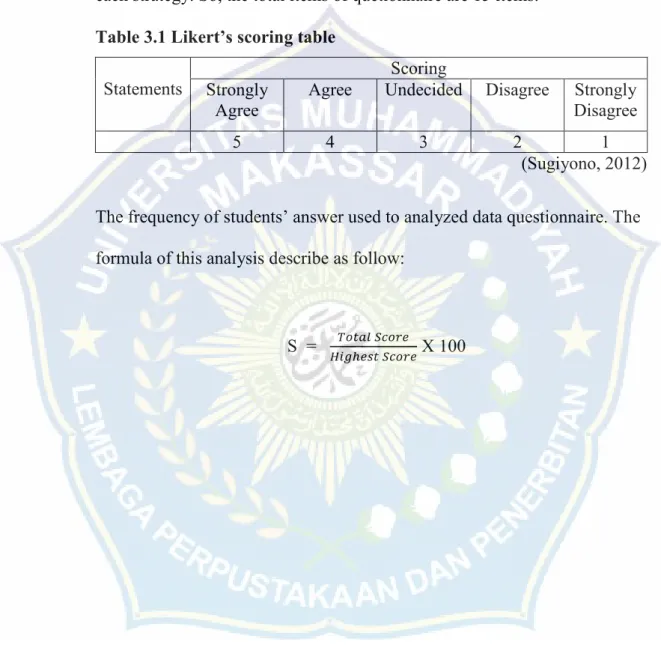
speaking English analyzed by using five strategies categories developed by Kondo and Ying Ling (2004: 262), preparation, relaxation, positive thinking, peer seeking and resignation. There are three itemsquestionnaire of each strategy. So, the total items of quetionnaire are 15 items.
Table 3.1 Likert’s scoring table
Statements
Scoring Strongly
Agree
Agree Undecided Disagree Strongly Disagree
5 4 3 2 1
(Sugiyono, 2012) The frequency of students’ answer used to analyzed data questionnaire. The formula of this analysis describe as follow:
S = X 100
CHAPTER IV
FINDINGS AND DISCUSSION
In this chapter deals with the result of the research which divided into three main sections. Those were the data descriptions, the findings of the research and discussion of research findings.
A.Data Description
The data in this research gained through 2 steps. First, data from interview aimed to found some students that felt anxiety in speaking English as the sample. After listened the students’ responded from the interview, the researcher got 17 students who had anxiety and 4 students not anxiety. And last the researcher gave questionnaire for the students that felt anxiety in speaking English to know the strategy that the students used in overcoming their anxiety in speaking English.
B.Findings
1. Students’ anxiety in speaking English as the sample of the research.
Before the researcher found out students’ strategies in overcoming anxiety in speaking English the researcher gave interview. The researcher gave interview to found out students anxiety as a sample of the research.
a. In interview consisted 5 questions which occurred, namely ; 1. “ Do you like speaking English subject ? why ? “
All the students or 100% answered “ yes”, because it is one of their favorite subject and they want improved their skill.
24
25
2. “ When you speak English, do you feel anxious ? “
From 21 students, 17 or 81% answered that they said “yes” and 4 students or 19% said “no”
3. “Do you restless when speaking English ? why ?”
17 students or 81% said “yes” because they were afraid if their grammar and pronunciation are being wrong and also they were less vocabulary. And 4 students or 19% said “No” because they felt enjoyed when speaking English and it was taken casually.
4. “At the time speaking English, do you trembel ?”
17 students or 81% said “yes” and 4 students or 19% said “no”.
5. “Do you feel your heart is pounding hard when you called to speaking English ? why ?”
17 students or 81% said “yes” because their speaking so bad and it made their nervous to started speaking English and they were afraid of failure. 4 students or 19% said “no” because they were enthusiastic and feel excited to speak English.
Table 4.1 The Result of Interviewed
No Responses Frequency Percentage (%)
1. Anxious 17 81%
2. Not Anxious 4 19%
Total 21 100%
From table 4.1 above showed that , total studens of the third semester English department (3B) of Muhammadiyah University of Makassar were 21 students. Based on the result of the interviewed, the researcher found that the students who had anxious in speaking
English were 17 students or 81% and the students who had not anxious were 4 students or 19%.
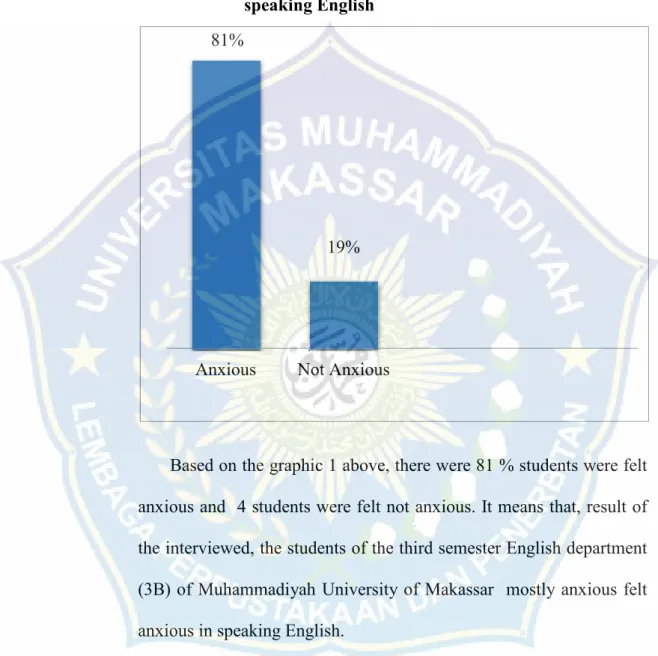
Graphic 4.1 Percentage of students’ anxious and not anxios in speaking English
Based on the graphic 1 above, there were 81 % students were felt anxious and 4 students were felt not anxious. It means that, result of the interviewed, the students of the third semester English department (3B) of Muhammadiyah University of Makassar mostly anxious felt anxious in speaking English.
2. Students’ strategies in overcoming their anxiety in speaking English To describe the students strategies in overcoming their anxiety in speaking English. The researcher gave questionnaire to the students who felt
81%
19%
Anxious Not Anxious
27
anxious that obtained of 15 items that based on the five strategies, namely preparation, relaxation, positive thinking, peer seeking and resignation.
Students strategies in overcoming their anxiety in speaking English based on the questionnaire, the researcher found that :
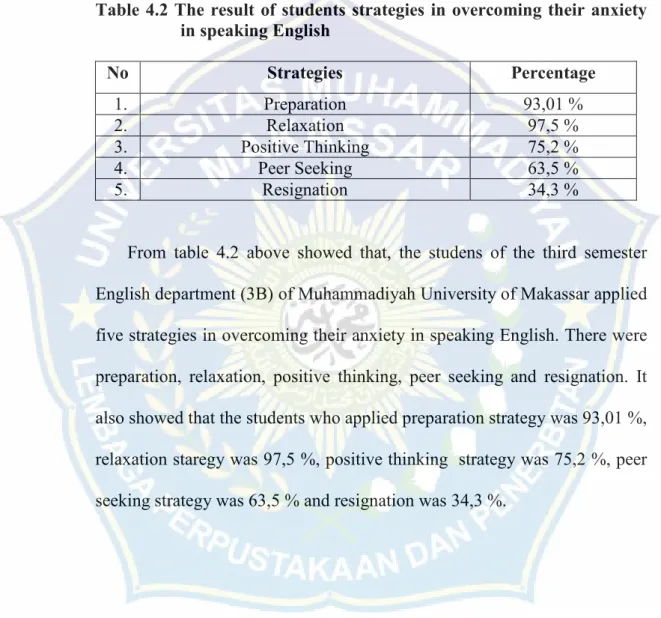
Table 4.2 The result of students strategies in overcoming their anxiety in speaking English
No Strategies Percentage
1. Preparation 93,01 %
2. Relaxation 97,5 %
3. Positive Thinking 75,2 %
4. Peer Seeking 63,5 %
5. Resignation 34,3 %
From table 4.2 above showed that, the studens of the third semester English department (3B) of Muhammadiyah University of Makassar applied five strategies in overcoming their anxiety in speaking English. There were preparation, relaxation, positive thinking, peer seeking and resignation. It also showed that the students who applied preparation strategy was 93,01 %, relaxation staregy was 97,5 %, positive thinking strategy was 75,2 %, peer seeking strategy was 63,5 % and resignation was 34,3 %.
Graphic 4.2 Percentage of students’ strategies in overcoming their anxiety in speaking English
Graphic 2 above, the researcher found that the students used five strategies to overcome their anxiety in speaking English. The graphic showed that the students mostly used relaxation strategy to overcome their anxiety, the fact there were 97,5 % students used that strategy and followed by preparation were 93,01 % students, positive thinking 75,2 % students, 63,5 % used peer seeking strategy and the students rarely used resignation as the strategy to overcome their anxiety based on the percentage. The fact, there 34,3 % students applied that strategy to overcome their anxiety.
Preparation Relaxation Positive Thinking
Peer Seeking
Resignation 93,01% 97,50%
75,20%
63,50%
34,30%
29
b. Discussion
1. Students with anxiety as the sample of the research collected by interviewed.
The description of the data was collected through interviewed as explained in the previous section. The third semester of English department (3B) at Unismuh Makassar were 21 students. Before the researcher gave questionnaire for the students, the researcher should have known the students anxious or not. Thus, the researcher gave interviewed.
In interviewed, there were 5 question based on the characteristic of anxious and the result of interviewed, the researcher found that the students who felt anxious in speaking English were 17 students or 81% and the students who not anxious in speaking English were 4 or 19% students.It means that based on interviewed the third semester of English department (3B) at Unismuh Makassar mostly felt anxious in speaking English.
2. Students’ strategies in overcoming their anxiety in speaking English based on the questionnaire.
After the researcher found the anxious students, the researcher gave the questionnaire for the students to know the strategies that the students applied in overcoming their anxiety in speaking English. It was previously stated that there were five strategies used by the students, namely preparation strategy, relaxation strategy, positive thinking strategy, peer seeking strategy and resignation strategy. There were 3 items questionnaire of each strategy. So, the total items of questionnaire were 15 items.
Based on the result of the questionnaire, the researcher found that relaxation strategy was frequently used by the students in overcoming their anxiety in speaking English.
a. Relaxation Strategy
Mostly of the students of the third semester English department (3B) at Unismuh Makassar used the relaxation strategy to reduce their anxiety in speaking English. Based on the rate percentage, relaxation was the high percentage than the others. There were 97,5% students chose relaxation strategy. in the questionnare, there were three items of the relaxation strategy.
The first item of the relaxation strategy was the students try to be calm to overcome their anxiety in speaking English. The result of the questionnaire there were 17 students strongly agree or chose point 5, there were 4 students agree or chose point 4, and there was not chose undecided or point 3, disagree or point 2 and strongly disagree or point 1.
The second item of relaxation was the students take a deep breath to overcome their anxiety in speaking English. There were 20 students chose strongly agree used take a deep breath to reduce their anxiety, there was 1 student agree and there was not student chose undecided, disagree and strongly disagree.
The third item of relaxation was the students try to relax to overcoming their anxiety. There were 18 students chose strongly agree
31
applied try to relax, there were 3 students agree and there was not student chose undecided, disagree and strongly disagree.
There were 5 kinds of scoring of the questionnaire based on Likert’
scales namely strongly agree point 5, agree point 4, undecided point 3, disagree point 2 and strongly disagree point 1. Scoring of the first item was 101 point, the second item was 104 point and the third item was 102 point. So, the total score of the three items of relaxation strategy was 307 point and the percentage was 97,5 %.
b. Preparation Strategy
Preparation also the strategy students used.to reduce their anxiety in speaking English. Based on the rate percentage the preparation strategy was the second higher percentage after the relaxation strategy. there were 93,01% students in the third semester English department (3B) at Unismuh Makassar used that strategy. preparation strategy also has three items in questionnaire.
The first item was the stdents prepare their self better before speak English to overcome their anxiety . There were 19 students chose strongly agree to applied prepare their self better before speak English.
There were 2 students chose agree, and there was not student chose undecided, disagree and strongly disagree.
The second item was the students try to get used to using English often or make habit of using English language. There were 14 students chose stongly agree to make habit using English. There were 6 students
agree, 1 students undecided and there was not student chose disagree and strongly disagree.
The third items was the students peruse the material before or study hard before speaking English class. There were 9 students chose strongly agree to study hard before speaking English class. There were 12 students agree about that and there was not students chose undecided, disagree and strongly disagree.
There were 5 kinds of scoring of the questionnaire based on Likert’
scales namely strongly agree point 5, agree point 4, undecided point 3, disagree point 2 and strongly disagree point 1. Scoring of the first item was 103 point, the second item was 97 point and the third item was 93 point. So, the total score of the three items of relaxation strategy was 293 point and the percentage was 93,01 %.
c. Positive Thinking
Positive thinking was the third strategy that the students used to reduce their anxiety in speaking English. Based on the rate percentage, there were 75,2% students applied positive thinking strategy to overcome their anxiety in speaking English. Positive thinking also has three items in questionnaire.
The first item was the students always think positively that their able to speak English. There were 6 students strongly agree about that, there were 13 students chose agree to always think positively that their able to
33
speak English, there were 2 students undecided and there was not students chose disagree and strongly disagree.
The second item was the students try to confident when feel nervous and confused to speaking English. There were 3 students stongly agree about that, there were 4 students agree, 14 students undecided about that and there was not students chose disagree and strongly disagree.
The third item was the students imagine their self that can giving a great performance when speaking English. There were 4 students cose strongly agree, there were 5 students agree about that, there were 12 students undecide and there was not students chose disagree and strongly disagree.
The scoring of the first item was 88 point, the second item was 73 point and the third item was 76 point. So, the total score of the three items of relaxation strategy was 237 point and the percentage was 75,2
%.
d. Peer Seeking
Peer seeking also the strategy students used and it was the third strategy that the students used to reduce their anxiety in speaking English. Based on the rate percentage, there were 63,5% students applied peer seeking strategy to overcome their anxiety in speaking English. Peer seeking also has three items in questionnaire.
The first item was the students tell their self that the others also feel anxious. There was 1 student strongly agree about that, there were 3
students chose agree, there were 10 students chose undecided, there were 6 students disagree about that and there was 1 student chose strongly disagree.
The second item was the students tell their self that difficult problems for are also difficult for the others. There were 4 students chose strongly agree, there was not student agree, there was 1 student undecided, there were 14 students feel disagree about that and there were 2 students chose strongly disagree.
The third item was the students try to talk with their around or their friends. There were 3 students chose strongly agree, there were 18 students agree about that and there was not students chose undecided, disagree and strongly disagree.
There were 5 kinds of scoring of the questionnaire based on Likert’
scales namely strongly agree, agree, undecided, disagree and strongly disagree. Scoring of the first item was 60 point, the second item was 53 point and the third item was 87 point. So, the total score of the three items of relaxation strategy was 200 point and the percentage was 63,5
%.
e. Resignation
Resignation also the strategy students used and it was the lowest strategy that the students used to reduce their anxiety in speaking English. Based on the rate percentage, there were 34,3% students applied
35
resignation strategy to overcome their anxiety in speaking English.
Resignation also has three items in questionnaire.
The first item was the students don’t feel to taking class when speaking English class begin. There was not students strongly agree about that, there were 2 students agree, there was not student chose undecided, there were 14 students disagree and there were 5 students fell strongly disagree about that.
The second item was the students prefer to be quiet because fear of making mistake while talking English when the lecturer asks to speak English. There was not students strongly agree, there were 3 students agree about that, there were 3 students decided, there was 1 student disagree, and there were 14 students chose strongly agree.
The third item was the students sleep in the class instead of paying attention to the lesson. There was not students chose strongly agree, there were 2 students agree, there was not students chose undecided, there were 3 students disagree, and there were 16 tudents chose strongly disagree about that.
There were 5 kinds of scoring of the questionnaire based on Likert’
scales namely strongly agree point 5, agree point 4, undecided point 3, disagree point 2 and strongly disagree point 1. Scoring of the first item was 41 point, the second item was 37 point and the third item was 30 point. So, the total score of the three items of relaxation strategy was 108 point and the percentage was 34,3 %.
CHAPTER V
CONCLUSIONS AND SUGGESTIONS
Conclusion and suggestion could be drawn by referring to the research findings and discussions in previous chapter:
A.Conclusions
Based on the research done by the researcher, the conclusions might be found as follows:
1. The students of the third semester English department (3B) at Muhammadiyah University of Makassar applied five strategies to overcome their anxiety in speaking English namely preparation strategy, relaxation strategy, positive thinking strategy, peer seeking strategy and resignation strategy.
2. Based on the result of questionnaire, the students preferred to relaxation strategy to overcome their anxiety in speaking English. The percentage of relaxation were 97,5%. The second strategy was preparation there were 93,01%. The third strategy was positive thinking, there were 75,2%. The fourth strategy was peer seeking, there were 63,5%. And the lowest strategy was resignation, there were 34,3%.
36
37
B.Suggestions
After seeing the findings as well as discussion, the researcher gives suggestion may be useful for teachers, students, and also for the other researchers who will conduct the same topic in the research:
1. The students would try to apply all of the strategies in overcoming their anxiety in speaking English to make students are expected to perform better in speaking English by minimizing their anxiety.
2. The lecturer should be more aware of students’ anxiety in order to students’
motivation to speak up confidently and fluently in English class.
3. The lecturer needed to give the students an appropriate treatment by looking at the class is consist of so many characteristic, lecturer need to pay more attention toward the students who were passive and less participation in speaking class to encouraged them to speaking English actively in the class.
4. Speech training and more practice are needed for the students in order to make speaking class is run effectively, not only giving them some topic and let them speech but it will be better if the teacher give training from speech making process, teach the appropriate manner in speaking and some coping strategies to cope their anxiety.
BIBLIOGRAPHY
Aeni, Nur, et al. 2017. English Oral Communication Apprehension in Students of Indonesian Maritime. International Journal of English Linguistics, Vol.7 No. 4
Bashir, Marriam, et al. 2011. Factor Effecting Students English Speaking Skill.
British Journal of Arts and Social Sciences, Vol.2, No.1.
Basic, L. 2011. Speaking Anxiety. Engelska med ämnesdidaktisk inriktning.
Clark, Herbert H & Clark, Eve V. 1977. Psychology and language. United States of America.
Elliot, Charles H & Smith, Laura L. 2010. Overcoming Anxiety for Dummies (2nd ed.). Canada.
Gebhard, J.G. 2000. Teaching English as a Foreign or Second Language: A Teacher Self-Development and Methodology Guide. Ann Arbor: The University of Michigan Press.
Harmer, Jeremy. 2007. How to Teach English. Harlow: Pearson Education Limited
Hornby. 1987. Oxford Learner Dictionary. Washington. Oxford University Press.
Juhana. 2012. Psychological Factors That Hinder Students from Speaking in English Class (A Case Study in a Senior High School in South Tangerang, Banten, Indonesia). Journal of Education and Practice. Vol 3, No 12, 2012.
Katz, L. 2000. Public Speaking Anxiety. UTM Counselling and Career Services.
Kondo, D.S., & Ying – Ling, Y. 2004 Strategies for Coping with language anxiety: the case of students’ of English Japan. ELT Journal volume 58/ 3 July: Oxford University Press, 258-265.
Listyaningrum, W. 2017. Psychological Problemsand Challengein EFL Speaking Classroom. Register Journal, Language and Language Teaching Journals, Vol 10, No 1, 2017, pp. 29-47.
Lucas, Stephen E. 2010. The art of public speaking. New York: McGraw-Hill.
Maulidiyah, Y. 2014. The Correlation Between Students’ Anxiety And Their Ability In Speaking Class. IAIN Tulungagung
39
Mitha, Weni D, et al. An Analysis of Students Speaking Anxiety Faced by the fourth Semester Students of English Education Study. Journal of English Language Teaching. Vol 7, No 3.
Nikitina, Arina, 2011. Succesful Public Speaking. Academic Transfer.
Nunan, 1998. Language Teaching Methodology. Teacher Education and Development. A text book for Teachers. Macquqrie University, Sydney.
Omer, Nasser. 2014. Public Speaking Instruction: Abridge to Improve English Speaking Competence and Reducing Communication Apprehension.
International Journal of Linguistics and Communication, Vol. 2, No. 4, pp. 45-68
Robbins, Stephen P., 1996. Perilaku Organisasi, Jakarta : PT. Prenhalindo
Robbins, Stephen P. 2003. Organizational Behavior. Edisi Bahasa Indonesia.
Jakarta : Indeks.
Raja, F. 2017. Anxiety Level In Students Of Public Speaking: Causes And Remedies. Journal Of Education And Educational Development, vol 4, no 1, june 2017.
Rakhmat, J. 2007. Psikologi komunikasi. Bandung: PT. Remaja Rosda Karya.
Sari, Darmaida. 2017. Speaking Anxiety As a Factor in Studying EFL. English Education Journal (EEJ). 8(2), 177-186. Syiah Kuala University: Banda Aceh.
Sugihartono, dkk. 2007. Psikologi Pendidikan. Yogyakarta: UNY Pers.
Sulastiani. 2018. Students Perception Toward Psychological Problems Faced in Public Speaking Class. Muhammadiyah University of Makassar.
Sunyi, D. 2017. Investigating Students’ Self-Efficacy Of Public Speaking.
International Journal of Education and Research. Vol. 5, No. 10 October.
Supartha, Wayan G & Sintaasih, Desak K. 2017. Pengantar Perilaku Organisasi.
Denpasar: PT. Mabhakti.
Thoha, Miftah. 2002. Perilaku Organisasi. Jakarta: PT.Raja Grafindo Persada.
Thoha, Miftah. 2003. Perilaku Organisasi Konsep Dasar dan Aplikasinya.
Jakarta: Grafindo Persada.
Ur, Penny. 2000. A Course in Language Teaching: Practice and Theory, Cambridge. Cambridge University Press.
Utomo, B. 2018. Students Anxiety in Speaking English. Muhammadiyah University of Makassar.
Wahdaniyat, 2015. Students Strategies in Overcoming Their Anxiety in Speaking English at SMA Muhammadiyah. Muhammadiyah University of Makassar.
Watkins, Cheryl. 2014. Strategies for ESL Students in Community Colleges to Develop Their Public Speaking Skills. University of San Fransisco.
Zeidner, M & Matthews, G. 2011. Anxiety 101. New York. Springer Publishing Company, LLC.
A P P E N D I C
E
S
1. Do you like speaking English subject ? why ? a. Yes ...
b. No ...
2. Do you ever feel anxious when speaking English in front of your friends ? a. Yes
b. No
3. Do you restless when speak English? Why ? a. Yes ...
b. No ...
4. At the time speaking test, Do you tremble ? a. Yes
b. No
5. Do you feel your heart is pounding hard when you called to speaking English ?why ?
a. Yes ...
b. No ...
APPENDIX B
QUESTIONNAIRE
NAME : AGE :
CLAS : SEX : M/F
PHONE NUMBER :
Please put a check mark (✔)on one of the points below:
NO STATEMENTS OPINION
SA A U DA SDA
1 To reduce anxiety, I prepare myself better before speak English.
2 To overcome anxiety, I try to get used to using English often.
3 To overcome anxiety, I peruse the material before I am called on by the teacher.
4 I try to calm down when I feel anxious to speak English.
5 I take a deep breath when I feel anxious to speak English.
6 To speak English in front of class , I try to relax to reduce the anxious.
7 When I feel anxious, I always think positively that I able to speak English in the classroom.
8 I try to be confident when I nervous and confused to speaking English.
9 To overcome anxiety, I imagine myself can giving a great performance when speaking English.
10 When I feel anxious, I tell myself that the others must also be anxious.
11 To reduce anxiety, I tell myself that difficult problems for are also
begin, I don’t feel to taking the class.
14 When the lecturer asks me to speak English, I prefer to be quiet for fear of making mistakes while talking.
15 To overcome anxiety, I choose to sleep in class instead of paying attention to the lesson.
(Kondo, D.S., & Ying – Ling, Y. 2004) NOTES :
SA (Strongly Agree) A (Agree)
U (Undecided) DA (Disagree)
SDA (Strongly Disagree)
APPENDIX C
TRANCRIPT INTERVIEW 1. Sri Nur Aisyah
Interviewer : Do you like speaking English subject ?Why ? Aisyah : Yes, Because it can practice difficult vocabulary.
Interviewer : Do you ever feel anxious when speaking English in front of your friends ?
Aisyah : Yes
Interviewer : Do you restless when speak English ?Why ?
Aisyah : Yes, Because I do not have a lot of vocabulary in English.
Interviewer : At the time speaking test, do you tremble ? Aisyah : Yes
Interviewer : Do you feel your heart is pounding hard when you called to speaking English ?Why ?
Aisyah : Yes, Because I am very nervous.
2. Siti Husnul Khatima
Interviewer : Do you like speaking English subject ?Why ?
Husnul : Yes, Because it is my favorite subject and helps develop my speaking skills.
Interviewer : Do you ever feel anxious when speaking English in front of your friends ?
Husnul : No
Interviewer : Do you restless when speak English ?Why ? Husnul : No, Because I am enjoyed when speak English.
speaking English ?Why ?
Husnul : No, Because I feel excited when I speak English 3. Asriani Astuti
Interviewer : Do you like speaking English subject ?Why ? Asriani : Yes, Because it is challenging to try confidence
Interviewer : Do you ever feel anxious when speaking English in front of your friends ?
Asriani : No
Interviewer : Do you restless when speak English ? Why ?
Asriani : No, Because it has been used to communicate a friend of the class.
Interviewer : At the time speaking test, do you tremble ? Asriani : No
Interviewer : Do you feel your heart is pounding hard when you called to speaking English ?Why ?
Asriani : No, Because used in trainer to speak.
4. Nurhidayat
Interviewer : Do you like speaking English subject ? Why ?
yayat : Yes, Because I was heard my friend speak like a native.
Then, I want to speak like her.
Interviewer : Do you ever feel anxious when speaking English in front of your friends?
yayat : Yes
Interviewer : Do you restless when speak English ?Why ?
yayat : Yes, Because sometimes when i speak, i forget what i want to say and then my vocabulary still bad. That’s my bad
Interviewer : At the time speaking test, do you tremble ? Asriani : Yes
Interviewer : Do you feel your heart is pounding hard when you called to speaking English ?Why ?
yayat : Yes, Because my speaking so bad. It makes me nervous when I started to speaking
5. Melda Maharani
Interviewer : Do you like speaking English subject ?Why ?
Melda : Yes, Because it is one of my favorite subject and improve my English skill.
Interviewer : Do you ever feel anxious when speaking English in front of your friends ?
Melda : Yes
Interviewer : Do you restless when speak English ?Why ? Melda : No, Because I feel enjoy when speaking Interviewer : At the time speaking test, do you tremble ? Melda : No
6. Eka Novita Sari
Interviewer : Do you like speaking English subject ?Why ? Eka : Yes, Because I can speak English fluently.
Interviewer : Do you ever feel anxious when speaking English in front of your friends ?
Eka : Yes
Interviewer : Do you restless when speak English ?Why ? Eka : No, Because it was taken casually enjoy Interviewer : At the time speaking test, do you tremble ? Eka : No
Interviewer : Do you feel your heart is pounding hard when you called to speaking English ?Why ?
Eka : No, Because it’s normal 7. Rizkiani Aulia
Interviewer : Do you like speaking English subject ?Why ?
Rizki : Yes, I like because with speaking subject I can enhance my vocabulary and pronounce.